US12018094B2
Crystalline dipeptides useful in the synthesis of elamipretide
Publication
Application
Classifications
IPC Classifications
CPC Classifications
Applicants
Stealth BioTherapeutics Inc.
Inventors
Scott M. Duncan, Martin P. Redmon
Abstract
Disclosed are crystalline forms of L-Lys(Boc)-Phe-NH 2 and Boc-D-Arg-DMT. The crystalline forms may be used in the synthesis of elamipretide.
Figures
Description
RELATED APPLICATIONS
[0001]This application is a continuation of U.S. patent application Ser. No. 17/224,353, filed Apr. 7, 2021; which is a divisional of U.S. patent application Ser. No. 16/485,369, filed Aug. 12, 2019, now U.S. Pat. No. 10,975,118; which is the U.S. National Stage of PCT/US19/24617, filed Mar. 28, 2019; which claims the benefit of priority to U.S. Provisional Patent Application No. 62/651,430, filed Apr. 2, 2018.
BACKGROUND OF THE INVENTION
[0002]Elamipretide (MTP-131) is a mitochondria-targeting peptide compound with therapeutic potential for treating diseases associated with mitochondrial dysfunction. Elamipretide contains four-amino acid residues and has been synthesized according to typical linear and convergent solution phase peptide synthesis methods. The synthetic routes to generate elamipretide that have been used to date require the preparation of various differentially protected peptides, such that certain protecting groups are selectively removed in order to subject the deprotected compound to peptide coupling, while other protecting groups remain to prevent unwanted side reactions. Even with protecting groups such coupling reactions and related steps generate impurities. Thus, there exists a need to develop new methods to purify elamipretide that allow the purification after coupling reactions. Crystallization of the desired reaction products are one method of achieving the necessary purification.
SUMMARY OF THE INVENTION
[0003]Disclosed are crystalline forms of L-Lys(Boc)-Phe-NH2 and Boc-D-Arg-DMT, wherein DMT is an abbreviation for dimethyltyrosine, which are intermediates in the synthesis of elamipretide.
BRIEF DESCRIPTION OF THE DRAWINGS
[0004]
[0005]
DETAILED DESCRIPTION OF THE INVENTION
[0006]Elamipretide has been shown to have various therapeutic effects in diseases related to mitochondrial dysfunction. Previous synthetic routes to elamipretide presented challenges with respect to scale-up due to reliance on chromatographic separations to enrich levels of desired intermediates. Herein are disclosed crystalline forms of L-Lys(Boc)-Phe-NH2 and Boc-D-Arg-DMT, which can be used as purified intermediates in the synthesis of elamipretide.
[0007]One aspect of the present invention relates to crystalline forms of Compound (I):

- [0009]which compound is also known as L-Lys(Boc)-Phe-NH2.
[0010]A crystalline form of Compound (I) can be used in the synthesis of elamipretide.
[0011]In certain embodiments, a polymorph of the crystalline form is characterized by powder X-ray diffraction (XRD). θ represents the diffraction angle, measured in degrees. In certain embodiments, the diffractometer used in XRD measures the diffraction angle as two times the diffraction angle θ. Thus, in certain embodiments, the diffraction patterns described herein refer to X-ray intensity measured against angle 2θ.
[0012]In certain embodiments, a crystalline form of Compound (I) is not solvated (e.g., the crystal lattice does not comprise molecules of a solvent). In certain alternative embodiments, a crystalline form of Compound (I) is solvated. In some cases, the solvent is water.
[0013]In one aspect, the invention features a crystalline form of Compound (I) which has characteristic peaks in the powder X-ray diffraction (XRPD) pattern as shown in
[0014]In another aspect, the invention features a crystalline form of Compound (I) which has characteristic peaks in the powder X-ray diffraction (XRPD) pattern at values of two theta (° 2θ) as shown in Table 1.
[0015]In another aspect, the invention features a crystalline form of Compound (I) which has characteristic peaks in the powder X-ray diffraction (XRPD) pattern at values of two theta (° 2θ) of: 4.7, 6.2, 12.4, 15.8, 16.5, 18.0, 18.2, 18.8, and 19.8.
[0016]In another aspect, the invention features a crystalline form of Compound (I) which has characteristic peaks in the powder X-ray diffraction (XRPD) pattern at values of two theta (° 2θ) of: 4.7, 6.2, 11.3, 12.4, 13.3, 15.0, 15.8, 16.5, 17.0, 17.7, 18.0, 18.2, 18.8, 19.8, 22.0, and 22.8.
[0017]The relative intensity, as well as the two theta value, of each peak in Table 1, as well as in
[0018]One aspect of the present invention relates to a crystalline form of Compound (II):
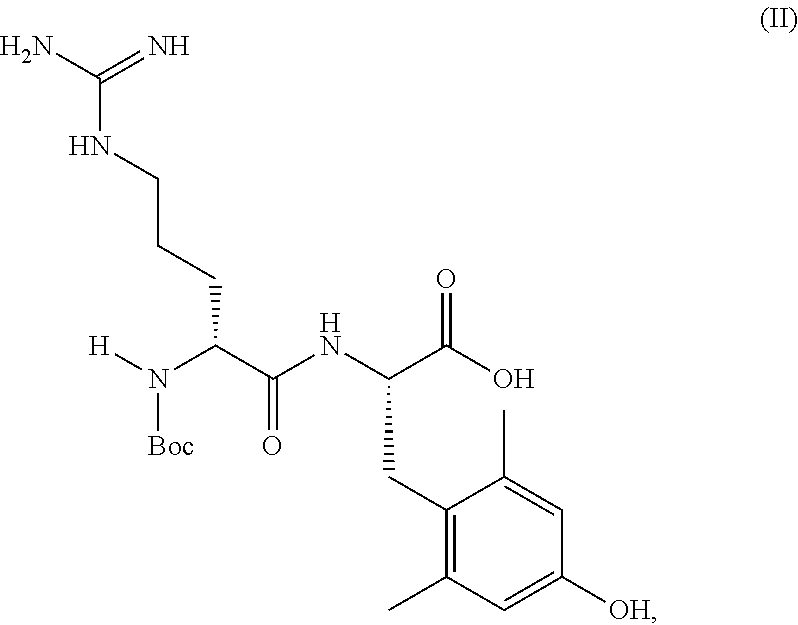
- [0020]which compound is also known as Boc-D-Arg-DMT, and may also be drawn in the form of a zwitterion.
[0021]A crystalline form of Compound (II) can be used in the synthesis of elamipretide.
[0022]In certain embodiments, a polymorph of the crystalline form is characterized by powder X-ray diffraction (XRD). θ represents the diffraction angle, measured in degrees. In certain embodiments, the diffractometer used in XRD measures the diffraction angle as two times the diffraction angle θ. Thus, in certain embodiments, the diffraction patterns described herein refer to X-ray intensity measured against angle 2θ.
[0023]In certain embodiments, a crystalline form of Compound (II) is not solvated (e.g., the crystal lattice does not comprise molecules of a solvent). In certain alternative embodiments, a crystalline form of Compound (II) is solvated. In some cases, the solvent is water.
[0024]In one aspect, the invention features a crystalline form of Compound (II) which has characteristic peaks in the powder X-ray diffraction (XRPD) pattern as shown in
[0025]In another aspect, the invention features a crystalline form of Compound (II) which has characteristic peaks in the powder X-ray diffraction (XRPD) pattern at values of two theta (° 2θ) as shown in Table 2.
[0026]In another aspect, the invention features a crystalline form of Compound (II) which has characteristic peaks in the powder X-ray diffraction (XRPD) pattern at values of two theta (° 2θ) of: 9.3, 12.1, 16.6, 17.6, 18.0, 18.8, and 19.4.
[0027]In another aspect, the invention features a crystalline form of Compound (II) which has characteristic peaks in the powder X-ray diffraction (XRPD) pattern at values of two theta (° 2θ) of: 9.3, 12.1, 13.7, 16.3, 16.6, 17.6, 18.0, 18.8, 19.4, 21.3, 23.0, 24.2, and 25.1.
[0028]The relative intensity, as well as the two theta value, of each peak in Table 2, as well as in
EXAMPLES
[0029]Materials and Methods
| Name | RM0858 General Method (2607) | |
| Parent | 2Theta | |
| Sample Name | S-18-0011882 SCC-169 | |
| File Name | RM0858 General Method (2607) | |
| Scan Type | Coupled TwoTheta/Theta | |
| Scan Mode | Continuous PSD fast | |
| Start | 2.000 | |
| End | 40.016 | |
| Step Size | 0.050 | |
| Time per Step | 192.00 | |
| Anode | Cu | |
| kα1 | 1.54 | |
| Generator kV | 40.0 | |
| Generator mA | 40.0 | |
| PSD Opening | 2.940 | |
| Detector Slit Opening | ||
| Primary Soller slit | 2.500 | |
| Secondary Soller slit | 2.500 | |
| Sample rotation speed | 15.000 | |
| Divergence Slit | 0.600 | |
| Antiscatter Slit | 3.000 | |
| Slit Mode | Fixed | |
Example 1. L-Lys(Boc)-Phe-NH 2 (Compound I)
[0031]Exemplary Synthetic Route
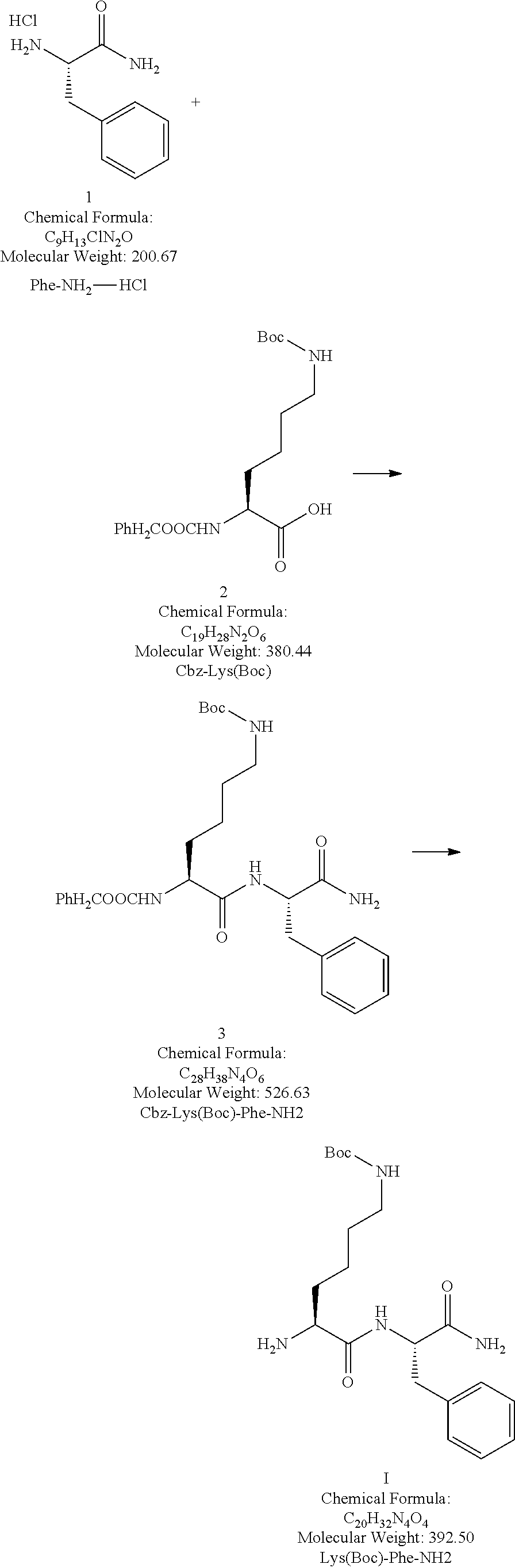
[0033]Synthesis of Compound 3
| BR | ||||||||
|---|---|---|---|---|---|---|---|---|
| Amount | Volume | MW | Molar | Density | Charge | |||
| Name | (g) | (mL) | (g/mol) | Equiv | Moles | g/mL | Amt (kg) | kg/kg |
| Phe-NH2 HCl | 950.00 | 950.00 | 200.67 | 1.00 | 4.734 | — | 7.030 | |
| Cbz-Lys(Boc)-OH | 1891.11 | 1891.11 | 380.44 | 1.05 | 4.971 | — | 13.990 | 1.99 |
| HOBt-H2O | 797.48 | 797.48 | 153.14 | 1.10 | 5.208 | — | 5.900 | 0.84 |
| Dimethylacetamide | 3736.49 | 3987.71 | 87.12 | — | — | 0.937 | 27.650 | 3.93 |
| (DMAc) | ||||||||
| N- | 957.72 | 1041.00 | 101.15 | 2.00 | 9.468 | 0.920 | 7.080 | 1.01 |
| Methylmorpholine | ||||||||
| (NMM) | ||||||||
| EDCI | 952.91 | 952.91 | 191.70 | 1.05 | 4.971 | — | 7.050 | 1.00 |
| Anhydrous Ethyl | 750.50 | 951.20 | 46.07 | — | — | 0.789 | 5.550 | 0.79 |
| Alcohol (EtOH) | ||||||||
| Acetonitrile (ACN) | 11202.70 | 14252.80 | 84.93 | — | — | 0.786 | 82.900 | 11.79 |
| Acetonitrile (ACN) | 11202.70 | 14252.80 | 85.93 | — | — | 0.786 | 82.900 | 11.79 |
| Operation | Charge | Units | |
|---|---|---|---|
| Inert the reactor with nitrogen. | |||
| 1 | Charge Compound 1 to reactor. | 950.00 | g |
| 2 | Charge Compound 2 to reactor. | 1891.11 | g |
| 3 | Charge HOBt-H2O to reactor. | 797.48 | g |
| 4 | Charge DMAc to reactor. | 3736.49 | g |
| 5 | Adjust solution to target 22° C. (19 to 25° C.) | ||
| with agitation. | |||
| 6 | Agitate for 10-15 min at 22° C. (19 to 25° C.). | ||
| 7 | Slowly charge NMM to reactor with moderate | 957.72 | g |
| agitation. | |||
| 8 | Adjust solution to target 7° C. (4 to 10° C.) | ||
| with agitation. | |||
| 9 | Slowly charge EDCI to reactor with vigorous | 952.91 | g |
| agitation. | |||
| 10 | Adjust solution to target 7° C. (4 to 10° C.) | ||
| with vigorous agitation. | |||
| 11 | Charge EtOH to reactor with vigorous | 750.50 | g |
| agitation. | |||
| 12 | Adjust solution to target 22° C. (19 to 25° C.) | ||
| with vigorous agitation. | |||
| 13 | Agitate vigorously for ≥1 h at 22° C. (19 to | ||
| 25° C.). | |||
| IPC for Reaction Completion (≤1.0% Phe- | 0.169% a/a | ||
| NH2 remaining) |
| CRYSTALLIZATION |
| 15 | Charge ACN to the reactor with vigorous | 11202.70 | g |
| agitation. | |||
| 16 | Agitate vigorously for ≥5 h at 22° C. (19 to | ||
| 25° C.). | |||
| 17 | Verify crystallization successful. | ||
| 18 | Filter the reaction to isolate the product | ||
| (SCC-175). | |||
| 19 | Wash the product cake with ACN and combine | 11202.70 | g |
| with mother liquor. | |||
| 20 | Dry the product with agitation and nitrogen | ||
| bleed for at least 17 h. | |||
[0036]Synthesis of Compound I
| BR | ||||||||
|---|---|---|---|---|---|---|---|---|
| Volume | MW | Molar | Density | Charge | ||||
| Name | Amt | (mL) | (g/mol) | Equiv | g/mL | Amt | units | kg/kg |
| Compound 3 | 2000.00 | 2000.00 | 526.63 | 1.00 | 15.700 | kg | ||
| 10% Pd/C (50% | 200.00 | 200.00 | 106.42 | 10% | — | 3.140 | kg | 0.20 |
| w/w wet) | w/w | |||||||
| Anhydrous | 14191.08 | 17918.03 | 32.04 | — | 0.792 | 111.400 | kg | 7.10 |
| Methyl Alcohol | ||||||||
| (MeOH) | ||||||||
| Anhydrous | 7000.00 | 8838.38 | 32.04 | — | 0.792 | 54.950 | kg | 3.50 |
| Methyl Alcohol | ||||||||
| (MeOH) | ||||||||
| Water | 7000.00 | 7000.00 | 18.02 | 1.000 | 54.950 | kg | 3.50 | |
| Water | 8000.00 | 8000.00 | 18.02 | 1.000 | 62.800 | kg | 4.00 | |
| MeOH-Water | 8000.00 | 7896.00 | 0.987 | 62.800 | kg | 4.00 | ||
| (1:9) Solution | ||||||||
| Water (1:9 | 9000.00 | 9000.00 | 18.02 | 1.000 | NA | NA | ||
| MeOH-water | ||||||||
| make-up) | ||||||||
| Anhydrous | 792.00 | 1000.00 | 33.04 | — | 0.792 | NA | NA | |
| Methyl Alcohol | ||||||||
| (MeOH) (1:9 | ||||||||
| MeOH-water | ||||||||
| make-up) | ||||||||
| Operation | Charge | Units | |
|---|---|---|---|
| REACTION (30 L Hydrogenator Main Reactor) | |||
| Inert the hydrogenation reactor with nitrogen. | |||
| 1 | Charge Pd/C (10%, 50% w/w water, 20A597) to | 200.00 | g |
| reactor. | |||
| 2 | Charge Compound 3 to reactor. | 2000.00 | g |
| 3 | Charge MeOH to the reactor. | 14191.08 | g |
| 4 | Adjust solution to target 22° C. (19 to 25° C.) | ||
| with agitation. | |||
| Inert the hydrogenation reactor with nitrogen. | |||
| 5 | Pressurize the reactor with hydrogen (20-25 psi). | ||
| 6 | Agitate for ≥6 h at 22° C. (19 to 25° C.) and | ||
| 20-25 psi hydrogen. | |||
| Note: Maintain the pressure at 20-25 psi | |||
| hydrogen. | |||
| 7 | De-pressurize the reactor and inert with nitrogen | ||
| at 22° C. (19 to 25° C.). | |||
| IPC for Reaction Completion (≤0.5% SCC-175 | 0.09% a/a | ||
| remaining) | |||
| 9 | Filter the reaction to remove catalyst. | ||
| 10 | Rinse the filter cake with MeOH and combine | 7000.00 | g |
| with filtrate. | |||
| DISTILLATION (30 L ChemGlass Jacketed Main | |||
| Reactor) | |||
| 11 | Distill the reaction at ≤45° C. (100-200 Torr | ||
| vacuum) to target. | |||
| Note: Distillation target = 1.5-2.5 mL/g SCC- | 5000.00 | mL | |
| 175 charge. | |||
| PRECIPITATION (30 L ChemGlass Jacketed | |||
| Main Reactor) | |||
| ISOLATION (12 L Allen Glass Filter w/30 | |||
| micron ChemGlass teflon frit) | |||
| 12 | Charge water to reactor with moderate agitation | 7000.00 | g |
| at 40° C. over 30-60 min. | |||
| 13 | Agitate the reaction at at 40° C. until | ||
| crystallization observed. | |||
| 14 | Verify crystallization successful. | ||
| 15 | Charge water to reactor with moderate agitation | 8000.00 | g |
| at 40° C. over 30-60 min. | |||
| 16 | Adjust the reaction to 22° C. (20 to 25° C.) over | ||
| 30-60 min. | |||
| 17 | Filter the reaction to isolate the product (SCC- | ||
| 169). | |||
| 18 | Wash the product cake with MeOH-water (1:9). | 8000.00 | g |
| 19 | Dry the product with agitation and nitrogen | ||
| bleed for at least 17 h. | |||
[0039]Preliminary Single-Solvent Solubility of Compound I:
| Solvent | Solubility (mg/mL)A | |
|---|---|---|
| EtOH (SDAG-7) | 154.8 | |
| THF | 84.5 | |
| iPrOAc | 5.1 | |
| MeOAc | 18.2 | |
| Water | 4.1 | |
[0041]Preliminary Precipitation Studies (MeOH/Water) of Compound I:
| Precipitation Studies |
| MeOH/ | Addition | Precip | Concentration | Solubility | |
| Experiment | Water | Mode | (Y/N) | (mL/g) | (mg/mL) |
| 1A | 1:3 | Normal | Y | 10 | 7.0 |
| 2A | 1:5 | Normal | Y | 10 | 5.0 |
| 3A | 1:9 | Normal | Y | 10 | 3.6 |
| 4A | 1:19 | Normal | Y | 10 | 2.7 |
| 5B | 1:3 | Reverse | N | 80 | — |
| +2 parts | 1:5 | Normal | Y | 120 | ND |
| water | |||||
[0043]In Process Precipitation Results (MeOH/Water) of Compound I:
| Precipitation Results |
| Concentration | Solubility | |||
| Experiment | MeOH/Water | (mL/g) | (mg/mL) | Total Losses |
| 2447-41A | 1:9 | 13 | 2.5 | 5.7% |
| 2447-47A | 1:5 | 10 | 4.2 | 6.2% |
Example 2. Boc-D-Arg-DMT-OH
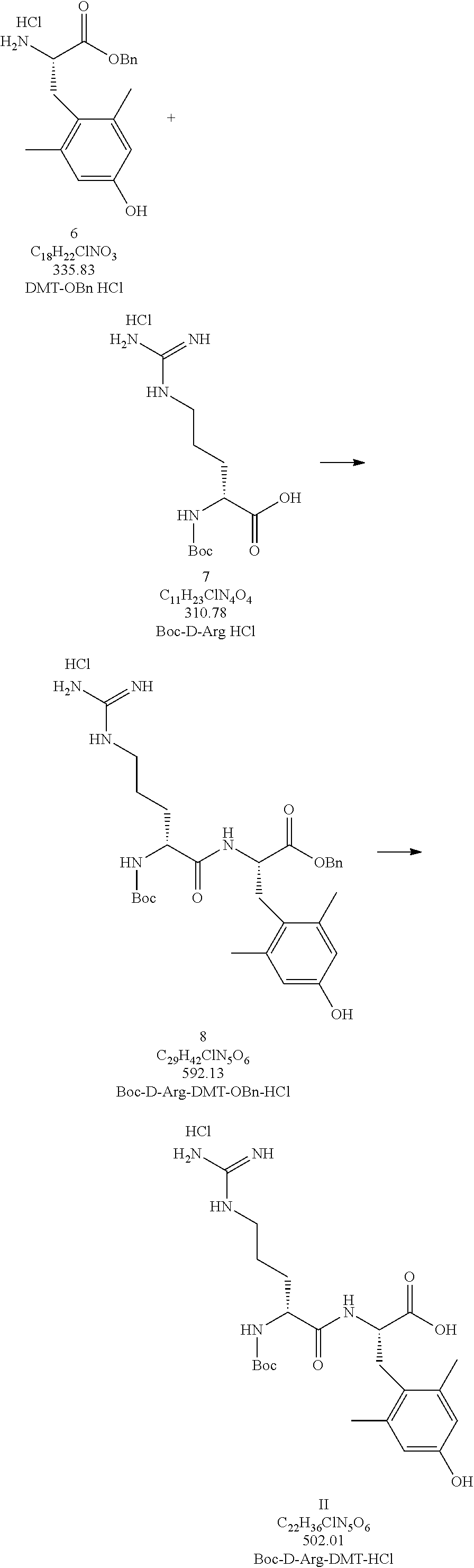
[0046]Manufacturing Process to Produce Compound 8
| Step | Operation |
|---|---|
| 1 | Charge DMT-OBn HCl (1 eq) and Boc-D-Arg-OH HCl (1.05 eq) |
| to the reactor. | |
| 2 | Charge HOBt (0.1 eq) and DCM (8.5 L/kg of DMT-OBn HCl) |
| to the reactor. | |
| 3 | Adjust temperature to about 22 ± 3° C. and charge NMM |
| (2.0 eq) to the reactor | |
| 4 | Adjust temperature to about 15 ± 3° C. and charge EDCI |
| (1.05 eq) to the reactor. | |
| 5 | Adjust temperature to about 15° C. and agitate. |
| 5 | Charge EtOH (1.5 L/kg of DMT-OBn HCl) to the reactor |
| 7 | Agitate for a minimum of 5 hours at 15 ± 3° C. |
| 8 | Sample for in-process control reaction completion test, if |
| reaction is not complete, charge additional EDCI, stir for | |
| a minimum of 1 hour andrepeat the in-process control test | |
| until criterion for completion is met. | |
| 9 | Charge 15% EtOH in DCM. |
| 10 | Charge 1M HCl. |
| 11 | Adjust temperature to ambient and agitate. |
| 12 | Stop agitation and separate layers |
| 13 | Wash organic layer successively with brine, 1M HCl, brine |
| and then brine again | |
| 14 | Reduce volume via vacuum distillation |
| 15 | Adjust temperature to ambient |
| 16 | Charge EtOH and reduce volume via vacuum distillation |
| 17 | Sample for in-process control DCM content test, Repeat EtOH |
| addition and volume reduction by vacuum distillation until | |
| the in-process control limit for DCM is met | |
| 18 | Adjust temperature to ambient |
| 19 | Sample the product for in-process control test for SCC-192 |
| purity and content | |
[0048]Manufacturing Process to Produce the HCl salt of Compound II
| Step | Operation |
|---|---|
| 1 | Charge the ethanol solution of Boc-D-Arg-DMT-OBn HCl |
| (SCC-192) | |
| 2 | Charge 10% Pd/C, 50% wet (w/w) (20 wt. %) |
| 3 | Charge EtOH (7 L/kg of SCC-192) |
| 4 | Agitate and begin hydrogenation around ambient |
| temperature | |
| 5 | Step 2B In-Process Control 1: Test for reaction |
| completion | |
| 5 | Filter suspension through filter aid and wash filter |
| cake three times with EtOH | |
| 7 | Reduce volume via vacuum distillation |
| 8 | Adjust temperature to ambient |
| 9 | Charge THF and reduce volume via vacuum distillation |
| 10 | Adjust temperature to ambient |
| 11 | Charge THF and reduce volume via vacuum distillation |
| 12 | Adjust temperature to ambient |
| 13 | Charge THF and reduce volume via vacuum distillation |
| 14 | Step 2B In-Process Control 2: Test for EtOH content |
| 15 | Charge iPrOAc and agitate at ambient temperature |
| 16 | Filter and wash solids three times with iPrOAc |
| 17 | Dry the product under vacuum and nitrogen |
| 18 | Sample the product for in-process control test for |
| purity | |
| 19 | Step 2B In-Process Control 3: Test for Purity |
[0050]Preparation of the Zwitterionic Form of Compound II

- [0052]1. The crude HCl salt is suspended in CH3OH/H2O (1/1, v/v)
- [0053]2. The suspension is heated to 45-50° C.
- [0054]3. After the clear solution is formed, an aqueous solution of Na2CO3 (1.2 eq.) is added. During the addition, the solid begins to precipitate.
- [0055]4. The suspension is stirred for 1 h at 45° C., and then cooled to 15° C. and stirred for an additional hour.
- [0056]5. The solid is isolated by filtration and dried to provide Compound II with high purity (99.4 area %) by HPLC. The calculated w/w assay correcting for residual solvents, water content and residue on ignition for this demonstration run was 98.7%.
[0057]Formation of zwitterionic compound led to high purity material that was stable, easily handled, and highly crystalline.
Example 3. Crystalline L-Lys(Boc)-Phe-NH 2 —XRPD Peak List (Table 1)
| Angle | d Value | Net Intensity | Gross Intensity | Rel. Intensity |
|---|---|---|---|---|
| 4.704 | 18.77211 | 9559 | 11528 | 100.0% |
| 5.230 | 16.88407 | 624 | 2301 | 6.5% |
| 5.648 | 15.63394 | 862 | 2340 | 9.0% |
| 6.200 | 14.24402 | 7663 | 8912 | 80.2% |
| 6.650 | 13.28067 | 394 | 1456 | 4.1% |
| 7.056 | 12.51772 | 508 | 1400 | 5.3% |
| 7.709 | 11.45860 | 1161 | 1869 | 12.1% |
| 8.553 | 10.33046 | 2135 | 2771 | 22.3% |
| 9.402 | 9.39869 | 2473 | 3073 | 25.9% |
| 9.922 | 8.90729 | 2627 | 3206 | 27.5% |
| 10.303 | 8.57920 | 1435 | 1997 | 15.0% |
| 11.292 | 7.82975 | 3301 | 3848 | 34.5% |
| 11.755 | 7.52244 | 1985 | 2530 | 20.8% |
| 12.265 | 7.24594 | 2827 | 3370 | 29.6% |
| 12.452 | 7.10258 | 4581 | 5123 | 47.9% |
| 12.655 | 6.98916 | 2764 | 3305 | 28.9% |
| 13.270 | 6.66655 | 4117 | 4655 | 43.1% |
| 13.778 | 6.42221 | 795 | 1330 | 8.3% |
| 14.133 | 6.26164 | 333 | 866 | 3.5% |
| 14.462 | 6.11961 | 882 | 1413 | 9.2% |
| 14.957 | 5.91833 | 3726 | 4255 | 39.0% |
| 15.756 | 5.61997 | 7404 | 7928 | 77.5% |
| 16.263 | 5.44580 | 2360 | 2881 | 24.7% |
| 16.504 | 5.36683 | 5366 | 5885 | 56.1% |
| 16.961 | 5.22337 | 2930 | 3447 | 30.7% |
| 17.107 | 5.17917 | 2585 | 3100 | 27.0% |
| 17.658 | 5.01859 | 3807 | 4320 | 39.8% |
| 17.956 | 4.93596 | 4360 | 4871 | 45.6% |
| 18.210 | 4.86777 | 4451 | 4960 | 46.6% |
| 18.832 | 4.70852 | 8963 | 9468 | 93.8% |
| 19.561 | 4.53460 | 3331 | 3830 | 34.8% |
| 19.802 | 4.47996 | 7877 | 8375 | 82.4% |
| 20.265 | 4.37865 | 1989 | 2483 | 2.8% |
| 20.715 | 4.28449 | 1746 | 2237 | 18.3% |
| 21.514 | 4.12715 | 1756 | 2241 | 18.4% |
| 21.958 | 4.04471 | 4087 | 4568 | 42.7% |
| 22.807 | 3.89590 | 3856 | 4331 | 40.3% |
| 23.398 | 3.79891 | 779 | 1248 | 8.1% |
| 23.660 | 3.75740 | 835 | 1303 | 8.7% |
| 24.306 | 3.65896 | 726 | 1188 | 7.6% |
| 25.050 | 3.55198 | 2158 | 2614 | 22.6% |
| 25.462 | 3.49548 | 764 | 1217 | 8.0% |
| 25.709 | 3.46234 | 1227 | 1677 | 12.8% |
| 26.016 | 3.42222 | 714 | 1161 | 7.5% |
| 26.319 | 3.38357 | 521 | 966 | 5.5% |
| 26.713 | 3.33445 | 662 | 1103 | 6.9% |
| 27.411 | 3.25119 | 709 | 1143 | 7.4% |
| 28.356 | 3.14493 | 831 | 1256 | 8.7% |
| 28.808 | 3.09564 | 340 | 761 | 3.6% |
| 30.662 | 2.91341 | 740 | 1142 | 7.7% |
| 61.492 | 2.83854 | 649 | 1041 | 6.8% |
| 35.876 | 2.50109 | 376 | 740 | 3.9% |
| 36.369 | 2.46832 | 362 | 723 | 3.8% |
Example 4. Crystalline Boc-D-Arg-DMT—XRPD Peak List (Table 2)
| Angle | d Value | Net Intensity | Gross Intensity | Rel. Intensity |
|---|---|---|---|---|
| 8.253 | 10.70448 | 3779 | 4204 | 15.0% |
| 9.353 | 9.44784 | 20863 | 21225 | 82.9% |
| 12.104 | 7.30592 | 20016 | 20338 | 79.6% |
| 12.809 | 6.90584 | 2797 | 3120 | 11.1% |
| 13.755 | 6.43269 | 11432 | 11758 | 45.4% |
| 15.709 | 5.53659 | 906 | 1235 | 3.6% |
| 16.307 | 5.43127 | 7500 | 7829 | 29.8% |
| 16.556 | 5.35006 | 12773 | 13103 | 50.8% |
| 16.725 | 5.29645 | 2495 | 2825 | 9.9% |
| 17.557 | 5.04740 | 22493 | 22824 | 89.4% |
| 18.006 | 4.92236 | 25154 | 25485 | 100.0% |
| 18.756 | 4.72740 | 18203 | 18534 | 72.4% |
| 18.908 | 4.68953 | 4809 | 5141 | 19.1% |
| 19.414 | 4.56848 | 12725 | 13056 | 50.6% |
| 20.715 | 4.28417 | 899 | 1231 | 3.6% |
| 21.259 | 4.17597 | 5674 | 5406 | 20.2% |
| 22.357 | 3.97329 | 3830 | 4161 | 15.2% |
| 23.009 | 3.86218 | 7511 | 7842 | 29.9% |
| 23.153 | 3.83695 | 2203 | 2533 | 8.8% |
| 23.511 | 3.78085 | 4659 | 4989 | 18.5% |
| 24.208 | 3.57354 | 7257 | 7585 | 28.8% |
| 24.809 | 3.58598 | 1940 | 2268 | 7.7% |
| 25.060 | 3.55054 | 5627 | 5954 | 22.4% |
| 25.767 | 3.45478 | 970 | 1297 | 3.9% |
| 26.009 | 3.42308 | 1418 | 1744 | 5.6% |
| 26.457 | 3.36613 | 255 | 580 | 1.0% |
| 26.721 | 3.33347 | 161 | 485 | 0.6% |
| 27.763 | 3.21973 | 1852 | 2185 | 7.4% |
| 28.111 | 3.17181 | 1182 | 1503 | 4.7% |
| 28.263 | 3.15505 | 366 | 687 | 1.5% |
| 29.111 | 3.06507 | 2546 | 2864 | 10.1% |
| 29.311 | 3.04456 | 1100 | 1418 | 4.4% |
| 29.652 | 3.00931 | 616 | 933 | 2.4% |
| 29.912 | 2.98475 | 1550 | 1865 | 6.2% |
| 30.212 | 2.95583 | 1607 | 1922 | 6.4% |
| 30.865 | 2.89475 | 1913 | 2226 | 7.6% |
| 31.414 | 2.84540 | 1565 | 1876 | 6.2% |
| 31.695 | 2.82084 | 468 | 778 | 1.9% |
| 32.665 | 2.73926 | 657 | 963 | 2.6% |
| 32.915 | 2.71901 | 296 | 602 | 1.2% |
| 33.805 | 2.64939 | 326 | 632 | 1.3% |
| 34.165 | 2.62230 | 670 | 976 | 2.7% |
| 34.977 | 2.56330 | 485 | 795 | 1.9% |
| 36.166 | 2.48167 | 798 | 1113 | 3.2% |
| 36.514 | 2.45883 | 611 | 927 | 2.4% |
| 36.813 | 2.43955 | 364 | 682 | 1.4% |
| 37.466 | 2.39651 | 173 | 502 | 0.7% |
| 37.966 | 2.36808 | 901 | 1257 | 3.6% |
| 38.221 | 2.35285 | 394 | 764 | 1.6% |
| 38.576 | 2.33202 | 878 | 1265 | 3.5% |
| 39.114 | 2.30117 | 394 | 810 | 1.6% |
| 39.516 | 2.27866 | 363 | 801 | 1.4% |
INCORPORATION BY REFERENCE
[0060]All U.S. patents and U.S. and PCT published patent applications mentioned in the description above are incorporated by reference herein in their entirety.
EQUIVALENTS
[0061]Having now fully described the present invention in some detail by way of illustration and examples for the purposes of clarity of understanding, it will be obvious to one of ordinary skill in the art that the same can be performed by modifying or changing the invention within a range of conditions, formulations and other parameters without affecting the scope of the invention or any specific embodiment thereof, and that such modifications or changes are intended to be encompassed within the scope of the appended claims.
Claims
We claim:
1. A crystalline form of a compound according to formula II:

2. A method of making a compound of formula II:

comprising:
(a) combining an HCl salt represented by formula I, and a mixture of CH3OH and H2O, thereby forming a suspension comprising the compound of Formula II; wherein the compound of formula I is:

3. The method of
(b) heating the suspension, thereby forming a solution.
4. The method of
5. The method of
(c) adding an aqueous solution of Na2CO3 to the solution formed in (b), thereby forming a second suspension.
6. The method of
7. The method of
(d) stirring the second suspension.
8. The method of
9. The method of
10. The method of
(e) cooling the second suspension to about 15° C.
11. The method of
12. The method of
(f) isolating from the second suspension the compound of formula II in solid form.
13. The method of
14. The method of
(g) drying the compound of formula II, thereby forming a dried compound of formula II.
15. The method of
16. The method of
17. A method of making a compound of formula II:

comprising:
(a) adding an aqueous solution of Na2CO3 to a solution comprising an HCl salt represented by formula I and a mixture of CH3OH and H2O; wherein the HCl salt of formula I is:

thereby forming a suspension comprising the compound of Formula II.
18. The method of
19. The method of
(b) isolating from the suspension the compound of formula II in solid form, wherein the solid form of formula II has a purity of 99.4% as measured by HPLC.