US12514863B2
Pharmaceutical combination and use thereof
Publication
Application
Classifications
IPC Classifications
CPC Classifications
Applicants
ASCENTAGE PHARMA (SUZHOU) CO., LTD., ASCENTAGE PHARMA GROUP CORP LIMITED
Inventors
Yifan Zhai, Dajun Yang, Douglas Dong Fang, Guangfeng Wang, Jing Deng, Qiuqiong Tang, Ran Tao
Abstract
Described herein are methods of treating a cancer, for example, a hematologic malignancy or a solid tumor, in a patient in need thereof, comprising administering to the patient a Bcl-2 inhibitor in combination with a second anti-cancer agent.
Figures
Description
CROSS REFERENCE TO RELATED APPLICATIONS
[0001]This application is a national phase of International Patent Application No. PCT/CN2020/133893, filed Dec. 4, 2020, which claims priority to Chinese Patent Application No. 202011332321.3, filed Nov. 24, 2020, and to International Patent Application No. PCT/CN2020/114326, filed Sep. 10, 2020, and International Patent Application No. PCT/CN2019/123022, filed Dec. 4, 2019, all of which are incorporated by reference herein in their entirety.
BACKGROUND
[0002]Apoptosis, the process of programmed cell death, is an essential biological process for tissue homeostasis. In mammals, it has been shown to regulate early embryonic development. Later in life, cell death is a default mechanism by which potentially dangerous cells, e.g., cells carrying cancerous defects, are removed. Several apoptotic pathways are known. One of the most important apoptotic pathways involves the Bcl-2 family of proteins which are key regulators of the mitochondrial (also called “intrinsic”) pathway of apoptosis. The structural homology domains BH1, BH2, BH3 and BH4 are characteristic of Bcl-2 family proteins. The Bcl-2 family of proteins can be further classified into three subfamilies depending on how many of the homology domains each protein contains and on its biological activity, i.e., whether it has pro- or anti-apoptotic function.
[0003]Down-regulated apoptosis (and more particularly the Bcl-2 family of proteins) may be involved in the onset of cancerous malignancy. The anti-apoptotic proteins, Bcl-2 and Bcl-xL, are over-expressed in many cancer cell types. The effect of this deregulation is the survival of altered cells which would otherwise have undergone apoptosis in normal conditions. The repetition of these defects associated with unregulated proliferation is thought to be the starting point of cancerous evolution. Additionally, BH3-only proteins can act as tumor suppressors when expressed in diseased animals.
[0004]The natural expression levels of anti-apoptotic Bcl-2 family proteins members vary in different cell types. For example, in young platelets, Bcl-xL protein is highly expressed and plays an important role in regulating cell death (life span) of platelets. Also, in certain cancer cell types, the cancer cell's survival is attributed to the dysregulation of the apoptotic pathway caused by the over-expression of one or more anti-apoptotic Bcl-2 protein family members. In view of the important role for Bcl-2 family of proteins in regulating apoptosis in both cancerous and normal, i.e., non-cancerous, cells, and the recognized inter-cell type variability of Bcl-2 family protein expression, it is advantageous to have a small molecule inhibitor that selectively targets and preferably binds to one type or a subset of anti-apoptotic Bcl-2 protein(s), for example, to an anti-apoptotic Bcl-2 family member that overexpressed in a certain cancer type. Such a selective compound also may confer certain advantages in the clinical setting, by providing, for example, the flexibility to select a dosing regimen, a reduced on-target toxic effect in normal cells, among others, e.g., lymphopenia has been observed in Bcl-2 deficient mice.
[0005]There is an ongoing need for compounds that selectively inhibit the activity of one type or a subset of Bcl-2 proteins for the treatment of hyperproliferative diseases such as cancer, including hematologic malignancies.
SUMMARY
[0006]The present disclosure provides, for example, methods of treating a hematologic malignancy in a patient in need thereof, comprising administering to the patient a compound of formula (V), as described herein, and administering a second compound represented by

or pharmaceutically acceptable salt thereof;
where an effective amount of the first and second compound is administered to the patient.
[0008]In another aspect, described herein is a method of treating a hematologic malignancy in a patient in need thereof, comprising: administering to the patient a first compound of formula (V) or a pharmaceutically acceptable salt thereof; and administering to the patient a FLT3 inhibitor.
[0009]In another aspect, described herein is a method of treating a solid tumor cancer in a patient need thereof, comprising: administering to the patient a first compound of formula (V) or a pharmaceutically acceptable salt thereof; and administering to the patient a second compound selected from a CDK4/6 inhibitor and/or tamoxifen.
[0010]In another aspect, described herein is a method of treating a cancer selected from the group consisting of: diffuse large B-cell lymphoma, follicular B-cell lymphoma, or chronic lymphocytic leukemia in a patient need thereof, comprising: administering to the patient a first compound of formula (V) or a pharmaceutically acceptable salt thereof; and administering to the patient a PI3K inhibitor.
[0011]In another aspect, described herein is a method of treating a hematologic malignancy in a patient in need thereof comprising: administering to the patient a first compound of formula (V) or a pharmaceutically acceptable salt thereof; and administering to the patient a PI3K inhibitor.
[0012]In another aspect, described herein is a method of treating a hematologic malignancy or a solid tumor cancer in a patient in need thereof, comprising administering: a first compound of formula (V) or a pharmaceutically acceptable salt thereof; and a second compound represented by:

or pharmaceutically acceptable salt thereof;
where an effective amount of the first and second compound is administered to the patient.
[0014]In another aspect, described herein is a method of treating a cancer selected from the group consisting of: diffuse large B-cell lymphoma, follicular B-cell lymphoma, and chronic lymphocytic leukemia in a patient need thereof, comprising: administering to the patient a first compound of formula (V) or a pharmaceutically acceptable salt thereof; and administering to the patient each of rituximab, etoposide, ifosfamide and carboplatin.
[0015]In another aspect, described herein is a method of treating a hematologic malignancy in a patient in need thereof, comprising: administering to the patient a first compound of formula (V) or a pharmaceutically acceptable salt thereof; and administering to the patient a second compound selected from the group consisting of bortezomib, lenalidomide and pomalodomide.
[0016]In another aspect, described herein is a pharmaceutically acceptable composition comprising: a first compound of formula (V) or a pharmaceutically acceptable salt thereof; a second compound selected from the group consisting of:

or pharmaceutically acceptable salt thereof, a FLT3 inhibitor, a CDK4/6 inhibitor and a PI3K inhibitor; and a pharmaceutically acceptable excipient.
[0018]In another aspect, described herein is a method of treating a solid tumor cancer in a patient in need thereof, comprising administering: a first compound of formula (I), (II), or (III), as described herein; and administering a second compound represented by:

or pharmaceutically acceptable salt thereof;
where an effective amount of the first and second compound is administered to the patient.
[0020]In another aspect, described herein is a method of treating a solid tumor cancer in a patient in need thereof, comprising administering: a first compound selected from: a compound of formula (I), (II), or (III), a compound of formula (IV), as described herein, and a pharmaceutically acceptable salt thereof; and administering a CDK4/6 inhibitor or pharmaceutically acceptable salt thereof; where an effective amount of the first and second compound is administered to the patient.
[0021]In another aspect, described herein is a method of treating a solid tumor cancer in a patient in need thereof, comprising administering to the patient: a first compound selected from: a compound of formula (I), (II), or (III), a compound of formula (IV), and a pharmaceutically acceptable salt thereof; and administering tamoxifen to the patient.
[0022]In another aspect, described herein is a method of treating a hematologic malignancy in a patient in need thereof, comprising: a first compound selected from: a compound of formula (I), (II), or (III), a compound of formula (IV), and a pharmaceutically acceptable salt thereof; and administering a second compound selected from the group consisting of: bortezomib, lenalidomide, pomalodomide and dexamethasone.
[0023]In another aspect, described herein is a method of treating a hematologic malignancy or a solid tumor cancer in a patient in need thereof, comprising administering a first compound selected from: a compound of formula (I), (II), or (III), a compound of formula (IV), and a pharmaceutically acceptable salt thereof; and administering a second compound represented by:

or pharmaceutically acceptable salt thereof; where an effective amount of the first and second compound is administered to the patient.
[0025]In another aspect, described herein is a method of treating a cancer selected from the group consisting of: diffuse large B-cell lymphoma, follicular B-cell lymphoma, and chronic lymphocytic leukemia in a patient in need thereof, comprising administering a first compound selected from: a compound of formula (I), (II), or (III), a compound of formula (IV), and a pharmaceutically acceptable salt thereof; and administering to the patient each of rituximab, etoposide, ifosfamide and carboplatin.
[0026]In another aspect, described herein is a method of treating a solid tumor cancer in a patient need thereof, comprising: administering to the patient a first compound of formula (V), and administering to the patient an MCL-1 inhibitor.
[0027]In another aspect, the disclosure provides a method of treating a solid tumor cancer in a patient need thereof, comprising: administering to the patient a first compound selected from: a compound of formula (I), (II), or (III), a compound of formula (IV), and a pharmaceutically acceptable salt thereof, and administering to the patient an MCL-1 inhibitor or a CDK9 inhibitor.
[0028]In another aspect, the disclosure provides a method of treating a solid tumor cancer in a patient need thereof, comprising: administering to the patient a first compound selected from: a compound of formula (I), (II), or (III), a compound of formula (IV), and a pharmaceutically acceptable salt thereof, and a second compound selected from a compound of formula (V) and anlotinib; where an effective amount of the first and second compound is administered to the patient.
[0029]In yet another aspect, the disclosure provides a method of treating a hematologic malignancy in a patient in need thereof, comprising administering to the patient a first compound selected from: a compound of formula (I), (II), or (III), a compound of formula (IV), and a pharmaceutically acceptable salt thereof, and a second compound represented by:

or pharmaceutically acceptable salt thereof;
where an effective amount of the first and second compound is administered to the patient.
[0031]In another aspect, the disclosure provides a method of treating a solid tumor cancer in a patient in need thereof, comprising administering: a first compound selected from a compound of formula (I), (II), or (III), a compound of formula (IV), and a pharmaceutically acceptable salt thereof, and a second compound represented by:
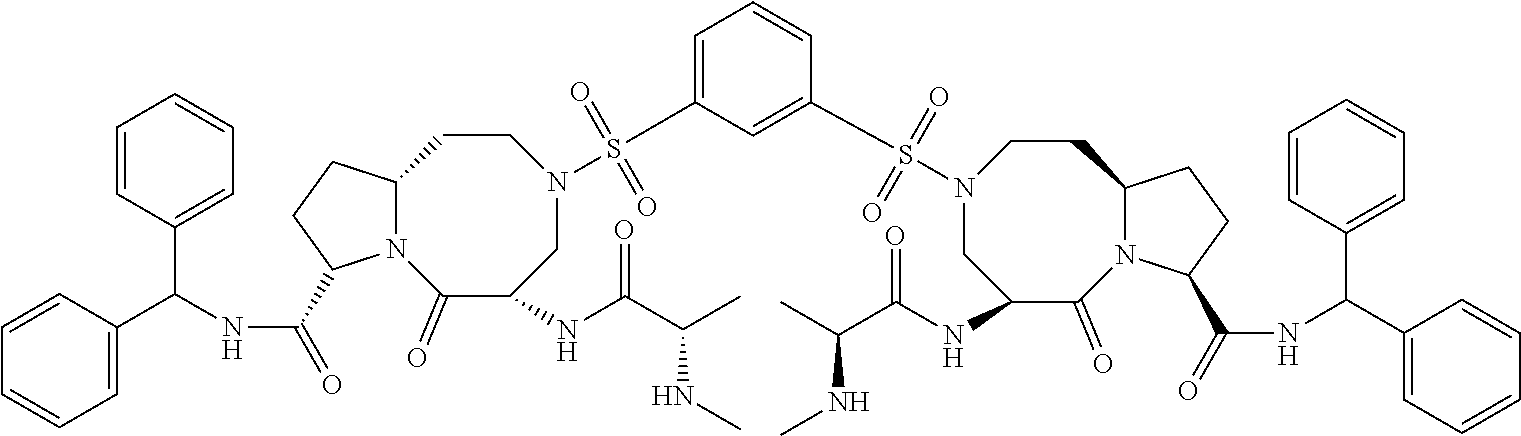
or pharmaceutically acceptable salt thereof;
where an effective amount of the first and second compound is administered to the patient.
[0033]In another aspect, the disclosure provides a method of treating a hematologic malignancy in a patient in need thereof, comprising administering: a first compound selected from a compound of formula (I), (II), or (III), a compound of formula (IV), and a pharmaceutically acceptable salt thereof, and a second compound which is a JAK2 inhibitor; where an effective amount of the first and second compound is administered to the patient.
[0034]In another aspect, the disclosure provides a method of treating a solid tumor cancer in a patient in need thereof, comprising administering: a first compound selected from a compound of formula (I), (II), or (III), a compound of formula (IV), and a pharmaceutically acceptable salt thereof, and a second compound which is an EGFR inhibitor; where an effective amount of the first and second compound is administered to the patient.
[0035]In another aspect, the disclosure provides a method of treating a hematologic malignancy in a patient need thereof, comprising: administering to the patient a first compound of formula (V), or a pharmaceutically acceptable salt thereof, and administering to the patient a second compound selected from cytarabine and a hypomethylating agent.
[0036]In another aspect, the disclosure provides a method of treating a solid tumor cancer in a patient need thereof, comprising: administering to the patient a first compound of formula (V), or a pharmaceutically acceptable salt thereof, and administering to the patient a second compound which is a HER2 inhibitor.
[0037]In another aspect, the disclosure provides a method of treating a solid tumor cancer in a patient need thereof, comprising: administering to the patient a first compound of formula (V), or a pharmaceutically acceptable salt thereof, and administering to the patient a second compound which is anti PD-1 antibody or anti PD-L1 antibody.
BRIEF DESCRIPTION OF THE DRAWINGS
[0038]
[0039]
[0040]
[0041]
[0042]
[0043]
[0044]
[0045]
[0046]
[0047]
[0048]
[0049]
[0050]
[0051]
[0052]
[0053]
[0054]
[0055]
[0056]
[0057]
[0058]
[0059]
[0060]
[0061]
[0062]
[0063]
[0064]
[0065]
[0066]
[0067]
[0068]
[0069]
[0070]
[0071]
[0072]
[0073]
[0074]
[0075]
[0076]
[0077]
[0078]
[0079]
[0080]
[0081]
[0082]
[0083]
[0084]
[0085]
[0086]
[0087]
[0088]
[0089]
[0090]
[0091]
[0092]
[0093]
[0094]
[0095]
[0096]
[0097]
[0098]
[0099]
[0100]
[0101]
[0102]
[0103]
[0104]
[0105]
[0106]
[0107]
[0108]
[0109]
[0110]
[0111]
[0112]
[0113]
[0114]
[0115]
[0116]
[0117]
[0118]
[0119]
[0120]
[0121]
[0122]
[0123]
[0124]
[0125]
[0126]
[0127]
[0128]
[0129]
[0130]
[0131]
[0132]
[0133]
[0134]
[0135]
[0136]
[0137]
[0138]
[0139]
[0140]
[0141]
[0142]
[0143]
[0144]
[0145]
[0146]
[0147]
[0148]
[0149]
[0150]
[0151]
[0152]
[0153]
[0154]
[0155]
[0156]
[0157]
[0158]
[0159]
[0160]
[0161]
[0162]
[0163]
[0164]
[0165]
[0166]
[0167]
[0168]
[0169]
[0170]
[0171]
[0172]
[0173]
[0174]
[0175]
[0176]
[0177]
[0178]
[0179]
[0180]
[0181]
[0182]
[0183]
[0184]
[0185]
[0186]
[0187]
[0188]
[0189]
[0190]
[0191]
[0192]
[0193]
[0194]
[0195]
[0196]
[0197]
[0198]
[0199]
[0200]
[0201]
DETAILED DESCRIPTION
[0202]As described herein, the compound N-((4-(((1,4-dioxan-2-yl)methyl)amino)-3-nitrophenyl)sulfonyl)-2-((1H-pyrrolo[2,3-b]pyridin-5-yl)oxy)-4-(4-((6-(4-chlorophenyl)spiro[3.5]non-6-en-7-yl)methyl)piperazin-1-yl)benzamide has the structure:

[0204]“Compound A” as described herein refers to (S)—N-((4-(((1,4-dioxan-2-yl)methyl)amino)-3-nitrophenyl)sulfonyl)-2-((1H-pyrrolo[2,3-b]pyridin-5-yl)oxy)-4-(4-((6-(4-chlorophenyl)spiro[3.5]non-6-en-7-yl)methyl)piperazin-1-yl)benzamide, and is also referred to herein as Cpd A. Compound A has the structure:

[0206]As described herein, the compound (R)—N-((4-(((1,4-dioxan-2-yl)methyl)amino)-3-nitrophenyl)sulfonyl)-2-((1H-pyrrolo[2,3-b]pyridin-5-yl)oxy)-4-(4-((6-(4-chlorophenyl)spiro[3.5]non-6-en-7-yl)methyl)piperazin-1-yl)benzamide has the structure:

[0208]“Compound B” as described herein has the structure:

and is also referred to herein as Cpd B.
[0210]“Compound C” as described herein has the structure:

and is also referred to herein as Cpd C.
[0212]“Compound D” as described herein has the structure:

and is also referred to herein as Cpd D.
[0214]“Compound E” as described herein has the structure:

and is also referred to herein as Cpd E.
[0216]“Compound F” as described herein has the structure:

and is also referred to herein as Cpd F.
[0218]“Compound G” as described herein has the structure:

and is also referred to herein as Cpd G.
Methods of Use
[0220]In one aspect, the present disclosure provides a method of treating a hematologic malignancy in a patient in need thereof, comprising administering a compound of formula (V):

- [0222]or a pharmaceutically acceptable salt or solvate thereof, wherein:
- [0223]A3 is selected from the group consisting of:


- [0225]E3 is a carbon atom and
is a double bond; or
- [0226]E3 is a —C(H)— and
is a single bond; or
- [0227]E3 is a nitrogen atom and
is a single bond;
- [0228]X31, X32, and X33 are each independently selected from the group consisting of —CR38═ and —N═;
- [0229]R31a and R31b taken together with the carbon atom to which they are attached form a 3-, 4-, or 5-membered optionally substituted cycloalkyl; or
- [0230]R31a and R31b taken together with the carbon atom to which they are attached form a 4- or 5-membered optionally substituted heterocyclo;
- [0231]R32 is selected from the group consisting of —NO2, —SO2CH3, and —SO2CF3;
- [0232]R32a is selected from the group consisting of hydrogen and halogen;
- [0233]R33 is selected from the group consisting of hydrogen, —CN, —C≡CH, and —N(R34a)(R34b);
- [0234]R34a is selected from the group consisting of optionally substituted C1-6 alkyl, optionally substituted C3-6 cycloalkyl, heterocyclo, heteroalkyl, (cycloalkyl)alkyl, and (heterocyclo)alkyl;
- [0235]R34b is selected from the group consisting of hydrogen and C1-4 alkyl;
- [0236]R35 is selected from the group consisting of is selected from the group consisting of optionally substituted C1-6 alkyl, heterocyclo, heteroalkyl, (cycloalkyl)alkyl, and (heterocyclo)alkyl;
- [0237]R36a, R36c, R36e, R36f, and R36g are each independently selected from the group consisting of hydrogen, optionally substituted C1-6 alkyl, optionally substituted C3-6 cycloalkyl, optionally substituted aryl, optionally substituted heteroaryl, heterocyclo, heteroalkyl, (cycloalkyl)alkyl, and (heterocyclo)alkyl;
- [0238]R36b and R36d are each independently selected from the group consisting of hydrogen, C1-4 alkyl, and halogen;
- [0239]R37 is selected from the group consisting of optionally substituted C1-6 alkyl, heterocyclo, heteroalkyl, (cycloalkyl)alkyl, and (heterocyclo)alkyl; and
- [0240]R38 is selected from the group consisting of hydrogen and halogen; and administering a second compound represented by
- [0225]E3 is a carbon atom and

or pharmaceutically acceptable salt thereof;
where an effective amount of the first and second compound is administered to the patient.
[0242]In some embodiments, the compound of formula (V) is selected from the group consisting of:


[0244]In some embodiments, the method comprises administering:
a first compound represented by (S)—N-((4-(((1,4-dioxan-2-yl)methyl)amino)-3-nitrophenyl)sulfonyl)-2-((1H-pyrrolo[2,3-b]pyridin-5-yl)oxy)-4-(4-((6-(4-chlorophenyl)spiro[3.5]non-6-en-7-yl)methyl)piperazin-1-yl)benzamide or a pharmaceutically acceptable salt thereof; and
a second compound represented by:

or pharmaceutically acceptable salt thereof;
where an effective amount of the first and second compound is administered to the patient.
- [0247]administering to the patient a first compound of formula (V) or a pharmaceutically acceptable salt thereof; and
- [0248]administering to the patient a FLT3 inhibitor.
- [0250]administering to the patient a first compound represented by (S)—N-((4-(((1,4-dioxan-2-yl)methyl)amino)-3-nitrophenyl)sulfonyl)-2-((1H-pyrrolo[2,3-b]pyridin-5-yl)oxy)-4-(4-((6-(4-chlorophenyl)spiro[3.5]non-6-en-7-yl)methyl)piperazin-1-yl)benzamide or a pharmaceutically acceptable salt thereof; and
- [0251]administering to the patient a FLT3 inhibitor.
[0252]In some embodiments, the FLT3 inhibitor is midostaurin or gilteritinib.
[0253]In some embodiments, the hematologic malignancy is selected from the group consisting of chronic lymphocytic leukemia, acute myeloid leukemia, multiple myeloma, lymphoplasmacytic lymphoma, and non-Hodgkin's lymphoma. In some embodiments, the hematologic malignancy is acute myeloid leukemia.
- [0255]administering to the patient a first compound of formula (V) or a pharmaceutically acceptable salt thereof; and
- [0256]administering to the patient a second compound selected from a CDK4/6 inhibitor and tamoxifen.
- [0258]administering to the patient a first compound represented by (S)—N-((4-(((1,4-dioxan-2-yl)methyl)amino)-3-nitrophenyl)sulfonyl)-2-((1H-pyrrolo[2,3-b]pyridin-5-yl)oxy)-4-(4-((6-(4-chlorophenyl)spiro[3.5]non-6-en-7-yl)methyl)piperazin-1-yl)benzamide or a pharmaceutically acceptable salt thereof; and
- [0259]administering to the patient a second compound selected from a CDK4/6 inhibitor and/or tamoxifen.
[0260]In some embodiments, the second compound is a CDK4/6 inhibitor. In some embodiments, the CDK4/6 inhibitor is palbociclib. In some embodiments, the second compound is palbociclib. In some embodiments, the second compound is tamoxifen.
[0261]In some embodiments, the method further comprises administering fulvestrant or an aromatase inhibitor to the patient. In some embodiments, the aromatase inhibitor is selected from the group consisting of lestrozole, anastrozole, and exemestane.
[0262]In some embodiments, the solid tumor cancer is selected from the group consisting of breast cancer, breast cancer in men, adrenal cortical cancer, advanced cancer, anal cancer, bile duct cancer, bladder cancer, bone cancer, bone metastasis, brain/CNS tumors in adults, brain/CNS tumors in children, cancer in children, cancer of unknown primary, cervical cancer, colon/rectum cancer, endometrial cancer, esophagus cancer, Ewing family of tumors, eye cancer, gallbladder cancer, gastrointestinal carcinoid tumors, gastrointestinal stromal tumor (GIST), gestational trophoblastic disease, ovarian cancer, prostate cancer, non-small cell lung cancer, head and neck cancer, neuroblastoma, and squamous cell carcinoma cancer. In some embodiments, the solid tumor cancer is breast cancer. In some embodiments, the breast cancer is tamoxifen-resistant breast cancer. In some embodiments, the breast cancer is estrogen resistant positive (ER+) breast cancer. In some embodiments, the breast cancer is hormone receptor positive breast cancer, human growth factor receptor 2 (HER2) negative advanced breast cancer or metastatic breast cancer.
[0263]In some embodiments, an effective amount of the first and second compound is administered to the patient.
- [0265]administering to the patient a first compound of formula (V) or a pharmaceutically acceptable salt thereof; and
administering to the patient a PI3K inhibitor.
- [0265]administering to the patient a first compound of formula (V) or a pharmaceutically acceptable salt thereof; and
- [0267]administering to the patient a first compound represented by (S)—N-((4-(((1,4-dioxan-2-yl)methyl)amino)-3-nitrophenyl)sulfonyl)-2-((1H-pyrrolo[2,3-b]pyridin-5-yl)oxy)-4-(4-((6-(4-chlorophenyl)spiro[3.5]non-6-en-7-yl)methyl)piperazin-1-yl)benzamide or a pharmaceutically acceptable salt thereof; and
administering to the patient a PI3K inhibitor.
- [0267]administering to the patient a first compound represented by (S)—N-((4-(((1,4-dioxan-2-yl)methyl)amino)-3-nitrophenyl)sulfonyl)-2-((1H-pyrrolo[2,3-b]pyridin-5-yl)oxy)-4-(4-((6-(4-chlorophenyl)spiro[3.5]non-6-en-7-yl)methyl)piperazin-1-yl)benzamide or a pharmaceutically acceptable salt thereof; and
[0268]In some embodiments, the PI3K inhibitor is duvelisib, alpelisib, or idelalisib.
[0269]In some embodiments the method further includes administering fulvestrant to the patient.
[0270]In some embodiments, the cancer is refractory or treatment resistant cancer.
- [0272]administering to the patient a first compound of formula (V) or a pharmaceutically acceptable salt thereof; and
- [0273]administering to the patient a PI3K inhibitor.
[0274]In some embodiments the method further includes administering fulvestrant to the patient.
- [0276]administering to the patient a first compound represented by (S)—N-((4-(((1,4-dioxan-2-yl)methyl)amino)-3-nitrophenyl)sulfonyl)-2-((1H-pyrrolo[2,3-b]pyridin-5-yl)oxy)-4-(4-((6-(4-chlorophenyl)spiro[3.5]non-6-en-7-yl)methyl)piperazin-1-yl)benzamide or a pharmaceutically acceptable salt thereof; and administering to the patient a PI3K inhibitor.
[0277]In some embodiments, the hematological malignancy is selected from the group consisting of chronic lymphocytic leukemia, acute myeloid leukemia, multiple myeloma, lymphoplasmacytic lymphoma, and non-Hodgkin's lymphoma.
[0278]In another aspect, the present disclosure provides a method of treating a hematologic malignancy or a solid tumor cancer in a patient in need thereof, comprising administering:
a first compound of formula (V) or a pharmaceutically acceptable salt thereof; and
a second compound represented by:

or pharmaceutically acceptable salt thereof;
where an effective amount of the first and second compound is administered to the patient.
[0280]In some embodiments, the present disclosure provides a method of treating a hematologic malignancy or a solid tumor cancer in a patient in need thereof, comprising administering:
a first compound represented by (S)—N-((4-(((1,4-dioxan-2-yl)methyl)amino)-3-nitrophenyl)sulfonyl)-2-((1H-pyrrolo[2,3-b]pyridin-5-yl)oxy)-4-(4-((6-(4-chlorophenyl)spiro[3.5]non-6-en-7-yl)methyl)piperazin-1-yl)benzamide or a pharmaceutically acceptable salt thereof; and
a second compound represented by:

or pharmaceutically acceptable salt thereof;
where an effective amount of the first and second compound is administered to the patient.
[0282]In some embodiments, the hematological malignancy is selected from the group consisting of chronic lymphocytic leukemia, acute myeloid leukemia, multiple myeloma, lymphoplasmacytic lymphoma, and non-Hodgkin's lymphoma. In some embodiments, the hematological malignancy is mantle cell lymphoma, diffuse large B-cell lymphoma, follicular B-cell lymphoma, or chronic lymphocytic leukemia. In some embodiments, the mantle cell lymphoma is ibrutinib resistant. In some embodiments, the hematological malignancy is acute myeloid leukemia.
[0283]In some embodiments, the solid tumor is selected from the group consisting of breast cancer, breast cancer in men, adrenal cortical cancer, advanced cancer, anal cancer, bile duct cancer, bladder cancer, bone cancer, bone metastasis, brain/CNS tumors in adults, brain/CNS tumors in children, cancer in children, cancer of unknown primary, cervical cancer, colon/rectum cancer, endometrial cancer, esophagus cancer, Ewing family of tumors, eye cancer, gallbladder cancer, gastrointestinal carcinoid tumors, gastrointestinal stromal tumor (GIST), gestational trophoblastic disease, ovarian cancer, prostate cancer, non-small cell lung cancer, head and neck cancer, neuroblastoma, and squamous cell carcinoma cancer. In some embodiments, the solid tumor cancer is breast cancer. In some embodiments, the breast cancer is tamoxifen-resistant breast cancer. In some embodiments, the solid tumor cancer is neuroblastoma.
- [0285]administering to the patient a first compound of formula (V) or a pharmaceutically acceptable salt thereof; and
administering to the patient each of rituximab, etoposide, ifosfamide and carboplatin.
- [0285]administering to the patient a first compound of formula (V) or a pharmaceutically acceptable salt thereof; and
- [0287]administering to the patient a first compound represented by (S)—N-((4-(((1,4-dioxan-2-yl)methyl)amino)-3-nitrophenyl)sulfonyl)-2-((1H-pyrrolo[2,3-b]pyridin-5-yl)oxy)-4-(4-((6-(4-chlorophenyl)spiro[3.5]non-6-en-7-yl)methyl)piperazin-1-yl)benzamide or a pharmaceutically acceptable salt thereof; and
administering to the patient each of rituximab, etoposide, ifosfamide and carboplatin.
- [0287]administering to the patient a first compound represented by (S)—N-((4-(((1,4-dioxan-2-yl)methyl)amino)-3-nitrophenyl)sulfonyl)-2-((1H-pyrrolo[2,3-b]pyridin-5-yl)oxy)-4-(4-((6-(4-chlorophenyl)spiro[3.5]non-6-en-7-yl)methyl)piperazin-1-yl)benzamide or a pharmaceutically acceptable salt thereof; and
[0288]In some embodiments, the diffuse large B-cell lymphoma is rituximab resistant.
- [0290]administering to the patient a first compound of formula (V) or a pharmaceutically acceptable salt thereof; and
- [0291]administering to the patient a second compound selected from the group consisting of bortezomib, lenalidomide and pomalodomide.
- [0293]administering to the patient a first compound represented by (S)—N-((4-(((1,4-dioxan-2-yl)methyl)amino)-3-nitrophenyl)sulfonyl)-2-((1H-pyrrolo[2,3-b]pyridin-5-yl)oxy)-4-(4-((6-(4-chlorophenyl)spiro[3.5]non-6-en-7-yl)methyl)piperazin-1-yl)benzamide or a pharmaceutically acceptable salt thereof; and
- [0294]administering to the patient a second compound selected from the group consisting of bortezomib, lenalidomide and pomalodomide.
[0295]In some embodiments, the method further comprises administering dexamethasone to the patient.
[0296]In some embodiments, the hematologic malignancy is selected from the group consisting of chronic lymphocytic leukemia, acute myeloid leukemia, multiple myeloma, lymphoplasmacytic lymphoma, and non-Hodgkin's lymphoma. In some embodiments, the hematologic malignancy is multiple myeloma.
[0297]In some embodiments, the method comprises administering a daily dose of 400 mg, 600 mg or 800 mg of the first compound.
- [0299]a second compound selected from the group consisting of:

or pharmaceutically acceptable salt thereof, a FLT3 inhibitor, a CDK4/6 inhibitor and a PI3K inhibitor; and
a pharmaceutically acceptable excipient.
[0301]In some embodiments, the present disclosure provides a pharmaceutically acceptable composition comprising: a first compound represented by (S)—N-((4-(((1,4-dioxan-2-yl)methyl)amino)-3-nitrophenyl)sulfonyl)-2-((1H-pyrrolo[2,3-b]pyridin-5-yl)oxy)-4-(4-((6-(4-chlorophenyl)spiro[3.5]non-6-en-7-yl)methyl)piperazin-1-yl)benzamide or a pharmaceutically acceptable salt thereof;
a second compound selected from the group consisting of:

or pharmaceutically acceptable salt thereof, a FLT3 inhibitor, aCDK4/6 inhibitor and a PI3K inhibitor; and
a pharmaceutically acceptable excipient.
- [0304]a first compound of formula (I), (II), or (III):

- [0306]wherein the A1 ring is
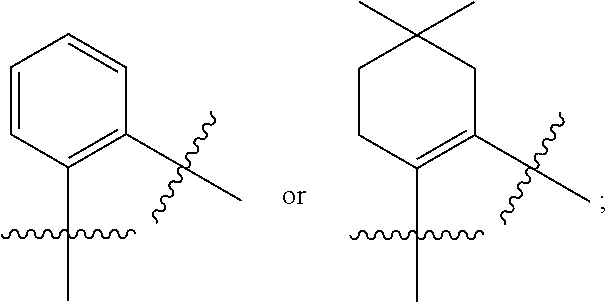
- [0308]X11, substituted or unsubstituted, is selected from the group consisting of alkylene, alkenylene, cycloalkylene, cycloalkenylene, and heterocycloalkylene;
- [0309]Y11 is selected from the group consisting of (CH2)n—N(R11a) and;

- [0311]Q11 is selected from the group consisting of O, O(CH2)1-3, NR11c, NR11c (C1-3alkylene), OC(═O)(C1-3alkylene), C(═O)O, C(═O)O(C1-3alkylene), NHC(═O)(C1-3alkylene), C(═O)NH, and C(═O)NH(C1-3alkylene);
- [0312]Z11 is O or NR11c
- [0313]R11 and R12, independently, are selected from the group consisting of H, CN, NO2, halo, alkyl, cycloalkyl, alkenyl, cycloalkenyl, alkynyl, aryl, heteroaryl, heterocycloalkyl, OR1′, SR1′, NR1′R1″, COR1′, CO2R1′, OCOR1′, CONR1′R1″, CONR1′SO2R1″, NR1″COR1″, NR1′CONR1″R1″′; NR1′C═SNR1″R1″′, NR1′SO2R1″, SO2R1′, and SO2NR1′R1″;
- [0314]R13 is selected from a group consisting of H, alkyl, cycloalkyl, alkenyl, cycloalkenyl, alkynyl, aryl, heteroaryl, heterocycloalkyl, OR1′, NR1′R1″, OCOR1′, CO2R1′, COR1′, CONR1′R1″, CONR1′SO2R1″′, C1-3alkyleneCH(OH)CH2OH, SO2R1′, and SO2NR1′R1″;
- [0315]R1′, R1″, and R1″′, independently, are H, alkyl, cycloalkyl, alkenyl, cycloalkenyl, alkynyl, aryl, heteroaryl, C1-3alkyleneheterocycloalkyl, or heterocycloalkyl;
- [0316]R1′ and R1″, or R1″ and R1″′, can be taken together with the atom to which they are bound to form a 3 to 7 membered ring;
- [0317]R14 is hydrogen, halo, C1-3alkyl, CF3, or CN;
- [0318]R15 is hydrogen, halo, C1-3alkyl, substituted C1-3alkyl, hydroxyalkyl, alkoxy, or substituted alkoxy;
- [0319]R16 is selected from the group consisting of H, CN, NO2, halo, alkyl, cycloalkyl, alkenyl, cycloalkenyl, alkynyl, aryl, heteroaryl, heterocycloalkyl, OR1′, SR1′, NR1′R1″, CO2R1′, OCOR1′, CONR1′R1″, CONR1″SO2R1″, NR1′COR1″, NR1′CONR1″R1″′, NR1′C═SNR1″R1″′, NR1′SO2R1″, SO2R1′, and SO2NR1′R1″;
- [0320]R17, substituted or unsubstituted, is selected form the group consisting of hydrogen, alkyl, alkenyl, (CH2)0-3cycloalkyl, (CH2)0-3cycloalkenyl, (CH2)0-3heterocycloalkyl, (CH2)0-3aryl, and (CH2)0-3heteroaryl;
- [0321]R18 is selected form the group consisting of hydrogen, halo, NO2, CN, CF3SO2, and CF3;
- [0322]R11a is selected from the group consisting of hydrogen, alkyl, heteroalkyl, alkenyl, hydroxyalkyl, alkoxy, substituted alkoxy, cycloalkyl, cycloalkenyl, and heterocycloalkyl;
- [0323]R11b is hydrogen or alkyl;
- [0324]R11c is selected from the group consisting of hydrogen, alkyl, substituted alkyl, hydroxyalkyl, alkoxy, and substituted alkoxy; and
- [0325]n1, r1, and s1, independently, are 1, 2, 3, 4, 5, or 6;
- [0326]or a pharmaceutically acceptable salt of (I), (II), or (III); and
administering a second compound represented by:

or pharmaceutically acceptable salt thereof;
where an effective amount of the first and second compound is administered to the patient.
[0328]In some embodiments, Y11 is

n is an integer of 1-3, R11b is hydrogen or C1-3 alkyl, Q is O, O(CH2)1-3, C(═O)O(CH2)1-3, OC(═O)(CH2)1-3 or C(═O)O(C3H7)1-3.
[0330]In some embodiments, the compound of formula (I), (II) or (III) is selected from the group consisting of:


[0332]In some embodiments, the present disclosure provides a method of treating a solid tumor cancer in a patient in need thereof, comprising administering:
a first compound represented by

or a pharmaceutically acceptable salt; and
administering a second compound represented by:

or pharmaceutically acceptable salt thereof;
where an effective amount of the first and second compound is administered to the patient.
[0335]In some embodiments, the solid tumor cancer is selected from the group consisting of breast cancer, breast cancer in men, adrenal cortical cancer, advanced cancer, anal cancer, bile duct cancer, bladder cancer, bone cancer, bone metastasis, brain/CNS tumors in adults, brain/CNS tumors in children, cancer in children, cancer of unknown primary, cervical cancer, colon/rectum cancer, endometrial cancer, esophagus cancer, Ewing family of tumors, eye cancer, gallbladder cancer, gastrointestinal carcinoid tumors, gastrointestinal stromal tumor (GIST), gestational trophoblastic disease, ovarian cancer, prostate cancer, non-small cell lung cancer, head and neck cancer, neuroblastoma, and squamous cell carcinoma cancer. In some embodiments, the solid tumor cancer is selected from the group consisting of breast cancer, ovarian cancer, prostate cancer, non-small cell lung cancer, head and neck cancer, neuroblastoma, brain cancer and squamous cell carcinoma cancer. In some embodiments, the solid tumor cancer is lung adenocarcinoma or lung squamous cell carcinoma cancer. In some embodiments, the solid tumor cancer is a refractory cancer.
[0336]In some embodiments, an effective amount of the first and second compound is administered to the patient.
[0337]In another aspect, the present disclosure provides a method of treating a solid tumor cancer in a patient in need thereof, comprising administering:
a first compound selected from:
a compound of formula (I), (II), or (III), a compound of formula (IV),

- [0339]wherein for formula IV,
- [0340]R21 is SO2R2′,
- [0341]R22 is alkyl, preferably C1-C4 alkyl, more preferably methyl, propyl, or isopropyl,
- [0342]R23 is alkyl, preferably C1-C4 alkyl, more preferably methyl, propyl, or isopropyl,
- [0343]R24 is halogen, preferably fluoride, chloride,
- [0344]R25 is halogen, preferably fluoride, chloride,
- [0345]R26 is selected from H, halogen, alkyl, preferably fluoride, chloride, C1-C4 alkyl, more preferably methyl, propyl, isopropyl
- [0346]R21b is H or alkyl, preferably C1-C4 alkyl, more preferably methyl, propyl, or isopropyl,
- [0347]n2, r2 and s2 are independently 1, 2, 3, 4, 5 or 6, more preferably, r2 and s2 are both 2 and n2 is 3, 4 or 5, more preferably, all of n2, r2 and s2 are 2, and
- [0348]R2′ is alkyl, preferably C1-C4 alkyl, more preferably methyl, propyl, or isopropyl;
and a pharmaceutically acceptable salt thereof; and
administering a CDK4/6 inhibitor or pharmaceutically acceptable salt thereof;
where an effective amount of the first and second compound is administered to the patient.
[0349]In some embodiments, the compound of formula (IV) is selected from the group consisting of:


[0351]In some embodiments, the present disclosure provides a method of treating a solid tumor cancer in a patient in need thereof, comprising administering:
a first compound selected from:

and
a pharmaceutically acceptable salt thereof; and
administering a CDK4/6 inhibitor or pharmaceutically acceptable salt thereof;
where an effective amount of the first and second compound is administered to the patient.
[0353]In some embodiments, the first compound is compound B. In some embodiments, the first compound is compound D.
[0354]In some embodiments, the CDK4/6 inhibitor is palbociclib.
[0355]In some embodiments, the solid tumor cancer is selected from the group consisting of breast cancer, breast cancer in men, adrenal cortical cancer, advanced cancer, anal cancer, bile duct cancer, bladder cancer, bone cancer, bone metastasis, brain/CNS tumors in adults, brain/CNS tumors in children, cancer in children, cancer of unknown primary, cervical cancer, colon/rectum cancer, endometrial cancer, esophagus cancer, Ewing family of tumors, eye cancer, gallbladder cancer, gastrointestinal carcinoid tumors, gastrointestinal stromal tumor (GIST), gestational trophoblastic disease, ovarian cancer, prostate cancer, non-small cell lung cancer, head and neck cancer, neuroblastoma, and squamous cell carcinoma cancer. In some embodiments, the cancer is refractory or treatment resistant cancer. In some embodiments, the solid tumor cancer is breast cancer. In some embodiments, the breast cancer is tamoxifen-resistant breast cancer.
[0356]In another aspect, the present disclosure provides a method of treating a solid tumor cancer in a patient in need thereof, comprising administering to the patient:
a first compound selected from:
a compound of formula (I), (II), or (III), a compound of formula (IV),
and a pharmaceutically acceptable salt thereof; and
- [0357]administering tamoxifen to the patient.
[0358]In some embodiments, the present disclosure provides a method of treating a solid tumor cancer in a patient in need thereof, comprising administering to the patient:
a first compound selected from:

and
a pharmaceutically acceptable salt thereof, and
- [0360]administering tamoxifen to the patient.
[0361]In some embodiments, the first compound is compound B. In some embodiments, the first compound is compound D.
[0362]In some embodiments, the solid tumor cancer is selected from the group consisting of breast cancer, breast cancer in men, adrenal cortical cancer, advanced cancer, anal cancer, bile duct cancer, bladder cancer, bone cancer, bone metastasis, brain/CNS tumors in adults, brain/CNS tumors in children, cancer in children, cancer of unknown primary, cervical cancer, colon/rectum cancer, endometrial cancer, esophagus cancer, Ewing family of tumors, eye cancer, gallbladder cancer, gastrointestinal carcinoid tumors, gastrointestinal stromal tumor (GIST), gestational trophoblastic disease, ovarian cancer, prostate cancer, non-small cell lung cancer, head and neck cancer, neuroblastoma, and squamous cell carcinoma cancer. In some embodiments, the solid tumor cancer is refractory or treatment resistant cancer. In some embodiments, the solid tumor cancer is breast cancer. In some embodiments, the breast cancer is tamoxifen-resistant breast cancer. In some embodiments, the breast cancer is estrogen resistant positive (ER+) breast cancer. In some embodiments, the breast cancer is hormone receptor positive breast cancer, human growth factor receptor 2 (HER2) negative advanced breast cancer or metastatic breast cancer.
[0363]In another aspect, the present disclosure provides a method of treating a hematologic malignancy in a patient in need thereof, comprising:
a first compound selected from:
a compound of formula (I), (II), or (III), a compound of formula (IV),
and a pharmaceutically acceptable salt thereof; and
administering a second compound selected from the group consisting of: bortezomib, lenalidomide, pomalodomide and dexamethasone.
[0364]In some embodiments, the present disclosure provides a method of treating a hematologic malignancy in a patient in need thereof, comprising:
a first compound selected from:

and
a pharmaceutically acceptable salt thereof, and
administering a second compound selected from the group consisting of: bortezomib, lenalidomide, pomalodomide and dexamethasone.
[0366]In some embodiments, the first compound is compound B. In some embodiments, the first compound is compound D.
[0367]In some embodiments, the hematologic malignancy is selected from the group consisting of chronic lymphocytic leukemia, acute myeloid leukemia, multiple myeloma, lymphoplasmacytic lymphoma, and non-Hodgkin's lymphoma. In some embodiments, the hematologic malignancy is multiple myeloma.
[0368]In another aspect, the present disclosure provides a method of treating a hematologic malignancy or a solid tumor cancer in a patient in need thereof, comprising administering
a first compound selected from:
a compound of formula (I), (II), or (III), a compound of formula (IV),
and a pharmaceutically acceptable salt thereof; and
administering a second compound represented by:

or pharmaceutically acceptable salt thereof;
where an effective amount of the first and second compound is administered to the patient.
[0370]In some embodiments, the present disclosure provides a method of treating a hematologic malignancy or a solid tumor cancer in a patient in need thereof, comprising administering
a first compound selected from:

and
a pharmaceutically acceptable salt thereof, and
administering a second compound represented by:

or pharmaceutically acceptable salt thereof;
where an effective amount of the first and second compound is administered to the patient.
[0373]In some embodiments, the first compound is compound B. In some embodiments, the first compound is compound D.
[0374]In some embodiments, the hematological malignancy is selected from the group consisting of chronic lymphocytic leukemia, acute myeloid leukemia, multiple myeloma, lymphoplasmacytic lymphoma, and non-Hodgkin's lymphoma. In some embodiments, the hematological malignancy is mantle cell lymphoma, diffuse large B-cell lymphoma, follicular B-cell lymphoma, or chronic lymphocytic leukemia. In some embodiments, the hematological malignancy is mantle cell lymphoma.
[0375]In some embodiments, the solid tumor cancer is selected from the group consisting of breast cancer, breast cancer in men, adrenal cortical cancer, advanced cancer, anal cancer, bile duct cancer, bladder cancer, bone cancer, bone metastasis, brain/CNS tumors in adults, brain/CNS tumors in children, cancer in children, cancer of unknown primary, cervical cancer, colon/rectum cancer, endometrial cancer, esophagus cancer, Ewing family of tumors, eye cancer, gallbladder cancer, gastrointestinal carcinoid tumors, gastrointestinal stromal tumor (GIST), gestational trophoblastic disease, ovarian cancer, prostate cancer, non-small cell lung cancer, head and neck cancer, neuroblastoma, and squamous cell carcinoma cancer. In some embodiments, the solid tumor cancer is neuroblastoma.
[0376]In another aspect, the present disclosure provides a method of treating a cancer selected from the group consisting of: diffuse large B-cell lymphoma, follicular B-cell lymphoma, and chronic lymphocytic leukemia in a patient in need thereof, comprising
administering a first compound selected from:
a compound of formula (I), (II), or (III), a compound of formula (IV),
and a pharmaceutically acceptable salt thereof; and
administering to the patient each of rituximab, etoposide, ifosfamide and carboplatin.
[0377]In some embodiments, the present disclosure provides a method of treating a cancer selected from the group consisting of: diffuse large B-cell lymphoma, follicular B-cell lymphoma, and chronic lymphocytic leukemia in a patient in need thereof, comprising
administering a first compound selected from:

and
a pharmaceutically acceptable salt thereof to the patient, and
administering to the patient each of rituximab, etoposide, ifosfamide and carboplatin.
[0379]In some embodiments, the first compound is compound B. In some embodiments, the first compound is compound D.
[0380]In another aspect, the disclosure provides a method of treating a solid tumor cancer in a patient need thereof, comprising: administering to the patient a first compound of formula (V), and administering to the patient an MCL-1 inhibitor.
[0381]In some embodiments, the disclosure provides a method of treating a solid tumor cancer in a patient need thereof, comprising: administering to the patient a first compound represented by (S)—N-((4-(((1,4-dioxan-2-yl)methyl)amino)-3-nitrophenyl)sulfonyl)-2-((1H-pyrrolo[2,3-b]pyridin-5-yl)oxy)-4-(4-((6-(4-chlorophenyl)spiro[3.5]non-6-en-7-yl)methyl)piperazin-1-yl)benzamide or a pharmaceutically acceptable salt thereof; and administering to the patient an MCL-1 inhibitor.
[0382]In some embodiments, the MCL-1 inhibitor is

or a pharmaceutically acceptable salt thereof.
[0384]In some embodiments, the solid tumor cancer is selected from the group consisting of breast cancer, breast cancer in men, adrenal cortical cancer, advanced cancer, anal cancer, bile duct cancer, bladder cancer, bone cancer, bone metastasis, brain/CNS tumors in adults, brain/CNS tumors in children, cancer in children, cancer of unknown primary, cervical cancer, colon/rectum cancer, endometrial cancer, esophagus cancer, Ewing family of tumors, eye cancer, gallbladder cancer, gastrointestinal carcinoid tumors, gastrointestinal stromal tumor (GIST), gestational trophoblastic disease, ovarian cancer, prostate cancer, non-small cell lung cancer, head and neck cancer, neuroblastoma, and squamous cell carcinoma cancer.
[0385]In another aspect, the disclosure provides a method of treating a solid tumor cancer in a patient need thereof, comprising: administering to the patient a first compound selected from: a compound of formula (I), (II), or (III), a compound of formula (IV), and a pharmaceutically acceptable salt thereof, and administering to the patient an MCL-1 inhibitor or a CDK9 inhibitor.
[0386]In some embodiments, the disclosure provides a method of treating a solid tumor cancer in a patient need thereof, comprising: administering to the patient a first compound selected from

and a pharmaceutically acceptable salt thereof;
and administering to the patient an MCL-1 inhibitor or a CDK9 inhibitor.
[0388]In some embodiments, the MCL-1 inhibitor is

alvocidib, or AZD5991, or a pharmaceutically acceptable salt thereof.
[0390]In some embodiments, the solid tumor cancer is selected from the group consisting of breast cancer, breast cancer in men, adrenal cortical cancer, advanced cancer, anal cancer, bile duct cancer, bladder cancer, bone cancer, bone metastasis, brain/CNS tumors in adults, brain/CNS tumors in children, cancer in children, cancer of unknown primary, cervical cancer, colon/rectum cancer, endometrial cancer, esophagus cancer, Ewing family of tumors, eye cancer, gallbladder cancer, gastrointestinal carcinoid tumors, gastrointestinal stromal tumor (GIST), gestational trophoblastic disease, ovarian cancer, prostate cancer, non-small cell lung cancer, head and neck cancer, neuroblastoma, and squamous cell carcinoma cancer.
[0391]In yet another aspect, the disclosure provides a method of treating a solid tumor cancer in a patient need thereof, comprising: administering to the patient a first compound selected from: a compound of formula (I), (II), or (III), a compound of formula (IV), and a pharmaceutically acceptable salt thereof, and a second compound selected from a compound of formula (V) and anlotinib; where an effective amount of the first and second compound is administered to the patient.
[0392]In some embodiments the disclosure provides a method of treating a solid tumor cancer in a patient in need thereof, comprising administering: a first compound selected from

and a pharmaceutically acceptable salt thereof; and a second compound selected from
(S)—N-((4-(((1,4-dioxan-2-yl)methyl)amino)-3-nitrophenyl)sulfonyl)-2-((1H-pyrrolo[2,3-b]pyridin-5-yl)oxy)-4-(4-((6-(4-chlorophenyl)spiro[3.5]non-6-en-7-yl)methyl)piperazin-1-yl)benzamide or pharmaceutically acceptable salt thereof, and anlotinib; where an effective amount of the first and second compound is administered to the patient.
[0394]In some embodiments, the solid tumor cancer is selected from the group consisting of breast cancer, breast cancer in men, adrenal cortical cancer, advanced cancer, anal cancer, bile duct cancer, bladder cancer, bone cancer, bone metastasis, brain/CNS tumors in adults, brain/CNS tumors in children, cancer in children, cancer of unknown primary, cervical cancer, colon/rectum cancer, endometrial cancer, esophagus cancer, Ewing family of tumors, eye cancer, gallbladder cancer, gastrointestinal carcinoid tumors, gastrointestinal stromal tumor (GIST), gestational trophoblastic disease, ovarian cancer, prostate cancer, non-small cell lung cancer, small cell lung cancer, head and neck cancer, neuroblastoma, and squamous cell carcinoma cancer. In some embodiments, the solid tumor cancer is small cell lung cancer.
[0395]In another aspect, the disclosure provides a method of treating a hematologic malignancy in a patient in need thereof, comprising administering to the patient a first compound selected from: a compound of formula (I), (II), or (III), a compound of formula (IV), and a pharmaceutically acceptable salt thereof, and a second compound represented by:

or pharmaceutically acceptable salt thereof;
where an effective amount of the first and second compound is administered to the patient.
[0397]In some embodiments, the disclosure provides a method of treating a hematologic malignancy in a patient in need thereof, comprising administering: a first compound selected from

and
a pharmaceutically acceptable salt thereof; and a second compound represented by:

or pharmaceutically acceptable salt thereof;
where an effective amount of the first and second compound is administered to the patient.
[0400]In some embodiments, the hematologic malignancy is selected from the group consisting of chronic lymphocytic leukemia, acute myeloid leukemia, multiple myeloma, lymphoplasmacytic lymphoma, and non-Hodgkin's lymphoma.
[0401]In another aspect, the disclosure provides a method of treating a solid tumor cancer in a patient in need thereof, comprising administering: a first compound selected from a compound of formula (I), (II), or (III), a compound of formula (IV), and a pharmaceutically acceptable salt thereof, and a second compound represented by:

or pharmaceutically acceptable salt thereof;
where an effective amount of the first and second compound is administered to the patient.
[0403]In some embodiments, the disclosure provides a method of treating a solid tumor cancer in a patient in need thereof, comprising administering: a first compound selected from:

and
a pharmaceutically acceptable salt thereof; and a second compound represented by:

or pharmaceutically acceptable salt thereof;
where an effective amount of the first and second compound is administered to the patient.
[0406]In some embodiments, the solid tumor cancer is selected from the group consisting of breast cancer, breast cancer in men, adrenal cortical cancer, advanced cancer, anal cancer, bile duct cancer, bladder cancer, bone cancer, bone metastasis, brain/CNS tumors in adults, brain/CNS tumors in children, cancer in children, cancer of unknown primary, cervical cancer, colon/rectum cancer, endometrial cancer, esophagus cancer, Ewing family of tumors, eye cancer, gallbladder cancer, gastrointestinal carcinoid tumors, gastrointestinal stromal tumor (GIST), gestational trophoblastic disease, ovarian cancer, prostate cancer, non-small cell lung cancer, head and neck cancer, neuroblastoma, and squamous cell carcinoma cancer. In some embodiments, the solid tumor cancer is non-small cell lung cancer.
[0407]In another aspect, the disclosure provides a method of treating a hematologic malignancy in a patient in need thereof, comprising administering: a first compound selected from a compound of formula (I), (II), or (III), a compound of formula (IV), and a pharmaceutically acceptable salt thereof, and a second compound which is a JAK2 inhibitor; where an effective amount of the first and second compound is administered to the patient.
[0408]In some embodiments, the disclosure provides a method of treating a hematologic malignancy in a patient in need thereof, comprising administering: a first compound selected from

and
a pharmaceutically acceptable salt thereof; and a second compound which is a JAK2 inhibitor;
where an effective amount of the first and second compound is administered to the patient.
[0410]In some embodiments, the JAK2 inhibitor is ruxolitinib.
[0411]In some embodiments, the hematologic malignancy is selected from the group consisting of chronic lymphocytic leukemia, acute myeloid leukemia, multiple myeloma, lymphoplasmacytic lymphoma, and non-Hodgkin's lymphoma. In some embodiments, the hematologic malignancy is JAK2 positive.
[0412]In another aspect, the disclosure provides a method of treating a solid tumor cancer in a patient in need thereof, comprising administering: a first compound selected from a compound of formula (I), (II), or (III), a compound of formula (IV), and a pharmaceutically acceptable salt thereof, and a second compound which is an EGFR inhibitor; where an effective amount of the first and second compound is administered to the patient.
[0413]In some embodiments, the disclosure provides a method of treating a solid tumor cancer in a patient in need thereof, comprising administering: a first compound selected from

and
a pharmaceutically acceptable salt thereof; and a second compound which is an EGFR inhibitor;
where an effective amount of the first and second compound is administered to the patient.
[0415]In some embodiments, the EGFR inhibitor is AZD9291.
[0416]In some embodiments, the solid tumor cancer is selected from the group consisting of breast cancer, breast cancer in men, adrenal cortical cancer, advanced cancer, anal cancer, bile duct cancer, bladder cancer, bone cancer, bone metastasis, brain/CNS tumors in adults, brain/CNS tumors in children, cancer in children, cancer of unknown primary, cervical cancer, colon/rectum cancer, endometrial cancer, esophagus cancer, Ewing family of tumors, eye cancer, gallbladder cancer, gastrointestinal carcinoid tumors, gastrointestinal stromal tumor (GIST), gestational trophoblastic disease, ovarian cancer, prostate cancer, non-small cell lung cancer, head and neck cancer, neuroblastoma, and squamous cell carcinoma cancer. In some embodiments, the solid tumor cancer is non-small cell lung cancer.
[0417]In another aspect, the disclosure provides a method of treating a hematologic malignancy in a patient need thereof, comprising: administering to the patient a first compound of formula (V), or a pharmaceutically acceptable salt thereof, and administering to the patient a second compound selected from cytarabine and a hypomethylating agent.
[0418]In some embodiments, the disclosure provides a method of treating a hematologic malignancy in a patient need thereof, comprising: administering to the patient a first compound represented by (S)—N-((4-(((1,4-dioxan-2-yl)methyl)amino)-3-nitrophenyl)sulfonyl)-2-((1H-pyrrolo[2,3-b]pyridin-5-yl)oxy)-4-(4-((6-(4-chlorophenyl)spiro[3.5]non-6-en-7-yl)methyl)piperazin-1-yl)benzamide or a pharmaceutically acceptable salt thereof; and administering to the patient a second compound selected from cytarabine and a hypomethylating agent.
[0419]In some embodiments, the hypomethylating agent is selected from azacytidine and decitabine.
[0420]In some embodiments, the hematologic malignancy is selected from the group consisting of chronic lymphocytic leukemia, acute myeloid leukemia, multiple myeloma, lymphoplasmacytic lymphoma, and non-Hodgkin's lymphoma. In some embodiments, the hematologic malignancy is acute myeloid leukemia.
[0421]In another aspect, the disclosure provides a method of treating a solid tumor cancer in a patient need thereof, comprising: administering to the patient a first compound of formula (V), or a pharmaceutically acceptable salt thereof, and administering to the patient a second compound which is a HER2 inhibitor.
[0422]In some embodiments, the disclosure provides a method of treating a solid tumor cancer in a patient need thereof, comprising: administering to the patient a first compound represented by (S)—N-((4-(((1,4-dioxan-2-yl)methyl)amino)-3-nitrophenyl)sulfonyl)-2-((1H-pyrrolo[2,3-b]pyridin-5-yl)oxy)-4-(4-((6-(4-chlorophenyl)spiro[3.5]non-6-en-7-yl)methyl)piperazin-1-yl)benzamide or a pharmaceutically acceptable salt thereof; and administering to the patient a second compound which is a HER2 inhibitor.
[0423]In some embodiments, the HER2 inhibitor is lapatinib.
[0424]In some embodiments, the solid tumor cancer is selected from the group consisting of breast cancer, breast cancer in men, adrenal cortical cancer, advanced cancer, anal cancer, bile duct cancer, bladder cancer, bone cancer, bone metastasis, brain/CNS tumors in adults, brain/CNS tumors in children, cancer in children, cancer of unknown primary, cervical cancer, colon/rectum cancer, endometrial cancer, esophagus cancer, Ewing family of tumors, eye cancer, gallbladder cancer, gastric cancer, gastrointestinal carcinoid tumors, gastrointestinal stromal tumor (GIST), gestational trophoblastic disease, ovarian cancer, prostate cancer, non-small cell lung cancer, head and neck cancer, neuroblastoma, and squamous cell carcinoma cancer. In some embodiments, the solid tumor cancer is gastric cancer.
[0425]In yet another aspect, the disclosure provides a method of treating a solid tumor cancer in a patient need thereof, comprising: administering to the patient a first compound of formula (V), or a pharmaceutically acceptable salt thereof, and administering to the patient a second compound which is anti PD-1 antibody or anti PD-L1 antibody.
[0426]In some embodiments, the disclosure provides a method of treating a solid tumor cancer in a patient need thereof, comprising: administering to the patient a first compound represented by (S)—N-((4-(((1,4-dioxan-2-yl)methyl)amino)-3-nitrophenyl)sulfonyl)-2-((1H-pyrrolo[2,3-b]pyridin-5-yl)oxy)-4-(4-((6-(4-chlorophenyl)spiro[3.5]non-6-en-7-yl)methyl)piperazin-1-yl)benzamide or a pharmaceutically acceptable salt thereof; and administering to the patient a second compound which is anti PD-1 antibody or anti PDL1 antibody.
[0427]In some embodiments, the second compound is anti PD-1 antibody.
[0428]In some embodiments, the method further comprises administration of a VEGF inhibitor. In some embodiments, the VEGF inhibitor is lenvatinib.
[0429]In some embodiments, the solid tumor cancer is selected from the group consisting of breast cancer, breast cancer in men, adrenal cortical cancer, advanced cancer, anal cancer, bile duct cancer, bladder cancer, bone cancer, bone metastasis, brain/CNS tumors in adults, brain/CNS tumors in children, cancer in children, cancer of unknown primary, cervical cancer, colon/rectum cancer, endometrial cancer, esophagus cancer, Ewing family of tumors, eye cancer, gallbladder cancer, gastric cancer, gastrointestinal carcinoid tumors, gastrointestinal stromal tumor (GIST), liver cancer, gestational trophoblastic disease, ovarian cancer, prostate cancer, non-small cell lung cancer, head and neck cancer, neuroblastoma, and squamous cell carcinoma cancer.
[0430]In some embodiments, the solid tumor cancer is colon cancer. In some embodiments, the solid tumor cancer is liver cancer.
[0431]In some embodiments wherein the first compound is a compound of formula (I), (II), (III), or (IV), the method comprises administering a dose weekly, twice weekly or daily of 40 mg, 80 mg, 160 mg, 240 mg or 240-500 mg of the first compound.
Dosing Regimen
[0432]In some embodiments, the method comprises administering a dose weekly, twice weekly or daily of 40 mg, 80 mg, 160 mg, 240 mg or 240-500 mg of the first compound.
[0433]In some embodiments, administering the first compound is by a daily step-wise dosing regimen. In some embodiments, administering the daily step-wise dosing regimen comprises: administering a first dose of 20 mg of the compound to the patient for one day; administering a second dose of 50 mg of the compound to the patient for one day, on the day after the first dose, and administering a third dose of 100 mg of the compound for one day, on the day after the second dose. In some embodiments, the method further comprises administering a fourth dose of 200 mg of the compound daily for 1 to 5 days or more. In some embodiments, the fourth dose is administered for one day. In some embodiments, the daily step-wise regimen further comprises administering a fifth dose of 400 mg after the fourth dose is administered. In some embodiments, the method further comprises administering a dose of 400 mg to 800 mg of the compound daily, after the third or fourth dose. In some embodiments, the method further comprises administering a daily dose of 400 mg, 600 mg or 800 mg of the compound for 1 week or more, or 1 month or more, after administering the daily step-wise dosing regimen. IN some embodiments, the compound is N-((4-(((1,4-dioxan-2-yl)methyl)amino)-3-nitrophenyl)sulfonyl)-2-((1H-pyrrolo[2,3-b]pyridin-5-yl)oxy)-4-(4-((6-(4-chlorophenyl)spiro[3.5]non-6-en-7-yl)methyl)piperazin-1-yl)benzamide. In some embodiments, the compound is (R)—N-((4-(((1,4-dioxan-2-yl)methyl)amino)-3-nitrophenyl)sulfonyl)-2-((1H-pyrrolo[2,3-b]pyridin-5-yl)oxy)-4-(4-((6-(4-chlorophenyl)spiro[3.5]non-6-en-7-yl)methyl)piperazin-1-yl)benzamide. In some embodiments, the (S)—N-((4-(((1,4-dioxan-2-yl)methyl)amino)-3-nitrophenyl)sulfonyl)-2-((1H-pyrrolo[2,3-b]pyridin-5-yl)oxy)-4-(4-((6-(4-chlorophenyl)spiro[3.5]non-6-en-7-yl)methyl)piperazin-1-yl)benzamide.
[0434]Also contemplated herein is a method of treating a hematologic malignancy or solid tumor cancer in a patient in need thereof, comprising: administering a daily step-wise dosing regimen of a compound N-((4-(((1,4-dioxan-2-yl)methyl)amino)-3-nitrophenyl)sulfonyl)-2-((1H-pyrrolo[2,3-b]pyridin-5-yl)oxy)-4-(4-((6-(4-chlorophenyl)spiro[3.5]non-6-en-7-yl)methyl)piperazin-1-yl)benzamide or a pharmaceutically acceptable salt thereof; wherein administering the daily step-wise dosing regimen comprises administering a first dose of 20 mg to 100 mg of the compound to the patient for one day; administering a second dose of 50 mg to 200 mg of the compound to the patient for one day, on the day after the first dose. In some embodiments, the daily step-wise dosing regimen further comprises administering a third dose of 100 to 400 mg of the compound to the patient for one day, on the day after the second dose. In some embodiments, the daily step-wise dosing regimen further comprises administering a fourth dose of 200 mg to 800 mg of the compound for one to seven days after the third dose. In some embodiments, the method further comprises administering to the patient, after the daily step-wise dosing regimen, about 400 mg to 800 mg of the compound daily for 1 week or more. In some embodiments, the patient, during or after administration of the daily step-wise dosing regimen, has a reduced risk of tumor lysis syndrome. In some embodiments, the hematologic malignancy is selected from the group consisting of chronic lymphocytic leukemia, acute myeloid leukemia, multiple myeloma, lymphoplasmacytic lymphoma, and non-Hodgkin's lymphoma. In some embodiments, the patient has primary refractory acute myeloid leukemia. In some embodiments, the patient has relapsed after a previous hematologic malignancy therapy. In some embodiments, the patient has received at least one prior therapy for the hematologic malignancy. In some embodiments, the method further comprises administering rituximab to the patient before, during or after the daily step-wise dosing regimen. In some embodiments, the method further comprises administering azacytidine, decitabine or low-dose cytarabine to the patient before, during or after the daily step-wise dosing regimen. In some embodiments, the method further comprises administering a second anti-cancer agent to the patient before, during or after the daily step-wise dosing regimen. In some embodiments, the compound is (R)—N-((4-(((1,4-dioxan-2-yl)methyl)amino)-3-nitrophenyl)sulfonyl)-2-((1H-pyrrolo[2,3-b]pyridin-5-yl)oxy)-4-(4-((6-(4-chlorophenyl)spiro[3.5]non-6-en-7-yl)methyl)piperazin-1-yl)benzamide. In some embodiments, the (S)—N-((4-(((1,4-dioxan-2-yl)methyl)amino)-3-nitrophenyl)sulfonyl)-2-((1H-pyrrolo[2,3-b]pyridin-5-yl)oxy)-4-(4-((6-(4-chlorophenyl)spiro[3.5]non-6-en-7-yl)methyl)piperazin-1-yl)benzamide.
[0435]In another embodiment, described herein is a method of treating a hematologic malignancy or solid tumor cancer in a patient in need thereof, wherein the patient is also being administered a CYP2C8 (and/or another drug that may cause a drug/drug interaction, such as a CYP3A4 inhibitor, or a food such as grapefruit juice) comprising administering an effective amount of a compound N-((4-(((1,4-dioxan-2-yl)methyl)amino)-3-nitrophenyl)sulfonyl)-2-((1H-pyrrolo[2,3-b]pyridin-5-yl)oxy)-4-(4-((6-(4-chlorophenyl)spiro[3.5]non-6-en-7-yl)methyl)piperazin-1-yl)benzamide or a pharmaceutically acceptable salt to the patient, wherein the effective amount for the patient taking the CYP2C8 inhibitor is about 60% or less, about 50% or less, about 40% or less, or about 20% or less, than an effective amount for a patient who is not being administered a CYP2C8 inhibitor (or, in certain embodiments other drugs or foods such as grapefruit juice, or a CYP3A4 inhibitor). In some embodiments, the effective amount for the patient taking the CYP2C8 inhibitor is about 20 mg to about 100 mg daily of the compound. In some embodiments, the effective amount for the patient taking the CYP2C8 inhibitor is about 10 mg, 20 mg, 30 mg, 40 mg, 50 mg, 100 mg or 200 mg per day. In some embodiments, the method comprises administering the effective amount for the patient taking the CYP2C8 inhibitor after administering the compound by an initial daily or weekly step-wise dosing regimen. In some embodiments, the CYP2C8 inhibitor is a strong CYP2C8 inhibitor. In some embodiments, the CYP2C8 inhibitor is selected from the group consisting of gemfibrozil, trimethoprim, thiazolidediones, montelukast, and quercetin. In some embodiments, the compound is (R)—N-((4-(((1,4-dioxan-2-yl)methyl)amino)-3-nitrophenyl)sulfonyl)-2-((1H-pyrrolo[2,3-b]pyridin-5-yl)oxy)-4-(4-((6-(4-chlorophenyl)spiro[3.5]non-6-en-7-yl)methyl)piperazin-1-yl)benzamide. In some embodiments, the (S)—N-((4-(((1,4-dioxan-2-yl)methyl)amino)-3-nitrophenyl)sulfonyl)-2-((1H-pyrrolo[2,3-b]pyridin-5-yl)oxy)-4-(4-((6-(4-chlorophenyl)spiro[3.5]non-6-en-7-yl)methyl)piperazin-1-yl)benzamide. In some embodiments, the method further comprises administering a second anti-cancer agent to the patient before, during or after the administering of a CYP2C8 (and/or another drug that may cause a drug/drug interaction, such as a CYP3A4 inhibitor, or a food such as grapefruit juice).
DEFINITIONS
[0436]For convenience, certain terms used in the specification, examples, and appended claims are collected here.
[0437]The phrase “combination therapy,” as used herein, refers to co-administering Bcl-2 inhibitor and at least one other anti-cancer agent, for example, where the other anti-cancer agent is an FTL3 inhibitor or a CDK4/6 inhibitor, as part of a specific treatment regimen intended to provide the beneficial effect from the co-action of these therapeutic agents. The beneficial effect of the combination includes, but is not limited to, pharmacokinetic or pharmacodynamic co-action resulting from the combination of therapeutic agents. Administration of these therapeutic agents in combination typically is carried out over a defined time period (usually weeks, months or years depending upon the combination selected). Combination therapy is intended to embrace administration of multiple therapeutic agents in a sequential manner, that is, wherein each therapeutic agent is administered at a different time, as well as administration of these therapeutic agents, or at least two of the therapeutic agents, in a substantially simultaneous manner. Substantially simultaneous administration can be accomplished, for example, by administering to the subject a single tablet or capsule having a fixed ratio of each therapeutic agent or in multiple, single capsules for each of the therapeutic agents. Sequential or substantially simultaneous administration of each therapeutic agent can be effected by any appropriate route including, but not limited to, oral routes, intravenous routes, intramuscular routes, and direct absorption through mucous membrane tissues. The therapeutic agents can be administered by the same route or by different routes. For example, a first therapeutic agent of the combination selected may be administered by intravenous injection while the other therapeutic agents of the combination may be administered orally. Alternatively, for example, all therapeutic agents may be administered orally or all therapeutic agents may be administered by intravenous injection.
[0438]Combination therapy also can embrace the administration of the therapeutic agents as described above in further combination with other biologically active ingredients and non-drug therapies. Where the combination therapy further comprises a non-drug treatment, the non-drug treatment may be conducted at any suitable time so long as a beneficial effect from the co-action of the combination of the therapeutic agents and non-drug treatment is achieved. For example, in appropriate cases, the beneficial effect is still achieved when the non-drug treatment is temporally removed from the administration of the therapeutic agents, perhaps by days or even weeks.
[0439]The components of the combination may be administered to a patient simultaneously or sequentially. It will be appreciated that the components may be present in the same pharmaceutically acceptable carrier and, therefore, are administered simultaneously. Alternatively, the active ingredients may be present in separate pharmaceutical carriers, such as, conventional oral dosage forms, that can be administered either simultaneously or sequentially.
[0440]It is contemplated that the combination of active ingredients will not only provide a greater degree of goal attainment, but it will also permit the goals to be achieved at lower dosages of the individual active ingredients thereby reducing the incidence and/or severity of dose-related adverse events associated with the individual active ingredients. It is contemplated that, for example, inhibition of cell growth of cancer cells by using, for example, a Bcl2 inhibitor in combination with an FTL3 inhibitor be superior to use of either agent alone. In some cases, use of a combination provides effects that are synergistic, i.e. more than the effect expected from simple addition of the effects of the individual drugs.
[0441]For example, the compositions can be used to reduce the growth of cancer cells to meet a clinical end-point but with fewer or reduced adverse events than (i) when the Bcl2 inhibitor is administered alone in a monotherapy at a dosage sufficient to achieve or substantially achieve (for example, within 10%) the clinical end-point or (ii) when the Bcl2 inhibitor is administered together with another anti-cancer agent, where the Bcl2 inhibitor and the other anti-cancer agent are administered at dosages sufficient to achieve or substantially achieve the clinical end-point
[0442]An “effective amount” includes the amount of the subject compound that will elicit the biological or medical response of a tissue, system, animal or human that is being sought by the researcher, veterinarian, medical doctor or other clinician. A compound described herein, e.g., Compound A, is administered in effective amounts to treat a condition, e.g., a hematologic malignancy. Alternatively, an effective amount of a compound is the quantity required to achieve a desired therapeutic and/or prophylactic effect, such as an amount which results in the prevention of or a decrease in the symptoms associated with the condition.
[0443]“Individual,” “patient,” or “subject” are used interchangeably herein and include any animal, including mammals, including mice, rats, other rodents, rabbits, dogs, cats, swine, cattle, sheep, horses, or primates, and humans. The compounds described herein can be administered to a mammal, such as a human, but can also be administered to other mammals such as an animal in need of veterinary treatment, e.g., domestic animals (e.g., dogs, cats, and the like), farm animals (e.g., cows, sheep, pigs, horses, and the like) and laboratory animals (e.g., rats, mice, guinea pigs, and the like). The mammal treated in the methods described herein is desirably a mammal in which treatment of a disorder described herein is desired, such as a human.
[0444]The term “pharmaceutically acceptable salt(s)” as used herein refers to salts of acidic or basic groups that may be present in compounds used in the compositions. Compounds included in the present compositions that are basic in nature are capable of forming a wide variety of salts with various inorganic and organic acids. The acids that may be used to prepare pharmaceutically acceptable acid addition salts of such basic compounds are those that form non-toxic acid addition salts, i.e., salts containing pharmacologically acceptable anions, including, but not limited to, malate, oxalate, chloride, bromide, iodide, nitrate, sulfate, bisulfate, phosphate, acid phosphate, isonicotinate, acetate, lactate, salicylate, citrate, tartrate, oleate, tannate, pantothenate, bitartrate, ascorbate, succinate, maleate, gentisinate, fumarate, gluconate, glucaronate, saccharate, formate, benzoate, glutamate, methanesulfonate, ethanesulfonate, benzenesulfonate, p-toluenesulfonate and pamoate (i.e., 1,1′-methylene-bis-(2-hydroxy-3-naphthoate)) salts.
[0445]As used herein, “treating” includes any effect, e.g., lessening, reducing, modulating, or eliminating, that results in the improvement of the condition, disease, disorder and the like.
[0446]A compound described herein, e.g., Compound A or pharmaceutically acceptable salt thereof, can be formulated as a pharmaceutical composition using a pharmaceutically acceptable carrier and administered by a variety of routes. In some embodiments, such compositions are for oral administration. In some embodiments, such compositions are for parenteral (by injection) administration. In some embodiments, such compositions are for transdermal administration. In some embodiments, such compositions are for intravenous (IV) administration. In some embodiments, such compositions are for intramuscular (IM) administration. Such pharmaceutical compositions and processes for preparing them are well known in the art. See, e.g., REMINGTON: THE SCIENCE AND PRACTICE OF PHARMACY (A. Gennaro, et al., eds., 19th ed., Mack Publishing Co., 1995).
EXAMPLES
[0447]The compounds described herein can be prepared in a number of ways based on the teachings contained herein and synthetic procedures known in the art. It is to be understood that all proposed reaction conditions, including choice of solvent, reaction atmosphere, reaction temperature, duration of the experiment and workup procedures, can be chosen to be the conditions standard for that reaction, unless otherwise indicated. It is understood by one skilled in the art of organic synthesis that the functionality present on various portions of the molecule should be compatible with the reagents and reactions proposed. Substituents not compatible with the reaction conditions will be apparent to one skilled in the art, and alternate methods are therefore indicated. The starting materials for the examples are either commercially available or are readily prepared by standard methods from known materials.
[0448]N-((4-(((1,4-dioxan-2-yl)methyl)amino)-3-nitrophenyl)sulfonyl)-2-((1H-pyrrolo[2,3-b]pyridin-5-yl)oxy)-4-(4-((6-(4-chlorophenyl)spiro[3.5]non-6-en-7-yl)methyl)piperazin-1-yl)benzamide, (R)—N-((4-(((1,4-dioxan-2-yl)methyl)amino)-3-nitrophenyl)sulfonyl)-2-((1H-pyrrolo[2,3-b]pyridin-5-yl)oxy)-4-(4-((6-(4-chlorophenyl)spiro[3.5]non-6-en-7-yl)methyl)piperazin-1-yl)benzamide, and Compound A can be synthesized in accordance with the synthetic methods described in WO 2018/027097, which is incorporated herein by reference.
| ABBREVIATIONS AND SPECIALIST TERMS |
|---|
| Mean ± SD | Mean ± standard deviation |
| Mean ± SEM | Mean ± Standard error mean |
| MDSC | Myeloid-derived suppressor cell |
| mg/kg | Milligram per kilogram |
| MSD | Meso Scale Discovery |
| n | Number |
| PK | Pharmacokinetic/Pharmacokinetics |
| PO or p.o. | Oral administration |
| i.p. | Intraperitoneal injection |
| i.v. | Intravenous injection |
| PBS | Phosphate buffer saline |
| PR | Partial (tumor) regression (i.e., tumor volumes become |
| smaller compared to before treatment) | |
| PD-1 | programmed death 1 |
| PD-L1 | programmed death-ligand 1 |
| qd | Once a day or once per day |
| q2d | Once every two days |
| QOD | Every other day |
| QW | Once a week |
| BIW | Twice weekly |
| BID | Twice a day |
| Response rate | % of responsive animals in each treatment group, |
| including CR, PR and SD | |
| RTV | Relative Tumor Volume (RTV = Vt/V1; |
| V1 and Vt are the | |
| average tumor volumes on the | |
| first day of treatment (day 1) | |
| and the average tumor volumes on a | |
| certain time point (day T) | |
| SD | Stable disease |
| SEM | Standard error of mean |
| SPF | Specific-pathogen-free |
| SPSS | Statistical Product and Service Solutions |
| Synergy | Synergy score = ((A/C) × (B/C))/(AB/C); |
| score/ratio | A = response to treatment A; B = response |
| to treatment B; C = response to vehicle | |
| control; AB = combination of treatment A and B. | |
| T/C (%) | T/C (%) = (TRTV/CRTV) × 100%; |
| TRTV is RTV of the treatment | |
| group and CRTV is RTV of the control group. | |
| TIL | Tumor infiltrating lymphocyte |
| TV | Tumor volume |
| W, WK or wk | Week |
Examples
| TABLE 1 |
|---|
| Materials/Reagents |
| Model | Indication | Source | Culture Conditions |
| MV-4-11 | AML | Cobio | IMDM + 10% FBS (Gibco) + P/S 1% |
| ML-2 | AML | Cobio | RPMI 1640 medium; fetal bovine serum, |
| 10%; P/S, 1% | |||
| MOLM-13 Luc | AML | WUXI | WUXI app outsourcing project |
| MOLT-4 | ALL | CCTCC | The base medium for this cell line is ATCC- |
| formulated RPMI-1640 Medium, ATCC 30-2001. To | |||
| make the complete growth medium, add the | |||
| following components to the base medium: fetal | |||
| bovine serum (ATCC 30-2020) to a final | |||
| concentration of 10%. | |||
| NCI-H1993 | NSCLC | Cobio | RPMI 1640 medium, add 4.5 g/L glucose, 10 mM |
| HEPES, and 1.0 mM sodium pyruvate; fetal bovine | |||
| serum, 10%; P/S, 1% | |||
| NCI-H2170 | NSCLC | Cobio | RPMI 1640 medium; fetal bovine serum, |
| 10%; P/S, 1% | |||
| NCI-H69 | SCLC | Cobio | RPMI 1640 medium with 300 mg/L(2 mM)L- |
| glutamine adjusted to contain 1.5 g/L sodium | |||
| bicarbonate, 4.5 g/L glucose, 10 mM HEPES, and | |||
| 1.0 mM sodium pyruvate, 90%; fetal bovine serum, | |||
| 10%; P/S 1% | |||
| NCI-H1688 | SCLC | SIBCB | RPMI 1640 medium; fetal bovine serum, |
| 10%; P/S, 1% | |||
| NCI-H446 | SCLC | SIBCB | RPMI 1640 medium with 300 mg/L(2 mM)L- |
| glutamine adjusted to contain 2.0 g/L sodium | |||
| bicarbonate, 90%; fetal bovine serum, 10%; 1 P/S | |||
| MCF-7 | ER+ | Cobio | Minimum essential medium (Eagle) with |
| Breast | 292 mg/L(2 mM) L-glutamine and Earle's BSS | ||
| cancer | adjusted to contain 2.2 g/L sodium bicarbonate, | ||
| 0.1 mM non-essential amino acids, and 1.0 mM | |||
| sodium pyruvate, 90%; fetal bovine serum, 10%; | |||
| P/S 1% | |||
| NCI-H526 | SCLC | Cobio | RPMI 1640 medium with 300 mg/L(2 mM)L- |
| glutamine adjusted to contain 1.5 g/L sodium | |||
| bicarbonate, 4.5 g/L glucose, 10 mM HEPES, and | |||
| 1.0 mM sodium pyruvate, 90%; fetal bovine serum, | |||
| 10%; P/S 1% | |||
| Z138 | MCL | ATCC | Iscove's modified Dulbecco's medium with 4 mM L- |
| glutamine adjusted to contain 1.5 g/L sodium | |||
| bicarbonate, 90%; horse serum, 10% | |||
| MDA-MB-468 | Breast | Cobio | RPMI 1640 medium with 300 mg/L(2 mM)L- |
| cancer | glutamine adjusted to contain 2.0 g/L sodium | ||
| bicarbonate, 90%; fetal bovine serum, 10%; P/S 1% | |||
| 2LMP | Breast | Cobio | RPMI 1640 medium with 300 mg/L(2 mM)L- |
| cancer | glutamine adjusted to contain 2.0 g/L sodium | ||
| bicarbonate, 90%; fetal bovine serum, 10%; P/S 1% | |||
| KMS26 | MM | Cobio | RPMI 1640 medium with 300 mg/L(2 mM)L- |
| glutamine adjusted to contain 2.0 g/L sodium | |||
| bicarbonate, 90%; fetal bovine serum, 10%; 1 P/S | |||
| NCI-H929 | MM | Cobio | RPMI 1640 medium with 300 mg/L(2 mM)L- |
| glutamine adjusted to contain 2.0 g/L sodium | |||
| bicarbonate, 90%; fetal bovine serum, 10%; P/S 1%; | |||
| 0.05 mM β-mercaptoethanol | |||
| RS4; 11 | ALL | Cobio | RPMI 1640 medium with 300 mg/L(2 mM)L- |
| glutamine adjusted to contain 2.0 g/L sodium | |||
| bicarbonate, 90%; fetal bovine serum, 10%; 1 P/S | |||
| RS4; 11R-ABT-199 | ALL | Induced by | RPMI 1640 medium with 300 mg/L(2 mM)L- |
| Ascentage | glutamine adjusted to contain 2.0 g/L sodium | ||
| Pharma | bicarbonate, 90%; fetal bovine serum, 10%; 1 P/S; | ||
| verapamil 5 μg/ml; ABT-199 1.01 μM | |||
| NCI-H146 | SCLC | Cobio | RPMI 1640 medium with 300 mg/L(2 mM)L- |
| glutamine adjusted to contain 2.0 g/L sodium | |||
| bicarbonate, 90%; fetal bovine serum, 10%; 1 P/S | |||
| DMS114 | SCLC | Cobio | Waymouth's MB 752/1 medium, 90%; fetal bovine |
| serum, 10%; P/S 1%. | |||
| A549 | NSCLC | Cobio | RPMI 1640 medium with 300 mg/L(2 mM)L- |
| glutamine adjusted to contain 2.0 g/L sodium | |||
| bicarbonate, 90%; fetal bovine serum, 10%; 1 P/S | |||
| NCI-H1975 | NSCLC | ATCC | RPMI 1640 medium with 300 mg/L(2 mM)L- |
| glutamine adjusted to contain 1.5 g/L sodium | |||
| bicarbonate, 4.5 g/L glucose, 10 mM HEPES, and | |||
| 1.0 mM sodium pyruvate; fetal bovine serum, 10%; | |||
| P/S 1% | |||
| NCI-H1650 | NSCLC | ATCC | RPMI 1640 medium with 300 mg/L(2 mM)L- |
| glutamine adjusted to contain 1.5 g/L sodium | |||
| bicarbonate, 4.5 g/L glucose, 10 mM HEPES, and | |||
| 1.0 mM sodium pyruvate, 90%; fetal bovine serum, | |||
| 10%; 1 P/S | |||
| CL-MM-001 | MM | Cureline | RPMI 1640 medium with 300 mg/L(2 mM)L- |
| glutamine adjusted to contain 1.5 g/L sodium | |||
| bicarbonate, 4.5 g/L glucose, 10 mM HEPES, and | |||
| 1.0 mM sodium pyruvate, 90%; fetal bovine serum, | |||
| 10%; 1 P/S; 3 ng/ml IL-6 | |||
| CL-MM-002 | MM | Cureline | RPMI 1640 medium with 300 mg/L(2 mM)L- |
| glutamine adjusted to contain 1.5 g/L sodium | |||
| bicarbonate, 4.5 g/L glucose, 10 mM HEPES, and | |||
| 1.0 mM sodium pyruvate, 90%; fetal bovine serum, | |||
| 10%; 1 P/S; 3 ng/ml IL-6 | |||
| CL-MM-003 | MM | Cureline | RPMI 1640 medium with 300 mg/L(2 mM)L- |
| glutamine adjusted to contain 1.5 g/L sodium | |||
| bicarbonate, 4.5 g/L glucose, 10 mM HEPES, and | |||
| 1.0 mM sodium pyruvate, 90%; fetal bovine serum, | |||
| 10%; 1 P/S; 3 ng/ml IL-6 | |||
| CL-MM-004 | MM | Cureline | RPMI 1640 medium with 300 mg/L(2 mM)L- |
| glutamine adjusted to contain 1.5 g/L sodium | |||
| bicarbonate, 4.5 g/L glucose, 10 mM HEPES, and | |||
| 1.0 mM sodium pyruvate, 90%; fetal bovine serum, | |||
| 10%; 1 P/S; 3 ng/ml IL-6 | |||
| CL-MM-005 | MM | Cureline | RPMI 1640 medium with 300 mg/L(2 mM)L- |
| glutamine adjusted to contain 1.5 g/L sodium | |||
| bicarbonate, 4.5 g/L glucose, 10 mM HEPES, and | |||
| 1.0 mM sodium pyruvate, 90%; fetal bovine serum, | |||
| 10%; 1 P/S; 3 ng/ml IL-6 | |||
| LD2-6026-200614 | CD20-Resistant DLBCL | LIDE, outsourcing project |
| (PDX) | ||
Example 1: Study Methods
WST Experiment
[0451]Cell plating: Anti-proliferative effects were detected by a CCK-8 (Cell Counting Kit-8) assay based on water soluble tetrazolium salt (WST). The cells were seeded in 96-well plates, and only 95 μL of complete medium was added to each negative control group. 95 μL of complete medium cell suspension was added to each well to be tested, and the cell density was (5-10)×10{circumflex over ( )}4/hole.
[0452]Dosing (protection from light): In 96-well culture plates, according to the sensitivity of different cells to different drugs, the highest concentration was selected as 10 μM, and 9 concentrations were obtained by serial dilution in a ratio of 1:3. 5 μL of compound was added to each well and 2-3 replicate wells were made for per concentration. After the compound was added, 96-well plates were incubated in a 5% C02 incubator at 37° C. After 72 hours of action by using 9 different concentrations of the drug with 3 fixed doses of Compound 5, the combination effect of Compound 5 and the drug was tested.
[0453]Reading: At the end of the culture, the old solution was removed from the well to be tested, and 100 μl/well CCK-8 test solution (containing 10% CCK-8, 5% FBS in the corresponding medium) was added. The plates were continuously incubated at 37° C. for 2-4 hours in a CO2 incubator.
[0454]The OD values were measured using a microplate reader (SpectraMax Plus 384, Molecular Devices, LLC., US) under A450 nm. Using the average OD value of 3 replicate wells, the percentage of cell viability was calculated by the following formula:
(O.D. of test well−O.D. of blank control well)/(O.D. of cell control well−O.D. of blank control well)×100%.
[0455]For combination experiments, cell viability was calculated by normalization of the mean OD values of 3 replicate wells of single drug control. The comparison of the IC50 values obtained from the curves of combined drugs of administration and single drug of administration shows that the two compounds achieved synergistic effect (the curve of the combined drugs of administration shifted to the left).
Cell Viability Assays
[0456]Cell viability was determined using CellTiter-Glo® luminescent cell viability assay (Promega) or WST assay (Cell counting Kit-8, Shanghai life iLab, China) by following manufacturer's instruction. Cell viability was calculated as cell viability=(mean RLU sample−mean RLU blank)/(RLU cell control−RLU blank)×100. IC50 value was calculated using GraphPad Prism. Combination index (CI) value was calculated by CalcuSyn software (BIOSOFT, UK). CI<0.9 indicate a synergistic combination effect. CI<0.1 scored as 5+ indicates very strong synergistic combination effect, CI between 0.1 and 0.3 scored as 4+ indicates strong synergistic combination effect, CI between 0.3 and 0.7 scored as 3+ indicates medium synergistic combination effect.
Caspase-Glo® 3/7 Assay
[0457]Activation of caspase 3/7 during apoptosis included by the treatment with drugs or their combinations was quantitatively assessed by the Caspase-Glo® 3/7 Assay kit (Promega). The procedures of cell seeding and drug dilutions were the same to the above section 3.1. Cells in 96-well plate were treated with drugs or their combination as indicated for 72 hours and then equilibrated to room temperature for 30 minutes. Thirty μL of Caspase-Glo® 3/7 reagent that requires protection from light was added to each well, thoroughly mixed to produce cell lysis. The 96-well plate was kept at room temperature for another 30 minutes to stabilize the luminescent signal. Luminescence signals were detected using a Biotek synergy H1 microplate reader. Caspase 3/7 activation curves were plotted using Graphpad Prism 6.0 software 4.
Flow Cytometry Analysis-Apoptosis Measurement
[0458]Apoptosis was detected using an Annexin V-PI (propidium iodide) staining kit. Briefly, cells were harvested 24-72 hours after the treatment and washed with PBS. Cells were then stained with Annexin-V and PI, analyzed by an Attune N×T flow cytometer following manufacturer's instruction. Apoptosis data were obtained by analyzing 20,000 cells from each experimental condition. Apoptotic primary AML cells were detected by Annexin V-PI staining in CD45+CD33+ cell population. The data were analyzed by the FlowJo software.
Evaluation Method for In Vivo Pharmacodynamic Experiment
[0459]A subcutaneous xenograft tumor model of human tumor immunodeficient mice was established by cell inoculation: tumor cells in logarithmic growth phase were collected, counted, resuspended in 1×PBS, and the cell suspension concentration was adjusted to 2.5-5×10⁷/mL. The tumor cells were inoculated subcutaneously in the right side of immunodeficient mice with a 1 mL syringe (4 gauge needle), 5-10×106/0.2 mL/mouse. All animal experiments were strictly in accordance with the specifications for the use and management of experimental animals in GenePharma Co., Ltd. and Suzhou Ascentage Pharma Co., Ltd. The calculation of relevant parameters refers to the Chinese NMPA “Guidelines for Non-Clinical Research Techniques of Cytotoxic Anti-tumor Drugs”.
[0460]Animal body weight and tumor size were measured twice weekly during the experiment. The state of the animal and the presence or absence of death were observed every day. The growth of tumor and the effects of treatment on normal behavior of animals were monitored routinely, specifically involving experimental animal activity, feeding and drinking, weight gain or loss, eyes, clothing hair and other abnormalities. The deaths and clinical symptoms observed during the experiment were recorded in the raw data. All operations for administration and measurement of mouse body weight and tumor volume were performed in a clean bench. According to the requirements of the experimental protocol, after the end of the last administration, plasma and tumor tissues were collected, weighed and photographed. The plasma and tumor samples were frozen at −80° C. for ready-to-use.
[0461]Tumor volume (TV) is calculated as: TV=a×b2/2, wherein a and b represent the length and width of the tumor to be measured, respectively.
[0462]The relative tumor volume (RTV) is calculated as: RTV=Vt/V1, wherein V1 is the tumor volume at the start of grouping and administration, and Vt is the tumor volume measured on the t day after administration.
[0463]The evaluation index of anti-tumor activity is the relative tumor proliferation rate T/C (%), and the calculation formula thereof is: relative tumor proliferation rate T/C (%)=(TRTV/CRTV)×100%, TRTV is the RTV of treatment group, CRTV is the RTV of solvent control group.
[0464]Tumor regression rate (%) is calculated as: the number of tumor-bearing mice which exhibit SD (stable disease), PR (partial regression) and CR (complete regression) after treatment/the total number of the mice in this group×100%.
Change of body weight (%)=(measured body weight−body weight at the start of grouping)/body weight at the start of grouping×100%.
[0465]Evaluation criteria for therapeutic efficiency: According to the Chinese NMPA “Guidelines for Non-Clinical Research Techniques of Cytotoxic Anti-tumor Drugs” (November 2006), when T/C (%) value is ≤40% and statistical analysis shows p<0.05, efficiency is confirmed. A dose of drug is considered to be severely toxic if the body weight of mouse is reduced by more than 20% or the number of drug-related deaths exceeds 20%.
[0466]According to the description by Clarke R., Issues in experimental design and endpoint analysis in the study of experimental cytotoxic agents in vivo in breast cancer and other models [J]. Breast Cancer Research & Treatment, 1997, 46(2-3): 255-278, synergy analysis was evaluated using the following formula: synergy factor=((A/C)×(B/C))/(AB/C); A=RTV value of drug A alone group; B=RTV value of drug B alone group; C=RTV value of the solvent control group, and AB=RTV value of the A and B combination group. Synergistic factor >1 indicates that synergy is achieved; synergy factor=1 indicates that additive effect is achieved; and synergy factor <1 indicates that antagonistic effect is achieved.
[0467]Use of mRECIST (Gao et al., 2015) measured tumor responses included stable disease (SD), partial tumor regression (PR), and complete regression (CR), determined by comparing tumor volume change at day t to its baseline: tumor volume change (%)=(Vt−V1/V1). The BestResponse was the minimum value of tumor volume change (%) for t≥10. For each time t, the average of tumor volume changes from t=1 to t was also calculated. BestAvgResponse was defined as the minimum value of this average for t≥10. The criteria for response (mRECIST) were adapted from RECIST criteria (Gao et al., 2015; Therasse et al., 2000) and defined as follows: mCR, BestResponse <−95% and BestAvg Response <−40%; mPR, BestResponse <−50% and BestAvgResponse <−20%; mSD, BestResponse <35% and BestAvgResponse <30%; mPD, not otherwise categorized. SD, PR, and CR were considered responders and used to calculate response rate (%). Body weight of animals were monitored simultaneously. The change in body weight was calculated based on the animal weight of the first day of dosing (day 1). Tumor volume and changes in body weight (%) were represented as the mean±standard error of the mean (SEM).
Example 2: Combination of Compound A and Compound C Achieved Synergistic Antitumor Effect in s.c. MV-4-11 AML Xenograft
[0468]As shown in
[0469]As shown in
| TABLE 2 | |||||
|---|---|---|---|---|---|
| T/ | Synergy @ | ||||
| Treatment | RTV@D 19 | C(%)@D 19 | D 19 | mRECIST_best | mRECIST_last |
| Vehicles | 15.6 ± 1.8 | — | — | 6/6 PD | 6/6 PD |
| Compound A 50 | 10.8 ± 1.2 | 69.6 | — | 6/6 PD | 6/6 PD |
| mg/kg | |||||
| Compound A 100 | 9.2 ± 0.8 | 59.0 | — | 6/6 PD | 6/6 PD |
| mg/kg | |||||
| Compound C 10 | 3.4 ± 0.6** | 22.0 | — | 6/6 PD | 6/6 PD |
| mg/kg | |||||
| Compound | 0.1 ± 0.1**##@ | 0.9 | 17.6 | 4/6 CR, | 4/6 CR, |
| C + Compound A | 2/6 PR | 1/6 PR, | |||
| 50 mg/kg | 1/6 SD | ||||
| Compound | 0.4 ± 0.3**$$$@ | 2.8 | 4.0 | 3/6 CR, | 3/6 CR, |
| C + Compound A | 1/6 PR, | 1/6 PR, | |||
| 100 mg/kg | 2/6 SD | 1/6 SD, | |||
| 1/6 PD | |||||
| *: p < 0.05, | |||||
| **p < 0.01, | |||||
| ***: p < 0.001 vs. vehicle control group; | |||||
| Ratio > 1, Synergistic; | |||||
| Ratio = 1, Additive; | |||||
| Ratio < 1, Antagonistic | |||||
[0471]Combination treatment achieved T/C of 0.9 in 50 mg/kg Compound A+Compound C group; T/C of 2.8 in 100 mg/kg Compound A+Compound C group on D19 of treatment (Table 2).
[0472]The synergy score was 17.6 and 4.0 respectively, indicating strong synergistic effects (Table 2)
[0473]Animals from 50 mg/kg Compound A+Compound C group achieved 2/6 PR, 4/6 CR, ORR=100% (Table 2). Animals from 100 mg/kg Compound A+Compound C group achieved 1/6 PR, 3/6 CR, ORR=66.7% (Table 2)
[0474]Statistics: *P<0.05, **P<0.01, ***P<0.001 vs. vehicle control group; ##P<0.01 vs. Compound A 50 mg/kg group; $$$P<0.001 vs. Compound A 100 mg/kg group; @P<0.05 vs. Compound C 10 mg/kg group; Ratio>1, Synergistic; Ratio=1, Additive; Ratio<1, Antagonistic
Conclusion:
[0475]Combination of Compound A and Compound C achieved synergistic antitumor effect in s.c. MV-4-11 AML xenograft. ORR increased from 0% to 100% (Compound C+Compound A-50 mg/kg) or 67.7% (Compound C+Compound A-100 mg/kg).
Example 3: Combination of Compound A and Compound C Extend Survival of MV-4-11 AML Xenograft
| TABLE 3 | |||||||
|---|---|---|---|---|---|---|---|
| Compound | Compound | ||||||
| C 10 mpk + | C 10 mpk + | ||||||
| Compound | Compound | Compound | Compound | Compound | |||
| Vehicle | A@50 mpk | A@100 mpk | C@10 mpk | A 50 mpk | A 100 mpk | ||
| Median survival | 32 | 36 | 36 | 45 | 45 | 49 |
| time (day) | ||||||
| Survival | — | 4 | 4 | 13 | 13 | 17 |
| prolongation | ||||||
[0477]As shown in
[0478]As described in table 3: Compound A at 50 mg/kg and 100 mg/kg can extend survival for 4 days. Compound C at 10 mg/kg can extend survival for 13 days. Compound C plus Compound A 100 mg/kg can extend survival for 17 days, better than any single agent groups.
Statistical significance: *P<0.05, ***P<0.001 VS vehicle group. #P<0.05 VS Compound A 50 mg/kg group; &&&P<0.001 VS Compound A 100 mg/kg group.
Conclusion:
[0479]Combination of Compound A and Compound C extend survival of MV-4-11 AML xenograft for 17 days, compared to vehicle group.
Example 4: Combination of Compound A Plus Compound C Extend Survival of MOLM-3 AML Xenograft
| TABLE 4 | |||||
|---|---|---|---|---|---|
| Compound C | Compound A | Compound C + | |||
| Vehicle | 10 mg/kg | 100 mg/kg | Compound A | ||
| Median | 18.0 | 27.5 | 22.0 | 29.0 |
| survival | ||||
| time (day) | ||||
| Survival | — | 9.5 | 4.0 | 11.0 |
| prolongation | ||||
[0481]As shown in
[0482]Statistical significance: *P<0.05 VS vehicle group. #P<0.5 VS Compound A; &P<0.05 VS Compound C group.
Conclusion:
[0483]Combination of Compound A plus Compound C extend survival of MOLM-3 AML xenograft for 11 days, compared to vehicle group.
Example 5: Compound A Plus Compound C Enhanced Cell Viability Inhibition in Kasumi-1 AML Cells
[0484]Method used was the cell viability CTG assay. As shown in
Example 6: Compound C Synergizes with Compound A to Induce Apoptosis in Kasumi-1 KIT-NK822K mutant t(8;21) Cell Line
[0485]Method used was Flow cytometry, staining with Annexin V. Compound A plus Compound C enhanced apoptosis induction in Kasumi-1 AML cells after 20 h combination treatment
[0486]Combination treatments of Compound A+Compound C results more apoptotic cells in Kasumi cells (
Conclusion:
[0487]Compound A plus Compound C enhanced apoptosis induction in Kasumi-1 AML cells after 20 h combination treatment.
Example 7: Combination of Compound A and Palbociclib Achieved Synergistic Antitumor Effect in s.c. ER+ MCF-7 Breast Cancer Xenograft
| TABLE 5 | ||||||||
|---|---|---|---|---|---|---|---|---|
| RTV@ | T/ | Synergy | T/ | Synergy | Response | |||
| Treatment | D 22 | C(%)@D 22 | @D 22 | RTV@D 36 | C(%)@D 36 | @D 36 | mRECIST | @D 36 |
| Vehicle | 3.6 ± 0.6 | — | — | 6.5 ± 1.3 | — | — | 1/6 SD, | 6/6 PD |
| control | 5/6 PD | |||||||
| Compound | 2.0 ± 0.4 | 56.2 | — | 3.3 ± 1.8 | 50.2 | — | 3/6 SD, | 1/6 SD, |
| A 100 | 3/6 PD | 5/6 PD | ||||||
| mg/kg | ||||||||
| Palbociclib | 1.4 ± 0.4 | 39.3 | — | 2.9 ± 0.8 | 44.2 | — | 1/6 PR, | 2/6 SD, |
| 50 mg/kg | 4/6 SD, | 4/6 PD | ||||||
| 1/6 PD | ||||||||
| Compound | 0.8 ± 0.2* | 22.7 | 0.98 | 1.9 ± 0.7* | 28.5 | 0.78 | 4/6 PR, | 1/6 PR, |
| A + | 2/6 SD | 3/6 SD, | ||||||
| Palbociclib | 2/6 PD | |||||||
| *p < 0.05 vs. vehicle control group; | ||||||||
| Ratio > 1, Synergistic; | ||||||||
| Ratio = 1, Additive; | ||||||||
| Ratio < 1, Antagonistic | ||||||||
[0489]As shown in
[0490]As shown in Table 5, T/C (%) value of the combination group was 22.7 on Day 22, compared to 56.2 or 39.3 from single agent groups. Animals from the combination group achieved 4/6 PR, ORR=66.7%
*P<0.05 vs. vehicle control group
Conclusion:
[0491]Combination of Compound A and Palbociclib achieved synergistic antitumor effect in s.c. ER+ MCF-7 breast cancer xenograft, achieved ORR 66.7% compared to 0% in other groups.
Example 8: Compound A Synergistically Enhances Palbociclib (CDK4/6i) Plus Fulvestrant Antitumor Activity in ER + Breast Cancer of MCF-7 Xenograft
| TABLE 6 | |||||
|---|---|---|---|---|---|
| T/ | Response | ||||
| Treatment | RTV@D 36 | C(%)@D 36 | Syngery@D 36 | rate@D 36 | mRECIST |
| Vehicle | 5.9 ± 1.3 | — | — | 6/6 PD | 6/6 PD |
| Compound A 100 | 5.8 ± 0.9 | 97.3 | — | 6/6 PD | 1/6 SD, |
| mg/kg | 5/6 PD | ||||
| Palbociclib 20 | 3.4 ± 0.7 | 57.1 | — | 1/6 SD, | 4/6 SD, |
| mg/kg | 5/6 PD | 2/6 PD | |||
| Compound A + | 2.2 ± 0.4 | 36.4 | 1.53 | 1/6 SD, | 4/6 SD, |
| Palbociclib | 5/6 PD | 2/6 PD | |||
| Palbociclib + | 0.9 ± 0.3 | 15.5 | — | 1/6 CR, | 1/6 CR, |
| Fulvestrant 20 | 1/6 PR, | 2/6 PR, | |||
| mg/kg | 2/6 SD, | 3/6 SD | |||
| 2/6 PD | |||||
| Compound A + | 3.0 | 5.06 | 1/4 CR, | 1/4 CR, | |
| Palbociclib + | 3/4 PR | 3/4 PR | |||
| Fulvestrant | |||||
| Ratio > 1, Synergistic; | |||||
| Ratio = 1, Additive; | |||||
| Ratio < 1, Antagonistic | |||||
[0493]As shown in
[0494]As shown in Table 6, Compound A plus palbociclib achieved a T/C (%) value of 36.4; the synergy score was 1.53. Palbociclib plus fulvestrant achieved a T/C (%) value of 15.5, 1/6 CR, 1/6 PR, ORR=33.3%. Compound A enhanced Palbociclib plus Fulvestrant antitumor effect, with a T/C (%) value of 3.0, achieved 1/4 CR, 3/4 PR, ORR=100%; the synergy score was 5.06, indicating strong synergistic effects.
#: p<0.05 vs. Compound A group
Conclusion:
[0495]Compound A can synergistically enhance Palbociclib+/−Fulvestrant antitumor effect in s.c. ER+ MCF-7 breast cancer xenograft, with improved ORR from 0 or 33.3% to 100%.
Example 9: Compound A Synergistically Enhances Palbociclib (CDK4/6i) Antitumor Activity in s.c. ER + BR5496 Breast PDX (Tamoxifen-Resistant, Crownbio Outsource)
| TABLE 7 | ||||
|---|---|---|---|---|
| T/ | Synergy ratio | |||
| Group | RTV @ D 50 | C (%) @ D 50 | @ D 50 | mRECIST |
| Vehicle | 4.40 ± 0.15 | — | — | 4/4 PD |
| Compound A | 1.28 ± 0.34** | 29.17 | — | 4/4 SD |
| Palbociclib | 3.43 ± 0.68 | 78.01 | — | 4/4PD |
| Compound A + | 0.09 ± 0.03***# | 2.07 | 11.00 | 1/3 CR, |
| Palbociclib | 2/3 PR | |||
| **P < 0.01, | ||||
| ***P < 0.001, vs. vehicle control group; | ||||
| Synergy: Ratio > 1, synergistic; Ratio = 1, additive; Ratio < 1, antagonistic. | ||||
[0497]As shown in the tumor volume curves (
T/C % value for palbociclib or Compound A single agents on D50 is 78.01 and 29.17 respectively (Table 7).
[0498]Compound A plus Palbociclib achieved a significantly synergetic antitumor effect, with a T/C (%) value of 2.07, achieved 1/3 CR, 2/3 PR, ORR=100%, the synergy score was 11, indicating strong synergistic effects.
**P<0.01, ***P<0.001 vs. vehicle control group; #P<0.05 vs. palbociclib group (Table).
Conclusion:
[0499]Combination treatment with Compound A and Palbociclib achieved a significantly synergetic antitumor effect in s.c. ER+ BR5496 breast cancer PDX, with 100% ORR compared to 0% in single agent groups. The combination can overcome tamoxifen-resistance.
Example 10: Compound A Enhances Antitumor Activity of Palbociclib Plus Fulvestrant in ER + Tamoxifen Resistant MCF-7 Breast Cancer Xenograft
| TABLE 8 | |||
|---|---|---|---|
| T/ | Synergy | ||
| Group | RTV @ D 25 | C (%) @ D 25 | ratio @ D 25 |
| Vehicle | 5.79 ± 0.87 | — | — |
| Compound A | 5.75 ± 1.37 | 99.37 | — |
| Palbociclib | 4.86 ± 0.71 | 83.86 | — |
| Compound A + Palbociclib | 3.68 ± 0.81 | 63.52 | 1.31 |
| Palbociclib + Fulvestrant | 1.65 ± 0.40** | 28.48 | — |
| Compound A + Palbociclib + | 0.79 ± 0.09***## | 13.71 | 2.06 |
| Fulvestrant | |||
| **P < 0.01, | |||
| ***P < 0.001, vs. vehicle group; | |||
| Synergy: | |||
| Ratio > 1, synergistic; | |||
| Ratio = 1, additive; | |||
| Ratio < 1, antagonistic. | |||
[0501]As shown in
[0502]As shown in Table 8, Compound A plus palbociclib results a T/C (%) value of 63.52, the synergy score was 1.31. Palbociclib plus fulvestrant results a T/C (%) value of 28.48. Compound A plus Palbociclib and Fulvestrant achieved T/C (%) value of 13.71; the synergy score was 5.06, indicating strong synergistic effects.
**P<0.01, ***P<0.001, vs. vehicle group; ##P<0.01, vs. Compound A group; Synergy: Ratio>1, synergistic; Ratio=1, additive; Ratio<1, antagonistic.
Conclusion:
[0503]Compound A can synergistically enhance Palbociclib+/−Fulvestrant antitumor effect in s.c. ER+ tamoxifen resistant MCF-7 breast cancer xenograft. The combination can overcome tamoxifen-resistance.
[0504]Palbociclib (IBRANCE) is a prescription medicine used to treat hormone receptor (HR)-positive, human epidermal growth factor receptor 2 (HER2)-negative breast cancer that has spread to other parts of the body (metastatic) in combination with:
an aromatase inhibitor as the first hormonal based therapy in women who have gone through menopause, or
fulvestrant in women with disease progression following hormonal therapy.
Example 11: Compound A Synergistically Enhances Tamoxifen in s.c. ER + PIK3CA E545K MCF-7 Breast Cancer Xenograft
| TABLE 9 | ||||||||
|---|---|---|---|---|---|---|---|---|
| RTV@ | T/ | Synergy | T/ | Synergy | ||||
| Treatment | D 22 | C(%)@D 22 | @D 22 | RTV@D 36 | C(%)@D 36 | @D 36 | mRECIST_best | mRECIST_last |
| Vehicle | 3.6 ± 0.6 | — | — | 6.5 ± 1.3 | — | — | 6/6 PD | 6/6 PD |
| control | ||||||||
| Compound | 2.0 ± 0.4 | 56.2 | — | 3.3 ± 1.8 | 50.2 | — | 3/6 SD, | 1/6 SD, |
| A 100 | 3/6 PD | 5/6 PD | ||||||
| mg/kg | ||||||||
| Tamoxifen | 0.7 ± 0.3* | 20.4 | — | 1.4 ± 0.8* | 22.0 | — | 4/6 PR, | 4/6 PR, |
| 3 or 1 | 2/6 SD | 2/6 PD | ||||||
| mg/kg | ||||||||
| Compound | 0.2 ± 0.0* | 4.0 | 2.83 | 0.1 ± 0.0* | 1.9 | 5.83 | 2/6 CR, | 2/6 CR, |
| A + | 4/6 PR | 4/6 PR | ||||||
| Tamoxifen | ||||||||
| *p < 0.05, | ||||||||
| **: p < 0.01 vs. vehicle control group; | ||||||||
| Ratio > 1, Synergistic; | ||||||||
| Ratio = 1, Additive; | ||||||||
| Ratio < 1, Antagonistic | ||||||||
[0506]As shown in
[0507]As shown in
As shown in Table 9, combination treatment achieved a T/C (%) value of 1.9 on D36, the synergy score was 5.83, indicating strong synergistic effects.
Animals from combination group achieved 2/6 CR, 4/6 PR, ORR=100%
*: p<0.05 vs. vehicle control group
Conclusion:
[0508]Compound A can enhance Palbociclib antitumor effect in s.c. ER+ MCF-7 breast cancer xenograft. Combination treatment achieved ORR of 100% compared to Tamoxifen-single agent 66.7%.
Example 12: In Vitro Anti-Proliferative Activity of Combination Treatment with Compound a and PI3Ki Idelalisib or Duvelisib in OCI-LY8: Synergy
| TABLE 10 |
|---|
| Combination Index Values |
| ED50 | ED75 | ED90 |
| 0.339 | 0.212 | 0.133 |
[0510]Method used is cell viability WST assay.
[0511]As shown in
Example 13: In Vitro Anti-Proliferative Activity of Combination Treatment with Compound a and PI3Ki Idelalisib (CAL-101) in OCI-LY10: Synergy
| TABLE 11A |
|---|
| Combination Index Values |
| ED50 | ED75 | ED90 |
| 0.518 | 0.427 | 0.356 |
[0513]Method used is cell viability WST assay.
[0514]As shown in
[0515]Compound A plus CAL-101 (PI3Ki) enhanced cell viability inhibition in OCI-LY10 cells after 72 h combination treatment.
Example 14: In Vitro Anti-Proliferative Activity of Combination Treatment with Compound A and PI3Ki Idelalisib (CAL-101) in DOHH-2: Synergy
[0516]Method used is cell viability WST assay (described previously).
[0517]As shown in
Example 15: Enhanced Antitumor Activity of Compound A Plus Idelalisib (CAL101) in Unstaged Subcutaneous FL DOHH2 Xenograft Models
| TABLE 12 | |||
|---|---|---|---|
| Treatment | RTV@D 21 | T/C(%) @211 | Synergy @D 21 |
| Vehicles | 14.1 ± 0.63 | — | — |
| Compound A 50 mg/kg, qd, po | 7.1 ± 0.56*** | 50.5 | — |
| idelalisib 15 mg/kg, bid, po | 10.7 ± 0.95* | 75.8 | — |
| Compound A + idelalisib | 5.69 ± 0.43***## | 40.1 | 0.95 |
| *p < 0.05, | |||
| ***p < 0.001 vs. vehicle control group;. | |||
| ##p < 0.01 vs. idelalisib group; | |||
| Ratio > 1, Synergistic; | |||
| Ratio = 1, Additive; | |||
| Ratio < 1, Antagonistic | |||
[0519]As shown in
[0520]As shown in Table 12, combination treatment achieved a T/C (%) value of 40.1.
*: p<0.05, ***: p<0.001 vs. vehicle control group; ##: p<0.01 vs. idelalisib group
Conclusion:
[0521]Compound A can enhance idelalisib antitumor effect in DLBCL DOHH2 xenograft.
Example 16: Compound E Synergizes with Compound A to Induce Cell Growth Inhibition in Ibrutinib Primary Resistant Z138 Mantle Cell Lymphoma Cell Line In Vitro
[0522]Methods used include cell viability CTG assay and apoptosis induction assay.
[0523]As shown in
[0524]As shown in
Example 17: Compound E Plus Compound A Achieved Synergetic Antitumor Effect in MCL Z138 Xenograft
| TABLE 13 | |||||
|---|---|---|---|---|---|
| T/ | Synergy ratio | Response | |||
| Treatment | RTV @ D 21 | C(%) @ D 21 | @ D 21 | mRECIST | @ D 21 |
| Vehicle control | 15.15 ± 2.03 | — | — | 6/6 PD | 6/6 PD |
| Compound E | 7.05 ± 2.45 | 46.55 | — | 1/6 PR, | 1/6 SD, |
| 50 mpk | 1/6 SD, | 5/6 PD | |||
| 4/6 PD | |||||
| Compound E | 0.82 ± 0.45** | 5.43 | — | 6/6 PR | 4/6 PR, |
| 100 mpk | 1/6 SD, | ||||
| 1/6 PD | |||||
| Compound A | 10.38 ± 1.53 | 68.55 | — | 6/6 PD | 6/6 PD |
| Compound A + | 0.05 ± 0.03**# | 0.36 | 89.35 | 4/6 CR, | 4/6 CR, |
| Compound E | 2/6 PR | 2/6 PR | |||
| 50 mpk | |||||
| Compound A + | 0.14 ± 0.05**# | 0.94 | 3.95 | 2/6 CR, | 2/6 CR, |
| Compound E | 4/6 PR | 4/6 PR | |||
| 100 mpk | |||||
| **P < 0.01, vs. vehicle control; | |||||
| Synergy: Ratio > 1, synergistic; Ratio = 1, additive; Ratio < 1, antagonistic. | |||||
[0526]As shown in
[0527]As indicated in Table 13, Compound E single agent results a T/C (%) value of 5.43. Combination treatment of Compound E 50 mg/kg plus Compound A results a T/C (%) value of 0.36, the synergy score was 89.35, indicating strong synergistic effects, 4/6 CR, 2/6 PR, ORR=100% was achieved.
[0528]Combination treatment of Compound E 100 mg/kg plus Compound A results a T/C (%) value of 0.94; the synergy score was 3.95, indicating strong synergistic effects, 2/6 CR, 4/6 PR, ORR=100% was achieved.
**P<0.01, vs. vehicle control; #P<0.05, vs. Compound A group; Synergy: Ratio>1, synergistic; Ratio=1, additive; Ratio<1, antagonistic.
Conclusion:
[0529]Compound A plus Compound E can achieve synergetic antitumor effect in MCL Z138 xenograft, achieved 100% ORR.
Example 18: Compound E Plus Compound A Achieved Synergetic Antitumor Effect in TP53 WT Breast Cancer MCF-7 Xenograft
| TABLE 14 | |||||
|---|---|---|---|---|---|
| T/ | Synergy ratio | Response | |||
| Treatment | RTV @ D 16 | C (%) @ D 16 | @ D 16 | mRECIST | @ D 16 |
| Vehicles | 2.19 ± 0.09 | — | — | 6/6 PD | 6/6 PD |
| Compound E | 1.79 ± 0.11* | 81.65 | — | 1/6 SD, | 6/6 PD |
| 5/6 PD | |||||
| Compound A | 1.63 ± 0.12** | 74.34 | — | 3/6 SD, | 1/6 SD, |
| 1/6 PD | 5/6 PD | ||||
| Compound E + | 0.94 | 34.50 | 1.76 | 5/6 SD, | 1/6 SD |
| Compound A | 1/6 PD | ||||
| *P < 0.05, | |||||
| **P < 0.01 vs. vehicle group; | |||||
| Ratio > 1, Synergistic; Ratio = 1, Additive; Ratio < 1, Antagonistic. | |||||
[0531]As shown in
[0532]As shown in
[0533]As shown in Table 14, combination treatment results a T/C (%) value of 34.50, the synergy score was 1.76.
*P<0.05, **P<0.01 vs. vehicle group; Ratio>1, Synergistic; Ratio=1, Additive; Ratio<1, Antagonistic.
Conclusion:
[0534]Compound A plus Compound E can achieve synergetic antitumor effect in MCF7 breast cancer xenograft.
Example 19: Synergistic Antitumor Activity of Compound E Plus Compound A in ER + Tamoxifen Resistant MCF-7 Breast Cancer Xenograft
| TABLE 15 | |||
|---|---|---|---|
| T/ | Synergy | ||
| Group | RTV @ D 25 | C (%) @ D 25 | ratio @ D 25 |
| Vehicle | 5.79 ± 0.87 | — | — |
| Compound A | 5.75 ± 1.37 | 99.37 | — |
| Compound E | 5.19 ± 1.11 | 89.66 | — |
| Compound A + | 2.90 ± 0.31 | 50.10 | 1.78 |
| Compound E | |||
| Synergy: Ratio > 1, synergistic; Ratio = 1, additive; Ratio < 1, antagonistic. | |||
[0536]As
Ratio>1, Synergistic; Ratio=1, Additive; Ratio<1, Antagonistic.
Conclusion:
[0537]Compound A plus Compound E can achieve synergetic antitumor effect in ER+ tamoxifen resistant MCF7 breast cancer xenograft.
Example 20: Combination Treatment with Compound A and Compound E in s.c. CD20-Resistant DLBCL PDX LD2-6026-200614 (BCL-xL High, BCL2 p.A43T)
| TABLE 16 | |||
|---|---|---|---|
| Group | T/C (%) @ D 10 | Synergy @ D 10 | mRECIST |
| Vehicle | |||
| Compound E | 66 | ||
| Compound A | 39 | ||
| R-ICE | 18 | 3/5 PR | |
| Compound B + | 14 | 0.86 | 3/5 PR, 1/5 SD |
| R-ICE | |||
| Compound A + | 1 | 10.8 | 5/5 CR |
| R-ICE | |||
[0539]PDX models: LIDe Bioteh, Rituximab-resistant DLBCL
R-Ice Model:
Rituximab 5 mg/kg IV, QW×21D (morning)
Ifosfamide 50 mg/kg IV, QW×21D (afternoon)
Carboplatin 30 mg/kg IP, QW×21D
Etoposide 10 mg/kg IP, QW×21D
Results:
- [0540]As
FIG. 26 shows, single agents showed good antitumor activity. Combination treatment showed strong synergistic antitumor effect, - [0541]As indicated in Table 16, combination treatment results T/C (%) value of 0 on D10, the synergy score was infinitive, indicating very strong synergy. 100% CR was observed, ORR 100%.
Ratio>1, Synergistic; Ratio=1, Additive; Ratio<1, Antagonistic.
Conclusion:
- [0540]As
[0542]Compound A plus Compound E can achieve synergetic antitumor effect in CD20-resistant DLBCL PDX, with an ORR of 100% compared to 0% in single agents groups.
Example 21: Combination Treatment with Compound A and R-ICE in s.c. CD20-Resistant DLBCL PDX LD2-6026-200614 (BCL-xL High, BCL-2 p.A43T)
| TABLE 17 | |||
|---|---|---|---|
| Group | T/C (%) @ D 10 | Synergy @ D 10 | mRECIST |
| Vehicle | |||
| Compound A | 39 | ||
| R-ICE | 18 | 3/5 PR | |
| Compound A + R-ICE | 1 | 10.8 | 5/5 CR |
[0544]PDX models: LIDe Bioteh, Rituximab-resistant DLBCLR-ICE
Rituximab 5 mg/kg IV, QW×21D (morning)
Ifosfamide 50 mg/kg IV, QW×21D (afternoon)
Carboplatin 30 mg/kg IP, QW×21D
Etoposide 10 mg/kg IP, QW×21D
Results:
- [0546]As indicated in Table 17, combination treatment results T/C (%) value of 1 on D10, the synergy score was 10.8, indicating very strong synergy. 100% CR was observed, ORR 100%.
Ratio>1, Synergistic; Ratio=1, Additive; Ratio<1, Antagonistic.
Conclusion:
- [0546]As indicated in Table 17, combination treatment results T/C (%) value of 1 on D10, the synergy score was 10.8, indicating very strong synergy. 100% CR was observed, ORR 100%.
[0547]Compound A plus R-ICE can achieve synergetic antitumor effect in CD20-resistant DLBCL PDX, with an ORR of 100% compared to 60% in the R-ICE group.
Example 22: MM Sample CL-MM-001 Shows Enhanced Cell Killing with Combination of Compound A+Bortezomib+Dexamethasone
[0548]Methods used include cell viability CTG assay.
[0549]Compound A plus bortezomib+/−dexamethasone demonstrated enhanced cell viability inhibition in primary multiple myeloma cells.
[0550]Dose response curve is shown in
Example 23: MM Sample CL-MM-003 Shows Enhanced Cell Killing with Combination of Compound A/ABT-199+Lenalidomide/+Dexamethasone for 48 Hrs
[0551]Methods used include cell viability CTG assay.
[0552]Compound A plus lenalidomide+/−dexamethasone demonstrated enhanced cell viability inhibition in primary multiple myeloma cells. Dose response curve is shown in
[0553]Compound A+lenalidomide inhibit cell viability compared to lenalidomide single agent. (39.7 VS 72.4). Triple therapy showed significant decrease of viable cells compared to lenalidomide+dexamethasone (12.4 VS 57.2)
Example 24: MM Sample CL-MM-003 Shows Enhanced Cell Killing with Combination of Compound A/ABT-199+Pomalidomide+Dexamethasone for 48 Hrs
[0554]Methods used include cell viability CTG assay.
[0555]Compound A plus pomalodomide+/−dexamethasone demonstrated enhanced cell viability inhibition in primary multiple myeloma cells. Dose response curve is shown in
Example 25: Compound B and Compound C: Synergy
[0556]Methods used include cell viability WST assay.
[0557]Combination treatment results lower number of live cells, with a lower value of IC50 compared to single agent. CI value<0.9, indicating synergistic effect.
[0558]Compound B plus Compound C enhanced cell viability inhibition in MV-4-11 cells (
Example 26: Compound B and Compound C Synergy
[0559]Methods used include cell viability WST assay.
[0560]Combination treatment results lower number of live cells, with a lower value of IC50 compared to single agent. CI value<0.9, indicating synergistic effect. Compound B plus Compound C enhanced cell viability inhibition in NCI-H1993 cells (lung adenocarcinoma,
Example 27: Combination Treatment with Compound B and Palbociclib (CDK4/6i) in ER + MCF-7 Subcutaneous Model of Breast Cancer
| TABLE 18 | ||||||||
|---|---|---|---|---|---|---|---|---|
| RTV@ | T/ | Synergy | T/ | Synergy | Response | |||
| Treatment | D 22 | C(%)@D 22 | @D 22 | RTV@D 36 | C(%)@D 36 | @D 36 | mRECIST | @ D 36 |
| Vehicle | 3.6 ± 0.6 | — | — | 6.5 ± 1.3 | — | — | 1/6 SD, | 6/6 PD |
| control | 5/6 PD | |||||||
| Compound B | 2.8 ± 0.5 | 78.8 | — | 7.1 ± 1.5 | 109.0 | — | 3/6 SD, | 1/6 SD, |
| 3/6 PD | 5/6 PD | |||||||
| Palbociclib | 1.4 ± 0.4 | 39.3 | — | 2.9 ± 0.8 | 44.2 | — | 1/6 PR, | 2/6 SD, |
| 4/6 SD, | 4/6 PD | |||||||
| 1/6 PD | ||||||||
| Compound B + | 1.0 ± 0.2 | 27.5 | 1.13 | 1.9 ± 0.4*# | 29.4 | 1.64 | 4/6, PR, | 1/6 PR, |
| Palbociclib | 2/6 SD | 3/6 SD, | ||||||
| 2/6 PD | ||||||||
| *p < 0.05 vs. vehicle control group; | ||||||||
| Ratio > 1, Synergistic; | ||||||||
| Ratio = 1, Additive; | ||||||||
| Ratio < 1, Antagonistic | ||||||||
[0562]As shown in the tumor volume curves, palbociclib single agent showed moderate antitumor activity (
*P<0.05 vs. vehicle control group; *P<0.05 vs. Compound B group (Table 18).
Conclusion:
[0563]Combination treatment with Compound B and Palbociclib achieved a significantly synergetic antitumor effect in s.c. ER+ MCF-7 breast cancer xenograft. with improved ORR from 0 to 16.7%.
Example 28: Combination Treatment with Compound B and Tamoxifen in ER+ MCF-7 Subcutaneous Model of Breast Cancer Shows Synergy
| TABLE 19 | ||||||||
|---|---|---|---|---|---|---|---|---|
| RTV@ | T/ | Synergy | T/ | Synergy | Response rate | |||
| Treatment | D 22 | C(%)@D 22 | @D 22 | RTV@D 36 | C(%)@D 36 | @D 36 | mRECIST | @D 36 |
| Vehicle | 3.6 ± 0.6 | — | — | 6.5 ± 1.3 | — | — | 1/6 SD, | 6/6 PD |
| control | 5/6 PD | |||||||
| Compound | 2.8 ± 0.5 | 78.8 | — | 7.1 ± 1.5 | 109.0 | — | 3/6 SD, | 1/6 SD, |
| B 50 mg/kg | 3/6 PD | 5/6 PD | ||||||
| Tamoxifen | 0.7 ± 0.3* | 20.4 | — | 1.4 ± 0.8* | 22.0 | — | 4/6 PR, | 4/6 PR, |
| 3 or 1 mg/kg | 2/6 SD | 2/6 PD | ||||||
| Compound | 0.4 ± 0.2*# | 11.9 | 1.35 | 0.7 ± 0.4**## | 10.1 | 2.37 | 3/6 CR, | 3/6 CR, |
| B + | 1/6 PR, | 1/6 PR, | ||||||
| Tamoxifen | 2/6 SD | 1/6 SD, | ||||||
| 1/6 PD | ||||||||
| *p < 0.05 vs. vehicle control group, | ||||||||
| **p < 0.01 vs. vehicle control group; | ||||||||
| #p < 0.05 vs. Compound B group, | ||||||||
| ##p < 0.01 vs. Compound B group; | ||||||||
| Ratio > 1, Synergistic; | ||||||||
| Ratio = 1, Additive; | ||||||||
| Ratio < 1, Antagonistic | ||||||||
[0565]As shown in
*p<0.05 vs. vehicle control group, **p<0.01 vs. vehicle control group; #p<0.05 vs. Compound B group, ##p<0.01 vs. Compound B group.
Conclusion:
[0566]Combination of Compound B and tamoxifen achieved synergistic antitumor effect in s.c. ER+ MCF-7 breast cancer xenograft, achieved ORR 66.7%, same as tamoxifen group but with more CR.
Example 29: In Vitro Anti-Proliferative Activity of Combination Treatment with Compound B/Compound D and Palbociclib
[0567]Methods used include cell viability WST assay.
[0568]Combination treatment results lower number of live cells. CI value<0.9, indicating synergistic effect achieved. Compound B plus CDK4/6 inhibitor(palbociclib) enhanced cell viability inhibition in NCI-H69 cells after 72 h combination treatment. Compound D plus CDK4/6 inhibitor(palbociclib) enhanced cell viability inhibition in SCLC cell lines NCI-H446 cells after 72 h combination treatment (
Example 30: In Vitro Anti-Proliferative Activity of Combination Treatment with Compound D and Palbociclib
[0569]Methods used include cell viability CTG assay.
[0570]Combination treatment results lower number of live cells. Compound D plus CDK4/6 inhibitor(palbociclib) enhanced cell viability inhibition in TNBC MDA-MB-468 cells (
Example 31: In Vitro Anti-Proliferative Activity of Combination Treatment with Compound D and Bortezomib/DXMS: Synergy
[0571]Methods used include cell viability CTG assay.
[0572]Combination treatment showed lower cell viability compared to single agents. Compound D plus bortezomib enhanced cell viability inhibition in KMS26 cells (
Example 32: Combination Treatment with Compound E and Compound A/Compound B in Subcutaneous Z138 MCL: Study Design
| TABLE 20 | |||||
|---|---|---|---|---|---|
| T/ | Synergy ratio | Response | |||
| Treatment | RTV @ D 21 | C(%) @ D 21 | @ D 21 | mRECIST | @ D 21 |
| Vehicle control | 15.15 ± 2.03 | — | — | 6/6 PD | 6/6 PD |
| Compound E | 0.82 ± 0.45** | 5.43 | — | 6/6 PR | 4/6 PR, |
| 100 mpk | 1/6 SD, | ||||
| 1/6 PD | |||||
| Compound B | 6.14 ± 0.89 | 40.54 | — | 6/6 PD | 6/6 PD |
| Compound B + | 0.96 | 2.30 | 2/6 CR, | 2/6 CR, | |
| Compound E | 4/6 PR | 4/6 PR | |||
| 100 mpk | |||||
| *P < 0.05, vs. vehicle control; | |||||
| ***P < 0.001, vs. vehicle control; | |||||
| Synergy: Ratio > 1, synergistic; Ratio = 1, additive; Ratio < 1, antagonistic. | |||||
[0574]As shown in
*P<0.05, vs. vehicle control; ***P<0.001, vs. vehicle control; $P<0.05, vs. Compound B 65 mg/kg group; Synergy: Ratio>1, synergistic; Ratio=1, additive; Ratio<1, antagonistic.
Conclusion:
[0575]Compound B plus Compound E can achieve synergetic antitumor effect in MCL Z138 xenograft, achieved 100% ORR, compared to 66.7% in the Compound E single group.
Example 33: Combination Treatment with Compound B and Compound E in Subcutaneous RS4;11 TP53 wt ALL (Staged) Shows Synergy
| TABLE 21 | |||
|---|---|---|---|
| Treatment | RTV@D 21 | T/C(%)@D 21 | Synergy ratio |
| Compound B | 11.5 ± | — | |
| Vehicle + | 1.0 | ||
| Compound E | |||
| Vehicle | |||
| Compound B | 6.4 ± | 56 | |
| 100 mg/kg | 0.7** | ||
| Compound E | 11.1 ± | 97 | |
| 50 mg/kg | 0.9 | ||
| Compound B | 4.3 ± | 38 | 1.44 (+) |
| 100 mg/kg + | 0.6***#+++ | ||
| Compound E | |||
| **p < 0.01, | |||
| ***p < 0.001 vs. vehicle control group; | |||
| Synergy: | |||
| Ratio > 1, Synergistic; | |||
| Ratio = 1, Additive; | |||
| Ratio < 1, Antagonistic | |||
[0577]As shown in
**P<0.01, vs. vehicle control; #P<0.05, vs. Compound A group; Synergy: Ratio>1, synergistic; Ratio=1, additive; Ratio<1, antagonistic.
Conclusion:
[0578]Compound B plus Compound E can achieve synergetic antitumor effect in RS4;11 ALL xenograft.
Example 34: In Vitro Antiproliferative Activity of Combination Treatment with Compound D and Compound E
[0579]Methods used include cell viability CTG assay.
[0580]Combination treatment showed lower cell viability compared to single agents (
Example 35: In Vitro Anti-Proliferative Activity of Combination Treatment with Compound B/Compound D and Compound E
[0581]Methods used include cell viability WST assay.
[0582]Combination treatment results lower number of live cells. A decrease of IC50 was recorded in the combination group, suggesting synergistic effect. Compound D plus Compound E enhanced cell viability inhibition in DMS114 cells (
Example 36: In Vitro Anti-Proliferative Activity of Combination Treatment with Compound D and Compound E
[0583]Methods used include cell viability WST assay
[0584]Combination treatment results lower number of live cells. A decrease of IC50 was recorded in the combination group, suggesting synergistic effect. Compound D plus Compound E enhanced cell viability inhibition in A549 cells (
Example 37: Combination Treatment of Compound E with Compound D in RS4;11 and RS4;11-R ABT-199 for 72 h to Overcome ABT-199 Resistance
[0585]Methods used include cell viability CTG assay
[0586]Combination treatment results lower number of live cells. CI<0.9 indicating synergistic antiproliferative effect. Compound D plus Compound E enhanced cell viability inhibition in RS4;11 cells and RS4;11-RABT-199 cells after 72 h combination treatment (
[0587]Tables in
[0588]The combination may overcome ABT-199 resistance.
Example 38: Compound E Synergizes with Compound A to Induce Cell Growth Inhibition in IMR-32 (Neuroblastoma) and SH-SY5Y
[0589]As shown in
Example 39: In Vitro Apoptogenic Activity of Combination Treatment with Compound D and Compound E
[0590]Compound D plus Compound E enhanced cell viability inhibition (
Example 40: Compound E Synergizes with Compound D to Induce Cell Growth Inhibition in IMR-32 and SH-SY5Y (Neuroblastoma)
[0591]Compound D plus Compound E enhanced cell viability inhibition in IMR-32 cells (
Example 41: Combination Treatment with Compound A in s.c. CD20-Resistant DLBCL PDX LD2-6026-200614 (BCL-xL High, BCL2 p.A43T)
| TABLE 22 | |||
|---|---|---|---|
| Group | T/C (%) @ D 21 | Synergy @ D 21 | mRECIST |
| Vehicle | |||
| Compound B | 70 | ||
| R-ICE | 14 | 3/5 PR | |
| Compound B + | 9 | 1.12 | 3/5 PR, |
| R-ICE | 1/5 SD | ||
[0593]PDX models: LIDe Bioteh, Rituximab-resistant DLBCL
R-ICE
Rituximab 5 mg/kg IV, QW×21D (morning)
Ifosfamide 50 mg/kg IV, QW×21D (afternoon)
Carboplatin 30 mg/kg IP, QW×21D
Etoposide 10 mg/kg IP, QW×21D
Results:
[0594]As
Conclusion:
[0595]Compound B plus R-ICE can enhance tumor repression in CD20-resistant DLBCL PDX, with an ORR of 60%.
Example 42: Combination Treatment with Compound A and Compound E in Systemic TP53 wt MOLM-13 AML Model
[0596]MOLM-13 cells labeled with GFP was provided by WUXI.
Results:
| TABLE 23 | ||||
|---|---|---|---|---|
| Treatment | Median survival days | P-value vs. vehicle | ||
| Vehicle control | 19 | |||
| Compound A | 24 | 0.0052 | ||
| Compound E | 34.5 | <0.0001 | ||
| Combination | 64 | <0.0001 | ||
[0598]As shown on the
[0599]As the
Conclusion:
[0600]Combination of Compound A and Compound E significant extend survival days in MOLM-13 AML xenograft (64 days VS 19 days of vehicle group).
Example 43: Combination Treatment with Compound A and Compound E in Subcutaneous p53 wt MV-4-11AML Model
Results:
| TABLE 24 | ||||
|---|---|---|---|---|
| T/ | Synergy | |||
| Treatment | RTV@ D 22 | C(%)@D 22 | @ D 22 | mRECIST |
| Vehicles | 13.7 ± 2.2 | — | — | |
| Compound | 7.5 ± 0.9 | 55.1 | — | |
| A 100 | ||||
| mg/kg | ||||
| Compound | 9.2 ± 2.3 | 67.1 | — | |
| E 100 | ||||
| mg/kg | ||||
| Compound | 1.2 ± 1.0***$ | 9.1 | 4.06 | 5/6 CR, |
| A + E | 1/6 SD | |||
| **: p < 0.01 vs. vehicle control group, | ||||
| ***p < 0.001 vs. vehicle control group; | ||||
| ###: p < 0.001 vs. Compound A group; | ||||
| $$$: p < 0.001 vs. Compound E group; | ||||
| Ratio > 1, Synergistic; | ||||
| Ratio = 1, Additive; | ||||
| Ratio < 1, Antagonistic | ||||
[0602]As the
Conclusion:
[0603]Combination of compound A and E achieved superior antitumor activity, with a ORR of 83.3% compared to 0% in single agent groups.
Example 44: Compound A+Palbociclib in MCF-7 Xenograft
[0604]Therefore, in this experiment, a MCF-7 xenograft tumor model was established to evaluate the anti-tumor effect of Compound in combination with CDK4/6 inhibitor Palbociclib (Yishiming (Beijing) Pharm-Chemicals Tech. Co., Ltd). The dosing regimen was as follows:
Compound A: 100 mg/kg, once per day, for a total of 3 weeks,
Palbociclib: 50 mg/kg, orally, once per day, for a total of 3 weeks,
[0605]The dosing regimen of each drug in the dosing regimen for the combination is the same as the dosing regimen for the single drug.
Results:
[0606]As shown in
[0607]As shown in
[0608]As shown in table 25, T/C (%) value of the combination group was 22.7 on Day 22. compared to 56.2 or 39.3 from single agents groups. Animals from combination group achieved 4/6 PR, ORR=66.7%
| TABLE 25 | |||||
|---|---|---|---|---|---|
| RTV@D 22/ | T/C(%)@D 22/ | Synergy@D 22/ | Response | ||
| Treatment | @D 36 | @D 36 | @D 36 | mRECIST | @D 36 |
| Vehicle control | 3.6 ± 0.6/ | —/— | —/— | 1/6 SD, | 6/6 PD |
| 6.5 ± 1.3 | 5/6 PD | ||||
| Compound A | 2.0 ± 0.4/ | 56.2/50.2 | —/— | 3/6 SD, | 1/6 SD, |
| 100 mg/kg | 3.3 ± 1.8 | 3/6 PD | 5/6 PD | ||
| Palbociclib | 1.4 ± 0.4/ | 39.3/44.2 | —/— | 1/6 PR, | 2/6 SD, |
| 50 mg/kg | 2.9 ± 0.8 | 4/6 SD, | 4/6 PD | ||
| 1/6 PD | |||||
| Compound A + | 0.8 ± 0.2*/ | 22.7/28.5 | 0.98/0.78 | 4/6 PR, | 1/6 PR, |
| Palbociclib | 1.9 ± 0.7* | 2/6 SD | 3/6 SD, | ||
| 2/6 PD | |||||
| *p < 0.05 vs. vehicle control group; | |||||
| Ratio > 1, Synergistic; | |||||
| Ratio = 1, Additive; | |||||
| Ratio < 1, Antagonistic | |||||
[0609]
Conclusion:
[0610]Combination of compound A and Palbociclib achieved synergistic antitumor effect in s.c. ER+ MCF-7 breast cancer xenograft, achieved ORR 66.7% compared to 0 in other groups.
Example 45: In Vitro Antiproliferative Activity of Combination Treatment with Compound D and Alvocidib in TNBC: Synergy
Methods: Cell viability CTG assay.
Results and Conclusion:
[0611]Combination treatments result lower number of live cells.
[0612]Compound D and Alvocidib showed a synergistic antiproliferative activity in MDA-MB-468 and 2LMP cells after 24 h combination treatment, CI<0.9. See
[0613]MDA-MB-468 cell source: cobioer; Culture: DMEM medium+10% FBS+1% P/S.
[0614]2LMP cell source: BLUEFBIO; Culture: RPMI 1640 medium with 300 mg/L (2 mM) L-glutamine adjusted to contain 2.0 g/L sodium bicarbonate, 90%; fetal bovine serum, 10%; P/S 1%.
[0615]Complex changes of combination treatment with compound D and Alvocidib in 2LMP cells
Methods: MSD-ELISA assay
Results and Conclusion:
[0616]Compound D treatment significantly disrupts BCL-2/BCL-XL:BIM complex, simultaneously increased MCL-1:BIM complex can be decreased by Alvocidib. See
[0617]2LMP cell source: BLUEFBIO
[0618]Culture: RPMI 1640 medium with 300 mg/L (2 mM) L-glutamine adjusted to contain 2.0 g/L sodium bicarbonate; fetal bovine serum, 10%; P/S 1%.
[0619]In Vitro Antiproliferative Activity of Combination Treatment with Compound D and MCL-1 Inhibitors in TNBC: Synergy
Methods: Cell viability CTG assay
Results and Conclusion:
Combination treatments result lower number of live cells.
[0620]Compound D and MCL-1 inhibitors (COMPOUND G or AZD5991 (selleck)) showed a synergistic antiproliferative activity in MDA-MB-468 and 2LMP cells after 24 h combination treatment, CI<0.9. See
[0621]MDA-MB-468 cell source: cobioer; Culture: DMEM medium+10% FBS+1% P/S.
[0622]2LMP cell source: BLUEFBIO; Culture: RPMI 1640 medium with 300 mg/L (2 mM) L-glutamine adjusted to contain 2.0 g/L sodium bicarbonate, 90%; fetal bovine serum, 10%; P/S 1%.
Example 46: In Vitro Antiproliferative Activity of Combination Treatment with Compound A and MCL-1 Inhibitors Compound G in SU-DHL-4 Cells: Synergy
Methods: Cell viability WST assay
Results and Conclusion:
[0623]Combination treatments result lower number of live cells.
[0624]Compound A and MCL-1 inhibitors (compound G) showed a synergistic antiproliferative activity in SU-DHL-4 cells after 72 h combination treatment, CI<0.9. See
| TABLE 26 | ||
|---|---|---|
| Compound A | Compound G | |
| Conc (μM) | Conc (μM) | CI* |
| 0.0014 | 0.05 | 0.437 |
| 0.0041 | 0.1 | 0.285 |
| 0.0123 | 0.15 | 0.162 |
| *Combination Index (CI): | ||
| CI < 0.90 = synergism; | ||
| CI from 0.90-1.10 = nearly additive; | ||
| CI > 1.10 = antagonism | ||
[0626]Cell source: cobioer
[0627]Culture: RPMI 1640 medium+10% FBS+1% P/S
Example 47: Combination Treatment with Compound G and Compound A in Subcutaneous DLBCL SU-DHL-4 Xenografts
[0628]Therefore, in this experiment, a subcutaneous DLBCL SU-DHL-4 xenograft model was established to evaluate the anti-tumor effect of Compound G in combination with Compound A. The dosing regimen was as follows:
Compound G: 12.5 mg/kg, orally, once per week, for a total of 3 weeks,
Compound A: 50 mg/kg, orally, once a day, for a total of 21 days,
[0629]The dosing regimen of each drug in the dosing regimen for the combination is the same as the dosing regimen for the single drug.
[0630]Results: As shown in
Conclusion:
[0631]Compound G and compound A achieved synergistic antitumor effect in s.c. DLBCL SU-DHL-4 xenograft mice model.
Example 48: Combination Treatment with Compound B and Compound A/Anlotinib in SCLC PDX Model LU5220
[0632]Therefore, in this experiment, a SCLC PDX model LU5220 model was established to evaluate the anti-tumor effect of compound B in combination with Compound A/Anlotinib(selleck). The dosing regimen was as follows:
Compound B: 50 mg/kg, IV, BIW, for a total of 4 weeks,
Compound A 100 mg/kg, orally, QD, for a total of 4 weeks,
Anlotinib 2 mg/kg, orally, QD, for a total of 4 weeks,
[0633]The dosing regimen of each drug in the dosing regimen for the combination is the same as the dosing regimen for the single drug.
Results:
[0634]As shown in
[0635]As shown in table 27, T/C (%) value of compound A was 13.87, the combination treatment with compound B and anlotinib or compound A was 29.61 (compared to 54.8 or 57.93 from single agents groups) or 5.94 (compared to 54.8 or 13.87 from single agents groups) on Day 28. Animals from combination group of compound B and anlotinib achieved ½ PR, ORR=50%. Animals from combination group of compound B and compound A achieved ½ CR, ORR=100%
| TABLE 27 | |||||||
|---|---|---|---|---|---|---|---|
| Synergy | |||||||
| RTV @ | T/ | ratio @ | Response | DCR | ORR | ||
| Treatment | D 28 | C(%) @ D 28 | D 28 | mRECIST | @D 28 | (%) | (%) |
| Vehicle | 4.88 ± 0.31 | — | — | 3/3 PD | 3/3 PD | 0 | 0 |
| control | |||||||
| Cpd B | 2.67 ± 0.31 | 54.80 | — | 3/3 PD | 3/3 PD | 0 | 0 |
| Cpd A | 0.68 ± 0.18 | 13.87 | — | 3/3 PR | 1/3 PR, | 100 | 100 |
| 2/3 SD | |||||||
| Anlotinib | 2.82 ± 0.24 | 57.93 | — | 3/3 PD | 3/3 PD | 0 | 0 |
| Cpd A + | 0.29 ± 0.29 | 5.94 | 1.3 | 1/2 CR (D 19), | 1/2 CR, | 100 | 100 |
| Cpd B | 1/2 PR, | 1/2 SD | |||||
| Cpd B + | 1.44 ± 0.44 | 29.61 | 1.1 | 1/2 PR, | 1/2 SD, | 100 | 50 |
| Anlotinib | 1/2 SD | 1/2 PD | |||||
| Cpd A + | 2.70 ± 1.57 | 55.44 | 1/2 SD, | 1/2 SD, | 50 | 50 | |
| Anlotinib | 1/2 PD | 1/2 PD | |||||
| Cpd A + | 0.56 ± 0.00 | 11.54 | 2/2 PR | 2/2 SD | 100 | 100 | |
| Cpd B + | |||||||
| Anlotinib | |||||||
| Synergy: Ratio > 1, synergistic; Ratio = 1, additive; Ratio < 1, antagonistic. DCR: Disease control rate, DCR is calculated with the proportion of animals demonstrating CR, PR, or SD based on mRECIST; ORR: Overall response rate, ORR is calculated with the proportion of animals demonstrating CR or PR based on mRECIST. | |||||||
[0636]
Conclusion:
[0637]Compound A showed potent antitumor activity, combination of compound B and anlotinib or compound A achieved synergistic antitumor effect in s.c. SCLC PDX LU5220 xenograft mice model.
Example 49: Combination Treatment with Compound B and Compound A/Anlotinib in SCLC PDX Model LU5220
Compound B: 50 mg/kg, IV, BIW, for a total of 4 weeks,
Compound A 100 mg/kg, orally, QD, for a total of 4 weeks,
Anlotinib 2 mg/kg, orally, QD, for a total of 4 weeks,
[0638]The dosing regimen of each drug in the dosing regimen for the combination is the same as the dosing regimen for the single drug.
Results:
[0639]As shown in
[0640]As shown in
[0641]As shown in
Conclusion:
[0642]Compound A showed potent antitumor activity, combination of compound B and anlotinib or compound A achieved synergistic antitumor effect in s.c. SCLC PDX LU5220 xenograft mice model.
Example 50: Combination Treatment with Compound B and Compound A/Anlotinib in SCLC PDX Model LU5220
[0643]Therefore, in this experiment, a SCLC PDX model LU5220 model was established to evaluate the anti-tumor effect of compound B in combination with compound A/Anlotinib. The dosing regimen was as follows:
Compound B: 50 mg/kg, IV, BIW, for a total of 4 weeks,
Compound A 100 mg/kg, orally, QD, for a total of 4 weeks,
Anlotinib 2 mg/kg, orally, QD, for a total of 4 weeks,
[0644]The dosing regimen of each drug in the dosing regimen for the combination is the same as the dosing regimen for the single drug. See
Example 51: In Vitro Antiproliferative Activity of Combination Treatment with Compound D and Compound F in MV-4-11 Cells: Synergy
Methods: Cell viability CTG assay
Results and Conclusion:
- [0645]Combination treatments result lower number of live cells.
[0646]Compound D and compound F showed a synergistic antiproliferative activity in MV-4-11 cells after 48 h combination treatment, CI<0.9. See
Cell source: cobioer
Culture: IMDM medium+20% FBS+1% P/S
Example 52: In Vitro Anti-Proliferative Activity of Combination Treatment with Compound D and Compound F in NSCLC Cells: Synergy
Methods: Cell viability CTG assay
Results and Conclusion: Combination treatments result lower number of live cells. See
[0647]Compound D and compound F showed a synergistic antiproliferative activity in A549, NCI-H1650, NCI-H1975 cells after 24 h combination treatment.
[0648]A549 cell source: cobioer; Culture: RPMI 1640 medium with 300 mg/L (2 mM) L-glutamine adjusted to contain 2.0 g/L sodium bicarbonate, 90%; fetal bovine serum, 10%; 1P/S.
[0649]NCI-H1650 cell source: ATCC; Culture: RPMI 1640 medium with 300 mg/L (2 mM) L-glutamine adjusted to contain 2.0 g/L sodium bicarbonate, 90%; fetal bovine serum, 10%; 1P/S.
[0650]NCI-H1975 cell source: ATCC; Culture: RPMI 1640 medium with 300 mg/L (2 mM) L-glutamine adjusted to contain 1.5 g/L sodium bicarbonate, 4.5 g/L glucose, 10 mM HEPES, and 1.0 mM sodium pyruvate; fetal bovine serum, 10%; P/S 1%.
Example 53: In Vitro Anti-Proliferative Activity of Combination Treatment with Compound D and Compound F in MM Cells: Synergy
Methods: Cell viability CTG assay
Results and Conclusion:
[0651]Combination treatments result lower number of live cells.
[0652]Compound D and compound E showed a synergistic antiproliferative activity in HCC827 cells after 24 h combination treatment. See
[0653]Compound D and compound F showed a synergistic antiproliferative activity in KMS-26 cells after 24 h combination treatment. See
Cell source: SHUNRAN BIOLOGY
[0654]Culture: RPMI 1640 medium with 300 mg/L (2 mM) L-glutamine adjusted to contain 2.0 g/L sodium bicarbonate, 90%; fetal bovine serum, 10%; 1P/S.
Example 54: Ruxolitinib Combination with Compound D had Synergistic Anti-Proliferative Effect in the JAK2V617F Positive HEL
Ruxolitinib (Selleck)
Methods: Cell viability CTG assay
Results and Conclusion:
[0655]Combination treatments result lower number of live HEL cells, but no in MV-4-11 cells.
[0656]Compound D and Ruxolitinib showed a synergistic antiproliferative activity in HEL cells after 48 h combination treatment, CI<0.9.
[0657]See
HEL cell source: cobioer; Culture: MEM medium+10% FBS+1% P/S+1% NEAA+1 mM NaP.
MV-4-11 cell source: cobioer; Culture: IMDM medium+20% FBS+1% P/S.
Example 55: Ruxolitinib Combination with Compound D had Higher Activated Caspase 3/7 in HEL
Methods: Caspase-Glo® 3/7 Assay
Results and Conclusion:
[0658]Combination treatments result higher caspase 3/7 activation in HEL cells compared to single agents treatment, but no in MV-4-11 cells.
[0659]Compound D and Ruxolitinib showed a synergistic activation of caspase 3/7 in HEL cells after 48 h combination treatment, but not in MV-4-11 cells.
[0660]See
HEL cell source: cobioer; Culture: MEM medium+10% FBS+1% P/S+1% NEAA+1 mM NaP.
MV-4-11 cell source: cobioer; Culture: IMDM medium+20% FBS+1% P/S.
Example 56: Combination Treatment with Compound B and AZD9291 (EGFRi) in Subcutaneous NSCLC NCI-H1975 Xenografts
[0661]Therefore, in this experiment, a subcutaneous NSCLC NCI-H1975 xenografts model was established to evaluate the anti-tumor effect of compound B in combination with AZD9291 (selleck) The dosing regimen was as follows:
Compound B: 65 mg/kg, IV, BIW, from D1-D5, for a total of 5 days,
Compound AZD9291: 15 mg/kg, orally, QD, from D1-D5, for a total of 5 days,
Compound AZD9291: 25 mg/kg, orally, QD, from D1-D5, for a total of 5 days,
- [0662]The dosing regimen of each drug in the dosing regimen for the combination is the same as the dosing regimen for the single drug.
Results:
- [0662]The dosing regimen of each drug in the dosing regimen for the combination is the same as the dosing regimen for the single drug.
[0663]As shown in
[0664]As shown in
[0665]As shown in table 27B, T/C (%) value of the combination treatment with compound B and AZD9291 (15 mg/kg) group was 5.0 on Day 26. compared to 138 or 24 from single agents groups. The synergy ratio of this group is 4.8. Animals from this group achieved 1/5 CR, 4/5 PR, ORR=100%.
[0666]T/C (%) value of the combination treatment with compound B and AZD9291 (25 mg/kg) group was 11 on Day 26. compared to 138 or 52 from single agents groups. The synergy ratio of this group is 2.98. Animals from this group achieved 1/3 CR, 1/3 PR, 1/3 SD, ORR=66.7%.
| TABLE 27B | |||||
|---|---|---|---|---|---|
| T/ | Synergy ratio | Response | |||
| Group | RTV @ D 26 | C (%) @ D 26 | @ D 21 | mRESCIT | @ D 26 |
| Vehicle | 18.8 ± 4.9 | — | — | 6/6 PD | 6/6 PD |
| Cpd B | 26.0 ± 6.1 | 138.0 | — | 6/6 PD | 6/6 PD |
| AZD9291 | 4.5 ± 1.8 | 24.0 | — | 1/6 CR, | 1/6 CR, |
| 15 mg/kg | 2/6 PR, | 1/6 SD, | |||
| 2/6 SD, | 4/6 PD | ||||
| 1/6 PD | |||||
| AZD9291 | 9.7 ± 1.5 | 52.0 | — | 1/6 PR, | 6/6 PD |
| 25 mg/kg | 5/6 SD | ||||
| Cpd B + | 0.9 ± 0.5 | 5.0 | 4.8 | 1/5 CR, | 1/5 CR, |
| AZD9291 | 4/5 PR | 2/5 PR, | |||
| 15 mg/kg | 2/5 SD | ||||
| Cpd B + | 2.1 ± 2.0 | 11.0 | 2.98 | 1/3 CR, | 2/3 CR, |
| AZD9291 | 1/3 PR, | 1/3 PD | |||
| 25 mg/kg | 1/3 SD | ||||
[0667]
Conclusion:
[0668]Combination of compound B and AZD9291 achieved synergistic antitumor effect in s.c. NCI-H1975 NSCLC xenograft.
Example 57: Lide: Combination Treatment with Compound B and AZD9291 in T790M/19 Del/C797S NSCLC PDX Model LUPF104: Synergy
[0669]Therefore, in this experiment, a T790M/19 del/C797S NSCLC PDX model LUPF104 was established to evaluate the anti-tumor effect of compound B in combination with AZD9291 The dosing regimen was as follows:
Compound B: 50 mg/kg, IV, BIW, for a total of 5 weeks,
Compound AZD9291: 5 mg/kg, P.O., QD, for a total of 33 days,
[0670]The dosing regimen of each drug in the dosing regimen for the combination is the same as the dosing regimen for the single drug.
Results:
- [0671]As shown in
FIG. 77A , single agents showed no antitumor activity. Combination treatment with compound B and AZD9291 significantly enhance tumor repression.
- [0671]As shown in
[0672]As shown in
[0673]As shown in table 28, TIC (%) value of the combination treatment with compound B and AZD9291 group was 73.5 on Day 40. compared to 105.8 or 83 from single agents groups. The synergy ratio of this group is 1.20.
| TABLE 28 | |||||||||
|---|---|---|---|---|---|---|---|---|---|
| RTV @ | T/C | Synergy | RTV @ | T/C | Synergy | RTV @ | T/C | Synergy | |
| D 33 | (%) | Score | D 36 | (%) | Score | D 40 | (%) | Score | |
| (Mean ± | @ | @ | (Mean ± | @ | @ | (Mean ± | @ | @ | |
| Treatment | SEM) | D 33 | D 33 | SEM) | D 36 | D 36 | SEM) | D 40 | D 40 |
| Vehicle | 5.6 ± 0.6 | — | — | 6.4 ± 0.7 | — | — | 7.4 ± 0.9 | — | — |
| Control | |||||||||
| Cpd B 50 | 5.9 ± 1.2 | 105.0 | — | 6.7 ± 1.4 | 105.8 | — | 7.9 ± 1.7 | 105.8 | — |
| mg/kg | |||||||||
| AZD9291 | 4.3 ± 0.9 | 77.3 | — | 5.0 ± 1.0 | 79.0 | — | 6.2 ± 1.5 | 83.0 | — |
| 5 mg/kg | |||||||||
| Cpd B + | 3.8 ± 0.9 | 68.1 | 1.19 | 4.5 ± 1.2 | 70.6 | 1.19 | 5.5 ± 1.6 | 73.5 | 1.20 |
| AZD9291 | |||||||||
| Ratio > 1, Synergistic; | |||||||||
| Ratio = 1, Additive; | |||||||||
| Ratio < 1, Antagonistic | |||||||||
[0675]Conclusion: Combination of compound B and AZD9291 achieved synergistic antitumor effect in s.c. AZD9291-resistant NSCLC LUPF104 PDX xenograft.
Example 58: Combination Treatment with Compound B and AZD9291 in s.c. AZD9291-Resistant NSCLC LD1-0025-200713 PDX (L858R, BRAF Mut)
[0676]Therefore, in this experiment, a s.c. AZD9291-resistant NSCLC LD1-0025-200713 PDX (L858R, BRAF Mut) model was established to evaluate the anti-tumor effect of compound B in combination with AZD9291 (selleck) The dosing regimen was as follows:
Compound B: 65 mg/kg, IV, BIW, for a total of 25 days,
Compound B: 50 mg/kg, IV, BIW, for a total of 25 days,
Compound AZD9291: 10 mg/kg, orally, QD, for a total of 25 days,
Compound AZD9291: 25 mg/kg, orally, QD, for a total of 25 days,
[0677]The dosing regimen of each drug in the dosing regimen for the combination is the same as the dosing regimen for the single drug.
Results:
[0678]As shown in
[0679]As shown in
[0680]As shown in table 29, T/C (%) value of the combination treatment with compound B and AZD9291 (10 mg/kg) group was 55.71 on Day 25. compared to 83.30 or 76.45 from single agents groups. The synergy ratio of this group is 1.14. T/C (%) value of the combination treatment with compound B and AZD9291 (25 mg/kg) group was 54.64 on Day 25. compared to 83.30 or 89.72 from single agents groups. The synergy ratio of this group is 1.37.
| TABLE 29 | ||||
|---|---|---|---|---|
| T/ | Synergy ratio | |||
| Group | RTV @ D 25 | C (%) @ D 25 | @ D 25 | mRECIST |
| Vehicle | 14.69 ± 5.76 | 5/5 PD | ||
| Cpd B | 12.24 ± 2.54 | 83.30 | 5/5 PD | |
| AZD9291(10 | 11.23 ± 1.32 | 76.45 | 5/5 PD | |
| mg/kg) | ||||
| AZD9291(25 | 13.21 ± 1.26 | 89.92 | 5/5 PD | |
| mg/kg) | ||||
| Cpd B + | 8.18 ± 0.88 | 55.71 | 1.14 | 5/5 PD |
| AZD9291(10 | ||||
| mg/kg) | ||||
| Cpd B + | 8.02 ± 2.12 | 54.64 | 1.37 | 5/5 PD |
| AZD9291(25 | ||||
| mg/kg) | ||||
| Synergy: Ratio > 1, synergistic; Ratio = 1, additive; Ratio < 1, antagonistic. | ||||
[0681]
Conclusion:
[0682]Combination of compound B and AZD9291 achieved synergistic antitumor effect in s.c. AZD9291-resistant NSCLC LD 1-0025-200713 PDX xenograft.
Example 59: Efficacy of Compound A Plus HMA in SKM-1 Model of Myelodysplastic Syndromes (MDS)
[0683]Therefore, in this experiment, a SKM-1 model of myelodysplastic syndromes (MDS) was established to evaluate the anti-tumor effect of compound A in combination with Azacitidine or Decitabine (selleck) The dosing regimen was as follows:
Compound A: 30 mg/kg, PO, QD, for a total of 22 days,
Azacitidine: 1 mg/kg, IV, QD, for a total of 7 days,
Decitabine: 0.3 mg/kg IV, QD, for a total of 7 days,
[0684]The dosing regimen of each drug in the dosing regimen for the combination is the same as the dosing regimen for the single drug.
Results:
[0685]As shown in
[0686]As shown in
[0687]As shown in table 30, T/C (%) value of the combination treatment with compound A and Azacitidine group was 57.4 on Day 22. compared to 92.0 or 99.3 from single agents groups. The synergy ratio of this group is 1.59. **: p<0.01 vs. vehicle control group; ##: p<0.01 vs. compound A 30 mg/kg group. T/C (%) value of the combination treatment with compound A and Decitabine group was 51.5 on Day 22. compared to 92.0 or 87.8 from single agents groups. The synergy ratio of this group is 1.57., ***: p<0.001 vs. vehicle control group; ##: p<0.01 vs. compound A 30 mg/kg group.
[0688]As shown in
| TABLE 30 | |||
|---|---|---|---|
| T/ | Synergy | ||
| Treatment | RTV@ PG-D 22 | C(%)@PG-D 22 | @ PG-D 22 |
| Cpd A | 17.9 ± 1.4 | — | — |
| Vehicle + | |||
| Azacitidine/ | |||
| Decitabine | |||
| Vehicle | |||
| Cpd A | 16.4 ± 0.8 | 92.0 | — |
| 30 mg/kg | |||
| Azacitidine | 17.7 ± 0.8 | 99.3 | — |
| 1 mg/kg | |||
| Decitabine | 15.7 ± 2.0 | 87.8 | — |
| 0.3 mg/kg | |||
| Azacitidine + | 10.2 ± 1.1 | 57.4**## | 1.59 |
| Cpd A | |||
| 30 mg/kg | |||
| Decitabine + | 9.2 ± 1.0 | 51.5***## | 1.57 |
| Cpd A | |||
| 30 mg/kg | |||
| *: p < 0.05, | |||
| **p < 0.01, | |||
| ***p < 0.001 vs. vehicle control group; | |||
| #: p < 0.05, | |||
| ##p < 0.01, | |||
| ###: p < 0.001 vs. COMPOUND A 30 mg/kg group; | |||
| &: p < 0.05 vs. COMPOUND A 100 mg/kg group; | |||
| Ratio > 1, Synergistic; | |||
| Ratio = 1, Additive; | |||
| Ratio < 1, Antagonistic | |||
[0689]
Conclusion:
[0690]Combination of compound A and Decitabine or Azacitidine achieved synergistic antitumor effect in s.c. SKM-1 MDS xenograft.
Example 60: Combination Treatment with Compound A and HMA in s.c. MV-4-11 AML Model
[0691]HMA (hypomethylating agents): azacitidine (Aza) or decitabine (Dec)
[0692]Therefore, in this experiment, a s.c. MV-4-11 AML model was established to evaluate the anti-tumor effect of compound A in combination with Azacitidine (selleck) The dosing regimen was as follows:
Compound A: 50 mg/kg, PO, QD, from day 2-day 21 for a total of 20 days,
Azacitidine: 2 mg/kg, IV, QD, for a total of 7 days,
Decitabine: 1 mg/kg IV, QD, for a total of 7 days,
[0693]The dosing regimen of each drug in the dosing regimen for the combination is the same as the dosing regimen for the single drug.
Results:
[0694]As shown in
[0695]As shown in
[0696]As shown in table 31, T/C (%) value of the combination treatment with compound A and Azacitidine group was 50.4 on Day 22. compared to 77.6 or 93.0 from single agents groups. The synergy ratio of this group is 4.13. **:p<0.01 vs vehicles, &:p<0.01 vs Azacitabine group. T/C (%) value of the combination treatment with COMPOUND A and Decitabine group was 40.5 on Day 19. compared to 77.6 or 52.7 from single agents groups. The synergy ratio of this group is 1.01. ***:p<0.001 vs vehicles.
| TABLE 31 | |||
|---|---|---|---|
| Treatment | RTV@ D 22 | T/C(%)@D 22 | Synergy @ D 22 |
| Vehicles | 12.9 ± 1.9 | — | — |
| Cpd A | 10.0 ± 0.8 | 77.6 | — |
| 50 mg/kg | |||
| Azacitidine | 12.0 ± 1.1 | 93.0 | — |
| 2 mg/kg | |||
| Decitabine | 6.8 ± 1.3** | 52.7 | — |
| 1 mg/kg | |||
| Cpd A + | 6.5 ± 1.0**& | 50.4 | 4.13 |
| Azacitidine | |||
| Cpd A + | 5.2 ± 0.4*** | 40.5 | 1.01 |
| Decitabine | |||
| **p < 0.01 vs vehicles, | |||
| ***p < 0.001 vs vehicles; | |||
| ##: p < 0.01 vs COMPOUND A group, | |||
| ###: p < 0.001 vs COMPOUND A group; | |||
| &&: p < 0.01 vs Azacitabine group; | |||
| Ratio > 1, Synergistic; | |||
| Ratio = 1, Additive; | |||
| Ratio < 1, Antagonistic | |||
[0697]
Conclusion:
[0698]Combination of compound A and Decitabine or Azacitidine achieved synergistic antitumor effect in s.c. MV-4-11 AML xenograft.
Example 61: Combination Treatment with Compound A and Cytarabine (Ara-C) in s.c. MV-4-11 AML Model
[0699]Therefore, in this experiment, a s.c. MV-4-11 AML model was established to evaluate the anti-tumor effect of compound A in combination with Cytarabine (selleck) The dosing regimen was as follows:
Compound A: 50 mg/kg, PO, QD, for a total of 19 days,
Compound A: 100 mg/kg, PO, QD, for a total of 19 days,
Ara-C: 5 mg/kg, I.P., QD, for a total of 10 days,
Ara-C: 10 mg/kg, I.P., QD, for a total of 10 days,
Ara-C: 50 mg/kg, I.P., QD, 5 days on 2 days off, for a total of 19 days,
Azacitidine: 2 mg/kg, IV, QD, for a total of 7 days,
Decitabine: 1 mg/kg IV, QD, for a total of 7 days,
[0700]The dosing regimen of each drug in the dosing regimen for the combination is the same as the dosing regimen for the single drug.
Results:
[0701]As shown in
[0702]As shown in
[0703]As shown in the table, T/C (%) value of the combination treatment with compound A 50 mg/kg and Ara-C 10 mg/kg group was 62.7 on Day 19. compared to 96.1 or 72.4 from single agents groups. The synergy ratio of this group is 1.11. T/C (%) value of the combination treatment with compound A 100 mg/kg and Ara-C 5 mg/kg group was 68.4 on Day 19. compared to 98.8 or 73.4 from single agents groups. The synergy ratio of this group is 1.06. T/C (%) value of the combination treatment with compound A 100 mg/kg and Ara-C 50 mg/kg group was 53.8 on Day 19. compared to 98.8 or 79.5 from single agents groups. The synergy ratio of this group is 1.46.
| TABLE 32 | |||
|---|---|---|---|
| Treatment | RTV@ D 19 | T/C(%)@D 19 | Synergy @ D 19 |
| Vehicles | 9.8 ± 0.9 | — | — |
| Cpd A 50 mg/kg | 9.4 ± 0.8 | 96.1 | — |
| Cpd A 100 mg/kg | 9.7 ± 0.9 | 98.8 | — |
| Ara-c 5 mg/kg | 7.2 ± 0.9 | 73.4 | — |
| Ara-c 10 mg/kg | 7.1 ± 0.6 | 72.4 | — |
| Ara-c 50 mg/kg | 7.8 ± 0.6 | 79.5 | — |
| Cpd A 50 mg/kg + | 7.1 ± 0.5 | 72.4 | 0.97 |
| Ara-C 5 mg/kg | |||
| Cpd A 50 mg/kg + | 6.1 ± 0.3* | 62.7 | 1.11 |
| Ara-C 10 mg/kg | |||
| Cpd A 100 mg/kg + | 6.7 ± 0.9* | 68.4 | 1.06 |
| Ara-C 5 mg/kg | |||
| Cpd A 100 mg/kg + | 8.2 ± 1.0 | 84.2 | 0.85 |
| Ara-C 10 mg/kg | |||
| Cpd A 100 mg/kg + | 5.3 ± 0.5** | 53.8 | 1.46 |
| Ara-C 50 mg/kg | |||
[0704]
Conclusion:
[0705]Combination of compound A and Ara-C achieved synergistic antitumor effect in s.c. MV-4-11 AML xenograft.
Example 62: Compound A Synergizes with Cytarabine (Ara-C) to Induce MV-4-11 Cell Apoptosis (2 Independent Expts)
Methods: Apoptosis detection assay
Results and Conclusion:
[0706]Combination treatments result higher proportion of Annexin V positive cells compared to single agents treatment.
[0707]Compound A and cytarabine showed an enhanced induction of apoptosis after 24 h combination treatment in MV-4-11 cells. See
cell source: cobioer;
- [0708]Culture: IMDM medium+20% FBS+1% P/S.
Example 63: Compound A Synergizes with Cytarabine (Ara-C) to Induce OCI-AML3 Cell Apoptosis (2 Independent Exps)
Methods: Apoptosis detection assay
Results and Conclusion:
[0709]Combination treatments result higher proportion of Annexin V positive cells compared to single agents treatment. See
[0710]Compound A and cytarabine showed an enhanced induction of apoptosis after 24 h combination treatment in OCI-AML3 cells.
cell source: cobioer;
Culture: RPMI 1640 medium 90%; fetal bovine serum, 10%; P/S 1%.
Example 64: Compound Synergizes with Azacitidine to Induce U937 Cell Apoptosis (Exp 1-24 h)
Methods: Apoptosis detection assay
Results and Conclusion:
[0711]Combination treatments result higher proportion of Annexin V positive cells compared to single agents treatment. See
[0712]Compound A and Azacitidine showed an enhanced induction of apoptosis after 24 h combination treatment in U937 cells.
cell source: ATCC;
Culture: RPMI 1640 medium with 300 mg/L (2 mM) L-glutamine adjusted to contain 2.0 g/L sodium bicarbonate; fetal bovine serum, 10% (gibco); P/S 1%.
Example 65: Compound A Synergizes with Decitabine to Induce SKM-1 Cell Apoptosis (Exp 1-48 h)
Methods: Apoptosis detection assay
Results and Conclusion:
[0713]Combination treatments result higher proportion of Annexin V positive cells compared to single agents treatment. See
[0714]Compound A (3 μM in
cell source: JCBR;
Culture: RPMI1640+20% Gibco FBS+P/S 1%.
Example 66: Compound A Synergizes with Decitabine to Induce SKM-1 Cell Apoptosis (Exp 2-24 h)
Methods: Apoptosis detection assay
Results and Conclusion:
- [0715]Combination treatments result higher proportion of Annexin V positive cells compared to single agents treatment. See
FIGS. 86A and 86B .
- [0715]Combination treatments result higher proportion of Annexin V positive cells compared to single agents treatment. See
[0716]Compound A (3 μM in
cell source: JCBR;
Culture: RPMI1640+20% Gibco FBS+P/S 1%.
Example 67: Compound A Synergizes with Azacitidine to Induce SKM-1 Cell Apoptosis (Exp 1-48 h)
Methods: Apoptosis detection assay
Results and Conclusion:
[0717]Combination treatments result higher proportion of Annexin V positive cells compared to single agents treatment. See
[0718]Compound A (1 μM in
cell source: JCBR;
Culture: RPMI1640+20% Gibco FBS+P/S 1%.
Example 68: Compound A Synergizes with Azacitidine to Induce SKM-1 Cell Apoptosis (Exp 2-24 h)
Methods: Apoptosis detection assay
Results and Conclusion:
[0719]Combination treatments result higher proportion of Annexin V positive cells compared to single agents treatment. See
[0720]Compound A (1 μM in
cell source: JCBR;
Culture: RPMI1640+20% Gibco FBS+P/S 1%.
Example 69: Combination Treatment with Compound A and HER2M in Subcutaneous ST-02-0103 HER2+Gastric Cancer PDX Model
[0721]Therefore, in this experiment, a subcutaneous ST-02-0103 HER2+Gastric cancer PDX model was established to evaluate the anti-tumor effect of compound A in combination with HER2 inhibitor Lapatinib (selleck) The dosing regimen was as follows:
Compound A: 100 mg/kg, PO, QD, for a total of 3 weeks,
Lapatinib: 100 mg/kg, PO, QD, for a total of 3 weeks,
[0722]The dosing regimen of each drug in the dosing regimen for the combination is the same as the dosing regimen for the single drug.
Results:
[0723]As shown in
[0724]As shown in
[0725]As shown in table 33, T/C (%) value of the combination group was 42.03 on Day 21. compared to 102.93 or 64.07 from single agents groups. The synergy ratio of combination group is 1.61.
| TABLE 33 | |||
|---|---|---|---|
| T/ | Synergy | ||
| Treatment | RTV @D 21 | C (%)@D 21 | ratio @ D 21 |
| Vehicle | 6.10 ± 0.15 | — | |
| Cpd A 100 mg/kg | 6.28 ± 0.58 | 102.93 | — |
| Lapatinib 100 mg/kg | 3.91 ± 1.00 | 64.07 | — |
| Cpd A + Lapatinib | 2.49 | 42.03 | 1.61 |
| Synergy ratio > 1, synergistic; Synergy ratio = 1, additive; Synergy ratio < 1, antagonistic. | |||
[0726]
Conclusion:
[0727]Combination of compound A and Lapatinib achieved synergistic antitumor effect in s.c. ST-02-0103 HER2+Gastric cancer PDX xenograft.
Example 70: Combination Treatment with Compound A and HER2i in Subcutaneous ST-02-0077 HER2+Gastric Cancer PDX Model
[0728]Therefore, in this experiment, a subcutaneous ST-02-0077 HER2+Gastric cancer PDX model was established to evaluate the anti-tumor effect of compound A in combination with HER2 inhibitor Lapatinib (selleck) The dosing regimen was as follows:
Compound A: 100 mg/kg, PO, QD, for a total of 3 weeks,
Lapatinib: 100 mg/kg, PO, QD, for a total of 3 weeks,
[0729]The dosing regimen of each drug in the dosing regimen for the combination is the same as the dosing regimen for the single drug.
Results:
[0730]As shown in
[0731]As shown in
[0732]As shown in table 34, T/C (%) value of the combination group was 28.42 on Day 21. compared to 83.48 or 80.03 from single agents groups. The synergy ratio of combination group is 2.35.
| TABLE 34 | |||
|---|---|---|---|
| T/ | Synergy | ||
| Treatment | RTV @D 21 | C (%)@D 21 | ratio @ D 21 |
| Vehicle | 11.61 ± 0.87 | — | — |
| Cpd A 100 mg/kg | 9.70 ± 0.21 | 83.48 | — |
| Lapatinib 100 mg/kg | 9.29 ± 0.53 | 80.03 | — |
| Cpd A + Lapatinib | 3.30 ± 0.17 | 28.42 | 2.35 |
[0733]
Conclusion:
[0734]Combination of compound A and Lapatinib achieved synergistic antitumor effect in s.c. ST-02-0077 HER2+Gastric cancer PDX xenograft.
Example 71: Triple Combination of Compound A, Alpelisib and Fulvestrant in SC TP53 wt PIK3CA mut (p. E545K) MCF-7 Breast Cancer Xenograft Model
[0735]Therefore, in this experiment, a SC TP53wt PIK3CAmut (p. E545K) MCF-7 breast cancer xenograft model was established to evaluate the anti-tumor effect of compound A in combination with Alpelisib and Fulvestrant (selleck) The dosing regimen was as follows:
Compound A: 100 mg/kg
Alpelisib: 25 mg/kg,
Fulvestrant: 20 mg/kg.
[0736]The dosing regimen of each drug in the dosing regimen for the combination is the same as the dosing regimen for the single drug.
Results:
[0737]As shown in
[0738]As shown in
[0739]As shown in table 35, Animals from triple combination group achieved 2/2 PR, ORR=100%
*P<0.05 vs. vehicle control group
| TABLE 35 | ||||||
|---|---|---|---|---|---|---|
| RTV | T/C (%) | Response | DCR | ORR | ||
| Treatment | @ D 33 | @ D 33 | mRECIST | @ D 33 | (%) | (%) |
| Vehicle | 1.98 ± 0.56 | — | 1/2 PD, | 2/2 PD | 50 | 0 |
| 1/2 SD | ||||||
| Ful- | 0.62 ± 0.23 | 31.19 | 2/2 PR | 1/2 PR, | 100 | 50 |
| vestrant + | 1/2 SD | |||||
| Alpelisib | ||||||
| Cpd A + | — | — | 2/2 PR | 2/2 PR | 100 | 100 |
| Ful- | ||||||
| vestrant + | ||||||
| Alpelisib | ||||||
| DCR: Disease control rate, DCR is calculated with the proportion of animals demonstrating CR, PR, or SD based on mRECIST; | ||||||
| ORR: Overall response rate, ORR is calculated with the proportion of animals demonstrating CR or PR based on mRECIST. | ||||||
[0741]Combination of compound A and fulvestrant and Alpelisib achieved synergistic antitumor effect in s.c. ER+ MCF-7 breast cancer xenograft, achieved ORR 100% compared to 50% in doublet combination treatment group of fulvestrant and alpelisib.
Example 72: Efficacy of Combination Therapy of Compound A and Anti-PD-1 Antibody in s.c. Syngeneic Colon MC38 Tumor Model
[0742]Therefore, in this experiment, a s.c. syngeneic colon MC38 tumor model was established to evaluate the anti-tumor effect of compound A in combination with anti-PD-1 antibody (selleck) The dosing regimen was as follows:
Compound A: 100 mg/kg, PO, QD, for a total of 21 doses,
Anti-PD-1: 5 mg/kg, I.P., BIW, for a total of 7 doses,
- [0743]The dosing regimen of each drug in the dosing regimen for the combination is the same as the dosing regimen for the single drug.
Results:
- [0743]The dosing regimen of each drug in the dosing regimen for the combination is the same as the dosing regimen for the single drug.
[0744]As shown in
[0745]As shown in
[0746]As shown in table 36, the synergy ratio of compound A and anti-PD-1 was 1.5, indicating synergistic antitumor effect between the two drugs.
*P<0.05, **P<0.01 vs. vehicle control group
| TABLE 36 | |||
|---|---|---|---|
| T/ | Synergy | ||
| Treatment | RTV@PG-D 17 | C(%)@PG-D 17 | @ PG-D 17 |
| Vehicles | 18.7 ± 1.8 | — | — |
| Cpd A, 10 mg/kg | 22.3 ± 4.6 # | 119 | — |
| Anti-PD-1, 5 | 9.8 ± 1.9* | 52 | — |
| mg/kg | |||
| Anti-PD-1 + Cpd | 41 | 1.5 | |
| A, 10 mg/kg | |||
| *p < 0.05; | |||
| **p < 0.01 vs. vehicle control group; | |||
| #: p < 0.05; | |||
| ##: p < 0.01, COMPOUND A group vs. Anti-PD-1 + COMPOUND A group; | |||
| Ratio > 1, Synergistic; | |||
| Ratio = 1, Additive; | |||
| Ratio < 1, Antagonistic | |||
[0747]
Conclusion:
[0748]Combination of compound A and anti-PD-1 did not antagonize anti-PD-1 antibody response, and even achieved synergistic antitumor effect in MC38 syngeneic colon cancer model. Compound A dose not impair responses to anti-PD-1 in vivo, and therefore can be considered for use in combination with immunotherapy targets.
Example 73: Triple Combination of Compound A, Anti-PD-1 and Lenvatinib in Subcutaneous MH-22A Syngeneic Liver Cancer Model
[0749]Therefore, in this experiment, a subcutaneous MH-22A syngeneic liver cancer model was established to evaluate the anti-tumor effect of compound A in combination with anti-PD-1 antibody and lenvatinib (selleck) The dosing regimen was as follows:
Compound A: 50 mg/kg, PO, QD, for a total of 21 days,
Lenvatinib: 10 mg/kg, PO, QD, for a total of 21 days,
Anti-PD-1: 5 mg/kg, I.P., BIW, for a total of 7 days,
[0750]The dosing regimen of each drug in the dosing regimen for the combination is the same as the dosing regimen for the single drug.
Results:
[0751]As shown in
[0752]As shown in
[0753]As shown in
| TABLE 37 | ||||
|---|---|---|---|---|
| Treatment | RTV @ D 23 | RTV @ D 58 | Best Response | Comment |
| Vehicles | — | — | 5/5 PD | — |
| Lenvatinib + | 2.60 ± 1.20 | 17.29 ± 10.87 | 2/5 SD, | 3/5 no palpable |
| anti-PD-1 | 3/5 PD | tumors, 2/5 >2000 | ||
| mm3 | ||||
| Cpd A + | 0.50 ± 0.25 | 0.00 ± 0.00 | 2/5 CR, | 5/5 no palpable |
| lenvatinib + | 1/5 PR, | tumors | ||
| anti-PD-1 | 1/5 SD, | |||
| 1/5 PD | ||||
[0754]
Conclusion:
[0755]Combination of compound A, anti-PD-1 and lenvatinib achieved enhanced antitumor effect in MH-22A syngeneic liver cancer model.
Example 74: Compound A+Lenvatinib: Synergy in Subcutaneous MH-22A Syngeneic Liver Cancer Model
[0756]Therefore, in this experiment, a subcutaneous MH-22A syngeneic liver cancer model was established to evaluate the anti-tumor effect of compound A in combination with lenvatinib (selleck) The dosing regimen was as follows:
Compound A: 50 mg/kg, PO, QD, for a total of 21 days,
Lenvatinib: 10 mg/kg, PO, QD, for a total of 21 days,
- [0757]The dosing regimen of each drug in the dosing regimen for the combination is the same as the dosing regimen for the single drug.
Results:
- [0757]The dosing regimen of each drug in the dosing regimen for the combination is the same as the dosing regimen for the single drug.
[0758]As shown in
[0759]As shown in the individual tumor growth curves
[0760]As shown in table 38, TIC (%) value of the combination group was 12.07 on Day 15. compared to 103.74 or 39.29 from single agents groups. The synergy ratio was 3.38.
| TABLE 38 | ||||
|---|---|---|---|---|
| T/ | Synergy | |||
| Treatment | RTV @ D 15 | C (%) @ D 15 | ratio @ D 15 | mRECIST |
| Vehicles | 32.93 ± 6.82 | — | — | 9/9 PD |
| Cpd A | 34.16 ± 6.22 | 103.74 | — | 9/9 PD |
| Lenvatinib | 12.94 ± 2.02 | 39.29 | — | 10/10 PD |
| Cpd A + | 3.97 ± 0.71*† | 12.07 | 3.38 | 9/9 PD |
| Lenvatinib | ||||
| *p < 0.05, vs. vehicle control; | ||||
| Synergy: Ratio > 1, synergistic; Ratio = 1, additive; Ratio < 1, antagonistic. | ||||
[0761]
Conclusion:
Example 75: Compound+Anti-PD-1+Lenvatinib: Synergy in Subcutaneous MH-22A Syngeneic Liver Cancer Model
[0763]Therefore, in this experiment, a subcutaneous MH-22A syngeneic liver cancer model was established to evaluate the anti-tumor effect of compound A in combination with anti-PD-1 antibody and lenvatinib (selleck) The dosing regimen was as follows:
Compound A: 50 mg/kg, PO, QD, for a total of 21 days,
Lenvatinib: 10 mg/kg, PO, QD, for a total of 21 days,
Anti-PD-1: 5 mg/kg, I.P., BIW, for a total of 21 days,
[0764]The dosing regimen of each drug in the dosing regimen for the combination is the same as the dosing regimen for the single drug.
Results:
[0765]Double combination treatment with compound A and lenvatinib, lenvatinib and anti-PD-1, as well as triple combination treatment with compound A, anti-PD-1 and lenvatinib exerted enhanced tumor repression, compared to either single agent treatments.
[0766]As shown in the individual tumor growth curves
| TABLE 39 | ||||
|---|---|---|---|---|
| DCR | ORR | |||
| Treatment | mRECIST | Response @ D 76 | (%) | (%) |
| Anti-PD-1 | 2/10 CR, 1/10 PR, | 2/10 CR, 1/10 PR, | 40 | 30 |
| 1/10 SD, 6/10 PD | 1/10 SD, 6/10 PD | |||
| Cpd A + | 1/10 SD, 9/10 PD | 1/10 SD, 9/10 PD | 10 | 0 |
| anti-PD-1 | ||||
| Lenvatinib + | 5/9 CR, 2/9 SD, | 5/9 CR, 2/9 SD, | 78 | 56 |
| anti-PD-1 | 2/9 PD | 2/9 PD | ||
| Cpd A + | 7/10 CR, , 1/10 PR, | 7/10 CR, , 1/10 PR, | 90 | 80 |
| lenvatinib + | 2/10 PD | 2/10 PD | ||
| anti-PD-1 | ||||
| DCR: CR, PR, or SD based on mRECIST; | ||||
| ORR: CR or PR based on mRECIST. | ||||
[0767]
Conclusion:
[0768]Combination of compound A, anti-PD-1 and lenvatinib achieved enhanced antitumor effect in MH-22A syngeneic liver cancer model.
Example 76: Compound A+Anti-PD-1+Lenvatinib: TIL Analysis in MH-22A Syngeneic Tumors
[0769]The dosing regimen was as follows:
Compound A: 50 mg/kg, PO, QD, for a total of 5 days,
Lenvatinib: 10 mg/kg, PO, QD, for a total of 5 days,
Anti-PD-1: 5 mg/kg, I.P., BIW, for a total of 5 days,
- [0770]The dosing regimen of each drug in the dosing regimen for the combination is the same as the dosing regimen for the single drug.
Results:
- [0770]The dosing regimen of each drug in the dosing regimen for the combination is the same as the dosing regimen for the single drug.
[0771]As shown in
[0772]As shown in table 40, combination treatment with lenvatinib and anti-PD-1 achieved TIC values of 35.09 on Day 5 with synergy ratio of 1.61. Triple combination treatment with compound A, lenvatinib and anti-PD-1 achieved T/C value of 38.53% on day 5 and synergy ration of 1.41.
| TABLE 40 | |||
|---|---|---|---|
| T/ | Synergy | ||
| Treatment | RTV @ D 5 | C (%) @ D 5 | ratio @ D 5 |
| Vehicles | 4.90 ± 0.20 | — | — |
| Cpd A | 4.24 ± 0.44 | 86.62 | — |
| Anti-PD-1 | 4.01 ± 0.50 | 81.83 | — |
| Lenvatinib | 3.19 ± 0.18*** | 65.07 | — |
| Cpd A + PD-1 | 3.88 ± 0.53 | 79.20 | 0.9 |
| Lenvatinib + PD-1 | 3.08 ± 0.86 | 62.85 | 0.85 |
| Cpd A + Lenvatinib | 1.72 ± 0.20***††§§ | 35.09 | 1.61 |
| Cpd A + Lenvatinib + | 1.89 ± 0.16***††‡|| | 38.53 | 1.41 |
| Anti-PD-1 | |||
[0773]
Conclusion:
[0774]Combination of compound A plus lenvatinib, and compound A, anti-PD-1 and lenvatinib achieved enhanced antitumor effect in MH-22A syngeneic liver cancer model.
Example 77: Compound A+Anti-PD-1+Lenvatinib TIL Analysis in MH-22A: Total T Cells
[0775]Tumor infiltrated lymphocytes analysis for the triple combination of compound A, anti-PD-1 and lenvatinib in subcutaneous MH-22A syngeneic liver cancer model.
[0776]Methods: tumors collected from Study no. SZ-TIL-01-2020 were dissociated into single cells. Tumor infiltrated lymphocytes were detected by staining cells with specific markers and analyzed by flow cytometry.
Results:
[0777]As shown in
Conclusion:
[0778]Combination of compound A plus lenvatinib, and compound A, anti-PD-1 and lenvatinib significantly increased tumor infiltrated T cells in MH-22A syngeneic liver cancer model, indicating theses combos could improve antitumor microenvironment.
Example 78: Compound A+Anti-PD-1+Lenvatinib TIL Analysis in MH-22A: CD8+T, CD4+T, and Treg Cells
[0779]Tumor infiltrated lymphocytes analysis for the triple combination of compound A, anti-PD-1 and lenvatinib in subcutaneous MH-22A syngeneic liver cancer model
[0780]Methods: tumors collected from Study no. SZ-TIL-01-2020 were dissociated into single cells. Tumor infiltrated lymphocytes were detected by staining cells with specific markers and analyzed by flow cytometry.
Results:
[0781]As shown in
Conclusion:
[0782]Combination of compound A plus lenvatinib, and compound A, anti-PD-1 and lenvatinib significantly decreased tumor infiltrated Treg cells in MH-22A syngeneic liver cancer model, indicating theses combos could improve antitumor microenvironment.
Example 79: Compound A+Anti-PD-1+Lenvatinib TIL Analysis in MH-22A: NK and B Cells
[0783]Methods: tumors collected from Study no. SZ-TIL-01-2020 were dissociated into single cells. Tumor infiltrated lymphocytes were detected by staining cells with specific markers and analyzed by flow cytometry.
Results:
[0784]As shown in
Conclusion:
- [0785]Combination of compound A plus lenvatinib significantly increased tumor infiltrated NK cells in MH-22A syngeneic liver cancer model, indicating theses combos could improve antitumor microenvironment.
Example 80: Compound A+Anti-PD-1+Lenvatinib TIL Analysis in MH-22A: M1 & M2 Macrophages
[0786]Example: Tumor infiltrated lymphocytes analysis for the triple combination of compound A, anti-PD-1 and lenvatinib in subcutaneous MH-22A syngeneic liver cancer model
[0787]Methods: tumors collected from Study no. SZ-TIL-01-2020 were dissociated into single cells. Tumor infiltrated lymphocytes were detected by staining cells with specific markers and analyzed by flow cytometry.
Results:
[0788]As shown in
Conclusion:
[0789]Combination of compound A plus lenvatinib, and compound A, anti-PD-1 and lenvatinib significantly decreased tumor infiltrated M2 macrophages in MH-22A syngeneic liver cancer model, indicating theses combos could improve antitumor microenvironment.
Example 81: Compound A+Anti-PD-1+Lenvatinib TIL Analysis in MH-22A: PD-L1+ Tumor Cells
[0790]Example: Tumor infiltrated lymphocytes analysis for the triple combination of compound A, anti-PD-1 and lenvatinib in subcutaneous MH-22A syngeneic liver cancer model
[0791]Methods: tumors collected from Study no. SZ-TIL-01-2020 were dissociated into single cells. Tumor infiltrated lymphocytes were detected by staining cells with specific markers and analyzed by flow cytometry.
Results:
[0792]As shown in
Conclusion:
[0793]Combination of compound A plus lenvatinib, and compound A, anti-PD-1 and lenvatinib significantly decreased PD-L1+ tumor cells in MH-22A syngeneic liver cancer model, indicating theses combos could improve antitumor microenvironment.
Example 82: Compound A+Anti-PD-(L)1+Lenvatinib: Synergy in Subcutaneous MC38 Syngeneic Colon Cancer Model-Final
[0794]Therefore, in this experiment, a subcutaneous MC38 syngeneic colon cancer model was established to evaluate the anti-tumor effect of compound A in combination with anti-PD-1 antibody and lenvatinib The dosing regimen was as follows:
Compound A: 50 mg/kg, PO, QD, for a total of 21 days,
Lenvatinib: 10 mg/kg, PO, QD, for a total of 21 days,
Anti-PD-1: 5 mg/kg, I.P., BIW, for a total of 21 days,
[0795]The dosing regimen of each drug in the dosing regimen for the combination is the same as the dosing regimen for the single drug.
Results:
[0796]As shown in 102A, 102B, and 102C, double combination treatment with compound A and lenvatinib, as well as triple combination treatment with compound A, anti-PD-1 and lenvatinib and compound A, anti-PD-L1 and lenvatinib exerted enhanced tumor repression, compared to either single agent and double combination treatments.
[0797]As shown in table 41, triple combination treatment with compound A, lenvatinib and anti-PD-1 achieved T/C value of 8.04 on D22, compared to T/C value of 13.76% for the double combination treatment with lenvatinib and anti-PD-1. The synergy ratio was 1.50.
[0798]Triple combination treatment with compound A, lenvatinib and anti-PD-L1 achieved TIC value of 6.31 on D22, compared to TIC value of 2.83% for the double combination treatment with lenvatinib and anti-PD-L1. The synergy ratio was 1.79.
| TABLE 41 | ||||
|---|---|---|---|---|
| T/ | Synergy | |||
| Treatment | RTV @ D 22 | C (%) @ D 22 | ratio @ D 22 | mRECIST |
| Vehicle control | 37.76 ± 3.51 | — | — | 10/10 PD |
| Cpd A | 33.18 ± 5.18 | 87.89 | — | 10/10 PD |
| anti-PD-1 | 16.13 ± 3.09** | 42.72 | — | 10/10 PD |
| anti-PD-L1 | 17.01 ± 5.18 | 45.05 | — | 10/10 PD |
| Lenvatinib | 9.29 ± 1.60*** | 24.59 | — | 10/10 PD |
| Cpd A + | 4.99 ± 0.72***‡ | 13.22 | 1.63 | 10/10 PD |
| lenvatinib | ||||
| Cpd A + anti- | 16.87 ± 3.05* | 44.67 | 0.84 | 9/9 PD |
| PD-1 | ||||
| Cpd A + anti- | 19.61 ± 3.48 | 51.93 | 0.76 | 10/10 PD |
| PD-L1 | ||||
| Lenvatinib + | 5.19 ± 0.66*** | 13.76 | 0.76 | 1/10 SD, |
| anti-PD-1 | 9/10 PD | |||
| Lenvatinib + | 4.84 ± 0.95*** | 12.83 | 0.86 | 10/10 PD |
| anti-PD-L1 | ||||
| Cpd A + | 3.04 ± 0.65***‡‡@ | 8.04 | 1.50 | 2/10 SD, |
| lenvatinib + | 8/10 PD | |||
| anti-PD-1 | ||||
| Cpd A + | 2.38 ± 0.80***†‡‡ | 6.31 | 1.79 | 3/10 SD, |
| lenvatinib + | 7/10 PD | |||
| anti-PD-L1 | ||||
| *p < 0.05, | ||||
| **p < 0.01, | ||||
| ***p < 0.001, vs. vehicle control group; | ||||
| ††p < 0.01, | ||||
| †††p < 0.001 vs. COMPOUND A group; | ||||
| §p < 0.05 vs. Lenvatinib group; | ||||
| |p < 0.05 vs. COMPOUND A + anti-PD-L1 group; | ||||
| ¶p < 0.05, | ||||
| ¶¶p < 0.01 vs. COMPOUND A + Lenvatinib group; | ||||
| Synergy: Ratio > 1, synergistic; Ratio = 1, additive; Ratio < 1, antagonistic. | ||||
[0799]
Conclusion:
[0800]Combination of compound A, anti-PD-1/L1 and lenvatinib achieved enhanced antitumor effect in MC38 syngeneic colon cancer model.
Example 83: Compound E Plus Compound A Coordinately Induce Apoptosis in Neuroblastoma IMR-32 and SH-SY5Y Cells
[0801]Method used was Flow cytometry, staining with Annexin V/PI. Compound E plus compound A enhanced apoptosis induction in IMR-32 and SH-SY5Y cells after 72 hours combination treatment
[0802]Combination treatments of compound E+compound A results in more apoptotic cells in IMR-32 cells. Similar combination effect was also observed when compound E combined with compound A in SH-SY5Y cells. See
Conclusion:
[0803]Compound E plus compound A enhanced apoptosis induction in IMR-32 and SH-SY5Y cells after 72 hours combination treatment.
Example 84: Compound E Plus Compound A Coordinately Induce Caspase-Glo 3/7 Upregulation in Neuroblastoma IMR-32 and SH-SY5Y Cells
[0804]Method used was Caspase 3n detection, assessed by the Caspase-Glo® 3n Assay kit (Promega, cat #G8092). Compound E plus compound A enhanced apoptotic marker caspase 3/7 induction in IMR-32 and SH-SY5Y cells after 24 hours combination treatment. See
Conclusion:
[0805]Compound E plus compound A enhanced apoptosis marker caspase 3/7 induction in IMR-32 and SH-SY5Y cells after 24 hours combination treatment.
Example 85: Synergy of Compound E Plus Compound A in TP53 wt, ALKmut, MYCNamp PDX Neuroblastoma Model LD1-0030-361609
[0806]Therefore, in this experiment, a TP53 wt, ALKmut, MYCNamp PDX neuroblastoma model LD1-0030-361609 was established to evaluate the anti-tumor effect of compound A in combination with compound E. The dosing regimen was as follows:
Compound E: 100 mg/kg, PO, QD, D1-D7, D22-D28,
Compound A: 100 mg/kg, PO, QD, for a total of 528 days
Anti-PD-1: 5 mg/kg, I.P., BIW, for a total of 21 days,
[0807]The dosing regimen of each drug in the dosing regimen for the combination is the same as the dosing regimen for the single drug.
[0808]As shown in
[0809]As shown in table 42, TIC (%) value of the combination group was 15.7 on Day 29, compared to 98.42 or 109.00 from single agent groups. Animals from the combination group achieved 2/5 CR, 1/5 PR, ORR=60%.
| TABLE 42 | ||||
|---|---|---|---|---|
| T/ | Synergy | |||
| Treatment | RTV @ D 29 | C(%) @ D 29 | ratio @ D 29 | mRECIST |
| Vehicle control | 11.60 ± 1.99 | — | — | 5/5 PD |
| Cpd E 100 mg/kg | 11.41 ± 2.06 | 98.42 | — | 5/5 PD |
| Cpd A 100 mg/kg | 12.63 ± 1.09 | 109.00 | — | 5/5 PD |
| Cpd E + Cpd A | 1.82 ± 0.73**†‡‡ | 15.70 | 6.83 | 2/5 CR, |
| 1/5 PR, | ||||
| 2/5 SD | ||||
| Synergy: | ||||
| Ratio > 1, synergistic; | ||||
| Ratio = 1, additive; | ||||
| Ratio < 1, antagonistic | ||||
[0811]**p<0.01, vs. vehicle group; †p<0.05 VS compound E; ‡‡p<0.01 vs. compound A group;
Conclusion:
[0812]Combination of compound E and compound A achieved synergistic antitumor effect in s.c. LD1-0030-361609 neuroblastoma PDX xenograft, achieved ORR 60% compared to 0% in either single agent treatment groups.
Example 86: Synergy of Compound E Plus Compound A in TP53 wt MYCN Non-Amplified CDX Neuroblastoma Model SH-SY5Y
[0813]Therefore, in this experiment, a TP53 wt MYCN non-amplified CDX neuroblastoma model SH-SY5Y was established to evaluate the anti-tumor effect of compound A in combination with compound E. The dosing regimen was as follows:
Compound E: 50 mg/kg, PO, QD, 7 doses,
Compound A: 100 mg/kg, PO, QD, for a total of 15 doses,
[0814]The dosing regimen of each drug in the dosing regimen for the combination is the same as the dosing regimen for the single drug.
[0815]As shown in
[0816]As shown in the table, T/C (%) value of the combination group was 6.61 on Day 15. Animals from the combination group achieved 1/6 CR, 2/6 PR, ORR=50%.
| TABLE 43 | |||||
|---|---|---|---|---|---|
| T/ | Synergy | mRECIST | |||
| Treatment | RTV @ D 15 | C (%) @ D 15 | ratio @ D 15 | mRECIST | @ D 15 |
| Vehicle | 13.44 ± 2.32 | — | — | 6/6 PD | 6/6 PD |
| control | |||||
| Cpd A 100 | 11.16 ± 1.18 | 83.05 | — | 6/6 PD | 6/6 PD |
| mg/kg | |||||
| Cpd E 50 | 5.20 ± 0.98 | 38.73 | — | 6/6 PD | 6/6 PD |
| mg/kg | |||||
| Cpd A + | 0.89 ± 0.25**†† | 6.61 | 4.87 | 1/6 CR, | 1/6 CR, |
| Cpd E | 2/6 PR, | 4/6 SD, | |||
| 3/6 SD | 1/6 PD | ||||
| **p < 0.01, vs. vehicle control group; | |||||
| Synergy: Ratio > 1, synergistic; Ratio = 1, additive; Ratio < 1, antagonistic. | |||||
[0818]**p<0.01, vs. vehicle group; †p<0.05 VS compound E; ‡‡p<0.01 vs. compound A group;
Conclusion:
[0819]Combination of compound E and compound A achieved synergistic antitumor effect in s.c. SH-SY5Y neuroblastoma CDX xenograft, achieved ORR 50% compared to 0% in other groups.
Example 87: Compound E Synergizes with Compound A to Inhibit Cell Viability of TP53 wt AML Cell Lines
[0820]Compound E plus compound A enhanced cell viability inhibition in MOLM-13 AML cells
[0821]Method used was the cell viability CTG assay. As shown in
Example 88: Combination of Compound E and Compound A Induce More Cell Apoptosis in MOLM-13 Cells In Vitro
[0822]Method used was Flow cytometry, staining with Annexin V/PI. Compound E plus compound A enhanced apoptosis induction in MOLM-13 cells after 24 hours combination treatment. See
Conclusion:
[0823]Compound E plus compound A enhanced apoptosis induction in MOLM-13 cells after 24 hours combination treatment.
Example 89: Combination of Compound E and Compound A Induce More Cell Apoptosis in OCI-AML-3 Cells In Vitro
[0824]Method used was Flow cytometry, staining with Annexin V/PI. Compound E plus compound A enhanced apoptosis induction in OCI-AML-3 cells after 24 hours combination treatment. See
Conclusion:
[0825]Compound E plus compound A enhanced apoptosis induction in OCI-AML-3 cells after 24 hours combination treatment.
Example 90: Combination of Compound E and Compound A Coordinately Induce Cell Apoptosis in MV-4-11 Cells In Vitro
[0826]Method used was Flow cytometry, staining with Annexin V/PI. Compound E plus compound A enhanced apoptosis induction in MV-4-11 cells after 24 hours combination treatment. See
Conclusion:
[0827]Compound E plus compound A enhanced apoptosis induction in MV-4-11 cells after 24 hours combination treatment.
Example 91: Combination Treatment with Compound A and Compound E in Systemic TP53 wt MOLM-13 AML Model
[0828]Results: As shown in the
| TABLE 44 | |||||||||
|---|---|---|---|---|---|---|---|---|---|
| Compound A + | |||||||||
| Compound A + | Compound E + | Compound A + | Compound E + | ||||||
| Vehicle | Compound A | Compound E | Azacitidine | azacitidine | azacitidine | Compound E | azacitidine | ||
| Median | 19.9 | 20.7 | 28.0 | 27.0 | 30.5 | 33.3 | 46.7 | 45.5 |
| survival | ||||||||
| time | ||||||||
| (day) | ||||||||
| Increase | — | 4.0 | 40.7 | 35.7 | 53.1 | 67.5 | 134.7 | 128.6 |
| in life | ||||||||
| span | ||||||||
| (ILS, %) | ||||||||
| p value vs. | <0.05 | <0.01 | <0.001 | <0.001 | ||||
| vehicle | ||||||||
| control | ||||||||
| The p value is significant after Bonferroni correction; | ||||||||
| ILS = (median survival time in treated group-median survival time in vehicle control group)/median survival time in vehicle control group; ILS >25% indicates biologically significant. | ||||||||
[0830]As shown in the table 44, combination treatment with Compound A+azacitidine, Compound E+azacitidine, Compound A+Compound E, and triple combo of Compound A+Compound E+azacitidine significantly prolonged mice survival, with ILS of 53.1%, 67.5%, 134.7%, and 128.6%, respectively.
Conclusion:
[0831]Combination of Compound A+Compound E achieved synergistic antitumor effect MOLM-13 AML xenograft, which is as potent as triple combo of Compound A+Compound E+azacitidine, but superior to doublet combo of Compound E plus azacitidine and Compound A plus azacitidine.
Example 92: Combination Treatment with Compound A Plus Compound E in Systemic TP53 wt MOLM-13 AML Model
Results:
[0832]As shown in the
| TABLE 45 | |||||
|---|---|---|---|---|---|
| Median | Increase in | P-value vs. | |||
| Treatment | survival days | life-span | vehicle | ||
| Vehicle | 21 | — | — | ||
| Compound A | 26 | 24% | >0.05 | ||
| Compound E | 41 | 95% | <0.0001 | ||
| Combination | 67 | 220% | <0.0001 | ||
[0834]As shown in the Table 45, combination treatment with Compound A+Compound E significantly prolonged mice survival, with ILS of 220%, compared to 24% for Compound A single agent treatment and 95% for Compound E single agent treatment. Importantly, combination treatment with Compound A and Compound E achieved 30% cure rate.
Conclusion:
[0835]Combination of Compound A and Compound E achieved synergistic antitumor effect MOLM-13 AML xenograft.
Example 93: Cell Death Increased in the Combination of Compound A and Compound E
- [0836]Method: MM Primary cells were obtained through bone marrow aspiration from newly diagnosed or relapsed MM patients. Red blood cells were removed by Cell Lysis Solution and the isolated mononuclear cells were washed twice with PBS. The isolated and verified mononuclear cells were used for plating. Before plating, single cell suspensions were prepared, and subjected to surface marker CD138 antibody staining for verification of MM indication. Briefly, Primary samples were treated with compound A for 24 hours and compound E for 48 hours. MM, patient #111, 113 primary myeloma cells were subjected for flow cytometry analysis. MM population was gated out using CD138+. the loss of CD138 indicates cell death.
- [0837]Conclusion: After primary cells were treated with compound A for 24 hours and compound E for 48 hours. CD138*cells were decreased by flow cytometry analysis (an indicator of cell death). compound A as a single drug has an IC50 of 1-3 μM, showing significant cell killing effects. In addition, with two representative patient samples, the combination of compound A with compound E greatly increased cell death, decreasing IC50 values from 1-3 μM (compound A single agent) to 0.12 μM. In summary, cell death increased in the combination of compound A and compound E.
Example 94 Combination Treatment with Compound B and Compound A/Anlotinib in SCLC PDX Model LU5220
Results:
[0838]As shown in the
[0839]As shown, T/C (%) value of compound B and compound A combination treatment was 5.94% on Day 28 compared to 54.80% or 13.87% from single agents treatments, the synergy score was 1.3, indicating synergistic effects. T/C (%) value of compound B and Anlotinib combination treatment was 29.61% on Day 28 compared to 54.80% or 57.93% from single agents treatments, the synergy score was 1.1, indicating synergistic effects.
Conclusion:
[0840]Combination of compound B plus compound A or Anlotinib achieved synergistic antitumor effect in s.c. LU5220 SCLC PDX model.
Example 95 Combination Treatment with Compound B and Compound A/Anlotinib/Lurbinectedin in SCLC PDX Model LU5183
Results:
[0841]As shown in the
[0842]As shown, T/C (%) value of COMPOUND B and COMPOUND A combination group was 49.06% on Day 22 compared to 62.79% or 65.48% from single agents groups. T/C (%) value of COMPOUND B and Anlotinib combination group was 41.05% on Day 26 compared to 67.86% or 45.34% from single agents groups. T/C (%) value of COMPOUND A and Anlotinib combination group was 43.11% on Day 26 compared to 70.22% or 45.34% from single agents groups.
Conclusion:
[0843]Combination of COMPOUND B plus COMPOUND A or Anlotinib and COMPOUND A plus Anlotinib achieved enhanced antitumor effect in s.c. LU5183 SCLC PDX model.
Example 96 Combination Treatment with Compound B and Compound A/Anlotinib/Lurbinectedin in SCLC PDX Model LU5264
Results:
[0844]As shown in the
[0845]As shown, T/C (%) value of compound B and compound A combination group was 8.91% on Day 22 compared to 72.78% or 32.09% from single agents groups, the synergy score was 2.62, indicating synergistic effects. T/C (%) value of compound B and Anlotinib combination group was 37.81% on Day 22 compared to 72.78% or 72.78% from single agents groups, the synergy score was 1.40, indicating synergistic effects. T/C (%) value of compound A and Anlotinib combination group was 26.19% on Day 22 compared to 32.09% or 72.78% from single agents groups.
Conclusion:
[0846]Combination of compound B plus compound A or Anlotinib achieved synergistic antitumor effect in s.c. LU5264 SCLC PDX model.
[0847]Combination of compound A plus Anlotinib achieved enhanced antitumor effect in s.c. LU5264 SCLC PDX model.
EQUIVALENTS
[0848]Those skilled in the art will recognize, or be able to ascertain, using no more than routine experimentation, numerous equivalents to the specific embodiments described specifically herein. Such equivalents are intended to be encompassed in the scope of the following claims.
Claims
What is claimed is:
1. A combination comprising:
a) Compound A:

(Compound A: (S)—N-((4-(((1,4-dioxan-2-yl)methyl)amino)-3-nitrophenyl)sulfonyl)-2-((1H-pyrrolo[2,3-b]pyridin-5-yl)oxy)-4-(4-((6-(4-chlorophenyl)spiro[3.5]non-6-en-7-yl)methyl)piperazin-1I-yl)benzamide)
or a pharmaceutically acceptable salt thereof, in an amount of about 200 mg, about 400 mg, or about 600 mg; and
b) Compound C: 7

or a pharmaceutically acceptable salt thereof in an amount of about 40 mg.
2. The combination of
3. The combination of
4. The combination of
5. The combination of
6. A pharmaceutical composition comprising the combination of