US12628858B2
Therapy for colorectal and small intestine cancers
Publication
Application
Classifications
IPC Classifications
CPC Classifications
Applicants
Cornell University
Inventors
Marcus Goncalves, Lewis C. Cantley, Jihye Yun
Abstract
As described herein ingestion of high amounts of sugar, especially fructose, can increase the growth of intestinal tumors. Such cancer growth can be inhibited or prevented by limiting the amounts of sugar and amino acids ingested, by inhibiting ketohexokinase (KHK), fructose transport (via GLUT5), fatty acid synthesis (via FASN), phosphoinositide 3-kinases (PI3K), or by limiting amounts of sugar and amino acids ingested while also receiving KHK inhibitors, GLUT5 inhibitors, FASN inhibitors, PI3K inhibitors, or a combination of such inhibitors.
Figures
Description
[0001]This application is a U.S. national stage filing under 35 U.S.C. § 371 from International Application No. PCT/US2020/024012, filed on Mar. 20,2020, and published as WO2020/191356 A1 on Sep. 24, 2020, which claims benefit of priority to the filing date of U.S. Provisional Application Ser. No. 62/821,546, filed Mar. 21, 2019, the contents of which are specifically incorporated by reference herein in their entirety.
GOVERNMENT SUPPORT
[0002]This invention was made with government support under R35 CA197588, HD067244, and R01 NS093872 awarded by the National Institutes of Health and under 1K22CA216036 and K08 CA230318 awarded by the National Cancer institute. The government has certain rights in the invention.
SEQUENCE LISTING
[0003]The instant application contains a Sequence Listing which has been submitted in ASCII format via EFS-Web and is hereby incorporated by reference in its entirety. Said ASCII copy, created on Aug. 4, 2022, is named 2259548.txt and is 131,072 bytes in size.
BACKGROUND
[0004]Colorectal cancer (CRC) is the third-leading cancer type in the world and contributes to 7.9% of the world cancer-related deaths in 2000. In Japan, CRC is the leading cause of death and the number of the patients has been increasing every year. In the United States, there is a rising incidence of CRC in young adults. The development of an agent and therapeutic method which are highly effective and safe is strongly desired.
[0005]The five-year survival rate of colorectal cancer is relatively high with stage I and stage II because the cancer lesions can be removed almost completely by surgical operation. However, this rate is significantly reduced with advanced cancer (stage III and stage IV).
SUMMARY
[0006]Methods are described herein that include (a) reducing or eliminating sucrose, fructose, glycine, serine, or a combination thereof from a subject's diet; (b) administering a GLUT5 inhibitor; (c) administering a ketohexokinase (KHK) inhibitor; (d) administering a fatty acid synthase (FASN) inhibitor; (e) administering a phosphoinositide 3 (PI3) kinase inhibitor, or (4) a combination two or more thereof to inhibit the onset of colorectal or small intestine cancer or to reduce colorectal or small intestine tumor growth in the subject.
[0007]As shown herein, high-fructose corn syrup enhances intestinal tumor growth and the incidence of high-grade tumors. Such cancer/tumor growth can be inhibited or prevented by genetic deletion of ketohexokinase (KHK), the major enzyme that initiates fructose metabolism, or fatty acid synthase (FASN). Methods and compositions are described herein for dietary changes and therapeutic inhibition of (1) fructose transport (via GLUT5), (2) metabolism (KHK), (3) fatty acid synthesis (FASN), (4) phosphoinositide 3-kinases, or (5) a combination thereof to inhibit and/or prevent tumor growth. Such methods can also include modifications of diet including to reduce or eliminate consumption of certain types of amino acids, sugars and/or carbohydrates. Also, as illustrated herein, the KHK-derived metabolite, fructose 1-phosphate (HP), allosterically inhibits pyruvate kinase M2 (PKM2). This inactivation can accelerate tumor growth. Hence, small molecules that activate PKM2 (e.g. TEPP-46) may also inhibit and/or prevent intestinal tumor growth.
DESCRIPTION OF THE FIGURES
[0008]
[0009]
[0010]
[0011]
[0012]
[0013]
[0014]
DETAILED DESCRIPTION
[0015]Methods and compositions are described herein that can be used to inhibit or delay the onset of certain types of cancer, including colorectal cancer and cancers of the small intestine. Colorectal cancer is one of cancer species which occurs in the large intestine (cecum, colon and rectum). Cancers that occur in the anal canal are also included in the definition of colorectal cancer, as well as intestinal polyps or adenomas that may eventually turn into cancer. In general, the colorectal cancer is divided into cecum cancer, colon cancer and rectum cancer. In some cases, the patient or subject that is treated has an adenomatous polyposis coli (APC) genetic mutation. The methods and compositions described herein can be used to inhibit or treat patients with APC mutations and/or any of these cancer types.
[0016]The methods and compositions described herein can inhibit (1) fructose transport (e.g., via GLUT5), (2) metabolism (e.g., via ketohexokinase, KHK), (3) fatty acid synthesis (e.g., via FASN), (4) phosphoinositide 3-kinase (PI3K), or (5) a combination thereof to inhibit and/or prevent tumor growth. The methods can include modifications of diet such as reducing or eliminating fructose from the diet, reducing or eliminating sugars from the diet, reducing or eliminating certain amino acids from the diet, reducing or eliminating carbohydrates from the diet, or combinations thereof. For example, the methods can include use of a ketogenic diet, a diet with a low glycemic index, or a sugar-free diet.
Diet
[0017]The methods described herein can include reducing or eliminating certain sugars, carbohydrates, amino acids, and combinations thereof.
[0018]Sugars and carbohydrates that include high amounts of sucrose, glucose, and especially fructose, can be reduced or eliminated from the diet to reduce the incidence and progression of cancers such as colorectal cancers and cancers of the small intestine. In general, to reduce the incidence and progression of cancers such as colorectal cancers and cancers of the small intestine the diet should have less than about 25 grains of sugar per day, or less than about 20 grains of sugar per day, or less than about 15 grams of sugar per day, or less than about 10 grams of sugar per day, or less than about 5 grams of sugar per day.
[0019]Some types of sugar are more problematic than other types. High fructose corn syrup consists of glucose and fructose in a 45:55 ratio and the amounts ingested should be reduced because it contains so much fructose. Honey and tapioca syrup also contain significant amounts of fructose. High levels of fructose are problematic because such levels accelerate glycolysis and de novo lipogenesis that support tumor growth.
[0020]Examples of foods that contain fructose and should be avoided include high fructose corn syrup, sugar-sweetened beverages (SSBs, which are primarily sweetened with high-fructose corn syrup), honey, tapioca syrup, candy, sweetened yogurt, salad dressings sweetened with sugars or high fructose corn syrup, frozen or boxed dinners dressings sweetened with sugars or high fructose corn syrup, frozen pizzas sweetened with sugars or high fructose corn syrup, breads dressings sweetened with sugars or high fructose corn syrup, canned fruit sweetened with sugars or high fructose corn syrup, fruit juices, and granola bars sweetened with sugars or high fructose corn syrup. However, some types of fruits and vegetables also contain significant amounts of fructose including apples, grapes, watermelon, asparagus, peas, and zucchini, which should also be avoided in some cases.
[0021]In some cases, the subject's diet can be a fructose-free diet, or a diet that is substantially reduced in fructose, combined with a KHK inhibitor (e.g., any of these described herein). One example of a KHK inhibitor that can be used is a PF-06835919 inhibitor.
[0022]Foods that include high amounts of the amino acid glycine can be reduced or eliminated from the diet to reduce the incidence and progression of cancers such as colorectal cancers and cancers of the small intestine. In general, a diet to reduce the incidence and progression of cancers can include less than 10 grams per day, or less than 7 grams per day, or less than 5 grams per clay, or less than 4 grams per day, or less than 3 grains per day, or less than 2 grams per day, or less than 1 gram per day of glycine.
[0023]Glycine is abundant in cartilage, collagen, bones, tendons, and gelatin. Examples of foods containing significant amounts of glycine that can be avoided to reduce the incidence and progression of cancers include gelatin, pork skins, pork ears, pork feet, meat-by-products, jellied beef luncheon meat, chicken breast, corned beef, ostrich, crustaceans (crab, Alaska king crab, mollusks, lobsters), etc. The following website provides a listing of foods high in glycine nutritiondata.self.com/foods-000094000000000000000.html. The following website provides listings of low glycine foods: eatthismuch.com/food/browse/low-glycine-foods/?q=&type=food&page=3&order_by=glycine&show_nutrient=glycine.
[0024]Foods that include high amounts of the amino acid serine can be reduced or eliminated from the diet to reduce the incidence and progression of cancers such as colorectal cancers and cancers of the small intestine. In general, a diet to reduce the incidence and progression of cancers can include less than 10 grams per day, or less than 7 grams per day, or less than 5 grams per day, or less than 4 grams per day, or less than 3 grams per day, or less than 2 grains per day, or less than 1 gram per day of serine.
[0025]Foods containing significant amounts of serine include fish (salmon, hake, monkfish, cod, and fish broth), milk, eggs, cheeses, beans, carob seeds, soy (tofu, tempeh, soymilk), peanuts, asparagus, yogurt, and lentils. The following website provides a listing of foods high in serine: nutritiondata.self.com/foods-000096000000000000000.html.
[0026]In some cases, the diet can be a serine/glycine depleted diet together with one or more phosphoglycerate dehydrogenase (PHGDH) inhibitors. Such PHGDH inhibitors include any of the following: PH719, NCT-502, NCT-503, TDI-8077, TDI-6570, CBR-5884, CBR-5807, CBR-6936, CBR-9480, PKUMDL-WQ-2201, PKUMDL-WQ-2101, alpha-ketothiomide inhibitor, AZ compound, Raze compound.
[0027]Some examples of PHGDH inhibitors are shown below.


[0029]In some cases, the diet can be a ketogenic dict that is highly palatable and easy to consume. A ketogenic diet involves ingestion of more calories from fat and less from carbohydrates. Hence a ketogenic diet is classified as a low, or very low carbohydrate diet. Sugars are generally eliminated or significantly reduced from a ketogenic diet. For example, a subject's ketogenic diet can involve ingestion of less than 30 grams carbohydrate per day, less than 20 grains carbohydrates, less than 15 grams carbohydrate per day, less than 10 grams carbohydrates, less than 7 grams carbohydrate per day, less than 5 grams carbohydrates, or less than 3 grams of carbohydrates per day. In some cases, the Atkins diet (an example of a high fat and high protein diet) can be used as a ketogenic diet.
[0030]In some cases, such a ketogenic diet can involve ingestion of a 3:1 ratio of ketogenic-to-antiketogenic macromolecules, which results in approximately 85% fat, 12% protein, and 3% carbohydrates. There is a diverse mixture of fats. For example, the fats can include those from plants, nuts, and animal products. The diet can be actively managed by dieticians who interact with patients on the diet on a weekly basis. Such a diet can obtain up to 80% compliance, up to 90% compliance, up to 95% compliance, up to 96% compliance, up to 98% compliance, up to 99% compliance, or even up to 100% compliance. For example, 100% compliance over 4 weeks was achieved in an ongoing pilot study in women with endometrial cancer.
[0031]In some embodiments, the ketogenic diet includes at most 5%, 6%, 7%, 8%, 9%, 10%, 11%, 12%, 13%, 14%, or 15% protein, with the remainder of the diet made up of fat, fiber, ash, and carbohydrates. In some embodiments, the ketogenic diet includes at most 2%, 3%, 4%, 5%, 6%, 7%, 8%, 9%, or 10% carbohydrates, with the remainder of the diet made up of fat, fiber, ash, and protein. In some embodiments, the ketogenic diet includes fat measured in grams and carbohydrates and proteins collectively measured in grams in a ratio of 2.5, 2.6, 2.7, 2.8, 2.9, 3, 3.1, 3.2, 3.3, 3.4, 3.5, 3.6, 3.7, 3.8, 3.9, 4, 4.1, 4.2, 4.3, 4.4, or 4.5 to one (1) of fat to carbohydrate/protein. A comparison of a ketogenic diet with a normal diet is shown below as Table 1.
| TABLE 1 | ||||
|---|---|---|---|---|
| Normal | Ketogenic | |||
| Diet | Diet | |||
| Protein | 21% | 8.60% | ||
| Fat | 11.30% | 75.10% | ||
| Fiber | 4.60% | 4.80% | ||
| Ash | 7% | 3.00% | ||
| Carbohydrate | 62% | 3.20% | ||
[0033]The methods described herein can include such a ketogenic diet with administration of PI3 kinase, GLUT5, KHK, FASN, PHGDH inhibitors, including any of those described herein.
[0034]In some cases, for any of the methods disclosed herein, “administration” includes providing one or more of a PI3 kinase inhibitor, GLUT5 inhibitor, KHK inhibitor, FASN inhibitor, PHGDH inhibitor, and/or ketogenic diet to the subject, e.g., to be ingested or administered at the same or a later time, or providing a prescription for one or more of a PI3 kinase inhibitor, GLUT5 inhibitor, KHK inhibitor, FASN inhibitor, PHGDH inhibitor, and/or ketogenic diet to the subject. In certain embodiments, “administration” of the ketogenic diet comprises instructing the subject to follow a ketogenic diet.
GLUT5
[0035]GLUT5 is a fructose-transporter, and a member of the facilitative glucose transporter (GLUT, SLC2) family. One example of a Homo sapiens GLUT5 protein sequence is shown below as SEQ ID NO:1 (NCBI accession no. NP_001315548.1).
| 1 | MEQQDQSMKE GRLTLVLALA TLIAAFGSSF QYGYNVAAVN |
| 41 | SPALLMQQFY NETYYGRTGE FMEDFPLTLL WSVTVSMFPF |
| 81 | GGFIGSLLVG PLVNKFGRKG ALLFNNIFSI VPAILMGCSR |
| 121 | VATSFELIII SRLLVGICAG VSSNVVPMYL GELAPKNLRG |
| 161 | ALGVVPQLFI TVGILVAQIF GLRNLLANVD GWPILLGLTG |
| 201 | VPAALQLLLL PFFPESPRYL LIQKKDEAAA KKALQTLRGW |
| 241 | DSVDREVAEI RQEDEAEKAA GFISVLKLFR MRSLRWQLLS |
| 281 | IIVLMGGQQL SGVNAIYYYA DQIYLSAGVP EEHVQYVTAG |
| 321 | TGAVNVVMTF CAVFVVELLG RRLLLLLGFS ICLIACCVLT |
| 361 | AALALQDTVS WMPYISIVCV ISYVIGHALG PSPIPALLIT |
| 401 | EIFLQSSRPS AFMVGGSVHW LSNFTVGLIE PFIQEGLGPY |
| 441 | SFIVFAVICL LTTIYIFLIV PETKAKTFIE INQIFTKMNK |
| 481 | VSEVYPEKEE LKELPPVTSE Q |
[0037]An example of a cDNA that encodes the GLUT5 protein with SEQ ID NO:1 is shown below as SEQ ID NO:2 (with NCBI accession no. NM_001328619.1).
| 1 | GCTTCTCACA GTCTCCCACC CCGCCCTGCT CGCGGAGCCT |
| 41 | GCAGGCCTCG GCCTCATGGC GGCCTGAGGC AGGGGCCTGG |
| 81 | AGGCTGGTCC GCCCGCCACG AAGGTTGGGG GGTCCCTGGC |
| 121 | CAGAAGCAGG ACCCGGGCGA GGCTGAGGGG GACTCTGGCA |
| 161 | GAAGCTGAAG GGGACCCGGT GCACGCGTTA CTTTGGCTAA |
| 201 | AAGGAGGTGA GCGGCACTCT GCCCTTCCAG AGCAAGCATG |
| 241 | GAGCAACAGG ATCAGAGCAT GAAGGAAGGG AGGCTGACGC |
| 281 | TTGTGCTTGC CCTGGCAACC CTGATAGCTG CCTTTGGGTC |
| 321 | ATCCTTCCAG TATGGGTACA ACGTGGCTGC TGTCAACTCC |
| 361 | CCAGCACTGC TCATGCAACA ATTTTACAAT GAGACTTACT |
| 401 | ATGGTAGGAC CGGTGAATTC ATGGAAGACT TCCCCTTGAC |
| 441 | GTTGCTGTGG TCTGTAACCG TGTCCATGTT TCCATTTGGA |
| 481 | GGGTTTATCG GATCCCTCCT GGTCGGCCCC TTGGTGAATA |
| 521 | AATTTGGCAG AAAAGGGGCC TTGCTGTTCA ACAACATATT |
| 561 | TTCTATCGTG CCTGCGATCT TAATGGGATG CAGCAGAGTC |
| 601 | GCCACATCAT TTGAGCTTAT CATTATTTCC AGACTTTTGG |
| 641 | TGGGAATATG TGCAGGTGTA TCTTCCAACG TGGTCCCCAT |
| 681 | GTACTTAGGG GAGCTGGCCC CTAAAAACCT GCGGGGGGCT |
| 721 | CTCGGGGTGG TGCCCCAGCT CTTCATCACT GTTGGCATCC |
| 761 | TTGTGGCCCA GATCTTTGGT CTTCGGAATC TCCTTGCAAA |
| 801 | CGTAGATGGC TGGCCGATCC TGCTGGGGCT GACCGGGGTC |
| 841 | CCCGCGGCGC TGCAGCTCCT TCTGCTGCCC TTCTTCCCCG |
| 881 | AGAGCCCCAG GTACCTGCTG ATTCAGAAGA AAGACGAAGC |
| 921 | GGCCGCCAAG AAAGCCCTAC AGACGCTGCG CGGCTGGGAC |
| 961 | TCTGTGGACA GGGAGGTGGC CGAGATCCGG CAGGAGGATG |
| 1001 | AGGCAGAGAA GGCCGCGGGC TTCATCTCCG TGCTGAAGCT |
| 1041 | GTTCCGGATG CGCTCGCTGC GCTGGCAGCT GCTGTCCATC |
| 1081 | ATCGTCCTCA TGGGCGGCCA GCAGCTGTCG GGCGTCAACG |
| 1121 | CTATCTACTA CTACGCGGAC CAGATCTACC TGAGCGCCGG |
| 1161 | CGTGCCGGAG GAGCACGTGC AGTACGTGAC GGCCGGCACC |
| 1201 | GGSGGCGTGA ACGTGGTCAT GACCTTCTGC GCCGTGTTCG |
| 1241 | TGGTGGAGCT CCTGGGTCGG AGGCTGCTGC TGCTGCTGGG |
| 1281 | CTTCTCCATC TGCCTCATAG CCTGCTGCGT GCTCACTGCA |
| 1321 | GCTCTGGCAC TGCAGGACAC AGTGTCCTGG ATGCCATACA |
| 1361 | TCAGCATCGT CTGTGTCATC TCCTACGTCA TAGGACATGC |
| 1401 | CCTCGGGCCC AGTCCCATAC CCGCGCTGCT CATCACTGAG |
| 1441 | ATCTTCCTGC AGTCCTCTCG GCCATCTGCC TTCATGGTGG |
| 1481 | GGGGCAGTGT GCACTGGCTC TCCAACTTCA CCGTGGGCTT |
| 1521 | GATCTTCCCG TTCATCCAGG AGGGCCTCGG CCCGTACAGC |
| 1561 | TTCATTGTCT TCGCCGTGAT CTGCCTCCTC ACCACCATCT |
| 1601 | ACATCTTCTT GATTGTCCCG GAGACCAAGG CCAAGACGTT |
| 1641 | CATAGAGATC AACCAGATTT TCACCAAGAT GAATAAGGTG |
| 1681 | TCTGAAGTGT ACCCGGAAAA GGAGGAACTG AAAGAGCTTC |
| 1721 | CACCTGTCAC TTCGGAACAG TGACTCTGGA GAGGAAGCCA |
| 1761 | GTGGAGCTGG TCTGCCAGGG GCTTCCCACT TTGGCTTATT |
| 1801 | TTTCTGACTT CTAGCTGTCT GTGAATATCC AGAAATAAAA |
| 1841 | CAACTCTGAT GTGGAATGCA GTCCTCATCT CCAGCCTCCC |
| 1881 | CACCCCAGTG GGAACTGTGC AAAGGGCTGC CTTGCTGTTC |
| 1921 | TTGAAGCTGG GCTGTCTCTC TCCATGTTGG CCTGTCACCA |
| 1961 | GACCCGAGTC AATTAAACAG CTGGTCCTCC ACTTTGCTGG |
| 2001 | TTCAGCCTTC GTGTGGCTCC TGGTAACGTG GCTCCACCTT |
| 2041 | GATGGGTCAA CCTTTGTGTG GCTCCTGGTA ACATAACAAC |
| 2081 | AACAGTTACT ATAGTGGTGA GATGGAAGGA ATCAAATTTT |
| 2121 | GCCAGAGAAA CTAACTTGGT GGCCCCGACA GGTCTTCCGG |
| 2161 | GGCCATGGGC ATTTGTTTAG AGCCAAATTC ATCCTCTTAC |
| 2201 | CAGATCCTTT TCCAGAAATA CCTGTCTAGG AAGGTGTGAT |
| 2241 | GTCAGAAACA ATGACATCCA GAAAGCTGAG GAACAGGTTC |
| 2281 | CTGTGGAGAC ACTGAGTCAG AATTCTTCAT CCTAAATTAT |
| 2321 | TTTGTTAGTG GAAAATGGAA TTGCTTCTGT GTAGTCAATA |
| 2361 | AAATGAACCT GATCACTTTT CAA |
[0039]Another example of a Homo sapiens GLUT5 protein sequence is shown below as SEQ ID NO:3 (NCBI accession no. AAA52570.1).
| 1 | MEQQDOSMKE GRLTLVLALA TLIAAFGSSE QYGYNVAAVN |
| 41 | SPALLMQQFY NETYYGRTGE FMEDEPLTLL WSVTVSMFPF |
| 81 | GGFIGSLLVG PLVNKFGRKG ALLFNNIFSI VPAILMGCSR |
| 121 | VATSFELIII SRLLVGICAG VSSNVVPMYL GELAPKNLRG |
| 141 | ALGVVPQLFI TVGILVAQIF GLRNLLANVD GWPILLGLTG |
| 181 | VPAALQLLLL PFFPESPRYL LIQKKDEAAA KKALQTLRGW |
| 241 | DSVDREVAEI RQEDEAEKAA GFISVLKLFR MRSLRWQLLS |
| 281 | IIVLMGGQQL SGVNAIYYYA DQIYLSAGVP EEHVQYVTAG |
| 321 | TGAVNVVMTF CAVFVVELLG RRLLLLLGFS ICLIACCVLT |
| 361 | AALALQDTVS WMPYISIVCV ISYVIGHALG PSPIPALLIT |
| 401 | EIFLQSSRPS AFMVGGSVHW LSNFTVGLIF PFIQEGLGPY |
| 441 | SFIVFAVICL LTTIYIFLIV PETKAKTFIE INQIFTKMNK |
| 481 | VSEVYPEKEE LKELPPVTSE Q |
[0041]An example of a cDNA that encodes the GLUT5 protein with SEQ ID NO:3 is shown below as SEQ ID NO:4 (with NCBI accession no. M55531.1).
| 1 | CTTCTCTCTC CATTCAGTGC ACGCGTTACT TTGGCTAAAA |
| 41 | GGAGGTGAGC GGCACTCTGC CCTTCCAGAG CAAGCATGGA |
| 81 | GCAACAGGAT CAGAGCATGA AGGAAGGGAG GCTGACGCTT |
| 121 | GTGCTTGCCC TGGCAACCCT GATAGCTGCC TTTGGGTCAT |
| 161 | CCTTCCAGTA TGGGTACAAC GTGGCTGCTG TCAACTCCCC |
| 201 | AGCACTGCTC ATGCAACAAT TTTACAATGA GACTTACTAT |
| 241 | GGTAGGACCG GTGAATTCAT GGAAGACTTC CCCTTGACGT |
| 281 | TGCTGTGGTC TGTAACCGTG TCCATGTTTC CATTTGGAGG |
| 321 | GTTTATCGGA TCCCTCCTGG TCGGCCCCTT GGTGAATAAA |
| 361 | TTTGGCAGAA AAGGGGCCTT GCTGTTCAAC AACATATTTT |
| 401 | CTATCGTGCC TGCGATCTTA ATGGGATGCA GCAGAGTCGC |
| 441 | CACATCATTT GAGCTTATCA TTATTTCCAG ACTTTTGGTG |
| 481 | GGAATATGTG CAGGTGTATC TTCCAACGTG GTCCCCATGT |
| 521 | ACTTAGGGGA GCTGGCCCCT AAAAACCTGC GGGGGGCTCT |
| 561 | CGGGGTGGTG CCCCAGCTCT TCATCACTGT TGGCATCCTT |
| 601 | GTGGCCCAGA TCTTTGGTCT TCGGAATCTC CTTGCAAACG |
| 641 | TAGATGGCTG GCCGATCCTG CTGGGGCTGA CCGGGGTCCC |
| 681 | CGCGGCGCTG CAGCTCCTTC TGCTGCCCTT CTTCCCCGAG |
| 721 | AGCCCCAGGT ACCTGCTGAT TCAGAAGAAA GACGAAGCGG |
| 761 | CCGCCAAGAA AGCCCTACAG ACGCTGCGCG GCTGGGACTC |
| 801 | TGTGGACAGG GAGGTGGCCG AGATCCGGCA GGAGGATGAG |
| 841 | GCAGAGAAGG CCGCGGGCTT CATCTCCGTG CTGAAGCTGT |
| 881 | TCCGGATGCG CTCGCTGCGC TGGCAGCTGC TGTCCATCAT |
| 921 | CGTCCTCATG GGCGGCCAGC AGCTGTCGGG CGTCAACGCT |
| 961 | ATCTACTACT ACGCGGACCA GATCTACCTG AGCGCCGGCG |
| 1001 | TGCCGGAGGA GCACGTGGAG TAGGTGACGG CCGGCACCGG |
| 1041 | GGCCGTGAAC GTGGTCATGA CCTTCTGCGC CGTGTTCGTG |
| 1081 | GTGGAGCTCC TGGGTCGGAG GCTGCTGCTG CTGCTGGGCT |
| 1121 | TCTCCATCTG CCTCATAGCC TGCTGCGTGC TCACTGCAGC |
| 1161 | TCTGGCACTG CAGGACACAG TGTCCTGGAT GCCATACATC |
| 1201 | AGCATCGTCT GTGTCATCTC CTACGTCATA GGACATGCCC |
| 1241 | TCGGGCCCAG TCCCATACCC GCGCTGCTCA TCACTGAGAT |
| 1281 | CTTCCTGCAG TCCTCTCGGC CATCTGCCTT CATGGTGGGG |
| 1321 | GGCAGTGTGC ACTGGCTCTC CAACTTCACC GTGGGCTTGA |
| 1361 | TCTTCCCGTT CATCCAGGAG GGCCTCGGCC CGTACAGCTT |
| 1401 | CATTGTCTTC GCCGTGATCT GCCTCCTCAC CACCATCTAC |
| 1441 | ATCTTCTTGA TTGTCCCGGA GACCAAGGCC AAGACGTTCA |
| 1481 | TAGAGATCAA CCAGATTTTC ACCAAGATGA ATAAGGTGTC |
| 1521 | TGAAGTGTAC CCGGAAAAGG AGGAACTGAA AGAGCTTCCA |
| 1561 | CCTGTCACTT CGGAACAGTG ACTCTGGAGA GGAAGCCAGT |
| 1601 | GGAGCTGGTC TGCCAGGGGC TTCCCACTTT GGCTTATTTT |
| 1641 | TCTGACTTCT AGCTGTCTGT GAATATCCAG AAATAAAACA |
| 1681 | ACTCTGATGT GGAATGCAGT CCTCATCTCC AGCCTCCCCA |
| 1721 | CCCCAGTGGG AACTGTGCAA AGGGCTGCCT TGCTGTTCTT |
| 1761 | GAAGCTGGGC TGTCTCTCTC CATGTTGGCC TGTCACCAGA |
| 1801 | CCCGAGTCAA TTAAACAGCT GGTCCTCCAC TTTGCTGGTT |
| 1841 | CAGCCTTCGT GTGGCTCCTG GTAACGTGGC TCCACCTTGA |
| 1881 | TGGGTCAACC TTTGTGTGGC TCCTGGTAAC ATAACAACAA |
| 1921 | CAGTTACTAT AGTGGTGAGA TGGAAGGAAT CAAATTTTGC |
| 1961 | CAGAGAAACT AACTCGGTGG CCCCAACAGG TCTTCCGGGG |
| 2001 | CCATGGGCAT TTGTTTAGAG CCAAATTCAT CCTCTTACCA |
| 2041 | GATCCTTTTC CAGAAATACC TGTCTAGGAA GGTGTGATGT |
| 2081 | CAGAAACAAT GACATCCAGA AAGCTGAGGA ACAGGTTCCT |
| 2121 | GTGGAGACAC TGAGTCAGAA TTCTTCATCC AAATTATTTT |
| 2161 | GTTAGTGGAA AATGGAATTG CTTCTGTGTA GTCAATAAAA |
| 2201 | TGAACCTGAT CACTTTTC |
[0043]Subjects can express a GLUT5 enzyme that can have one or more amino acid differences compared to the sequences described herein. For example, subjects can express a GLUT5 enzyme at least 80%, at least 85%, at least 90%, at least 95%, at least 96%, at least 97%, at least 99% amino acid sequence identity or similarity with the GLUT5 amino acid sequences described herein. Similarly, subjects can express GLUT5 RNA with one or more nucleotide differences compared to the GLUT5 nucleic acids described herein. For example, subjects can express a GLUT5 RNA at least 80%, at least 85%, at least 90%, at least 95%, at least 96%, at least 97%, at least 99% amino acid sequence identity or similarity with the GLUT5 nucleic acid sequences described herein.
[0044]As described herein, inhibition of GLUT5 can inhibit cancer, including colorectal cancer and cancers of the small intestine. One example of an inhibitor of GLUT5 is N-[4-(methylsulfonyl)-2-nitrophenyl]-1,3-benzodioxol-5-amine (MSNBA), with the following structure. See WO2016201214A1.

[0046]Other examples of GLUT5 inhibitors include N-(2,5-dimethoxybenzyl)-N-[4-(methylsulfonyl)-2-nitrophenyl]amine; N-(3,4-dimethoxyphenyl)-4-(methylsulfonyl)-2-nitroaniline; N-[1-(3-fluoro-4-methoxypheny 1) ethyl]-4-(methylsulfonyl)-2-nitroaniline; N-[1-(1,3-benzodioxol-5-yl) ethyl]-4-(methylsulfonyl)-2-nitroaniline; and N-(3,5-dimethoxyphenyl)-4-(methylsulfonyl)-2-nitroaniline. See WO2016201214A1. Structures of some GLUT5 inhibitors are shown below.


[0048]Additional inhibitors of GLUT5 are provided in JP 2015-205827 A.
Ketohexokinase (KHK)
[0049]Ketohexokinase (KHK) is a fructokinase that catalyzes the phosphorylation of fructose to fructose-1-phosphate (F1P) in the first step in fructolysis. The C isoform of fructokinase is the predominant form of the enzyme in the liver, kidney and intestine, whereas the fructokinase A splice variant is expressed in most tumors and throughout the body. There are at least 12 other KHK isoforms expressed in humans.
[0050]One example of an amino acid sequence for a Homo sapiens isoform C of fructokinase (KHK) is shown below as SEQ ID NO:5 (NCBI accession no. NP_006479.1).
| 1 | MEEKQILCVG LVVLDVISLV DKYPKEDSEI RCLSQRWQRG |
| 41 | GNASNSCTVL SLLGAPCAFM GSMAPGHVAD FLVADFRRRG |
| 81 | VDVSQVAWQS KGDTPSSCCI INNSNGNRTI VLHDTSLPDV |
| 121 | SATDFEKVDL TQFKWIHIEG RNASEQVKML QRIDAHNTRQ |
| 161 | PPEQKIRVSV EVEKPREELF QLFGYGDVVF VSKDVAKHLG |
| 201 | FQSAEEALRG LYGRVRKGAV LVCAWAEEGA DALGPDGKLL |
| 241 | HSDAFPPPRV VDTLGAGDTF NASVIFSLSQ GRSVQEALRF |
| 281 | GCQVAGRRCG LQGPDGIV |
[0052]An example of a cDNA that encodes the KHK protein with SEQ ID NO:5 is shown below as SEQ ID NO:6 (with NCBI accession no. NM_006488.3).
| 1 | AGGCAGGGCT GCAGATGCGA GGCCCAGCTG TACCTCGCGT |
| 41 | GTCCCGGGTC GGGAGTCGGA GACGCAGGTG CAGGAGAGTG |
| 81 | CGGGGCAAGT AGGGGATTTT CTCTTTGCAT TCTCGAGATC |
| 121 | GCTTAGCCGC GCTTTAAAAA GGTTTGCATC AGCTGTGAGT |
| 161 | CCATCTGACA AGCGAGGAAA CTAAGGCTGA GAAGTGGGAG |
| 201 | GCGTTGCCAT CTGCAGGCCC AGGCAACCTG CTACGGGAAG |
| 241 | ACCGGGGACC AAGACCTCTG GGTTGGCTTT CCTAGACCCG |
| 281 | CTCGGGTCTT CGGGTGTCGC GAGGAAGGGC CCTGCTCCTT |
| 321 | TCGTTCCCTG CACCCCTGGC CGCTGCAGGT GGCTCCCTGG |
| 361 | AGGAGGAGCT CCCACGCGGA GGAGGAGCCA GGGCAGCTGG |
| 401 | GAGCGGGGAC ACCATCCTCC TGGATAAGAG GCAGAGGCCG |
| 441 | GGAGGAACCC CGTCAGCCGG GCGGGCAGGA AGCTCTGGGA |
| 481 | GTAGCCTCAT GGAAGAGAAG CAGATCCTGT GCGTGGGGCT |
| 521 | AGTGGTGCTG GACGTCATCA GCCTGGTGGA CAAGTACCCT |
| 561 | AAGGAGGACT CGGAGATAAG GTGTTTGTCC CAGAGATGGC |
| 601 | AGCGCGGAGG CAACGCGTCC AACTCCTGCA CCGTTCTCTC |
| 641 | CCTGCTCGGA GCCCCCTGTG CCTTCATGGG CTCAATGGCT |
| 681 | CCTGGCCATG TTGCTGACTT CCTGGTGGCC GACTTCAGGC |
| 721 | GGCGGGGCGT GGACGTGTCT CAGGTGGCCT GGCAGAGCAA |
| 761 | GGGGGACACC CCCAGCTCCT GCTGCATCAT CAACAACTCC |
| 801 | AATGGCAACC GTACCATTGT GCTCCATGAC ACGAGCCTGC |
| 841 | GAGATGTGTC TGCTACAGAC TTTGAGAAGG TTGATCTGAC |
| 881 | CCAGTTCAAG TGGATCCACA TTGAGGGCCG GAACGCATCG |
| 921 | GAGCAGGTGA AGATGCTGCA GCGGATAGAC GCACACAACA |
| 961 | CCAGGCAGCC TCCAGAGCAG AAGATCCGGG TGTCCGTGGA |
| 1001 | GGTGGAGAAG CCACGAGAGG AGCTCTTCCA GCTGTTTGGC |
| 1041 | TACGGAGACG TGGTGTTTGT CAGCAAAGAT GTGGCCAAGC |
| 1081 | ACTTGGGGTT CCAGTCAGCA GAGGAAGCCT TGAGGGGCTT |
| 1121 | GTATGGTCGT GTGAGGAAAG GGGCTGTGCT TGTCTGTGCC |
| 1161 | TGGGCTGAGG AGGGCGCCGA CGCCCTGGGC CCTGATGGCA |
| 1201 | AATTGCTCCA CTCGGATGCT TTCCCGCCAC CCCGCGTGGT |
| 1241 | GGATACACTG GGAGCTGGAG ACACCTTCAA TGCCTCCGTC |
| 1281 | ATCTTCAGCC TCTCCCAGGG GAGGAGCGTG CAGGAAGCAC |
| 1321 | TGAGATTCGG GTGCCAGGTG GCCGGCAAGA AGTGTGGCCT |
| 1361 | GCAGGGCTTT GATGGCATCG TGTGAGAGCA GGTGCCGGCT |
| 1401 | CCTCACACAC CATGGAGACT ACCATTGCGG CTGCATCGCC |
| 1441 | TTCTCCCCTC CATCCAGCCT GGCGTCCAGG TTGCCCTGTT |
| 1481 | CAGGGGACAG ATGCAAGCTG TGGGGAGGAC TCTGCCTGTG |
| 1521 | TCCTGTGTTC CCCACAGGGA GAGGCTCTGG GGGGATGGCT |
| 1561 | GGGGGATGCA GAGCCTCAGA GCAAATAAAT CTTCCTCAGA |
| 1601 | GCCAGCTTCT CCTCTCAATG TCTGAACTGC TCTGGCTGGG |
| 1641 | CATTCCTGAG GCTCTGACTC TTCGATCCTC CCTCTTTGTG |
| 1681 | TCCATTCCCC AAATTAACCT CTCCGCCCAG GCCCAGAGGA |
| 1721 | GGGGCTGCCT GGGCTAGAGC AGCGAGAAGT GCCCTGGGCT |
| 1761 | TGCCACCAGC TCTGCCCTGG CTGGGGAGGA CACTCGGTGC |
| 1801 | CCCACACCCA GTGAACCTGC CAAAGAAACC GTGAGAGCTC |
| 1841 | TTCGGGGCCC TGCGTTGTGC AGACTCTATT CCCACAGCTC |
| 1881 | AGAAGCTGGG AGTCCACACC GCTGAGCTGA ACTGACAGGC |
| 1921 | CAGTGGGGGG CAGGGGTGCG CCTCCTCTGC CCTGCCCACC |
| 1961 | AGCCTGTGAT TTGATGGGGT CTTCATTGTC CAGAAATACC |
| 2001 | TCCTCCCGCT GACTGCCCCA GAGCCTGAAA GTCTCACCCT |
| 2041 | TGGAGCCCAC CTTGGAATTA AGGGCGTGCC TCAGCCACAA |
| 2081 | ATGTGACCCA GGATACAGAG TGTTGCTGTC CTCAGGGAGG |
| 2121 | TCCGATCTGG AACACATATT GGAATTGGGG CCAACTCCAA |
| 2161 | TATAGGGTGG GTAAGGCCTT ATAATGTAAA GAGCATATAA |
| 2201 | TGTAAAGGGC TTTAGAGTGA GACAGACCTG GATTAAAATC |
| 2241 | TGCCATTTAA TTAGCTGCAT ATCACCTTAG GGTACAGCAC |
| 2281 | TTAACGCAAT CTGCCTCAAT TTCTTCATCT GTCAAATGGA |
| 2321 | ACCAATTCTG CTTGGCTACA GAATTATTGT GAGGATAAAA |
| 2361 | TCATATATAA AATGCCCAGC ATGATGCCTG ATGTGTA |
[0054]Another example of a Homo sapiens KUM protein sequence is shown below as 110 SEQ ID NO:7.
| 1 | MGSSHHHHHH SSGEVPRGSQ ILCVGLVVLD VISLVDKYPK |
| 41 | EDSEIRCLSQ RWQRGGNASN SCTVLSLLGA PCAFMGSMAP |
| 81 | GHVADFLVAD FRRRGVDVSQ VAWQSKGDTP SSCCIINNSN |
| 121 | GNRTIVLHDT SLPDVSATDF EKVDLTQFKW IHIEGRNASE |
| 161 | QVKMLQRIDA HNTRQPPEQK IRVSVEVEKP REELFQLFGY |
| 201 | GDVVFVSKDV AKHLGFQSAE EALRGLYGRV RKGAVLVCAW |
| 241 | AEEGADALGP DGKLLHSDAF PPPRVVDTLG AGDTFNASVI |
| 281 | FSLSQGRSVQ EALRFGCQVA GKKCGLQGFD GIV |
[0056]Another example of a Homo sapiens KHK protein sequence is shown below as SEQ IF) NO:8 (NCBI accession no. P50053.2).
| 1 | MEEKQILCVG LVVLDVISLV DKYPKEDSEI RCLSQRWQRG |
| 41 | GNASNSCTVI SLLGAPCAFM GSMAPGHVAD FLVADFRRRG |
| 81 | VDVSQVAWQS KGDTPSSCCI INNSNGNRTI VLHDTSLPDV |
| 121 | SATDFEKVDL TQFKWIHIEG RNASEQVKML QRIDAHNTRQ |
| 161 | PPEQKIRVSV EVEKPKEELF QLFGYGDVVF VSKDVAKHLG |
| 201 | FQSAEEALRG LYGRVRKGAV LVCAWAEEGA DALGPDGKLL |
| 241 | HSDAFPPPRV VDTLGAGDTF NASVIFSLSQ GRSVQEALRF |
| 281 | GCQVAGKKCG LQGFDGIV |
[0058]An example of a cDNA that encodes the KHK protein with SEQ ID NO:8 is shown below as SEQ ID NO:9 (with EMBL accession no. X78678.1).
| 4 | GTAGCCTCAT GGAAGAGAAG CAGATCCTGT GCGTGGGGCT |
| 41 | AGTGGTGCTG GACGTCATCA GCCTGGTGGA CAAGTACCCT |
| 81 | AAGGAGGACT CGGAGATAAG GTGTTTGTCC CAGAGATGGC |
| 121 | AGCGCGGAGG CAACGCGTCC AACTCCTGCA CCGTTCTCTC |
| 161 | CCTGCTCGGA GCCCCCTGTG CCTTCATGGG CTCAATGGCT |
| 201 | CCTGGCCATG TTGCTGATTT TGTCCTGGAT GACCTCCGCC |
| 241 | GCTATTCTGT GGACCTACGC TACACAGTCT TTCAGACCAC |
| 281 | AGGCTCCGTC CCCATCGCCA CGGTCATCAT CAACGAGGCC |
| 321 | AGTGGTAGCC GCACGATCCT ATACTATGAC AGGAGCCTGC |
| 361 | CAGATGTGTC TGCTACAGAC TTTGAGAAGG TTGATCTGAC |
| 401 | CCAGTTCAAG TGGATCCACA TTGAGGGCCG GAACGCATCG |
| 441 | GAGCAGGTGA AGATGCTGCA GCGGATAGAC GCACACAACA |
| 481 | CCAGGCAGCC TCAAGAGCAG AAGATCCGGG TGTCCGTGGA |
| 521 | GGTGGAGAAG CCACGAGAGG AGCTCTTCCA GCTGTTTGGC |
| 561 | TACGGAGACG TGGTGTTTGT CAGCAAAGAT GTGGCCAAGC |
| 601 | ACTTGGGGTT CCAGTCAGCA GAGGAAGCCT TGAGGGGCTT |
| 641 | GTATGGTCGT GTGAGGAAAG GGGCTGTGCT TGTCTGTGCC |
| 681 | TGGGCTGAGG AGGGCGCCGA CGCCCTGGGC CCTGATGGCA |
| 721 | AATTGCTCCA CTCGGATGCT TTCCCGCCAC CCCGCGTGGT |
| 761 | GGATACACTG GGAGCTGGAG ACACCTTCAA TGCCTCCGTC |
| 801 | ATCTTCAGCC TCTCCCAGGG GAGGAGCGTG CAGGAAGCAC |
| 841 | TGAGATTCGG GTGCCAGGTG GCCGGCAAGA AGTGTGGCCT |
| 881 | GCAGGGCTTT GATGGCATCG TGTGAGAGCA GGTGCCGGCT |
| 921 | CCTCACACAC CATGGAGACT ACCATTGCGG CTGCATCGCC |
| 961 | TTCTCCCCTC CATCCAGCCT GGCGTCCAGG TTGCCCTGTT |
[0060]One example of an amino acid sequence for a Homo sapiens isoform A of fructokinase ((KHK) is shown below as SEQ ID NO:10 (NCBI accession no. NP_000212).
| 1 | MEEKQILCVG LVVLDVISLV DKYPKEDSEI RCLSQRWQRG |
| 41 | GNASNSCTVL SLLGAPCAFM GSMAPGHVAD FVLDDLRRYS |
| 81 | VDLRYTVFQT TGSVPIATVI INEASGSRTI LYYDRSLPDV |
| 121 | SATDFEKVDL TQFKWIHIEG RNASEQVKML QRIDAHNTRQ |
| 161 | PPEQKIRVSV EVEKPREELF QLFGYGDVVF VSKDVAKHLG |
| 201 | FQSAEEALRG LYGRVRKGAV LVCAWAEEGA DALGPDGKLL |
| 241 | HSDAFPPPRV VDTLGAGDTF NASVIFSLSQ GRSVQEALRF |
| 281 | GCQVAGKKCG LQGFDGIV |
[0062]An example of a cDNA that encodes the KHK protein with SEQ ID NO:10 is shown below as SEQ ID NO:11 (with NCBI accession no. NM_000221.3).
| 1 | AGGCAGGGCT GCAGATGCGA GGCCCAGCTG TACCTCGCGT |
| 41 | GTCCCGGGTC GGGAGTCGGA GACGCAGGTG CAGGAGAGTG |
| 81 | CGGGGCAAGT AGCGCATTTT CTCTTTGCAT TCTCGAGATC |
| 121 | GCTTAGCCGC GCTTTAAAAA GGTTTGCATC AGCTGTGAGT |
| 161 | CCATCTGACA AGCGAGGAAA CTAAGGCTGA GAAGTGGGAG |
| 201 | GCGTTGCCAT CTGCAGGCCC AGGCAACCTG CTACGGGAAG |
| 241 | ACCGGGGACC AAGACCTCTG GGTTGGCTTT CCTAGACCCG |
| 281 | CTCGGGTCTT CGGGTGTCGC GAGGAAGGGC CCTGCTCCTT |
| 321 | TCGTTCCCTG CACCCCTGGC CGCTGCAGGT GGCTCCCTGG |
| 361 | AGGAGGAGCT CCCACGCGGA GGAGGAGCGA GGGCAGCTGG |
| 401 | GAGCGGGGAC ACCATCCTCC TGGATAAGAG GCAGAGGCCG |
| 441 | GGAGGAACCC CGTCAGCCGG GCGGGCAGGA AGCTCTGGGA |
| 481 | GTAGCCTCAT GGAAGAGAAG CAGATCCTGT GCGTGGGGCT |
| 521 | AGTGGTGCTG GACGTCATCA GCCTGGTGGA CAAGTACCCT |
| 561 | AAGGAGGACT CGGAGATAAG GTGTTTGTCC CAGAGATGGC |
| 601 | AGCGCGGAGG CAACGCGTCC AACTCCTGCA CCGTTCTCTC |
| 641 | CCTGCTCGGA GCCCCCTGTG CCTTCATGGG CTCAATGGCT |
| 681 | CCTGGCCATG TTGCTGATTT TGTCCTGGAT GACCTCCGCC |
| 721 | GCTATTCTGT GGACCTACGC TACACAGTCT TTCAGACCAC |
| 761 | AGGCTCCGTC CCCATCGCCA CGGTCATCAT CAACGAGGCC |
| 801 | AGTGGTAGCC GCACCATCCT ATACTATGAC AGGAGCCTGC |
| 841 | CAGATGTGTC TGCTACAGAC TTTGAGAAGG TTGATCTGAC |
| 881 | CCAGTTCAAG TGGATCCACA TTGAGGGCCG GAACGCATCG |
| 921 | GAGCAGGTGA AGATGCTGCA GCGGATAGAC GCACACAACA |
| 961 | CCAGGCAGCC TCCAGAGCAG AAGATCCGGG TGTCCGTGGA |
| 1001 | GGTGGAGAAG CCACGAGAGG AGCTCTTCCA GCTGTTTGGC |
| 1041 | TACGGAGACG TGGTGTTTGT CAGCAAAGAT GTGGCCAAGC |
| 1081 | ACTTGGGGTT CCAGTCAGCA GAGGAAGCCT TGAGGGGCTT |
| 1121 | GTATGGTCGT GTGAGGAAAG GGGCTGTGCT TGTCTGTGCC |
| 1161 | TGGGCTGAGG AGGGGGCCGA CGCCCTGGGC CCTGATGGCA |
| 1201 | AATTGCTCCA CTCGGATGCT TTCCCGCCAC CCCGGGTGGT |
| 1241 | GGATACACTG GGAGCTGGAG ACACCTTCAA TGCCTCCGTC |
| 1281 | ATCTTCAGCC TCTCCCAGGG GAGGAGCGTG CAGGAAGCAC |
| 1321 | TGAGATTCGG GTGCCAGGTG GCCGGCAAGA AGTGTGGCCT |
| 1361 | GCAGGGCTTT GATGGCATCG TGTGAGAGCA GGTGCCGGCT |
| 1401 | CCTCACACAC CATGGAGACT ACCATTGCGG CTGCATCGCC |
| 1441 | TTCTCCCCTC CATCCAGCCT GGCGTCCAGG TTGCCCTGTT |
| 1481 | CAGGGGACAG ATGCAAGCTG TGGGGAGGAC TCTGCCTGTG |
| 1521 | TCCTGTGTTC CCCACAGGGA GAGGCTCTGG GGGGATGGCT |
| 1561 | GGGGGATGCA GAGCCTCAGA GCAAATAAAT CTTCCTCAGA |
| 1601 | GCCAGCTTCT CCTCTCAATG TCTGAACTGC TCTGGCTGGG |
| 1641 | CATTCCTGAG GCTCTGACTC TTCGATCCTC CCTCTTTGTG |
| 1681 | TCCATTCCCC AAATTAACCT CTCCGCCCAG GCCCAGAGGA |
| 1721 | GGGGCTGCCT GGGCTAGAGC AGCGAGAAGT GCCGTGGGCT |
| 1761 | TGCCACCAGC TCTGCCCTGG CTGGGGAGGA CACTCGGTGC |
| 1801 | CCCACACCCA GTGAACCTGC CAAAGAAACC GTGAGAGCTC |
| 1841 | TTCGGGGCCC TGCGTTGTGC AGACTCTATT CCCACAGCTC |
| 1881 | AGAAGCTGGG AGTCCACACC GCTGAGCTGA ACTGACAGGC |
| 1921 | CAGTGGGGGG CAGGGGTGCG CCTCCTCTGC CCTGCCCACC |
| 1961 | AGCCTGTGAT TTGATGGGGT CTTCATTGTC CAGAAATACC |
| 2001 | TCCTCCCGCT GACTGCCCCA GAGCCTGAAA GTCTCACCCT |
| 2041 | TGGAGCCCAC CTTGGAATTA AGGGCGTGCC TCAGCCACAA |
| 2081 | ATGTGACCCA GGATACAGAG TGTTGCTGTC CTCAGGGAGG |
| 2121 | TCCGATCTGG AACACATATT GGAATTGGGG CCAACTCCAA |
| 2161 | TATAGGGTGG GTAAGGCCTT ATAATGTAAA GAGCATATAA |
| 2201 | TGTAAAGGGC TTTAGAGTGA GAGAGACCTG GATTAAAATC |
| 2241 | TGCCATTTAA TTAGCTGCAT ATCACCTTAG GGTACAGCAC |
| 2281 | TTAACGCAAT CTGCCTCAAT TTCTTCATCT GTCAAATGGA |
| 2321 | ACCAATTCTG CTTGGCTACA GAATTATTGT GAGGATAAAA |
| 2361 | TCATATATAA AATGCCCAGC ATGATGCCTG ATGTGTA |
[0064]Subjects can express a KHK enzyme can have one or more amino acid differences compared to the sequences described herein. For example, subjects can express a KHK enzyme at least 80%, at least 85%, at least 90%, at least 95%, at least 96%, at least 97%, at least 99% amino acid sequence identity or similarity with the KHK amino acid sequences described herein. Similarly, subjects can express KHK RNA with one or more nucleotide differences compared to the KHK nucleic acids described herein. For example, subjects can express a KHK RNA at least 80%, at least 85%, at least 90%, a least 95%, at least 96%, at least 97%, at least 99% amino acid sequence identity or similarity with the KHK nucleic acid sequences described herein.
[0065]As described herein, inhibition of KHK isoforms can inhibit cancer, including colorectal cancer and cancers of the small intestine, as well as intestinal polyps or adenomas that may eventually turn into cancer. In some cases, the KHK inhibitors employed in the compositions and methods described herein inhibit one isoform (e.g. KHK-C), but do not the others (e.g. KHK-A). In some cases, the KIRK inhibitors employed in the compositions and methods described herein inhibit one isoform (e.g. KHK-A), but do not the others (e.g. KHK-C). The KHK inhibitor can be used alone to inhibit cancer, including colorectal cancer and cancers of the small intestine, or the KHK inhibitor(s) can be used in combination with a diet that does not include ingestion of substantial amounts of fructose, glycine, serine, or a combination thereof.
[0066]Examples of inhibitors of KHK that can be used include those described by Maryanoff et al. (ACS Med. Chem, Lett, 2: 538-543 (2011)) such as the following compounds of Formula I:

wherein:
[0068]R1 is alkyl, cycloalkyl, phenyl, alkylphenyl, alkoxyphenyl, alkylthiophenyl, alkylsulfinylphenyl, aminoalkyl, or halophenyl:
[0069]R2 is alkyl, aminoalkyl, alkylamino, alkenylamino, aminoalkenyl, alkynylamino, aminoalkynyl, aminophenyl, aminoalkylphenyl, aminoalkylthienyl, aminoalkylthiazolyl, alkylalkoxy, or alkylheterocyclyl; and
[0070]R3 is alkylamino, aminoalkylamino, aminoalkylaminoalkyl, piperazino, homopiperazino, alkylpiperazino, piperazinoalkyl, morpholino, aminopiperidino, aminoalkylpiperidino, alkyhaninopiperidino, azetidino, aminoalkylazetidino, alkylaminoazetidino, diazaspiroalkyl, alkylaminoalkylpiperidino, or alkylpiperazino.
[0071]Examples of KHK inhibitors include those with the R1 and R2 substituents shown in Table 2.
| TABLE 2 |
|---|
| Examples of R1 and R2 substituents |
| Compound | R1 | R2 | R3 |
| 1 | 2-MeC6H4 | Me | piperazino |
| 2 | 2-MeC6H4 | CH2—c-Pr | piperazino |
| 3 | Phenyl | CH2—c-Pr | piperazino |
| 4 | 3-MeC6H4 | CH2—c-Pr | piperazino |
| 5 | 2-MeOC6H4 | CH2—c-Pr | piperazino |
| 6 | 2-EtOC6H4 | CH2—c-Pr | piperazino |
| 7 | 2-MeSC6H4 | CH2—c-Pr | piperazino |
| 8 | 3-MeSC6H4 | CH2—c-Pr | piperazino |
| 9 | 4-MeSC6H4 | CH2—c-Pr | piperazino |
| 10 | 2-MeSO2C6H4 | CH2—c-Pr | piperazino |
| 11 | 2-EtSC6H4 | CH2—c-Pr | piperazino |
| 12 | 2-CF3SC6H4 | CH2—c-Pr | piperazino |
| 13 | 2-EtC6H4 | CH2—c-Pr | piperazino |
| 14 | 2-(i-Pr)C6H4 | CH2—c-Pr | piperazino |
| 15 | 2-(c-Pr)C6H4 | CH2—c-Pr | piperazino |
| 16 | 2-FC6H4 | CH2—c-Pr | piperazino |
| 17 | 2-ClC6H4 | CH2—c-Pr | piperazino |
| 18 | 2-BrC6H4 | CH2—c-Pr | piperazino |
| 19 | c-Pr | CH2—c-Pr | piperazino |
| 20 | c-hexyl | CH2—c-Pr | piperazino |
| 21 | phenylalkyl | NH—Me | piperazino |
| 22 | phenylalkyl | NH—Pr | piperazino |
| 23 | phenylalkyl | NH—hexyl | piperazino |
| 24 | phenylalkyl | NH—(c-hexyl) | piperazino |
| 25 | phenylalkyl | N(ethyl)2 | piperazino |
| 26 | phenylalkyl | NH—CH2C≡≡CH | piperazino |
| 27 | phenylalkyl | NH—CH2Ph | piperazino |
| 28 | phenylalkyl | NH—CH2(2-thienyl) | piperazino |
| 29 | phenylalkyl | NH—CH2(2-thiazolyl) | piperazino |
| 30 | phenylalkyl | NH(CH2-c-Pr) | homopiperazino |
| 31 | phenylalkyl | NH(CH2-c-Pr) | N—Me-piperazino |
| 32 | phenylalkyl | NH(CH2-c-Pr) | morpholino |
| 33 | phenylalkyl | NH(CH2-c-Pr) | 4-(NH2CH2)-piperidino |
| 34 | phenylalkyl | NH(CH2-c-Pr) | 4-(NH2)-piperidino |
| 35 | phenylalkyl | NH(CH2-c-Pr) | 4-piperidinyl-NH |
| 36 | 2-MeSC6H4 | CH2—c-Bu | piperazino |
| 37 | 2-MeSC6H4 | CH2CH2—c-Pr | piperazino |
| 38 | 2-MeSC6H4 | CH2CH2OMe | piperazino |
| 39 | 2-MeSC6H4 | CH2(2-thienyl) | piperazine |
| 40 | 2-MeSC6H4 | CH2(2-thiazolyl) | piperazino |
| 41 | 2-MeSC6H4 | CH2(2-pyridyl) | piperazino |
| 42 | 2-MeSC6H4 | H | piperazino |
| 43 | 2-MeSC6H4 | CH2—c-Pr | (R)-3-(NH2)-piperidino |
| 44 | 2-MeSC6H4 | CH2—c-Pr | (S)-3-(NH2)-piperidino |
| 45 | 2-MeSC6H4 | CH2—c-Pr | 4-(NH2CH2)-piperidino |
| 46 | 2-MeSC6H4 | CH2—c-Pr | 3-(NH2CH2)-azetidino |
| 47 | 2-MeSC6H4 | CH2—c-Pr | 2,6-diazaspiro |
| [3.3]hept-2-yl | |||
| 48 | 2-MeSC6H4 | CH2—c-Pr | MeNHCH2CH2NMe |
| 49 | 2-MeSC6H4 | CH2—c-Pr | 4-(Me2NCH2)- |
| piperidino | |||
| 50 | 2-MeSC6H4 | CH2—c-Pr | N-Me-piperazino |
[0073]Another example of a KHK inhibitor is the following compound (see. e.g., Huard et al. J. Med, Chem, 60 (18): 7835-7849 (2017)):
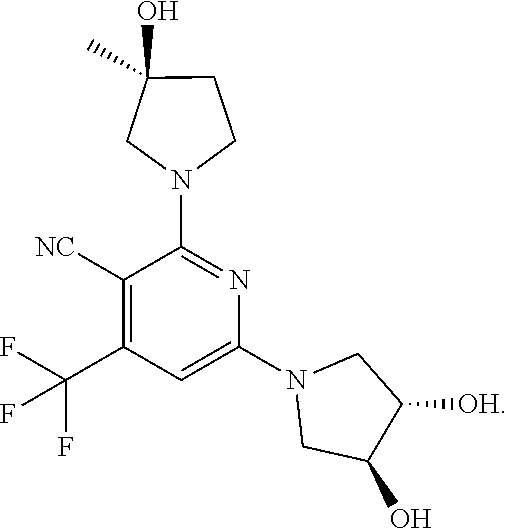
[0075]Another example of a KUM inhibitor is shown below (available from Millipore Sigma, see webpage at emdmillipore.com/US/en/product/Ketohexoinase-Inhibitor-Calbiochern, EMD_BIO-420640).

[0077]Other KHK inhibitors that can be used are any of those described in WO2011133750A1. For example, the KHK inhibitor can be a compound of formula II:

wherein:
- [0079]a is an integer from 0 to 1;
- [0080]X is —O— or —S—;
- [0081]R10 is C(1-4)alkyl or a halogenated C(1-4)alkyl;
- [0082]h is an integer from 0 to 2;
- [0083]R20 is halogen, hydroxy, cyano, nitro, NRARB, —O—C(1-4)alkyl, thioalkyl (e.g., —S—C(1-4)alkyl) or halogenated C(1-4)alkyl; wherein RA and R8 are independently hydrogen or C(1-4)alkyl;
- [0084]R30 is hydrogen, halogen, hydroxy, —O—C(1-4)alkyl, or NRCRD; wherein Rc and RD are each independently hydrogen or C(1-4)alkyl;
- [0085]Y is CH; Z is CH; or alternatively Y is CH and Z is N; or alternatively Y is N and Z is N;
- [0086]Q is -(L1)c-(Ring, A), -(L1)c-(Ring B)-(Ring C) or -(Ring B)-L1-(Ring C);
- [0087]c is art integer from 0 to 1;
- [0088]L1 is —CH2—, —CH(OH)—, —CH2CH2—, —CH2CH2CH2—, —CH═CH—, —CH═CH—CH2—, or —O—, —O—CH2—, —C(O)—, —C(0)-C(0)-, —C(0)-CH2—, —C(0)-N(R4)—, —N(R4)—, —N(R4)—CH2—, —N(R1)—CH2CH2—, —N(R4)—(CO)—, —N(R4)—C(O)—CH2—, —N(R4)—C(O)—CH2—CH2— and —N(R4)—C(O)—N(R5)—; wherein R4 and R5 are each independently hydrogen or C(1-2)alkyl;
- [0089](Ring A) is phenyl or 4-10 membered nitrogen containing ring; wherein (Ring A) is optionally substituted with halogen, C(1-4)alkyl, cyano, NRERF, —C(═NH)—NRERF, —C(O)—CH2—NRERF, —C(O)—CH2CH2—NRERP or phenyl; wherein RE and RF are each independently hydrogen or C(1-4)alkyl;
- [0090](Ring B) is phenyl or 410 membered nitrogen containing ring;
- [0091](Ring C) is 4-10 membered nitrogen containing ring wherein (Ring C) is optionally substituted with one to two C(1-4)alkyl.
Phosphoinositide 3-Kinase (PI3K)
[0092]The phosphoinositide 3-kinase (PI3K) signaling pathway is a key regulator in cancer proliferation (rapid increase or spread) and metastasis (development of secondary growths away from a primary site of cancer). The PI3K pathway includes four Class I isoforms: alpha, beta, delta and gamma (a, (3, (3, and 7). The four isoforms play unique roles in the survival of different tumor types and in the creation of supportive tumor microenvironments.
[0093]One example of an amino acid sequence for a Homo sapiens phosphoinositide 3-kinase (PI3K) is shown below as SEQ ID NO:12 (NCBI accession no. CAA72168.1).
| 1 | MSSTQDNGEH WKSLESVGIS RKELAMAEAL QMEYDALSRL |
| 41 | RHDKEENRAK QNADPSLISW DEPGVDFYSK PAGRRTDLKL |
| 81 | LRGLSGSDPT LNYNSLSPQE GPPNHSTSQG PQPGSDPWPK |
| 121 | GSLSGDYLYI FDGSDGGVSS SPGPGDIEGS CKKLSPPPLP |
| 161 | PRASIWDTPP LPPRKGSPSS SKISQPSDIN TFSLVEQLPG |
| 201 | KLLEHRILEE EEVLGGGGQG RLLGSVDYDG INDAIRTLNL |
| 241 | KSTYDVEMLR DATRGWKEGR GPLDFSKDTS GKPVARSKTM |
| 281 | PPQVPPRTYA SRYGNRKNAT PGKNRRISAA PVGSRPHTVA |
| 321 | NGHELFEVSE ERDEEVAAFC HMLDILRSGS DIQDYFLTGY |
| 361 | VWSAVTPSPE HLGDEVNLKV TVLCDRLQEA LTFTCNCSST |
| 401 | VDLLIYQTLC YTHDDLRNVD VGDFVLKPCG LEEFLQNKHA |
| 441 | LGSHEYIQYC RKFDIDIRLQ LMEQKVVRSD LARTVNDDQS |
| 481 | PSTLNYLVHL QERPVKQTIS RQALSLLFDT YHNEVDAFLL |
| 521 | ADGDFPLKAD RVVQSVKAIC NALAAVETPE ITSALNQLPP |
| 561 | CPSRMQPKIQ KDPSVLAVRE NREKVVEALT AAILDLVELY |
| 601 | CNTFNADFQT AVPGSRKHDL VQEACHFARS LAFTVYATHR |
| 641 | IPIIWATSYE DFYLSCSLSH GGKDMCSPLQ TRRAHFSKYL |
| 681 | FHLIVWDQQI CFPVQVNRLP RETLLCATLY ALPIPPPGSS |
| 721 | SEANKQRRVP EALGWVTTPL FNFRQVLTCG RKLLGLWPAT |
| 761 | QENPSARWSA PNFHQPDSVI LQIDFPTSAF DIKFTSPPGD |
| 801 | KFSPRYEFGS LREEDQRKLK DIMQKESLYW LTDADKKRLW |
| 841 | EKRYYCHSEV SSLPLVLASA PSWEWACLPD IYVLLKQWTH |
| 881 | MNHQDALGLL HATFPDQEVR RMAVQWISGL SDAELLDYLP |
| 921 | QLVQALKYEC YLDSPLVRFL LKRAVSDLRV THYFFWLLKD |
| 961 | GLKDSQFSIR YQYLLAALLC CCGKGLREEF NRQCWLVNAL |
| 1001 | AKLAQQVREA APSARQGILR TGLEEVKQFF ALNGSCRLPL |
| 1041 | SPSLLVKGIV PRDCSYFNSN AVPLKLSGQN VDPLGENIRV |
| 1081 | IFKCGDDLRQ DMLTLQMIRI MSKIWVQEGL DMRMVIFRCF |
| 1121 | STGRGRGMVE MIPNAETLRK IQVHEGVTGS FKDRPLADWL |
| 1161 | QKHNPGEDEY EKAVENFIYS CAGCCVATYV LGICKRHNDN |
| 1201 | IMLKTTGHMF HIDFGRFLGH AQMFGNIKRD RAPFVFTSDM |
| 1241 | AYVINGGDKP SSRFHDFVDL CCQAYNLIRK HTHLFLNLLG |
| 1281 | LMLSCGIPEL SDLEDLKYVY DALRPQDTEA NATTYFTRLI |
| 1321 | ESSLGSVATK LNFFIHNLAQ MKFTGSDDRL TLSFASRTHT |
| 1361 | LKSSGRISDV FLCRHEKIFH PNKGYIYVVK VMRENTHEAT |
| 1401 | YIQRTFEEFQ ELHNKLRLLF PSSHLPSFPS RFVIGRSRGE |
| 1441 | AVAERRREEL NGYIWHLIHA PPEVAECDLV YTFFHPLPRD |
| 1481 | EKAMGTSPAP KSSDGTWARP VGKVGGEVKL SISYKNNKLF |
| 1521 | IMVMHIRGLQ LLQDGNDPDP YVKIYLLPDP QKTTKRKTKV |
| 1561 | ARKTCNPTYN EMLVYDGIPK GDLQQRELQL SVLSEQGFWE |
| 1601 | NVLLGEVNIR LRELDLAQEK TGWFALGSRS HGTL |
[0095]An example of a cDNA that encodes the Homo sapiens phosphoinositide 3-kinase (PI3K) protein with SEQ ID NO:12 is shown below as SEQ ID NO:13 (with NCBI accession no. Y11312.1).
| 1 | ACTCACTATA GGGCTCGAGC GGCCGCCCGG GCAGGTAAGA |
| 41 | ATCAGAAGAC ATTTGTGCTT TGGGGAGCAG AGGCCCTCAG |
| 81 | GGTATAGAGA AGGAAGAAGA GAGAGGTTCA CTGTAGTCCT |
| 121 | GAAGCAGAAA TAAGACCTGT GGCTGAAGGA AGCCTTAGCA |
| 161 | ATTCACTCCT TCCTCTTCCT GAGAACTCTC TGTAGGAAGT |
| 201 | CTCACCTAGC AGAGGCTTCA CAGTATTTCA GAGAAGCCAA |
| 241 | AGATTGTTTG CCTCTTTGGA AACTGTTATC CTTCCATCAT |
| 281 | GACTGTGTCA CTCCTGCCAC TGTTCCACCA TAGAGATGGC |
| 321 | GTCCTTTGCA GCAAACCGTA AGTTATAAGG ATGAGGGAAG |
| 361 | AAGAGTAGAG GGCCAAAAGG ATTCCATTTT GAGGAAAAAC |
| 401 | TACAGTTTGC CTTGCCAGGT AGAAGAATCA GGCGCCCAGA |
| 441 | CACCATGTCA CAACCCTCCA GAACTGACGT TGGCAGGAAG |
| 481 | TAGAGACTTT GTTGCCTGTG TCCCCCATCC TCACCATGTC |
| 521 | TTCGACTCAG GACAATGGGG AACACTGGAA GTCCCTGGAG |
| 561 | TCTGTGGGCA TCAGCCGCAA AGAACTAGCG ATGGCCGAAG |
| 601 | CCCTGCAGAT GGAGTATGAT GCCCTGTCCC GGCTCCGGCA |
| 641 | TGACAAGGAG GAGAACAGAG CCAAGCAGAA CGCAGACCCC |
| 681 | TCTCTCATCA GCTGGGATGA GCCTGGGGTA GACTTTTACA |
| 721 | GCAAGCCAGC AGGAAGGCGG ACCGACCTCA AGCTGTTACG |
| 761 | CGGTCTCTCT GGCTCTGATC CTACCCTTAA CTACAACTCA |
| 801 | CTATCCCCAC AGGAAGGGCC GCCCAACCAC TCTACCTCCC |
| 841 | AAGGGCCACA GCCTGGCTCA GATCCCTGGC CCAAAGGCTC |
| 881 | CCTGTCTGGA GACTATCTCT ACATTTTTGA TGGTTCAGAT |
| 921 | GGGGGAGTCT CTTCGTCCCC AGGACCAGGG GACATAGAGG |
| 961 | GCTCTTGCAA GAAACTATCC CCACCTCCTC TGCCTCCCCG |
| 1001 | AGCTTCTATC TGGGATACCC CTCCCCTGCC TCCCAGAAAG |
| 1041 | GGGTCCCCCT CATCCTCCAA GATCTCCCAG CCCAGTGACA |
| 1081 | TCAACACTTT CTCTTTGGTC GAACAATTGC CAGGCAAACT |
| 1121 | GCTAGAGCAT CGGATCCTAG AAGAGGAAGA GGTGCTGGGA |
| 1161 | GGTGGGGGTC AGGGGCGCCT ACTGGGGTCT GTGGACTATG |
| 1201 | ATGGTATCAA TGATGCAATT ACTAGGCTCA ACTTGAAATC |
| 1241 | GACCTATGAT GTGGAGATGT TGCGGGATGC CACCAGGGGC |
| 1281 | TGGAAGGAGG GCCGAGGGCC GCTGGACTTC AGCAAAGACA |
| 1321 | CCTCTGGAAA ACCCGTGGCC AGGAGCAAGA CTATGCCCCC |
| 1361 | TCAGGTGCCC CCCCGCACCT ATGCCTCCCG CTATGGCAAC |
| 1401 | CGAAAGAATG CGACGCCTGG CAAGAACCGC CGGATTTCTG |
| 1441 | CAGCCCCGGT GGGCTCCCGG CCCCACACTG TTGCCAATGG |
| 1481 | CCATGAGTTG TTTGAGGTCT CAGAAGAGAG AGATGAGGAG |
| 1521 | GTTGCTGCAT TTTGCCACAT GCTGGATATC CTTCGATCTG |
| 1561 | GCTCTGACAT CCAAGACTAC TTCCTCACTG GCTATGTCTG |
| 1601 | GAGTGCTGTC ACCCCTAGCC CAGAGCACCT CGGGGATGAG |
| 1641 | GTCAACCTGA AGGTGACTGT GTTGTGTGAC AGGCTTCAAG |
| 1681 | AGGCACTCAC TTTCACCTGC AACTGTTCCT CCACTGTAGA |
| 1721 | CTTGCTTATC TACCAGACCC TGTGCTACAC CCATGATGAC |
| 1761 | CTGAGGAATG TGGACGTGGG TGACTTTGTG CTAAAGCCCT |
| 1801 | GCGGGCTGGA GGAGTTCCTG CAGAACAAGC ATGCCTTGGG |
| 1841 | CAGTCATGAG TACATCCAAT ACTGCCGCAA GTTTGACATT |
| 1881 | GACATTCGGC TACAGCTGAT GGAGCAGAAG GTTGTGCGCA |
| 1921 | GTGACCTGGC CCGGACGGTG AATGATGACC AGAGCCCCTC |
| 1961 | CACCTTGAAC TACCTCGTCC ATCTCCAAGA GAGGCCTGTC |
| 2001 | AAGCAGACCA TCAGCAGGCA GGCCCTGAGT CTTCTGTTCG |
| 2041 | ACACTTACCA CAATGAGGTG GATGCCTTCC TGCTGGCTGA |
| 2081 | TGGAGACTTC CCACTGAAGG CTGACAGGGT GGTCCAGTCC |
| 2121 | GTCAAGGCCA TCTGCAACGC CCTGGCCGCC GTGGAAACCC |
| 2161 | CTGAGATCAC CAGTGCTCTC AACCAGCTGC CCCCCTGCCC |
| 2201 | CTCCCGCATG CAGCCTAAAA TTCAGAAGGA TCCCAGTGTC |
| 2241 | TTGGCTGTGA GGGAAAACCG AGAGAAGGTC GTGGAAGCCC |
| 2281 | TGACCGCTGC CATCTTGGAC CTGGTGGAGC TGTACTGCAA |
| 2321 | CACATTCAAC GCAGACTTCC AGACGGCAGT GCCCGGGAGC |
| 2361 | CGCAAGCATG ACCTGGTCCA GGAGGCCTGC CATTTCGCCA |
| 2401 | GGTCCCTGGC CTTCACTGTC TATGCCACCC ACCGCATCCC |
| 2441 | CATCATCTGG GCTACCAGCT ATGAAGATTT CTACCTCTCC |
| 2481 | TGCTCCCTCA GCCATGGCGG CAAGGACATG TGCAGCCCCC |
| 2521 | TGCAGACCCG AAGAGCTCAC TTCTCCAAGT ACCTCTTCCA |
| 2561 | CCTCATCGTC TGGGACCAGC AGATCTGCTT CCCAGTGCAG |
| 2601 | GTGAACCGGC TGCCTCGGGA GACACTGCTG TGTGCCACTC |
| 2641 | TCTATGCTCT GCCCATCCCC CCACCGGGGA GCTCCTCAGA |
| 2681 | GGCCAATAAG CAGCGGCGGG TGCCTGAAGC CCTGGGCTGG |
| 2721 | GTCACTACCC CACTCTTCAA CTTCAGGCAG GTCCTGACCT |
| 2761 | GTGGCCGGAA GCTTCTGGGT TTGTGGCCAG CAACACAGGA |
| 2801 | AAATCCCAGC GCCCGTTGGA GTGCACCTAA TTTCCACCAG |
| 2841 | CCAGACAGTG TCATCCTGCA GATTGACTTC CCCACCTCGG |
| 2881 | CCTTTGACAT CAAGTTCACC AGCCCCCCTG GAGACAAGTT |
| 2921 | CAGCCCCCGC TATGAGTTTG GCAGCCTCCG GGAAGAAGAC |
| 2961 | CAGCGCAAGC TTAAAGACAT CATGCAGAAA GAGTCCTTGT |
| 3001 | ACTGGCTCAC TGATGCTGAC AAGAAGCGCC TGTGGGAGAA |
| 3041 | GCGATATTAC TGCCACTCGG AGGTGAGCTC GCTCCCCCTG |
| 3081 | GTGCTCGCCA GCGCCCCCAG CTGGGAGTGG GCTTGCCTGC |
| 3121 | CTGACATCTA TGTTCTCCTG AAGCAGTGGA CCCACATGAA |
| 3161 | CCACCAGGAT GCCCTGGGGC TCCTGCATGC CACCTTCCCG |
| 3201 | GACCAGGAGG TGCGTCGTAT GGCTGTGCAG TGGATTGGCT |
| 3241 | CACTCTCAGA TGCTGAGCTG CTAGACTACC TGCCCCAGCT |
| 3281 | GGTACAGGCC CTGAAGTATG AATGCTACCT GGACAGCCCG |
| 3321 | TTGGTGCGCT TCCTCCTGAA ACGAGCTGTG TCTGACTTGA |
| 3361 | GAGTGACTCA CTACTTCTTC TGGTTACTGA AGGACGGCCT |
| 3401 | CAAGGACTCT CAGTTCAGCA TCCGCTACCA GTATCTGCTG |
| 3441 | GCAGCCTTAC TGTGCTGCTG TGGCAAGGGG CTGAGAGAAG |
| 3481 | AGTTTAACCG CCAGTGCTGG CTTGTCAATG CCCTGGCCAA |
| 3521 | ACTGGCCCAG CAGGTCCGGG AGGCAGCCCC ATCTGCAAGG |
| 3561 | CAGGGAATCC TCCGCACGGG CCTGGAGGAG GTGAAGCAGT |
| 3601 | TCTTTGCCCT CAATGGCTCG TGCCGCTTGC CACTCAGCCC |
| 3641 | CAGTCTGCTG GTTAAGGGAA TTGTGCCCAG GGACTGTTCC |
| 3681 | TACTTCAACT CCAATGCTGT CCCCCTCAAA CTCTCCTTCC |
| 3721 | AAAATGTGGA TCCCCTGGGT GAGAACATCC GTGTCATCTT |
| 3761 | CAAGTGTGGG GACGACCTTC GCCAGGACAT GCTAACGCTG |
| 3801 | CAGATGATTC GCATCATGAG CAAGATCTGG GTCCAGGAGG |
| 3841 | GGCTGGACAT GCGCATGGTC ATCTTCCGCT GCTTCTCCAC |
| 3881 | CGGCCGGGGC AGAGGGATGG TGGAGATGAT CCCTAATGCT |
| 3921 | GAGACCCTGC GTAAGATCCA GGTGGAGCAT GGGGTGACCG |
| 3961 | GCTCGTTCAA GGACCGGCCC CTGGCAGACT GGCTGCAGAA |
| 4001 | ACACAACCCT GGGGAGGACG AGTATGAGAA GGCTGTGGAG |
| 4041 | AACTTTATCT ACTCCTGCGC TGGCTGCTGC GTGGCCACGT |
| 4081 | ACGTCTTGGG CATCTGTGAC CGACATAATG ACAACATCAT |
| 4121 | GCTGAAGACC ACTGGTCACA TGTTCCACAT TGATTTTGGC |
| 4161 | CGCTTCCTGG GCCATGCCCA GATGTTTGGC AACATCAAGC |
| 4201 | GGGACCGTGC CCCCTTTGTC TTCACCTCGG ACATGGCGTA |
| 4241 | TGTCATCAAC GGGGGTGACA AGCCTTCCAG CCGCTTCCAT |
| 4281 | GATTTTGTTG ACCTTTGCTG CCAAGCCTAC AACCTCATTC |
| 4321 | GCAAGCACAC CCACCTCTTC CTCAACCTTC TGGGCCTGAT |
| 4361 | GTTGTCCTGT GGGATCCCTG AACTCTCAGA CCTGGAGGAC |
| 4401 | CTCAAGTATG TGTACGATGC CCTGAGGCCT CAGGATACAG |
| 4441 | AGGCCAATGC CACTACCTAC TTCACTAGGT TGATTGAGTC |
| 4481 | CAGCCTGGGC AGTGTAGCCA CAAAGCTCAA TTTTTTCATC |
| 4521 | CATAATCTGG CTCAGATGAA GTTCACGGGC TCAGATGACC |
| 4561 | GGCTGACCCT CTCCTTTGCC TCCCGAACAC ACACTCTCAA |
| 4601 | GAGCTCTGGC CGAATCAGTG ATGTTTTCCT CTGCCGCCAT |
| 4641 | GAGAAGATCT TCCACCCCAA CAAAGGCTAT ATATATGTGG |
| 4681 | TAAAGGTGAT GCGAGAGAAC ACTCACGAGG CCACCTACAT |
| 4721 | CCAGCGGACC TTTGAGGAGT TCCAGGAATT ACACAATAAG |
| 4761 | TTGCGGCTGC TCTTCCCTTC TTCCCACTTG CCCAGCTTCC |
| 4801 | CTAGTCGCTT CGTGATCGGC CGCTCCCGGG GAGAGGCGGT |
| 4841 | GGCCGAGCGG CGGAGGGAGG AGCTAAACGG TTACATCTGG |
| 4881 | CACTTGATCC ACGCACCCCC TGAGGTGGCC GAGTGTGATT |
| 4921 | TGGTGTACAC CTTCTTCCAC CCACTGCCCC GGGATGAGAA |
| 4961 | GGCTATGGGC ACCAGCCCAG CTCCTAAGTC CTCAGATGGC |
| 5001 | ACATGGGCCC GGCCCGTCGG AAAGGTGGGA GGGGAGGTGA |
| 5041 | AGCTGTCCAT CTCCTACAAA AACAATAAAC TCTTCATCAT |
| 5081 | GGTGATGCAT ATTCGGGGCT TGCAACTGCT CCAGGATGGA |
| 5121 | AATGACCCTG ACCCCTATGT GAAAATTTAC CTCCTTCCTG |
| 5161 | ACCCTCAGAA AACCACTAAG AGGAAAACCA AAGTGGCCCG |
| 5201 | GAAAACCTGC AATCCTACCT ACAATGAGAT GTTGGTATAT |
| 5241 | GATGGGATCC CCAAGGGTGA CCTGCAGCAG CGGGAGCTCC |
| 5281 | AGCTGAGCGT GCTGAGTGAG CAGGGATTCT GGGAGAACGT |
| 5321 | CCTCCTCGGT GAGGTGAACA TCCGCCTGCG AGAGCTGGAC |
| 5361 | CTGGCTCAGG AGAAGACCGG CTGGTTCGCC CTGGGATCTC |
| 5401 | GAAGTCATGG CACCTTGTGA GCCCAGCAGA GCCACCACCC |
| 5441 | AGCATCCCAG GCTGGTGGCA GGAGCTGGGG GAGAGGACTC |
| 5481 | TCCCCTGTGA GACTCCTCCT TGTGAAGGGC CAGGGCCCTG |
| 5521 | GGCAGGCCTC CAGCTCGGTC CAGGTGATTC TGGCCTCTGT |
| 5561 | GGTAGGAGGC AGGGAGAGTA AGACATGCTC TGCTGTCTCT |
| 5601 | TCCTCTGGAG ACTGAACTTG GGTTGGTTGT GATGAGCAGC |
| 5641 | CCCTTGGAGG CTGTGAGGTT GCAGCAAAGT TTTAAGTTTA |
| 5681 | CCTTGTGTCA AGGGAGCAAT GCTTGGTTTG GGGAATGTGT |
| 5721 | GGGGTGGGCT GTATGAAGTA CCATTTTGGG GGTGGGTGGG |
| 5761 | TGGATATCTT AATTTTTATT TTTAAAAAAT GAAATAGTGA |
| 5801 | TGTTGTCCTA ACTGGGACAG GAAGCCTTGC GAGAAGGGAC |
| 5841 | GTACCTATGC CCCACAAGGC AAGAGAGGAA CACTATTTGG |
| 5881 | ACTTTTTGTA TGATTAAGGT TCTTATTGGA CTTTTCCCTA |
| 5921 | GGTTTTTTTT TTTTGTTATT GTTGTTGTTG TTCCGTTTTC |
| 5961 | TAGCTATAGG AACTATCTGG GGAGGGGCCC AGTGGGTCCT |
| 6001 | CGGCCAGAGC CCTCTCTAAG GACAGGTTGG GGAGGGTTGG |
| 6041 | GGAGGGCTGC CTGTGCTGGA CTGAGGCTTG TGCCACTGGG |
| 6081 | CCTTTCTGAT TTTGCCTCCA AAGGAGAGCG CTGTGATACC |
| 6121 | TACATGTGTA AGGAAGGGCC TTCCGTATTG GGGTTCTGCC |
| 6161 | AAGGACCCGT ATTCAGGGAC CCATGCTCTT TTGGGGGGAC |
| 6201 | TTTTCCTCTT GTCTTCCCTA CTTTATTAGG ACTTGCCCTG |
| 6241 | AATACCATTT TCTACCCCTT GCCCCTCCAT TCTCCTGGCC |
| 6281 | CTTCTGGGGG TCAGCTGGTC TCTATGAATA TGCTGGGGGT |
| 6321 | GCTTCCCCAT AGGTCTCTCC CTTCATTTGT CTCTGGTGGG |
| 6361 | ACAAAATACT GACTCAGTCC TTAGATGTAG TTTCACCCAA |
| 6401 | GAGCATCTTG GCCCTGGGAA GAGGTCCCTA GGCTGCAGAT |
| 6441 | GCTACTGACT GCTTGCTAGG TAGCCTCTGG AAAGCATTCC |
| 6481 | CCATCCATCA CTCCCCACTT CTTTCTGCTG TGCTGCTTCC |
| 6521 | CTCCCAAACT CCATTTCTGT CACCCTTTTT ATAAGACTTT |
| 6561 | TCCTCATTCT GTGGGGCCAT AAACCTATTT AGTCTGGAGC |
| 6601 | CAAAGGGATG CCCTATCTGA AGGAAAGGGG CATGGGGTGG |
| 6641 | GGGATTCCAT CAAAACTGTT GTTTTTTGCC CCATGATTTT |
| 6681 | TCTTTGGTCA GTAGGAGGCT GGATTGGAGT GGTGATTATT |
| 6721 | CCCCTGGAGC TAAGCTCAGG AGCCCGAAGG GAGAGACTGA |
| 6761 | GACTGACTCC CTTATCTCTT CATATTCTTT ATTCCCTACC |
| 6801 | AGATGGATTT TTTTTTTTTT TTTTGGAGAC GGAGTCTCGC |
| 6841 | CCTGTCGCCA GGCTGGAGTG TAGTGGCATG ATCTCGACTC |
| 6881 | ACTGCAAAAT CTGCCTCCCG GGTTCAAGCG ATTCTCCTAC |
| 6921 | CTCAGCCTCC CGAGTAGCTG GGATTACAGG CATGTGCCAC |
| 6961 | CACGCCAAGC TAATTTTTGT ATTTTTAGTA GAGACGGGGT |
| 7001 | TTCACCATGT TGGCCAGGAT GGTCTCGATC TCTTGACCTC |
| 7041 | GTGATCTGCC TGCCTTGGCC TCCCAAAGTG CTGGGATTAC |
| 7081 | AGGCGTGAGC CACCATGCCC CGCCCCAGAT GGATTTTACA |
| 7121 | TTTGCTCTTT TGTGTTTCGC TCCAAAGGGT TGTCTTCCTC |
| 7161 | GCCAAAAGGA GGGAGGGACT TTGAATTTGA TATGAATCTT |
| 7201 | TAAAACCAGA ATTGGCTGGA TATTTCCCAT GATTGGGAAA |
| 7241 | AGAGTGAAAT GAGGACATTC TGTAAACTGT CCCTCCCTAA |
| 7281 | TTCCAAGGAT CAGAAACTCC CCGTTTTGCT GACTCATTCC |
| 7321 | ATAACTGGAG AAAGAAGCTC CATTGACCGA AGCCACAGGG |
| 7361 | CAGCATGGAA GTTTAAATTT TCTCTAAAAT TAAAATGCCA |
| 7401 | AGGATAAAGC TGGCTGCTTC CAGGAGGGGG AAGAGGAGTG |
| 7441 | GGGAGTGGGC GGTGAAACTT TTCCAGATGA ACGGACCATA |
| 7481 | AATGTGTTAC TGGCTTTGTG CCTGTAGCTC ATTTTATTAT |
| 7521 | GACCTATATG CTCCTGATTT AAAGAGATCT GTGTACTGTT |
| 7561 | TACTTCCCAC TTCCCAGAAT CCCTTGTATC TCCTTTCTCG |
| 7601 | GGAATTGTAT TTTCTAATAA ATGACATTTG AGAAAAAAAA |
| 7641 | AAAAAAAAAA AAAA |
[0097]Subjects can express a phosphoinositide 3-kinase PI3K) enzyme can have one or more amino acid differences compared to the sequences described herein. For example, subjects can express a PI3K enzyme at least 80%, at least 85%, at least 90%, at least 95%, at least 96%, at least 97%, at least 99% amino acid sequence identity or similarity with the PI3K amino acid sequences described herein. Similarly, subjects can express PI3K RNA with one or more nucleotide differences compared to the PI3K nucleic acids described herein. For example, subjects can express a PI3K RNA at least 80%, at least 85%, at least 90%, at least 95%, at least 96%, at least 97%, at least 99% amino acid sequence identity or similarity with the PI3K nucleic acid sequences described herein.
[0098]As described herein, inhibition of PI3K can inhibit cancer, including colorectal cancer and cancers of the small intestine, as well as intestinal polyps or adenomas that may eventually turn into cancer. Examples of inhibitors of PI3K that can be used include the following compounds:
- [0100]p110a inhibitors such as Taselisib/GDC-0032, Alpelisib/BYL-719, Serabelisib/MLN1117;
- [0101]p110b inhibitors such as GSK2636771;
- [0102]p110d inhibitors such as Idelalisib/CAL-101, Duvelisib/IPI-145;
- [0103]PI3K/mTOR inhibitors such as BEZ235, GDC-0980, PKI-587, 765/SAR245409, BGT226, DS-7423, PLVT33597, or SF1126.
Fatty Acid Synthase (FASN)
[0104]Fatty acid synthase is a multi-enzyme protein that catalyzes fatty acid synthesis. It is not a single enzyme but a whole enzymatic system composed of two identical 272 kDa multifunctional polypeptides, in which substrates are handed from one functional domain to the next.
[0105]One example of an amino acid sequence for a Homo sapiens fatty acid synthase (FASN) is shown below as SEQ ID NO:14 (NCBI accession no. NP_004095.4).
| 1 | MEEVVIAGMS GKLPESENLQ EFWDNLIGGV DMVTDDDRRW |
| 41 | KAGLYGLPRR SGKLKDLSRF DASFFGVHPK QHATMDPQLR |
| 81 | LLLEVTYEAI VDGGINPDSL RGTHTGVWVG VSGSETSEAL |
| 121 | SRDPETLVGY SMVGCQRAMM ANRLSFFFDF RGPSIALDTA |
| 161 | CSSSLMALQN AYQAIHSGQC PAAIVGGINV LLKPNTSVQF |
| 201 | LRLGMLSPEG TCKAFDTAGN GYCRSEGVVA VLLTKKSLAR |
| 241 | RVYATILNAG TNTDGFKEQG VTFPSGDIQE QLIRSLYQSA |
| 281 | GVAPESFEYI EAHGTGTKVG DPQELNGITR ALCARTQEPL |
| 321 | LIGSTKSNMG HPEPASGLAA LAKVLLSLEH GLWAPNLHFH |
| 361 | SPNPEIPALL DGRLQVVDQP LPVRGGNVGI NSFGFGGSVN |
| 401 | HIILRPNTQP PPAPAPHATL PRLLRASGRT PEAVQKLLEQ |
| 441 | GLRHSQDLAF LSMLNDIAAV PATAMPFRGY AVLGGERGGP |
| 481 | EVQQVPAGER PLWFICSGMG TQWRGMGLSL MRLDRFRDSI |
| 521 | LRSDEAVKPF GLKVSQLLLS TDESTFDDIV HSFVSLTAIQ |
| 561 | IGLIDLLSCM GLRPDGIVGH SLGEVACGYA DGCLSQEEAV |
| 601 | LAAYWRGQCI KEAHLPPGAM AAVGLSWEEC KQRCPPGVVP |
| 641 | ACHNSKDTVT ISGPQAPVFE FVEQLRKEGV FAKEVRTGGM |
| 681 | AFHSYFMEAI APPLLQELKK VIREPKPRSA RWLSTSIPEA |
| 721 | QWHSSLARTS SAEYNVNNLN SPVLFQEALW HVPEHAVVLE |
| 761 | IAPHALLQAV LKRGLKPSCT IIPLMKKDHR DNLEFFLAGI |
| 801 | GRLHLSGIDA NPNALFPPVE FPAPRGTPLI SPLIKWDHLS |
| 841 | AWDVPAAEDF PNGSGSPSAA IYNIDTSSES PDHYLVDHTL |
| 881 | DGRVLFPATG YLSIVWKTLA RALGLGVEQL PVVFEDVVLH |
| 921 | QATILPKTGT VSLEVRLLEA SRAFEVSENG NLVVSGKVYQ |
| 961 | WDDPDPRLFD HPESPTPNPT EPLFLAQAEV YKELRLRGYD |
| 1001 | YGPHFQGILE ASLEGDSGRL LWKDNWVSFM DTMLQMSILG |
| 1041 | SAKHGLYLPT RVTAIHIDPA THRQKLYTLQ DKAQVADVVV |
| 1081 | SRWLRVTVAG GVHISGLHTE SAPRRQQEQQ VPILEKFCFT |
| 1121 | PHTEEGCLSE RAALQEELQL CKGLVQALQT KVTQQGLKMV |
| 1161 | VPGLDGAQIP RDPSQQELPR LLSAACRLQL NGNLQLELAQ |
| 1201 | VLAQERPKLP EDPLLSGLLD SPALKACLDT AVENMPSLKM |
| 1241 | KVVEVLAGHG HLYSRIPGLL SPHPLLQLSY TATDRHPQAL |
| 1281 | EAAQAELQQH DVAQGQWDPA DPAPSALGSA DLLVCNCAVA |
| 1321 | ALGDPASALS NMVAALREGG FLLLHTLLRG HPLGDIVAFL |
| 1361 | TSTEPQYGQG ILSQDAWESL FSRVSLRLVG LKKSFYGSTL |
| 1401 | FLCRRPTPQD SPIFLPVDDT SFRWVESLKG ILADEDSSRP |
| 1441 | VWLKAINCAT SGVVGLVNCL RREPGGNRLR CVLLSNLSST |
| 1481 | SHVPEVDPGS AELQKVLQGD LVMNVYRDGA WGAFRHFLLE |
| 1521 | EDKPEEPTAH AFVSTLTRGD LSSIRWVCSS LRHAQPTCPG |
| 1561 | AQLCTVYYAS LNFRDIMALT GKLSPDAIPG KWTSQDSLLG |
| 1601 | MEFSGRDASG KRVMGLVPAK GLATSVLLSP DFLWDVPSNW |
| 1641 | TLEEAASVPV VYSTAYYALV VRGRVRPGET LLIHSGSGGV |
| 1681 | GQAAIAIALS LGCRVFTTVG SAEKRAYLQA RFPQLDSTSF |
| 1721 | ANSRDTSFEQ HVLWHTGGKG VDLVLNSLAE EKLQASVRCL |
| 1761 | ATHGRFLEIG KFDLSQNHPL GMAIFLKNVT FHGVLLDAFF |
| 1801 | NESSADWREV WALVQAGIRD GVVRPLKCTV FHGAWVEDAF |
| 1841 | RYAMQGKHIG KVVVQVLAEE PEAVLKGAKP KLMSAISKTF |
| 1881 | CPAHKSYIIA GGLGGFGLEL AQWLIQRGVQ KLVLTSRSGI |
| 1921 | RTGYQAKQVR RWRRQGVQVQ VSTSNISSLE GARGLIAEAA |
| 1961 | QLGPVGGVFN LAVVLRDGLL NEQTPEFFQD VCKPKYSGTL |
| 2001 | NLDRVTREAC PELDYFVVFS SVSCGRGNAG QSNYGFANSA |
| 2041 | MERICEKRRH EGLPGLAVQW GAIGDVGILV ETMSTNDTIV |
| 2081 | SGTLPQRMAS CLEVLDLFLN QPHMVLSSFV LAEKAAAYRD |
| 2121 | RDSQRDLVEA VAHILGIRDL AAVNLDSSLA DLGLDSLMSV |
| 2161 | EVRQTLEREL NLVLSVREVR QLTLRKLQEL SSKADEASEL |
| 2201 | ACPTPKEDGL AQQQTQLNLR SLLVNPEGPT LMRLNSVQSS |
| 2241 | ERPLFLVHPI EGSTTVFHSL ASRLSIPTYG LQCTRAAPLD |
| 2281 | SIHSLAAYYI DCIRQVQPEG PYRVAGYSYG ACVAFEMCSQ |
| 2321 | LQAQQSPAPT HNSLFLFDGS PTYVLAYTQS YRAKLTPGCE |
| 2361 | AEAETEAICF FVQQFTDMEH NRVLEALLPL KGLEERVAAA |
| 2401 | VDLIIKSHQG LDRQELSFAA RSFYYKLRAA EQYTPKAKYH |
| 2441 | GNVMLLRAKT GGAYGEDLGA DYNLSQVCDG GVSVHVIEGD |
| 2481 | HRTLLEGSGL ESIISIIHSS LAEPRVSVRE G |
[0107]An example of a cDNA that encodes the Home sapiens fatty acid synthase (FASN) protein with SEQ ID NO: 14 is shown below as SEQ ID NO:15 (with NCBI accession no. NM_004104.5).
| 1 | GAGCCAGAGA GACGGCAGCG GCCCCGGCCT CCCTCTCCGC |
| 41 | CGCGCTTCAG CCTCCCGCTC CGCCGCGCTC CAGCCTCGCT |
| 81 | CTCCGCCGCC CGCACCGCCG CCCGCGCCCT CACCAGAGCA |
| 121 | GCCATGGAGG AGGTGGTGAT TGCCGGCATG TCCGGGAAGC |
| 161 | TGCCAGAGTC GGAGAACTTG CAGGAGTTCT GGGACAACCT |
| 201 | CATCGGCGGT GTGGACATGG TCACGGACGA TGACCGTCGC |
| 241 | TGGAAGGCGG GGCTCTACGG CCTGCCCCGG CGGTCCGGCA |
| 281 | AGCTGAAGGA CCTGTCTAGG TTTGATGCCT CCTTCTTCGG |
| 321 | AGTCCACCCC AAGCAGGCAC ACACGATGGA CCCTCAGCTG |
| 361 | CGGCTGCTGC TGGAAGTCAC CTATGAAGCC ATCGTGGACG |
| 401 | GAGGCATCAA CCCAGATTCA CTCCGAGGAA CACACACTGG |
| 441 | CGTCTGGGTG GGCGTGAGCG GCTCTGAGAC CTCGGAGGCC |
| 481 | CTGAGCCGAG ACCCCGAGAC ACTCGTGGGC TACAGCATGG |
| 521 | TGGGCTGCCA GCGAGCGATG ATGGCCAACC GGCTCTCCTT |
| 561 | CTTCTTCGAC TTCAGAGGGC CCAGCATCGC ACTGGACACA |
| 601 | GCCTGCTCCT CCAGCCTGAT GGCCCTGCAG AACGCCTACC |
| 641 | AGGCCATCCA CAGCGGGCAG TGCCCTGCCG CCATCGTGGG |
| 681 | GGGCATCAAT GTCCTGCTGA AGCCCAACAC CTCCGTGCAG |
| 721 | TTCTTGAGGC TGGGGATGCT CAGCCCCGAG GGCACCTGCA |
| 761 | AGGCCTTCGA CACAGCGGGG AATGGGTACT GCCGCTCGGA |
| 801 | GGGTGTGGTG GCCGTCCTGC TGACCAAGAA GTCCCTGGCC |
| 841 | CGGCGGGTGT ACGCCACCAT CCTGAACGCC GGCACCAATA |
| 881 | CAGATGGCTT CAAGGAGCAA GGCGTGACCT TCCCCTCAGG |
| 921 | GGATATCCAG GAGCAGCTCA TCCGCTCGTT GTACCAGTCG |
| 961 | GCCGGAGTGG CCCCTGAGTC ATTTGAATAC ATCGAAGCCC |
| 1001 | ACGGCACAGG CACCAAGGTG GGCGACCCCC AGGAGCTGAA |
| 1041 | TGGCATCACC CGAGCCCTGT GCGCCACCCG CCAGGAGCCG |
| 1081 | CTGCTCATCG GCTCCACCAA GTCCAACATG GGGCACCCGG |
| 1121 | AGCCAGCCTC GGGGCTGGCA GCCCTGGCCA AGGTGCTGCT |
| 1161 | GTCCCTGGAG CACGGGCTCT GGGCCCCCAA CCTGCACTTC |
| 1201 | CATAGCCCCA ACCCTGAGAT CCCAGCGCTG TTGGATGGGC |
| 1241 | GGCTGCAGGT GGTGGACCAG CCCCTGCCCG TCCGTGGCGG |
| 1281 | CAACGTGGGC ATCAACTCCT TTGGCTTCGG GGGCTCCAAC |
| 1321 | GTGCACATCA TCCTGAGGCC CAACACGCAG CCGCCCCCCG |
| 1361 | CACCCGCCCC ACATGCCACC CTGCCCCGTC TGCTGCGGGC |
| 1401 | CAGCGGACGC ACCCCTGAGG CCGTGCAGAA GCTGCTGGAG |
| 1441 | CAGGGCCTCC GGCACAGCCA GGACCTGGCT TTCCTGAGCA |
| 1481 | TGCTGAACGA CATCGCGGCT GTCCCCGCCA CCGCCATGCC |
| 1521 | CTTCCGTGGC TACGCTGTGC TGGGTGGTGA GCGCGGTGGC |
| 1561 | CCAGAGGTGC AGCAGGTGCC CGCTGGCGAG CGCCCGCTCT |
| 1601 | GGTTCATCTG CTCTGGGATG GGCACACAGT GGCGCGGGAT |
| 1641 | GGGGCTGAGC CTCATGCGCC TGGACCGCTT CCGAGATTCC |
| 1681 | ATCCTACGCT CCGATGAGGC TGTGAAGCCA TTCGGCCTGA |
| 1721 | AGGTGTCACA GCTGCTGCTG AGCACAGACG AGAGCACCTT |
| 1761 | TGATGACATC GTCCATTCGT TTGTGAGCCT GACTGCCATC |
| 1801 | CAGATAGGCC TCATAGACCT GCTGAGCTGC ATGGGGCTGA |
| 1841 | GGCCAGATGG CATCGTCGGC CACTCCCTGG GGGAGGTGGC |
| 1881 | CTGTGGCTAC GCCGACGGCT GCCTGTCCCA GGAGGAGGCC |
| 1921 | GTCCTCGCTG CCTACTGGAG GGGACAGTGC ATCAAAGAAG |
| 1961 | CCCATCTCCC GCCGGGCGCC ATGGCAGCCG TGGGCTTGTC |
| 2001 | CTGGGAGGAG TGTAAACAGC GCTGCCCCCC GGGCGTGGTG |
| 2041 | CCCGCCTGCC ACAACTCCAA GGACACAGTC ACCATCTCGG |
| 2081 | GACCTCAGGC CCCGGTGTTT GAGTTCGTGG AGCAGCTGAG |
| 2121 | GAAGGAGGGT GTGTTTGCCA AGGAGGTGCG GACCGGCGGT |
| 2161 | ATGGCCTTCC ACTCCTACTT CATGGAGGCC ATCGCACCCC |
| 2201 | CACTGCTGCA GGAGCTCAAG AAGGTGATCC GGGAGCCGAA |
| 2241 | GCCACGTTCA GCCCGCTGGC TCAGCACCTC TATCCCCGAG |
| 2281 | GCCCAGTGGC ACAGCAGCCT GGCACGCACG TCCTCCGCCG |
| 2321 | AGTACAATGT CAACAACCTG GTGAGCCCTG TGCTGTTCCA |
| 2361 | GGAGGCCCTG TGGCACGTGC CTGAGCACGC GGTGGTGCTG |
| 2401 | GAGATCGCGC CCCACGCCCT GCTGCAGGCT GTCCTGAAGC |
| 2441 | GTGGCCTGAA GCCGAGCTGC ACCATCATCC CCCTGATGAA |
| 2481 | GAAGGATCAC AGGGACAACC TGGAGTTCTT CCTGGCCGGC |
| 2521 | ATCGGCAGGC TGCACCTCTC AGGCATCGAC GCCAACCCCA |
| 2561 | ATGCCTTGTT CCCACCTGTG GAGTTCCCAG CTCCCCGAGG |
| 2601 | AACTCCCCTC ATCTCCCCAC TCATCAAGTG GGACCACAGC |
| 2641 | CTGGCCTGGG ACGTGCCGGC CGCCGAGGAC TTCCCCAACG |
| 2681 | GTTCAGGTTC CCCCTCAGCC GCCATCTACA ACATCGACAC |
| 2721 | CAGCTCCGAG TCTCCTGACC ACTACCTGGT GGACCACACC |
| 2761 | CTCGACGGTC GCGTCCTCTT CCCCGCCACT GGCTACCTGA |
| 2801 | GCATAGTGTG GAAGACGCTG GCCCGCGCCC TGGGCCTGGG |
| 2841 | CGTCGAGCAG CTGCCTGTGG TGTTTGAGGA TGTGGTGCTG |
| 2881 | CACCAGGCCA CCATCCTGCC CAAGACTGGG ACAGTGTCCC |
| 2921 | TGGAGGTACG GCTCCTGGAG GCCTCCCGTG CCTTCGAGGT |
| 2961 | GTCAGAGAAC GGCAACCTGG TAGTGAGTGG GAAGGTGTAC |
| 3001 | CAGTGGGATG ACCCTGACCC CAGGCTCTTC GACCACCCGG |
| 3041 | AAAGCCCCAC CCCCAACCCC ACGGAGCCCC TCTTCCTGGC |
| 3081 | CCAGGCTGAA GTTTACAAGG AGCTGCGTCT GCGTGGCTAC |
| 3121 | GACTACGGCC CTCATTTCCA GGGCATCCTG GAGGCCAGCC |
| 3161 | TGGAAGGTGA CTCGGGGAGG CTGCTGTGGA AGGATAACTG |
| 3201 | GGTGAGCTTC ATGGACACCA TGCTGCAGAT GTCCATCCTG |
| 3241 | GGCTCGGCCA AGCACGGCCT GTACCTGCCC ACCCGTGTCA |
| 3281 | CCGCCATCCA CATCGACCCT GCCACCCACA GGCAGAAGCT |
| 3321 | GTACACACTG CAGGACAAGG CCCAAGTGGC TGACGTGGTG |
| 3361 | GTGAGCAGGT GGCTGAGGGT CACAGTGGCC GGAGGCGTCC |
| 3401 | ACATCTCCGG GCTCCACACT GAGTCGGCCC CGCGGCGGCA |
| 3441 | GCAGGAGCAG CAGGTGCCCA TCCTGGAGAA GTTTTGCTTC |
| 3481 | ACTCCCCACA CGGAGGAGGG GTGCCTGTCT GAGCGCGCTG |
| 3521 | CCCTGCAGGA GGAGCTGCAA CTGTGCAAGG GGCTGGTGCA |
| 3561 | GGCACTGCAG ACCAAGGTGA CCCAGCAGGG GCTGAAGATG |
| 3601 | GTGGTGCCCG GACTGGATGG GGCCCAGATC CCCCGGGACC |
| 3641 | CCTCACAGCA GGAACTGCCC CGGCTGTTGT CGGCTGCCTG |
| 3681 | CAGGCTTCAG CTCAACGGGA ACCTGCAGCT GGAGCTGGCG |
| 3721 | CAGGTGCTGG CCCAGGAGAG GCCCAAGCTG CCAGAGGACC |
| 3761 | CTCTGCTCAG CGGCCTCCTG GACTCCCCGG CACTCAAGGC |
| 3801 | CTGCCTGGAC ACTGCCGTGG AGAACATGCC CAGCCTGAAG |
| 3841 | ATGAAGGTGG TGGAGGTGCT GGCTGGCCAC GGTCACCTGT |
| 3881 | ATTCCCGCAT CCCAGGCCTG CTCAGCCCCC ATCCCCTGCT |
| 3921 | GCAGCTGAGC TACACGGCCA CCGACCGCCA CCCCCAGGCC |
| 3961 | CTGGAGGCTG CCCAGGCCGA GCTGCAGCAG CACGACGTTG |
| 4001 | CCCAGGGCCA GTGGGATCCC GCAGACCCTG CCCCCAGCGC |
| 4041 | CCTGGGCAGC GCCGACCTCC TGGTGTGCAA CTGTGCTGTG |
| 4081 | GCTGCCCTCG GGGACCCGGC CTCAGCTCTC AGCAACATGG |
| 4121 | TGGCTGCCCT GAGAGAAGGG GGCTTTCTGC TCCTGCACAC |
| 4161 | ACTGCTCCGG GGGCACCCCC TCGGGGACAT CGTGGCCTTC |
| 4201 | CTCACCTCCA CTGAGCCGCA GTATGGCCAG GGCATCCTGA |
| 4241 | GCCAGGACGC GTGGGAGAGC CTCTTCTCCA GGGTGTCGCT |
| 4281 | GCGCCTGGTG GGCCTGAAGA AGTCCTTCTA CGGCTCCACG |
| 4321 | CTCTTCCTGT GCCGCCGGCC CACCCCGCAG GACAGCCCCA |
| 4361 | TCTTCCTGCC GGTGGACGAT ACCAGCTTCC GCTGGGTGGA |
| 4441 | GTCTCTGAAG GGCATCCTGG CTGACGAAGA CTCTTCCCGG |
| 4441 | CCTGTGTGGC TGAAGGCCAT CAACTGTGCC ACCTCGGGCG |
| 4481 | TGGTGGGCTT GGTGAACTGT CTCCGCCGAG AGCCCGGCGG |
| 4521 | GAACCGCCTC CGGTGTGTGC TGCTCTCCAA CCTCAGCAGC |
| 4561 | ACCTCCCACG TCCCGGAGGT GGACCCGGGC TCCGCAGAAC |
| 4601 | TGCAGAAGGT GTTGCAGGGA GACCTGGTGA TGAACGTCTA |
| 4641 | CCGCGACGGG GCCTGGGGGG CTTTCCGCCA CTTCCTGCTG |
| 4681 | GAGGAGGACA AGCCTGAGGA GCCGACGGCA CATGCCTTTG |
| 4721 | TGAGCACCCT CACCCGGGGG GACCTGTCCT CCATCCGCTG |
| 4761 | GGTCTGCTCC TCGCTGCGCC ATGCCCAGCC CACCTGCCCT |
| 4801 | GGCGCCCAGC TCTGCACGGT CTACTACGCC TCCCTCAACT |
| 4841 | TCCGCGACAT CATGCTGGCC ACTGGCAAGC TGTCCCCTGA |
| 4881 | TGCCATCCCA GGGAAGTGGA CCTCCCAGGA CAGCCTGCTA |
| 4921 | GGTATGGAGT TCTCGGGCCG AGACGCCAGC GGCAAGCGTG |
| 4961 | TGATGGGACT GGTGCCTGCC AAGGGCCTGG CCACCTCTGT |
| 5001 | CCTGCTGTCA CCGGACTTCC TCTGGGATGT GCCTTCCAAC |
| 5041 | TGGACGCTGG AGGAGGCGGC CTCGGTGCCT GTCGTCTACA |
| 5081 | GCACGGCCTA CTACGCGCTG GTGGTGCGTG GGCGGGTGCG |
| 5121 | CCCCGGGGAG ACGCTGCTCA TCCACTCGGG CTCGGGCGGC |
| 5161 | GTGGGCCAGG CCGCCATCGC CATCGCCCTC AGTCTGGGCT |
| 5201 | GCCGCGTCTT CACCACCGTG GGGTCGGCTG AGAAGCGGGC |
| 5241 | GTACCTCCAG GCCAGGTTCC CCCAGCTCGA CAGCACCAGC |
| 5281 | TTCGCCAACT CCCGGGACAC ATCCTTCGAG CAGCATGTGC |
| 5321 | TGTGGCACAC GGGCGGGAAG GGCGTTGACC TGGTCTTGAA |
| 5361 | CTCCTTGGCG GAAGAGAAGC TGCAGGCCAG CGTGAGGTGC |
| 5401 | TTGGCTACGC ACGGTCGCTT CCTGGAAATT GGCAAATTCG |
| 5441 | ACCTTTCTCA GAACCACCCG CTCGGCATGG CTATCTTCCT |
| 5481 | GAAGAACGTG ACATTCCACG GGGTCCTACT GGATGCGTTC |
| 5521 | TTCAACGAGA GCAGTGCTGA CTGGCGGGAG GTGTGGGCGC |
| 5561 | TTGTGCAGGC CGGCATCCGG GATGGGGTGG TACGGCCCCT |
| 5601 | CAAGTGCACG GTGTTCCATG GGGCCCAGGT GGAGGACGCC |
| 5641 | TTCCGCTACA TGGCCCAAGG GAAGCACATT GGCAAAGTCG |
| 5681 | TCGTGCAGGT GCTTGCGGAG GAGCCGGAGG CAGTGCTGAA |
| 5721 | GGGGGCCAAA CCCAAGCTGA TGTCGGCCAT CTCCAAGACC |
| 5761 | TTCTGCCCGG CCCACAAGAG CTACATCATC GCTGGTGGTC |
| 5801 | TGGGTGGCTT CGGCCTGGAG TTGGCGCAGT GGCTGATACA |
| 5841 | GCGTGGGGTG CAGAAGCTCG TGTTGACTTC TCGCTCCGGG |
| 5881 | ATCCGGACAG GCTACCAGGC CAAGCAGGTC CGCCGGTGGA |
| 5921 | GGCGCCAGGG CGTACAGGTG CAGGTGTCCA CCAGCAACAT |
| 5961 | CAGCTCACTG GAGGGGGCCC GGGGCCTCAT TGCCGAGGCG |
| 6001 | GCGCAGCTTG GGCCCGTGGG CGGCGTCTTC AACCTGGCCG |
| 6041 | TGGTCTTGAG AGATGGCTTG CTGGAGAACC AGACCCCAGA |
| 6081 | GTTCTTCCAG GACGTCTGCA AGCCCAAGTA CAGCGGCACC |
| 6121 | CTGAACCTGG ACAGGGTGAC CCGAGAGGCG TGCCCTGAGC |
| 6161 | TGGACTACTT TGTGGTCTTC TCCTCTGTGA GCTGCGGGCG |
| 6201 | TGGCAATGCG GGACAGAGCA ACTACGGCTT TGCCAATTCC |
| 6241 | GCCATGGAGC GTATCTGTGA GAAACGCCGG CACGAAGGCC |
| 6281 | TCCCAGGCCT GGCCGTGCAG TGGGGCGCCA TCGGCGACGT |
| 6321 | GGGCATTTTG GTGGAGACGA TGAGCACCAA CGACACGATC |
| 6361 | GTCAGTGGCA CGCTGCCCCA GCGCATGGCG TCCTGCCTGG |
| 6401 | AGGTGCTGGA CCTCTTCCTG AACCAGCCCC ACATGGTCCT |
| 6441 | GAGCAGCTTT GTGCTGGCTG AGAAGGCTGC GGCCTATAGG |
| 6481 | GACAGGGACA GCCAGCGGGA CCTGGTGGAG GCCGTGGCAC |
| 6521 | ACATCCTGGG CATCCGCGAC TTGGCTGCTG TCAACCTGGA |
| 6561 | CAGCTCACTG GCGGACCTGG GCCTGGACTC GCTCATGAGC |
| 6601 | GTGGAGGTGC GCCAGACGCT GGAGCGTGAG CTCAACCTGG |
| 6641 | TGCTGTCCGT GCGCGAGGTG CGGCAACTCA CGCTCCGGAA |
| 6681 | ACTGCAGGAG CTGTCCTCAA AGGCGGATGA GGCCAGCGAG |
| 6721 | CTGGCATGCC CCACGCCCAA GGAGGATGGT CTGGCCCAGC |
| 6761 | AGCAGACTCA GCTGAACCTG CGCTCCCTGC TGGTGAACCC |
| 6801 | GGAGGGCCCC ACCCTGATGC GGCTCAACTC CGTGCAGAGC |
| 6841 | TCGGAGCGGC CCCTGTTCCT GGTGCACCCA ATCGAGGGCT |
| 6881 | CCACCACCGT GTTCCACAGC CTGGCCTCCC GGCTCAGCAT |
| 6921 | CCCCACCTAT GGCCTGCAGT GCACCCGAGC TGCGCCCCTT |
| 6961 | GACAGCATCC ACAGCCTGGC TGCCTACTAC ATCGACTGCA |
| 7001 | TCAGGCAGGT GCAGCCCGAG GGCCCCTACC GCGTGGCCGG |
| 7041 | CTACTCCTAC GGGGCCTGCG TGGCCTTTGA AATGTGCTCC |
| 7081 | CAGCTGCAGG CCCAGCAGAG CCCAGCCCCC ACCCACAACA |
| 7121 | GCCTCTTCCT GTTCGACGGC TCGCCCACCT ACGTACTGGC |
| 7161 | CTACACCCAG AGCTACCGGG CAAAGCTGAC CCCAGGCTGT |
| 7201 | GAGGCTGAGG CTGAGACGGA GGCCATATGC TTCTTCGTGC |
| 7241 | AGCAGTTCAC GGACATGGAG CACAACAGGG TGCTGGAGGC |
| 7281 | GCTGCTGCCG CTGAAGGGCC TAGAGGAGCG TGTGGCAGCC |
| 7321 | GCCGTGGACC TGATCATCAA GAGCCACCAG GGCCTGGACC |
| 7361 | GCCAGGAGCT GAGCTTTGCG GCCCGGTCCT TCTACTACAA |
| 7401 | GCTGCGTGCC GCTGAGCAGT ACACACCCAA GGCCAAGTAC |
| 7441 | CATGGCAACG TGATGCTACT GCGCGCCAAG ACGGGTGGCG |
| 7481 | CCTACGGCGA GGACCTGGGC GCGGACTACA ACCTCTCCCA |
| 7521 | GGTATGCGAC GGGAAAGTAT CCGTCCACGT CATCGAGGGT |
| 7561 | GACCACCGCA CGCTGCTGGA GGGCAGCGGC CTGGAGTCCA |
| 7601 | TCATCAGCAT CATCCACAGC TCCCTGGCTG AGCCACGCGT |
| 7641 | GAGCGTGCGG GAGGGCTAGG CCCGTGCCCC CGCCTGCCAC |
| 7681 | CGGAGGTCAC TCCACCATCC CCACCCCACC CCACCCCACC |
| 7721 | CCCGCCATGC AACGGGATTG AAGGGTCCTG CCGGTGGGAC |
| 7761 | CCTGTCCGGC CCAGTGCCAC TGCCCCCCGA GGCTGCTAGA |
| 7801 | TGTAGGTGTT AGGCATGTCC CACCCACCCG CCGCCTCCCA |
| 7841 | CGGCACCTCG GGGACACCAG AGCTGCCGAC TTGGAGACTC |
| 7881 | CTGGTCTGTG AAGAGCCGGT GGTGCCCGTG CCCGCAGGAA |
| 7921 | CTGGGCTGGG CCTCGTGCGC CCGTGGGGTC TGCGCTTGGT |
| 7961 | CTTTCTGTGC TTGGATTTGC ATATTTATTG CATTGCTGGT |
| 8001 | AGAGACCCCC AGGCCTGTCC ACCCTGCCAA GACTCCTCAG |
| 8041 | GCAGCGTGTG GGTCCCGCAC TCTGCCCCCA TTTCCCCGAT |
| 8081 | GTCCCCTGCG GGCGCGGGCA GCCACCCAAG CCTGCTGGCT |
| 8121 | GCGGCCCCCT CTCGGCCAGG CATTGGCTCA GCCCGCTGAG |
| 8161 | TGGGGGGTCG TGGGCCAGTC CCCGAGGAGC TGGGCCCCTG |
| 8201 | CACAGGCACA CAGGGCCCGG CCACACCCAG CGGCCCCCCG |
| 8241 | CACAGCCACC CGTGGGGTGC TGCCCTTATG CCCGGCGCCG |
| 8281 | GGCACCAACT CCATGTTTGG TGTTTGTCTG TGTTTGTTTT |
| 8321 | TCAAGAAATG ATTCAAATTG CTGCTTGGAT TTTGAAATTT |
| 8361 | ACTGTAACTG TCAGTGTACA CGTCTGGACC CCGTTTCATT |
| 8401 | TTTACACCAA TTTGGTAAAA ATGCTGCTCT CAGCCTCCCA |
| 8441 | CAATTAAACC GCATGTGATC TCCA |
[0109]Subjects can express a tarty acid synthase enzyme can have one or more amino acid differences compared to the sequences described herein. For example, subjects can express a FASN enzyme at least 80%, at least 85%, at least 90%, at least 95%, at least 96%, at least 97%, at least 99% amino acid sequence identity or similarity with the FASN amino acid sequences described herein. Similarly, subjects can express FASN RNA with one or more nucleotide differences compared to the FASN nucleic acids described herein. For example, subjects can express a FASN RNA at least 80%, at least 85%, at least 90%, at least 95%, at least 96%, at least 97%, at least 99% amino acid sequence identity or similarly with the FASN nucleic acid sequences described herein.
[0110]As described herein, inhibition of FASN can inhibit cancer, including colorectal cancer and cancers of the small intestine, as well as intestinal polyps or adenomas that may eventually turn into cancer. Examples of inhibitors of FASN that can be used include the following compounds:


Nucleic Acids that Inhibit GLUT5, FASN, PI3 Kinase, or KHK
[0112]Various inhibitors of GLUT5, FASN, PI3 kinase, or KHK function can be employed in the compositions and methods described herein. For example, one type of GLUT5, FASN, PI3 kinase, or KHK inhibitor can be an inhibitory nucleic acid. See, e.g., Liu et al. Targeting Ketohexokinase (KHK) with a Novel Antisense Oligonucleotide (ASO) Decreases De Novo Lipogenesis and Improves Insulin—Mediated Whole Body Glucose Metabolism, Diabetes J. 67 (1): (July 2018)). The expression or translation of an endogenous GLUT5, FASN, PI3 kinase, or KHK can be inhibited, for example, by use of an inhibitory nucleic acid that specifically binds to an endogenous (target) nucleic acid that encodes GLUT5, FASN, PI3 kinase, or KHK.
[0113]An inhibitory nucleic acid can have at least one segment that will hybridize to GLUT5, FASN, PI3 kinase, or KHK nucleic acid under intracellular or stringent conditions. The inhibitory nucleic acid can reduce expression of a nucleic acid encoding GLUT5, FASN, PI3 kinase, or KHK. An inhibitory nucleic acid may hybridize to a genomic DNA, a messenger RNA, or a combination thereof. An inhibitory nucleic acid may be incorporated into a plasmid vector or viral DNA. It may be single stranded or double stranded, circular or linear.
[0114]An inhibitory nucleic acid is a polymer of ribose nucleotides or deoxyribose nucleotides having more than 13 nucleotides in length. An inhibitory nucleic acid may include naturally occurring nucleotides synthetic, modified, or pseudo-nucleotides such as phosphorothiolates; as well as nucleotides having a detectable label such as P32, biotin or digoxigenin. An inhibitory nucleic acid can reduce the expression and/or activity of a GLUT5, FASN, PI3 kinase, or KHK nucleic acid. Such an inhibitory nucleic acid may be completely complementary to a segment of GLUT5, FASN, PI3 kinase, or KHK nucleic acid (e.g., to a GLUT5, FASN, PI3 kinase, or KHK mRNA). Alternatively, some variability is permitted in the inhibitory nucleic acid sequences relative to GLUT5, FASN, PI3 kinase, or KHK sequences. For example, the GLUT5, TAW PI3 kinase, or KHK nucleic acids or GLUT5, FASN, PI3 kinase, or KHK proteins can have at least 85% sequence identity and/or complementary, or at least 90% sequence identity and/or complementary, or at least 95% sequence identity and/or complementary, or at least 96% sequence identity and/or complementary, or at least 97% sequence identity and/or complementary, or at least 98% sequence identity and/or complementary, or at least 99% sequence identity and/or complementary to the target GLUT5, FASN, PI3 kinase, or KHK nucleic acid.
[0115]An inhibitory nucleic acid can hybridize to a GLUT5, FASN, PI3 kinase, or KHK nucleic acid under intracellular conditions or under stringent hybridization conditions and in amounts sufficient to inhibit expression of a GLUT5, FASN, PI3 kinase, or KHK nucleic acid. Intracellular conditions refer to conditions such as temperature, pH and salt concentrations typically found inside a cell, e.g. an animal or mammalian cell. One example of such an animal or mammalian cell is a cancer cell such as a colorectal or small intestine cancer cell. Generally, stringent hybridization conditions are selected to be about 5° C. lower than the thermal melting point (Tm) for the specific sequence at a defined ionic strength and pH. However, stringent conditions encompass temperatures in the range of about 1° C. to about 20° C. lower than the thermal melting point of the selected sequence, depending upon the desired degree of stringency as otherwise qualified herein. Inhibitory oligonucleotides that comprise, for example, 2, 3, 4, or 5 or more stretches of contiguous nucleotides that are precisely complementary to a GLUT5, FASN, PI3 kinase, or KHK coding or flanking sequence, can each be separated by a stretch of contiguous nucleotides that are not complementary to adjacent coding sequences, and such an inhibitory nucleic acid can still inhibit the function of a GLUT5, FASN, PI3 kinase, or KHK nucleic acid. In general, each stretch of contiguous nucleotides is at least 4, 5, 6, 7, or 8 or more nucleotides in length. Non-complementary intervening sequences may be 1, 2, 3, or 4 nucleotides in length.
[0116]One skilled in the art can easily use the calculated melting point of an inhibitory nucleic acid hybridized to a sense nucleic acid to estimate the degree of mismatching that will be tolerated for inhibiting expression of a particular target nucleic acid. Inhibitory nucleic acids of the invention include, for example, a short hairpin RNA, a small interfering RNA, a ribozyme or an antisense nucleic acid molecule.
[0117]The inhibitory nucleic acid molecule may be single or double stranded (e.g. a small interfering RNA (siRNA)) and may function in an enzyme-dependent manner or by steric blocking. Inhibitory nucleic acid molecules that function in an enzyme-dependent manner include forms dependent on RNase H activity to degrade target mRNA. These include single-stranded DNA, RNA, and phosphorothioate molecules, as well as the double-stranded RNAi/siRNA system that involves target mRNA recognition through sense-antisense stand pairing followed by degradation of the target mRNA by the RNA-induced silencing complex. Steric blocking inhibitory nucleic acids, which are RNase-H independent, interfere with gene expression or other mRNA-dependent cellular processes by binding to a target mRNA and getting in the way of other processes. Steric blocking inhibitory nucleic acids include 2′-O alkyl (usually in chimeras with RNase-H dependent antisense), peptide nucleic acid (PNA), locked nucleic acid (LNA) and morpholino antisense.
[0118]Small interfering RNAs, for example, may be used to specifically reduce GLUT5, FASN, PI3 kinase, or KHK, translation such that translation of the encoded polypeptide is reduced. SiRNAs mediate post-transcriptional gene silencing in a sequence-specific manner. See, for example, website at invitrogen.com/site/us/enlhome/Products-and-Services/Applicationstrnai.html. Once incorporated into an RNA-induced silencing complex, siRNA mediate cleavage of the homologous endogenous mRNA transcript by guiding the complex to the homologous mRNA transcript, which is then cleaved by the complex. The siRNA may be homologous to any region of the GLUT5, FASN, PI3 kinase, or KIM mRNA transcript. The region of homology may be 30 nucleotides or less in length, such as less than 25 nucleotides, or for example about 21 to 23 nucleotides in length. SiRNA is typically double stranded and may have two-nucleotide 3′ overhangs, for example, 3′ overhanging UU dinucleotides. Methods for designing siRNAs are available, see, for example, Elbashir et al. Nature 411: 494-498 (2001); Harborth et al. Antisense Nucleic Acid Drug Dev. 13: 83-106 (2003).
[0119]One example of KHK nucleic acid inhibitor is described in Liu et al. Targeting Ketohexokinase (KHK) with a Novel Antisense Oligonucleotide (ASO) Decreases De Nova Lipogenesis and Improves Insulin-Mediated Whole Body Glucose Metabolism, Diabetes J. 67(1): (July 2018)).
[0120]The pSuppressorNeo vector for expressing hairpin siRNA, commercially available from IMGENEX (San Diego, California), can be used to make siRNA for inhibiting GLUT, PI3 kinase, or KHK expression. The construction of the siRNA expression plasmid involves the selection of the target region of the mRNA, which can be a trial-and-error process. However, Elbashir et al. have provided guidelines that appear to work ˜80% of the time. Elbashir, S. M., et al. Analysis of gene function in somatic mammalian cells using small interfering RNAs. Methods, 2002. 26 (2): p. 199-213. Accordingly, for synthesis of synthetic siRNA, a target region may be selected preferably 50 to 100 nucleotides downstream of the start codon. The 5′ and 3′ untranslated regions and regions close to the start codon should be avoided as these may be richer in regulatory protein binding sites. As siRNA can begin with AA, have 3′ UU overhangs for both the sense and antisense siRNA strands, and have an approximate 50% G/C content. An example of a sequence for a synthetic siRNA is 5′-AA(N19)UU, where N is any nucleotide in the mRNA sequence and should be approximately 50% G-C content. The selected sequence(s) can be compared to others in the human genome database to mini mite homology to other known coding sequences (e.g., by Blast search, for example, through the NCBI website).
[0121]SiRNAs may be chemically synthesized, created by in vitro transcription, or expressed from an siRNA expression vector or a PCR expression cassette. See, e.g., website at invitrogen.com/site/us/en/home/Products-and-Services/Applications/rnai.html. When an siRNA is expressed from an expression vector or a PCR expression cassette, the insert encoding the siRNA may be expressed as an RNA transcript that folds into an siRNA hairpin or a shRNA. Thus, the RNA transcript may include a sense siRNA sequence that is linked to its reverse complementary antisense siRNA sequence by a spacer sequence that forms the loop of the hairpin as well as a string of U's at the 3′ end. The loop of the hairpin may be of any appropriate lengths, for example, 3 to 30 nucleotides in length, or about 3 to 23 nucleotides in length, and may include various nucleotide sequences including for example, AUG, CCC, UUCG, CCACC, CTCGAG, AAGCUU, and CCACACC. SiRNAs also may be produced in vivo by cleavage of double-stranded RNA introduced directly or via a transgene or virus. Amplification by an RNA-dependent RNA polymerase may occur in some organisms.
[0122]An inhibitory nucleic acid such as a short hairpin RNA siRNA or an antisense oligonucleotide may be prepared using methods such as by expression from an expression vector or expression cassette that includes the sequence of the inhibitory nucleic acid. Alternatively, it may be prepared by chemical synthesis using naturally occurring nucleotides, modified nucleotides or any combinations thereof. In some embodiments, the inhibitory nucleic acids are made from modified nucleotides or non-phosphodiester bonds, for example, that are designed to increase biological stability of the inhibitory nucleic acid or to increase intracellular stability of the duplex formed between the inhibitory nucleic acid and the target GLUT, PI3 kinase, or KHK nucleic acid.
Antibodies that Inhibit GLUT5, FASN, PI3 Kinase, or KHK
[0123]In some cases, isolated antibodies that hind specifically to GLUT5, FASN, PI3 kinase, or KHK can be used as inhibitors of GLUT5, FASN, PI3 kinase, or KHK in the compositions and methods described herein. Such antibodies may be monoclonal antibodies. In some cases, the antibodies can be polyclonal antibodies. Such antibodies may also be humanized or fully human antibodies. The antibodies can exhibit one or more desirable functional properties, such as high affinity or specific binding to GLUT5, FASN, PI3 kinase, or KHK.
[0124]Methods and compositions described herein can include GLUT5, FASN, PI3 kinase, or KHK antibodies, or a combination of GLUT5, FASN, PI3 kinase, or KHK antibodies with inhibitory nucleic acids, and/or small molecule inhibitors of GLUT5, FASN. PI3 kinase, or KHK.
[0125]The term “antibody” as referred to herein includes whole antibodies and any antigen binding fragment (i.e., “antigen-binding portion”) or single chains thereof. An “antibody” refers to a glycoprotein comprising at least two heavy (H) chains and two light (L) chains inter-connected by disulfide bonds, or an antigen binding portion thereof. Each heavy chain is comprised of a heavy chain variable region (abbreviated herein as VII) and a heavy chain constant region. The heavy chain constant region is comprised of three domains, CHI, CH2 and CH3. Each light chain is comprised of a light chain variable region (abbreviated herein as VL) and a light chain constant region. The light chain constant region is comprised of one domain, CL. The VH and VL regions can be further subdivided into regions of hypervariability, termed complementarity determining regions (CDR), interspersed with regions that are more conserved, termed framework regions (FR). Each VH and VL is composed of three CDRs and four FRs, arranged from amino-terminus to carboxy-terminus in the following order: FR1, CDR1, FR2, CDR2, FR3, CDR3, FR4. The variable regions of the heavy and light chains contain a binding domain that interacts with an antigen. The constant regions of the antibodies may mediate the binding of the immunoglobulin to host tissues or factors, including various cells of the immune system (e.g., effector cells) and the first component (C1q) of the classical complement system.
[0126]The term “antigen-binding portion” of an antibody (or simply “antibody portion”), as used herein, refers to one or more fragments of an antibody that retain the ability to specifically bind to an antigen (e.g. an epitope or a domain of GLUT5, FASN, PI3 kinase, or KHK). It has been shown that the antigen-binding function of an antibody can be performed by fragments of a full-length antibody. Examples of binding fragments encompassed within the term “antigen-binding portion” of an antibody include (i) a Fab fragment, a monovalent fragment consisting of the VL, VH, CL and CH1 domains; (ii) a F(ab′)2 fragment, a bivalent fragment comprising two Fab fragments linked by a disulfide bridge at the hinge region; (iii) a Fd fragment consisting of the VH, and CH1 domains; (iv) a Fv fragment consisting of the VL and VH domains of a single arm of an antibody, (v) a dAb fragment (Ward et al., (1989) Nature 341:544-546), which consists of a VH domain; and (vi) an isolated complementarity determining region (CDR). Furthermore, although the two domains of the Fv fragment, VL and VH, are coded for by separate genes, they can be joined, using recombinant methods, by a synthetic linker that enables them to be made as a single protein chain in which the VL and VH regions pair to form monovalent molecules (known as single chain Fv (scFv); see e.g. Bird et al. (1988) Science 242:423-426; and Huston et al. (1988) Proc. Natl. Acad. Sci. USA 85:5879-5883). Such single chain antibodies are also intended to be encompassed within the term “antigen-binding portion” of an antibody. These antibody fragments are obtained using conventional techniques known to those with skill in the art, and the fragments are screened for utility in the same manner as are intact antibodies.
[0127]An “isolated antibody.” as used herein, is intended to refer to an antibody that is substantially free of other antibodies having different antigenic specificities (e.g., an isolated antibody that specifically binds GLUT5, FASN, PI3 kinase, or KHK is substantially free of antibodies that specifically bind antigens other than GLUT5, FASN, PI3 kinase, or KHK. In some cases, the antibodies ay however, have cross-reactivity to other antigens, such as GLUT5, FASN, PI3 kinase, or KHK protein variants or GLUT5, FASN, PI3 kinase, or KHK from other species. Moreover, an isolated antibody may be substantially free of other cellular material and/or chemicals.
[0128]The terms “monoclonal antibody” or “monoclonal antibody composition” as used herein refer to a preparation of antibody molecules of single molecular composition. A monoclonal antibody composition displays a single binding specificity and affinity for a particular epitope.
[0129]The term “human antibody.” as used herein, is intended to include antibodies having variable regions in which both the framework and CDR regions are derived from human germline immunoglobulin sequences. Furthermore, if the antibody contains a constant region, the constant region also is derived from human germline immunoglobulin sequences. The human antibodies of the invention may include amino acid residues not encoded by human germline immunoglobulin sequences (e.g., mutations introduced by random or site-specific mutagenesis in vitro or by somatic mutation in vivo). However, the term “human antibody.” as used herein, is not intended to include antibodies in which CDR sequences derived from the germline of another mammalian species, such as a mouse, have been grafted onto human framework sequences.
[0130]The term “human monoclonal antibody” refers to antibodies displaying a single binding specificity which have variable regions in which both the framework and CDR regions are derived from human germline immunoglobulin sequences. In one embodiment, the human monoclonal antibodies are produced by a hybridoma which includes a B cell obtained from a transgenic nonhuman animal, e.g., a transgenic mouse, having a genome comprising a human heavy chain transgene and a light chain transgene fused to an immortalized cell.
[0131]The term “recombinant human antibody.” as used herein, includes all human antibodies that are prepared, expressed, created or isolated by recombinant means, such as (a) antibodies isolated from an animal (e.g., a mouse) that is transgenic or transchromosomal for human immunoglobulin genes or a hybridoma prepared therefrom (described further below), (b) antibodies isolated from a host cell transformed to express the human antibody, e.g., from a transfectoma. (c) antibodies isolated from a recombinant, combinatorial human antibody library, and (d) antibodies prepared, expressed, created or isolated by any other means that involve splicing of human immunoglobulin gene sequences to other DNA sequences. Such recombinant human antibodies have variable regions in which the framework and CDR regions are derived from human germline immunoglobulin sequences. In certain embodiments, however, such recombinant human antibodies can be subjected to in vitro mutagenesis (or, when an animal transgenic for human Ig sequences is used, in vivo somatic mutagenesis) and thus the amino acid sequences of the VL and VH regions of the recombinant antibodies are sequences that, while derived from and related to human germline VL and VH sequences, may not naturally exist within the human antibody germline repertoire in vivo.
[0132]As used herein, “isotype” refers to the antibody class (e.g., IgM or IgG1) that is encoded by the heavy chain constant region genes.
[0133]The phrases “an antibody recognizing an antigen” and “an antibody specific for an antigen” are used interchangeably herein with the term “an antibody which binds specifically to an antigen.”
[0134]The term “human antibody derivatives” refers to any modified form of the human antibody, e.g., a conjugate of the antibody and another agent or antibody.
[0135]The term “humanized antibody” is intended to refer to antibodies in which CDR sequences derived from the germline of another mammalian species, such as a mouse, have been grafted onto human framework sequences. Additional framework region modifications may be made within the human framework sequences.
[0136]The term “chimeric antibody” is intended to refer to antibodies in which the variable region sequences are derived from one species and the constant region sequences are derived from another species, such as an antibody in which the variable region sequences are derived from a mouse antibody and the constant region sequences are derived from a human antibody.
[0137]As used herein, an antibody that “specifically binds to human GLUT5, FASN, PI3 kinase, or KHK is intended to refer to an antibody that binds to human GLUT, PI3 kinase, or KHK with a Ku of 1×10⁻⁷M or less, more preferably 5×10⁻⁸ M or less, more preferably 1×10⁻⁸ M or less, more preferably 5×10⁻⁹ M or less, even more preferably between 1×10⁻⁸ M and 1×1 M or less.
[0138]The term “Kasscc” or “Ka,” as used herein, is intended to refer to the association rate of a particular antibody-antigen interaction, whereas the term “Kdis” or “Kd,” as used herein, is intended to refer to the dissociation rate of a particular antibody-antigen interaction. The term “Ku,” as used herein, is intended to refer to the dissociation constant, which is obtained from the ratio of Kd to Ka (i.e., Kd/Ka) and is expressed as a molar concentration (M). KD values for antibodies can be determined using methods well established in the art. A preferred method for determining the KD of an antibody is by using surface plasmon resonance, preferably using a biosensor system such as a Biacore™ system.
- [0140](a) binds to human GLUT5, FASN, PI3 kinase, or HK with a KD of 1×10⁻⁷ M or less;
- [0141](b) inhibits the function or activity of GLUT, PI3 kinase, or HK proteins;
- [0142](c) reduces tumor growth;
- [0143](d) inhibits the onset of colorectal or small intestine cancer;
- [0144](e) inhibits intestinal polyps or adenomas that can turn into cancer; or
- [0145](e) a combination thereof.
[0146]Assays to evaluate the binding ability of the antibodies toward GLUT5, FASN, PI3 kinase, or KHK can be used, including for example, ELISAs, Western blots and RIAs. The binding kinetics (e.g., binding affinity) of the antibodies also can be assessed by standard assays known in the art, such as by Biacore™. analysis.
[0147]Given that the subject antibody preparations can bind to GLUT5, FASN, PI3 kinase, or KHK, the VL and VH sequences can be “mixed and matched” to create other binding molecules that bind to GLUT5, FASN, PI3 kinase, cr KHK. The binding properties of such “mixed and matched” antibodies can be tested using the binding assays (e.g., ELISAs). When VL and VH chains are mixed and matched, a VH sequence from a particular VH/VL pairing can be replaced with a structurally similar VH sequence. Likewise, preferably a VL sequence from a particular VH/VL pairing is replaced with a structurally similar VL sequence.
- [0149](a) a heavy chain variable region comprising an amino acid sequence; and
- [0150](b) a light chain variable region comprising an amino acid sequence;
wherein the antibody specifically hinds GLUT5, FASN, PI3 kinase, or KHK.
[0151]In some cases, the CDR3 domain, independently from the CDR1 and/or CDR2 domain(s), alone can determine the binding specificity of an antibody for a cognate antigen and that multiple antibodies can predictably be generated having the same binding specificity based on a common CDR3 sequence. See, for example, Klimka et al., British J. of Cancer 83 (21:252-260 (2000) (describing the production of a humanized anti-CD30 antibody using only the heavy chain variable domain CDR3 of murine anti-CD30 antibody Ki-4); Beiboer et al., J. Mol. Biol. 296:833-849 (2000) (describing recombinant epithelial glycoprotein-2 (EGP-2) antibodies using only the heavy chain CDR3 sequence of the parental murine MOC-31 anti-EGP-2 antibody); Rader et al., Proc. Natl. Acad. Sci. U.S.A. 95:8910-8915 (1998) (describing a panel of humanized anti-integrin alphavbeta3 antibodies using a heavy and light chain variable CDR3 domain. Hence, in some cases a mixed and matched antibody or a humanized antibody contains a CDR3 antigen binding domain that is specific for GLUT5, FASN, PI3 kinase, or KHK.
Genomic Modification to Reduce Susceptibility to Cancer
[0152]In some cases, GLUT5, FASN, PI3 kinase, or KHK expression of functioning can be reduced by genomic modification of GLUT5, FASN, PI3K, and/or KHK genes.
[0153]Non-limiting examples of methods of introducing a modification into the genome of a cell can include use of microinjection, viral delivery, recombinase technologies, homologous recombination, TALENS, CRISPR, and/or ZFN, see, e.g. Clark and Whitelaw Nature Reviews Genetics 4:825-833 (2003); which is incorporated by reference herein in its entirety.
[0154]For example, nucleases such as zinc finger nucleases (ZEN s) transcription activator like effector nucleases (TALENs), and/or meganucleases can be employed with a guide nucleic acid that allows the nuclease to target the genomic GLUT5, FASN, PI3K, and/or KHK site(s). In some cases, a targeting vector can be used to introduce a deletion or modification of one or more genomic GLUT5, FASN, and/or KHK site(s).
[0155]A “targeting vector” is a vector generally has a 5′ flanking region and a 3′ flanking region homologous to segments of the gene of interest. The 5′ flanking region and a 3′ flanking region can surround a DNA sequence comprising a modification and/or a foreign DNA sequence to be inserted into the gene. For example, the foreign DNA sequence may encode a selectable marker. In some cases, the targeting vector does not comprise a selectable marker but such a selectable marker can facilitate identification and selection of cells with desirable mutations. Examples of suitable selectable markers include antibiotics resistance genes such as chloramphenicol resistance, gentamycin resistance, kanamycin resistance, spectinomycin resistance (SpecR), neomycin resistance gene (NEO), and/or the hygromycin β-phosphotransferase genes. The 5′ flanking region and the 3′ flanking region can be homologous to regions within the gene, or to regions flanking the gene to be deleted, modified, or replaced with the unrelated DNA sequence. The targeting vector is contacted with the native gene of interest in vivo (e.g., within the cell) under conditions that favor homologous recombination. For example, the cell can be contacted with the targeting vector under conditions that result in transformation of the cyanobacterial cell(s) with the targeting vector.
[0156]A typical targeting vector contains nucleic acid fragments of not less than about 0.1 kb nor more than about 10.0 kb from both the 5′ and the 3′ ends of the genomic locus which encodes the gene to be modified (e.g. the genomic GLUT5, FASN, PI3K, and/or KHK site(s)). These two fragments are separated by an intervening fragment of nucleic acid which encodes the modification to be introduced. When the resulting construct recombines homologously with the chromosome at this locus, it results in the introduction of the modification, e.g. a deletion of a portion of the genomic GLUT5, FASN, PI3K, and/or KHK site(s), replacement of the genomic GLUT5, FASN, PI3K, and/or KIM promoter or coding region site(s) or the insertion of non-conserved codon or a stop codon.
[0157]In some cases, a Cas9/CRISPR system can be used to create a modification in genomic GLUT5, FASN, PI3K, and/or KHK that reduces the expression or functioning of the GLUT5, FASN, PI3K, and/or KHK gene products. Clustered regularly interspaced short palindromic repeats (CRISPR)/CRISPR-associated (Cas) systems are useful for, e.g. RNA-programmable genome editing (see e.g., Marraffini and Sontheimer, Nature Reviews Genetics 11: 181-190 (2010); Sorek et al. Nature Reviews Microbiology 2008 6: 181-6; Karginov and Hannon. Mol Cell 2010 1:7-19; Hale et al. Mol Cell 2010:45:292-302; Jinek et al. Science 2012 337:815-820; Bikard and Marraffini Curr Opin Immunol 2012 24:15-20; Bikard et al. Cell Host & Microbe 2012 12: 177-186; all of which are incorporated by reference herein in their entireties). A CRISPR guide RNA can be used that can target a Cas enzyme to the desired location in the genome, where it generates a double strand break. This technique is described, for example, by Mali et al. Science 2013 339:823-6; which is incorporated by reference herein in its entirety. Kits for the design and use of CRISPR-mediated genome editing are commercially available, e.g. the PRECISION X CAS9 SMART NUCLEASE™ System (Cat No. CAS900A-1) from System Biosciences, Mountain View, CA
[0158]In other cases, a cre-lox recombination system of bacteriophage P1, described by Abremski et al. 1983. Cell 32:1301 (1983), Sternberg et al., Cold Spring Harbor Symposia on Quantitative Biology, Vol. XLV 297 (1981) and others, can be used to promote recombination and alteration of the genomic GLUT5, FASN, PI3K, and/or KHK site(s). The cre-lox system utilizes the cre recombinase isolated from bacteriophage P1 in conjunction with the DNA sequences that the recombinase recognizes (termed lox sites). This recombination system has been effective for achieving recombination in plant cells (see, e.g., U.S. Pat. No. 5,658,772), animal cells (U.S. Pat. Nos. 4,959,317 and 5,801,030), and in viral vectors (Hardy et al., J. Virology 71:1842 (1997).
[0159]The genomic mutations so incorporated can alter one or more amino acids in the encoded GLUT5, FASN, PI3K, and/or KHK gene products. For example, genomic sites modified so that in the encoded GLUT5, FASN, PI3K, and/or KHK protein is more prone to degradation, or is less stable, so that the half-life of such protein(s) is reduced. In another example, genomic sites can be modified so that at least one amino acid of a GLUT5, FASN, PI3K, and/or KHK polypeptide is deleted or mutated to reduce the enzymatic activity at least one of GLUT5, FASN, PI3K, and/or KHK. In some cases, a conserved amino acid or a conserved domain of the GLUT5, FASN, PI3K, and/or KHK polypeptide is modified. For example, a conserved amino acid or several amino acids in a conserved domain of the GLUT5, FASN, PI3K, and/or KHK polypeptide can be replaced with one or more amino acids having physical and/or chemical properties that are different from the conserved amino acid(s). For example, to change the physical and/or chemical properties of the conserved amino acid(s), the conserved amino acid(s) can be deleted or replaced by amino acid(s) of another class, where the classes are identified in the following Table 3.
| TABLE 3 | |||
|---|---|---|---|
| Classification | Genetically Encoded | ||
| Hydrophobic | A, G, F, I, L, M, P, V, W | ||
| Aromatic | F, Y, W | ||
| Apolar | M, G, P | ||
| Aliphatic | A, V, L, I | ||
| Hydrophilic | C, D, E, H, K, N, Q, R, S, T, Y | ||
| Acidic | D, E | ||
| Basic | H, K, R | ||
| Polar | Q, N, S, T, Y | ||
| Cysteine-Like | C | ||
[0161]Different types of amino acids can be employed in the GLUT5, FASN, and/or KHK polypeptide. Examples are shown in Table 4.
| TABLE 4 | ||||
|---|---|---|---|---|
| One-Letter | Common | |||
| Amino Acid | Symbol | Abbreviation | ||
| Alanine | A | Ala | ||
| Arginine | R | Arg | ||
| Asparagine | N | Asn | ||
| Aspartic acid | D | Asp | ||
| Cysteine | C | Cys | ||
| Glutamine | Q | Gln | ||
| Glutamic acid | E | Glu | ||
| Glycine | G | Gly | ||
| Histidine | H | His | ||
| Isoleucine | I | Ile | ||
| Leucine | L | Leu | ||
| Lysine | K | Lys | ||
| Methionine | M | Met | ||
| Phenylalanine | F | Phe | ||
| Proline | P | Pro | ||
| Serine | S | Ser | ||
| Threonine | T | Thr | ||
| Tryptophan | W | Trp | ||
| Tyrosine | Y | Tyr | ||
| Valine | V | Val | ||
| β-Alanine | bAla | |||
| N-Methylglycine | MeGly | |||
| (sarcosine) | ||||
| Ornithine | Orn | |||
| Norleucine | Nle | |||
| Penicillamine | Pen | |||
| Homoarginine | hArg | |||
| N-methylvaline | MeVal | |||
| Homocysteine | hCys | |||
| Homoserine | hSer | |||
[0163]Such genomic modifications can reduce the expression or functioning of GLUT5, FASN, PI3K, and/or KHK gene products by at least 10%, or at least 15%, or at least 20%, or at least 25%, or at least 30%, or at least 35%, or at least 40%, or at least 45%, or at least 50% compared to the unmodified G FASN, PI3K, and/or KHK gene product expression or functioning.
Methods of Identifying Agents that can Inhibit or Treat Cancer Growth
[0164]The invention further provides screening assays that are useful for generating or identifying therapeutic agents for prevention and treatment of cancer or tumor growth, and assays for generating or identifying agents that inhibit GLUT5, FASN, PI3 kinase, or KHK. In particular, GLUT5, FASN, PI3 kinase, or KHK may be used in a variety of assays for identifying factors that inhibit tumor growth.
[0165]In some cases, the methods can be performed in vitro. For example, WO/2008/024902 and US20130195886 describe some methods for identifying agents that can inhibit KHK.
[0166]For example, in one embodiment, the invention relates to a method of identifying a therapeutic agent that can inhibit GLUT5, FASN, PI3 kinase, or KHK-mediated tumor growth. Such a method can involve use of an animal model for colorectal or small intestinal cancer. For example, a method of identifying a therapeutic agent can involve administering a test agent to an experimental animal that expresses GLUT5, FASN, PI3 kinase, or KHK in tumor cells and observing whether one or more tumors in the experimental animal increase in size. In some embodiments, the method also includes comparing the number of tumors that increase in size compared to a control experimental animal has not been administered the test agent or a control experimental animal that has also been administered the test agent but that does not express GLUT5, FASN, PI3 kinase, or KHK.
[0167]Examples of experimental animals that can be employed include mice, rats, dogs, goats, monkeys, and chimpanzees. In general, any experimental animal can be employed se long as it is susceptible to tumor growth, particularly if the animal is susceptible to tumor growth of human cancer cells that have been administered to the experimental animal. One type of mouse strain that can be used is the, Lgr5-EGFP-IRES-creERT2; Apcflox/flox (referred as APC−/−) mice, in C57BL/6 background or other mouse strains described in the Examples.
[0168]Dosages of known and newly identified therapeutic agents can also be determined by use of such methods. For example, in one embodiment, the invention includes a method of identifying dosage of a therapeutic agent that can inhibit GLUT5, FASN, PI3 kinase, or KHK-mediated tumor growth. Such a method can e administering a series of test dosages of a therapeutic agent to an experimental animal that expresses GLUT5, FASN, PI3 kinase, or KHK in tumor cells and observing which dosage(s) inhibit tumor growth in the experimental animal.
[0169]The present invention also provides a method of evaluating a therapeutically effective dosage for treating a cancer with a GLUT5, FASN, PI3 kinase, cr KHK inhibitor or a test agent that includes determining the LD100 or ED50 of the agent in vitro. Such a method permits calculation of the approximate amount of agent needed per volume to inhibit cancer cell growth or to kill 50% to 100% of the cancer cells. Such amounts can be determined, for example, by standard microdilution methods in cultured cells or by administration of varying amounts of a GLUT5, FASN, PI3 kinase, or KHK inhibitor or a test agent to an experimental animal.
[0170]Test agents and test dosages that can successfully inhibit GLUT5, FASN, PI3 kinase, or KHK-mediated tumor growth can reduce the tumor growth of a primary tumor by any amount such as, for example, by at least 2%, 5%, 10%, 20%, 40%, 50%, 60%, 70%, 80%, 90%, 95% or more than 95%. A therapeutically effective dosage is also one that is substantially non-toxic. For example, a therapeutically effective dosage is a dosage that does not adversely affect the production of differentiated cells from the bone marrow such as immune cells (e.g., T cells and/or B cells), erythrocytes, lymphocytes, or combinations thereof.
Subjects for Treatment
[0171]The methods and compositions described herein can be administered to an animal or a human subject in need of treatment, for prevention, elimination, alleviation or amelioration of a cancer. The cancer can for example be a colorectal cancer or a cancer of the small intestine. The cancer can occur in the small intestine, the large intestine (cecum, colon and rectum), or the anal canal. The cancer can be an intestinal polyp or intestinal adenoma that could eventually turn into cancer.
[0172]In some cases, the patient or subject that is treated has an adenomatous polyposis coli (APC) genetic mutation. The APC gene in humans is located on chromosome 5, see NCBI accession number NC_00005.10 in band q22.2 (5q22.2) (chromosome 5 location 112707498 . . . 112846239). Missense mutations, nonsense mutations, silent mutations, and frameshift deletions in the APC gene can lead to cancers such as intestinal cancer, stomach cancer, and thymus cancer. For example, the APC gene is deleted in polyposis 2.5 (DP2.5). Germline defects in the APC gene cause an autosomal dominant syndrome called familial adenomatous polyposis (FAP).
[0173]The APC gene encodes a tumor suppressor protein that is involved in the β-Catenin/Wnt signaling pathway. An example of a sequence for a human APC protein is shown below as SEQ If) NO:16.
| 1 | MASSGQIDLL ERLKELNLDS SNFPGVKLRS KMSLRSYGSR |
| 41 | EGSVSSRSGE CSPVPMGSFP RRGFVNGSRE STGYLEELEK |
| 81 | ERSLLLADLD KEEKEKDWYY AQLQNLTKRI DSLPLTENFS |
| 121 | LQTDMTRRQL EYEARQIRVA MEEQLGTCQD MEKRAQRRIA |
| 161 | RIQQIEKDIL RIRQLLQSQA TEAERSSQNK HETGSHDAER |
| 201 | QNEGQGVGEI NMATSGNGQG STTRMDHETA SVLSSSSTHS |
| 241 | APRRLTSHLG TKIRAYCETC WEWQEAHEPG MDQDKNPMPA |
| 281 | PVEHQICPAV CVLMKLSFDE EHRHAMNELG GLQAIAELLQ |
| 321 | VDCEMYGLTN DHYSITLRRY AGMALTNLTF GDVANKATLC |
| 361 | SMKGCMRALV AQLKSESEDL QQVIASVLRN LSWRADVNSK |
| 401 | KTLREVGSVK ALMECALEVK KESTLKSVLS ALWNLSAHCT |
| 441 | ENKADICAVD GALAFLVGTL TYRSQTNTLA IIESGGGILR |
| 481 | NVSSLIATNE DHRQILRENN CLQTLLQHLK SHSLTIVSNA |
| 521 | CGTLWNLSAR NPKDQEALWD MGAVSMLKNL IHSKHKMIAM |
| 561 | GSAAALRNLM ANRPAKYKDA NIMSPGSSLP SLHVRKQKAL |
| 601 | EAELDAQHLS ETFDNIDNLS PKASHRSKQR HKQSLYGDYV |
| 641 | FDTNRHDDNR SDNFNTGNMT VLSPYLNTTV LPSSSSSRGS |
| 681 | LDSSRSEKDR SLERERGIGL GNYHPATENP GTSSKRGLQI |
| 721 | STTAAQIAKV MEEVSAIHTS QEDRSSGSTT ELHCVTDERN |
| 761 | ALRRSSAAHT HSNTYNFTKS ENSNRTCSMP YAKLEYKRSS |
| 801 | NDSLNSVSSS DGYGKRGQMK PSIESYSEDD ESKFCSYGQY |
| 841 | PADLAHKIHS ANHMDDNDGE LDTPINYSLK YSDEQLNSGR |
| 881 | QSPSQNERWA RPKHIIEDEI KQSEQRQSRN QSTTYPVYTE |
| 921 | STDDKHLKFQ PHFGQQECVS PYRSRGANGS ETNRVGSNHG |
| 961 | INQNVSQSLC QEDDYEDDKP TNYSERYSEE EQHEEEERPT |
| 1001 | NYSIKYNEEK RHVDQPIDYS LKYATDIPSS QKQSFSFSKS |
| 1041 | SSGQSSKTEH MSSSSENTST PSSNAKRONQ LHPSSAQSRS |
| 1081 | GQPQKAATCK VSSINQETIQ TYCVEDTPIC FSRCSSLSSL |
| 1121 | SSAEDEIGCN QTTQEADSAN TLQIAEIKEK IGTRSAEDPV |
| 1161 | SEVPAVSQHP RTKSSRLQGS SLSSESARHK AVEFSSGAKS |
| 1201 | PSKSGAQTPK SPPEHYVQET PLMFSRCTSV SSLDSFESRS |
| 1241 | IASSVQSEPC SGMVSGIISP SDLPDSPGQT MPPSRSKTPP |
| 1281 | PPPQTAQTKR EVPKNKAPTA EKRESGPKQA AVNAAVQRVQ |
| 1321 | VLPDADTLLH FATESTPDGF SCSSSLSALS LDEPFIQKDV |
| 1361 | ELRIMPPVQE NDNGNETESE QPKESNENQE KEAEKTIDSE |
| 1401 | KDLLDDSDDD DIEILEECII SAMPTKSSRK AKKPAQTASK |
| 1441 | LPPPVARKPS QLPVYKLLPS QNRLQPQKHV SFTPGDDMPR |
| 1481 | VYCVEGTPIN FSTATSLSDL TIESPPNELA AGEGVRGGAQ |
| 1521 | SGEFEKRDTI PTEGRSTDEA QGGKTSSVTI PELDDNKAEE |
| 1561 | GDILAECINS AMPKGKSHKP FRVKKIMDQV QQASASSSAP |
| 1601 | NKNQLDGKKK KPTSPVKPIP QNTEYRTRVR KNADSKNNLN |
| 1641 | AERVFSDNKD SKKQNLKNNS KVFNDKLPNN EDRVRGSFAF |
| 1681 | DSPHHYTPIE GTPYCFSRND SLSSLDFDDD DVDLSREKAE |
| 1721 | LRKAKENKES EAKVTSHTEL TSNQQSANKT QAIAKQPINR |
| 1761 | GQPKPILQKQ STFPQSSKDI PDRGAATDEK LQNFAIENTP |
| 1801 | VCFSHNSSLS SLSDISQENN NKENEPIKET EPPDSQGEPS |
| 1841 | KPQASGYAPK SFHVEDTPVC FSRNSSLSSL SIDSEDDLLQ |
| 1881 | ECISSAMPKK KKPSRLKGDN EKHSPRNMGG ILGEDLTLDL |
| 1921 | KDIQRPDSEH GLSPDSENFD WKAIQEGANS IVSSLHQAAA |
| 1961 | AACLSRQASS DSDSILSLKS GISLGSPFHL TPDQEEKPFT |
| 2001 | SNKGPRILKP GEKSTLETKK IESESKGIKG GKKVYKSLIT |
| 2041 | GKVRSNSEIS GQMKQPLQAN MPSISRGRTM IHIPGVRNSS |
| 2081 | SSTSPVSKKG PPKLTPASKS PSEGQTATTS PRGAKPSVKS |
| 2121 | ELSPVARQTS QIGGSSKAPS RSGSRDSTPS RPAQQPLSRP |
| 2161 | IQSPGRNSIS PGRNGISPPN KLSQLPRTSS PSTASTKSSG |
| 2201 | SGKMSYTSPG RQMSQQNLTK QTGLSKNASS IPRSESASKG |
| 2241 | LNQMNNGNGA NKKVELSRMS STKSSGSESD RSERPVLVRQ |
| 2281 | STFIKEAPSP TLRRKLEESA SFESLSPSSR PASPTRSQAQ |
| 2321 | TPVLSPSLPD MSLSTHSSVQ AGGWRKLPPN LSPTIEYNDG |
| 2361 | RPAKRHDIAR SHSESPSRLP INRSGTWKRE HSKHSSSLPR |
| 2401 | VSTWRRTGSS SSILSASSES SEKAKSEDEK HVNSISGTKQ |
| 2441 | SKENQVSAKG TWRKIKENEF SPTNSTSQTV SSGATNGAES |
| 2481 | KTLIYQMAPA VSKTEDVWVR IEDCPINNPR SGRSPTGNTP |
| 2521 | PVIDSVSEKA NPNIKDSKDN QAKQNVGNGS VPMRTVGLEN |
| 2561 | RLNSFIQVDA PDQKGTEIKP GQNNPVPVSE TNESSIVERT |
| 2601 | PFSSSSSSKH SSPSGTVAAR VTPFNYNPSP RKSSADSTSA |
| 2641 | RPSQIPTPVN NNTKKRDSKT DSTESSGTQS PKRHSGSYLV |
| 2681 | TSV |
[0175]A cDNA sequence encoding the APC protein shown above (as SEQ ID NO:16) is provided below as SEQ ID NO:17
| 1 | ACTGGAGACA GAATGGAGGT GCTGCCGGAC TCGGAAATGG |
| 41 | GGAAGTACTT AAACAACTAC AAGGAAGTAT TGAAGATGAA |
| 81 | GCTATGGCTT CTTCTGGACA GATTGATTTA TTAGAGCGTC |
| 121 | TTAAAGAGCT TAACTTAGAT AGCAGTAATT TCCCTGGAGT |
| 161 | AAAACTGCGG TCAAAAATGT CCCTCCGTTC TTATGGAAGC |
| 201 | CGGGAAGGAT CTGTATCAAG CCGTTCTGGA GAGTGCAGTC |
| 241 | CTGTTCCTAT GGGTTCATTT CCAAGAAGAG GGTTTGTAAA |
| 281 | TGGAAGCAGA GAAAGTACTG GATATTTAGA AGAACTTGAG |
| 321 | AAAGAGAGGT CATTGCTTCT TGCTGATCTT GACAAAGAAG |
| 361 | AAAAGGAAAA AGACTGGTAT TACGCTCAAC TTCAGAATCT |
| 401 | CACTAAAAGA ATAGATAGTC TTCCTTTAAC TGAAAATTTT |
| 441 | TCCTTACAAA CAGATATGAC CAGAAGGCAA TTGGAATATG |
| 481 | AAGCAAGGCA AATCAGAGTT GCGATGGAAG AACAACTAGG |
| 521 | TACCTGCCAG GATATGGAAA AACGAGCACA GCGAAGAATA |
| 561 | GCCAGAATTC AGCAAATCGA AAAGGACATA CTTCGTATAC |
| 601 | GACAGCTTTT ACAGTCCCAA GCAACAGAAG CAGAGAGGTC |
| 641 | ATCTCAGAAC AAGCATGAAA CCGGCTCACA TGATGCTGAG |
| 681 | CGGCAGAATG AAGGTCAAGG AGTGGGAGAA ATCAACATGG |
| 721 | CAACTTCTGG TAATGGTCAG GGTTCAACTA CACGAATGGA |
| 761 | CCATGAAACA GCCAGTGTTT TGAGTTCTAG TAGCACACAC |
| 801 | TCTGCACCTC GAAGGCTGAC AAGTCATCTG GGAACCAAGA |
| 841 | TACGCGCTTA CTGTGAAACC TGTTGGGAGT GGCAGGAAGC |
| 881 | TCATGAACCA GGCATGGACC AGGACAAAAA TCCAATGCCA |
| 921 | GCTCCTGTTG AACATCAGAT CTGTCCTGCT GTGTGTGTTC |
| 961 | TAATGAAACT TTCATTTGAT GAAGAGCATA GACATGCAAT |
| 1001 | GAATGAACTA GGGGGACTAC AGGCCATTGC AGAATTATTG |
| 1041 | CAAGTGGACT GTGAAATGTA TGGGCTTACT AATGACCACT |
| 1081 | ACAGTATTAC ACTAAGACGA TATGCTGGAA TGGCTTTGAC |
| 1121 | AAACTTGACT TTTGGAGATG TAGCCAACAA GGCTACGCTA |
| 1161 | TGCTCTATGA AAGGCTGCAT GAGAGCACTT GTGGCCCAAC |
| 1201 | TAAAATCTGA AAGTGAAGAC TTACAGCAGG TTATTGCGAG |
| 1241 | TGTTTTGAGG AATTTGTCTT GGCGAGCAGA TGTAAATAGT |
| 1281 | AAAAAGACGT TGCGAGAAGT TGGAAGTGTG AAAGCATTGA |
| 1321 | TGGAATGTGC TTTAGAAGTT AAAAAGGAAT CAACCCTCAA |
| 1361 | AAGCGTATTG AGTGCCTTAT GGAATTTGTC AGCACATTGC |
| 1401 | ACTGAGAATA AAGCTGATAT ATGTGCTGTA GATGGTGCAC |
| 1441 | TTGCATTTTT GGTTGGCACT CTTACTTACC GGAGCCAGAC |
| 1481 | AAACACTTTA GCCATTATTG AAAGTGGAGG TGGGATATTA |
| 1521 | CGGAATGTGT CCAGCTTGAT AGCTACAAAT GAGGACCACA |
| 1561 | GGCAAATCCT AAGAGAGAAC AACTGTCTAC AAACTTTATT |
| 1601 | ACAACACTTA AAATCTCATA GTTTGACAAT AGTCAGTAAT |
| 1641 | GCATGTGGAA CTTTGTGGAA TCTCTCAGCA AGAAATCCTA |
| 1681 | AAGACCAGGA AGCATTATGG GACATGGGGG CAGTTAGCAT |
| 1721 | GCTCAAGAAC CTCATTCATT CAAAGCACAA AATGATTGCT |
| 1761 | ATGGGAAGTG CTGCAGCTTT AAGGAATCTC ATGGCAAATA |
| 1801 | GGCCTGCGAA GTACAAGGAT GCCAATATTA TGTCTCCTGG |
| 1841 | CTCAAGCTTG CCATCTCTTC ATGTTAGGAA ACAAAAAGCC |
| 1881 | CTAGAAGCAG AATTAGATGC TCAGCACTTA TCAGAAACTT |
| 1921 | TTGACAATAT AGACAATTTA AGTCCCAAGG CATCTCATCG |
| 1961 | TAGTAAGCAG AGACACAAGC AAAGTCTCTA TGGTGATTAT |
| 2001 | GTTTTTGACA CCAATCGACA TGATGATAAT AGGTCAGACA |
| 2041 | ATTTTAATAC TGGCAACATG ACTGTCCTTT CACCATATTT |
| 2081 | GAATACTACA GTGTTACCCA GCTCCTCTTC ATCAAGAGGA |
| 2121 | AGCTTAGATA GTTCTCGTTC TGAAAAAGAT AGAAGTTTGG |
| 2161 | AGAGAGAACG CGGAATTGGT CTAGGCAACT ACCATCCAGC |
| 2201 | AACAGAAAAT CCAGGAACTT CTTCAAAGCG AGGTTTGCAG |
| 2241 | ATCTCCACCA CTGCAGCCCA GATTGCCAAA GTCATGGAAG |
| 2281 | AAGTGTCAGC CATTCATACC TCTCAGGAAG ACAGAAGTTC |
| 2321 | TGGGTCTACC ACTGAATTAC ATTGTGTGAC AGATGAGAGA |
| 2361 | AATGCACTTA GAAGAAGCTC TGCTGCCCAT ACACATTCAA |
| 2401 | ACACTTACAA TTTCACTAAG TCGGAAAATT CAAATAGGAC |
| 2441 | ATGTTCTATG CCTTATGCCA AATTAGAATA CAAGAGATCT |
| 2481 | TCAAATGATA GTTTAAATAG TGTCAGTAGT AGTGATGGTT |
| 2521 | ATGGTAAAAG AGGTCAAATG AAACCCTCGA TTGAATCCTA |
| 2561 | TTCTGAAGAT GATGAAAGTA AGTTTTGCAG TTATGGTCAA |
| 2601 | TACCCAGCCG ACCTAGCCCA TAAAATACAT AGTGCAAATC |
| 2641 | ATATGGATGA TAATGATGGA GAACTAGATA CACCAATAAA |
| 2681 | TTATAGTCTT AAATATTCAG ATGAGCAGTT GAACTCTGGA |
| 2721 | AGGCAAAGTC CTTCACAGAA TGAAAGATGG GCAAGACCCA |
| 2761 | AACACATAAT AGAAGATGAA ATAAAACAAA GTGAGCAAAG |
| 2801 | ACAATCAAGG AATCAAAGTA CAACTTATCC TGTTTATACT |
| 2841 | GAGAGCACTG ATGATAAACA CCTCAAGTTG CAACCACATT |
| 2881 | TTGGACAGCA GGAATGTGTT TCTCCATACA GGTCACGGGG |
| 2921 | AGCCAATGGT TCAGAAACAA ATCGAGTGGG TTCTAATCAT |
| 2961 | GGAATTAATC AAAATGTAAG CCAGTCTTTG TGTCAAGAAG |
| 3001 | ATGACTATGA AGATGATAAG CCTACCAATT ATAGTGAACG |
| 3041 | TTACTCTGAA GAAGAACAGC ATGAAGAAGA AGAGAGACCA |
| 3081 | ACAAATTATA GCATAAAATA TAATGAAGAG AAACGTCATG |
| 3121 | TGGATCAGCC TATTGATTAT AGTTTAAAAT ATGCCACAGA |
| 3161 | TATTCCTTCA TCACAGAAAC AGTCATTTTC ATTCTCAAAG |
| 3201 | AGTTCATCTG GACAAAGCAG TAAAACCGAA CATATGTCTT |
| 3241 | CAAGCAGTGA GAATACGTCC ACACCTTCAT CTAATGCCAA |
| 3281 | GAGGCAGAAT CAGCTCCATC CAAGTTCTGC ACAGAGTAGA |
| 3321 | AGTGGTCAGC CTCAAAAGGC TGCCACTTGC AAAGTTTCTT |
| 3361 | CTATTAACCA AGAAACAATA CAGACTTATT GTGTAGAAGA |
| 3401 | TACTCCAATA TGTTTTTCAA GATGTAGTTC ATTATCATCT |
| 3441 | TTGTCATCAG CTGAAGATGA AATAGGATGT AATCAGACGA |
| 3481 | CACAGGAAGC AGATTCTGCT AATACCCTGC AAATAGCAGA |
| 3521 | AATAAAAGAA AAGATTGGAA CTAGGTCAGC TGAAGATCCT |
| 3561 | GTGAGCGAAG TTCCAGCAGT GTCACAGCAC CCTAGAACCA |
| 3601 | AATCCAGCAG ACTGCAGGGT TCTAGTTTAT CTTCAGAATC |
| 3641 | AGCCAGGCAC AAAGCTGTTG AATTTTCTTC AGGAGCGAAA |
| 3681 | TCTCCCTCCA AAAGTGGTGC TCAGACACCC AAAAGTCCAC |
| 3721 | CTGAACACTA TGTTCAGGAG ACCCCACTCA TGTTTAGCAG |
| 3761 | ATGTACTTCT GTCAGTTCAC TTGATAGTTT TGAGAGTCGT |
| 3801 | TCGATTGCCA GCTCCGTTCA GAGTGAACCA TGCAGTGGAA |
| 3841 | TGGTAAGTGG CATTATAAGC CCCAGTGATC TTCCAGATAG |
| 3881 | CCCTGGACAA ACCATGCCAC CAAGCAGAAG TAAAACACCT |
| 3921 | CCACCACCTC CTCAAACAGC TCAAACCAAG CGAGAAGTAC |
| 3961 | CTAAAAATAA AGCACCTACT GCTGAAAAGA GAGAGAGTGG |
| 4001 | ACCTAAGCAA GCTGCAGTAA ATGCTGCAGT TCAGAGGGTC |
| 4041 | CAGGTTCTTC CAGATGCTGA TACTTTATTA CATTTTGCCA |
| 4081 | CGGAAAGTAC TCCAGATGGA TTTTCTTGTT CATCCAGCCT |
| 4121 | GAGTGCTCTG AGCCTCGATG AGCCATTTAT ACAGAAAGAT |
| 4161 | GTGGAATTAA GAATAATGCC TCCAGTTCAG GAAAATGACA |
| 4201 | ATGGGAATGA AACAGAATCA GAGCAGCCTA AAGAATCAAA |
| 4241 | TGAAAACCAA GAGAAAGAGG CAGAAAAAAC TATTGATTCT |
| 4281 | GAAAAGGACC TATTAGATGA TTCAGATGAT GATGATATTG |
| 4321 | AAATACTAGA AGAATGTATT ATTTCTGCCA TGCCAACAAA |
| 4361 | GTCATCACGT AAAGCAAAAA AGCCAGCCCA GACTGCTTCA |
| 4441 | AAATTACCTC CACCTGTGGC AAGGAAACCA AGTCAGCTGC |
| 4441 | CTGTGTACAA ACTTCTACCA TCACAAAACA GGTTGCAACC |
| 4481 | CCAAAAGCAT GTTAGTTTTA CACCGGGGGA TGATATGCCA |
| 4521 | CGGGTGTATT GTGTTGAAGG GACACCTATA AACTTTTCCA |
| 4561 | CAGCTACATC TCTAAGTGAT CTAACAATCG AATCCCCTCC |
| 4601 | AAATGAGTTA GCTGCTGGAG AAGGAGTTAG AGGAGGGGCA |
| 4641 | CAGTCAGGTG AATTTGAAAA ACGAGATACC ATTCCTACAG |
| 4681 | AAGGCAGAAG TACAGATGAG GCTCAAGGAG GAAAAACCTC |
| 4721 | ATCTGTAACC ATACCTGAAT TGGATGACAA TAAAGCAGAG |
| 4761 | GAAGGTGATA TTCTTGCAGA ATGCATTAAT TCTGCTATGC |
| 4801 | CCAAAGGGAA AAGTCACAAG CCTTTCCGTG TGAAAAAGAT |
| 4841 | AATGGACCAG GTCCAGCAAG CATCTGCGTC TTCTTCTGCA |
| 4881 | CCCAACAAAA ATCAGTTAGA TGGTAAGAAA AAGAAACCAA |
| 4921 | CTTCACCAGT AAAACCTATA CCACAAAATA CTGAATATAG |
| 4961 | GACACGTGTA AGAAAAAATG CAGACTCAAA AAATAATTTA |
| 5001 | AATGCTGAGA GAGTTTTCTC AGACAACAAA GATTCAAAGA |
| 5041 | AACAGAATTT GAAAAATAAT TCCAAGGTCT TCAATGATAA |
| 5081 | GCTCCCAAAT AATGAAGATA GAGTCAGAGG AAGTTTTGCT |
| 5121 | TTTGATTCAC CTCATCATTA CACGCCTATT GAAGGAACTC |
| 5161 | CTTACTGTTT TTCACGAAAT GATTCTTTGA GTTCTCTAGA |
| 5201 | TTTTGATGAT GATGATGTTG ACCTTTCCAG GGAAAAGGCT |
| 5241 | GAATTAAGAA AGGCAAAAGA AAATAAGGAA TCAGAGGCTA |
| 5281 | AAGTTACCAG CCACACAGAA CTAACCTCCA ACCAACAATC |
| 5321 | AGCTAATAAG ACACAAGCTA TTGCAAAGCA GCCAATAAAT |
| 5361 | CGAGGTCAGC CTAAACCCAT ACTTCAGAAA CAATCCACTT |
| 5401 | TTCCCCAGTC ATCCAAAGAC ATACCAGACA GAGGGGCAGC |
| 5441 | AACTGATGAA AAGTTACAGA ATTTTGCTAT TGAAAATACT |
| 5481 | CCGGTTTGCT TTTCTCATAA TTCCTCTCTG AGTTCTCTCA |
| 5521 | GTGACATTGA CCAAGAAAAC AACAATAAAG AAAATGAACC |
| 5561 | TATCAAAGAG ACTGAGCCCC CTGACTCACA GGGAGAACCA |
| 5601 | AGTAAACCTC AAGCATCAGG CTATGCTCCT AAATCATTTC |
| 5641 | ATGTTGAAGA TACCCCAGTT TGTTTCTCAA GAAACAGTTC |
| 5681 | TCTCAGTTCT CTTAGTATTG ACTCTGAAGA TGACCTGTTG |
| 5721 | CAGGAATGTA TAAGCTCCGC AATGCCAAAA AAGAAAAAGC |
| 5761 | CTTCAAGACT CAAGGGTGAT AATGAAAAAC ATAGTCCCAG |
| 5801 | AAATATGGGT GGCATATTAG GTGAAGATCT GACACTTGAT |
| 5841 | TTGAAAGATA TACAGAGACC AGATTCAGAA CATGGTCTAT |
| 5881 | CCCCTGATTC AGAAAATTTT GATTGGAAAG CTATTCAGGA |
| 5921 | AGGTGCAAAT TCCATAGTAA GTAGTTTACA TCAAGCTGCT |
| 5961 | GCTGCTGCAT GTTTATCTAG ACAAGCTTCG TCTGATTCAG |
| 6001 | ATTCCATCCT TTCCCTGAAA TCAGGAATCT CTCTGGGATC |
| 6041 | ACCATTTCAT CTTACACCTG ATCAAGAAGA AAAACCCTTT |
| 6081 | ACAAGTAATA AAGGCCCACG AATTCTAAAA CCAGGGGAGA |
| 6121 | AAAGTACATT GGAAACTAAA AAGATAGAAT CTGAAAGTAA |
| 6161 | AGGAATCAAA GGAGGAAAAA AAGTTTATAA AAGTTTGATT |
| 6201 | ACTGGAAAAG TTCGATCTAA TTCAGAAATT TCAGGCCAAA |
| 6241 | TGAAACAGCC CCTTCAAGCA AACATGCCTT CAATCTCTCG |
| 6281 | AGGCAGGACA ATGATTCATA TTCCAGGAGT TCGAAATAGC |
| 6321 | TCCTCAAGTA CAAGTCCTGT TTCTAAAAAA GGCCCACCCC |
| 6361 | TTAAGACTCC AGCCTCCAAA AGCCCTAGTG AAGGTCAAAG |
| 6401 | AGCCACCACT TCTCCTAGAG GAGCCAAGCC ATCTGTGAAA |
| 6441 | TCAGAATTAA GCCCTGTTGC CAGGCAGACA TCCCAAATAG |
| 6481 | GTGGGTCAAG TAAAGCACCT TCTAGATCAG GATCTAGAGA |
| 6521 | TTCGACCCCT TCAAGACCTG CCCAGCAACC ATTAAGTAGA |
| 6561 | CCTATACAGT CTCCTGGCCG AAACTCAATT TCCCCTGGTA |
| 6601 | GAAATGGAAT AAGTCCTCCT AACAAATTAT CTCAACTTCC |
| 6641 | AAGGACATCA TCCCCTAGTA CTGCTTCAAC TAAGTCCTCA |
| 6681 | GGTTCTGGAA AAATGTCATA TACATCTCCA GGTAGACAGA |
| 6721 | TGAGCCAACA GAACCTTACC AAACAAACAG GTTTATCCAA |
| 6761 | GAATGCCAGT AGTATTCCAA GAAGTGAGTC TGCCTCCAAA |
| 6801 | GGACTAAATC AGATGAATAA TGGTAATGGA GCCAATAAAA |
| 6841 | AGGTAGAACT TTCTAGAATG TCTTCAACTA AATCAAGTGG |
| 6881 | AAGTGAATCT GATAGATCAG AAAGACCTGT ATTAGTACGC |
| 6921 | CAGTCAACTT TCATCAAAGA AGCTCCAAGC CCAACCTTAA |
| 6961 | GAAGAAAATT GGAGGAATCT GCTTCATTTG AATCTCTTTC |
| 7001 | TCCATCATCT AGACCAGCTT CTCCCACTAG GTCCCAGGCA |
| 7041 | CAAACTCCAG TTTTAAGTCC TTCCCTTCCT GATATGTCTC |
| 7081 | TATCCACACA TTCGTCTGTT CAGGCTGGTG GATGGCGAAA |
| 7121 | ACTCCCACCT AATCTCAGTC CCACTATAGA GTATAATGAT |
| 7161 | GGAAGACCAG CAAAGCGCCA TGATATTGCA CGGTCTCATT |
| 7201 | CTGAAAGTCC TTCTAGACTT CCAATCAATA GGTCAGGAAC |
| 7241 | CTGGAAACGT GAGCACAGCA AACATTCATC ATCCCTTCCT |
| 7281 | CGAGTAAGCA CTTGGAGAAG AACTGGAAGT TCATCTTCAA |
| 7321 | TTCTTTCTGC TTCATCAGAA TCCAGTGAAA AAGCAAAAAG |
| 7361 | TGAGGATGAA AAACATGTGA ACTCTATTTC AGGAACCAAA |
| 7401 | CAAAGTAAAG AAAACCAAGT ATCCGCAAAA GGAACATGGA |
| 7441 | GAAAAATAAA AGAAAATGAA TTTTCTCCCA CAAATAGTAC |
| 7481 | TTCTCAGACC GTTTCCTCAG GTGCTACAAA TGGTGCTGAA |
| 7521 | TCAAAGACTC TAATTTATCA AATGGCACCT GCTGTTTCTA |
| 7561 | AAACAGAGGA TGTTTGGGTG AGAATTGAGG ACTGTCCCAT |
| 7601 | TAACAATCCT AGATCTGGAA GATCTCCCAC AGGTAATACT |
| 7641 | CCCCCGGTGA TTGACAGTGT TTCAGAAAAG GCAAATCCAA |
| 7681 | ACATTAAAGA TTCAAAAGAT AATCAGGCAA AACAAAATGT |
| 7721 | GGGTAATGGC AGTGTTCCCA TGCGTACCGT GGGTTTGGAA |
| 7761 | AATCGCCTGA ACTCCTTTAT TCAGGTGGAT GCCCCTGACC |
| 7801 | AAAAAGGAAC TGAGATAAAA CCAGGACAAA ATAATCCTGT |
| 7841 | CCCTGTATCA GAGACTAATG AAAGTTCTAT AGTGGAACGT |
| 7881 | ACCCCATTCA GTTCTAGCAG CTCAAGCAAA CACAGTTCAC |
| 7921 | CTAGTGGGAC TGTTGCTGCC AGAGTGACTC CTTTTAATTA |
| 7661 | CAACCCAAGC CCTAGGAAAA GCAGCGCAGA TAGCACTTCA |
| 8001 | GCTCGGCCAT CTCAGATCCC AACTCCAGTG AATAACAACA |
| 8041 | CAAAGAAGCG AGATTCCAAA ACTGACAGCA CAGAATCCAG |
| 8081 | TGGAACCCAA AGTCCTAAGC GCCATTCTGG GTCTTACCTT |
| 8121 | GTGACATCTG TTTAAAAGAG AGGAAGAATG AAACTAAGAA |
| 8161 | AATTCTATGT TAATTACAAC TGCTATATAG ACATTTTGTT |
| 8201 | TCAAATGAAA CTTTAAAAGA CTGAAAAATT TTGTAAATAG |
| 8241 | GTTTGATTCT TGTTAGAGGG TTTTTGTTCT GGAAGCCATA |
| 8281 | TTTGATAGTA TACTTTGTCT TCACTGGTCT TATTTTGGGA |
| 8321 | GGCACTCTTG ATGGTTAGGA AAAAAATAGT AAAGCCAAGT |
| 8361 | ATGTTTGTAC AGTATGTTTT ACATGTATTT AAAGTAGCAT |
| 8401 | CCCATCCCAA CTTCCTTTAA TTATTGCTTG TCTTAAAATA |
| 8441 | ATGAACACTA CAGATAGAAA ATATGATATA TTGCTGTTAT |
| 8481 | CAATCATTTC TAGATTATAA ACTGACTAAA CTTACATCAG |
| 8521 | GGAAAAATTG GTATTTATGC AAAAAAAAAT GTTTTTGTCC |
| 8561 | TTGTGAGTCC ATCTAACATC ATAATTAATC ATGTGGCTGT |
| 8601 | GAAATTCACA GTAATATGGT TCCCGATGAA CAAGTTTACC |
| 8641 | CAGCCTGCTT TGCTTTACTG CATGAATGAA ACTGATGGTT |
| 8681 | CAATTTCAGA AGTAATGATT AACAGTTATG TGGTCACATG |
| 8721 | ATGTGCATAG AGATAGCTAC AGTGTAATAA TTTACACTAT |
| 8761 | TTTGTGCTCC AAACAAAACA AAAATCTGTG TAACTGTAAA |
| 8801 | ACATTGAATG AAACTATTTT ACCTGAACTA GATTTTATCT |
| 8841 | GAAAGTAGGT AGAATTTTTG CTATGCTGTA ATTTGTTGTA |
| 8881 | TATTCTGGTA TTTGAGGTGA GATGGCTGCT CTTTTATTAA |
| 8921 | TGAGACATGA ATTGTGTCTC AACAGAAACT AAATGAACAT |
| 8961 | TTCAGAATAA ATTATTGCTG TATGTAAACT GTTACTGAAA |
| 9001 | TTGGTATTTG TTTGAAGGGT CTTGTTTCAC ATTTGTATTA |
| 9041 | ATAATTGTTT AAAATGCCTC TTTTAAAAGC TTATATAAAT |
| 9081 | TTTTTTCTTC AGCTTCTATG CATTAAGAGT AAAATTCCTC |
| 9121 | TTACTGTAAT AAAAACAATT GAAGAAGACT GTTGCCACTT |
| 9161 | AACCATTCCA TGCGTTGGCA CTTATCTATT CCTGAAATTT |
| 9201 | CTTTTATGTG ATTAGCTCAT CTTGATTTTT AATATTTTTC |
| 9241 | CACTTAAACT TTTTTTTCTT ACTCCACTGG AGCTCAGTAA |
| 9281 | AAGTAAATTC ATGTAATAGC AATGCAAGCA GCCTAGCACA |
| 9321 | GACTAAGCAT TGAGCATAAT AGGCCCACAT AATTTCCTCT |
| 9361 | TTCTTAATAT TATAGAATTC TGTACTTGAA ATTGATTCTT |
| 9401 | AGACATTGCA GTCTCTTCGA GGCTTTACAG TGTAAACTGT |
| 9441 | CTTGCCCCTT CATCTTCTTG TTGCAACTGG GTCTGACATG |
| 9481 | AACACTTTTT ATCACCCTGT ATGTTAGGGC AAGATCTCAG |
| 9521 | CAGTGAAGTA TAATCAGCAC TTTGCCATGC TCAGAAAATT |
| 9561 | CAAATCACAT GGAACTTTAG AGGTAGATTT AATACGATTA |
| 9601 | AGATATTCAG AAGTATATTT TAGAATCCCT GCCTGTTAAG |
| 9641 | GAAACTTTAT TTGTGGTAGG TACAGTTCTG GGGTACATGT |
| 9681 | TAAGTGTCCC CTTATACAGT GGAGGGAAGT CTTCCTTCCT |
| 9721 | GAAGGAAAAT AAACTGACAC TTATTAACTA AGATAATTTA |
| 9761 | CTTAATATAT CTTCCCTGAT TTGTTTTAAA AGATCAGAGG |
| 9801 | GTGACTGATG ATACATGCAT ACATATTTGT TGAATAAATG |
| 9841 | AAAATTTATT TTTAGTGATA AGATTCATAC ACTCTGTATT |
| 9881 | TGGGGAGGGA AAACCTTTTT AAGCATGGTG GGGCACTCAG |
| 9921 | ATAGGAGTGA ATACACCTAC CTGGTGCCTT GAAAATCACA |
| 9961 | TCAAGTAGTT AATTATCTAC CCCTTACCTG TGTTTATAAC |
| 10001 | TTCCAGGTAA TGAGAATGAT TTTTTTTAAA GCTAAAATGC |
| 10041 | CAGTAAATAA AAGTGCTATG ACTTGAGCTA AGATATTTGA |
| 10081 | CTCCAATGCC TGTACTGTGT CTACTGCACC ACTTTGTAAA |
| 10121 | CACTTCAATT TACTATCTTT GAAATGATTG ACCTTTAAAT |
| 10161 | TTTTGCCAAA TGTTATCTGA AATTGTCTAT GAATACCATC |
| 10201 | TACTTCTGTT GTTTTCCCAG GCTTCCATAA ACAATGGAGA |
| 10241 | TACATGCA |
[0176]
SEQ ID NOs:16 and 17 are merely examples of some APC sequences. There are number of variations in APC genes and APC proteins that do not adversely affect their functions.
[0177]However, subjects with APC mutations that reduce the expression or functioning of their APC gene or the APC protein can lead to cancer. Hence, subjects treated by the methods and compositions described herein can have a variety of mutations in the APC gene such that a defective amount or type an APC protein is present in the subject. Subjects with missense mutations, nonsense mutations, silent mutations, and frameshift deletions in the APC gene can have cancers such as intestinal cancer, stomach cancer, and thymus cancer. Hence, use of the methods and compositions described herein can treat, prevent or ameliorate the incidence, progression, and severity of cancers such as cancers related to APC mutations.
- [0179]Lgr5-EGFP-CreERT2; Apcflox/flox (WT)
- [0180]Lgr5-EGFP-CreERT2; Apcflox/flox (APC−/−)
- [0181]I.gr5-EGFP-CreERT2; Apcflox/flox; KHK−/− (APC−/−KHK−/−)
- [0182]Lgr5-EGFP-CreERT2; Apcflox/flox; Fasnflox/flox (APC−/−FASN−/−)
- [0183]Cdx2P-CreERT2; Apoflox/flox
- [0184]Balb/c+azoxymethane (AOM) and dextran sodium sulfate (DSS)
[0185]Therefore, the methods, uses and compositions described herein are effective for treatment of subjects that have an APC mutation and that have symptoms of colorectal cancer, as well as intestinal polyps or adenomas that may eventually turn into cancer.
[0186]In some cases, the patient or subject that is treated has one or more activating mutations in beta catenin. The beta catenin protein in humans is encoded by the CTNNB1 gene. Mutations and overexpression of beta-catenin are associated with cancers such as hepatocellular carcinoma, colorectal carcinoma, lung cancer, malignant breast tumors, ovarian and endometrial cancer.
[0187]The CTNNB1 gene is located on chromosome 3 (see NCBI accession number NC_000003.12) at positions 41199422 . . . 41240445. The beta-catenin protein binds to the product of the APC gene, which is mutated in adenomatous polyposis of the colon. Mutations in this gene are a cause of colorectal cancer (CRC), pilomatrixoma (PTR), medulloblastoma (MDB), and ovarian cancer.
[0188]An example of a sequence for a human beta-catenin protein is shown below as SEQ ID NO:18.
| 1 | MELDMAMEPD RKAAVSHWQQ QSYLDSGIHS GATTTAPSLS |
| 41 | GKGNPEEEDV DTSQVLYEWE QGFSQSFTQE QVADIDGQYA |
| 81 | MTRAQRVRAA MFPETLDEGM QIPSTQFDAA HPTNVQRLAE |
| 121 | PSQMLKHAVV NLINYQDDAE LATRAIPELT KLLNDEDQVV |
| 161 | VNKAAVMVHQ LSKKEASRHA IMRSPQMVSA IVRTMQNTND |
| 201 | VETARCTAGT LHNLSHHREG LLAIFKSGGI PALVKMLGSP |
| 241 | VDSVLFYAIT TLHNLLLHQE GAKMAVRLAG GLQKMVALLN |
| 281 | KTNVKFLAIT TDVLQILAYG NQESKLIILA SGGPQALVNI |
| 321 | MRTYTYEKLL WTTSRVLKVL SVCSSNKPAI VEAGGMQALG |
| 361 | LHLTDPSQRL VNQCLWTLRN LSDAATKQEG MEGLLGTLVQ |
| 401 | LLGSDDINVV TCAAGILSNL TCNNYKNKMM VCQVGGIEAL |
| 441 | VRTVLRAGDR EDITEPAICA LRHLTSRHQE AEMAQNAVRL |
| 481 | HYGLPVVVKL LHPPSHWPLI KATVGLIRNL ALCPANHAPL |
| 521 | REQGAIPRLV QLLVRAHQDT QRRTSMGGTQ QQFVEGVRME |
| 561 | EIVEGCTGAL HILARDVHNR IVIRGLNTIP LFVQLLYSPI |
| 601 | ENIQRVAAGV LCELAQDKEA AEAIEAEGAT APLTELLHSR |
| 641 | NEGVATYAAA VLFRMSEDKP QDYKKRLSVE LTSSLFRTEP |
| 681 | MAWNETADLG LDIGAQGEPL GYRQDDPSYR SFHSGGYGQD |
| 721 | ALGMDPMMEH EMGGHHPGAD YPVDGLPDLG HAQDLMDGLP |
| 761 | PGDSNQLAWF DTDL |
[0190]A cDNA sequence for the human beta-catenin protein (SEQ ID NO:18) is shown below as SEQ ID NO:19.
| 1 | AAGCCTCTCG GTCTGTGGCA GCAGCGTTGG CCCGGCCCCG |
| 41 | GGAGCGGAGA GCGAGGGGAG GCGGAGACGG AGGAAGGTCT |
| 81 | GAGGAGCAGC TTCAGTCCCC GCCGAGCCGC CACCGCAGGT |
| 121 | CGAGGACGGT CGGACTCCCG CGGCGGGAGG AGCCTGTTCC |
| 161 | CCTGAGGGTA TTTGAAGTAT ACCATACAAC TGTTTTGAAA |
| 201 | ATCCAGCGTG GACAATGGCT ACTCAAGGCT ACCTTTTGCT |
| 241 | CCATTTTCTG CTCACTCCTC CTAATGGCTT GGTGAAATAG |
| 281 | CAAACAAGCC ACCAGCAGGA ATCTAGTCTG GATGACTGCT |
| 321 | TCTGGAGCCT GGATGCAGTA CCATTCTTCC ACTGATTCAC |
| 361 | TGATTTGATG GAGTTGGACA TGGCCATGGA ACCAGACAGA |
| 401 | AAAGCGGCTG TTAGTCACTG GCAGCAACAG TCTTACCTGG |
| 441 | ACTCTGGAAT CCATTCTGGT GCCACTACCA CAGCTCCTTC |
| 481 | TCTGAGTGGT AAAGGCAATC CTGAGGAAGA GGATGTGGAT |
| 521 | ACCTCCCAAG TCCTGTATGA GTGGGAACAG GGATTTTCTC |
| 561 | AGTCCTTCAC TCAAGAACAA GTAGCTGATA TTGATGGACA |
| 601 | GTATGCAATG ACTCGAGCTC AGAGGGTACG AGCTGCTATG |
| 641 | TTCCCTGAGA CATTAGATGA GGGCATGCAG ATCCCATCTA |
| 681 | CACAGTTTGA TGCTGCTCAT CCCACTAATG TCCAGCGTTT |
| 721 | GGCTGAACCA TCACAGATGC TGAAACATGC AGTTGTAAAC |
| 761 | TTGATTAACT ATCAAGATGA TGCAGAACTT GCCACACGTG |
| 801 | CAATCCCTGA ACTGACAAAA CTGCTAAATG ACGAGGACCA |
| 841 | GGTGGTGGTT AATAAGGCTG CAGTTATGGT CCATCAGCTT |
| 881 | TCTAAAAAGG AAGCTTCCAG ACACGCTATC ATGCGTTCTC |
| 921 | CTCAGATGGT GTCTGCTATT GTACGTACCA TGCAGAATAC |
| 961 | AAATGATGTA GAAACAGCTC GTTGTACCGC TGGGACCTTG |
| 1001 | CATAACCTTT CCCATCATCG TGAGGGCTTA CTGGCCATCT |
| 1041 | TTAAGTCTGG AGGCATTCCT GCCCTGGTGA AAATGCTTGG |
| 1081 | TTCACCAGTG GATTCTGTGT TGTTTTATGC CATTACAACT |
| 1121 | CTCCACAACC TTTTATTACA TCAAGAAGGA GCTAAAATGG |
| 1161 | CAGTGCGTTT AGCTGGTGGG CTGCAGAAAA TGGTTGCCTT |
| 1201 | GCTCAACAAA ACAAATGTTA AATTCTTGGC TATTACGACA |
| 1241 | GACTGCCTTC AAATTTTAGC TTATGGCAAC CAAGAAAGCA |
| 1281 | AGCTCATCAT ACTGGCTAGT GGTGGACCCC AAGCTTTAGT |
| 1321 | AAATATAATG AGGACCTATA CTTACGAAAA ACTACTGTGG |
| 1361 | ACCACAAGCA GAGTGCTGAA GGTGCTATCT GTCTGCTCTA |
| 1401 | GTAATAAGCC GGCTATTGTA GAAGCTGGTG GAATGCAAGC |
| 1441 | TTTAGGACTT CACCTGACAG ATCCAAGTCA ACGTCTTGTT |
| 1481 | CAGAACTGTC TTTGGACTCT CAGGAATCTT TCAGATGCTG |
| 1521 | CAACTAAACA GGAAGGGATG GAAGGTCTCC TTGGGACTCT |
| 1561 | TGTTCAGCTT CTGGGTTCAG ATGATATAAA TGTGGTCACC |
| 1601 | TGTGCAGCTG GAATTCTTTC TAACCTCACT TGCAATAATT |
| 1641 | ATAAGAACAA GATGATGGTC TGCCAAGTGG GTGGTATAGA |
| 1681 | GGCTCTTGTG CGTACTGTCC TTCGGGCTGG TGACAGGGAA |
| 1721 | GACATCACTG AGCCTGCCAT CTGTGCTCTT CGTCATCTGA |
| 1761 | CCAGCCGACA CCAAGAAGCA GAGATGGCCC AGAATGCAGT |
| 1801 | TCGCCTTCAC TATGGACTAC CAGTTGTGGT TAAGCTCTTA |
| 1841 | CACCCACCAT CCCACTGGCC TCTGATAAAG GCTACTGTTG |
| 1881 | GATTGATTCG AAATCTTGCC CTTTGTCCCG CAAATCATGC |
| 1921 | ACCTTTGCGT GAGCAGGGTG CCATTCCACG ACTAGTTCAG |
| 1961 | TTGCTTGTTC GTGCACATCA GGATACCCAG CGCCGTACGT |
| 2001 | CCATGGGTGG GACACAGCAG CAATTTGTGG AGGGGGTCCG |
| 2041 | CATGGAAGAA ATAGTTGAAG GTTGTACCGG AGCCCTTCAC |
| 2081 | ATCCTAGCTC GGGATGTTCA CAACCGAATT GTTATCAGAG |
| 2121 | GACTAAATAC CATTCCATTG TTTGTGCAGC TGCTTTATTC |
| 2161 | TCCCATTGAA AACATCCAAA GAGTAGCTGC AGGGGTCCTC |
| 2201 | TGTGAACTTG CTCAGGACAA GGAAGCTGCA GAAGCTATTG |
| 2241 | AAGCTGAGGG AGCCACAGCT CCTCTGACAG AGTTACTTCA |
| 2281 | CTCTAGGAAT GAAGGTGTGG CGACATATGC AGCTGCTGTT |
| 2321 | TTGTTCCGAA TGTCTGAGGA CAAGCCACAA GATTACAAGA |
| 2361 | AACGGCTTTC AGTTGAGCTG ACCAGCTCTC TCTTCAGAAC |
| 2401 | AGAGCCAATG GCTTGGAATG AGACTGCTGA TCTTGGACTT |
| 2441 | GATATTGGTG CCCAGGGAGA ACCCCTTGGA TATCGCCAGG |
| 2481 | ATGATCCTAG CTATCGTTCT TTTCACTCTG GTGGATATGG |
| 2521 | CCAGGATGCC TTGGGTATGG ACCCCATGAT GGAACATGAG |
| 2561 | ATGGGTGGCC ACCACCCTGG TGCTGACTAT CCAGTTGATG |
| 2601 | GGCTGCCAGA TCTGGGGCAT GCCCAGGACC TCATGGATGG |
| 2641 | GCTGCCTCCA GGTGACAGCA ATCAGCTGGC CTGGTTTGAT |
| 2681 | ACTGACCTGT AAATCATCCT TTAGCTGTAT TGTCTGAACT |
| 2721 | TGCATTGTGA TTGGCCTGTA GAGTTGCTGA GAGGGCTCGA |
| 2761 | GGGGTGGGCT GGTATCTCAG AAAGTGCCTG ACACACTAAC |
| 2801 | CAAGCTGAGT TTCCTATGGG AACAATTGAA GTAAACTTTT |
| 2841 | TGTTCTGGTC CTTTTTGGTC GAGGAGTAAC AATACAAATG |
| 2881 | GATTTTGGGA GTGACTCAAG AAGTGAAGAA TGCACAAGAA |
| 2921 | TGGATCACAA GATGGAATTT ATCAAACCCT AGCCTTGCTT |
| 2961 | GTTAAATTTT TTTTTTTTTT TTTTTAAGAA TATCTGTAAT |
| 3001 | GGTACTGACT TTGCTTGCTT AGAAGTAGCT CTTTTTTTTT |
| 3041 | TTTTTTTTTT TTTTTTGCAG TAACTGTTTT TTAAGTCTCT |
| 3081 | CGTAGTGTTA AGTTATAGTG AATACTGCTA CAGCAATTTC |
| 3121 | TAATTTTTAA GAATTGAGTA ATGGTGTAGA ACACTAATTC |
| 3161 | ATAATCACTC TAATTAATTG TAATCTGAAT AAAGTGTAAC |
| 3201 | AATTGTGTAG CCTTTTTGTA TAAAATAGAC AAATAGAAAA |
| 3241 | TGGTCCAATT AGTTTCCTTT TTAATATGCT TAAAATAAGC |
| 3281 | AGGTGGATCT ATTTCATGTT TTTGATCAAA AACTATTTGG |
| 3321 | GATATGTATG GGTAGGGTAA ATCAGTAAGA GGTGTTATTT |
| 3361 | GGAACCTTGT TTTGGACAGT TTACCAGTTG CCTTTTATCC |
| 3401 | CAAAGTTGTT GTAACCTGCT GTGATACGAT GCTTCAAGAG |
| 3441 | AAAATGCGGT TATAAAAAAT GGTTCAGAAT TAAACTTTTA |
| 3481 | ATTCATTC |
[0192]SEQ ID NOs:18 and 19 are merely examples of some beta-catenin sequences. There are a number of variations in CTNNB1 genes and beta-catenin proteins that do not adversely affect their functions.
[0193]However, subjects with mutations that increase the expression or functioning of their CTNNB1 gene or the beta-catenin protein can lead to cancer. Hence, subjects treated by the methods and compositions described herein can have a variety of mutations such that the amount or activity of a beta-catenin protein is present in the subject. Subjects with missense mutations, nonsense mutations, silent mutations, and frameshift deletions that affect the expression of the CTNNB1 gene or the activity of a beta-catenin protein can have cancers such as intestinal cancer, stomach cancer, and thymus cancer. Hence, use of the methods and compositions described herein can neat, prevent or ameliorate the incidence, progression, and severity of cancers such as cancers related to mutations that increase the expression or the activity of a beta-catenin protein.
Compositions
[0194]The GLUT5, FASN, PI3 kinase, or KHK inhibitors and/or GLUT5, FASN, PI3 kinase, or KHK binding agents can be formulated as compositions with or without additional therapeutic agents, and administered to an animal, such as a human patient, in a variety of forms adapted to the chosen route of administration. Routes for administration include, for example, oral, local, parenteral, intraperitoneal, intravenous and intraarterial routes.
[0195]The compositions can be formulated as pharmaceutical dosage forms. Such pharmaceutical dosage forms can include (a) liquid solutions; (b) tablets, sachets, or capsules containing liquids, solids, granules, or gelatin; (c) suspensions in an appropriate liquid; and (d) suitable emulsions.
[0196]Solutions of the active agents (GLUT5, FASN, PI3 kinase, or KHK inhibitors, other therapeutic agents and/or GLUT5, FASN, PI3 kinase, or KHK binding agents) can be prepared in water or saline, and optionally mixed with other agents. For example, formulations for intravenous or intraarterial administration may include sterile aqueous solutions that may also contain buffers, diluents, stabilizing agents, nontoxic surfactants, chelating agents, polymers and/or other suitable additives. Sterile injectable solutions are prepared by incorporating the active agents in the required amount in the appropriate solvent with various of the other ingredients, in a sterile manner or followed by sterilization (e.g., filter sterilization) after assembly.
[0197]In another embodiment, active agent-lipid particles can be prepared and incorporated into a broad range of lipid-containing dosage forms. For instance, the suspension containing the active agent-lipid particles can be formulated and administered as liposomes, gels, oils, emulsions, topical creams, pastes, ointments, lotions, foams, mousses, and the like.
[0198]In some embodiments, the active agents may be formulated in liposome compositions. Sterile aqueous solutions, active agent-lipid particles or dispersions comprising the active agent(s) are adapted for administration by encapsulation in liposomes. Such liposomal formulations can include an effective amount of the liposomally packaged active agent(s) suspended in diluents such as water, saline, or PEG 400.
[0199]The liposomes may be unilamellar or multilamellar and are formed of constituents selected from phosphatidylcholine, dipalmitoylphosphatidylcholine, cholesterol, phosphatidylethanolamine, phosphatidylserine, demyristoylphosphatidylcholine and combinations thereof. The multilamellar liposomes comprise multilamellar vesicles of similar composition to unilamellar vesicles but are prepared to provide a plurality of compartments in which the silver component in solution or emulsion is entrapped. Additionally, other adjuvants and modifiers may be included in the liposomal formulation such as polyethyleneglycol, or other materials.
[0200]While a suitable formulation of liposome includes dipalmitoylphosphatidylcholine:cholesterol (1:1) it is understood by those skilled in the art that any number of liposome bilayer compositions can be used in the composition of the present invention. Liposomes may be prepared by a variety of known methods such as those disclosed in U.S. Pat. No. 4,235,871 and in RRC, Liposomes: A Practical Approach. IRL Press, Oxford, 1990, pages 33-101.
[0201]The liposomes containing the active agents may have modifications such as having non-polymer molecules bound to the exterior of the liposome such as haptens, enzymes, antibodies or antibody fragments, cytokines and hormones and other small proteins, polypeptides or non-protein molecules which confer a desired enzymatic or surface recognition feature to the liposome. Surface molecules which preferentially target the liposome to specific organs or cell types include for example antibodies which target the liposomes to cells bearing specific antigens. Techniques for coupling such molecules are available (see for example U.S. Pat. No. 4,762,915 the disclosure of which is incorporated herein by reference). Alternatively, or in conjunction, one skilled in the art would understand that any number of lipids bearing a positive or negative net charge may be used to alter the surface charge or surface charge density of the liposome membrane. The liposomes can also incorporate thermal sensitive or pH sensitive lipids as a component of the lipid bilayer to provide controlled degradation of the lipid vesicle membrane.
[0202]Liposome formulations for use with active agents may also be formulated as disclosed in WO 2005/105152 (the disclosure of which is incorporated herein in its entirety). Briefly, such formulations comprise phospholipids and steroids as the lipid component. These formulations help to target the molecules associated therewith to in vivo locations without the use of an antibody or other molecule.
[0203]Antibody-conjugated liposomes, termed immunoliposomes, can be used to carry active agent(s) within their aqueous compartments. Compositions of active agent(s) provided within antibody labeled liposomes (immunoliposomes) can specifically target the active agent(s) to a particular cell or tissue type to elicit a localized effect. Methods for making of such immunoliposomal compositions are available, for example, in Selvam M. P., et al., 1996. Antiviral Res. Dec; 33(1):11-20 (the disclosure of which is incorporated herein in its entirety).
[0204]For example, immunoliposomes can specifically deliver active agents to the cells possessing a unique antigenic marker recognized by the antibody portion of the immunoliposome. Immunoliposomes are ideal for the in vivo delivery of active agent(s) to target tissues due to simplicity of manufacture and cell-specific specificity.
[0205]Tumor-specific antibodies can be used in conjunction with the inhibitors or liposomes containing inhibitors. Other active agents can also be included in such liposomes. Antibodies such as anti-CD1 lb antibodies, anti-CD33 antibodies, anti-VEGF receptor antibodies, anti-alphafetoprotein (AFP) antibodies, anti-carcinoembryonic antigen (CEA) antibodies, anti-CA-125 antibodies, anti-MUC-1 antibodies, anti-epithelial tumor antigen (ETA) antibodies, anti-tyrosinase antibodies, anti-ras antibodies, anti-p53 antibodies and antibodies directed against melanoma-associated antigen 1 (MAGE1) can be used in liposomes. For example, the antibodies can be mixed with or tethered to the lipids making up the liposomal shell. VEGF receptor is highly expressed in various tumor-related cells. The entire coding sequences for all MAGE genes are located within the last exon, which exhibits 64 to 85% homology with the sequence of MAGE1. Active agents including GLUT5, FASN. PI3 kinase, or KHK inhibitors can be loaded into liposomes following conjugation of liposomal lipids with antibodies that specifically bind CD11b, CD33, VEGF receptor, AFT, CEA, CA-125, MUC-1, ETA, tyrosinase, ras, p53, MAGE1, or combinations of antibodies directed against these or other tumor antigens.
[0206]In some instances, the active agents can be administered orally, in combination with a pharmaceutically acceptable vehicle such as an inert diluent or an assimilable edible carrier. They may be enclosed in hard or softshell gelatin capsules, may be compressed into tablets, or may be incorporated directly with the food of the patient's diet. For oral therapeutic administration, they may be combined with one or more excipients and used in the form of ingestible tablets, buccal tablets, troches, capsules, elixirs, suspensions, syrups, wafers, and the like. Such compositions and preparations may contain at least 0.1% of active compound. The percentage of the compositions and preparations may, of course, be varied. The amount of compound in such therapeutically useful compositions is such that an effective dosage level will be obtained.
[0207]The active agents can also be incorporated into dosage forms such as tablets, troches, pills, and capsules. These dosage forms may also contain any of the following: binders such as gum tragacanth, acacia, corn starch or gelatin; excipients such as dicalcium phosphate; a disintegrating agent such as corn starch, potato starch, alginic acid and the like; a lubricant such as magnesium stearate; polymers such as cellulose-containing polymers (e.g., hydroxypropyl methylcellulose, methylcellulose, ethylcellulose), polyethylene glycol, poly-glutamic acid, poly-aspartic acid or poly-lysine; and a sweetening agent such as lactose or aspartame or a flavoring agent such as peppermint, oil of wintergreen, or cherry flavoring may be added.
[0208]Tablet formulations can include one or more of lactose, sucrose, mannitol, sorbitol, calcium phosphates, corn starch, potato starch, microcrystalline cellulose, gelatin, colloidal silicon dioxide, talc, magnesium stearate, stearic acid, and other excipients, colorants, fillers, binders, diluents, buffering agents, moistening agents, preservatives, flavoring agents, dyes, disintegrating agents, and pharmaceutically compatible carriers. Lozenge forms can comprise the active agents in a flavoring or sweetener, e.g., as well as pastilles comprising the active a (s) in an inert base, such as gelatin and glycerin or sucrose and acacia emulsions, gels, and the like containing carriers available in the art.
[0209]When the unit dosage form is a capsule, it may contain, in addition to materials of the above type, a liquid carrier, such as a vegetable oil or a polyethylene glycol. Various other materials may be present as coatings or to otherwise modify the physical form of the solid unit dosage form. For instance, tablets, pills, or capsules may be coated with gelatin, wax, shellac or sugar and the like. A syrup or elixir may contain the active compound, sucrose or fructose as a sweetening agent, methyl and propylparabens as preservatives, a dye and flavoring such as cherry or orange flavor. Any material used in preparing any unit dosage form should be pharmaceutically acceptable and substantially non-toxic in the amounts employed. In addition, the active compounds and agents may be incorporated into sustained-release preparations and devices.
[0210]Useful solid carriers include finely divided solids such as talc, clay, microcrystalline cellulose, silica, alumina and the like. Useful liquid carriers include water, alcohols or glycols or water-alcohol/glycol blends, in which the present compounds can be dissolved or dispersed at effective levels, optionally with the aid of non-toxic surfactants. Adjuvants such as fragrances and additional antimicrobial agents can be added to optimize the properties for a given use.
[0211]Thickeners such as synthetic polymers, fatty acids, fatty acid salts and esters, fatty alcohols, modified celluloses or modified mineral materials can also be employed with liquid carriers to form spreadable pastes, gels, ointments, soaps, and the like, for application directly to the skin of the user.
[0212]In some embodiments, one or more of the active agents are linked to polyethylene glycol (PEG). For example, one of skill in the art may choose to link an active agent to PEG to form the following pegylated drug.
[0213]Useful dosages of the active agents (e.g., GLUT5, FASN, PI3 kinase, or KHK inhibitors) can be determined by comparing their in vitro activity, and in vivo activity in animal models, for example, as described herein. Methods for the extrapolation of effective dosages in mice, and other animals, to humans are available to the art; for example, see U.S. Pat. No. 4,938,949. The agents can be conveniently administered in unit dosage form.
[0214]The desired dose may conveniently be presented in a single dose or as divided doses administered at appropriate intervals, for example, as two, three, four or more sub-doses per day. The sub-dose itself may be further divided, for example, into a number of discrete loosely spaced administrations; such as multiple oral, intraperitoneal or intravenous doses. For example, it can be desirable to administer the present compositions intravenously over an extended period, either by continuous infusion or in separate doses.
[0215]The therapeutically effective amount of the active agent(s) a GLUT5, FAS PI3 kinase, and/or KHK inhibitor) necessarily varies with the subject and the disease, disease severity, or physiological problem to be treated. As one skilled in the art would recognize, the amount can be varied depending on the method of administration. The amount of the active agent (e.g., inhibitor) for use in treatment will vary not only with the route of administration, but also the nature of the condition being treated and the age and condition of the patient and will be ultimately at the discretion of the attendant physician or clinician.
[0216]The pharmaceutical compositions of the invention can include an effective amount of at least one of the active agents of the invention (e.g., GLUT5, FASN, PI3 kinase, or KHK inhibitors), or two or more different agents of the invention (e.g., two or more GLUT5, FASN, PI3 kinase, or KHK inhibitors). These compositions can also include a pharmaceutically effective carrier.
[0217]The components of the compositions are effective over a wide dosage range. For example, in the treatment of adult humans, dosages from about 0.05 to about 5000 mg, preferably from about 1 to about 2000 mg, and more preferably between about 2 and about 2000 mg per day can be used. A typical dosage is about 10 mg to about 1000 mg per day. In choosing a regimen for patients it can be beneficial to begin with a higher dosage and when the condition is under control to reduce the dosage. The exact dosage will depend upon the activity of the compound, mode of administration, on the therapy desired, form in which administered, the subject to be treated and the body weight of the subject to be treated, and the preference and experience of the physician or veterinarian in charge. The bioactivity of the components can be determined by use of an in vitro assay system which measures the activity the component and can be determined by various methods. Such bioactivities can be expressed as EC50 or IC50 values.
[0218]Generally, the compounds are dispensed in unit dosage form including from about 0.05 mg to about 1000 mg of active ingredient together with a pharmaceutically acceptable carrier per unit dosage.
[0219]The pharmaceutical compositions of the invention can also include other active ingredients and therapeutic agents, for example, other chemotherapeutic agents, anti-inflammatory agents, analgesics, vitamins, and the like. It is also within the scope of the present invention to combine any of the methods and any of the compositions disclosed herein with conventional cancer therapies, anti-cancer agents and various drugs in order to enhance the efficacy of such methods and/or compositions. For example, methods and compositions containing combinations of active agents can act through different mechanisms to improve the efficacy or speed of treatment. Methods and compositions containing combinations of active agents can also reduce the doses/toxicity of conventional therapies and/or to increase the sensitivity of conventional therapies.
[0220]One conventional therapy that can be used in conjunction with the methods and compositions containing combinations of active agents is surgery to remove identified sites of tumors. Other conventional therapies that can be employed include radiation therapy or other types of chemotherapeutic drugs. Chemotherapeutic drugs that can be used include anti-cancer drugs available in the art, including but not limited to any radioactive drug, topoisomerase inhibitor, DNA binding agent, anti-metabolite, cytoskeletal-interacting drugs, ionizing radiation, or a combination of two or more of such known DNA damaging agents.
[0221]Cytoskeletal drugs are small molecules that interact with actin or tubulin. Any such cytoskeletal drug can be used in the methods and compositions described herein. Cytoskeletal drugs include paclitaxel, colchicine, cytochalasins, demecolcine, latsunculin, nocodazole, phalloidin, swinholide and vinblastine. Some cytoskeletal drugs stabilize a cytoskeletal component, for example, paclitaxel stabilizes microtubules. Other cytoskeletal drugs prevent polymerization. For example, cytochalasin D binds to actin monomers and prevents polymerization of actin filaments. In some embodiments, the anti-cancer agent is paclitaxel.
[0222]A topoisomerase inhibitor that can be used in conjunction with the invention can be, for example, a topoisomerase I (Topo I) inhibitor, a topoisomerase II (Topo II) inhibitor, or a dual topoisomerase I and II inhibitor. A topo I inhibitor can be from any of the following classes of compounds: camptothecin analogue (e.g., karenitecin, aminocamptothecin, lurtotecan, topotecan, irinotecan, BAY 56-3722, nibitecan, G114721, exatecan mesylate), rebeccamycin analogue, PNU 16614$, rebeccamycin, TAS-103, camptothecin (e.g., camptothecin polyglutamate, camptothecin sodium), intoplicine, ecteinascidin 743, J-107088, pibenzimol. Examples of preferred topo I inhibitors include but are not limited to camptothecin, topotecan (hycaptamine), irinotecan (irinotecan hydrochloride), belotecan, or an analogue or derivative thereof.
[0223]A topo II inhibitor that can be used in conjunction with the invention can be, for example, from any of the following classes of compounds: anthracycline antibiotics (e.g., carubicin, pirarubicin, daunorubicin citrate liposomal, daunomycin, 4-iodo-4-doxydoxorubicin, doxorubicin, docetaxel, n,n-dibenzyl daunomycin, morpholinodoxorubicin, aclacinomycin antibiotics, duborimycin, menogaril, nogalamycin, zorubicin, epirubicin, marcellomycin, detorubicin, annamycin, 7-cyanoquinocarcinol, deoxydoxorubicin, idarubicin, GPX-100, MEN-10755, valrubicin, KRN5500), epipodophyllotoxin compound (e.g., podophyllin, teniposide, etoposide, GL331, 2-ethylhydrazide), anthraquinone compound (e.g., ametantrone, bisantrene, mitoxantrone, anthraquinone), ciprofloxacin, acridine carboxamide, amonafide, anthrapyrazole antibiotics (e.g., teloxantrone, secloxantrone trihydrochloride, piroxantrone, anthrapyrazole, losoxantrone), TAS-103, fostriecin, razoxane, XK469R, XK469, chloroquinoxaline sulfonamide, merbarone, intoplicine, elsamitrucin, CI 921, pyrazoloacridine, elliptinium, amsacrine. Examples of preferred topo II inhibitors include but are not limited to doxorubicin (Adriamycin), etoposide phosphate (etopofos), teniposide, sobuzoxane, or an analogue or derivative thereof.
[0224]DNA binding agents that can be used in conjunction with the invention include but are not limited to DNA groove binding agent, e.g., DNA minor groove binding agent; DNA crosslinking agent; intercalating agent; and DNA adduct forming agent. A DNA minor groove binding agent can be an anthracycline antibiotic, mitomycin antibiotic (e.g., porfiromycin, KW-2149, mitomycin B, mitomycin A, mitomycin C), chromomycin A3, carzelesin, actinomycin antibiotic (e.g., cactinomycin, dactinomycin, actinomycin F1), brostallicin, echinomycin, bizelesin, duocarmycin antibiotic (e.g., KW 2189), adozelesin, olivomycin antibiotic, plicamycin, zinostatin, distamycin, MS-247, ecteinascidin 743, amsacrine, anthramycin, and pibenzimol, or an analogue or derivative thereof. DNA crosslinking agents include but are not limited to antineoplastic alkylating agent, methoxsalen, mitomycin antibiotic, psoralen. An antineoplastic alkylating agent can be a nitrosourea compound (e.g., cystemustine, tauromustine, semustine, PCNU, streptozocin, SarCNU, CGP-6809, carmustine, fotemustine, methylnitrosourea, nimustine, ranimustine, ethylnitrosourea, lomustine, chlorozotocin), mustard agent (e.g., nitrogen mustard compound, such as spiromustine, trofosfamide, chlorambucil, estramustine, 2,2,2-trichlorotriethylamine, prednimustine, novembichin, phenamet, glufosfamide, peptichemio, ifosfamide, defosfamide, nitrogen mustard, phenesterin, mannomustine, cyclophosphamide, melphalan, perfosfamide, mechlorethamine oxide hydrochloride, uracil mustard, bestrabucil, DHEA mustard, tallimustine, mafosfamide, aniline mustard, chlomaphazine; sulfur mustard compound, such as bischloroethylsulfide; mustard prodrug, such as TLK286 and ZD2767), ethylenimine compound (e.g., mitomycin antibiotic, ethylenimine, uredepa, thiotepa, diaziquone, hexamethylene bisacetamide, pentamethylmelamine, altretamine, carzinophilin, triaziquone, meturedepa, benzodepa, carboquone), alkylsulfonate compound (e.g., dimethylbusulfan, Yoshi-864, improsulfan, piposulfan, treosulfan, busulfan, hepsulfam), epoxide compound (e.g., anaxirone, mitolactol, dianhydrogalactitol, teroxirone), miscellaneous alkylating agent (e.g., ipomeanol, carzelesin, methylene dimethane sulfonate, mitobronitol, bizelesin, adozelesin, piperazinedione, VNP40101M, asaley, 6-hydroxymethylacylfulvene, EO9, etoglucid, ecteinascidin 743, pipobroman), platinum compound (e.g., ZD0473, liposomal-cisplatin analogue, satraplatin, BBR 3464, spiroplatin, ormaplatin, cisplatin, oxaliplatin, carboplatin, lobaplatin, zeniplatin, iproplatin), triazene compound (e.g., imidazole mustard, CB 10-277, mitozolomide, temozolomide, procarbazine, dacarbazine), picoline compound (e.g., penclomedine), or an analogue or derivative thereof. Examples of preferred alkylating agents include but are not limited to cisplatin, dibromoduicitol, fotemustine, ifosfamide (ifosfamid), ranimustine (ranomustine), nedaplatin (latoplatin), bendamustine (bendamustine hydrochloride), eptaplatin, temozolomide (methazolastone), carboplatin, altretamine (hexamethylmelamine), prednimustine, oxaliplatin (oxalaplatinum), carmustine, thiotepa, leusulfon (busulfan), lobaplatin, cyclophosphamide, bisulfan, melphalan, and chlorambucil, or analogues or derivatives thereof.
[0225]Intercalating agents can be an anthraquinone compound, bleomycin antibiotic, rebeccamycin analogue, acridine, acridine carboxamide, amonafide, rebeccamycin, anthrapyrazole antibiotic, echinomycin, psoralen, LU 79553, BW A773U, crisnatol mesylate, benzo(a)pyrene-7,8-diol-9,10-epoxide, acodazole, elliptinium, pixantrone, or an analogue or derivative thereof, etc.
[0226]DNA adduct forming agents include but are not limited to enediyne antitumor antibiotic (e.g., dynemicin A, esperamicin A1, zinostatin, dynemicin, calicheamicin gamma 11), platinum compound, carmustine, tamoxifen (e.g., 4-hydroxy-tamoxifen), psoralen, pyrazine diazohydroxide, benzo(a)pyrene-7,8-diol-9,10-epoxide, or an analogue or derivative thereof.
[0227]Anti-metabolites include but are not limited to cytosine, arabinoside, floxuridine, fluorouracil, mercaptopurine, Gemcitabine, and methotrexate (MTX).
[0228]Monoclonal antibodies, cancer vaccines, angiogenesis inhibitors, and gene therapy are targeted therapies that can also be combined into the GLUT5, FASN. PI3 kinase, or KHK inhibitor compositions and used in the methods described herein.
[0229]The ultimate dosage form should be sterile, fluid and stable under the conditions of manufacture and storage.
Kits
[0230]Another aspect of the invention is one or more kits for inhibiting or treating the cancer.
[0231]The kits of the present invention can include GLUT5, FASN, PI3 kinase, and/or KHK inhibitor, a chemotherapeutic agent, instructions for reducing or eliminating ingestion of certain sugars, polysaccharides, and/or amino acids, or a combination thereof. The kits can also include instructions for administering the GLUT5, FASN, PI3 kinase, and/or KHK inhibitor, and/or the chemotherapeutic agent.
[0232]The following non-limiting Examples illustrate materials and methods used for development of the invention.
Example 1: Materials and Methods
[0233]This Example describes some of the materials and methods used in the experiments described herein.
Animal Study
[0234]A genetically engineered mouse model of intestinal tumorigenesis, Lgr5-EGFP-IRES-creERT2; Apcflox/flox (referred as APC−/−) mice, in C57BL/6 background were generated as described by Yun et al. (Science. 350, 1391-1396 (2015)). Compound mice, APC−/−; FASN and APC−/−; KHK−/− mice, were generated by crossing the APC−/− line with FASN−/− mice and mice deficient in ketohexokinase (KHK). FASNflox/flox mice were generously provided by Dr. Semenkovich at Washington University (Lodhi et al. Cell Metab, 16, 189-201 (2012)). KHK−/− mice lacking both KHK-A and KHK-C in a C57BL/6 background and were kindly shared by Dr. Bonthron at University of Leeds at UK and Drs. Lanaspa and Johnson at University of Colorado (Diggle et al. J. Histochem, Cytochem, 57, 763-774 (2009)). CDX2P-CreER72 mice were purchased from JAX stock #022390 (Feng et al., Am, J. Pathol. 183, 493-503 (2013)) and crossed to APCflox/flox mice to generate CDX2P-CreERT2; APCflox/flox mice. Only male mice were used throughout the study to reflect the strong epidemiological evidence linking obesity or sugar consumption to colon cancer incidence in male but not female (Kim et al., Cancer Causes Control CCC. 28, 1-4 (2017)). Mice were maintained in temperature-controlled and humidity-controlled specific pathogen-free conditions on a 12-hour light/dark cycle and received rodent chow (PicoLab Rodent 20 5053 lab Diet St. Louis, MO) and free access to drinking water. Mice harboring Lgr5-EGFP-IRES-creERT2 allele (APC−/−, APC FASN−/− and APC−/−; KHK−/−) were injected a single tamoxifen intraperitoneal injection (IP) (20 mg/kg, Sigma, Cat. #T5648) at 7 to 8 weeks of age to induce tumors. CDX2P-CreERT2; APCflox/flox mice were injected a single tamoxifen IP injection (16 mg/kg) at 7 to 8 weeks of age. Littermates without tumor induction were used as wild-type (WT) controls. High-fructose corn syrup (HFCS) was prepared by combining D-(+)-Glucose (Sigma, Cat. #G8270) and D-(−)-Fructose (Sigma, Cat. #F0127) in a 45:55 ratio using tap water. Age-matched cohorts of WT and APC−/− were created with HFCS by two types of methods. The first is via ad libitum delivery in the drinking water (25% HFCS in water, referred as the Water Bottle or WB group). The other method is via daily oral gavage of HFCS (Glucose 45 mg+Fructose 55 mg, total 400 ul in tap water, referred as HFCS group). As a control for the HFCS group, mice were treated with 400 ul of tap water via daily oral gavage (referred as Con group). APC−/−; KHK−/− mice were treated with HFCS or water via daily oral gavage (HFCS or Con groups). Treatments in APC−/− and APC−/−; KHK−/− mice started the day after tamoxifen injection. Mice were longitudinally assessed for intestinal tumor progression by testing weekly for the presence of heme in the stool using the Hemocult Sensa test (Beckman Coulter). Animals were euthanized based on the degree weight loss and the Hemocult score. This resulted in all APC−/−, FASN−/−, and APC−/−; KHK−/− mice being sacrificed between 8 and 9 weeks after treatment. Polyp number and volume were determined in whole mount tissue following methylene blue staining (0.2% methylene blue in H2O, Sigma, Cat. #M9140) using a dissecting microscope in a blinded manner. Subsequently, intestines were Swiss-rolled, paraffin embedded, and subjected to histologic analysis following H&E staining. Experiments were repeated multiple times over 15 cohorts of 8-10 mice per group. All animal studies were approved by the Institutional Animal Care and Use Committee (IACUC) of Weill Cornell Medical College and Baylor College of Medicine.
Body Composition and Glucose Tolerance
[0235]Body Mass, Fat mass (FM) and fat-free mass (FFM) were measured and calculated using magnetic resonance spectroscopy (MRI) as described by Mystkowski et al. (Int. J. Obes, Relat. Metab. Disord. J. Int. Assoc. Study Obes. 24.719-724 (2000)). Skeletal muscle was assessed by measuring the weight of the gastrocnemius. Visceral fat was assessed by measuring the weight of the gonadal white adipose depot. Glucose tolerance testing was performed in WT and APC−/− mice with or without chronic treatment using WB or HFCS. Mice were fasted for six hours after which 2 g/kg intraperitoneal glucose solution was administered. Tail blood glucose was measured with a glucose meter over time. Mice were allowed to recover and resume their diets after completion of the testing.
Biochemical Analysis
[0236]The serum level of insulin was determined using the Ultra-Sensitive Mouse Insulin ELISA Kit (Crystal Chem Inc. Cat. #90080) after mice were fasted for six hours. Glucose and Fructose concentration in the serum and the intestinal lumen were measured with EnzyChrom glucose assay kit (BioAssay Systems, Cat. #EBGL-100) and EnzyChrom fructose assay kit (BioAssay Systems, Cat. #EFRU-100). For measurement of hepatic and stool triglyceride, the frozen liver or stool were weighed and digested in 6 volumes of alcoholic KOH (2:1 EtOH to 30% KOH) at 60° C. until tissue was completely dissolved. 500 μL of digest was added to 540 μL of 1M MgCl2 and mixed well. After 10-minute incubation on ice, samples were centrifuged for 30 minutes at maximum speed. The supernatant was aspirated into a new tube and glycerol content was measured using calorimetric assay (Stanbio, Boerne, TX). Phosphofructokinase activity was measured using a commercial assay kit (Abcam ab155898). As per the vendor's instructions, tumors were homogenized by Dounce homogenizer in ice-cold assay buffer. It was determined that 5 ug of tumor homogenate was ideal per reaction. The kinetic change in absorbance was measured using a POLARstar Omega plate reader.
Metabolite Extraction for Targeted Metabolomics
[0237]Polar metabolites were extracted from the frozen liver, small intestinal epithelium, and tumor tissue using either 80% methanol (Yuan et al. Nat. Protoc. 7, 872-881 (2012)) or a 40:40:20 mixture of acetonitrile:methanol:water with 0.1M formic acid followed by neutralization with ammonium bicarbonate for ATP measurements (Lu et al. Anna, Rev, Biochem. 86, 277-304 (2017)). Briefly, each sample was crushed on dry ice using a mortar and pestle and transferred to a pre-cooled 2 mL homogenization tube. Pre-cooled exaction buffer (1 mL) was added to each sample and incubated on ice for 10 min. Samples were then centrifuged at 4° C. for 15 minutes at 14,000 rpm. The supernatants were removed, and pellets were re-extracted with 0.5 mL of extraction buffer. The pooled supernatants were then evaporated, and used for LC/MS. For fatty acid analysis, total tissue lipids were extracted and saponified using methods described by Kamphorst et al. (Anal. Chem. 83, 9114-9122 (2011)). Lipids were extracted from crushed tissue powder using 1 ml of cold 50:50 mnethanol:water containing 0.1M HCl followed by the addition of 0.5 ml of chloroform. The mixture was vortexed and centrifuged at 16.000×g for 5 min. The lower chloroform layer was transferred to a glass vial and pooled together with a subsequent 0.5 ml chloroform wash of the methanol:water phase. The chloroform phase was dried under nitrogen gas, resuspended in 1 ml of 90:10 MeOH:H2O containing 0.3M KOH, and incubated for 1 h at 80° C. to saponify fatty acids. The fatty acids were then extracted in 1 ml of hexanes, dried under nitrogen gas, and used for LC/MS.
Targeted Metabolomics Analysis
[0238]Analytical mass spectroscopy was carried out to quantify aqueous polar metabolites, fatty acids, and sugar phosphates. For polar metabolites, aqueous tissue extracts were separated via liquid chromatography on an Agilent 1290 LC system (Agilent Technologies, Santa Clara, CA) as detailed by de Carvalho et al. (Chem. Biol. 17, 323-332 (2010)). Briefly, solvent A (ddH2O with 0.2% formic acid) and solvent B (acetonitrile with 0.2% formic acid) mobile phase solvents are paired to a Cogent Diamond Hydride Type C column (MicroSolv Technology Corp, Leland, NC) with the following gradient applied at 0.4 mL/min flow rate: 0-2 min, 85% B; 3-5 min, 80% B; 6-7 min, 75%; 8-9 min, 70% B; 10-11.1 min, 50% B; 11.1-14 min 20% B; 14.1-24 min 5% B followed by a 10 min wash period at 85% B. The continuous infusion of twin reference masses for mass axis calibration achieved mass errors of <6 ppm.
[0239]Dried fatty acid pellets were resuspended in 50% methanol and 0.2% formic acid in ddH2O and transferred to glass autosampler vials. Mass spectrometry was based on methods described by Sana et al. (J. Chromatogr. B Analyt. Technol. Biomed. Life. Sci, 871, 314-321 (2008)). Briefly, a ZORBAX Eclipse Plus C18 column 4.6 mm×100 mm, 3.5 μm (Agilent Technologies, Santa Clara, CA) was paired with an Agilent 1200 Rapid Resolution system. The LC parameters were as follows: column temperature, 40° C.; injection volume, 4 μL; flow rate of 0.4 mL/min. Chromatography relied on a gradient of solvent A (0.2% formic acid in methanol) to solvent B (0.2% formic acid in ddH2O), where a 2-minute equilibration period of 90% A was followed by a linear decrease over the course of 18-minutes to 2% followed by a 17-minute hold. Acquisition was performed on an Agilent 6224 TOE mass spectrometer in high resolution mode. The following settings were used: ESI capillary voltage, 4000 V (+) and 3500 V (−); fragmentor 170 V, the liquid nebulizer was set to 35 psig and the nitrogen drying gas was set to a flow rate of 12 L/min at 250° C. APCI capillary voltage was set at 4000 V (both ion modes), corona current was set to 4 μA and fragmentor at 170 V. The liquid nebulizer was set to 60 psig. Centroid mode was used for acquisition of 1.4 spectra/s for m/z's from 50-1300.
[0240]Sugar phosphate identification was done by a method that included an ion pairing chromatographic method that was developed for the resolution of phosphate-containing compounds from small molecule extracts (Hartman et al. Metabolomics Analysis of Tuberculosis Drug Activity Using an Agilent 6545 Q-TOF LC/MS (2017), (available at webpage agilent.com/cs/library/applications/5991-7970EN.pdf). Reproducible separation of individual hexose phosphate species was accomplished on an Agilent 1290 infinity LC system by injection of 5 μL of filtered extract through an Agilent ZORBAX Extend C18, 2.1×150 mm, 1.8 nm (Agilent Technologies, Santa Clara, CA) downstream of an Agilent ZORBAX SB-C8, 2.1 mm×30 mm, 3.5 nm (Agilent Technologies, Santa Clara, CA) guard column heated to 40° C. Solvent A (97% water/3% methanol containing 5 mM tetrabutylammonium hydroxide (TBA) and 5.5 mM acetic acid) and Solvent B (methanol containing 5 mM TBA and 5.5 mM acetic acid) were infused at a flow rate of 0.250 mL/min. The 24-minute reverse phase gradient was as follows: 0-3.5 min, 0% B; 4-7.5 min, 30% B; 8-15 min, 35% B: 20-24 min, 99% B; followed by a 7-minute post-run at 0% B. Acquisition was performed on an Agilent 6230 TOE mass spectrometer (Agilent Technologies, Santa Clara, CA) employing an Agilent Jet Stream electrospray ionization source (Agilent Technologies, Santa Clara, CA) operated at 4000 V Cap and 2000 V nozzle voltage in high resolution, negative mode. The following settings were used for acquisition: The sample nebulizer set to 45 prig with sheath gas flow of 12 L/min at 400° C. Drying gas was kept at 325° C. at 8 L/min. Fragmentor was set to 125 V, with the skimmer set to 50 V and Octopole Vpp at 400 V. Samples were acquired in centroid mode for 1.5 spectra/s for m/z's from 50-1100.
[0241]Collected data from the above methods was analyzed by batch processing with Agilent MassHunter Profinder software version 8.0SPI (Agilent Technologies, Santa Clara. CA) for both targeted and untargeted analysis. Targeted metabolites were identified from m/z pairs by both retention time comparability with authentic standards and expected isotopomer distributions. Untargeted compounds were first identified as m/z:RT pairs using the Profinder Batch Targeted Feature Extraction. Candidate pairs were then processed through Agilent Mass Profiler Professional software version B14.5 (Agilent Technologies, Santa Clara, CA), where features were assessed for quality control measures (threshold m/z value peak height >10,000, coefficient of variation <25%) and statistically analyzed. When indicated mice or tumors were pre-treated with D-[14C(U)]-Glucose (Perkin Elmer, Waltham, MA), D-[14C(U)]-Fructose (American Radiolabeled Chemicals, St. Louis, MO), D-[U-13C6]-Glucose (Cambridge isotope Laboratories, Tewksbury, MA), or D-[U-13C6]-Fructose (Cambridge Isotope Laboratories, Tewksbury, MA). The various fatty acids are represented by “Cx:y” where x denotes the number of carbons and y the number of double bonds. For example, the symbol for palmitic acid is C16:0 and palmitoleic acid is C16:1. Eicosanoids were measured from total tumor lysates using the Comprehensive Eicosanoid Panel at the UCSD Lipidomics Core (Quehenberger et al. J. Lipid Res. 51, 3299-3305 (2010)).
Untargeted Metabolites Profiling
[0242]The excised animal tissues or tumors were added to 2 mL Eppendorf tubes containing 600 μL of 3 mM monobromobimane (MBB) in CH3OH:H2O (80:20) at −20° C. and incubated for 2 h, followed by 1 h incubation at 0° C. Here, MBB was used to react with thiols and protect them for further oxidation. This initial incubation was followed by tissue disruption using stainless steel beads in a TissueLyser (Qiagen) and an additional 30 min at −20° C. Extracts were centrifuged for 15 min at 13000 rpm to pellet insoluble material and supernatants were transferred to clean tubes. This extraction was repeated two additional times and all three supernatants were dried in a speed-vac (Savant) and stored at −80° C. until analysis. For normalization of sample analyses, post-extracted tissue/tumor pellets were solubilized in 800 μL of 0.2 M aqueous NaOH at 95° C. for 60 min and the pellet protein was determined using the BioRad assay, relative to bovine serum albumin standards (0-1.5 mg/mL). For metabolite analysis, dried tissue/tumor extracts were reconstituted in CH3CN:H2O (70:30) containing 0.025% acetic acid at a relative protein concentration of 10 μg/μL and 3 μL solution was injected for LC/MS. Plasma were incubated with 2.5 mM MBB in CH3OH:H2O (80:20) at room temperature for 30 min, then diluted with same volume of CH3CN:H2O (70:30) containing 0,025% acetic acid. The diluted samples were briefly vortexed and centrifuged for 25 min at 20,000 g to pellet precipitated proteins. The supernatants were transferred to autosampler vials with 3 μL solution injection for analysis by TOF LC/MS.
[0243]Metabolite profiling was performed using an Agilent Model 1200 liquid chromatography system coupled to an Agilent Model 6230 time-of-flight mass analyzer as described by Yun et al. (Science. 350, 1391-1396 (2015)). Chromatography of metabolites was performed using aqueous normal phase (ANP) gradient separation on a Diamond Hydride column (Microsolv, NJ). The mobile phases consisted of 6 EDTA and 0,025% acetic acid in isopropanol:H2O (50:50) (solvent A) and 6 μM EDTA and 5 mM ammonium acetate in CH3CN: H2O (90:10) (solvent B). The following gradient was applied: 0-1.0 min, 99% B; 1.0-15.0 min, to 20% B; 15.1-29.0 min, 0% B; 29; 1-37 min, 99% B. Both positive and negative mass spectra were acquired in 2 GHz (extended dynamic range) mode with 1.41 spectra/sec sampled over a mass/charge range of 40-1400 Daltons. Data was saved in both centroid and profile mode using Agilent Mass Hunter Workstation B600 Data Acquisition Software.
[0244]Raw data files were analyzed using Mass Profiler Professional (Agilent, version B14.5) and Mass Hunter Profinder (version B08.00). Briefly, the molecular feature extraction (MFE) searches compounds based on the profile of identical m/z values and retention times, within a defined mass accuracy (<5 ppm). These features are further grouped into one or more “compounds” based on their isotope pattern, the formation of dimer, adduct ions (e.g. H+, Na+, NH4+ for positive mode and H−, CH3COO−, HCOO− and CI− for negative mode) and common neutral losses of H2O and NH3. The identified features were manually validated following extraction. The identification is further confirmed by comparison to chemical standards.
Immunoblotting and immunohistochemistry
[0245]Liver, small intestine epithelium, and tumor tissue were lysed using lysis buffer containing 50 mM Tris·HCl (pH 7.4), 150 mM NaCl, 1 mM EDTA, 10% glycerol, 1% NP-40, 0.5% Triton X-100, and 1 tablet (per 10 mL) of protease and phosphatase inhibitor. Protein extracts (50 μg) were separated by 4-12% NuPAGE Bis-Tris gel (Invitrogen, Carlsbad, CA) and transferred to 0.45 nm PVDF membranes with wet transfer cells (Bio-Rad Laboratories, Hercules, CA). After 1 h of blocking with Tris-buffered saline with 0.1% (v/v) Tween 20 (TBST) containing 5% (w/v) BSA, membranes were incubated overnight at 4° C. with antibodies against GLUT1 (Millipore 07-1401), GLUT2 (abcamn ab192599), GLUT5 (abcam ab113931), SGLT1 (abcam ab14686), HK1 (CST 2024), HK2 (CST 2867), KHK (abcam ab154405), ALDOA (CST8060), ALDOB (abcam ab152828), ALDOC (proteintech 14884-1-AP), PKL (abcam ab171744), PKM1 (CST 7067), PKM2 (CST 4053), ENO1 (CST 3810) at a 1:1000 dilution in 5% BSA followed by a TBST wash and the appropriate secondary antibody (1:3000) for 1 h at room temperature. The signals were detected on HyBlot CL Autoradiography Film (Denville Scientific Holliston, MA) with SuperSignal Western Blot enhancer solution (Thermo Fisher, Waltham, MA). GLUT5 immunohistochemistry on Tumor Microarray (US Biomax Inc. Cat. #BC05002a) was done using the VENTANA BenchMark ULTRA stainer. Slides were deparaffinized with xylene and rehydrated in a graded ethanol series and water. Antigen retrieval was performed with 0.01 M citrate, pH 6.0 buffer by heating the samples in the microwave for 15 min. Sections were blocked with avidin/biotin blocking for 30 minutes. Sections were incubated with anti-SLC2A5 (Sigma, Cat. #AV42096, dilution 1:150) for 1 hour, followed by 60 minutes incubation with biotinylated goat anti-rabbit IgG (Vector labs, Cat. #PK6101, dilution 1:500). The detection was performed with the DAB detection kit (Ventana Medical Systems) according to manufacturer's instructions, followed by counterstaining with hematoxylin (Ventana Medical Systems) and cover slipping with Permount (Fisher Scientific).
Transcriptome Profiling Using RNA-Sect
[0246]Total RNA was extracted from small intestine epithelium and tumor tissue using RNeasy kit (Qiagen). 500 ug of total RNA of each sample was submitted to the Weill Cornell Medicine Genomics Resources Core Facility. Following isolation, total RNA integrity is checked using an Agilent Technologies 2100 Bioanalyzer with an RNA Integrity Number (RIN) value greater than 8. The library construction was followed by the protocol from Illumina TruSeq Stranded mRNA Sample Preparation kit. After the clot has generated clonal clusters of the DNA fragments, they were sequenced using HiSeq4000 using Paired End Clustering and 50×2 Cycles Sequencing (per lane). The quality of the raw FASTQ files were checked with FastQC, then mapped to mouse reference GRCm38 using STAR (v3.5.3a). FPKM (Fragments per Kilobase per million) was estimated using Cufflinks (v2.2.1) and HTSeq (v0.6.1) (Trapnell et al. Nat. Biotechnol. 28, 511-515 (2010) Anders et al. Bioinforma. Oxf. Engl. 31. 166-169 (2015)). Mouse gene symbols were converted to human gene symbols using the vertebrate homology list provided by Mouse Genome Informatics (Blake et al. Nucleic Acids Res. 45, D723-D729 (2017)). Differential expression analyses and variance stabilizing transformation for unsupervised analyses were performed using DESeq2 (v1.14.1) (Love et al. Genome Biol. 15, 550 (2014)). All custom code, statistical analysis, and visualizations were performed in Python or R, and used Nextflow to manage the computational pipelines (Di Tommaso et al. Nat. Biotechnol. 35, 316-319 (2017)). Code used for these analyses are available via the website: github.com/murphycj/manuscripts/tree/master/GoncalvesEtA12018.
Lipid Incorporation from Glucose
[0247]For in vivo measurement of glucose incorporation into lipids, mice were given a one-time bolus of HFCS (Glucose 45 mg ¢ Fructose 55 mg, total 400 ul in tap water) containing 5 μCi of D-[14C(U)]-Glucose (Perkin Elmer, Waltham, MA). Four hours after the bolus, the mice were euthanized, and the small intestine epithelium and tumor tissue were harvested, then flash frozen in liquid nitrogen. Lipids were extracted and dried as described above using chloroform and methanol. The dried lipid extract was suspended in 4 mL of Ultima Gold liquid scintillation cocktail (PerkinElmer, Waltham, MA) and radioactivity was measured in disintegrations per minute (DPM) using a Tri-carb 2910 TR Liquid Scintillation Counter (PerkinElmer, Waltham, MA). Values were normalized to tissue mass.
RT-PCR
[0248]Total RNA was extracted from small intestine epithelium and tumor tissue using Trizol Thermo Fisher, Waltham, MA) followed by clean-up using RNeasy kit (Qiagen, Hilden, Germany). One microgram of total RNA was reversed transcribed using SuperScript VILO Master Mix (Thermo Fisher, Waltham, MA). Quantitative real time PCR was done using the Applied Biosystems TaqMan Gene Expression Assays (Thermo Fisher, Waltham, MA) with the following primers: ACACA (Mm01304257_m1), FASN, (Mm00662319_m1), SCD1 (Mm00772290_m1), and ACTB (Mm00607939_s1). The relative expression of each gene was calculated after normalizing to ACTB endogenous control and using the comparative ΔCt method.
ATP Measurement in Tumors by HPLC
[0249]Polar metabolites were extracted from the tumor tissue using a 40:40:20 mixture of acetonitrile:methanol:water with 0.1 M formic acid followed by neutralization with ammonium bicarbonate (Lu et al. Anew, Rev. Biochem, 86, 277-304 (2017)). The dried extracts were then dissolved in 100 μl of 0.1 M KH2PO4 (pH 6.0) buffer and used in an ion-pair reversed-phase high-performance liquid chromatography (HPLC) method that was adapted from a method described by Zur Nedden et al. (Anal. Biochem, 388, 108-114 (2009)). Five microliters of dissolved extract were injected into an Agilent 1260 binary pump connected to a C18 column (Phenomnenex, 150 mm×4.6 mm, 5 μm; LUNA) with a 1 mL/min flow rate. ATP and ADP were separated using an isocratic mobile phase of 0.1 M KH2PO4 (pH 6.0) and absorbance was monitored by a diode array detector. Peaks were quantified at A254 using Chemstation software (Agilent Technologies, Santa Clara, CA).
Statistics
[0250]All summary data are expressed as mean±SEM. When comparing means from two groups, a two-tailed, unpaired t-test was used following confirmation that the data was sampled from a Gaussian distribution by the D'Agostino-Pearson normality test. When comparing effects of genotype and treatment, a two-way ANOVA was done with post-test comparisons made by the Holm multiple comparisons test using Prism 6 (GraphPad La Jolla, CA). Statistical significance is indicated in figures using the following denotation: *P<0.05, **P<0.01, ***P<0.001, and ****P<0.0001.
Example 2: Larger and Higher-Grade Tumors are Present in Mice Fed High-Fructose Corn Syrup
[0251]Increased consumption of sugar-sweetened beverages has been paralleled by an epidemic of obesity around the world, starting in the 1980s. During, this same time-period, period, the rate of colorectal cancer (CRC) incidence also increased among young and middle-aged adults, suggesting a potential link between sugar-sweetened beverages, obesity, and CRC development. Some studies have shown that excessive consumption of sugar-sweetened beverages causes obesity and that being obese increases the risk of CRC, especially in men (Fuchs et al. PLOS ONE 9: e99816 (2014); Bardou et al. 62:933-947 (2013)). However, whether sugar-sweetened beverages contribute directly to tumorigenesis is unclear. Two important confounders are obesity and metabolic syndrome, which can indirectly affect tumor development by changing a myriad of physiologic and endocrine systems in multiple organs (Hopkins et al. J. Clin. Oncol. 34:4277-4283 (2016)).
[0252]To untangle the link between sugar consumption, obesity, and cancer, the inventors mimicked sugar-sweetened beverage consumption in a genetically engineered mouse model of intestinal tumorigenesis. In this model, the adenomatous polyposis coli (APC) gene is deleted in Lgr5+ intestinal stem cells upon systemic tamoxifen injection (Lgr5-EGFP-CreERT2; APCflox/flox, hereafter APC−/− mice) (Yun et al. Science 350:1391-1396 (2015); Barker et al., Nature 457:608-611 (2009). APC is a negative regulator of Wnt signaling, and a tumor suppressor that is frequently mutated (75 to 80%) in the early stages of CRC development (Fearon & Vogelstein, Cell 61:759-767 (1990)). Sugar-sweetened beverages are primarily sweetened with high-fructose corn syrup (HFCS), which consists of glucose and fructose in a 45:55 ratio (Fulgoni 3rd, Am. J. Clin. Nutr. 88: 1715S (2008)). The physiological effects of HFCS administered to APC−/− and wild-type (WT) mice were first determined through ad libitum delivery in their drinking water (25% HFCS in water; referred to hereafter as the “water bottle” or WB group). The consumption of HFCS in this manner led to obesity in both WT and APC−/− mice (
[0253]To uncouple the metabolic effects caused directly by HFCS from those caused by HFCS-induced obesity, APC−/− mice were treated with a restricted amount (400 ml of 25% HFCS) of HFCS daily via oral gavage starting the day after tamoxifen injection (referred to as the HFCS group). This modest amount of HFCS (˜3% of total daily caloric intake) is calorically equivalent to human consumption of less than 12 ounces of sugar-sweetened beverage (˜20 g of HFCS) per day. Chronic treatment of HFCS using this strategy did not induce obesity or metabolic dysfunction in APC−/− mice (
[0254]Although the total number of tumors was similar (
[0255]Glucose is efficiently transported by the intestinal epithelial cells (IECs) in the small intestine via sodium-coupled glucose transporters (SGLTs) (Drozdowski & Thomson, World J. Gastroenterol. 12:1657-1670 (2006)). By contrast, fructose transport is mediated by a passive transporter (GLUT5) in IECs (Drozdowski & Thomson (2006)). The consumption of as little as 5 g of fructose can lead to the saturation of GLUT5 in the small intestine (i.e., malabsorption), resulting in an increased concentration of fructose in the lumen of the colon (large intestine) of healthy humans (Ravich et al. Gastroenterology 84, 26-29 (1983); Rumessen & Gudmand-Høyer, Gut 27:1161-1168 (1986); Beyer et al. J. Am. Dict. Assoc. 105:1559-1566 (2005)). One study in mice showed that fructose doses greater than 1 g/kg (˜1% of daily calorie intake) overwhelm fructose absorption in the small intestine, resulting in a higher concentration of fructose in the colon (Jang et al., Cell Metab. 27:351-361.e3 (2018)). Fructose concentrations were significantly increased in the colonic lumen (4.4 mM at peak 30 min) in WT mice after an oral bolus of HFCS (
[0256]Glucose and fructose have the same caloric value and similar chemical structures; however, these two sugars are metabolized differently in both the liver and in intestinal epithelial cells (IECs (
[0257]APC−/− tumors can efficiently transport both glucose and fructose. The inventors sought to determine the metabolic fate of glucose and fructose using 13C isotopic tracing. Tumors from APC−/− mice were isolated and exposed to four different labeling conditions for 10 min ex vivo: 13C-glucose (labeled at all six carbons), 13C-fructose (labeled at all six carbons), 13C-glucose+unlabeled fructose, and 13C-fructose+unlabeled glucose. The labeling pattern of metabolic intermediates from glucose and fructose was then determined using liquid chromatography with tandem mass spectrometry (LC-MS/MS). F1P was predominantly 13C-labeled at all six positions (M+6) in tumors treated with 13C-fructose or 13C-fructose+unlabeled glucose (47.1 and 67.1%, respectively), as assessed by the percentage of labeling (
[0258]In the liver, the activity of the purine degradation pathway increases during fructose ingestion because AMP deaminase (AMPD2) is stimulated by the depletion of inorganic phosphate (Pi) that occurs in response to the high rate of glycolysis. In agreement with this mechanistic link between fructose and purine metabolism, the inventors found that the abundance of downstream metabolites of AMPD2 was higher in tumors from HFCS-treated APC−/− mice than in tumors from control APC mice (
[0259]The inventors then explored the mechanism by which increased glycolysis enhances tumor growth in HFCS-treated APC−/− mice. In addition to generating ATP, glycolysis serves as a carbon source for de novo fatty acid synthesis. Cancer cells rely heavily on fatty acid synthesis (also known as “de novo lipogenesis”) for cellular membrane formation, energy generation and storage, and intracellular signaling (Currie et al. Cell Metab. 18:153-161 (2013; Menendez et al. Cell Metab. 16, 189-201 (2012)). Next-generation RNA sequencing (RNA-seq) was used to evaluate the expression levels of all lipogenic enzymes, including acetyl-CoA (coenzyme A) carboxylase alpha (ACACA) and fatty acid synthase (FASN), were markedly increased in F3 APC−/− tumors in comparison to IECs (
[0260]The above findings show that tumors in HFCS-treated APC−/− mice rewire their metabolic pathways in favor of fatty acid synthesis. The inventors postulated that chronic treatment of mice with HFCS would accelerate glycolysis and further increase the levels of fatty acids in tumors as compared to tumors from the Con group. To investigate this hypothesis, the inventors assessed the level of citrate, a key intermediate between glucose metabolism and fatty acid synthesis, in tumors by measuring its fractional labeling from 13C-glucose after tumors were exposed to either 13C-glucose or 13C-glucose+unlabeled fructose. The proportion of two-carbon—labeled (M+2) citrate derived from glucose was significantly increased when fructose was added to the medium (
[0261]The inventors also investigated whether the increased tumor growth in the HFCS group was dependent on fructose metabolism. APC−/−; KHK−/− mice were generated by crossing the APCflox/flox mice with mice deficient in KHK (T. Ishimoto et al., Proc. Natl. Acad. Sci. U.S.A. 109, 4320-4325 (2012); Diggle et al., J. Histochem. Cytochem. 57, 763-774 (2009)) and the mice were treated chronically by daily oral gavage with the modest amount of HFCS (3% of total daily caloric intake) for 8 weeks. The absence of KHK abolished HFCS enhancement of tumor growth and grade in APC−/− mice (
[0262]Hence, the inventors have found that HFCS, the primary sweetener used in sugar-sweetened beverages, contributes to intestinal tumorigenesis in mice by accelerating glycolysis and de novo lipogenesis. These effects are independent of obesity and metabolic syndrome. HFCS in liquid form rapidly increases the levels of fructose and glucose in the intestinal lumen and serum, respectively, which allows intestinal tumors to take up these sugars for their growth. The results described herein also identify KHK as a key accelerator of tumor growth. When tumors are exposed to both glucose and fructose, KHK consumes fructose, rapidly depleting ATP, which in turn accelerates glycolysis and de novo lipogenesis. This reduction in ATP accelerates the flux of glucose through glycolysis by activating PFK. Such increased rate of glycolysis depletes Pi [at the step of glyceraldehyde 3-phosphate (GAPDH)] and results in activation of AMPD2, which degrades all forms of adenine nucleotides and further reduces cytosolic ATP in APC−/− tumors. Because fructose is not essential for the survival and growth of normal cells, inhibitors of GLUT5 or KHK may selectively impede the growth of colorectal cancer cells. These findings indicate that therapeutic targeting of fructose metabolism is a strategy for slowing the progression of colorectal cancer and that the combination of dietary glucose and fructose, even at moderate dose, can enhance intestinal tumor growth.
REFERENCES
- [0263]1. V. S. Malik, M. B. Schulze, F. B. Hu, Am. J. Chu. Nutr. 84: 274-288 (2006).
- [0264]2. A. M. Hodge, J. K. Bassett, R. L. Milne, D. R. English, G. G. Giles, Public Health Nutr. 21: 1618-1626 (2018).
- [0265]3. L. Tappy, K. A. Lê, Physiol. Rev. 90: 23-46 (2010).
- [0266]4. G. M. Singh et al., PLOS ONE 10, e0124845 (2015).
- [0267]5. R. L. Siegel, K. D. Miller, A. Jemal, JAMA 318, 572-574 (2017).
- [0268]6. M. Araghi et al int. J. Cancer ijc.32055 (2018),
- [0269]7. H. Sung, R. L. Siegel, P. S. Rosenberg, A. Jemal, Lancet Public Health S2468-2667(18)30267-6 (2019).
- [0270]8. M. A. Fuchs et al., PLOS ONE 9, e99816 (2014).
- [0271]9. M. Bardou, N. Barkun, M. Martel, Gut 62, 933-947 (2013).
- [0272]10. B. D. Hopkins, M. D. Goncalves, L. C. Cantley, J. Clin. Oncol. 34: 4277-4283 (2016).
- [0273]11. J. Yun et al., Science 350: 1391-1396 (2015).
- [0274]12. N. Barker et al., Nature 457: 608-611 (2009),
- [0275]13. E. R. Fearon, B. Vogelstein, Cell 61: 759-767 (1990).
- [0276]14. V. Fulgoni 3rd, Am. J. Clin. Nutr. 88: 1715S (2008).
- [0277]15. Y. Feng et al., Am. J. Pathol. 183: 493-503 (2013).
- [0278]16. L. A. Drozdowski, A. B. R. Thomson, World J. Gastroenterol. 12: 1657-1670 (2006).
- [0279]17. W. J. Ravich, T. M. Bayless, M. Thomas, Gastroenterology 84: 26-29 (1983).
- [0280]18. J. J. Rumessen, E. Gudmand-Høyer, Gut 27, 1161-1168 (1986).
- [0281]19. P. L. Beyer, E. M. Caviar, R. W. McCallum, J. Am. Diet. Assoc. 105: 1559-1566 (2005).
- [0282]20. C. Jang et al Cell Metab. 27: 351-361.e3 (2018).
- [0283]21. A. Godoy et al., J. Cell. Physiol. 207: 614-627 (2006).
- [0284]22. Q. Li et al., Cell. Physiol. Biochem. 42: 397-406 (2017).
- [0285]23. A. Uzozie et al., Mol. Cell. Proteomics 13: 1198-1218 (2014).
- [0286]24. T. Jensen et al., J. Hepatol. 68: 1063-1075 (2018).
- [0287]25. S. A. Hannou, D. E. Haslam, N. M. McKeown, M. A. Herman, J. Clin. Invest. 128: 545-555 (2018).
- [0288]26. G. Van den Berghe, Prog. Biochem. Pharmacol. 21: 1-32 (1986).
- [0289]27. R. C. Morris Jr., K. Nigon, E. B. Reed, J. Clin. Invest. 61: 209-220 (1978).
- [0290]28. R. G. Kemp, L. G. Foe, Mol. Cell. Biochem. 57: 147-154 (1983).
- [0291]29. E. Currie, A. Schulze, R. Zechner. T. C. Walther, R. V. Farese Jr. Cell Metab. 18: 153-161(2013).
- [0292]30. J. A. Menendez, R. Lupu, Nat. Rev. Cancer 7: 763-777 (2007).
- [0293]31. I. J. Lodhi et al., Cell Metab. 16: 189-201 (2012).
- [0294]32. T. Ishimoto et al., Proc. Natl. Acad. Sci. U.S.A. 109: 4320-4325 (2012).
- [0295]33. C. P. Diggle et al., J. Histochem, Cytochem, 57: 763-774 (2009).
- [0296]34. R. D. Feinman, E. J. Fine, Nutr. Metab. (Lond.) 10: 45 (2013).
- [0297]35. G. Livesey, J. Nutr. 139: 1246S-1252S (2009).
- [0298]36. E. IL Yau et al., Cancer Res. 77: 6330-6339 (2017).
- [0299]37. J. Yun et al., Vitamin C selectively kills KRAS and BRAF mutant colorectal cancer cells by targeting GAPDH. Science. 350, 1391-1396 (2015).
- [0300]38. I. J. Lodhi et al., Inhibiting adipose tissue lipogenesis reprograms thermogenesis and PPARγ activation to decrease diet-induced obesity. Cell Metab. 16, 189-201 (2012).
- [0301]39. C. P. Diggle et al., Ketohexokinase: Expression and Localization of the Principal Fructose-metabolizing Enzyme. J. Histochem. Cytochem. 57, 763-774 (2009).
- [0302]40. Y. Feng et al., Sox9 Induction, Ectopic Paneth Cells, and Mitotic Spindle Axis Defects in Mouse Colon Adenomatous Epithelium Arising from Conditional Biallelic Apc Inactivation. Am. J. Pathol. 183, 493-503 (2013).
- [0303]41. H. Kim, E. L. Giovannucci, Sex differences in the association of obesity and colorectal cancer risk. Cancer Causes Control CCC. 28, 1-4 (2017).
- [0304]42. P. Mystkowski et al., Validation of whole-body magnetic resonance spectroscopy as a tool to assess murine body composition. Int. J. Obes. Relat. Metab. Disord. J. Int. Assoc. Study Obes. 24, 719-724 (2000).
- [0305]43. M. Yuan, S. B. Breitkopf, X. Yang, J. M. Asara, A positive/negative ion-switching, targeted mass spectrometry-based metabolomics platform for bodily fluids, cells, and fresh and fixed tissue. Nat. Protoc. 7, 872-881 (2012).
- [0306]44. W. Lu et al., Metabolite Measurement: Pitfalls to Avoid and Practices to Follow. Annu. Rev. Biochem. 86, 277-304 (2017).
- [0307]45. J. J. Kamphorst, J. Fan, W. Lu, E. White, J. D. Rabinowitz, Liquid chromatography-high resolution mass spectrometry analysis of fatty acid metabolism Anal. Chem. 83, 9114-9122 (2011).
- [0308]46. L. P. S. de Carvalho et al., Activity-based metabolomic profiling of enzymatic function: identification of Rv1248c as a mycobacterial 2-hydroxy-3-oxoadipate synthase. Chem. Biol. 17, 323-332 (2010).
- [0309]47. T. R. Sana, K. Waddell, S. M. Fischer, A sample extraction and chromatographic strategy for increasing LC/MS detection coverage of the erythrocyte metabolome. J. Chromatogr. B Analyt. Technol. Biomed. Life, Sci, 871, 314-321 (2008).
- [0310]48. T. Hartman, K. Rhee, Y. Dai, Metabolomics Analysis of Tuberculosis Drug Activity Using an Agilent 6545 Q-TOF LC/MS (2017), (available at https://www.agilent.com/cs/library/applications/5991-7970EN.pdf).
- [0311]49. O. Quehenberger et al., Lipidomics reveals a remarkable diversity of lipids in human plasma. J. Lipid Res. 51, 3299-3305 (2010).
- [0312]50. A. Dobin et al., STAR: ultrafast universal RNA-seq aligner. Bioinforma. Oxf Engl. 29, 15-21 (2013).
- [0313]51. C. Trapnell et al., Transcript assembly and quantification by RNA-Seq reveals unannotated transcripts and isoform switching during cell differentiation. Nat. Biotechnol. 28, 511-515 (2010).
- [0314]52. S. Anders, P. T. Pyl, W. Huber, HTSeq-a Python framework to work with high-throughput sequencing data. Bioinforma. Oxf. Engl. 31, 166-169 (2015).
- [0315]53. J. A. Blake et al., Mouse Genome Database (MGD)-2017: community knowledge resource for the laboratory mouse. Nucleic Acids Res. 45, D723-D729 (2017).
- [0316]54. M. I. Love, W. Huber, S. Anders, Moderated estimation of fold change and dispersion for RNA-seq data with DESeq2. Genome Biol. 15, 550 (2014).
- [0317]55. P. Di Tommaso et al., Nextflow enables reproducible computational workflows. Nat. Biotechnol. 35, 316-319 (2017).
- [0318]56. S. Zur Nedden, R. Eason, A. S. Doney, B. G. Frenguelli. An ion-pair reversed-phase HPLC method for determination of fresh tissue adenine nucleotides avoiding freeze-thaw degradation of ATP. Anal. Biochem. 388, 108-114 (2009).
[0319]All patents and publications referenced or mentioned herein are indicative of the levels of skill of these skilled in the art to which the invention pertains, and each such referenced patent or publication is hereby specifically incorporated by reference to the same extent as if it had been incorporated by reference in its entirety individually or set forth herein in its entirety. Applicants reserve the right to physically incorporate into this specification any and all materials and information from any such cited patents or publications.
[0320]The following statements are intended to describe and summarize various embodiments of the invention according to the foregoing description in the specification.
Statements:
- [0321]1. A method comprising (a) reducing or eliminating sucrose, fructose, glycine, serine, or a combination thereof from a subject's diet; (b) administering a GLUT5 inhibitor; (c) administering A ketohexokinase (KUK) inhibitor; (d) administering a fatty acid synthase (FASN) inhibitor; (e) administering phosphoinositide 3 (PI3) kinase inhibitor, or (4) a combination two or more thereof to inhibit the onset of colorectal or small intestine cancer or reduce colorectal or small intestine tumor growth in the subject.
- [0322]2. The method of statement 1 wherein the subject's diet is provided by one or more dieticians or medical personnel.
- [0323]3. The method of statement 1 or 2, wherein the subject's diet is a sugar-free diet or a diet that involves ingestion of less than about 25 grams of sugar per day, or less than about 20 grams of sugar per day, or less than about 15 grams of sugar per day, or less than about 10 gams of sugar per day, or less than about 5 grams of sugar per day.
- [0324]4. The method of statement 1, 2, or 3, wherein the subject's diet is a ketogenic diet or a low glycemic index diet.
- [0325]5. The method of statement 1-3 or 4, wherein the subject's diet is a ketogenic diet comprising ingestion of a 4:1, 3.5:1, 3:1, 2.5:1, or 2:1 ratio of ketogenic-to-antiketogenic macromolecules, with approximately 85% fat, 12% protein, and 3% carbohydrates.
- [0326]6. The method of statement 1-4 or 5, wherein the subject's diet is a serine-depleted, glycine-depleted, or a serine-depleted and glycine-depleted diet.
- [0327]7. The method of statement 1-5 or 6, comprising administering a phosphoinositide 3 (PI3) kinase inhibitor to the subject, wherein the subject's diet is a ketogenic diet.
- [0328]8. The method of statement 1-6 or 7, comprising administering a ketohexokinase (KHK) inhibitor to the subject, wherein the subject's diet is a sugar-free diet or a diet that involves ingestion of less than about 25 grains of sugar per clay, and the subject.
- [0329]9. The method of statement 1-7 or 8, comprising administering a fatty acid synthase (FASN) inhibitor to the subject, wherein the subject's diet is a sugar-free diet or a diet that involves ingestion of less than about 25 grams of sugar per day, and the subject.
- [0330]10. The method of statement 1-8 or 9, comprising administering a phosphoglycerate dehydrogenase (PHGDH) inhibitor, wherein the subject's diet is a serine-depleted, glycine-depleted, or a serine-depleted and glycine-depleted diet.
- [0331]11. The method of statement 1-9 or 10, wherein the GLUT5 inhibitor, ketohexokinase (KHK) inhibitor, fatty acid synthase (FASN) inhibitor, or the phosphoinositide 3 (PI3) kinase inhibitor is an inhibitory nucleic acid or an antibody.
- [0332]12. The method of statement 1-9 or 10, wherein the GLUT5 inhibitor, ketohexokinase (KHK) inhibitor, fatty acid synthase (FASN) inhibitor, or the phosphoinositide 3 (PI3) kinase inhibitor is a compound or small molecule.
- [0333]13. The method of statement 1-1.1 or 12, wherein the subject has an APC mutation or a mutation that increases beta-catenin expression or activity.
[0334]The specific methods and compositions described herein are representative of preferred embodiments and are exemplary and not intended as limitations on the scope of the invention. Other objects, aspects, and embodiments will occur to those skilled in the art upon consideration of this specification and are encompassed within the spirit of the invention as defined by the scope of the claims. It will be readily apparent to one skilled in the an that varying substitutions and modifications may be made to the invention disclosed herein without departing from the scope and spirit of the invention.
[0335]The invention illustratively described herein suitably may be practiced in the absence of any element or elements, or limitation or limitations, which is not specifically disclosed herein as essential. The methods and processes illustratively described herein suitably may be practiced in differing orders of steps, and the methods and processes are not necessarily restricted to the orders of steps indicated herein or in the claims.
[0336]As used herein and in the appended claims, the singular forms “a,” “an,” and “the” include plural reference unless the context clearly dictates otherwise. Thus, for example, a reference to “a nucleic acid” or “a protein” or “a cell” includes a plurality of such nucleic acids, proteins, or cells (for example, a solution or dried preparation of nucleic acids or expression cassettes, a solution of proteins, or a population of cells), and so forth. In this document, the term “or” is used to refer to a nonexclusive or, such that “A or B” includes “A but not B,” “B but not A,” and “A and B.” unless otherwise indicated.
[0337]Under no circumstances may the patent be interpreted to be limited to the specific examples or embodiments or methods specifically disclosed herein. Under no circumstances may the patent be interpreted to be limited by any statement made by any Examiner or any other official or employee of the Patent and Trademark Office unless such statement is specifically and without qualification or reservation expressly adopted in a responsive writing by Applicants.
[0338]The terms and expressions that have been employed are used as terms of description and not of limitation, and there is no intent in the use of such terms and expressions to exclude any equivalent of the features shown and described or portions thereof, but it is recognized that various modifications are possible within the scope of the invention as claimed. Thus, it will be understood that although the present invention has been specifically disclosed by preferred embodiments and optional features, modification and variation of the concepts herein disclosed may be resorted to by those skilled in the art, and that such modifications and variations are considered to be within the scope of this invention as defined by the appended claims and statements of the invention.
[0339]The invention has been described broadly and generically herein. Each of the narrower species and subgeneric groupings falling within the generic disclosure also form part of the invention. This includes the generic description of the invention with a proviso or negative limitation removing any subject matter from the genus, regardless of whether or not the excised material is specifically recited herein. In addition, where features or aspects of the invention are described in terms of Markush groups, those skilled in the art will recognize that the invention is also thereby described in terms of any individual member or subgroup of members of the Markush group.
Claims
What is claimed:
1. A method comprising administering a combination of at least two of
(a) a GLUT5 inhibitor;
(b) a ketohexokinase (KHK) inhibitor; or
(c) a fatty acid synthase (FASN) inhibitor; and
administering a pyruvate kinase M2 (PKM2) activator; to inhibit the onset of colorectal or small intestine cancer, or to reduce colorectal or small intestine tumor growth in the subject, wherein the FASN inhibitor is an inhibitory nucleic acid or an antibody, wherein the subject has an APC mutation or a mutation that increases beta-catenin expression or activity.
2. The method of
3. The method of
4. The method of
5. The method of
6. The method of
7. The method of
8. A method for maintaining a healthy intestinal system in a subject, comprising:
administering to the subject a combination of at least two of: (a) a GLUT5 inhibitor; (b) a ketohexokinase (KHK) inhibitor; or (c) a fatty acid synthase (FASN) inhibitor; and
administering a pyruvate kinase M2 (PKM2) activator: wherein the FASN inhibitor is an inhibitory nucleic acid or an antibody.
9. The method of