US12649935B2
Methods for production of novel diterpene scaffolds
Publication
Application
Classifications
IPC Classifications
CPC Classifications
Applicants
Board of Trustees of Michigan State University
Inventors
Björn Hamberger, Sean Johnson, Wajid Waheed Bhat
Abstract
Enzymes and methods are described herein for manufacturing terpenes, including terpenes.
Figures
Description
[0001]This application is a divisional of U.S. application Ser. No. 17/265,482, filed Feb. 2, 2021, which is a U.S. national stage filing under 35 U.S.C. 371 from International Application No. PCT/US2019/044887, filed on 2 Aug. 2019, and published as WO 2020/028795 A1 on 6 Feb. 2020, which claims the benefit of U.S. Provisional Application Ser. No. 62/714,216, filed Aug. 3, 2018, which applications are incorporated by reference herein their entirety.
GOVERNMENT FUNDING
[0002]This invention was made with government support under 1737898 awarded by the National Science Foundation, and under DE-FC02-07ER64494 and DE-SC0018409 awarded by the U.S. Department of Energy. The government has certain rights in the invention.
INCORPORATION BY REFERENCE OF SEQUENCE LISTING
[0003]This application contains a Sequence Listing which has been submitted electronically in ST26 format and is hereby incorporated by reference in its entirety. Said ST26 file, created on Dec. 4, 2023, is named “2390069.xml” and is 293,571 bytes in size.
BACKGROUND
[0004]Plant-derived terpenoids have a wide range of commercial and industrial uses. Examples of uses for terpenoids include specialty fuels, agrochemicals, fragrances, nutraceuticals and pharmaceuticals. However, currently available methods for petrochemical synthesis, extraction, and purification of terpenoids from the native plant sources have limited economic sustainability.
SUMMARY
[0005]Described herein are enzymes useful for production of a variety of terpenes, diterpenes and terpenoids. In some cases, the enzymes synthesize diterpenes. The enzymes were isolated from the mint family (Lamiaceae). Members of the mint family accumulate a wide variety of industrially and medicinally relevant diterpenes. While there are more than 7000 plant species in Lamiaceae, diterpene synthase (diTPS) genes have been characterized from just eleven. The Mint Evolutionary Genomics Consortium (see website at mints.plantbiology.msu.edu) has now sequenced leaf transcriptomes from at least 48 phylogenetically diverse Lamiaceae species, more than doubling the number of mint species for which transcriptomes are available. The available chemotaxonomic and enzyme activity data are described herein for diterpene synthases (diTPSs) in Lamiaceae. The diTPS sequences and terpenes produced are also described herein. One of the new enzymes produces neo-cleroda-4(18),13E-dienyl diphosphate, a molecule with promising applications in agricultural biotechnology as a precursor to potent insect anti-feedants.
[0006]Described herein are expression systems that include at least one expression cassette having at least one heterologous promoter operably linked to at least one nucleic acid segment encoding an enzyme with at least 90% sequence identity to SEQ ID NO:1, 3, 5, 7, 9, 11, 13, 15, 17, 19, 21, 23, 25, 27, 29, 31, 33, 35, 37, 39, 41, 43, 45, 47, 49, 51, 53, 57, 59, or 176. In some cases, the expression systems can have more than one expression cassettes or expression vectors, each expression cassette or expression vector can have at least one nucleic acid segment encoding an enzyme with at least 90% sequence identity to SEQ ID NO:1, 3, 5, 7, 9, 11, 13, 15, 17, 19, 21, 23, 25, 27, 29, 31, 33, 35, 37, 39, 41, 43, 45, 47, 49, 51, 53, 57, 59, or 176. Host cells that include such expression systems are also described herein.
[0007]Methods are also described herein that include incubating a host cell comprising a heterologous expression system that includes at least one expression cassette having a heterologous promoter operably linked to a nucleic acid segment encoding an enzyme with at least 90% sequence identity to SEQ ID NO:1, 3, 5, 7, 9, 11, 13, 15, 17, 19, 21, 23, 25, 27, 29, 31, 33, 35, 37, 39, 41, 43, 45, 47, 49, 51, 53, 57, 59, or 176. The expression system within host cell can include more than one expression cassettes or expression vectors.
[0008]In addition, methods are described herein for synthesizing a diterpene comprising incubating a terpene precursor with at least one enzyme having at least 90% sequence identity to SEQ ID NO:1, 3, 5, 7, 9, 11, 13, 15, 17, 19, 21, 23, 25, 27, 29, 31, 33, 35, 37, 39, 41, 43, 45, 47, 49, 51, 53, 57, 59, or 176. Such methods can include incubating more than one terpene precursor and/or incubating more than one enzyme in a mixture to produce one or more terpenes or terpenoid compounds.
[0009]A variety of diterpenes are also described herein.
DESCRIPTION OF THE FIGURES
[0010]
[0011]
[0012]
[0013]
[0014]
[0015]
[0016]
DETAILED DESCRIPTION
[0017]Described herein are new enzymes and compounds, as well as methods that are useful for manufacturing such compounds. The compounds that can be made by the enzymes and methods are new compounds and compounds that were previously difficult to make.
[0018]The enzymes described herein are from a variety of mint plant species and can synthesize a variety of terpene skeletons and terpenes.
Terpenes
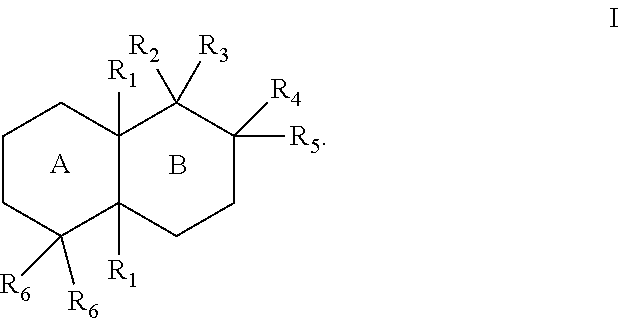
[0019]The enzymes described herein can facilitate synthesis of a variety of terpenes, diterpenes, and terpenoids. For example, the enzymes described herein can facilitate synthesis of terpenes, diterpenes, and terpenoids can generally have the structure of Formula I:
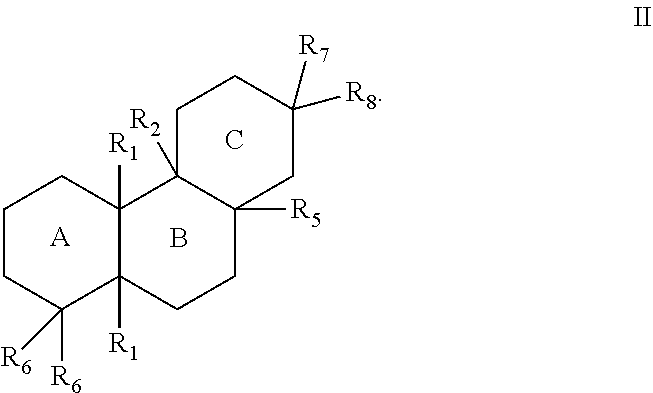
In some cases, the terpenes, diterpenes, and terpenoids can generally have the structure of Formula II:
In some cases, the terpenes, diterpenes, and terpenoids can generally have the structure of Formula III:
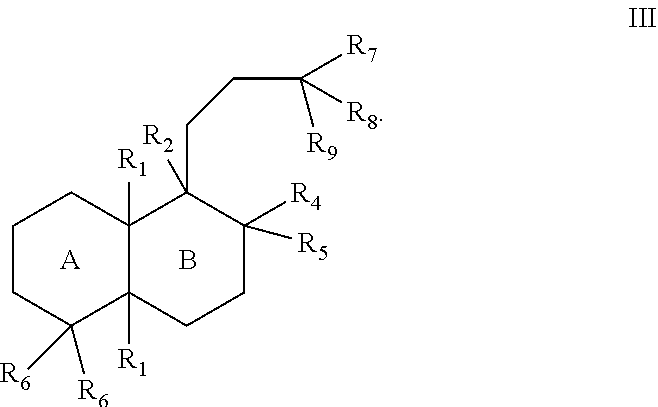
The substituents of Formulae I, II, and III can be as follows:
- [0023]each R1 can separately be hydrogen or lower alkyl;
- [0024]R2 can be hydrogen, lower alkyl, hydroxy, a bond to an adjacent ring carbon, or form a C4-C6 cycloheteroalkyl with R3;
- [0025]R3 can be a branched C5-C6 alkyl with 0-2 double bonds, can form a C4-C6 cycloheteroalkyl with R2; can form a cycloalkyl with R4, or can form a cycloheteroalkyl ring with R4, wherein the C5-C6 alkyl can optionally have one hydroxy, phosphate or diphosphate substituent, and wherein each cycloalkyl or cycloheteroalkyl ring can have 0-2 double bonds, and each cycloalkyl or cycloheteroalkyl ring can have 0-2 alkyl or 0-2 alkene substituents;
- [0026]R4 can be hydrogen, lower alkyl, lower alkene, hydroxy, a carbon bonded to R9, an oxygen bonded to R9, form a cycloalkyl ring with R3, or form a cycloheteroalkyl ring with R3, wherein each cycloalkyl ring or cycloheteroalkyl ring can have 0-2 double bonds, and each cycloalkyl ring or cycloheteroalkyl ring can have 0-2 alkyl or 0-2 alkene substituents;
- [0027]R5 can be hydrogen, hydroxy, lower alkyl, a lower alkene, a bond with an adjacent carbon, form a cycloalkyl ring with a ring atom of a ring formed by R3 and R4, wherein the cycloalkyl ring can have 0-2 double bonds, and the cycloalkyl ring can have 0-2 alkyl or 0-2 alkene substituents;
- [0028]each R6 can separately be hydrogen, lower alkyl, lower alkene, or form a bond with an adjacent carbon;
- [0029]R7 can be lower alkyl, lower alkene, or form a cycloalkyl ring with a R5,
- [0030]R8 can be lower alkyl, hydroxy, phosphate, diphosphate, or form a bond with an adjacent carbon; or
- [0031]R9 can be hydrogen, lower alkyl, lower alkene, ═CH2, hydroxy, phosphate, diphosphate, form a bond with an adjacent carbon, form a cycloalkyl ring with R4, or form a cycloheteroalkyl ring with R4, wherein each cycloalkyl ring or cycloheteroalkyl ring can have 0-2 double bonds, and each cycloalkyl ring or cycloheteroalkyl ring can have 0-2 alkyl or 0-2 alkene substituents.
[0032]The alkyl group(s) can have one to ten carbon atoms. In some cases, the alkyl groups can be lower alkyl group(s) (e.g., C1-C6 alkyl groups). In some cases, where substituents such as R1, R2, R5, and R6 are lower alkyl groups, they can be a C1-C3 lower alkyl. In some cases, where substituents such as R1, R2, R5, and Rb are lower alkyl groups, they are an ethyl or methyl group.
[0033]Cycloalkyl groups are cyclic alkyl groups such as, but not limited to, cyclopropyl, cyclobutyl, cyclopentyl, cyclohexyl, cycloheptyl, and cyclooctyl groups. In some cases, the cycloalkyl group can have 3 to about 8-12 ring members, whereas in other cases the number of ring carbon atoms range from 4, 5, 6, or 7. Cycloalkyl groups can include cycloalkyl rings having at least one double bond between 2 carbons (i.e., cycloalkenyl rings). Thus, for example, the A, B and/or C rings can also be a cycloalkenyl group such as a cyclohexenyl, cyclopentenyl, or cyclohexadienyl group. Cycloalkenyl groups can have from 4 to about 8-12 ring members.
[0034]Cycloalkyl groups further include polycyclic cycloalkyl groups such as, but not limited to, norbornyl, adamantyl, bornyl, camphenyl, isocamphenyl, and carenyl groups, and fused rings such as, but not limited to, decalinyl, and the like. Cycloalkyl groups also include rings that are substituted with straight or branched chain alkyl groups as defined above. Representative substituted cycloalkyl groups can be mono-substituted or substituted more than once, such as, but not limited to, 2,2-, 2,3-, 2,4-2,5- or 2,6-disubstituted cyclohexyl groups or mono-, di- or tri-substituted norbornyl or cycloheptyl groups. The term “cycloalkenyl” alone or in combination denotes a cyclic alkenyl group.
[0035]Heterocycloalkyl groups include ring groups containing 3 or more ring members, of which, one or more is a heteroatom such as, but not limited to, N, O, and S. The compounds described herein that have heteroatoms typically have an oxygen heteroatom. In some embodiments, heterocyclyl groups include 3 to about 15 ring members, whereas other such groups have 3 to about 10 ring members. A heterocyclyl group designated as a C2-heterocyclyl can be a 5-ring with two carbon atoms and three heteroatoms, 6-ring with two carbon atoms and four heteroatoms and so forth. A C3-heterocyclyl can be a 5-ring with three carbons and two heteroatoms, a 6-ring with three carbons and three heteroatoms, and so forth. A C4-heterocyclyl can be a 5-ring four carbons and one heteroatom, a 6-ring with four carbons and two heteroatoms, and so forth. The number of carbon atoms plus the number of heteroatoms sums up to equal the total number of ring atoms. A heterocyclyl ring can also include one or more double bonds. The phrase “heterocyclyl group” includes fused ring species including those comprising fused aromatic and non-aromatic groups. For example, a dioxolanyl ring and a benzdioxolanyl ring system (methylenedioxyphenyl ring system) are both heterocyclyl groups within the meaning herein. The phrase also includes polycyclic ring systems containing a heteroatom such as, but not limited to, quinuclidyl. Heterocyclyl groups can be unsubstituted, or they can be substituted. Heterocyclyl groups include, but are not limited to, pyrrolidinyl, piperidinyl, piperazinyl, morpholinyl, pyrrolyl, pyrazolyl, triazolyl, tetrazolyl, oxazolyl, isoxazolyl, thiazolyl, pyridinyl, thiophenyl, benzothiophenyl, benzofuranyl, dihydrobenzofuranyl, indolyl, dihydroindolyl, azaindolyl, indazolyl, benzimidazolyl, azabenzimidazolyl, benzoxazolyl, benzothiazolyl, benzothiadiazolyl, imidazopyridinyl, isoxazolopyridinyl, thianaphthalenyl, purinyl, xanthinyl, adeninyl, guaninyl, quinolinyl, isoquinolinyl, tetrahydroquinolinyl, quinoxalinyl, and quinazolinyl groups. Representative substituted heterocyclyl groups can be mono-substituted or substituted more than once, such as, but not limited to, piperidinyl or quinolinyl groups, which are 2-, 3-, 4-, 5-, or 6-substituted, or disubstituted with groups
[0036]In some cases, only one of the R1 groups is a lower alkyl, while the other is hydrogen.
[0037]In some cases, R2 is hydrogen when R3 forms a ring with R4.
[0038]Although in many diterpenes, each R6 is a lower alkyl, in some cases one R6 is a lower alkene white the other is bond that contributes to lower alkene. For example, in some cases the two R6 groups form a lower alkene together, for example, a ═CH2 group.
[0039]The compounds produced by the enzymes described herein are typically terpenes or diterpenes. Diterpenes are a class of chemical compounds composed of two terpene units, often with the molecular formula C20H32, though some can include 1-2 heteroatoms or other substituents. Diterpenes generally consist of four isoprene subunits. The positions of various atoms in a diterpene can, for example, be numbered as shown below.
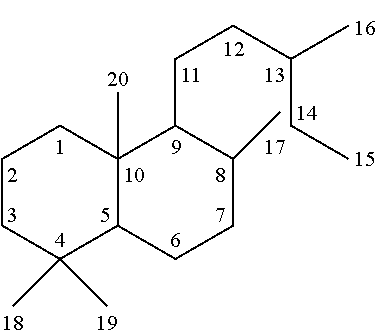
[0041]The enzymes described herein can produce compounds with the following skeletons (Sk1-Sk14), where 1-2 of the ring atoms can in some cases be heteroatoms (e.g., oxygen or nitrogen). If a heteroatom is present in it is usually an oxygen atom.
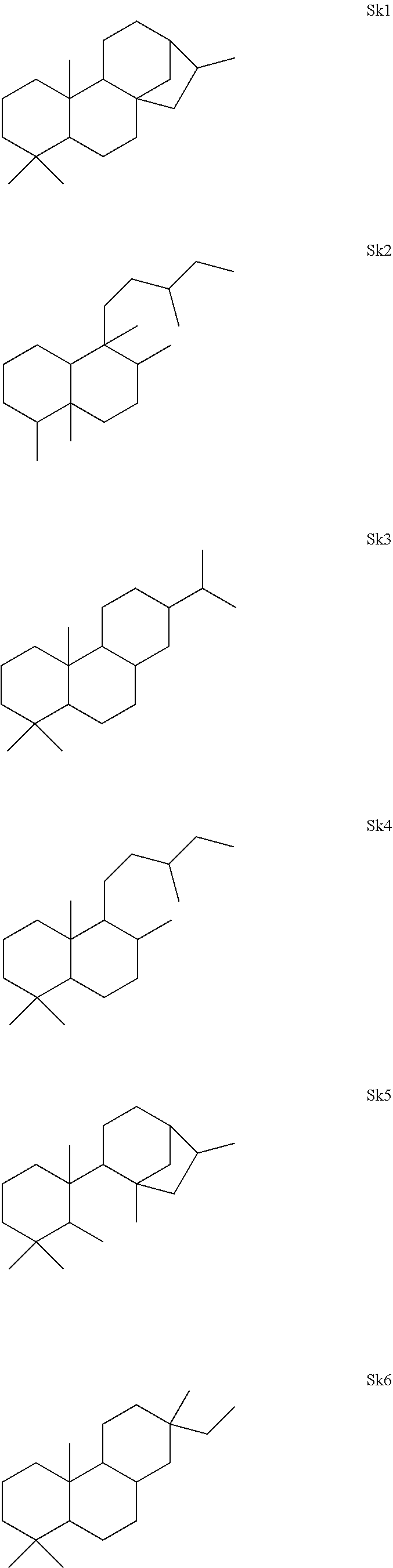
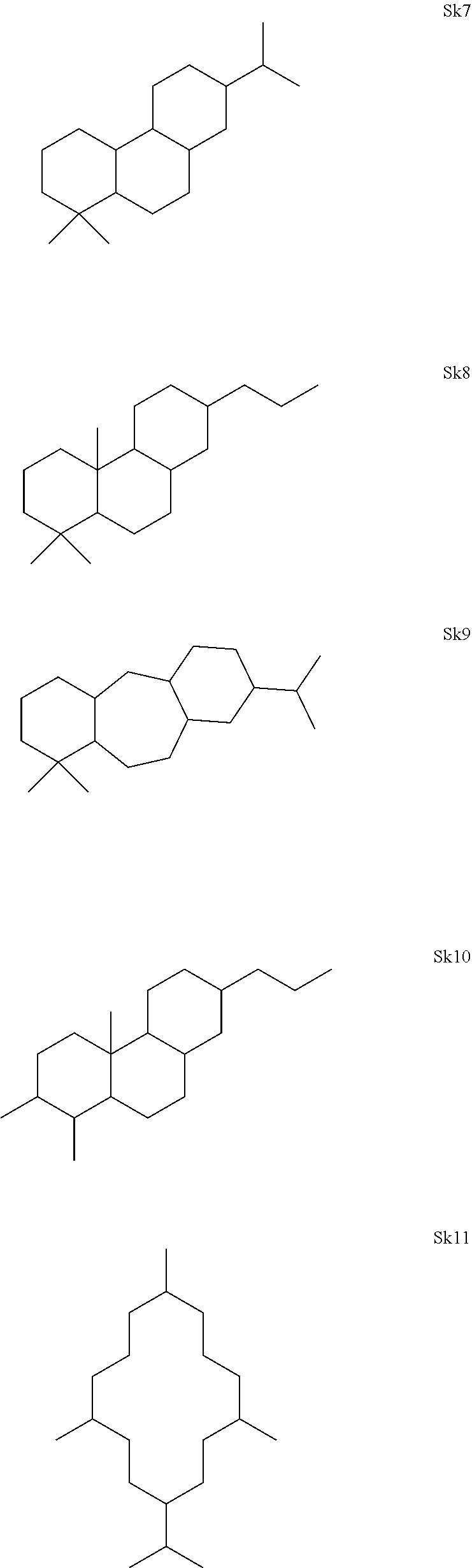
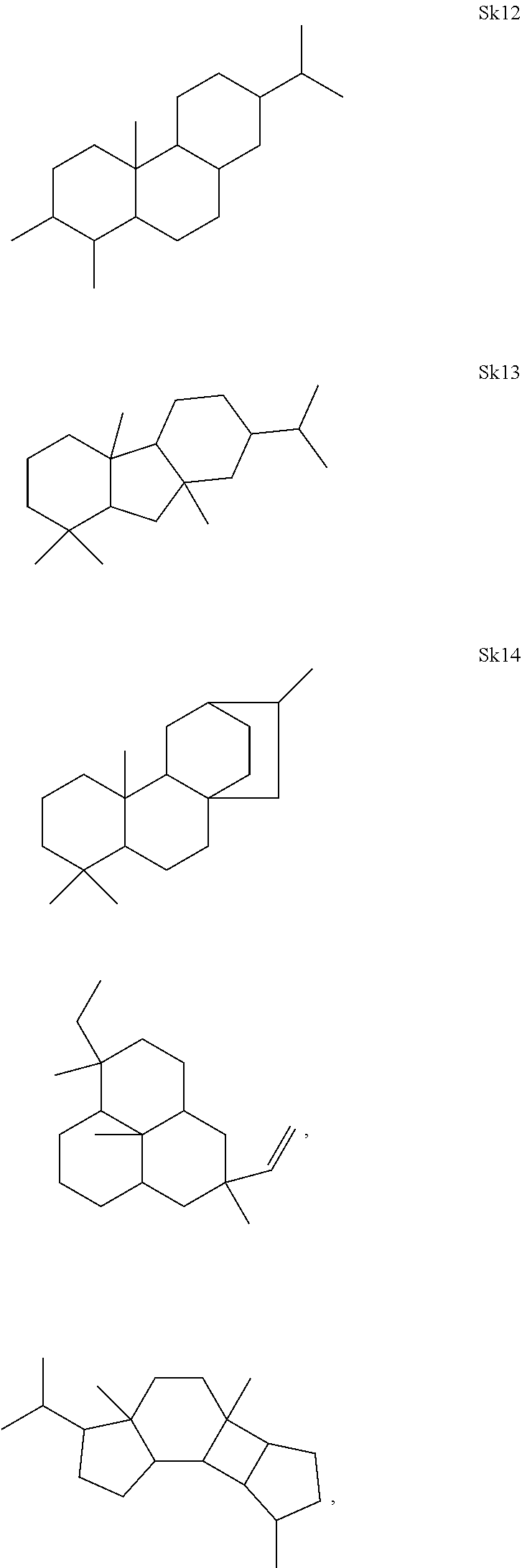
or a combination thereof.
Enzymes
[0043]The enzymes described herein are from a variety of mint plant species and can synthesize a variety of terpenes, diterpene skeletons, and terpenoid compounds.
[0044]For example, an Ajuga reptans miltiradiene synthase (ArTPS3), a Leonotis leonurus sandaracopimaradiene synthase (LITPS4), a Mentha spicata class I diterpene synthase (MsTPS1), an Origanum majorana trans-abienol synthase (OmTPS3), an Origanum majorana manool synthase (OmTPS4), an Origanum majorana palustradiene synthase (OmTPS5), Perovskia atriplicifolia miltiradiene synthase (PaTPS3), Prunella vulgaris miltiradiene synthase (PvTPS1), Salvia officinalis miltiradiene synthase (SoTPS1) were identified and isolated as described herein.
[0045]Eight of these enzymes, ArTPS3, LITPS4, MsTPS1, OmTPS4, OmTPS5, PaTPS3, PvTPS1, and SoTPS1 can convert a labda-13-en-8-ol diphosphate ((+)-8-LPP) [compound 10]) to 13R-(+)-manoyl oxide [8].
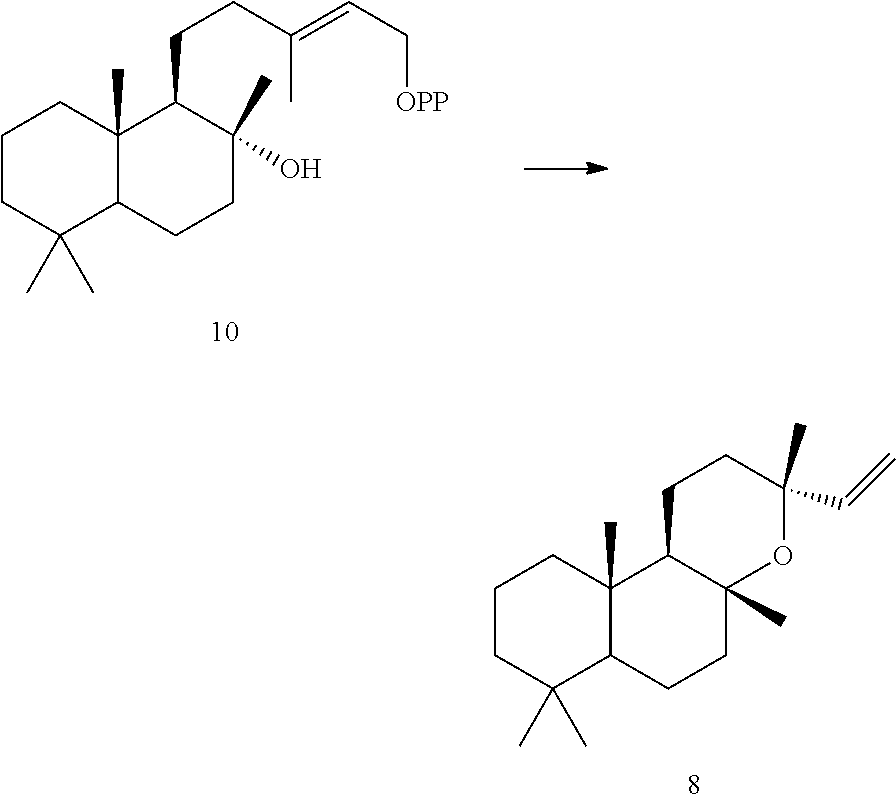
[0047]The ArTPS3, LITPS4, OmTPS4, OmTPS5, PaTPS3, PvTPS1, and SoYPS1 enzymes can also convert peregrinol diphosphate (PgPP) [5] to a combination of compounds 1, 2, and 3, as illustrated below.
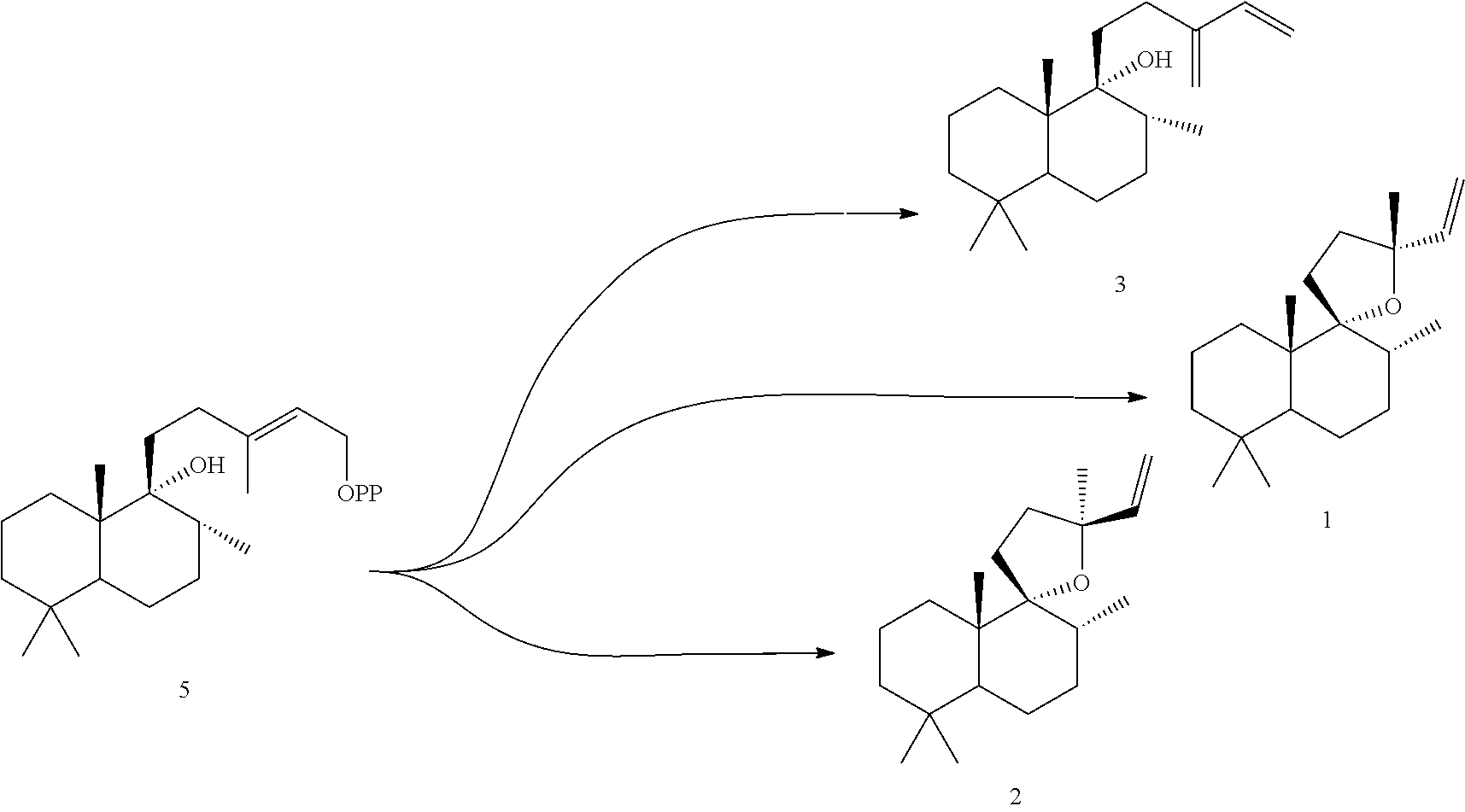
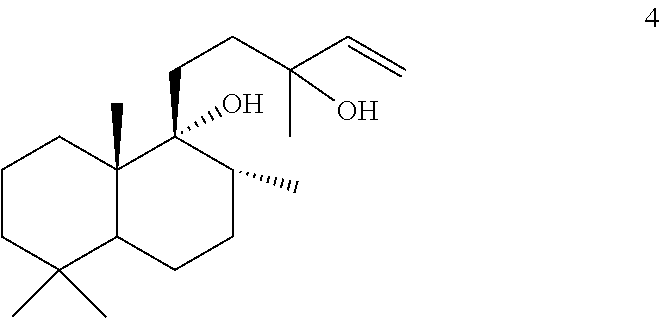
However, MsTPS1 produced only compound 3 from compound 5, while the OmTPS3 enzyme produced only 1, and 2. The OmTPS4 enzyme produced compound 4 (shown below) in addition to compounds 1, 2, and 3.
[0050]The ArTPS3, PaTPS3, PvTPS1, and SoTPS1 enzymes can also convert (+)-copalyl diphosphate ((+)-CPP) [31]) to miltiradiene [32].

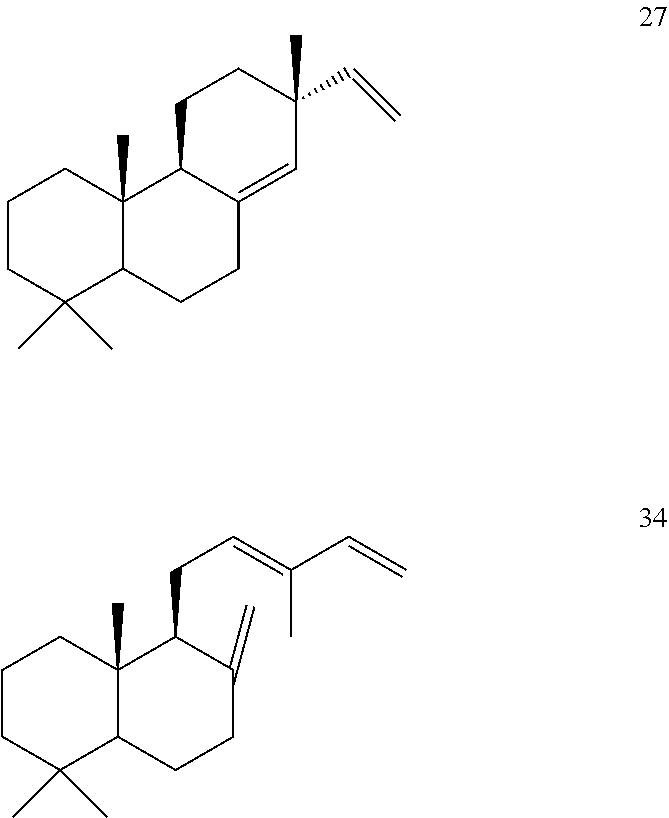
[0052]However, LITPS4 and MsTPS1 converted (+)-copalyl diphosphate ((+)-CPP) [31]) to sadaracopimaradiene [27], while OmTPS3 converted (+)-copalyl diphosphate ((+)-CPP) [31]) to trans-biformene [34].
[0054]The Ajuga reptans miltiradiene synthase (ArTPS3) has the amino acid sequence shown below (SEQ ID NO:1).
| 1 | MSLSFTIKVT PFSGQRVHSS TESFPIQQFP TITTKSAMAV |
| 41 | KCSSLSTATV SFQDFVGKIR DTINGKVDNS PAATTIHPAD |
| 81 | IPSNLCVVDT LQRLGVDRYF QSEIDSVLND TYRFWQQKGE |
| 121 | DIFTDVACRA MAFRLLRVKG YEVSSDELAS YAEQEHVNLQ |
| 161 | PSDITTVIEL YRASQTRLYE DEGNLEKLHT WTSNFLKQQL |
| 201 | QSETISDEKL HKQVEYYLKN YHGILDRAGV RQSLDLYDIN |
| 241 | QYQNLKSTDR FPTLSNEDLL EFAKQDFNFC QAQHQKELQQ |
| 281 | LQRWYADCKL DTLTYGRDVV RVASFLTAAI FGEPEFSDAR |
| 321 | LAFAKHIILV TRIDDFFDHG GSIEESYKIL DLVKEWEDKP |
| 361 | AEEYPSKEVE ILFTAVYNTV NDLAEMAYIE QGRSIKPLLI |
| 401 | KLWVEILTSF KKELDSWTED TELTLEEYLA SSWVSIGCRI |
| 441 | CSLNSLQFLG ITLSEEMLSS EECMELCRHV SSVDRLLNDV |
| 481 | QTFEKERLEN TINSVSLQLA EAQREGRTIT EEEAMSKIKD |
| 521 | LADYHRRQLM QMVYKDGTIF PRQCKDVFLR VCRIGYYLYA |
| 561 | SGDEFTTPQQ MMGDMKSLVY EPLNTSSS |
[0055]
A nucleic acid encoding the Ajuga reptans miltiradiene synthase (ArTPS3) with SEQ ID NO:1 is shown below as SEQ ID NO:2.
| 1 | ATGTCACTCT CGTTCACCAT CAAAGTCACC CCCTTTTCGG |
| 41 | GCCAGAGAGT TCACAGCAGC ACAGAAAGCT TTCCAATCCA |
| 81 | ACAATTTCCA ACGATCACCA CCAAATCCGC CATGGCTGTC |
| 121 | AAATGCAGCA GCCTCAGTAC CGCAACAGTA AGCTTCCAGG |
| 161 | ATTTCGTCGG AAAAATCAGA GATACGATCA ACGGGAAAGT |
| 201 | TGACAATTCT CCAGCAGCGA CCACTATTCA TCCTGCAGAT |
| 241 | ATACCCTCCA ATCTCTGCGT GGTGGATACC CTCCAAAGAT |
| 281 | TGGGAGTTGA CCGTTACTTC CAATCTGAAA TCGACAGCGT |
| 321 | TCTTAACGAC ACATACAGGT TCTGGCAGCA GAAAGGAGAA |
| 361 | GATATCTTCA CTGATGTTGC TTGTCGTGCA ATGGCATTTC |
| 401 | GACTTTTGCG AGTTAAAGGA TATGAAGTTT CATCAGATGA |
| 521 | ACTCGCTTCG TATGCTGAAC AAGAGCATGT TAACCTGCAA |
| 561 | CCAAGTGACA TAACTACGGT TATCGAGCTT TACAGAGCAT |
| 601 | CACAGACAAG ATTATATGAA GACGAGGGCA ATCTTGAGAA |
| 641 | GTTACATACT TGGACTAGCA ATTTTCTGAA GCAACAATTG |
| 681 | CAGAGTGAAA CTATTTCTGA CGAGAAATTG CACAAACAGG |
| 721 | TGGAGTATTA CTTGAAGAAC TACCACGGCA TACTAGACCG |
| 761 | TGCTGGAGTT AGACAAAGTC TCGATTTATA TGACATAAAC |
| 801 | CAATACCAGA ATCTAAAATC TACAGATAGA TTCCCTACTT |
| 841 | TAAGTAACGA AGATTTACTT GAATTCGCGA AGCAAGATTT |
| 881 | TAACTTTTGC CAAGCTCAAC ACCAGAAAGA GCTTCAGCAA |
| 921 | CTGCAAAGGT GGTATGCGGA TTGTAAATTG GATACATTGA |
| 961 | CTTACGGAAG AGATGTGGTA CGTGTTGCAA GTTTCCTGAC |
| 1001 | AGCTGCAATT TTTGGTGAGC CTGAATTCTC TGATGCTCGT |
| 1041 | CTAGCCTTCG CCAAACACAT CATCCTCGTG ACACGTATTG |
| 1081 | ATGATTTCTT CGATCATGGT GGGTCTATAG AAGAGTCATA |
| 1121 | CAAGATCCTG GATTTAGTAA AAGAATGGGA AGATAAGCCA |
| 1161 | GCTGAGGAAT ATCCTTCCAA GGAAGTTGAA ATCCTCTTTA |
| 1201 | CAGCAGTATA TAATACAGTA AATGACTTGG CAGAAATGGC |
| 1241 | TTATATTGAG CAAGGCCGTT CCATTAAACC TCTTCTAATT |
| 1281 | AAACTGTGGG TTGAAATACT GACAAGTTTC AAGAAAGAAC |
| 1321 | TGGATTCATG GACAGAAGAC ACAGAACTAA CCTTGGAGGA |
| 1361 | GTACTTGGCT TCCTCCTGGG TGTCGATCGG TTGCAGAATC |
| 1401 | TGCAGTCTCA ATTCGCTGCA GTTCCTTGGT ATAACATTAT |
| 1441 | CCGAAGAAAT GCTTTCAAGC GAAGAGTGCA TGGAGTTGTG |
| 1481 | TAGGCATGTT TCTTCAGTCG ACAGGCTACT CAATGACGTG |
| 1521 | CAAACTTTCG AGAAGGAACG CCTAGAAAAT ACGATAAACA |
| 1561 | GTGTGAGCCT ACAGCTAGCA GAAGCTCAGA GAGAAGGAAG |
| 1601 | AACCATTACA GAAGAGGAGG CTATGTCAAA GATTAAAGAC |
| 1641 | CTGGCTGATT ATCACAGGAG ACAACTGATG CAGATGGTTT |
| 1681 | ATAAGGATGG GACCATATTT CCGAGACAAT GCAAAGATGT |
| 1721 | CTTTTTGAGG GTATGCAGGA TTGGCTACTA CTTATACGCG |
| 1761 | AGCGGCGATG AATTCACTAC TCCACAACAA ATGATGGGGG |
| 1801 | ATATGAAATC ATTGGTTTAT GAACCCCTAA ACACTTCATC |
| 1841 | CTCTTGA |
[0057]The Leonotis leonarus sandaracopimaradiene synthase (LITPS4) has the amino acid sequence shown below (SEQ ID NO:3).
| 1 | MSVAFNLIVV RFPGHGIQSS RETFPAKIIT RTKSSMRFQS |
| 41 | SLNTSTDFVG KIREMIRGKT DNSINPLDIP STLCVIDTLH |
| 81 | SFGIDRYFQS EINSVLHHTY RLWNDRNNII FKDVICCAIA |
| 121 | FRLLRVKGYQ VSSDELAPFA QQQVTGLQTS DIATILELYR |
| 161 | ASQERLHEDD DTLDKLHDWS SNLLKLHLLN ENIPDHKLHK |
| 201 | RVGYFLKNYH GMLDRVAVRR NIDLHNINHY QIPEVADRFP |
| 241 | TEAFLEFSRQ DFNICQAQHQ KELQQLHRWY ADCRLDTLNH |
| 281 | GTDVVHFANF LTSAIFGEPE FSEARLAFAK QVILITRMDD |
| 321 | FFDHDGSREE SHKILHLVQQ WKEKPAEEYG SKEVEILFTA |
| 361 | VYTTVNSLAE KACMEQGRSV KQLLIKLWVE LLTSFKKELD |
| 401 | SWTEKMALTL DEYLSFSWVS IGCRLCILNS LQFLGIKLSE |
| 441 | EMLWSQECLD LCRHVSSVVR LLNDLQTFKK ERIENTINGV |
| 481 | DVQLAARKGE RAITEEEAMS KIKEMADHHR RKLMQIVYKE |
| 521 | GTIFPRECKD VFLRVCRIGY YLYSGDELTS PQQMKEDMKA |
| 561 | LVHESSS |
[0058]
A nucleic acid encoding the Leonotis leonurus sandaracopimaradiene synthase (LITPS4) with SEQ ID NO:3 is shown below as SEQ ID NO:4.
| 1 | ATGTCGGTGG CGTTCAACCT CATAGTCGTC CGTTTTCCGG |
| 41 | GCCATGGAAT TCAGAGCAGT AGAGAAACTT TTCCAGCCAA |
| 81 | AATTATTACC AGAACTAAAT CAAGCATGAG ATTCCAAAGC |
| 121 | AGCCTCAACA CTTCAACAGA TTTCGTGGGA AAAATAAGAG |
| 161 | AGATGATCAG AGGGAAAACT GATAATTCTA TTAATCCCCT |
| 201 | GGATATTCCC TCCACTCTAT GCGTAATCGA CACCCTACAC |
| 241 | AGCTTCGGAA TTGATCGCTA CTTTCAATCC GAAATCAACT |
| 281 | CTGTTCTTCA CCACACATAC AGATTATGGA ACGACAGAAA |
| 321 | TAATATCATC TTCAAAGATG TCATTTGCTG CGCAATTGCC |
| 361 | TTTAGACTTT TGCGAGTGAA AGGATATCAA GTCTCATCAG |
| 401 | ATGAACTGGC GCCATTTGCC CAACAACAGG TGACTGGACT |
| 441 | ACAAACAAGC GACATTGCCA CGATTCTAGA GCTCTACAGA |
| 481 | GCATCACAGG AGAGATTACA CGAAGACGAC GACACTCTTG |
| 521 | ACAAACTACA TGATTGGAGC AGCAACCTTC TGAAGCTGCA |
| 561 | TCTGCTGAAT GAGAACATTC CTGATCATAA ACTGCACAAA |
| 601 | CGGGTGGGGT ATTTCTTGAA GAACTACCAT GGCATGCTAG |
| 641 | ATCGCGTTGC GGTTAGACGA AACATCGACC TTCACAACAT |
| 681 | AAACCATTAC CAAATCCCAG AAGTTGCAGA TAGGTTCCCT |
| 721 | ACTGAAGCTT TTCTTGAATT TTCAAGGCAA GATTTTAATA |
| 761 | TTTGCCAAGC TCAACACCAG AAAGAACTTC AGCAACTGCA |
| 801 | TAGGTGGTAT GCAGATTGTA GATTGGACAC ACTGAATCAC |
| 841 | GGAACAGACG TAGTACATTT TGCTAATTTT CTAACTTCAG |
| 881 | CAATTTTCGG AGAGCCTGAA TTCTCCGAGG CTCGTCTAGC |
| 921 | CTTTGCTAAA CAGGTTATCC TAATAACACG TATGGATGAT |
| 961 | TTCTTCGATC ACGATGGGTC TAGAGAAGAA TCACACAAGA |
| 1001 | TCCTCCATCT AGTTCAACAA TGGAAAGAGA AGCCCGCCGA |
| 1041 | AGAATATGGT TCAAAGGAAG TTGAGATCCT CTTTACAGCA |
| 1081 | GTGTACACTA CAGTAAATAG CTTGGCAGAA AAGGCTTGTA |
| 1121 | TGGAGCAAGG CCGTAGTGTC AAACAACTTC TAATTAAGCT |
| 1161 | GTGGGTCGAG CTGCTAACAA GTTTCAAGAA AGAATTGGAT |
| 1201 | TCATGGACGG AGAAGATGGC GCTAACCTTG GATGAGTACT |
| 1241 | TGTCTTTCTC CTGGGTGTCA ATTGGCTGCA GACTCTGCAT |
| 1281 | TCTCAATTCC CTGCAATTTC TTGGGATAAA ATTATCTGAA |
| 1321 | GAAATGCTGT GGAGTCAAGA GTGTCTGGAT TTATGCCGGC |
| 1361 | ATGTTTCATC AGTGGTTCGC CTGCTCAACG ATTTACAAAC |
| 1401 | TTTCAAGAAG GAGCGCATAG AAAATACGAT AAACGGTGTG |
| 1441 | GACGTTCAGC TAGCTGCTCG TAAAGGCGAA AGAGCCATTA |
| 1481 | CAGAAGAGGA GGCCATGTCC AAGATTAAGG AAATGGCTGA |
| 1521 | CCATCACAGG AGAAAACTGA TGCAAATTGT GTATAAAGAA |
| 1561 | GGAACCATTT TTCCAAGAGA ATGCAAAGAT GTGTTTTTGA |
| 1601 | GAGTGTGCAG GATTGGCTAC TATCTCTACT CGGGCGATGA |
| 1641 | GTTAACTTCT CCACAACAAA TGAAGGAGGA TATGAAAGCG |
| 1681 | TTGGTACATG AATCATCCTC TTGA |
[0060]The Mentha spicata class I diterpene synthase (MsTPS1) has the amino acid sequence shown below (SEQ ID NO:5).
| 1 | MSSIRNLSLH IDLPKAEKKL VEKIRERIRN GRVEMSPSAY |
| 41 | DTAWVAMVPS RGYSGRPGFP ECVDWIIENQ NPDGSWGLDS |
| 81 | DQPLLVKDSL SSTLACLLAL RKWKTHNQLV QRGMEFIDSR |
| 121 | GWAATDDDNQ ISPIGFNIAF PAMINYAKEL NLTLPLHPPS |
| 161 | IHSLLHIRDS EIRKRNWEYV AEGVVDDTSN WKQIIGTHQR |
| 201 | NNGSLFNSPA TTAAAVIHSH DDKCFRYLIS TLENSNGGWV |
| 241 | PTIYPYDIYA PLCMIDTLER LGIHTYFEVE LSGIFDDIYR |
| 281 | NWQEREEEIF CNVMCRALAF RLLRMRGYHV SSDELAEFVD |
| 321 | KEEFFNSVSM QESGEGTVLE LYRASLTKIN EEERILDKIH |
| 361 | AWTKPFLKHQ LLNRSIRDKR LEKQVEYDLK NFYGALVRFQ |
| 401 | NRRTIDSYDA KSIQISKTAY RCSTVYNEDF IHLSVEDFKI |
| 441 | SRAQYLKELE EMNKWYSDCR LDLLTKGRNA CRESYILTAA |
| 481 | IIVDPHESMA RISYAQSILL ITVFDDFFDH YGSKEEALNI |
| 521 | IDLVKEWKPA GSYCSKEVEI LFTALHDTIN EIAAKADAEQ |
| 561 | GFSSKQQLIN MWVELLESAV REKDSLSXNK VSTLEEYLSF |
| 601 | APITIGCKLC VLTSVHFLGI KLSEEIWTSE ELSSLCRHGN |
| 641 | VVCRLLNDLK TYEREREENT LNSVSVQTVG GGVSEEEAVT |
| 681 | KVEEVLEFHR RKVMQLACRR GGSSVPRECK ELVWKTCTIG |
| 721 | YCLYGHDGGD ELSSPKDILK DINAMMFEPL K |
[0061]
A nucleic acid encoding the Mentha spicata class I diterpene synthase (MsTPS1) with SEQ ID NO:5 is shown below as SEQ ID NO:6
| 1 | ATGAGTTCCA TTCGAAATTT AAGTTTGCAT ATTGATCTGC |
| 41 | CAAAGGCCGA GAAGAAGTTG GTTGAGAAAA TCAGAGAGAG |
| 81 | GATAAGAAAT GGGAGGGTGG AGATGTCGCC GTCGGCTTAC |
| 121 | GACACCGCGT GGGTGGCCAT GGTGCCGTCT CGAGGATATT |
| 161 | CCGGCAGGCC GGGTTTCCCG GAGTGCGTGG ATTGGATAAT |
| 201 | CGAGAACCAG AATCCCGACG CGTCGTGGGG TTTGGATTCG |
| 241 | GATCAACCAC TTCTGGTCAA AGACTCCCTC TCGTCCACCT |
| 281 | TGGCATGCCT ACTTGCCCTG CGTAAATGGA AAACACACAA |
| 321 | CCAACTAGTG CAAAGGGGCA TGGAGTTCAT CGACTCCCGT |
| 361 | GGTTGGGCTG CAACTGATGA TGACAATCAG ATTTCTCCTA |
| 401 | TTGGATTCAA TATTGCCTTT CCTGCAATGA TTAATTACGC |
| 441 | CAAAGAGCTT AATTTAACTC TGCCTCTACA TCCACCTTCG |
| 481 | ATTCATTCAT TGTTACACAT TAGAGATTCA GAAATAAGAA |
| 521 | AGCGAAACTG GGAATACGTA GCTGAAGGAG TAGTCGACGA |
| 561 | TACAAGCAAT TGGAAGCAAA TAATCGGCAC GCATCAAAGA |
| 601 | AATAATGGAT CCTTGTTCAA CTCACCTGCT ACCACTGCAG |
| 641 | CTGCTGTTAT TCACTCTCAC GACGATAAAT GTTTCCGATA |
| 681 | TTTGATCTCC ACTCTTGAGA ATTCTAACGG TGGATGGGTA |
| 721 | CCAACTATCT ATCCATACGA TATATACGCT CCTCTCTGCA |
| 761 | TGATCGATAC GCTAGAAAGA TTAGGAATAC ACACATATTT |
| 801 | TGAAGTTGAA CTCACCGGCA TTTTTGATGA CATATACAGG |
| 841 | AATTGGCAAG AGAGAGAAGA AGAGATCTTT TGTAATGTTA |
| 881 | TGTGTCGACC TCTGGCATTT CGGCTTCTAC GAATGAGGGG |
| 921 | ATATCATGTT TCATCTGATG AACTAGCAGA ATTTGTGGAC |
| 961 | AAGGAGGAGT TTTTTAATAG CGTGAGCATG CAAGAGAGCG |
| 1001 | GCGAAGGCAC AGTGCTTGAG CTTTACAGAG CTTCACTCAC |
| 1041 | AAAAATCAAC GAAGAAGAAA GGATTCTCGA CAAAATTCAT |
| 1081 | GCATGGACCA AACCATTTCT CAAGCACCAG CTTCTCAACC |
| 1121 | GCAGCATTCG CGACAAACGA TTAGAGAAGC AGGTGGAATA |
| 1161 | CGACTTGAAG AACTTCTACG GCGCACTAGT CCGATTCCAG |
| 1201 | AACAGAAGAA CCATCGACTC ATACGATGCT AAATCAATCC |
| 1241 | AAATTTCGAA AACAGCATAT AGGTGCTCTA CAGTTTACAA |
| 1281 | TGAAGACTTC ATCCATTTAT CCGTTGAGGA CTTCAAAATC |
| 1321 | TCCCGAGCAC AATACCTAAA AGAACTTGAA GAAATGAACA |
| 1361 | AGTGGTACTC TGATTGTAGG TTGGACCTCT TAACTAAAGG |
| 1401 | AAGAAATGCA TGTCGAGAAT CTTACATTTT AACAGCTGCA |
| 1441 | ATCATTGTCG ATCCTCACGA ATCCATGGCT CGAATCTCTT |
| 1481 | ACGCTCAATC TATTCTTCTT ATAACTGTTT TCGACGACTT |
| 1521 | TTTCGATCAT TATGGGTCTA AAGAAGAGGC TCTCAATATT |
| 1561 | ATTGATCTAG TCAAGGAATG GAAGCCAGCT GGCAGTTACT |
| 1601 | GCTCCAAAGA AGTGGAGATT TTGTTTACTG CATTACACGA |
| 1641 | CACGATAAAT GAGATTGCAG CCAAGGCTGA TGCAGAGCAA |
| 1681 | GGCTTTTCTT CCAAACAACA GCTTATCAAC ATGTGGGTGG |
| 1721 | AGCTACTTGA GAGCGCCGTG AGAGAAAAGG ACTCGCTGAG |
| 1761 | TGGNAACAAA GTGTCGACTC TAGAAGAGTA CTTATCTTTC |
| 1801 | GCACCAATCA CCATCGGCTG CAAACTTTGC GTCCTGACGT |
| 1841 | CTGTCCATTT CCTCGGAATC AAACTGTCCG AGGAAATCTG |
| 1881 | GACTTCCGAG GAGTTGAGCA GTCTGTGCAG GCACGGCAAT |
| 1921 | GTTGTCTGCA GACTGCTCAA CGACCTCAAG ACTTACGAGA |
| 1961 | GAGAGCGCGA AGAGAACACG CTCAACAGCG TGAGCGTGCA |
| 2001 | GACAGTGGGA GGAGGCGTTT CGGAGGAAGA GGCGGTGACG |
| 2041 | AAGGTGGAGG AGGTGTTGGA ATTTCATAGA AGAAAAGTGA |
| 2081 | TGCAGCTCGC GTGTCGAAGA GGAGGAAGCA GTGTTCCGAG |
| 2121 | AGAATGTAAG GAGCTGGTGT GGAAGACGTG CACGATAGGT |
| 2161 | TACTGCTTGT ACGGTCACGA CGGAGGCGAT GAGTTATCGT |
| 2201 | CTCCGAAGGA TATTCTAAAG GACATTAATG CAATGATGTT |
| 2241 | TGAGCCTCTC AAGTGA |
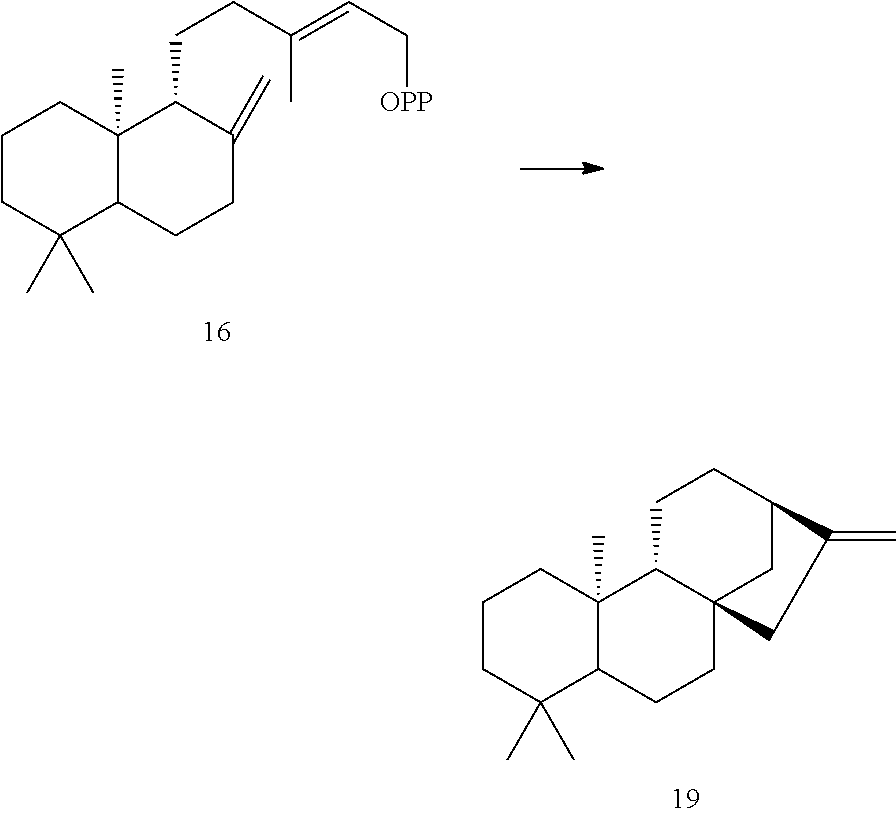
[0063]A Nepeta mussinii ent-kaurene synthase (NmTPS2) was identified and isolated as described herein. This NmTPS2 enzyme was identified as an ent-kaurene synthase, which converts ent-CPP [16] into ent-kaurene [19].
[0065]The Nepeta mussinii ent-kaurene synthase (NmTPS2) has the amino acid sequence shown below (SEQ ID NO:7).
| 1 | MSLPLSSCVL FPPNDSRFPV SRFSRASASL EVGLQGATSA |
| 41 | KVSSQSSCFE ETKRRITKLF HKDELSVSTY DTAWVAMVPS |
| 81 | PTSSEEPCFP GCLTWLLENQ CRDGSWARPH HHSLLKKDVL |
| 121 | SSTLACILAL KKWGVCEEQI NKGLHFIELN CASATEKCQI |
| 161 | TPVGFDIIFP AMLDYARDFS LNLRLEPTTF NDLMDKRDLE |
| 201 | LKRCYQNYTP EREAYLAYIV EGMGRLQDWE LVMKYQRKNG |
| 241 | SLFNCPSTTA AAFIALRDSA CLNYLNLSLK KFGNAVPAVY |
| 281 | PLDIYSQLCT VDNLERLGIN QYFIAEIQSV LDETYRCWIQ |
| 321 | GNEDIFLDTS TCALAFRILR MNGYDVTSDS TTKILEECFS |
| 361 | SSFRGNMTDI NTTLDLYRAS ELMLYPDEKD LEKHNLRLKL |
| 401 | LLKQKLSTVL IQSFQLGRNI NEEVKQTLEH PFYASLDRIA |
| 441 | KRKNIEHYNF DNTRILKTSY CSPNFGNKDF FFLSIEDFNW |
| 481 | CQVIHRQELA ELERWLIENR LDELKFARSK SAYCYFSAAA |
| 521 | TFFAPELSDA RMSWAKSGVL TTVVDDFFDV GGSMEELKNL |
| 561 | IQLVELWDVD ASTKCSSHNV HIIFSALRRT IYEIGNKGFK |
| 601 | LQGRNITNHI IDIWLDLLNS MMKETEWARD NFVPTIDEYM |
| 641 | SNAYTSFALG PIVLPTLYLV GPKLSEEMIN HSEYHNLFKL |
| 681 | MSTCGRLLND IRGYERELKD GKLNALSLYI INNGGKVSKE |
| 721 | AGISEMKSWI EAQRRELLRL VLESNKSVLP KSCKELFWHM |
| 761 | CSVVHLFYCK DDGFTSQDLI QVVNAVIHEP IALKDFKVHE |
[0066]
A nucleic acid encoding the Nepeta mussinii ent-kaurene synthase (NmTPS2) with SEQ ID NO:7 is shown below as SEQ ID NO:8.
| 1 | ATGTCTCTTC CGCTCTCCTC TTGTGTCTTA TTTCCCCCCA |
| 41 | ATGACTCACG TTTTCCGCTC TCCCGCTTTT CTCGCGCTTC |
| 81 | AGCTTCTTTG GAAGTCGGGC TTCAAGGAGC TACTTCAGCA |
| 121 | AAAGTCTCCT CACAATCATC GTGTTTTGAG GAGACAAAGA |
| 161 | GAAGGATAAC AAAGTTGTTT CATAAGGACG AACTTTCGGT |
| 201 | TTCGACATAT GACACAGCAT GGGTTGCTAT GGTCCCTTCT |
| 241 | CCAACTTCTT CAGAGGAACC TTGCTTCCCA GGTTGTTTGA |
| 281 | CTTGGTTGCT TGAAAACCAG TGTCGAGATG GTTCATGGGC |
| 321 | TCGTCCCCAC CATCACTCTT TGTTAAAAAA AGATGTCCTT |
| 361 | TCTTCTACCT TGGCATGCAT TCTCGCACTT AAAAAATGGG |
| 401 | GGGTTGGTGA AGAACAAATC AACAAGGGTT TGCATTTTAT |
| 441 | AGAGCTAAAT TGTGCTTCAG CTACCGAGAA GTGTCAAATT |
| 481 | ACTCCCGTGG GGTTTGACAT TATATTTCCT GCCATGCTTG |
| 521 | ATTATGCAAG AGACTTCTCT TTGAACTTGC GTTTAGAGCC |
| 561 | AACTACGTTT AATGATTTGA TGGATAAAAG GGATTTAGAG |
| 601 | CTCAAAAGGT GTTACCAAAA TTACACACCG GAGAGGGAAG |
| 641 | CATACTTGGC ATATATAGTT GAAGGAATGG GAAGATTGCA |
| 681 | AGATTGGGAA TTGGTGATGA AATATCAAAG AAAGAATGGA |
| 721 | TCTCTTTTCA ATTGTCCATC TACAACTGCA GCAGCTTTTA |
| 761 | TTGCCCTTCG GGATTCTGCG TGCCTCAACT ATCTGAATTT |
| 801 | GTCTTTGAAA AAGTTCGGGA ATGCAGTTCC TGCAGTTTAT |
| 841 | CCTCTAGATA TATATTCTCA ACTTTGCACG GTTGATAATC |
| 881 | TTGAAAGGCT GGGGATCAAC CAATATTTTA TAGCAGAAAT |
| 921 | TCAGAGTGTG TTGGATGAAA CGTACAGATG TTGGATACAG |
| 961 | CGAAACGAAG ACATATTTTT GGACACCTCA ACTTGTCCTT |
| 1001 | TAGCATTCCG AATATTGAGA ATGAATGGCT ATGATGTGAC |
| 1041 | TTCAGATTCA CTTACAAAAA TCCTAGAAGA GTGCTTTTCA |
| 1081 | AGTTCCTTTC GTGGAAATAT GACAGACATT AACACAACTC |
| 1121 | TTGACTTATA TAGGGCATCA GAACTTATGT TATATCCAGA |
| 1161 | TGAAAAGGAT CTGGAGAAAC ATAATTTAAG GCTTAAACTC |
| 1201 | TTACTTAAGC AAAAACTATC CACTGTTTTA ATCCAATCAT |
| 1241 | TTCAACTTGG AAGAAATATC AATGAAGAGG TGAAACAGAC |
| 1281 | TCTCGAGCAT CCCTTTTATG CAAGTTTGGA TAGGATTGCA |
| 1321 | AAGCGGAAAA ATATAGAGCA TTACAACTTT GATAACACAA |
| 1361 | GAATTCTTAA AACTTCATAT TGTTCGCCAA ATTTTGGCAA |
| 1401 | CAAGGATTTC TTTTTTCTTT CCATAGAAGA CTTCAATTGG |
| 1441 | TGTCAAGTCA TACATCGACA AGAACTCGGA GAACTTGAAA |
| 1481 | GATGGTTAAT TGAAAATAGA TTGGATGAGC TGAAGTTTGC |
| 1521 | AAGGAGTAAG TCTGCATACT GTTATTTTTC TGCGGCAGCA |
| 1561 | ACTTTTTTTG CTCCAGAATT GTCGGATGCC CGCATGTCAT |
| 1601 | GGGCTAAAAG TGGTGTTCTA ACCACAGTGG TAGATGACTT |
| 1641 | TTTTGATGTT GGAGGTTCTA TGGAGGAATT GAAGAACTTA |
| 1681 | ATTCAATTGG TTGAACTATG GGATGTGGAT GCTAGCACAA |
| 1721 | AATGCTCTTC TCATAATGTC CATATAATAT TTTCAGCACT |
| 1761 | TAGGCGCACC ATCTATGAGA TAGGGAACAA AGGATTTAAG |
| 1801 | CTACAAGGAC GTAACATTAC CAATCATATA ATTGACATTT |
| 1841 | GGCTAGATTT ACTAAACTCT ATGATGAAAG AAACCGAATG |
| 1881 | GGCCAGAGAC AACTTTGTCC CAACAATTGA TGAATACATG |
| 1921 | AGCAATGCAT ATACATCGTT TGCTCTGGGG CCAATTGTCC |
| 1961 | TTCCAACTCT CTATCTTGTC GGGCCCAAGC TCTCAGAAGA |
| 2001 | GATGATTAAC CACTCCGAAT ACCATAACCT ATTCAAATTG |
| 2041 | ATGAGTACGT GCGGACGTCT TCTAAATGAC ATCCGTGGTT |
| 2081 | ATGAGAGAGA ACTGAAAGAT GGTAAATTGA ACGCGTTATC |
| 2121 | ATTGTACATA ATTAATAATG GTGGTAAAGT AAGTAAAGAA |
| 2161 | GCTGGCATCT CGGAGATGAA AAGTTGGATC GAGGCACAAC |
| 2201 | GAAGAGAGTT ACTGAGATTA GTTTTGGAGA GCAACAAAAG |
| 2241 | CGTCCTTCCG AAGTCGTGCA AGGAATTGTT TTGGCATATG |
| 2281 | TGCTCAGTGG TGCATCTATT CTACTGCAAA GATGATGGAT |
| 2321 | TCACCTCGCA GGATTTGATT CAAGTTGTAA ATGCAGTTAT |
| 2361 | TCATGAACCT ATTGCTCTCA AGGATTTTAA GGTGCATGAA |
| 2401 | TAA |
[0068]An Origanum majorana trans-abienol synthase (OmTPS3) was identified and isolated. When this OmTPS3 enzyme was expressed in N. benthamiana with Hyptis suaveolens labda-7,13E-dienyl diphosphate synthase (HsTPS1) a new compound, labda-7,12E,14-triene [24], was produced. The HsTPS1 enzyme produced labda-7,13(16),14-triene [22] when HsTPS1 was expressed in N. benthamiana.
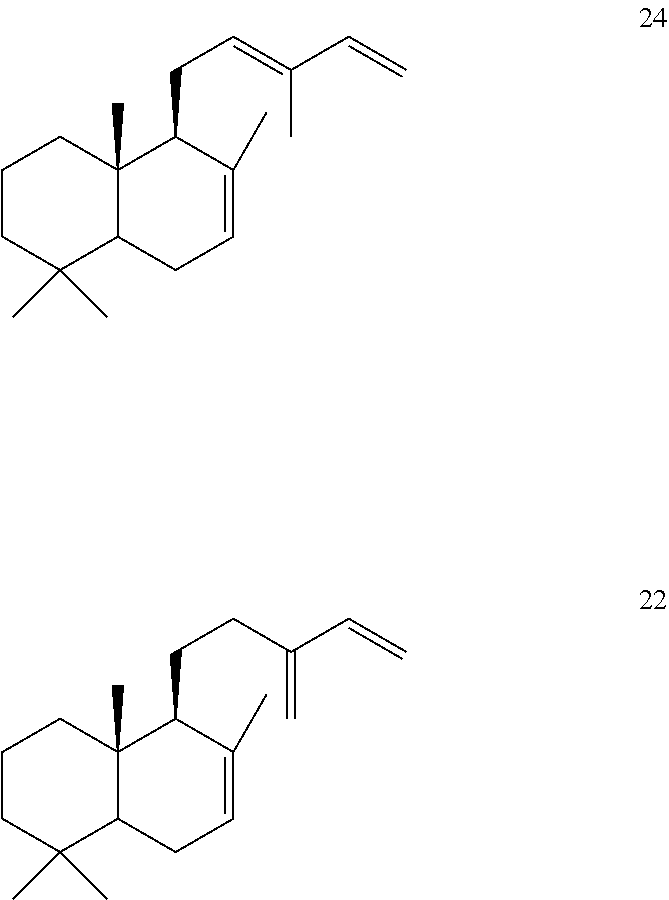
OmTPS3 also produced trans-abienol [11] from labda-13-en-8-ol diphosphate ((+)-8-LPP) [10]).

[0071]The Origanum majorana trans-abienol synthase (OmTPS3) has the amino acid sequence shown below (SEQ ID NO:9.
| MASLAFTPGA ATFSGNVVRR RKDNFPVHGF PTTIRSSVSV | |
| TVKCYVSTTN LMVKIKEKFK GKNVNSLTVE AADDDMPSNL | |
| CIIDTLQRLG IDRYFQPQVD SVLDHAYKLW QGKEKDTVYS | |
| DISIHAMAFR LLRVKGYQVS SEELDPYIDV ERMKKLKTVD | |
| VPTVIELYRA AQERMYEEEG SLERLHVWST NFLMHQLQAN | |
| SIPDEKLHKL VEYYLKNYHG ILDRVGVRRN LDLFDISHYP | |
| TLRARVPNLC TEDFLSFAKE DFNTCQAQHQ KEHEQLQRWF | |
| EDCRFDTLKF GRETAVGAAH FLSSAILGES ELCNVRLALA | |
| KHMVLVVFID DFFDHYGSRE DSFKILHLLK EWKEKPAGEY | |
| GSEEVEILFT AVYNTVNELA EMAHVEQGRN IKGFLIELWV | |
| EIVSIFKIEL DTWSNDTTLT LDEYLSSSWV SVGCRICILV | |
| SMQLLGVQLT DEMLLSDECI NLCKHVSMVD RLLNDVGTFE | |
| KERKENTGNS VSLLLAAAVK EGRPITEEEA IIKIKKMAEN | |
| ERRKLMQIVY KRESVFPRKC KDMFLKVCRI GCYLYASGDR | |
| FTSPQKMKED VKSLIYESL |
[0072]
A nucleic acid encoding the Origanum majorana trans-abienol synthase (OmTPS3) with SEQ ID NO:9 is shown below as SEQ ID NO:10.
| ATGGCGTCGC TCGCGTTCAC ACCCGGAGCC GCCACTTTCT | |
| CCGGCAACGT AGTTCGGAGG AGGAAAGATA ACTTTCCGGT | |
| CCACGGATTT CCGACGACGA TCAGGTCATC GGTCTCCGTC | |
| ACCGTCAAAT GCTACGTCAG TACAACGAAT TTGATGGTGA | |
| AAATCAAAGA GAAGTTCAAG GGTAAAAACG TCAATTCGCT | |
| GACAGTTGAA GCTGCTGATG ACGATATGCC CTCTAATCTG | |
| TGCATAATTG ACACCCTCCA ACGATTGGGA ATCGACCGTT | |
| ACTTCCAACC CCAAGTCGAC TCTGTTCTCG ACCACGCCTA | |
| CAAACTATGG CAAGGGAAAG AGAAAGATAC GGTGTATTCG | |
| GACATTAGTA TTCATGCGAT GGCATTTAGA CTTTTACGAG | |
| TCAAAGGCTA TCAAGTCTCT TCGGAGGAAC TGGATCCATA | |
| CATCGATGTG GAGCGAATGA AGAAACTGAA AACAGTTGAT | |
| GTTCCGACGG TTATCGAACT GTACAGAGCG GCACAGGAGA | |
| GAATGTATGA AGAAGAAGGT AGCCTTGAGA GACTCCATGT | |
| TTGGAGCACC AACTTCCTCA TGCACCAGCT GCAGGCTAAC | |
| TCAATTCCTG ATGAAAAGCT ACACAAACTG GTGGAATACT | |
| ACTTGAAGAA CTACCATGGC ATACTGGATA GAGTTGGAGT | |
| TCGACGAAAC CTCGACCTAT TCGACATAAG CCATTATCCA | |
| ACACTCAGAG CTAGGGTTCC GAACCTATGT ACCGAAGATT | |
| TTCTATCGTT CGCGAAGGAA GATTTCAATA CTTGCCAAGC | |
| CCAACACCAG AAAGAACATG AGCAACTACA AAGGTGGTTC | |
| GAAGATTGTA GGTTCGATAC GTTGAAGTTC GGAAGGGAGA | |
| CAGCCGTAGG CGCTGCTCAT TTTCTATCTT CAGCAATACT | |
| TGGTGAATCT GAACTATGTA ATGTTCGTCT TGCCCTTGCT | |
| AAGCATATGG TGCTTGTGGT ATTCATCGAT GACTTCTTCG | |
| ACCATTATGG CTCTAGAGAA GACTCCTTCA AGATCCTCCA | |
| CCTCTTAAAA GAATGGAAAG AGAAGCCGGC CGGAGAATAC | |
| GGTTCCGAGG AAGTCGAAAT CCTCTTCACA GCCGTATACA | |
| ATACAGTAAA CGAGTTGGCG GAGATGGCTC ATGTCGAACA | |
| AGGACGTAAT ATCAAAGGAT TTCTAATTGA ATTGTGGGTT | |
| GAAATAGTGT CAATTTTCAA GATAGAACTG GATACATGGA | |
| GCAATGACAC AACACTAACC TTGGATGAGT ACTTGTCCTC | |
| CTCATGGGTG TCGGTCGGTT GCAGAATCTG CATCCTCGTC | |
| TCAATGCAGC TCCTCGGTGT ACAACTAACC GACGAAATGC | |
| TTCTGAGCGA CGAGTGCATA AACCTGTGTA AGCATGTCTC | |
| GATGGTCGAT CGCCTCCTCA ACGACGTCGG AACATTCGAG | |
| AAGGAACGGA AGGAGAATAC AGGAAACAGT GTGAGCCTTC | |
| TGCTAGCAGC AGCTGTGAAA GAAGGAAGGC CTATTACCGA | |
| AGAGGAAGCT ATTATTAAAA TTAAAAAAAT GGCGGAAAAC | |
| GAGAGGAGGA AACTAATGCA GATTGTGTAT AAAAGAGAGA | |
| GTGTTTTCCC CAGAAAATGC AAGGATATGT TCTTGAAGGT | |
| GTGTAGAATT GGGTGCTATC TATACGCGAG CGGCGACGAA | |
| TTTACGTCTC CTCAGAAAAT GAAGGAAGAT GTGAAATCCT | |
| TAATTTATGA ATCCTTGTAG |
[0074]The Origanum majorana manool synthase (OmTPS4) can also convert ent-copalyl diphosphate (ent-CPP) [16] to ent-manool [20].

[0076]In addition, Origanum majorana manool synthase (OmTPS4) can also convert (+)-copalyl diphosphate ((+)-CPP) [31]) to manool [33].
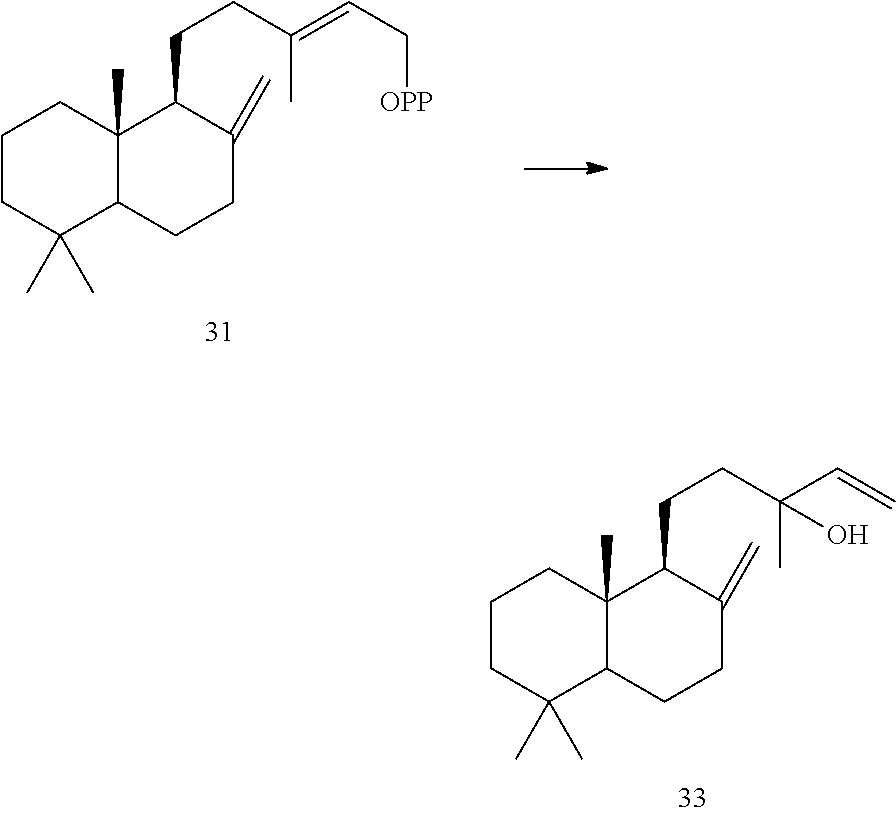
[0078]The Origanum majorana manool synthase (OmTPS4) can have the amino acid sequence shown below (SEQ ID NO:11).
| MSLAFSHVST FFSGQRVVGS RREIIPVNGV PTTANKPSFA | |
| VKCNLTTKDL MVKMKEKLKG QDGNLTVGVA DMPSSLCVID | |
| TLERLGVDRY FRSEIHVILH DTYRLWQQKD KDICSNVTTH | |
| AMAFRLLRVN GYEVSSEELA PYANLEHFSQ QKVDTAMAIE | |
| LYRAAQERIH EDESGLDKIL AWTTTFLEQQ LLTNSILDNK | |
| LHKLVEYYLN NYHGQTNRVG ARRHLDLYEM SHYQNLKPSH | |
| SLCNEDLLAF AKQGFRDFQI QQQKEFEQLQ RWYEDCRLDK | |
| LSYGRDVVKI SSFMASILMD DPELADVRLS IAKQMVLVTR | |
| IDDFFDHGGS REDSYKIIEL VKEWKEKAEY DSEEVKILFT | |
| AVYTTVNELA EACVQQGRNS TTVKEFLVQL WIEILSAFKV | |
| ELDTWSDGTE VSLDEYLSWS WISNGCRVSI VTTMHLLPTK | |
| LCSDEMLRSE ECKDLCRHVS MVCRLLNDIH SFEKEHEENT | |
| GNSVSILVAG EDTEEEAIGK IKEIVEYERR KLMQIVYKRG | |
| TILPRECKDI FLKACRATFY VYSSTDEFTS PRQVMEDMKT | |
| LSS |
[0079]
A nucleic acid encoding Origanum majorana manool synthase (OmTPS4) with SEQ ID NO:11 is shown below as SEQ ID NO:12.
| ATGTCACTCG CCTTCAGCCA TGTTAGTACC TTTTTCTCCG | |
| GCCAAAGAGT CGTCGGAAGC AGGAGAGAGA TTATTCCAGT | |
| TAACCGAGTT CCGACGACGG CCAATAAGCC GTCGTTCGCC | |
| GTTAAGTGCA ACCTTACTAC AAAGGATTTG ATGGTGAAAA | |
| TGAAGGAGAA GTTGAAGGGG CAAGACGGTA ATTTGACTGT | |
| CGGAGTAGCC GATATGCCCT CTAGCCTGTG CGTGATCGAC | |
| ACTCTTGAAA GGTTGGGAGT TGACCGATAC TTCCGATCTG | |
| AAATCCACGT TATTCTACAC GACACTTACC GGTTATGGCA | |
| ACAAAAGGAC AAAGATATAT GTTCCAACGT TACTACTCAT | |
| GCAATGGCGT TTAGACTTCT GAGAGTGAAT GGATACGAGG | |
| TTTCATCAGA GGAACTGGCT CCATATGCTA ACCTAGAGCA | |
| CTTTAGCCAG CAAAAAGTTG ATACTGCAAT GGCTATAGAG | |
| CTCTACAGAG CAGCACAGGA GAGAATACAC GAAGACGAGA | |
| GCGGTCTCGA CAAAATACTT GCTTGGACCA CCACTTTTCT | |
| CGAGCAACAG CTGCTCACTA ACTCCATTCT TGACAATAAA | |
| TTGCATAAAC TGGTGGAGTA CTACTTGAAC AACTACCACG | |
| GCCAAACGAA TAGGGTCGGA GCTAGACGAC ACCTCGACCT | |
| ATGAGATG AGCCATTACC AAAATCTAAA ACCTTCACAT | |
| AGTCTATGCA ATGAAGACCT TCTAGCATTT GCAAAGCAAG | |
| GTTTTCGAGA TTTTCAAATC CAGCAGCAGA AAGAATTCGA | |
| GCAACTGCAA AGGTGGTATG AAGATTGCAG GTTGGACAAG | |
| TTGAGTTATG GGAGAGATGT AGTAAAAATT TCTAGTTTCA | |
| TGGCTTCAAT ATTGATGGAT GATCCAGAAT TAGCCGATGT | |
| TCGTCTCTCC ATCGCCAAAC AGATGGTGCT CGTGACACGT | |
| ATCGATGATT tCTTCGACCA CGGTGGCTCT AGAgAaGACT | |
| CCTACAAGAT CATTGAACTA GTAAAAGAAT GGAAGGAGAA | |
| GGCaGAATAC GATTCCGAGG AAGTAAAAAT CCTTTTTACA | |
| GCAGTATACA CCACAGTAAA TGAGCTAGCA GAGGCTTGTG | |
| TTCAACAAGG AAGGAATAGT ACTACTGTCA AAGAATTCCT | |
| AGTTCAGTTG TGGATTGAAA TACTATCAGC TTTCAAGGTC | |
| GAGCTAGATA CGTGGAGCGA TGGCACGGAA GTAAGCCTGG | |
| ACGAGTACTT GTCGTGGTCG TGGATTTCGA ATGGCTGCAG | |
| AGTGTCTATA GTAACGACGA TGCATTTGCT CCCTACGAAA | |
| TTATGCAGTG ATGAAATGCT TAGGAGTGAA GAGTGCAAGG | |
| ATTTGTGTAG GCATGTTTCT ATGGTTGGCC GCTTGCTCAA | |
| CGACATCCAC TCTTTTGAGA AGGAGCATGA GGAGAATACG | |
| GGAAACAGTG TGAGCATTCT AGTAGCAGGT GAGGATACCG | |
| AAGAGGAAGC TATTGGAAAG ATCAAAGAGA TAGTTGAGTA | |
| TGAGAGGAGA AAATTGATGC AAATTGTGTA CAAGAGAGGA | |
| ACCATTCTCC CAAGAGAATG CAAAGACATA TTCTTGAAGG | |
| CGTGTAGGGC TACATTTTAC GTGTACTCGA GCACGGATGA | |
| GTTTACGTCT CCTCGACAAG TGATGGAAGA TATGAAAACC | |
| CTAAGCTCCT AG |
[0081]Origanum majorana palustradiene synthase (OmTPS5) can also convert (+)-copalyl diphosphate ((+)-CPP) [31]) to palustradiene [29].

[0083]The Origanum majorana palustradiene synthase (OmTPS5) can have the amino acid sequence shown below (SEQ ID NO:13).
| MVSACLKLKN NPFLDHRFRK SSNGFSVNFP ATMLTTVKCS | |
| RDNSEDLIAK IKERMNEKFV TVPAREYSVI EHRNPKPAWC | |
| GGLQSKTVIE EEVCSRLFLV EHLQDLGVDR FFQSEIQHIL | |
| HHTFRLWQQK DEQVFKDVTC RAMAFRLLRL EGYHVSSGEL | |
| GEYVDEEKFF RTVRLEWRST DTILELYKAS QVRLPEDDND | |
| NSNILKNLHE WTFIFLKEQL RRKTILDKGL ERKVEFYLKN | |
| YHGILDAVKH RRSLDHTRFW KTTAYNPAVY DEDLFRLSAQ | |
| DFMARQAQSQ KELEMLLKWY DECRLDKMEY GRNVIHVSHF | |
| LNANNFPDPR LSETRLSFAK TMTLVTRLDD FFDHHGSRED | |
| SVLIIELIRQ WNEPSTITTI FPSEEVEILY SALHSTVTDI | |
| AEKAYPIQGR CIKSLIIHLW VEILSSFMSE MDSCTAETQP | |
| DFHEYLGFAW ISIGCRICIL IAIHFLGEKV SQQMVMGAEC | |
| TELCRHVSTI ARLLNDLQTF KKEREERKVN SVIIQLKGDK | |
| ISEEVAVSNI ERMVEYHRKE LLKMVVRREG SLVPKRCKDV | |
| FWKSCNIAYY LYAFTDEFTS PQQMKEDMKL LFRDPINCVP | |
| SIPS |
[0084]
A nucleic acid encoding the Origanum majorana palustradiene synthase (OmTPS5) with SEQ ID NO:13 is shown below as SEQ ID NO:14.
| ATGGTATCTG CATGTCTAAA ACTCAAAAAT AATCCTTTCT | |
| TGGACCATCG ATTCAGGAAA AGCAGCAATG GATTTTCAGT | |
| TAATTTTCCG GCGACCATGC TCACCACTGT CAAGTGCAGC | |
| CGCGATAATT CAGAAGACTT GATAGCAAAG ATAAAAGAAA | |
| GGATGAATGA AAAATTTGTT ACGGTGCCGG CGAGGGAATA | |
| TTCCGTCATT GAGCATCGGA ATCCGAAGCC GGCGTGGTGC | |
| GGTCGTTTGC AATCCAAAAC AGTAATAGAA GAAGAAGTGT | |
| GCAGCCGTCT GTTTCTGGTC GAACACCTTC AAGATTTAGG | |
| AGTAGACCGC TTCTTTCAAT CAGAAATCCA ACATATTCTA | |
| CATCACACAT TCAGATTATG GCAGCAAAAA GATGAACAAG | |
| TTTTTAAAGA CGTGACATGT CGCGCCATGG CATTCAGACT | |
| CCTGCGTCTC GAAGGTTATC ATGTCTCGTC AGGAGAATTG | |
| GGGGAGTATG TTGATGAGGA AAAATTCTTT AGAACGGTAA | |
| GGTTAGAATG GAGAAGTACG GATACAATTC TTGAGCTGTA | |
| CAAAGCATCA CAGGTAAGAC TACCTGAAGA CGACAACGAC | |
| AATTCCAATA TCCTCAAAAA CTTGCACGAA TGGACCTTCA | |
| TATTTTTGAA GGAGCAGTTG CGGCGTAAAA CTATTCTTGA | |
| TAAAGGTTTA GAGAGAAAGG TAGAATTTTA CTTGAAGAAT | |
| TACCACGGCA TATTAGACGC GGTTAAGCAT AGACGAAGCC | |
| TCGATCACAC ACGATTCTGG AAAACTACTG CGTATAACCC | |
| TGCAGTGTAT GATGAGGATC TTTTCCGATT GTCGGCCCAA | |
| GATTTCATGG CTCGCCAAGC TCAGAGCCAG AAGGAACTTG | |
| AGATGTTGCT CAAGTGGTAC GATGAATGTA GACTGGACAA | |
| GATGGAGTAT GGGCGAAACG TGATACACGT TTCCCATTTC | |
| TTAAACGCAA ACAACTTCCC CGATCCTCGC CTGTCCGAAA | |
| CTCGTCTATC CTTTGCGAAA ACCATGACTC TCGTCACGCG | |
| TTTGGATGAT TTCTTCGATC ACCATGGCTC TAGAGAAGAT | |
| TCGGTCCTCA TCATCGAATT AATAAGGCAG TGGAATGAGC | |
| CTTCAACTAT TACAACAATA TTCCCCTCCG AAGAAGTGGA | |
| GATTCTCTAC TCTGCACTCC ACTCCACCGT AACAGATATA | |
| GCAGAGAAGG CTTATCCCAT CCAGGGTCGC TGCATCAAAT | |
| CGCTCATAAT TCATCTGTGG GTCGAGATAC TGTCGAGCTT | |
| CATGAGCGAA ATGGACTCGT GCACCGCGGA AACTCAGCCG | |
| GACTTTCACG AGTACTTAGG GTTTGCATGG ATCTCGATCG | |
| GCTGCAGAAT CTGCATTCTC ATAGCTATAC ATTTCTTGGG | |
| GGAGAAGGTA TCTCAACAAA TGGTTATGGG TGCTGAGTGC | |
| ACCGAGTTAT GTAGGCACGT TTCTACGATC GCACGCCTTC | |
| TCAACGATCT CCAAACCTTT AAGAAGGAGA GAGAAGAGAG | |
| GAAGGTAAAC AGCGTGATAA TCCAGCTCAA AGGGGATAAG | |
| ATATCGGAGG AGGTGGCCGT GTCGAATATA GAGAGAATGG | |
| TTGAATATCA CAGGAAAGAG CTGCTGAAGA TGGTGGTTCG | |
| GAGAGAAGGA AGCTTGGTTC CTAAGAGGTG TAAGGACGTG | |
| TTCTGGAAAT CCTGCAACAT TGCTTACTAT CTGTACGCTT | |
| TTACAGATGA ATTCACTTCG CCTCAACAAA TGAAGGAAGA | |
| TATGAAACTA CTCTTTCGTG ATCCAATCAA CTGCGTTCCT | |
| TCAATTCCTT CATGA |
[0086]The Perovskia atriplicifolia miltiradiene synthase (PaTPS3) can have the amino acid sequence shown below (SEQ ID NO:15).
| MLLAFNISDV PLSQHRVILS RREHFPRHAF QEFPMIAATK | |
| SSVNAICSLA TPTDLMGKIK EKFKAKDGDP LAAAAIQLAA | |
| DIPSSLCIID TLQRLGVDRY FQSEIDSILE ETHKLWKVKD | |
| RDIYSEVTTH AMAFRLLRVK GYEVSSEELA PYAEQERFDL | |
| QTIDLATVIE LYRAAQERTC EENDNSLEKL LAWTTTFLKH | |
| QLLTNSIPDT KLHKQVEYYL KNYHGILDRM GVRRSLDLYD | |
| ISHYRPLRAR FPNLCNEDFL SFARQDFSMC QAQHQKELEQ | |
| LQRWYSDCRL DALLKFGRNV VRVSSFLTSA IIGEPELSEV | |
| RLVFAKHIIL VTLIDDLFDH GGTREESYKI LELVTEWKEK | |
| TAAEYGSEEV EILETAVYNT VNELVERAHV EQGRSVKEFL | |
| IKLWVQILSI FKIELDTWSD ETALTLDEYL SSSWVSIGCR | |
| ICILMSMQFI GIKLTDEMLL SEECTDLCRH VSMVDRLLND | |
| VQTFEKERKE NTGNSVSLLL AANKDVTEEE AIRRAKEMAE | |
| CNRRQLMQIV YKTGTIFPRK CKDMFLKVCR IGCYLYASGD | |
| EFTSPQQMME DMKSLVYEPL YLPN |
[0087]
A nucleic acid encoding the Perovskia atriplicifolia miltiradiene synthase (PaTPS3) with SEQ ID NO:13 is shown below as SEQ ID NO:16.
| ATGTTACTTG CGTTCAACAT AAGCGATGTC CCTCTCTCGC | |
| AGGATAGAGT AATTCTGAGC AGGAGGGAAC ATTTTCCACG | |
| TCATGCATTC CAGGAATTTC CGATGATCGC CGCTACTAAG | |
| TCATCTGTTA ATGCCATTTG CAGCCTCGCT ACTCCAACTG | |
| ATTTGATGGG AAAAATAAAA GAGAAGTTCA AGGCCAAGGA | |
| CGGCGATCCT CTTGCCGCCG CGGCTATTCA ACTCGCGGCG | |
| GATATACCCT CGAGTCTGTG TATAATCGAC ACCCTCCAGA | |
| GGTTGGGAGT CGACCGATAC TTCCAATCCG AAATCGACTC | |
| TATTCTAGAG GAAACACACA AGTTATGGAA AGTGAAAGAT | |
| AGAGATATAT ACTCTGAGGT TACTACTCAT GCAATGGCGT | |
| TTAGACTTCT GCGAGTGAAG GGATATGAAG TTTCATCAGA | |
| GGAACTAGCT CCGTATGCTC AGCAAGAGCG CTTTGACCTG | |
| CAAACGATTG ATCTGGCGAC GGTTATCGAG CTTTACAGAG | |
| CAGCACAGGA GAGAACATGC GAAGAAAACG ACAACAGTCT | |
| TGAGAAACTA CTTGCTTGGA CCACCACCTT TCTCAAGCAC | |
| CAATTGCTCA CCAACTCCAT ACCTGACACC AAATTGCACA | |
| AACAGGTGGA ATACTACTTG AAGAACTACC ACGGGATATT | |
| AGATAGAATG GGAGTTAGAC GAAGCCTCGA CCTATACGAC | |
| ATAAGCCATT ATCGACCTCT GAGAGCAAGA TTCCCTAATC | |
| TGTGTAATGA AGATTTCCTA TCATTTGCGA GGCAAGATTT | |
| CAGTATGTGC CAACCCCAAC ACCAGAAGGA ACTTGAGCAA | |
| CTGCAAAGGT GGTATTCTGA TTGTAGGTTG GACGCGTTGT | |
| TGAAGTTTGG AAGAAATGTA GTGCGCGTTT CTAGCTTTCT | |
| GACTTCAGCA ATTATTGGTG AACCCGAATT GTCTGAAGTT | |
| CGACTAGTCT TTGCCAAACA TATTATTCTC GTTACACTTA | |
| TTCATGATTT ATTCGATCAT GGTGGAACTA GAGAAGAGTC | |
| ATACAAGATC CTTGAATTAG TAACAGAATG GAAAGAGAAG | |
| ACCGCAGCAG AATATGGTTC CGAGGAAGTT GAAATCCTTT | |
| TTACAGCGGT CTACAACACA GTAAATGAGT TGGTAGAGAG | |
| GGCTCATGTC GAACAAGGGC GCAGTGTCAA AGAATTTCTT | |
| ATTAAACTGT GGGTTCAAAT ACTATCAATT TTCAAGATAG | |
| AATTAGATAC ATGGAGCGAT GAGACTGCGC TAACCTTGGA | |
| TGAATACTTG TCTTCGTCGT GGGTGTCAAT TGGTTGCAGA | |
| ATCTGCATTC TCATGTCGAT GCAATTCATC GGTATAAAAT | |
| TAACTGATGA AATGCTTCTG AGTGAAGAGT GCACTGATTT | |
| GTGTAGGCAT GTTTCGATGG TTGACCGGCT GCTCAACGAT | |
| GTGCAAACCT TCGAGAAGGA ACGCAAAGAA AATACAGGAA | |
| ACAGTGTAAG CCTTCTGCTA GCAGCTAACA AAGATGTTAC | |
| TGAAGAGGAA GCAATTAGAA GAGCAAAAGA AATGGCGGAA | |
| TGCAACAGGA GACAACTGAT GCAGATTGTG TATAAAACAG | |
| GAACCATTTT CCCAAGAAAA TGCAAAGATA TGTTTCTCAA | |
| GGTATGCAGG ATTGGCTGTT ATTTGTATGC AAGCGGCGAC | |
| GAATTCACAT CTCCACAACA AATGATGGAA GATATGAAAT | |
| CCTTGGTTTA TGAACCCCTC TACCTACCTA ATTAA |
[0089]A Perovskia atriplicifolia miltiradiene synthase (PaTPS1) can have the amino acid sequence shown below (SEQ ID NO:17).
| MSLTFNAGVV RFSSHRVRST KDCFTVYGFP MIANKAAFAV | |
| KCSLTPTDLM GRVEEKFKGK NGNSLAASTT VESADIPSNL | |
| CIIDTLQRLG VDRYFQTEIN AILEDTYRLW ERKDKDIYSD | |
| ATTHAMAFRL LRVKGYEVSS EELAPYADQE CVNVQTADVA | |
| TVIELYRAAQ VRISEEESSL KKLHAWTTTF LKYQLQSNSI | |
| PEKKLHKLVE YYLKNYHGIL DRMGVRMDLD LFDISHYRTL | |
| QASDRFSSLR NEDFLEFARQ DFNICQAKHQ KELQQLQRWY | |
| ADCRLDTLKF GRDVVRVANF LTSAIFGEPE LSDARLIFAK | |
| HIVLVTCIDE FFDHGGSKEE SYKILELVEE WKEKPTGEYG | |
| CEEVEILFTA VYSTVNELAE MAHVEQGRSV KEFLVKLWVQ | |
| ILSIFKIELD TWSDDTELTL DSYLNNSWVS IGCRICILMS | |
| MQFAGVKLSD EMLLSEECVD LCRHVSMVDR LLNDVQTFEK | |
| ERKENTGNSV SLLQAAAERE GRAITEEEAI TQIKELAEYH | |
| RRKLMQIVYK TDTIFPRKCK DMFLKVCRIG CYLYASGDEF | |
| TTPQQMMEDM KSLVYQPLTV DDMSAKELTS VRN |
[0090]
A nucleic acid encoding the Perovskia atriplicifolia miltiradiene synthase (PaTPS1) with SEQ ID NO:13 is shown below as SEQ ID NO:18.
| ATGTCACTCA CTTTCAACGC TGGAGTCGTC CGTTTCTCCA | |
| GCCACCGCGT TCGGAGCACG AAAGATTGCT TTACAGTTTA | |
| CGGATTTCCG ATGATTGCAA ATAAGGCAGC TTTCGCAGTT | |
| AAATGCAGCC TTACTCCAAC CGATTTGATG GGGAGAGTAG | |
| AGGAGAAGTT CAAGGGCAAA AATGGTAATT CACTAGCAGC | |
| CTCGACGACG GTTGAATCCG CGGATATACC CTCGAACCTG | |
| TGTATAATCG ACACCCTCCA AAGATTGGGA GTCGACCGAT | |
| ACTTTCAAAC TGAAATCAAT GCCATTCTAG AGGACACTTA | |
| CAGATTATGG GAACGAAAAG ACAAAGACAT ATATTCCGAT | |
| GCCACAACTC ACGCGATGGC GTTTAGGTTA CTACGAGTGA | |
| AAGGATACGA AGTTTCATCA GAGGAACTGG CTCCTTACGC | |
| TGATCAAGAG TGCGTGAACG TGCAAACGGC TGATGTGGCA | |
| ACAGTTATCG AGCTTTACAG AGCAGCGCAG GTGAGAATAA | |
| GCGAAGAAGA GAGCAGTCTT AAGAAGCTTC ATGCTTGGAC | |
| CACCACCTTT CTCAAATATC AGTTGCAGAG TAACTCCATA | |
| CCTGAAAAGA AACTGCACAA ACTGGTGGAA TATTACTTGA | |
| AGAACTACCA TGGCATATTG GATAGAATGG GAGTTCGAAT | |
| GGACCTCGAC TTATTCGACA TCAGCCATTA TCGAACTCTA | |
| CAAGCTTCCG ATAGGTTCTC TAGTCTGCGT AACGAAGATT | |
| TTCTAGAGTT TGCAAGGCAA GATTTCAATA TCTGCCAAGC | |
| CAAGCACCAG AAAGAACTCC AACAACTGCA AAGGTGGTAT | |
| GCAGATTGCA GGCTCGACAC CTTGAAGTTC GGGAGAGACG | |
| TCGTACGCGT TGCTAATTTT CTGACTTCAG CAATCTTTGG | |
| CGAACCCGAG CTATCCGATG CTCGTCTGAT CTTTGCCAAG | |
| CATATCGTGC TCGTAACATG TATCGATGAA TTCTTCGATC | |
| ATGGTGGGTC TAAAGAAGAG TCCTACAAGA TCCTTGAATT | |
| AGTAGAAGAA TGGAAAGAGA AGCCAACTGG AGAATATGGG | |
| TGTGAGGAGG TTGAGATCCT TTTCACAGCA GTGTACAGTA | |
| CAGTGAATGA GTTGGCAGAG ATGGCTCATG TCGAACAAGG | |
| ACGTAGTGTG AAAGAGTTTC TAGTTAAACT GTGGGTGCAG | |
| ATACTGTCGA TTTTCAAGAT AGAACTGGAT ACATGGAGTG | |
| ATGACACGGA ACTGACGTTG GACAGCTACT TGAACAACTC | |
| GTGGGTGTCG ATCGCATGCA GAATCTGCAT TCTCATGTCG | |
| ATGCAGTTCG CCGGTGTAAA ACTGTCCGAC GAAATGCTTC | |
| TGAGTGAAGA GTGTGTTGAC TTGTGCAGGC ACGTCTCCAT | |
| GGTCGATCGC CTCCTGAACG ATGTGCAAAC TTTCGAGAAG | |
| GAACGCAAGG AAAATACAGG AAACAGTGTG AGCCTTCTGC | |
| AAGCAGCAGC TGAGAGAGAA GGAAGACCCA TTACAGAAGA | |
| GGAAGCTATT ACACAGATCA AAGAATTGGC TGAATACCAC | |
| AGGAGAAAAC TGATGCAGAT TGTGTACAAA ACAGACACCA | |
| TTTTCCCAAG AAAATGCAAA GATATGTTCT TGAAGGTGTG | |
| CAGGATTGGG TGCTATCTGT ACGCAAGTGG AGACGAATTC | |
| ACAACTCCAC AACAAATGAT GGAAGACATG AAATCATTGG | |
| TTTATCAACC CCTAACAGTT GATGACATGA GTGCCAAAGA | |
| ATTGACTTCT GTGAGAAACT AG |
[0092]The Salvia officinalis miltiradiene synthase (SoTPS1) can have the amino acid sequence shown below (SEQ ID NO:19).
| MSLAFNAAVA TFSGHRIRSR REILPGQGFP MITNKSSFAV | |
| KCNLTTTDLM GKITEKFKGR DSNFSAATAV QPAADIPSNL | |
| CIIDTLQRLG VDRYFQSEID TILEDTYRLW QRKEREIFSD | |
| ITIHAMAFRL LRVKGYVVSS EELAPYADQE RINLQRIDVA | |
| TVIELYRAAQ ERISEDESSL EKLHAWTATY LKQQLLTNSI | |
| PDKKLNKLVE CYLKNYHGIL DRMGVRQNLD LYDISHYQTL | |
| KAADRFSNLR NEDFLAFARQ DFNICQEQHQ KELQQLQRWY | |
| ADCRLDTLKY GRDVVRVANF LTSAIIGDPE LSEVRLVFAK | |
| HIVLVTRIDD FFDHGGSREE SYKILELLKE WKEKPAAEYG | |
| SKEVEILFIA VYNTVNELAE MAHIEQGRSV KEFLIKLWVQ | |
| IISIFKIELD TWSDETALTL DEYLSSSWVS IGCRICILMS | |
| MQFIGIKLSD EMLLSEECID LCRHVSMVDR LLNDVQTFEK | |
| ERKENTGNSV SLLLAANKDD SAFTEEEAIT KAKEMAECNR | |
| RQLMKIVYKT GTIFPRKCKD MFLKVCRIGC YLYASGDEFT | |
| SPQQMMEDMK SLVYEPLTVD PLEAKNVSGK |
[0093]
A nucleic acid encoding the Salvia officinalis miltiradiene synthase (SoTPS1) with SEQ ID NO:19 is shown below as SEQ ID NO:20.
| ATGTCCCTCG CCTTCAACGC AGCAGTTGCC ACTTTCTCCG | |
| GCCACAGAAT TCGGAGCAGG AGAGAAATTC TTCCGGGGCA | |
| AGGATTTCCG ATGATCACCA ACAAGTCGTC TTTCGCCGTG | |
| AAATGTAACC TTACTACAAC AGATTTGATG GGCAAGATAA | |
| CAGAGAAATT CAAGGGAAGA GACAGTAATT TTTCAGCAGC | |
| AACGGCTGTT CAACCTGCGG CGGATATACC CTCTAACCTG | |
| TGCATAATCG ACACCCTCCA AAGGTTGGGA GTCGACCGAT | |
| ACTTCCAATC TGAAATCGAC ACTATTCTAG AGGACACATA | |
| CAGGTTATGG CAAAGGAAAG AGAGAGAGAT ATTTTCGGAT | |
| ATAACTATTC ATGCAATGGC ATTTAGACTT TTGCGAGTTA | |
| AAGGATATGT AGTTTCATCA GAGGAACTGG CTCCGTATGC | |
| TGACCAAGAG CGCATTAACC TGCAAAGGAT TGATGTAGCG | |
| ACAGTTATCG AGCTTTACAG AGCAGCACAG GAGAGAATAA | |
| GTGAAGACGA GAGCAGTCTT GAGAAACTAC ATGCTTGGAC | |
| CGCCACCTAT CTCAAGCAGC AGCTGCTCAC TAACTCCATT | |
| CCTGAGAAGA AATTGAACAA ACTGGTGGAA TGCTACTTGA | |
| AGAACTATCA CGGGATATTA GATAGAATGG GAGTTAGACA | |
| AAACCTCGAC CTCTACGACA TAAGCCACTA TCAAACTCTA | |
| AAAGCTGCAG ATAGGTTCTC TAATCTACGT AATGAAGATT | |
| TTCTAGCATT TGCGAGGCAA GATTTTAATA TTTGCCAAGA | |
| ACAACACCAA AAAGAACTTC AGCAACTGCA AAGGTGGTAT | |
| GCAGATTGTA GGTTGGACAC ATTGAAGTAT GGAAGAGATG | |
| TCGTGCGGGT TGCTAATTTT CTAACATCAG CAATTATTGG | |
| TGATCCTGAA TTGTCTGAAG TCCGTCTAGT CTTCGCCAAA | |
| CATATTGTGC TTGTAACACG TATTGATGAT TTTTTCGATC | |
| ATGGTGGATC TAGAGAAGAG TCCTACAAGA TCCTTGAATT | |
| ACTAAAAGAA TGGAAAGAGA AGCCAGCTGC AGAATATGGT | |
| TCCAAAGAAG TTGAAATTCT TTTCACAGCA GTATACAATA | |
| CAGTAAACGA GTTGGCAGAG ATGGCTCACA TCGAACAAGG | |
| ACGTAGTGTT AAAGAATTTC TAATAAAGCT GTGGGTTCAA | |
| ATCATATCGA TTTTCAAGAT AGAATTAGAT ACATGGAGCG | |
| ATGAGACAGC GCTGACCTTG GATGAGTACT TGTCTTCGTC | |
| GTGGGTGTCA ATTGGGTGCA GAATCTGCAT TCTCATGTCG | |
| ATGCAATTCA TTGGTATAAA ATTATCTGAT GAAATGCTTC | |
| TGAGTGAAGA GTGTATTGAT TTGTGTCGGC ATGTCTCCAT | |
| GGTTGACCGG CTGCTCAACG ACGTGCAGAC TTTCGAGAAG | |
| GAACGCAAGG AAAATACAGG AAATAGCGTG AGCCTTCTGC | |
| TAGCAGCTAA CAAAGACGAC AGCGCCTTTA CTGAAGAGGA | |
| AGCTATTACA AAAGCAAAAG AAATGGCGGA ATGTAACAGG | |
| AGACAACTGA TGAAGATTGT GTATAAAACA GGAACCATTT | |
| TCCCAAGAAA ATGCAAAGAT ATGTTTCTGA AGGTATGCAG | |
| GATTGGCTGT TACTTGTATG CAAGCGGCGA TGAATTCACA | |
| TCTCCACAAC AAATGATGGA AGATATGAAA TCCTTGGTCT | |
| ATGAACCCCT AACAGTTGAT CCTCTCGAGG CCAAAAATGT | |
| GAGTGGCAAA TGA |
[0095]Ajuga reptans (+)-copalyl diphosphate synthase (ArTPS1) is a (+)-copalyl diphosphate ((+)-CPP) [31] synthase, and compound 31 is shown below.

[0097]The Ajuga reptans(+)-copalyl diphosphate synthase (ArTPS1) can have the amino acid sequence shown below (SEQ ID NO:21).
| MASLSTFHLY SSSLLHRKTL QSSPKLNLSS ECFSTRTWMN | |
| SSKNLSLNYQ VNQKIGKLTG TRVATVDAPQ QLEHDDSTAK | |
| GHDIVDIETQ DPIEYIRMLL NTTGDGRISV SPYDTAWIAL | |
| IKDVEGRDFP QFPSSLEWIA NHQLADGSWG DEGFFCVYDR | |
| LVNTIACVVA LRSWNVHHDK SQRGIQYIKE NVHQLKDGNA | |
| EHMMCGFEVV FPALLQKAKN MGIDDLPYEA PVIQDIYHTR | |
| EQKLKRIPLE MMHKVPTSLL FSLEGLENLD WDKLLKLQSA | |
| DGSFLTSPSS TAFAFMQTKD EKCFQFIKNT VETFNGGAPH | |
| TYPVDVFGRL WAVDRLQRLG ISRFFEAEIA DCLSHIHRYW | |
| NDKGLFSGRE SDFVDIDDTS MGFRLLRMQG YDVSPNVLRN | |
| FKNGDKFSCY GGQTIESSTP IYNLYRASQF RFPGEEILEE | |
| ADKFAHEFLS EQLGNNQLLD KWVISDRLQE EISIGLGMPF | |
| YATLPRVEAS YYIQHYAGAD DVWIGKTLYR MPEISNDTYL | |
| ELARNDFKRC QAQHQFEWIY MQEWYESCNI EEFGISRKEL | |
| LRVYFLACSS IFEVERTKER MAWAKSQIIS RMITSFFNKQ | |
| TTSSEEKETL LTEFRNINGL HKSNNTRDGD MNIVLATLHQ | |
| FFAGFDRYTS HQLKNAWGVW LSKLQRGAVD GGADAELITT | |
| TINVCAGHIA LKEDILSHDE YKTLTDLTSK ICQQLSHIQN | |
| EKVVEIDGGI TAKSRLKNEE LQRDMQSLVK LVLEKSVGLN | |
| RNIKQTFLTV AKTYYYRAYN AEETMDAHIF KVLFEPVA |
[0098]
A nucleic acid encoding the Ajuga reptans (+)-copalyl diphosphate synthase (ArTPS1) with SEQ ID NO:21 is shown below as SEQ ID NO:22.
| ATCGCCTCTT TGTCCACTTT CCACCTCTAC TCTTCCTCAC | |
| TCCTTCACCG CAAAACACTG CAATCTTCAC CAAAGCTTAA | |
| CCTGTCTTCA GAATGCTTCT CCACCAGAAC TTGGATGAAC | |
| AGCAGCAAAA ACTTGTCGTT AAATTACCAA GTTAATCAGA | |
| AAATAGGAAA GCTGACAGGG ACTCGAGTTG CCACTGTGGA | |
| TGCGCCACAA CAACTTGAAC ACGATGATTC AACTGCTAAA | |
| GGCCATGATA TAGTCGATAT TGAAACTCAG GATCCAATTG | |
| AATATATTAG AATGCTGTTG AACACAACAG GCGATGGCAG | |
| AATCAGCGTT TCGCCTTACG ACACAGCATG GATTGCTCTT | |
| ATTAAGGACG TGGAAGGACG TGATTTTCCT CAATTTCCAT | |
| CCAGCCTTGA GTGGATCGCG AACCATCAAC TCGCTGATGG | |
| TTCATGGGGA GACGAAGGAT TTTTCTGTGT GTATGATCGG | |
| CTCGTAAATA CTATAGCATG TGTCGTAGCA TTGAGATCAT | |
| CGAATGTCCA TCACGACAAG AGCCAAAGAG GAATACAATA | |
| TATCAAGGAA AATGTGCATC AACTTAAGGA TGGAAATGCT | |
| GAGCACATGA TGTGTGGTTT CGAAGTAGTG TTTCCTGCAC | |
| TTCTTCAAAA AGCCAAAAAT ATGGGCATTG ATGATCTTCC | |
| ATATGAGGCT CCTGTCATCC AGGATATTTA CCATACAAGG | |
| GAGCAGAAAT TGAAAAGGAT ACCATTGGAG ATGATGCACA | |
| AAGTGCCTAC TTCTCTGCTG TTTAGTTTGG AAGGACTGGA | |
| GAATTTAGAT TGGGATAAAC TCCTTAAGTT GCAGTCAGCT | |
| GATGGCTCTT TCCTCACTTC TCCCTCCTCT ACTGCTTTCG | |
| CATTCATGCA AACAAAAGAC GAAAAATGCT TCCAGTTCAT | |
| CAAGAACACT GTTGAAACCT TTAATGGAGG AGCACCACAT | |
| ACTTATCCGG TCGATGTTTT TGGAAGACTT TGGGCGGTTG | |
| ATAGGCTGCA GCGCCTCGGA ATTTCTCGAT TCTTTGAGGC | |
| TGAGATTGCT GATTGCTTAA GTCACATTCA TAGATATTGG | |
| AATGATAAGG GGCTTTTCAG TGGACGTGAA TCGGACTTTG | |
| TCGATATTGA CGACACATCC ATGGGTTTCA GACTTCTAAG | |
| AATGCAAGGC TATGATGTTA GTCCAAATGT ACTGAGGAAT | |
| TTCAAGAATG GTGACAAGTT TTCATGTTAC GGAGGTCAAA | |
| CGATCGAGTC ATCAACTCCA ATATACAATC TGTACAGACC | |
| TTCTCAATTC CGGTTTCCAG GAGAAGAAAT TCTTGAAGAA | |
| GCCGACAAGT TCGCCCATGA GTTCTTGTCC GAACAGCTTG | |
| GCAACAACCA ATTGCTTGAT AAATGGGTTA TATCCGACCG | |
| CTTGCAGGAA GAGATAAGTA TTGGATTGGG GATGCCATTT | |
| TATGCCACCC TTCCCAGAGT TGAAGCAAGC TACTATATAC | |
| AACATTACGC TGGTGCCGAC GACGTGTGGA TCGGCAAGAC | |
| ACTCTACAGG ATGCCGGAAA TAAGTAATGA TACATACCTG | |
| GAGCTAGCAA GAAATGATTT CAAGAGATGC CAAGCACAAC | |
| ATCAGTTCGA GTGGATCTAC ATGCAAGAAT GGTATGAGAG | |
| TTGCAACATT GAAGAATTCG GGATAAGCCG AAAGGAGCTC | |
| CTTCGCGTTT ACTTTTTGGC TTGCTCTAGC ATCTTTGAGG | |
| TCGAGAGGAC TAAAGAGAGA ATGGCATGGG CAAAATCTCA | |
| AATTATTTCT AGAATGATCA CTTCTTTCTT TAATAAACAA | |
| ACTACTTCAT CTGAGGAAAA AGAAACACTT TTAACCGAAT | |
| TCAGAAACAT CAACGGTCTG CACAAATCAA ACAATACAAG | |
| AGATGGAGAT ATGAACATTG TGCTTGCAAC CCTCCATCAA | |
| TTCTTCGCTG GATTTGACAG ATATACTAGC CATCAACTGA | |
| AAAATGCTTG GGGAGTATGG TTGACCAAGC TGCAACGAGG | |
| AGCAGTAGAC GGTGGAGCAG ACGCAGAGCT GATAACAACC | |
| ACCATAAACG TATGCGCCGG TCATATAGCT CTTAAGGAAG | |
| ACATATTGTC CCACGATGAG TACAAGACTC TCACCGACCT | |
| CACCAGCAAG ATTTGTCAGC AGCTTTCTCA TATTCAAAAC | |
| GAAAAGGTTG TGGAAATTGA CGGTGGGATT ACAGCAAAAT | |
| CTAGGTTGAA GAATGAGGAA CTGCAACGTG ACATGCAATC | |
| ATTGGTGAAA TTAGTACTTG AGAAATCAGT TGGGCTCAAC | |
| CGGAATATAA AGCAAACATT TCTAACGGTT GCAAAAACAT | |
| ACTACTACAG AGCCTACAAT GCTGAGGAAA CTATGGATGC | |
| CCATATATTC AAAGTTCTTT TCGAACCAGT TGCGTGA |
[0100]Ajuga reptans cleroda-4(18),13E-dienyl diphosphate synthase (ArTPS2) was identified and isolated as described herein. ArTPS2 was identified as a (5R,8R,9S,10R) neo-cleroda-4(18),13E-dienyl diphosphate [38] synthase. In addition, the combination of ArTPS2 and SsSS enzymes generated neo-cleroda-4(18),14-dien-13-ol [37]. These compounds are shown below.
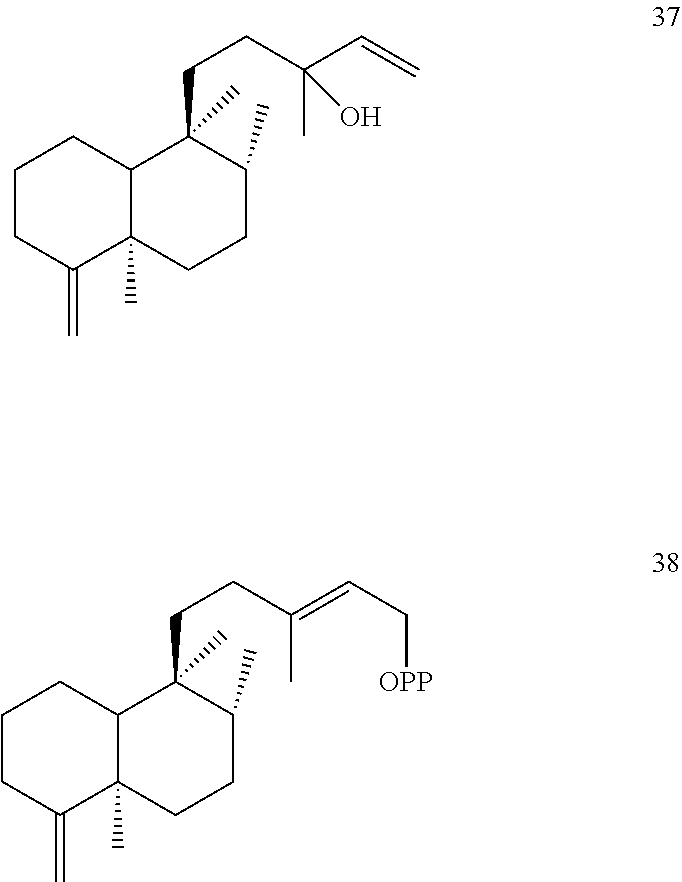
[0102]ArTPS2 is of particular interest for applications in agricultural biotechnology, for example, because it is useful for production of neo-clerodane diterpenoids. Neo-clerodane diterpenoids, particularly those with an epoxide moiety at the 4(18) position, have garnered significant attention for their ability to deter insect herbivores (Coll et al., Phytochem Rev 7(1):25 (2008); Klein Gebbinck et al. Phytochemistry 61(7):737-770 (2002); Li et al. Nat Prod Rep 33(10):1166-1226 (2016)). The 4(18)-desaturated products produced by ArTPS2 (e.g., compounds 37 and 38 with the ═CH2 4(18) desaturation projecting from the A ring) the can be used in biosynthetic or semisynthetic routes to yield potent insect antifeedants.
[0103]The Ajuga reptans cleroda-4(18),13E-dienyl diphosphate synthase (ArTPS2) can have the amino acid sequence shown below (SEQ ID NO:23).
| MSFASQATSL LSSPNRLGHV PTPSSPARFA AGGAPFWKIL | |
| FTARSNGQYK AISRARNQGN VEYIDEIQKG PQVVLEAENS | |
| LEDDTQKDTD QIRELVENVR VKLQNIGGGG ISISAYDTAW | |
| VALVEDINGS GQPQFPTSLD WISNHQFPDG SWGSSKFLYY | |
| DRILCTLACI VALKTWNVHP DKYHKGLDFI RENIHKLADE | |
| EEVHMPIGFE VAFPSIIETA KKVGIEIPED FPGKKEIYAK | |
| RDLKLKKIPM DILHKMPTPL LFSIEGMEGL DWQKLFKFRD | |
| DGSFLTSPSS TAYALQQTKD ELCLKYLTDL VKKDNGGVPN | |
| AFPVDLFDRN YTVDRLRRLG ISRYFQPEIE ECMKYVYRFW | |
| DKRGISWARN TNVQDLDDTA QGFRNLRMHG YEVTLDVFKQ | |
| FEKCGEFFSF HGQSSDAVLG MFNLYRASQV LFPGEHMLAD | |
| ARKYAANYLH KRRLNNRVVD KWIINKDLEG EVAYGLDVPF | |
| YASLPRLEAR FYIEQYGGSD DVWIGKALYR MVNVSCDTYL | |
| ELAKLDYNKC QSVHQNEWKS FQKWYKSCSL GEFGFSEGSL | |
| LQAYYIAAST IFEPEKSGER LAWAKTAALM ETIQQLSSQQ | |
| KREFVDEFKH KNILKNENGE RYRSSTSLVE TLISTVNQLS | |
| SDILLEQGRD VHQELCHVWL KWLSTWEERG NLVEAEAELL | |
| LRTLHLNSGL DESSFSHPKY QQLLEVSTKV CHLLRLFQKR | |
| KVYDPEGCTT DIATGTTFQI EACMQELVKL VFSRSSEDLD | |
| SLTKLRFLDV ARSFYYTABC DPQVVESHID KVLFEKVV |
[0104]
A nucleic acid encoding the Ajuga reptans cleroda-4(18),13E-dienyl diphosphate synthase (ArTPS2) with SEQ ID NO:23 is shown below as SEQ ID NO:24.
| ATGTCATTTG CTTCCCAAGC CACCTCCCTC CTATCATCCC | |
| CCAACCGTCT CGGCCATGTT CCGACGCCAA GCTCGCCGGC | |
| TCGTTTCGCT GCCGGTGGTG CCCCATTTTG GAAGATATTA | |
| TTTACAGCTA GGTCTAATGG GCAGTATAAA GCTATTTCAA | |
| GAGCTCGTAA CCAAGGAAAT GTAGAGTACA TTGATGAGAT | |
| TCAGAAAGGC CCGCAAGTCG TATTGGAGGC AGAAAACAGC | |
| TTGGAAGATG ACACACAAAA AGATACTGAT CAGATAAGGG | |
| AACTAGTGGA AAATGTCCGA GTAAAGCTGC AGAATATCGG | |
| TGGTGGAGGG ATAAGCATAT CGGCGTACGA CACCGCATGG | |
| GTGGCGCTGG TGGAGGACAT CAACGGCAGT GGCCAGCCAC | |
| AGTTTCCGAC GAGCCTCGAT TGGATATCGA ACCATCAGTT | |
| CCCTGATGGG TCATGGGGCA GCAGCAAGTT TTTGTATTAT | |
| GATCGGATTC TATGCACATT AGCATGTATA GTTGCATTGA | |
| AAACCTGGAA TGTGCATCCT GATAAGTACC ACAAAGGGTT | |
| GGATTTCATC AGAGAGAACA TTCACAAGCT TGCGGACGAA | |
| GAAGAAGTGC ACATGCCAAT TGGGTTCGAA GTGGCATTCC | |
| CATCAATTAT TGAAACAGCT AAAAAAGTAG GAATCGAAAT | |
| CCCTGAGGAT TTTCCTGGCA AGAAAGAAAT TTATGCAAAA | |
| AGAGATTTAA AGCTAAAAAA AATACCAATG GATATACTGC | |
| ATAAAATGCC CACACCATTG CTCTTCAGCA TAGAAGGAAT | |
| GGAAGGCCTT GACTGGCAAA AGCTATTCAA ATTCCGCGAT | |
| GATGGCTCGT TTCTTACGTC TCCGTCCTCA ACAGCCTATG | |
| CACTCCAGCA AACAAAGGAT GAGCTATGCC TCAAGTATCT | |
| AACAGATCTT GTCAAGAAAG ACAACGGAGG AGTTCCGAAT | |
| GCATTTCCAG TAGACCTGTT TGATCGTAAC TATACAGTAG | |
| ACCGCTTGCG AAGGCTAGGA ATTTCACGGT ACTTTCAACC | |
| TGAAATTGAA GAATGCATGA AATATGTTTA CAGATTTTGG | |
| GATAAAAGAG GAATTAGCTG GGCAAGAAAT ACCAATGTTC | |
| AGGACCTTGA TGACACTGCA CAGGGATTCA GGAATTTAAG | |
| GATGCATGGT TATGAAGTCA CTCTAGATGT TTTCAAACAA | |
| TTTGAGAAAT GTGGAGAGTT TTTCAGTTTT CATGGGCAAT | |
| CCAGCGATGC TGTTTTAGGA ATGTTCAACT TGTACCGGGC | |
| TTCTCAGGTT TTATTTCCGG GAGAACACAT GCTTGCAGAT | |
| GCGAGGAAGT ATGCAGCCAA CTATTTGCAT AAACGAAGAC | |
| TTAATAATAG GGTGGTCGAC AAATGGATTA TCAACAAAGA | |
| CCTTGAAGGC GAGGTGGCAT ATGGGCTAGA TGTTCCGTTC | |
| TACGGCAGCC TACCTCGACT CGAAGCAAGG TTCTACATAG | |
| AACAATATGG GGGTAGTGAT GATGTGTGGA TTGGAAAAGC | |
| TTTATACAGA ATGGTAAATG TAAGCTGCGA CACTTACCTT | |
| GAGCTAGCAA AATTAGACTA CAACAAATGC CAATCCGTGC | |
| ATCAGAATGA GTGGAAAAGC TTTCAAAAAT GGTACAAAAG | |
| TTGCAGTCTT GGGGAGTTTG GGTTCAGTGA AGGAAGCCTA | |
| CTCCAAGCTT ACTACATAGC AGCCTCAACT ATATTCGAGC | |
| CAGAGAAATC AGGAGAACGC CTAGCTTGGG CTAAAACAGC | |
| AGCTCTAATG GAGACAATTC AACAACTTTC CAGCCAGCAA | |
| AAACGTGAAT TTGTTGATGA ATTCAAACAT AAAAACATAC | |
| TGAAGAATGA AAATGGAGAA AGGTATAGAT CAAGTACCAG | |
| TTTGGTAGAG ACTCTGATAA GCACTGTAAA TCAGCTCTCA | |
| TCAGACATAC TATTGGAGCA AGGCAGAGAC GTTCATCAAG | |
| AATTATGTCA CGTGTGGCTA AAATGGCTGA GTACATGGGA | |
| GGAAAGAGGA AACCTGGTGG AAGCGGAAGC CGAGCTTCTT | |
| CTGCGAACCT TACATCTCAA CAGCGGATTG GATGAATCAT | |
| CATTTTCCCA CCCTAAATAT CAACAGCTCT TGGAGGTGTC | |
| TACCAAAGTT TGCCACCTCC TTCGCCTATT TCAGAAACGA | |
| AAGGTGTATG ATCCCGAAGG GTGTACAACC GACATAGCAA | |
| CAGGAACAAC GTTCCAGATA GAAGCATGCA TGCAAGAACT | |
| AGTGAAATTA GTGTTCAGCA GATCCTCAGA AGATTTAGAT | |
| TCTCTTACTA AGTTGAGATT TTTGGATGTT GCTAGAAGTT | |
| TCTATTACAC TGCCCATTGT GATCCACAGG TGGTCGAGTC | |
| CCACATCGAT AAAGTATTGT TTGAGAAGGT AGTCTAG |
[0106]The Plectranthus barbatus (+)-Copalyl diphosphate synthase (CfTPS16) was identified and isolated using the methods described herein, and this CfTPS116 protein can have the amino acid sequence shown below (SEQ ID NO:25).
| MQASMSSLNL NNAPAVCSSR SQLSAKLHPP EYSTVGAWLN | |
| RGNKNQRLGY RIRPKQLSKL TECRVASADV SQEIGKVGQS | |
| VRTPEEVNKK IEESIKYVKE LLMTSGDGRI SVAPYDTAIV | |
| ALIKDLEGRD APEFPSCLEW IANNQKDDGS WGDDFFCIYD | |
| RIVNTIASVV ALKSWNVHPD KIERGVSYIK ENAHKLKGGN | |
| LEHMTSGFEF VVPGCFDRAK ALGIEGLPYD DPIIKEIYAT | |
| KERRLSKVPK DMIYKVPTTL LFSLEGLGME DLDWQKILKL | |
| QSGDGSFLTS PSSTAYAFMQ TGDEKCYKFL QNAVRNCNGG | |
| APHTYPVDVF ARLWAVDRLQ RLGISRFFQP EIKFCLDHIK | |
| NVWTKNGVFS GRDSEFVDID DTSMGIRLLK MHGYDVDPNA | |
| LKHFKQEDGR FSCYGGQMIE SASPIYNLYR AAQLRFPGEE | |
| ILEEATKFAY NFLQQKLANN QIQEKWVISE HLIDEIKMGL | |
| KMPWYATLPR VEASYYLQYY AASGDVWIGK TFYRMPEISN | |
| DTYKELALLD FNRCQAQHQF EWIYMQEWYQ SNNIKEFGIS | |
| KKELLLAYFL AAATIFEPER SQERIVWAKT QVVSKMITSF | |
| LSQENALSSX QKTALFIDFG HSINGLNQIT SVEKENGLAQ | |
| TVLATFGQLL EEYDRYTRHQ LKNAWSQWFM KLQQGDDNGG | |
| ADAELLANTL NICAGHIAFN EDILSHNEYT SLSSLTNKIC | |
| QRLSQIRDNK ILEIEDGSIK DKELEQEMQA LVKLVLEETG | |
| GIDRNIKQTF LSVFKMFYYR AYHDAEAIDX HIFKVMFEPV | |
| V |
[0107]
A nucleic acid encoding the Plectranthus barbatus (+)-Copalyl diphosphate synthase (CfTPS16) with SEQ ID NO:25 is shown below as SEQ ID NO:26.
| ATGCAGGCTT CTATCTCATC TCTGAACTTG AACAATGCAC | |
| CGGCCGTCTG CAGCAGCAGG TCACAGCTAT CCGCTAAACT | |
| TCACCCGCCG GAATATTCCA CCGTGGGTGC ATGGCTGAAT | |
| CGTGGCAACA AAAACCAGCG GTTGGGCTAC CGGATTCGTC | |
| CAAAGCAACT ATCAAAACTA ACTGAGTGTC GAGTAGCAAG | |
| TGCAGATGTG TCACAAGAGA TTGGAAAAGT CGGCCAATCT | |
| GTTCGGACTC CTGAAGAGGT AAATAAAAAG ATAGAGGAAT | |
| CCATCAAGTA CGTGAAGGAG CTGCTGATGA CGTCGGGCGA | |
| CGGGCGAATC AGTGTGGCGC CCTACGACAC GGCCATAGTT | |
| GCCCTTATCA AGGACTTGGA AGGGCGCGAT GCCCCGGAGT | |
| TTCCATCTTG CTTGGAGTGG ATTGCAAACA ATCAAAAAGA | |
| CGATGGTTCT TGGGGGGATG ACTTCTTCTG CATCTATGAT | |
| CGGATCGTTA ATACCATAGC ATCCGTCGTC GCCTTAAAAT | |
| CATGGAATGT GCACCCAGAC AAGATTGAGA GAGGAGTATC | |
| CTACATCAAG GAAAACGCGC ATAAACTAAA AGGTGGGAAT | |
| CTCGAACACA TGACATCAGG GTTCGAGTTC GTGGTTCCCG | |
| CGTGTTTTGA CAGAGCCAAA GCCTTGGGCA TCGAAGGCCT | |
| TCCCTATGAT GATCCCATCA TCAAGGAGAT TTATGCTACA | |
| AAAGAAAGGA CATTGAGCAA GGTACCGAAG GACATGATCT | |
| ACAAAGTTCC GACAACTCTA TTGTTTAGTT TAGAGGGACT | |
| GGGCATGGAG GATTTGGACT GGCAAAAGAT ACTGAAACTG | |
| CAGTCGGGCG ACGGCTCATT CCTCACCTCT CCGTCGTCCA | |
| CCGCCTACGC ATTCATGCAG ACCGGAGACG AAAAATGCTA | |
| CAAATTCCTC CAGAACGCCG TCAGAAATTG CAACGGCGGA | |
| GCGCCGCACA CTTATCCAGT CGACGTCTTT GCACGGCTCT | |
| GGGCGGTCGA CCGACTTCAG CGACTCGGAA TTTCTCGCTT | |
| CTTTCAGCCC GAGATCAAGT TTTGCCTAGA CCACATCAAA | |
| AATGTGTGGA CTAAGAACGG AGTTTTCAGT GGACGGGATT | |
| CAGAGTTTGT GGATATCGAC GACACATCCA TGGGCATCAG | |
| GCTTCTGAAA ATGCACGGAT ACGATGTCGA CCCAAATGCA | |
| CTGAAACATT TCAAGCAGGA GGATGGGAGG TTTTCATGCT | |
| ACGGTGGTCA AATGATCGAG TCTGCATCTC CGATTTACAA | |
| TCTCTACAGG GCTGCTCAGC TTCGTTTTCC AGGAGAAGAA | |
| ATTCTTGAAG AAGCCACTAA ATTTGCCTAC AACTTCCTGC | |
| AACAGAAGCT GGCCAACAAT CAAATTCAAG AAAAGTGGGT | |
| CATATCCGAG CACCTAATTG ATGAGATAAA AATGGGATTG | |
| AAGATGCCAT GGTACGCCAC CCTACCTAGA GTTGAGGCTT | |
| CATACTATCT CCAATATTAT GCAGCTTCTG GCGACGTATG | |
| GATTGGCAAG ACTTTTTACA GGATGCCAGA AATAAGTAAT | |
| GACACGTACA AAGAGCTTGC ACTATTGGAT TTCAACCGAT | |
| GCCAAGCACA ACATCAGTTC GAATGGATTT ACATGCAAGA | |
| GTGGTATCAA AGCAACAACA TTAAAGAATT TGGGATAAGC | |
| AAGAAAGAGC TTCTTCTTGC TTACTTCTTG GCTGCTGCAA | |
| CCATTTTTGA ACCCGAACGA TCGCAAGAGC GGATCGTGTG | |
| GGCTAAAACC CAAGTTGTTT CTAAGATGAT CACATCGTTT | |
| CTGTCTCAAG AAAACGCTTT GTCATCGGAN CAAAAGACTG | |
| CACTTTTCAT CGATTTTGGG CATAGTATCA ATGGCCTCAA | |
| TCAAATAACT AGTGTTGAGA AAGAGAATGG GCTTGCTCAG | |
| ACTGTCCTGG CAACCTTCGG ACAACTACTC GAGGAATTCG | |
| ACAGATACAC AAGGCATCAA CTGAAAAATG CTTGGAGCCA | |
| ATGGTTCATG AAACTGCAGC AAGGAGATGA CAATGGCGGG | |
| GCAGACGCAG AGCTCCTAGC AAACACATTG AACATCTGCG | |
| CTGGTCATAT TGCTTTTAAC GAAGACATAT TATCTCACAA | |
| CGAATACACC TCTCTCTCCT CCCTCACAAA CAAAATCTGT | |
| CAGCGGCTAA GTCAAATTCG AGATAATAAG ATACTGGAAA | |
| TTGAGGATGG GAGCATAAAA GATAAGGAAC TAGAACAGGA | |
| AATGCAGGCG CTGGTGAAGT TAGTCCTGGA AGAAACCGGT | |
| GGCATCGACA GGAACATCAA GCAAACATTT TTGTCAGTTT | |
| TCAAAATGTT TTACTACAGA GCCTACCACG ATGCTGAGGC | |
| TATCGATGNC CATATTTTCA AAGTAATGTT TGAACCAGTC | |
| GTATGA |
[0109]Hyptis suaveolens labda-7,13E-dienyl diphosphate synthase (HsTPS1) was identified and isolated as described herein, and is a (5S, 9S, 10S) labda-7,13E-dienyl diphosphate [21] synthase. When HsTPS1 was expressed in N. benthamiana, labda-7,13(16),14-triene [22] was formed. The combination of HsTPS1 with OmTPS3 produced labda-7,12E,14-triene [24].

[0111]The Hyptis suaveolens labda-7,13E-dienyl diphosphate synthase (HsTPS1) can have the amino acid sequence shown below (SEQ ID NO:27).
| MAYMISISNL NCSSLINTNL SAKIQLHQGL KGTWLKTSKR | |
| MCMDQQVHGK QIAKVIESRV TDKDVSTAQD FEVLKVNRVE | |
| DLISSIKSSL KTMEDGRISV SPYSTSWIAL IPSIDGRQTP | |
| QFPSSLEWIV KHQLSDGSWG DALFFCVYDR LVNTIACIIA | |
| LHTWKVHADK VKKGVSFVKE NIWKLEDANE VHMTSGFEVI | |
| FPILLRRARD MGIDGLPSDD TPVVRMISAA RDHKLKKIPR | |
| EVMHQVTTIL LYSLEGLEDL DWSRLFKLQS ADGSFLTSPS | |
| STAFAFMQTN NHNCLRFITS VVQTFNGGAP DNYPIDIFAR | |
| LWAVDRLQRL GISRFFEQEI NDCLSYVYRF WNANGVFSAG | |
| ATNFCDLDDT SMAFRLLRLH GYDVDPNVLR KFKEGDRFCC | |
| HSGEVAMSTS PTYALYRASQ IQFPGEEILD EAFSFTRDYL | |
| QDWLARDQVL DKWIVSKDLP DEIKVGLEVP WYASLPRVEA | |
| AYYMQRHYGG STDAWVAKTC YRMPDVSNDD YLELARLDFK | |
| RCQAQHQSEL SYMQRWYDSC NVEEFGISRK ELLVAYFVAA | |
| ATIFEPERAT ERIVWAKTEI VSKMIKAFFG EDSLDQKTML | |
| LKEFRNSINN GSHRFMKSEH RIVNILLQAL QELLHGSDDC | |
| RIGQLKNAWY EWLMKFEGGD EASLWGEGEL LVTTLNICTA | |
| HFLQHHDLLL NHDYITLSEL TNRICLKLSQ IQVGEMNEMR | |
| EDMQALTKLV IGESCIVNKN IKQTFLAVAK TFYYRAYFDA | |
| DTVDLHIFKV LFEPIV |
[0112]
A nucleic acid encoding the Hyptis suaveolens labda-7,13E-dienyl diphosphate synthase (HsTPS1) with SEQ ID NO:27 is shown below as SEQ ID NO:28.
| ATGGCGTATA TGATATCTAT TTCAAATCTC AACTGTTCCT | |
| CGCTACTAAA CACCAATCTT TCAGCAAAGA TTCAGCTGCA | |
| CCAAGGTCTC AAAGGAACAT GGCTAAAAAC CAGCAAACGC | |
| ATGTGCATGG ATCAACAGGT TCATGGCAAG CAGATAGCAA | |
| AAGTGATCGA GAGCCGAGTT ACTGATAAGG ATGTTTCCAC | |
| TGCTCAGGAC TTTGAAGTGT TAAAGGTCAA TAGAGTGGAG | |
| GATCTGATAT CAAGCATTAA GAGTTCATTG AAGACAATGG | |
| AAGATGGAAG AATAAGCGTG TCGCCCTACA GCACATCATG | |
| GATCGCACTC ATTCCAAGTA TTGATGGGCG CCAGACGCCC | |
| CAGTTTCCAT CTTCACTGGA GTCGATCGTG AAGCATCAGC | |
| TATCAGATGG TTCATGGGGT GATGCCCTTT TTTTCTGCGT | |
| TTATGATCGT CTCGTAAATA CGATTGCATG CATCATTGCC | |
| CTGCACACCT GGAAGGTTCA TGCAGACAAG GTTAAAAAAG | |
| GAGTAAGTTT TGTGAAGGAA AATATATGGA AACTTGAAGA | |
| CGCCAACGAG GTCCACATGA CTAGTGGTTT CGAAGTTATA | |
| TTTCCCATCC TTCTTCGAAG AGCACGAGAC ATGGGAATTG | |
| ATGGTCTTCC TTCTGATGAT ACTCCAGTTG TTAGGATGAT | |
| TTCTGCTGCT AGGGATCACA AATTGAAAAA GATTCCGAGG | |
| GAGGTGATGC ACCAAGTGAC AACAACTCTA TTATATAGTT | |
| TGGAAGGGTT GGAAGATTTA GACTGGTCAA GGCTTTTCAA | |
| ACTTCAGTCA GCTGATGGTT CATTCTTAAC TTCTCCATCT | |
| TCAACTGCCT TCGCATTCAT GCAAACTAAT AACCACAATT | |
| GCTTGAGATT CATCACTAGC GTTGTCCAAA CATTCAATGG | |
| AGGAGCTCCA GATAACTATC CAATCGACAT CTTTGCGAGA | |
| CTGTGGGCAG TTGACAGGTT ACAGCGGTTA GGGATTTCTC | |
| GTTTCTTCGA GCAGGAGATA AATGATTGCC TAAGCTATGT | |
| ATATAGATTT TGGAATGCAA ATGGAGTTTT CAGTGCAGGA | |
| GCCACTAATT TTTGTGATCT TGACGACACA TCCATGGCTT | |
| TCCGGCTACT ACGTTTGCAT GGATATGATG TCGACCCAAA | |
| TGTTCTGAGG AAATTCAAAG AGGGAGACAG ATTCTGTTGC | |
| CACAGTGGTG AAGTGGCGAT GTCGACATCG CCAACGTACG | |
| CTCTCTACAG AGCTTCCCAA ATTCAGTTTC CAGGAGAAGA | |
| AATTCTGGAT GAAGCCTTCA GCTTCACTCG CGACTATCTA | |
| CAGGACTGGT TAGCAAGAGA TCAAGTTCTT GATAAGTGGA | |
| TTGTATCCAA GGACCTTCCA GATGAGATTA AGGTAGGACT | |
| AGAGGTGCCA TGGTATGCCA GCCTGCCACG GGTAGAGGCT | |
| GCTTATTACA TGCAACGACA TTACGGCGGG TCTACTGATG | |
| CGTGGGTGGC CAAGACTTGT TACAGGATGC CTGATGTGAG | |
| CAACGATGAT TACCTGGAGC TTGCAAGATT GGATTTCAAG | |
| AGATGTCAAG CCCAACATCA GACTGAATTG AGTTACATGC | |
| AACGATGGTA TGACAGTTGC AATGTCGAAG AATTCGGAAT | |
| AAGCAGAAAA GAGTTGCTTG TAGCTTATTT TGTGGCTGCT | |
| GCAACTATTT TTGAACCTGA GAGAGCAACT GAGAGAATTG | |
| TGTGGGCAAA AACTGAAATA GTTTCTAAGA TGATCAAAGC | |
| ATTTTTTGGT GAAGACTCAT TAGACCAAAA AACTATGTTG | |
| TTAAAAGAAT TCAGAAACAG CATCAATAAT GGCTCCCACA | |
| GATTCATGAA GAGTGAGCAT AGAATCGTCA ACATTCTACT | |
| ACAAGCCTTG CAGGAGCTAT TACATGGATC TGATGATTGT | |
| CGTATTGGTC AACTCAAAAA TGCTTGGTAT GAGTGGCTGA | |
| TGAAATTCGA GGGAGGAGAT GAAGCAAGTT TGTGGGGAGA | |
| AGGAGAGCTT CTTGTCACCA CCTTAAACAT TTGCACAGCT | |
| CATTTCCTTC AACACCATGA TTTACTGTTG AATCATGACT | |
| ACATAACTCT TTCTGAGCTC ACAAACAAGA TCTGCCTCAA | |
| GCTTTCTCAG ATTCAGGTAG GAGAAATGAA TGAAATGAGA | |
| GAAGATATGC AGGCGTTGAC GAAATTAGTG ATTGGGGAAT | |
| CATGCATCGT CAACAAAAAC ATTAAGCAAA CATTTCTTGC | |
| AGTTGCAAAG ACTTTCTATT ACAGAGCCTA CTTCGATGCC | |
| GACACCGTTG ATCTCCATAT ATTTAAAGTT CTATTTGAGC | |
| CCATTGTCTG A |
[0114]Leonotis leonurus peregrinol diphosphate synthase (LITPS1) was identified and isolated using the methods described herein. The LITPS1 enzyme was identified as a peregrinol diphosphate (PgPP) [5] synthase, where the peregrinol diphosphate (PgPP) [5] compound is shown below.
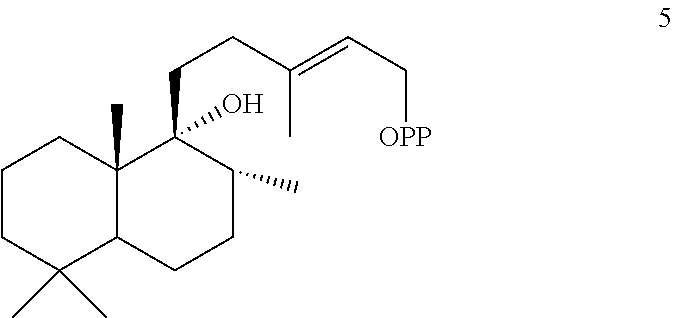
[0116]The Leonotis leonurus peregrinol diphosphate synthase (LITPS1) can have the amino acid sequence shown below (SEQ ID NO:29).
| MASTASTLNL TINSTPFVST KTQAKVSLTA CLWMQDRSSS | |
| RHVSLKHKFC RNQQLKCRAS LDVQQVRDEV FSTAQSPESV | |
| DKKIEERKKW VKNLLSTMDD GRINWSAYDT AWISLIKEFE | |
| GRDATQFPST LMRIAENQLA DGSWGDPDYD CSYDRIINTL | |
| ACVVALTTWN AHPEHNKKGI KYIKENMYKL EETPVVLMTS | |
| AFEVVFPALL NRAKNLGIQD LPYDMPIVKE ICKIGDEKLA | |
| RIPKKMMEKE PTSLMYAAEG VENLDWEKLL KQRTPENGSF | |
| LSSPAATAVA FMHTKDENCL RYIMYLLDKF NGGAPNVYPI | |
| DLWSRLWATD RIQRLGISRF FKEEIKEILS YVYSYWTDIG | |
| VYCTRDSKYA DIDDTSMGFR LLRMHGFKMD PNVFKYFQKD | |
| DRFVCLGGQM NDSPTATYNL YRAAQYQFPG EKILEDARKF | |
| SQEFLQHCID TNNLLDKWVI SPRFPEELKF GMEMTWYSCL | |
| PRIEARYYVQ HYGATEDVWL GKTFFRMEEI SNENYKELAK | |
| LDFSKCQAQH QTEWIHMQEW YESSNAKEFG ISRKDLLFAY | |
| FLAAASIFET ERAKERILWA KSQIICKMVK SYLENQTASL | |
| EHKIAFLTGF GDNNNGLHTI NKGSGPVNNV MRTLQQLLGE | |
| FDGYISSQLE NAWAAWLTKL EQGEANDGEL LATTLNICSG | |
| RIVYNEDTLS NKEYKAFADL TNKICQNLAQ IQNKKGDEIK | |
| DPNEGEKDKE VEQGMQALAK LVFEESGLER SIKETFLAVV | |
| RTYHYGAYVA DEKIDVHMFK VLFEPVE |
[0117]
A nucleic acid encoding the Leonotis leonurus peregrinol diphosphate synthase (LITPS1) with SEQ ID NO:29 is shown below as SEQ ID NO:30.
| ATGGCCTCCA CTGCATCCAC TCTAAATTTG ACCATCAATA | |
| GTACACCATT TGTAAGCACC AAAACGCAAG CAAAGGTTTC | |
| CTTGCCCGCA TGTTTATGGA TGCAGGATAG AAGCAGCAGT | |
| AGACACGTGT CGTTAAAACA CAAATTCTGT CGAAATCAAC | |
| AACTTAAGTG TCGAGCAAGT CTGGATGTTC AGCAAGTACG | |
| TGATGAAGTT TTTTCCACTG CTCAATCCCC TGAATCGGTG | |
| GATAAAAAAA TAGAGGAACG TAAAAAATGG GTGAAGAATT | |
| TGTTGAGTAC AATGGACGAT GGACGAATAA ATTGGTCAGC | |
| CTATGACACG GCATGGATTT CACTTATTAA AGAATTTGAA | |
| GGACGAGATG CTCCCCAGTT TCCGTCGACT CTCATGCGCA | |
| TCGCGGAGAA CCAATTGGCC GACGGGTCAT GGGGCGATCC | |
| AGATTACGAC TGCTCCTATG ATCGGATAAT AAACACACTA | |
| GCGTGTGTTG TAGCCTTGAC AACATGGAAT GCTCATCCTG | |
| AACACAATAA AAAAGGAATA AAATACATCA AGGAAAATAT | |
| GTATAAACTA GAAGAGACGC CTGTTGTACT CATGACTAGT | |
| GCATTTGAAG TTGTGTTTCC GGCGCTTCTT AACAGAGCTA | |
| AAAACTTGGG CATTCAAGAT CTTCCCTATG ATATGCCCAT | |
| CGTGAAGGAG ATTTGTAAAA TAGGGGATGA GAAGTTGGCA | |
| AGGATACCAA AGAAAATGAT GGAGAAAGAG CCAACATCGC | |
| TGATGTATGC CGCGGAAGGA GTCGAAAACT TGGACTGGGA | |
| AAAGCTTCTG AAACAGCGGA CACCCGAGAA TGGCTCGTTC | |
| CTCTCTTCCC CGGCCGCAAC TGCCGTTCCA TTTATGCACA | |
| CAAAAGATGA AAATTGCTTA AGATACATCA TGTACCTTTT | |
| GGACAAATTT AATGGAGGAG CACCAAATGT TTATCCGATC | |
| GACCTCTGGT CAAGACTTTG GGCAACGGAC AGGATACAAC | |
| GTCTGGGAAT TTCCCGCTTC TTTAAGGAAG AGATTAAGGA | |
| AATCTTAAGT TATGTCTATA GCTATTGGAC AGACATTGGA | |
| GTCTATTGTA CACGAGATTC CAAATATGCT GACATTGACG | |
| ACACATCCAT GGGATTCAGG CTTCTGAGGA TGCACGGATT | |
| TAAAATGGAC CCAAATGTAT TTAAATACTT CCAGAAAGAC | |
| GACAGATTTG TTTGTCTAGG TGGTCAAATG AATGATTCTC | |
| CAACTGCAAC ATACAATCTT TACAGGGCTG CTCAATACCA | |
| ATTTCCAGGT GAAAAAATTC TAGAAGATGC TAGAAAGTTC | |
| TCTCAAGAGT TTCTACAACA TTGTATAGAC ACCAATAACC | |
| TTCTAGATAA ATGGGTGATA TCCCCGCGCT TTCCGGAAGA | |
| GTTGAAATTT GGAATGGAGA TGACATGGTA TTCCTGCCTA | |
| CCACGAATTG AGGCTAGATA CTACGTACAA CATTATGGTG | |
| CTACAGAGGA CGTCTGGCTT GGAAAGACTT TTTTCAGGAT | |
| GGAAGAAATC AGTAATGAGA ACTATAAGGA GCTTGCAAAA | |
| CTTGATTTCA GTAAATGCCA AGCACAACAT CAGACAGAGT | |
| GGATTCATAT GCAAGAGTGG TATGAAAGTA GCAATGCTAA | |
| GGAATTTGGG ATAAGCAGAA AAGACCTACT TTTTGCTTAC | |
| TTTTTGGCTG CAGCTTCCAT ATTTGAAACC GAAAGGGCAA | |
| AAGAGAGAAT TCTGTGGGCA AAATCTCAAA TTATTTGCAA | |
| GATGGTTAAG TCATATCTGG AAAACCAAAC GGCGTCGTTG | |
| GAGCACAAAA TCGCCTTTTT AACTGGATTC GGAGATAACA | |
| ACAATGGCCT GCACACAATT AATAAGGGGT CTGGACCTGT | |
| TAACAATGTC ATGAGAACCC TCCAACAGCT CCTTGGAGAA | |
| TTCGACGGAT ATATTAGTAG TCAATTGGAA AATGCTTGGG | |
| CAGCATGGTT GACGAAACTC GAGCAAGGCG AGGCCAACGA | |
| TGGCGAGCTC CTCGCAACCA CACTAAACAT TTGTTCTGGG | |
| CGTATTGTGT ATAACGAGGA TACATTATCG AACAAGGAGT | |
| ACAAGGCTTT CGCAGACCTC ACAAATAAAA TTTGTCAAAA | |
| TCTTGCTCAA ATCCAAAATA AAAAGGGTGA CGAAATTAAG | |
| GATCCGAATG AAGGCGAAAA GGACAAGGAA GTCGAGCAAG | |
| GCATGCAGGC ATTGGCTAAG TTAGTTTTTG AGGAATCTGG | |
| GCTTGAGAGG AGTATCAAAG AAACATTCTT AGCAGTGGTG | |
| AGAACTTATC ACTATGGGGC CTATGTTGCT GATGAGAAGA | |
| TTGATGTCCA CATGTTCAAG GTTTTGTTCG AACCAGTTGA | |
| ATGA |
[0119]Nepeta mussinii (+)-copalyl diphosphate synthase (NmTPS1) was identified and isolated. The NmTPS1 enzyme can synthesize compound 31, shown below.
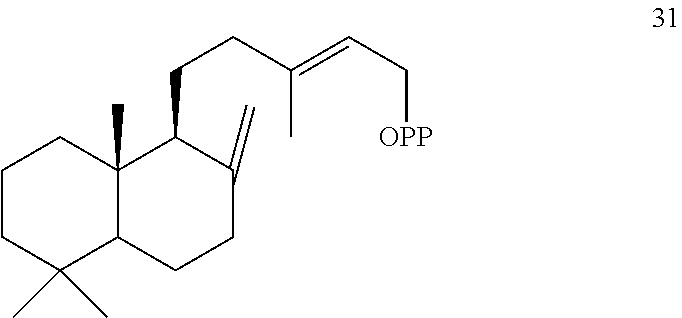
[0121]The Nepeta mussinii (+)-copalyl diphosphate synthase (NmTPS1) can have the amino acid sequence shown below SEQ ID NO:31).
| MTSISSLNLS NAAAARRRLQ LPANVHLPEF HSVCAWLNSS | |
| SKHDPFSCRI HRKQKSKVTE CRVASVDASP VSDHKMSSPV | |
| QTQEEANKNM EESIEYIKNL LMTSGDGRIS VSAYDTSIVA | |
| LIKDIEGRDA PQFPSCLEWI GQNQKADGSW GDDFFCIYDR | |
| FVNTLACIVA LKSWNLHPHK IQKGVTYIKK NVHKLKDGRP | |
| ELMTSGFEIC VPAILQRAKD LGIQDLPYDD PMIKQITDTK | |
| ERRLKKIPKD FIYQLPTTLL FSLEGQENLD WEKILKLQSA | |
| DGSFLTSPSS TAAVFMHTKD EKCLKFIENA VKNCDGGVPH | |
| TYPVDVFARL WAVDRLQRLG ISRFFQPEIK YFLDHIQSVW | |
| TENGVFSGRD SQFCDIDDTS MGIRLLKMHG YKIDPNALEH | |
| FKQEDGKFSC YGGQMIESAS PIYNLYRAAQ LRFPGEEILE | |
| EAIKFSYNFL QEKLAKDEIQ EKWVISEHLI DEIKTGLKMP | |
| WYATLPRVEA AYYLDYYAGS GDVWIGKTFY RMPEISNDTY | |
| KEMAILDFNR CQAQHQFEWI YMQEWYESSN VKEFGISKKE | |
| LLVAYFLAAS TIFEPERAQE RIMWAKTKIV SKMIASSLNK | |
| QTTLSLDQKT ALFTQLEHSL NGLDSDEKDN GVAETKNLVA | |
| TFQQLLDGFD KYTRHQLKNA WSQWLKQVQQ GEATGGADAE | |
| LEANTLNICA GHIAFNEQVL SHNEYTTLST LTNKICHRLT | |
| QIQDKKTLEI IDGGIRYKEL EQEMQALVKL VVEENDGGGI | |
| DRNIKQTFLS VFKNYYYSAY HDAHTTDVHI FKVLFGPVV |
[0122]
A nucleic acid encoding the Nepeta mussinii (+)-copalyl diphosphate synthase (NmTPS1) with SEQ ID NO:31 is shown below as SEQ ID NO:32.
| ATGACTTCAA TATCCTCTCT AAATTTGAGC AATGCAGCAG | |
| CTGCTCGCCG CAGGTTACAA CTACCAGCAA ACGTTCACCT | |
| GCCGGAATTT CACTCCGTCT GTGCATGGCT GAATAGCAGC | |
| AGCAAACACG ATCCCTTTAG TTGCCGAATT CATCGAAAGC | |
| AAAAATCGAA AGTAACCGAG TGTCGAGTAG CAAGCGTGGA | |
| TGCATCACCA GTGAGTGATC ATAAAATGAG TTCTCCTGTT | |
| CAAACTCAAG AAGAGGCAAA TAAAAATATG GAGGAGTCAA | |
| TCGAGTACAT AAAGAATTTG TTGATGACAT CTGGAGACGG | |
| GCGAATAAGC GTGTCGGCAT ACGACACGTC AATAGTCGCC | |
| CTAATTAAGG ACATAGAAGG ACGCCACGCC CCGCAATTTC | |
| CATCATGCCT GGAGTGGATC GGGCAAAACC AAAAGGCCGA | |
| TGGCTCGTGG GGGGACGACT TCTTCTGTAT TTACGACCGC | |
| TTCGTAAATA CACTAGCATG TATCGTGGCC TTGAAATCAT | |
| GGAACCTTCA CCCTCACAAG ATTCAAAAAG GAGTGACATA | |
| CATCAAGAAA AACGTGCATA AGCTTAAAGA TGGGAGGCCT | |
| GAGCTGATGA CGTCAGGGTT CGAAATTTGT GTTCCCGCCA | |
| TTCTTCAAAG AGCCAAAGAC TTGGGCATCC AAGATCTTCC | |
| CTATGATGAT CCCATGATTA AACAGATCAC TGATACGAAA | |
| GAGCGACGAC TCAAAAAGAT ACCGAAGGAT TTTATATACC | |
| AATTGCCGAC GACTTTACTC TTCAGTTTGG AAGGGCAGGA | |
| GAATTTGGAC TGGGAAAAGA TACTCAAACT GCAGTCAGCT | |
| CACGGCTCCT TCCTTACTTC GCCGTCCTCC ACCGCCGCCG | |
| TCTTCATGCA TACCAAAGAT GAAAAATGCT TGAAGTTCAT | |
| AGAGAACGCC GTCAAAAATT GCGACGGCGG AGTGCCCCAT | |
| ACCTACCCAG TAGACGTGTT TGCAAGACTT TGGGCAGTTG | |
| ACAGACTACA ACGCCTAGGG ATTTCTCGCT TTTTTCAGCC | |
| TGAGATTAAA TATTTCTTAG ATCACATACA AAGCGTTTGG | |
| ACTGAGAACG GAGTTTTCAG TGGACGAGAT TCACAATTTT | |
| GCGACATTGA TGATACGTCC ATGGGGATAA GGCTTCTGAA | |
| AATGCATGGA TACAAAATCG ACCCAAATGC ACTTGAGCAT | |
| TTCAAGCAGG AGGATGGTAA ATTTTCGTGC TACGGTGGTC | |
| AAATGATCGA GTCTGCATCA CCGATATACA ATCTGTACCG | |
| AGCTGCTCAA CTCCGATTTC CAGGAGAAGA AATTCTTGAA | |
| GAGGCCATTA AATTTTCCTA TAACTTTTTG CAAGAAAAGC | |
| TAGCCAAGGA TGAAATTCAA GAAAAATGGG TCATATCGGA | |
| GCACTTAATT GATGAGATTA AGATCGGGCT AAAGATGCCA | |
| TGGTACGCCA CTCTACCCCG AGTTGAAGCT GCATATTACC | |
| TGGACTATTA TGCAGGATCC GGCGATGTGT GGATTGGCAA | |
| GACTTTCTAC AGGATGCCAG AAATCAGTAA TGATACATAC | |
| AAAGAAATGG CCATTTTGGA TTTCAACCGA TGCCAAGCAC | |
| AACATCAGTT TGAATGGATT TACATGCAAG AGTGGTATGA | |
| AAGTAGCAAC GTAAAGGAAT TTGGGATAAG CAAAAAAGAG | |
| CTACTTGTTG CTTATTTCTT GGCTGCATCA ACCATATTTG | |
| AACCGGAAAG AGCACAAGAG AGGATTATGT GGGCAAAAAC | |
| AAAAATTGTT TCCAAAATGA TCGCATCATC TCTTAACAAA | |
| CAAACCACTC TATCGTTAGA CCAAAAGACT GCACTTTTTA | |
| CCCAACTCGA ACATAGTCTC AATGGCCTCG ACAGTGATGA | |
| GAAAGATAAT GGAGTAGCTG AGACGAAAAA TCTAGTGGCA | |
| ACCTTCCAGC AGCTGCTAGA TGGATTCGAC AAATACACTC | |
| GCCATCAATT GAAAAATGCT TGGAGCCAGT GGTTGAAGCA | |
| AGTGCAGCAA GGAGAGGCGA CCGGGGGCGC AGACGCGGAG | |
| CTGGAAGCAA ACACGTTGAA CATCTGTGCC GGTCATATCG | |
| CATTCAACGA ACAAGTATTA TCGCACAACG AATACACAAC | |
| TCTCTCCACA CTCACAAACA AGATCTGCCA CCGGCTTACC | |
| CAAATTCAAG ACAAAAAGAC GCTTGAGATA ATCGACGGCG | |
| GCATAAGATA TAAGGAGCTG GAGCAGGAGA TGCAGGCGTT | |
| GGTGAAATTA GTTGTTGAAG AAAACGACGG CGGCGGCATA | |
| GACAGGAATA TTAAACAAAC ATTTTTATCA GTTTTCAAGA | |
| ATTATTACTA CAGTGCCTAC CACGATGCTC ACACAACCGA | |
| TGTTCATATT TTCAAAGTAT TATTTGGACC GGTCGTCTGA |
[0124]Origanum majorana (+)-copalyl diphosphate synthase (OmTPS1) was identified and isolated as describe herein. The OmTPS1 enzyme can synthesize compound 31. OmTPS1 can also synthesize palustradiene [29] (shown below), when combined with OmTPS5.
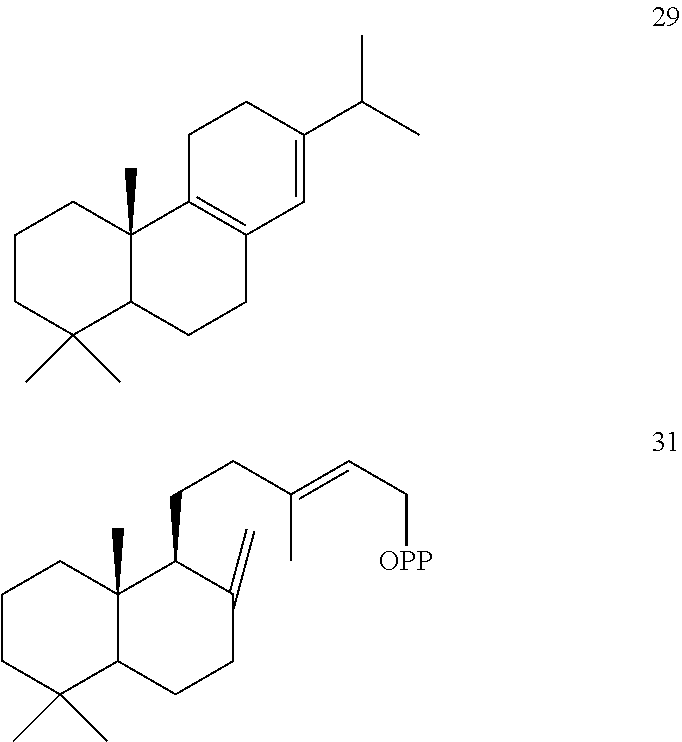
[0126]The Origanum majorana (+)-copalyl diphosphate synthase (OmTPS1) can have the amino acid sequence shown below (SEQ ID NO:33).
| MTDVSSLRLS NAPAAGGRLP LPGKVHLPEF RTVCAWLNNG | |
| CKYEPLTCRI SRRKISECRV ASLNSSQLIE KVGSPAQSLE | |
| EANKKIEDSI EYIKNLLMTS GDGRISVSAY DTSLVALIKD | |
| VKGRDAPQFP SCLEWIAQNQ MADGSWGDEF FCIYDRIVNT | |
| LACLVALKSW NLHPDKIEKG VTYINENVHK LKDGSTEHMT | |
| SGFEIVVPAT LERAKVLGIQ GLPYDHPFIK EIINTKERRL | |
| SKIPKDLIYK LPTTLLFSLE GQGELDWEKI LKLQSSDGSF | |
| LTSPSSTASV FMRTKDEKCL KFIENAVKNC GGGAPHTYPV | |
| DVFARLWAVD RLQRLGISRF FQHEIKYFLD HINSVWTENG | |
| VFSGRDSQFC DIDDTSMGVR LLKMHGYNVD PNALKHFKQE | |
| DGKFSCYPGQ MIESASPIYN LYRAAQLRFP GEEILEEASR | |
| FAFNFLQEKI ANHEIQEKWV ISEHLIDEIK LGLKMPWYAT | |
| LPRVEAAYYL EYYAGSGDVW IGKTFYRMPE ISNDTYKEVA | |
| ILDFNTCQAQ HQFEWIYMQE WYESSKVKDF GISKKDLLVA | |
| YFLAASTIFE PERTQERIIW AKTLILSRMI TSFLNKQATL | |
| SSQQKNAILT QLGESVDGLD KIYSGEKDSG LAETLLATFQ | |
| QLLDGFDRYT RHQLKNAWGQ WLMKVQQGEA NGGADAELIA | |
| NTLNICAGLI AFNEDVLLHS EYTTLSSLTN KICQRLSQIE | |
| DEKTLEVIEG GIKDKELEED IQALVKLALE ENGGCGVDRR | |
| IKQSFLSVFK TFYYRAYHDA ETTDLHIFKV LFGPVM |
[0127]
A nucleic acid encoding the Origanum majorana (+)-copalyl diphosphate synthase (OmTPS1) with SEQ ID NO:33 is shown below as SEQ ID NO:34.
| ATGACCGATG TATCCTCTCT TCGTTTGAGC AATGCACCAG | |
| CTGCCGGCGG CAGGTTGCCG CTGCCGGGAA AGGTTCACCT | |
| GCCTGAATTT CGCACCGTTT GTGCATGGTT GAACAATGGC | |
| TGCAAATACG AGCCCTTGAC TTGTCGAATT AGTCGACGGA | |
| AGATATCTGA ATGTCGAGTA GCAAGTCTGA ATTCGTCGCA | |
| AGTAATTGAA AAGGTCGGTT CTCCTGCTCA ATCTCTAGAA | |
| GAGGCAAACA AAAAGATCGA GGACTCCATC GAGTACATTA | |
| AGAATCTATT GATGACATCT GGCGACGGGC GGATAAGTGT | |
| GTCGGCTTAC GACACGTCGC TAGTCGCCCT AATAAAGGAC | |
| GTGAAAGGAC GAGATGCCCC TCAGTTCCCG TCGTGCCTGG | |
| AGTGGATAGC GCAAAACCAA ATGGCCGACG GGTCGTGGGG | |
| GGATGAGTTC TTCTGTATTT ACGACCGGAT CGTGAATACA | |
| TTAGCATGCC TCGTTGCCTT GAAATCATGG AACCTTCACC | |
| CCGACAAGAT CGAAAAAGGA GTGACGTACA TCAACGAAAA | |
| TGTGCACAAA CTGAAAGACG GGAGCACCGA GCACATGACG | |
| TCAGGGTTCG AAATCGTGGT CCCCGCCACT CTAGAAAGAG | |
| CCAAAGTCTT GGGCATCCAA GGCCTCCCTT ATGATCATCC | |
| CTTCATTAAG GAGATTATTA ATACTAAGGA GCGAAGATTA | |
| AGCAAAATAC CCAAGGATTT GATATACAAA CTGCCAACGA | |
| CGCTGCTGTT CAGTTTAGAA GGGCAGGGAG AATTAGATTG | |
| GGAAAAGATA CTGAAACTGC AGTCAAGCGA TGGCTCCTTC | |
| CTTACTTCGC CCTCGTCGAC CGCCTCCGTC TTCATGCGGA | |
| CGAAAGACGA GAAATGCCTC AAGTTCATTG AGAACGCCGT | |
| TAAGAATTGC GGCGGGGGAG CGCCGCATAC TTACCCAGTG | |
| GATGTGTTTG CAAGACTTTG GGCAGTTGAC AGACTACAGC | |
| GATTAGGGAT TTCTCGATTC TTCCAACACG AGATTAAATA | |
| CTTCTTAGAT CACATTAAGA GTGTATGGAC CGAGAATGGA | |
| GTTTTCAGTG GACGAGATTC ACAATTTTGT GATATCGACG | |
| ACACTTCTAT GGGAGTTAGG CTTCTAAAAA TGCATGGATA | |
| CAATGTTGAT CCAAATGCGC TCAAGCATTT CAAGCAGGAG | |
| GATGGCAAAT TCTCTTGCTA CCCTGGCCAA ATGATCGAGT | |
| CTGCATCTCC GATATACAAT CTCTACCGAG CCGCTCAACT | |
| CCGGTTCCCC GGAGAAGAAA TTCTCGAAGA AGCAAGTCGA | |
| TTCGCCTTCA ACTTTCTGCA GGAAAAGATA GCCAACCATG | |
| AAATTCAAGA AAAATGGGTC ATATCTGAGC ACTTAATTGA | |
| TGAGATAAAG TTGGGACTGA AGATGCCATG GTACGCGACT | |
| CTGCCCCGAG TTGAGGCCGC TTATTATCTA GAGTATTATG | |
| CTGGCTCAGG CGACGTATGG ATTGGAAAGA CTTTCTACCG | |
| GATGCCGGAA ATCAGTAACG ATACGTATAA AGAGGTGGCC | |
| ATTTTGGATT TCAACACATG CCAAGCTCAA CACCAGTTTG | |
| AATGGATTTA CATGCAAGAG TGGTACGAAA GTAGCAAGGT | |
| TAAAGATTTC GGGATAAGCA AAAAGGACCT ACTTGTTGCT | |
| TACTTTCTGG CGGCATCGAC TATATTTGAA CCCGAAAGAA | |
| CACAAGAGAG GATTATTTGG GCAAAAACCC TAATTCTTTC | |
| TAGGATGATC ACATCATTTC TCAACAAACA AGCTACACTT | |
| TCATCCCAAC AAAAGAATGC CATCTTAACA CAACTTGGAG | |
| AGAGTGTCGA TGGCCTCGAT AAAATATATA GTGGTGAGAA | |
| AGATTCTGGG CTGGCTGAGA CTCTGCTGGC TACCTTCCAG | |
| CAACTGCTCG ACGGATTCGA TAGATACACT CGCCATCAAC | |
| TGAGAAATGC TTGGGGGCAA TGGTTGATGA AAGTGCAGCA | |
| AGGAGAGGCC AACGGTGGCG CCGACGCTGA GCTCATAGCA | |
| AACACACTCA ATATCTGCGC CGGCCTTATC GCCTTCAACG | |
| AAGACGTATT GTTGCACAGC GAATACACGA CTCTCTCCTC | |
| CCTCACCAAC AAAATATGCC ACCGCCTTAG CCAGATTGAA | |
| GATGAAAAGA CGCTTGAAGT GATTGAAGGG GGCATAAAAG | |
| ATAAGGAACT GGAGGAGGAT ATTCAGGCGT TGGTGAAGCT | |
| AGCCCTCGAA GAAAACGGCG GCTGCGGCGT CGACAGAAGA | |
| ATCAAGCAGT CATTCTTATC AGTATTCAAG ACTTTTTACT | |
| ACAGAGCCTA CCATGATGCT GAGACCACCG ATCTTCATAT | |
| TTTCAAAGTA CTGTTGGGGC CGGGTATGTG A |
[0129]A Perovskia atriplicifolia (+)-Copalyl diphosphate synthase (PaTPS1) enzyme was identified and isolated as described herein. This Perovskia atriplicifolia (+)-Copalyl diphosphate synthase (PaTPS1) enzyme was identified to be a (+)-copalyl diphosphate ((+)-CPP) synthase that can synthesize compound 31. The Perovskia atriplicifolia (+)-Copalyl diphosphate synthase (PaTPS1) can have the amino acid sequence shown below (SEQ ID NO:35).
| MTSMSSLNLS RAPATTHRLQ LQAKVHVPEF YAVCAWLNSS | |
| SKQAPLSCQI RCKQLSRVTE CRVASLDASQ VSEKDTSHVQ | |
| TPDEVNKKIE DYIEYVKNLL MTSGDGRISV SPYDTSIVAL | |
| IKDSKGRNIP QFPSCLEWIA QHQMADGSWG DQFFCIYDRI | |
| LNTLACVVAL KSWNVHGDMI EKGVTYVKEN VHKLKDGNIE | |
| HMTSGFEIVV PALVQRAKDL GIQGLPYDDP LIKEIADTKE | |
| RRLKKIPKDM IYQTPTTLLF SLEGQGDLEW EKILKLQSGD | |
| GSFLTSPSST AHVFVQTKDE KCLKFIENAV KNCSGGAPHT | |
| YPVDVFARLW AIDRLQRLGI SRFFQPEIKY FIDHINSVWT | |
| ENGVFSGRDS EFCDIDDTSM GIRLLKMHGY KVDPNALNHF | |
| KQQDGKFSCY GGQMIESASP IYNLYRAAQL RFPGEEILEE | |
| ASKFAFNFLQ EKIANDQFQE KWVISDHLID EVKLGLKMPW | |
| YATLPRVEAA YYLQYYAGSG DVWIGKVFYR MPEISNDTYK | |
| ELAILDFNRC QAQHQFEWIY MQEWYHRSSV SEFGISKKEL | |
| LRTYFLAAAT IFEPERTQER LVWAKTQIVS RMITSFVNNG | |
| TTLSLDQMTA LATQIGHNFD GLDQIISAMK DHGLAGTLLT | |
| TFQQLLDGFD RYTRHQLKNA WSQWFMKLQQ GEANGGEDAE | |
| LLANTLNICA GFIAFNEDVL SHDEYTTLST LTNKICKRLS | |
| QIQDKKALEV VDGSIKDKEL EQDMQALVKL VLEENGGGVD | |
| RNIKQTFLSV FKTFYYTAYH DDETTDVHIF KVLFGPVV |
[0130]
A nucleic acid encoding the Perovskia atriplicifolia (+)-Copalyl diphosphate synthase (PaTPS1) enzyme with SEQ ID NO:35 is shown below as SEQ ID NO:36.
| ATGACCTCTA TGTCCTCTCT AAATTTGAGC AGAGCACCAG | |
| CTACCACCCA CCGGTTACAG CTACAGGCAA AGGTTCACGT | |
| GCCGGAATTT TATGCCGTGT GTGCATGGCT GAATAGCAGC | |
| AGCAAACAGG CACCCTTGAG TTGCCAAATT CGCTGCAAGC | |
| AACTATCAAG AGTAACTGAA TGTCGGGTAG CAAGTCTGGA | |
| TGCGTCGCAA GTGAGTGAAA AAGACACTTC TCATGTCCAA | |
| ACTCCCGATG AGGTGAACAA AAAGATCGAG GACTATATCG | |
| AGTACGTCAA GAATCTGTTG ATGACGTCGG GCGACGGGCG | |
| AATAAGCGTG TCGCCCTACG ACACGTCAAT AGTCGCCCTT | |
| ATTAAGGACT CGAAAGGGCG CAACATCCCG CAGTTTCCGT | |
| CGTGCCTCGA GTGGATAGCG CAGCACCAAA TGGCGGATGG | |
| CTCATGGGGG GATCAATTCT TCTGCATTTA CGACCGGATT | |
| CTAAATACAT TAGCATGTGT CGTAGCTTTG AAATCCTGGA | |
| ACGTTCACGG TGACATGATC GAAAAAGGAG TGACGTACGT | |
| CAAGGAAAAT GTGCATAAGC TTAAAGATGG GAATATTGAG | |
| CACATGACGT CGGGGTTCGA AATTGTGGTT CCCGCCCTTG | |
| TTCAAAGAGC CAAAGACTTG GGCATCCAAG GCCTGCCCTA | |
| TGATGATCCC CTCATCAAGG AGATTGCTGA TACAAAAGAA | |
| AGAAGATTGA AAAAGATACC CAAGGATATG ATTTACCAAA | |
| CGCCAACGAC ATTACTATTC AGTTTAGAAG GGCAGGGAGA | |
| TTTGGAGTGG GAAAAGATAC TGAAACTGCA GTCAGGCGAT | |
| GGCTCCTTCC TCACTTCGCC GTCATCCACC GCCCACGTGT | |
| TCGTGCAGAC CAAAGATGAA AAATGCTTGA AATTCATCGA | |
| GAACGCCGTC AAGAATTGCA GTGGAGGAGC GCCGCATACT | |
| TATCCAGTCG ATGTCTTCGC AAGACTTTGG GCAATTGACA | |
| GACTACAACG CCTAGGAATT TCTCGTTTCT TCCAGCCGGA | |
| AATTAAGTAT TTCATAGACC ACATCAACAG CGTTTGGACA | |
| GAGAACGGAG TTTTCAGTGG GCGAGATTCG GAATTTTGCG | |
| ATATTGATGA CACGTCCATG GGCATCAGGC TTCTCAAAAT | |
| GCACGGATAC AAAGTCGACC CAAATGCACT CAATCATTTC | |
| AAGCAGCAAG ATGGTAAATT TTCTTGCTAC GGTGGTCAAA | |
| TGATCGAGTC TGCATCTCCA ATATACAATC TCTACAGGGC | |
| TGCTCAGCTA CGATTTCCAG GAGAAGAAAT TCTTGAAGAA | |
| GCCAGTAAAT TTGCCTTTAA CTTTTTGCAA GAAAAAATAG | |
| CCAACGATCA ATTTCAAGAA AAATGGGTGA TATCCGACCA | |
| CTTAATCGAT GAGGTGAAGC TCGGGCTGAA GATGCCATGG | |
| TACGCCACTC TACCCCGGGT TGAGGCTGCA TATTATCTAC | |
| AATACTATGC TGGTTCTGGC GACGTATGGA TTGGCAAGGT | |
| TTTCTACAGG ATGCCGGAAA TCAGCAATGA TACATACAAA | |
| GAGCTGGCCA TATTGCATTT CAACAGATGC CAAGCACAGC | |
| ATCAGTTCGA ATGGATTTAT ATGCAAGAGT GGTATCACAG | |
| AAGCAGCGTT AGTGAATTCG GGATAAGCAA AAAAGAGCTG | |
| CTTCGTACTT ACTTTCTGGC TGCAGCAACC ATATTCGAAC | |
| CCGAGAGAAC ACAAGAGAGG CTTGTGTGGG CAAAAACCCA | |
| AATTGTCTCT AGGATGATCA CATCATTTGT TAACAATGGA | |
| ACTACACTAT CTTTGGACCA AATGACTGCA CTTGCAACAC | |
| AAATCGGCCA TAATTTCGAT GGCCTCGATC AAATAATTAG | |
| TGGTATGAAA GATCATGGAC TGGCTGGGAC TCTGCTGACA | |
| ACCTTCCAGC AACTTCTAGA TGGATTCGAC AGATACACTC | |
| GCCATCAACT CAAAAATGCT TGGAGCCAAT GGTTCATGAA | |
| ACTCCACCAA GGGGAGGCGA ACGGCGGGGA AGACGCGGAG | |
| CTCCTAGCAA ACACGCTCAA CATCTGCGCG GGTTTCATTG | |
| CTTTCAACGA AGACGTATTG TCGCACGATG AATACACGAC | |
| TCTCTCCACC CTTACAAACA AAATCTGCAA GCGCCTTAGC | |
| CAAATTCAAG ATAAAAAGGC GCTGGAAGTT GTCGACGGGA | |
| GCATAAAGGA TAAGGAGCTC GAACAGGATA TGCAGGCGTT | |
| GGTGAAGTTG GTCCTTGAAG AAAATGGCGG CGGCGTCGAC | |
| AGGAACATCA AACAGACATT TTTGTCCGTT TTCAAGACTT | |
| TTTACTACAC CGCCTACCAC GATGATGAGA CCACTGATGT | |
| TCATATTTTC AAAGTACTGT TTGGACCGGT CGTATGA |
[0132]Pogostemon cablin (10R)-labda-8,13E-dienyl diphosphate synthase (PcTPS1) was identified and isolated as described herein. This Pogostemon cablin (10R)-labda-8,13E-dienyl diphosphate synthase (PcTPS1) enzyme was identified to be a (10R)-labda-8,13E-dienyl diphosphate synthase, which can synthesize compound 25.
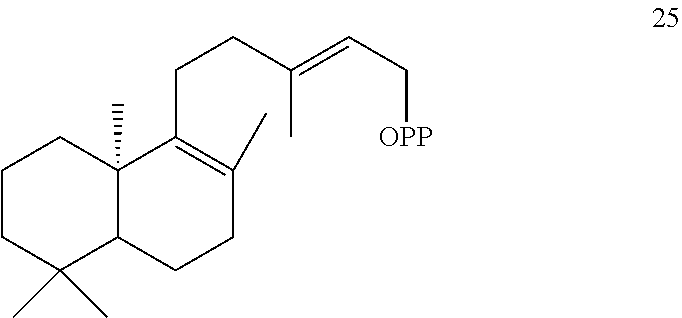
The combination of PcTPS1 and SsSS, both in-vitro, and in N. benthamiana expression produced (10R)-labda-8,14-en-13-ol [26], shown below.
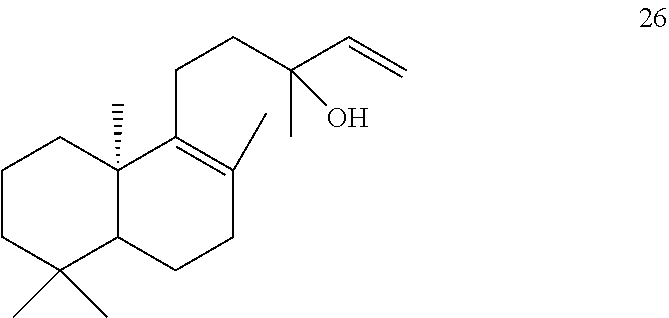
[0135]This Pogostemon cablin (10R)-labda-8,13E-dienyl diphosphate synthase (PcTPS1) can have the amino acid sequence shown below (SEQ ID NO:37).
| MSFASQSHVA FVLRRPSAVA PPPPTRIPTT AALSPLKPGD | |
| FSHGRSSFMP TSIKCNAIST SRVEEYKYTD DHNQSGLLEH | |
| DGLISDKINE LVTKIQLMLQ NMDDGEISIS PYDTAWVSLV | |
| EDVGGNDRPQ FPTSLEWISN NQLPDGSWGD PNAFLVHDRI | |
| LNTLACVVAL KSWKMHPHKC NRGVSFVREN IYRMDDEKEE | |
| HMPNGFEVVF PALLQKAKTL NIDIPYEFPG IQKFYAKRDL | |
| KFARIPMDIL HSVPTTLLFS LEGVRCGLDL DWGKLLELQA | |
| ADGSFLYSPS STAFALEQTK DQNCLKYLSK LVRKFDGGVP | |
| NVYPVDLFEH NWAVDRLQRL GISRYFTPEI NQCLDYSYRY | |
| WSNSKGMYSA SNSQIQDVDD TAMGFRLLRL NGYDVSTQGF | |
| RQFEAGGDFF CFAGQSSQAV TGMYNLYRAS QVMFPGEKLL | |
| EDAKKFSTNF LQQKRANNQL TDKWVIAKDV PAEVGYALDI | |
| PWYASLPRLE ARFFIQQYGG DDDVWIGKTL YRMGYVNNNT | |
| YLELAKLDYN TCQRLHQHEW ITIQRWYEIN LKITSVGLSK | |
| RGVLLSYYLA AANLFEPQNS THRIAWAKTS ILVSAIQLSP | |
| LQKRDFINQF HRSTANNGYE TSNVLVKSVI KGVHELSMDA | |
| MLTHNKDIHR QLFNAWRKWM SVWEEGGDGE AELLLSTLNT | |
| CDGVDESTFS DPKYEHLLEI TVRVTHQLHL IQNAETKRVG | |
| DREEIDLSMQ QLVKLVFTKS SSDLDSCIKQ RFFAIARSFY | |
| YVAHCDPEMV DSHIAKVLFE RVM |
[0136]
A nucleic acid encoding the Pogostemon cablin (10R)-labda-8,13E-dienyl diphosphate synthase (PcTPS1) enzyme with SEQ ID NO:35 is shown below as SEQ ID NO:38.
| ATGTCATTTG CTTCTCAATC ACATGTCGCC TTTGTACTCC | |
| GACGGCCATC TGCCGTTGCT CCGCCACCAC CGACTAGAAT | |
| TCCGACAACA GCCGCTCTTT CTCCTCTCAA ACCAGGTGAT | |
| TTTTCCCATG GCAGATCATC ATTTATGCCC ACTTCCATTA | |
| AATGTAATGC AATTTCCACA TCTCGCGTCG AAGAATACAA | |
| GTACACGGAT GATCATAATC AGAGTGGTTT ATTGGAGCAT | |
| GATGGTTTGA TATCAGACAA GATAAATGAA TTGGTGACCA | |
| AGATACAATT GATGCTACAA AACATGGATG ACGGAGAGAT | |
| AAGCATCTCC CCATATGACA CCGCATGGGT GTCGTTGGTG | |
| GAGGATGTGG GCGGCAACGA CCGCCCACAG TTTCCTACGA | |
| GCCTGGAGTG GATATCGAAT AACCAGCTCC CCGACGGCTC | |
| GTGGGGCGAC CCGAATGCCT TTTTGGTGCA CGACCGTATC | |
| CTCAACACAT TGGCATGCGT CGTTGCACTC AAATCCTGGA | |
| AAATGGACCC CCACAAATGC AATAGAGGAG TTAGTTTCGT | |
| GAGAGAAAAT ATATACAGAA TGGATGATGA AAAAGAGGAA | |
| CACATGCCAA ATGGATTCGA AGTGGTATTT CCAGCACTCC | |
| TTCAAAAAGC GAAAACCCTA AACATTGATA TCCCGTACGA | |
| GTTTCCAGGA ATACAAAAAT TTTATGCCAA AAGAGATTTA | |
| AAATTCGCCA GGATTCCAAT GGATATATTG CATAGCGTTC | |
| CGACAACATT ACTGTTCAGC TTAGAAGGTG TAAGATGTGG | |
| TCTTGATCTG GATTGGGGGA AGCTTCTAGA ATTGCAAGCT | |
| GCTGATGGCT CATTTCTCTA CTCTCCATCC TCTACTGCCT | |
| TTGCACTAGA ACAAACCAAG GATCAAAACT GCCTCAAATA | |
| TCTATCTAAA CTTGTTCGAA AATTCGATGG CGGAGTACCC | |
| AACGTGTACC CGGTGGACTT GTTCGAACAT AATTGGGCAG | |
| TTGATCGTCT CCAAAGGCTC GGAATTTCTC GTTATTTTAC | |
| GCCTGAAATC AACCAATGTC TTGATTATTC TTACAGATAT | |
| TGGTCAAATA GTAAAGGGAT GTACTCGGCA AGCAATTCCC | |
| AGATTCAGCA CGTTGATGAC ACCGCCATGG GATTCAGGCT | |
| TTTGAGACTC AACGGCTACG ATGTCTCTAC ACAAGGGTTT | |
| AGGCAATTCG AGGCAGGGGG GGACTTCTTC TGCTTCGCGG | |
| GGCAGTCGAG CCAAGGTGTA ACCGGAATGT ACAACCTCTA | |
| CAGAGCTTCC CAAGTGATGT TCCCTGGAGA GAAGCTACTG | |
| GAAGATGCCA AGAAATTCTC CACCAACTTC TTGCAACAAA | |
| AACGAGCCAA TAACCAGCTC ACTGACAAGT GGGTTATTGC | |
| CAAAGATGTT CCAGCTGAGG TGGGATATGC CTTGGATATT | |
| CCCTGGTATG CCAGTCTGCC CCGACTGGAA GCAAGATTTT | |
| TCATACAACA ATACGGTGGA GACGACGACG TTTGGATCGG | |
| CAAAACCTTG TATAGAATGG GATATGTGAA CAACAACACT | |
| TATCTGGAAC TCGCAAAGCT AGACTACAAC ACCTGCCAAA | |
| GGTTGCATCA GCATGAGTGG ATAACCATTC AACGATGGTA | |
| CGAAATTAAT TTAAAAATTA CTAGTGTTGG GTTGAGCAAA | |
| AGAGGGGTCC TGTTGAGTTA TTACTTAGCC GCAGCCAATC | |
| TGTTTGAGCC TCAAAACTCA ACACACCGCA TCGCTTGGGC | |
| CAAAACTTCG ATTTTAGTAA GCGCTATTCA ACTTTCTCCC | |
| CTCCAAAAGC GCGACTTTAT TAACCAATTC CACCGCTCCA | |
| CCGCAAATAA TGGGTATGAA ACAAGTAATG TGTTGGTGAA | |
| GAGTGTAATC AAGGGTGTGC ATGAGCTCTC CATGGACGCT | |
| ATGTTGACGC ACAATAAAGA CATACATCGC CAACTTTTTA | |
| ATGCTTGGCG AAAGTGGATG TCAGTGTGGG AAGAGGGAGG | |
| TGATGGAGAA GCGGAGCTGT TATTGTCGAC GCTTAAGACG | |
| TGCGACGGAG TAGATGAATC CACATTCAGC GATCCCAAAT | |
| ACGAGCACCT CTTAGAGATC ACCGTCAGAG TCACCCACCA | |
| GCTTCATCTC ATTCAGAATG CAGAGACGAA GCGTGTGGGT | |
| GACCGTGAGG AAATAGATTT GAGCATGCAA CAACTTGTTA | |
| AGTTGGTGTT CACTAAATCA TCATCGGATC TGGATTCTTG | |
| TATCAAGCAA AGATTTTTTG CGATTGCCAG AAGTTTCTAT | |
| TACGTGGCTC ATTGTGATCC GGAGATGGTG GACTCCCACA | |
| TAGCCAAAGT ATTGTTTGAG AGGGTGATGT AG |
[0138]Prunella vulgaris 11-hydroxy vulgarisane synthase (PvHVS) was identified and isolated as described herein. The Prunella vulgaris 11-hydroxy vulgarisane synthase (PvHVS) enzyme catalyzes the first Committed step and forms the scaffold found in all Vulgarisins, a class of diterpenes with pharmaceutical applications (e.g., gout, cancer). For example, PvH-VS can synthesize 11-hydroxy vulgarisane (shown below).
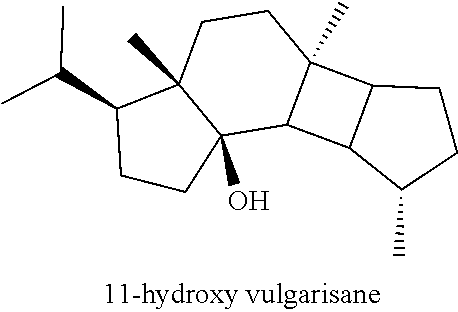
An example of a formula for several Vulgarisin diterpenes is shown below.
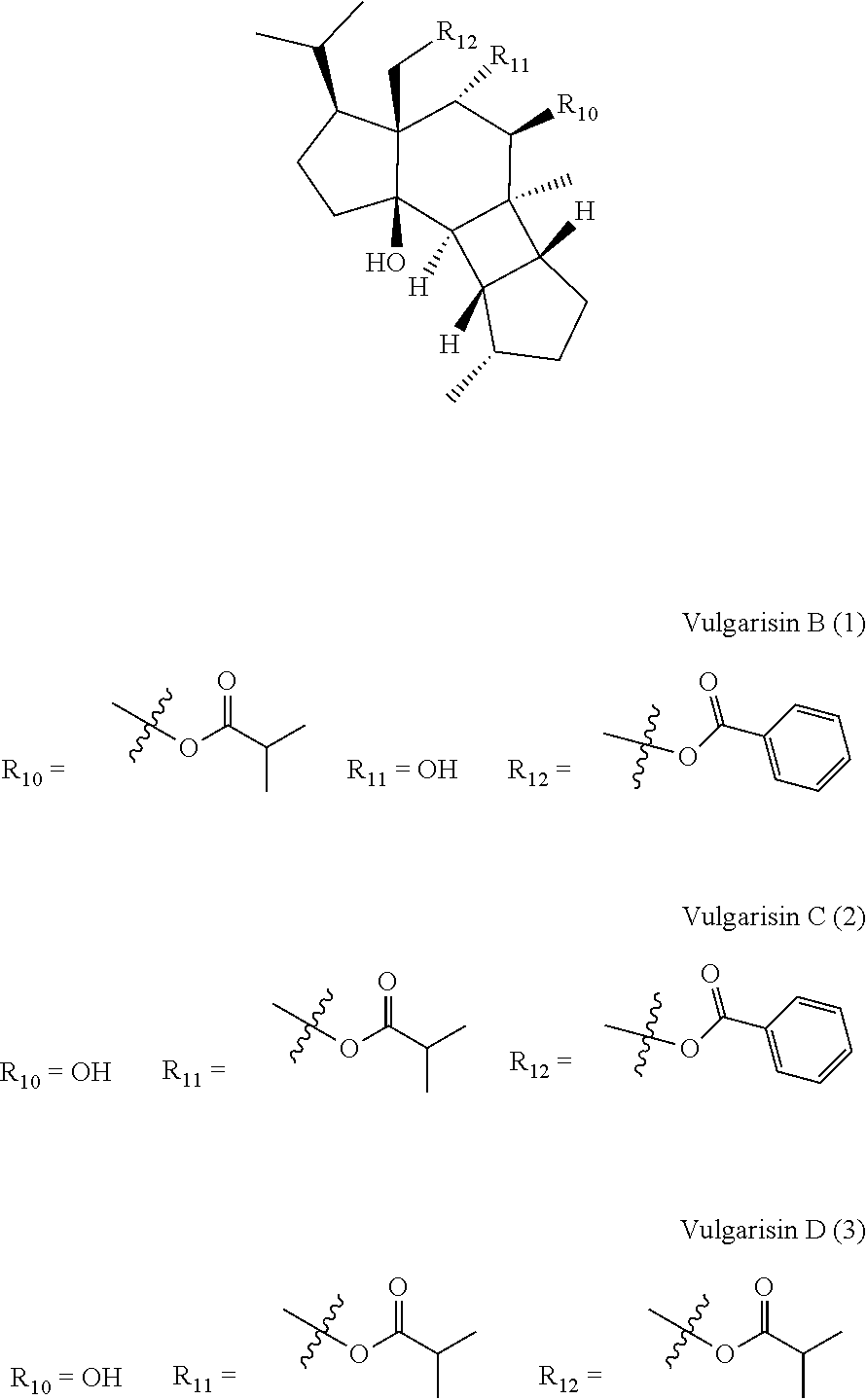
Vulgarisins B (1) and C (2) exhibit modest cytotoxicity activity against human lung carcinoma A549 cell line (Lou et al. Tetrahedron Letters 58: 401-404 (2017)).
[0141]The Prunella vulgaris 11-hydroxy vulgarisane synthase (PvHVS) can have the amino acid sequence shown below (SEQ ID NO:39).
| MSSLSIPFSS AICTSSIPKI STGHHRRTAR MPAHDTSRLV | |
| FRPSAVMVEG SPMTTSSNGK EVQRLITTFK PSMWKDIFST | |
| FSFDNQVQEK YLKEIEELKK EVRSTLMSAT HRKLFDLIDN | |
| LERMGIAYHF ETEIEDKLKQ AHASLEEEDD YDLFTTALRF | |
| RLLRQHRYHV SCDPFAKFVD QDNKLKESLS SDVEGLLSLF | |
| EASHLRIHNE DVLDEAIVFT THHLNRMKPQ LESPLKEEVK | |
| HALRYPLHKC LGILSLRFHI DRYENDKSRD EVVLRLGQVN | |
| FNYMQNIYMN ELYEITTWWN KLQMTSKVPY FRDRLVECYM | |
| WGLAYHFEPE YAPVRVLITK YYMTATTVDD TYDNYATLEE | |
| IELFTQAIDR WSEDEIDQLP DEYLKIVYKG LMNFTEEFRR | |
| DAEERGKGYV IPYFIEETKR ATQGYANEQR WIMKREMPSF | |
| EEYMVNSRVT SLMYVTYVAV VAVIESATKE TVDWALSDSD | |
| IFVYTNDIGR LIDDLATHRR ERKDGTMLTS MDYYMKEYGG | |
| TMEEGEAAFR KLMEEKWKLL NAAWVDTING KESKEIVVQV | |
| LDLARICGTL YGDEEDGFTY PEKNFAPLVA ALLMNPIHI |
[0142]
A nucleic acid encoding the Prunella vulgaris 11-hydroxy vulgarisane synthase (PvHVS) enzyme with SEQ ID NO:39 is shown below as SEQ ID NO:40.
| ATGAGCTCTC TCTCAATTCC CTTTTCTTCC GCCATTTGCA | |
| CTTCATCAAT CCCAAAGATC AGTACTGGGC ATCATCGCCG | |
| CACCGCGAGG ATGCCCGCGC ACGACACATC GCGTCTCGTC | |
| TTTCGCCCTT CAGCTGTGAT GGTGGAAGGA AGTCCGATGA | |
| CTACTTCAAG CAACGGGAAG GAAGTCCAAC GACTTATAAC | |
| CACTTTCAAG CCTAGCATGT GGAAAGATAT TTTTTCTACC | |
| TTCTCTTTCG ATAATCAGGT GCAAGAAAAG TATTTGAAAG | |
| AAATTGAGGA ATTGAAGAAA GAAGTAAGAA GCACACTAAT | |
| GAGTGCTACG CATAGGAAAT TGTTTGACTT GATCGACAAT | |
| CTCGAGCGTA TGGGAATCGC CTATCATTTC GAGACAGAAA | |
| TCGAAGACAA GCTCAAACAA GCTCATGCTT CTCTAGAGGA | |
| GGAAGATGAC TACGACTTGT TCACTACTGC ACTTCGCTTT | |
| CGTCTGCTCA GACAACATCG CTATCATGTT TCTTGCGATC | |
| CCTTTGCGAA ATTTGTTGAC CAAGACAACA AATTGAAAGA | |
| GAGTCTTAGT AGCGACGTCG AGGGGCTATT AAGCTTGTTC | |
| GAGGCATCCC ATCTTCGGAT CCACAACGAG GATGTTCTAG | |
| ATGAAGCTAT AGTGTTCACA ACCCATCACT TGAATCGAAT | |
| GATGCCACAA TTGGAATCGC CCCTTAAAGA AGAAGTGAAG | |
| CATGCTCTTC GATACCCCCT TCACAAGTGT CTTGGAATCC | |
| TTAGCCTTCG TTTTCATATC GACAGATATG AGAATGATAA | |
| GTCGAGGGAT GAAGTTGTTC TCAGACTAGG CCAAGTTAAT | |
| TTCAATTACA TGCAGAACAT TTACATGAAC GAGCTCTATG | |
| AAATCACCAC GTGGTGGAAC AAGTTGCAGA TGACTTCAAA | |
| AGTACCTTAC TTTAGAGATA GATTGGTAGA GTGCTATATG | |
| TGGGGTTTGG CATATCATTT CGAACCAGAA TACGCTCCCG | |
| TTCGAGTCCT CATTACCAAG TACTATATGA CCGCCACAAC | |
| TGTCGACGAT ACCTATGATA ATTATGCTAC ACTCGAAGAA | |
| ATCGAACTCT TCACTCAGGC CATTGACAGG TGGAGCGAGG | |
| ATGAGATTGA TCAGCTACCT GATGAATACC TAAAAATAGT | |
| GTACAAAGGT CTAATGAACT TCACTGAAGA GTTTAGACGT | |
| GACGCAGAAG AGCGAGCGAA AGGCTATGTG ATTCCTTACT | |
| TTATTGAAGA AACGAAGAGA GCAACACAGG GTTATGCAAA | |
| CGAGCAGAGG TGGATAATGA AGAGAGAAAT GCCGAGTTTT | |
| GAAGAGTATA TGGTGAACTC AAGGGTAACA TCACTTATGT | |
| ATGTGACCTA CGTTGCTGTT GTGGCAGTCA TAGAATCAGC | |
| TACCAAAGAA ACCGTAGATT GGGCGCTAAG TGACTCCGAT | |
| ATCTTTGTCT ACACTAACGA TATCGGCCGA CTTATCGACG | |
| ACCTTGCCAC TCATCGACGC GAGAGGAAAG ACGGGACAAT | |
| GCTTACATCG ATGGATTATT ACATGAAGGA ATATGGCGGT | |
| ACGATGGAAG AGGGGGAAGC TGCATTTAGG AAATTGATGG | |
| AGGAGAAATG GAAACTTTTG AATGCAGCAT GGGTAGATAC | |
| TATTAATGGA AAAGAGTCGA AGGAAATAGT TGTGCAAGTT | |
| CTCGACCTCG CCAGGATATG CGGAACGCTC TATCGGGACG | |
| AAGAAGATGG CTTCACCTAC CCAGAGAAGA ATTTTGCACC | |
| ACTCGTTGCT GCTCTATTGA TGAATCCTAT ACATATTTGA |
[0144]A Chiococca alba ent-CPP synthase (CaTPS1) was identified and isolated. This CaTPS1 enzyme was identified that converts GGPP to ent-CPP [16].
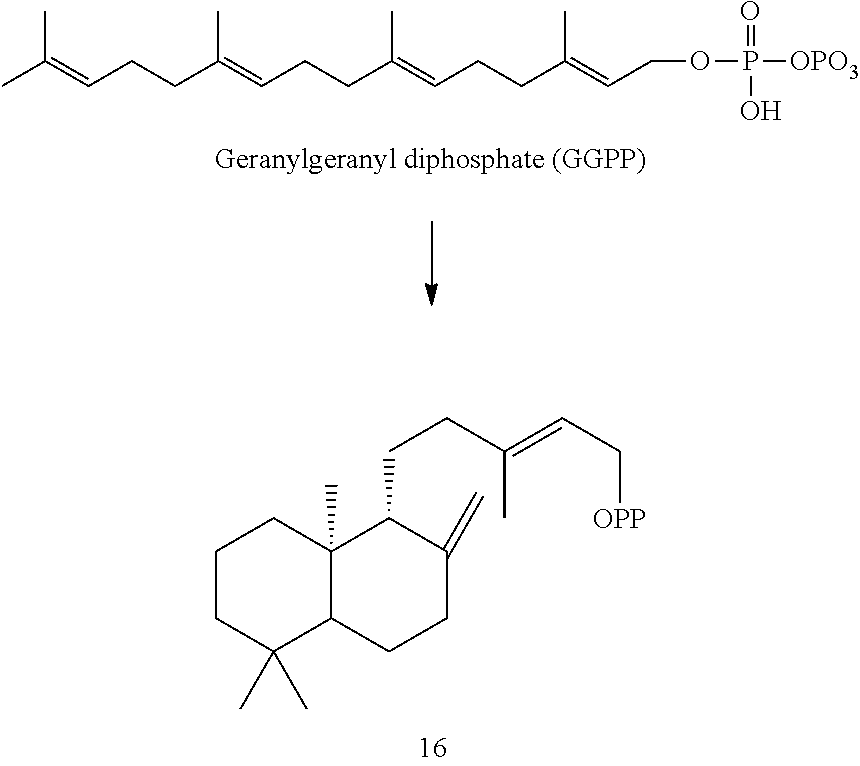
[0146]The Chiococca alba ent-CPP synthase (CaTPS1) has the amino acid sequence shown below (SEQ ID NO:41).
| 1 | MSSSTSAAAT LLGLSPASRR FVSFPPANGP IETITGIWSP |
| 41 | GKALHHFNFR LRCSTVSSPR TQELGQVSQN GMSGIKWHDI |
| 81 | VEEGVTEKGT LEANTSSWIK ESIEAIRWML RTMDDGDISI |
| 121 | SAYDTAWVAL VEDINGSGGP QFPSSLEWIA NNQLPDGSWG |
| 161 | DSDIFSAHDR ILNTLGCVVA LKSWNMHPEK SEKGLLYLRD |
| 201 | NIHKLEDENV EHMPIGFEVA FPSLIEIAKK LSIDIPDDSA |
| 241 | ILQEIYARRN LKLTRIPKDI MHTVPTTLLH SLEGMPELDW |
| 281 | KRLISLKCED GSFLFSPSST AFALTQTKDA DCLRYLIKTV |
| 321 | QKFNGGVPNV YPVDLFEHIW AVDRLQRLGI SRYFQSEIRE |
| 361 | CIDYVHRYWT DKGICWARNT HVYDIDDTAM GFRLLRLHGY |
| 401 | DVSADVFRYY EKDGEFVCFA GQSNQAVTGM YNLYRASQVM |
| 441 | FPGENILSDA RKFSSEFLHD KRANNELLDK WIITKDLPGE |
| 481 | VAYALDVPWY ASLPRLETRL YLEQYGGEDD VWIGKTLYRM |
| 521 | QKVNNNIYLE LGKLDYNNCQ ALHQLEWRSI QKWYNECGLG |
| 561 | EYGLSERSLL LSYYLAAASI FEPERSKERL AWAKTTMLIR |
| 601 | TIESYLSSEQ MVEDHNGAFV SEFQYYCSNL DYVNGGRHKP |
| 641 | TQRLVRTLLG TLNQISLDAV LVHGRDIHQY LRQAWEKWLI |
| 681 | ALQEGDDSDM GQEEAELLVR TLNLCAGRYA SEELLLSHPK |
| 721 | YQQLLHITTR VCNQIRHFQH KKVQDGENGR ANMGDGITSI |
| 761 | SSIESDMQEL TKLVVGNTQN DLDADTKQTF LTVAKSFYYT |
| 801 | AHCNPGTINC HIAKVLFERV L |
[0148]A nucleic acid encoding the Chiococca alba ent-CPP synthase (CaTPS1) with SEQ ID NO:41 is shown below as SEQ ID NO:42.
| 1 | ATGTCTTCTT CTACCTCAGC AGCAGCAACC CTTCTCGGAT |
| 41 | TATCGCCGGC AAGCCGCCGG TTTGTATCAT TTCCTCCGGC |
| 81 | AAATGGACCT ATAGAAACTA TTACCGGTAT TTGGTCGCCC |
| 121 | GGCAAAGCTC TTCATCACTT TAATTTCCGT CTGCGTTGTA |
| 161 | GCACGGTGTC CAGTCCTCGC ACCCAAGAAT TGGGCCAGGT |
| 201 | GTCACAAAAT GGCATGTCTG GTATAAAGTG GCATGACATA |
| 241 | GTGGAAGAAG GAGTCACAGA AAAAGGAACT CTTGAGGCGA |
| 281 | ACACATCAAG CTGGATAAAA GAAAGCATAG AAGCCATTCG |
| 321 | TTGGATGCTG CGTACCATGG ATGACGGGGA TATCAGCATA |
| 361 | TCTGCTTATG ATACTGCATG GGTTGCCCTT GTGGAAGATA |
| 401 | TCAACGGAAG TGGCGGTCCT CAATTTCCTT CAAGCCTCGA |
| 441 | GTGGATTGCC AACAATCAGC TTCCTGATGG TTCATGGGGC |
| 481 | GACAGCGACA TCTTTTCAGC TCACGATCCG ATTCTCAACA |
| 521 | CTTTGGGATG CGTTGTTGCA TTAAAATCTT GGAACATGCA |
| 561 | CCCTGAAAAG AGTGAAAAAG GATTATTATA TTTAAGGGAT |
| 601 | AACATTCACA AGCTTGAGGA TGAAAATGTC GAGCACATGC |
| 641 | CTATCGGTTT TGAAGTGGCA TTTCCTTCAC TAATTGAGAT |
| 681 | AGCCAAAAAG TTGAGCATTG ATATTCCGGA TGATTCTGCA |
| 721 | ATCTTGCAGG AGATATATGC CAGAAGAAAT CTAAAGCTAA |
| 761 | CAAGGATACC GAAGGACATT ATGCACACAG TGCCCACAAC |
| 801 | ATTGCTCCAC AGCTTGGAAG GCATGCCAGA ACTAGACTGG |
| 841 | AAAAGGCTAA TATCTCTAAA GTGTCAGGAT GGTTCCTTTC |
| 881 | TGTTTTCTCC ATCCTCCACT GCTTTTGCCC TCACGCAAAC |
| 921 | TAAAGATGCT GATTGCCTCA GATATTTAAC TAAAACCGTA |
| 961 | CAAAAATTCA ATGGAGGAGT TCCCAATGTT TACCCCGTGG |
| 1001 | ACTTATTCGA ACACATCTGG GCTGTTGATC GACTTCAAAG |
| 1041 | ACTAGGAATT TCTCGATACT TCCAGTCAGA AATCCGCGAG |
| 1081 | TGCATCGATT ATGTTCACCG ATATTGGACG GATAAAGGTA |
| 1121 | TCTGTTGGGC TAGAAATACC CACGTTTATG ACATTGATGA |
| 1161 | TACAGCTATG GGTTTTAGAC TTCTAAGGTT GCATGGCTAC |
| 1201 | GATGTTTCTG CAGATGTTTT CAGATACTAT GAGAAGGATG |
| 1241 | GCGAATTCGT TTGCTTTGCC GGACAGTCAA ACCAGGCGGT |
| 1281 | GACCGGAATG TATAACCTGT ATAGAGCTTC TCAAGTGATG |
| 1321 | TTTCCAGGGG AGAATATACT TTCGGATGCT AGGAAATTCT |
| 1361 | CGTCCGAATT CTTGCATGAT AAGCGAGCCA ACAATGAGCT |
| 1401 | CCTAGATAAA TGGATCATAA CCAAAGATTT GCCTGGGGAG |
| 1441 | GTAGCATATG CTTTAGATGT TCCATGGTAT GCCAGTTTAC |
| 1481 | CTCGTTTAGA AACCAGATTG TATTTGGAAC AATATGGCGG |
| 1521 | CGAAGATGAT GTCTGGATTG GCAAGACATT GTACAGGATG |
| 1561 | CAAAAAGTTA ACAACAACAT CTATCTTGAA CTTGGCAAAT |
| 1601 | TAGATTACAA CAACTGTCAG GCATTGCATC AGCTTGAGTG |
| 1641 | GAGAAGCATC CAAAAATGGT ACAATGAATG CGGTCTTGGA |
| 1681 | GAGTACGGAT TAAGCGAGAG AAGCCTCCTT CTTTCGTATT |
| 1721 | ATTTGGCCGC AGCCAGTATA TTTGAAGCGG AGAGGTCAAA |
| 1761 | GGAACGGCTT GCCTGGGCCA AAACTACTAT GCTAATCCGC |
| 1801 | ACAATTGAAT CTTATTTGAG TAGTGAACAA ATGGTTGAGG |
| 1841 | ATCACAATGG AGCCTTTGTT AGCGAGTTCC AATACTATTG |
| 1881 | CAGTAACCTT GACTACGTAA ATGGTGGAAG GCATAAGCCA |
| 1921 | ACACAAAGGC TAGTGAGGAC TCTACTCGGA ACTTTAAATC |
| 1961 | AGATTTCTTT GGACGCAGTG TTAGTCCACG GCAGAGATAT |
| 2001 | CCATCAATAT TTGCGTCAAG CCTGGGAAAA GTGGTTGATA |
| 2041 | GCTTTGCAAG AGGGAGATGA TAGTGACATG GGTCAAGAGG |
| 2081 | AAGCAGAACT TTTAGTGCGC ACACTAAACC TATGCGCCGG |
| 2121 | TCGCTACGCA TCGGAGGAGC TATTGTTGTC CCATCCCAAG |
| 2161 | TATCAACAAC TTTTGCACAT CACTACTAGA GTCTGTAACC |
| 2201 | AAATTCGTCA TTTCCAACAC AAAAAGGTGC AAGATGGGGA |
| 2241 | AAATGGAAGA GCAAACATGG GTGATGGCAT CACAAGCATC |
| 2281 | AGCTCAATAG AGTCGGACAT GCAAGAACTA ACGAAATTAG |
| 2321 | TTGTCGGCAA TACCCAAAAC GATCTAGATG CTGATACGAA |
| 2361 | GCAAACATTT CTCACGGTGG CAAAAAGCTT CTACTACACC |
| 2401 | GCCCACTGCA ATCCCGGAAC AATCAATTGC CATATTGCTA |
| 2441 | AAGTATTATT TGAGAGAGTA CTTTGA |
[0150]A Chiococca alba (5R,8S,9S,10S)-labda-13-en-8-ol diphosphate (ent-8-LPP) synthase (CaTPS2) was identified and isolated as described herein. This CaTPS2 enzyme was identified as an 5R,8S,9S,10S)-labda-13-en-8-ol diphosphate (ent-8-LPP) synthase, which converts GGPP to 5R,8S,9S,10S)-labda-13-en-8-ol diphosphate (ent-8-LPP, [7]).
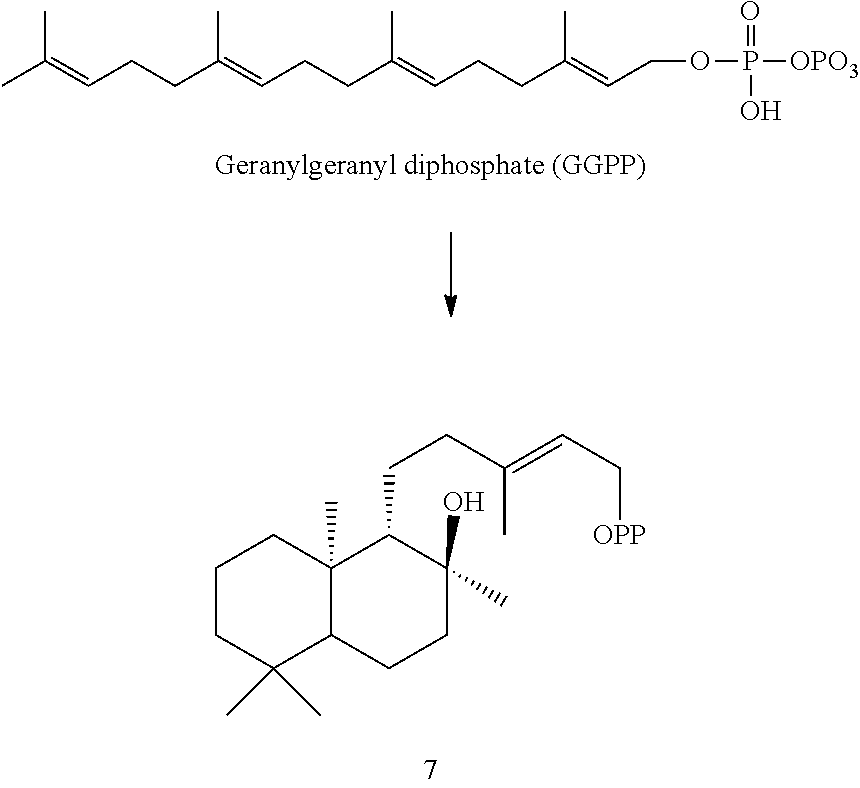
[0152]The Chiococca alba (5R,8S,9S,10S)-labda-13-en-8-ol diphosphate (ent-8-LPP) synthase (CaTPS2) has the amino acid sequence shown below (SEQ ID NO:43).
| 1 | MPVIKSHEFI EEVGPEKGTL KLSRSSRINE LVESIQTMLQ |
| 41 | SMDDGEISMS AYDTAWVALV EDINGSSYPQ FPMSLEWIAN |
| 81 | NQLPDGSWGD GSIFSVHDRI ISTLGCVLAL KSWNMHPDKS |
| 121 | EKGLLFIRDN IHKVGDESAE HMPIGFEVVF PSLIERAKNL |
| 161 | DIDIPDISAI LQEIYARRNL KLARIPKDIL YTVPTTLLHS |
| 201 | LEGMPELDWQ KLLPLKCEDG SFLFSPSCTA FALMQTKDGD |
| 241 | CLRYLTNTIE KFNGGVPGVY PVDLFEHIWA VDRLQRLGIS |
| 281 | RYFQTEIEEC MSYVYRYWTD KGICWARNSK VEDIDDTAMG |
| 321 | FRLLRLHGYM VSADVFAQFE KGGEFVCFAG QSNQALTGMF |
| 361 | NLYRASQVMF PGEKILADAK KFSSNFLHEK RANNELLDKW |
| 401 | IITKDLPGEV TYALDVPWYA SLPRVETRLY LEQYGGEDDV |
| 441 | WIAKTLYRMR KVNNKIYLEL GILDYNNCQA LHQLEWRSIQ |
| 481 | KWYKDSGLEE YGLSERNLLL AYYLATACIF EPERLVERLS |
| 521 | WAKTTALIYT TKSYFRTECN SGEQRKAFLH EFQQYCNDLD |
| 561 | YVSGARHKPT IRLIEALLGT LEQVSLDAIL DHGRYIHQDL |
| 601 | RNAWEKWLIA LQEGVDMDQE EAELTVLTLH LCAGSYTSEE |
| 641 | LLLSHPKYQQ LLNITSRVCH QIRQFQREKA QDTDNGRENL |
| 681 | VAITSIKAIE SDMQELAKLV LTKSTGDLAA KIKQTFLIVA |
| 721 | KSFYYTAHCL PGIISTHIAK VLFEKVF |
[0154]A nucleic acid encoding the Chiococca alba (5R,8S,9S,10S)-labda-13-en-8-ol diphosphate (ent-8-LPP) synthase (CaTPS2) with SEQ ID NO:43 is shown below as SEQ ID NO:44.
| 1 | ATGCCAGTAA TAAAGTCGCA TGAGTTTATT GAAGAGGTCG |
| 41 | GCCCGGAAAA AGGAACTCTG AAGCTGAGCA GATCAAGTAG |
| 81 | GATAAACGAA CTTGTAGAAT CAATTCAAAC GATGCTTCAA |
| 121 | TCGATGGATG ATGGGGAAAT AAGCATGTCT GCTTATGACA |
| 161 | CCGCGTGGGT TGCCCTTGTG GAAGATATTA ATGGAAGCAG |
| 201 | CTACCCTCAA TTCCCTATGA GCCTCGAGTG GATTGCCAAC |
| 241 | AATCAGCTTC CTGATGGTTC ATGGGGTGAC GGCAGTATCT |
| 281 | TTTCGGTTCA TGATCGGATA ATCAGCACAT TAGGATGTGT |
| 321 | TCTTGCATTA AAATCATGGA ACATGCACCC GGACAAAAGC |
| 361 | GAAAAAGGAC TGTTATTTAT AAGGGACAAT ATTCACAAGG |
| 401 | TTGGAGATGA CAGCGCTGAG CACATGCCTA TTGGTTTTGA |
| 441 | GGTGGTATTT CCTTCGCTTA TTGAGAGAGC CAAAAACTTG |
| 481 | GACATTGATA TTCCAGATAT TTCTGCTATC TTGCAAGAGA |
| 521 | TTTATGCACG AAGAAATCTA AAGCTCGCAA GGATTCCAAA |
| 561 | GGATATACTG TATACCGTGC CCACGACATT ACTTCATAGC |
| 601 | TTAGAAGGAA TGCCAGAACT GGACTGGCAA AAGCTACTGC |
| 641 | CATTAAAATG TGAGGATGGT TCATTTCTAT TTTCTCCATC |
| 681 | GTGCACTGCT TTTGCCCTCA TGCAGACTAA GGATGGTGAT |
| 721 | TGCCTCAGAT ATCTAACTAA TACCATAGAA AAATTCAATG |
| 761 | GGGGAGTTCC CGGTGTATAC CCTGTGGACT TGTTCGAACA |
| 801 | CATTTGGGCT GTTGATCGCT TGCAAAGACT AGGAATTTCC |
| 841 | CGGTATTTTC AGACAGAAAT TGAAGAATGT ATGAGTTATG |
| 881 | TTTACCGATA TTGGACGGAT AAAGGTATCT GTTGGGCTAG |
| 921 | AAACTCCAAA GTTGAAGACA TCGATGACAC AGCCATGGGT |
| 961 | TTTAGACTTC TAAGGTTGCA TGGTTACATG GTTTCTGCAG |
| 1001 | ATGTGTTTGC ACAGTTTGAG AAAGGGGGTG AATTCGTTTG |
| 1041 | CTTTGCTGGA CAGTCGAACC AGGCGCTGAC TGGAATGTTT |
| 1081 | AACCTGTATA GAGCTTCTCA AGTAATGTTT CCAGGGGAGA |
| 1121 | AGATACTTGC TGATGCCAAG AAATTCTCAT CGAACTTCTT |
| 1161 | ACATGAAAAG CGTGCAAACA ACGAGCTTCT AGATAAATGG |
| 1201 | ATCATAACTA AAGATTTGCC TGGAGAGGTG ACGTATGCGC |
| 1241 | TAGATGTTCC ATGGTACGCC AGTTTACCTC GTGTAGAAAC |
| 1281 | GAGATTATAT CTGGAACAAT ATGGAGGAGA GGATGATGTC |
| 1321 | TGGATTGCCA AGACATTGTA CAGGATGAGA AAAGTTAACA |
| 1361 | ACAAAATTTA CCTTGAACTT GGCATATTAG ATTACAATAA |
| 1401 | CTGTCAAGCA TTGCATCAGC TGGAGTGGAG AAGCATCCAA |
| 1441 | AAATGGTATA AGGATTCTGG CCTTGAAGAG TACGGGTTGA |
| 1481 | GCGAGAGGAA CCTTCTCCTG GCATATTATC TGGCCACAGC |
| 1521 | TTGTATATTT GAACCCGAAA GGTTGGTGGA GCGCCTTTCC |
| 1561 | TGGGCGAAAA CAACCGCCTT AATCTACACA ACAAAATCTT |
| 1601 | ATTTCAGAAC TGAATGCAAC TCTGGGGAAC AGAGAAAAGC |
| 1641 | TTTTCTTCAT GAGTTCCAAC AGTACTGCAA TGACCTGGAC |
| 1681 | TACGTTAGTG GCGCAAGGCA CAAGCCAACA ATAAGATTGA |
| 1721 | TCGAAGCTCT ACTTGGAACC CTAGAGCAGG TCTCTTTGGA |
| 1761 | TGCAATATTA GATCATGGCC GATATATCCA TCAAGATTTG |
| 1801 | CGTAATGCTT GGGAGAAATG GTTGATAGCT TTGCAAGAGG |
| 1841 | GAGTTGACAT GGACCAAGAA GAAGCAGAAC TTACAGTGCT |
| 1881 | CACACTACAC CTGTGTGCCG GCAGCTACAC ATCGGAGGAG |
| 1921 | TTACTGTTAT CTCATCCCAA GTATCAACAA CTTTTAAATA |
| 1961 | TCACTAGTAG AGTCTGCCAC CAAATTCGTC AATTCCAGCG |
| 2001 | CGAAAAGGCA CAGGATACGG ATAATGGAAG AGAAAACTTG |
| 2041 | CTTGCCATCA CAAGCATCAA GGCGATAGAA TCAGACATGC |
| 2081 | AAGAACTTGC GAAATTAGTT CTGACCAAAT CCACTGGCGA |
| 2121 | TTTAGCTGCT AAAATCAAGC AAACATTTCT TATAGTGGCA |
| 2161 | AAGAGCTTCT ACTACACCGC ACATTGCCTT CCTGGAATTA |
| 2201 | TCAGTACCCA CATTGCCAAA GTACTATTTG AGAAAGTTTT |
| 2241 | CTGA |
[0156]A Chiococca alba CaTPS3 and CaTPS4 were identified and isolated. CaTPS3 and CaTPS4 were identified as an ent-kaurene synthase, converting ent-CPP [16] into ent-kaurene [19].
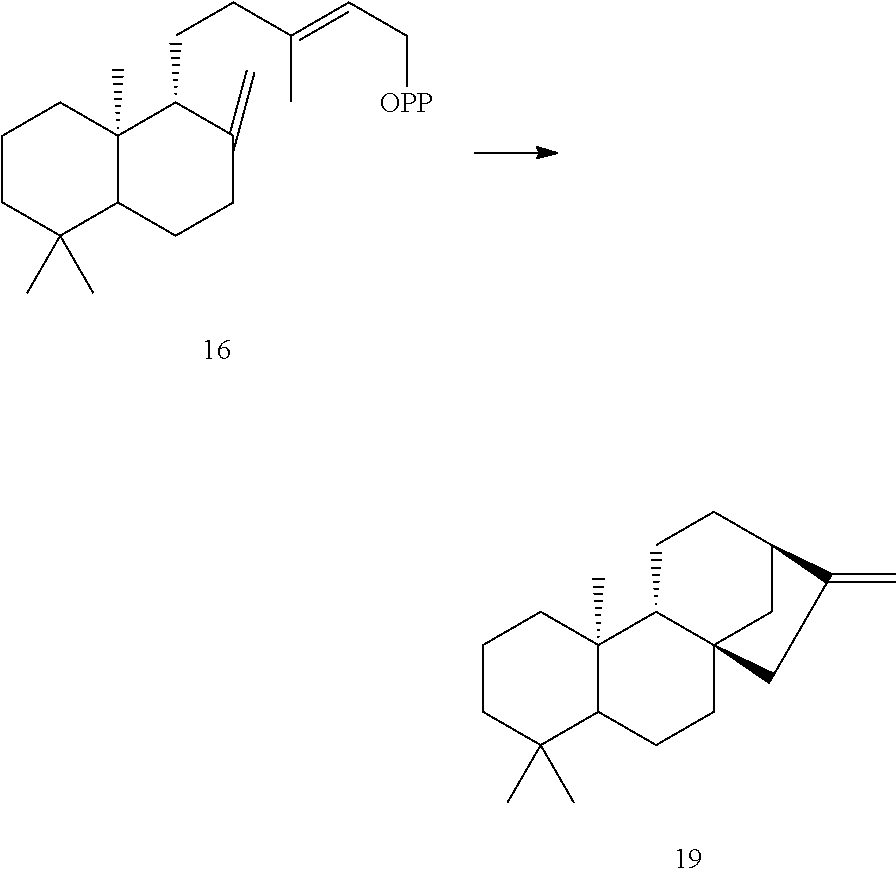
The Chiococca alba ent-kaurene synthase (CaTPS3) has the amino acid sequence shown below (SEQ ID NO:45).
| 1 | MMMMMVVMNT APAHSYHPFP FAGPKSSATL FSNYYCSSRK |
| 41 | KSSPPRISAS VSLLTGVEST TAINSSDPEI KERIRKLFHD |
| 81 | VDISLSSYDT AWVAMVPAPH SSQSPLFPQC INWLLDNQLP |
| 121 | DGSWSLPPPH HHPLLLKDAL SSTLACVLAL RRWGIGQEQV |
| 161 | DKGIRFVELN FASASDQNQH LPVGFDIIFP GMLEYARDLN |
| 201 | LNLQLESATV NALLLKRDQE LTRFFKSYSD ESKAYLAYVS |
| 241 | EGIVKLQNWD TVMKFQRKNG SLFNSPSATA AAVMHVHNPG |
| 281 | CLDYLHSVLE KHGNAVPTVY PLDIYPRLCL VDNLERLGIC |
| 321 | GHFRKEILSV LDDTYRCWMQ GDEEIFAEKS TCAIAFTLLR |
| 361 | KHGYNISADP LTPFLKEECF SNSLGGCLKD TSAVLELYRA |
| 401 | LEMIISQNES ALVKKSLWSR SFLKEHISGG CDLKGFSNQI |
| 441 | SILVDDILNF PSHATLQRVA NRRSIEQYNL DSTKILKTSY |
| 481 | CSSNFSNKDL LILAVKDFNH CQLIHREELK ELERWVTDNR |
| 521 | LDKLKFARQK SAYCYFSAAA TIFSPELSDA RMSWAKNGVL |
| 561 | ATLVDDFFDV GGSLEELKKL IELVEKWDIN VSDGCCSEPV |
| 601 | QILFSALHST IQEIGDkAFK WQARSVTNHI FKIWLDLLNS |
| 641 | MLREAEWARN ATVPTVEEYM TNGYVSFALG PIILPALYLV |
| 681 | GPKLSEEVVK DSEFHSLFKL VSTCGRLLND VHSFERESKS |
| 721 | GQLNALSLRL IHGGVGITEA AAVAEMKSSI ENLRRELLRL |
| 761 | VLRKEGSVVP RACKDLFWNM SKVLHQFYNK DDGFTSEEMI |
| 801 | QLVKSIIYEP IAVNEFLNSC HT |
[0159]A nucleic acid encoding the Chiococca alba ent-kaurene synthase (CaTPS3) with SEQ ID NO:45 is shown below as SEQ ID NO:46.
| 1 | ATGATGATCA TGATGGTGGT GATGAACACA GCTCCCGCCC |
| 41 | ACTCTTACCA TCCTTTCCCC TTTGCCGGCC CAAAATCCTC |
| 81 | AGCCACACTT TTTTCCAATT ATTATTGTTC CAGTAGGAAG |
| 121 | AAATCATCGC CACCTCGCAT CTCTGCCTCA GTTTCTTTGC |
| 241 | TAACTGGAGT TGAAAGCACA ACTGCAATTA ATTCTTCAGA |
| 281 | CCCGGAGATC AAAGAAAGAA TAAGGAAACT ATTTCATGAT |
| 321 | GTTGATATCT CGCTTTCTTC ATATGACACT GCATGGGTGG |
| 361 | CAATGGTCCC TGCTCCACAT TCTTCCCAGT CTCCCCTTTT |
| 401 | TCCCCAGTGC ATTAATTGGT TATTGGACAA TCAGCTTCCT |
| 441 | GATGGCTCAT GGAGTCTTCC TCCTCCTCAT CATCATCCTC |
| 481 | TATTACTTAA AGATGCATTA TCCTCTACCC TTGCATGTGT |
| 521 | TCTTGCGCTC AGGAGATGGG GAATTGGTCA AGAACAAGTT |
| 561 | GACAAGGGTA TTCGTTTTGT TGAGTTAAAT TTTGCTTCAG |
| 601 | CATCTGACCA GAACCAGCAT TTGCCACTTG GATTTGACAT |
| 641 | TATATTCCCT GGCATGCTCG AATATGCTAG AGATTTAAAT |
| 681 | TTAAATCTTC AACTAGAATC TGCAACAGTA AATGCCTTAC |
| 721 | TTCTTAAAAG AGATCAGGAG CTTACAAGAT TCTTTAAAAG |
| 761 | CTACTCAGAC GAGAGTAAAG CATACCTTGC ATATGTATCA |
| 801 | GAAGGTATAG TAAAGTTACA GAACTGGGAT ACAGTTATGA |
| 841 | AGTTCCAAAG AAAGAACGGG TCACTATTCA ATTCACCTTC |
| 881 | AGCTACAGCA GCTGCTGTTA TGCATGTCCA CAATCCTGGT |
| 921 | TGCCTCGATT ACCTTCACTC AGTGTTGGAG AAGCATGGAA |
| 961 | ATGCTGTTCC AACAGTTTAC CCTTTGGATA TATATCCACG |
| 1001 | CCTCTGCTTG GTTGACAACC TTGAGAGACT GGGTATTTGT |
| 1041 | GGTCATTTTA GGAAGGAAAT TCTGAGTGTA TTGGATGATA |
| 1081 | CATACAGATG CTGGATGCAG GGGGATGAAG AGATATTTGC |
| 1121 | AGAAAAATCA ACTTGTGCCA TAGCATTTAC ATTATTGCGA |
| 1161 | AAGCATGGGT ACAACATCTC TGCAGATCCA TTGACCCCAT |
| 1201 | TCTTAAAGGA AGAGTGTTTT TCCAATTCTT TGGGTGGATG |
| 1241 | TTTGAAAGAT ACTAGTGCTG TACTTGAATT ATACCGGGCA |
| 1281 | TTAGAGATGA TTATTAGCCA GAATGAATCA GCTCTGGTGA |
| 1321 | AAAAAAGCTT GTGGTCCAGA AGCTTCCTGA AAGAGCATAT |
| 1361 | TTCTGGTGGT TGTGATTTAA AGGGATTCAG CAATCAAATT |
| 1401 | TCCATACTGG TGGATGATAT CCTCAACTTT CCATCGCATG |
| 1481 | CTACTTTGCA ACGGGTTGCT AACAGGAGAA GCATAGAGCA |
| 1521 | ATACAACTTA GACAGTACAA AAATTTTAAA AACTTCATAT |
| 1561 | TGCTCGTCGA ATTTTAGCAA CAAAGATTTA TTGATCCTGG |
| 1601 | CAGTCAAAGA TTTTAATCAT TGCCAACTCA TACACCGTGA |
| 1641 | AGAACTGAAA GAACTAGAAA GGTGGGTCAC AGACAATAGA |
| 1681 | TTGGACAAGT TAAAGTTTGC TAGGCAGAAG TCTGCATACT |
| 1721 | GTTACTTTTC TGCTGCAGCA ACCATATTCT CACCTGAACT |
| 1761 | TTCTGATGCC CGCATGTCAT GGGCCAAGAA TGGTGTACTT |
| 1801 | GCTACTTTGG TTGATGACTT CTTTGACGTG GGAGGTTCTC |
| 1841 | TAGAGGAATT AAAGAAACTG ATTGAGTTGG TTGAAAAGTG |
| 1881 | GGATATAAAT GTCAGTGATG GTTGTTGCTC TGAACCAGTG |
| 1921 | CAAATCCTCT TCTCAGCACT ACATAGTACA ATCCAGGAGA |
| 1961 | TTGGAGATAA AGCATTCAAA TGGCAAGCAC GCAGTGTAAC |
| 2001 | AAACCACATA TTTAAGATAT GGTTAGATTT GCTTAATTCT |
| 2041 | ATGTTGAGGG AAGCTGAGTG GGCTAGAAAT GCAACAGTGC |
| 2081 | CTACAGTTGA AGAATATATG ACAAATGGTT ATGTATCATT |
| 2121 | TGCTTTGGGG CCAATTATCC TCCCTGCTCT TTATCTTGTT |
| 2161 | GGACCTAAGC TGTCAGAGGA AGTAGTTAAG GATTCTGAAT |
| 2201 | TCCACTCCCT TTTTAAGCTA GTGAGTACCT GTGGGCGGCT |
| 2241 | TCTGAATGAT GTCCACAGCT TCGAGAGGGA ATCAAAGTCC |
| 2281 | GGCCAACTAA ATGCTCTGTC TCTGCGCCTG ATTCATGGTG |
| 2321 | GTGTTGGCAT TACTGAAGCA GCTGCTGTTG CAGAGATGAA |
| 2361 | GAGTTCAATT GAGAATCTAA GGAGAGAACT GCTGAGACTA |
| 2401 | GTCTTGCGCA AAGAGGGTAG TGTAGTTCCA AGAGCTTGCA |
| 2441 | AGGATTTGTT TTGGAATATG AGTAAAGTGC TACATCAATT |
| 2481 | TTACAACAAA GATGATGGAT TTACTTCAGA GGAGATGATT |
| 2521 | CAGCTTGTGA AGTCGATCAT TTATGAGCCA ATTGCGGTCA |
| 2561 | ATGAATTTTT GAATAGTTGC CATACATGA |
[0161]The Chiococca alba ent-kaurene synthase (CaTPS4) has the amino acid sequence shown below (SEQ ID NO:47).
| 1 | MMIMVMNTAP VHAYHALPIP TQKSSTTLFP NYNCSSRKKS |
| 41 | SPPRISAASV SLQTGVERTT AIHSSDLEIK ERIRKLFHDV |
| 81 | DISLSSYDTA WVAMVPAPHS SQSPLFPQCI NWLLDNQLPD |
| 121 | GSWSLPPHHH HHHPLLLKDA LSSTLACVLA LRRWGIGQEQ |
| 161 | VDKGIRFVEL NFASASDQNQ HLPVGFDIIF PGMLEYARDL |
| 201 | NLNLQLESAT VDALLLKRDQ ELIRFFKSYS DESKAYLAYV |
| 241 | SEGIIKLQNW DTVMKFQRKN GSLFNSPSAT AAAVMHVHNP |
| 281 | GCLDYLHSVL EKHGNAVPTV YPLDIYPRLC LVDNLERLGI |
| 321 | CGHFRKEILS VLDDTYRCWM QGDEEIFAEK STCAIAFTLL |
| 361 | RKHGYNISAD PLTPFLKEEC FSNSLGGCLK DTSAVLELYR |
| 401 | ALEMIISQNE SALVKKSLWS RSFLKEHISG GCDLKGFSNQ |
| 441 | ISKQVDDILN FPSHATLQRV ANRRSIEQYN LDSTKILKTS |
| 481 | YCSSNFSNKD LLILAVKDFN HCQLIHREEL KELERWVADN |
| 521 | RLDKLKFARQ KSAYCYFSAA ATIFSPELSD ARISWAKNGV |
| 561 | LTTLVDDFFD VGGSLEELKK LIELVEKWDI NVSDGCCSEP |
| 601 | VQILFSALHS TIQEIGDKAF KWQARSVTNH IIKIWLDLLN |
| 641 | SMLREAEWAR NATVPTVEEY MTNGYVSFAL GPIILPALYL |
| 681 | VGPKLSEELV KDSEFHSLFK LVSTCGRLLN DVHSFERESK |
| 721 | AGQLNALSLR LIHGGVGITE AAAVAEMKSS IEKQRRELLR |
| 761 | LVLRKEGSVV PRACKDLFWN MSRVLHQFYV KDDGFTSEEM |
| 801 | IELVKSIIYE PIAVNEF |
[0162]
A nucleic acid encoding the Chiococca alba ent-kaurene synthase (CaTPS4) with SEQ ID NO:47 is shown below as SEQ ID NO:48.
| 1 | ATGATGATAA TGGTGATGAA CACAGCTCCC GTCCACGCTT |
| 41 | ACCACGCTTT ACCCATTCCC ACCCAAAAAT CCTCAACCAC |
| 81 | ACTTTTTCCC AATTATAACT GTTCCAGTAG GAAGAAATCA |
| 121 | TCGCCACCTC GCATCTCTGC CGCCTCAGTT TCTTTGCAAA |
| 161 | CTGGAGTTGA AAGAACGACG GCAATTCATT CTTCAGACCT |
| 201 | AGAGATCAAA GAAAGAATAA GGAAACTATT TCATGATGTT |
| 241 | GATATCTCGC TTTCTTCATA TGACACTGCA TGGGTGGCAA |
| 281 | TGGTCCCTGC TCCACATTCT TCCCAGTCTC CCCTTTTTCC |
| 321 | CCAGTGCATT AATTGGTTAT TGGACAATCA GCTTCCTGAT |
| 361 | GGCTCATGGA GTCTTCCTCC TCATCATCAT CATCATCATC |
| 401 | CCCTATTACT TAAAGATGCA TTATCCTCTA CGCTTGCATG |
| 441 | TGTTCTTGCG CTCAGGAGAT GGGGAATTGG TCAAGAACAA |
| 481 | GTTGACAAGG GTATTCGTTT TGTTGAGTTA AATTTTGCTT |
| 521 | CTGCATCTGA CCAGAACCAG CATTTGCCAG TTGGATTTGA |
| 561 | CATTATATTC CCTGGCATGC TCGAATATGC TAGAGATTTA |
| 601 | AATTTAAATC TTCAACTAGA ATCCGCAACT GTAGATGCCT |
| 641 | TACTTCTCAA AAGAGATCAG GAGCTTATAA GATTCTTTAA |
| 681 | AAGCTACTCA GACGAGAGTA AAGCATACCT TGCATATGTA |
| 721 | TCAGAAGGTA TCATAAAGTT ACAGAACTGG GATACAGTTA |
| 761 | TGAAGTTCCA AAGAAAGAAC GGGTCACTGT TCAATTCACC |
| 801 | TTCAGCTACA GCAGCTGCTG TTATGCATGT CCACAATCCT |
| 841 | GGCTGCCTCG ATTACCTTCA CTCAGTGTTG GAGAAGCATG |
| 881 | GCAATGCTGT TCCAACAGTT TACCCTTTGG ATATATATCC |
| 921 | ACGCCTCTGC TTGGTTGACA ACCTTGAGAG ACTGGGTATT |
| 961 | TGTGGTCATT TTAGGAAGGA AATTCTGAGT GTATTGGATG |
| 1001 | ATACATACAG ATGCTGGATG CAGGGGGATG AAGAGATATT |
| 1041 | TGCAGAAAAA TCAACTTGTG CCATAGCATT TACATTATTG |
| 1081 | CGAAAGCATG GGTACAACAT CTCTGCAGAT CCATTGACCC |
| 1121 | CATTCTTAAA GGAAGAGTGT TTTTCCAATT CTTTGGGTGG |
| 1161 | ATGTTTGAAA GATACTAGTG CTGTACTTGA ATTATACCGG |
| 1201 | GCATTAGAGA TGATTATTAG CCAGAATGAA TCAGCTCTGG |
| 1241 | TGAAAAAAAG CTTGTGGTCC AGAAGCTTCC TGAAAGAGCA |
| 1281 | TATTTCTGGT GGTTGTGATT TAAAGGGATT CAGCAATCAA |
| 1321 | ATTTCCAAAC AGGTGGATGA TATCCTCAAC TTTCCATCGC |
| 1361 | ATGCTACTTT GCAACGGGTT GCTAACAGGA GAAGCATAGA |
| 1401 | GCAATACAAC TTAGACAGTA CAAAAATTTT AAAAACTTCA |
| 1441 | TATTGCTCGT CGAATTTTAG TAACAAAGAT TTATTGATCC |
| 1481 | TGGCAGTCAA AGATTTTAAT CATTGCCAAC TCATACACCG |
| 1521 | TGAAGAACTG AAAGAACTAG AAAGGTGGGT CGCAGACAAT |
| 1561 | AGATTGGACA AGTTAAAGTT TGCTAGGCAG AAGTCTGCAT |
| 1601 | ACTGTTACTT TTCTGCTGCA GCAACCATAT TCTCACCTGA |
| 1641 | ACTTTCTGAT GCCCGCATCT CATGGGCCAA AAATGGTGTA |
| 1681 | CTTACTACTT TGGTTGATGA CTTCTTTGAC GTGGGAGGTT |
| 1721 | CTCTAGAGGA ATTAAAGAAA CTGATTGAGT TGGTTGAAAA |
| 1761 | GTGGGATATA AATGTCAGTG ATGGTTGTTG CTCTGAACCA |
| 1801 | GTGCAAATCC TCTTCTCAGC ACTACATAGT ACAATCCAGG |
| 1841 | AGATTGGAGA TAAAGCATTC AAATGGCAAG CACGCAGTGT |
| 1881 | AACAAACCAC ATAATTAAGA TATGGTTAGA TTTGCTTAAT |
| 1921 | TCTATGTTGA GGGAAGCTGA GTGGGCTAGA AATGCAACAG |
| 1961 | TGCCTACAGT TGAAGAATAT ATGACAAATG GTTATGTATC |
| 2001 | ATTTGCCTTG GGGCCAATTA TCCTCCCTGC TCTTTATCTT |
| 2041 | GTTGGACCTA AGCTCTCAGA GGAATTAGTT AAGGATTCTG |
| 2081 | AATTCCACTC CCTTTTTAAG CTAGTGAGTA CCTGTGGGCG |
| 2121 | GCTTCTGAAT GATGTCCACA GCTTCGAGAG GGAATCAAAG |
| 2161 | GCCGGCCAAC TAAATGCTCT TTCTCTGCGC CTGATTCATG |
| 2201 | GTGGAGTTGG CATTACTGAA GCAGCTGCTG TTGCAGAGAT |
| 2241 | GAAGAGTTCA ATTGAGAAGC AAAGGAGAGA ACTGCTGAGA |
| 2281 | CTAGTCTTGC GCAAAGAGGG TAGTGTAGTT CCAAGAGCTT |
| 2321 | GCAAGGATTT GTTTTGGAAT ATGAGTAGGG TGCTACATCA |
| 2361 | ATTTTACGTC AAAGATGATG GATTTACTTC AGAGGAGATG |
| 2401 | ATTGAGCTTG TGAACTCGAT CATTTATGAG CCAATTGCGG |
| 2441 | TCAATGAATT TTGA |
[0164]A Chiococca alba 13(R)-epi-dolabradiene synthase (CaTPS5) was identified and isolated. This CaTPS5 enzyme was identified as an 13(R)-epi-dolabradiene synthase, which converts ent-CPP [16] to 13(R)-epi-dolabradiene.
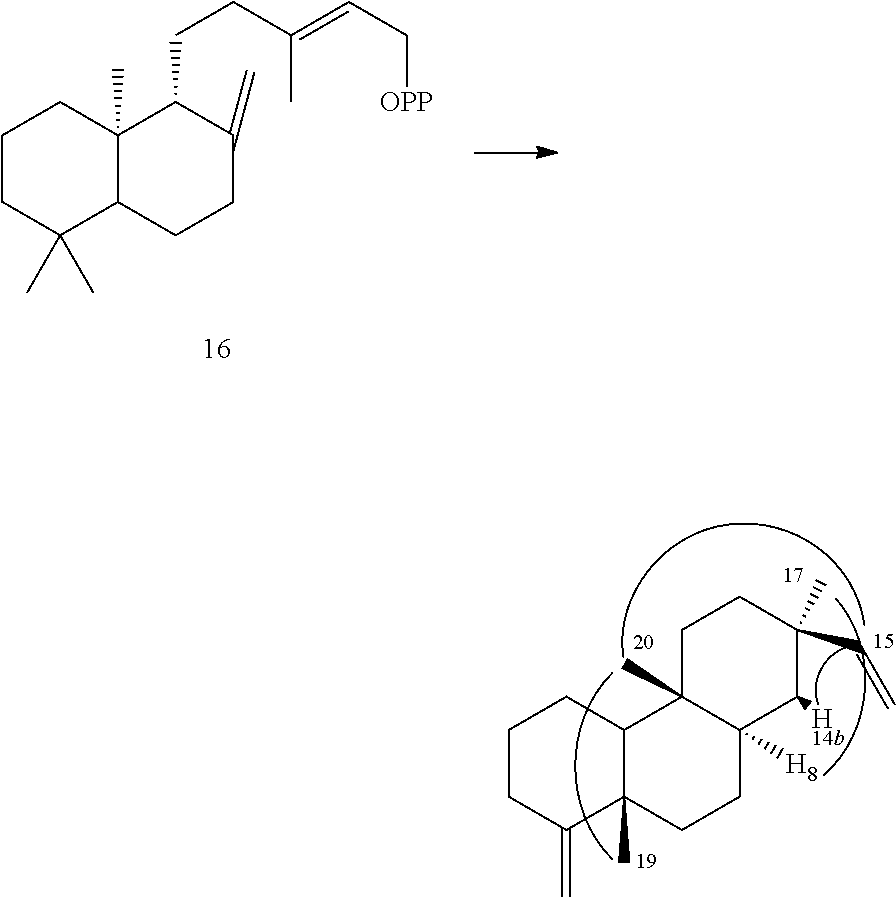
[0166]The Chiococca alba 13(R)-epi-dolabradiene synthase (CaTPS5) has the amino acid sequence shown below (SEQ ID NO:49).
| 1 | MIHTLPHGGQ AHFISHKTQP YYSSRPRFSS AASLDTRVRR |
| 41 | TSPSNSSVLD FNETKERITK LFHNVDYSIS SYDTAWVAMV |
| 81 | PDPHSSQAPL FPECINWLLD NQFHDGSWSL PHHNSLLLKD |
| 121 | VLSSTLACVL ALKRWGIGGR QIDKGVRFIE MNFGSASDNC |
| 161 | QHTPIGFDII FPGMLENARD LDLNLRLEPR IVTDMQRKRD |
| 201 | MQLTRLHESD LKGDQAYLAY VSEGMQKLQN WDLAMKFQRK |
| 241 | NGSLFNSPSA TAAAVMHVQN PASLNYLHSV VDKFGHAVPA |
| 281 | VYPLDLYARL CLVDNLERLG ICRHFTNEIE IVMEDTYRCW |
| 321 | LQDDEDIFAE ISTCALAFRL LRKHGYVVSP DPLTKIIEEE |
| 401 | DVSNSSGNGY WNDIHAVMEV HRASEVVIHE NESDLKNQNT |
| 441 | ISKHLLRHHL FNGSDVKPFP NPIYKQVDYA LKFPTPLILQ |
| 481 | RVENKTLIQN YDVDSTRLLK TSYRSSNFCN EDLLRLAVKD |
| 521 | FNDCQLLHRK ELKELERWSA DNRLHELKFA RQKAIYCSFS |
| 561 | AAATIFIPEW YEARMSLAKN SVLATVVDDF FDVGGSMEEL |
| 601 | KKLIEFVEKW DIDITKESCS EPLKIIFSAL HSTISEIGEQ |
| 641 | AVKWQGRNVT SHIIEIWLDL LNSMLRESEW TTDVHMPTLD |
| 681 | EYMEAAYVSF AMGPIIIPAL YFVGPKLSDE IVRDPEIRSL |
| 721 | HKLVSICGRL LNDMQGFERE KKAGKPNAVS IRISQNGDGI |
| 761 | TESAAFEEVK MELEDARREL LRLVVQKDGS VVPRACKDAF |
| 801 | WSVSRMLHHF YFNNDGYTSE VEMVELVNSI IHEPLK |
[0168]A nucleic acid encoding the Chiococca alba 13(R)-epi-dolabradiene synthase (CaTPS5) with SEQ ID NO:49 is shown below as SEQ ID NO:50.
| 1 | ATGATTCATA CTCTCCCTCA TGGCGGCCAG GCTCACTTCA |
| 41 | TTTCCCACAA AACACAGCCT TATTATTCCA GTAGACCTCG |
| 81 | CTTTTCTTCA GCAGCTTCTT TGGACACACG AGTCCGGAGA |
| 121 | ACATCGCCCT CTAATTCCTC TGTCCTAGAC TTCAACGAGA |
| 161 | CCAAAGAAAG AATCACAAAA TTATTTCATA ATGTTGATTA |
| 201 | TTCAATTTCT TCATATGATA CAGCATGGGT TGCTATGGTC |
| 241 | CCGGACCCAC ATTCTTCTCA GGCTCCCCTT TTCCCAGAGT |
| 281 | GCATAAATTG GTTGCTAGAT AATCAATTTC ATGATGGCTC |
| 321 | CTGGAGTCTT CCTCATCACA ATTCTCTATT GCTTAAGGAT |
| 361 | GTTTTATCCT CTACGCTTGC GTGTGTTCTT GCTCTTAAGA |
| 401 | GATGGGGAAT AGGAGGAAGG CAGATTGACA AAGGTGTTCG |
| 441 | CTTTATTGAG ATGAATTTTG GCTCAGCATC TGACAATTGC |
| 481 | CAGCATACTC CAATAGGATT TGACATAATA TTTCCAGGAA |
| 521 | TGCTTGAAAA TGCCAGAGAT TTGGATCTAA ATCTTAGACT |
| 561 | ACAACCCAGA ATTGTAACTG ACATGCAACG TAAAAGAGAC |
| 601 | ATGCAGCTTA CAAGACTCCA TGAAAGCGAT CTAAAGGGGG |
| 641 | ACCAAGCATA CTTGGCATAT GTATCCGAAG GGATGCAAAA |
| 681 | GTTACAGAAT TGGGATTTGG CGATGAAGTT TCAAAGGAAG |
| 721 | AATGGATCGC TCTTCAACTC ACCATCAGCT ACAGCAGCCG |
| 801 | CTGTTATGCA TGTCCAAAAT CCTGCTTCCC TCAATTATCT |
| 841 | TCATTCAGTC GTCGACAAAT TCGGCCATGC AGTTCCGGCT |
| 881 | GTTTACCCTT TGGATCTCTA TGCGCGCCTT TGCTTGGTTG |
| 921 | ACAATCTTGA GAGGCTGGGT ATCTGTCGAC ATTTTACTAA |
| 961 | TGAAATTGAA ATTGTAATGG AGGACACGTA CAGGTGCTGG |
| 1001 | CTGCAGGATG ATGAAGATAT ATTTGCCGAA ATATCAACTT |
| 1041 | GTGCCTTAGC TTTTCGGTTA TTGAGAAAAC ATGGCTATGT |
| 1081 | TGTCTCCCCA GATCCACTGA CAAAAATCAT AGAAGAAGAA |
| 1121 | GATGTTTCCA ATTCTTCTGG TAATGGATAT TGGAATGATA |
| 1161 | TACATGCTGT AATGGAAGTG CATCGGGCAT CAGAGGTGGT |
| 1201 | TATACATGAA AATGAATCAG ATTTAAAGAA TCAAAATACC |
| 1241 | ATATCAAAAC ACCTTCTCAG ACACCATCTT TTCAATGGTT |
| 1281 | CTGATGTGAA GCCCTTTCCT AATCCAATAT ACAAGCAGGT |
| 1321 | GGACTATGCT CTCAAGTTTC CAACCCCCTT AATTCTACAA |
| 1361 | CGTGTTGAAA ACAAGACCCT CATACAGAAC TACGACGTAG |
| 1401 | ACAGTACAAG ACTTCTTAAA ACTTCATATC GATCATCAAA |
| 1441 | TTTCTGCAAT GAAGATTTAC TGAGGTTAGC AGTGAAAGAT |
| 1481 | TTTAATGACT GTCAACTCCT GCACCGGAAA GAACTAAAAG |
| 1521 | AACTAGAAAG ATGGTCCGCA GATAACAGAC TGCACGAACT |
| 1601 | AAAATTTGCT CGGCAGAAAG CTATATACTG CTCCTTTTCT |
| 1641 | GCTGCAGCAA CGATTTTCAT ACCTGAATGG TACGAAGCCC |
| 1681 | GCATGTCATT GGCCAAAAAT AGTGTACTTG CTACTGTGGT |
| 1721 | TGATGACTTC TTTGATGTGG GTGGTTCGAT GGAGGAATTA |
| 1761 | AAGAAGCTAA TTGAATTTGT TGAAAAGTGG GATATTGACA |
| 1801 | TCACCAAGGA ATCCTGCTCT GAGCCACTCA AAATCATATT |
| 1841 | TTCAGCACTG CACAGTACAA TCTCTGAGAT TGGAGAGCAA |
| 1881 | GCAGTTAAAT GGCAAGGACG CAATGTAACA AGCCACATAA |
| 1921 | TTGAGATCTG GTTGGATTTG CTCAATTCGA TGTTGAGGGA |
| 1961 | GTCTGAATGG ACTACAGATG TGCACATGCC AACATTGGAT |
| 2001 | GAATATATGG AAGCTGCTTA TGTATCATTC GCCATGGGGC |
| 2041 | CAATTATCAT CCCTGCTCTG TATTTTGTTG GGCCTAAGCT |
| 2081 | ATCTGATGAA ATTGTTCGGG ATCCTGAAAT ACGATCCCTC |
| 2121 | CATAAGCTTG TGAGCATTTG TGGGCGGCTT CTAAATGATA |
| 2161 | TGCAAGGGTT CGAGAGGGAA AAGAAGGCTG GTAAACCAAA |
| 2201 | TGCCGTGTCT ATACGCATTA GTCAAAATGG TGATGGCATT |
| 2241 | ACCGAATCAG CAGCTTTCGA AGAAGTGAAG ATGGAATTAG |
| 2281 | AGGATGCAAG GAGAGAATTG CTAAGATTAG TTGTGCAAAA |
| 2321 | AGATGGTAGT GTAGTTCCAA GAGCTTGCAA GGATGCGTTT |
| 2361 | TGGAGCGTAA GCAGAATGTT GCATCATTTC TACTTCAATA |
| 2401 | ATGATGGATA CACGTCAGAG GTGGAGATGG TTGAGCTCGT |
| 2441 | GAATTCAATT ATTCATGAAC CACTAAAATA A |
[0170]A Salvia hispanica (−)-kolavenyl diphosphate synthase (ShTPS1) was identified and isolated. This ShTPS1 enzyme was identified as an (−)-kolavenyl diphosphate synthase, which converts GGPP to (−)-kolavenyl diphosphate [36].
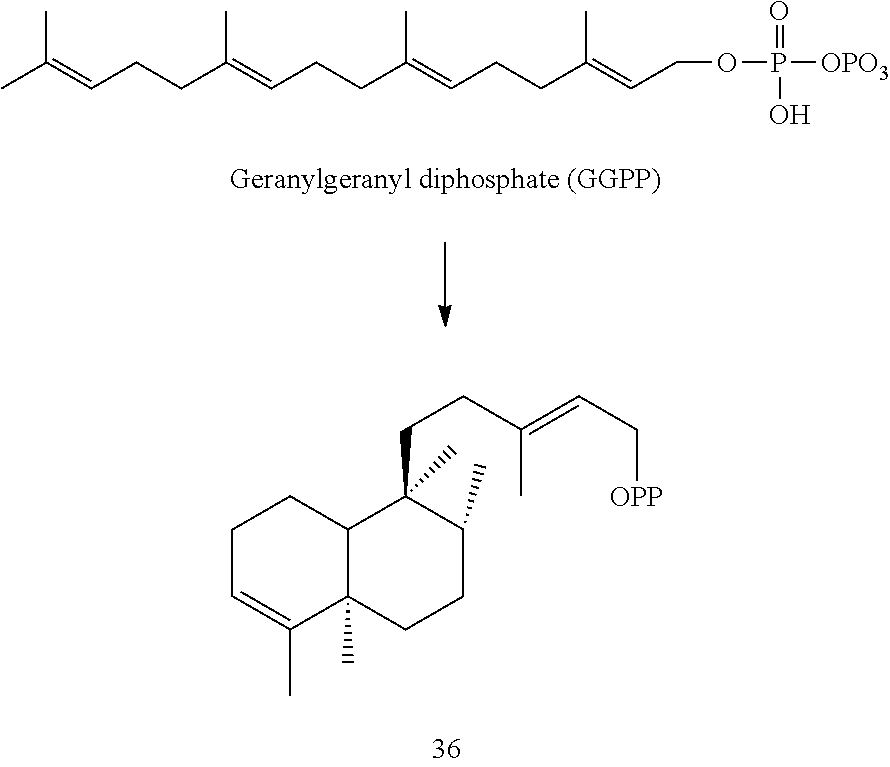
The Salvia hispanica (−)-kolavenyl diphosphate synthase (ShTPS1) has, for example, an amino acid sequence shown below (SEQ ID NO:51).
| 1 | MSIQANMSFA TSLHRSTTPG VGLPLKPCIS PSPSLSFSPN |
| 41 | FGTFNNTSLR LKPEAGSKSY EGIRRSHQLA ASTILEGQTP |
| 81 | ITPEVESEKT RLIERIRSML QDMDNDGQIS VSPYDTAWVA |
| 121 | LVEDIGGSGG PQFPTSLEWI SNHQYDDGSW GDRKFVLYDR |
| 161 | ILNTLACVVA LTNWKMHPNK CEKGLRFIHE NIKKLADEDE |
| 201 | ELMPVGFEIA LPSVIDLAKR LGIEIPENSA SIKRIYELRD |
| 241 | SKLKKIPMDL VHKRPTSLLF SLEGMEGLNW DKLMNFLAEG |
| 281 | SFLSSPSSTA YALQHTKNEL CLEYLLKAVK RFNGGVPNAY |
| 321 | PVDMFEHLWS VDRLQRLGIS RYFQAEIEEN MAYAYRYWTN |
| 361 | KGITWARNMV VQDSDDSAQG FRLLRLYGYD IPIDVFKHFE |
| 401 | QGGQFCSIPG QMTHAITGMY NLYRASELLF PGEHILSDAR |
| 441 | KYTGNFLHQR RITNTVVDKW IITKDLHGEV AYALDVPFYA |
| 481 | SLPRLEARFF IEQYGGDEDV WIGKTLYRMF KVNSDTYLEM |
| 521 | AKLDYKQCQS VHQLEWNSMQ RLYRDCNLGE FGLSERSLLL |
| 561 | AYYIAASTTF EPEKSSERLA WAITTILVEI IASQKLSDEQ |
| 601 | KREFVDEFVK GSIVNNQNGG RHKPGNRLVE VLINNITLMA |
| 641 | EGRGTYQQLS NAWKKWLKTW EEGGDLGEAE ARLLLHTIHL |
| 681 | SSGLDDSSFS HPKYQQLLEA TSKVCHQLRV FQSVKVYDDQ |
| 721 | ESTSQLVTRT TFQIEAGMQE LVKLVFTKTL EDLPSTTKQS |
| 761 | FFSVARSFYY TACIHADTID SHINKVLFEK IV |
[0173]A nucleic acid encoding the Salvia hispanica (−)-kolavenyl diphosphate synthase (ShTPS1) with SEQ ID NO:51 is shown below as SEQ ID NO:52.
| 1 | ATGAGTATTC AAGCAAACAT GTCATTTGCC ACCTCCCTCC |
| 41 | ACCGATCAAC CACCCCCGGA GTTGGCCTTC CGCTAAAACC |
| 81 | ATGTATCTCT CCCTCTCCCT CTCTTTCCTT TTCCCCAAAC |
| 121 | TTTGGCACTT TTAACAACAC AAGTTTGAGA CTCAAACCAG |
| 161 | AGGCTGGGAG CAAAAGTTAT GAGGGGATTC GAAGAAGTCA |
| 201 | TCAATTAGCA GCATCAACAA TTTTGGAGGG TCAAACTCCG |
| 241 | ATTACTCCGG AGGTTGAATC GGAGAAAACA CGCCTGATTG |
| 281 | AAAGGATTCG TTCGATGTTA CAAGACATGG ACAACGATGG |
| 321 | CCAGATAAGT GTGTCACCAT ACGACACAGC ATGGGTGGCG |
| 361 | CTCGTGGAAG ATATTGGTGG CAGCGGAGGG CCACAGTTTC |
| 401 | CAACGAGCCT AGAGTGGATT TCTAACCACC AGTACGACGA |
| 441 | TGGATCGTGG GGGGATCGCA AATTTGTTCT CTATGACCGG |
| 481 | ATACTCAATA CATTAGCATG TGTTGTCGCA CTCACGAATT |
| 521 | GGAAAATGCA TCCTAACAAA TGCGAAAAAG GGTTGAGGTT |
| 561 | TATTCATGAG AATATTAAGA AACTCGCGGA TGAAGATGAA |
| 601 | GAGCTCATGC CCGTAGGATT CGAAATCGCA CTGCCATCAG |
| 641 | TCATTGATTT AGCTAAAAGA CTGGGTATAG AAATCCCAGA |
| 681 | AAATTCTGCA AGCATAAAAA GAATTTATGA ATTGAGAGAT |
| 721 | TCAAAACTTA AAAAAATACC AATGGATTTA GTGCACAAAA |
| 761 | GGCCCACATC ACTACTCTTC AGCTTGGAAG GCATGGAAGG |
| 301 | CCTTAACTGG GACAAACTAA TGAATTTTCT AGCCGAGGGT |
| 841 | TCGTTTCTTT CATCGCCATC GTCCACTGCC TACGCTCTCC |
| 881 | AACACACCAA GAATGAGTTA TGCCTAGAGT ATTTACTCAA |
| 921 | GGCAGTCAAG AGATTCAATG GTGGAGTTCC AAATGCATAC |
| 961 | CCTGTCGACA TGTTTGAGCA TCTGTGGTCC GTGGATCGCT |
| 1001 | TACAGAGATT AGGAATTTCT CGGTATTTTC AAGCTGAAAT |
| 1041 | TGAAGAAAAC ATGGCCTATG CTTACAGATA CTGGACAAAT |
| 1081 | AAAGGAATCA CCTGGGCAAG AAATATGGTT GTCCAAGACA |
| 1121 | GTGACGACAG CGCACAGGGA TTCAGGCTCT TAAGGTTGTA |
| 1161 | CGGATACGAT ATTCCTATAG ATGTTTTCAA ACATTTCGAG |
| 1201 | CAAGGTGGAC AATTCTGCAG CATACCAGGA CAGATGACAC |
| 1241 | ACGCTATTAC AGGAATGTAC AACTTGTATA GAGCTTCTGA |
| 1281 | ACTTCTGTTC CCTGGAGAAC ACATACTTTC TGATGCTAGA |
| 1321 | AAATACACAG GTAACTTCTT GCATCAAAGA AGAATTACTA |
| 1361 | ACACGGTAGT AGACAAGTGG ATCATTACCA AAGACCTTCA |
| 1401 | CGGCGAGGTG GCTTATGCAT TGGATGTGCC ATTCTACGCC |
| 1441 | AGTCTGCCAC GACTGGAAGC ACGATTCTTC ATAGAACAAT |
| 1481 | ATGGGGGTGA TGAAGATGTT TGGATTGGGA AAACATTGTA |
| 1521 | CAGGATGTTT AAAGTAAACT CCGACACATA CCTTGAGATG |
| 1561 | GCAAAATTAG ATTACAAACA ATGCCAGTCT GTGCATCAGT |
| 1601 | TAGAGTGGAA TAGCATGCAA AGATTGTATA GAGATTGCAA |
| 1641 | TCTAGGAGAG TTTGGGTTGA GCGAAAGAAG CCTTCTCCTA |
| 1681 | GCTTACTACA TAGCAGCCTC AACTACATTT GAGCCGGAAA |
| 1721 | AATCAAGTGA AAGACTGGCT TGGGCTATAA CAACAATTTT |
| 1761 | AGTCGAAATA ATCGCATCCC AAAAACTCTC TGATGAGCAA |
| 1801 | AAGAGAGAGT TTGTTGATGA ATTTGTAAAA GGAAGCATCG |
| 1841 | TCAATAACCA AAATGGAGGA AGACATAAAC CGGGAAACAG |
| 1881 | ATTGGTTGAA GTTTTGATCA ACAATATAAC ACTGATGGCA |
| 1921 | GAAGGCAGAG GCACATATCA GCAGTTGTCT AATGCGTGGA |
| 1961 | AAAAATGGCT AAAGACATGG GAAGAGGGAG GTGACCTGGG |
| 2001 | GGAAGCACAA GCACGGCTTC TCCTGCACAC GATACATTTG |
| 2041 | AGCTCCGGAT TGGATGATTC ATCATTTTCC CATCCAAAAT |
| 2081 | ATCAGCAGCT CTTGGAGGCA ACCAGCAAAG TCTGCCACCA |
| 2121 | ACTTCGCGTA TTCCAGAGTG TAAAGGTGTA TGATGACCAA |
| 2161 | GAGTCTACAA GCCAACTGGT AACTAGGACA ACTTTCCAAA |
| 2201 | TAGAAGCAGG CATGCAAGAA CTAGTGAAAT TAGTTTTCAC |
| 2241 | AAAAACCTTG GAAGATTTGC CTTCTACTAC CAAGCAAAGC |
| 2281 | TTTTTTAGTG TTGCTAGAAG TTTCTATTAC ACTGCCTGTA |
| 2321 | TTCATGCAGA CACTATAGAC TCCCACATAA ACAAAGTATT |
| 2361 | GTTTGAAAAA ATTGTCTAG |
[0175]A Teucrium canadense cleroda-4(18),13E-dienyl diphosphate synthase (TcTPS1) was identified and isolated as described herein. This TcTPS1 enzyme was identified as a cleroda-4(18),13E-dienyl diphosphate synthase, which converts GGPP to cleroda-4(18),13E-dienyl diphosphate [38]. In addition, the combination of TcTPS1 and SsSS enzymes generated neo-cleroda-4(18),14-dien-13-ol [37]. These compounds are shown below.
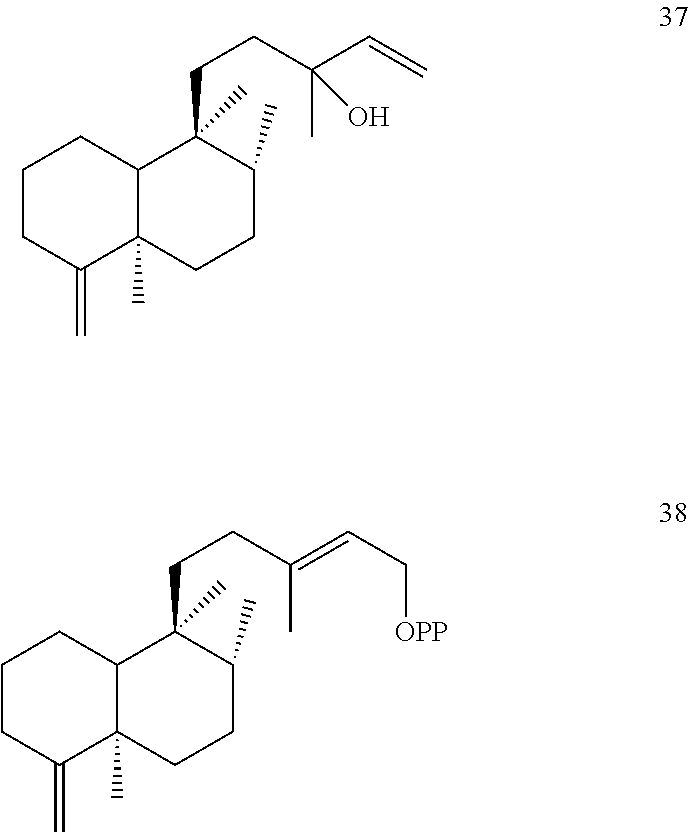
[0177]The Teucrium canadense cleroda-4(18),13E-dienyl diphosphate synthase (TcTPS1) amino acid sequence is shown below as SEQ ID NO:53.
| 1 | MSFASQATSL LLSSHNATAL PPLSAARLPP LTAGAAPFGR |
| 41 | ISFTTTSLRQ YKLVSRAQSQ EVDEIEKVTQ VVLEAEKDID |
| 81 | QEAKVRELVE NVRVKLQNIG EGGISISPYD TAWVALVEDV |
| 121 | GGSGRPQFPE SLDWISNHQF PDGSWGSHKF LYYDRVLCTL |
| 161 | ACIVALKTWN LHPHKFDKGL KFVRENIGKL ADEEDVHMPI |
| 201 | GFEVAFPSLI ETAKRKGIDI PEDFPGKKEI YAKRDLKLKK |
| 241 | IPMDILHKIP TPLLFSIEGI EGLDWQKLFK FRDHGSFLTS |
| 281 | PSSTAHALQQ TKDELCLKYL TNLVKKNNGG VPNAFPVDLF |
| 321 | DRNYTVDRLR RLGILRYFQP EIEECMKYVY RFWDKRGISW |
| 361 | ARNTHVQDLD DTVQGFRNLR MHGYDVTLDV FKQFERCGEF |
| 401 | FSFHGQSSDA VLCMFNLYRA SQVLFPGEDM LADARKYAAN |
| 441 | YLHKRRVSNR VVDKWIINKD LPGEVAYGLD VPFYASLPRL |
| 481 | EARFYVEQYG GNDDVWIGKA LYRMLNVSCD TYLELAKLDY |
| 521 | NICQAVHQKE WKSFQKWHRD GEFGLDEKSL LLAYYIAAST |
| 561 | VFEPEKSLER LAWAKTAVLM EAILSQQLPS TKKHELVDEF |
| 601 | KHASILNNQN GGSYKTRTPL VETLVNAISE LSTTILLEQD |
| 641 | RDIHLQLSNA WLKWLSRWEA RGNLVEAEAE LLLQTLHLSN |
| 681 | GLEESSFSHP KYQQLLQVTS KVCHLLRLFQ KRKVHDPEGC |
| 721 | TTDIATGTTF QIEACMQQVV KLVFTKSSHD LDSVVKQRFL |
| 761 | DVARSFYYTA HCDPQVIQSH INKVLFEKVV |
[0179]A nucleic acid encoding the Teucrium canadense Cleroda-4(18),13E-dienyl diphosphate synthase (TcTPS1) has with SEQ ID NO:53 is shown below as SEQ ID NO:54.
| 1 | ATGTCATTTG CTTCCCAAGC CACCTCCCTC CTCCTTTCTT |
| 41 | CCCACAACGC CACCGCTCTT CCGCCTCTCT CTGCCGCCCG |
| 81 | CCTTCCGCCT CTCACTGCCG GTGCTGCTCC ATTCGGAAGA |
| 121 | ATATCATTTA CTACTACCTC TCTTCGGCAG TATAAACTGG |
| 161 | TGTCAAGAGC TCAAAGCCAA GAGGTGGATG AGATTGAAAA |
| 201 | AGTGACACAA GTGGTATTGG AGGCAGAAAA AGACATCGAT |
| 241 | CAAGAGGCGA AGGTAAGGGA GCTGGTGGAA AATGTCCGAG |
| 281 | TGAAGCTGCA AAATATCGGG GAAGGAGGGA TAAGCATATC |
| 321 | GCCGTACGAC ACCGCATGGG TGGCGCTGGT GGAGGATGTC |
| 361 | GGCGGCAGCG GCAGACCGCA GTTCCCGGAG AGCCTGGATT |
| 401 | GGATATCAAA CCACCAGTTC CCGGACGGGT CGTGGGGCAG |
| 441 | CCACAAATTC TTGTACTATG ACCGGGTTTT GTGCACGTTA |
| 481 | GCATGTATAG TTGCATTGAA AACTTGGAAT CTGCATCCTC |
| 521 | ACAAATTCGA CAAAGGGTTG AAATTCGTCA GAGAGAACAT |
| 561 | TGGAAAGCTC GCGGATGAAG AAGACGTGCA CATGCCGATT |
| 601 | GGGTTCGAAG TGGCATTCCC ATCACTTATA GAGACTGCAA |
| 641 | AGAGAAAAGG AATTGACATC CCGGAAGATT TCCCTGGCAA |
| 681 | GAAAGAAATC TATGCAAAAA GAGACCTAAA GCTGAAAAAG |
| 721 | ATACCTATGG ATATACTGCA CAAAATCCCC ACACCATTAC |
| 761 | TGTTCAGCAT AGAAGGGATA GAAGGCCTTG ATTGGCAGAA |
| 801 | GCTATTCAAA TTCCGCGATC ACGGCTCCTT CCTCACGTCC |
| 841 | CCGTCCTCAA CGGCCCACGC TCTCCAGCAA ACAAAGGACG |
| 881 | AGTTATGCCT CAAATATCTG ACCAATCTTG TCAAAAAGAA |
| 921 | CAATGGGGGA GTTCCAAATG CATTTCCGGT GGACCTATTT |
| 961 | GATCGTAACT ATACAGTAGA TCGCCTGAGG AGGCTGGGAA |
| 1001 | TTTTGCGCTA TTTTCAACCT GAAATCGAGG AATGCATGAA |
| 1041 | ATATGTATAC AGATTCTGGG ATAAAAGAGG AATCAGCTGG |
| 1081 | GCAAGAAATA CCCATGTTCA GGACCTTGAT GATACCGTAC |
| 1121 | AGGGATTCAG GAACTTAAGG ATGCATGGTT ATGATGTCAC |
| 1161 | CTTAGATGTT TTCAAACAGT TCGAGAGATG TGGAGAATTC |
| 1201 | TTTAGCTTCC ACGGGCAATC AAGTGATGCT GTCTTAGGAA |
| 1241 | TGTTCAACTT GTACCGAGCT TCTCAGGTTC TGTTTCCAGG |
| 1281 | AGAAGACATG CTTGCAGATG CAAGGAAGTA CGCGGCCAAC |
| 1321 | TATTTGCATA AAAGAAGAGT TAGTAATAGG GTCGTGGACA |
| 1401 | AATGGATTAT TAACAAAGAT CTTCCAGGCG AGGTGGCGTA |
| 1441 | TGGGCTAGAT GTTCCGTTCT ACGCCAGTCT ACCTCGACTG |
| 1481 | GAAGCAAGAT TCTACGTCGA ACAATATGGG GGTAACGATG |
| 1521 | ATGTCTGGAT TGGAAAAGCT TTATATAGAA TGTTGAATGT |
| 1601 | GAGCTGTGAT ACTTACCTTG AGCTAGCAAA ATTAGACTAC |
| 1641 | AATATTTGCC AGGCTGTGCA TCAGAAAGAG TGGAAAAGCT |
| 1681 | TTCAAAAATG GCACAGGGAT GGGGAGTTTG GATTGGATGA |
| 1721 | AAAAAGCTTA CTTTTAGCTT ACTACATAGC AGCCTCGACT |
| 1761 | GTTTTCGAGC CTGAAAAATC TCTAGAGCGA CTGGCTTGGG |
| 1801 | CTAAAACCGC AGTTCTAATG GAGGCAATTT TGTCCCAACA |
| 1841 | ACTTCCTAGC ACAAAAAAAC ATGAGCTTGT TGACGAATTT |
| 1881 | AAACATGCAA GCATCCTCAA CAACCAAAAT GGAGGAAGCT |
| 1921 | ATAAAACAAG AACTCCTTTG GTAGAGACTC TAGTAAACGC |
| 1961 | CATAAGTGAG CTCTCAACTA CCATACTATT GGAGCAAGAC |
| 2001 | AGAGACATTC ATCTGCAATT ATCTAATGCG TGGCTGAAGT |
| 2041 | GGCTAAGTAG ATGGGAGGCA AGAGGCAACC TAGTGGAAGC |
| 2081 | AGAAGCAGAG CTTCTTCTGC AAACCTTACA TCTGAGCAAT |
| 2121 | GGATTAGAAG AATCATCATT TTCTCATCCA AAATATCAAC |
| 2161 | AACTCTTACA GGTTACCAGC AAAGTCTGTC ACCTACTTCG |
| 2201 | GCTATTCCAG AAACGAAAGG TGCATGATCC GGAAGGGTGT |
| 2241 | ACAACAGACA TTGCAACAGG GACAACTTTC CAAATAGAAG |
| 2281 | CATGCATGCA ACAAGTAGTG AAATTAGTGT TCACCAAATC |
| 2321 | CTCACATGAT TTAGATTCTG TTGTTAAGCA GAGATTTTTG |
| 2361 | GATGTTGCCA GAAGTTTCTA TTACACAGCC CACTGTGATC |
| 2401 | CACAAGTGAT CCAGTCCCAC ATTAATAAAG TGTTGTTTGA |
| 2441 | AAAAGTAGTC TAG |
[0181]Salvia officinalis (SoTPS2), Scutellaria baicalensis SbTPS1, and SbTPS2 enzymes were identified and isolated. These SoTPS2, SbTPS1, SbTPS2, CfTPS18a and CfTPS18b enzymes were all identified as ent-CPP synthases, which convert GGPP to ent-CPP.
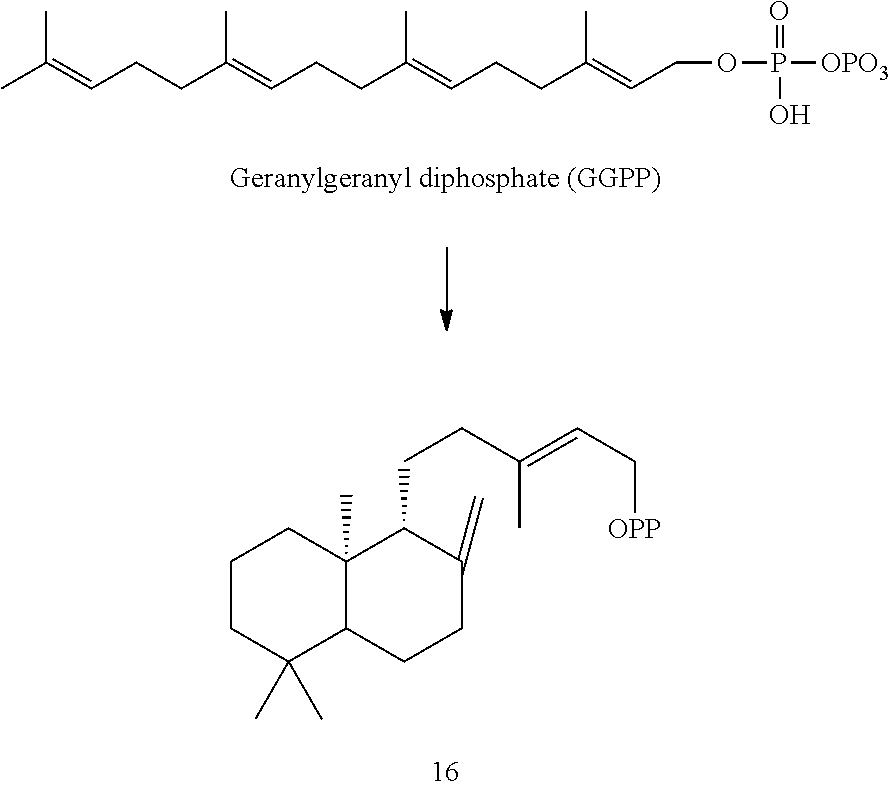
[0183]The Salvia officinalis (SoTPS2) enzyme can have the amino acid sequence shown below (SEQ ID NO:55).
| 1 | MSFASTTSLL RPSVTGFGVS PRVTSTSILS RSYGQILKGK |
| 41 | TKYITDNRRN RQLAVKFEGQ IALDLEDGVA KQTNQEAESE |
| 81 | KIRQLKGKIR WILQNMEDGE MSVSPYDTAW VALVEDISGG |
| 121 | GGPQFPTSLE WISKNQLADG SWGDPNYFLL YDRILNTLAC |
| 161 | VVALTTWNMH PHKCDQGLRF IRDNIEKLED EDEELILVGF |
| 201 | EIALPSLIDY AQNLGIQIQY DSPFIKKICA KRDLKLRKIP |
| 241 | MDLMHRKPTS LLYSLEGMEG LEWEKLMNLR SEGSFLSSPS |
| 281 | STAYALQHTK DELCLDYLVK AVNKFNGGVP NVYPVDMYEH |
| 321 | LWCVDRLQRL GISRYFQLEI QQCLDYVYRY WTNEGISWAR |
| 361 | YTNIRDSDDT AMGFRLLRLY GYDVSIDAFK PFEESGEFYS |
| 401 | MAGQMNHAVT GMYNLYRASQ LMFPQEHILS DARNFSAKFL |
| 441 | HQKRRTNALV DKWIITKDLP GEVGYALDVP FYASLPRLEA |
| 481 | RFFLEQYGGD DDVWIGYTLY RMPYVNSNTY LELAKVDYKN |
| 521 | CQSVHQLEWK SMQKWYRECN IGEFGLSERS LLLAYYIAAS |
| 561 | TTFEPEKSGE RLAWATTAIL IETIASQQLS DEQKREFVDE |
| 601 | FENSIIIKNQ NGGRYKARNR LVKVLINTVT LVAEGRGINQ |
| 641 | QLFNAWQKWL KTWEEGGDMG EAEAQLLLRT LHLSSGFDQS |
| 681 | SFSHPKYEQL LEATSKVCHQ LRLFQNRKVD DGQGCISRLV |
| 721 | IGTTSQIEAG MQEVVKLVFT KTSQDLTSAT KQSFFNIARS |
| 761 | FYYTAYFHAD TIDSHIYKVL FQTIV |
[0184]
A nucleic acid encoding the Salvia officinalis (SoTPS2) has with SEQ ID NO:55 is shown below as SEQ ID NO:56.
| 1 | ATGTCATTTG CTTCCACCAC CTCCCTCCTC CGACCAAGCG |
| 41 | TCACTGGGTT CGGTGTTTCT CCAAGGGTTA CTTCCACCTC |
| 81 | CATTCTTAGC CGAAGTTATG GTCAAATATT AAAAGGAAAA |
| 121 | ACAAAATACA TAACTGATAA CCGTAGAAAT CGACAATTGG |
| 161 | CGGTAAAATT TGAGGGCCAA ATTGCTTTGG ATTTGGAGGA |
| 201 | TGGCGTAGCA AAGCAGACGA ATCAAGAGGC GGAATCTGAG |
| 241 | AAGATAAGGC AACTGAAGGG AAAGATCCGA TGGATTCTGC |
| 281 | AAAACATGGA GGACGGCGAG ATGAGCGTGT CGCCGTACGA |
| 321 | CACCGCATGG GTGGCGCTGG TGGAAGATAT CAGCGGCGGC |
| 361 | GGCGGGCCGC AGTTCCCGAC GAGCCTCGAG TGGATTTCCA |
| 401 | AGAATCAGTT GGCGGATGGG TCATGGGGGG ATCCTAATTA |
| 441 | TTTCCTTCTC TACGACAGAA TACTCAATAC TTTAGCATGT |
| 481 | GTAGTCGCAC TCACGACTTG GAATATGCAT CCTCACAAAT |
| 521 | GCGATCAAGG GTTGAGGTTT ATAAGAGACA ACATTGAGAA |
| 561 | ACTTGAGGAT GAAGATGAGG AGCTAATTCT CGTAGGATTC |
| 601 | GAGATCGCAC TGCCTTCACT CATTGATTAT GCTCAAAACC |
| 641 | TTGGGATACA AATCCAATAT GATTCTCCAT TCATTAAAAA |
| 681 | AATTTGTGCA AAGAGAGATC TAAAACTCAG AAAAATACCA |
| 721 | ATGGATTTAA TGCACAGAAA GCCAACATCA TTGCTCTACA |
| 761 | GCTTGGAAGG CATGGAAGGC CTTGAGTGGG AAAAGCTAAT |
| 801 | GAATTTGCGA TCGGAGGGTT CGTTTCTGTC ATCGCCGTCG |
| 841 | TCCACGGCCT ACGCTCTCCA ACACACCAAG GATGAGTTAT |
| 881 | GCCTTGACTA TCTGGTCAAG GCGGTCAACA AATTCAATGG |
| 921 | TGGAGTTCCC AACGTGTACC CTGTCGACAT GTATGAGCAT |
| 961 | CTATGGTGCG TAGACCGCTT GCAGAGGTTG GGAATTTCTC |
| 1001 | GCTATTTTCA ACTTGAAATT CAACAATGCC TCGACTATGT |
| 1041 | TTACAGATAC TGGACAAATG AAGGAATTTC GTGGGCAAGA |
| 1081 | TATACTAATA TCCGGGATAG TGACGACACC GCAATGGGAT |
| 1121 | TCAGGCTTCT AAGGTTGTAC GGCTATGATG TCTCTATAGA |
| 1161 | TGCTTTTAAA CCATTCGAGG AAAGCGGAGA ATTCTATAGC |
| 1201 | ATGGCAGGGC AGATGAACCA CGCTGTTACA GGAATGTACA |
| 1241 | ACTTGTACAG AGCTTCTCAA CTTATGTTCC CTCAAGAACA |
| 1281 | CATACTTTCC GATGCCAGAA ACTTCTCTGC CAAATTCTTG |
| 1321 | CATCAAAAGA GGCGTACTAA TGCACTAGTA GACAAGTGGA |
| 1361 | TCATTACCAA AGACCTTCCC GGCGAGGTTG GATATGCATT |
| 1401 | GGATGTGCCG TTCTACGCCA GTCTGCCTCG ACTGGAAGCA |
| 1441 | CGATTCTTCT TAGAACAATA TGGGGGTGAT GATGATGTTT |
| 1481 | GGATTGGAAA AACTTTGTAC AGGATGCCAT ATGTGAACTC |
| 1521 | CAACACATAC CTTGAGCTTG CAAAAGTAGA CTACAAAAAC |
| 1561 | TGCCAGTCCG TGCATCAGTT GGAGTGGAAG AGCATGCAAA |
| 1601 | AATGGTACAG AGAATGCAAT ATAGGTGAGT TTGGGTTGAG |
| 1641 | CGAAAGAAGC CTTCTCCTAG CTTACTACAT AGCAGCCTCA |
| 1681 | ACTACATTCG AGCCAGAAAA ATCAGGTGAG CGGCTCGCTT |
| 1721 | GGGCTACAAC AGCAATTTTA ATCGAGACAA TCGCGTCCCA |
| 1761 | ACAACTCTCC GATGAACAAA AGAGAGAGTT CGTTGATGAA |
| 1801 | TTTGAAAACA GCATCATTAT CAAGAATCAA AATGGAGGGA |
| 1841 | GATATAAAGC AAGAAACAGA TTGGTCAAGG TTTTGATCAA |
| 1381 | CACTGTAACA CTGGTAGCAG AAGGCAGAGG CATAAATCAG |
| 1921 | CAGTTGTTTA ATGCGTGGCA AAAATGGCTA AAGACATGGG |
| 1961 | AAGAAGGAGG TGACATGGGG GAAGCAGAAG CCCAGCTTCT |
| 2001 | TCTGCGCACG CTACATTTGA GCTCCGGATT CGATCAATCA |
| 2041 | TCATTTTCCC ATCCAAAATA TGAGCAGCTC TTGGAGGCGA |
| 2081 | CCAGCAAAGT TTGCCACCAA CTTCGCCTAT TCCAGAATCG |
| 2121 | AAAGGTGGAT GATGGCCAAG GGTGTATAAG TCGATTGGTA |
| 2161 | ATTGGGACAA CTTCCCAAAT AGAAGCAGGC ATGCAAGAAG |
| 2201 | TAGTGAAATT AGTTTTCACC AAAACCTCAC AAGACTTGAC |
| 2241 | TTCTGCTACC AAGCAAAGCT TTTTCAATAT TGCTAGAAGT |
| 2281 | TTCTATTATA CTGCCTACTT TCATGCAGAC ACTATAGACT |
| 2321 | CCCACATATA CAAAGTATTG TTTCAAACAA TAGTATAG |
[0186]A Scutellaria baicalensis SbTPS1 amino acid sequence shown below (SEQ ID NO:57).
| 1 | MPFLLPSSAT SSPAFYTPAA PLAGHHVFPS FKPLIISRSS |
| 41 | LQCNAISRPR TQEYIDVIQN GLPVIKWHEA VEEDETDKDS |
| 81 | LNKEATSDKI RELVNLIRSM LQSMGDGEIS SSPYDAAWVA |
| 121 | LVPDVGGSGG PQFPSSLEWI SKNQLPDGSW GDTCTFSIYD |
| 161 | RIINTLACVV ALKSWNIHPH KTYQGISFIK ANMDKLEDEN |
| 201 | EEHMPIGFEV ALPSLIEIAK RLDIDISSDS RGLQEIYTRR |
| 241 | EVKLKRIPKE IMHQVPTTLL HSLEGMAELT WHKLLKLQCQ |
| 281 | DGSFLFSPSS TAFALHQTKD HNCLHYLTKY VHKFHGGVPN |
| 321 | VYPVDLFEHL WAVDRIQRLG ISRHFKPQVD ECIAYVYRYW |
| 361 | TDKGICWARN SVVQDLDDTA MGFRLLRLHG YDVSADVFKH |
| 401 | FENGGEFFCF KGQSTQAVTG MYNLYRASQL MFPGESILED |
| 441 | AKTESSKFLQ RKRANNELLD KWIITKDLPG EVGYALDVPW |
| 481 | YASLPRVETR FYLEQYGGED DVWIGKTLYR MPYVNNNKYL |
| 521 | ELAKLDYSNC QSLHQQEWKN IQKWYESCNL GEFGLSERRV |
| 561 | LLAYYVAAAC IYEPEKSNQR LAWAKTVILM ETITSYFEHQ |
| 601 | QLSAEQRRAF VNEFEHGSIL KYANGGRYKR RSVLGTLLKT |
| 641 | LNQLSLDILL THGRNVHQPF KNAWHKWLKT WEEGGDIEEG |
| 681 | EAEVLVRTLN LSGEGRHDSY VLEQSLLSQP IYEQLLKATM |
| 721 | SVCKKLRLFQ HRKDENGCMT KMRGITTLEI ESEMQELVKL |
| 761 | VFTKSSDDLD CEIKQNFFTI ARSFYYVAYC NQGTINYHIA |
| 801 | KVLFERVL |
[0187]
A nucleic acid encoding the Scutellaria baicalensis SbTPS1 with SEQ ID NO:57 is shown below as SEQ ID NO:58.
| 1 | ATGCCTTTCC TCCTCCCTTC CTCCGCCACC AGCTCCCCCG |
| 41 | CGTTCTATAC TCCGGCCGCG CCTCTCGCCG GTCATCATGT |
| 31 | TTTTCCATCT TTCAAGCCAC TCATTATTTC CCGTTCTTCA |
| 121 | CTCCAATGCA ATGCAATCTC TCGACCTCGT ACCCAAGAAT |
| 161 | ACATAGATGT GATTCAGAAT GGATTGCCAG TAATAAAGTG |
| 201 | GCACGAAGCT GTGGAAGAAG ATGAGACAGA TAAAGATTCT |
| 241 | CTTAATAAGG AGGCCACGTC AGACAAGATA AGAGAGTTGG |
| 281 | TAAATCTGAT CCGTTCGATG CTCCAATCAA TGGGCGACGC |
| 521 | AGAGATAAGC TCGTCGCCGT ACGACGCCGC ATGGGTGGCG |
| 561 | CTGGTGCCGG ACGTCGGCGG CTCCGGCGGG CCCCAGTTCC |
| 601 | CCTCCAGCCT CGAATGGATA TCCAAAAACC AACTCCCCGA |
| 641 | CGGCTCCTGG GGCGACACGT GTACCTTTTC CATTTATGAT |
| 681 | CGAATCATCA ACACACTGGC TTGCGTTGTT GCTTTGAAAT |
| 721 | CTTGGAACAT ACATCCCCAC AAAACTTATC AAGGGATTTC |
| 761 | ATTCATAAAG GCAAATATGG ACAAACTTGA AGACGAGAAC |
| 801 | GAGGAGCACA TGCCGATCGG ATTTGAAGTG GCACTCCCGT |
| 841 | CGCTAATCGA GATAGCGAAA AGGCTCGATA TCGATATTTC |
| 881 | CAGCGATTCG AGAGGGCTGC AAGAGATATA CACGAGGAGG |
| 921 | GAGGTAAAGC TGAAAAGGAT ACCGAAAGAG ATAATGCACC |
| 961 | AAGTGCCCAC AACACTGCTT CATAGCTTGG AGGGTATGGC |
| 1041 | CGAGCTGACG TGGCACAAGC TTTTGAAATT ACAGTGCCAA |
| 1081 | GATGGCTCCT TTCTTTTCTC TCCATCTTCA ACTGCCTTTG |
| 1121 | CTCTTCACCA AACTAAGGAC CATAATTGTC TCCATTATTT |
| 1161 | GACCAAATAT GTTCACAAAT TTCATGGTGG AGTGCCAAAT |
| 1201 | GTGTATCCGG TGGACTTGTT CGAGCATCTA TGGGCAGTTG |
| 1241 | ATCGGATCCA ACGGCTGGGG ATTTCCCGGC ATTTCAAGCC |
| 1281 | CCAAGTTGAT GAATGTATTG CCTATGTTTA TAGATATTGG |
| 1321 | ACAGATAAAG GAATATGCTG GGCAAGAAAT TCAGTAGTTC |
| 1361 | AAGATCTTGA TGACACAGCC ATGGGATTCA GGCTTCTTAG |
| 1401 | GTTGCATGGC TACGATGTTT CAGCAGATGT TTTCAAACAT |
| 1441 | TTTGAAAATG GTGGAGAGTT CTTCTGCTTC AAAGGGCAAA |
| 1481 | GCACGCAGGC AGTGACTGGA ATGTACAATC TGTACAGAGC |
| 1521 | TTCTCAGTTG ATGTTTCCTG GAGAAAGCAT ACTGGAAGAT |
| 1601 | GCTAAGACCT TCTCATCTAA GTTTTTGCAA CGAAAACGAG |
| 1641 | CCAATAACGA GTTGTTAGAT AAGTGGATTA TTACCAAGGA |
| 1681 | TCTTCCTGGA GAGGTGGGAT ATGCTCTAGA TGTACCATGG |
| 1721 | TATGCTAGCT TACCTAGAGT TGAAACTAGA TTCTACTTGG |
| 1801 | AACAATATGG TGGTGAAGAT GATGTTTGGA TTGGCAAAAC |
| 1841 | TTTATACAGG ATGCCATATG TTAACAATAA TAAATATCTA |
| 1881 | GAACTGGCAA AATTAGACTA TAGTAACTGC CAGTCATTAC |
| 1921 | ATCAACAAGA GTGGAAAAAC ATTCAAAAAT GGTATGAGAG |
| 1961 | TTGCAATCTG GGAGAATTTG GTTTGAGTGA AAGAAGGGTT |
| 2001 | CTACTAGCCT ACTACGTAGC TGCTGCCTGT ATATATGAGC |
| 2041 | CCGAAAAGTC AAACCAGCGC TTGGCTTGGG CCAAAACCGT |
| 2081 | AATTTTAATG GAGACTATTA CTTCCTATTT TGAGCACCAA |
| 2121 | CAACTCTCCG CAGAACAGAG ACGCGCCTTT GTTAATGAAT |
| 2161 | TTGAACATGG GAGTATCCTC AAATATGCAA ATGGAGGAAG |
| 2201 | ATACAAAAGG AGGAGTGTTT TGGGGACTTT GCTCAAAACA |
| 2241 | CTAAATCAGC TTTCATTGGA TATATTATTG ACACACGGTC |
| 2281 | GAAACGTCCA TCAGCCTTTC AAAAATGCGT GGCACAAGTG |
| 2321 | GCTAAAAACG TGGGAAGAAG GAGGTGACAT TGAAGAAGGC |
| 2361 | GAAGCAGAGG TATTGGTCCG AACCCTAAAC CTAAGCGGCG |
| 2401 | AAGGGAGGCA CGACTCCTAT GTATTGGAGC AATCATTATT |
| 2441 | GTCAGAACCT ATATATGAAC AACTTTTGAA AGCCACCATG |
| 2481 | AGTGTTTGCA AGAAGCTTCG ATTGTTCCAA CATCGAAAGG |
| 2521 | ATGAGAATGG ATGTATGACG AAGATGAGAG GCATTACAAC |
| 2561 | GTTAGAGATA GAATCGGAGA TGCAAGAATT AGTGAAATTA |
| 2601 | GTATTTACTA AATCCTCAGA TGATTTAGAT TGTGAAATTA |
| 2641 | AACAAAACTT TTTTACAATT CGTAGGAGTT TCTATTATGT |
| 2681 | GGCTTATTGT AACCAAGGAA CTATCAACTT TCACATTGCT |
| 2721 | AAGGTGCTCT TTGAAAGAGT TCTTTAG |
[0189]A Scutellaria baicalensis SbTPS2 amino acid sequence is shown below (SEQ ID NO:59).
| 1 | MASLSTLSLN FSPAIHRKIQ QSSAKLQFQG HCFTISSCMN |
| 41 | NSKRLSLNHQ SNHKRTSNVS ELQVATLDAP QIREKEDYST |
| 81 | AQGYEKVDEV EDPIEYIRML LNTTGDGRIS VSPYDTAWIA |
| 121 | LIKDVEGRDA PQFPSSLEWI ANNQLSDGSW GDEKFFCVYD |
| 161 | RLVNTLACVV ALRSWNIDAE KSEKGIRYIK ENVDKLKDGN |
| 201 | PEHMTCGFEV VFPSLLQRAQ SMGIHDLPYD APVIQDIYNT |
| 241 | RESKLKRIPM EVMHKVPTSL LFSLEGLENL EWDKLLKLQS |
| 281 | SDGSFLTSPS STAYAFMHTK DPKCFEFIKN TVETFNGGAP |
| 321 | HTYPVDVFGR LWAIDRLQRL GISRFFESEI ADCLDHIYKY |
| 361 | WTDKGVFSGR ESDFVDVDDT SMGVRLLRMH GYQVDPNVLR |
| 401 | NFKQGDKFSC YGGQMIESSS PIYNLYRASQ LRFPGEDILE |
| 441 | DANKFAYEFL QEQLSNNQLL DKWVISKHLP DEIKLGLQMP |
| 481 | WYATLPRVEA KYYLQYYAGA DDVWIGKTLY RMPEISNDTY |
| 521 | LELARMDFKR CQAQHQFEWI SMQEWYESCN IEEFGISRKE |
| 561 | LLQAYFLACS SVFELERTTE RIGWAKSQII SRMIASFFNN |
| 601 | ETTTADEKDA LLTRFRNING PNRTKSGQRE SEAVNMLVAT |
| 641 | LQQYLAGFDR YTRHQLKDAW SVWFRKVQEE EAIYGAEAEL |
| 681 | LTTTLNICAG HIAFDENIMA NKDYTTLSSL TSKICQKLSE |
| 721 | IRNEKVEEME SGIKAKSSIK DKEVEHDMQS LVKLVLERCE |
| 761 | GINNRKLKQT FLSVAKTYYY RAYNADETMD IHMFKVLFEP |
| 801 | VM |
[0190]
A nucleic acid encoding the Scutellaria baicalensis SbTPS2 with SEQ ID NO:59 is shown below as SEQ ID NO:60.
| 1 | ATGGCCTCTC TATCAACTCT GAGCCTCAAC TTTTCCCCAG |
| 41 | CAATTCACCG CAAAATACAG CAATCATCTG CAAAACTTCA |
| 81 | GTTCCAGGGA CATTGTTTCA CCATAAGTTC ATGCATGAAC |
| 121 | AACAGTAAAA GACTGTCTTT GAACCACCAA TCTAATCACA |
| 161 | AAAGAACGTC AAACGTATCT GAGCTGCAAG TTGCCACTTT |
| 201 | GGATGCGCCC CAAATACGTG AAAAAGAAGA CTACTCCACT |
| 241 | GCTCAAGGCT ATGAGAAGGT GGATGAAGTA GAGGATCCTA |
| 281 | TCGAATATAT TAGAATGCTG TTGAACACAA CAGGTGATGG |
| 321 | GCGAATAAGT GTGTCGCCAT ACGACACAGC CTGGATCGCT |
| 361 | CTTATTAAAG ACGTGGAAGG ACGTGATGCT CCCCAGTTCC |
| 401 | CATCTAGTCT CGAATGGATT GCCAATAATC AACTGAGTGA |
| 441 | TGGGTCGTGG GGCGATGAGA AGTTTTTCTG TGTGTATGAT |
| 481 | CGCCTTGTTA ATACACTTGC ATGTGTCGTG GCATTGAGAT |
| 521 | CATGGAATAT TGATGCTGAA AAGAGCGAGA AAGGAATAAG |
| 561 | ATACATAAAA GAAAACGTGG ATAAACTGAA AGATGGGAAT |
| 601 | CCAGAGCACA TGACCTGTGG TTTTGAGGTG GTGTTTCCTT |
| 641 | CCCTTCTTCA GAGAGCCCAA AGTATGGGAA TTCATGATCT |
| 681 | TCCCTATGAT GCTCCTGTCA TCCAAGACAT TTACAATACC |
| 721 | AGGGAGAGTA AATTGAAAAG CATTCCAATG GAGGTTATCC |
| 761 | ACAAGGTGCC AACATCTCTA TTGTTCAGCT TGGAAGGATT |
| 801 | GGAGAATTTG GAGTGGGATA AGCTCCTCAA ACTTCAGTCT |
| 841 | TCTGATGGTT CATTCCTCAC TTCTCCATCC TCAACTGCCT |
| 881 | ATGCTTTCAT GCACACTAAG GACCCTAAAT GCTTCGAATT |
| 921 | CATCAAAAAC ACCGTCGAAA CATTTAATGG AGGAGCACCT |
| 961 | CATACTTATC CGGTGGATGT TTTTGGAAGA CTGTGGGCCA |
| 1001 | TTGACAGGCT GCAGCGCCTC GGAATCTCTC GCTTCTTTGA |
| 1041 | GTCCGAGATT GCTGATTGCT TAGATCACAT CTATAAATAT |
| 1081 | TGGACAGACA AAGGAGTGTT CAGTGGAAGA GAATCAGATT |
| 1121 | TTGTGGATGT GGATGACACA TCCATGGGTG TTAGGCTTCT |
| 1161 | AAGGATGCAC GGATATCAAG TTGATCCAAA TGTATTGAGG |
| 1201 | AACTTCAAGC AGGGTGACAA ATTTTCATGC TATGGTGGTC |
| 1241 | AAATGATAGA GTCATCATCT CCGATATACA ATCTCTATAG |
| 1281 | GGCTTCTCAA CTCCGATTTC CAGGAGAAGA CATTCTTGAA |
| 1321 | GATGCCAACA AATTCGCATA CGAGTTCTTG CAAGAACAGC |
| 1361 | TATCCAACAA TCAACTTTTG GACAAATGGG TTATATCCAA |
| 1401 | GCACTTGCCT GATGAGATAA AGCTTGGATT GCAGATGCCA |
| 1441 | TGGTATGCCA CCCTACCCCG AGTGGAGGCT AAATACTACC |
| 1481 | TACAGTATTA TGCTGGTGCT GATGATGTCT GGATCGGCAA |
| 1521 | GACTCTCTAC AGAATGCCAG AAATCAGTAA TGATACATAT |
| 1561 | CTGGAGTTAG CAAGAATGGA TTTCAAGAGA TGCCAAGCAC |
| 1601 | AGCATCAATT TGAGTGGATT TCCATGCAAG AATGGTATGA |
| 1641 | AAGTTGCAAC ATTGAAGAAT TTGGGATAAG CAGAAAAGAG |
| 1681 | CTTCTTCAGG CTTACTTTTT GGCCTGCTCA AGTGTATTTG |
| 1721 | AACTCGAGAG GACAACAGAG AGAATAGGAT GGGCCAAATC |
| 1761 | CCAAATTATT TCAAGGATGA TAGCTTCTTT CTTCAACAAT |
| 1801 | GAAACTACAA CAGCCGATGA AAAAGATGCA CTTTTAACCA |
| 1841 | GATTCAGAAA CATCAATGGC CCAAACAAAA CAAAAAGTGG |
| 1881 | TCAGAGAGAG AGTGAAGCTG TGAACATGTT GGTAGCAACG |
| 1921 | CTCCAACAAT ACCTGGCAGG ATTTGATAGA TATACCAGAC |
| 1961 | ATCAATTGAA AGATGCTTGG AGTGTGTGGT TCAGAAAAGT |
| 2001 | GCAAGAAGAA GAGGCCATCT ACGGGGCAGA AGCGGAGCTT |
| 2041 | CTAACAACCA CCTTAAACAT CTGTGCTGGT CATATTGCTT |
| 2081 | TCGACGAAAA CATAATGGCC AACAAAGATT ACACCACTCT |
| 2121 | TTCCAGCCTT ACAAGCAAAA TTTGCCAGAA GCTTTCTGAA |
| 2161 | ATTCGAAATG AAAAGGTTGA GGAAATGGAG AGTGGAATTA |
| 2201 | AAGCAAAATC AAGCATCAAA GACAAGGAAG TGGAACATGA |
| 2241 | TATGCAGTCA CTGGTGAAAT TAGTCCTGGA GAGATGTGAA |
| 2281 | GGCATAAACA ACAGAAAACT GAAGCAAACA TTTCTATCGG |
| 2321 | TTGCAAAAAC ATATTACTAC AGAGCCTATA ATGCTGATGA |
| 2361 | AACCATGGAC ATCCATATGT TCAAAGTACT TTTCGAACCA |
| 2401 | GTCATGTGA |
[0192]An example of a Salvia sclarea sclareol synthase amino acid sequence is shown below (SEQ ID NO:176, NCBI accession no. AET21246.1).
| 1 | MSLAFNVGVT PFSGQRVGSR KEKFPVQGFP VTTPNRSRLI |
| 41 | VNCSLTTIDF MAKMKENFKR EDDKFPTTTT LRSEDIPSNL |
| 81 | CIIDTLQRLG VDQFFQYEIN TILDNTFRLW QEKHKVIYGN |
| 121 | VTTHAMAFRL LRVKGYEVSS EELAPYGNQE AVSQQTNDLP |
| 161 | MIIELYRAAN ERIYEEERSL EKILAWTTIF LNKQVQDNSI |
| 201 | PDKKLHKLVE FYLRNYKGIT IRLGARRNLE LYDMTYYQAL |
| 241 | KSTNRFSNLC NEDFLVFAKQ DFDIHEAQNQ KGLQQLQRWY |
| 281 | ADCRLDTLNF GRDVVIIANY LASLIIGDHA FDYVRLAFAK |
| 321 | TSVLVTIMDD FFDCHGSSQE CDKIIELVKE WKENPDAEYG |
| 361 | SEELEILFMA LYNTVNELAE RARVEQGRSV KEFLVKLWVE |
| 401 | ILSAFKIELD TWSNGTQQSF DEYISSSWLS NGSRLTGLLT |
| 441 | MQFVGVKLSD EMLMSEECTD LARHVCMVGR LLNDVCSSER |
| 481 | EREENIAGKS YSILLATEKD GRKVSEDEAI AEINEMVEYH |
| 521 | WRKVLQIVYK KESILPRRCK DVFLEMAKGT FYAYGINDEL |
| 561 | TSPQQSKEDM KSFVF |
[0193]
A nucleic acid encoding the Salvia sclarea sclareol synthase with SEQ ID NO:176 is shown below as SEQ ID NO:177.
| 1 | ATGTCGCTCG CCTTCAACGT CGGAGTTACG CCTTTCTCCG |
| 41 | GCCAAAGAGT TGGGAGCAGG AAAGAAAAAT TTCCAGTCCA |
| 81 | AGGATTTCCT GTGACCACCC CCAATAGGTC ACGTCTCATC |
| 121 | GTTAACTGCA GCCTTACTAC AATAGATTTC ATGGCGAAAA |
| 161 | TGAAAGAGAA TTTCAAGAGG GAAGACGATA AATTTCCAAC |
| 201 | GACAACGACT CTTCGATCCG AAGATATACC CTCTAATTTG |
| 241 | TGTATAATCG ACACCCTTCA AAGGTTGGGG GTCGATCAAT |
| 231 | TCTTCCAATA TGAAATCAAC ACTATTCTAG ATAACACATT |
| 321 | CAGGTTGTGG CAAGAAAAAC ACAAAGTTAT ATATGGCAAT |
| 361 | GTTACTACTC ATGCAATGGC ATTTAGGCTT TTGCGAGTGA |
| 401 | AAGGATACGA AGTTTCATCA GAGGAGTTGG CTCCATATGG |
| 441 | TAACCAAGAG GCTGTTAGGC AGCAAACAAA TGACCTGCCG |
| 481 | ATGATTATTG AGCTTTATAG AGCAGCAAAT GAGAGAATAT |
| 521 | ATGAAGAAGA GAGGAGTCTT GAAAAAATTC TTGCTTGGAC |
| 561 | TACCATCTTT CTCAATAAGC AAGTGCAAGA TAACTCAATT |
| 601 | CCCGACAAAA AACTGCACAA ACTGGTGGAA TTCTACTTGA |
| 641 | GGAATTACAA AGGCATAACC ATAAGATTGG GAGCTAGACG |
| 681 | AAACCTCGAG CTATATGACA TGACCTACTA TCAAGCTCTG |
| 721 | AAATCTACAA ACAGGTTCTC TAATTTATGC AACGAAGATT |
| 761 | TTCTAGTTTT CGCAAAGGAA GATTTCGATA TACATGAAGC |
| 801 | CCAGAACCAG AAAGGACTTC AACAACTGCA AAGGTGGTAT |
| 841 | GCAGATTGTA GGTTGGACAC CTTAAACTTT GGAAGAGATG |
| 831 | TAGTTATTAT TGCTAATTAT TTGGCTTCAT TAATTATTGG |
| 921 | TGATCATGCG TTTGACTATG TTCGTCTCGC ATTTGCCAAA |
| 961 | ACATCTGTGC TTGTAACAAT TATGGATGAT TTTTTCGACT |
| 1001 | GTCATGGCTC TAGTCAAGAG TGTGAGAAGA TCATTGAATT |
| 1041 | AGTAAAAGAA TGGAAGGAGA ATCCGGATGC AGAGTACGGA |
| 1081 | TCTGAGGAGC TTGAGATCCT TTTTATGGCG TTGTACAATA |
| 1121 | CAGTAAATGA GTTGGCGGAG AGGGCTCGTG TTGAACAGGG |
| 1161 | GCGTAGTGTC AAAGAGTTTC TAGTCAAACT GTGGGTTGAA |
| 1201 | ATACTCTCAG CTTTCAAGAT AGAATTAGAT ACATGGAGCA |
| 1241 | ATGGCACGCA GCAAAGCTTC GATGAATACA TTTCTTCGTC |
| 1281 | GTGGTTGTCG AACGGTTCCC GGCTGACAGG TCTCCTGACG |
| 1321 | ATGCAATTCG TCGGAGTAAA ATTGTCCGAT GAAATGCTTA |
| 1361 | TGAGTGAAGA GTGCACTGAT TTGGCTAGGC ATGTCTGTAT |
| 1401 | GGTCGGCCGG CTGCTCAACG ACGTGTGCAG TTCTGAGAGG |
| 1441 | GAGCGCGAGG AAAATATTGC AGGAAAAAGT TATAGCATTC |
| 1431 | TACTAGCAAC TGAGAAAGAT GGAAGAAAAG TTAGTGAAGA |
| 1521 | TGAAGCCATT GCAGAGATCA ATGAAATGGT TGAATATCAC |
| 1561 | TGGAGAAAAG TGTTGCAGAT TGTGTATAAA AAAGAAAGCA |
| 1601 | TTTTGCCAAG AAGATGCAAA GATGTATTTT TGGAGATGGC |
| 1641 | TAAGGGTACG TTTTATGCTT ATGGGATCAA CGATGAATTG |
| 1681 | ACTTCTCCTC AGCAATCCAA GGAAGATATG AAATCCTTTG |
| 1721 | TCTTTTGA |
[0195]Enzymes described herein can have one or more deletions, insertions, replacements, or substitutions in a part of the enzyme. The enzyme(s) described herein can have, for example, at least 60%, or at least 70%, or at least 80%, or at least 90%, or at least 93%, or at least 95%, or at least 96%, or at least 97%, or at least 98%, or at least 99% sequence identity to a sequence described herein.
[0196]In some cases, enzymes can have conservative changes such as one or more deletions, insertions, replacements, or substitutions that have no significant effect on the activities of the enzymes. Examples of conservative substitutions are provided below in Table 1A.
| TABLE 1A |
|---|
| Conservative Substitutions |
| Type of Amino Acid | Substitutable Amino Acids |
| Hydrophilic | Ala, Pro, Gly, Glu, Asp, Gln, Asn, Ser, Thr |
| Sulfhydryl | Cys |
| Aliphatic | Val, Ile, Leu, Met |
| Basic | Lys, Arg, His |
| Aromatic | Phe, Tyr, Trp |
[0198]Due to an increase in resolution at the taxonomic level and consistent clustering of enzymes with identical, or related function, the inventors propose a hierarchical scheme for classifying TPS genes in Lamiaceae from the TPS-e and TPS-c subfamilies. TPS-c genes (class II diTPSs) from Lamiaceae fall broadly into two clades (
[0199]The remaining TPS-c clades contain genes involved in specialized metabolism. The only characterized gene from clade c.1.2 is PcTPS1 which makes an ent-labda-8-ene diphosphate product [25]. Enzymes from clade c.1.3 catalyze the production of a variety of products, including ent-CPP [16], ent-8-LPP [7], kolavenyl-PP [36], and 38. 36 and 38 are the only products without the labdane (Sk4) skeleton produced by Lamiaceae class II diTPSs. Compounds apparently derived from 36 are widespread among Lamiaceae (Table 6), so the inventors hypothesize that the progenitor of c.1.3 was a kolavenyl-PP synthase present in an early common ancestor. The labdane compounds produced by enzymes in c.1 are all in the ent-configuration. With two exceptions, the known enzymes from clade c.2 all make products with the labdane skeleton in the normal configuration, suggesting that the founder of that clade may have been a normal configuration labdadiene diphosphate synthase. The exceptions are VacTPS3, the only characterized member of c.2.1, which produces syn-CPP [13], and the curious case of SdCPS1, which produces ent-CPP.
[0200]Among TPS-e (class I) genes, all but one of the characterized enzymes from e.1 are ent-kaurene [19] synthases, presumably involved in gibberellin biosynthesis. As with the c.1.1 clade, e.1 reflects the taxonomic distribution among the species. Notable in this clade are IrKSL4, which is an ent-atiserene synthase, and SmKSL2, which, in addition to ent-kaurene synthase activity, can convert ent-8-LPP 7 into ent-13-epi-manoyl oxide [6]. Andersen-Ranberg et al. (Angew Chem Int Ed 55(6):2142-2146 (2016)) have tested four of four ent-kaurene synthases and have data indicating that one was from Lamiaceae, which had the ability to convert 7 to 6, so it is likely that this is a general characteristic of enzymes in the e.1 group.
[0201]Most of the specialized class I diTPSs in Lamiaceae fall into clade e.2. Enzymes in e.2 have lost the γ domain, present in many diTPSs, and located on the opposite end of the peptide from the class I active site. Characteristic of enzymes in e.2 is their ability to act on multiple substrates. The extreme example is SsSS (Caniard et al. M C Plant Biology 12:119 (2012)) which so far has been able to catalyze the dephosphorylation and minor rearrangement of all class II enzyme products that it has been tested. The range of substrates accepted by other enzymes in this group has not been tested systematically, but among the e.2 enzymes characterized in this study, only one (OmTPS4) accepted ent-CPP, and all accepted (+)-CPP [31], (+)-8-LPP [10], and PgPP [5]. There is great diversity the products of e.2 enzymes, with over 20 distinct compounds represented. Most of the enzymes in e.2 convert (+)-CPP to miltiradiene [32], and (+)-8-LPP to 13R-(+)-manoyl oxide [8], with other activities arising sporadically across the clade. Both characterized enzymes in the Nepetoideae specific e.2.2 have unusual activities: IrKSL6 converts (+)-CPP to isopimara-7,15-diene [28], and OmTPS5 converts (+)-CPP to palustradiene [29]. Most of the enzymes in e.2 fall into the e.2.1 clade which also accounts for most of the known products. Enzymes that we characterized from e.2.1 lent support to emerging functionally consistent subclades. OmTPS4 activity, for three out of four substrates tested, mimics that of its nearest homolog (SsSS), notably accepting ent-CPP as a substrate to produce ent-manool [20]. LITPS4 likewise has activities most similar to its closest homolog, MvELS, converting PgPP into 9,13(S)-epoxy-labd-14-ene [2] with greater specificity than other enzymes tested, although the products from (+)-CPP are different. From the remaining clade, e.2.3, the three characterized enzymes all come from Nepetoideae, and convert (+)-CPP into different products: IrKSL3 produces miltiradiene, IrTPS2 produces nezukol [30], and MsTPS1 produces sandaracopimaradiene [27].
[0202]The existence of two strongly supported subclades of specialized diTPSs within c.1, together with the presence of an ent-atiserene synthase in e.1, indicate that the emergence of specialized diTPSs from ent-CPP and ent-kaurene synthases is an ongoing process that has occurred multiple times in the Lamiaceae lineage. While it is evident that candidates selected from anywhere in the phylogenetic tree may have novel activities, clades that seem particularly promising and underexplored are c.2.1, c.1.2, and e.2.3. So far, including this work and previous work, diTPSs have been characterized from only four of the twelve major Lamiaceae clades: Ajugoideae, Lamioideae, Nepetoideae, and Viticoideae. Further expanding to the remaining eight Lamiaceae clades may also be a promising strategy for finding new enzyme activities.
Expression of Enzymes
[0203]Also described herein are expression systems that include at least one expression cassette (e.g., expression vectors or transgenes) that encode one or more of the enzyme(s) described herein. The expression systems can also include one or more expression cassettes encoding an enzyme that can synthesize terpene building blocks. For example, the expression systems can include one or more expression cassettes encoding terpene synthases that facilitate production of terpene precursors or building blocks such as those involved in the synthesis of isopentenyl diphosphate (IPP) or dimethylallyl diphosphate (DMAPP).
[0204]Cells containing such expression systems are further described herein. The cells containing such expression systems can be used to manufacture the enzymes (e.g., for in vitro use) and/or one or more terpenes, diterpenes, or terpenoids produced by the enzymes. Methods of using the enzymes or cells containing expression cassettes encoding such enzymes to make products such as terpenes, diterpenes, terpenoids, and combinations thereof are also described herein.
[0205]Nucleic acids encoding the enzymes can have sequence modifications. For example, nucleic acid sequences described herein can be modified to express enzymes that have modifications. Most amino acids can be encoded by more than one codon. When an amino acid is encoded by more than one codon, the codons are referred to as degenerate codons. A listing of degenerate codons is provided in Table 1B below.
| TABLE 1B |
|---|
| Degenerate Amino Acid Codons |
| Amino Acid | Three Nucleotide Codon | |
| Ala/A | GCT, GCC, GCA, GCG | |
| Arg/R | CGT, CGC, CGA, CGG, AGA, AGG | |
| Asn/N | AAT, AAC | |
| Asp/D | GAT, GAC | |
| Cys/C | TGT, TGC | |
| Gln/Q | CAA, CAG | |
| Glu/E | GAA, GAG | |
| Gly/G | GGT, GGC, GGA, GGG | |
| His/H | CAT, CAC | |
| Ile/I | ATT, ATC, ATA | |
| Leu/L | TTA, TTG, CTT, CTC, CTA, CTG | |
| Lys/K | AAA, AAG | |
| Met/M | ATG | |
| Phe/F | TTT, TTC | |
| Pro/P | CCT, CCC, CCA, CCG | |
| Ser/S | TCT, TCC, TCA, TCG, AGT, AGC | |
| Thr/T | ACT, ACC, ACA, ACG | |
| Trp/W | TGG | |
| Tyr/Y | TAT, TAC | |
| Val/V | GTT, GTC, GTA, GTG | |
| START | ATG | |
| STOP | TAG, TGA, TAA | |
[0207]Different organisms may translate different codons more or less efficiently (e.g., because they have different ratios of tRNAs) than other organisms. Hence, when some amino acids can be encoded by several codons, a nucleic acid segment can be designed to optimize the efficiency of expression of an enzyme by using codons that are preferred by an organism of interest. For example, the nucleotide coding regions of the enzymes described herein can be codon optimized for expression in various plant species. For example, many of the enzymes described herein were originally isolated from the mint family (Lamiaceae), however such enzymes can be expressed in a variety of host cells, including for example, as Nicotiana benthamiana, Nicotiana tabacum, Nicotiana rustica, Nicotiana excelsior, and Nicotiana excelsiana.
[0208]An optimized nucleic acid can have less than 98%, less than 97%, less than 95%, or less than 94%, or less than 93%, or less than 92%, or less than 91%, or less than 90%, or less than 89%, or less than 88%, or less than 85%, or less than 83%, or less than 80%, or less than 75% nucleic acid sequence identity to a corresponding non-optimized (e.g., a non-optimized parental or wild type enzyme nucleic acid) sequence.
[0209]The enzymes described herein can be expressed from an expression cassette and/or an expression vector. Such an expression cassette can include a nucleic acid segment that encodes an enzyme operably linked to a promoter to drive expression of the enzyme. Convenient vectors, or expression systems can be used to express such enzymes. In some instances, the nucleic acid segment encoding an enzyme is operably linked to a promoter and/or a transcription termination sequence. The promoter and/or the termination sequence can be heterologous to the nucleic acid segment that encodes an enzyme. Expression cassettes can have a promoter operably linked to a heterologous open reading frame encoding an enzyme. The invention therefore provides expression cassettes or vectors useful for expressing one or more enzyme(s).
[0210]Constructs, e.g., expression cassettes, and vectors comprising the isolated nucleic acid molecule, e.g., with optimized nucleic acid sequence, as well as kits comprising the isolated nucleic acid molecule, construct or vector are also provided.
[0211]The nucleic acids described herein can also be modified to improve or alter the functional properties of the encoded enzymes. Deletions, insertions, or substitutions can be generated by a variety of methods such as, but not limited to, random mutagenesis and/or site-specific recombination-mediated methods. The mutations can range in size from one or two nucleotides to hundreds of nucleotides (or any value there between). Deletions, insertions, and/or substitutions are created at a desired location in a nucleic acid encoding the enzyme(s).
[0212]Nucleic acids encoding one or more enzyme(s) can have one or more nucleotide deletions, insertions, replacements, or substitutions. For example, the nucleic acids encoding one or more enzyme(s) can, for example, have less than 95%, or less than 94.8%, or less than 94.5%, or less than 94%, or less than 93.8%, or less than 94.50% nucleic acid sequence identity to a corresponding parental or wild-type sequence. In some cases, the nucleic acids encoding one or more enzyme(s) can have, for example, at least 50%, or at least 55%, or at least 60%, or at least 65%, or at least 70%, or at least 75%, or at least 80%, or at least 85%, or at 90% sequence identity to a corresponding parental or wild-type sequence. Examples of parental or wild type nucleic acid sequences for unmodified enzyme(s) with amino acid sequences SEQ ID NOs:1, 3, 5, 7, 9, 11, 13, 15, 17, 19, 21, 23, 25, 27, 29, 31, 33, 35, 37, 39, 41, 43, 45, 47, 49, 51, 53, 57, 59, or 176 include nucleic acid sequences SEQ ID NOs:2, 4, 6, 8, 10, 12, 14, 16, 18, 20, 22, 24, 26, 28, 30, 32, 34, 36, 38, 40, 42, 44, 46, 48, 50, 52, 54, 56, 58, 60, or 177 respectively. Any of these nuclei acid or amino acid sequences can, for example, encode or have enzyme sequences with less than 99%, less than 98%, less than 97%, less than 96%, less than 95%, less than 94.8%, less than 94.5%, less than 94%, less than 93.8%, less than 93.5%, less than 93%, less than 92%, less than 91%, or less than 90% sequence identity to a corresponding parental or wild-type sequence.
[0213]Also provided are nucleic acid molecules (polynucleotide molecules) that can include a nucleic acid segment encoding an enzyme with a sequence that is optimized for expression in at least one selected host organism or host cell. Optimized sequences include sequences which are codon optimized, i.e., codons which are employed more frequently in one organism relative to another organism. In some cases, the balance of codon usage is such that the most frequently used codon is not used to exhaustion. Other modifications can include addition or modification of Kozak sequences and/or introns, and/or to remove undesirable sequences, for instance, potential transcription factor binding sites.
[0214]An enzyme useful for synthesis of terpenes, diterpenes, and terpenoids may be expressed on the surface of, or within, a prokaryotic or eukaryotic cell. In some cases, expressed enzyme(s) can be secreted by that cell.
[0215]Techniques of molecular biology, microbiology, and recombinant DNA technology which are within the skill of the art can be employed to make and use the enzymes, expression systems, and terpene products described herein. Such techniques available in the literature. See, e.g., Sambrook, Fritsch & Maniatis, Molecular Cloning: A Laboratory Manual, Second Edition (1989); DNA Cloning, Vols. I and II (D. N. Glover ed. 1985); Oligonucleotide Synthesis (M. J. Gait ed. 1984); Nucleic Acid Hybridization (B. D. Hames & S. J. Higgins eds. 1984); Animal Cell Culture (R. K. Freshney ed. 1986); Immobilized Cells and Enzymes (IRL press, 1986); Perbal, B., A Practical Guide to Molecular Cloning (1984); the series Methods In Enzymology (S. Colowick and N. Kaplan eds., Academic Press, Inc.); Current Protocols In Molecular Biology (John Wiley & Sons, Inc), Current Protocols In Protein Science (John Wiley & Sons, Inc), Current Protocols In Microbiology (John Wiley & Sons, Inc), Current Protocols In Nucleic Acid Chemistry (John Wiley & Sons, Inc), and Handbook of Experimental Immunology, Vols. I-IV (D. M. Weir and C. C. Blackwell eds., 1986, Blackwell Scientific Publications).
[0216]Modified plants that contain nucleic acids encoding enzymes within their somatic and/or germ cells are described herein. Such genetic modification can be accomplished by available procedures. For example, one of skill in the art can prepare an expression cassette or expression vector that can express one or more encoded enzymes. Plant cells can be transformed by the expression cassette or expression vector, and whole plants (and their seeds) can be generated from the plant cells that were successfully transformed with the enzyme nucleic acids. Some procedures for making such genetically modified plants and their seeds are described below.
[0217]Promoters: The nucleic acids encoding enzymes can be operably linked to a promoter, which provides for expression of mRNA from the nucleic acids encoding the enzymes. The promoter is typically a promoter functional in plants and can be a promoter functional during plant growth and development. A nucleic acid segment encoding an enzyme is operably linked to the promoter when it is located downstream from the promoter. The combination of a coding region for an enzyme operably linked to a promoter forms an expression cassette, which can optionally include other elements as well.
[0218]Promoter regions are typically found in the flanking DNA upstream from the coding sequence in both the prokaryotic and eukaryotic cells. A promoter sequence provides for regulation of transcription of the downstream gene sequence and typically includes from about 50 to about 2,000 nucleotide base pairs. Promoter sequences also contain regulatory sequences such as enhancer sequences that can influence the level of gene expression. Some isolated promoter sequences can provide for gene expression of heterologous DNAs, that is a DNA different from the native or homologous DNA.
[0219]Promoter sequences are also known to be strong or weak, or inducible. A strong promoter provides for a high level of gene expression, whereas a weak promoter provides for a very low level of gene expression. An inducible promoter is a promoter that provides for the turning gene expression on and off in response to an exogenously added agent, or to an environmental or developmental stimulus. For example, a bacterial promoter such as the Ptac promoter can be induced to varying levels of gene expression depending on the level of isopropyl-beta-D-thiogalactoside added to the transformed cells. Promoters can also provide for tissue specific or developmental regulation. An isolated promoter sequence that is a strong promoter for heterologous DNAs is advantageous because it provides for a sufficient level of gene expression for easy detection and selection of transformed cells and provides for a high level of gene expression when desired.
[0220]Expression cassettes generally include, but are not limited to, examples of plant promoters such as the CaMV 35S promoter (Odell et al., Nature. 313:810-812 (1985)), or others such as CaMV 19S (Lawton et al., Plant Molecular Biology. 9:315-324 (1987)), nos (Ebert et al., Proc. Natl. Acad. Sci. USA. 84:5745-5749 (1987)), Adh1 (Walker et al. Proc. Natl. Acad. Sci. USA. 84:6624-6628 (1987)), sucrose synthase (Yang et al., Proc. Natl. Acad. Sci. USA. 87:4144-4148 (1990)), α-tubulin, ubiquitin, actin (Wang et al, Mol. Cell. Biol. 12:3399 (1992)), cab (Sullivan et al., Mol. Gen. Genet. 215:431 (1989)), PEPCase (Hudspeth et al., Plant Molecular Biology. 12:579-589 (1989)) or those associated with the R gene complex (Chandler et al, The Plant Cell. 1:1175-1183 (1989)). Further suitable promoters include a CYP71D16 trichome-specific promoter and the CBTS (cembratrienol synthase) promotor, cauliflower mosaic virus promoter, the Z10 promoter from a gene encoding a 10 kD zein protein, a Z27 promoter from a gene encoding a 27 kD zein protein, the plastid rRNA-operon (rrn) promoter, inducible promoters, such as the light inducible promoter derived from the pea rbcS gene (Coruzzi et al., EMBO J. 3:1671 (1971)), RUBISCO-SSU light inducible promoter (SSU) from tobacco and the actin promoter from rice (McElroy et al., The Plant Cell. 2:163-171 (1990)). Other promoters that are useful can also be employed.
[0221]Alternatively, novel tissue specific promoter sequences may be employed. cDNA clones from a particular tissue can be isolated and those clones which are expressed specifically in that tissue can be identified, for example, using Northern blotting. Preferably, the gene isolated is not present in a high copy number but is relatively abundant in specific tissues. The promoter and control elements of corresponding genomic clones can then be localized using techniques well known to those of skill in the art.
[0222]A nucleic acid encoding an enzyme can be combined with the promoter by standard methods to yield an expression cassette, for example, as described in Sambrook et al. (M
[0223]The nucleic acid sequence encoding for the enzyme(s) can be subcloned downstream from the promoter using restriction enzymes and positioned to ensure that the DNA is inserted in proper orientation with respect to the promoter so that the DNA can be expressed as sense RNA. Once the nucleic acid segment encoding the enzyme is operably linked to a promoter, the expression cassette so formed can be subcloned into a plasmid or other vector (e.g., an expression vector).
[0224]In some embodiments, a cDNA clone encoding an enzyme is isolated from a mint species, for example, from leaf, trichome, or root tissue. In other embodiments, cDNA clones from other species (that encode an enzyme) are isolated from selected plant tissues, or a nucleic acid encoding a wild type, mutant or modified enzyme is prepared by available methods or as described herein. For example, the nucleic acid encoding the enzyme can be any nucleic acid with a coding region that hybridizes to SEQ ID NOs: 4, 6, 8, 10, 12, 14, 16, 18, 20, 22, 24, 26, 28, 30, 32, 34, 36, 38, 40, 42, 44, 46, 48, 50, 52, 54, 56, 58, 60, or 177, and that has enzyme activity. Using restriction endonucleases, the entire coding sequence for the enzyme is subcloned downstream of the promoter in a 5′ to 3′ sense orientation.
[0225]Targeting Sequences: Additionally, expression cassettes can be constructed and employed to target the nucleic acids encoding an enzyme to an intracellular compartment within plant cells or to direct an encoded protein to the extracellular environment. This can generally be achieved by joining a DNA sequence encoding a transit or signal peptide sequence to the coding sequence of the nucleic acid encoding the enzyme. The resultant transit, or signal, peptide can transport the protein to a particular intracellular, or extracellular, destination and can then be co-translationally or post-translationally removed. Transit peptides act by facilitating the transport of proteins through intracellular membranes, e.g., vacuole, vesicle, plastid and mitochondrial membranes, whereas signal peptides direct proteins through the extracellular membrane. By facilitating transport of the protein into compartments inside or outside the cell, these sequences can increase the accumulation of a particular gene product within a particular location. For example, see U.S. Pat. No. 5,258,300.
[0226]For example, in some cases it may be desirable to localize the enzymes to the plastidic compartment and/or within plant cell trichomes. The best compliment of transit peptides/secretion peptide/signal peptides can be empirically ascertained. The choices can range from using the native secretion signals akin to the enzyme candidates to be transgenically expressed, to transit peptides from proteins known to be localized into plant organelles such as trichome plastids in general. For example, transit peptides can be selected from proteins that have a relative high titer in the trichomes. Examples include, but not limited to, transit peptides form a terpenoid cyclase (e.g. cembratrieneol cyclase), the LTP1 protein, the Chlorophyll a-b binding protein 40, Phylloplanin, Glycine-rich Protein (GRP), Cytochrome P450 (CYP71D16); all from Nicotiana sp. alongside RUBISCO (Ribulose bisphosphate carboxylase) small unit protein from both Arabidopsis and Nicotiana sp.
[0227]3′ Sequences: When the expression cassette is to be introduced into a plant cell, the expression cassette can also optionally include 3′ untranslated plant regulatory DNA sequences that act as a signal to terminate transcription and allow for the polyadenylation of the resultant mRNA. The 3′ untranslated regulatory DNA sequence can include from about 300 to 1,000 nucleotide base pairs and can contain plant transcriptional and translational termination sequences. For example, 3′ elements that can be used include those derived from the nopaline synthase gene of Agrobacterium tumefaciens (Bevan et al., Nucleic Acid Research. 11:369-385 (1983)), or the terminator sequences for the T7 transcript from the octopine synthase gene of Agrobacterium tumefaciens, and/or the 3′ end of the protease inhibitor I or 11 genes from potato or tomato. Other 3′ elements known to those of skill in the art can also be employed. These 3′ untranslated regulatory sequences can be obtained as described in An (Methods in Enzymology. 153:292 (1987)). Many such 3′ untranslated regulatory sequences are already present in plasmids available from commercial sources such as Clontech, Palo Alto, California. The 3′ untranslated regulatory sequences can be operably linked to the 3′ terminus of the nucleic acids encoding the enzyme.
[0228]Selectable and Screenable Marker Sequences: To improve identification of transformants, a selectable or screenable marker gene can be employed with the expressible nucleic acids encoding the enzyme(s). “Marker genes” are genes that impart a distinct phenotype to cells expressing the marker gene and thus allow such transformed cells to be distinguished from cells that do not have the marker. Such genes may encode either a selectable or a screenable marker, depending on whether the marker confers a trait which one can ‘select’ for by chemical means, i.e., through the use of a selective agent (e.g., a herbicide, antibiotic, or the like), or whether it is simply a trait that one can identify through observation or testing, i.e., by ‘screening’ (e.g., the R-locus trait). Of course, many examples of suitable marker genes are available can be employed in the practice of the invention.
[0229]Included within the terms ‘selectable or screenable marker genes’ are also genes which encode a “secretable marker” whose secretion can be detected as a means of identifying or selecting for transformed cells. Examples include markers which encode a secretable antigen that can be identified by antibody interaction, or secretable enzymes that can be detected by their catalytic activity. Secretable proteins fall into a number of classes, including small, diffusible proteins detectable, e.g., by ELISA; and proteins that are inserted or trapped in the cell wall (e.g., proteins that include a leader sequence such as that found in the expression unit of extensin or tobacco PR-S).
[0230]With regard to selectable secretable markers, the use of an expression system that encodes a polypeptide that becomes sequestered in the cell wall, where the polypeptide includes a unique epitope may be advantageous. Such a cell wall antigen can employ an epitope sequence that would provide low background in plant tissue, a promoter-leader sequence that imparts efficient expression and targeting across the plasma membrane, and that can produce protein that is bound in the cell wall and yet is accessible to antibodies. A normally secreted cell wall protein modified to include a unique epitope would satisfy such requirements.
[0231]Example of protein markers suitable for modification in this manner include extensin or hydroxyproline rich glycoprotein (HPRG). For example, the maize HPRG (Stiefel et al., The Plant Cell. 2:785-793 (1990)) is well characterized in terms of molecular biology, expression, and protein structure and therefore can readily be employed. However, any one of a variety of extensins and/or glycine-rich cell wall proteins (Keller et al., EMBO J. 8:1309-1314 (1989)) could be modified by the addition of an antigenic site to create a screenable marker.
[0232]Selectable markers for use in connection with the present invention can include, but are not limited to, a neo gene (Potrykus et al., Mol. Gen. Genet. 199:183-188 (1985)) which codes for kanamycin resistance and can be selected for using kanamycin, G418; a bar gene which codes for bialaphos resistance; a gene which encodes an altered EPSP synthase protein (Hinchee et al., Bio/Technology 6:915-922 (1988)) thus conferring glyphosate resistance; a nitrilase gene such as bxn from Klebsiella ozaenae which confers resistance to bromoxynil (Stalker et al., Science. 242:419-423 (1988)); a mutant acetolactate synthase gene (ALS) which confers resistance to imidazolinone, sulfonylurea or other ALS-inhibiting chemicals (European Patent Application 154,204 (1985)); a methotrexate-resistant DHFR gene (Thillet et al, J. Biol. Chem. 263:12500-12508 (1988)); a dalapon dehalogenase gene that confers resistance to the herbicide dalapon; or a mutated anthranilate synthase gene that confers resistance to 5-methyl tryptophan. Where a mutant EPSP synthase gene is employed, additional benefit may be realized through the incorporation of a suitable chloroplast transit peptide. CTP (European Patent Application 0 218 571 (1987)).
[0233]An illustrative embodiment of a selectable marker gene capable of being used in systems to select transformants is the gene that encode the enzyme phosphinothricin acetyltransferase, such as the bar gene from Streptomyces hygroscopicus or the pat gene from Streptomyces viridochromogenes (U.S. Pat. No. 5,550,318). The enzyme phosphinothricin acetyl transferase (PAT) inactivates the active ingredient in the herbicide bialaphos, phosphinothricin (PPT). PPT inhibits glutamine synthetase, (Murakami et al. Mol. Gen. Genet. 205:42-50 (1986); Twell et al., Plant Physiol. 91:1270-1274 (1989)) causing rapid accumulation of ammonia and cell death. Screenable markers that may be employed include, but are not limited to, a β-glucuronidase or uidA gene (GUS) that encodes an enzyme for which various chromogenic substrates are known; an R-locus gene, which encodes a product that regulates the production of anthocyanin pigments (red color) in plant tissues (Dellaporta et al., In: Chromosome Structure and Function: Impact of New Concepts, 18th Stadler Genetics Symposium, J. P. Gustafson and R. Appels, eds. (New York: Plenum Press) pp. 263-282 (1988)); a β-lactamase gene (Sutcliffe, Proc. Natl. Acad. Sci. USA. 75:3737-3741 (1978)), which encodes an enzyme for which various chromogenic substrates are known (e.g., PADAC, a chromogenic cephalosporin); a xyIE gene (Zukowsky et al., Proc. Natl. Acad. Sci. USA 80:1101 (1983)) which encodes a catechol dioxygenase that can convert chromogenic catechols; an α-amylase gene (Ikuta et al, Bio/technology 8:241-242 (1990)); a tyrosinase gene (Katz et al., J Gen. Microbiol. 129:2703-2714 (1983)) which encodes an enzyme capable of oxidizing tyrosine to DOPA and dopaquinone which in turn condenses to form the easily detectable compound melanin; a β-galactosidase gene, which encodes an enzyme for which there are chromogenic substrates; a luciferase (lux) gene (Ow et al., Science. 234:856-859.1986), which allows for bioluminescence detection; or an aequorin gene (Prasher et al., Biochem. Biophys. Res. Comm. 126:1259-1268 (1985)), which may be employed in calcium-sensitive bioluminescence detection, or a green or yellow fluorescent protein gene (Niedz et al., Plant Cell Reports. 14:403 (1995)).
[0234]Another screenable marker contemplated for use is firefly luciferase, encoded by the lux gene. The presence of the lux gene in transformed cells may be detected using, for example, X-ray film, scintillation counting, fluorescent spectrophotometry, low-light video cameras, photon counting cameras or multiwell luminometry. It is also envisioned that this system may be developed for population screening for bioluminescence, such as on tissue culture plates, or even for whole plant screening.
[0235]Other Optional Sequences: An expression cassette of the invention can also include plasmid DNA. Plasmid vectors include additional DNA sequences that provide for easy selection, amplification, and transformation of the expression cassette in prokaryotic and eukaryotic cells, e.g., pUC-derived vectors such as pUC8, pUC9, pUC18, pUC19, pUC23, pUC119, and pUC120, pSK-derived vectors, pGEM-derived vectors, pSP-derived vectors, or pBS-derived vectors. The additional DNA sequences can include origins of replication to provide for autonomous replication of the vector, additional selectable marker genes, for example, encoding antibiotic or herbicide resistance, unique multiple cloning sites providing for multiple sites to insert DNA sequences or genes encoded in the expression cassette and sequences that enhance transformation of prokaryotic and eukaryotic cells.
[0236]Another vector that is useful for expression in both plant and prokaryotic cells is the binary Ti plasmid (as disclosed in Schilperoort et al., U.S. Pat. No. 4,940,838) as exemplified by vector pGA582. This binary Ti plasmid vector has been previously characterized by An (Methods In Enzymology. 153:292 (1987)) and is available from Dr. An. This binary Ti vector can be replicated in prokaryotic bacteria such as E. coli and Agrobacterium. The Agrobacterium plasmid vectors can be used to transfer the expression cassette to dicot plant cells, and under certain conditions to monocot cells, such as rice cells. The binary Ti vectors can include the nopaline T DNA right and left borders to provide for efficient plant cell transformation, a selectable marker gene, unique multiple cloning sites in the T border regions, the colE1 replication of origin and a wide host range replicon. The binary Ti vectors carrying an expression cassette of the invention can be used to transform both prokaryotic and eukaryotic cells but is usually used to transform dicot plant cells.
[0237]DNA Delivery of the DNA Molecules into Host Cells: Methods described herein can include introducing nucleic acids encoding enzymes, such as a preselected cDNA encoding the selected enzyme, into a recipient cell to create a transformed cell. In some instances, the frequency of occurrence of cells taking up exogenous (foreign) DNA may be low. Moreover, it is most likely that not all recipient cells receiving DNA segments or sequences will result in a transformed cell wherein the DNA is stably integrated into the plant genome and/or expressed. Some recipient cells may show only initial and transient gene expression. However, certain cells from virtually any dicot or monocot species may be stably transformed, and these cells regenerated into transgenic plants, through the application of the techniques disclosed herein.
[0238]Another aspect of the invention is a plant that can produce terpenes, diterpenes and terpenoids, wherein the plant has introduced nucleic acid sequence(s) encoding one or more enzymes. The plant can be a monocotyledon or a dicotyledon. Another aspect of the invention includes plant cells (e.g., embryonic cells or other cell lines) that can regenerate fertile transgenic plants and/or seeds. The cells can be derived from either monocotyledons or dicotyledons. In some embodiments, the plant or cell is a monocotyledon plant or cell. In some embodiments, the plant or cell is a dicotyledon plant or cell. For example, the plant or cell can be a tobacco plant or cell. The cell(s) may be in a suspension cell culture or may be in an intact plant part, such as an immature embryo, or in a specialized plant tissue, such as callus, such as Type I or Type II callus.
[0239]Transformation of plant cells can be conducted by any one of a number of methods available in the art. Examples are: Transformation by direct DNA transfer into plant cells by electroporation (U.S. Pat. Nos. 5,384,253 and 5,472,869, Dekeyser et al., The Plant Cell. 2:591-602 (1990)); direct DNA transfer to plant cells by PEG precipitation (Hayashimoto et al., Plant Physiol. 93:857-863 (1990)); direct DNA transfer to plant cells by microprojectile bombardment (McCabe et al., Bio/Technology. 6:923-926 (1988); Gordon-Kamm et al., The Plant Cell. 2:603-618 (1990); U.S. Pat. Nos. 5,489,520; 5,538,877; and 5,538,880) and DNA transfer to plant cells via infection with Agrobacterium. Methods such as microprojectile bombardment or electroporation can be carried out with “naked” DNA where the expression cassette may be simply carried on any E. coli-derived plasmid cloning vector. In the case of viral vectors, it is desirable that the system retain replication functions, but lack the functions for disease induction.
[0240]One method for dicot transformation, for example, involves infection of plant cells with Agrobacterium tumefaciens using the leaf-disk protocol (Horsch et al., Science 227:1229-1231 (1985). Methods for transformation of monocotyledonous plants utilizing Agrobacterium tumefaciens have been described by Hiei et al. (European Patent 0 604 662, 1994) and Saito et al. (European Patent 0 672 752, 1995).
[0241]Monocot cells such as various grasses or dicot cells such as tobacco can be transformed via microprojectile bombardment of embryogenic callus tissue or immature embryos, or by electroporation following partial enzymatic degradation of the cell wall with a pectinase-containing enzyme (U.S. Pat. Nos. 5,384,253; and 5,472,869). For example, embryogenic cell lines derived from immature embryos can be transformed by accelerated particle treatment as described by Gordon-Kamm et al. (The Plant Cell. 2:603-618 (1990)) or U.S. Pat. Nos. 5,489,520; 5,538,877 and 5,538,880, cited above. Excised immature embryos can also be used as the target for transformation prior to tissue culture induction, selection and regeneration as described in U.S. application Ser. No. 08/112,245 and PCT publication WO 95/06128.
[0242]The choice of plant tissue source for transformation may depend on the nature of the host plant and the transformation protocol. Useful tissue sources include callus, suspensions culture cells, protoplasts, leaf segments, stem segments, tassels, pollen, embryos, hypocotyls, tuber segments, meristematic regions, and the like. The tissue source is selected and transformed so that it retains the ability to regenerate whole, fertile plants following transformation, i.e., contains totipotent cells.
[0243]The transformation is carried out under conditions directed to the plant tissue of choice. The plant cells or tissue are exposed to the DNA or RNA encoding enzymes for an effective period of time. This may range from a less than one second pulse of electricity for electroporation to a 2-day to 3-day co-cultivation in the presence of plasmid-bearing Agrobacterium cells. Buffers and media used will also vary with the plant tissue source and transformation protocol. Many transformation protocols employ a feeder layer of suspended culture cells (tobacco, for example) on the surface of solid media plates, separated by a sterile filter paper disk from the plant cells or tissues being transformed.
[0244]Electroporation: Where one wishes to introduce DNA by means of electroporation, it is contemplated that the method of Krzyzek et al. (U.S. Pat. No. 5,384,253) may be advantageous. In this method, certain cell wall-degrading enzymes, such as pectin-degrading enzymes, are employed to render the target recipient cells more susceptible to transformation by electroporation than untreated cells. Alternatively, recipient cells can be made more susceptible to transformation, by mechanical wounding.
[0245]To effect transformation by electroporation, one may employ either friable tissues such as a suspension cell cultures, or embryogenic callus, or alternatively, one may transform immature embryos or other organized tissues directly. The cell walls of the preselected cells or organs can be partially degraded by exposing them to pectin-degrading enzymes (pectinases or pectolyases) or mechanically wounding them in a controlled manner. Such cells would then be receptive to DNA uptake by electroporation, which may be carried out at this stage, and transformed cells then identified by a suitable selection or screening protocol dependent on the nature of the newly incorporated DNA.
[0246]Microprojectile Bombardment: A further advantageous method for delivering transforming DNA segments to plant cells is microprojectile bombardment. In this method, microparticles may be coated with DNA and delivered into cells by a propelling force. Exemplary particles include those comprised of tungsten, gold, platinum, and the like.
[0247]It is contemplated that in some instances DNA precipitation onto metal particles would not be necessary for DNA delivery to a recipient cell using microprojectile bombardment. In an illustrative embodiment, non-embryogenic BMS cells were bombarded with intact cells of the bacteria E. coli or Agrobacterium tumefaciens containing plasmids with either the β-glucoronidase or bar gene engineered for expression in selected plant cells. Bacteria were inactivated by ethanol dehydration prior to bombardment. A low level of transient expression of the β-glucoronidase gene was observed 24-48 hours following DNA delivery. In addition, stable transformants containing the bar gene were recovered following bombardment with either E. coli or Agrobacterium tumefaciens cells. It is contemplated that particles may contain DNA rather than be coated with DNA. Hence it is proposed that particles may increase the level of DNA delivery but are not, in and of themselves, necessary to introduce DNA into plant cells.
[0248]An advantage of microprojectile bombardment, in addition to being an effective means of reproducibly stably transforming monocots, microprojectile bombardment does not require the isolation of protoplasts (Christou et al., PNAS 84:3962-3966 (1987)), the formation of partially degraded cells, and no susceptibility to Agrobacterium infection is required. An illustrative embodiment of a method for delivering DNA into maize cells by acceleration is a Biolistics Particle Delivery System, which can be used to propel particles coated with DNA or cells through a screen, such as a stainless steel or Nytex screen, onto a filter surface covered with maize cells cultured in suspension (Gordon-Kamm et al., The Plant Cell 2:603-618 (1990)). The screen disperses the particles so that they are not delivered to the recipient cells in large aggregates. It is believed that a screen intervening between the projectile apparatus and the cells to be bombarded reduces the size of projectile aggregate and may contribute to a higher frequency of transformation, by reducing the damage inflicted on recipient cells by an aggregated projectile.
[0249]For bombardment, cells in suspension are preferably concentrated on filters or solid culture medium. Alternatively, immature embryos or other target cells may be arranged on solid culture medium. The cells to be bombarded are positioned at an appropriate distance below the microprojectile stopping plate. If desired, one or more screens are also positioned between the acceleration device and the cells to be bombarded. Through the use of techniques set forth herein, one may obtain up to 1000 or more foci of cells transiently expressing a marker gene. The number of cells in a focus which express the exogenous gene product 48 hours post-bombardment often range from about 1 to 10 and average about 1 to 3.
[0250]In bombardment transformation, one may optimize the prebombardment culturing conditions and the bombardment parameters to yield the maximum numbers of stable transformants. Both the physical and biological parameters for bombardment can influence transformation frequency. Physical factors are those that involve manipulating the DNA/microprojectile precipitate or those that affect the path and velocity of either the macro- or microprojectiles. Biological factors include all steps involved in manipulation of cells before and immediately after bombardment, the osmotic adjustment of target cells to help alleviate the trauma associated with the bombardment, and also the nature of the transforming DNA, such as linearized DNA or intact supercoiled plasmid DNA.
[0251]One may wish to adjust various bombardment parameters in small scale studies to fully optimize the conditions and/or to adjust physical parameters such as gap distance, flight distance, tissue distance, and helium pressure. One may also minimize the trauma reduction factors (TRFs) by modifying conditions which influence the physiological state of the recipient cells and which may therefore, influence transformation and integration efficiencies. For example, the osmotic state, tissue hydration and the subculture stage or cell cycle of the recipient cells may be adjusted for optimum transformation. Execution of such routine adjustments will be known to those of skill in the art.
[0252]Selection: An exemplary embodiment of methods for identifying transformed cells involves exposing the bombarded cultures to a selective agent, such as a metabolic inhibitor, an antibiotic, or the like. Cells which have been transformed and have stably integrated a marker gene conferring resistance to the selective agent used, will grow and divide in culture. Sensitive cells will not be amenable to further culturing.
[0253]To use the bar-bialaphos or the EPSPS-glyphosate selective system, bombarded tissue is cultured for about 0-28 days on nonselective medium and subsequently transferred to medium containing from about 1-3 mg/l bialaphos or about 1-3 mM glyphosate, as appropriate. While ranges of about 1-3 mg/l bialaphos or about 1-3 mM glyphosate can be employed, it is proposed that ranges of at least about 0.1-50 mg/l bialaphos or at least about 0.1-50 mM glyphosate will find utility in the practice of the invention. Tissue can be placed on any porous, inert, solid or semi-solid support for bombardment, including but not limited to filters and solid culture medium. Bialaphos and glyphosate are provided as examples of agents suitable for selection of transformants, but the technique of this invention is not limited to them.
[0254]The enzyme luciferase is also useful as a screenable marker in the context of the present invention. In the presence of the substrate luciferin, cells expressing luciferase emit light which can be detected on photographic or X-ray film, in a luminometer (or liquid scintillation counter), by devices that enhance night vision, or by a highly light sensitive video camera, such as a photon counting camera. All of these assays are nondestructive and transformed cells may be cultured further following identification. The photon counting camera is especially valuable as it allows one to identify specific cells or groups of cells which are expressing luciferase and manipulate those in real time.
[0255]It is further contemplated that combinations of screenable and selectable markers may be useful for identification of transformed cells. For example, selection with a growth inhibiting compound, such as bialaphos or glyphosate at concentrations that provide 100% inhibition followed by screening of growing tissue for expression of a screenable marker gene such as luciferase would allow one to recover transformants from cell or tissue types that are not amenable to selection alone.
[0256]Regeneration and Seed Production: Cells that survive the exposure to the selective agent, or cells that have been scored positive in a screening assay, are cultured in media that supports regeneration of plants. One example of a growth regulator that can be used for such purposes is dicamba or 2,4-D. However, other growth regulators may be employed, including NAA, NAA+2,4-D or perhaps even picloram. Media improvement in these and like ways can facilitate the growth of cells at specific developmental stages. Tissue can be maintained on a basic media with growth regulators until sufficient tissue is available to begin plant regeneration efforts, or following repeated rounds of manual selection, until the morphology of the tissue is suitable for regeneration, at least two weeks, then transferred to media conducive to maturation of embryoids. Cultures are typically transferred every two weeks on this medium. Shoot development signals the time to transfer to medium lacking growth regulators.
[0257]The transformed cells, identified by selection or screening and cultured in an appropriate medium that supports regeneration, can then be allowed to mature into plants. Developing plantlets are transferred to soilless plant growth mix, and hardened, e.g., in an environmentally controlled chamber at about 85% relative humidity, about 600 ppm CO2, and at about 25-250 microeinsteins/sec·m2 of light. Plants can be matured either in a growth chamber or greenhouse. Plants are regenerated from about 6 weeks to 10 months after a transformant is identified, depending on the initial tissue. During regeneration, cells are grown on solid media in tissue culture vessels. Illustrative embodiments of such vessels are petri dishes and Plant Con™. Regenerating plants can be grown at about 19° C. to 28° C. After the regenerating plants have reached the stage of shoot and root development, they may be transferred to a greenhouse for further growth and testing.
[0258]Mature plants are then obtained from cell lines that are known to express the trait. In some embodiments, the regenerated plants are self-pollinated. In addition, pollen obtained from the regenerated plants can be crossed to seed grown plants of agronomically important inbred lines. In some cases, pollen from plants of these inbred lines is used to pollinate regenerated plants. The trait is genetically characterized by evaluating the segregation of the trait in first and later generation progeny. The heritability and expression in plants of traits selected in tissue culture are of particular importance if the traits are to be commercially useful.
[0259]Regenerated plants can be repeatedly crossed to inbred plants to introgress the nucleic acids encoding an enzyme into the genome of the inbred plants. This process is referred to as backcross conversion. When a sufficient number of crosses to the recurrent inbred parent have been completed in order to produce a product of the backcross conversion process that is substantially isogenic with the recurrent inbred parent except for the presence of the introduced nucleic acids, the plant is self-pollinated at least once in order to produce a homozygous backcross converted inbred containing the nucleic acids encoding the enzyme(s). Progeny of these plants are true breeding.
[0260]Alternatively, seed from transformed plants regenerated from transformed tissue cultures is grown in the field and self-pollinated to generate true breeding plants.
[0261]Seed from the fertile transgenic plants can then be evaluated for the presence and/or expression of the enzyme(s). Transgenic plant and/or seed tissue can be analyzed for enzyme expression using methods such as SDS polyacrylamide gel electrophoresis, Western blot, liquid chromatography (e.g., HPLC) or other means of detecting an enzyme product (e.g., a terpene, diterpene, terpenoid, or a combination thereof).
[0262]Once a transgenic seed expressing the enzyme(s) and producing one or more terpenes, diterpenes, and/or terpenoids in the plant is identified, the seed can be used to develop true breeding plants. The true breeding plants are used to develop a line of plants expressing terpenes, diterpenes, and/or terpenoids in various plant tissues (e.g., in leaves, bracts, and/or trichomes) while still maintaining other desirable functional agronomic traits. Adding the trait of terpene, diterpene, and/or terpenoid production can be accomplished by back-crossing with selected desirable functional agronomic trait(s) and with plants that do not exhibit such traits and studying the pattern of inheritance in segregating generations. Those plants expressing the target trait(s) in a dominant fashion are preferably selected. Back-crossing is carried out by crossing the original fertile transgenic plants with a plant from an inbred line exhibiting desirable functional agronomic characteristics while not necessarily expressing the trait of terpene, diterpene, and/or terpenoid production in the plant. The resulting progeny can then be crossed back to the parent that expresses the terpenes, diterpenes, and/or terpenoids. The progeny from this cross will also segregate so that some of the progeny carry the trait and some do not. This back-crossing is repeated until the goal of acquiring an inbred line with the desirable functional agronomic traits, and with production of terpenes, diterpenes, and/or terpenoids within various tissues of the plant is achieved. The enzymes can be expressed in a dominant fashion.
[0263]Subsequent to back-crossing, the new transgenic plants can be evaluated for synthesis of terpenes, diterpenes, and/or terpenoids in selected plant lines. This can be done, for example, by gas chromatography, mass spectroscopy, or NMR analysis of whole plant cell walls (Kim, H., and Ralph, J. Solution-state 2D NMR of ball-milled plant cell wall gels in DMSO-d6/pyridine-d5. (2010) Org. Biomol. Chem. 8(3), 576-591; Yelle, D. J., Ralph, J., and Frihart, C. R. Characterization of non-derivatized plant cell walls using high-resolution solution-state NMR spectroscopy. (2008) Magn. Reson. Chem. 46(6), 508-517; Kim, H., Ralph, J., and Akiyama, T. Solution-state 2D NMR of Ball-milled Plant Cell Wall Gels in DMSO-d6. (2008) BioEnergy Research 1(1), 56-66; Lu, F., and Ralph, J. Non-degradative dissolution and acetylation of ball-milled plant cell walls; high-resolution solution-state NMR. (2003) Plant J. 35(4), 535-544). The new transgenic plants can also be evaluated for a battery of functional agronomic characteristics such as lodging, yield, resistance to disease, resistance to insect pests, drought resistance, and/or herbicide resistance.
[0264]Determination of Stably Transformed Plant Tissues: To confirm the presence of the nucleic acids encoding terpene synthesizing enzymes in the regenerating plants, or seeds or progeny derived from the regenerated plant, a variety of assays may be performed. Such assays include, for example, molecular biological assays, such as Southern and Northern blotting and PCR; biochemical assays, such as detecting the presence of enzyme products, for example, by enzyme assays, by immunological assays (ELISAs and Western blots). Various plant parts can be assayed, such as trichomes, leaves, bracts, seeds or roots. In some cases, the phenotype of the whole regenerated plant can be analyzed.
[0265]Whereas DNA analysis techniques may be conducted using DNA isolated from any part of a plant, RNA may only be expressed in particular cells or tissue types and so RNA for analysis can be obtained from those tissues. PCR techniques may also be used for detection and quantification of RNA produced from introduced nucleic acids. PCR can also be used to reverse transcribe RNA into DNA, using enzymes such as reverse transcriptase, and then this DNA can be amplified through the use of conventional PCR techniques. Further information about the nature of the RNA product may be obtained by Northern blotting. This technique will demonstrate the presence of an RNA species and give information about the integrity of that RNA. The presence or absence of an RNA species can also be determined using dot or slot blot Northern hybridizations. These techniques are modifications of Northern blotting and also demonstrate the presence or absence of an RNA species.
[0266]While Southern blotting may be used to detect the nucleic acid encoding the enzyme(s) in question, it may not provide information as to whether the preselected DNA segment is being expressed. Expression may be evaluated by specifically identifying the protein products of the introduced nucleic acids or evaluating the phenotypic changes brought about by their expression.
[0267]Assays for the production and identification of specific proteins may make use of physical-chemical, structural, functional, or other properties of the proteins. Unique physical-chemical or structural properties allow the proteins to be separated and identified by electrophoretic procedures, such as, native or denaturing gel electrophoresis or isoelectric focusing, or by chromatographic techniques such as ion exchange, liquid chromatography or gel exclusion chromatography. The unique structures of individual proteins offer opportunities for use of specific antibodies to detect their presence in formats such as an ELISA assay. Combinations of approaches may be employed with even greater specificity such as Western blotting in which antibodies are used to locate individual gene products that have been separated by electrophoretic techniques. Additional techniques may be employed to absolutely confirm the identity of the enzyme such as evaluation by amino acid sequencing following purification. Other procedures may be additionally used.
[0268]The expression of a gene product can also be determined by evaluating the phenotypic results of its expression. These assays also may take many forms including but not limited to analyzing changes in the chemical composition, morphology, or physiological properties of the plant. Chemical composition may be altered by expression of preselected DNA segments encoding storage proteins which change amino acid composition and may be detected by amino acid analysis.
Hosts
[0269]Terpenes, including diterpenes and terpenoids, can be made in a variety of host organisms either in vitro or in vivo. In some cases, the enzymes described herein can be made in host cells, and those enzymes can be extracted from the host cells for use in vitro. As used herein, a “host” means a cell, tissue or organism capable of replication. The host can have an expression cassette or expression vector that can include a nucleic acid segment encoding an enzyme that is involved in the biosynthesis of terpenes.
[0270]The term “host cell”, as used herein, refers to any prokaryotic or eukaryotic cell that can be transformed with an expression cassettes or vector carrying the nucleic acid segment encoding an enzyme that is involved in the biosynthesis of one or more terpenes. The host cells can, for example, be a plant, bacterial, insect, or yeast cell. Expression cassettes encoding biosynthetic enzymes can be incorporated or transferred into a host cell to facilitate manufacture of the enzymes described herein or the terpene, diterpene, or terpenoid products of those enzymes. The host cells can be present in an organism. For example, the host cells can be present in a host such as a plant.
[0271]For example, the enzymes, terpenes, diterpenes, and terpenoids can be made in a variety of plants or plant cells. Although some of the enzymes described herein are from species of the mint family, the enzymes, terpenes, diterpenes, and terpenoids can be made in species other than in mint plants or mint plant cells. The terpenes, diterpenes, and terpenoids can, for example, be made and extracted from whole plants, plant parts, plant cells, or a combination thereof. Enzymes can conveniently, for example, be produced in bacterial, insect, plant, or fungal (e.g., yeast) cells.
[0272]Examples of host cells, host tissues, host seeds and plants that may be used for producing terpenes and terpenoids (e.g., by incorporation of nucleic acids and expression systems described herein) include but are not limited to those useful for production of oils such as oilseeds, camelina, canola, castor bean, corn, flax, lupins, peanut, potatoes, safflower, soybean, sunflower, cottonseed, oil firewood trees, rapeseed, rutabaga, sorghum, walnut, and various nut species. Other types host cells, host tissues, host seeds and plants that can be used include fiber-containing plants, trees, flax, grains (maize, wheat, barley, oats, rice, sorghum, millet and rye), grasses (switchgrass, prairie grass, wheat grass, sudangrass, sorghum, straw-producing plants), softwood, hardwood and other woody plants (e.g., poplar, pine, and eucalyptus), oil (oilseeds, camelina, canola, castor bean, lupins, potatoes, soybean, sunflower, cottonseed, oil firewood trees, rapeseed, rutabaga, sorghum), starch plants (wheat, potatoes, lupins, sunflower and cottonseed), and forage plants (alfalfa, clover and fescue). In some embodiments the plant is a gymnosperm. Examples of plants useful for pulp and paper production include most pine species such as loblolly pine, Jack pine, Southern pine, Radiata pine, spruce, Douglas fir and others. Hardwoods that can be modified as described herein include aspen, poplar, eucalyptus, and others. Plants useful for making biofuels and ethanol include corn, grasses (e.g., miscanthus, switchgrass, and the like), as well as trees such as poplar, aspen, pine, oak, maple, walnut, rubber tree, willow, and the like. Plants useful for generating forage include legumes such as alfalfa, as well as forage grasses such as bromegrass, and bluestem. In some cases, the plant is a Brassicaceae or other Solanaceae species. In some embodiments, the plant is not a species of Arabidopsis, for example, in some embodiments, the plant is not Arabidopsis thaliana.
[0273]Additional examples of hosts cells and host organisms include, without limitation, tobacco cells such as Nicotiana benthamiana, Nicotiana tabacum, Nicotiana rustica, Nicotiana excelsior, and Nicotiana excelsiana cells; cells of the genus Escherichia such as the species Escherichia coli, cells of the genus Clostridium such as the species Clostridium ljungdahlii, Clostridium autoethanogenum or Clostridium kluyveri, cells of the genus Corynebacterium such as the species Corynebacterium glutamicum, cells of the genus Cupriavidus such as the species Cupriavidus necator or Cupriavidus metallidurans; cells of the genus Pseudomonas such as the species Pseudomonas fluorescens Pseudomonas putida or Pseudomonas oleovorans; cells of the genus Delftia such as the species Delftia acidovorans; cells of the genus Bacillus such as the species Bacillus subtilis, cells of the genus Lactobacillus such as the species Lactobacillus delbrueckii, or cells of the genus Lactococcus such as the species Lactococcus lactis.
[0274]“Host cells” can further include, without limitation, those from yeast and other fungi, as well as, for example, insect cells. Examples of suitable eukaryotic host cells include yeasts and fungi from the genus Aspergillus such as Aspergillus niger, from the genus Saccharomyces such as Saccharomyces cerevisae, from the genus Candida such as C. tropicalis, C. albicans, C. cloacae, C. guilliermondii, C. intermedia, C. maltosa, C. parapsilosis, and C. zeylenoides; from the genus Pichia (or Komagataella) such as Pichia pastoris; from the genus Yarrowia such as Yarrowia lipolytica; from the genus Issatchenkia such as Issatchenkia orientalis, from the genus Debaryomyces such as Debaryomyces hansenii, from the genus Arxula such as Arxula adeninivorans, or from the genus Kluyveromyces such as Kluyveromyces lactis or from the genera Exophiala, Mucor, Trichoderma, Cladosporium, Phanerochaete, Cladophialophora, Paecilomyces, Scedosporium, and Ophiostoma.
[0275]In some cases, the host cells can have organelles that facilitate manufacture or storage of the terpenes, diterpenes, and terpenoids. Such organelles can include lipid droplets, smooth endoplasmic reticulum, plastids, trichomes, vacuoles, vesicles, plastids, and cellular membranes. During and after production of the terpenes, diterpenes, and terpenoids these organelles can be isolated as a semi-pure source of the of the terpenes, diterpenes, and terpenoids.
The Diterpene Skeletons of Lamiaceae and how to Make them
[0276]Enzymes responsible for all new skeletons were not specifically located, but considering the known skeletons and diTPS activities, the inventors have deduced how diverse skeletons arise and what strategies may be used for finding the enzymes responsible. All of the six diterpene skeletons with a known biosynthetic route in Lamiaceae contain a decalin core: Sk2, and Sk4 (
[0277]Many diterpene skeletons with an intact decalin core can be made by as-yet undiscovered diTPSs from the TPS-c and TPS-e subfamilies, for example through methyl shifts during cyclization. Examples of diTPSs that catalyze methyl shifts are the TPS-c enzymes SdKPS and ArTPS2 which produce the clerodane skeleton (Sk2), and the TPS-e enzyme OmTPS5 which has a product with the abietane skeleton (Sk3). The same mechanisms may form skeletons such as Sk8 and Sk12. Other decalin-containing skeletons, for example the nor-diterpenes (missing one or more methyl side chains, e.g. Sk7) are can be made by oxidative decarboxylation occurring after the TPS steps. Ring rearrangements catalyzed by TPS-e enzymes also have precedent, for example the generation of ent-kaurene (with skeleton Sk1) or ent-atiserene (with skeleton Sk14) from ent-CPP (with skeleton Sk4), but always preserve the decaline core structure.
[0278]Diterpenoids lacking a decalin core are taxonomically restricted within Lamiaceae, with no single skeleton being reported in more than two clades (
Implications for Biotechnology
[0279]Arrays of compounds can be produced by combining class II diTPSs with different class I diTPSs. Particularly prolific enzymes for combinatorial biosynthesis have been Cyc2 from the bacterium Streptomyces griseolosporeus (Hamano et al. J Biol Chem 277(40):37098-37104 (2002); Dairi et 1. J Bacteriol 183(20):6085-4094 (2001)), which generates alkene moieties on prenyl-diphosphate substrates, and SsSS, which installs an alcohol at the 13 position and a double bond at the 14 position; both of these enzymes have demonstrated activity on 12 different class II enzyme products. The inventors have found that SsSS is also active on the products of PcTPS1 and ArTPS2. In addition, the inventors have found class I enzymes that provide routes to products that previously were biosynthetically inaccessible or poorly accessible. OmTPS3 is active on class II products with a labdane skeleton and normal absolute configuration, typically generating a trans-methyl-pentadiene moiety, as in 11, 34, and 24. An enzyme with similar activity, producing 24 and 34, was recently reported from the bacterium Streptomyces cyslabdanicus (Yamada et al. The Journal of Antibiotics 69(7):515-523 (2016); Ikeda et al. J Ind Microbiol Biotechnol 43(2-3):325-342 (2016)) but was not tested against additional substrates. LITPS4 produces sandaracopimaradiene [27] from 31, with greater specificity than the earlier enzyme, Euphorbia peplus TPS8 (Andersen-Ranberg et al. Angew Chem Int Ed 55(6):2142-2146 (2016)). Finally, OmTPS5 enables efficient and specific production of palustradiene 1291 from 31. The other known biosynthetic route to 29 is as a minor spontaneous degradation product of 13-hydroxy-8(14)-abietane from Picea abies levopimaradiene/abietadiene synthase and related enzymes.
[0280]ArTPS2 is of particular interest for applications in agricultural biotechnology. Neo-clerodane diterpenoids, particularly those with an epoxide moiety at the 4(18)-position, have garnered significant attention for their ability to deter insect herbivores. The 4(18)-desaturated product of ArTPS2 could be used in biosynthetic or semisynthetic routes to potent insect antifeedants.
Definitions
[0281]As used herein, the singular forms “a,” “an,” and “the” are intended to include the plural forms as well, unless the context clearly indicates otherwise. Also, as used herein, “and/or” refers to, and encompasses, any and all possible combinations of one or more of the associated listed items. Unless otherwise defined, all terms, including technical and scientific terms used in the description, have the same meaning as commonly understood by one of ordinary skill in the art to which this invention pertains.
[0282]The term “about”, as used herein, can allow for a degree of variability in a value or range, for example, within 10%, within 5%, or within 1% of a stated value or of a stated limit of a range.
[0283]The term “enzyme” or “enzymes”, as used herein, refers to a protein catalyst capable of catalyzing a reaction. Herein, the term does not mean only an isolated enzyme, but also includes a host cell expressing that enzyme. Accordingly, the conversion of A to B by enzyme C should also be construed to encompass the conversion of A to B by a host cell expressing enzyme C.
[0284]The term “heterologous” when used in reference to a nucleic acid refers to a nucleic acid that has been manipulated in some way. For example, a heterologous nucleic acid includes a nucleic acid from one species introduced into another species. A heterologous nucleic acid also includes a nucleic acid native to an organism that has been altered in some way (e.g., mutated, added in multiple copies, linked to a non-native promoter or enhancer sequence, etc.). Heterologous nucleic acids can include cDNA forms of a nucleic acid; the cDNA may be expressed in either a sense (to produce mRNA) or anti-sense orientation (to produce an anti-sense RNA transcript that is complementary to the mRNA transcript). For example, heterologous nucleic acids can be distinguished from endogenous plant nucleic acids in that the heterologous nucleic acids are typically joined to nucleic acids comprising regulatory elements such as promoters that are not found naturally associated with the natural gene for the protein encoded by the heterologous gene. Heterologous nucleic acids can also be distinguished from endogenous plant nucleic acids in that the heterologous nucleic acids are in an unnatural chromosomal location or are associated with portions of the chromosome not found in nature (e.g., the heterologous nucleic acids are expressed in tissues where the gene is not normally expressed).
[0285]The terms “identical” or percent “identity”, as used herein, in the context of two or more nucleic acids or polypeptide sequences, refer to two or more sequences or subsequences that are the same or have a specified percentage of amino acid residues or nucleotides that are the same (e.g., 75% identity, 80% identity, 85% identity, 90% identity, 95% identity, 97% identity, 98% identity, 99% identity, or 100% identity in pairwise comparison). Sequence identity can be determined by comparison and/or alignment of sequences for maximum correspondence over a comparison window, or over a designated region as measured using a sequence comparison algorithm, or by manual alignment and visual inspection. The percentage is calculated by determining the number of positions at which the identical nucleic acid base or amino acid residue occurs in both sequences to yield the number of matched positions, dividing the number of matched positions by the total number of positions in the window of comparison and multiplying the results by 100 to yield the percentage of sequence identity. A “reference sequence” is a defined sequence used as a basis for a sequence comparison; a reference sequence may be a subset of a larger sequence.
[0286]As used herein, a “native” nucleic acid or polypeptide means a DNA, RNA or amino acid sequence or segment that has not been manipulated in vitro, i.e., has not been isolated, purified, amplified and/or modified.
[0287]As used herein, the term “plant” is used in its broadest sense. It includes, but is not limited to, any species of grass (fodder, ornamental or decorative), crop or cereal, fodder or forage, fruit or vegetable, fruit plant or vegetable plant, herb plant, woody plant, flower plant or tree. It is not meant to limit a plant to any particular structure. It also refers to a unicellular plant (e.g. microalga) and a plurality of plant cells that are largely differentiated into a colony (e.g. volvox) or a structure that is present at any stage of a plant's development. Such structures include, but are not limited to, a seed, a tiller, a sprig, a stolen, a plug, a rhizome, a shoot, a stem, a leaf, a flower petal, a fruit, et cetera.
[0288]The term “plant tissue” includes differentiated and undifferentiated tissues of plants including those present in roots, shoots, leaves, pollen, seeds and tumors, as well as cells in culture (e.g., single cells, protoplasts, embryos, callus, etc.). Plant tissue may be in planta, in organ culture, tissue culture, or cell culture.
[0289]As used herein, the term “plant part” as used herein refers to a plant structure or a plant tissue, for example, pollen, an ovule, a tissue, a pod, a seed, a leaf and a cell. Plant parts may comprise one or more of a tiller, plug, rhizome, sprig, stolen, meristem, crown, and the like. In some instances, the plant part can include vegetative tissues of the plant.
[0290]The terms “in operable combination,” “in operable order,” and “operably linked” refer to the linkage of nucleic acid sequences in such a manner that a nucleic acid molecule capable of directing the transcription of a coding region (e.g., gene) and/or the synthesis of a desired protein molecule is produced. The term also refers to the linkage of amino acid sequences in such a manner so that a functional protein is produced.
[0291]As used herein the term “terpene” includes any type of terpene or terpenoid, including for example any monoterpene, diterpene, sesquiterpene, sesterterpene, triterpene, tetraterpene, polyterpene, and any mixture thereof.
[0292]The term “transgenic” when used in reference to a plant or leaf or vegetative tissue or seed for example a “transgenic plant,” transgenic leaf,” “transgenic vegetative tissue,” “transgenic seed,” or a “transgenic host cell” refers to a plant or leaf or tissue or seed that contains at least one heterologous or foreign gene in one or more of its cells. The term “transgenic plant material” refers broadly to a plant, a plant structure, a plant tissue, a plant seed or a plant cell that contains at least one heterologous gene in one or more of its cells.
[0293]As used herein, the term “wild-type” when made in reference to a gene refers to a functional gene common throughout an outbred population. As used herein, the term “wild-type” when made in reference to a gene product refers to a functional gene product common throughout an outbred population. A functional wild-type gene is that which is most frequently observed in a population and is thus arbitrarily designated the “normal” or “wild-type” form of the gene.
[0294]The following non-limiting Examples describe some procedures that can be performed to facilitate making and using the invention.
Example 1: Materials and Methods
[0295]This Example illustrates some of the materials and methods used in the development of the invention.
Data Mining
[0296]A subset of the NAPRALERT database including all the occurrences of diterpenoids in mint species was obtained. NAPRALERT reports chemical names, but not structures. For Lamiaceae, the species reported in NAPRALERT largely overlap with those from the Dictionary of Natural Products (DNP), which does include structures. A simplifying assumption was therefore made that each unique name represents a unique compound, and structures for the 3080 Lamiaceae diterpenes in NAPRALERT were not all located due to the deficiencies of the NAPRALERT database.
[0297]For SISTEMAT, structure files were obtained by redrawing the structures from the publication by Alvarenga et al. (2001) into MarvinSketch (ChemAxon, Budapest. Hungary). The occurrence counts were obtained by transcribing the association table into a spreadsheet. A publicly available digital version of SISTEMAT, called SISTAMATX exists (see website at sistematx.ufpb.br/), but there is no option for bulk downloads, limiting assessment of its completeness or the ability to cross-reference it with other data. For the present work, the proprietary DNP therefore appeared to be one of the only viable option for many analyses.
[0298]Lamiaceae diterpene structures were obtained from the DNP by searching for them through the DNP web interface. Additional compounds were found by searching for individual species names for which transcriptome data was available. This additional search step was used because some species have been reclassified between families, or their family is not correctly annotated in the DNP. Records for all the Lamiaceae diterpenes were downloaded and converted into a spreadsheet using a Python script. Species names were extracted from the Biological Source field in a semi-automated method. The DNP contains structural information in the form of IUPAC International Chemical Identifier (InChI) strings (Heller et al. J Cheminform 7 (2015)). In most cases, the DNP InChIs do not include stereochemical information, so for consistency, all stereochemical information was ignored. Skeletons were extracted from the structures using the RDKit (see website at rdkit.org) Python interface. Briefly, all bonds were converted into single bonds, bonds involving at least one non-carbon atom were broken, and the fragment with a carbon-count closest to 35 was retained as the skeleton. The resulting skeletons were then manually examined to correct those where the algorithm chose the wrong fragment, for example, a small number of diterpenoids are attached to acyl chains of more than 20 carbons, in which case the algorithm would incorrectly select the acyl chain as the skeleton; the diterpenoid was therefore selected instead. There are a few cases where sesquiterpenes or other terpenes seemed to have been misannotated in DNP as diterpenes, and those sesquiterpenes or other terpenes were left in the dataset, but their presence or absence does not significantly change any of the analyses.
[0299]For all three databases, genus and species names were cross-referenced to TaxIDs from the NCBI Taxonomy database (Federhen Nucleic Acids Res 40(D1): D136-D143 (2012)), first by automated text comparisons, then by manual inspection of un-matched names. Genus level TaxID assignments were possible for every entry in NAPRALERT and the DNP, but in some cases, species-level TaxID assignments were not possible, so species-level analyses were avoided.
Phylogenetic Trees
[0300]Peptide sequences were aligned using Clustal Omega (v. 1.2.1) (Sievers et al., Molecular Systems Biology 7:539 (2011)) and maximum likelihood trees were generated using RAxML (v. 8.2.11) (Stamatakis Bioinformatics 30(9):1312-1313 (2014)) using automatic model selection and 1000 bootstrap iterations. Tree visualizations were generated using ETE3 (Huerta-Cepas Mol Biol Evol 33(6):1635-1638 (2016)).
Plant Material, RNA Isolation and cDNA Synthesis
[0301]The following types of plants were obtained from different commercial nurseries or botanical gardens: Ajuga reptans L., Hyptis suaveolens (L.) Poit., Leonotis leonurus (L.) R.Br., Mentha spicata L., Nepeta mussinii Spreng. ex Henckel, Origanum majorana L., Perovskia atriplicifolia Benth., Plectranthus barbatus, Pogostemon cablin (Blanco) Benth., Prunella vulgaris L., and Salvia officinalis L. The plants were grown in a greenhouse under ambient photoperiod and 24° C. day/17° C. night temperatures. Nicotiana benthamiana were grown in a greenhouse under 16 h light (24° C.) and 8 h dark (17° C.) regime.
[0302]Total RNA from leaf tissues of A. reptans, N. mussinii, L. leonurus, P. atriplicifolia, and S. officinalis was extracted using methods described by Hamberger et al. (Plant Physiology 157(4):1677-1695 (2011)). Total RNA from leaves of P. vulgaris, M. spicata, P. cablin, H. Suaveolens, O. majorana was extracted using the Spectrum Plant Total RNA Kit (Sigma-Aldrich, St. Louis, MO, USA). RNA extraction was followed by DNase I digestion using DNA-Free™ DNA Removal Kit (Thermo Fisher Scientific, Waltham, MA, USA). First-strand cDNAs were synthesized from 5 μg of total RNA, with oligo(dT) primer, using the RevertAid First Strand cDNA Synthesis Kit (Thermo Fisher Scientific, Waltham, MA, USA). cDNA was diluted 5-fold and used as template for cloning of full length cDNAs. See Table 2 for primers and other oligonucleotides.
Characterization of diTPS Genes by Transient Expression in N. benthamiana
[0303]Full length coding sequences of diTPSs were cloned into pEAQ-HT vector (Sainsbury et al., 2009: kindly provided by Prof. G. Lomonossoff, John Innes Centre, UK) using In-Fusion® HD Cloning Plus (Takara Bio, California, USA). pEAQ-HT vector contains a copy of anti-post transcriptional gene silencing protein p19 that suppresses the silencing of transgenes (Voinnet et al. The Plant Journal 33(5):949-956). Expression vectors carrying full length coding sequence of candidate diTPS genes were transformed into the LBA4404 A. tumefaciens strain by electroporation. DXS and GGPPS are known to be the rate limiting enzymes in GGPP biosynthesis and have been shown to substantially increase the production of diterpenes in N. benthamiana system. Therefore, the Plectranthus barbatus 1-deoxy-D-xylulose 5-phosphate synthase (CfDXS) (genbank accession: KP889115) and geranylgeranyl diphosphate synthase (CfGGPPS) (genbank accession: KP889114) coding regions were cloned, and a chimeric polyprotein was created with a LP4-2A hybrid linker peptide between CfDXS and CfGGPPS. LP4/2A contains the first nine amino acids of LP4 (a linker peptide originating from a natural polyprotein occurring in seeds of Impatiens balsamina) and 20 amino acids of the self-processing FMDV 2A (2A is a peptide from the foot-and-mouth disease virus).
[0304]The transformed A. tumefaciens were subsequently transferred to 1 mL SOC media and grown for 1 hour at 28° C. 100 μL cultures were transferred to LB-agar solid media containing 50.0 μg/mL rifampicin and 50.0 μg/mL kanamycin and grown for 2 days. A single colony PCR positive clone was transferred to 10 mL LB media in a falcon tube containing 50.0 μg/mL rifampicin and 50.0 μg/mL kanamycin and grown at 28° C. over-night (at 225 rpm). About 1% of the primary culture was transferred to 25 mL of fresh LB media and grown overnight. Cells were pelleted by centrifugation at 4000×g for 15 min and resuspended in 10 mL water containing 200 μM acetosyringone. Cells were diluted with water-acetosyringone solution to a final OD600 of 1.0 and incubated at 28° C. for 2-3 hours to increase the infectivity. Equal volumes of culture containing the plasmids with cDNA encoding different diTPS genes were mixed. Each combination of A. tumefaciens culture mixture was infiltrated into independent 4-5 weeks old N. benthamiana plants. Plants were grown for 5-7 days in the greenhouse before metabolite extraction. Leaf discs of 2 cm diameter (approximately 0.1 g fresh weight) were cut from the infiltrated leaves. Diterpenes were extracted in 1 mL n-hexane with 1 mg/L 1-eicosene as internal standard (IS) at room temperature overnight in an orbital shaker at 200 rpm. Plant material was collected by centrifugation and the organic phase transferred to GC vials for analysis.
In-Vitro Enzyme Activity Assays
[0305]To confirm the biosynthetic products obtained in N. benthamiana, diTPS combinations were tested in in vitro assays as described by Pateraki et al. (Plant Physiol 164(3):1222-1236 (2014)). TargetP (Emanuelsson et al. Journal of Molecular Biology 300(4):1005-1016 (2000)) was used for prediction of the plastidial target sequence. Pseudo mature variants versions of HsTPS1, ArTPS2, PcTPS1, OmTPS3, OmTPS5, SsSS, CfTPS1, CfTPS2 and codon optimized CfTPS3 (IDT, USA), lacking the predicted plastidial targeting sequences were cloned in pET-28b(+) (EMD Millipore, Burlington, MA), then expressed and purified from E. coli. The pET_diTPS constructs were transformed into chemically competent OverExpress™ C41(DE3) cells (Lucigen, Middleton, WI, USA), the cells were inoculated in a starter culture with terrific broth medium and 50 μg mL−1 kanamycin, then grown overnight. About 1% of the starter culture was used to inoculate 50 mL terrific broth medium having 50 μg mL−1 kanamycin, and the culture was grown at 37° C. with mixing at 200 rpm until the OD600 reached 0.4. Cultures were grown at 16° C. until an OD600 of approximately 0.6-0.8 was achieved at which point cultures were induced by 0.2 mM IPTG. Expression was allowed to proceed overnight, and cells were harvested by centrifugation at 5000 g/4° C. for 15 minutes. Cell pellets were resuspended in lysis buffer containing 20 mM HEPES, pH 7.5, 0.5 M NaCl, 25 mM Imidazole, 5% [v/v] glycerol, using one protease inhibitor cocktail tablet per 100 mL (Sigma Aldrich, St. Louis, MO, USA). Lysozyme (0.1 mg per liter) was added to the cell pellet, and the mixture was gently shaken for 30 min, then lysed by sonication. Cell lysate was centrifuged for 25 min at 14000 g, and the supernatant was subsequently used for purification of the recombinant proteins. Proteins were purified on 1-mL His SpinTrap columns (GE Healthcare Life Sciences, Piscataway, NJ, USA) using elution buffer (HEPES, pH 7.5, 0.5 M NaCl, 5% [v/v] glycerol, 350 mM Imidazole and 5 mM dithiothreitol [DTT]) and desalted on PD MiniTrap 0-25 columns (GE Healthcare, Life Sciences, Piscataway, NJ, USA) with a desalting buffer (20 mM HEPES, pH 7.2, 350 mM NaCl, 5 mM DTT, 1 mM MgCl2, 5% [v/v] glycerol). In-vitro diTPS assays were performed by adding 15 μM GGPP and 50-100 μg purified enzymes in 400 μL enzyme assay buffer (50 mM HEPES, pH 7.2, 7.5 mM MgCl2, 5% [v/v] glycerol, 5 mM DTT). 500 mL n-hexane (Fluka GC-MS grade) containing 1 ng/ml 1-eicosene as internal standard was gently added as an overlay onto the reaction mix. Assays were incubated for 60-120 min at 30° C. with mixing at approximately 75 rpm, and the hexane overlay was subsequently removed by centrifugation at 1500×g for 15 min before proceeding for GC-MS analysis.
Metabolite Analysis of O. majorana
[0306]Fresh leaf, stem, root, and flowers (20 to 50 mg) of O. majorana were harvested. Flowers were further separated with forceps into two parts, the green part (“calyx”), and the rest of the flower (“corolla”). Tissues were extracted overnight in 500 μL of methyl tert-butyl ether. Extracts were concentrated to 100 μL and subjected to GC-MS analysis.
Compound Purification
[0307]For bulk production of diterpenes for structural determination, 15-30 N. benthamiana plants were vacuum infiltrated with diTPS combinations as well as CfGGPPS and CfDXS (46). After 5 days, 100-200 g (fresh weight) of leaves were subjected to two rounds of overnight extractions in 500 mL hexane, which was then concentrated using a rotary evaporator. Compounds were purified on silica gel columns using a mobile phase of hexane with 0-20% ethyl-acetate. In some cases, additional rounds of column purification, or preparative TLC using a hexane/ethyl-acetate or chloroform/methanol mobile phase, were necessary to obtain compounds of sufficient purity for structural determination by NMR.
GC-MS
[0308]All GC-MS analyses were performed on an Agilent 7890A GC with an Agilent VF-5 ms column (30 m×250 μm×0.25 μm, with 10m EZ-Guard) and an Agilent 5975C detector. For N. benthamiana and in-vitro assays, the inlet was set to 250° C. splitless injection, using helium carrier gas with column flow of 1 mL/min. The oven program was 45° C. hold 1 min, 40° C./min to 230° C., 7° C./min to 320° C. hold 3 min. The detector was activated after a four-minute solvent delay. For analysis of O. majorana extracts, conditions were the same, except that the solvent cutoff was set to six minutes to allow monoterpenes to pass, and the oven program was a 45° C. hold for 1 min., 40° C./min to 200° C. 5° C./min to 260° C., 40° C./min to 320° C. with a hold for 3 min.
NMR and Optical Rotation
[0309]The NMR spectra for trans-biformene (Yamada et al. The Journal of Antibiotics 69(7):515-523 (2016)) were measured on a Bruker AVANCE 900 MHz spectrometer. All other spectra were measured on an Agilent DirectDrive2 500 MHz spectrometer. All NMR was done in CDCl3 solvent. The CDCl3 peaks were referenced to 7.24 ppm and 77.23 ppm for 1H and 13C spectra, respectively. To aid in the interpretation of NMR spectra, the NAPROC-13 (Lopez-Perez et al. Bioinformatics 23(23):3256-3257 (2007)), and Spektraris (Fischedick et al., Phytochemistry 113:87-95 (2015)) databases were used. Reconstruction of 13C spectra from the literature was performed with MestReNova (Mestrelab Research, Santiago de Compostela, Spain). Optical rotation was measured in chloroform at ambient temperature using a Perkin Elmer Polarimeter 341 instrument.
| TABLE 2 |
|---|
| List of synthetic oligonucleotides |
| Primer Name (gene) | Sequence |
| Amplification of full length genes from |
| cDNA synthesized from plant tissues total RNA |
| ZmAN2-F | ATGGTTCTTTCATCGTCTTGCACA |
| (ZmAN2) | (SEQ ID NO: 61) |
| ZmAN2-R | TTATTTTGCGGCGGAAACAGGTTCA |
| (ZmAN2) | (SEQ ID NO: 62) |
| CfTPS2-F | AGATTGAGGATTCCATTGAGTACGTGAAGG |
| (CfTPS2) | (SEQ ID NO: 63) |
| CfTPS2-R | GAAGTTTAATATCCTTCATTCTTTATTACA |
| (CfTPS2) | (SEQ ID NO: 64) |
| CfTPS3-F | AGCTCCATTCAACTAGAGTCATGTCGT |
| (CfTPS3) | (SEQ ID NO: 65) |
| CfTPS3-R | TTCATCTGGCTTAACTAGTTGCTGACAC |
| (CfTPS3) | (SEQ ID NO: 66) |
| CfTPS16-F | TTAAAGTACTCTCTCAAAGAGTACTTTGG |
| (CfTPS16) | (SEQ ID NO: 67) |
| CfTPS16-R | GCGACCAACCATCATACGACT |
| (CfTPS16) | (SEQ ID NO: 68) |
| LlTPS1-F | AATGGCCTCCACTGCATCCACTCTA |
| (LlTPS1) | (SEQ ID NO: 69) |
| LlTPS1-R | CCATACTCATTCAACTGGTTCGAACA |
| (LlTPS1) | (SEQ ID NO: 70) |
| LlTPS4-F | AGCCTGTGTACTCGAAATGTC |
| (LlTPS4) | (SEQ ID NO: 71) |
| LlTPS4-R | CAAGAGGATGATTCATGTACCAAC |
| (LlTPS4) | (SEQ ID NO: 72) |
| SoTPS1-F | TCTCTTTCAAGAATATCCCCTCTC |
| (SoTPS1) | (SEQ ID NO: 73) |
| SoTPS1-R | GGCATTCAATGATTTTGAGTCG |
| (SoTPS1) | (SEQ ID NO: 74) |
| ArTPS1-F | AAATGGCCTCTTTGTCCACTCTC |
| (ArTPS1) | (SEQ ID NO: 75) |
| ArTPS1-R | TTACGCAACTGGTTCGAAAAGCA |
| (ArTPS1) | (SEQ ID NO: 76) |
| ArTPS2-F | TAATGTCATTTGCTTCCCAAGCCA |
| (ArTPS2) | (SEQ ID NO: 77) |
| ArTPS2-R | GGCCTAGACTATACCTTCTCAAACAA |
| (ArTPS2) | (SEQ ID NO: 78) |
| ArTPS3-F | AATGTCACTCTCGTTCACCATCAA |
| (ArTPS3) | (SEQ ID NO: 79) |
| ArTPS3-R | ACTTCAAGAGGATGAAGTGTTTAGG |
| (ArTPS3) | (SEQ ID NO: 80) |
| PaTPS1-F | CTCCAAAACTCGGGCCGGTAAAT |
| (PaTPS1) | (SEQ ID NO: 81) |
| PaTPS1-R | TACGTATTTCCTCACAATCGAGCA |
| (PaTPS1) | (SEQ ID NO: 82) |
| PaTPS3-F | CTAGAAATGTTACTTGCGTTCAAC |
| (PaTPS3) | (SEQ ID NO: 83) |
| PaTPS3-R | GGGTAAGAGTTGAATTTAGATGTCT |
| (PaTPS3) | (SEQ ID NO: 84) |
| NmTPS1-F | ATGACTTCAATATCCTCTCTAAATTTGAGC |
| (NmTPS1) | (SEQ ID NO: 85) |
| NmTPS1-R | GAATATAGTAATCAGACGACCGGTCCA |
| (NmTPS1) | (SEQ ID NO: 86) |
| NmTPS2-F | GCCATATCATGTCTCTTCCGCTCT |
| (NmTPS2) | (SEQ ID NO: 87) |
| NmTPS2-R | TTATTCATGCACCTTAAAATCCTTGAGAG |
| (NmTPS2) | (SEQ ID NO: 88) |
| OmTPS1-F | ATGACCGATGTATCCTCTCTTCGT |
| (OmTPS1) | (SEQ ID NO: 89) |
| OmTPS1-R | AAACACTCACATAACCGGCCCAA |
| (OmTPS1) | (SEQ ID NO: 90) |
| OmTPS3-F | GTCCTTGCTTTCGGAATACT |
| (OmTPS3) | (SEQ ID NO: 91) |
| OmTPS3-R | GAAGTGATCTACAAGGATTCATAAA |
| (OmTPS3) | (SEQ ID NO: 92) |
| OmTPS4-F | TCATTGATTTGCCCTGCATCCAC |
| (OmTPS4) | (SEQ ID NO: 93) |
| OmTPS4-R | CAAAGCTAGTGCTGCTTCTGATT |
| (0mTPS4) | (SEQ ID NO: 94) |
| OmTPS5-F | ATGGTATCTGCATGTCTAAAACTCAA |
| (0mTPS5) | (SEQ ID NO: 95) |
| OmTPS5-R | CTTTCTCTCTCTTGTGCATCTTAGT |
| (OmTPS5) | (SEQ ID NO: 96) |
| MsTPS1-F | ACGTTCATCTTCAATGAGTTCCA |
| (MsTPS1) | (SEQ ID NO: 97) |
| MsTPS1-R | TACGTGTATGTCGATCTGTTCCAAT |
| (MsTPS1) | (SEQ ID NO: 98) |
| PcTPS1-F | CATGTCATTTGCTTCTCAATCAC |
| (PcTPS1) | (SEQ ID NO: 99) |
| PcTPS1-R | CCCATTATCTAAAAGTCTACATCACC |
| (PcTPS1) | (SEQ ID NO: 100) |
| HsTPS1-F | TCCTCATAAAGCAATGGCGTATA |
| (HsTPS1) | (SEQ ID NO: 101) |
| HsTPS1-R | CTAAGATTCAGACAATGGGCTCA |
| (HsTPS1) | (SEQ ID NO: 102) |
| EpTPS8-F | GCAGACGCCAATCTTTCTTGGT |
| (EpTPS8) | (SEQ ID NO: 103) |
| EpTPS8-R | TTATGAAGTTAAAAGGAGTGGTTCGTTGAC |
| (EpTPS8) | (SEQ ID NO: 104) |
| PVTPS1-F | GGAACGAGAAATGTCACTCAC |
| (PVTPS1) | (SEQ ID NO: 105) |
| PVTPS1-R | TTCTAGTTTCTCACAGAAGTCAA |
| (PVTPS1) | (SEQ ID NO: 106) |
| LP4-2A Ver.1 | TCAAATGCAGCAGACGAAGTTGCTACT |
| sequence | CAACTTTTGAATTTTGACTTGCTGAAGTT |
| GGCTGGTGATGTTGAGTCAAACCCTGGACCT | |
| (SEQ ID NO: 107) |
| Cloning of full length diTPS genes into pEAQ-HT |
| for transient expression in N. benthamiana |
| pEAQ_Infusion_CfTPS1-F | TTCTGCCCAAATTCGATGGGGTCTCTATC |
| (CfTPS1) | CACTATGA |
| (SEQ ID NO: 108) | |
| pEAQ_Infustion_CfTPS1-R | AGTTAAAGGCCTCGATCAGGCGACTGGTTCG |
| (CfTPS1) | AA |
| AAGTA (SEQ ID NO: 109) | |
| pEAQ_Infusion_SsSCS-F | TTCTGCCCAAATTCGATGTCGCTCGCCTT |
| (SsSS) | CAAC |
| (SEQ ID NO: 110) | |
| pEAQ_Infusion_SsSCS-R | AGTTAAAGGCCTCGATCAAAAGACAAAGGAT |
| (SsSS) | T |
| TCATA (SEQ ID NO: 111) | |
| pEAQ_Infusion_ZmAN2-F | TTCTGCCCAAATTCGATGGTTCTTTCATCG |
| (ZmAN2) | TCTT |
| GCAC (SEQ ID No: l12) | |
| pEAQ_Infusion_ZmAN2-R | AGTTAAAGGCCTCGATTATTTTGCGGCGGAA |
| (ZmAN2) | AC |
| AGGT (SEQ ID NO: 113) | |
| pEAQ_Infusion_CfTPS2-F | TTCTGCCCAAATTCGATGAAAATGTTGATG |
| (CfTPS2) | ATCA |
| AAAGT (SEQ ID NO: 114) | |
| pEAQ_Infusion_CfTPS2-R | AGTTAAAGGCCTCGATCAGACCACTGGTT |
| (CfTPS2) | CAAA |
| TAGTA (SEQ ID NO: 115) | |
| pEAQ_Infusion_CfTPS3-F | TTCTGCCCAAATTCGATGTCGTCCCTCGCC |
| (CfTPS3) | GGC |
| AACCT (SEQ ID NO: 116) | |
| pEAQ_Infusion_CfTPS3-R | AGTTAAAGGCCTCGACTAGTTGCTGACACAA |
| (CfTPS3) | CT |
| CATT (SEQ ID NO: 117) | |
| pEAQ_Infusion_CfTPS16-F | TTCTGCCCAAATTCGATGCAGGCTTCTATGTC |
| (CfTPS16) | ATCT |
| (SEQ ID NO: 118) | |
| pEAQ_Infusion_CfTPS16-R | AGTTAAAGGCCTCGATCATACGACTGGTTCA |
| (CfTPS16) | AA |
| CATT (SEQ ID NO: 119) | |
| pEAQ_Infusion_LlTPS1-F | TTCTGCCCAAATTCGATGGCCTCCACTGCATC |
| (LlTPS1) | C |
| (SEQ ID NO: 120) | |
| pEAQ_Infusion_LlTPS1-R | AGTTAAAGGCCTCGATCATTCAACTGGTTCGA |
| (LlTPS1) | ACAA |
| (SEQ ID NO: 121) | |
| pEAQ_Infusion_LlTPS2-F | TTCTGCCCAAATTCGATGATTCCTAATCCCGA |
| (LlTPS2) | AA |
| (SEQ ID NO: 122) | |
| pEAQ_Infusion_LlTPS2-R | AGTTAAAGGCCTCGATTACATTGGCAATCCG |
| (LlTPS2) | ATGAA |
| (SEQ ID NO: 123) | |
| pEAQ_Infusion_LlTPS4-F | TTCTGCCCAAATTCGATGTCGGTGGCGTTCAA |
| (LlTPS4) | CCT |
| (SEQ ID NO: 124) | |
| pEAQ_Infusion_LlTPS4-R | AGTTAAAGGCCTCGATCAAGAGGATGATTCA |
| (LlTPS4) | TG |
| TACC (SEQ ID NO: 125) | |
| pEAQ_Infusion_SoTPS1-F | TTCTGCCCAAATTCGATGTCCCTCGCCTTCAA |
| (SoTPS1) | CG |
| (SEQ ID NO: 126) | |
| pEAQ_Infusion_SoTPS1-R | AGTTAAAGGCCTCGATCATTTGCCACTCACAT |
| (SoTPS1) | TT |
| (SEQ ID NO: 127) | |
| pEAQ_Infusion_ArTPS1-F | TTCTGCCCAAATTCGATGGCCTCTTTGTCCAC |
| (ArTPS1) | TTTCC |
| (SEQ ID NO: 128) | |
| pEAQ_Infusion_ArTPS1-R | AGTTAAAGGCCTCGATCACGCAACTGGTTCG |
| (ArTPS1) | AAA |
| AGA (SEQ ID NO: 129) | |
| pEAQ_Infusion_ArTPS2-F | TTCTGCCCAAATTCGATGTCATTTGCTTCCCA |
| (ArTPS2) | AG |
| CCAC (SEQ ID NO: 130) | |
| pEAQ_Infusion_ArTPS2-R | AGTTAAAGGCCTCGACTAGACTACCTTCTCAA |
| (ArTPS2) | ACA |
| ATAC (SEQ ID NO: 131) | |
| pEAQ_Infusion_ArTPS3-F | TTCTGCCCAAATTCGATGTCACTCTCGTTCAC |
| (ArTPS3) | CATCA |
| (SEQ ID NO: 132) | |
| pEAQ_Infusion_ArTPS3-R | AGTTAAAGGCCTCGATCAAGAGGATGAAGTG |
| (ArTPS3) | TTTAG |
| (SEQ ID NO: 133) | |
| pEAQ_Infusion_PaTPS1-F | TTCTGCCCAAATTCGATGACCTCTATGTCCTC |
| (PaTPS1) | TCTAA |
| (SEQ ID NO: 134) | |
| pEAQ_Infusion_PaTPS1-R | AGTTAAAGGCCTCGATCATACGACCGGTCCA |
| (PaTPS1) | AAC |
| AGT (SEQ ID NO: 135) | |
| pEAQ_Infusion_PaTPS3-F | TTCTGCCCAAATTCGATGTTACTTGCGTTCAA |
| (PaTPS3) | CATA |
| AGC (SEQ ID NO: 136) | |
| pEAQ_Infusion_PaTPS3-R | AGTTAAAGGCCTCGATTAATTAGGTAGGTAG |
| (PaTPS3) | AGGG |
| GTT (SEQ ID NO: 137) | |
| pEAQ_Infusion_NmTPS1-F | ATATTCTGCCCAAATTCGATGACTTCAATATC |
| (NmTPS1) | CTCT |
| CTAAATTTGAGCAATG (SEQ ID NO: 138) | |
| pEAQ_Infusion_NmTPS1-R | CAGAGTTAAAGGCCTCGATCAGACGACCGGT |
| (NmTPS1) | CCAA |
| (SEQ ID NO: 139) | |
| pEAQ_Infusion_NmTPS2-F | TTCTGCCCAAATTCGATGTCTCTTCCGCTCTC |
| (NmTPS2) | CTCT |
| (SEQ ID NO: 140) | |
| pEAQ_Infusion_NmTPS2-R | GATAAGTTAAAGGCCTCGATTATTCATGCACC |
| (NmTPS2) | TTA |
| AAATCCTTGAGAGC (SEQ ID NO: 141) | |
| pEAQ_Infusion_OmTPS1-F | TTCTGCCCAAATTCGATGACCGATGTATCCTC |
| (OmTPS1) | TCTTC |
| (SEQ ID NO: 142) | |
| pEAQ_Infusion_OmTPS1-R | AGTTAAAGGCCTCGATCACATAACCGGCCCA |
| (OmTPS1) | AACA |
| (SEQ ID NO: 143) | |
| pEAQ_Infusion_OmTPS3-F | TTCTGCCCAAATTCGATGGCGTCGCTCGCGTT |
| (OmTPS3) | CAC |
| (SEQ ID NO: 144) | |
| pEAQ_Infusion_OmTPS3-R | AGTTAAAGGCCTCGACTACAAGGATTCATAA |
| (OmTPS3) | ATT |
| AAGGA (SEQ ID NO: 145) | |
| pEAQ_Infusion_OmTPS4-F | TTCTGCCCAAATTCGCGAATGTCACTCGCCTT |
| (OmTPS4) | CAGC |
| (SEQ ID NO: 146) | |
| pEAQ_Infusion_OmTPS4-R | AGTTAAAGGCCTCGAGCTAGGAGCTTAGGGT |
| (OmTPS4) | TT |
| TCAT (SEQ ID NO: 147) | |
| pEAQ_Infusion_OmTPS5-F | TTCTGCCCAAATTCGATGGTATCTGCATGTCT |
| (OmTPS5) | AAA |
| (SEQ ID NO: 148) | |
| pEAQ_Infusion_OmTPS5-R | AGTTAAAGGCCTCGATCATGAAGGAATTGAA |
| (OmTPS5) | GGAA |
| (SEQ ID NO: 149) | |
| pEAQ_Infusion_MsTPS1-F | TTCTGCCCAAATTCGATGAGTTCCATTCGAAA |
| (MsTPS1) | TTT |
| AAGT (SEQ ID NO: 150) | |
| pEAQ_Infusion_MsTPS1-R | AGTTAAAGGCCTCGATCACTTGAGAGGCTCA |
| (MsTPS1) | AAC |
| ATCAT (SEQ ID NO: 151) | |
| pEAQ_Infusion_PcTPS1-F | TTCTGCCCAAATTCGATGTCATTTGCTTCTCA |
| (PCTPS1) | AT |
| CAC (SEQ ID NO: 152) | |
| pEAQ_Infusion_PcTPS1-R | AGTTAAAGGCCTCGACTACATCACCCTCTCAA |
| (PcTPS1) | ACA |
| ATAC (SEQ ID NO: 153) | |
| pEAQ_Infusion_HsTPS1-F | TTCTGCCCAAATTCGATGGCGTATATGATATC |
| (HsTPS1) | TAT |
| TTCAAATCTC (SEQ ID NO: 154) | |
| pEAQ_Infusion_HsTPS1-R | AGTTAAAGGCCTCGATCAGACAATGGGCTCA |
| (HsTPS1) | AAT |
| AGAAC (SEQ ID NO: 155) | |
| pEAQ_Infusion_EpTPS8-F | TTCTGCCCAAATTCGATGCAAGTCTCTCTCTC |
| (EpTPS8) | C |
| CTCA (SEQ ID NO: 156) | |
| pEAQ_Infusion_EpTPS8-R | AGTTAAAGGCCTCGATTATGAAGTTAAAAGG |
| (EpTPS8) | AG |
| TGGTT (SEQ ID NO: 157) | |
| pEAQ_Infusion_PVTPS1-F | TTCTGCCCAAATTCGCGAATGTCACTCACTTT |
| (PVTPS1) | CA |
| ACG (SEQ ID NO: 158) | |
| pEAQ_Infusion_PVTPS1-R | AGTTAAAGGCCTCGAGCTAGTTTCTCACAGA |
| (PVTPS1) | AG |
| TCAA (SEQ ID NO: 159) |
| Cloning of diTPS genes into pET-28 b (+) |
| for <i>E. coli</i> expression |
| pET28_CfTPS1-F | AGGAGATATACCATGGCCGAGATTCGAGTG |
| (CfTPS1) | CCAC |
| (SEQ ID NO: 160) | |
| pET28_CfTPS1-R | GGTGGTGGTGCTCGAAGGCGACTGGTTCGAA |
| (CfTPS1) | AAG |
| TAC (SEQ ID NO: 161) | |
| pET28_SsSS-F | AGGAGATATACCATGGATTTCATGGCGAAAA |
| (SsSS) | TGAA |
| AGAGA (SEQ ID NO: 162) | |
| pET28_SsSS-R | GGTGGTGGTGCTCGAAAAAGACAAAGGATTT |
| (SsSS) | CATAT |
| (SEQ ID NO: 163) | |
| pET28_CfTPS2-F | AGGAGATATACCATGCAAATTCGTGGAAAGC |
| (cfTPS2) | AAAG |
| ATCAC (SEQ ID NO: 164) | |
| pET28_CfTPS2-R | GGTGGTGGTGCTCGAAGACCACTGGTTCAAA |
| (CfTPS2) | TAG |
| AACT (SEQ ID NO: 165) | |
| pET28_CfTPS3-F | AGGAGATATACCATGTCTAAATCATCTGCAG |
| (CfTPS3) | CTGT |
| (SEQ ID NO: 166) | |
| pET28_CfTPS3-R | GGTGGTGGTGCTCGAAGTTGCTGACACAACT |
| (CfTPS3) | CATT |
| (SEQ ID NO: 167) | |
| pET28_OmTPS3-F | AGGAGATATACCATGACCGTCAAATGCTAC |
| (OmTPS3) | (SEQ ID NO: 168) |
| pET28_OmTPS3-R | GGTGGTGGTGCTCGAACAAGGATTCATAAAT |
| (OmTPS3) | TAAG |
| (SEQ ID NO: 169) | |
| pET28_OmTPS5-F | AGGAGATATACCATGACTGTCAAGTGCAGC |
| (OmTPS5) | (SEQ ID NO: 170) |
| pET28_OmTPS5-R | GGTGGTGGTGCTCGAATGAAGGAATTGAAG |
| (OmTPS5) | (SEQ ID NO: 171) |
| pET28_PcTPS1-F | AGGAGATATACCATGTTTATGCCCACTTCCAT |
| (PcTPS1) | TAA |
| ATGTA (SEQ ID NO: 172) | |
| pET28_PcTPS1-R | GGTGGTGGTGCTCGAACATCACCCTCTCAAA |
| (PcTPS1) | CAA |
| TACTTTGG (SEQ ID NO: 173) | |
| pET28_HsTPS1-F | AGGAGATATACCATGGTAGCAAAAGTGATCG |
| (HsTPS1) | AGAG |
| CCGAGTTA (SEQ ID NO: 174) | |
| pET28_HsTPS1-R | GGTGGTGGTGCTCGAAGACAATGGGCTCAAA |
| (HsTPS1) | TAGA |
| ACTTTAAAT (SEQ ID NO: 175) | |
Example 2: Diversity of Diterpenoids in Lamiaceae
[0311]To help determine the most promising species in which to find previously unknown but useful diterpene synthase (diTPS) activities, a dataset of diterpene occurrences in Lamiaceae species and a dataset of functionally characterized diTPS genes from Lamiaceae were generated. Information about diterpene occurrence was collected from three sources, SISTEMAT, DNP, and NAPRALERT.SISTEMAT (Vestri et al. Phytochemistry 56(6):583-595 (2001)) contains Lamiaceae diterpenes reported up to 1997, including 91 unique carbon skeletons (the core alkanes, disregarding all desaturation, acyl-side chains, heteroatoms, and stereochemistry) from 295 species and 51 genera. An electronic copy of SISTEMAT was not available, so it was reconstructed based on the figures and tables in the paper.
[0312]The Dictionary of Natural Products (DNP; see website at dnp.chemnetbase.com, accessed Jan. 11, 2018) includes a wealth of information on diterpenes from Lamiaceae, including full structures and the species where those structures have been reported. NAPRALERT (Loub et al., J Chem Inf Comput Sci 25(2):99-103 (1985)) identifies compounds by their common name rather than their structure or skeleton, but it does associate the compounds to genus and species names, and gives various other information, such as the tissue where the compound was found.
[0313]To enable comparison among the databases, and cross-referencing with transcriptome and enzyme data, all genus and species names were converted into TaxIDs from the NCBI Taxonomy database (Federhen Nucleic Acids Res 40(D1): D136-D143 (2012)). To put structure occurrences into clearer evolutionary context, each genus was annotated as a member of one of the 12 monophyletic clades that form the backbone of Lamiaceae, as delineated by Li and colleagues (Li et al. Scientific Reports 6:34343 (2016)).
[0314]In the context of diTPSs, examination of skeletons can be helpful because the skeleton often resembles the diterpene synthase product more obviously than a highly decorated downstream product would. Therefore, the skeletons were extracted from the DNP structures. An example of such skeleton extraction is shown below, where Table 3A provides an example of which class I diTPS generate which products when using a N. benthamiana transient expression. Bold numbers refer to assigned compound numbers; “np” indicates that the combination was tested but no product was detected: “-” indicates that the combination was not tested. The following are newly identified enzymes: LITPS1, HsPS1, PcTPS1, ArTPS2, OmTPS1, ArTPS3, LITPS4, MsTPS1, NmTPS2, OmTPS3, OmTPS4, OmTPS5, PaTPS3, PvTPS1, and SoTPS1.
| TABLE 3A |
|---|
| Index of Enzyme Types and Products Observed in Transient Expression Assays |
| CfTPS1 | CfTPS2 | LlTPS1 | ZmAN2 | HsPS1 | PcTPS1 | ArTPS2 | OmTPS1 | |
| Enzyme | [31] | [10] | [5] | [16] | [21] | [25] | [38] | [31] |
| ArTPS3 | np | — | — | np | — | |||
| LlTPS4 | np | — | — | — | — | |||
| MsTPS1 | np | — | — | np | — | |||
| NmTPS2 | np | np | np | — | — | np | — | |
| OmTPS3 | np | — | np | |||||
| OmTPS4 | — | — | — | |||||
| OmTPS5 | np | — | — | np | ||||
| PaTPS3 | np | — | — | — | — | |||
| PvTPS1 | np | — | — | — | — | |||
| SoTPS1 | np | — | — | — | — | |||
| CfTPS3 | np | np | np | |||||
| SsSS | — | — | ||||||
[0316]Table 3B provides an example of an index of new class 11 diTPS enzymes and the products identified by functional assays of these enzymes using the N. benthamiana transient expression assay. The products were identified by GC-MS chromatography of hexane extracts from N. benthamiana transient expression assays that expressed new (+)-CPP synthases or new class II diTPSs along with reference combinations.
| TABLE 3B |
|---|
| Products Identified for New Class II diTPS Enzymes |
| Enzyme | Product | |
| ArTPS1 | Copalyl-PP [31] | |
| CfTPS16 | Copalyl-PP [31] | |
| NmTPS1 | Copalyl-PP [31] | |
| OmTPS1 | Copalyl-PP [31] | |
| PaTPS1 | Copalyl-PP [31] | |
| ArTPS2 | Neo-cleroda-4(18), 13E-dienyl-PP [38] | |
| HsTPS1 | Labda-7,13E-dienyl-PP [21] | |
| LlTPS1 | Peregrinol-PP [7] | |
| PcTPS1 | Ent-labda-8,13E-dienyl-PP [25] | |
[0318]Using data like that obtained in Tables 3A and 3B, a labdane skeleton was extracted from the forskolin structure shown below by deleting all heteroatoms, desaturations, and stereochemistry.
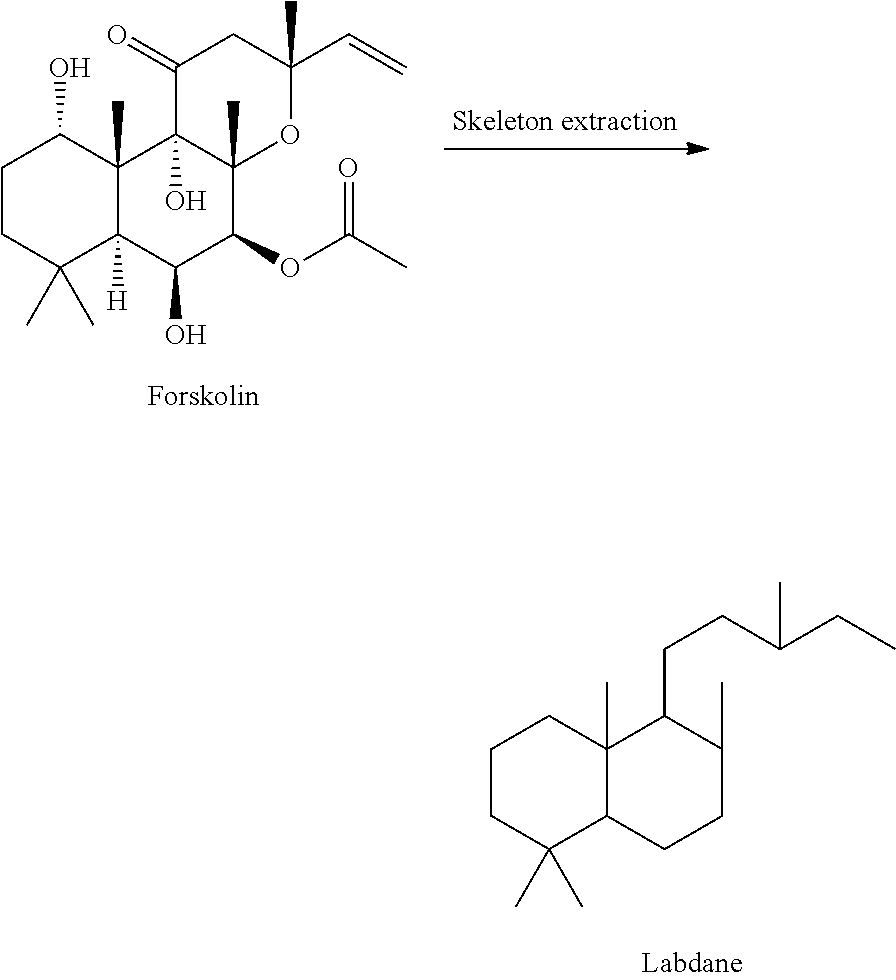
A tabulation of the skeletons from SISTEMAT and DNP was therefore generated.
[0320]The three databases were relatively consistent in their estimations of the diversity and distribution of diterpenes and diterpene skeletons, as illustrated in Table 4 and
| TABLE 4 |
|---|
| Comparison of different sources for data |
| about Lamiaceae diterpene chemotaxonomy |
| DNP | NAPRALERT | SISTEMAT | |
| Genera | 67 | 60 | 44 | |
| Species | 342 | 378 | — | |
| Diterpene | 3336 | 3080 | — | |
| names | ||||
| Diterpene | 3268 | — | — | |
| structures | ||||
| Diterpene | 229 | — | 91 | |
| skeletons | ||||
[0322]A total of 239 skeletons are represented, with five, the kaurane (Sk1), clerodane (Sk2), abietane (Sk3), labdane (Sk4), and pimarane (Sk6) being, by far, the most widely distributed and accounting for most of the total structures (Table 4,
Example 3: Identifying Candidate Diterpene Synthase Genes
[0323]Through a comprehensive literature search, a reference set was built of known Lamiaceae diTPSs and their activities. Fifty-four functional diTPSs have been reported in this family, which correspond to thirty class II and 24 class I enzymes. Combinations of these diterpene synthases account for twenty-seven distinct products represented by six different skeletons, the five widely distributed skeletons, Sk1-4 and Sk6, as well as the less common atisane (Sk14) skeleton. This leaves 233 skeletons for which the biosynthetic route remains unknown. Further, a single skeleton can correspond to multiple distinct diTPS products, so there is also a possibility of finding new diTPS activities for skeletons already accounted for by known enzymes.
[0324]BLAST homology searches (Camacho et al. BMC Bioinformatics 10: 421 (2009)) were performed to the list of Lamiaceae diTPSs to mine 48 leaf transcriptomes made available by the Mint Genome Project (Boachon et al. Molecular Plant. (2018)) for candidate diTPSs. The number of diTPS candidates was cross-referenced to the number of diterpenes and diterpene skeletons reported from each species and genus (Table 5). Table 5 shows species from which diTPSs were selected for cloning, the total number of diTPS candidate sequences, and the number of unique diterpene structures and skeletons for those species, based on DNP.
| TABLE 5 |
|---|
| Species from which diTPSs were Isolated |
| diTPS | ||||
| Full name | Code | hits | Diterpenes | Skeletons |
| Ar | 5 | 13 | 2 | |
| Hs | 7 | 4 | 1 | |
| Ll | 5 | 14 | 2 | |
| Ms | 5 | 0 | 0 | |
| Nm | 3 | 0 | 0 | |
| Om | 5 | 0 | 0 | |
| Pa | 5 | 2 | 2 | |
| Cf | 5 | 50 | 10 | |
| Pc | 2 | 0 | 0 | |
| Pv | 1 | 1 | 1 | |
| So | 5 | 13 | 5 | |
[0326]A phylogenetic tree was generated from the peptide sequences from the reference set, alongside those from the new transcriptome data, including established substrates and products for each enzyme (
Example 4: Characterization of Class H diTPSs
[0327]
[0328]Class II diTPS products retained the diphosphate group from the GGPP substrate. When expressed in-vivo, whether in E. coli or N. benthamiana, without a compatible class I diTPS, a diphosphate product degrades to the corresponding alcohol, presumably by the action of non-specific endogenous phosphatases. Due to difficulties in purifying and structurally characterizing diphosphate class II products it is customary in the field to instead characterize the alcohol derivatives (Heskes et al. Plant J 93(5):943-958 (2018): Pelot et al. Plant J 89(5):885-897 (2017)), which is the approach taken in this study. For clarity, the alcohol has been indicated by appending an “a” to the compound number, for example, 16a refers to ent-copalol.
[0329]ArTPS1, PaTPS1, NmTPS1, OmTPS1, and CfTPS1 were identified as (+)-copalyl diphosphate ((+)-CPP) [31] synthases by comparison to products of Plectranthus barbatus (synonym Coleus forskohli) CfTPS1, and the reference combination of CfTPS1 combined with CfTPS3, yielding miltiradiene (Pateraki et al. Plant Physiol 164(3):1222-1236 (2014)). LITPS1 was identified as a peregrinol diphosphate (PgPP) [5] synthase based on a comparison of products with Marrubium vulgare MvCPS1 (Zerbe et al. Plant J 79(6):914-927 (2014)), and MvCPS1 combined with M. vulgare 9,13-epoxylabdene synthase (MvELS), and Salvia sclarea sclareol synthase (SsSS) (Jia et al. Metabolic Engineering 37:24-34 (2016)).
[0330]Table 6 illustrates the distribution among selected Lamiaceae clades of diterpenes with various structural patterns. Blue enzyme names are placed according to the pattern they install and the clade of the species they were cloned from. A solid line indicates that only compounds with the bond-type shown at that position are counted. A dashed line indicates that all types of bonds and substituents are counted at that position. Based on data from the DNP.
| TABLE 6A |
|---|
| Lamiaceae clades of diterpenes with various structural patterns. |
| Clerodane | Cleroda-4(18)-ene | 4(18)-epoxy-Clerodane | |
| Ajugoideae | 317 | (ArTPS2) 6 | 206 |
| Lamioideae | 32 | 3 | 1 |
| Nepetoideae | 132 | 1 | 1 |
| Scutellarioideae | 160 | 19 | 78 |
| Viticoideae | 1 | 0 | 0 |
| All clades | 668 | 31 | 289 |
| TABLE 6B |
|---|
| Lamiaceae clades of diterpenes with various structural patterns. |
| Clerodane-3-ene | Labdane | |
| Ajugoideae | 23 | 3 |
| Lamioideae | 25 | 201 |
| Nepetoideae | 84 | 60 |
| Scutellarioideae | 44 | 0 |
| Viticoideae | 0 | 37 |
| All clades | 189 | 300 |
| TABLE 6C |
|---|
| Lamiaceae clades of diterpenes with various structural patterns. |
| Labda-8-ene | Labda-7-ene | |
| Ajugoideae | 2 | 0 |
| Lamioideae | (PcTPS1) 27 | 5 |
| Nepetoideae | 1 | (HsTPS1) 1 |
| Scutellarioideae | 0 | 0 |
| Viticoideae | 2 | 2 |
| All clades | 33 | 9 |
[0334]HsTPS1 was identified as a (5S,9S,10S) labda-7,13E-dienyl diphosphate [21] synthase based on comparison to the product of an enzyme from Grindelia robusta, GrTPS2 (Zerbe et al. The Plant Journal 83(5):783-793 (2015)), and by NMR of the alcohol derivative [21a]. Normal absolute stereochemistry was assigned to the HsTPS1 product based on the optical rotation of 21a, [α]D +8.3° (c. 0.0007, CHCl3) (c.f. lit. [α]D+5°, c. 1.0, CHCl3 (Urones et al. Phytochemistry 35(3):713-719 (1994)); [α]D25+12°, c. 0.69, CHCl3 (Suzuki et al. Phytochemistry 22(5):1294-1295 (1983)). When HsTPS1 was expressed in N. benthamiana, labda-7,13(16),14-triene [22] was formed, which seemed to be enhanced by co-expression with CfTPS3. The combination of HsTPS1 with OmTPS3 produced labda-7,12E,14-triene [24] (Roengsumran et al. Phytochemistry 50(3):449-453 (1999)), which has previously been accessible only by combinations of bacterial enzymes (Yamada et al. The Journal of Antibiotics 69(7):515-523 (2016)). Labdanes with a double bond at the 7-position have not been reported in H. suaveolens, and such labdanes do not seem to be common in Lamiaceae. Of nine compounds with the labdane skeleton and a double bond at position-7 (Table 6) only one was from the same clade as H. suaveolens. (13E)-ent-labda-7,13-dien-15-oic acid, from Isodon scoparius (Xiang et al. Helvetica Chimica Acta 87(11):2860-2865 (2004)), has the opposite absolute stereochemistry to the HsTPS1 product, likely not deriving from a paralog of HsTPS1 because absolute stereochemistry of a skeleton is not known to change after the diTPS steps.
[0335]ArTPS2 was identified as a (5R,8R,9S,10R) neo-cleroda-4(18),13E-dienyl diphosphate [38] synthase. The combination of ArTPS2 and SsSS generated neo-cleroda-4(18),14-dien-13-ol [37] (
[0336]Previously reported clerodane diTPSs from Lamiaceae produce kolavenyl diphosphate [36] (Heskes et al. Plant J 93(5):943-958 (2018); Chen et al. J Exp Bot 68(5):1109-1122 (2017): Pelot et al. Plant J 89(5):885-897 (2017)), and kolavenyl diphosphate [36] has a double bond at the 3-position. Clerodanes with desaturation at position-3 are spread throughout multiple clades but are most common in Nepetoideae (Table 6A-6C), which includes Salvia divinorum. Clerodanes with a double bond at the 4(18)-position are rare by comparison, but those with a 4(18)-epoxy moiety, make up nearly half of the clerodanes reported in Lamiaceae, including two-thirds of those reported from the Ajugoideae clade (Table 6A-6C), one of which is clerodin (Barton et al. J Chem Soc: 5061-5073 (1961)) and from which the clerodane skeleton gets its name. Neo-cleroda-4(18),13E-dienyl diphosphate is a logical biosynthetic precursor for the 4(18)-epoxy clerodanes. It is unclear if any of the previously described diTPSs directly produce an epoxide moiety.
[0337]PcTPS1 was identified as a (10R)-labda-8,13E-dienyl diphosphate [25] synthase. The structure was established by comparison of 13C NMR of compound 25a to previously reported spectra (Suzuki et al. Phytochemistry 22(5):1294-1295 (1983)). The 10R (ent-) absolute stereochemistry was established by optical rotation of compound 25a [α]D −64° (c. 0.0008, CHCl3), (c.f. lit. [α]D25 −71.2°, c. 1.11, CHCl3) (Arima et al. Tetrahedron: Asymmetry 18(14):1701-1711 (2007)). The combination of PcTPS1 and SsSS, both in-vitro, and in N. benthamiana expression produced (10R)-labda-8,14-en-13-ol [26] (
Example 5: Characterization of Class I dITPSs
- [0339]CfTPS1, a (+)-CPP [31] synthase;
- [0340]CfTPS2, a labda-13-en-8-ol diphosphate ((+)-8-LPP) [10] synthase (Pateraki et al. Plant Physiol 164(3):1222-1236 (2014);
- [0341]LITPS1, a PgPP 151 synthase; or
- [0342]Zea mays ZmAN2, an ent-copalyl diphosphate (ent-CPP) [16] synthase (Harris et al. Plant Mol Biol 59(6):881-894 (2005)).
Substrates accepted by each enzyme and the products are indicated inFIG. 2B andFIG. 5 . NmTPS2 was identified as an ent-kaurene [19] synthase, converting ent-CPP into ent-kaurene (identified using Physcomitrella patens extract as a standard (Zhan et al. Plant Physiology and Biochemistry 96:110-114 (2015))), but not showing activity with any other substrate. The only other enzyme to show activity with ent-CPP was OmTPS4, which produced ent-manool [20], just as SsSS produces from ent-CPP.
[0343]PaTPS3, PvTPS1, SoTPS1, ArTPS3, OmTPS4, LITPS4, OmTPS5, and MsTPS1 converted (+)-8-LPP to 13R-(+)-manoyl oxide [8], verified by comparison to the product of CfTPS2 and CfTPS3 (Pateraki et al. Plant Physiol 164(3):1222-1236 (2014)). OmTPS3 produced trans-abienol [11]. The trans-abienol structure was determined by NMR, with the stereochemistry of the 12(13)-double bond supported by comparison of the NOESY spectrum to that of a commercial standard for cis-abienol (Toronto Research Chemicals. Toronto Canada). The trans-abienol showed clear NOE correlation between positions 16 and 11, while the cis-abienol standard showed correlations between 14 and 11.
[0344]PaTPS3, PvTPS1, SoTPS1, and ArTPS3, LITPS4, and OmTPS5 converted PgPP to a combination of 1, 2, and 3, with some variation in the ratios between the products. Because perigrinol [5a] spontaneously degrades into 1, 2, and 3 under GC conditions (Zerbe et al. Plant J 79(6):914-927 (2014)), it was difficult to distinguish whether these enzymes have low activity, but specific products, or moderate activity with a mix of products. Nevertheless, differences in relative amounts of the products observed between LITPS1 alone and in combination with these class 1 enzymes suggest that they do have some activity on PgPP. OmTPS4 produced 1, 2, 3, and 4. MsTPS1 produced only 3, and OmTPS3 produced only 1, and 2. PgPP products were established by comparison to MvCPS1, MvCPS1 with MvELS (Zerbe et al. Plant J 79(6):914-927 (2014)), and MvCPS1 with SsSS (Jia et al. Metabolic Engineering 37:24-34 (2016)).
[0345]PaTPS3, PvTPS1, SoTPS1, and ArTPS3 converted (+)-CPP to miltiradiene [32], similarly to CfTPS3. OmTPS4 produced manool [33], as compared to SsSS. LITPS4 and MsTPS1 produced sadaracopimaradiene [27], by comparison to a product from Euphorbia peplus EpTPS8 (Andersen-Ranberg et al. Angew Chem Int Ed 55(6):2142-2146 (2016)). OmTPS5 produced palustradiene [29], as compared to a minor product from Abies grandis abietadiene synthase (Vogel et al. J Biol Chem 271(38):23262-23268 (1996)). OmTPS3 produced trans-biformene [34], as established by comparison of 3C-NMR of compounds described by Bohlmann & Czerson, Phytochemistry 18(1):115-118 (1979)), with a trans configuration further supported by clear NOE correlations between 16 and 11, and the absence of NOE correlations between 14 and 11.
Example 6 : Origanum majorana Enzymes can Make Palustradiene and Other Diterpenoids
[0346]The class I enzymes from Origanum majorana, OmTPS3, OmTPS4, and OmTPS5 all produced different products from (+)-CPP, which itself is the product of OmTPS1 from the same species. Despite the apparent richness of activities of enzymes from O. majorana, no reports of diterpenes were located from that species either in database searches, or in a subsequent literature search.
[0347]To determine whether diterpene synthases are active in O. majorana, the products of enzyme combinations with extracts from O. majorana leaf, stem, calyx, corolla, and root were evaluated. Palustradiene [29], the product of OmTPS1 and OmTPS5, was detected in all tissues except roots (
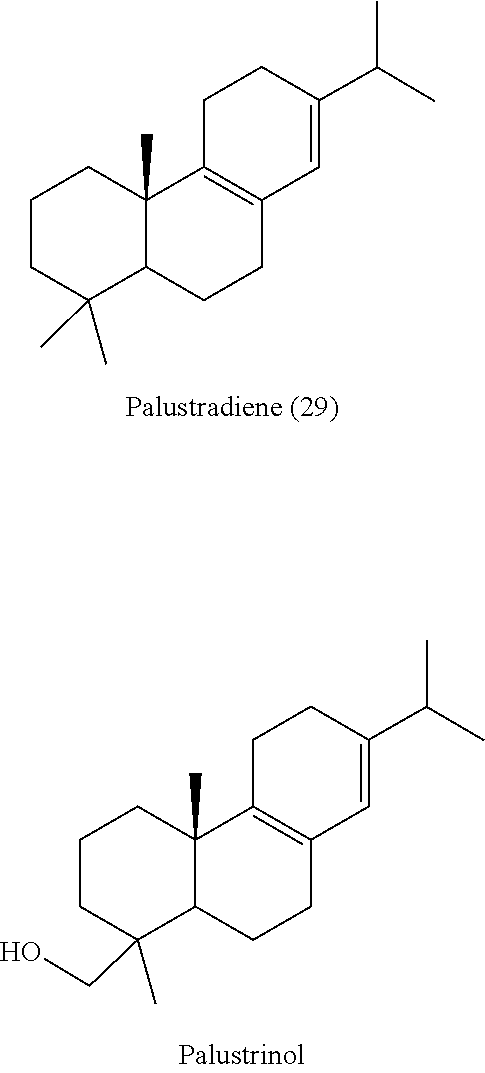
Example 7 : Chiococca alba Enzymes can Make 13(R)-Epi-Dolabradiene and Other Compounds
[0349]This Example illustrates that enzymes from Chiococca alba can produce products such as ent-kaurene, ent-dolabradiene (13-epi-dolabradiene), and (13R)-ent-manoyl oxide.
- [0351]class I terpene synthase enzyme from Chiococca alba (CaTPS1) with SoTPS2, SbTPS1, and SbTPS2 and the substrate ent-copalyl diphosphate.
- [0352]class II terpene synthase enzyme from Chiococca alba (CaTPS2) with substrate ent-labda-13-en-8-ol diphosphate
- [0353]class III and class IV terpene synthase enzymes from Chiococca alba (CaTPS3 and CaTPS4) with substrate ent-kaurene
- [0354]class V terpene synthase enzyme from Chiococca alba (CaTPS5) with substrate ent-dolabradiene
- [0355]class I (−)-kolavenyl diphosphate synthase enzyme from Salvia hispanica (ShTPS1) with substrate (−)-kolavenyl diphosphate
- [0356]class I cleroda-4(18),13E-dienyl diphosphate synthase enzyme from Teucrium canadense (TcTPS1) with substrate clerodadienyl diphosphate
- [0357]class I sclareol synthase enzyme from Salvia sclarea (SsSCS) with substrate neo-clerodadienol.
[0358]
[0359]Compounds ent-dolabradiene (13-epi-dolabradiene) and (13R)-ent-manoyl oxide are plausible intermediates in the biosynthetic routes to the structurally unusual merilactone and ribenone, that have demonstrated activity against Leishmanina and potential anti-cancer activity (Piozzi, F., Bruno, M. Diterpenoids from Roots and Aerial Parts of the Genus Stachys Rec. Nat. Prod. 5, 1-11, (2011)).
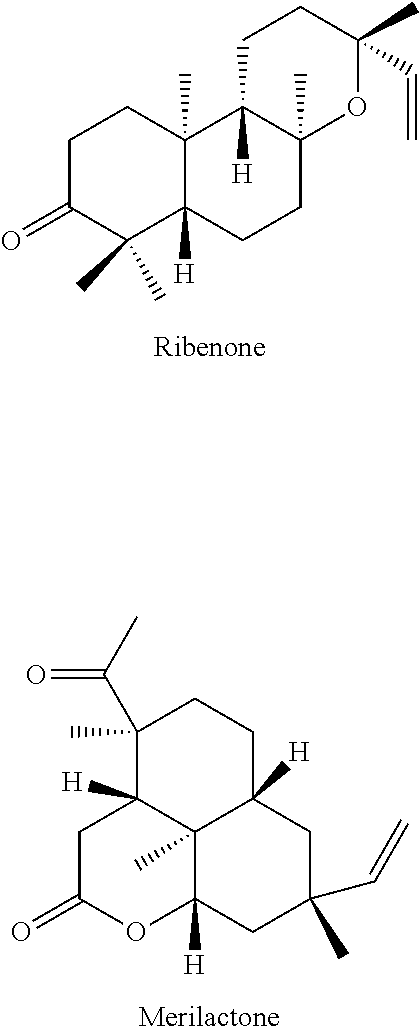
Both merilactone and ribenone are detected in the root extract of C. alba.
REFERENCES
- [0361]1. Dictionary of Natural Products 26.2 Available at: http://dnp.chemnetbase.com [Accessed Jan. 11, 2018].
- [0362]2. Peters R J (2010) Two rings in them all: The labdane-related diterpenoids. Natural product reports 27(11):1521.
- [0363]3. Chen F, Tholl D, Bohlmann J, Pichersky E (2011) The family of terpene synthases in plants: a mid-size family of genes for specialized metabolism that is highly diversified throughout the kingdom. The Plant Journal 66(1):212-229.
- [0364]4. Zerbe P, Bohlmann J (2015) Plant diterpene synthases: exploring modularity and metabolic diversity for bioengineering. Trends In Biotechnology 33(7):419-428.
- [0365]5. Hamberger B, Bak S (2013) Plant P450s as versatile drivers for evolution of species-specific chemical diversity. Philosophical Transactions of the Royal Society of London B: Biological Sciences 368(1612):20120426.
- [0366]6. Banerjee A, Hamberger B (2018) P450s controlling metabolic bifurcations in plant terpene specialized metabolism. Phytochem Rev 17(1):81-111.
- [0367]7. Pateraki I, et al. (2017) Total biosynthesis of the cyclic AMP booster forskolin from Coleus forskohlii. elife 6:e23001.
- [0368]8. Ondari M E, Walker K D (2008) The Taxol Pathway 10-O-Acetyltransferase Shows Regioselective Promiscuity with the Oxetane Hydroxyl of 4-Deacetyltaxanes. J Am Chem Soc 130(50):17187-17194.
- [0369]9. Chau M, Walker K, Long R, Croteau R (2004) Regioselectivity of taxoid-O-acetyltransferases: heterologous expression and characterization of a new taxadien-5α-ol-O-acetyltransferase. Archives of Biochemistry and Biophysics 430(2):237-246.
- [0370]10. Cui G, et al. (2015) Functional divergence of diterpene syntheses in the medicinal plant Salvia miltiorrhiza Bunge. Plant Physiol 169(3):1607-1618.
- [0371]11. Gao W, et al. (2009) A Functional Genomics Approach to Tanshinone Biosynthesis Provides Stereochemical Insights. Org Lett 11(22):5170-5173.
- [0372]12. Guo J, et al. (2013) CYP76AH1 catalyzes turnover of miltiradiene in tanshinones biosynthesis and enables heterologous production of ferruginol in yeasts. PNAS 110(29):12108-12113.
- [0373]13. Heskes A M, et al. (2018) Biosynthesis of bioactive diterpenoids in the medicinal plant Vitex agnus-castus. Plant J 93(5):943-958.
- [0374]14. Zerbe P, et al. (2014) Diterpene synthases of the biosynthetic system of medicinally active diterpenoids in Marrubium vulgare. Plant J 79(6):914-927.
- [0375]15. Chen X, Berim A, Dayan F E, Gang D R (2017) A (−)-kolavenyl diphosphate synthase catalyzes the first step of salvinorin A biosynthesis in Salvia divinorum. J Exp Bot 68(5):1109-1122.
- [0376]16. Pelot K A, et al. (2017) Biosynthesis of the psychotropic plant diterpene salvinorin A: Discovery and characterization of the Salvia divinorum clerodienyl diphosphate synthase. Plant J 89(5):885-897.
- [0377]17. Caniard A, et al. (2012) Discovery and functional characterization of two diterpene synthases for sclareol biosynthesis in Salvia sclarea (L.) and their relevance for perfume manufacture. BMC Plant Biology 12:119.
- [0378]18. Günnewich N, et al. (2013) A diterpene synthase from the clary sage Salvia sclarea catalyzes the cyclization of geranylgeranyl diphosphate to (8R)-hydroxy-copalyl diphosphate. Phytochemistry 91:93-99.
- [0379]19. Boachon B, et al. (2018) Phylogenomic Mining of the Mints Reveals Multiple Mechanisms Contributing to the Evolution of Chemical Diversity in Lamiaceae. Molecular Plant. doi:10.1016/j.molp.2018.06.002.
- [0380]20. Coll J, Tandrón Y A (2008) neo-Clerodane diterpenoids from Ajuga: structural elucidation and biological activity. Phytochem Rev 7(1):25.
- [0381]21. Klein Gebbinck E A, Jansen B J M, de Groot A (2002) Insect antifeedant activity of clerodane diterpenes and related model compounds. Phytochemistry 61(7):737-770.
- [0382]22. Li R, Morris-Natschke S L, Lee K-H (2016) Clerodane diterpenes: sources, structures, and biological activities. Nat Prod Rep 33(10):1166-1226.
- [0383]23. Vestri Alvarenga S A, Pierre Gastmans J, do Vale Rodrigues G, Roberto H. Moreno P, de Paulo Emerenciano V (2001) A computer-assisted approach for chemotaxonomic studies—diterpenes in Lamiaceae. Phytochemistry 56(6):583-595.
- [0384]24. Loub W D, Farnsworth N R, Soejarto D D, Quinn M L (1985) NAPRALERT: computer handling of natural product research data. J Chem Inf Comput Sci 25(2):99-103.
- [0385]25. Federhen S (2012) The NCBI Taxonomy database. Nucleic Acids Res 40(D1):D136-D143.
- [0386]26. Li B. et al. (2016) A large-scale chloroplast phylogeny of the Lamiaceae sheds new light on its subfamilial classification. Scientific Reports 6:34343.
- [0387]27. Camacho C, et al. (2009) BLAST+: architecture and applications. BMC Bioinformatics 10:421.
- [0388]28. Pateraki I, et al. (2014) Manoyl Oxide (13R), the Biosynthetic Precursor of Forskolin, Is Synthesized in Specialized Root Cork Cells in Coleus forskohlii. Plant Physiol 164(3):1222-1236.
- [0389]29. Jia M, Potter K C, Peters R J (2016) Extreme promiscuity of a bacterial and a plant diterpene synthase enables combinatorial biosynthesis. Metabolic Engineering 37:24-34.
- [0390]30. Zerbe P, et al. (2015) Exploring diterpene metabolism in non-model species: transcriptome-enabled discovery and functional characterization of labda-7,13 E-dienyl diphosphate synthase from Grindelia robusta. The Plant Journal 83(5):783-793.
- [0391]31. Urones J G, et al. (1994) Compounds with the labdane skeleton from Halimium viscosum. Phytochemistry 35(3):713-719.
- [0392]32. Suzuki H, Noma M, Kawashima N (1983) Two labdane diterpenoids from Nicotiana setchellii. Phytochemistry 22(5):1294-1295.
- [0393]33. Roengsumran S, Petsom A, Sommit D, Vilaivan T (1999) Labdane diterpenoids from Croton oblongifolius. Phytochemistry 50(3):449-453.
- [0394]34. Yamada Y, Komatsu M, Ikeda H (2016) Chemical diversity of labdane-type bicyclic diterpene biosynthesis in Actinomycetales microorganisms. The Journal of Antibiotics 69(7):515-523.
- [0395]35. Xiang W, Li R-T, Song Q-S, Na Z, Sun H-D ent-Clerodanoids from Isodon scoparius. Helvetica Chimica Acta 87(11):2860-2865.
- [0396]36. Rudi A, Kashman Y (1992) Chelodane, Barekoxide, and Zaatirin-Three New Diterpenoids from the Marine Sponge Chelonaplysilla erecta. J Nat Prod 55(10):1408-1414.
- [0397]37. Ohsaki A, et al. (1994) The isolation and in vivo Potent Antitumor activity of clerodane diterpenoid from the oleoresin of the brazilian medicinal plant, copaifera langsdorfi desfon. Bioorganic & Medicinal Chemistry Letters 4(24):2889-2892.
- [0398]38. Monaco P, Previtera L, Mangoni L (1982) Terpenes from the bled resin of Araucaria hunsteinii. Rendiconto della Academia delle scienze fisiche e matematiche 48:465-470.
- [0399]39. Barton D H R, Cheung H T, Cross A D, Jackman L M, Martin-Smith M (1961) 1003. Diterpenoid bitter principles. Part III. The constitution of clerodin. J Chem Soc. 5061-5073.
- [0400]40. Arima Y, Kinoshita M, Akita H (2007) Natural product synthesis from (8aR)- and (8aS)-bicyclofarnesols: synthesis of (+)-wiedendiol A, (+)-norsesterterpene diene ester and (−)-subersic acid. Tetrahedron: Asymmetry 18(14):1701-1711.
- [0401]41. Wu C-L, Hsiang-Ru Lin (1997) Labdanoids and bis(bibenzyls) from Jungermannia species. Phytochemistry 44(1):101-105.
- [0402]42. Boalino D M, McLean S, Reynolds W F, Tinto W F (2004) Labdane Diterpenes of Leonurus sibiricus. J Nat Prod 67(4):714-717.
- [0403]43. Gray C A, Rivett D E A, Davies-Coleman M T (2003) The absolute stereochemistry of a diterpene from Ballota aucheri. Phytochemistry 63(4):409-413.
- [0404]44. Harris L J, et al. (2005) The Maize An2 Gene is Induced by Fusarium Attack and Encodes an ent-Copalyl Diphosphate Synthase. Plant Mol Biol 59(6):881-894.
- [0405]45. Zhan X, Bach S S, Hansen N L, Lunde C, Simonsen H T (2015) Additional diterpenes from Physcomitrella patens synthesized by copalyl diphosphate/kaurene synthase (PpCPS/KS). Plant Physiology and Biochemistry 96:110-114.
- [0406]46. Andersen-Ranberg J, et al. (2016) Expanding the Landscape of Diterpene Structural Diversity through Stereochemically Controlled Combinatorial Biosynthesis. Angew Chem Int Ed 55(6):2142-2146.
- [0407]47. Vogel B S, Wildung M R, Vogel G, Croteau R (1996) Abietadiene synthase from grand fir (Abies grandis) cDNA isolation, characterization, and bacterial expression of a bifunctional diterpene cyclase involved in resin acid biosynthesis. J Biol Chem 271(38):23262-23268.
- [0408]48. Bohlmann F, Czerson H (1979) Neue labdan-und pimaren-derivate aus Palafoxia rosea. Phytochemistry 18(1):115-118.
- [0409]49. Li J-L, et al. (2012) IeCPS2 is potentially involved in the biosynthesis of pharmacologically active Isodon diterpenoids rather than gibberellin. Phytochemistry 76:32-39.
- [0410]50. Jin B, et al. (2017) Functional diversification of kaurene synthase-like genes. Plant Physiol 174:973-955.
- [0411]51. Hillwig M L, et al. (2011) Domain loss has independently occurred multiple times in plant terpene synthase evolution. The Plant Journal 68(6):1051-1060.
- [0412]52. Pelot K A, Hagelthorn D M, Addison J B, Zerbe P (2017) Biosynthesis of the oxygenated diterpene nezukol in the medicinal plant Isodon rubescens is catalyzed by a pair of diterpene synthases. PLOS ONE 12(4):e0176507.
- [0413]53. Helliwell C A, Chandler P M, Poole A, Dennis E S, Peacock W J (2001) The CYP88A cytochrome P450, ent-kaurenoic acid oxidase, catalyzes three steps of the gibberellin biosynthesis pathway. PNAS 98(4):2065-2070.
- [0414]54. Han Q-B, et al. (2006) Maoecrystal Z, a Cytotoxic Diterpene from Isodon eriocalyx with a Unique Skeleton. Org Lett 8(21):4727-4730.
- [0415]55. Li X-N, et al. (2010) Structure and Cytotoxicity of Diterpenoids from Isodon eriocalyx. J Nat Prod 73(11):1803-1809.
- [0416]56. González A G, Andrés L S, Luis J G, Brito I, Rodríguez M L (1991) Diterpenes from Salvia mellifera. Phytochemistry 30(12):4067-4070.
- [0417]57. Chen Y-L, et al. (2008) Bioactive Cembrane Diterpenoids of Anisomeles indica. J Nat Prod 71(7):1207-1212.
- [0418]58. Li L-M, et al. (2009) ent-Kaurane and Cembrane Diterpenoids from Isodon sculponeatus and Their Cytotoxicity. J Nat Prod 72(10):1851-1856.
- [0419]59. Kirby J, et al. (2010) Cloning of casbene and neocembrene synthases from Euphorbiaceae plants and expression in Saccharomyces cerevisiae. Phytochemistry 71(13):1466-1473.
- [0420]60. Ennajdaoui H, et al. (2010) Trichome specific expression of the tobacco (Nicotiana sylvestris) cembratrien-ol synthase genes is controlled by both activating and repressing cis-regions. Plant Mol Bio 73(6):673-685.
- [0421]61. Hamano Y, et al. (2002) Functional Analysis of Eubacterial Diterpene Cyclases Responsible for Biosynthesis of a Diterpene Antibiotic, Terpentecin. J Biol Chem 277(40):37098-37104.
- [0422]62. Dairi T, et al. (2001) Eubacterial Diterpene Cyclase Genes Essential for Production of the Isoprenoid Antibiotic Terpentecin. J Bacteriol 183(20):6085-6094.
- [0423]63. Schalk M, et al. (2012) Toward a Biosynthetic Route to Sclareol and Amber Odorants. J Am Chem Soc 134(46):18900-18903.
- [0424]64. Ikeda H, Shin-ya K, Nagamitsu T, Tomoda H (2016) Biosynthesis of mercapturic acid derivative of the labdane-type diterpene, cyslabdan that potentiates imipenem activity against methicillin-resistant Staphylococcus aureus: cyslabdan is generated by mycothiol-mediated xenobiotic detoxification. J Ind Microbiol Biotechnol 43(2-3):325-342.
- [0425]65. Keeling C I, Madilao L L, Zerbe P, Dullat H K, Bohlmann J (2011) The Primary Diterpene Synthase Products of Picea abies Levopimaradiene/Abietadiene Synthase (PaLAS) Are Epimers of a Thermally Unstable Diterpenol. J Biol Chem 286(24):21145-21153.
- [0426]66. Geuskens R B M, Luteijn J M, Schoonhoven L M (1983) Antifeedant activity of some ajugarin derivatives in three lepidopterous species. Experientia 39(4):403-404.
- [0427]67. Belles X, Camps F, Coll J, Piulachs M D (1985) Insect antifeedant activity of clerodane diterpenoids against larvae of Spodoptera Littoralis (Boisd.) (Lepidoptera). J Chem Ecol 11(10):1439-1445.
- [0428]68. Challis G L (2008) Genome Mining for Novel Natural Product Discovery. J Med Chem 51(9):2618-2628.
- [0429]69. Xu H, et al. (2016) Analysis of the Genome Sequence of the Medicinal Plant Salvia miltiorrhiza. Molecular Plant 9(6):949-952.
- [0430]70. King A J, Brown G D, Gilday A D, Larson T R, Graham I A (2014) Production of Bioactive Diterpenoids in the Euphorbiaceae Depends on Evolutionarily Conserved Gene Clusters. The Plant Cell Online 26(8):3286-3298.
- [0431]71. Huang A C, et al. (2017) Unearthing a sesterterpene biosynthetic repertoire in the Brassicaceae through genome mining reveals convergent evolution. PNAS 114(29):E6005-E6014.
- [0432]72. Busta L, Jetter R (2017) Moving beyond the ubiquitous: the diversity and biosynthesis of specialty compounds in plant cuticular waxes. Phytochem Rev: 1-30.
- [0433]73. Kodama Y, Shumway M, Leinonen R (2012) The sequence read archive: explosive growth of sequencing data. Nucleic Acids Res 40(D1):D54-D56.
- [0434]74. Benson D A, et al. (2013) GenBank. Nucleic Acids Res 41(D1):D36-D42.
- [0435]75. Kuhn S, Schlörer N E, Kolshorn H, Stoll R (2012) From chemical shift data through prediction to assignment and NMR LIMS—multiple functionalities of nmrshiftdb2. Journal of Cheminformatics 4(Suppl 1):P52.
- [0436]76. Fischedick J T, Johnson S R, Ketchum R E B, Croteau R B, Lange B M (2015) NMR spectroscopic search module for Spektraris, an online resource for plant natural product identification—Taxane diterpenoids from Taxus x media cell suspension cultures as a case study. Phytochemistry 113:87-95.
- [0437]77. Scotti M T, et al. (2018) SistematX, an Online Web-Based Cheminformatics Tool for Data Management of Secondary Metabolites. Molecules 23(1):103.
- [0438]78. Heller S R, McNaught A, Pletnev I, Stein S, Tchekhovskoi D (2015) InChI, the IUPAC International Chemical Identifier. J Cheminform 7. doi:10.1186/s13321-015-0068-4.
- [0439]79. Sievers F, et al. (2011) Fast, scalable generation of high-quality protein multiple sequence alignments using Clustal Omega. Molecular Systems Biology 7:539.
- [0440]80. Stamatakis A (2014) RAxML version 8: a tool for phylogenetic analysis and post-analysis of large phylogenies. Bioinformatics 30(9):1312-1313.
- [0441]81. Huerta-Cepas J, Serra F, Bork P (2016) ETE 3: Reconstruction, Analysis, and Visualization of Phylogenomic Data. Mol Biol Evol 33(6):1635-1638.
- [0442]82. Lopez-Perez J L, Theron R, del Olmo E, Diaz D (2007) NAPROC-13: a database for the dereplication of natural product mixtures in bioassay-guided protocols. Bioinformatics 23(23):3256-3257.
[0443]All patents and publications referenced or mentioned herein are indicative of the levels of skill of those skilled in the art to which the invention pertains, and each such referenced patent or publication is hereby specifically incorporated by reference to the same extent as if it had been incorporated by reference in its entirety individually or set forth herein in its entirety. Applicants reserve the right to physically incorporate into this specification any and all materials and information from any such cited patents or publications.
[0444]The following statements are intended to describe and summarize various features of the invention according to the foregoing description provided in the specification and figures.
Statements:
- [0445]1. An expression system comprising at least one expression cassette having a heterologous promoter operably linked to a nucleic acid segment encoding an enzyme with at least 90% sequence identity to SEQ ID NO:1, 3, 5, 7, 9, 11, 13, 15, 17, 19, 21, 23, 25, 27, 29, 31, 33, 35, 37, 39, 41, 43, 45, 47, 49, 51, 53, 57, 59, or 176
- [0446]2. The expression system of statement 1, wherein at least one expression cassette is within at least one expression vector.
- [0447]3. The expression system of statement 1 or 2, wherein the expression system comprises two, or three, or four, or five expression cassettes or expression vectors, each expression cassette encoding a separate enzyme.
- [0448]4. The expression system of statement 1, 2 or 3, wherein the expression system further comprises one or more expression cassettes having a promoter operably linked to a nucleic acid segment encoding an enzyme that can synthesize isopentenyl diphosphate (IPP), dimethylallyl diphosphate (DMAPP), or geranylgeranyl diphosphate (GGPP).
- [0449]5. The expression system of statement 1-3 or 4, wherein the expression system has at least one expression cassette having a constitutive promoter.
- [0450]6. The expression system of statement 1-3 or 4, wherein the expression system has at least one expression cassette having an inducible promoter.
- [0451]7. The expression system of statement 1-5 or 6, wherein the expression system has at least one expression cassette having a CaMV 35S promoter, CaMV 19S promoter, nos promoter, Adh1 promoter, sucrose synthase promoter, α-tubulin promoter, ubiquitin promoter, actin promoter, cab promoter, PEPCase promoter, R gene complex promoter, CYP71D16 trichome-specific promoter, CBTS (cembratrienol synthase) promotor, Z10 promoter from a 10 kD zein protein gene, Z27 promoter from a 27 kD zein protein gene, plastid rRNA-operon (rrn) promoter, light inducible pea rbcS gene, RUBISCO-SSU light-inducible promoter (SSU) from tobacco, or rice actin promoter.
- [0452]8. A host cell comprising the expression system of statement 1-6 or 7, which is heterologous to the host cell.
- [0453]9. The host cell of statement 8, which is a plant cell, an algae cell, a fungal cell, a bacterial cell, or an insect cell.
- [0454]10. The host cell of statement 8 or 9, which is a Nicotiana benthamiana, Nicotiana tabacum, Nicotiana rustica, Nicotiana excelsior, Nicotiana excelsiana, Escherichia coli. Clostridium Ijungdahlii, Clostridium autoethanogenum, Clostridium kluyveri, Corynebacterium glutamicum, Cupriavidus necator, Cupriavidus metallidurans; Pseudomonas fluorescens. Pseudomonas putida, Pseudomonas oleovorans; Delftia acidovorans, Bacillus subtilis, Lactobacillus delbrueckii, Lactococcus lactis, Aspergillus niger, Saccharomyces cerevisae, Candida tropicalis, Candida albicans, Candida cloacae, Candida guilliermondii, Candida intermedia, Candida maltosa, Candida parapsilosis, Candida zeylenoides, Pichia pastoris, Yarrowia lipolytica, Issatchenkia orientalis, Debaryomyces hansenii, Arxula adeninivorans, Kluyveromyces lactis, or Exophiala, Mucor, Trichoderma, Cladosporium, Phanerochaete, Cladophialophora, Paecilomyces. Scedosporium, or Ophiostoma cell.
- [0455]11. The host cell of statement 8, 9 or 10, which is a Nicotiana benthamiana.
- [0456]12. A method of synthesizing a terpene comprising incubating a host cell that has the expression system of any of statements 1-7.
- [0457]13. A method for synthesizing a terpene comprising incubating a host cell comprising a heterologous expression system that includes at least one expression cassette having a heterologous promoter operably linked to a nucleic acid segment encoding an enzyme with at least 90% sequence identity to SEQ ID NO:1, 3, 5, 7, 9, 11, 13, 15, 17, 19, 21, 23, 25, 27, 29, 31, 33, 35, 37, 39, 41, 43, 45, 47, 49, 51, 53, 57, 59, or 176.
- [0458]14. A method for synthesizing a terpene comprising incubating a terpene precursor with an enzyme with at least 90% sequence identity to SEQ ID NO:1, 3, 5, 7, 9, 11, 13, 15, 17, 19, 21, 23, 25, 27, 29, 31, 33, 35, 37, 39, 41, 43, 45, 47, 49, 51, 53, 57, 59, or 176.
- [0459]15. The method of statement 12, 13 or 14, wherein the terpene is a compound of formula I, II, or III:

- [0461]wherein
- [0462]each R1 can separately be hydrogen or lower alkyl;
- [0463]R2 can be hydrogen, lower alkyl, hydroxy, a bond to an adjacent ring carbon, or form a C4-C6 cycloheteroalkyl with R3;
- [0464]R3 can be a branched C5-C6 alkyl with 0-2 double bonds, can form a C4-C6 cycloheteroalkyl with R2; can form a cycloalkyl with R4, or can form a cycloheteroalkyl ring with R4, wherein the C5-C6 alkyl can optionally have one hydroxy, phosphate or diphosphate substituent, and wherein each cycloalkyl or cycloheteroalkyl ring can have 0-2 double bonds, and each cycloalkyl or cycloheteroalkyl ring can have 0-2 alkyl or 0-2 alkene substituents;
- [0465]R4 can be hydrogen, lower alkyl, lower alkene, hydroxy, a carbon bonded to R9, an oxygen bonded to R9, form a cycloalkyl ring with R3, or form a cycloheteroalkyl ring with R3, wherein each cycloalkyl ring or cycloheteroalkyl ring can have 0-2 double bonds, and each cycloalkyl ring or cycloheteroalkyl ring can have 0-2 alkyl or 0-2 alkene substituents;
- [0466]R5 can be hydrogen, hydroxy, lower alkyl, a lower alkene, a bond with an adjacent carbon, form a cycloalkyl ring with a ring atom of a ring formed by R3 and R4, wherein the cycloalkyl ring can have 0-2 double bonds, and the cycloalkyl ring can have 0-2 alkyl or 0-2 alkene substituents;
- [0467]each R6 can separately be hydrogen, lower alkyl, lower alkene, or form a bond with an adjacent carbon;
- [0468]R7 can be lower alkyl, lower alkene, or form a cycloalkyl ring with a R5,
- [0469]R8 can be lower alkyl, hydroxy, phosphate, diphosphate, or form a bond with an adjacent carbon; and
- [0470]R9 can be hydrogen, lower alkyl, lower alkene, ═CH2, hydroxy, phosphate, diphosphate, form a bond with an adjacent carbon, form a cycloalkyl ring with R4, or form a cycloheteroalkyl ring with R4, wherein each cycloalkyl ring or cycloheteroalkyl ring can have 0-2 double bonds, and each cycloalkyl ring or cycloheteroalkyl ring can have 0-2 alkyl or 0-2 alkene substituents.
- [0471]16. The method of statement 12-14 or 15 wherein the terpene is a compound with a skeleton selected from Sk1-Sk14:
- [0461]wherein
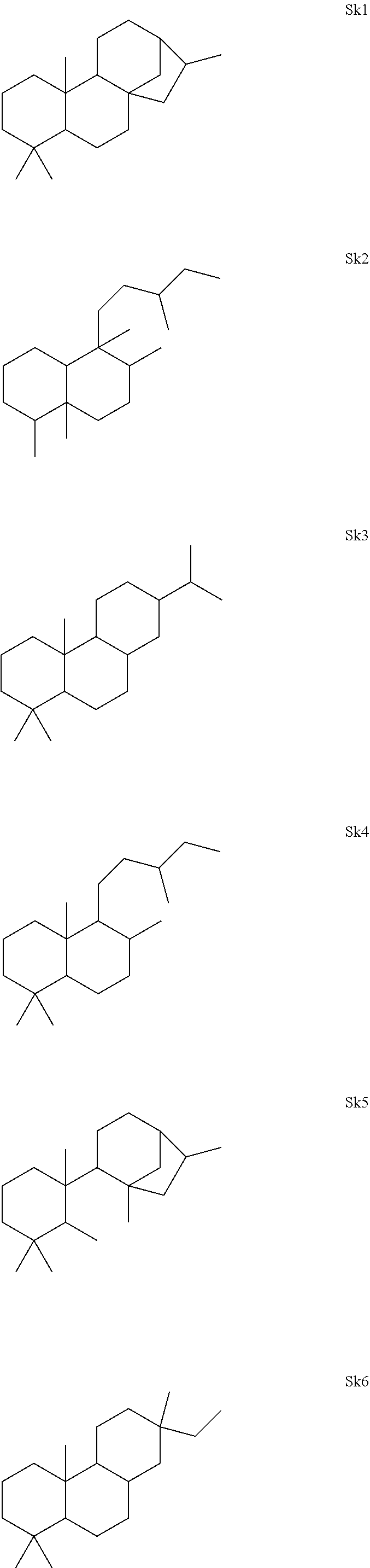
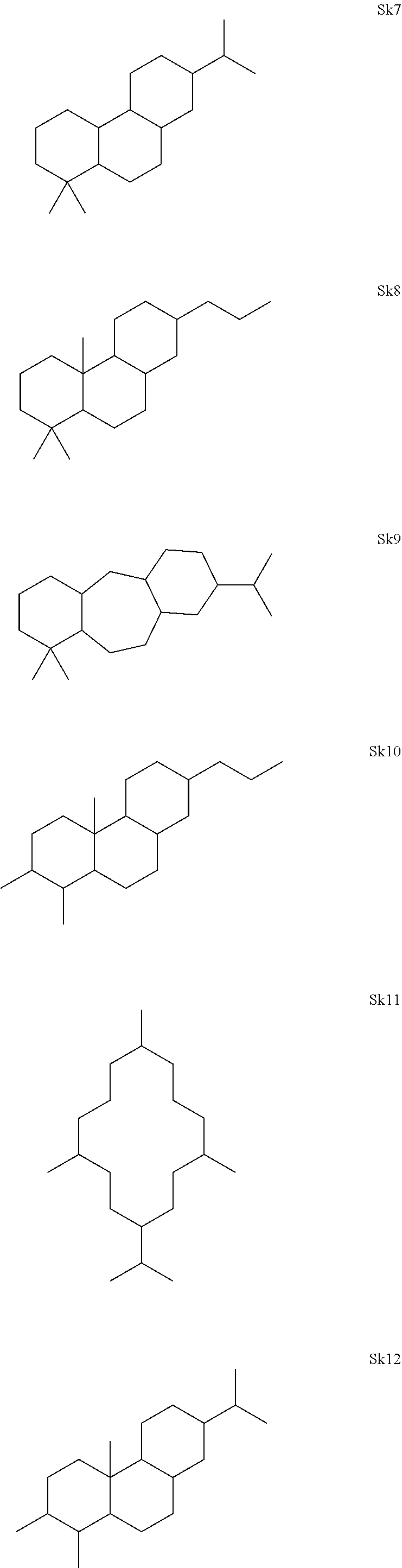
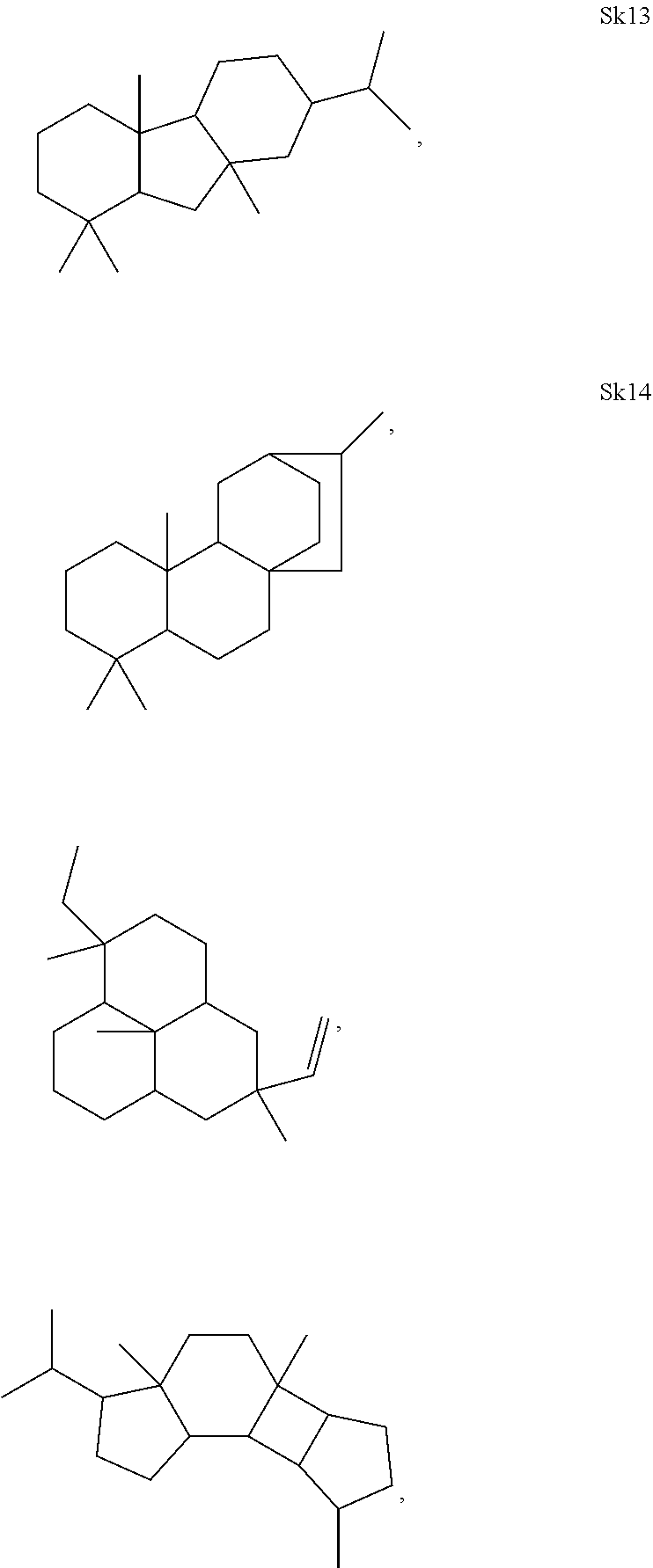
- [0473] or a combination thereof.
- [0474]17. The method of statement 12-15 or 16, wherein the terpene is any of the following compounds:
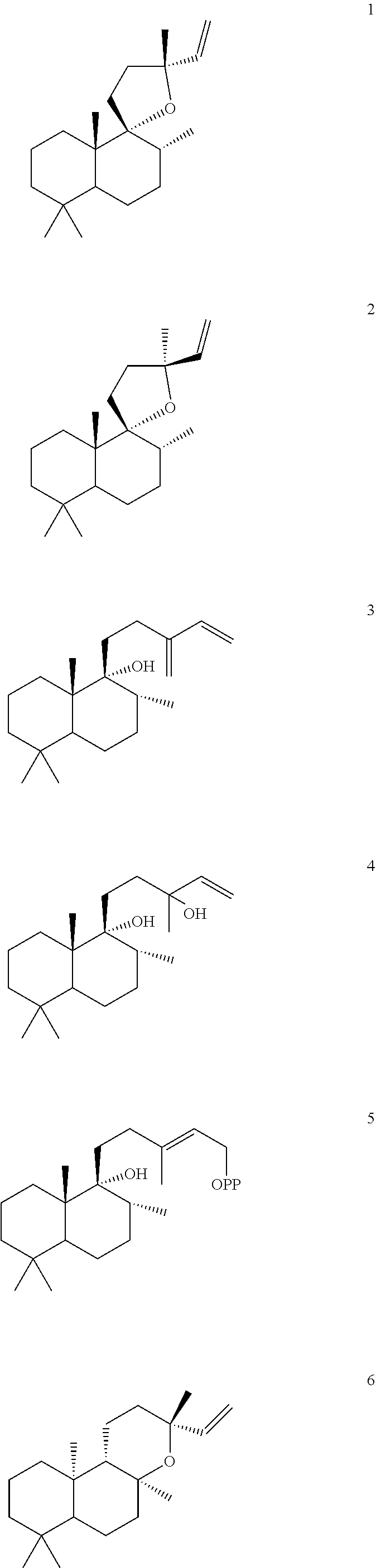

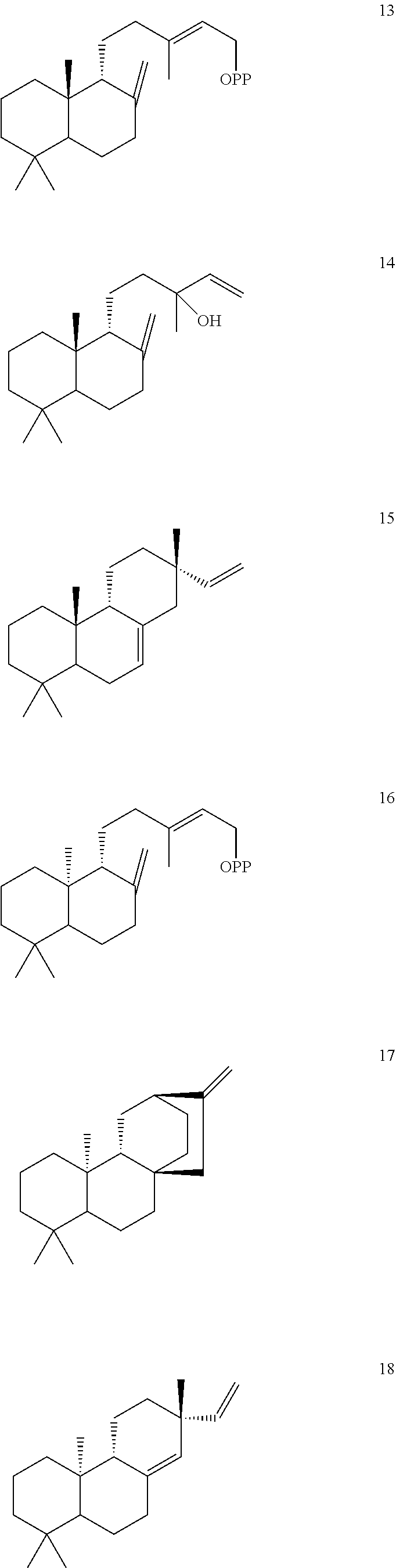
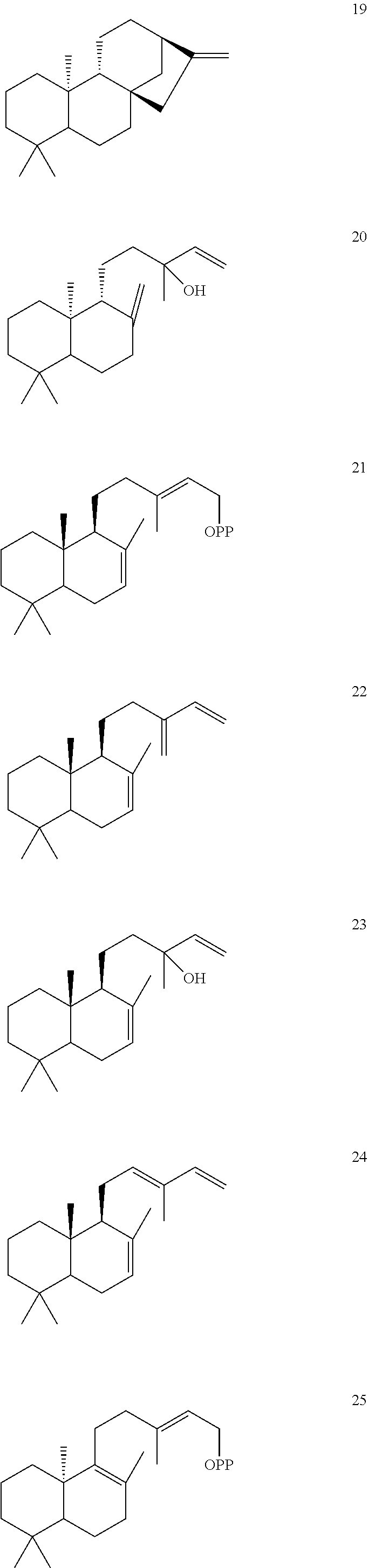
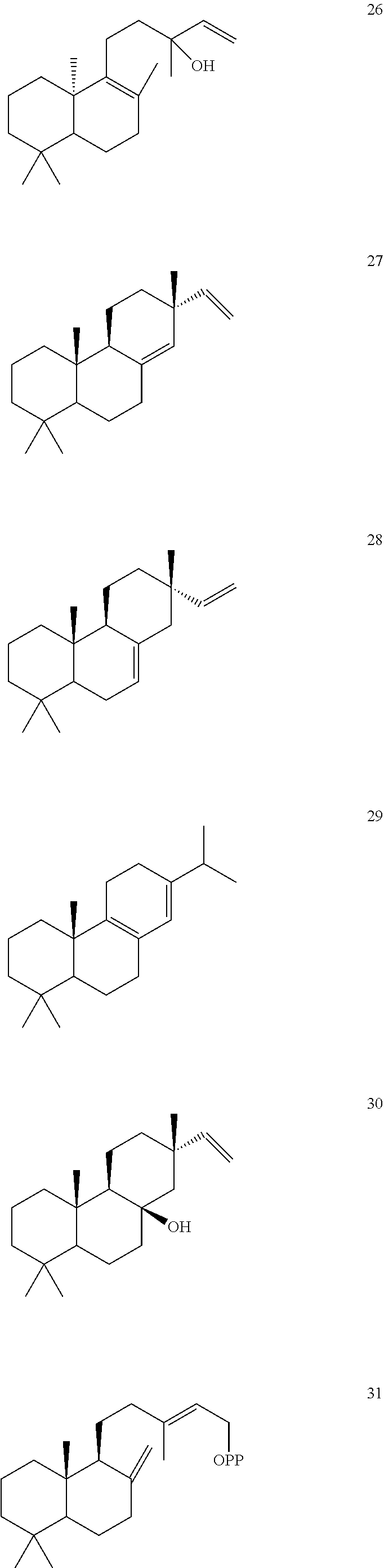
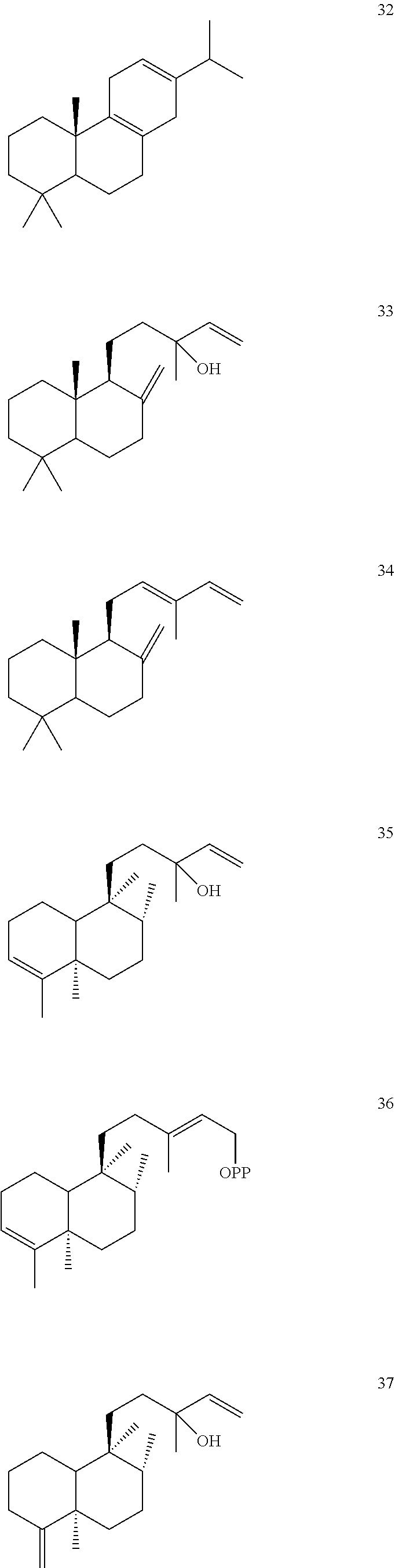

- [0476]wherein:
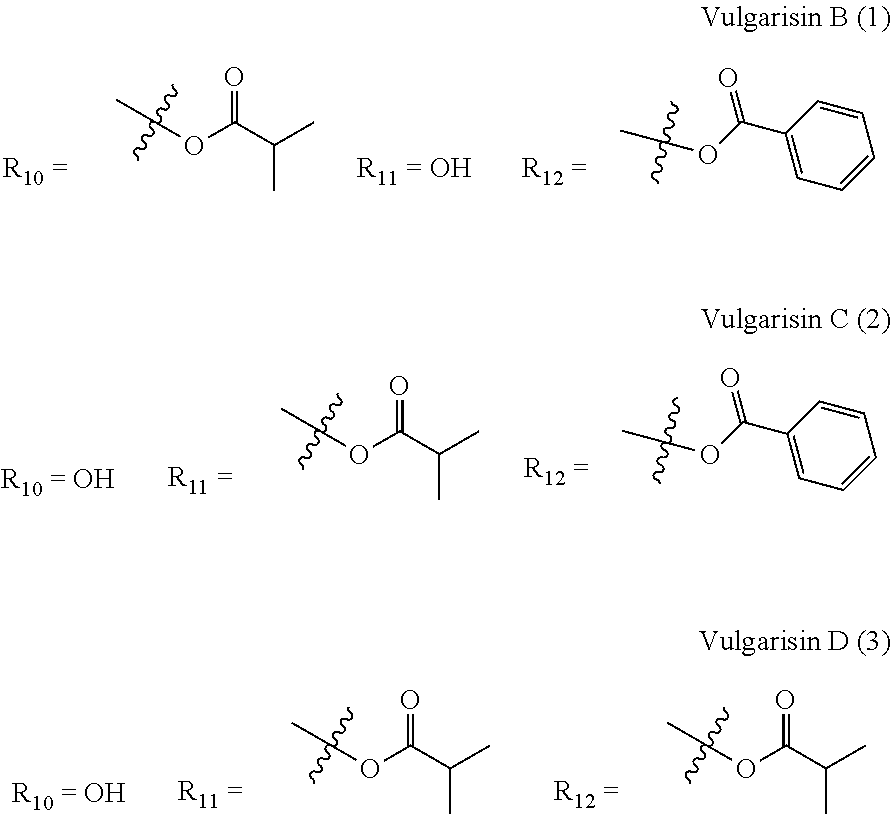
[0478]18. The method of statement 12-16 or 17, wherein the terpene is at least one of the following compounds:
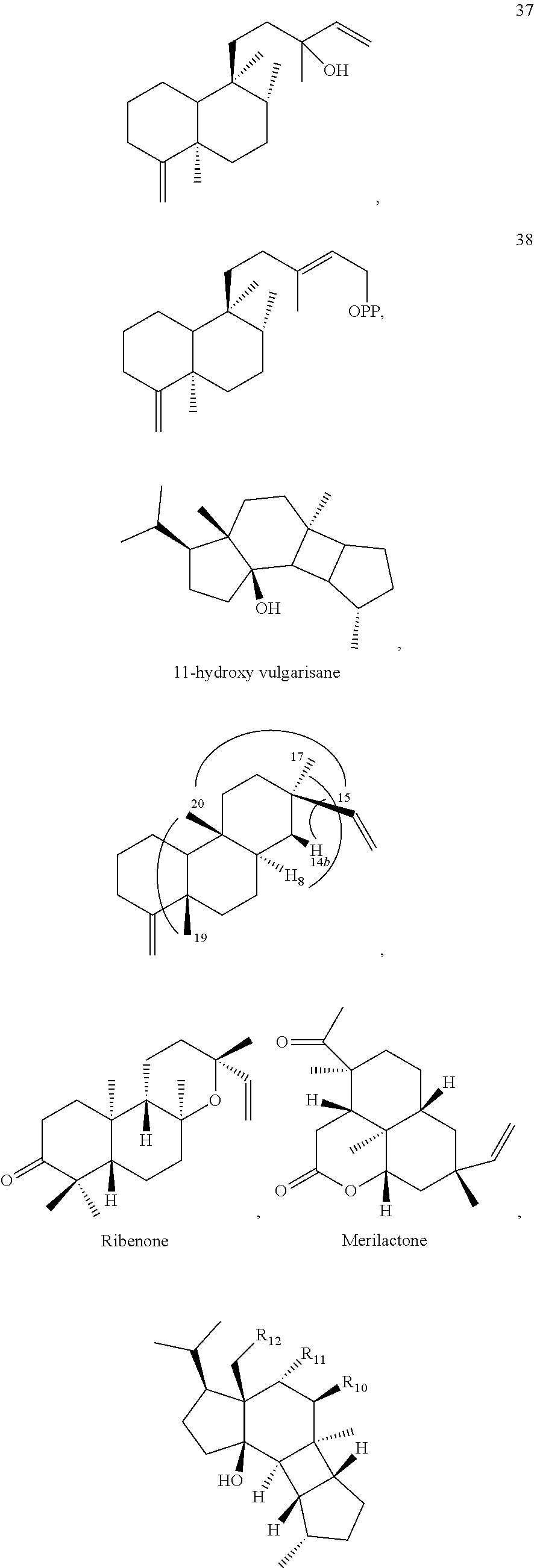
- [0480]or
- [0481]wherein:
- [0480]or
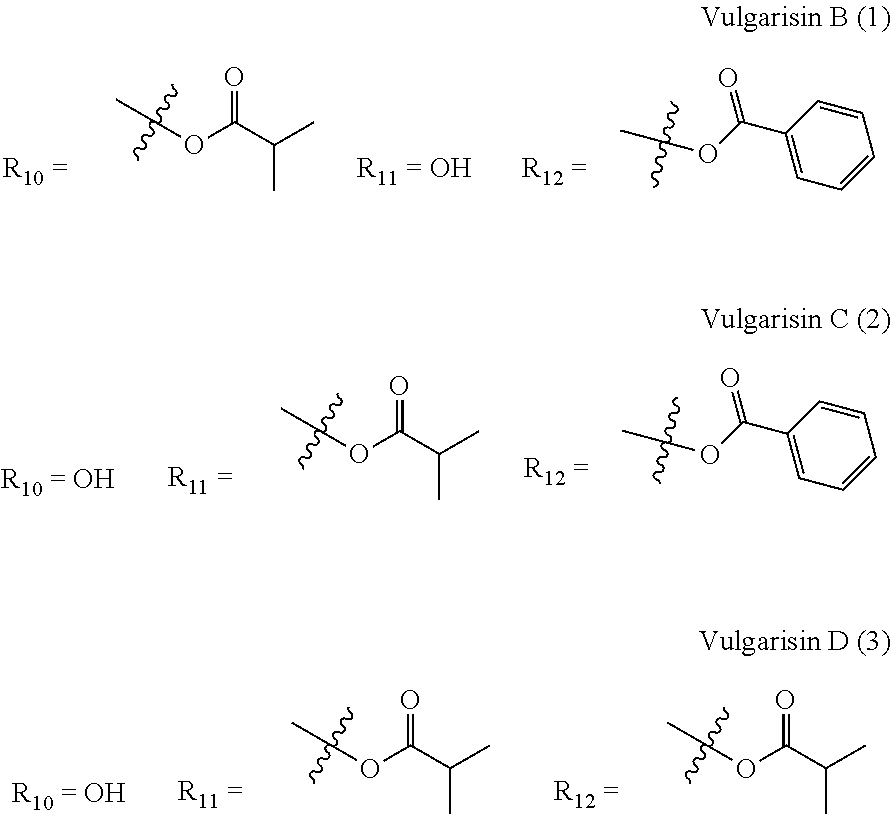
- [0483]19. The method of statement 12-17 or 18 wherein the terpene precursor is geranylgeranyl diphosphate (GGPP).
- [0484]20. A compound selected from:
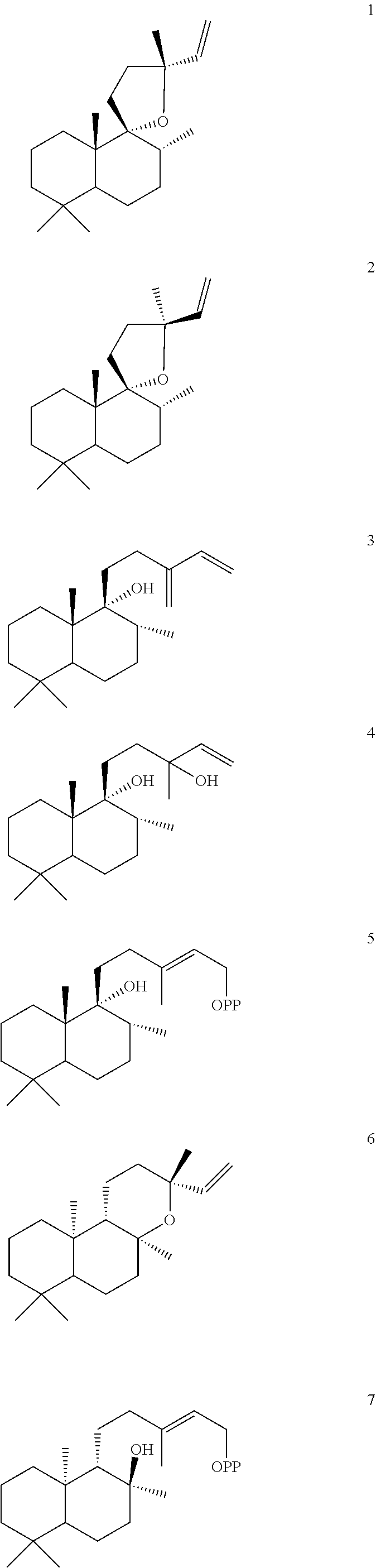

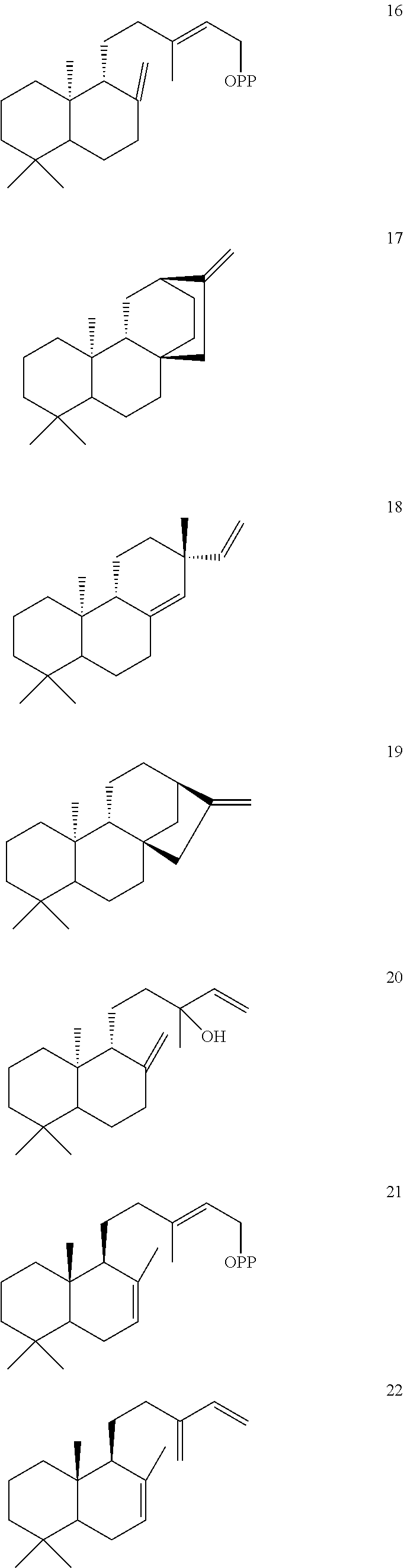
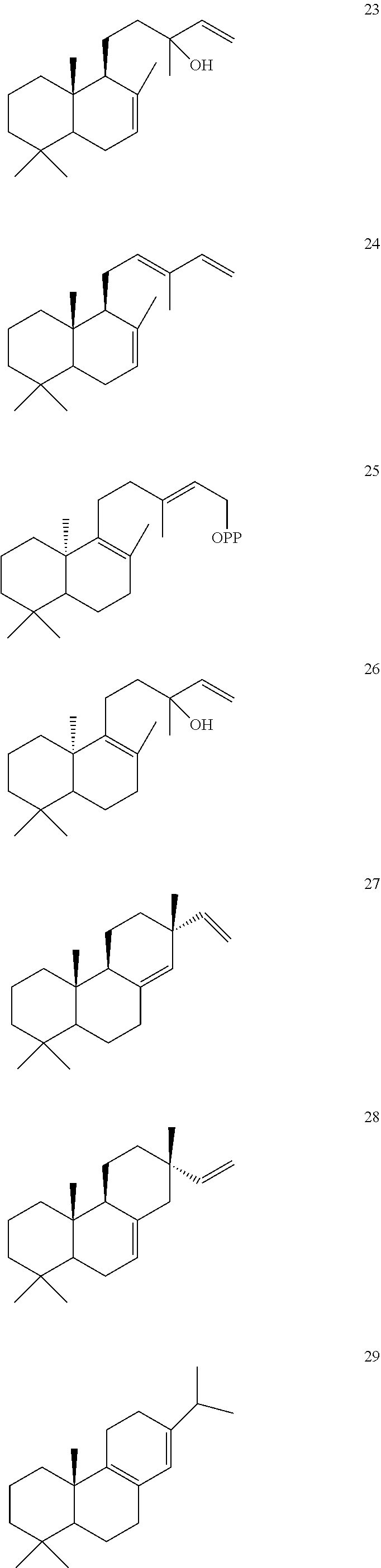
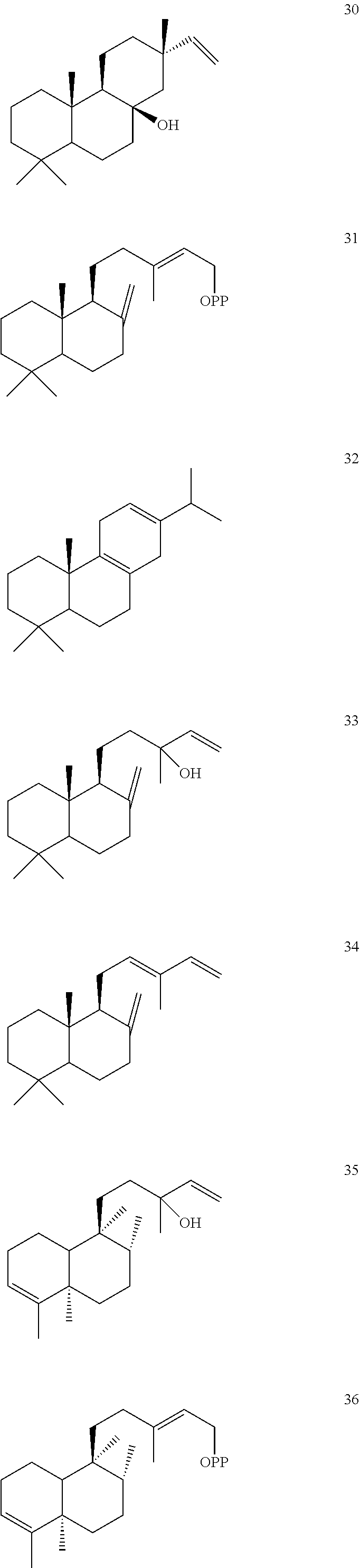
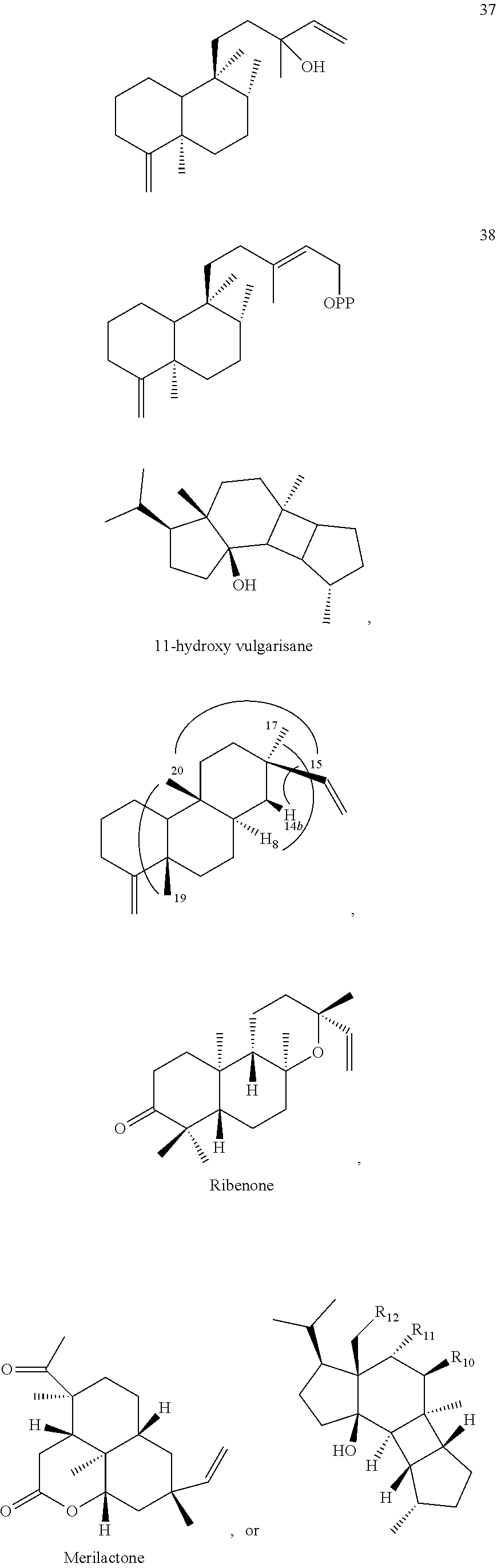
- [0486]wherein:
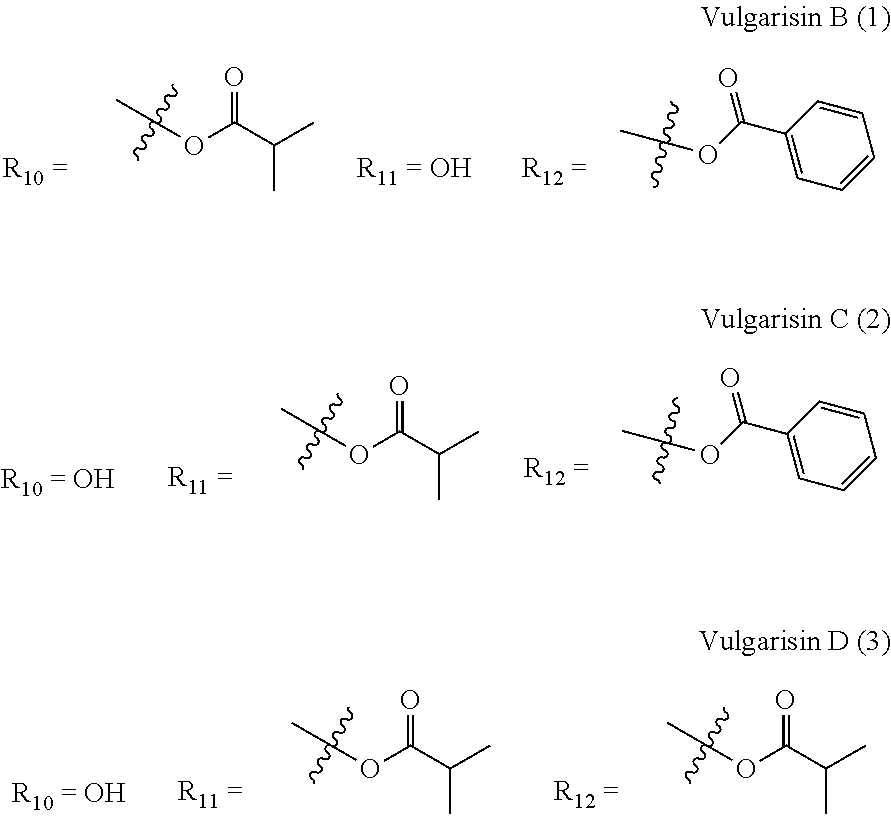
- [0488]21. A reaction mixture comprising one or more of the following:
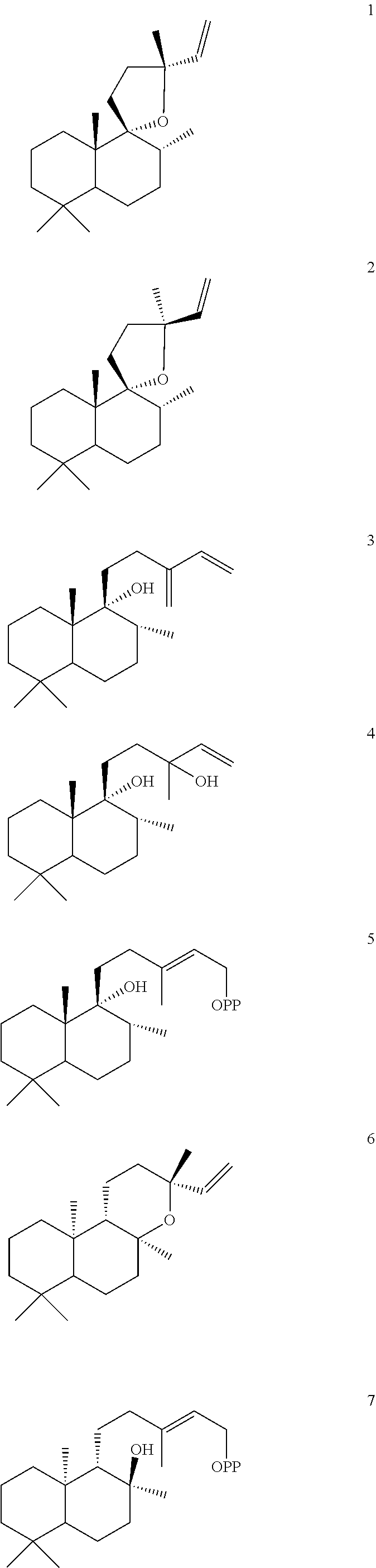
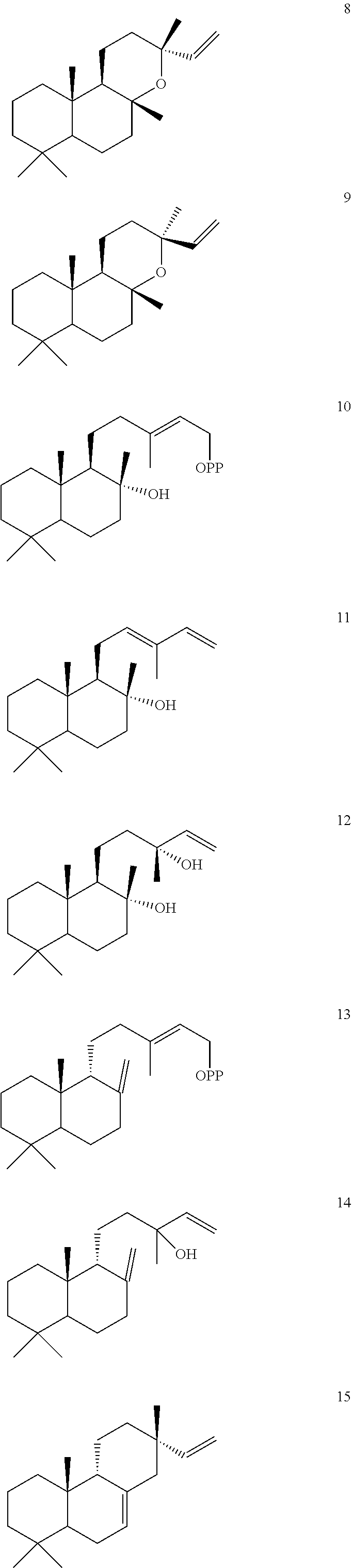
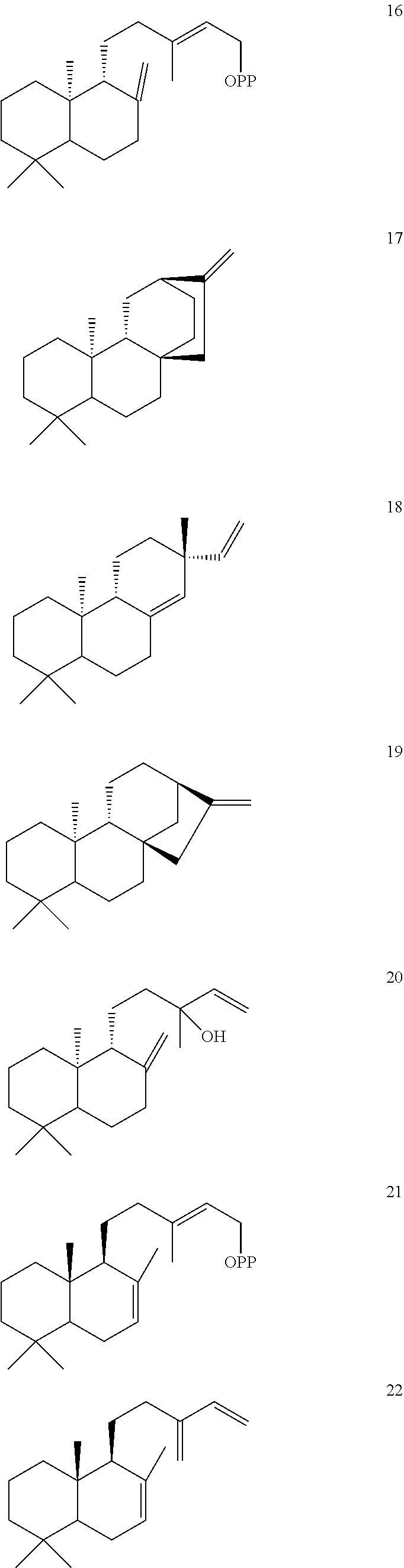
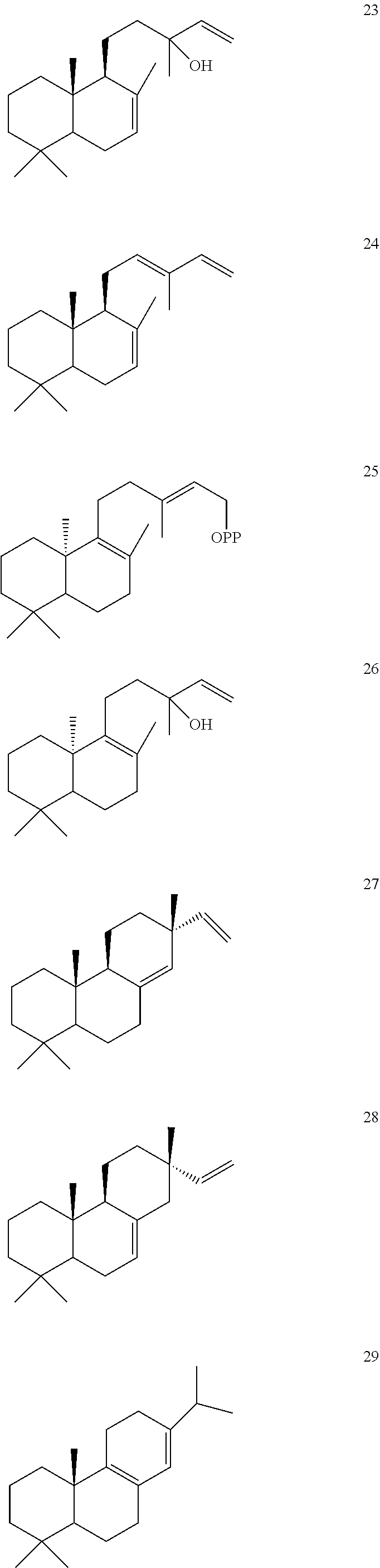
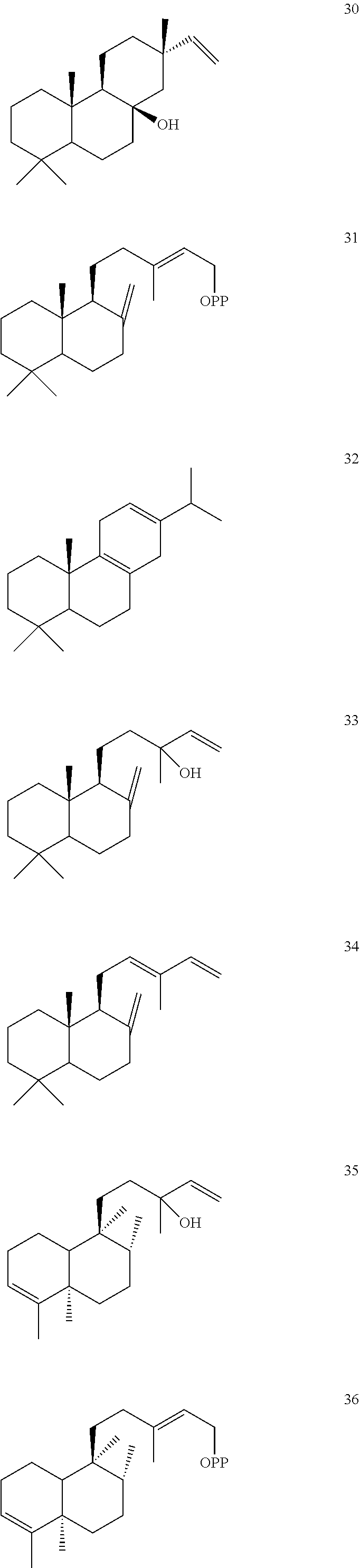
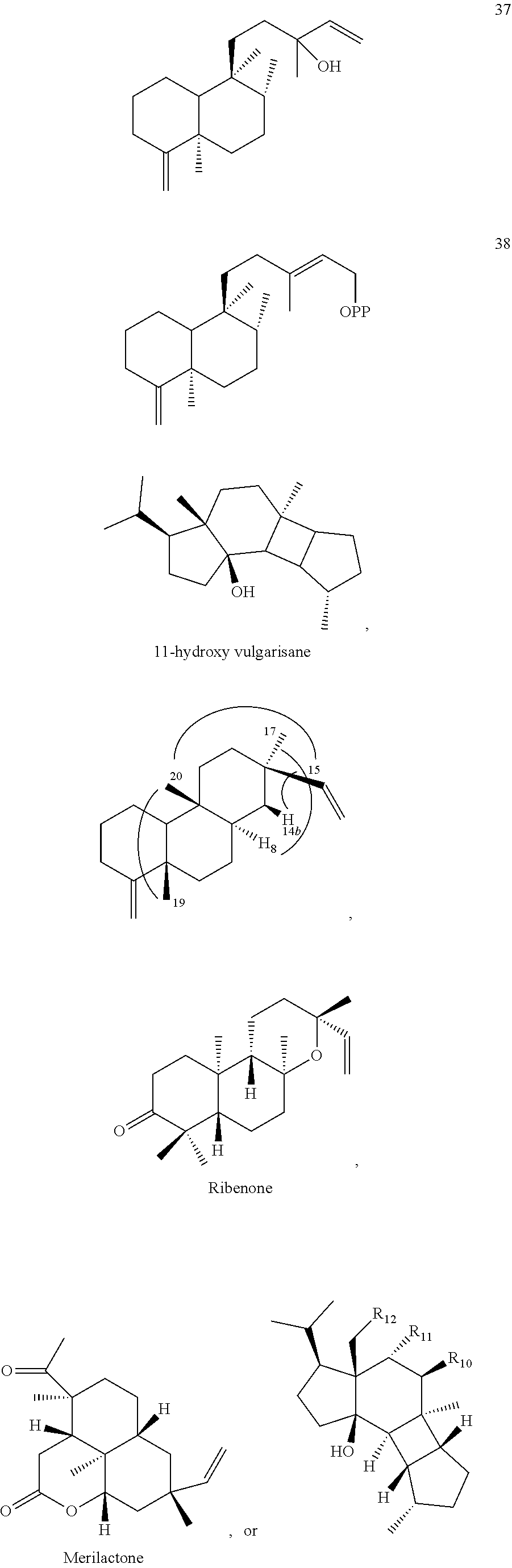
- [0490]wherein:

[0492]The specific methods, devices and compositions described herein are representative of preferred embodiments and are exemplary and not intended as limitations on the scope of the invention. Other objects, aspects, and embodiments will occur to those skilled in the art upon consideration of this specification, and are encompassed within the spirit of the invention as defined by the scope of the claims. It will be readily apparent to one skilled in the art that varying substitutions and modifications may be made to the invention disclosed herein without departing from the scope and spirit of the invention.
[0493]The invention illustratively described herein suitably may be practiced in the absence of any element or elements, or limitation or limitations, which is not specifically disclosed herein as essential. The methods and processes illustratively described herein suitably may be practiced in differing orders of steps, and the methods and processes are not necessarily restricted to the orders of steps indicated herein or in the claims.
[0494]Under no circumstances may the patent be interpreted to be limited to the specific examples or embodiments or methods specifically disclosed herein. Under no circumstances may the patent be interpreted to be limited by any statement made by any Examiner or any other official or employee of the Patent and Trademark Office unless such statement is specifically and without qualification or reservation expressly adopted in a responsive writing by Applicants.
[0495]The terms and expressions that have been employed are used as terms of description and not of limitation, and there is no intent in the use of such terms and expressions to exclude any equivalent of the features shown and described or portions thereof, but it is recognized that various modifications are possible within the scope of the invention as claimed. Thus, it will be understood that although the present invention has been specifically disclosed by preferred embodiments and optional features, modification and variation of the concepts herein disclosed may be resorted to by those skilled in the art, and that such modifications and variations are considered to be within the scope of this invention as defined by the appended claims and statements of the invention.
[0496]The invention has been described broadly and generically herein. Each of the narrower species and subgeneric groupings falling within the generic disclosure also form part of the invention. This includes the generic description of the invention with a proviso or negative limitation removing any subject matter from the genus, regardless of whether or not the excised material is specifically recited herein. In addition, where features or aspects of the invention are described in terms of Markush groups, those skilled in the art will recognize that the invention is also thereby described in terms of any individual member or subgroup of members of the Markush group.
Claims
What is claimed:
1. A method for synthesizing a terpene comprising incubating a terpene precursor with an enzyme with at least 95% sequence identity to the amino acid sequence of SEQ ID NO:9.
2. The method of
3. The method of
4. The method of
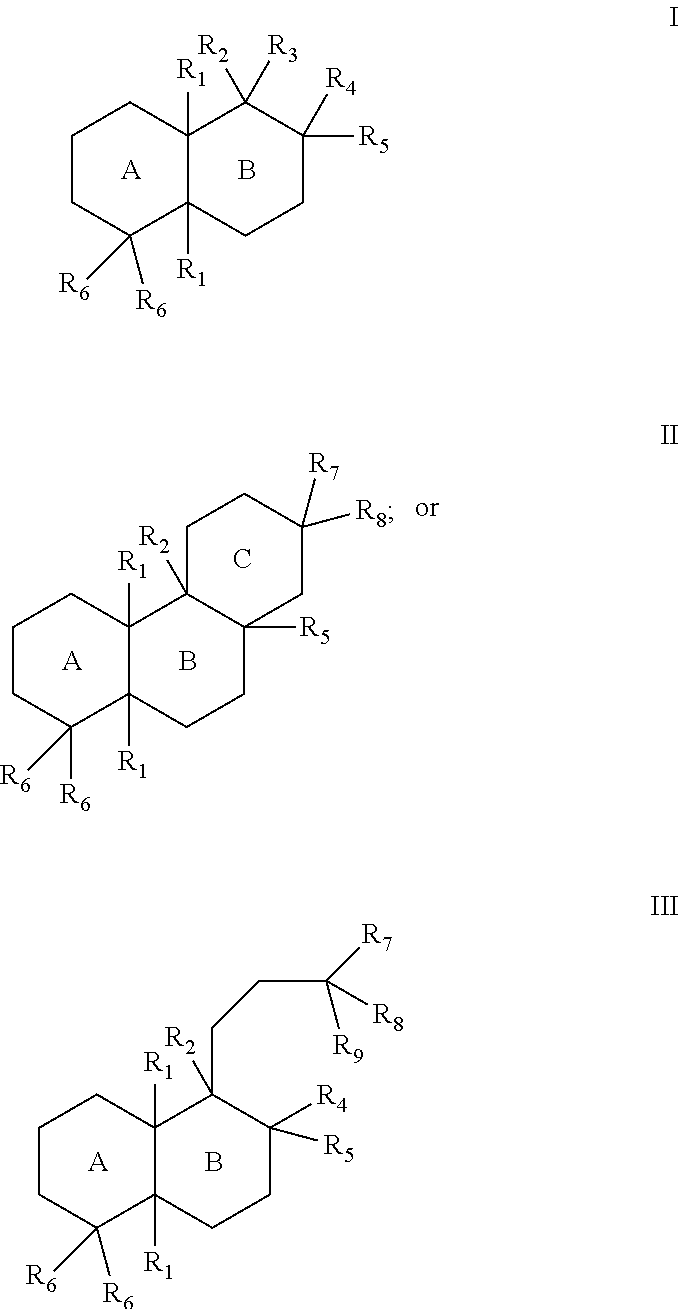
wherein
each R1 can separately be hydrogen;
R2 can be hydrogen;
R3 can be a branched C5-C6 alkyl with 0-2 double bonds, wherein the C5-C6 alkyl can optionally have one hydroxy, phosphate or diphosphate substituent;
R4 can be lower alkyl;
R5 can be hydroxy;
each R6 can separately be lower alkyl;
R7 can be lower alkyl, lower alkene, or form a cycloalkyl ring with a R5,
R8 can be lower alkyl, hydroxy, phosphate, diphosphate, or form a bond with an adjacent carbon; and
R9 can be hydrogen, lower alkyl, lower alkene, ═CH2, hydroxy, phosphate, diphosphate, form a bond with an adjacent carbon, form a cycloalkyl ring with R4, or form a cycloheteroalkyl ring with R4, wherein each cycloalkyl ring or cycloheteroalkyl ring can have 0-2 double bonds, and each cycloalkyl ring or cycloheteroalkyl ring can have 0-2 alkyl or 0-2 alkene substituents.
5. The method of
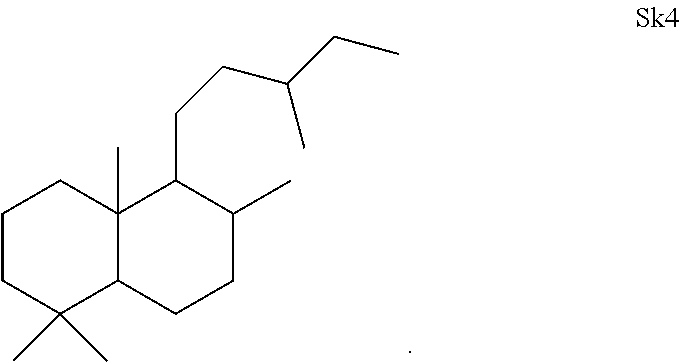
6. The method of
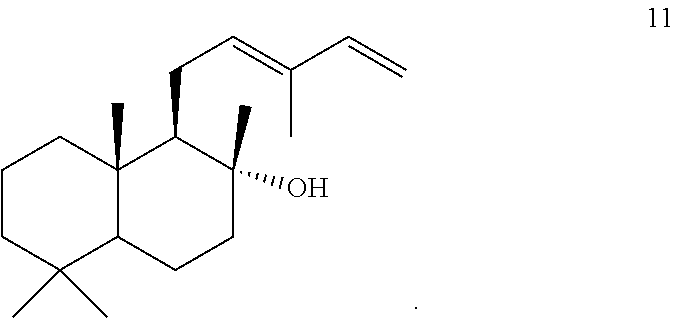
7. A method for synthesizing a terpene comprising incubating a terpene precursor of a terpene of formula I, II, or III, with an enzyme with at least 95% sequence identity to the amino acid sequence of SEQ ID NO:9, wherein the terpene of formula I, II, or III is:
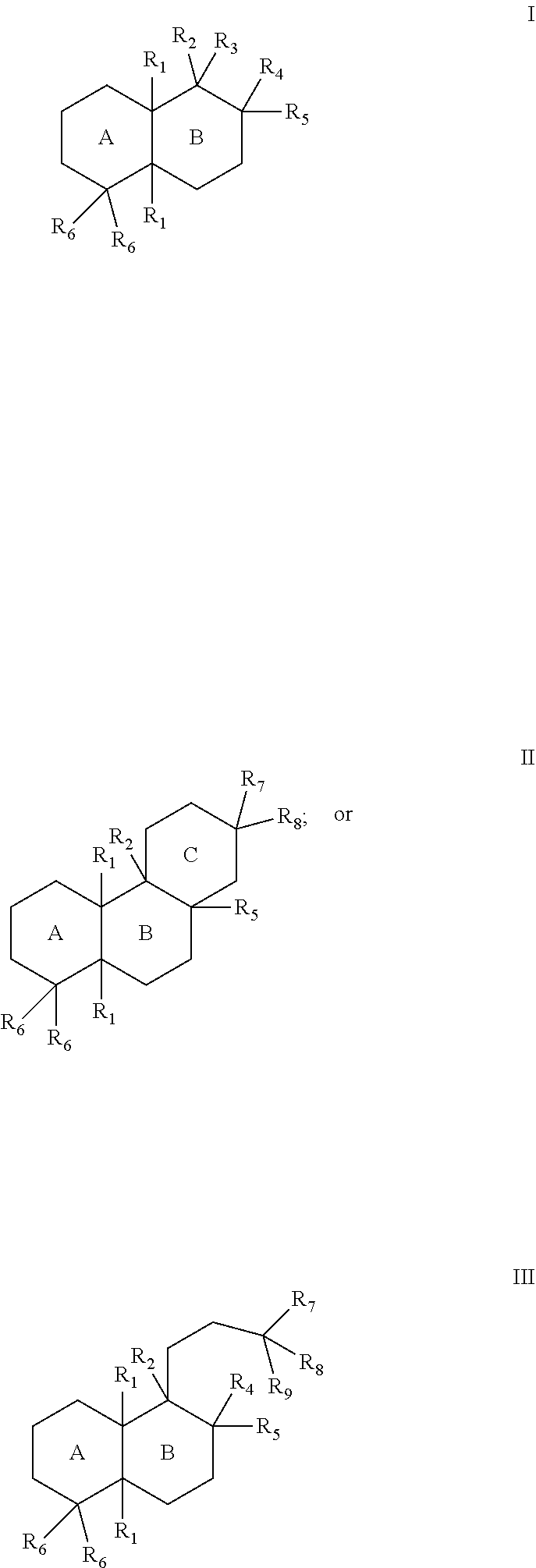
wherein
each R1 can separately be hydrogen or lower alkyl;
R2 can be hydrogen, lower alkyl, hydroxy, a bond to an adjacent ring carbon, or form a C4-C6 cycloheteroalkyl with R3;
R3 can be a branched C5-C6 alkyl with 0-2 double bonds, can form a C4-C6 cycloheteroalkyl with R2; can form a cycloalkyl with R4, or can form a cycloheteroalkyl ring with R4, wherein the C5-C6 alkyl can optionally have one hydroxy, phosphate or diphosphate substituent, and wherein each cycloalkyl or cycloheteroalkyl ring can have 0-2 double bonds, and each cycloalkyl or cycloheteroalkyl ring can have 0-2 alkyl or 0-2 alkene substituents;
R4 can be hydrogen, lower alkyl, lower alkene, hydroxy, a carbon bonded to R9, an oxygen bonded to R9, form a cycloalkyl ring with R3, or form a cycloheteroalkyl ring with R3, wherein each cycloalkyl ring or cycloheteroalkyl ring can have 0-2 double bonds, and each cycloalkyl ring or cycloheteroalkyl ring can have 0-2 alkyl or 0-2 alkene substituents;
R5 can be hydrogen, hydroxy, lower alkyl, a lower alkene, a bond with an adjacent carbon, form a cycloalkyl ring with a ring atom of a ring formed by R3 and R4, wherein the cycloalkyl ring can have 0-2 double bonds, and the cycloalkyl ring can have 0-2 alkyl or 0-2 alkene substituents;
each R6 can separately be hydrogen, lower alkyl, lower alkene, or form a bond with an adjacent carbon;
R7 can be lower alkyl, lower alkene, or form a cycloalkyl ring with a R5,
R8 can be lower alkyl, hydroxy, phosphate, diphosphate, or form a bond with an adjacent carbon; and
R9 can be hydrogen, lower alkyl, lower alkene, ═CH2, hydroxy, phosphate, diphosphate, form a bond with an adjacent carbon, form a cycloalkyl ring with R4, or form a cycloheteroalkyl ring with R4, wherein each cycloalkyl ring or cycloheteroalkyl ring can have 0-2 double bonds, and each cycloalkyl ring or cycloheteroalkyl ring can have 0-2 alkyl or 0-2 alkene substituents.
8. A method for synthesizing a terpene comprising incubating a terpene precursor with an enzyme with at least 95% sequence identity to the amino acid sequence of SEQ ID NO:9, wherein the terpene precursor comprises a diphosphate.