US12656258B1
CIS,CIS-muconic acid sensor in
Publication
Application
Classifications
IPC Classifications
CPC Classifications
Applicants
Triad National Security, LLC
Inventors
Ramesh K. Jha, Taraka T. Dale
Abstract
Biosensors for detection of cis,cis-muconic acid and methods of their use are provided. The biosensors include a nucleic acid encoding a CatM protein operably linked to a regulatory element comprising a modified P cat promoter. Vectors and host cells including the biosensors are also provided.
Figures
Description
CROSS REFERENCE TO RELATED APPLICATION
[0001]This application claims the benefit of U.S. Provisional Application No. 63/275,080 filed on Nov. 3, 2021, which is incorporated by reference herein in its entirety.
ACKNOWLEDGMENT OF GOVERNMENT SUPPORT
[0002]This invention was made with government support under Contract No. 89233218CNA000001 awarded by the U.S. Department of Energy/National Nuclear Security Administration. The government has certain rights in the invention.
FIELD
[0003]This disclosure relates to biosynthesis of cis,cis-muconic acid in Corynebacterium glutamicum, particularly biosensors for cis,cis-muconic acid and methods of their use.
SEQUENCE LISTING INCORPORATION BY REFERENCE
[0004]The Sequence Listing is submitted as an XML file in the form of the file named 8472-107171-02_Sequence_Listing.xml, which was created on Oct. 31, 2022, and is 21,650 bytes, which is incorporated by reference herein.
BACKGROUND
[0005]cis,cis-Muconic acid (muconate) is an important industrial precursor used for the production of adipic acid and terephthalic acid for nylon and polyethylene terephthalate (PET) bottles, respectively. These are presently made from petroleum. Synthetic biology and microbial engineering can be used to develop biomanufacturing of these compounds; however, in order to be competitive with conventional manufacturing, the biosynthetic route needs to be optimized, which requires capability to rapidly test large numbers of engineered strains and growth conditions.
SUMMARY
[0006]A key component in biosynthesis of plastics is production of cis,cis-muconic acid. A bottleneck in establishing such production is the lack of a high throughput screening platform for muconate production in non-model organisms, such as Corynebacterium glutamicum. Provided herein are biosensors for muconate that can be used in high-throughput testing of engineered microbes, in particular in engineered Corynebacterium glutamicum.
[0007]Provided herein in some embodiments is a cis,cis-muconic acid biosensor including a nucleic acid encoding a CatM protein operably linked to a regulatory element including a modified Pcat promoter. The modified Pcat promoter is capable of producing a response in the presence of ccMA or ccMA precursors (e.g., benzoate or catechol). In some examples, the modified Pcat promoter includes a nucleic acid sequence with at least 98% sequence identity to SEQ ID NO: 9 or SEQ ID NO: 11. In some examples, the modified Pcat promoter includes the nucleic acid sequence of SEQ ID NO: 9 or SEQ ID NO: 11. In some examples, the modified Pcat promoter includes a nucleic acid sequence with at least 98% sequence identity to the nucleic acid sequence of SEQ ID NO: 10 or SEQ ID NO: 4.
[0008]In some embodiments, the cis,cis-muconic acid biosensor, further includes a nucleic acid encoding a reporter protein operably linked to the modified Pcat promoter. In some examples, the reporter protein is a fluorescent protein, such as a green fluorescent protein (GFP) or superfolder GFP (sfGFP).
[0009]In some examples, the cis,cis-muconic acid biosensor includes a nucleic acid sequence with at least 90% sequence identity to SEQ ID NO: 5 or the complement thereof. In other examples, the biosensor includes or consists of the nucleic acid sequence of SEQ ID NO: 5, or the complement thereof.
[0010]Vectors including the cis,cis-muconic acid biosensor are also provided. In some embodiments, the vector includes a nucleic acid sequence with at least 98% sequence identity to SEQ ID NO: 9 or SEQ ID NO: 11 or the complement thereof. In other examples, the vector includes a nucleic acid with at least 98% sequence identity to SEQ ID NO: 10 or SEQ ID NO: 4 or the complement thereof. In further examples, the vector includes a nucleic acid sequence with at least 90% sequence identity to SEQ ID NO: 5 or the complement thereof. In one example, the vector includes or consists of the nucleic acid sequence of SEQ ID NO: 6.
[0011]Also provided are hosts cells including a disclosed cis,cis-muconic acid biosensor or vectors including a disclosed cis,cis-muconic acid biosensor. In some examples, the host cell is a bacterial cell, such as a Corynebacterium glutamicum cell. In other examples, the cell includes an inactive or deleted catB gene, an overexpressed catA gene, or both.
[0012]Methods of detecting cis,cis-muconic acid utilizing the disclosed biosensors are also provided. In some embodiments, the methods include culturing a host cell including or expressing a cis,cis-muconic acid biosensor under conditions sufficient to detect cis,cis-muconic acid (such as conditions sufficient to produce cis,cis-muconic acid) and detecting output of a reporter. In some examples, the reporter is a fluorescent protein, and detecting the output is by detecting fluorescent signal (for example, using flow cytometry or a fluorescence microplate reader). In some examples, the cis,cis-muconic acid is produced by the cell. In other examples, the cis,cis-muconic acid is produced outside the cell (for example, in the environment of the cell). The host cell may also express a transporter capable of transporting cis,cis-muconic acid into the host cell (such as a heterologous, modified, or overexpressed transporter). In some embodiments, the methods the genome of the host cell is mutated, for example, to generate a population of cells with a plurality of genotypic variants.
[0013]The foregoing and other features of the disclosure will become more apparent from the following detailed description, which proceeds with reference to the accompanying figures.
BRIEF DESCRIPTION OF THE DRAWINGS
[0014]
[0015]
[0016]
[0017]
[0018]
[0019]
[0020]
[0021]
SEQUENCE LISTING
[0022]Any nucleic acid and amino acid sequences listed herein and in the accompanying sequence listing are shown using standard letter abbreviations for nucleotide bases and amino acids, as defined in 37 C.F.R. § 1.822. In at least some cases, only one strand of each nucleic acid sequence is shown, but the complementary strand is understood as included by any reference to the displayed strand.
[0023]SEQ ID NO: 1 is a nucleic acid sequence including the sequence of a native Acinetobacter baylyi ADP1 Pcat promoter (uppercase text) and flanking regions (lowercase text).
| gttccatTTATACGCCCTAATTGGTTTTATATACCTTTTTAGTATGCAAA |
| AATACCAAATTGTTTATCTTTTTTATTATTACATTAATTTAAGGTATGTA |
| AATAGTATTTATTGAAAAGAAGATGGACCGatggctag |
[0025]SEQ ID NO: 4 is a nucleic acid sequence including the sequence of an alternate exemplary Pcat promoter optimized for C. glutamicum.
| TTATACGCCCTAATTGGTTTTATATACCTTTTTAGTATGCAAAAATACCA |
| AATTGGTATTTGTTTTTATTATTACATACATTTACTGTATGTAAATAGTA |
| TTTATTGAAAAGGAGATATACAT |
[0027]SEQ ID NO: 2 is a nucleic acid sequence including the sequence of Pcat-opt-1, a Pcat promoter optimized for Pseudomonas putida (uppercase text) and flanking regions (lowercase text).
| gttccatTTATACGCCCTAATTGGTTTTATATACCTTTTTAGTATGCAAA |
| AATACCAAATTGGTGTTGGTTTTTATTATTACATTAATTTAAGGTATGTA |
| AATAGTATTTATTGAAAAGGAGATGGACCGatggctag |
[0029]SEQ ID NO: 3 is a nucleic acid sequence including the sequence of Pcat-opt-2, an exemplary Pcat promoter optimized for C. glutamicum (uppercase text) and flanking regions (lowercase text).
| gttccatTTATACGCCCTAATTGGTTTTATATACCTTTTTAGTATGCAAA |
| AATACCAAATTGGTATTTGTTTTTATTATTACATTCATTTAAAGTATGTA |
| AATAGTATTTATTGAAAAGGAGATATACATatggctag |
[0031]SEQ ID NO: 5 is the nucleic acid sequence of an exemplary cis,cis-muconic acid sensor. Underlined text: catM; bold text: modified Pcat promoter (Pcat-opt-2).
[0033]SEQ ID NO: 6 is the nucleic acid sequence of an exemplary vector (pRJ2010) including a cis,cis-muconic acid biosensor. Underlined text: catM; bold text: modified Pour promoter (Pour-opt-2); italic text: sfgfp reporter.
| GGGTATGGACAGTTTTCCCTTTGATATGTAACGGTGAACAGTTGTTCTACTTTTGTTTGTTAGTCTTGAT | |
| GCTTCACTGATAGATACAAGAGCCATAAGAACCGTTTAAACAAACGGGCACTGGAAGGGTTCTTCGGCCA | |
| GCAAAAGGCCAGGAACCGTAAAAAGGCCGCGTTGCTGGCGTTTTTCCATAGGCTCCGCCCCCCTGACGAG | |
| CATCACAAAAATCGACGCTCAAGTCAGAGGTGGCGAAACCCGACAGGACTATAAAGATACCAGGCGTTTC | |
| CCCCTGGAAGCTCCCTCGTGCGCTCTCCTGTTCCGACCCTGCCGCTTACCGGATACCTGTCCGCCTTTCT | |
| CCCTTCGGGAAGCGTGGCGCTTTCTCATAGCTCACGCTGTAGGTATCTCAGTTCGGTGTAGGTCGTTCGC | |
| TCCAAGCTGGGCTGTGTGCACGAACCCCCCGTTCAGCCCGACCGCTGCGCCTTATCCGGTAACTATCGTC | |
| TTGAGTCCAACCCGGTAAGACACGACTTATCGCCACTGGCAGCAGCCACTGGTAACAGGATTAGCAGAGC | |
| GAGGTATGTAGGCGGTGCTACAGAGTTCTTGAAGTGGTGGCCTAACTACGGCTACACTAGAAGAACAGTA | |
| TTTGGTATCTGCGCTCTGCTGAAGCCAGTTACCTTCGGAAAAAGAGTTGGTAGCTCTTGATCCGGCAAAC | |
| AAACCACCGCTGGTAGCGGTGGTTTTTTTGTTTGCAAGCAGCAGATTACGCGCAGAAAAAAAGGATCTCA | |
| AGAAGATCCTTTGATCTTTTCTACGGGGTCTGACGCTCAGTGGAACGAAAACTCACGTTAAGGGATTTTG | |
| GTCATGAGATTATCAAAAAGGATCTTCACCTAGATCCTTTTGGGGTGGGCGAAGAACTCCAGCATGAGAT | |
| CCCCGCGCTGGAGGATCATCCAGCCATTCGGGGTCGTTCACTGGTTCCCCTTTCTGATTTCTGGCATAGA | |
| AGAACCCCCGTGAACTGTGTGGTTCCGGGGGTTGCTGATTTTTGCGAGACTTCTCGCGCAATTCCCTAGC | |
| TTAGGTGAAAACACCATGAAACACTAGGGAAACACCCATGAAACACCCATTAGGGCAGTAGGGCGGCTTC | |
| TTCGTCTAGGGCTTGCATTTGGGCGGTGATCTGGTCTTTAGCGTGTGAAAGTGTGTCGTAGGTGGCGTGC | |
| TCAATGCACTCGAACGTCACGTCATTTACCGGGTCACGGTGGGCAAAGAGAACTAGTGGGTTAGACATTG | |
| TTTTCCTCGTTGTCGGTGGTGGTGAGCTTTTCTAGCCGCTCGGTAAACGCGGCGATCATGAACTCTTGGA | |
| GGTTTTCACCGTTCTGCATGCCTGCGCGCTTCATGTCCTCACGTAGTGCCAAAGGAACGCGTGCGGTGAC | |
| CACGACGGGCTTAGCCTTTGCCTGCGCTTCTAGTGCTTCGATGGTGGCTTGTGCCTGCGCTTGCTGCGCC | |
| TGTAGTGCCTGTTGAGCTTCTTGTAGTTGCTGTTCTAGCTGTGCCTTGGTTGCCATGCTTTAAGACTCTA | |
| GTAGCTTTCCTGCGATATGTCATGCGCATGCGTAGCAAACATTGTCCTGCAACTCATTCATTATGTGCAG | |
| TGCTCCTGTTACTAGTCGTACATACTCATATTTACCTAGTCTGCATGCAGTGCATGCACATGCAGTCATG | |
| TCGTGCTAATGTGTAAAACATGTACATGCAGATTGCTGGGGGTGCAGGGGGCGGAGCCACCCTGTCCATG | |
| CGGGGTGTGGGGCTTGCCCCGCCGGTACAGACAGTGAGCACCGGGGCACCTAGTCGCGGATACCCCCCCT | |
| AGGTATCGGACACGTAACCCTCCCATGTCGATGCAAATCTTTAACATTGAGTACGGGTAAGCTGGCACGC | |
| ATAGCCAAGCTAGGCGGCCACCAAACACCACTAAAAATTAATAGTCCCTAGACAAGACAAACCCCCGTGC | |
| GAGCTACCAACTCATATGCACGGGGGCCACATAACCCGAAGGGGTTTCAATTGACAACCATAGCACTAGC | |
| TAAGACAACGGGCACAACACCCGCACAAACTCGCACTGCGCAACCCCGCACAACATCGGGTCTAGGTAAC | |
| ACTGAAATAGAAGTGAACACCTCTAAGGAACCGCAGGTCAATGAGGGTTCTAAGGTCACTCGCGCTAGGG | |
| CGTGGCGTAGGCAAAACGTCATGTACAAGATCACCAATAGTAAGGCTCTGGCGGGGTGCCATAGGTGGCG | |
| CAGGGACGAAGCTGTTGCGGTGTCCTGGTCGTCTAACGGTGCTTCGCAGTTTGAGGGTCTGCAAAACTCT | |
| CACTCTCGCTGGGGGTCACCTCTGGCTGAATTGGAAGTCATGGGCGAACGCCGCATTGAGCTGGCTATTG | |
| CTACTAAGAATCACTTGGCGGCGGGTGGCGCGCTCATGATGTTTGTGGGCACTGTTCGACACAACCGCTC | |
| ACAGTCATTTGCGCAGGTTGAAGCGGGTATTAAGACTGCGTACTCTTCGATGGTGAAAACATCTCAGTGG | |
| AAGAAAGAACGTGCACGGTACGGGGTGGAGCACACCTATAGTGACTATGAGGTCACAGACTCTTGGGCGA | |
| ACGGTTGGCACTTGCACCGCAACATGCTGTTGTTCTTGGATCGTCCACTGTCTGACGATGAACTCAAGGC | |
| GTTTGAGGATTCCATGTTTTCCCGCTGGTCTGCTGGTGTGGTTAAGGCCGGTATGGACGCGCCACTGCGT | |
| GAGCACGGGGTCAAACTTGATCAGGTGTCTACCTGGGGTGGAGACGCTGCGAAAATGGCAACCTACCTCG | |
| CTAAGGGCATGTCTCAGGAACTGACTGGCTCCGCTACTAAAACCGCGTCTAAGGGGTCGTACACGCCGTT | |
| TCAGATGTTGGATATGTTGGCCGATCAAAGCGACGCCGGCGAGGATATGGACGCTGTTTTGGTGGCTCGG | |
| TGGCGTGAGTATGAGGTTGGTTCTAAAAACCTGCGTTCGTCCTGGTCACGTGGGGCTAAGCGTGCTTTGG | |
| GCATTGATTACATAGACGCTGATGTACGTCGTGAAATGGAAGAAGAACTGTACAAGCTCGCCGGTCTGGA | |
| AGCACCGGAACGGGTCGAATCAACCCGCGTTGCTGTTGCTTTGGTGAAGCCCGATGATTGGAAACTGATT | |
| CAGTCTGATTTCGCGGTTAGGCAGTACGTTCTCGATTGCGTGGATAAGGCTAAGGACGTGGCCGCTGCGC | |
| AACGTGTCGCTAATGAGGTGCTGGCAAGTCTGGGTGTGGATTCCACCCCGTGCATGATCGTTATGGATGA | |
| TGTGGACTTGGACGCGGTTCTGCCTACTCATGGGGACGCTACTAAGCGTGATCTGAATGCGGCGGTGTTC | |
| GCGGGTAATGAGCAGACTATTCTTCGCACCCACTAAAAGCGGCATAAACCCCGTTCGATATTTTGTGCGA | |
| TGAATTTATGGTCAATGTCGCGGGGGCAAACTATGATGGGTCTTGTTGTTGGCGTCCCGGAAAACGATTC | |
| CGAAGCCCAACCTTTCATAGAAGGCGGCGGTGGAATCGAAATCTCGTGATGGCAGGTTGGGCGTCGCTTG | |
| GTCGGTCATTTCGAAGGGCACCAATAACTGCCTTAAAAAAATTACGCCCCGCCCTGCCACTCATCGCAGT | |
| ACTGTTGTAATTCATTAAGCATTCTGCCGACATGGAAGCCATCACAAACGGCATGATGAACCTGAATCGC | |
| CAGCGGCATCAGCACCTTGTCGCCTTGCGTATAATATTTGCCCATGGTGAAAACGGGGGCGAAGAAGTTG | |
| TCCATATTGGCCACGTTTAAATCAAAACTGGTGAAACTCACCCAGGGATTGGCTGAGACGAAAAACATAT | |
| TCTCAATAAACCCTTTAGGGAAATAGGCCAGGTTTTCACCGTAACACGCCACATCTTGCGAATATATGTG | |
| TAGAAACTGCCGGAAATCGTCGTGGTATTCACTCCAGAGCGATGAAAACGTTTCAGTTTGCTCATGGAAA | |
| ACGGTGTAACAAGGGTGAACACTATCCCATATCACCAGCTCACCGTCTTTCATTGCCATACGTAACTCCG | |
| GATGAGCATTCATCAGGCGGGCAAGAATGTGAATAAAGGCCGGATAAAACTTGTGCTTATTTTTCTTTAC | |
| GGTCTTTAAAAAGGCCGTAATATCCAGCTGAACGGTCTGGTTATAGGTACATTGAGCAACTGACTGAAAT | |
| GCCTCAAAATGTTCTTTACGATGCCATTGGGATATATCAACGGTGGTATATCCAGTGATTTTTTTCTCCA | |
| TTTTAGCTTCCTTAGCTCCTGAAAATCTCGTCGAAGCTCGGCGGATTTGTCCTACTCAAGCTGATCCGAC | |
| AAAATCCACACATTATCCCAGGTGTCCGGATCGGTCAAATACGCTGCCAGCTCATAGACCGTATCCAAAG | |
| CATCCGGGGCTGATCCCCGGCGCCAGGGTGGTTTTTCTTTTCACCAGTGAGACGGGCAACAGCATACGCA | |
| AACCGCCTCTCCCCCCTCCGTTGAAAACTAAAAAGCTGGGAAGGTGAATCGAATTTCGGGGCTTTAAAGC | |
| AAAAATGAACAGCTTGGTCTATAGTGGCTAGGTACCCTTTTTGTTTTGGACACATGTAGGGTGGCCGAAA | |
| CAAAGTATGGCAGGAAAAA<u style="single">TTATTCGATGAGTGGCCTGATATGGTGCGTTGCAAACACCTCCTGTACACA</u> | |
| GGCGAGAATTTTAGGAATGTAATTACTGTGGTCCATATTTCGCACCGCGAGTGAAATTGGGCTATAGGCA | |
| AAAGCTAACTTCAAAATTCGCCACAACGTTGAAGATGGTTCCGTTCAACTAGCAGACCATTATCAACAAA | |
| AAAGGCTCAGTCGAAAGACTGGGCCTTTCGTTTTATCTGTTGTTTGTCGGTGAACGCTCTCTACTAGAGT | |
| CACACTGGCTCACCTTCGGGTGGGCCTTTCTGCGTTTATAGATGTTGGTTCTTTCCTAAAGTTG |
[0035]SEQ ID NO: 7 is the amino acid sequence of an exemplary A. baylyi CatM protein.
| MELRHLRYFVTVVEEQSISKAAEKLCIAQPPLSRQIQKLEEELGIQLFE |
| RGERPAKVTEAGMFFYQHAVQILTHTAQASSMAKRIATVSQTLRIGYVS |
| SLLYGLLPEIIYLFRQQNPEIHIELIECGTKDQINALKQGKIDLGFGRL |
| KITDPAIRRIVLHKEQLKLAIHKHHHLNQFAATGVHLSQIIDEPMLLYP |
| VSQKPNFATFIQSLFTELGLVPSKLTEIREIQLALGLVAAGEGVCIVPA |
| SAMDIGVKNLLYIPILDDDAYSPISLAVRNMDHSNYIPKILACVQEVFA |
| THHIRPLIE |
[0037]SEQ ID NO: 8 is an exemplary nucleic acid sequence encoding a sfgfp reporter:
| ATGGCTAGCAAAGGAGAAGAACTTTTCACGGGAGTTGTCCCAATTCTTG |
| TTGAATTAGATGGTGATGTTAATGGGCACAAATTTTCTGTCCGTGGAGA |
| GGGTGAAGGTGATGCTACAAACGGAAAACTCACCCTTAAATTTATTTGC |
| ACTACTGGAAAACTACCTGTTCCATGGCCAACACTTGTCACTACTCTGA |
| CCTATGGTGTTCAATGCTTTTCCCGTTATCCGGATCACATGAAACGGCA |
| TGACTTTTTCAAGAGTGCCATGCCCGAAGGTTATGTACAGGAACGCACT |
| ATATCTTTCAAAGATGACGGGACCTACAAGACGCGTGCTGAAGTCAAGT |
| TTGAAGGTGATACCCTTGTTAATCGTATCGAGTTAAAGGGTATTGATTT |
| TAAAGAAGATGGAAACATTCTTGGACACAAACTCGAGTACAACTTTAAC |
| TCACACAATGTATACATCACGGCAGACAAACAAAAGAATGGAATCAAAG |
| CTAACTTCAAAATTCGCCACAACGTTGAAGATGGTTCCGTTCAACTAGC |
| AGACCATTATCAACAAAATACTCCAATTGGCGATGGCCCTGTCCTTTTA |
| CCAGACAACCATTACCTGTCGACACAATCTGTCCTTTCGAAAGATCCCA |
| ACGAAAAGCGTGACCACATGGTCCTTCTTGAGTTTGTAACTGCTGCTGG |
| GATTACACATGGCATGGATGAGCTCTACAAA |
[0039]SEQ ID NO: 9 is the nucleic acid sequence of a portion of a modified Pcat; promoter, encompassing −35/−10 sites:
| GTATTTGTTTTTATTATTACATTCATTTAAAGTA |
[0041]SEQ ID NO: 10 is the nucleic acid sequence of Pcat-opt-2, an exemplary Pcat; promoter optimized for C. glutamicum:
| TTATACGCCCTAATTGGTTTTATATACCTTTTTAGTATGCAAAAATACC |
| AAATTGGTATTTGTTTTTATTATTACATTCATTTAAAGTATGTAAATAG |
| TATTTATTGAAAAGGAGATATACAT |
[0043]SEQ ID NO: 11 is the nucleic acid sequence of a portion of an additional modified Pcat; promoter:
| GTATTTGTTTTTATTATTACATACATTTACTGTA |
[0045]SEQ ID NO: 12 is a nucleic acid sequence encoding an exemplary A. baylyi CatM protein (reverse complement):
| TTATTCGATGAGTGGCCTGATATGGTGCGTTGCAAACACCTCCTGTACA |
| CAGGCGAGAATTTTAGGAATGTAATTACTGTGGTCCATATTTCGCACCG |
| CGAGTGAAATTGGGCTATAGGCATCATCATCTAAAATTGGAATATAAAG |
| TAGATTCTTCACCCCAATATCCATGGCAGACGCCGGTACGATGCAGACG |
| CCTTCACCTGCTGCCACCAAGCCGAGTGCCAGTTGAATTTCTCGAATTT |
| CGGTGAGTTTGGATGGTACTAGGCCTAGTTCGGTAAAGAGTGACTGAAT |
| AAAGGTCGCAAAATTGGGCTTTTGAGAGACTGGGTACAGCAGCATCGGT |
| TCATCAATAATTTGAGAGAGATGAACCCCTGTTGCTGCAAACTGATTGA |
| GGTGATGATGCTTATGGATTGCAAGTTTGAGCTGTTCTTTATGCAACAC |
| GATACGTCGAATTGCAGGATCGGTAATTTTGAGCCGACCAAAACCCAGG |
| TCTATTTTTCCCTGCTTAAGGGCATTAATTTGATCTTTGGTGCCGCATT |
| CGATGAGTTCGATGTGAATTTCAGGATTTTGTTGACGAAACAGATAAAT |
| AATTTCAGGTAACAAACCATACAGTAAGGAGCTGACGTAACCAATTCTC |
| AAGGTTTGACTGACCGTTGCAATCCGTTTTGCCATTGAGGACGCTTGTG |
| CAGTATGAGTCAAAATCTGCACAGCATGCTGATAAAAAAACATGCCTGC |
| TTCAGTCACTTTAGCCGGTCTGAAGCCGCGTTCAAATAGTTGGATACCC |
| AATTCTTCTTCGAGTTTTTGAATTTGTCGGCTGAGGGGCGGCTGGGCAA |
| TACACAACTTTTCAGCAGCTTTGGAAATGCTTTGCTCTTCAACCACGGT |
| CACAAAATATCTGAGGTGTCTTAGITCCAT |
DETAILED DESCRIPTION
[0047]cis,cis-Muconic acid is an important industrial precursor, used for the production of adipic acid and terephthalic acid, which are in turn used for production of nylon and polyethylene terephthalate (PET), respectively. While several microbial chassis have been explored for metabolic engineering to produce muconate from renewable feedstocks, such as sugars or lignin derived from biomass, Corynebacterium glutamicum has an advantage due to its ability to grow in an acidic environment. Microbial engineering and optimization of strains for high titer, yield, and rate need high throughput testing tools. Provided herein are biosensors that can detect production of muconate and provide a reporter signal, such as in the form of fluorescence. When coupled to a high throughput detection and sorting system such as flow cytometry, more than 100,000 variants can be screened in a matter of minutes (Jha et al., Nucl. Acids Res. 42:8150-8160, 2014). As a result, metabolic pathways and whole genomes of C. glutamicum can be rapidly optimized for production of muconate.
I. Terms
[0048]Unless otherwise noted, technical terms are used according to conventional usage. Definitions of common terms in molecular biology may be found in Lewin's Genes X, ed. Krebs et al., Jones and Bartlett Publishers, 2009 (ISBN 0763766321); Kendrew et al. (eds.), The Encyclopedia of Molecular Biology, published by Blackwell Publishers, 1994 (ISBN 0632021829); Robert A. Meyers (ed.), Molecular Biology and Biotechnology: a Comprehensive Desk Reference, published by Wiley, John & Sons, Inc., 1995 (ISBN 0471186341); and George P. Rédei, Encyclopedic Dictionary of Genetics, Genomics, Proteomics and Informatics, 3rd Edition, Springer, 2008 (ISBN: 1402067534), and other similar references.
[0049]Unless otherwise explained, all technical and scientific terms used herein have the same meaning as commonly understood by one of ordinary skill in the art to which this disclosure belongs. The singular terms “a,” “an,” and “the” include plural referents unless context clearly indicates otherwise. Similarly, the word “or” is intended to include “and” unless the context clearly indicates otherwise. Hence “comprising A or B” means including A, or B, or A and B. It is further to be understood that all base sizes or amino acid sizes, and all molecular weight or molecular mass values, given for nucleic acids or polypeptides are approximate, and are provided for description.
[0050]Although methods and materials similar or equivalent to those described herein can be used in the practice or testing of the present disclosure, suitable methods and materials are described below. All publications, patent applications, patents, and other references mentioned herein are incorporated by reference in their entirety. All database accession numbers (such as GenBank or UniProt accession numbers) are incorporated herein by reference in their entirety, as present in the database on Nov. 3, 2021. In case of conflict, the present specification, including explanations of terms, will control. In addition, the materials, methods, and examples are illustrative only and not intended to be limiting.
[0051]In order to facilitate review of the various embodiments of the disclosure, the following explanations of specific terms are provided:
[0052]Biosensor: A biological molecule (such as a nucleic acid, peptide, or protein) that can detect a change in environment, for example, in a dose-dependent manner. In some examples, a biosensor includes a protein (such as a transcription factor) that can sense a change in concentration of a small molecule in or around a cell. The biosensor may be coupled (directly or indirectly) to a reporter, including but not limited to an antibiotic resistance gene (such as a gene encoding a β-lactamase), a gene encoding a fluorescent protein (such as a green fluorescent protein), or a metabolic gene (such as lacZ). The reporter then indicates the presence and/or amount of the detected molecule, for example, by antibiotic resistance, fluorescence, or color change.
[0053]CatM: A transcription factor belonging to LysR family from Acinetobacter baylyi (e.g., A. baylyi ADP1). CatM binds to cis,cis-muconic acid and regulates the metabolism of the molecule by activating cat gene expression. The GenBank Accession number P07774 is an exemplary wild-type CatM amino acid sequence.
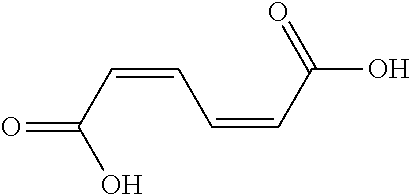
[0054]cis,cis-muconic acid (ccMA): Also referred to as muconate. A precursor of adipic acid, which is utilized for nylon 6,6 production, and of terephthalic acid, which is used for polyethylene terephthalate (PET) production for bottles and textiles. ccMA has the structure:
[0056]Corynebacterium glutamicum: A non-pathogenic gram-positive rod-shaped bacterium that was originally identified as secreting glutamate and is currently used industrially for the production of several amino acids. An exemplary C. glutamicum genome sequence is GenBank Accession No. NZ_CP025533.
[0057]Heterologous: Originating from a different genetic source or species. A gene or nucleic acid that is heterologous to a prokaryotic cell originates from an organism or species other than the prokaryotic cell in which it is expressed or in a different genetic location, orientation, or in any other way modified from its natural sequence and location in the genome. Methods for introducing a heterologous gene or nucleic acid in a cell or organism are well known in the art, for example transformation with a nucleic acid, including electroporation, lipofection, particle gun acceleration, and homologous recombination.
[0058]Isolated: An “isolated” biological component (such as a nucleic acid molecule, protein, or cell) has been substantially separated or purified away from other biological components in the cell of the organism, or the organism itself, in which the component occurs, such as other chromosomal and extra-chromosomal DNA and RNA, proteins and cells. Nucleic acid molecules and proteins that have been “isolated” include nucleic acid molecules and proteins purified by standard purification methods. The term also embraces nucleic acid molecules and proteins prepared by recombinant expression in a host cell as well as chemically synthesized nucleic acid molecules and proteins.
[0059]It is understood that the term “isolated” does not imply that the component is free of trace contamination, and can include molecules that are at least 50% isolated, such as at least 50%, 55%, 60%, 65%, 70%, 75%, 80%, 85%, 90%, 95%, 98%, 99%, or even 100% isolated.
[0060]Modified: A “modified” nucleic acid or polypeptide is one that has a sequence that is not naturally occurring or has a sequence that is made by an artificial combination of two or more otherwise separated segments of sequence. A modified nucleic acid or polypeptide may be produced by chemical synthesis or artificial manipulation of isolated segments of nucleic acids, e.g., by genetic engineering or genetic editing techniques.
[0061]Operably linked: A first nucleic acid is operably linked to a second nucleic acid when the first nucleic acid is placed in a functional relationship with the second nucleic acid. For instance, a regulatory element is operably linked to a coding sequence if the regulatory element affects the transcription or expression of the coding sequence. Regulatory elements include regions such as promoters or portions thereof (such as −35 and/or −10 sites), transcription factor binding sites, operators, terminators and the like, that may be located upstream or downstream of a coding sequence.
[0062]Promoter: Promoters are sequences of DNA near the 5′ end of a gene that act as a binding site for RNA polymerase, and from which transcription is initiated. A promoter includes necessary nucleic acid sequences near the start site of transcription, such as, in the case of a polymerase II type promoter, a TATA element. In one embodiment, a promoter includes an enhancer. In another embodiment, a promoter includes a repressor element.
[0063]Transduced and Transformed: A vector “transduces” a cell when it transfers nucleic acid into the cell. A cell is “transformed” by a nucleic acid transduced into the cell when the DNA becomes stably replicated by the cell, either by incorporation of the nucleic acid into the cellular genome, or by episomal replication. As used herein, the term transformation encompasses all techniques by which a nucleic acid molecule is introduced into such a cell, including transformation with plasmid vectors, and introduction of naked DNA by electroporation, lipofection, and particle gun acceleration.
[0064]Vector: A nucleic acid molecule that can be introduced into a host cell, thereby producing a transformed or transduced host cell. Recombinant DNA vectors are vectors including recombinant DNA. A vector can include nucleic acid sequences that permit it to replicate in a host cell, such as an origin of replication. A vector can also include one or more selectable marker genes, a cloning site for introduction of heterologous nucleic acids, a promoter (for example for expression of an operably linked nucleic acid), and/or other genetic elements known in the art. Vectors include plasmid vectors, including plasmids for expression in Gram negative and Gram positive bacterial cells. Exemplary vectors include those for use in E. coli, P. putida, A. baylyi, and C. glutamicum.
II. Muconate Biosensors
[0065]Disclosed herein are biosensors for cis,cis-muconic acid. In some embodiments, the biosensors include a nucleic acid encoding a CatM protein, a promoter regulated by cis,cis-muconic acid (such as a CatM-regulated promoter; Pcat), and in some examples, a nucleic acid encoding a reporter. The nucleic acid encoding the reporter protein is operably linked to the promoter. In some embodiments, the CatM-encoding nucleic acid is also operably linked to the same promoter, but in other embodiments can be independently regulated from an independent promoter. A schematic diagram showing an exemplary cis,cis-muconic acid biosensor (in the context of a plasmid vector) is illustrated in
[0066]In some embodiments, the biosensor includes a nucleic acid encoding a CatM protein operably linked to a regulatory element including a modified Pcat promoter, wherein the modified Pcat promoter includes a nucleic acid sequence with at least 95% sequence identity (such as at least 95%, at least 96%, at least 97%, at least 98%, or at least 99% sequence identity) to SEQ ID NO: 9 or the complement thereof. The modified Pcat promoter is capable of producing a response in the presence of ccMA or ccMA precursors (e.g., benzoate or catechol). In some examples, the biosensor includes a modified Pcat promoter including a nucleic acid sequence including the nucleic acid sequence of SEQ ID NO: 9 or the complement thereof. In other examples, the modified Pcat promoter includes a nucleic acid sequence with at least 90% sequence identity (such as at least 91%, 92%, 93%, 94%, 95%, 96%, 97%, 98%, 99%, or more sequence identity) to SEQ ID NO: 10. In other examples, the promoter includes or consists of the nucleic acid sequence of SEQ ID NO: 10 or the complement thereof.
[0067]In other embodiments, the cis,cis-muconic acid biosensor includes a CatM protein operably linked to a regulatory element including a modified Pcat promoter including a nucleic acid sequence with at least 95% sequence identity (such as at least 95%, at least 96%, at least 97%, at least 98%, or at least 99% sequence identity) to SEQ ID NO: 11 or the complement thereof. In other examples, the promoter includes the nucleic acid sequence of SEQ ID NO: 11. In some examples, the promoter includes a nucleic acid sequence with at least 90% sequence identity (such as at least 91%, 92%, 93%, 94%, 95%, 96%, 97%, 98%, 99%, or 100% identity) to the nucleic acid sequence of SEQ ID NO: 4 or the complement thereof. In other examples, the promoter includes or consists of the nucleic acid sequence of SEQ ID NO: 4 or the complement thereof.
[0068]In some examples, the CatM protein encoded by the biosensor is an Acinetobacter baylyi CatM protein. In some examples, the CatM protein is encoded by a nucleic acid sequence with at least 90% sequence identity (such as at least 91%, 92%, 93%, 94%, 95%, 96%, 97%, 98%, 99%, or 100% identity) to the nucleic acid sequence of SEQ ID NO: 12. In some examples, the CatM protein includes one or more amino acid substitutions compared to the wild type protein. For example, the CatM protein may include an amino acid substitution at one or more of amino acid positions corresponding to amino acids 97, 127, 128, and 147 of SEQ ID NO: 7 (such as one or more of V97I, G127A. T128A and L147V).
[0069]In some embodiments, the biosensor includes a nucleic acid encoding a reporter protein operably linked to the modified Pear promoter. The reporter encodes a protein that generates a detectable output, such as an antibiotic resistance (e.g., genes for β-lactamase, streptomycin or kanamycin), fluorescence, bioluminescence (such as gene for a luciferase) or a color (such as gene for LacZ). In some examples, the reporter encodes a fluorescent protein, such as a green fluorescent protein (GFP). In one example, the reporter encodes a superfolder GFP (sfGFP). Other GFPs or related fluorescent proteins (such as eGFP, red fluorescent protein (RFP), superfolder RFP (sfRFP), mCherry, sfCherry, mStrawberry, mOrange, or dTomato) can also be used as a reporter in the disclosed biosensors. In some examples, the reporter is a sfGFP and the protein is encoded by a nucleic acid sequence with at least 90% sequence identity (such as at least 91%, 92%, 93%, 94%, 95%, 96%, 97%, 98%, 99%, or 100% identity) to the nucleic acid sequence of SEQ ID NO: 8.
[0070]In some embodiments, the cis,cis-muconic acid biosensors provided herein are incorporated into a vector, into an autonomously replicating plasmid or virus, or into the genomic DNA of a host cell, or which exists as a separate molecule independent of other sequences. In some examples, the vector including the biosensor includes a nucleic acid sequence with at least 95% sequence identity (such as at least 95%, at least 96%, at least 97%, at least 98%, or at least 99% sequence identity) to SEQ ID NO: 9 or SEQ ID NO: 11 or includes the nucleic acid sequence of SEQ ID NO: 9 or SEQ ID NO: 11. In other examples, the including the vector including the biosensor includes a nucleic acid sequence with at least 95% sequence identity (such as at least 95%, at least 96%, at least 97%, at least 98%, or at least 99% sequence identity) to SEQ ID NO: 10 or SEQ ID NO: 4 or includes the nucleic acid sequence of SEQ ID NO: 10 or SEQ ID NO: 4. In some examples, the vector includes a nucleic acid sequence with at least 90% identity (such as at least 91%, 92%, 93%, 94%, 95%, 96%, 97%, 98%, 99%, or 100% identity) to the nucleic acid sequence of SEQ ID NO: 5 or the complement thereof. In other examples, the vector includes a nucleic acid sequence with at least 95% identity (such as at least 95%, 96%, 97%, 98%, 99%, or 100% identity) to SEQ ID NO: 6 or the complement thereof. In other examples, the vector includes or consists of the nucleic acid sequence of SEQ ID NO: 6.
[0071]In some non-limiting examples, the vector also includes one or more of an origin of replication, a nucleic acid encoding a replication initiator protein (such as RepA or a temperature-sensitive RepA), a nucleic acid encoding an antibiotic resistance gene (such as chloramphenicol resistance or apramycin resistance), a transcription terminator (such as a dual transcription terminator), or other features. In particular examples, the vector encodes a replicase. One of ordinary skill in the art will recognize that these portions of the vector can be altered (for example, modified or replaced) with other appropriate components.
[0072]Vectors for cloning, replication, and/or expression of the disclosed nucleic acid molecules include bacterial plasmids, such as bacterial cloning or expression plasmids. Exemplary bacterial plasmids into which the nucleic acids can be cloned include E. coli plasmids, such as pBR322, pUC plasmids (such as pUC18 or pUC19), pBluescript. pACYC184, pCD1, pGEM® plasmids (such as pGEM®-3, pGEM®-4, pGEM-T® plasmids; Promega, Madison, WI), TA-cloning vectors, such as pCR® plasmids (for example, pCR® II, pCR® 2.1, or pCR® 4 plasmids; Life Technologies, Grand Island, NY) or pcDNA plasmids (for example pcDNA™3.1 or pcDNA™3.3 plasmids; Life Technologies). In some examples, the vector includes a heterologous promoter which allows protein expression in bacteria. Exemplary vectors include pET vectors (for example, pET-21b), pDEST™ vectors (Life Technologies), pRSET vectors (Life Technologies), pBAD vectors, and pQE vectors (Qiagen). The disclosed nucleic acids can also be cloned into B. subtilis plasmids, for example, pTA1060 and pHT plasmids (such as pHT01, pHT43, or pHT315 plasmids). In some examples, the vector is a broad host range vector, such as pBTBX vectors (Prior et al., Biotechnol. Bioeng. 106:326-332, 2010), pBTL vectors (Lynch et al., Biotechnol. Bioeng. 94:151-158, 2006), or BAVIK vectors (Murin et al., Appl. Env. Microbiol. 78:280-283, 2012). In some examples, the vector is based on vector pBTL-2 (Addgene plasmid #22806) or vector pBAVIK-PT5-gfp (Addgene plasmid #26702), or pCRA1 (Kotrba et al., Biochem. Biophys. Res. Commun. 289:1307-1313, 2001) or pSFK6 (Nakamura et al., Plasmid 56:179-186, 2006), or pBL1 or pUL330 (Santamaria et al, J. Gen. Microbiol. 130:2237-2246, 1984), or pEKO or pEKEx1 (Eikmanns et al., Gene 102:93-98, 1991) or their derivatives such as pEKEx2 (JBEI-7909) and pEKEx3.
III. Host Cells
[0073]Also provided are host cells including a nucleic acid including one or more of the disclosed cis,cis-muconic acid biosensors or vectors including one or more of the disclosed cis,cis-muconic acid biosensors. In some embodiments, the cells are bacterial cells. Bacterial cells are available from numerous sources, including commercial sources known to those skilled in the art, such as the American Type Culture Collection (ATCC; Manassas, VA). Commercial sources of cells used for recombinant protein expression also provide instructions for usage of such cells.
[0074]In particular non-limiting examples, the bacterial cells are Corynebacterium glutamicum cells. In one example, the cells are C. glutamicum strain 534 cells (ATCC 13032; see also U.S. Pat. No. 3,002,889). In some examples, the C. glutamicum cells are modified to increase accumulation of cis,cis-muconic acid in the cells. In some examples, the cells have an inactive or deleted catB gene, which decreases or prevents conversion of cis,cis-muconic acid to muconolactone. In other examples, the cells include overexpression of the catA gene, which increases conversion of catechol to cis,cis-muconic acid. In some other examples, the cells include overexpression of the qsuB gene or a heterologous dehydroshikimate dehydratase gene (such as asbF from Bacillus cereus or Bacillus thuringiensis) along with a heterologous gene for protocatechuate decarboxylase (such as aroY from Enterobacter cloacae) to convert a metabolic intermediate dehydroshikimate (in shikimate pathway) to catechol.
[0075]In some examples, the cis,cis-muconic acid biosensor nucleic acid or vector including the cis,cis-muconic acid biosensor nucleic acid is introduced extrachromosomally and replicated within the host cell. In other examples, after introduction of the plasmid, a double homologous recombination event occurs and the one or more genes are inserted into the genome of the host cell.
[0076]Transformation of a bacterial cell with recombinant DNA can be carried out by techniques known to those skilled in the art. Where the host is bacterial, competent cells which are capable of DNA uptake can be prepared from cells harvested after exponential growth phase and subsequently treated by the CaCl2) method using procedures well known in the art. Alternatively, MgCl2 or RbCl can be used. Bacteria can also be transformed by methods including heat shock, electroporation, conjugation, or transduction.
IV. Methods of Use
[0077]Also disclosed herein are methods of utilizing the disclosed cis,cis-muconic acid biosensors or cells expressing the disclosed cis,cis-muconic acid biosensors. In some embodiments, the methods include detecting production of cis,cis-muconic acid in a sample. In other embodiments, the methods include detecting presence of cis,cis-muconic acid in the environment of a cell.
[0078]In some examples, the methods can be used to detect or identify improved or increased production of cis,cis-muconic acid by a cell and/or improved or increased transport of cis,cis-muconic acid into the cell. For example, cells including the cis,cis-muconic acid biosensor can be transformed with one or more variants (such as a library of variants) of one or more of the enzymes involved in production of cis,cis-muconic acid (such as DAHP synthase (encoded by aroG or homologs), dehydroshikimate dehydratase (encoded by qsuB or asbF), PCA decarboxylase (encoded by aroY), catechol 1,2-dioxygenase (encoded by catA), benzoate 1,2-dioxygenase (encoded by benABC), or benzoate 1,2-cis-dihydrodiol dehydrogenase (encoded by benD)) and can be screened for increased production of cis,cis-muconic acid, to identify variants with desirable properties. In other embodiments, the genome of cells including the biosensor can be mutated (for example by chemical or ultraviolet mutagenesis) in order to produce a population of cells with a plurality of genotypic variants. Cells that have improved or increased production of cis,cis-muconic acid can be selected and isolated, for example, based on detection of increased reporter output.
[0079]In some examples, bacterial cells (e.g., C. glutamicum cells) are transformed with a vector including a disclosed biosensor. In other examples, the cells are transformed with variants of the biosensor (such as a library encoding variants of the biosensor). The cells are screened for presence and/or amount of cis,cis-muconic acid by detecting output of the reporter, such as fluorescence. In some examples, cells including a disclosed biosensor are cultured under conditions sufficient for detection of cis,cis-muconic acid or production of cis,cis-muconic acid and output of the reporter is detected. In some examples, the cells are cultured in the presence of a precursor of muconate in C. glutamicum, such as benzoate or catechol. In one example, the reporter is a fluorescent protein (such as a GFP, for example, sfGFP), and fluorescence is detected.
[0080]Samples can be screened for production of or presence of cis,cis-muconic acid via either flow cytometry or a fluorescence microplate reader (Jha et al., Nucl. Acids Res. 42:8150-8160, 2014) or on a solid growth media (e.g., petri dish; Jha et al., ACS Syn. Biol. 9:1234-1239, 2020) and selection based on the fluorescence of the individual cell (for flow cytometry or a fluorescence microplate reader) or fluorescence (or other visually detectable signal) of the colonies on a solid growth media. If the reporter gene in the sensor plasmid is a survival enhancing gene (for example the protein product of the gene provides resistance to a suitable antibiotic or the protein product of the gene provides a suitable nutrient to the auxotroph), the screening can be carried out based on growth characteristics, such as the growth rate. If the reporter gene is for a hydrolytic enzyme (for example lacZ), the colonies on a petri dish will produce intense blue color suitable for screening if the growth medium is supplemented with 5-bromo-4-chloro-3-indolyl-β-D galactopyranoside (X-gal).
EXAMPLES
[0081]The following examples are provided to illustrate certain particular features and/or embodiments. These examples should not be construed to limit the disclosure to the particular features or embodiments described.
Example 1
Generation of a Muconate Biosensor for Use in Corynebacterium glutamicum
[0082]A muconate biosensor was constructed using the muconate-responsive transcription factor CatM, such that transcription of a reporter (superfolder GFP; sfgfp) was under the control of a Pcat promoter including three CatM binding sites, referred to as operator (CatMO). The Pcat promoter was placed between the catM and sfgfp genes (
[0083]A modified Pcat promoter that was active in C. glutamicum was identified. The promoter included changes in the −35 and −10 sites, as well as other changes compared to the original A. baylyi Pcat and the P. putida Pcat (
Example 2
Characterization of a Muconate Biosensor
[0084]C. glutamicum ATCC 13032 (AcatB) strain including plasmid pRJ2010 was designated RJ95A and stored as glycerol stocks. For characterization, RJ95A was grown overnight from the glycerol stock in BHIS medium (brain heart infusion with sorbitol) supplemented with 10 μg/mL of chloramphenicol (Cm10). The overnight seed culture was then transferred into fresh BHIS+Cm10 media in a culture tube and grown to an OD (600 nm) of 0.6 at 30° C. and continuous shaking at 225 rpm. The culture was then split in a volume of 180 μL per well into a deep-well 96 well plate containing inducers (muconate or benzoate and catechol as muconate precursors, protocatechuate (PCA) as a negative control) to give a final concentration ranging from 0.01 mM to 10 mM in triplicate wells. The plate was incubated overnight at 1000 rpm and 30° C. in a deep-well maximizer shaker (Taitec Bioshaker MBR-022UP). In order to measure the fluorescence of the cells at different inducer concentration, 5 μL of overnight culture was diluted into 200 μL of 1×PBS (phosphate buffered saline) buffer and read using Accuri C6 (BD Biosciences) using standard setting for GFP fluorescence. The FSC/SSC (FSC measures forward scatter representing the size of the cell, and SSC measures side scatter representing the granularity of the cells) scatter plot was gated appropriately to represent C. glutamicum cells and mean fluorescence of the cells in the gate was noted as the biosensor response.
[0085]The biosensor (plasmid construct pCg_CatM_C2), when tested in ccMA accumulating strain (C. glutamicum 13032 AcatB), showed a clear dose-response with a ccMA precursor such as benzoate (
[0086]At concentrations higher than 1 mM, the aromatic precursors most likely were toxic to the cells, resulting in drop in fluorescence response (
Example 3
Temperature Sensitive Biosensor for Rapid Curing
[0087]While biosensor tools provide advantages in elevating throughput to rapidly arrive to an optimized strain, it is necessary to cure the strain of the biosensor after the strain optimization efforts. In order to establish a protocol for curing strains of biosensor plasmid, the sensor-reporter cassette from the ccMA biosensor plasmid pRJ2010 was ported to a vector containing BL1's that consists of a replicase RepA with mutation Pro→Ser (Nakamura et al., Plasmid 56:179-186, 2006). The plasmid pJV4 (
[0088]In view of the many possible embodiments to which the principles of the disclosure may be applied, it should be recognized that the illustrated embodiments are only examples and should not be taken as limiting the scope of the invention. Rather, the scope of the invention is defined by the following claims. We therefore claim as our invention all that comes within the scope and spirit of these claims.
Claims
We claim:
1. A cis,cis-muconic acid biosensor comprising a nucleic acid encoding a HTH-type transcriptional regulator CatM (CatM) protein operably linked to a regulatory element comprising a modified Pcat promoter, wherein the modified Pcat promoter comprises a nucleic acid sequence with at least 98% sequence identity to SEQ ID NO: 9 or SEQ ID NO: 11.
2. The cis,cis-muconic acid biosensor of
3. The cis,cis-muconic acid biosensor of
4. The cis,cis-muconic acid biosensor of
5. The cis,cis-muconic acid biosensor of
6. The cis,cis-muconic acid biosensor of
7. The cis,cis-muconic acid biosensor of
8. The cis,cis-muconic acid biosensor of
9. A vector comprising the cis,cis-muconic acid biosensor of
10. The vector of
11. A host cell comprising the cis,cis-muconic acid biosensor of
12. A host cell comprising the vector of
13. The host cell of
14. The host cell of
15. The host cell of
16. A method of detecting cis,cis-muconic acid, comprising:
culturing the host cell of
detecting output of the reporter protein.
17. The method of
18. The method of
19. The method of