US12674025B2 · App 18/168,162
Branched type hetero monodispersed polyethylene glycol, production method thereof, and conjugate thereof
Publication
Application
Classifications
IPC Classifications
CPC Classifications
Applicants
TOKYO INSTITUTE OF TECHNOLOGY, NOF CORPORATION
Inventors
Kazushi Kinbara, Tomoki Uruga, Tomoyuki Ohtake
Abstract
An intermediate for production of a branched type hetero monodispersed polyethylene glycol which is represented by formula (2), the intermediate being represented by formula (3) or (40):
where X 1 , L 1 , L 3 , Y 1 , Y 2 , and n are as defined herein.
Get a summary, plain-language explanation, or ask your own question.
Description
CROSS REFERENCE TO RELATED APPLICATIONS
[0001]This application is a Divisional Application of Ser. No. 16/338,873 filed Apr. 2, 2019, which is a National Stage of International Application No. PCT/JP2017/036479 filed Oct. 6, 2017, which claims priority based on Japanese Patent Application No. 2016-198654 filed Oct. 7, 2016. The contents of all of the above prior applications are incorporated herein by reference in their entireties.
TECHNICAL FIELD
[0002]The present invention relates to a branched type hetero monodispersed polyethylene glycol, an intermediate for production of the branched type hetero monodispersed polyethylene glycol and methods for producing these, and a branched type hetero monodispersed polyethylene glycol conjugate. More specifically, it relates to a branched type hetero monodispersed polyethylene glycol, which is used for modification of a biofunctional polymer, a drug or a drug carrier in a drug delivery system, a material or device for diagnosis and the like and in particular, which is useful as a linker for antibody-drug conjugate.
BACKGROUND ART
[0003]In recent years, an antibody-drug conjugate (Antibody-Drug Conjugate: ADC), in which a drug is conjugated to an antibody through a linker and which is capable of actively transporting the drug to an antigen-presenting cell, is practically used and has attracted high attention in the field of pharmaceuticals (Toxins, 2011, 3, p. 848-883 (Non-Patent Document 1), J. Med. Chem., 2011, 54, p. 3606-3623 (Non-Patent Document 2)).
[0004]Since many of the drugs are commonly hydrophobic, when they are used as ADC, aggregation sometimes occurs. Therefore, one of the linkers which have been investigated is a hetero type monodispersed polyethylene glycol which is a hydrophilic linker.
[0005]The hetero type monodispersed polyethylene glycol means a compound which has functional groups different from each other at both terminals (hetero type) in order to separately conjugate a drug and an antibody to each of the terminals and contains 90% or more of a compound having a specific ethylene glycol chain length in order to simplify the drug application and the production, purification and analysis of ADC.
[0006]In the ADC described above, since an antibody and a drug are separately conjugated to each of the terminals of the hetero type monodispersed polyethylene glycol described above as a linker, when a compound having the mutually same functional groups at the both terminals (homo type polyethylene glycol or the like) is present as an impurity in the hetero type monodispersed polyethylene glycol described above, a compound having two antibodies conjugated or a compound having two drugs conjugated is generated. The compound having two antibodies conjugated does not exhibit the effect of ADC because the drug is not conjugated. The compound having two drugs conjugated is transported to a position other than the antigen-presenting cell to be a cause of side effects because the antibody is not conjugated. Further, the same problems as described above also arise in the case where other hetero type compound having functional groups in combination different from a hetero type polyethylene glycol having the desired functional groups is present as an impurity, because a compound losing either the desired antibody or the desired drug is generated. Therefore, from the standpoint of use and effect of the drug, it can be said to be important that the hetero type monodispersed polyethylene glycol described above contains a hetero type polyethylene glycol having the different functional groups each other at the both terminals thereof in high purity, that is, the functional group purity is high.
[0007]Further, in recent years, for the purpose of increasing the transport efficiency of the drug in ADC described above, it has been desired to use ADC in which a plurality of drugs are conjugated to an antibody and a method of using a linker having a branched type structure has been tried as one means.
[0008]For example, in Patent Document 1 (US20130052130A1) a branched type hetero monodispersed polyethylene glycol in which three of four ethylene glycol chains described above are introduced by conjugating the monodispersed polyethylene glycols to a branching site composed of trishydroxyaminomethane (Tris) or an amino acid, for example, lysine is disclosed.
[0009]Further, in Patent Document 2 (CN104530415A) a branched type hetero monodispersed polyethylene glycol in which three ethylene glycol chains described above are introduced by conjugating the monodispersed polyethylene glycols to a branching site composed of glycerol or thioglycerol is disclosed.
[0010]In Patent Document 1 and Patent Document 2, in common, the monodispersed polyethylene glycols are conjugated to all conjugating points of the branch site and a functional group conjugatable to an antibody or a drug is conjugated to the end of the polyethylene glycol. This can be schematically shown as below:
(X-PEG1-)n-B-PEG2-Y
(in the formula, X and Y each represents a functional group different from each other, and n represents an integer of 2 or 3. B represents a branch skeleton. PEG1 and PEG2 each represents a straight-chain type monodispersed polyethylene glycol.)
[0011]In Patent Document 1 and Patent Document 2, as a method of obtaining the branched type hetero monodispersed polyethylene glycol described above, a method in which two kinds of straight-chain type monodispersed polyethylene glycols having the terminal functional groups different form each other (X-PEG1 and PEG2-Y) are prepared, and first X-PEG1 and a branch site are reacted and then PEG2-Y is reacted or first PEG2-Y and a branch site are reacted and then X-PEG1 is reacted is described. An example of the case where first PEG2-Y and a branch site are reacted is shown in the formulae below.
First Step
B+PEG2-Y→B-PEG2-Y
Second Step
X-PEG1+B-PEG2-Y→(X-PEG1-)n-B-PEG2-Y
(in the formulae, X and Y each represents a functional group different from each other, and n represents an integer of 2 or 3. B represents a branch site. PEG1 and PEG2 each represents a straight-chain type monodispersed polyethylene glycol.)
[0012]In the production of branched type hetero monodispersed polyethylene glycol described above, there is a possibility of remaining PEG2-Y in the reaction between the branch site B and PEG2-Y in the first step as shown in the formula below. This compound has the same functional group as the desired branched type hetero monodispersed polyethylene glycol at only one terminal. Therefore, when the branched type hetero monodispersed polyethylene glycol containing the monodispersed polyethylene glycol excessively added is used for the production of ADC, because of low functional group purity, a compound losing either the desired antibody or the desired drug is generated to cause decrease in effectiveness as drug.
B+PEG2-Y→+B-PEG2-Y+PEG2-Y
[0013]Further, there is a possibility of remaining X-PEG1 excessively added in the reaction with X-PEG1 in the second step as shown in the formula below. This compound has the same functional group as the desired branched type hetero monodispersed polyethylene glycol at only one terminal. Therefore, when the branched type hetero monodispersed polyethylene glycol containing the monodispersed polyethylene glycol excessively added is used for the production of ADC, because of low functional group purity, a compound losing either the desired antibody or the desired drug is generated to cause decrease in effectiveness as drug.
X-PEG1+B-PEG2-Y→(X-PEG1-)n-B-PEG2-Y+X-PEG1
PRIOR ART DOCUMENTS
Patent Documents
- [0014]Patent Document 1: US20130052130A1
- [0015]Patent Document 2: CN104530415A
Non-Patent Document
- [0016]Non-Patent Document 1: Toxins, 2011, 3, p. 848-883
- [0017]Non-Patent Document 2: J. Med. Chem., 2011, 54, p. 3606-3623
SUMMARY OF THE INVENTION
Problems to be Solved by the Invention
[0018]As described above, because in the branched type hetero monodispersed polyethylene glycols described in Patent Document 1 and Patent Document 2 it is necessary to react two kinds of straight-chain type monodispersed polyethylene glycols having different terminal functional groups in the two steps, due to the remaining of the straight-chain type monodispersed polyethylene glycol excessively added, the purity of the desired branched type hetero monodispersed polyethylene glycol decreases and there is a possibility that a problem may arise in view of use and effect of drug.
[0019]Further, as a method of purifying the branched type hetero monodispersed polyethylene glycol, recrystallization, column purification and the like are exemplified. In Patent Document 1 and Patent Document 2, the monodispersed polyethylene glycol excessively added (PEG2-Y and X-PEG1) is removed by column chromatography. However, since the monodispersed polyethylene glycols having the same terminal functional group have similar physical properties even when the chain lengths are different, the column purification is difficult to cause decrease in the yield.
[0020]An object of the invention is to obtain a branched type hetero monodispersed polyethylene glycol having functional groups different from each other at the both terminals thereof in high purity, an intermediate for production of the branched type hetero monodispersed polyethylene glycol described above, a hetero type monodispersed polyethylene glycol conjugate in which the branched type hetero monodispersed polyethylene glycol and a biofunctional molecule are conjugated, and an intermediate for production of the branched type hetero monodispersed polyethylene glycol described above.
Means for Solving the Problems
[0021]As a result of the intensive investigations to achieve the object described above, the inventors have found that a branched type monodispersed polyethylene glycol which has functional groups different from each other at the both terminals thereof in high purity and in which a monodispersed polyethylene glycol is not conjugated to one of three conjugating points of the branch site as shown in formula (1) can be obtained. Further, the inventors have found that a branched type hetero monodispersed polyethylene glycol having functional groups different from each other at the both terminals thereof in high purity can be obtained only with a simple separatory extraction and without using a purification method, for example, column chromatography by synthesizing an intermediate for producing the branched type hetero monodispersed polyethylene glycol described above using a specific functional group at the terminal to complete the invention.
- [0023](1) A branched type hetero monodispersed polyethylene glycol represented by formula (1):

(in formula (1),
- [0025]X1 and Y1 each represents an atomic group containing at least a functional group capable of reacting with a functional group present in a biofunctional molecule to form a covalent bond, provided that the functional group contained in the atomic group X1 and the functional group contained in the atomic group Y1 are different from each other,
- [0026]n is an integer of 6 to 30,
- [0027]E is a branch site having a divalent bond valence number to L2 and a monovalent bond valence number to L3 and represents a glycerol site,
- [0028]L1 and L2 each independently represents a single bond or a divalent organic group, and
- [0029]L3 represents a single bond, —L4-(CH2)m1— or —L4—(CH2)m2—L5—(CH2)m3—, L4 represents any of an ether bond, an amide bond and a urethane bond, L5 represents an amide bond or a urethane bond, and m1, m2 and m3 each independently represents an integer of 1 to 5.)
- [0030](2) The branched type hetero monodispersed polyethylene glycol of (1), wherein L3 represents —L4—(CH2)m1— or —L4—(CH2)m2—L5—(CH2)m3—, L4 represents any of an ether bond, an amide bond and a urethane bond, L5 represents an amide bond or a urethane bond, and m1, m2 and m3 each independently represents an integer of 1 to 5.
- [0031](3) The branched type hetero monodispersed polyethylene glycol of (1) or (2), wherein L2 in formula (1) is an ether bond.
- [0032](4) The branched type hetero monodispersed polyethylene glycol of (1) or (2), which is represented by formula (2):

(in formula (2),
- [0034]X1 and Y1 each represents an atomic group containing at least a functional group capable of reacting with a functional group present in a biofunctional molecule to form a covalent bond, provided that the functional group contained in the atomic group X1 and the functional group contained in the atomic group Y1 are different from each other,
- [0035]n is an integer of 6 to 30,
- [0036]L1 represents a single bond or a divalent organic group, and
- [0037]L3 represents a single bond, —L4—(CH2)m1— or —L4—(CH2)m2—L5—(CH2)m3—, L4 represents any of an ether bond, an amide bond and a urethane bond, L5 represents an amide bond or a urethane bond, and m1, m2 and m3 each independently represents an integer of 1 to 5.)
- [0038](5) An intermediate for production of the branched type hetero monodispersed polyethylene glycol of (4), which is represented by formula (3):

(in formula (3),
- [0040]n represents an integer of 6 to 30, and
- [0041]Y2 represents —NH2 or —O—(CH2)m4—NH2, and m4 represents an integer of 1 to 5.)
- [0042](6) A method of producing the intermediate for production of the branched type hetero monodispersed polyethylene glycol of (5) comprising:
- [0043]step (1) of performing coupling of a monodispersed polyethylene glycol derivative represented by formula (4) shown below with a compound represented by formula (5) shown below using a base catalyst having a pKa in an aqueous solution of 15 to 20 to obtain a compound represented by formula (6) shown below,
A—(OCH2CH2)n—B (4)
(in formula (4), - [0044]A represents a protective group for a hydroxyl group,
- [0045]B represents a leaving group, and
- [0046]n represents an integer of 6 to 30),
- [0043]step (1) of performing coupling of a monodispersed polyethylene glycol derivative represented by formula (4) shown below with a compound represented by formula (5) shown below using a base catalyst having a pKa in an aqueous solution of 15 to 20 to obtain a compound represented by formula (6) shown below,

(in formula (5),
- [0048]Z represents —Z1 or —O—(CH2)m5—Z1, Z1 represents any of a protected form of an amino group, an azide group and a cyano group, and m5 represents an integer of 1 to 5),

(in formula (6),
- [0050]A represents a protective group for a hydroxyl group,
- [0051]Z represents —Z1 or —O—(CH2)m5—Z1, Z1 represents any of a protected form of an amino group, an azide group and a cyano group, and m5 represents an integer of 1 to 5, and
- [0052]n represents an integer of 6 to 30);
- [0053]step (2) of deprotecting the protective group A of the compound represented by formula (6) to obtain a compound represented by formula (7) shown below,
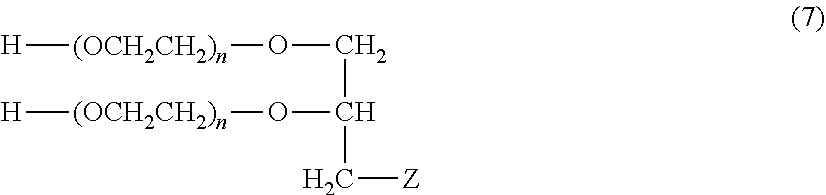
(in formula (7),
- [0055]Z represents —Z1 or —O—(CH2)m5—Z1, Z1 represents any of a protected form of an amino group, an azide group and a cyano group, and m5 represents an integer of 1 to 5, and
- [0056]n represents an integer of 6 to 30);
- [0057]step (3) of subjecting the compound represented by formula (7) to separatory purification; and
- [0058]step (4) of subjecting the compound represented by formula (7) to deprotection treatment or reduction treatment to obtain the intermediate for production of the branched type hetero monodispersed polyethylene glycol represented by formula (3), in the order described above.
- [0059](7) The method of (6), wherein the base catalyst is any of potassium hydroxide, sodium hydroxide, potassium tert-butoxide and sodium tert-butoxide.
- [0060](8) A branched type hetero monodispersed polyethylene glycol conjugate in which a biofunctional molecule is conjugated to the branched type hetero monodispersed polyethylene glycol of any one of (1) to (4).
- [0061](9) An intermediate for production of the branched type hetero monodispersed polyethylene glycol of (4), which is represented by formula (40):

(in formula (40),
- [0063]n represents an integer of 6 to 30, and
- [0064]Y2 represents —NH2 or —O—(CH2)m4—NH2, and m4 represents an integer of 1 to 5.)
- [0065](10) A method of producing the intermediate for production of the branched type hetero monodispersed polyethylene glycol of (9) comprising:
- [0066]step (1′) of performing coupling of a monodispersed polyethylene glycol derivative represented by formula (41) shown below with a compound represented by formula (42) shown below using a base catalyst having a pKa in an aqueous solution of 15 to 20 to obtain a compound represented by formula (43) shown below,
Z—CH2CH2—(OCH2CH2)n-1—B (41)
(in formula (41), - [0067]Z represents —Z1 or —O—(CH2)m5—Z1, Z1 represents any of a protected form of an amino group, an azide group and a cyano group, and m5 represents an integer of 1 to 5,
- [0068]B represents a leaving group, and
- [0069]n represents an integer of 6 to 30),
- [0066]step (1′) of performing coupling of a monodispersed polyethylene glycol derivative represented by formula (41) shown below with a compound represented by formula (42) shown below using a base catalyst having a pKa in an aqueous solution of 15 to 20 to obtain a compound represented by formula (43) shown below,

(in formula (42),
- [0071]A represents a protective group for a hydroxyl group),

(in formula (43),
- [0073]A represents a protective group for a hydroxyl group,
- [0074]Z represents —Z1 or —O—(CH2)m5—Z1, Z1 represents any of a protected form of an amino group, an azide group and a cyano group, and m5 represents an integer of 1 to 5, and
- [0075]n represents an integer of 6 to 30);
step (2′) of deprotecting the protective group A of the compound represented by formula (43) to obtain a compound represented by formula (44) shown below,

(in formula (44),
- [0077]Z represents —Z1 or —O—(CH2)m5—Z1, Z1 represents any of a protected form of an amino group, an azide group and a cyano group, and m5 represents an integer of 1 to 5, and
- [0078]n represents an integer of 6 to 30);
- [0079]step (3′) of subjecting the compound represented by formula (44) to deprotection treatment or reduction treatment to obtain the intermediate for production of the branched type hetero monodispersed polyethylene glycol represented by formula (40); and
- [0080]step (4′) of subjecting the compound represented by formula (40) to separatory purification, in the order described above.
- [0081](11) The method of (10), wherein the base catalyst is any of potassium hydroxide, sodium hydroxide, potassium tert-butoxide and sodium tert-butoxide.
Effect of the Invention
[0082]Since the compound represented by formula (1) described above or formula (2) described above of the invention has functional groups different from each other at the both terminals thereof in high purity, when it is used as ACD, generation of a compound losing either the desired antibody or the desired drug is suppressed so that the increase in the effect of ADC is expected.
[0083]Further, in the method of producing the compound represented by formula (1) described above or formula (2) described above of the invention, since a monodispersed polyethylene glycol is not conjugated to one of three conjugating points of the branch site, the compound represented by formula (1) described above or formula (2) described above having functional groups different from each other at the both terminals thereof in high purity can be easily obtained.
[0084]Moreover, in the method of producing the compound represented by formula (3) described above of the invention, since a side reaction is suppressed by using a specific base catalyst in step (1) described above and impurities derived from the compound represented by formula (4) described above excessively added in step (1) can be removed only with separatory purification by performing step (1) to step (4) described above in this order, the compound represented by formula (3) described above having high chain length purity and high functional group purity can be easily obtained.
[0085]Furthermore, since a side reaction is suppressed by using a specific base catalyst in step (1′) described above and impurities derived from the compound represented by formula (41) described above excessively added in step (1′) can be removed only with separatory purification by performing step (1′) to step (4′) described above in this order, the compound represented by formula (40) described above having high chain length purity and high functional group purity can be easily obtained.
MODE FOR CARRYING OUT THE INVENTION
[0086]Preferred embodiments of the invention will be described in detail hereinafter.
[0087]The branched type hetero monodispersed polyethylene glycol according to the invention is a compound which has two kinds of functional groups at the terminals in high purity and a monodispersed polyethylene glycol is not conjugated to one of three conjugating points of the branch site. Further, the terminal functional group of high purity means that purity of the compound having a specific combination of functional groups (hereinafter, referred to as functional group purity) is 95% or more. Moreover, a monodispersed polyethylene glycol means that purity of the compound having a specific ethylene glycol chain length (hereinafter, referred to as chain length purity) is 90% or more.
[0088]The branched type hetero monodispersed polyethylene glycol is represented by formula (1).

[0090]In formula (1), X1 and Y1 each represents an atomic group containing at least a functional group capable of reacting with a functional group present in a biofunctional molecule to form a covalent bond, provided that the functional group contained in the atomic group X1 and the functional group contained in the atomic group Y1 are different from each other. n represents a number of repeating units of a monodispersed polyethylene glycol and is an integer of 6 to 30. E is a branch site having a divalent bond valence number to L1 and a monovalent bond valence number to L3 and represents a glycerol site. L1 and L2 each independently represents a single bond or a divalent organic group. L3 represents a single bond, —L4—(CH2)m1— or —L4—(CH2)m2—L5—(CH2)m3—, L4 represents any of an ether bond, an amide bond and a urethane bond, L5 represents an amide bond or a urethane bond, and m1, m2 and m3 each independently represents an integer of 1 to 5.
[0091]In formula (1) described above, X1 and Y1 are functional groups different from each other and the functional group is not particularly limited as long as it is a functional group capable of forming a covalent bond by reacting with a functional group present in a biofunctional molecule (protein drug, polypeptide, enzyme, antibody, antibody drug, gene, nucleic acid compound including oligonucleic acid or the like, nucleic acid drug, anticancer drug, and other drugs, for example, low molecular weight drug), which is a target for modification by the branched type hetero monodispersed polyethylene glycol. Among them, X1 and Y1 each independently is preferably a functional group capable of reacting under mild conditions and with a high reaction efficiency with a group (for example, an amino group, a thiol group, an aldehyde group or a carboxyl group) present in a naturally occurring biofunctional molecule represented by protein or a group (for example, a maleimide group, a ketone group, an azide group or an alkynyl group) capable of artificially introducing into the biofunctional molecule. More specifically, it is preferably an aldehyde group, a maleimide group, a vinylsulfone group, an iodoacetamide group, a bromoacetamide group, an active ester group, an active carbonate group, a carboxyl group, an amino group, an aminooxy group, a thiol group, an allyl group, a vinyl group, an alkynyl group or an azide group. Further, taking the reaction efficiency and the like into consideration, X1 and Y1 each is more preferably a maleimide group, an active ester group, an active carbonate group, an alkynyl group, an azide group, an iodoacetamide group or a bromoacetamide group.
[0092]Further, X1 and Y1 each independently is preferably an aldehyde group, an active ester group, an active carbonate group, a carboxyl group or a ketone group in the case where the functional group present in the biofunctional molecule targeted is an amino group; a maleimide group, a vinylsulfone group, an iodoacetamide group, a bromoacetamide group, an allyl group or a vinyl group in the case where the functional group present in the biofunctional molecule targeted is a thiol group; an amino group in the case where the functional group present in the biofunctional molecule targeted is an aldehyde group or a ketone group; an amino group, an aminooxy group or a thiol group in the case where the functional group present in the biofunctional molecule targeted is a carboxyl group; a thiol group in the case where the functional group present in the biofunctional molecule targeted is a maleimide group; an alkynyl group in the case where the functional group present in the biofunctional molecule targeted is an azide group; and an azide group in the case where the functional group present in the biofunctional molecule targeted is an alkynyl group.
[0093]As to a preferred combination of X1 and Y1, for example, when X1 is an active ester group, Y1 is preferably a maleimide group, an azide group, an alkynyl group, an iodoacetamide group, a bromoacetamide group, a vinylsulfone group, an oxyamino group, a thiol group, an allyl group or a vinyl group; when X1 is an active carbonate group, Y1 is preferably a maleimide group, an azide group, an alkynyl group, an iodoacetamide group, a bromoacetamide group, a vinylsulfone group, an oxyamino group, a thiol group, an allyl group or a vinyl group; when X1 is a maleimide group, Y1 is preferably an active ester group, an active carbonate group, an azide group, an alkynyl group, an aldehyde group, a carboxyl group, an amino group, an oxyamino group or a ketone group; when X1 is an azide group, Y1 is preferably an active ester group, an active carbonate group, a maleimide group, an iodoacetamide group, a bromoacetamide group, an aldehyde group, a vinylsulfone group, a carboxyl group, an amino group, an oxyamino group, a thiol group, an allyl group, a vinyl group or a ketone group; when X1 is an alkynyl group, Y1 is preferably an active ester group, an active carbonate group, a maleimide group, an iodoacetamide group, a bromoacetamide group, an aldehyde group, a vinylsulfone group, a carboxyl group, an amino group, an oxyamino group, a thiol group, an allyl group, a vinyl group or a ketone group.
[0094]In formula (1) described above, L is a linker responsible for the conjugate between the polyethylene glycol chain and X1, is not particularly limited as long as it is a site composed of a covalent bond, and is preferably a single bond, a divalent saturated hydrocarbon group, a urethane bond, an amide bond, an ether bond, a carbonate bond or a divalent saturated hydrocarbon group containing a urethane bond, an amide bond, an ether bond or a carbonate bond. The saturated hydrocarbon group described above is preferably that containing 10 or less carbon atoms and includes, for example, a methylene group, an ethylene group, a trimethylene group, a propylene group, an isopropylene group, a tetramethylene group, a butylene group, an isobutylene group, a pentamethylene group and a hexamethylene group.
[0095]In formula (1), L3 is a linker responsible for the conjugate between Y1 and the branch site E and is represented by a single bond, —L4—(CH2)m1— or —L4—(CH2)m2—L5—(CH2)m3—. L4 represents any of an ether bond, an amide bond and a urethane bond, L5 represents an amide bond or a urethane bond, and m1, m2 and m3 each independently represents an integer of 1 to 5.
[0096]A preferred example of L3 in the invention in which L4 is an ether bond and L5 is an amide bond is represented by any of the following formulae:
—O—(CH2)m2—C(O)NH—(CH2)m3— (8)
—O—(CH2)m2—NHC(O)—(CH2)m3— (9)
[0097]The maleimide group in the invention is a group represented by the following formula including L1 or L3 and is a group which reacts with a nucleophilic group, for example, a thiol group.

[0099]In formula (10) described above, R1 is preferably a hydrogen atom or a methyl group, and more preferably a hydrogen atom.
[0100]In the case where X1 or Y1 is a maleimide group in the invention, a preferred example of —L1-X1 or —L3-Y1 is represented by the following formula:

[0102]In formula (11) described above, a represents an integer of 1 to 5, and R1 has the same meaning as R1 in formula (10) described above.
[0103]The active ester group in the invention is a group represented by the following formula including L1 or L3 and reacts with a nucleophilic group, for example, an amino group.

[0105]In formula (12) described above, R2 is preferably a phenyl group, a 3-pyridyl group, a succinimide group, a 2-benzothiazole group or a 1-benzotriazole group, more preferably a succinimide group or a 1-benzotriazole group, and most preferably a succinimide group.
[0106]In the case where X1 or Y1 is an active ester group in the invention, a preferred example of —L1-X1 or —L3-Y1 is represented by the following formula:

[0108]In formula (13) described above, b represents an integer of 1 to 5, and R2 has the same meaning as R2 in formula (12) described above.
[0109]The active carbonate group in the invention is a group represented by the following formula including L1 or L3 and reacts with a nucleophilic group, for example, an amino group.

[0111]In formula (14) described above, R3 is preferably a phenyl group, a 3-pyridyl group, a succinimide group, a 4-nitrophenyl group, a 2-benzothiazole group or a 1-benzotriazole group, more preferably a succinimide group or a 1-benzotriazole group, and most preferably a succinimide group.
[0112]In the case where X1 or Y1 is an active carbonate group in the invention, a preferred example of —L1-X1 or —L3-Y1 is represented by the following formula:

[0114]In formula (15) described above, R3 has the same meaning as R3 in formula (14) described above.
[0115]The alkynyl group in the invention is a group represented by any one of the following formulae including L1 or L2 and reacts with an azide group.

[0117]In the formula described above, R4 is preferably a saturated hydrocarbon group having 8 or less carbon atoms or a hydrogen atom and more preferably a hydrogen atom.
[0118]In the case where X1 or Y1 is an alkynyl group in the invention, a preferred example of —L1-X1 or —L3-Y1 is represented by the following formulae:

[0120]In formula (20) described above, c represents an integer of 2 to 5, and R4 has the same meaning as R4 in formula (21) described above. Further, in formula (22) described above, d represents an integer of 1 to 6.
[0121]X1 or Y1 in the case where X1 or Y1 is an iodoacetamide group or a bromoacetamide group in the invention is represented by the following formulae including L1 or L3 and reacts with a thiol group.

[0123]n represents a number of repeating units of a monodispersed polyethylene glycol and is an integer of 6 to 30. From the standpoint of using as a linker for ADC, n is preferably an integer of 6 to 24.
[0124]E is a branch site having a divalent bond valence number to L2 and a monovalent bond valence number to L3 and represents a glycerol site.
[0125]The glycerol site in the invention is represented by any one of the following formulae including L2 and L3 and from the standpoint of raw material purity, it is preferred to have the structure represented by formula (25).

[0127]L2 is a linker responsible for the conjugate between the polyethylene glycol chain and the branch site E, is not particularly limited as long as it is a site composed of a covalent bond, and includes, for example, a single bond, a divalent saturated hydrocarbon group, a urethane bond, an amide bond, an ether bond, a carbonate bond and a divalent saturated hydrocarbon group containing a urethane bond, an amide bond, an ether bond or a carbonate bond. L2 is preferably any of a urethane bond, an amide bond and an ether bond, and from the standpoint of raw material purity, it is more preferably an ether bond. The saturated hydrocarbon group described above is preferably that containing 10 or less carbon atoms and includes, for example, a methylene group, an ethylene group, a trimethylene group, a propylene group, an isopropylene group, a tetramethylene group, a butylene group, an isobutylene group, a pentamethylene group and a hexamethylene group.
[0128]Preferred examples of the branched type hetero monodispersed polyethylene glycol represented by formula (1) described above include compounds represented by formula (28) shown below.

[0130]The intermediate for production of the branched type hetero monodispersed polyethylene glycol in the invention is represented by formula (29) shown below.

[0132]In formula (29) described above, n represents an integer of 6 to 30. X2 and Y2 are functional groups different from each other, and X2 represents a hydrogen atom or any of an amino group and carboxyl group containing a divalent saturated hydrocarbon group. Y2 represents any of —NH2, —O—(CH2)m4—NH2, —COOH and —O—(CH2)m6—COOH. m4 and m6 each represents an integer of 1 to 5. L2 represents a divalent organic group. E is a branch site having a divalent bond valence number to L2 and a monovalent bond valence number to Y2 and represents a glycerol site.
[0133]In formula (29) described above, n represents a number of repeating units of a monodispersed polyethylene glycol and is an integer of 6 to 30. From the standpoint of using as a linker for ADC, n is preferably an integer of 6 to 24.
[0134]In formula (29) described above, X2 is not particularly limited as long as it is a functional group capable of being converted to X1 in formula (1), and is preferably a hydrogen atom or any of an amino group and carboxyl group containing a divalent saturated hydrocarbon group, more preferably a hydrogen atom. The saturated hydrocarbon group described above is preferably that containing 10 or less carbon atoms and includes, for example, a methylene group, an ethylene group, a trimethylene group, a propylene group, an isopropylene group, a tetramethylene group, a butylene group, an isobutylene group, a pentamethylene group and a hexamethylene group.
[0135]In formula (29) described above, Y2 is not particularly limited as long as it is a functional group capable of being converted to Y1 in formula (1), and is preferably any of —NH2, —O—(CH2)m4—NH2, —COOH and —O—(CH2)m6—COOH, and from the standpoint of synthesis easiness, more preferably —NH2 or —O—(CH2)m4—NH2. m4 and m6 each represents an integer of 1 to 5.
[0136]X2 and Y2 in formula (29) described above are preferably functional groups different from each other, from the standpoint of synthesizing the branched type hetero monodispersed polyethylene glycol represented by formula (1) described above. As to a preferred combination of X2 and Y2, for example, when Y2 is —COOH or —O—(CH2)m6—COOH, X2 is preferably a hydrogen atom or an amino group containing a divalent saturated hydrocarbon group, and when Y2 is —NH2 or —O—(CH2)m4—NH2, X2 is preferably a hydrogen atom or a carboxyl group containing a divalent saturated hydrocarbon group.
[0137]In formula (29) described above, L2 is a linker responsible for the conjugate between the polyethylene glycol chain and the branch site E and has the same meaning as L2 in formula (1) described above. From the standpoint of raw material purity, L2 in formula (29) described above is preferably an ether bond.
[0138]E is a branch site having a divalent bond valence number to L2 and a monovalent bond valence number to Y2, and represents the glycerol site represented by formula (25) described above or formula (26) described above. From the standpoint of raw material purity, E is preferably the branch site represented by formula (25) described above.
[0139]Preferred examples of the intermediate for production of the branched type hetero monodispersed polyethylene glycol represented by formula (29) described above include compounds represented by formula (3) described above.

[0141]In a method of obtaining the branched type hetero monodispersed polyethylene glycol represented by formula (1) described above using the intermediate for production of the branched type hetero monodispersed polyethylene glycol represented by formula (29) described above, a compound obtained by a known synthesis method can be appropriately used. For example, a method of introducing a maleimide group includes a method in which 3-maleimidopropionic acid or maleimidobutyric acid is reacted with a condensing agent, for example, 1-(3-dimethylaminopropyl)-3-ethylcarbodiimide hydrochloride and then reacted with an amino group of the intermediate for production of the branched type hetero monodispersed polyethylene glycol represented by formula (29) of the invention and a method in which 3-maleimidopropionic acid N-succinimidyl or maleimidobutyric acid N-succinimidyl is reacted with an amino group of the intermediate for production of the branched type hetero monodispersed polyethylene glycol represented by formula (29) of the invention in the presence of a base, for example, triethylamine.
[0142]Further, for example, a method for introducing an active ester group includes a method in which N-hydroxysuccinimide is reacted with a carboxyl group of the intermediate for production of the branched type hetero monodispersed polyethylene glycol represented by formula (29) in the presence of a condensing agent, for example, 1-(3-dimethylaminopropyl)-3-ethylcarbodiimide hydrochloride and a method in which disuccinimidyl carbonate is reacted with a hydroxyl group of the intermediate for production of the branched type hetero monodispersed polyethylene glycol represented by formula (29) in the presence of a base, for example, triethylamine.
[0143]Moreover, for example, a method for introducing an iodoacetamide group includes, for example, a method in which di(iodoacetic) anhydride or the like is reacted with an amino group of the intermediate for production of the branched type hetero monodispersed polyethylene glycol represented by formula (29) in the presence of a base, for example, triethylamine.
[0144]Furthermore, for example, a method for introducing an alkynyl group includes, for example, a method in which propargyl chloroformate, (1R,8S, 9S)-bicyclo[6.1.0]non-4-yn-9-ylmethyl N-succinimidyl carbonate, dibenzocyclooctyne-N-hydroxysuccinimidyl ester or the like is reacted with an amino group of the intermediate for production of the branched type hetero monodispersed polyethylene glycol represented by formula (29) in the presence of a base, for example, triethylamine.
- [0146](a) Synthesis of a compound having an active carbonate group and a maleimide group at terminals

[0148]With an amino group of an intermediate for production of the branched type hetero monodispersed polyethylene glycol represented by formula (30) described above is reacted 3-maleimidopropionic acid N-succinimidyl in the presence of triethylamine in a chloroform solvent to obtain a compound represented by formula (31) shown below.

[0150]With a hydroxyl group of the compound represented by formula (31) described above is reacted disuccinimidyl carbonate in the presence of triethylamine in a dichloromethane solvent to obtain a branched type hetero monodispersed polyethylene glycol represented by formula (32) shown below. The compound represented by formula (32) is same as a compound represented by formula (1) in which X1 is an active ester group and Y1 is a maleimide group.

- [0152](b) Synthesis of a compound having an active ester group and an iodoacetamide group at terminals

[0154]With an amino group of an intermediate for production of the branched type hetero monodispersed polyethylene glycol represented by formula (33) described above is reacted di(iodoacetic)anhydride in the presence of triethylamine in a chloroform solvent to obtain a compound represented by formula (34) shown below.

[0156]With a carboxyl group of the compound represented by formula (34) described above is reacted N-hydroxysuccinimide in the presence of 1-(3-dimethylaminopropyl)-3-ethylcarbodiimide hydrochloride in a dichloromethane solvent to obtain a branched type hetero monodispersed polyethylene glycol represented by formula (35) shown below. The compound represented by formula (35) is same as a compound represented by formula (1) in which X1 is an active ester group and Y1 is an iodoacetamide group.

- [0158](c) Synthesis of a compound having an alkynyl group and an active ester group at terminals

[0160]With an amino group of an intermediate for production of the branched type hetero monodispersed polyethylene glycol represented by formula (36) described above is reacted (1R,8S, 9S)-bicyclo[6.1.0]non-4-yn-9-ylmethyl N-succinimidyl carbonate in the presence of triethylamine in a chloroform solvent to obtain a compound represented by formula (37) shown below.

[0162]With a carboxyl group of the compound represented by formula (37) described above is reacted N-hydroxysuccinimide in the presence of 1-(3-dimethylaminopropyl)-3-ethylcarbodiimide hydrochloride in a dichloromethane solvent to obtain a branched type hetero monodispersed polyethylene glycol represented by formula (38) shown below. The compound represented by formula (38) is same as a compound represented by formula (1) in which X1 is an alkynyl group and Y1 is an active ester group.

[0164]Further, an intermediate for production of the branched type hetero monodispersed polyethylene glycol in the invention is represented by formula (40) shown below.

(in formula (40), n represents an integer of 6 to 30. Y2 represents —NH2 or —O—(CH2)m4—NH2, and m4 represents an integer of 1 to 5.)
[Measurement of Chain Length Purity]
[0166]As the chain length purity of the compound represented by formula (1) described above, a chain length purity of the compound represented by formula (3) described above measured by reverse phase chromatography was used. This is because that when the compound represented by formula (1) described above is a compound having an active ester group or an active carbonate group at X1 or Y1, the decomposition thereof occurs during the measurement and the accurate measurement of chain length purity by reverse phase chromatography cannot be carried out. Additionally, since the reaction of obtaining the compound represented by formula (1) described above from the compound represented by formula (3) described above is a condensation reaction between an acid chloride and an acid anhydride, it does not affect to the chain length purity.
[Measurement of Functional Group Purity]
[0167]The functional group purity of the compound represented by formula (1) described above is determined based on 1H-NMR measurement of functional group purity of the compound represented by formula (3) described above. Similar to the above, this is because that the accurate measurement of functional group purity of the compound represented by formula (1) described above by reverse phase chromatography cannot be carried out. As to the measurement method, first, the functional group purity of the compound represented by formula (3) described above is measured by reverse phase chromatography of the compound represented by formula (3) described above. Next, 1H-NMR measurements of the compound represented by formula (1) described above and the compound represented by formula (3) described above are carried out to determine introduction rates of the functional groups X1 and Y1, and the functional group purity is calculated according to formula (F1) shown below:
[0168]Functional group purity of the compound represented by formula (1)={(Functional group purity of the compound represented by formula (3)×(Introduction rate of X1)×(Introduction rate of Y1)}(F1)
- [0170]Detector: Quattro micro tandem mass spectrometer manufactured by Waters Corp.
- [0171]Column: TSKgel ODS-80 Ts (particle diameter: 5 μm, column size: 4.6 mm×25 cm) manufactured by Tosoh Corp.
- [0172]Developing solvent: 5 mM ammonium acetate in methanol/distilled water=j/k
- [0173]j and k represents a volume ratio of methanol and distilled water. j and k are appropriately selected depending on the number of repeating units n of a monodispersed polyethylene glycol and the kind of the terminal functional group of the compound to be measured.
- [0175]Detector: RI-8020 manufactured by Tosoh Corp.
- [0176]Column: TSKgel ODS-80 Ts (particle diameter: 5 μm, column size: 4.6 mm×25 cm) manufactured by Tosoh Corp.
- [0177]Developing solvent: 5 mM ammonium acetate in methanol/distilled water=j/k
- [0178]j and k represents a volume ratio of methanol and distilled water and have the same meanings as j and k used in the measurement conditions in the case of using a mass spectrometer as a detector.
[0179]In the 1H-NMR measurement described above, the introduction rates of the functional groups X1 and Y1 are calculated from the integrated values of the peaks derived from the functional groups X1 and Y1 by using an integrated value of a peak which is not affected by the reaction of obtaining the compound represented by formula (1) described above from the compound represented by formula (3) described above as the standard. The peak used as the standard is appropriately selected depending on the kinds of the functional groups X1 and Y1.
<Method of Producing Intermediate for Production of Branched Type Hetero Monodispersed Polyethylene Glycol>
[0180]The intermediate for production of the branched type hetero monodispersed polyethylene glycol of the invention which satisfies the specific conditions described above can be obtained by a method for producing the intermediate for production of the branched type hetero monodispersed polyethylene glycol of the invention. The method for producing the intermediate for production of the branched type hetero monodispersed polyethylene glycol of the invention represented by formula (3) described above is characterized by containing at least step (1), step (2), step (3) and step (4) shown below in this order.
[Step (1)]
[0181]The step (1) according to the invention is a step of performing coupling a monodispersed polyethylene glycol derivative represented by formula (4) shown below with a compound represented by formula (5) shown below using any of potassium hydroxide, sodium hydroxide, potassium tert-butoxide and sodium tert-butoxide, as a base catalyst to obtain a compound represented by formula (6) shown below:

[0183]As to the monodispersed polyethylene glycol derivative represented by formula (4) described above, a known method is able to be utilized and a method described in Polym. Chem., 2016, 7, 2389-2394 is effective.
[0184]A is a protective group for a hydroxyl group, is not particularly limited as long as it is a protective group stable to the base catalyst used in the coupling described above, and includes, for example, a methoxymethyl group, a benzyloxymethyl group, a 2-methoxyethoxymethyl group, a tetrahydropyranyl group, an allyl group, a benzyl group, a 4-methoxybenzyl group, a trimethylbenzyl group, a triphenylmethyl group, a triethylsilyl group, a triisopropylsilyl group, a tert-butyldimethylsilyl group and a tert-butyldiphenylsilyl group. From the standpoint of synthesis easiness, A is preferably a benzyloxymethyl group, a tetrahydropyranyl group, a benzyl group, a trimethylbenzyl group or a triphenylmethyl group, and more preferably a benzyl group or a triphenylmethyl group.
[0185]B is a leaving group, is not particularly limited as long as it is a leaving group having reactivity in the coupling described above, and includes, for example, a chloro group, a bromo group, an iodo group, a mesylate group, a tosylate group, a chloromethanesulfonate group and a trifluoromethanesulfonate group. From the standpoint of synthesis easiness, B is preferably a bromo group, a mesylate group, a tosylate group or a chloromethanesulfonate group, and more preferably a mesylate group.
[0186]n represents a number of repeating units of a monodispersed polyethylene glycol and is an integer of 6 to 30. From the standpoint of using as a linker for ADC, n is preferably an integer of 6 to 24.
[0187]The compound represented by formula (5) described above is able to be synthesized from commercially available 2,2-dimethyl-1,3-dioxolane-4-methanol by appropriately utilizing a known method.
[0188]In the compound represented by formula (5) described above, Z represents —Z1 or —O—(CH2)m5—Z1. m5 represents an integer of 1 to 5. From the standpoint of synthesis easiness, Z is preferably any of —Z1, —O—(CH2)2—Z1, —O—(CH2)3—Z1 and —O—(CH2)5—Z1. Z1 is not particularly limited as long as it is a functional group stable to the base catalyst used in the coupling described above. From the standpoint of producing the intermediate for production of the branched type hetero monodispersed polyethylene glycol represented by formula (4) described above, Z1 is preferably an atomic group containing a nitrogen atom capable of being converted to an amino group, and is preferably, for example, a protected form of an amino group, an azide group or a cyano group.
[0189]Further, the protected form of an amino group means a conjugate of an amino group and a protective group. The protective group is not particularly limited as long as it is a protective group stable to the base catalyst used in the coupling described above and includes, for example, a 9-fluorenylmethylcarbonyl group, a tert-butoxycarbonyl group, a benzyloxycarbonyl group and a dibenzyl group, preferably a tert-butoxycarbonyl group, a benzyloxycarbonyl group and a dibenzyl group.
[0190]The combination of the protective group A in formula (4) described above and Z1 in formula (5) described above is not particularly limited as long as Z1 is stable to deprotection conditions of the protective group A in the step (2). In the case where the deprotection in the step (2) is a hydrolysis reaction under an acidic condition, Z1 is preferably a protected form of an amino group with a 9-fluorenylmethylcarbonyl group, a protected form of an amino group with a tert-butoxycarbonyl group, a protected form of an amino group with a benzyloxycarbonyl group, a protected form of an amino group with a dibenzyl group, an azide group or a cyano group. In the case where the deprotection in the step (2) is a catalytic hydrogenation, Z1 is preferably a protected form of an amino group with a 9-fluorenylmethylcarbonyl group or a protected form of an amino group with a tert-butoxycarbonyl group.
[0191]The base catalyst used in the coupling described above is not particularly limited as long as it is a base catalyst which proceeds the reaction. It is preferably a base catalyst having a pKa in an aqueous solution of 15 to 20 and includes, for example, potassium hydroxide (pKa=15.7), sodium hydroxide (pKa=15.7), potassium tert-butoxide (pKa=19), sodium tert-butoxide (pKa=15.7), sodium methoxide (pKa=15.5) and sodium ethoxide (pKa=16). More preferably, it includes potassium hydroxide, sodium hydroxide, potassium tert-butoxide and sodium tert-butoxide. In the case of using a base catalyst having a pKa in an aqueous solution exceeding 20, for example, sodium hydride, etc., the branch site represented by formula (5) described above is decomposed by a reaction with the base catalyst so that the yield in the coupling and the purity are decreased. On the other hand, in the case of using a base catalyst having a pKa in an aqueous solution less than 15, for example, trimethylamine, etc., the progress of the coupling described above tends to be slow. Further, the use amount of the base catalyst described above has no problem as long as the reaction proceeds and is ordinarily from 2.0 to 10 times, preferably from 2.1 to 5 times in a molar ratio, with respect to the compound represented by formula (5) described above. In the case where the use amount of the base catalyst described above is less than the lower limit described above, the reaction does not proceeds completely and the hydroxyl group of the compound represented by formula (5) described above tends to remain without introduction of a monodispersed polyethylene glycol chain to the hydroxyl group. On the other hand, in the case where the use amount exceeds the upper limit described above, due to the excessive base a side reaction is liable to proceed.
[0192]As to the coupling described above, the reaction can be performed in a solvent. The solvent described above is not particularly limited as long as it does not react with the compound represented by formula (4) described above and the compound represented by formula (5) described above and includes, for example, an aprotic polar solvent, for example, tetrahydrofuran, acetonitrile, DMF, dichloromethane or chloroform and a mixture thereof. The use amount of the solvent described above is ordinarily from 1 to 100 times, preferably from 2 to 50 times, most preferably from 3 to 30 times in a mass ratio, with respect to the compound represented by formula (4) described above. In the case where the use amount of the solvent described above exceeds the upper limit described above, the progress of the coupling described above tends to be slow.
[0193]The reaction temperature of the coupling described above vary depending on the solvent used or the like and is ordinarily from 0 to 100° C. In the case where the reaction temperature described above is less than the lower limit described above, the progress of the reaction is liable to be slow. On the other hand, in the case where the reaction temperature exceeds the upper limit described above, due to the excessive temperature a side reaction is liable to proceed. Further, the reaction time of the coupling described above vary depending on the conditions, for example, the reaction temperature described above or the like and is usually preferably approximately from 1 to 48 hours.
[0194]The use amount of the compound represented by formula (4) described above in the coupling described above is ordinarily from 2.0 to 10 times, preferably from 2.1 to 4 times in a molar ratio, with respect to the compound represented by formula (5) described above. In the case where the use amount of the compound represented by formula (4) described above is less than the lower limit described above, the reaction does not proceeds completely and the hydroxyl group of the compound represented by formula (5) described above tends to remain without introduction of a monodispersed polyethylene glycol chain to the hydroxyl group. On the other hand, in the case where the use amount exceeds the upper limit, the excess of the compound represented by formula (4) described above is of no use and not only the production cost increases but also the yield decreases because it is difficult to separate the excess of the compound represented by formula (4) described above from the compound represented by formula (6) described above which is the reaction product.
[0195]In the step (1), the compound represented by formula (6) described above can be obtained by the coupling as described above. The compound described above may be used as it is without purification in the next step (2) or may be used after purification with silica gel column chromatography, an adsorbent treatment or the like. In the invention, however, the hetero type monodispersed polyethylene glycol of the invention of high purity can be obtained without performing purification with silica gel column chromatography.
[Step (2)]
[0196]The step (2) according to the invention is a step of deprotecting the protective group A of the compound represented by formula (6) described above to obtain a compound represented by formula (7) shown below.

[0198]In formula (7) described above, Z represents —Z1 or —O—(CH2)m5—Z1, and Z1 represents any of a protected form of an amino group, an azide group and a cyano group. m5 represents an integer of 1 to 5. n represents an integer of 6 to 30. The protected form of an amino group described above is derived from Z1 in the compound represented by formula (6) described above and has the same meaning as Z1 in formula (6) described above.
[0199]A method for deprotecting the protective group A of the compound represented by formula (6) described above vary depending on the kind of the protective group and includes a method of performing deprotection utilizing a known method. For example, in the case where A is an ether-based protective group, for example, a methoxymethyl group, a tetrahydropyranyl group or a trityl group, the deprotection includes a method by hydrolysis under an acidic condition. Further, for example, in the case where A is a protective group containing a benzyl group, for example, a benzyl group or a trityl group, the deprotection includes a method by catalytic hydrogenation in the presence of a catalyst. Moreover, for example, in the case where A is a silyl-based protective group, for example, a triethylsilyl group, the deprotection includes a desilylation reaction by a fluoride ion, for example, tetrabutylammonium fluoride.
[0200]In the case where the deprotection described above is hydrolysis, the hydrolysis can be performed in a solvent. The solvent described above includes, for example, a protic polar solvent, for example, water, methanol or ethanol and a mixture thereof. Further, the solvent may contain an organic solvent miscible with water in any ratio, for example, tetrahydrofuran, acetone or DMF. The use amount of the solvent described above is ordinarily from 1 to 100 times, preferably from 2 to 50 times, most preferably from 3 to 30 times in a mass ratio, with respect to the compound represented by formula (6) described above. In the case where the use amount of the solvent described above exceeds the upper limit described above, the progress of the hydrolysis described above tends to be slow. As to the hydrolysis described above, the reaction is performed by using an acid catalyst. The acid catalyst described above includes, for example, an inorganic acid, for example, hydrochloric acid, sulfuric acid or phosphoric acid, an organic acid, for example, p-toluenesulfonic acid monohydrate or methanesulfonic acid, and a cation exchange resin, for example, Amberlyst. The equivalent of the acid catalyst described above is ordinarily from 0.1 to 2 times, preferably from 0.2 to 1 time in a molar ratio, with respect to the compound represented by formula (6) described above. The reaction temperature of hydrolysis described above vary depending on the solvent used or the like and is ordinarily from 0 to 100° C. In the case where the reaction temperature described above is less than the lower limit described above, the progress of the reaction is liable to be slow. On the other hand, in the case where the reaction temperature exceeds the upper limit described above, due to the excessive temperature a side reaction is liable to proceed. Further, the reaction time of the hydrolysis described above vary depending on the conditions, for example, the reaction temperature described above or the like and is usually preferably approximately from 1 to 48 hours.
[0201]In the case where the deprotection described above is catalytic hydrogenation, the reaction is performed in the presence of a catalyst. The catalyst described above includes, for example, palladium carbon or palladium hydroxide carbon. The equivalent of the catalyst described above is ordinarily from 0.01 to 1 time, preferably from 0.05 to 0.2 times in a weight ratio, with respect to the compound represented by formula (6) described above. As to the catalytic hydrogenation described above, the reaction can be performed in a solvent. The solvent described above includes, for example, water, methanol, ethanol, tetrahydrofuran, ethyl acetate, DMF and a mixture thereof. The use amount of the solvent described above is ordinarily from 1 to 100 times, preferably from 2 to 50 times, most preferably from 3 to 30 times in a mass ratio, with respect to the compound represented by formula (6) described above. In the case where the use amount of the solvent described above exceeds the upper limit described above, the progress of the catalytic hydrogenation described above tends to be slow. The reaction temperature of the catalytic hydrogenation described above vary depending on the solvent used or the like and is ordinarily from 0 to 100° C. In the case where the reaction temperature described above is less than the lower limit described above, the progress of the reaction is liable to be slow. On the other hand, in the case where the reaction temperature exceeds the upper limit described above, due to the excessive temperature a side reaction is liable to proceed. Further, the reaction time of the hydrolysis described above vary depending on the conditions, for example, the reaction temperature described above or the like and is usually preferably approximately from 1 to 48 hours.
[0202]In the case where the deprotection described above is a desilylation reaction, it includes deprotection by acid hydrolysis and deprotection by a fluoride ion. The deprotection by acid hydrolysis can be performed by the method same as in the deprotection by the hydrolysis of the ether-based protective group described above. The deprotection by a fluoride ion is performed by using a reagent having a fluoride ion, for example, tetrabutylammonium fluoride or hydrogen fluoride. The equivalent of the reagent having a fluoride ion described above is ordinarily from 1.0 to 2 times, preferably from 1.1 to 1.5 times in a molar ratio, with respect to the compound represented by formula (6) described above. As to the deprotection by a fluoride ion described above, the reaction can be performed in a solvent. The solvent described above includes, for example, water, methanol, ethanol, tetrahydrofuran, ethyl acetate, DMF and a mixture thereof. The use amount of the solvent described above is ordinarily from 1 to 100 times, preferably from 2 to 50 times, most preferably from 3 to 30 times in a mass ratio, with respect to the compound represented by formula (6) described above. In the case where the use amount of the solvent described above exceeds the upper limit described above, the progress of the catalytic hydrogenation described above tends to be slow. The reaction temperature of the deprotection by a fluoride ion described above vary depending on the solvent used or the like and is ordinarily from 0 to 100° C. In the case where the reaction temperature described above is less than the lower limit described above, the progress of the reaction is liable to be slow. On the other hand, in the case where the reaction temperature exceeds the upper limit described above, due to the excessive temperature a side reaction is liable to proceed. Further, the reaction time of the catalytic hydrogenation described above vary depending on the conditions, for example, the reaction temperature described above or the like and is usually preferably approximately from 1 to 48 hours.
[0203]In the step (2), the compound represented by formula (7) described above can be obtained by the deprotection as described above. The compound described above may be used as it is without purification in the next step (3) or may be used after purification with silica gel column chromatography, an adsorbent treatment or the like. In the invention, however, the hetero type monodispersed polyethylene glycol of the invention of high purity can be obtained without performing purification with silica gel column chromatography.
[Step (3)]
[0204]The step (3) according to the invention is a step of subjecting a reaction product containing the compound represented by formula (7) described above to separatory purification.
[0205]For example, the compound represented by formula (4) described above excessively added in the step (1) described above remains in the compound represented by formula (6) described above which is the reaction product. The protective group A of the compound represented by formula (4) described above is deprotected in the step (2) same as the compound represented by formula (6) described above to form a compound represented by formula (39) shown below.
H—(OCH2CH2)n—B (3 9)
[0206]In formula (39) described above, B is a leaving group, and n represents a number of repeating units of a monodispersed polyethylene glycol and is an integer of 6 to 30. The leaving group described above is derived from B in the compound represented by formula (4) described above and has the same meaning as B in formula (4) described above.
[0207]The step (3) described above is a step of separatory washing the compound represented by formula (39) described above contained in the desired compound represented by formula (7) described above dissolved in an organic solvent with an aqueous solution.
[0208]The organic solvent used in the step (3) described above includes, for example, ethyl acetate, toluene, chloroform or dichloromethane and is preferably chloroform or dichloromethane from the standpoint of solubility of the desired compound. The use amount of the organic solvent described above is ordinarily from 2 to 30 times, preferably from 3 to 20 times in a mass ratio, with respect to the reaction product containing the compound represented by formula (7) described above and the compound represented by formula (39) described above. In the case where the use amount of the organic solvent described above is less than the lower limit described above, the compound represented by formula (7) described above is liable to be dissolved in an aqueous solution. On the other hand, in the case where the use amount exceeds the upper limit described above, washing efficiency of the compound represented by formula (39) described above tends to decrease.
[0209]The aqueous solution used in the step (3) described above is not particularly limited as long as it is able to dissolve the compound represented by formula (39) described above and includes, for example, ion-exchanged water and an aqueous solution with low salt concentration of sodium chloride, potassium chloride or the like. The use amount of the aqueous solution described above is ordinarily from 2 to 30 times, preferably from 3 to 20 times in a mass ratio, with respect to the reaction product containing the compound represented by formula (7) described above and the compound represented by formula (39) described above. In the case where the use amount of the aqueous solution described above is less than the lower limit described above, washing efficiency of the compound represented by formula (39) described above decrease. On the other hand, in the case where the use amount exceeds the upper limit described above, the compound represented by formula (7) described above is liable to be dissolved in an aqueous phase.
[0210]In the step (3) described above, a ratio of the organic solvent described above and the aqueous solution described above is ordinarily from 0.2 to 3.0, preferably from 0.5 to 2.0 in a mass ratio as a value of organic solvent/aqueous solution.
[0211]The temperature of the step C described above varies depending on n. In the case where n is from 6 to 10, the temperature described above is preferably from 1 to 25° C., and more preferably from 5 to 20° C. In the case where n is from 11 to 30, the temperature described above is preferably from 1 to 15° C., and more preferably from 5 to 10° C. In the case where the temperature described above exceeds the upper limit described above, the compound represented by formula (39) described above cannot be removed because it is dissolved in the organic phase. Further, the number of times of performing the separatory washing described above is not particularly limited and it is preferred to perform several times while confirming the compound represented by formula (39) described above contained in the organic solvent by TLC, MS measurement or the like.
[Step (4)]
[0212]The step (4) according to the invention is a step of subjecting the compound represented by formula (7) described above to a deprotection treatment or a reduction treatment to obtain the intermediate for production of the branched type hetero monodispersed polyethylene glycol represented by formula (3) described above.
[0213]The treatment used in the step (4) described above vary depending on the kind of Z1 in the compound represented by formula (39) described above and it can be performed appropriately by a known method depending on the kind of Z1. For example, in the case where Z1 is a protected form of an amino group, the treatment used in the step (4) described above is a deprotection treatment. The deprotection treatment described above vary depending on the kind of protective group in the protected form of an amino group described above and in the case where the protective group is a 9-fluorenylmethylcarbonyl group, the deprotection includes a reaction using a secondary amine, for example, piperidine or pyrrolidine. In the case where the protective group is a tert-butoxycarbonyl group, the deprotection includes a reaction using trifluoroacetic acid, 4N hydrochloric acid or the like. In the case where the protective group is a benzyloxycarbonyl group, the deprotection includes catalytic hydrogenation in the presence of a palladium carbon catalyst. For example, in the case where Z1 is an azide group or a cyano group, the treatment used in the step (4) described above is a reduction treatment. The reduction treatment described above vary depending on the kind of Z1 and in the case where Z1 is an azide group, the reduction includes Staudinger reduction using triphenylphosphine as a reducing agent and catalytic hydrogenation in the presence of a palladium carbon catalyst. In the case where Z1 is a cyano group, the reduction includes hydrogenation in the presence of a palladium carbon catalyst or a nickel catalyst and the like.
[0214]In the reaction product described above, since the impurity is able to be removed by the separatory purification treatment in the step (3) described above, purification by silica gel column chromatography or the like is not needed. Additionally, the intermediate for production of the branched type hetero monodispersed polyethylene glycol containing the compound represented by formula (3) described above obtained is able to use as it is in the production of the branched type hetero monodispersed polyethylene glycol of the invention described above, but it may be used after purification by treatment, for example, crystallization, adsorbent treatment or silica gel column chromatography.
[0215]According to the production method described above, the intermediate for production of the branched type hetero monodispersed polyethylene glycol represented by formula (3) described above can be obtained. Since the intermediate for production of the branched type hetero monodispersed polyethylene glycol represented by formula (3) described above of the invention has high chain length purity and high functional group purity, the branched type hetero monodispersed polyethylene glycol represented by formula (1) described above or formula (2) described above can be obtained in high chain length purity and high functional group purity without performing purification by treatment, for example, silica gel column chromatography.
[0216]The chain length purity and functional group purity of the intermediate for production of the branched type hetero monodispersed polyethylene glycol represented by formula (3) described above can be determined by reverse phase chromatography measurement.
[0217]In the case where L3 in the compound represented by formula (1) is a single bond, the compound can be obtained by reacting disuccinimidyl carbonate with a hydroxyl group of the compound represented by formula (40) in the presence of triethylamine in dichloromethane solvent.
[0218]The method for producing the intermediate for production of the branched type hetero monodispersed polyethylene glycol represented by formula (40) described above is characterized by containing at least step (1′) to step (4′) shown below in this order.
[Step (1′)]
[0219]The step (1′) includes performing coupling a monodispersed polyethylene glycol derivative represented by formula (41) shown below with a compound represented by formula (42) shown below using a base catalyst having a pKa in an aqueous solution of 15 to 20 to obtain a compound represented by formula (43) shown below.
Z—CH2CH2—(OCH2CH2)n-1—B (41)
(in formula (41), Z represents —Z1 or —O—(CH2)m5—Z1, Z1 represents any of a protected form of an amino group, an azide group and a cyano group, m5 represents an integer of 1 to 5, B represents a leaving group, and n represents an integer of 6 to 30.),

(in formula (42), A represents a protective group for a hydroxyl group.),

(in formula (43), A represents a protective group for a hydroxyl group, Z represents —Z1 or —O—(CH2)m5—Z1, Z1 represents any of a protected form of an amino group, an azide group and a cyano group, m5 represents an integer of 1 to 5, and n represents an integer of 6 to 30.)
[Step (2′)]
[0222]The step (2′) includes deprotecting the protective group A of the compound represented by formula (43) described above to obtain a compound represented by formula (44) shown below.

(in formula (44), Z represents —Z1 or —O—(CH2)m5—Z1, Z1 represents any of a protected form of an amino group, an azide group and a cyano group, m5 represents an integer of 1 to 5, and n represents an integer of 6 to 30.)
[Step (3′)]
[0224]The step (3′) includes subjecting the compound represented by formula (44) described above to deprotection treatment or reduction treatment to obtain the intermediate for production of the branched type hetero monodispersed polyethylene glycol represented by formula (40) described above.
[Step (4′)]
[0225]The step (4′) includes subjecting the compound represented by formula (40) described above to separatory purification.
[0226]The base catalyst described above is preferably any of potassium hydroxide, sodium hydroxide, potassium tert-butoxide and sodium tert-butoxide.
[0227]The chain length purity and functional group purity of the intermediate for production of the branched type hetero monodispersed polyethylene glycol represented by formula (40) described above can be determined by reverse phase chromatography measurement.
<Branched Type Hetero Monodispersed Polyethylene Glycol Conjugate>
[0228]By using the branched type hetero monodispersed polyethylene glycol represented by formula (1) or formula (2) described above of the invention, the hetero type monodispersed polyethylene glycol conjugate in which the compound (hetero type polyethylene glycol) and a biofunctional molecule are conjugated can be obtained.
[0229]The biofunctional molecule described above includes protein drug, polypeptide, enzyme, antibody, antibody drug, gene, nucleic acid compound containing oligonucleic acid or the like, nucleic acid drug, anticancer drug, and other drugs, for example, low molecular weight drug.
[0230]The method for obtaining the hetero type monodispersed polyethylene glycol conjugate described above includes, for example, a method wherein first, a drug, for example, an anticancer drug or a protein drug is introduced into X1 of the compound represented by formula (1) described above or formula (2) described above, and an antibody is conjugated to the another terminal Y1. Since the compound represented by formula (1) described above or formula (2) described above has functional groups different from each other at the both terminals thereof in high purity, when it is used as ADC, generation of a compound losing either the desired antibody or the desired drug is suppressed so that the increase in the effect of ADC is expected.
EXAMPLE
[0231]The invention will be described more specifically with reference to the examples, but the invention should not be construed as being limited thereto.
[0232]In each synthesis example, JMTC-400 manufactured by JEOL Ltd. was used for measurement of nuclear magnetic resonance (1H-NMR) and Quattro micro tandem mass spectrometer manufactured by Waters Corp. was used for measurement of mass spectrometry (ESI-MS).
Example 1-1
Synthesis of Compound 4 Represented by Formula (5) Wherein Z1 is Azide Group

(in the formula, Ms represents a methanesulfonyl group.)
[0234]Compound 1 (20.0 g, 0.151 mol) and toluene (200 mL) were charged in an eggplant-shaped flask, the inside of the eggplant-shaped flask was purged with nitrogen, and triethylamine (18.4 g, 0.182 mol) was added thereto. Methanesulfonyl chloride (19.1 g, 0.167 mol) was dropwise added thereto at 0° C., and the mixture was stirred at room temperature for 2 hours. After 2 hours, the disappearance of Compound 1 was confirmed by ESI-MS measurement, and 150 mL of 1M hydrochloric acid was added thereto to cause liquid separation. The organic phase was washed once with 150 mL of 1M hydrochloric acid, twice with 150 mL of an aqueous saturated sodium bicarbonate solution and once with 150 mL of an aqueous saturated sodium chloride solution. Sodium sulfate was added to the organic phase to dry, followed by filtration. The filtrate was concentrated under a reduced pressure to obtain Compound 2 as pale yellow colored transparent liquid.

(in the formula, Ms represents a methanesulfonyl group.)
- [0237]Yield: 15.3 g

- [0240]Yield: 2.01 g
- [0241]MS (ESI*): Compound 4 118.1 [M+H]+
- [0242]1H-NMR (CDCl3, 400 MHz): 3.89 (m, 1H), 3.71 (dd, 1H), 3.61 (dd, 1H), 3.41 (m, 2H)
Example 1-2
Synthesis of Compound 9 represented by formula (3) wherein Y2 is —NH2 and n is 12

(in the formula, Trt represents a triphenylmethyl group.)
- [0245]Yield: 52.0 g
[Step (1)]
- [0245]Yield: 52.0 g

(in the formula, Trt represents a triphenylmethyl group.)
- [0248]Yield: 35.5 g
[Steps (2) to (3)]
- [0248]Yield: 35.5 g

(in the formula, Trt represents a triphenylmethyl group.)
- [0251]Yield: 11.5 g
[Step (4)]
- [0251]Yield: 11.5 g

- [0254]Yield: 9.6 g
- [0255]MS (ESI+): Compound 9 1148.2 [M+H]+
- [0256]1H-NMR (CDCl3, 400 MHz): 3.62 (m, 99H), 3.16 (dd, 1H), 3.04 (dd, 1H))
Example 1-3
Synthesis of Compound 11 represented by formula (1) wherein X1 is active carbonate group, Y1 is maleimide group, L2 is ether bond, L3 is —NHC(O)—(CH2)2— and n is 12

- [0259]Yield: 928 mg

- [0262]Yield: 994 mg
- [0263]MS (ESI+): Compound 11 1598.7 [M+NH4]+
- [0264]1H-NMR (CD3OD, 400 MHz): 6.83 (s, 2H), 4.47 (m, 4H), 3.62 (m, 97H), 3.38 (dd, 1H), 3.18 (dd, 1H), 2.83 (s, 8H), 2.49 (t, 2H)
Example 2-1
Synthesis of Compound 15 represented by formula (5) wherein Z1 is protected form of amino group and m5is 3

- [0267]Yield: 6.9 g

(in the formula, Ms represents a methanesulfonyl group.)
- [0270]Yield: 6.9 g

- [0273]Yield: 1.7 g
- [0274]MS (ESI+): Compound 15 250.2 [M+H]+
- [0275]1H-NMR (CDCl3, 400 MHz): 4.83 (s, 1H), 3.85 (m, 1H), 3.70 (dd, 1H), 3.64 (dd, 1H), 3.51 (m, 4H), 3.25 (m, 2H), 1.74 (m, 2H), 1.44 (s, 9H)
Example 2-2

(in the formula, Bn represents a benzyl group and Trt represents a triphenylmethyl group.)
- [0278]Yield: 30.9 g

(in the formula, Bn represents a benzyl group and Trt represents a triphenylmethyl group.)
- [0281]Yield: 15.6 g

(in the formula, Trt represents a triphenylmethyl group and Bn represents a benzyl group.)
- [0284]Yield: 55.8 g

(in the formula, Trt represents a triphenylmethyl group and Bn represents a benzyl group.)
- [0287]Yield: 39.3 g

(in the formula, Bn represents a benzyl group and Ms represents a methanesulfonyl group.)
- [0290]Yield: 12.7 g

- [0293]Yield: 8.5 g

- [0296]Yield: 3.9 g

- [0299]Yield: 3.4 g
Example 2-3
Synthesis of Compound 25 represented by formula (1) wherein X1 is azide group, Y1 is bromoacetamide group, L1 is —(CH2)2—, L2 is ether bond, L3 is —O—(CH2)3—and n is 23

- [0302]Yield 1.0 g

- [0305]Yield: 1.0 g
- [0306]MS (ESI+): Compound 25 1352.6 [M+2NH4]2+
- [0307]1H-NMR (CD3OD, 400 MHz): 4.43 (m, 4H), 3.64 (m, 195H), 3.41 (m, 2H), 3.22 (m, 2H), 2.80 (s, 8H), 2.71 (t, 2H), 1.74 (m, 2H), 1.46 (m, 4H)
Example 3-1
Synthesis of Compound 27 represented by formula (1) wherein X1 is active carbonate group, Y1 is bromoacetamide group, L2 is ether bond and n is 12

- [0310]Yield: 1.03 g

- [0313]Yield: 1.20 g
- [0314]MS (ESI+): Compound 27 816.8 [M+2NH4]2+
- [0315]1H-NMR (CD3OD, 400 MHz): 8.37 (d, 2H), 7.44 (d, 2H), 4.31 (m, 4H), 4.10 (s, 2H), 3.64 (m, 95H), 3.41 (m, 2H)
Example 4-1
Synthesis of Compound 31 represented by formula (1) wherein X1 is active ester group, Y1 is alkynyl group, L1 is —(CH2)2—, L2 is ether bond, L3 is —NHC(O)—(CH2)2— and n is 12

- [0318]Yield: 613 mg

- [0321]Yield: 715 mg

- [0324]Yield: 641 mg

- [0327]Yield: 633 mg
- [0328]MS (ESI+): Compound 31 904.3 [M+2NH4]2+
- [0329]1H-NMR (CD3OD, 400 MHz): 7.48 (m, 8H), 5.13 (d, 1H), 3.64 (m, 104H), 3.40 (m, 2H), 2.98 (m, 4H), 2.83 (s, 8H), 2.66 (t, 4H)
<Chain Length Purity and Functional Group Purity of Branched Type Hetero Monodispersed Polyethylene Glycol Represented by Formula (1)>
Example 5-1
[Measurement of Chain Length Purity]
[0330]As the chain length purity of Compound 11 synthesized in Example 1-3, the chain length purity of Compound 9 synthesized in Example 1-2 was used.
[0331]As a result of reverse phase chromatography measurement of Compound 9, it was found that 93.4% of a branched type monodispersed polyethylene glycol having n representing a number of repeating units of a monodispersed polyethylene glycol of 12 and 6.6% in total of compounds having n other than 12 were contained so that the chain length purity was 93.4%. The results were summarized in Table 1.
[0332]Additionally, in the reverse phase chromatography measurement, identification of the respective peaks is performed by using a mass spectrometer as a detector, and then the purity is determined from the area values of the respective peaks calculated by using a differential refractometer as a detector. In the case of using a mass spectrometer as a detector, the measurement was carried out by using Alliance 2695 manufactured by Waters Corp. as an equipment, Quattro micro tandem mass spectrometer manufactured by Waters Corp. as an detector (mass spectrometer), TSKgel ODS-80 Ts (particle diameter: 5 μm, column size: 4.6 mm×25 cm) manufactured by Tosoh Corp. as a column, and 5 mM ammonium acetate in methanol/distilled water=45/55 as a developing solvent, respectively, under conditions of flow rate of 0.6 mL/min, column temperature of 45° C., sample concentration of 0.01 mg/g, and injection volume of 5 μL. In the case of using a differential refractometer as a detector, the measurement was carried out by using build GPC system HLC-8220 manufactured by Tosoh Corp. as an equipment, RI-8020 manufactured by Tosoh Corp. as a detector (differential refractometer), TSKgel ODS-80 Ts (particle diameter: 5 μm, column size: 4.6 mm×25 cm) manufactured by Tosoh Corp. as a column, and 5 mM ammonium acetate in methanol/distilled water=45/55 as a developing solvent, respectively, under conditions of flow rate of 0.6 mLmin, column temperature of 45° C., sample concentration of 0.2 mg/mL and injection volume of 40 μL.
[Measurement of Functional Group Purity]
[0333]The functional group purity of Compound 11 synthesized in Example 1-3 was determined by 1H-NMR measurement based on the functional group purity of Compound 9.
[0334]Specifically, as a result of reverse phase chromatography measurement of Compound 9, it was found that 99.9% of the compound having two hydroxyl groups and one amino group at the terminals and 0.1% of the compounds having other combinations of the terminal functional groups were contained so that the functional group purity was 99.9%. Further, in the reaction for obtaining Compound 10 from Compound 9, the peaks (3.16, 3.04 ppm, 2H) based on the methylene group at α-position of the amino group of Compound 9 were disappeared and new peaks were observed at 3.38 and 3.18 ppm. When the peak (3.62 ppm, 97H) whose integral value did not change in the reaction was taken as the standard, the integral value of the new peaks was 1.997 in total so that the introduction rate of maleimide group was 99.9% (=1.997÷2×100).
[0335]Subsequently, when the integral value of the peak (6.83 ppm, 2H) based on the maleimide group in the 1H-NMR spectrum of Compound 11 was taken as the standard (2.0), the integral value of the peak (4.47 ppm, 4H) based on the active carbonate group was 3.840, thus the introduction rate of active carbonate group was 96.0% (=3.840÷4). Therefore, the functional group purity of Compound 11 was 95.8% (=99.9×0.999×0.96). The results were summarized in Table 1.
Example 5-2
[Measurement of Chain Length Purity]
[0336]As the chain length purity of Compound 25 synthesized in Example 2-3, the chain length purity of Compound 23 synthesized in Example 2-2 was used.
[0337]As a result of reverse phase chromatography measurement of Compound 23, it was found that 91.6% of a branched type monodispersed polyethylene glycol having n representing a number of repeating units of a monodispersed polyethylene glycol of 24 and 8.4% in total of compounds having n other than 24 were contained so that the chain length purity was 91.6%. The results were summarized in Table 1. The reverse phase chromatography measurement was carried out by the same method as in Example 5-1 except for using 5 mM ammonium acetate in methanol/distilled water=55/45 as the developing solvent.
[Measurement of Functional Group Purity]
[0338]The functional group purity of Compound 25 synthesized in Example 2-3 was determined by 1H-NMR measurement in the same manner as in Example 7-1.
[0339]As a result of reverse phase chromatography measurement of Compound 23, the functional group purity was 99.9%. Further, in the reaction for obtaining Compound 24 from Compound 23, the peak (3.10 ppm, 2H) based on the methylene group at α-position of the amino group of Compound 23 was disappeared and a new peak was observed at 3.41 ppm. When the peak (3.64 ppm, 195H) whose integral value did not change in the reaction was taken as the standard, the integral value of the new peak was 1.990 in total so that the introduction rate of azide group was 99.5% (=1.990÷2×100). Subsequently, when the integral value of the peak (3.22 ppm, 2H) based on the azide group in the 1H-NMR spectrum of Compound 25 was taken as the standard (2.0), the integral value of the peak (4.43 ppm, 4H) based on the active carbonate group was 3.905, thus the introduction rate of active carbonate group was 97.6% (=3.905÷4). Therefore, the functional group purity of Compound 25 was 97.0% (=99.9×0.995×0.976). The results were summarized in Table 1.
Example 5-3
[Measurement of Chain Length Purity]
[0340]The chain length purity of Compound 27 synthesized in Example 3-1 was determined by the same method as in Example 5-1. The chain length purity was 93.4%. The results were summarized in Table 1.
[Measurement of Functional Group Purity]
[0341]The functional group purity of Compound 27 synthesized in Example 3-1 was determined by 1H-NMR measurement in the same manner as in Example 5-1.
[0342]As a result of reverse phase chromatography measurement of Compound 9, the functional group purity was 99.9%. Further, in the reaction for obtaining Compound 26 from Compound 9, the peaks (3.16, 3.04 ppm, 2H) based on the methylene group at α-position of the amino group of Compound 9 were disappeared and a new peak was observed at 3.41 ppm. When the peak (3.62 ppm, 97H) whose integral value did not change in the reaction was taken as the standard, the integral value of the new peak was 1.992 so that the introduction rate of bromoacetamide group was 99.6% (=1.992÷2×100). Subsequently, when the integral value of the peak (4.13 ppm, 2H) based on the bromoacetamide group in the 1H-NMR spectrum of Compound 27 was taken as the standard (2.0), the integral value of the peak (4.31 ppm, 4H) based on the active carbonate group was 3.896. Thus, the introduction rate of active carbonate group was 97.4% (=3.896÷4). Therefore, the functional group purity of Compound 27 was 96.9% (=99.9×0.996×0.974). The results were summarized in Table 1.
Example 5-4
[Measurement of Chain Length Purity]
[0343]The chain length purity of Compound 31 synthesized in Example 4-1 was determined by the same method as in Example 5-1. The chain length purity was 93.4%.
[Measurement of Functional Group Purity]
[0344]The functional group purity of Compound 31 synthesized in Example 4-1 was determined by 1H-NMR measurement.
[0345]As a result of reverse phase chromatography measurement of Compound 30, the functional group purity was 99.9%. Further, in the reaction for obtaining Compound 28 from Compound 9, the peaks (3.16, 3.04 ppm, 2H) based on the methylene group at α-position of the amino group of Compound 9 were disappeared and a new peak was observed at 3.40 ppm. When the peak (3.62 ppm, 97H) whose integral value did not change in the reaction was taken as the standard, the integral value of the new peak was 1.998 so that the introduction rate of alkynyl group was 99.9% (=1.998÷2×100). Subsequently, when the integral value of the peak (2.98 ppm, 4H) based on the alkynyl group in the 1H-NMR spectrum of Compound 31 was taken as the standard (4.0), the integral value of the peak (2.83 ppm, 8H) based on the active ester group was 7.624. Thus, the introduction rate of active ester group was 95.3% (=7.624÷8). Therefore, the functional group purity of Compound 31 was 95.1% (=99.9×0.999×0.953). The results were summarized in Table 1.
| TABLE 1 | |||||
|---|---|---|---|---|---|
| Chain | Functional | ||||
| Length | Group | ||||
| Purity | Purity | ||||
| Sample | (%) | (%) | |||
| Example 5-1 | Compound 11 Obtained | 93.4 | 95.8 | ||
| in Example 1-3 | |||||
| Example 5-2 | Compound 25 Obtained | 91.6 | 97.5 | ||
| in Example 2-3 | |||||
| Example 5-3 | Compound 27 Obtained | 93.4 | 96.9 | ||
| in Example 3-1 | |||||
| Example 5-4 | Compound 31 Obtained | 93.4 | 95.2 | ||
| in Example 4-1 | |||||
[0346]
<Chain Length Purity and Functional Group Purity of Intermediate for Production of Branched Type Hetero Monodispersed Polyethylene Glycol Represented by Formula (3)>
Example 6-1
[0347]Compound 9 was obtained in the same manner as in Example 1-2 except for using sodium hydroxide in place of potassium hydroxide as the base catalyst in the reaction between Compound 4 and Compound 6. The molar yield of three steps based on Compound 4 was 48.3%. The results were summarized in Table 2.
Example 6-2
[0348]Compound 9 was obtained in the same manner as in Example 1-2 except for using potassium tert-butoxide in place of potassium hydroxide as the base catalyst in the reaction between Compound 4 and Compound 6. The molar yield of three steps based on Compound 4 was 50.1%. The results were summarized in Table 2.
Example 7-1
[0349]The purity of Compound 9 synthesized in Example 1-2 was determined by reverse phase chromatography measurement.
[0350]The measurement conditions were same as those in Example 5-1. As a result, 93.4% of a branched type monodispersed polyethylene glycol having n representing a number of repeating units of a monodispersed polyethylene glycol of 12 and 6.6% in total of compounds having n other than 12 were contained so that the chain length purity was 93.4%. Further, 99.9% of the compound having two hydroxyl groups and one amino group at the terminals and 0.1% of the compounds having other combinations of the terminal functional groups were contained so that the functional group purity was 99.9%. The results were summarized in Table 2.
Example 7-2
[0351]The purity of Compound 9 synthesized in Example 6-1 was determined by the same method as in Example 5-1. The chain length purity was 91.8% and the functional group purity was 99.9%. The results were summarized in Table 2.
Example 7-3
[0352]The chain length purity of Compound 9 synthesized in Example 6-2 was determined by the same method as in Example 5-1. The chain length purity was 92.6% and the functional group purity was 99.7%. The results were summarized in Table 2.
(Reference Example 1-1: Case where Base Catalyst in Step (1) was Changed)
[0353]Compound 9 was obtained in the same manner as in Example 1-2 except for using sodium hydride in place of potassium hydroxide as the base catalyst in the reaction between Compound 4 and Compound 6. The molar yield of three steps based on Compound 4 was 23.2%. The results were summarized in Table 2.
(Reference Example 1-2: Case where Liquid Separation Temperature in Step (3) was Changed)
[0354]Compound 9 was obtained in the same manner as in Example 1-2 except for changing the temperature at the separatory washing to 25° C. The molar yield of three steps based on Compound 4 was 52.8%. The results were summarized in Table 2.
Reference Example 1-3: Case where Combination of Protective Group a and Functional Group Z is not preferred)
[0355]Compound 9 was obtained in the same manner as in Example 1-2 except for using Compound 32 in place of Compound 6. The molar yield of three steps based on Compound 4 was 36.2%. The results were summarized in Table 2.

(in the formula, Bn represents a benzyl group and Ms represents a methanesulfonyl group.)
- [0358]Yield: 16.7 g

(in the formula, Bn represents a benzyl group.)
- [0361]Yield: 30.2 g

(in the formula, Bn represents a benzyl group.)
- [0364]Yield: 5.8 g
Reference Example 2-1
[0365]The purity of Compound 9 synthesized in Reference Example 1-1 was determined by the same method as in Example 9-1. The chain length purity was 64.9% and the functional group purity was 70.4%. The results were summarized in Table 2.
Reference Example 2-2
[0366]The purity of Compound 9 synthesized in Reference Example 1-2 was determined by the same method as in Example 9-1. The chain length purity was 86.1% and the functional group purity was 92.2%. The results were summarized in Table 2.
Reference Example 2-3
[0367]The purity of Compound 9 synthesized in Reference Example 1-3 was determined by the same method as in Example 9-1. The chain length purity was 92.7% and the functional group purity was 99.3%. The results were summarized in Table 2.
| TABLE 2 | ||||
|---|---|---|---|---|
| Molar | Chain | Functional | ||
| Yield | Length | Group | ||
| Sample | (%) | Purity (%) | Purity (%) | |
| Example 7-1 | Compound 9 Obtained | 51.0 | 93.4 | 99.9 |
| in Example 1-2 | ||||
| Example 7-2 | Compound 9 Obtained | 48.3 | 91.8 | 99.9 |
| in Example 6-1 | ||||
| Example 7-3 | Compound 9 Obtained | 50.1 | 92.6 | 99.7 |
| in Example 8-2 | ||||
| Reference | Compound 9 Obtained in | 23.2 | 84.9 | 70.4 |
| Example 2-1 | Reference Example 1-1 | |||
| Reference | Compound 9 Obtained in | 52.8 | 86.1 | 92.2 |
| Example 2-2 | Reference Example 1-2 | |||
| Reference | Compound 9 Obtained in | 36.2 | 92.7 | 99.3 |
| Example 2-3 | Reference Example 1-3 | |||
[0369]From the results described above, it was confirmed that in Compound 9 obtained in Example 1-2, Example 6-1 or Example 6-2, the purity (chain length purity) of the compound in which n which represents a number of repeating units of a monodispersed polyethylene glycol was 12 was 90% or more and the purity (functional group purity) of the compound having two hydroxyl groups and one amino group at the terminals was 95% or more.
[0370]Further, as to Compound 9 obtained in Reference Example 1-1, because of using sodium hydride as the base catalyst in the coupling of step (1), due to decomposition of the branch site or side reaction a plurality of impurities having unknown structures were generated so that the molar yield, chain length purity and functional group purity were decreased. In the case of synthesizing the compound represented by formula (1) described above using Compound 9 obtained in Reference Example 1-1, the compound having low chain length purity and low functional group purity is obtained and when purification by column chromatography is carried out for increase in the purity, the molar yield is further decreases.
[0371]Moreover, as to Compound 9 obtained in Reference Example 1-2, because of high temperature in the separatory purification in Step (3), the monodispersed polyethylene glycol represented by formula (39) described above was not separated. Since the impurity was a straight-chain type and the terminal functional groups were a combination of a hydroxyl group and a mesylate group, the chain length purity and functional group purity of Compound 9 were decreased.
[0372]In the case of obtaining Compound 11, for example, in the same manner as in Example 1-3 using Compound 9 obtained in Reference Example 1-2, since the impurity described above forms a compound which is a straight-chain type and has an active carbonate group and a mesylate group at the terminals, the chain length purity and functional group purity of Compound 11 are decreased. When purification by column chromatography is carried out for increase in the purity, the molar yield is decreases.
[0373]Furthermore, as to Compound 9 obtained in Reference Example 1-3, because the deprotection of the protective group A (benzyl group) and the reduction treatment of the functional group Z1 (azide group) of the compound represented by formula (6) described above were carried out at the same time in step (2), the compound represented by formula (3) described above was dissolved in the aqueous phase together with the monodispersed polyethylene glycol represented by formula (39) described above in the separatory purification of step (3) so that the molar yield was decreased. In the case of synthesizing the compound represented by formula (1) described above using Compound 9 obtained in Reference Example 1-3, the chain length purity is 90% or more and the functional group purity is 95% or more, but the molar yield is low.
Example 8-1
Synthesis of Compound 45 represented by formula (40) wherein Y2 is —NH2 and n is 12

(in the formula, Trt represents a triphenylmethyl group.)
[0375]Compound 15 (15 g, 19.0 mmol) and dichloromethane (71 mL) were charged in an eggplant-shaped flask to be dissolved. The inside of the eggplant-shaped flask was purged with nitrogen, and phthalimide (3.92 g, 26.6 mmol) and triphenyl phosphine (6.98 g, 26.6 mmol) were added thereto. Diisopropyl azodicarboxylate (4.61 g, 22.8 mmol) dissolved in dichloromethane (15 mL) was dropwise added thereto from 20 to 30° C. and the mixture was stirred at 25° C. for one hour. After one hour, the disappearance of Compound 5 was confirmed by thin layer chromatography (TLC) measurement, and methanol (0.73 mL, 22.8 mmol) was added thereto to terminate the reaction. The reaction solution was concentrated under a reduced pressure to obtain Compound 46 as transparent liquid.
NH2—CH2CH2—(OCH2CH2)n-1—O-Trt (47)
(in the formula, Trt represents a triphenylmethyl group.)
[0376]The total amount of Compound 46 described above, methanol (59.4 mL) and ethylenediamine monohydrate (22.28 g, 285 mmol) were charged in an eggplant-shaped flask, followed by nitrogen purge to be dissolved. The mixture was stirred from 35 to 45° C. for one hour. After one hour, the disappearance of Compound 46 was confirmed by NMR measurement. Toluene (75 mL) and an aqueous 20% sodium chloride solution (75 mL) were added to wash three times, and the organic phase was concentrated under a reduced pressure. Then, the residue was dissolved in ion-exchanged water (45 mL) and an aqueous 5% dihydrogen sodium phosphate solution (120 mL) was added thereto to adjust pH to 6. The solution was washed three times with ethyl acetate (190 mL) to obtain an aqueous solution of Compound 47.
NH2—CH2CH2—(OCH2CH2)n-1—OH (48)
- [0378]Yield: 6.51 g

- [0381]Yield: 6.31 g

(in the formula, Ms represents a methanesulfonyl group.)
- [0384]Yield: 5.87 g
[Step (1′)]
- [0384]Yield: 5.87 g


- [0388]Yield: 3.2 g
[Step (2′)]
- [0388]Yield: 3.2 g

- [0391]Yield: 2.2 g
[Step (3′) to (4′)]
- [0391]Yield: 2.2 g

- [0394]Yield: 1.4 g
Example 8-2
Synthesis of Compound 54 represented by formula (1) wherein X1 is maleimide group, Y1 is active carbonate group and L3 is single bond

- [0397]Yield: 890 mg
- [0399]Yield: 705 mg
Claims
The invention claimed is:
1. An intermediate for production of a branched type hetero monodispersed polyethylene glycol which is represented by formula (2), the intermediate being represented by formula (3):

in formula (2),
X1 and Y1 each represents an atomic group containing at least a functional group capable of reacting with a functional group present in a biofunctional molecule to form a covalent bond, provided that the functional group contained in the atomic group X1 and the functional group contained in the atomic group Y1 are different from each other,
n is an integer of 6 to 12,
L1 represents a single bond or a divalent organic group, and
L3 represents a single bond, —L4—(CH2)m1—or —L4—(CH2)m2—L5—(CH2)m3—, L4 represents any of an ether bond, an amide bond and a urethane bond, L5 represents an amide bond or a urethane bond, and m1, m2 and m3 each independently represents an integer of 1 to 5,

in formula (3),
n represents an integer of 6 to 12, and
Y2 represents —NH2 or —O—(CH2)m4—NH2, and m4 represents an integer of 1 to 5.
2. An intermediate for production of a branched type hetero monodispersed polyethylene glycol which is represented by formula (2), the intermediate being represented by formula (40):

in formula (2),
X1 and Y1 each represents an atomic group containing at least a functional group capable of reacting with a functional group present in a biofunctional molecule to form a covalent bond, provided that the functional group contained in the atomic group X1 and the functional group contained in the atomic group Y1 are different from each other,
n is an integer of 6 to 12,
L1 represents a single bond or a divalent organic group, and
L3 represents a single bond, —L4—(CH2)m1— or —L4—(CH2)m2—L5—(CH2)m3—, L4 represents any of an ether bond, an amide bond and a urethane bond, L5 represents an amide bond or a urethane bond, and m1, m2 and m3 each independently represents an integer of 1 to 5,

in formula (40),
n represents an integer of 6 to 12, and
Y2 represents —NH2 or —O—(CH2)m4—NH2, and m4 represents an integer of 1 to 5.