US20240025902A1
BIFUNCTIONAL COMPOUNDS FOR DEGRADATION OF EGFR AND RELATED METHODS OF USE
Publication
Application
Classifications
IPC Classifications
CPC Classifications
Applicants
BeiGene, Ltd.
Inventors
Bailin LEI, Huaqing LIU, Songzhe HAN, Zhiwei WANG
Abstract
Disclosed herein are bifunctional compounds formed by conjugating EGFR inhibitor moieties with E3 ligase Ligand moieties, which function to recruit targeted proteins to E3 ubiquitin ligase for degradation of mutant EGFR kinase, and methods of preparation and uses thereof.
Get a summary, plain-language explanation, or ask your own question.
Description
FIELD OF THE INVENTION
[0001]Disclosed herein are novel bifunctional compounds formed by conjugating EGFR inhibitor moieties with E3 ligase Ligand moieties, which function to recruit targeted proteins to E3 ubiquitin ligase for degradation of mutant EGFR kinase, and methods of preparation and uses thereof.
BACKGROUND OF THE INVENTION
[0002]Proteolysis targeting chimera (PROTAC) consists of two covalently linked protein-binding molecules: one capable of engaging an E3 ubiquitin ligase, and another that binds to the protein of interest (POI) a target meant for degradation (Sakamoto K M et al., Proc. Natl. Acad. Sci. 2001, 98: 8554-9.; Sakamoto K. M. et al., Methods Enzymol. 2005; 399:833-847.). Rather than inhibiting the target protein's enzymatic activity, recruitment of the E3 ligase to the specific unwanted proteins results in ubiquitination and subsequent degradation of the target protein by the proteasome. The whole process of ubiquitination and proteasomal degradation is known as the ubiquitin-proteasome pathway (UPP) (Ardley H. et al., Essays Biochem. 2005, 41, 15-30; Komander D. et al., Biochem. 2012, 81, 203-229; Grice G. L. et al., Cell Rep. 2015, 12, 545-553; Swatek K. N. et al., Cell Res. 2016, 26, 399-422). Proteasomes are protein complexes which degrade unneeded, misfolded or abnormal proteins into small peptides to maintain health and productivity of the cells. Ubiquitin ligases, also called an E3 ubiquitin ligase, directly catalyze the transfer of ubiquitin from the E2 to the target protein for degradation. Although the human genome encodes over 600 putative E3 ligases, only a limited number of E3 ubiquitin ligases have been widely applied by small molecule PROTAC technology: cereblon (CRBN), Von Hippel-Lindau (VHL), mouse double minute 2 homologue (MDM2) cellular inhibitor of apoptosis protein (cIAP) (Philipp O. et al., Chem. Biol. 2017, 12, 2570-2578), recombinant Human Ring Finger Protein 114 (RNF114) (Spradlin, J. N. et al. Nat. Chem. Biol. 2019, 15, 747-755) and DDB1 And CUL4 Associated Factor 16 (DCAF16) (Zhang, X. et al. Nat. Chem. Biol. 2019, 15, 737-746). For example, cereblon (CRBN) forms an E3 ubiquitin ligase complex with damaged DNA binding protein 1 (DDB1) and Cullin-4A (CUL4A) to ubiquitinate a number of other proteins followed by the degradation via proteasomes. (Yi-An Chen, et al., Scientific Reports 2015, 5, 1-13). Immunomodulatory drugs (IMiDs), including thalidomide, lenalidomide, and pomalidomide, function as monovalent promoters of PPIs by binding to the cereblon (CRBN) subunit of the CRL4ACRBN E3 ligase complex and recruiting neosubstrate proteins. (Matyskiela, M. E. et al., Nat Chem Biol 2018, 14, 981-987.) As a consequence, the ability of thalidomide, and its derivatives, to recruit CRBN has been widely applied in proteolysis-targeting chimeras (PROTACs) related studies (Christopher T. et al. ACS Chem. Biol. 2019, 14, 342-347.; Honorine L. et al, ACS Cent. Sci. 2016, 2, 927-934). PROTACs have great potential to eliminate protein targets that are “undruggable” by traditional inhibitors or are non-enzymatic proteins. (Chu T T. et al., Cell Chem Biol. 2016; 23:453-461. Qin C. et al., J Med Chem 2018; 61: 6685-6704. Winter G E. et al., Science 2015; 348:1376-1381.) In the recent years, PROTACs as useful modulators promote the selective degradation of a wide range of target proteins have been reported in antitumor studies. (Lu J. et al., Chem Biol. 2015; 22(6):755-763; Ottis P. et al., Chem Biol. 2017; 12(4):892-898.; Crews C. M. et al., J Med Chem. 2018; 61(2):403-404; Neklesa T. K. et al., Pharmacol Ther. 2017, 174:138-144.; Cermakova K. et al., Molecules, 2018.23(8).; An S. et al., EBioMedicine, 2018.; Lebraud H. et al., Essays Biochem. 2017; 61(5): 517-527.; Sun Y. H. et al., CellRes. 2018; 28:779-81; Toure M. et al., Angew Chem Int Ed Engl. 2016; 55(6):1966-1973; Yonghui Sun et al., Leukemia, volume 33, pages 2105-2110(2019); Shaodong Liu et al., Medicinal Chemistry Research, volume 29, pages 802-808(2020); and has been disclosed or discussed in patent publications, e.g., US20160045607, US20170008904, US20180050021, US20180072711, WO2002020740, WO2014108452, WO2016146985, WO2016149668, WO2016197032, WO2016197114, WO2017011590, WO2017030814, WO2017079267, WO2017182418, WO2017197036, WO2017197046, WO2017197051, WO2017197056, WO2017201449, and WO2018071606.
[0003]Epidermal growth factor receptor (EGFR) that belongs to the ErbB family is a transmembrane receptor tyrosine kinase (RTK), which plays a fundamentally key role in cell proliferation, differentiation, and motility (Y Yarden, et al., Nat. Rev. Mol. Cell Biol. 2001; 2:127-137.). Homo- or heterodimerization of EGFR and other ErbB family members activates cytoplasmic tyrosine kinase domains to initiate intracellular signaling. Overexpression or activating mutations of EGFR are associated the development of many types of cancers, such as pancreatic cancer, breast cancer, glioblastoma multiforme, head and neck cancer, and non-small cell lung cancer (Yewale C., et al. Biomaterials. 2013, 34 (34): 8690-8707.). The activating mutations in the EGFR tyrosine kinase domain (L858R mutation and exon-19 deletion) have been identified as oncogenic drivers for NSCLC (Konduri, K., et al. Cancer Discovery 2016, 6 (6), 601-611.). The first-generation EGFR tyrosine kinase inhibitors (EGFR-TKIs) gefitinib and erlotinib have been approved for NSCLC patients with EGFR activation mutations (M. Maemondo, N. Engl. J. Med. 362 (2010) 2380-2388.). Although most patients with EGFR mutant NSCLC respond to these therapies, patients typically develop resistance after an average of one year on treatment. There are several mechanisms of acquired resistance to gefitinib and erlotinib, including a secondary threonine 790 to methionine 790 mutation (T790M), is also called “gatekeeper” T790M mutation (Xu Y, et al. Cancer Biol Ther. 2010, 9 (8): 572-582.). Therefore, the second-generation EGFR-TKIs afatinib and the third-generation EGFR-TKIs osimertinib (AZD9291) were developed as irreversible EGFR inhibitors that bind to Cys797 for the treatment of patients with T790M mutation. In particular, osimertinib that largely spares WT EGFR has achieved a greater clinical response rate in NSCLC patients with EGFR T790M. However, several recent studies have reported a tertiary Cys797 to Ser797 (C797S) point mutation with osimertinib clinical therapy (Thress K S, et al. Nat. Med. 2015, 21 (6): 560-562.). There is a need for drugs which can overcome EGFR (C797S) resistance obstacle in non-small cell lung cancer (NSCLC). EGFR-Targeting PROTACs serve as a potential strategy to overcome drug resistance mediated by these mutants, which has been disclosed or discussed in patent publications, e.g. WO2018119441, WO2019149922, WO2019183523, WO2019121562 and US20190106417.
[0004]Although, a number of EGFR-targeting PROTACs which were designed to degrade EGFR mutant proteins have been published (Zhang X., et al. Eur. J. Med. Chem. 2020, 192, 112199.; Zhang H, et al. Eur J. Med. Chem. 2020, 189, 112061.; Lu X, Med. Res. Rev. 2018, 38(5):1550-1581. He K., et al. Bioorg. Med. Chem. Lett. 2020, 15, 127167.). Most of the published molecules are based on the first, second, and third generations of EGFR inhibitors. However, there were no data which showed those EGFR-Targeting PROTACs degrading all the main EGFR mutations.
[0005]The present application provides novel bifunctional compounds which degrade mutant EGFR kinase and compositions for the treatment of serious diseases.
SUMMARY OF THE INVENTION
[0006]One objective of the present invention is to provide compounds and derivatives formed by conjugating EGFR inhibitor moieties with E3 ligase Ligand moieties, which function to recruit targeted proteins to E3 ubiquitin ligase for degradation, and methods of preparation and uses thereof.
Aspect 1. A compound of Formula (I):

- [0007]or an N-oxide thereof, or a pharmaceutically acceptable salt thereof, or a stereoisomer thereof, or a tautomer or a prodrug thereof, wherein:
- [0008]Cy1 is selected from an aromatic ring or non-aromatic ring;
- [0009]R1 is selected from —S(O)R1a, —S(O)2R1a, —C(O)R1a or —P(O)R1aR1b, wherein R1a and R1b are each independently selected from —C1-8alkyl, —C2-8alkenyl, —C2-8alkynyl, cycloalkyl, heterocyclyl, aryl, heteroaryl, —CN, —OR1d, —CH2CONR1dR1e, —CH2CH2CONR1dR1e, —CH2CH2CH2CONR1dR1e, —NR1dR1e, —CH2NR1dR1e, —CH2CH2NR1dR1e, —CH2CH2CH2NR1dR1e or —NR1dCOR1e, wherein each of said —C1-8alkyl, —C2-8alkenyl, —C2-8alkynyl, cycloalkyl, heterocyclyl, aryl or heteroaryl is optionally substituted with at least one substituent R1f;
- [0010]R1d and R1e are each independently hydrogen, —C1-8alkyl, —C1-8haloalkyl, —C2-8alkenyl, —C2-8alkynyl, cycloalkyl, heterocyclyl, aryl, or heteroaryl; or
- [0011]R1d and R1e together with the atom(s) to which they are attached, form a 3- to 12-membered ring, said ring comprising 0, 1 or 2 additional heteroatom(s) independently selected from nitrogen, oxygen or optionally oxidized sulfur as ring member(s), said ring is optionally substituted with at least one substituent R1f;
- [0012]R1f, at each of its occurrences, is independently hydrogen, halogen, hydroxyl, —C1-8alkyl, —C1-8haloalkyl, —C2-8alkenyl, —C2-8alkynyl, cycloalkyl, heterocyclyl, aryl, heteroaryl, oxo, —CN, —OR1g, —COR1g, —CO2R1g, —CONR1gR1h, —NR1gR1h, —NR1gCOR1h, or —NR1gCO2R1h, wherein each of said cycloalkyl, heterocyclyl, aryl or heteroaryl is optionally substituted with 1, 2 or 3 substituents selected from halogen and —C1-8alkyl;
- [0013]R1g and R1h are each independently hydrogen, halogen, hydroxyl, —C1-8alkyl, C1-8alkoxy-C1-8alkyl-, —C1-8haloalkyl, —C2-8alkenyl, —C2-8alkynyl, cycloalkyl, heterocyclyl, aryl or heteroaryl;
- [0014]R2, at each of their occurrences, is selected from hydrogen, halogen, oxo, —C1-8alkyl, cycloalkyl, heterocyclyl, —C6-C12aryl, 5- to 12-membered heteroaryl, —CN, —OR2a, —COR2a, —CO2R2a, —CONR2aR2b, —NR2aR2b, —NR2aCOR2b or —NR2aCO2R2b, wherein each of said —C1-8alkyl, cycloalkyl, heterocyclyl, aryl or heteroaryl is optionally substituted with at least one substituent R2c; or
- [0015]when m≥2, two R2 together with the atom(s) to which they are attached, form a 3- to 12-membered ring, said ring comprising 0, 1 or 2 heteroatom(s) independently selected from nitrogen, oxygen, or optionally oxidized sulfur as ring member(s), said ring is optionally substituted with at least one substituent R2c;
- [0016]R2a and R2b are each independently selected from hydrogen, —C1-8alkyl, —C2-8alkenyl, —C2-8alkynyl, C1-8alkoxy-C1-8alkyl-, cycloalkyl, heterocyclyl, aryl or heteroaryl, wherein each of said —C1-8alkyl, —C2-8alkenyl, —C2-8alkynyl, C1-8alkoxy-C1-8alkyl-, cycloalkyl, heterocyclyl, aryl or heteroaryl is optionally substituted with at least one substituent R2c;
- [0017]R2c, at each of its occurrence, is independently halogen, hydroxyl, —C1-8alkyl, -haloC1-8alkyl, —C2-8alkenyl, —C2-8alkynyl, cycloalkyl, heterocyclyl, aryl, heteroaryl, oxo, —CN, —OR2d, —COR2d, —CO2R2d, —CONR2dR2e, —NR2aR2e, —NR2dCOR2e, or —NR2dCO2R2e;
- [0018]R2d and R2e are each independently hydrogen, —C1-8alkyl, -haloC1-8alkyl, —C2-8alkenyl, —C2-8alkynyl, cycloalkyl, heterocyclyl, aryl or heteroaryl;
- [0019]R3, R9 and R10 are each independently selected from hydrogen, halogen, —C1-8alkyl, —NR3aR3b, —OR3a, cycloalkyl, heterocyclyl, aryl, heteroaryl, —CN, —COR3a or —CO2R3a, wherein each of said —C1-8alkyl, cycloalkyl, heterocyclyl, aryl, or heteroaryl is optionally substituted with at least one substituent R3c;
- [0020]R3a and R3b are each independently selected from hydrogen, —C1-8alkyl, —C2-8alkenyl, —C2-8alkynyl, C1-8alkoxy-C1-8alkyl-, cycloalkyl, heterocyclyl, aryl or heteroaryl, wherein each of said —C1-8alkyl, —C2-8alkenyl, —C2-8alkynyl, cycloalkyl, heterocyclyl, aryl or heteroaryl is optionally substituted with at least one substituent R3d; or
- [0021]R3C and R3d are each independently halogen, hydroxy, —C1-8alkyl, -haloC1-8alkyl, —C1-8alkoxy, —C2-8alkenyl, —C2-8alkynyl, cycloalkyl, heterocyclyl, aryl or heteroaryl;
- [0022]R4 and R11 are each independently selected from hydrogen, halogen, —C1-8alkyl, —C2-8alkynyl, —C1-8alkoxy, cycloalkyl, heterocyclyl, aryl, heteroaryl, —CN, —OR4a, —NR4aR4b, —NR4aCOR4b, or CONR4aR4b, wherein each of said —C1-8alkyl, —C2-8alkynyl, —C1-8alkoxy, cycloalkyl, heterocyclyl, aryl, or heteroaryl is optionally substituted with at least one R4e, or
- [0023]R4a and R4b are each independently hydrogen, —C1-8alkyl, -haloC1-8alkyl, —C2-8alkenyl, —C2-8alkynyl, cycloalkyl, heterocyclyl, aryl, or heteroaryl; or
- [0024]R4 and R11, together with the atom(s) to which they are attached, form a 3- to 12-membered ring, said ring comprising 0, 1 or 2 heteroatom(s) independently selected from nitrogen, oxygen, or optionally oxidized sulfur as ring member(s), said ring is optionally substituted with at least one substituent R4e;
- [0025]R4e, is selected from halogen, —C1-8alkyl, -haloC1-8alkyl, cycloalkyl, heterocyclyl, aryl, heteroaryl, oxo, —CN, —OR4c, —SO2R4c, —SO2NR4cR4d, —COR4c, —CO2R4c, —CONR4cR4d, —NR4cR4d, —NR4cCOR4d, —NR4cCO2R4d, or —NR4cSO2R4d;
- [0026]R4c and R4d are each independently hydrogen, —C1-8alkyl, -haloC1-8alkyl, —C2-8alkenyl, —C2-8alkynyl, cycloalkyl, heterocyclyl, aryl, or heteroaryl;
- [0027]R12 is independently selected from hydrogen, halogen, —C1-8alkyl, —NR12aR12b, —OR12a, cycloalkyl, heterocyclyl, aryl, heteroaryl, oxo or —CN, wherein each of said —C1-8alkyl, cycloalkyl, heterocyclyl, aryl, or heteroaryl is optionally substituted with at least one substituent R12c; or
- [0028]two R12 together with the atom(s) to which they are attached, form a 3- to 12-membered ring, said ring comprising 0, 1 or 2 heteroatom(s) independently selected from nitrogen, oxygen, or optionally oxidized sulfur as ring member(s), said ring is optionally substituted with at least one substituent R12c;
- [0029]R12a and R12b are each independently selected from hydrogen, —C1-8alkyl, —C2-8alkenyl, —C2-8alkynyl, cycloalkyl, heterocyclyl, aryl or heteroaryl, wherein each of said —C1-8alkyl, —C2-8alkenyl, —C2-8alkynyl, cycloalkyl, heterocyclyl, aryl or heteroaryl is optionally substituted with at least one substituent R12d; or
- [0030]R12c and R12d are each independently halogen, hydroxy, —C1-8alkyl, -haloC1-8alkyl, —C1-8alkoxy, —C2-8alkenyl, —C2-8alkynyl, cycloalkyl, heterocyclyl, aryl or heteroaryl;
- [0031]Z1, Z2, Z3 and Z4 are each independently selected from —CRZ, or N; RZ, at each of its occurrences, is independently selected from hydrogen, halogen, —C1-8alkyl, —NRZaRZb, —ORZa, cycloalkyl, heterocyclyl, aryl, heteroaryl, or CN, wherein each of said —C1-8alkyl, cycloalkyl, heterocyclyl, aryl, or heteroaryl is optionally substituted with at least one RZc;
- [0032]or two RZ, when attached to adjacent carbon atoms of the ring, together with the two carbon atoms to which they are attached, form a 3- to 12-membered ring comprising 0, 1 or 2 heteroatom(s) independently selected from nitrogen, oxygen or optionally oxidized sulfur as ring member(s), said ring is optionally substituted with at least one substituent RZc;
- [0033]RZa and RZb are each independently selected from hydrogen, —C1-8alkyl, —C2-8alkenyl, —C2-8alkynyl, cycloalkyl, heterocyclyl, aryl, or heteroaryl, wherein each of said —C1-8alkyl, —C2-8alkenyl, —C2-8alkynyl, cycloalkyl, heterocyclyl, aryl, or heteroaryl is optionally substituted with at least one substituent RZd;
- [0034]RZc is independently halogen, hydroxy, —C1-8alkyl, -haloC1-8alkyl, —C1-8alkoxy, —C2-8alkenyl, —C2-8alkynyl, cycloalkyl, heterocyclyl, aryl, or heteroaryl; or
- [0035]two RZc, together with the atom(s) to which they are attached, form a 3- to 12-membered ring, said ring comprising 0, 1 or 2 heteroatom(s) independently selected from nitrogen, oxygen, or optionally oxidized sulfur as ring member(s), said ring is optionally substituted with at least one substituent RZd;
- [0036]RZd is independently halogen, hydroxy, —C1-8alkyl, -haloC1-8alkyl, —C1-8alkoxy, —C2-8alkenyl, —C2-8alkynyl, cycloalkyl, heterocyclyl, aryl, or heteroaryl;
- [0037]L1 is selected from a single bond, —O—, —SO2—, —C(O)—, —NRLa—, —C3-C8cycloalkylene-, *L1—O—C1-8alkylene-**L1, *L1—C1-8alkylene-O—**L1, *L1—SO2C1-8alkylene-**L1, *L1—C1-8alkylene-SO2—**L1, *L1—C(O)—C1-8alkylene-**L1, *L1—C1-8alkylene-C(O)—**L1, *L1—NRL1a—C1-8alkylene-**L1, *L1—C1-8alkylene-NRL1a—**L1, *L1—NRL1aC(O)—**L1, *L1—C(O)NRL1a—**L1, —C1-8alkylene-, —C2-8alkenylene-, —C2-8alkynylene-, —[O(CRL1aRL1b)m4]m5—,
- [0007]or an N-oxide thereof, or a pharmaceutically acceptable salt thereof, or a stereoisomer thereof, or a tautomer or a prodrug thereof, wherein:


- [0038]each of said —C3-C8cycloalkylene-, *L1—O—C1-8alkylene-**L1, *L1—C1-8alkylene-O—**L1, *L1—S—C1-8alkylene-**L1, *L1—SO2—C1-8alkylene-**L1, *L1—C1-8alkylene-SO2—**L1, *L1—CO—C1-8alkylene-**L1, *L1—C1-8alkylene-CO—**L1, *L1—NRL1a—C1-8alkylene-**L1, *L1—C1-8alkylene-NRL1a—**L1, —C1-8alkylene-, *L1—C2-8alkenylene-, —C2-9alkynylene-,


- [0039] are optionally substituted with at least one RL1c;
- [0040]wherein *L1 refers to the position attached to the

- moiety, and **L1 refers to the position attached to the
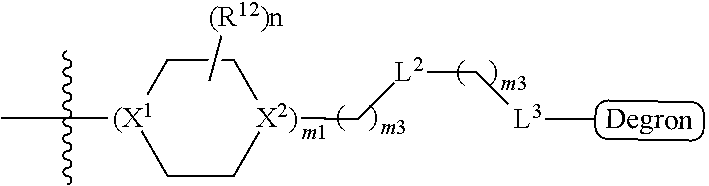
- moiety;
- [0041]RL1a and RL1b are each independently selected from hydrogen, —C1-8alkyl, —C2-8alkenyl, —C2-8alkynyl, cycloalkyl, heterocyclyl, aryl or heteroaryl, wherein each of said —C1-8alkyl, —C2-8alkenyl, —C2-8alkynyl, cycloalkyl, heterocyclyl, aryl or heteroaryl is optionally substituted with at least one substituent RL1d;
- [0042]each of said RL1c and RL1d are independently halogen, hydroxy, —C1-8alkyl, -haloC1-8alkyl, —C1-8alkoxy, —C2-8alkenyl, —C2-8alkynyl, cycloalkyl, heterocyclyl, aryl or heteroaryl; L2 is selected from a single bond, —O—, —SO2—, —CO—, —NRL2a—, —C3-C8cycloalkylene-, *L2—O—C1-8alkylene-**L2, *L2—C1-8alkylene-O—**L2, *L2—SO2—C1-8alkylene-**L2, *L2—C1-8alkylene-SO2—**L2, *L2—CO—C1-8alkylene-**L2, *L2—C1-8alkylene-CO—**L2, *L2—NRL2a—C1-8alkylene-**L2, *L2—C1-8alkylene-NRL2a—**L2, *L2—NRL2aC(O)—**L2, *L2—C(O)NRL2a—**L2, —C1-8alkylene-, —C2-8alkenylene-, —C2-8alkynylene-, —[O(CRL2aRL2b)m4]m5—,


- [0043]each of said —C3-C8cycloalkylene-, *L2—O—C1-8alkylene-**L2, *L2—C1-8alkylene-O—**L2, *L2—SO2—C1-8alkylene-**L2, *L2—C1-8alkylene-SO2—**L2, *L2—CO—C1-8alkylene-**L2, *L2—C1-8alkylene-CO—**L2,*L2—NRL2—C1-8alkylene-**L2, *L2—C1-8alkylene-NR2a—**L2, —C1-8alkylene-, —C2-8alkenylene, —C2-8alkynylene-,


- [0044] are optionally substituted with at least one substituent RL2c;
- [0045]wherein *L2 refers to the position attached to the

- moiety, and **L2 refers to the position attached to the

- moiety;
- [0046]RL2a and RL2b are each independently selected from hydrogen, —C1-8alkyl, —C2-8alkenyl, —C2-8alkynyl, cycloalkyl, heterocyclyl, aryl or heteroaryl, wherein each of said —C1-8alkyl, —C2-8alkenyl, —C2-8alkynyl, cycloalkyl, heterocyclyl, aryl or heteroaryl is optionally substituted with at least one substituent RL2d;
- [0047]each of said RL2c and RL2d are independently halogen, hydroxy, —C1-8alkyl, -haloC1-8alkyl, —C1-8alkoxy, —C2-8alkenyl, —C2-8alkynyl, cycloalkyl, heterocyclyl, aryl or heteroaryl;
- [0048]L3 is selected from a single bond, —O—, —SO2—, —CO—, —NRL3a—, —C3-C8cycloalkylene-, *L3—O—C1-8alkylene-**L3, *L3—C1-8alkylene-O—**L3, *L3—SO2—C1-8alkylene-**L3, *L3—C1-8alkylene-SO2—**L3, *L3—CO—C1-8alkylene-**L3, *L3—C1-8alkylene-CO—**L3, *L3—NRL3a—C1-8alkylene-**L3, *L3—C1-8alkylene-NRL3a—**L3, *L3—NRL3aC(O)—**L3, *L3—C(O)NRL3a—**L3, —C1-8alkylene-, —C2-8alkenylene-, —C2-8alkynylene-, —[O(CRL3aRL3b)m4]m5—, and


- [0049]each of said —C3-C8cycloalkylene-, *L3—O—C1-8alkylene-**L3, *L3—C1-8alkylene-O—**L3, *L3—SO2—C1-8alkylene-**L3, *L3—C1-8alkylene-SO2—**L3, *L3—CO—C1-8alkylene-**L3, *L3—C1-8alkylene-CO—**L3, *L3—NRL3a—C1-8alkylene-**L3, *L3—C1-8alkylene-NRL3a—**L3, —C1-8alkylene-, —C2-8alkenylene-, —C2-8alkynylene-,


- [0050] are optionally substituted with at least one substituent RL3c;
- [0051]wherein *L3 refers to the position attached to the

- moiety, and **L3 refers to the position attached to the

- moiety;
- [0052]RL3a and RL3b are each independently selected from hydrogen, —C1-8alkyl, —C2-8alkenyl, —C2-8alkynyl, cycloalkyl, heterocyclyl, aryl or heteroaryl, wherein each of said —C1-8alkyl, —C2-8alkenyl, —C2-8alkynyl, cycloalkyl, heterocyclyl, aryl or membered heteroaryl is optionally substituted with at least one substituent RL3d; each of said RL3c and RL3d are independently halogen, hydroxy, —C1-8alkyl, -haloC1-8alkyl, —C1-8alkoxy, —C2-8alkenyl, —C2-8alkynyl, cycloalkyl, heterocyclyl, aryl or heteroaryl;

- is selected from


- [0053]wherein Ring A is selected from 3-12 membered cycloalkyl, 3-12 membered heterocyclyl, aryl, or heteroaryl;
- [0054]R13, R14, R15, R16 and R17 are independently selected from hydrogen, halogen, CN, —C1-8alkyl, —C1-8alkoxy, cycloalkyl, heterocyclyl, aryl, heteroaryl, —OR13a, —COR13a, —CO2R13a, —NR13aR13b, —NR13aCOR13b or —NR13aCO2R13b wherein each of said —C1-8alkyl, —C1-8alkoxy, cycloalkyl, heterocyclyl, aryl or heteroaryl is optionally substituted with at least one substituent halogen, —C1-8alkyl, -haloC1-8alkyl, C1-8alkoxy-C1-8alkyl-, —C2-8alkenyl, —C2-8alkynyl, cycloalkyl, heterocyclyl, aryl or heteroaryl;
- [0055]R13a and R13b are each independently selected from hydrogen, —C1-8alkyl, —C2-8alkenyl, —C2-8alkynyl, C1-8alkoxy-C1-8alkyl-, cycloalkyl, heterocyclyl, aryl or heteroaryl, wherein each of said —C1-8alkyl, —C2-8alkenyl, —C2-8alkynyl, C1-8alkoxy-C1-8alkyl-, cycloalkyl, heterocyclyl, aryl or heteroaryl is optionally substituted with at least one substituent halogen, —C1-8alkyl, -haloC1-8alkyl, C1-8alkoxy-C1-8alkyl-, —C2-8alkenyl, —C2-8alkynyl, cycloalkyl, heterocyclyl, aryl or heteroaryl;
- [0056]X1, X2, X3, X4 and X8 are each independently selected from —CRa or N;
- [0057]X5, X6, X7 and X9 are each independently selected from —NRa—, —O—, —S— and —CRaRb—;
- [0058]X12 and X13 are each independently selected from a single bond, —NRa— and —O—;
- [0059]L4 is each independently selected from a single bond, —O—, —NRa—, —(CRaRb)n9—, —O(CRaRb)n9—, —NRa(CRaRb)n9— or —C(O)—;
- [0060]L5 and L6 are each independently selected from —CRaRb- or —C(O)—;
- [0061]Q1, Q2, Q3, Q4, Y1, Y2 and Y3 are each independently selected from CRa or N;
- [0062]Q5 is each independently selected from —O—, —NRa—, —CRaRb—, —S— or —C(O)—;
- [0063]P1 is a single bond, —O—, —NH—, —CH2—, —S—, —SO— or —SO2—;
- [0064]Ra and Rb are each independently selected from oxo, hydrogen, halogen, CN, —C1-8alkyl, —C1-8alkoxy, —C2-8alkenyl, —C2-8alkynyl, cycloalkyl, heterocyclyl, aryl or heteroaryl, wherein each of said —C1-8alkyl, —C1-8alkoxy, —C2-8alkenyl, —C2-8alkynyl, cycloalkyl, heterocyclyl, aryl or heteroaryl is optionally substituted with at least one substituent halogen, hydroxy, halogen, —C1-8alkyl, —C1-8alkoxy, —C2-8alkenyl, —C2-8alkynyl, cycloalkyl, heterocyclyl, aryl or heteroaryl;
- [0065]m1 is 0, 1 or 2;
- [0066]m2 and m3 are each independently 0, 1, 2, 3, 4, 5, 6, 7 or 8;
- [0067]m4, m5 are each independently 0, 1, 2 or 3;
- [0068]m6 is each independently 0, 1, 2 or 3;
- [0069]m7 each independently 0, 1, 2, 3 or 4;
- [0070]n, n1, n2, n3, n4 and n5 are each independently 0, 1, 2 or 3; and
- [0071]n6, n7, n8 and n9 are each independently 0, 1, 2, 3 or 4.
Aspect 2. The compound of aspect 1, wherein R1 is —SO2R1a, wherein R1a is each independently selected from —C1-5alkyl, —C6-8aryl, —C3-7cycloalkyl, or 4- to 7-membered heterocyclyl or —NR1dR1e, wherein each of said —C1-5alkyl, —C6-8aryl, —C3-7cycloalkyl, or 4- to 7-membered heterocyclyl is optionally substituted with at least one substituent R1f;
- [0072]R1d and R1e are each independently hydrogen, —C1-8alkyl, —C1-8haloalkyl, —C2-8alkenyl, —C2-8alkynyl, cycloalkyl, heterocyclyl, aryl, or heteroaryl;
- [0073]R1f, at each of its occurrences, is independently hydrogen, halogen, —C1-8alkyl, —C1-8haloalkyl, —C2-8alkenyl, —C2-8alkynyl, cycloalkyl, halocycloalkyl, heterocyclyl, phenyl, heteroaryl, —CN, or —OR1g, wherein each of said cycloalkyl, heterocyclyl, aryl or heteroaryl is optionally substituted with 1, 2 or 3 substituents selected from halogen and —C1-8alkyl;
- [0074]R1g is hydrogen, —C1-8alkyl, —C1-8haloalkyl, C1-8alkoxy-C1-8alkyl-, —C2-8alkenyl, —C2-8alkynyl, cycloalkyl, heterocyclyl, aryl, or heteroaryl.
Aspect 3. The compound of aspect 1, wherein R1a is selected from —CH3, —C2H5, —C3H7, -tert-butyl, -n-butyl, -iso-butyl, —C5H11, -cyclopropyl,

Aspect 4. The compound of aspect 1, wherein R2 is independently selected from hydrogen, —F, —Cl, —Br, —I, methyl, ethyl, propyl, butyl, pentyl, hexyl, heptyl, octyl, cyclopropyl, cyclobutyl, cyclopentyl, cyclohexyl, cycloheptyl, cyclooctyl, —CN, —OR2a or —COR2a, wherein each of said methyl, ethyl, propyl, butyl, pentyl, hexyl, heptyl, octyl, cyclopropyl, cyclobutyl, cyclopentyl, cyclohexyl, cycloheptyl, or cyclooctyl is optionally substituted with at least one substituent R2c, or
- [0075]two germinal R2 together with the atom to which they are attached, form a spiro 3-, 4-, 5- or 6-membered cycloalkyl, said cycloalkyl is optionally substituted with at least one substituent R2c; or
- [0076]two R2 on different atoms, together with the atoms to which they are attached, form a 3-, 4-, 5- or 6-membered cycloalkyl, said cycloalkyl is optionally substituted with at least one substituent R2c;
- [0077]R2a is selected from hydrogen, —C1-8alkyl, —C2-8alkenyl, —C2-8alkynyl, C1-8alkoxy-C1-8alkyl-, or C3-8cycloalkyl;
- [0078]R2c, at each of its occurrences, is independently —F, —Cl, —Br, —I, —OH, —C1-8alkyl, -haloC1-8alkyl, —C2-8alkenyl, —C2-8alkynyl, or —C3-8cycloalkyl.
Aspect 5. The compound of aspect 1, wherein - [0079]R2 is selected from hydrogen, —F, —Cl, —Br, —I, methyl, ethyl, propyl, butyl, pentyl, hexyl, heptyl, or octyl; or two germinal R2, together with the atom to which they are attached, form a spiro 3-, 4-membered cycloalkyl.
Aspect 6. The compound of aspect 1, wherein - [0080]R2 is selected from hydrogen, F, Cl, Br, I, —CH3, —C2H5, —C3H7, —C4H9, or —C5H11; or two germinal R2, together with the atom to which they are attached, form a spiro cyclopropyl or a spiro cyclobutyl.
Aspect 7. The compound of aspect 1, wherein - [0081]R3, R9 and R10 are independently selected from hydrogen, —F, —Cl, —Br, —I, methyl, ethyl, propyl, butyl, pentyl, hexyl, heptyl, octyl, cyclopropyl, cyclobutyl, cyclopentyl, cyclohexyl, cycloheptyl, cyclooctyl, —NR3aR3b, —CN, —OR3a, —COR3a or —CO2R3a, wherein each of methyl, ethyl, propyl, butyl, pentyl, hexyl, heptyl, octyl, cyclopropyl, cyclobutyl, cyclopentyl, cyclohexyl, cycloheptyl, cyclooctyl is optionally substituted with at least one substituent R3c,
- [0082]R3a is each independently selected from hydrogen, —C1-8alkyl, —C2-8alkenyl, —C2-8alkynyl, C1-8alkoxy-C1-8alkyl-, or C3-8cycloalkyl, wherein each of said —C1-8alkyl, —C2-8alkenyl, —C2-8alkynyl, C1-8alkoxy-C1-8alkyl-, or C3-8cycloalkyl is optionally substituted with at least one substituent R3a;
- [0083]R3c and R3d, at each of their occurrences, is independently halogen, —C1-8alkyl, —C2-8alkenyl, —C2-8alkynyl, or —C3-8cycloalkyl.
Aspect 8. The compound of aspect 1, wherein - [0084]R3, R9 and R10 are each independently selected from H, F, Br, Cl, I, —CH3, —C2H5, —C3H7, —C4H9, —C5H11, —CF3, cyclopropyl, cyclobutyl, cyclopentyl, cyclohexyl, cycloheptyl, cyclooctyl, —NH2, —N(CH3)2, —N(CH3)C2H5, —N(C2H5)2, —OCH3, —OC2H5, —OC3H7, —OC4H9, or —OC5H11.
Aspect 9. The compound of aspect 1, wherein the

moiety is selected from

Aspect 10. The compound of aspect 1, wherein the

moiety is

preferred


- [0085]R4a and R4b are each independently hydrogen, —C1-8alkyl, -haloC1-8alkyl, —C2-8alkenyl, —C2-8alkynyl, C3-C8cycloalkyl, 3- to 8-membered heterocyclyl, C6-C2aryl, or 5- to 12-membered heteroaryl;
- [0086]R4e is selected from F, Br, Cl, I, methyl, ethyl, propyl, butyl, pentyl, hexyl, heptyl, octyl, cyclopropyl, cyclobutyl, cyclopentyl, cyclohexyl, cycloheptyl, cyclooctyl, 3- to 8-membered heterocyclyl, phenyl, 5- to 12-membered heteroaryl, oxo, —CN, or —OR4c;
- [0087]R4c is independently hydrogen, methyl, ethyl, propyl, butyl, pentyl, hexyl, heptyl, octyl, or phenyl.
Aspect 12. The compound of aspect 1, wherein R4 and R1, together with the atom(s) to which they are attached, form a 3-, 4-, 5-, 6-, 7- or 8-membered ring, said ring comprising 0, 1 or 2 heteroatom(s) independently selected from nitrogen, oxygen, or optionally oxidized sulfur as ring member(s), said ring is optionally substituted with at least one substituent R4e; - [0088]R4e is selected from —F, —Cl, —Br, —I, methyl, ethyl, propyl, butyl, pentyl, hexyl, heptyl, octyl, cyclopropyl, cyclobutyl, cyclopentyl, cyclohexyl, cycloheptyl, cyclooctyl, 3- to 8-membered heterocyclyl, phenyl, 5- to 12-membered heteroaryl, oxo, —CN, or —OR4c;
- [0089]R4c is independently hydrogen, —C1-8alkyl, —C2-8alkenyl, —C2-8alkynyl, C3-C8cycloalkyl, 3- to 8-membered heterocyclyl, C6-C12aryl, or 5- to 12-membered heteroaryl;
Aspect 13. The compound of aspect 1, wherein R4 and R11, together with the atom(s) to which they are attached, form a 5- or 6-membered ring, said ring comprising 1 or 2 heteroatom(s) independently selected from nitrogen, oxygen, or optionally oxidized sulfur, said ring is optionally substituted with at least one substituent R4e; - [0090]R4e is selected from —F, —Cl, —Br, —I, methyl, ethyl, propyl, butyl, pentyl, hexyl, heptyl, octyl, cyclopropyl, cyclobutyl, cyclopentyl, cyclohexyl, cycloheptyl, cyclooctyl, phenyl, 5- to 12-membered heteroaryl, oxo, —CN, —OCH3, —OC2H5, —OC3H7, —OC4H9, and —OC5H11.
Aspect 14. The compound of aspect 1, wherein

moiety is selected from


- [0091]two germinal R12 together with the atom to which they are attached, form a spiro 3-, 4-, 5-, 6-membered cycloalkyl, said cycloalkyl is optionally substituted with at least one substituent R12c; or
- [0092]two R12 on different atoms, together with the atoms to which they are attached, form a 3-, 4-, 5-, 6-membered cycloalkyl, said cycloalkyl is optionally substituted with at least one substituent R12e;
- [0093]R12c is independently halogen, hydroxy, —C1-8alkyl, -haloC1-8alkyl, —C1-8alkoxy, —C2-8alkenyl, —C2-8alkynyl, cycloalkyl, heterocyclyl, aryl or heteroaryl.
Aspect 16. The compound of aspect 1, wherein

is selected from

- [0094]RZ, at each of its occurrences, is independently selected from hydrogen, —F, —Cl, —Br, —I, methyl, ethyl, propyl, butyl, pentyl, hexyl, heptyl, octyl, —NRZaRZb, —ORZa, cyclopropyl, cyclobutyl, cyclopentyl, cyclohexyl, cycloheptyl, cyclooctyl, 3- to 8-membered heterocyclyl, phenyl, 5- to 12-membered heteroaryl, or CN, wherein each of said methyl, ethyl, propyl, butyl, pentyl, hexyl, heptyl, octyl, cyclopropyl, cyclobutyl, cyclopentyl, cyclohexyl, cycloheptyl, cyclooctyl, 3- to 8-membered heterocyclyl, phenyl, or 5- to 12-membered heteroaryl is optionally substituted with at least one RZc; or
- [0095]or two RZ, when attached to adjacent carbon atoms of the ring, together with the two carbon atoms to which they are attached, form a 3- to 12-membered ring comprising 0, 1 or 2 heteroatom(s) independently selected from nitrogen, oxygen or optionally oxidized sulfur as ring member(s), said ring is optionally substituted with at least one substituent RZc;
- [0096]RZa and RZb are each independently selected from hydrogen, methyl, ethyl, propyl, butyl, pentyl, hexyl, heptyl, octyl, cyclopropyl, cyclobutyl, cyclopentyl, cyclohexyl, cycloheptyl, cyclooctyl, or phenyl, wherein each of said methyl, ethyl, propyl, butyl, pentyl, hexyl, heptyl, octyl, cyclopropyl, cyclobutyl, cyclopentyl, cyclohexyl, cycloheptyl, cyclooctyl, or phenyl is optionally substituted with at least one substituent RZd;
- [0097]RZc and RZd are each independently —F, —Cl, —Br, —I, —OH, methyl, ethyl, propyl, butyl, pentyl, hexyl, heptyl, octyl, —OCH3, —OC2H5, —OC3H7, —OC4H9, —OC5H11, cyclopropyl, cyclobutyl, cyclopentyl, cyclohexyl, cycloheptyl, cyclooctyl, or phenyl, or
- [0098]two RZc, together with the atom(s) to which they are attached, form a 3- to 8-membered ring, said ring comprising 0, 1 or 2 heteroatom(s) independently selected from nitrogen, oxygen, or optionally oxidized sulfur as ring member(s).
Aspect 18. The compound of aspect 1, wherein Z1, Z2, Z3 and Z4 are each independently —CRz; - [0099]RZ, at each of its occurrences, is independently selected from hydrogen, —F, —Cl, —Br, —I, methyl, ethyl, propyl, butyl, pentyl, hexyl, heptyl, octyl, —OCH3, —OC2H5, —OC3H7, —OC4H9, or —OC5H11; or
- [0100]two RZ, when attached to adjacent carbon atoms of the ring, together with the atoms to which they are attached, form a 4-, 5-, 6- or 7-membered ring, said ring comprising 0, 1 or 2 heteroatom(s) independently selected from nitrogen or oxygen, said ring is optionally substituted with at least one substituent RZc, wherein two germinal RZc, together with the atom to which they are attached, form a spiro 3-, 4-, 5- or 6-membered cycloalkyl or, two RZc on different atoms, together with the atoms to which they are attached, form a 3-, 4-, 5- or 6-membered cycloalkyl.
Aspect 19. The compound of aspect 1, wherein the

moiety is selected from


wherein *a refers to the position attached to

moiety, and *b refers to the position attached to the

moiety.
Aspect 20. The compound of aspect 1, wherein L1 is selected from a single bond, —C1-8alkylene- (preferably —CH2—, —C2H4—, —C3H6—),

Aspect 21. The compound of aspect 1, wherein X1 and X2 are each independently selected from CH or N; m1=1 or 0; and R12 is hydrogen or —CH3.
Aspect 22. The compound of aspect 1, wherein m2 and m3 are selected from 0, 1, 2, 3, 4 or 5.
Aspect 23. The compound of aspect 1, wherein L2 is selected from a single bond, —CO—, —O—, —NRL2a—, —C1-8alkylene- (preferably —CH2—, —C2H4—, —C3H6—),


wherein RL2a is selected from hydrogen, methyl, ethyl or propyl.
Aspect 24. The compound of aspect 1, wherein L3 is selected from a single bond, —O—, —NRL3a—, —C1-8alkylene- (preferably —CH2—, —C2H4—, —C3H6—),

wherein RL3a is selected from hydrogen, methyl, ethyl or propy.
Aspect 25. The compound of aspect 1, wherein

is selected from


wherein * refers to the position attached to

moeity, and ** refers to the position attached to the

moiety.
Aspect 26. The compound of aspect 1, wherein the compound is Formula (II):

- [0101]or an N-oxide thereof, or a pharmaceutically acceptable salt thereof, or a stereoisomer thereof, or a tautomer or a prodrug thereof, wherein: R1, R2, R3, R4, R9, R10, R11, R12, Z1, Z2, Z3, Z4, X1, X2, X3, X4, L2, L3, Degron, n, m1, m2, m3 and m7 have the same meaning with Aspect 1.
Aspect 27. The compound of aspect 1, wherein the compound is Formula (III):
- [0101]or an N-oxide thereof, or a pharmaceutically acceptable salt thereof, or a stereoisomer thereof, or a tautomer or a prodrug thereof, wherein: R1, R2, R3, R4, R9, R10, R11, R12, Z1, Z2, Z3, Z4, X1, X2, X3, X4, L2, L3, Degron, n, m1, m2, m3 and m7 have the same meaning with Aspect 1.

- [0102]or an N-oxide thereof, or a pharmaceutically acceptable salt thereof, or a stereoisomer thereof, or a tautomer or a prodrug thereof, wherein: R1, R2, R3, R4, R9, R10, R11, R12, Z1, Z2, Z3, Z4, X1, X2, X3, X4, L2, L3, Degron, n, m1, m3 and m7 have the same meaning with Aspect 1, preferred m1 is 0 or 1.
Aspect 28. The compound of aspect 1, wherein
- [0102]or an N-oxide thereof, or a pharmaceutically acceptable salt thereof, or a stereoisomer thereof, or a tautomer or a prodrug thereof, wherein: R1, R2, R3, R4, R9, R10, R11, R12, Z1, Z2, Z3, Z4, X1, X2, X3, X4, L2, L3, Degron, n, m1, m3 and m7 have the same meaning with Aspect 1, preferred m1 is 0 or 1.

is selected from

- [0103]R14 is independently selected from hydrogen, halogen, —C1-8alkyl, —C1-8alkoxy, or CN, wherein each of said —C1-8alkyl or —C1-8alkoxy is optionally substituted by one or more halogen or —C1-8alkyl; preferably R14 is independently selected from H, F, Cl, Br, I, CH3, —OCH3, CH2F, CN, CHF2, or CF3;
- [0104]X8 is independently selected from CF, CH, C(CH3), C(C2H5), C(C3H7), C(CN) or N;
- [0105]L4 is independently selected from a single bond, —O—, —NH—, —CH2—, —CHF—, or —CF2—;
- [0106]Y1, Y2, and Y3 are each independently selected from CRa or N, wherein Ra is each independently selected from hydrogen, halogen, —C1-8alkyl or —C1-8alkoxy, wherein each of said —C1-8alkyl or —C1-8alkoxy is optionally substituted with at least one or more halogen, hydroxy, halogen, —C1-8alkyl, or —C1-8alkoxy;
- [0107]X9 is CH2;
- [0108]n6 is independently 0, 1 or 2.
Aspect 29. The compound of aspect 1, wherein

- [0109]wherein Ring A is selected from 5-7 membered cycloalkyl, 5-7 membered heterocyclyl, aryl, or heteroaryl;
- [0110]X8 is independently selected from CF, CH, C(CH3), C(C2H5), C(C3H7), C(CN) or N;
- [0111]L4 is independently selected from a single bond, —O—, —NH—, —CH2—, —CHF—, or —CF2—;
- [0112]Y1 and Y2 are each independently selected from CRa or N;
- [0113]Ra is each independently selected from hydrogen, halogen, —C1-8alkyl, or —C1-8alkoxy, each of said —C1-8alkyl or —C1-8alkoxy is optionally substituted with at least one or more halogen, hydroxy, halogen, —C1-8alkyl, or —C1-8alkoxy;
- [0114]X9 is CH2; and
- [0115]n6 is independently 0, 1 or 2.
Aspect 30. The compound of aspect 1, wherein

- [0116]Wherein R14 is independently selected from hydrogen, halogen, —C1-8alkyl, or —C1-8alkoxy, wherein each of said each —C1-8alkyl or —C1-8alkoxy is optionally substituted by one or more halogen, —C1-8alkyl, or C1-8alkoxy-C1-8alkyl-;
- [0117]X8 is independently selected from CH, C(CH3), C(C2H5), C(C3H7), C(CN) or N;
- [0118]L4 is independently selected from a single bond, —O—, —NH—, —CH2—, —CHF—, or —CF2—;
- [0119]Y1, Y2, and Y3 are each independently selected from CRa, or N;
- [0120]Ra is each independently selected from hydrogen, halogen, —C1-8alkyl, or —C1-8alkoxy, each of said —C1-8alkyl, or —C1-8alkoxy is optionally substituted with at least one or more halogen, hydroxy, halogen, —C1-8alkyl, or —C1-8alkoxy;
- [0121]X9 is CH2; and
- [0122]n6 is independently 0, 1 or 2.
Aspect 31. The compound of aspect 1, wherein

- [0123]wherein L5 and L6 are each independently selected from —CH2 or —CO—;
- [0124]X9 is CH2;
- [0125]each R13 is independently selected from hydrogen, halogen, CN, —C1-8alkyl, or —C1-8alkoxy;
- [0126]n6 is 0 or 1; and
- [0127]n7 is 0, 1 or 2.
Aspect 32. The compound of aspect 1, wherein

- [0128]wherein R13 and R16 are independently selected from hydrogen, halogen, —C1-8alkyl, or —C1-8alkoxy; said each —C1-8alkyl or —C1-8alkoxy is optionally substituted by one or more halogen, —C1-8alkyl, or C1-8alkoxy-C1-8alkyl-;
- [0129]R15 and R14 is selected from the group consisting of 5- to 12-membered heteroaryl, 3- to 8-membered heterocyclyl, and C6-C12aryl, and R15 is optionally substituted by one or more halogen, —C1-8alkyl, or C1-8alkoxy-C1-8alkyl-; and
- [0130]n7 is independently 0, 1, 2, 3 or 4.
Aspect 33. The compound of aspect 1, wherein

is selected from


Aspect 34. The compound of aspect 1 selected from


- [0131]or an N-oxide thereof, or a pharmaceutically acceptable salt thereof, or a stereoisomer thereof, or a tautomer or a prodrug thereof.
Aspect 35. A pharmaceutical composition comprising a compound of any one of Aspects 1-34 or an N-oxide thereof, or a pharmaceutically acceptable salt thereof, or a stereoisomer thereof, or a tautomer or a prodrug thereof, together with a pharmaceutically acceptable excipient.
Aspect 36. A method of treating a disease in which EGFR modulation is involved, comprising administrating a subject in need thereof a therapeutically effective amount of a compound of any one of Aspects 1-34 or an N-oxide thereof, or a pharmaceutically acceptable salt thereof, or a stereoisomer thereof, or a tautomer or a prodrug thereof.
Aspect 37. The method of Aspect 36, wherein the disease is selected from cancer, preferred pancreatic cancer, breast cancer, glioblastoma multiforme, head and neck cancer, or non-small cell lung cancer.
Aspect 38. Use of a compound of any one of Aspects 1-34 or an N-oxide thereof, or a pharmaceutically acceptable salt thereof, or a stereoisomer thereof, or a tautomer or a prodrug thereof in the preparation of a medicament for treating a disease in which EGFR modulation is involved.
Aspect 39. The use of Aspect 37, wherein the disease is cancer, preferred pancreatic cancer, breast cancer, glioblastoma multiforme, head and neck cancer, or non-small cell lung cancer.
- [0131]or an N-oxide thereof, or a pharmaceutically acceptable salt thereof, or a stereoisomer thereof, or a tautomer or a prodrug thereof.
DETAILED DESCRIPTION OF THE INVENTION
[0132]The following terms have the indicated meanings throughout the specification:
[0133]Unless specifically defined elsewhere in this document, all other technical and scientific terms used herein have the meaning commonly understood by one of ordinary skill in the art to which this invention belongs.
[0134]The following terms have the indicated meanings throughout the specification: As used herein, including the appended claims, the singular forms of words such as “a” “an”, and “the”, include their corresponding plural references unless the context clearly indicates otherwise.
[0135]The term “or” is used to mean, and is used interchangeably with, the term “and/or” unless the context clearly dictates otherwise.
[0136]The term “alkyl” includes a hydrocarbon group selected from linear and branched, saturated hydrocarbon groups comprising from 1 to 18, such as from 1 to 12, further such as from 1 to 10, more further such as from 1 to 8, or from 1 to 6, or from 1 to 4, carbon atoms. Examples of alkyl groups comprising from 1 to 6 carbon atoms (i.e., C1-6 alkyl) include, but not limited to, methyl, ethyl, 1-propyl or n-propyl (“n-Pr”), 2-propyl or isopropyl (“i-Pr”), 1-butyl or n-butyl (“n-Bu”), 2-methyl-1-propyl or isobutyl (“i-Bu”), 1-methylpropyl or s-butyl (“s-Bu”), 1,1-dimethylethyl or t-butyl (“t-Bu”), 1-pentyl, 2-pentyl, 3-pentyl, 2-methyl-2-butyl, 3-methyl-2-butyl, 3-methyl-1-butyl, 2-methyl-1-butyl, 1-hexyl, 2-hexyl, 3-hexyl, 2-methyl-2-pentyl, 3-methyl-2-pentyl, 4-methyl-2-pentyl, 3-methyl-3-pentyl, 2-methyl-3-pentyl, 2,3-dimethyl-2-butyl and 3,3-dimethyl-2-butyl groups.
[0137]The term “propyl” includes 1-propyl or n-propyl (“n-Pr”), 2-propyl or isopropyl (“i-Pr”).
[0138]The term “butyl” includes 1-butyl or n-butyl (“n-Bu”), 2-methyl-1-propyl or isobutyl (“i-Bu”), 1-methylpropyl or s-butyl (“s-Bu”), 1,1-dimethylethyl or t-butyl (“t-Bu”).
[0139]The term “pentyl” includes 1-pentyl, 2-pentyl, 3-pentyl, 2-methyl-2-butyl, 3-methyl-2-butyl, 3-methyl-1-butyl, 2-methyl-1-butyl.
[0140]The term “hexyl” includes 1-hexyl, 2-hexyl, 3-hexyl, 2-methyl-2-pentyl, 3-methyl-2-pentyl, 4-methyl-2-pentyl, 3-methyl-3-pentyl, 2-methyl-3-pentyl, 2,3-dimethyl-2-butyl and 3,3-dimethyl-2-butyl.
[0141]The term “alkylene” refers to a divalent alkyl group by removing two hydrogens from alkane. Alkylene includes but not limited to methylene, ethylene, propylene, and so on.
[0142]The term “halogen” includes fluoro (F), chloro (Cl), bromo (Br) and iodo (I).
[0143]The term “alkenyl” includes a hydrocarbon group selected from linear and branched hydrocarbon groups comprising at least one C═C double bond and from 2 to 18, such as from 2 to 8, further such as from 2 to 6, carbon atoms. Examples of the alkenyl group, e.g., C2-6 alkenyl, include, but not limited to ethenyl or vinyl, prop-1-enyl, prop-2-enyl, 2-methylprop-1-enyl, but-1-enyl, but-2-enyl, but-3-enyl, buta-1,3-dienyl, 2-methylbuta-1,3-dienyl, hex-1-enyl, hex-2-enyl, hex-3-enyl, hex-4-enyl, and hexa-1,3-dienyl groups.
[0144]The term “alkenylene” refers to a divalent alkenyl group by removing two hydrogens from alkene. Alkenylene includes but not limited to, vinylidene, butenylene, and so on.
[0145]The term “alkynyl” includes a hydrocarbon group selected from linear and branched hydrocarbon group, comprising at least one C≡C triple bond and from 2 to 18, such as 2 to 8, further such as from 2 to 6, carbon atoms. Examples of the alkynyl group, e.g., C2-6 alkynyl, include, but not limited to ethynyl, 1-propynyl, 2-propynyl (propargyl), 1-butynyl, 2-butynyl, and 3-butynyl groups.
[0146]The term “alkynylene” refers to a divalent alkynyl group by removing two hydrogens from alkyne. Alkenylene includes but not limited to ethynylene and so on.
[0147]The term “cycloalkyl” includes a hydrocarbon group selected from saturated cyclic hydrocarbon groups, comprising monocyclic and polycyclic (e.g., bicyclic and tricyclic) groups including fused, bridged or spiro cycloalkyl.
[0148]For example, the cycloalkyl group may comprise from 3 to 12, such as from 3 to 10, further such as 3 to 8, further such as 3 to 6, 3 to 5, or 3 to 4 carbon atoms. Even further for example, the cycloalkyl group may be selected from monocyclic group comprising from 3 to 12, such as from 3 to 10, further such as 3 to 8, 3 to 6 carbon atoms. Examples of the monocyclic cycloalkyl group include cyclopropyl, cyclobutyl, cyclopentyl, cyclohexyl, cycloheptyl, cyclooctyl, cyclononyl, cyclodecyl, cycloundecyl, and cyclododecyl groups. In particular, examples of the saturated monocyclic cycloalkyl group, e.g., C3-8cycloalkyl, include, but not limited to cyclopropyl, cyclobutyl, cyclopentyl, cyclohexyl, cycloheptyl, and cyclooctyl groups. In a preferred embodiment, the cycloalkyl is a monocyclic ring comprising 3 to 6 carbon atoms (abbreviated as C3-6 cycloalkyl), including but not limited to, cyclopropyl, cyclobutyl, cyclopentyl, and cyclohexyl. Examples of the bicyclic cycloalkyl groups include those having from 7 to 12 ring atoms arranged as a fused bicyclic ring selected from [4,4], [4,5], [5,5], [5,6] and [6,6] ring systems, or as a bridged bicyclic ring selected from bicyclo[2.2.1]heptane, bicyclo[2.2.2]octane, and bicyclo[3.2.2]nonane. Further Examples of the bicyclic cycloalkyl groups include those arranged as a bicyclic ring selected from [5,6] and [6,6] ring systems.
[0149]The term “spiro cycloalkyl” includes a cyclic structure which contains carbon atoms and is formed by at least two rings sharing one atom.
[0150]The term “fused cycloalkyl” includes a bicyclic cycloalkyl group as defined herein which is saturated and is formed by two or more rings sharing two adjacent atoms.
[0151]The term “bridged cycloalkyl” includes a cyclic structure which contains carbon atoms and is formed by two rings sharing two atoms which are not adjacent to each other. The term “7 to 10 membered bridged cycloalkyl” includes a cyclic structure which contains 7 to 12 carbon atoms and is formed by two rings sharing two atoms which are not adjacent to each other.
[0152]Examples of fused cycloalkyl, fused cycloalkenyl, or fused cycloalkynyl include but are not limited to bicyclo[1.1.0]butyl, bicyclo[2.1.0]pentyl, bicyclo[3.1.0]hexyl, bicyclo[4.1.0]heptyl, bicyclo[3.3.0]octyl, bicyclo[4.2.0]octyl, decalin, as well as benzo 3 to 8 membered cycloalkyl, benzo C4-6 cycloalkenyl, 2,3-dihydro-1H-indenyl, 1H-indenyl, 1, 2, 3,4-tetralyl, 1,4-dihydronaphthyl, etc. Preferred embodiments are 8 to 9 membered fused rings, which refer to cyclic structures containing 8 to 9 ring atoms within the above examples.
- [0154]5- and 6-membered carbocyclic aromatic rings, e.g., phenyl;
- [0155]bicyclic ring systems such as 7 to 12 membered bicyclic ring systems, wherein at least one ring is carbocyclic and aromatic, e.g., naphthyl and indanyl; and,
- [0156]tricyclic ring systems such as 10 to 15 membered tricyclic ring systems wherein at least one ring is carbocyclic and aromatic, e.g., fluorenyl.
[0157]The terms “aromatic hydrocarbon ring” and “aryl” are used interchangeably throughout the disclosure herein. In some embodiments, a monocyclic or bicyclic aromatic hydrocarbon ring has 5 to 10 ring-forming carbon atoms (i.e., C5-10 aryl). Examples of a monocyclic or bicyclic aromatic hydrocarbon ring includes, but not limited to, phenyl, naphth-1-yl, naphth-2-yl, anthracenyl, phenanthrenyl, and the like. In some embodiments, the aromatic hydrocarbon ring is a naphthalene ring (naphth-1-yl or naphth-2-yl) or phenyl ring. In some embodiments, the aromatic hydrocarbon ring is a phenyl ring.
[0158]Specifically, the term “bicyclic fused aryl” includes a bicyclic aryl ring as defined herein. The typical bicyclic fused aryl is naphthalene.
- [0160]5-, 6- or 7-membered aromatic, monocyclic rings comprising at least one heteroatom, for example, from 1 to 4, or, in some embodiments, from 1 to 3, in some embodiments, from 1 to 2, heteroatoms, selected from nitrogen (N), sulfur (S) and oxygen (O), with the remaining ring atoms being carbon;
- [0161]7- to 12-membered bicyclic rings comprising at least one heteroatom, for example, from 1 to 4, or, in some embodiments, from 1 to 3, or, in other embodiments, 1 or 2, heteroatoms, selected from N, O, and S, with the remaining ring atoms being carbon and wherein at least one ring is aromatic and at least one heteroatom is present in the aromatic ring; and
- [0162]11- to 14-membered tricyclic rings comprising at least one heteroatom, for example, from 1 to 4, or in some embodiments, from 1 to 3, or, in other embodiments, 1 or 2, heteroatoms, selected from N, O, and S, with the remaining ring atoms being carbon and wherein at least one ring is aromatic and at least one heteroatom is present in an aromatic ring.
[0163]When the total number of S and O atoms in the heteroaryl group exceeds 1, those heteroatoms are not adjacent to one another. In some embodiments, the total number of S and O atoms in the heteroaryl group is not more than 2. In some embodiments, the total number of S and O atoms in the aromatic heterocycle is not more than 1. When the heteroaryl group contains more than one heteroatom ring member, the heteroatoms may be the same or different. The nitrogen atoms in the ring(s) of the heteroaryl group can be oxidized to form N-oxides.
[0164]Specifically, the term “bicyclic fused heteroaryl” includes a 7- to 12-membered, preferably 7- to 10-membered, more preferably 9- or 10-membered fused bicyclic heteroaryl ring as defined herein. Typically, a bicyclic fused heteroaryl is 5-membered/5-membered, 5-membered/6-membered, 6-membered/6-membered, or 6-membered/7-membered bicyclic. The group can be attached to the remainder of the molecule through either ring.
[0165]“Heterocyclyl”, “heterocycle” or “heterocyclic” are interchangeable and include a non-aromatic heterocyclyl group comprising one or more heteroatoms selected from nitrogen, oxygen or optionally oxidized sulfur as ring members, with the remaining ring members being carbon, including monocyclic, fused, bridged, and spiro ring, i.e., containing monocyclic heterocyclyl, bridged heterocyclyl, spiro heterocyclyl, and fused heterocyclic groups.
[0166]The term “at least one substituent” disclosed herein includes, for example, from 1 to 4, such as from 1 to 3, further as 1 or 2, substituents, provided that the theory of valence is met. For example, “at least one substituent F” disclosed herein includes from 1 to 4, such as from 1 to 3, further as 1 or 2, substituents F.
[0167]The term “divalent” refers to a linking group capable of forming covalent bonds with two other moieties. For example, “a divalent cycloalkyl group” refers to a cycloalkyl group obtained by removing two hydrogen from the corresponding cycloalkane to form a linking group. the term “divalent aryl group”, “divalent heterocyclyl group” or “divalent heteroaryl group” should be understood in a similar manner.
[0168]Compounds disclosed herein may contain an asymmetric center and may thus exist as enantiomers. “Enantiomers” refer to two stereoisomers of a compound which are non-superimposable mirror images of one another. Where the compounds disclosed herein possess two or more asymmetric centers, they may additionally exist as diastereomers. Enantiomers and diastereomers fall within the broader class of stereoisomers. All such possible stereoisomers as substantially pure resolved enantiomers, racemic mixtures thereof, as well as mixtures of diastereomers are intended to be included. All stereoisomers of the compounds disclosed herein and/or pharmaceutically acceptable salts thereof are intended to be included. Unless specifically mentioned otherwise, reference to one isomer applies to any of the possible isomers. Whenever the isomeric composition is unspecified, all possible isomers are included.
[0169]When compounds disclosed herein contain olefinic double bonds, unless specified otherwise, such double bonds are meant to include both E and Z geometric isomers.
[0170]When compounds disclosed herein contain a di-substituted cyclic ring system, substituents found on such ring system may adopt cis and trans formations. Cis formation means that both substituents are found on the upper side of the 2 substituent placements on the carbon, while trans would mean that they were on opposing sides. For example, the di-substituted cyclic ring system may be cyclohexyl or cyclobutyl ring.
[0171]It may be advantageous to separate reaction products from one another and/or from starting materials. The desired products of each step or series of steps is separated and/or purified (hereinafter separated) to the desired degree of homogeneity by the techniques common in the art. Typically such separations involve multiphase extraction, crystallization from a solvent or solvent mixture, distillation, sublimation, or chromatography. Chromatography can involve any number of methods including, for example: reverse-phase and normal phase; size exclusion; ion exchange; high, medium and low pressure liquid chromatography methods and apparatus; small scale analytical; simulated moving bed (“SMB”) and preparative thin or thick layer chromatography, as well as techniques of small scale thin layer and flash chromatography. One skilled in the art could select and apply the techniques most likely to achieve the desired separation.
[0172]“Diastereomers” refer to stereoisomers of a compound with two or more chiral centers but which are not mirror images of one another. Diastereomeric mixtures can be separated into their individual diastereomers on the basis of their physical chemical differences by methods well known to those skilled in the art, such as by chromatography and/or fractional crystallization. Enantiomers can be separated by converting the enantiomeric mixture into a diastereomeric mixture by reaction with an appropriate optically active compound (e.g., chiral auxiliary such as a chiral alcohol or Mosher's acid chloride), separating the diastereomers and converting (e.g., hydrolyzing) the individual diastereoisomers to the corresponding pure enantiomers. Enantiomers can also be separated by use of a chiral HPLC column.
[0173]A single stereoisomer, e.g., a substantially pure enantiomer, may be obtained by resolution of the racemic mixture using a method such as formation of diastereomers using optically active resolving agents (Eliel, E. and Wilen, S. Stereochemistry of Organic Compounds. New York: John Wiley & Sons, Inc., 1994; Lochmuller, C. H., et al. “Chromatographic resolution of enantiomers: Selective review.” J. Chromatogr., 113(3) (1975): pp. 283-302). Racemic mixtures of chiral compounds of the invention can be separated and isolated by any suitable method, including: (1) formation of ionic, diastereomeric salts with chiral compounds and separation by fractional crystallization or other methods, (2) formation of diastereomeric compounds with chiral derivatizing reagents, separation of the diastereomers, and conversion to the pure stereoisomers, and (3) separation of the substantially pure or enriched stereoisomers directly under chiral conditions. See: Wainer, Irving W., Ed. Drug Stereochemistry: Analytical Methods and Pharmacology. New York: Marcel Dekker, Inc., 1993.
[0174]Some of the compounds disclosed herein may exist with different points of attachment of hydrogen, referred to as tautomers. For example, compounds including carbonyl —CH2C(O)— groups (keto forms) may undergo tautomerism to form hydroxyl —CH═C(OH)— groups (enol forms). Both keto and enol forms, individually as well as mixtures thereof, are also intended to be included where applicable.
[0175]“Prodrug” refers to a derivative of an active agent that requires a transformation within the body to release the active agent. In some embodiments, the transformation is an enzymatic transformation. Prodrugs are frequently, although not necessarily, pharmacologically inactive until converted to the active agent.
[0176]“Pharmaceutically acceptable salts” refer to those salts which are, within the scope of sound medical judgment, suitable for use in contact with the tissues of humans and lower animals without undue toxicity, irritation, allergic response and the like, and are commensurate with a reasonable benefit/risk ratio. A pharmaceutically acceptable salt may be prepared in situ during the final isolation and purification of the compounds disclosed herein, or separately by reacting the free base function with a suitable organic acid or by reacting the acidic group with a suitable base. The term also includes salts of the stereoisomers (such as enantiomers and/or diastereomers), tautomers and prodrugs of the compound of the invention.
[0177]In addition, if a compound disclosed herein is obtained as an acid addition salt, the free base can be obtained by basifying a solution of the acid salt. Conversely, if the product is a free base, an addition salt, such as a pharmaceutically acceptable addition salt, may be produced by dissolving the free base in a suitable organic solvent and treating the solution with an acid, in accordance with conventional procedures for preparing acid addition salts from base compounds. Those skilled in the art will recognize various synthetic methodologies that may be used without undue experimentation to prepare non-toxic pharmaceutically acceptable addition salts.
[0178]The terms “administration”, “administering”, “treating” and “treatment” herein, when applied to an animal, human, experimental subject, cell, tissue, organ, or biological fluid, mean contact of an exogenous pharmaceutical, therapeutic, diagnostic agent, or composition to the animal, human, subject, cell, tissue, organ, or biological fluid. Treatment of a cell encompasses contact of a reagent to the cell, as well as contact of a reagent to a fluid, where the fluid is in contact with the cell. The term “administration” and “treatment” also means in vitro and ex vivo treatments, e.g., of a cell, by a reagent, diagnostic, binding compound, or by another cell. The term “subject” herein includes any organism, preferably an animal, more preferably a mammal (e.g., rat, mouse, dog, cat, and rabbit) and most preferably a human.
[0179]The term “effective amount” or “therapeutically effective amount” refers to an amount of the active ingredient, such as compound that, when administered to a subject for treating a disease, or at least one of the clinical symptoms of a disease or disorder, is sufficient to affect such treatment for the disease, disorder, or symptom. The term “therapeutically effective amount” can vary with the compound, the disease, disorder, and/or symptoms of the disease or disorder, severity of the disease, disorder, and/or symptoms of the disease or disorder, the age of the subject to be treated, and/or the weight of the subject to be treated. An appropriate amount in any given instance can be apparent to those skilled in the art or can be determined by routine experiments. In some embodiments, “therapeutically effective amount” is an amount of at least one compound and/or at least one stereoisomer, tautomer or prodrug thereof, and/or at least one pharmaceutically acceptable salt thereof disclosed herein effective to “treat” as defined herein, a disease or disorder in a subject. In the case of combination therapy, the term “therapeutically effective amount” refers to the total amount of the combination objects for the effective treatment of a disease, a disorder or a condition.
[0180]The term “disease” refers to any disease, discomfort, illness, symptoms or indications, and can be interchangeable with the term “disorder” or “condition”.
[0181]Throughout this specification and the claims which follow, unless the context requires otherwise, the term “comprise”, and variations such as “comprises” and “comprising” are intended to specify the presence of the features thereafter, but do not exclude the presence or addition of one or more other features. When used herein the term “comprising” can be substituted with the term “containing”, “including” or sometimes “having”.
[0182]Throughout this specification and the claims which follow, the term “Cn-m” indicates a range which includes the endpoints, wherein n and m are integers and indicate the number of carbons. Examples include C1-s, C1-6, and the like.
[0183]Unless specifically defined elsewhere in this document, all other technical and scientific terms used herein have the meaning commonly understood by one of ordinary skill in the art to which this invention belongs.
[0184]General Reaction Scheme for Compound Preparation
[0185]The subject compounds and pharmaceutically acceptable salts thereof, can be prepared from (a) commercially available starting materials (b) known starting materials which may be prepared as described in literature procedures (c) new intermediates described in the schemes and experimental procedures herein. In making the compounds of the invention, the order of synthetic steps may be varied to increase the yield of the desired product. Some of the compounds in this invention may be generated by the methods as shown in the following reaction schemes and the description thereof.


EXAMPLES
[0186]The examples below are intended to be purely exemplary and should not be considered to be limiting in any way. Efforts have been made to ensure accuracy with respect to numbers used (for example, amounts, temperature, etc.), but some experimental errors and deviations should be accounted for. Unless indicated otherwise, the temperature is in degrees Centigrade. Reagents were purchased from commercial suppliers such as Sigma-Aldrich, Alfa Aesar, or TCI, and were used without further purification unless indicated otherwise. Unless indicated otherwise, the reactions set forth below were performed under a positive pressure of nitrogen or argon or with a drying tube in anhydrous solvents; the reaction flasks were fitted with rubber septa for the introduction of substrates and reagents via syringe; and glassware was oven dried and/or heat dried.
[0187]1H NMR spectra were recorded on an Agilent instrument operating at 400 MHz. 1HNMR spectra were obtained using CDCl3, CD2Cl2, CD3OD, D2O, d6-DMSO, d6-acetone or (CD3)2CO as solvent and tetramethylsilane (0.00 ppm) or residual solvent (CDCl3: 7.25 ppm; CD3OD: 3.31 ppm; D2O: 4.79 ppm; d6-DMSO: 2.50 ppm; d6-acetone: 2.05; (CD3)3CO: 2.05) as the reference standard. When peak multiplicities are reported, the following abbreviations are used: s (singlet), d (doublet), t (triplet), q (quartet), qn (quintuplet), sx (sextuplet), m (multiplet), br (broadened), dd (doublet of doublets), dt (doublet of triplets). Coupling constants, when given, are reported in Hertz (Hz).
[0188]LCMS-1: LC-MS spectrometer (Agilent 1260 Infinity) Detector: MWD (190-400 nm), Mass detector: 6120 SQ Mobile phase: A: water with 0.1% Formic acid, B: acetonitrile with 0.1% Formic acid Column: Poroshell 120 EC-C18, 4.6×50 mm, 2.7 pm Gradient method: Flow: 1.8 mL/min Time (min) A (%) B (%)
| Time (min) | A(%) | B(%) |
|---|---|---|
| 0.00 | 95 | 5 |
| 1.5 | 5 | 95 |
| 2.0 | 5 | 95 |
| 2.1 | 95 | 5 |
| 3.0 | 95 | 5 |
[0189]LCMS, LCMS-3: LC-MS spectrometer (Agilent 1260 Infinity II) Detector: MWD (190-400 nm), Mass detector: G6125C SQ Mobile phase: A: water with 0.1% Formic acid, B: acetonitrile with 0.1% Formic acid Column: Poroshell 120 EC-C18, 4.6×50 mm, 2.7 pm Gradient method: Flow: 1.8 mL/min Time min A %) B (00
| Time (min) | A(%) | B(%) |
|---|---|---|
| 0.00 | 95 | 5 |
| 1.5 | 5 | 95 |
| 2.0 | 5 | 95 |
| 2.1 | 95 | 5 |
| 3.0 | 95 | 5 |
[0190]LCMS-2: LC-MS spectrometer (Agilent 1290 Infinity II) Detector: MWD (190-400 nm), Mass detector: G6125C SQ Mobile phase: A: water with 0.1% Formic acid, B: acetonitrile with 0.1% Formic acid Column: Poroshell 120 EC-C18, 4.6×50 mm, 2.7 pm Gradient method: Flow: 1.2 mL/min Time (min) A (%) B (%)
| Time (min) | A(%) | B(%) |
|---|---|---|
| 0.00 | 90 | 10 |
| 1.5 | 5 | 95 |
| 2.0 | 5 | 95 |
| 2.1 | 90 | 10 |
| 3.0 | 90 | 10 |
[0191]Preparative HPLC was conducted on a column (150×21.2 mm ID, 5 pm, Gemini NXC 18) at a flow rate of 20 m1/min, injection volume 2 m1, at room temperature and UV Detection at 214 nm and 254 nm.
[0192]In the following examples, the abbreviations below are used:
| (BPin)2 | 4,4,4′,4′,5,5,5′,5′-Octamethyl- |
| 2,2′-bi-1,3,2-dioxaborolane | |
| Ac2O | acetic anhydride |
| AcCl | Acetyl chloride |
| ACN | Acetonitrile |
| AcOH or HOAc | Acetic acid |
| AcONa or NaOAc | Sodium acetate |
| Aq | Aqueous |
| BINAP | (±)-2,2′-Bis(diphenylphosphino)-1,1′-BINAPhthyl |
| Bn | benzyl |
| BnBr | Benzyl Bromide |
| Boc | t-Butyloxy carbonyl |
| C:40691-33-6 | dichlorobis(tri-o-tolylphosphine)palladium(II) |
| Cbz | Benzyloxycarbonyl |
| DCM | Dichloromethane |
| Con. | Concentrated |
| DavePhos | 2′-(Dicyclohexylphosphino)-N,N- |
| dimethyl-2-biphenylamine | |
| DBU | 1, 8-diazabicyclo[5.4.0]undec-7-ene |
| DCE | dichloroethane |
| DHP | 3,4-Dihydro-2H-pyran |
| DIBAL-H | Diisobutylaluminium hydride |
| DIEA or DIPEA | N, N-diisopropylethylamine |
| DMAP | 4-N, N-dimethylaminopyridine |
| DMF | N,N-Dimethylformamide |
| DMSO | Dimethyl sulfoxide |
| Dppf | 1, 1″-bis(diphenylphosphino)ferrocene |
| EA or EtOAc | Ethyl acetate |
| EtOH | ethanol |
| FA | Formic acid |
| h or hr | Hour |
| HATU | 2-(7-Azabenzotriazol-1-yl)- |
| N,N,N′,N′-tetramethyluronium | |
| hexafluorophosphate | |
| HBTU | O-(7- Benzotriazole-1-yl)- |
| N, N, N′, N′-tetramethyluronium | |
| hexafluorophosphate | |
| Hex | Hexane |
| HPLC | High Performance Liquid Chromatography |
| hrs | hours |
| IBX | 2-Iodoxybenzoic acid |
| IPA | 2-propanol |
| i-PrOH | Isopropyl alcohol |
| KHMDS | Potassium bis(trimethylsilyl)amide |
| KOAc | Potassium Acetate |
| MeCN or ACN | Acetonitrile |
| MeOH | Methanol |
| Min | Minutes |
| ms or MS | Mass spectrum |
| MsCl | Methanesulfonyl chloride |
| MsOH | Methanesulfonic acid |
| MTBE | Methyl tert-butyl ether |
| o/n | overnight |
| Pd(dppf)Cl2 | [1,1′-Bis(diphenylphosphino)ferrocene]di- |
| chloropalladium(II) | |
| G3 BrettPhos Pd | Methanesulfonato(2- |
| dicyclohexylphosphino-3,6-dimethoxy- | |
| 2′,4′,6′-tri-i-propyl-1,1′- | |
| biphenyl)(2′-amino-1,1′-biphenyl-2- | |
| yl)palladium(II) | |
| Pd2(dba)2 | |
| PE | Petroleum ether |
| PhMe | Toluene |
| PPA | Polyphosphoric acid |
| R.T. or r.t. | Room temperature |
| Rt | Retention time |
| SEMCl | 2-(Trimethylsilyl)ethoxymethyl chloride |
| STAB | Sodium Triacetoxyborohydride; |
| Sodium triacetoborohydride | |
| TBAF | Tetra-butyl ammonium fluoride |
| TBDPS | tert-Butyldiphenylsilyl |
| TBS | tert-Butyldimethylsilyl |
| TBSCl | tert-Butyldimethylsilyl chloride |
| t-Bu | tert-butyl |
| t-BuOH | tert-Butanol |
| t-BuONa | Sodium tert-butoxide |
| TEA | Triethylamine |
| Tf2O | Triflic anhydride |
| TFA | Trifluoroacetic acid |
| THF | Tetrahydrofuran |
| TLC | Thin layer chromatography |
| TMSOK | Potassium trimethylsilanolate |
| Ts | para-Toluenesulfonyl |
| TsCl | 4-Toluenesulfonyl chloride |
| TsOH | p-toluenesulfonic acid |
| TsOH, Py | Pyridinium toluene-4-sulphonate |
| Xphos | 2-Dicyclohexylphosphino- |
| 2′,4′,6′-triisopropylbiphenyl | |
| XantPhos | 4,5-Bis(diphenylphosphino)-9,9-dimethylxanthene |
Example 3: 3-(2-fluoro-4-(2-(4-(1-(2-fluoro-4-((4-((1-(methylsulfonyl)indolin-7-yl)amino)-7H-pyrrolo[2,3-d]pyrimidin-2-yl)amino)phenyl)piperidin-4-yl)piperazin-1-yl)ethyl)phenyl)piperidine-2,6-dione
Step 1: 2-(4-bromo-3-fluorophenyl)ethan-1-ol
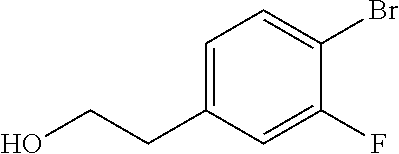
[0194]To a solution of 2-(4-bromo-3-fluorophenyl)acetic acid (45.0 g, 193 mmol) in THF (270 mL) was added BH3·THF (1 M, 386 mL) at 0° C. Then the mixture was stirred at 20° C. for 2 hrs. Under cooling with ice, MeOH (250 mL) was added dropwise until there was no foaming in the system and the solvent was distilled off under reduced pressure. To the resulting residue, water (50 mL) was added for extraction with EtOAc (1000.0 mL). The combined organic phase was washed with brine (40.0 mL), dried over Na2SO4, filtered and concentrated in vacuum. 2-(4-bromo-3-fluorophenyl)ethan-1-ol (38.0 g, 89.8%) was obtained. 1HNMR (400 MHz, CDCl3-d) δ ppm 7.45 (t, J=7.72 Hz, 1H), 7.00 (dd, J=9.48, 1.76 Hz, 1H), 6.86-6.92 (m, 1H), 3.82 (t, J=6.50 Hz, 2H), 2.80 (t, J=6.50 Hz, 2H), 2.03 (s, 1H); [M+H]+=219.1.
Step 2: (4-bromo-3-fluorophenethoxy)(tert-butyl)dimethylsilane

[0196]To a solution of 2-(4-bromo-3-fluorophenyl)ethan-1-ol (38.0 g, 173 mmol) in DCM (210 mL) was added imidazole (17.7 g, 260 mmol) at 20° C. TBSCl (36.6 g, 242 mmol, 29.7 mL) was added to the reaction mixture at 0° C. Then the mixture was stirred at 20° C. for 3 hrs. Then the mixture was adjusted to pH=6 with 5% citric acid (180 mL), and extracted with DCM (150 mL). The organic phase was adjusted to pH=8 with NaHCO3 and then aqueous phase was extracted with DCM (100 mL). The combined organic phase was washed with brine (150 mL), dried over Na2SO4, filtered and concentrated in vacuum. (4-bromo-3-fluorophenethoxy)(tert-butyl)dimethylsilane (52.0 g, 156 mmol) was obtained. 1HNMR (400 MHz, CDCl3-d) δ ppm 7.43 (t, J=7.72 Hz, 1H), 7.00 (dd, J=9.56, 1.87 Hz, 1H), 6.89 (dd, J=8.00, 1.87 Hz, 1H), 3.80 (t, J=6.48 Hz, 2H), 2.78 (t, J=6.48 Hz, 2H), 0.84-0.89 (m, 9H), −0.05-0.01 (m, 6H); [M+H]+=333.2.
Step 3: 2,6-bis(benzyloxy)-3-(4-(2-((tert-butyldimethylsilyl)oxy)ethyl)-2-fluorophenyl)pyridine

[0198]To a solution of (4-bromo-3-fluorophenethoxy)(tert-butyl)dimethylsilane (52.0 g, 156 mmol) and 2,6-bis(benzyloxy)-3-(4,4,5,5-tetramethyl-1,3,2-dioxaborolan-2-yl)pyridine (65.1 g, 156 mmol) in dioxane (320 mL) was added KOAc (45.9 g, 468 mmol) at 20° C. Pd(dppf)Cl2 (11.4 g, 15.6 mmol) was added to the mixture at 20° C. The suspension was degassed under vacuum and purged with N2 three times. Then the mixture was stirred at 90° C. for 16 hrs. Water (160 mL) was poured into the mixture, extracted with EtOAc (100 mL). The combined organic phase was washed with brine (100 mL), dried over Na2SO4, filtered and concentrated in vacuum. The residue was purified by column chromatography. 2,6-bis(benzyloxy)-3-(4-(2-((tert-butyldimethylsilyl)oxy)ethyl)-2-fluorophenyl)pyridine (32.0 g, 37.8%) was obtained.
[0199]1HNMR (400 MHz, CDCl3-d) δ ppm 7.55 (dd, J=8.04, 0.99 Hz, 1H), 7.43-7.47 (m, 2H), 7.33-7.42 (m, 7H), 7.25-7.33 (m, 3H), 6.98-7.05 (m, 2H), 5.40 (d, J=18.4 Hz, 4H), 3.87 (t, J=6.84 Hz, 1H), 3.84-3.89 (m, 1H), 2.86 (t, J=6.84 Hz, 2H), 0.88-0.92 (m, 9H), 0.01-0.03 (m, 6H); [M+H]+=544.2.
Step 4: 3-(4-(2-((tert-butyldimethylsilyl)oxy)ethyl)-2-fluorophenyl)piperidine-2,6-dione

[0201]To a solution of 2,6-bis(benzyloxy)-3-(4-(2-((tert-butyldimethylsilyl)oxy)ethyl)-2-fluorophenyl)pyridine (32.0 g, 58.8 mmol) in THF (50.0 mL) was added Pd/C (0.800 g, 10.0% purity) under Ar at 20° C. The suspension was degassed and purged with H2 for 3 times. The mixture was stirred under H2 (50 Psi) at 50° C. for 16 hrs. The suspension was filtered through a pad of celite and the filter cake was washed with THF (200 mL×3). The combined filtrates were concentrated to dryness to give crude product. The crude product was triturated with petroleum ether (50.0 mL) at 20° C. for 1 hrs. 3-(4-(2-((tert-butyldimethylsilyl)oxy)ethyl)-2-fluorophenyl)piperidine-2,6-dione (12.0 g, 55.7%) was obtained. 1HNMR (400 MHz, CDCl3-d) δ ppm 7.06-7.12 (m, 1H) 7.93 (br s, 1H), 6.96-7.04 (m, 2H), 3.91 (dd, J=11.2, 5.04 Hz, 1H), 3.81 (t, J=6.80 Hz, 2H), 2.82 (t, J=6.80 Hz, 2H), 2.58-2.73 (m, 2H), 2.18-2.34 (m, 2H), 0.87 (s, 9H), 0.00 (s, 6H); [M+H]+=366.3.
Step 5: 3-(2-fluoro-4-(2-hydroxyethyl)phenyl)piperidine-2,6-dione

[0203]To a solution of 3-(4-(2-((tert-butyldimethylsilyl)oxy)ethyl)-2-fluorophenyl)piperidine-2,6-dione (12.0 g, 32.8 mmol) in MeOH (60 mL) was added HCl (12 M, 6 mL) at 20° C. Then the mixture was stirred at 20° C. for 3 hrs. Water (60 mL) was poured into the mixture, extracted with EtOAc (40 mL). The combined organic phase was washed with brine (40 mL), dried over Na2SO4, filtered and concentrated in vacuum. The combined crude product was purified by re-crystallization from toluene (32.0 mL) at 100° C. 3-(2-fluoro-4-(2-hydroxyethyl)phenyl)piperidine-2,6-dione (6.50 g, 78.8%) was obtained. 1HNMR (400 MHz, DMSO-d6) δ ppm 10.8 (s, 1H), 7.19 (t, J=7.84 Hz, 1H), 6.99-7.08 (m, 2H), 4.67 (t, J=5.18 Hz, 1H), 3.99 (dd, J=12.6, 4.74 Hz, 1H), 3.55-3.66 (m, 2H), 2.68-2.75 (m, 3H), 2.18 (qd, J=12.8, 3.86 Hz, 1H), 1.93-2.03 (m, 1H); [M+H]+=252.2.
Step 6: 2-(4-(2,6-dioxopiperidin-3-yl)-3-fluorophenyl)acetaldehyde

[0205]To a solution of 3-(2-fluoro-4-(2-hydroxyethyl)phenyl)piperidine-2,6-dione (200 mg, 0.8 mmol) in DMSO (10 mL) was added IBX (338 mg, 1.2 mmol). The mixture was stirred in a flask at rt overnight. After being determined the reaction to be completed by LCMS, the mixture was extracted with EA (30 mL*3). The combined organic phase was dried over anhydrous Na2SO4, and evaporated in vacuum to afford the crude product (100 mg, crude), which was used for next step without further purification. [M+H]+=250.4.
Step 7: tert-butyl 4-(1-(2-fluoro-4-nitrophenyl)piperidin-4-yl)piperazine-1-carboxylate

[0207]A mixture of 1,2-difluoro-4-nitrobenzene (500 mg, 3.1 mmol), tert-butyl 4-(piperidin-4-yl)piperazine-1-carboxylate (915 mg, 3.4 mmol) and K2CO3 (855 mg, 6.2 mmol) in DMF (15 mL) was stirred in a round bottom flask at 80° C. overnight. The reaction was cooled to room temperature, the mixture was poured into water (50 mL) and stirred for 10 mins. The solid was filtered and washed with water (30 mL×2), dried to give the product (750 mg, 58%). [M+H]+=409.4.
Step 8: tert-butyl 4-(1-(4-amino-2-fluorophenyl)piperidin-4-yl)piperazine-1-carboxylate

[0209]To a solution of tert-butyl 4-(1-(2-fluoro-4-nitrophenyl)piperidin-4-yl)piperazine-1-carboxylate (220 mg, 0.54 mmol) in MeOH (20 mL) was added 10% Pd/C (50 mg) at 25° C. And then the mixture was exchanged with H2 two times and stirred under H2 atmosphere at 25° C. for 2 h. The mixture was filtered through a pad of celite and washed with MeOH (20 mL). The filtrate was concentrated under vacuum to obtain the product (190 mg, 95%). [M+H]+=378.2
Step 9: 1-(methylsulfonyl)-7-nitroindoline

[0211]To a stirred solution of 7-nitroindoline (300 mg, 1.8 mmol) and NaH (146 mg, 3.6 mmol) in DMF (5 mL) was added methanesulfonyl chloride dropwise (315 mg, 2.7 mmol). The resulting mixture was stirred at room temperature for 1 hour. The reaction was quenched with saturated NH4Cl (aq.) solution and extracted with EtOAc (2×50 mL). The combined organic layer was washed with brine (2×50 mL), dried over Na2SO4 and concentrated under vacuum to afford the crude residue, which was purified with silica gel column chromatography (PE:EA=100:0˜2:1 gradient elution) to give the title product (390 mg, 88%). [M+H]+=243.1.
Step 10: 1-(methylsulfonyl)indolin-7-amine

[0213]Under N2, to a solution of 1-(methylsulfonyl)-7-nitroindoline (390 mg, 1.6 mmol) in MeOH (20 mL) was added 10% Pd/C (50 mg) at room temperature. And then the mixture was exchanged with H2 two times and stirred under H2 atmosphere at room temperature for 2 h. Reaction was monitored by LC-MS. The mixture was filtered through a pad of Celite and washed with MeOH (20 mL). The filtrate was concentrated under vacuum to obtain the title product (340 mg, 99%). [M+H]+=213.1.
Step 11: 2-chloro-N-(1-(methylsulfonyl)indolin-7-yl)-7H-pyrrolo[2,3-d]pyrimidin-4-amine

[0215]To a solution of 1-(methylsulfonyl)indolin-7-amine (60 mg, 0.28 mmol) and 2,4-dichloro-5H-pyrrolo[3,2-d]pyrimidine (79 mg, 0.42 mmol) in i-PrOH (8 mL) was added conc. HCl (0.2 mL. The resulting mixture was heated at 80° C. overnight. The organic solvent was removed under reduced pressure, the residue was basified with saturated NaHCO3 (aq.) solution and extracted with DCM (2×30 mL). The combined organic layer was dried over Na2SO4 and concentrated under vacuum to afford the crude residue, which was purified with silica gel column chromatography (PE:EA=100:0˜1:1 gradient elution) to give the title product (100 mg, 97%). [M+H]+=364.2.
Step 12: tert-butyl 4-(1-(2-fluoro-4-((4-((1-(methylsulfonyl)indolin-7-yl)amino)-7H-pyrrolo[2,3-d]pyrimidin-2-yl)amino)phenyl)piperidin-4-yl)piperazine-1-carboxylate

[0217]A mixture of 2-chloro-N-(1-(methylsulfonyl)indolin-7-yl)-7H-pyrrolo[2,3-d]pyrimidin-4-amine (40 mg, 0.11 mmol), tert-butyl 4-(1-(4-amino-2-fluorophenyl)piperidin-4-yl)piperazine-1-carboxylate (45 mg, 0.12 mmol), G3 BrettPhos Pd (10 mg, 0.011 mmol) and Cs2CO3 (72 mg, 0.22 mmol) in 1,4-dioxane (6 mL) was stirred in a round bottom flask at 100° C. overnight under N2 atmosphere. The mixture was evaporated in vacuum to afford the crude product, which was purified by silica gel column chromatography (DCM:MeOH=100:0˜5:1 gradient elution) to give the title product (60 mg, 78%). [M+H]+=706.2.
Step 13: N 2 -(3-fluoro-4-(4-(piperazin-1-yl)piperidin-1-yl)phenyl)-N 4 -(1-(methylsulfonyl)indolin-7-yl)-7H-pyrrolo[2,3-d]pyrimidine-2,4-diamine

[0219]A solution of tert-butyl 4-(1-(2-fluoro-4-((4-((1-(methylsulfonyl)indolin-7-yl)amino)-7H-pyrrolo[2,3-d]pyrimidin-2-yl)amino)phenyl)piperidin-4-yl)piperazine-1-carboxylate (750 mg, 1.06 mmol) in TFA/DCM=1/4 (5 mL) was stirred in a round bottom flask at room temperature for 2 h. The mixture was evaporated in vacuum to afford the crude product (610 mg, 95%), which was used for next step without further purification. [M+H]+=606.4.
Step 14: 3-(2-fluoro-4-(2-(4-(1-(2-fluoro-4-((4-((1-(methylsulfonyl)indolin-7-yl)amino)-7H-pyrrolo[2,3-d]pyrimidin-2-yl)amino)phenyl)piperidin-4-yl)piperazin-1-yl)ethyl)phenyl)piperidine-2,6-dione

[0221]A mixture of N2-(3-fluoro-4-(4-(piperazin-1-yl)piperidin-1-yl)phenyl)-N4-(1-(methylsulfonyl)indolin-7-yl)-7H-pyrrolo[2,3-d]pyrimidine-2,4-diamine (40 mg, 0.066 mmol), 2-(4-(2,6-dioxopiperidin-3-yl)-3-fluorophenyl)acetaldehyde (17 mg, 0.069 mmol) and NaOAc (14 mg, 0.17 mmol) in chloromethane (4 mL) and EtOH (0.5 mL) was stirred in a flask at room temperature for 2 hour. The mixture was added NaBH3CN (10 mg, 0.17 mmol) and stirred in a flask at room temperature for another 2 h. Then the mixture was evaporated in vacuum to afford the crude product, which was purified with HPLC chromatography (0.1% FA in water:acetonitrile=90:10˜50:50 gradient elution) to give the product (15 mg, 27%). 1H NMR (400 MHz, CD3OD) δ 7.64 (s, 1H), 7.53 (s, 1H), 7.37 (s, 1H), 7.29 (s, 2H), 7.19-7.07 (m, 4H), 7.03 (s, 1H), 4.12 (s, 2H), 4.03 (d, J=7.9 Hz, 1H), 3.59 (d, 3H), 3.47 (s, 4H), 3.14-3.20 (m, 4H), 2.95 (s, 3H), 2.85-2.90 (m, 2H), 2.61-2.68 (s, 4H), 2.29 (s, 4H), 2.10-2.16 (m, 2H), 2.02-2.04 (m, 2H), 1.28 (s, 3H); [M+H]+=839.4.
Example 1: 3-(4-(2-(4-(1-(2-fluoro-4-((4-((1-(methylsulfonyl)indolin-7-yl)amino)-7H-pyrrolo[2,3-d]pyrimidin-2-yl)amino)phenyl)piperidin-4-yl)piperazin-1-yl)ethyl)phenyl)piperidine-2,6-dione

[0223]The titled compound was prepared in a manner similar to that in Example 3. 1H NMR (400 MHz, DMSO) δ 11.60 (s, 1H), 10.84 (s, 1H), 9.44 (s, 1H), 8.09-7.72 (m, 2H), 7.24 (d, J=18.1 Hz, 6H), 7.02 (s, 2H), 6.34 (s, 1H), 4.10 (s, 2H), 3.84 (d, J=11.5 Hz, 6H), 3.61 (s, 2H), 3.30-3.21 (m, 2H), 3.12-3.18 (m, 3H), 3.10-2.88 (m, 7H), 2.68 (d, J=8.4 Hz, 4H), 2.54 (s, 1H), 2.19 (d, J=8.7 Hz, 3H), 2.03 (s, 1H), 1.90 (s, 2H), 1.23 (s, 2H); [M+H]+=821.3.
Example 2: 3-(4-(2-(4-(1-(2-fluoro-4-((4-((1-(methylsulfonyl)indolin-7-yl)amino)-7H-pyrrolo[2,3-d]pyrimidin-2-yl)amino)phenyl)piperidin-4-yl)piperazin-1-yl)ethyl)-2-methoxyphenyl)piperidine-2,6-dione

[0225]The titled compound was prepared in a manner similar to that in Example 3. 1H NMR (400 MHz, DMSO) δ 11.34 (s, 1H), 10.73 (s, 1H), 9.04 (s, 1H), 8.94 (s, 1H), 8.30 (d, J=6.7 Hz, 1H), 7.87 (d, J=15.1 Hz, 1H), 7.31 (d, J=9.1 Hz, 1H), 7.25 (s, 1H), 7.14 (s, 1H), 7.04-6.94 (m, 2H), 6.92 (d, J=14.8 Hz, 2H), 6.77 (d, J=7.4 Hz, 1H), 6.21 (s, 1H), 4.11 (s, 2H), 3.86 (s, 1H), 3.73 (s, 3H), 3.16-3.07 (m, 6H), 3.03-2.91 (m, 2H), 2.76-2.54 (m, 13H), 2.43-2.45 (m, 1H), 2.31-2.33 (m, 2H), 2.23-2.10 (m, 1H), 1.93-1.81 (m, 3H), 1.64-1.49 (m, 2H); [M+H]+=851.2.
Example 4: 3-(4-(3-(4-(1-(2-fluoro-4-((4-((1-(methylsulfonyl)indolin-7-yl)amino)-7H-pyrrolo[2,3-d]pyrimidin-2-yl)amino)phenyl)piperidin-4-yl)piperazin-1-yl)propoxy)phenoxy)piperidine-2,6-dione
Step 1: 4-(3-((tert-butyldimethylsilyl)oxy)propoxyphenol

[0227]Hydroquinone (10.6 g, 96.1 mmol) was dissolved in DMF (100 mL). The solution was added (3-bromopropoxy)(tert-butyl)dimethylsilane (23.0 g, 91 mmol) and Cs2CO3 (45.0 g, 138.1 mmol). The mixture was stirred at 50° C. for 2 h. The mixture was diluted with water (100 mL), extracted with EA (150 mL×2). The combined organic lays were washed with water (50 mL×3) and brine (50 mL×2), dried over Na2SO4 and concentrated under reduced pressure, the residue was purified by column chromatography to obtain the product (8.5 g, 31.3%). [M+H]+=283.2.
Step 2: 3-bromopiperidine-2,6-dione

[0229]Br2 (25.4 g, 158 mmol) was added to a solution of piperidine-2,6-dione (15.0 g, 132 mmol) in CHCl3 (30 mL), the mixture is stirred for 4 h at 110° C. After cooling, the mixture was added water (200 mL), extracted with EA (200 mL×2). The combined organic lays were washed with water (100 mL) and brine (100 mL), dried over Na2SO4 and concentrated under reduced pressure. The residue was purified by column chromatography to give the product (7.9 g, 31%). [M+H]+=192.2.
Step 3: 3-(4-(3-((tert-butyldimethylsilyl)oxy)propoxy)phenoxy)piperidine-2,6-dione

[0231]4-(3-((Tert-butyldimethylsilyl)oxy)propoxy)phenol (22.1 g, 78.1 mmol) was dissolved in THF (100 mL). The solution was added NaH (4.7 g, 60%, 117.2 mmol) at 0° C., the resulting mixture was stirred for 1 h. Then the mixture was dropped into a solution of 3-bromopiperidine-2,6-dione (15.0 g, 78.1 mmol) in THF (100 mL). The mixture was stirred at 60° C. for 2 h, then added saturated aqueous solution of NH4Cl (100 mL) at 0° C., extracted with EA (100 mL×4). The combined organic phases were washed with water (50 mL×2) and brine (50 mL×2), dried over Na2SO4 and concentrated under reduced pressure. The residue was purified by column chromatography to give the product (14.5 g, 47%). [M+H]+=394.2.
Step 4: 3-(4-(3-hydroxypropoxy)phenoxy)piperidine-2,6-dione

[0233]3-(4-(3-((Tert-butyldimethylsilyl)oxy)propoxy)phenoxy)piperidine-2,6-dione (19.0 g, 48.3 mmol) was dissolved in THF (200 mL), was added TBAF (1M in THF) (72.5 mL, 72.5 mmol), the mixture was stirred at 25° C. for 5 h. The mixture was added water (100 mL), extracted with EA (150 mL×2). The combined organic phases were washed with water (100 mL) and brine (100 mL), dried over Na2SO4 and concentrated under reduced pressure. The residue was purified by column chromatography) to give the product (5.3 g, 39.3%). 1H NMR (400 MHz, DMSO) δH 10.89 (s, 1H), 6.94 (d, J=9.1 Hz, 2H), 6.84 (d, J=9.1 Hz, 2H), 5.02 (dd, J=10.5, 4.9 Hz, 1H), 4.51 (t, J=5.1 Hz, 1H), 3.97 (t, J=6.4 Hz, 2H), 3.56-3.52 (m, 2H), 2.76-2.54 (m, 2H), 2.23-2.02 (m, 2H), 1.88-1.79 (m, 2H); [M+H]+=280.2.
Step 5: 3-(4-((2,6-dioxopiperidin-3-yl)oxy)phenoxy)propyl methanesulfonate

[0235]3-(4-(3-hydroxypropoxy)phenoxy)piperidine-2,6-dione (279 mg, 1.0 mmol), triethylamine (202 mg, 2.0 mmol) were dissolved in THF (5 mL), was added methanesulfonyl chloride (136.1 mg, 1.2 mmol), the mixture was stirred at 25° C. for 2 h. The mixture was added water (10 mL), extracted with EA (15 mL×2). The combined organic phases were washed with water (10 mL) and brine (10 mL), dried over Na2SO4 and concentrated under reduced pressure. The residue was purified by column chromatography) to give the product (200 mg, 56%). [M+H]+=358.2.
Step 6: 3-(4-(3-(4-(1-(2-fluoro-4-((4-((1-(methylsulfonyl)indolin-7-yl)amino)-7H-pyrrolo[2,3-d]pyrimidin-2-yl)amino)phenyl)piperidin-4-yl)piperazin-1-yl)propoxy)phenoxy)piperidine-2,6-dione

[0237]A mixture of N2-(3-fluoro-4-(4-(piperazin-1-yl)piperidin-1-yl)phenyl)-N4-(1-(methylsulfonyl)indolin-7-yl)-7H-pyrrolo[2,3-d]pyrimidine-2,4-diamine (34 mg, 0.057 mmol), 3-(4-((2,6-dioxopiperidin-3-yl)oxy)phenoxy)propyl methanesulfonate (24 mg, 0.069 mmol), KI (11.6 mg, 0.069 mmol) and DIEA (14.7 mg, 0.114 mmol) in acetonitrile (4 mL) was stirred in a round bottom flask at 75° C. for 12 hours. The reaction was quenched with water and the mixture was extracted with DCM, washed triple times with saturated brine, dried over anhydrous Na2SO4. After filtration, the filtrate was concentrated under reduced pressure. The residue was purified by HPLC chromatography to give the product (10 mg, 20%). 1H NMR (400 MHz, DMSO) δ 11.32 (s, 1H), 10.90 (s, 1H), 9.03 (s, 1H), 8.92 (s, 1H), 8.30 (d, J=8.0 Hz, 1H), 7.86 (d, J=15.5 Hz, 1H), 7.35-7.20 (m, 2H), 7.12 (d, J=7.2 Hz, 1H), 7.02-6.77 (m, 5H), 6.21 (s, 1H), 5.10-4.96 (m, 1H), 4.11 (s, 2H), 3.94 (s, 2H), 3.18-2.83 (m, 8H), 2.75-2.54 (m, 8H), 2.45-2.24 (m, 5H), 2.23-2.00 (m, 2H), 1.95-1.76 (m, 4H), 1.65-1.47 (m, 2H); [M+H]+=867.5.
Example 5: 3-(3-(2-(4-(1-(2-fluoro-4-((4-((1-(methylsulfonyl)indolin-7-yl)amino)-7H-pyrrolo[2,3-d]pyrimidin-2-yl)amino)phenyl)piperidin-4-yl)piperazin-1-yl)ethoxy)phenyl)piperidine-2,6-dione

[0239]The titled compound was prepared in a manner similar to that in Example 1. 1H NMR (400 MHz, DMSO) δ 11.32 (s, 1H), 10.83 (s, 1H), 9.03 (s, 1H), 8.92 (s, 1H), 8.30 (d, J=7.8 Hz, 1H), 7.86 (d, J=14.8 Hz, 1H), 7.27-7.81 (m, 3H), 7.12 (d, J=6.8 Hz, 1H), 7.01-6.75 (m, 5H), 6.21 (s, 1H), 4.08-4.11 (m, 4H), 3.81 (s, 1H), 3.28-3.21 (m, 3H), 3.17-3.07 (m, 6H), 3.04-2.87 (m, 2H), 2.74-2.52 (m, 10H), 2.32-2.14 (m, 2H), 2.10-1.92 (m, 1H), 1.95-1.75 (m, 2H), 1.65-1.47 (m, 2H); [M+H]+=837.
Example 6: 3-(3-((2-(4-(1-(2-fluoro-4-((4-((1-(methylsulfonyl)indolin-7-yl)amino)-7H-pyrrolo[2,3-d]pyrimidin-2-yl)amino)phenyl)piperidin-4-yl)piperazin-1-yl)ethyl)(methyl)amino)phenyl)piperidine-2,6-dione

[0241]The titled compound was prepared in a manner similar to that in Example 1. 1H NMR (400 MHz, DMSO) δ 11.32 (s, 1H), 10.80 (s, 1H), 9.02 (s, 1H), 8.92 (s, 1H), 8.30 (d, J=8.0 Hz, 1H), 7.86 (d, J=15.8 Hz, 1H), 7.35-7.20 (m, 2H), 7.16-7.05 (m, 2H), 6.92-6.95 (m, 2H), 6.61-6.50 (m, 2H), 6.44 (d, J=7.1 Hz, 1H), 6.21 (s, 1H), 4.11 (s, 2H), 3.74 (s, 1H), 3.42 (s, 3H), 3.11 (m, 6H), 3.05-2.92 (m, 2H), 2.88 (s, 3H), 2.62-2.65 (m, 4H), 2.44-2.48 (m, 5H), 2.35-1.95 (m, 4H), 1.83-1.86 (m, 2H), 1.56-1.58 (m, 2H), 1.24 (s, 2H); [M+H]+=850.
Example 8: 3-(4-(4-(2-(4-(1-(2-fluoro-4-((4-((1-(methylsulfonyl)indolin-7-yl)amino)-7H-pyrrolo[2,3-d]pyrimidin-2-yl)amino)phenyl)piperidin-4-yl)piperazin-1-yl)ethyl)piperidin-1-yl)phenyl)piperidine-2,6-dione
Step 1: 2,6-bis(benzyloxy)-3-(4-bromophenyl)pyridine

[0243]To a stirred mixture of 2,6-bis(benzyloxy)-3-(4,4,5,5-tetramethyl-1,3,2-dioxaborolan-2-yl)pyridine (The intermediate can be prepared according to the way described in WO2017197046) (25 g, 59.9 mmol) and 4-bromoiodobenzene (20.3 g, 71.9 mmol) in dioxane (250 mL) and H2O (50 mL) were added K2CO3 (16.6 g, 120 mmol) and Pd(dppf)Cl2 (4.4 g, 6.0 mmol) at room temperature under nitrogen atmosphere. The resulting mixture was stirred for 16 h at 80° C. under nitrogen atmosphere. The reaction mixture was allowed to cool down to room temperature. The resulting mixture was extracted with EtOAc (3×500 mL). The combined organic layers were washed with brine (500 mL), dried over anhydrous Na2SO4. After filtration, the filtrate was concentrated under reduced pressure. The residue was purified by silica gel column chromatography, eluted with PE/EtOAc (10:1) to afford the product (23 g, 86%); [M+H]+=446.2.
Step 2: ethyl 2-(1-[4-[2,6-bis(benzyloxy)pyridin-3-yl]phenyl]piperidin-4-yl)acetate

[0245]To a stirred solution of 2,6-bis(benzyloxy)-3-(4-bromophenyl)pyridine (15 g, 33.6 mmol) and ethyl 2-(piperidin-4-yl)acetate (8.6 g, 50.4 mmol) in 2-methyl-THF (150 mL) and H2O (15 mL) were added Cs2CO3 (32.9 g, 100.8 mmol), DavePhos (2.7 g, 6.7 mmol) and Pd2(dba)3 (3.1 g, 3.4 mmol) at room temperature under nitrogen atmosphere. The resulting mixture was stirred for 16 h at 100° C. under nitrogen atmosphere. The mixture was allowed to cool down to room temperature. The resulting mixture was concentrated under reduced pressure. The residue was diluted with EtOAc (500 mL), washed with water (3×200 mL) and brine (200 mL). The organic layer was dried over anhydrous Na2SO4. After filtration, the filtrate was concentrated under reduced pressure. The residue was purified by silica gel column chromatography, eluted with PE/EtOAc (1:1) to afford the product (14 g, 78%); [M+H]+=537.3.
Step 3: 2-(1-(4-(2,6-bis(benzyloxy)pyridin-3-yl)phenyl)piperidin-4-yl)ethan-1-ol

[0247]To a stirred solution of ethyl 2-(1-[4-[2,6-bis(benzyloxy)pyridin-3-yl]phenyl]piperidin-4-yl)acetate (13 g, 24.2 mmol) in THF (130 mL) was added LiAlH4 (1 g, 26.6 mmol) in portions at 0° C. The resulting mixture was stirred for 2 h at room temperature. The reaction was quenched by the addition of water/ice (50 mL) at 0° C. The resulting mixture was extracted with EtOAc (3×50 mL). The combined organic layers were washed with brine (50 mL), dried over anhydrous Na2SO4. After filtration, the filtrate was concentrated under reduced pressure. The residue was purified by silica gel column chromatography, eluted with PE/EtOAc (1:1) to afford the product (11 g, 92%); [M+H]+=495.3.
Step 4:3-(4-(4-(2-hydroxyethyl)piperidin-1-yl)phenyl)piperidine-2,6-dione

[0249]To a stirred solution of 2-(1-(4-(2,6-bis(benzyloxy)pyridin-3-yl)phenyl)piperidin-4-yl)ethan-1-ol (10.5 g, 21.2 mmol) in EtOH (100 mL), EtOAc (100 mL) and DCM (20 mL) was added Pd/C (wet, 10%) (5 g) under nitrogen atmosphere. The resulting mixture was stirred for 16 h at room temperature under hydrogen atmosphere. The resulting mixture was filtered, the filter cake was washed with DCM/CH3OH (10:1, 200 mL). The filtrate was concentrated under reduced pressure. The residue was purified by silica gel column chromatography, eluted with MeOH/DCM (1:10) to afford the product (5.1 g, 76%). [M+H]+=317.1.
Step 5: 2-(1-(4-(2,6-dioxopiperidin-3-yl)phenyl)piperidin-4-yl)acetaldehyde

[0251]A mixture of 3-(4-(4-(2-hydroxyethyl)piperidin-1-yl)phenyl)piperidine-2,6-dione (100 mg, 0.32 mmol) and IBX (132 mg, 0.47 mmol) in DMSO (10 mL) was stirred in a flask at room temperature overnight. The reaction was quenched with water and the mixture was extracted with EtOAc, washed three times with saturated aqueous NaCl and twice with saturated aqueous NaHCO3. The organic layer was dried over anhydrous Na2SO4 and evaporated in vacuum to afford the product (70 mg, 70%). [M+H]+=315.2.
Step 6: 3-(4-(4-(2-(4-(1-(2-fluoro-4-((4-((1-(methylsulfonyl)indolin-7-yl)amino)-7H-pyrrolo[2,3-d]pyrimidin-2-yl)amino)phenyl)piperidin-4-yl)piperazin-1-yl)ethyl)piperidin-1-yl)phenyl)piperidine-2,6-dione

[0253]The titled compound was prepared in a manner similar to that in Example 3. 1H NMR (400 MHz, DMSO) δ 11.32 (s, 1H), 10.77 (s, 1H), 9.03 (s, 1H), 8.92 (s, 1H), 8.30 (d, J=8.3 Hz, 1H), 7.86 (d, J=14.7 Hz, 1H), 7.28-7.30 (m, 2H), 7.13 (s, 1H), 7.03 (d, J=8.7 Hz, 2H), 6.91-6.95 (m, 4H), 6.21 (s, 1H), 4.16-4.06 (m, 2H), 3.75-3.61 (m, 3H), 3.20-3.03 (m, 6H), 2.73-2.54 (m, 10H), 2.49-2.21 (m, 7H), 2.20-2.06 (m, 1H), 2.05-1.95 (m, 1H), 1.89-1.80 (m, 2H), 1.79-1.68 (m, 2H), 1.63-1.51 (m, 2H), 1.47-1.35 (m, 3H), 1.30-1.17 (m, 3H); [M+H]+=904.2.
Example 9: 3-(2-fluoro-4-(4-(2-(4-(1-(2-fluoro-4-((4-((1-(methylsulfonyl)indolin-7-yl)amino)-7H-pyrrolo[2,3-d]pyrimidin-2-yl)amino)phenyl)piperidin-4-yl)piperazin-1-yl)ethyl)piperidin-yl)phenyl)piperidine-2,6-dione

[0255]The titled compound was prepared in a manner similar to that in Example 3. 1H NMR (400 MHz, DMSO) δ 11.31 (s, 1H), 10.79 (s, 1H), 9.02 (s, 1H), 8.90 (s, 1H), 8.29 (d, J=7.3 Hz, 1H), 7.86 (d, J=16.9 Hz, 1H), 7.31 (d, J=7.7 Hz, 1H), 7.24 (t, J=7.8 Hz, 1H), 7.12 (d, J=7.0 Hz, 1H), 7.04 (d, J=8.5 Hz, 1H), 6.92 (m, 2H), 6.70 (d, J=10.8 Hz, 2H), 6.21 (s, 1H), 4.10 (s, 2H), 3.87 (d, J=7.8 Hz, 1H), 3.69 (d, J=11.7 Hz, 2H), 3.17-3.06 (m, 6H), 2.73-2.55 (m, 8H), 2.43-2.25 (m, 6H), 2.22-2.05 (m, 2H), 2.00-1.90 (m, 1H), 1.83 (s, 2H), 1.73 (d, J=11.5 Hz, 2H), 1.61-1.51 (m, 2H), 1.48-1.32 (m, 4H), 1.29-1.14 (m, 4H); [M+H]+=922.3.
Example 10: 2-(2,6-dioxopiperidin-3-yl)-5-(4-(2-(4-(1-(2-fluoro-4-((4-((1-(methylsulfonyl)indolin-7-yl)amino)-7H-pyrrolo[2,3-d]pyrimidin-2-yl)amino)phenyl)piperidin-4-yl)piperazin-1-yl)ethyl)piperidin-1-yl)benzonitrile

[0257]The titled compound was prepared in a manner similar to that in Example 3. 1H NMR (400 MHz, DMSO) δ 11.33 (s, 1H), 10.92 (s, 1H), 9.03 (s, 1H), 8.92 (s, 1H), 8.30 (d, J=8.1 Hz, 1H), 7.86 (d, J=15.3 Hz, 1H), 7.35-7.19 (m, 5H), 7.12 (d, J=7.2 Hz, 1H), 6.92-6.95 (m, 2H), 6.21 (s, 1H), 4.10 (d, J=7.2 Hz, 2H), 3.99 (dd, J=12.5, 4.6 Hz, 1H), 3.77 (d, J=12.1 Hz, 2H), 3.18-3.07 (m, 6H), 2.85-2.53 (m, 10H), 2.44-2.22 (m, 8H), 2.01-2.05 (m, 1H), 1.88-1.80 (m, 2H), 1.78-1.70 (m, 2H), 1.63-1.34 (m, 5H), 1.27-1.15 (m, 3H); [M+H]+=929.2.
Example 11: 3-(4-(1-(3-(4-(1-(2-fluoro-4-((4-((1-(methylsulfonyl)indolin-7-yl)amino)-7H-pyrrolo[2,3-d]pyrimidin-2-yl)amino)phenyl)piperidin-4-yl)piperazin-1-yl)-3-oxopropyl)piperidin-4-yl)phenyl)piperidine-2,6-dione
Step 1: tert-butyl 4-(4-(2,6-bis(benzyl)oxy)pyridin-3-yl)phenyl)piperidine-1-carboxylate

[0259]Tert-butyl 4-(4-(4,4,5,5-tetramethyl-1,3,2-dioxaborolan-2-yl)phenyl)piperidine-1-carboxylate (17 g, 44 mmol), Pd(dppf)Cl2 (3.2 g, 4.4 mmol), 2,6-bis(benzyloxy)-3-bromopyridine (16.2 g, 44.0 mmol), Cs2CO3 (28.7 g, 88 mmol) were placed in dioxane/water (300 mL, 10:1). The mixture was stirred at 100° C. for overnight until LC-MS indicated all the starting material was consumed. The resulting solution was filtered and the filtrate was concentrated to afford the crude residue which was purified by SiO2-gel column (eluted with EtOAc/Hexane=1:1) to give the desired product (5 g, 21%). [M+H]+=551.3.
Step 2: tert-butyl 4-(4-(2,6-dioxopiperidin-3-yl)phenyl)piperidine-1-carboxylate

[0261]Tert-butyl 4-(4-(2,6-bis(benzyloxy)pyridin-3-yl)phenyl)piperidine-1-carboxylate (5 g, 9.1 mmol) was dissolved in MeOH (50 mL), Pd/C (10%, w/w, 0.5 g) was added to the solution in one portion. The resulting mixture was stirred under H2 atmosphere overnight until LC-MS indicated all the starting material was consumed. The resulting solution was filtered and the filtrate was concentrated to give the desired product (1.9 g, 56.1%). [M+H]+=373.
Step 3: 3-(4-(piperidin-4-yl)phenyl)piperidine-2,6-dione hydrochloride

[0263]Tert-butyl 4-(4-(2,6-dioxopiperidin-3-yl)phenyl)piperidine-1-carboxylate (1.9 g, 5.1 mmol) was placed in HCl-dioxane (4M, 20 mL), the mixture was stirred at room temperature for 2 h until LC-MS indicated all the starting material was consumed. The resulting solution was concentrated to afford the crude residue which was triturated with MTBE (5 mL) to afford the desired product (1.38 g, 88%). [M+H]+=273.2.
Step 4: tert-butyl 3-(4-(4-(2,6-dioxopiperidin-3-yl)phenyl)piperidin-1-yl)propanoate

[0265]A mixture of 3-(4-(piperidin-4-yl)phenyl)piperidine-2,6-dione hydrochloride (228 mg, 0.74 mmol), tert-butyl acrylate (189 mg, 1.48 mmol) and DIEA (189 mg, 1.48 mmol) in MeCN (8 mL) was stirred in a flask at 80° C. overnight. The mixture was evaporated in vacuum to afford the crude product, which was further purified with silica gel column chromatography (DCM:MeOH=100:0˜10:1 gradient elution) to give the product (178 mg, 60%); [M+H]+=401.2.
Step 5: 3-(4-(4-(2,6-dioxopiperidin-3-yl)phenyl)piperidin-1-yl)propanoic acid

[0267]A solution of tert-butyl 3-(4-(4-(2,6-dioxopiperidin-3-yl)phenyl)piperidin-1-yl)propanoate (178 mg, 0.45 mmol) in HCl/1,4-dioxane (8 mL) was stirred in a flask at room temperature overnight. The mixture was evaporated in vacuum to afford the crude product (150 mg, 97%), which was used for next step without further purification. [M+H]+=345.4.
Step 6: 3-(4-(1-(3-(4-(1-(2-fluoro-4-((4-((1-(methylsulfonyl)indolin-7-yl)amino)-7H-pyrrolo[2,3-d]pyrimidin-2-yl)amino)phenyl)piperidin-4-yl)piperazin-1-yl)-3-oxopropyl)piperidin-4-yl)phenyl)piperidine-2,6-dione

[0269]To a solution of 3-(4-(4-(2,6-dioxopiperidin-3-yl)phenyl)piperidin-1-yl)propanoic acid (24 mg, 0.069 mmol), HATU (27 mg, 0.073 mmol) and DIEA (34 mg, 0.264 mmol) in DMF (4 mL) was added N2-(3-fluoro-4-(4-(piperazin-1-yl)piperidin-1-yl)phenyl)-N4-(1-(methylsulfonyl)indolin-7-yl)-7H-pyrrolo[2,3-d]pyrimidine-2,4-diamine (40 mg, 0.066 mmol). The resulting mixture was stirred at room temperature for 5 h. The reaction was quenched with water and the mixture was extracted with DCM. The organic phase was washed with saturated brine, dried over anhydrous Na2SO4. After filtration, the filtrate was concentrated under reduced pressure, the residue was purified by Pre-HPLC (0.1% FA in water:acetonitrile=90:10˜50:50 gradient elution) to give the title product (13.6 mg, 22%). 1H NMR (400 MHz, DMSO) δ 11.32 (s, 1H), 10.81 (s, 1H), 9.02 (s, 1H), 8.92 (s, 1H), 8.30 (d, J=7.9 Hz, 1H), 8.23 (s, 1H), 7.86 (d, J=15.7 Hz, 1H), 7.32 (d, J=8.5 Hz, 1H), 7.28-7.18 (m, 3H), 7.13 (d, J=7.7 Hz, 3H), 6.98-6.87 (m, 2H), 6.21 (s, 1H), 4.11 (s, 2H), 3.80 (d, J=6.8 Hz, 1H), 3.45 (s, 6H), 3.31-3.25 (m, 5H), 3.13 (s, 3H), 3.09 (s, 3H), 2.99 (d, J=10.7 Hz, 2H), 2.59 m, 3H), 2.48-2.42 (m, 3H), 2.35 (s, 1H), 2.16 (d, J=10.5 Hz, 1H), 2.10-2.00 (m, 3H), 1.83 (d, J=11.2 Hz, 2H), 1.74 (d, J=11.3 Hz, 2H), 1.62 (m, 4H); [M+H]+=932.8.
Example 12: 3-(4-(4-(2-(4-(1-(2-fluoro-4-((4-((1-(methylsulfonyl)indolin-7-yl)amino)-7H-pyrrolo[2,3-d]pyrimidin-2-yl)amino)phenyl)piperidin-4-yl)piperazin-1-yl)-2-oxoethyl)piperidin-1-yl)phenyl)piperidine-2,6-dione
Step 1: 4-(2,6-bis(benzyloxy)pyridin-3-yl)aniline

[0271]2,6-bis(benzyloxy)-3-bromopyridine (58.0 g, 156.7 mmol), 4-aminophenylboronic acid pinacol ester (44.6 g, 203.7 mmol), K2CO3 (65.0 g, 470.0 mmol) and Pd(dppf)Cl2 (11.5 g, 15.7 mmol) were added to the reaction flask, the mixture was degassed and purged with nitrogen for three times. Next 1.4-dioxane (1 L) and water (300 mL) were added to the reaction flask, and nitrogen was recharged three times again, the reaction was heated to reflux. After stirring for three hours, the reaction was cooled to room temperature, extracted with EtOAc (500 mL×3), the combined organic phases were washed with water and brine, dried and concentrated. 4-(2,6-bis(benzyloxy)pyridin-3-yl)aniline (57.3 g, 95.6%) was obtained after column separation (petroleum ether:ethyl acetate=10:1). 1H NMR (400 MHz, CDCl3) δ 7.57 (d, J=8.0 Hz, 1H), 7.50-7.27 (m, 12H), 6.72 (d, J=8.5 Hz, 2H), 6.45 (d, J=8.0 Hz, 1H), 5.43 (s, 2H), 5.36 (s, 2H), 3.68 (s, 2H); [M+H]+=383.2.
Step 2: 2,6-bis(benzyloxy)-3-(4-iodophenyl)pyridine

[0273]p-Toluenesulfonic acid monohydrate (106.0 g, 557 mmol) was added to tert-Butanol (800 mL). 4-(2,6-bis(benzyloxy)pyridin-3-yl)aniline (78.5 g, 205 mmol) was dissolved in MeCN (400 mL) and added to the system, and the mixture was stirred at room temperature. NaNO2 (28.3 g, 404 mmol) and KI (85.2 g, 513.1 mmol) in water (400 mL) was added. Then system was stirred at room temperature. After stirred for 1.5 h, the mixture was diluted with water (1.5 L), and pH was adjusted to 10 with 2M sodium hydroxide solution. 2M sodium thiosulfate solution (1 L) was added to the mixture, extracted with DCM (1 L×3). The combined organic phases were washed with water and brine, dried and concentrated. The residue was purified with silica gel column (petroleum ether:ethyl acetate=100:1) to obtain 2,6-bis(benzyloxy)-3-(4-iodophenyl)pyridine (31.2 g, 30.8%). 1H NMR (400 MHz, CDCl3) δ 7.70 (d, J=8.4 Hz, 2H), 7.57 (d, J=8.1 Hz, 1H), 7.47-7.28 (m, 12H), 6.48 (d, J=8.1 Hz, 1H), 5.41 (s, 2H), 5.37 (s, 2H); [M+H]+=494.1.
Step 3: tert-butyl 2-(1-(4-(2,6-bis(benzyloxy)pyridin-3-yl)phenyl)piperidin-4-yl)acetate

[0275]Under the atmosphere of nitrogen, add 2,6-bis(benzyloxy)-3-(4-iodophenyl)pyridine (45.4 g, 92.0 mmol), tert-butyl 2-(piperidin-4-yl)acetate (27.5 g, 138 mmol) and t-BuONa (13.3 g, 138 mmol) to 1.4-dioxane (450 mL). After pumping nitrogen three times, Pd2(dba)3 (4.2 g, 4.6 mmol) and X-Phos (4.4 g, 9.2 mmol) were added to the system, and then nitrogen was pumped for three times again, then temperature was raised to reflux. After 1.5 h, the reaction was cooled to room temperature, water (250 mL) was added, extracted with DCM (3×250 mL). The combined organic phases were washed with water and brine, dried and concentrated. The residue was purified with silica gel column (petroleum ether:ethyl acetate=20:1) to obtain tert-butyl 2-(1-(4-(2,6-bis(benzyloxy)pyridin-3-yl)phenyl)piperidin-4-yl)acetate (31.1 g, 60.2%). 1H NMR (400 MHz, CDCl3) δ 7.59 (d, J=8.1 Hz, 1H), 7.50-7.28 (m, 12H), 6.96 (d, J=8.8 Hz, 2H), 6.46 (d, J=8.0 Hz, 1H), 5.43 (s, 2H), 5.36 (s, 2H), 3.73-3.70 (m, 2H), 2.80-2.74 (m, 2H), 2.21 (d, J=7.0 Hz, 2H), 2.00-1.89 (m, 1H), 1.86-1.82 (m, 2H), 1.53-1.35 (m, 11H). [M+H]+=565.3
Step 4: tert-butyl 2-(1-(4-(2,6-dioxopiperidin-3-yl)phenyl)piperidin-4-yl)acetate

[0277]Tert-butyl 2-(1-(4-(2,6-bis(benzyloxy)pyridin-3-yl)phenyl)piperidin-4-yl)acetate (28.6 g, 50.6 mmol) and Pd/C (7.5 g) were added to DMF (500 mL), the mixture was stirred at 50° C. under hydrogen atmosphere for 16 h, cooled to room temperature, filtered through a pad of Celite and washed with DCM. The filtrate was concentrated to get tert-butyl 2-(1-(4-(2,6-dioxopiperidin-3-yl)phenyl)piperidin-4-yl)acetate (17.4 g, 89%). 1H NMR (400 MHz, CDCl3) δ 7.97 (s, 1H), 7.07 (d, J=8.5 Hz, 2H), 6.91 (d, J=8.4 Hz, 2H), 3.79-3.49 (m, 3H), 2.82-2.54 (m, 4H), 2.27-2.18 (m, 4H), 1.91-1.87 (m, 1H), 1.83-1.80 (m, 2H), 1.50-1.25 (m, 11H). [M+H]+=387.2.
Step 5: 2-(1-(4-(2,6-dioxopiperidin-3-yl)phenyl)piperidin-4-yl)acetic acid trifluoroacetate

[0279]Tert-butyl 2-(1-(4-(2,6-dioxopiperidin-3-yl)phenyl)piperidin-4-yl)acetate (16.2 g, 41.9 mmol) and TFA (95.5 g, 838 mmol) were added to DCM (100 mL). The temperature was raised to 40° C. and stirred for 1.5 h. After cooling to room temperature, the mixture was concentrated, then recrystallized in MTBE (150 mL) to give the product (14.5 g, 77.9%). 1H NMR (400 MHz, MeOD) δ 7.57 (d, J=8.6 Hz, 2H), 7.47 (d, J=8.6 Hz, 2H), 3.96 (dd, J=11.7, 5.0 Hz, 1H), 3.71-3.68 (m, 2H), 3.61-3.56 (m, 2H), 2.78-2.63 (m, 2H), 2.39-2.38 (m, 2H), 2.27-2.13 (m, 6H), 1.79-1.69 (m, 2H). [M+H]+=331.2.
Step 6: 3-(4-(4-(2-(4-(1-(2-fluoro-4-((4-((1-(methylsulfonyl)indolin-7-yl)amino)-7H-pyrrolo[2,3-d]pyrimidin-2-yl)amino)phenyl)piperidin-4-yl)piperazin-1-yl)-2-oxoethyl)piperidin-1-yl)phenyl)piperidine-2,6-dione

[0281]The titled compound was prepared in a manner similar to that in Example 11. 1H NMR (400 MHz, DMSO) δ 11.38 (s, 1H), 10.77 (s, 1H), 10.37 (s, 1H), 9.07 (s, 2H), 7.82 (d, J=15.3 Hz, 1H), 7.20 (m, 6H), 6.94 (s, 3H), 6.22 (s, 1H), 4.47 (s, 1H), 4.06 (s, 4H), 3.77 (s, 2H), 3.56 (s, 3H), 3.47 (s, 4H), 3.10 (s, 3H), 3.03 (s, 4H), 2.98 (s, 1H), 2.63 (s, 4H), 2.35 (s, 2H), 2.11 (s, 3H), 1.98 (s, 2H), 1.82 (s, 4H), 1.45 (s, 2H), 1.19 (s, 1H); [M+H]+=918.8.
Example 13: 3-(4-((S)-3-(2-(4-(1-(2-fluoro-4-((4-((1-(methylsulfonyl)indolin-7-yl)amino)-7H-pyrrolo[2,3-d]pyrimidin-2-yl)amino)phenyl)piperidin-4-yl)piperazin-1-yl)ethyl)pyrrolidin-1-yl)phenyl)piperidine-2,6-dione
Step 1: tert-butyl (S)-3-(2-hydroxyethyl)pyrrolidine-1-carboxylate

[0283]To a stirred solution of ((3S)-1-(tert-butoxycarbonyl)pyrrolidin-3-yl)acetic acid (5 g, 21.81 mmol) in THF (10 mL) was added BH3-THF (20 mL) dropwise at 0° C. The resulting mixture was stirred overnight at room temperature. The reaction was quenched with MeOH at 0° C. The solvent was removed and the residue was purified by silica gel column chromatography, eluted with PE/EtOAc (1:1) to afford the product (3 g, 64%). [M+H]+=216.2.
Step 2: (S)-2-(pyrrolidin-3-yl)ethan-1-ol hydrochloride

[0285]To a stirred solution of tert-butyl (3S)-3-(2-hydroxyethyl)pyrrolidine-1-carboxylate (3 g, 13.934 mmol) was added 4 M HCl in 1,4-dioxane (30 m1) dropwise at ° C. The resulting mixture was stirred for 3 h at room temperature which was concentrated under vacuum. The crude product was used in the next step directly without further purification. [M+H]+=116.3.
Step 3: 3-(4-((S)-3-(2-hydroxyethyl)pyrrolidin-1-yl)phenyl)piperidine-2,6-dione

[0287]To a stirred solution of (S)-2-(pyrrolidin-3-yl)ethan-1-ol hydrochloride (1.99 g, 13.02 mmol) and 3-(4-bromophenyl)piperidine-2,6-dione (3.12 g, 11.72 mmol) in dioxane (30 mL) was added Cs2CO3 (12.73 g, 39.07 mmol) and Pd-PEPPSI-IPentCl 2-methylpyridine (o-picoline) (cas:1612891-29-8, 413 mg, 0.49 mmol) at room temperature under nitrogen atmosphere. The resulting mixture was stirred overnight at 90° C. under nitrogen atmosphere. The mixture was acidified to pH 6 with citric acid. The aqueous layer was extracted with CH2Cl2 (2×100 mL). The resulting mixture was concentrated under vacuum. The residue was purified by prep-TLC (CH2Cl2/MeOH=10:1) to the product (212 mg, 6%). [M+H]+=303.1.
Step 4: 2-((3S)-1-(4-(2,6-dioxopiperidin-3-yl)phenyl)pyrrolidin-3-yl)ethyl methanesulfonate

[0289]The titled compound (140 mg, 62%) was prepared in a manner similar to that in Example 1 step 5 from 3-(4-((S)-3-(2-hydroxyethyl)pyrrolidin-1-yl)phenyl)piperidine-2,6-dione and sulfurous dichloride. [M+H]+=381.2.
Step 5: 3-(4-((S)-3-(2-(4-(1-(2-fluoro-4-((4-((1-(methylsulfonyl)indolin-7-yl)amino)-7H-pyrrolo[2,3-d]pyrimidin-2-yl)amino)phenyl)piperidin-4-yl)piperazin-1-yl)ethyl)pyrrolidin-1-yl)phenyl)piperidine-2,6-dione

[0291]The titled compound was prepared in a manner similar to that in Example 1. 1H NMR (400 MHz, DMSO) δ 11.32 (s, 1H), 10.74 (s, 1H), 9.03 (s, 1H), 8.92 (s, 1H), 8.30 (d, J=8.3 Hz, 1H), 7.86 (d, J=15.3 Hz, 1H), 7.36-7.19 (m, 2H), 7.12 (d, J=7.2 Hz, 1H), 7.04-6.84 (m, 4H), 6.46 (d, J=8.6 Hz, 2H), 6.21 (s, 1H), 4.10 (s, 2H), 3.67 (d, J=5.8 Hz, 1H), 3.45-3.35 (m, 3H), 3.22-3.05 (m, 7H), 2.88-2.79 (m, 1H), 2.70-2.52 (m, 7H), 2.47-2.20 (m, 9H), 2.18-1.94 (m, 3H), 1.89-1.79 (m, 2H), 1.67-1.48 (m, 5H); [M+H]+=890.2.
Example 14: 2-(2,6-dioxopiperidin-3-yl)-5-(4-((4-(4-(1-(2-fluoro-4-((4-((1-(methylsulfonyl)indolin-7-yl)amino)-7H-pyrrolo[2,3-d]pyrimidin-2-yl)amino)phenyl)piperidin-4-yl)piperazine-1-carbonyl)piperidin-1-yl)methyl)piperidin-1-yl)isoindoline-1,3-dione
Step 1: benzyl 4-((4-(tert-butoxycarbonyl)piperidin-1-yl)methyl)piperidine-1-carboxylate

[0293]To a stirred solution of benzyl 4-formylpiperidine-1-carboxylate (1.01 g, 4.044 mmol), tert-butyl piperidine-4-carboxylate hydrochloride (897 mg, 4.044 mmol), AcONa (3.31 g, 40.4 mmol,) and DCM (20 mL) was added STAB (5.14 g, 24.263 mmol) in portions at 0° C. The resulting mixture was stirred overnight at room temperature. The reaction was quenched with water at room temperature. The resulting mixture was extracted with CH2Cl2. The combined organic layers were washed with brine, dried over anhydrous Na2SO4. After filtration, the filtrate was concentrated under reduced pressure to afford the crude product (1.20 g) which was used in the next step directly without further purification. [M+H]+=417.3.
Step 2: tert-butyl 1-(piperidin-4-ylmethyl)piperidine-4-carboxylate

[0295]A suspension of benzyl 4-((4-(tert-butoxycarbonyl)piperidin-1-yl)methyl)piperidine-1-carboxylate (1.20 g, crude), AcOH (20 mL) and Pd/C (1.20 g, 10% wt) in MeOH (20 mL) was stirred for 1 h at room temperature under hydrogen atmosphere. The resulting mixture was filtered, the filter cake was washed with MeOH. The filtrate was concentrated under reduced pressure to afford the crude product (900 mg) which was used in the next step directly without further purification. [M+H]+=283.2.
Step 3: tert-butyl 1-((1-(2-(2,6-dioxopiperidin-3-yl)-1,3-dioxoisoindolin-5-yl)piperidin-4-yl)methyl)piperidine-4-carboxylate

[0297]A solution of tert-butyl 1-(piperidin-4-ylmethyl)piperidine-4-carboxylate (500 mg, crude) and 2-(2,6-dioxopiperidin-3-yl)-5-fluoroisoindoline-1,3-dione (489 mg, 1.770 mmol), DIEA (1.14 g, 8.852 mmol) in DMSO (6 mL) was stirred for 1 h at 80° C. The resulting mixture was extracted with EtOAc. The combined organic layers were washed with brine, dried over anhydrous Na2SO4. After filtration, the filtrate was concentrated under reduced pressure to afford the crude product (830 mg) which was used in the next step directly without further purification. [M+H]+=539.3.
Step 4: 1-((1-(2-(2,6-dioxopiperidin-3-yl)-1,3-dioxoisoindolin-5-yl)piperidin-4-yl)methyl)piperidine-4-carboxylic acid

[0299]A solution of tert-butyl 1-((1-(2-(2,6-dioxopiperidin-3-yl)-1,3-dioxoisoindolin-5-yl)piperidin-4-yl)methyl)piperidine-4-carboxylate (810.00 mg, crude) and TFA (8 mL) in DCM (8 mL) was stirred for 1 h at room temperature. The resulting mixture was concentrated under vacuum. The resulting mixture was diluted with water. The resulting mixture was concentrated under vacuum to afford the crude product (725 mg) which was used in the next step directly without further purification. [M+H]+=483.2.
Step 5: 2-(2,6-dioxopiperidin-3-yl)-5-(4-((4-(4-(1-(2-fluoro-4-((4-((1-(methylsulfonyl)indolin-7-yl)amino)-7H-pyrrolo[2,3-d]pyrimidin-2-yl)amino)phenyl)piperidin-4-yl)piperazine-1-carbonyl)piperidin-1-yl)methyl)piperidin-1-yl)isoindoline-1,3-dione

[0301]The titled compound was prepared in a manner similar to that in Example 11. 1H NMR (400 MHz, DMSO) δ 11.39 (s, 1H), 11.08 (s, 1H), 10.88 (s, 1H), 9.21 (s, 2H), 8.21 (s, 1H), 7.89 (d, J=15.4 Hz, 1H), 7.69 (d, J=8.2 Hz, 1H), 7.37 (s, 1H), 7.26 (s, 3H), 7.17 (s, 1H), 6.99 (s, 2H), 6.25 (s, 1H), 5.06 (s, 1H), 4.10 (s, 3H), 3.56 (s, 1H), 3.14 (s, 5H), 3.09 (s, 3H), 3.00 (s, 9H), 2.67 (s, 2H), 2.54 (s, 1H), 2.33 (s, 1H), 2.16 (s, 3H), 1.99 (s, 4H), 1.87 (s, 6H), 1.24 (s, 8H), 0.85 (s, 1H); [M+H]+=1070.2.
Example 15: 2-(2,6-dioxopiperidin-3-yl)-5-(4-(3-(4-(1-(2-fluoro-4-((4-((1-(methylsulfonyl)indolin-7-yl)amino)-7H-pyrrolo[2,3-d]pyrimidin-2-yl)amino)phenyl)piperidin-4-yl)piperazin-1-yl)-3-oxopropyl)piperazin-1-yl)isoindoline-1,3-dione

[0303]The titled compound was prepared in a manner similar to that in Example 11. 1H NMR (400 MHz, DMSO) δ 11.42 (s, 1H), 11.09 (s, 1H), 10.95 (s, 1H), 10.50 (s, 1H), 9.12 (s, 1H), 8.17 (s, 1H), 7.77 (d, J=8.4 Hz, 1H), 7.51 (s, 1H), 7.38 (d, J=7.0 Hz, 1H), 7.28 (d, J=15.5 Hz, 2H), 7.18 (s, 1H), 6.99 (s, 2H), 6.26 (s, 1H), 5.10 (d, J=7.9 Hz, 1H), 4.48 (s, 1H), 4.25 (d, J=12.2 Hz, 2H), 4.10 (s, 3H), 3.61 (s, 5H), 3.14 (s, 7H), 3.08 (s, 3H), 3.01 (s, 5H), 2.65 (m, 4H), 2.18 (s, 2H), 2.01 (s, 2H), 1.89 (s, 2H), 1.24 (s, 4H); [M+H]+=1002.7.
Example 16: 2-(2,6-dioxopiperidin-3-yl)-5-(4-((4-(1-(2-fluoro-4-((4-((1-(methylsulfonyl)indolin-7-yl)amino)-7H-pyrrolo[2,3-d]pyrimidin-2-yl)amino)phenyl)piperidin-4-yl)piperazin-1-yl)methyl)piperidin-1-yl)isoindoline-1,3-dione

[0305]The titled compound was prepared in a manner similar to that in Example 1. 1H NMR (400 MHz, DMSO) δ 11.32 (s, 1H), 11.07 (s, 1H), 9.03 (s, 1H), 8.92 (s, 1H), 8.29 (d, J=14.3 Hz, 2H), 7.86 (d, J=16.2 Hz, 1H), 7.64 (d, J=8.4 Hz, 1H), 7.35-7.20 (m, 2H), 7.12 (d, J=7.3 Hz, 1H), 6.93 (m, 3H), 6.80 (d, J=9.0 Hz, 1H), 6.21 (s, 1H), 5.04 (s, 1H), 4.11 (s, 2H), 3.60 (dd, J=16.3, 5.6 Hz, 2H), 3.15-2.84 (m, 11H), 2.60-2.62 (m, 4H), 2.43-2.10 (m, 7H), 2.05-1.93 (m, 2H), 1.85-1.88 (m, 2H), 1.72-1.51 (m, 5H), 1.24 (s, 3H); [M+H]+=959.
Example 17: 2-(2,6-dioxopiperidin-3-yl)-5-(4-(2-(4-(1-(2-fluoro-4-((4-((1-(methylsulfonyl)indolin-7-yl)amino)-7H-pyrrolo[2,3-d]pyrimidin-2-yl)amino)phenyl)piperidin-4-yl)piperazin-1-yl)ethyl)piperidin-1-yl)isoindoline-1,3-dione

[0307]The titled compound was prepared in a manner similar to that in Example 1. 1H NMR (400 MHz, DMSO) δ 11.31 (s, 1H), 11.06 (s, 1H), 9.02 (s, 1H), 8.90 (s, 1H), 8.30 (d, J=8.2 Hz, 1H), 8.20 (s, 1H), 7.86 (d, J=15.5 Hz, 1H), 7.64 (d, J=8.5 Hz, 1H), 7.30 (s, 2H), 7.25 (d, J=7.5 Hz, 2H), 7.12 (d, J=7.5 Hz, 1H), 6.93 (m, 2H), 6.21 (s, 1H), 5.06 (d, J=7.7 Hz, 1H), 4.16-3.94 (m, 4H), 3.14-3.08 (m, 9H), 3.00-2.83 (m, 7H), 2.61 (d, J=10.8 Hz, 1H), 2.42-2.21 (m, 5H), 2.05-1.97 (m, 2H), 1.84-1.86 (m, 1H), 1.75-1.78 (m, 1H), 1.66-1.48 (m, 4H), 1.42-1.31 (m, 2H), 1.30-1.12 (m, 4H); [M+H]+=973.
Example 18: 3-(5-(4-(2-(4-(1-(2-fluoro-4-((4-((1-(methylsulfonyl)indolin-7-yl)amino)-7H-pyrrolo[2,3-d]pyrimidin-2-yl)amino)phenyl)piperidin-4-yl)piperazin-1-yl)ethyl)piperidin-1-yl)-1-oxoisoindolin-2-yl)piperidine-2,6-dione
Step 1: 3-(5-(4-(2-hydroxyethyl)piperidin-1-yl)-1-oxoisoindolin-2-yl)piperidine-2,6-dione

[0309]To a stirred solution/mixture of 3-(5-bromo-1-oxo-3H-isoindol-2-yl)piperidine-2,6-dione (1.5 g, 4.642 mmol) and 4-piperidineethanol (0.63 g, 4.874 mmol) in dioxane (20 mL) was added Cs2CO3 (4.54 g, 13.926 mmol) and Pd-PEPPSI-IPentCl 2-methylpyridine (o-picoline) (cas:1612891-29-8, 148.9 mg, 0.18 mmol) at room temperature under nitrogen atmosphere. The resulting mixture was stirred overnight at 90° C. under nitrogen atmosphere. The mixture was acidified to pH=6 with citric acid (2 mL). The resulting mixture was concentrated under vacuum to afford the crude residue which was purified by prep-TLC (CH2Cl2/MeOH=10:1) to afford the product (650 mg, 38%). [M+H]+=372.2.
Step 2: 2-(1-(2-(2,6-dioxopiperidin-3-yl)-1-oxoisoindolin-5-yl)piperidin-4-yl)ethyl methanesulfonate

[0311]The titled compound (210 mg, 34%) was prepared in a manner similar to that in Example 1 step 5 from 3-(5-(4-(2-hydroxyethyl)piperidin-1-yl)-1-oxoisoindolin-2-yl)piperidine-2,6-dione and sulfurous dichloride. [M+H]+=450.2.
Step 3: 3-(5-(4-(2-(4-(1-(2-fluoro-4-((4-((1-(methylsulfonyl)indolin-7-yl)amino)-7H-pyrrolo[2,3-d]pyrimidin-2-yl)amino)phenyl)piperidin-4-yl)piperazin-1-yl)ethyl)piperidin-1-yl)-1-oxoisoindolin-2-yl)piperidine-2,6-dione

[0313]The titled compound was prepared in a manner similar to that in Example 1. 1H NMR (400 MHz, DMSO) δ 11.32 (s, 1H), 10.94 (s, 1H), 9.03 (s, 1H), 8.92 (s, 1H), 8.30 (d, J=8.2 Hz, 1H), 7.86 (d, J=17.1 Hz, 1H), 7.49 (d, J=8.2 Hz, 1H), 7.31 (d, J=8.9 Hz, 1H), 7.24 (d, J=8.0 Hz, 1H), 7.12 (d, J=7.4 Hz, 1H), 7.05 (s, 2H), 6.96 (s, 1H), 6.92 (d, J=8.9 Hz, 1H), 6.21 (s, 1H), 5.04 (d, J=8.1 Hz, 1H), 4.25 (m, 2H), 4.11 (s, 2H), 3.86 (d, J=11.3 Hz, 2H), 3.15-3.05 (m, 6H), 2.89 (m, 6H), 2.70-2.57 (m, 4H), 2.45-2.19 (m, 8H), 1.99-1.91 (m, 1H), 1.83 (s, 2H), 1.75 (d, J=10.2 Hz, 2H), 1.64-1.46 (m, 3H), 1.45-1.34 (m, 2H), 1.29-1.15 (m, 3H); [M+H]+=959.2.
Example 19: 2-(2,6-dioxopiperidin-3-yl)-5-(3-(3-(4-(1-(2-fluoro-4-((4-((1-(methylsulfonyl)indolin-7-yl)amino)-7H-pyrrolo[2,3-d]pyrimidin-2-yl)amino)phenyl)piperidin-4-yl)piperazin-1-yl)propyl)azetidin-1-yl)isoindoline-1,3-dione
Step 1: 3-(azetidin-3-yl)propan-1-ol

[0315]Into a 25-mL flask, was placed tert-butyl 3-(3-hydroxypropyl)azetidine-1-carboxylate (950 mg, 4.413 mmol), DCM (4.0 mL), TFA (2.0 mL, 2.693 mmol). The resulting solution was stirred for 1 hour at room temperature. The resulting mixture was concentrated under vacuum to afford 1.4 g crude product. [M+H]+=116.2.
Step 2: 2-(2,6-dioxopiperidin-3-yl)-5-(3-(3-hydroxypropyl)azetidin-1-yl)isoindoline-1,3-dione

[0317]Into a 50-mL flask, was placed 3-(azetidin-3-yl)propan-1-ol (1.40 g, crude), DMSO (10 mL), 2-(2,6-dioxopiperidin-3-yl)-5-fluoroisoindole-1,3-dione (1.21 g, 4.38 mmol), DIEA (2.83 g, 21.9 mmol). The resulting solution was stirred for 1 hour at 80° C. The reaction mixture was cooled to room temperature. The resulting solution was diluted with EA. The resulting solution was extracted with H2O and the organic layers were combined and dried over anhydrous sodium sulfate and concentrated under vacuum. The residue was applied onto a silica gel column with dichloromethane/methanol (8:1) to afford the product (550 mg, 33.6% for two steps). [M+H]+=372.3.
Step 3: 3-(1-(2-(2,6-dioxopiperidin-3-yl)-1,3-dioxoisoindolin-5-yl)azetidin-3-yl)propyl 4-methylbenzenesulfonate

[0319]Into a 25-mL flask, was placed 2-(2,6-dioxopiperidin-3-yl)-5-(3-(3-hydroxypropyl)azetidin-1-yl)isoindoline-1,3-dione (480 mg, 1.29 mmol), DCM (10 mL), TEA (262 mg, 2.59 mmol), TsCl (493 mg, 2.59 mmol). The resulting solution was stirred overnight at room temperature. The resulting mixture was concentrated under vacuum. The residue was applied onto a silica gel column with dichloromethane/methanol (7:1) to afford the product (400 mg, 58.89%). [M+H]+=526.2.
Step 4: 2-(2,6-dioxopiperidin-3-yl)-5-(3-(3-(4-(1-(2-fluoro-4-((4-((1-(methylsulfonyl)indolin-7-yl)amino)-7H-pyrrolo[2,3-d]pyrimidin-2-yl)amino)phenyl)piperidin-4-yl)piperazin-1-yl)propyl)azetidin-1-yl)isoindoline-1,3-dione

[0321]The titled compound was prepared in a manner similar to that in Example 1. 1H NMR (400 MHz, DMSO) δ 11.32 (s, 1H), 11.07 (s, 1H), 9.02 (s, 1H), 8.92 (s, 1H), 8.29 (s, 1H), 7.84 (s, 1H), 7.63 (d, J=8.3 Hz, 1H), 7.30 (s, 1H), 7.24 (s, 1H), 7.13 (s, 1H), 6.96 (s, 1H), 6.90 (s, 1H), 6.76 (s, 1H), 6.62 (d, J=8.6 Hz, 1H), 6.21 (s, 1H), 5.04 (s, 1H), 4.12 (d, J=8.3 Hz, 4H), 3.65 (s, 2H), 3.28-3.24 (m, 3H), 3.13 (s, 2H), 3.09 (s, 3H), 2.76 (s, 4H), 2.63 (m, 6H), 2.35 (d, J=13.5 Hz, 3H), 2.27 (s, 3H), 2.01 (s, 1H), 1.82 (s, 2H), 1.60 (m, 4H), 1.43 (s, 2H); [M+H]+=959.8.
Example 20: 3-(4-(2-(4-(1-(2-fluoro-4-((4-((1-(methylsulfonyl)indolin-7-yl)amino)-7H-pyrrolo[2,3-d]pyrimidin-2-yl)amino)phenyl)piperidin-4-yl)piperazin-1-yl)ethoxy)-1-oxoisoindolin-2-yl)piperidine-2,6-dione
Step 1: methyl 2-formyl-3-hydroxybenzoate

[0323]A solution of methyl 3-hydroxybenzoate (40.00 g, 262.90 mmol) in TFA (1.00 L) was stirred at room temperature. To the above mixture was added hexamethylenetetraamine (44.17 g, 315.48 mmol) in portions at room temperature. The resulting mixture was stirred for additional 4 h at 80° C. The resulting mixture was extracted with EtOAc. The combined organic layers were washed with ice water, dried over anhydrous Na2SO4. After filtration, the filtrate was concentrated under reduced pressure. The residue was purified by silica gel column chromatography, eluted with PE/EtOAc (10:1) to afford methyl 2-formyl-3-hydroxybenzoate (20 g, 42%). m/z [M+H]+=181.1.
Step 2: methyl 3-(2-(benzyloxy)ethoxy)-2-formylbenzoate

[0325]A mixture of methyl 2-formyl-3-hydroxybenzoate (20.00 g, 111.01 mmol) and [(2-bromoethoxy)methyl]benzene (71.63 g, 333.03 mmol), K2CO3 (30.69 g, 222.02 mmol), KI (9.21 g, 55.50 mmol) in DMF (300 mL) was stirred overnight at 70° C. The resulting mixture was extracted with EtOAc. The combined organic layers were washed with brine, dried over anhydrous Na2SO4. After filtration, the filtrate was concentrated under reduced pressure. The residue was purified by silica gel column chromatography, eluted with PE/EtOAc (2:1) to afford the product (10 g, 29%). [M+H]+=315.1.
Step 3: 3-(4-(2-(benzyloxy)ethoxy)-1-oxoisoindolin-2-yl)piperidine-2,6-dione

[0327]A mixture of 3-aminopiperidine-2,6-dione hydrochloride (6.26 g, 38.17 mmol) and DIEA (8.22 g, 63.62 mmol) in DCE (100 mL) and DMF (5 mL) was stirred for 2 h at room temperature. The mixture was acidified to pH=6 with AcOH. To the resulting solution was added methyl 3-(2-(benzyloxy)ethoxy)-2-formylbenzoate (10.00 g, 31.81 mmol). Then it was stirred overnight at room temperature. And then NaBH3CN (6.00 g, 95.43 mmol) was added to the mixture in portions at room temperature. The resulting mixture was stirred for additional 5 h at room temperature. The reaction was quenched by the addition of water. The resulting mixture was extracted with CH2Cl2. The combined organic layers were washed with brine, dried over anhydrous Na2SO4. After filtration, the filtrate was concentrated under reduced pressure. The residue was purified by silica gel column chromatography, eluted with CH2Cl2/MeOH (5:1) to afford crude product. The residue was purified by reverse phase flash chromatography (0 to 50% MeCN in H2O) to afford the product (4.1 g, 33%), [M+1]=395.3.
Step 4: 3-(4-(2-hydroxyethoxy)-1-oxoisoindolin-2-yl)piperidine-2,6-dione

[0329]A mixture of 3-(4-(2-(benzyloxy)ethoxy)-1-oxoisoindolin-2-yl)piperidine-2,6-dione (4.10 g, 10.39 mmol), Pd/C (2.00 g, 10% wt), AcOH (4 mL), THF (30 mL) and DCM (30 mL) was stirred overnight at 40° C. under hydrogen atmosphere. The resulting mixture was filtered, the filter cake was washed with MeOH and DCM. The filtrate was concentrated under reduced pressure to afford the product (2.13 g, 67%). [M+1]+=305.3.
Step 5: 2-((2-(2,6-dioxopiperidin-3-yl)-1-oxoisoindolin-4-yl)oxy)ethyl methanesulfonate

[0331]The titled compound (310 mg, 34%) was prepared in a manner similar to that in Example 1 step 5 from 3-(4-(2-hydroxyethoxy)-1-oxoisoindolin-2-yl)piperidine-2,6-dione and sulfurous dichloride.
Step 6: 3-(4-(2-(4-(1-(2-fluoro-4-((4-((1-(methylsulfonyl)indolin-7-yl)amino)-7H-pyrrolo[2,3-d]pyrimidin-2-yl)amino)phenyl)piperidin-4-yl)piperazin-1-yl)ethoxy)-1-oxoisoindolin-2-yl)piperidine-2,6-dione

[0333]The titled compound was prepared in a manner similar to that in Example 1. 1H NMR (400 MHz, DMSO) δ 11.32 (s, 1H), 10.98 (s, 1H), 9.02 (s, 1H), 8.92 (s, 1H), 8.29 (d, J=8.2 Hz, 1H), 7.86 (d, J=15.5 Hz, 1H), 7.47 (d, J=7.6 Hz, 1H), 7.36-7.18 (m, 4H), 7.12 (d, J=6.7 Hz, 1H), 6.99-6.82 (m, 2H), 6.21 (s, 1H), 5.10-5.12 (m, 1H), 4.37-4.39 (m, 1H), 4.25 (s, 3H), 4.10 (s, 2H), 3.92 (s, 1H), 3.46-3.50 (m, 3H), 3.26-2.60 (m, 17H), 2.46-2.40 (m, 1H), 2.36-2.24 (m, 1H), 2.04-1.93 (m, 1H), 1.80-1.83 (m, 2H), 1.66-1.49 (m, 2H). [M+H]+=892.1.
Example 21: 3-(4-(2-(4-(1-(3-methoxy-4-((4-((1-(methylsulfonyl)indolin-7-yl)amino)-7H-pyrrolo[2,3-d]pyrimidin-2-yl)amino)phenyl)piperidin-4-yl)piperazin-1-yl)ethyl)phenyl)piperidine-2,6-dione

[0335]The titled compound was prepared in a manner similar to that in Example 3. 1H NMR (400 MHz, DMSO) δ 11.25 (s, 1H), 10.82 (s, 1H), 8.99 (s, 1H), 8.24-8.17 (m, 1H), 7.97 (d, J=8.5 Hz, 1H), 7.25-7.15 (m, 4H), 7.12 (d, J=8.2 Hz, 3H), 6.92 (s, 1H), 6.63 (s, 1H), 6.44 (s, 1H), 6.19 (s, 1H), 4.09 (s, 2H), 3.82 (s, 4H), 3.65 (s, 2H), 3.11 (d, J=14.1 Hz, 5H), 3.04-2.87 (m, 2H), 2.76-2.52 (m, 11H), 2.48-2.40 (m, 3H), 2.32 (s, 1H), 2.21-2.12 (m, 1H), 2.03 (s, 1H), 1.85 (s, 2H), 1.55 (s, 2H); [M+H]+=833.7.
Example 27: 3-(4-(4-(2-(4-(2-fluoro-4-((4-((1-(methylsulfonyl)indolin-7-yl)amino)-7H-pyrrolo[2,3-d]pyrimidin-2-yl)amino)phenyl)piperazin-1-yl)ethyl)piperidin-1-yl)phenyl)piperidine-2,6-dione

[0337]The titled compound was prepared in a manner similar to that in Example 3. 1H NMR (400 MHz, DMSO) δ 11.33 (s, 1H), 10.77 (s, 1H), 9.03 (s, 1H), 8.93 (s, 1H), 8.29 (s, 1H), 7.87 (d, J=15.5 Hz, 1H), 7.32 (s, 1H), 7.25 (s, 1H), 7.13 (s, 1H), 7.02 (s, 2H), 6.92-6.94 (d, 4H), 6.21 (s, 1H), 4.11 (s, 2H), 3.75-3.56 (m, 4H), 3.17-3.05 (m, 6H), 2.93 (s, 4H), 2.61 (s, 4H), 2.39 (s, 3H), 2.11 (s, 1H), 2.01 (s, 1H), 1.76 (d, J=10.2 Hz, 2H), 1.43 (s, 3H), 1.24 (s, 3H); [M+H]+=821.
Example 34: 3-(4-(2-(4-(1-(4-((5-chloro-4-((1-(methylsulfonyl)indolin-7-yl)amino)pyrimidin-2-yl)amino)-3-methoxyphenyl)piperidin-4-yl)piperazin-1-yl)ethyl)phenyl)piperidine-2,6-dione

[0339]The titled compound was prepared in a manner similar to that in Example 3. 1H NMR (400 MHz, DMSO) δ 10.83 (s, 1H), 8.93 (s, 1H), 8.08 (s, 1H), 7.89 (s, 2H), 7.44 (s, 1H), 7.17 (d, J=16.8 Hz, 6H), 6.42 (s, 1H), 4.09-4.00 (m, 2H), 3.88-3.65 (m, 6H), 3.14-2.98 (m, 6H), 2.84-2.55 (m, 11H), 2.45-2.28 (m, 4H), 2.18-2.20 (m, 2H), 2.08-1.98 (m, 2H), 1.96-1.84 (m, 2H), 1.63-1.45 (m, 2H); [M+H]+=828.
Example 35: 3-(4-(4-(2-(4-(1-(4-((5-chloro-4-((1-(methylsulfonyl)indolin-7-yl)amino)pyrimidin-2-yl)amino)-3-methoxyphenyl)piperidin-4-yl)piperazin-1-yl)ethyl)piperidin-1-yl)phenyl)piperidine-2,6-dione

[0341]The titled compound was prepared in a manner similar to that in Example 3. 1H NMR (400 MHz, DMSO) δ 10.78 (s, 1H), 8.92 (s, 1H), 8.08 (s, 1H), 7.89 (s, 2H), 7.43 (s, 1H), 7.15 (s, 2H), 7.01 (s, 2H), 6.89 (s, 2H), 6.60 (s, 1H), 6.41 (s, 1H), 4.05 (s, 2H), 3.60-3.80 (m, 8H), 2.80-3.10 (m, 7H), 2.70-2.60 (m, 6H), 1.70-2.35 (m, 12H), 1.83 (m, 2H), 1.73 (m, 2H), 1.34-1.60 (m, 4H), 1.25 (m, 2H); [M+H]+=911.2.
Example 36: 3-(4-(4-(2-(4-(1-(4-((5-chloro-4-((1-(methylsulfonyl)indolin-7-yl)amino)pyrimidin-2-yl)amino)-3-methoxyphenyl)piperidin-4-yl)piperazin-1-yl)ethyl)piperidin-1-yl)-2-fluorophenyl)piperidine-2,6-dione

[0343]The titled compound was prepared in a manner similar to that in Example 3. 1H NMR (400 MHz, DMSO) δ 10.78 (s, 1H), 8.91 (s, 1H), 8.08 (s, 1H), 7.86 (s, 2H), 7.45 (d, J=8.7 Hz, 1H), 7.14 (s, 2H), 7.04 (d, J=8.8 Hz, 1H), 6.69 (d, J=12.5 Hz, 2H), 6.59 (s, 1H), 6.40 (d, J=6.8 Hz, 1H), 4.05 (s, 2H), 3.87 (d, J=7.6 Hz, 1H), 3.76 (s, 3H), 3.68 (d, J=11.6 Hz, 4H), 3.10 (s, 3H), 3.04 (s, 4H), 2.75-2.59 (m, 6H), 2.48-2.25 (m, 8H), 2.19-2.07 (m, 1H), 2.02-1.89 (m, 1H), 1.85 (d, J=10.0 Hz, 2H), 1.73 (d, J=11.9 Hz, 2H), 1.58-1.43 (m, 3H), 1.41-1.33 (m, 2H), 1.28-1.13 (m, 3H); [M+H]+=929.3.
Example 37: 5-(4-(2-(4-(1-(4-((5-chloro-4-((1-(methylsulfonyl)indolin-7-yl)amino)pyrimidin-2-yl)amino)-3-methoxyphenyl)piperidin-4-yl)piperazin-1-yl)ethyl)piperidin-1-yl)-2-(2,6-dioxopiperidin-3-yl)isoindoline-1,3-dione

[0345]The titled compound was prepared in a manner similar to that in Example 1. 1H NMR (400 MHz, DMSO) δ 11.06 (s, 1H), 8.92 (s, 1H), 8.08 (s, 1H), 7.86 (s, 2H), 7.64 (d, J=8.4 Hz, 1H), 7.45 (d, J=8.5 Hz, 1H), 7.30 (s, 1H), 7.23 (d, J=8.1 Hz, 1H), 7.14 (s, 2H), 6.59 (s, 1H), 6.40 (d, J=8.4 Hz, 1H), 5.06 (d, J=12.7 Hz, 1H), 4.05 (s, 4H), 3.76 (s, 3H), 3.68 (d, J=11.4 Hz, 2H), 3.16-2.82 (m, 12H), 2.70-2.54 (m, 5H), 2.43-2.25 (m, 6H), 2.08-1.95 (m, 1H), 1.85 (d, J=12.1 Hz, 2H), 1.75 (d, J=12.6 Hz, 2H), 1.62-1.46 (m, 3H), 1.41-1.32 (m, 2H), 1.26-1.12 (m, 2H); [M+H]+=980.2.
Example 38: 3-(4-(2-(4-(4-(4-((5-chloro-4-((1-(methylsulfonyl)indolin-7-yl)amino)pyrimidin-2-yl)amino)-3-methoxyphenyl)piperazin-1-yl)piperidin-1-yl)ethyl)phenyl)piperidine-2,6-dione

[0347]The titled compound was prepared in a manner similar to that in Example 3. 1H NMR (400 MHz, DMSO) δ 10.82 (s, 1H), 8.92 (s, 1H), 8.08 (s, 1H), 7.88 (s, 2H), 7.46 (d, J=8.6 Hz, 1H), 7.15 (dt, J=14.2, 8.0 Hz, 6H), 6.60 (s, 1H), 6.39 (d, J=8.6 Hz, 1H), 4.05 (s, 2H), 3.81 (dd, J=11.5, 4.7 Hz, 1H), 3.76 (s, 3H), 3.10 (s, 6H), 3.02 (d, J=13.7 Hz, 6H), 2.71 (d, J=8.1 Hz, 2H), 2.64 (s, 5H), 2.54 (s, 1H), 2.46 (s, 1H), 2.19 (m, 2H), 1.99 (t, J=11.0 Hz, 3H), 1.80 (d, J=10.7 Hz, 2H), 1.46 (d, J=10.5 Hz, 2H); [M+H]+=828.7.
Example 39: 3-(4-(2-(4-(1-(4-((5-bromo-4-((1-(methylsulfonyl)indolin-7-yl)amino)pyrimidin-2-yl)amino)-5-methoxy-2-methylphenyl)piperidin-4-yl)piperazin-1-yl)ethyl)phenyl)piperidine-2,6-dione

[0349]The titled compound was prepared in a manner similar to that in Example 3. 1H NMR (400 MHz, DMSO) δ 10.83 (s, 1H), 8.80 (s, 1H), 8.18 (s, 1H), 7.88 (s, 2H), 7.44 (s, 1H), 7.16 (m, 6H), 6.68 (s, 1H), 4.05 (s, 2H), 3.76 (s, 4H), 3.07 (m, 8H), 2.51-2.80 (m, 12H), 2.33-2.48 (m, 3H), 1.80-2.28 (m, 6H), 1.89 (m, 2H), 1.61 (m, 2H); [M+H]+=886.2.
Example 40: 3-(4-(4-((4-(1-(4-((5-bromo-4-((1-(methylsulfonyl)indolin-7-yl)amino)pyrimidin-2-yl)amino)-5-methoxy-2-methylphenyl)piperidin-4-yl)piperazin-1-yl)methyl)piperidin-1-yl)phenyl)piperidine-2,6-dione

[0351]The titled compound was prepared in a manner similar to that in Example 3. 1H NMR (400 MHz, DMSO) δ 10.76 (s, 1H), 8.79 (s, 1H), 8.17 (s, 1H), 7.86 (s, 2H), 7.44 (s, 1H), 7.15 (s, 2H), 7.03 (d, J=8.5 Hz, 2H), 6.88 (d, J=8.5 Hz, 2H), 6.68 (s, 1H), 4.05 (s, 2H), 3.70 (m, 6H), 3.07 (m, 7H), 2.61 (m, 9H), 2.38 (s, 6H), 2.11 (m, 7H), 1.76 (s, 4H), 1.57 (d, J=10.4 Hz, 3H), 1.19 (d, J=11.3 Hz, 2H); [M+H]+=955.2.
Example 41: 3-(4-(4-(2-(4-(1-(4-((5-bromo-4-((1-(methylsulfonyl)indolin-7-yl)amino)pyrimidin-2-yl)amino)-5-methoxy-2-methylphenyl)piperidin-4-yl)piperazin-1-yl)ethyl)piperidin-1-yl)phenyl)piperidine-2,6-dione

[0353]The titled compound was prepared in a manner similar to that in Example 3. 1H NMR (400 MHz, DMSO) δ 10.77 (s, 1H), 8.78 (s, 1H), 8.16 (s, 1H), 7.87 (s, 1H), 7.78 (s, 1H), 7.40 (s, 1H), 7.13 (s, 2H), 7.01 (d, J=8.8 Hz, 2H), 6.86 (d, J=8.8 Hz, 2H), 6.65 (s, 1H), 4.02 (d, J=7.7 Hz, 2H), 3.73 (s, 3H), 3.71-3.66 (m, 1H), 3.62 (d, J=11.0 Hz, 2H), 3.05-3.11 (m, 9H), 2.58 (m, 4H), 2.31 (m, 5H), 2.09 (m, 2H), 2.05 (s, 3H), 1.99 (m, 2H), 1.82-1.85 (m, 3H), 1.72-175 (m, 3H), 1.55-1.60 (m, 3H), 1.38-1.42 (m, 3H), 1.18-1.21 (m, 3H); [M+H]+=969.3.
Example 42: 5-(4-(3-(4-(1-(4-((5-bromo-4-((1-(methylsulfonyl)indolin-7-yl)amino)pyrimidin-2-yl)amino)-5-methoxy-2-methylphenyl)piperidin-4-yl)piperazin-1-yl)-3-oxopropyl)piperazin-1-yl)-2-(2,6-dioxopiperidin-3-yl)isoindoline-1,3-dione

[0355]The titled compound was prepared in a manner similar to that in Example 11. 1H NMR (400 MHz, DMSO) δ 11.08 (s, 1H), 8.80 (s, 1H), 8.17 (d, J=4.1 Hz, 1H), 7.87 (s, 1H), 7.80 (s, 1H), 7.68 (d, J=8.3 Hz, 1H), 7.43 (s, 1H), 7.35 (s, 1H), 7.27 (d, J=8.9 Hz, 1H), 7.15 (s, 2H), 6.68 (s, 1H), 5.07 (d, J=7.8 Hz, 1H), 4.05 (s, 2H), 3.76 (s, 3H), 3.44 (s, 10H), 3.14-3.02 (m, 8H), 2.86 (d, J=12.1 Hz, 1H), 2.60 (s, 4H), 2.54 (s, 9H), 2.37 (s, 1H), 2.07 (s, 3H), 2.02 (s, 1H), 1.83 (s, 2H), 1.58 (d, J=11.0 Hz, 2H); [M+H]+=1067.3.
Example 43: 5-(4-((4-(4-(1-(4-((5-bromo-4-((1-(methylsulfonyl)indolin-7-yl)amino)pyrimidin-2-yl)amino)-5-methoxy-2-methylphenyl)piperidin-4-yl)piperazine-1-carbonyl)piperidin-1-yl)methyl)piperidin-1-yl)-2-(2,6-dioxopiperidin-3-yl)isoindoline-1,3-dione
Step 1: 1-(methylsulfonyl)-7-nitroindoline

[0357]To a stirred solution of 7-nitroindoline (300 mg, 1.8 mmol) and NaH (146 mg, 3.6 mmol) in DMF (5 mL) was added methanesulfonyl chloride dropwise (315 mg, 2.7 mmol). The resulting mixture was stirred at room temperature for 1 hour. The reaction was quenched with saturated NH4Cl (aq.) solution and extracted with EtOAc (2×50 mL). The combined organic layer was washed with brine (2×50 mL), dried over Na2SO4 and concentrated under vacuum to afford the crude residue, which was purified with silica gel column chromatography (PE:EA=100:0˜2:1 gradient elution) to give the title product (390 mg, 88%). [M+H]+=243.1.
Step 2: 1-(methylsulfonyl)indolin-7-amine

[0359]Under N2, to a solution of 1-(methylsulfonyl)-7-nitroindoline (390 mg, 1.6 mmol) in MeOH (20 mL) was added 10% Pd/C (50 mg) at room temperature. And then the mixture was exchanged with H2 two times and stirred under H2 atmosphere at room temperature for 2 h. Reaction was monitored by LC-MS. The mixture was filtered through a pad of Celite and washed with MeOH (20 mL). The filtrate was concentrated under vacuum to obtain the title product (340 mg, 99%). [M+H]+=213.1.
Step 3: N-(5-bromo-2-chloropyrimidin-4-yl)-1-(methylsulfonyl)indolin-7-amine

[0361]A mixture of 1-(methylsulfonyl)indolin-7-amine (340 mg, 1.6 mmol), 5-bromo-2,4-dichloropyrimidine (729 mg, 3.2 mmol) and DIEA (412 mg, 3.2 mmol) in i-PrOH (20 mL) was stirred in a round bottom flask at 100° C. for 16 h. The mixture was evaporated in vacuum to afford the crude product, which was purified with silica gel column chromatography (PE:EA=100:0˜2:1 gradient elution) to give the title product (550 mg, 85%). [M+H]+=402.8, 404.7
Step 4: 5-bromo-N 2 -(2-methoxy-5-methyl-4-(4-(piperazin-1-yl)piperidin-1-yl)phenyl)-N 4 -(1-(methylsulfonyl)indolin-7-yl)pyrimidine-2,4-diamine

[0363]A mixture of N-(5-bromo-2-chloropyrimidin-4-yl)-1-(methylsulfonyl)indolin-7-amine (500 mg, 1.24 mmol), tert-butyl 4-(1-(4-amino-5-methoxy-2-methylphenyl)piperidin-4-yl)piperazine-1-carboxylate (637 mg, 1.57 mmol) and MsOH (476 mg, 4.96 mmol) in t-BuOH (10 mL) was stirred in a round bottom flask at 100° C. for 16 hours. The mixture was evaporated in vacuum to afford the crude product which was diluted with water and extracted with DCM (2×30 mL). The organic layer was combined and washed with brine (2×50 mL), dried over Na2SO4 and concentrated under vacuum to afford the crude title product (560 mg, 67%); [M+H]+=671.3, 673.3
Step 5: 5-(4-((4-(4-(1-(4-((5-bromo-4-((1-(methylsulfonyl)indolin-7-yl)amino)pyrimidin-2-yl)amino)-5-methoxy-2-methylphenyl)piperidin-4-yl)piperazine-1-carbonyl)piperidin-1-yl)methyl)piperidin-1-yl)-2-(2,6-dioxopiperidin-3-yl)isoindoline-1,3-dione

[0365]To a solution of 1-((1-(2-(2,6-dioxopiperidin-3-yl)-1,3-dioxoisoindolin-5-yl)piperidin-4-yl)methyl)piperidine-4-carboxylic acid (37.6 mg, 0.078 mmol), HATU (30.9 mg, 0.081 mmol) and DIEA (38 mg, 0.296 mmol) in DMF (5 mL) was added 5-bromo-N2-(2-methoxy-5-methyl-4-(4-(piperazin-1-yl)piperidin-1-yl)phenyl)-N4-(1-(methylsulfonyl)indolin-7-yl)pyrimidine-2,4-diamine (50 mg, 0.074 mmol). The resulting mixture was stirred at room temperature for 4 h. The reaction was quenched with water and the mixture was extracted with DCM, washed with saturated brine. dried over anhydrous Na2SO4. After filtration, the filtrate was concentrated under reduced pressure, the residue was purified by Pre-HPLC to give the title product (23.4 mg, 27%). 1H NMR (400 MHz, DMSO) δ 11.08 (s, 1H), 8.80 (s, 1H), 8.17 (s, 1H), 7.87 (s, 1H), 7.80 (s, 1H), 7.65 (d, J=8.4 Hz, 1H), 7.43 (s, 1H), 7.30 (s, 1H), 7.23 (d, J=8.6 Hz, 1H), 7.15 (s, 2H), 6.68 (s, 1H), 5.06 (d, J=7.2 Hz, 1H), 4.05 (s, 4H), 3.76 (s, 3H), 3.47 (s, 4H), 3.07 (m, 8H), 3.01-2.90 (m, 3H), 2.84 (s, 3H), 2.61 (s, 3H), 2.53 (s, 3H), 2.47-2.45 (m, 1H), 2.36 (s, 1H), 2.10 (d, J=18.9 Hz, 5H), 1.96 (m, 3H), 1.87-1.75 (m, 5H), 1.58 (s, 6H), 1.14 (s, 2H); [M+H]+=1135.4.
Example 44: 5-(3-(3-(4-(1-(4-((5-bromo-4-((1-(methylsulfonyl)indolin-7-yl)amino)pyrimidin-2-yl)amino)-5-methoxy-2-methylphenyl)piperidin-4-yl)piperazin-1-yl)propyl)azetidin-1-yl)-2-(2,6-dioxopiperidin-3-yl)isoindoline-1,3-dione

[0367]The titled compound was prepared in a manner similar to that in Example 1. 1H NMR (400 MHz, DMSO) δ 11.07 (s, 1H), 8.79 (s, 1H), 8.17 (s, 1H), 7.87 (s, 1H), 7.80 (s, 1H), 7.64 (d, J=8.3 Hz, 1H), 7.43 (s, 1H), 7.15 (s, 2H), 6.76 (s, 1H), 6.67 (s, 1H), 6.63 (d, J=8.6 Hz, 1H), 5.05 (d, J=8.0 Hz, 1H), 4.12 (d, J=8.3 Hz, 2H), 4.05 (s, 2H), 3.76 (s, 3H), 3.65 (s, 3H), 3.10 (s, 3H), 3.05 (s, 5H), 2.86 (d, J=11.4 Hz, 2H), 2.77 (s, 1H), 2.57 (m, 8H), 2.40 (s, 3H), 2.29 (s, 3H), 2.07 (s, 3H), 2.01 (s, 1H), 1.84 (s, 2H), 1.62 (s, 2H), 1.56 (d, J=10.4 Hz, 1H), 1.44 (s, 2H); [M+H]+=1024.3.
Example 45: 3-(4-(2-(4-(1-(4-((5-chloro-4-((1-(methylsulfonyl)indolin-7-yl)amino)pyrimidin-2-yl)amino)-2-fluorophenyl)piperidin-4-yl)piperazin-1-yl)ethyl)phenyl)piperidine-2,6-dione

[0369]The titled compound was prepared in a manner similar to that in Example 3. 1H NMR (400 MHz, DMSO) δ 10.81 (s, 1H), 9.40 (s, 1H), 9.02 (s, 1H), 8.18 (s, 1H), 7.86 (s, 1H), 7.55 (d, J=15.2 Hz, 1H), 7.32-7.22 (m, 2H), 7.18 (d, J=8.0 Hz, 3H), 7.12 (d, J=8.0 Hz, 2H), 6.87 (t, J=9.4 Hz, 1H), 4.07 (s, 2H), 3.81 (d, J=6.8 Hz, 1H), 3.29-3.23 (m, 3H), 3.10 (m, 6H), 2.71 (s, 2H), 2.60 (m, 7H), 2.48-2.39 (m, 4H), 2.27 (s, 2H), 2.17 (d, J=10.6 Hz, 1H), 2.03 (s, 1H), 1.82 (s, 2H), 1.55 (d, J=11.7 Hz, 2H); [M+H]+=816.6.
Example 46: 3-(4-(4-(2-((1-(7-((5-chloro-4-((1-(methylsulfonyl)indolin-7-yl)amino)pyrimidin-2-yl)amino)-2,3-dihydrobenzofuran-4-yl)piperidin-4-yl)(methyl)amino)ethyl)piperidin-1-yl)-2-fluorophenyl)piperidine-2,6-dione

[0371]The titled compound was prepared in a manner similar to that in Example 3. 1H NMR (400 MHz, DMSO) δH 10.80 (s, 1H), 8.89 (s, 1H), 8.28 (s, 1H), 8.20 (s, 1H), 8.07 (s, 1H), 7.91 (d, J=7.5 Hz, 1H), 7.11 (d, J=6.2 Hz, 2H), 7.06 (t, J=8.6 Hz, 2H), 6.70 (d, J=10.8 Hz, 2H), 6.36 (d, J=8.5 Hz, 1H), 4.45 (t, J=8.4 Hz, 2H), 4.04 (t, J=6.6 Hz, 2H), 3.87 (dd, J=12.1, 4.2 Hz, 1H), 3.70 (d, J=12.6 Hz, 3H), 3.17-3.06 (m, 6H), 3.03 (s, 3H), 2.72-2.57 (m, 4H), 2.54 (s, 3H), 2.24 (s, 3H), 2.14 (d, J=12.5 Hz, 1H), 1.99-1.89 (m, 1H), 1.78 (dd, J=24.1, 12.5 Hz, 4H), 1.64-1.45 (m, 3H), 1.43-1.34 (m, 2H), 1.22 (dd, J=20.3, 10.9 Hz, 2H); [M+H]+=886.4.
Example 47: 5-(4-(2-((1-(7-((5-chloro-4-((1-(methylsulfonyl)indolin-7-yl)amino)pyrimidin-2-yl)amino)-2,3-dihydrobenzofuran-4-yl)piperidin-4-yl)(methyl)amino)ethyl)piperidin-1-yl)-2-(2,6-dioxopiperidin-3-yl)isoindoline-1,3-dione

[0373]The titled compound was prepared in a manner similar to that in Example 3. 1H NMR (400 MHz, DMSO) δH 11.08 (s, 1H), 8.93-8.84 (m, 1H), 8.28 (s, 1H), 8.07 (s, 1H), 7.92 (d, J=7.9 Hz, 1H), 7.65 (d, J=8.4 Hz, 1H), 7.31 (s, 1H), 7.24 (d, J=8.2 Hz, 1H), 7.11 (d, J=7.5 Hz, 2H), 7.06 (t, J=8.2 Hz, 1H), 6.36 (d, J=8.4 Hz, 1H), 5.06 (dd, J=13.5, 4.8 Hz, 1H), 4.46 (t, J=8.1 Hz, 2H), 4.11-3.99 (m, 4H), 3.17-3.07 (m, 5H), 3.04 (s, 3H), 2.99-2.92 (m, 3H), 2.92-2.80 (m, 2H), 2.64-2.54 (m, 6H), 2.27 (s, 3H), 2.01 (dt, J=19.0, 7.9 Hz, 1H), 1.86-1.73 (m, 4H), 1.67-1.55 (m, 3H), 1.46-1.34 (m, 2H), 1.20 (m, 2H); [M+H]+=937.4.
Example 48: 3-(4-(2-((1-(7-((5-chloro-4-((1-(methylsulfonyl)indolin-7-yl)amino)pyrimidin-2-yl)amino)-2,3-dihydrobenzofuran-4-yl)piperidin-4-yl)(methyl)amino)ethyl)-2-fluorophenyl)piperidine-2,6-dione

[0375]The titled compound was prepared in a manner similar to that in Example 3. 1H NMR (400 MHz, DMSO) δH 10.86 (s, 1H), 8.93-8.85 (m, 1H), 8.27 (s, 1H), 8.07 (s, 1H), 7.96-7.87 (m, 1H), 7.21 (m, 1H), 7.08 (m, 5H), 6.35 (d, J=8.6 Hz, 1H), 4.45 (t, J=8.6 Hz, 2H), 4.08-3.96 (m, 4H), 3.30 (s, 2H), 3.17-3.06 (m, 4H), 3.03 (s, 3H), 2.73 (s, 5H), 2.60 (m, 3H), 2.31 (s, 3H), 2.17 (t, J=11.8 Hz, 1H), 1.98 (dd, J=14.0, 6.0 Hz, 1H), 1.80 (d, J=12.7 Hz, 2H), 1.57 (m, 2H); [M+H]+=803.3.
Example 49: 3-(4-(4-(2-((1-(7-((5-chloro-4-((1-(methylsulfonyl)indolin-7-yl)amino)pyrimidin-2-yl)amino)-2,3-dihydrobenzofuran-4-yl)piperidin-4-yl)(methyl)amino)ethyl)piperidin-1-yl)phenyl)piperidine-2,6-dione

[0377]The titled compound was prepared in a manner similar to that in Example 3. 1H NMR (400 MHz, DMSO) δH 10.76 (s, 1H), 8.94-8.84 (m, 1H), 8.26 (s, 1H), 8.07 (s, 1H), 7.92 (d, J=8.5 Hz, 1H), 7.15-6.99 (m, 5H), 6.88 (d, J=8.7 Hz, 2H), 6.36 (d, J=8.9 Hz, 1H), 4.45 (t, J=8.7 Hz, 2H), 4.04 (t, J=7.2 Hz, 2H), 3.71 (dd, J=10.5, 4.6 Hz, 1H), 3.65 (d, J=11.7 Hz, 2H), 3.30-3.27 (m, 4H), 3.12 (dt, J=14.7, 5.1 Hz, 4H), 3.03 (s, 3H), 2.61 (t, J=11.1 Hz, 5H), 2.49-2.40 (m, 2H), 2.22 (s, 3H), 2.12 (d, J=11.0 Hz, 1H), 2.01 (dd, J=13.2, 9.1 Hz, 1H), 1.76 (d, J=13.7 Hz, 4H), 1.58 (dd, J=21.1, 9.5 Hz, 2H), 1.49-1.36 (m, 3H), 1.25 (m, 2H); [M+H]+=868.4.
Example 50: 5-(3-(3-((1-(7-((5-chloro-4-((1-(methylsulfonyl)indolin-7-yl)amino)pyrimidin-2-yl)amino)-2,3-dihydrobenzofuran-4-yl)piperidin-4-yl)(methyl)amino)propyl)azetidin-1-yl)-2-(2,6-dioxopiperidin-3-yl)isoindoline-1,3-dione

[0379]The titled compound was prepared in a manner similar to that in Example 1. 1H NMR (400 MHz, DMSO) δH 11.07 (s, 1H), 8.89 (s, 1H), 8.27 (s, 1H), 8.17 (s, 1H), 8.07 (s, 1H), 7.91 (d, J=9.0 Hz, 1H), 7.64 (d, J=8.4 Hz, 1H), 7.15-7.03 (m, 3H), 6.77 (s, 1H), 6.63 (d, J=7.7 Hz, 1H), 6.36 (d, J=8.7 Hz, 1H), 5.05 (dd, J=12.9, 5.7 Hz, 1H), 4.45 (t, J=9.0 Hz, 2H), 4.15 (d, J=7.8 Hz, 2H), 4.04 (t, J=6.5 Hz, 2H), 3.69-3.62 (m, 4H), 3.50 (s, 8H), 3.19-3.06 (m, 3H), 3.03 (s, 3H), 2.93-2.73 (m, 1H), 2.69-2.52 (m, 5H), 2.25 (s, 2H), 2.01 (s, 1H), 1.81 (d, J=9.3 Hz, 1H), 1.69-1.52 (m, 3H), 1.50-1.37 (m, 2H); [M+H]+=923.4.
Example 51: 3-(4-(4-(2-(4-(1-(7-((5-chloro-4-((1-(methylsulfonyl)indolin-7-yl)amino)pyrimidin-2-yl)amino)-2,3-dihydrobenzofuran-4-yl)piperidin-4-yl)piperazin-1-yl)ethyl)piperidin-1-yl)-2-fluorophenyl)piperidine-2,6-dione

[0381]The titled compound was prepared in a manner similar to that in Example 3. 1H NMR (400 MHz, DMSO) δ 10.80 (s, 1H), 8.89 (s, 1H), 8.27 (s, 1H), 8.07 (s, 1H), 7.90 (s, 1H), 7.08 (m, 4H), 6.70 (d, J=11.3 Hz, 2H), 6.35 (d, J=8.3 Hz, 1H), 4.45 (s, 2H), 4.04 (s, 2H), 3.85 (s, 1H), 3.69 (d, J=10.2 Hz, 2H), 3.09 (s, 5H), 3.03 (s, 4H), 2.73-2.58 (m, 6H), 2.52 (s, 4H), 2.39 (s, 3H), 2.32 (s, 4H), 2.13 (d, J=12.9 Hz, 1H), 1.96 (s, 1H), 1.85 (s, 2H), 1.73 (d, J=11.8 Hz, 2H), 1.54 (s, 2H), 1.40 (s, 3H), 1.22 (s, 2H); [M+H]+=941.7.
Example 52: 5-(4-(2-(4-(1-(7-((5-chloro-4-((1-(methylsulfonyl)indolin-7-yl)amino)pyrimidin-2-yl)amino)-2,3-dihydrobenzofuran-4-yl)piperidin-4-yl)piperazin-1-yl)ethyl)piperidin-1-yl)-2-(2,6-dioxopiperidin-3-yl)isoindoline-1,3-dione

[0383]The titled compound was prepared in a manner similar to that in Example 1.1H NMR (400 MHz, DMSO) δ 11.08 (s, 1H), 8.89 (s, 1H), 8.27 (s, 1H), 8.07 (s, 1H), 7.90 (s, 1H), 7.65 (d, J=8.5 Hz, 1H), 7.30 (s, 1H), 7.23 (d, J=8.3 Hz, 1H), 7.09 (t, J=13.2 Hz, 3H), 6.35 (d, J=8.5 Hz, 1H), 5.06 (d, J=7.6 Hz, 1H), 4.45 (s, 2H), 4.03 (d, J=7.9 Hz, 4H), 3.10 (d, J=11.8 Hz, 5H), 3.04 (s, 4H), 2.92 (m, 5H), 2.60 (s, 6H), 2.39 (s, 2H), 2.31 (s, 5H), 2.02 (s, 1H), 1.85 (s, 2H), 1.75 (d, J=10.7 Hz, 2H), 1.52 (d, J=10.9 Hz, 3H), 1.39 (s, 2H), 1.18 (d, J=10.8 Hz, 2H); [M+H]+=992.8.
Example 53: 3-(4-(2-(4-(1-(7-((5-chloro-4-((1-(methylsulfonyl)indolin-7-yl)amino)pyrimidin-2-yl)amino)-2,3-dihydrobenzofuran-4-yl)piperidin-4-yl)piperazin-1-yl)ethyl)-2-fluorophenyl)piperidine-2,6-dione

[0385]The titled compound was prepared in a manner similar to that in Example 3. 1H NMR (400 MHz, DMSO) δ 10.86 (s, 1H), 8.89 (s, 1H), 8.27 (s, 1H), 8.07 (s, 1H), 7.90 (s, 1H), 7.20 (t, J=7.6 Hz, 1H), 7.15-7.01 (m, 5H), 6.36 (d, J=8.4 Hz, 1H), 4.45 (s, 2H), 4.09-3.98 (m, 3H), 3.09 (m, 8H), 2.74 (s, 3H), 2.62 (d, J=11.4 Hz, 10H), 2.49-2.42 (m, 4H), 2.33 (s, 1H), 2.18 (d, J=10.8 Hz, 1H), 1.99 (s, 1H), 1.87 (d, J=10.6 Hz, 2H), 1.54 (d, J=10.5 Hz, 2H); [M+H]=858.7.
Example 54: 3-(4-(4-(2-(4-(1-(7-((5-chloro-4-((1-(methylsulfonyl)indolin-7-yl)amino)pyrimidin-2-yl)amino)-2,3-dihydrobenzofuran-4-yl)piperidin-4-yl)piperazin-1-yl)ethyl)piperidin-1-yl)phenyl)piperidine-2,6-dione

[0387]The titled compound was prepared in a manner similar to that in Example 3. 1H NMR (400 MHz, DMSO) δ 11.07 (s, 1H), 8.89 (s, 1H), 8.27 (s, 1H), 8.07 (s, 1H), 7.94-7.87 (m, 1H), 7.64 (d, J=8.2 Hz, 1H), 7.10 (s, 2H), 7.08-7.02 (m, 1H), 6.76 (s, 1H), 6.63 (s, 1H), 6.34 (s, 1H), 5.04 (s, 1H), 4.45 (s, 2H), 4.13 (s, 2H), 4.04 (s, 2H), 3.66 (s, 3H), 3.46-3.41 (m, 2H), 3.06 (m, 8H), 2.91-2.73 (m, 3H), 2.57 (m, 9H), 2.40-2.24 (m, 4H), 2.04-1.96 (m, 1H), 1.86 (s, 2H), 1.62 (s, 2H), 1.57-1.49 (m, 2H), 1.47-1.39 (m, 2H), 1.24 (s, 2H); [M+H]+=923.8.
Example 55: 5-(3-(3-(4-(1-(7-((5-chloro-4-((1-(methylsulfonyl)indolin-7-yl)amino)pyrimidin-2-yl)amino)-2,3-dihydrobenzofuran-4-yl)piperidin-4-yl)piperazin-1-yl)propyl)azetidin-1-yl)-2-(2,6-dioxopiperidin-3-yl)isoindoline-1,3-dione
Step 1: tert-butyl 4-(1-(7-nitro-2,3-dihydrobenzofuran-4-yl)piperidin-4-yl)piperazine-1-carboxylate

[0389]A mixture of 4-bromo-7-nitro-2,3-dihydrobenzofuran (1.0 g, 4.098 mmol), tert-butyl 4-(piperidin-4-yl)piperazine-1-carboxylate (1.32 g, 4.917 mmol), Pd2(dba)3 (375 mg, 0.409 mmol), BINAP (254 mg, 0.409 mmol) and K3PO4 (2.6 g, 12.29 mmol) in toluene (30 mL) was stirred in a round bottom flask at 100° C. overnight under N2. The mixture was evaporated in vacuum to afford the crude product, which was further purified with silica gel column chromatography (DCM:MeOH=100:0˜50:1 gradient elution) to give the product (350 mg, 19%). [M+H]+=433.5.
Step 2: tert-butyl 4-(1-(7-amino-2,3-dihydrobenzofuran-4-yl)piperidin-4-yl)piperazine-1-carboxylate

[0391]To a solution of tert-butyl 4-(1-(7-nitro-2,3-dihydrobenzofuran-4-yl)piperidin-4-yl)piperazine-1-carboxylate (350 mg, 0.809 mmol) in MeOH (5 mL) and DCM (5 mL) was added 10% Pd/C (100 mg) at 25° C. And then the mixture was exchanged with H2 three times and stirred under H2 atmosphere at 25° C. for 12 h. Reaction was monitored by LCMS. The mixture was filtered through a pad of Celite and washed with MeOH (20 mL). The filtrate was concentrated under vacuum to obtain the product (280 mg, 86%). [M+H]+=403.4.
Step 3: tert-butyl 4-(1-(7-((5-chloro-4-((1-(methylsulfonyl)indolin-7-yl)amino)pyrimidin-2-yl)amino)-2,3-dihydrobenzofuran-4-yl)piperidin-4-yl)piperazine-1-carboxylate

[0393]A mixture of N-(2,5-dichloropyrimidin-4-yl)-1-(methylsulfonyl)indolin-7-amine (210 mg, 0.588 mmol) (The intermediate was prepared according to the same procedure as step 3 in example 43 from 2,4,5-trichloropyrimidine), tert-butyl 4-(1-(7-amino-2,3-dihydrobenzofuran-4-yl)piperidin-4-yl)piperazine-1-carboxylate (260 mg, 0.647 mmol), Pd2(dba)3 (54 mg, 0.059 mmol), BINAP (37 mg, 0.059 mmol) and K3PO4 (373 mg, 1.764 mmol) in toluene (15 mL) was stirred in a round bottom flask at 100° C. overnight under N2. The mixture was evaporated in vacuum to afford the crude product, which was further purified with silica gel column chromatography (DCM:MeOH=100:0˜50:1 gradient elution) to give the product (240 mg, 56%). [M+H]+=725.6.
Step 4: 5-chloro-N 4 -(1-(methylsulfonyl)indolin-7-yl)-N 2 -(4-(4-(piperazin-1-yl)piperidin-1-yl)-2,3-dihydrobenzofuran-7-yl)pyrimidine-2,4-diamine hydrochloride

[0395]A solution of tert-butyl 4-(1-(7-((5-chloro-4-((1-(methylsulfonyl)indolin-7-yl)amino)pyrimidin-2-yl)amino)-2,3-dihydrobenzofuran-4-yl)piperidin-4-yl)piperazine-1-carboxylate (230 mg, 0.317 mmol) in HCl/1,4-dioxane (4 mL) was stirred in a round bottom flask at room temperature for 2 h. The mixture was evaporated in vacuum to afford the crude product (180 mg, 86%), which was used for next step without further purification. [M+H]+=625.5.
Step 5: 5-(3-(3-(4-(1-(7-((5-chloro-4-((1-(methylsulfonyl)indolin-7-yl)amino)pyrimidin-2-yl)amino)-2,3-dihydrobenzofuran-4-yl)piperidin-4-yl)piperazin-1-yl)propyl)azetidin-1-yl)-2-(2,6-dioxopiperidin-3-yl)isoindoline-1,3-dione

[0397]The titled compound was synthesized in the procedures similar to Example 1. 1H NMR (400 MHz, DMSO) δ 11.07 (s, 1H), 8.89 (s, 1H), 8.27 (s, 1H), 8.07 (s, 1H), 7.90 (s, 1H), 7.65 (s, 1H), 7.10 (s, 3H), 6.76 (s, 1H), 6.61 (s, 1H), 6.37 (s, 1H), 5.04 (s, 1H), 4.45 (s, 2H), 4.13 (s, 2H), 4.04 (s, 2H), 3.66 (s, 3H), 3.42 (s, 2H), 3.06 (m, 7H), 2.92-2.72 (m, 3H), 2.57 (m, 7H), 2.29 (s, 4H), 2.05-1.96 (m, 1H), 1.86 (s, 2H), 1.63 (s, 2H), 1.57-1.48 (m, 2H), 1.48-1.40 (m, 2H), 1.24 (s, 2H); [M+H]+=978.4.
Example 56: 3-(4-(4-(2-(4-(4-((5-chloro-4-((1-(methylsulfonyl)indolin-7-yl)amino)pyrimidin-2-yl)amino)-3-methoxyphenyl)piperazin-1-yl)ethyl)piperidin-1-yl)phenyl)piperidine-2,6-dione

[0399]The titled compound was prepared in a manner similar to that in Example 3. 1H NMR (400 MHz, DMSO) δ 10.77 (s, 1H), 8.92 (s, 1H), 8.08 (s, 1H), 7.89 (s, 2H), 7.47 (s, 1H), 7.15 (s, 2H), 7.03 (d, J=8.3 Hz, 2H), 6.88 (d, J=8.7 Hz, 2H), 6.61 (s, 1H), 6.41 (s, 1H), 4.05 (s, 2H), 3.77 (s, 3H), 3.64 (s, 4H), 3.12 (s, 6H), 3.04 (s, 3H), 2.62 (s, 4H), 2.53 (s, 3H), 2.41 (s, 2H), 2.17-2.07 (m, 1H), 2.05-1.96 (m, 1H), 1.76 (s, 2H), 1.46 (s, 3H), 1.29 (s, 2H); [M+H]+=828.3.
Example 58: 3-(4-(3-(4-(1-(2-fluoro-4-((4-((1-(methylsulfonyl)indolin-7-yl)amino)-7H-pyrrolo[2,3-d]pyrimidin-2-yl)amino)phenyl)piperidin-4-yl)piperazine-1-carbonyl)azetidin-1-yl)phenyl)piperidine-2,6-dione
Step 1: methyl 1-(4-(2,6-bis(benzyloxy)pyridin-3-yl)phenyl)azetidine-3-carboxylate

[0401]To the solution of 2,6-bis(benzyloxy)-3-(4-bromophenyl)pyridine (4 g, 9 mmol), methyl azetidine-3-carboxylate hydrochloride (1.5 g, 9.9 mmol) and Cs2CO3 (7.3 g, 22.5 mmol) in 50 mL dioxane, Pd2(dba)3 (824 mg, 0.9 mmol) and Xantphos (780 mg, 1.35 mmol) were added. The mixture was stirred at 100° C. for 16 hours under N2 atmosphere. After LCMS showed the reaction was completed. The mixture was evaporated and purified by silica column chromatography (PE:EA=10:1˜1:1) to afford the product (2.3 g, 53.2% yield). [M+H]+=481.4.
Step 2: 1-(4-(2,6-bis(benzyloxypyridin-3-yl)phenyl)azetidine-3-carboxylic acid

[0403]To the solution of methyl 1-(4-(2,6-bis(benzyloxy)pyridin-3-yl)phenyl)azetidine-3-carboxylate (1.3 g, 2.7 mmol) in 10 mL THF and 10 mL MeOH, LiOH H2O (340 mg, 8.1 mmol) in 5 mL water was added. The mixture was stirred at room temperature for 2 hours. Then the mixture was concentrated in vacuum to afford the residue which was diluted with water (50 mL) and adjust pH=3 with IN aqueous HCl solution. The mixture was extracted with EtOAc (50 mL×2) and separated. The organic phase was dried over Na2SO4 and filtered. The filtrate was concentrated to afford the product (1.26 g, 100% yield). [M+H]+=467.4.
Step 3: 1-(4-(2,6-dioxopiperidin-3-yl)phenyl)azetidine-3-carboxylic acid

[0405]To the solution of 1-(4-(2,6-bis(benzyloxy)pyridin-3-yl)phenyl)azetidine-3-carboxylic acid (1.3 g, 2.79 mmol) in 50 mL MeOH, 130 mg Pd/C was added. The mixture was stirred at room temperature for 16 hours at H2 atmosphere. After LCMS showed the reaction was completed. The mixture was filtered through a pad of celite. The filtrate was concentrated to afford the product (240 mg, 29.8% yield). [M+H]+=289.2.
Step 4: 3-(4-(3-(4-(1-(2-fluoro-4-((4-((1-(methylsulfonyl)indolin-7-yl)amino)-7H-pyrrolo[2,3-d]pyrimidin-2-yl)amino)phenyl)piperidin-4-yl)piperazine-1-carbonyl)azetidin-1-yl)phenyl)piperidine-2,6-dione

[0407]The titled compound was prepared in a manner similar to that in Example 11. 1H NMR (400 MHz, DMSO) δ 11.32 (s, 1H), 10.76 (s, 1H), 9.03 (s, 1H), 8.93 (s, 1H), 8.30 (d, J=8.1 Hz, 1H), 7.87 (d, J=17.7 Hz, 1H), 7.32 (d, J=7.7 Hz, 1H), 7.24 (d, J=7.9 Hz, 1H), 7.12 (d, J=7.2 Hz, 1H), 7.01 (d, J=8.4 Hz, 2H), 6.98-6.86 (m, 2H), 6.42 (d, J=8.6 Hz, 2H), 6.21 (s, 1H), 4.11 (t, J=7.4 Hz, 2H), 4.00 (s, 2H), 3.90-3.78 (m, 3H), 3.70-3.73 (m, 1H), 3.52-3.44 (m, 2H), 3.31-3.23 (m, 3H), 3.18-3.11 (m, 2H), 3.09 (s, 3H), 2.62-2.68 (m, 7H), 2.39-2.41 (m, 3H), 2.16-2.04 (m, 1H), 2.03-1.95 (m, 1H), 1.88-1.77 (m, 2H), 1.65-1.53 (m, 2H); [M+H]+=876.6.
Example 59: 3-(5-(3-((4-(1-(2-fluoro-4-((4-((1-(methylsulfonyl)indolin-7-yl)amino)-7H-pyrrolo[2,3-d]pyrimidin-2-yl)amino)phenyl)piperidin-4-yl)piperazin-1-yl)methyl)azetidin-1-yl)-1-oxoisoindolin-2-yl)piperidine-2,6-dione

[0409]The titled compound was prepared in a manner similar to that in Example 1 (The key intermediate (1-(2-(2,6-dioxopiperidin-3-yl)-1-oxoisoindolin-5-yl)azetidin-3-yl)methyl 4-methylbenzenesulfonate was prepared according to the way described in WO2020038415A1). 1H NMR (400 MHz, DMSO) δ 11.32 (s, 1H), 10.94 (s, 1H), 9.03 (s, 1H), 8.93 (s, 1H), 8.30 (d, J=7.9 Hz, 1H), 7.87 (d, J=15.5 Hz, 1H), 7.48 (d, J=8.3 Hz, 1H), 7.30 (t, J=8.6 Hz, 1H), 7.25 (t, J=7.7 Hz, 1H), 7.13 (d, J=7.2 Hz, 1H), 6.98-6.87 (m, 2H), 6.53-6.44 (m, 2H), 6.21 (s, 1H), 5.03 (dd, J=13.2, 5.0 Hz, 1H), 4.30 (d, J=17.1 Hz, 1H), 4.17 (d, J=17.0 Hz, 1H), 4.11 (t, J=7.4 Hz, 2H), 4.02 (t, J=7.3 Hz, 2H), 3.59-3.52 (m, 2H), 3.17-3.05 (m, 6H), 3.00-2.84 (m, 3H), 2.68-2.54 (m, 9H), 2.44-2.26 (m, 5H), 2.00-1.90 (m, 1H), 1.91-1.80 (m, 2H), 1.63-1.47 (m, 3H); [M+H]+=917.5.
Example 60: 2-(2,6-dioxopiperidin-3-yl)-5-(3-((4-(1-(2-fluoro-4-((4-((1-(methylsulfonyl)indolin-7-yl)amino)-7H-pyrrolo[2,3-d]pyrimidin-2-yl)amino)phenyl)piperidin-4-yl)piperazin-1-yl)methyl)azetidin-1-yl)isoindoline-1,3-dione
Step 1: 2-(2,6-dioxopiperidin-3-yl)-5-(3-(hydroxymethyl)azetidin-1-yl)isoindoline-1,3-dione

[0411]Into a 100-mL flask, was placed azetidin-3-ylmethanol hydrochloride (500 mg, 4.05 mmol), DMSO (8 mL), 2-(2,6-dioxopiperidin-3-yl)-5-fluoroisoindole-1,3-dione (1.23 g, 4.45 mmol), DIEA (2.61 g, 20.25 mmol). The resulting solution was stirred for 3 hours at 80° C. The reaction mixture was cooled to room temperature. The reaction was quenched with water and extracted with DCM (2×50 mL). The combined organic layers were washed with brine, dried over anhydrous Na2SO4, and evaporated in vacuum to afford the crude product, which was further purified with silica gel column chromatography (DCM:MeOH=100:0˜90:10 gradient elution) to give the product (600 mg, 43%). [M+H]+=344.1.
Step 2: (1-(2-(2,6-dioxopiperidin-3-yl)-1,3-dioxoisoindolin-5-yl)azetidin-3-yl)methyl methanesulfonate

[0413]To a solution of 2-(2,6-dioxopiperidin-3-yl)-5-(3-(hydroxymethyl)azetidin-1-yl)isoindoline-1,3-dione (300 mg, 0.875 mmol) in DCM (10 mL) was added TEA (353 mg, 3.498 mmol). The reaction mixture was cool down to 0° C., then MsCl (152 mg, 1.313 mmol) was added. The mixture was stirred at 25° C. for 3 hrs. The reaction was quenched with water and extracted with DCM (2×30 mL). The combined organic layers were washed with brine, dried over anhydrous Na2SO4, and evaporated in vacuum to afford the crude product, which was further purified with silica gel column chromatography (DCM:MeOH=100:0˜20:1 gradient elution) to give the product (180 mg, 49%). [M+H]+=422.3.
Step 3: 2-(2,6-dioxopiperidin-3-yl)-5-(3-((4-(1-(2-fluoro-4-((4-((1-(methylsulfonyl)indolin-7-yl)amino)-7H-pyrrolo[2,3-d]pyrimidin-2-yl)amino)phenyl)piperidin-4-yl)piperazin-1-yl)methyl)azetidin-1-yl)isoindoline-1,3-dione

[0415]The titled compound was prepared in a manner similar to that in Example 1. 1H NMR (400 MHz, DMSO) δ 11.33 (s, 1H), 11.07 (s, 1H), 9.03 (s, 1H), 8.93 (s, 1H), 8.32-8.25 (m, 2H), 7.86 (d, J=14.5 Hz, 1H), 7.63 (d, J=8.1 Hz, 1H), 7.35-7.21 (m, 2H), 7.13 (d, J=6.8 Hz, 1H), 6.94 m, 2H), 6.77 (s, 1H), 6.64 (d, J=6.7 Hz, 1H), 6.21 (s, 1H), 5.04 (s, 1H), 4.12 (d, J=8.2 Hz, 4H), 3.68 (s, 2H), 3.15-3.06 (m, 6H), 3.02-2.85 (m, 5H), 2.64-2.54 (m, 6H), 2.46-2.23 (m, 6H), 2.05-1.96 (m, 1H), 1.88-1.79 (m, 2H), 1.62-1.50 (m, 2H); [M+H]+=931.7.
Example 61: 2-(2,6-dioxopiperidin-3-yl)-5-(3-(2-(4-(1-(2-fluoro-4-((4-((1-(methylsulfonyl)indolin-7-yl)amino)-7H-pyrrolo[2,3-d]pyrimidin-2-yl)amino)phenyl)piperidin-4-yl)piperazin-1-yl)-2-oxoethyl)azetidin-1-yl)isoindoline-1,3-dione
Step 1: 2-(1-(2-(2,6-dioxopiperidin-3-yl)-1,3-dioxoisoindolin-5-yl)azetidin-3-yl)acetic acid

[0417]To the solution of 2-(azetidin-3-yl)acetic acid hydrochloride (1 g, 6.6 mmol), 2-(2,6-dioxopiperidin-3-yl)-5-fluoroisoindoline-1,3-dione (1.66 g, 6 mmol) and DIEA (3.1 g, 24 mmol) in 10 mL DMSO. The mixture was stirred at 80° C. for 16 hours. After LCMS showed the reaction was completed, the mixture was poured into water (50 mL) and extracted with DCM (50 mL×2). The combined organic layers were washed with brine (50 mL) and dried over Na2SO4. The mixture was filtered and the filtrate was evaporated to afford the product (100 mg, 4.5% yield). [M+H]+=372.2.
Step 2: 2-(2,6-dioxopiperidin-3-yl)-5-(3-(2-(4-(1-(2-fluoro-4-((4-((1-(methylsulfonyl)indolin-7-yl)amino)-7H-pyrrolo[2,3-d]pyrimidin-2-yl)amino)phenyl)piperidin-4-yl)piperazin-1-yl)-2-oxoethyl)azetidin-1-yl)isoindoline-1,3-dione

[0419]The titled compound was prepared in a manner similar to that in Example 11. 1H NMR (400 MHz, DMSO) δ 11.60 (s, 1H), 10.84 (s, 1H), 9.44 (s, 1H), 8.09-7.72 (m, 2H), 7.24 (m, 6H), 7.02 (s, 2H), 6.34 (s, 1H), 4.10 (s, 2H), 3.84 (d, J=11.5 Hz, 6H), 3.61 (s, 2H), 3.30-3.21 (m, 2H), 3.12-3.16 (m, 3H), 3.10-2.88 (m, 6H), 2.68-2.70 (m, 4H), 2.54 (m, 4H), 2.19-2.20 (m, 3H), 2.03-2.06 (m, 1H), 1.90-2.00 (m, 2H), 1.23-1.26 (m, 2H); [M+H]+=959.7.
Example 62: 2-(2,6-dioxopiperidin-3-yl)-5-((R)-3-(4-(1-(2-fluoro-4-((4-((1-(methylsulfonyl)indolin-7-yl)amino)-7H-pyrrolo[2,3-d]pyrimidin-2-yl)amino)phenyl)piperidin-4-yl)piperazine-1-carbonyl)pyrrolidin-1-yl)isoindoline-1,3-dione

[0421]The titled compound was prepared in a manner similar to that in Example 11. 1H NMR (400 MHz, DMSO) δ 11.32 (s, 1H), 11.07 (s, 1H), 9.03 (s, 1H), 8.93 (s, 1H), 8.30 (d, J=8.1 Hz, 1H), 7.87 (d, J=17.6 Hz, 1H), 7.65 (d, J=8.3 Hz, 1H), 7.26 (dd, J=19.5, 12.1 Hz, 2H), 7.13 (d, J=7.2 Hz, 1H), 6.93 (t, J=13.7 Hz, 3H), 6.84 (d, J=8.7 Hz, 1H), 6.21 (s, 1H), 5.06 (d, J=12.7 Hz, 1H), 4.11 (s, 2H), 3.69-3.41 (m, 10H), 3.12 (d, J=16.4 Hz, 6H), 2.95-2.82 (m, 2H), 2.69-2.54 (m, 7H), 2.44-2.28 (m, 1H), 2.23 (m, 1H), 2.16-2.06 (m, 1H), 2.06-1.95 (m, 1H), 1.92-1.80 (m, 2H), 1.69-1.53 (m, 2H); [M+H]+=959.6.
Example 63: 2-(2,6-dioxopiperidin-3-yl)-5-((S)-3-(4-(1-(2-fluoro-4-((4-((1-(methylsulfonyl)indolin-7-yl)amino)-7H-pyrrolo[2,3-d]pyrimidin-2-yl)amino)phenyl)piperidin-4-yl)piperazine-1-carbonyl)pyrrolidin-1-yl)isoindoline-1,3-dione
Step 1: (3S)-1-(2-(2,6-dioxopiperidin-3-yl)-1,3-dioxoisoindolin-5-yl)pyrrolidine-3-carboxylic acid

[0423]To a stirred mixture of 2-(2,6-dioxopiperidin-3-yl)-5-fluoroisoindole-1,3-dione (3.00 g, 10.86 mmol) in DMSO (50 mL) was added (3S)-pyrrolidine-3-carboxylic acid (1.50 g, 13.03 mmol) and DIEA (9.5 mL, 54.31 mmol), which was stirred overnight at 120° C. The mixture was allowed to cool down to room temperature and neutralized to pH=5 with 1 N HCl (5 mL). The resulting mixture was extracted with EtOAc. The combined organic layers were washed with brine, dried over anhydrous Na2SO4. After filtration, the filtrate was concentrated under reduced pressure to afford the product (3.37 g, 84%). [M+H]+=372.2.
Step 2: 2-(2,6-dioxopiperidin-3-yl)-5-((S)-3-(4-(1-(2-fluoro-4-((4-((1-(methylsulfonyl)indolin-7-yl)amino)-7H-pyrrolo[2,3-d]pyrimidin-2-yl)amino)phenyl)piperidin-4-yl)piperazine-1-carbonyl)pyrrolidin-1-yl)isoindoline-1,3-dione

[0425]The titled compound was prepared in a manner similar to that in Example 11. 1H NMR (400 MHz, DMSO) δ 11.32 (s, 1H), 11.07 (s, 1H), 9.03 (s, 1H), 8.93 (s, 1H), 8.30 (d, J=8.0 Hz, 1H), 7.87 (d, J=15.7 Hz, 1H), 7.65 (d, J=8.5 Hz, 1H), 7.32 (d, J=7.1 Hz, 1H), 7.25 (t, J=7.8 Hz, 1H), 7.13 (d, J=7.3 Hz, 1H), 6.99-6.88 (m, 3H), 6.84 (d, J=8.7 Hz, 1H), 6.21 (s, 1H), 5.06 (dd, J=13.0, 5.3 Hz, 1H), 4.11 (t, J=7.4 Hz, 2H), 3.71-3.39 (m, 10H), 3.14 (t, J=7.6 Hz, 2H), 3.10 (s, 3H), 2.89-2.91 (m, 2H), 2.69-2.51 (m, 8H), 2.41-2.28 (m, 1H), 2.27-2.18 (m, 1H), 2.13-2.16 (m, 1H), 2.02-2.05 (m, 1H), 1.89-1.77 (m, 2H), 1.68-1.51 (m, 2H); [M+H]+=959.6.
Example 64: 3-(4-((R)-3-(2-(4-(1-(2-fluoro-4-((4-((1-(methylsulfonyl)indolin-7-yl)amino)-7H-pyrrolo[2,3-d]pyrimidin-2-yl)amino)phenyl)piperidin-4-yl)piperazin-1-yl)ethyl)pyrrolidin-1-yl)phenyl)piperidine-2,6-dione

[0427]The titled compound was prepared in a manner similar to that in Example 3. 1H NMR (400 MHz, DMSO) δ 11.32 (s, 1H), 10.74 (s, 1H), 9.03 (s, 1H), 8.92 (s, 1H), 8.30 (d, J=8.1 Hz, 1H), 7.86 (d, J=15.7 Hz, 1H), 7.31 (d, J=8.7 Hz, 1H), 7.25 (t, J=7.8 Hz, 1H), 7.12 (d, J=7.4 Hz, 1H), 7.04-6.94 (m, 3H), 6.91 (t, J=9.4 Hz, 1H), 6.46 (d, J=8.6 Hz, 2H), 6.21 (s, 1H), 4.11 (t, J=7.6 Hz, 2H), 3.67 (dd, J=10.5, 5.0 Hz, 1H), 3.38 (dd, J=16.6, 8.4 Hz, 3H), 3.21-3.07 (m, 7H), 2.83 (t, J=8.4 Hz, 1H), 2.66-2.53 (m, 7H), 2.47-2.20 (m, 9H), 2.11-2.15 (m, 2H), 2.04-1.95 (m, 1H), 1.90-1.80 (m, 2H), 1.66-1.50 (m, 5H); [M+H]+=890.6.
Example 66: 3-((4-(2-(4-(1-(2-fluoro-4-((4-((1-(methylsulfonyl)indolin-7-yl)amino)-7H-pyrrolo[2,3-d]pyrimidin-2-yl)amino)phenyl)piperidin-4-yl)piperazin-1-yl)ethyl)phenyl)amino)piperidine-2,6-dione
Step 1: 4-(2-((tert-butyldimethylsilyl)oxy)ethyl)aniline

[0429]2-(4-aminophenyl)ethan-1-ol (13.7 g, 100 mmol), TEA (20.0 g, 200 mmol) and DMAP (1.2 g, 10 mmol) were placed in DCM (150 mL). TBSCl (17.0 g, 110 mmol) was added to the solution in dropwise at 0° C. The resulting mixture was stirred at room temperature for 1 h. The mixture was diluted with ice-water, extracted with DCM, the combined organic phases were washed with 0.5 M HCl solution for 3 times and Brine for once. The resulting organic phase was dried over Na2SO4, concentrated to give the desired product (16.9 g, 67.3%), which was used directly without further purification. [M+H]+=252.2
Step 2: 3-((4-(2-((tert-butyldimethylsilyl)oxy)ethyl)phenyl)amino)piperidine-2,6-dione

[0431]4-(2-((tert-butyldimethylsilyl)oxy)ethyl)aniline (9.4 g, 37.5 mmol), 3-bromopiperidine-2,6-dione (10.8 g, 56 mmol) and DIEA (9.7 g, 75 mmol) were placed in MeCN (200 mL). The mixture was stirred at 80° C. for 8 h. Cooling the reaction to room temperature, concentrated and purified with SiO2-gel column to give the desired product (4.8 g, 35.2%). [M+H]+=363.2.
Step 3: 3-((4-(2-hydroxyethyl)phenyl)amino)piperidine-2,6-dione hydrochloride

[0433]3-((4-(2-((tert-butyldimethylsilyl)oxy)ethyl)phenyl)amino)piperidine-2,6-dione (4.8 g, 13.2 mmol) was placed in HCl-dioxane (4M, 30 mL), the mixture was stirred at room temperature for 2 h. Concentrated and triturated with MTBE to afford desired product (3.1 g, 95%). [M+H]+=249.1.
Step 4: 4-((2,6-dioxopiperidin-3-yl)amino)phenethyl 4-methylbenzenesulfonate

[0435]Into a 25-mL flask, 3-((4-(2-hydroxyethyl)phenyl)amino)piperidine-2,6-dione hydrochloride was placed (170.0 mg, 0.6 mmol) was dissolved in pyridine (4.0 mL), TsCl (230.0 mg, 1.2 mmol) was added. The resulting solution was stirred overnight at room temperature. The resulting mixture was concentrated under vacuum. The residue was applied onto a silica gel column with dichloromethane/methanol (7:1) to afford the product (100 mg, 41.7%). [M+H]+=403.2.
Step 5: 3-((4-(2-(4-(1-(2-fluoro-4-((4-((1-(methylsulfonyl)indolin-7-yl)amino)-7H-pyrrolo[2,3-d]pyrimidin-2-yl)amino)phenyl)piperidin-4-yl)piperazin-1-yl)ethyl)phenyl)amino)piperidine-2,6-dione

[0437]The titled compound was prepared in a manner similar to that in Example 1. 1H NMR (400 MHz, DMSO) δ 11.32 (s, 1H), 10.77 (s, 1H), 9.03 (s, 1H), 8.92 (s, 1H), 8.30 (d, J=8.1 Hz, 1H), 7.87 (d, J=15.4 Hz, 1H), 7.37-7.18 (m, 2H), 7.13 (d, J=7.3 Hz, 1H), 6.94 (d, J=8.4 Hz, 4H), 6.60 (d, J=7.8 Hz, 2H), 6.21 (s, 1H), 5.65 (d, J=7.4 Hz, 1H), 4.26 (s, 1H), 4.11 (s, 2H), 3.14 (ddd, J=11.7, 6.1, 2.0 Hz, 5H), 3.06-2.86 (m, 2H), 2.78-2.51 (m, 16H), 2.36-2.26 (m, 1H), 2.17-2.05 (m, 1H), 1.92-1.79 (m, 3H), 1.63-1.50 (m, 2H); [M+H]+=836.6.
Example 67: 3-(2,6-difluoro-4-(4-(2-(4-(1-(2-fluoro-4-((4-((1-(methylsulfonyl)indolin-7-yl)amino)-7H-pyrrolo[2,3-d]pyrimidin-2-yl)amino)phenyl)piperidin-4-yl)piperazin-1-yl)ethyl)piperidin-1-yl)phenyl)piperidine-2,6-dione
Step 1: 2,6-bis(benzyloxy)-3-(4,4,5,5-tetramethyl-1,3,2-dioxaborolan-2-yl)pyridine

[0439]A mixture of 2,6-bis(benzyloxy)-3-bromopyridine (15 g, 40.65 mmol) and 4,4,4′,4′,5,5,5′,5′-octamethyl-2,2′-bi(1,3,2-dioxaborolane) (12.6 g, 49.61 mmol), Pd(dppf)Cl2 (3.32 g, 4.07 mmol), KOAc (12 g, 122.45 mmol) in dioxane (200 mL) was stirred at 100° C. for 16 h under nitrogen atmosphere. The resulting mixture was filtered, the filter cake was washed with MeOH and DCM. The filtrate was concentrated under reduced pressure to afford the residue, which was purified by silica gel column chromatography eluted with PE/EtOAc (8:1) to afford the product (9.00 g, 53%). [M+H]+*=418.2.
Step 2: 2,6-bis(benzyloxy)-3-(4-bromo-2,6-difluorophenyl)pyridine

[0441]A mixture of 2,6-bis(benzyloxy)-3-(4,4,5,5-tetramethyl-1,3,2-dioxaborolan-2-yl)pyridine (9.00 g, 21.56 mmol) and 5-bromo-1,3-difluoro-2-iodobenzene (6.88 g, 21.57 mmol), K2CO3 (10.43 g, 75.48 mmol), Pd(dppf)Cl2 (789 mg, 1.078 mmol) in dioxane (90 mL) and H2O (30 mL) was stirred overnight at 100° C. under nitrogen atmosphere. The resulting mixture was extracted with EtOAc. The combined organic layers were washed with brine, dried over anhydrous Na2SO4. After filtration, the filtrate was concentrated under reduced pressure. The residue was purified by silica gel column chromatography, eluted with PE/EtOAc (5:1) to afford the product (4 g, 38%). [M+H]+=482.2, 484.3.
Step 3: ethyl 2-(1-(4-(2,6-bis(benzyloxy)pyridin-3-yl)-3,5-difluorophenyl)piperidin-4-yl)acetate

[0443]A mixture of 2,6-bis(benzyloxy)-3-(4-bromo-2,6-difluorophenyl)pyridine (4.00 g, 8.29 mmol), ethyl 2-(piperidin-4-yl)acetate (2.13 g, 12.43 mmol), Cs2CO3 (8.11 g, 24.89 mmol), DavePhos (652.7 mg, 1.659 mmol), Pd2(dba)3 (759.4 mg, 0.829 mmol) in 2-methyl-THF (50 mL) and H2O (5 mL) was stirred overnight at 100° C. under nitrogen atmosphere. The resulting mixture was extracted with EtOAc. The combined organic layers were washed with brine, dried over anhydrous Na2SO4. After filtration, the filtrate was concentrated under reduced pressure. The residue was purified by silica gel column chromatography, eluted with PE/EtOAc (1:1) to afford the product (2 g, 42%). [M+H]+=573.5.
Step 4: 2-(1-(4-(2,6-bis(benzyloxy)pyridin-3-yl)-3,5-difluorophenyl)piperidin-4-yl)ethan-1-ol

[0445]To a stirred mixture of ethyl 2-(1-(4-(2,6-bis(benzyloxy)pyridin-3-yl)-3,5-difluorophenyl)piperidin-4-yl)acetate (2.00 g, 3.49 mmol) in THF (50 mL) was added LiBH4 (1.52 g, 69.77 mmol) in portions at room temperature overnight. The reaction was quenched with water at room temperature. The resulting mixture was extracted with EtOAc. The combined organic layers were washed with brine, dried over anhydrous Na2SO4. After filtration, the filtrate was concentrated under reduced pressure to afford the product (1.8 g, 97%). [M+H]=531.4.
Step 5: 3-(2,6-difluoro-4-(4-(2-hydroxyethyl)piperidin-1-yl)phenyl)piperidine-2,6-dione

[0447]To a stirred mixture of 2-(1-(4-(2,6-bis(benzyloxy)pyridin-3-yl)-3,5-difluorophenyl)piperidin-4-yl)ethan-1-ol (1.80 g, 3.39 mmol) and Pd/C (1 g, 10% wt) in EtOH (20 mL) and DCM (20 mL) were added AcOH (20 mL) at rt and stirred at 40° C. under hydrogen atmosphere overnight. The resulting mixture was filtered, the filter cake was washed with MeOH. The filtrate was concentrated under reduced pressure to afford the product (1.2 g, 100%). [M+H]=353.1.
Step 6: 2-(1-(4-(2,6-dioxopiperidin-3-yl)-3,5-difluorophenyl)piperidin-4-yl)ethyl methanesulfonate

[0449]The titled compound (210 mg, 52%) was prepared in a manner similar to that in Example 1 step 5 from 3-(2,6-difluoro-4-(4-(2-hydroxyethyl)piperidin-1-yl)phenyl)piperidine-2,6-dione and sulfurous dichloride. [M+H]=431.1.
Step 7: 3-(2,6-difluoro-4-(4-(2-(4-(1-(2-fluoro-4-((4-((1-(methylsulfonyl)indolin-7-yl)amino)-7H-pyrrolo[2,3-d]pyrimidin-2-yl)amino)phenyl)piperidin-4-yl)piperazin-1-yl)ethyl)piperidin-1-yl)phenyl)piperidine-2,6-dione

[0451]The titled compound was prepared in a manner similar to that in Example 3. 1H NMR (400 MHz, DMSO) δ 11.32 (s, 1H), 10.86 (s, 1H), 9.02 (s, 1H), 8.92 (s, 1H), 8.30 (d, J=7.9 Hz, 1H), 8.18 (s, 1H), 7.86 (d, J=17.4 Hz, 1H), 7.27 (dd, J=29.6, 7.6 Hz, 2H), 7.12 (d, J=7.6 Hz, 1H), 6.99-6.87 (m, 2H), 6.60 (d, J=12.9 Hz, 2H), 6.21 (s, 1H), 4.08 (d, J=19.0 Hz, 3H), 3.73 (d, J=12.3 Hz, 2H), 3.17-3.06 (m, 6H), 2.82-2.53 (m, 8H), 2.31-2.45 (m, 9H), 2.14-2.01 (m, 1H), 1.99-1.89 (m, 1H), 1.88-1.80 (m, 2H), 1.75-1.66 (m, 2H), 1.62-1.34 (m, 5H), 1.25-1.11 (m, 2H); [M+H]+=940.5.
Example 68: 3-(2,6-difluoro-4-(2-(4-(1-(2-fluoro-4-((4-((1-(methylsulfonyl)indolin-7-yl)amino)-7H-pyrrolo[2,3-d]pyrimidin-2-yl)amino)phenyl)piperidin-4-yl)piperazin-1-yl)ethyl)phenyl)piperidine-2,6-dione

[0453]The titled compound was prepared in a manner similar to that in Example 3. 1H NMR (400 MHz, DMSO) δ 11.32 (s, 1H), 10.96 (s, 1H), 9.03 (s, 1H), 8.96 (s, 1H), 8.29 (d, J=8.0 Hz, 1H), 7.90 (d, J=15.4 Hz, 1H), 7.33 (d, J=8.5 Hz, 1H), 7.25 (t, J=7.7 Hz, 1H), 7.10 (dd, J=23.0, 8.4 Hz, 3H), 6.95 (d, J=13.1 Hz, 2H), 6.21 (s, 1H), 4.28-4.17 (m, 1H), 4.15-4.06 (m, 2H), 3.60-3.38 (m, 6H), 3.19-2.89 (m, 10H), 2.90-2.74 (m, 3H), 2.71-2.58 (m, 4H), 2.57-2.53 (m, 1H), 2.46-2.31 (m, 1H), 2.22-2.06 (m, 2H), 2.04-1.95 (m, 1H), 1.90-1.54 (m, 2H); [M+H]+=857.5.
Example 69: 3-(2,3-difluoro-4-(2-(4-(1-(2-fluoro-4-((4-((1-(methylsulfonyl)indolin-7-yl)amino)-7H-pyrrolo[2,3-d]pyrimidin-2-yl)amino)phenyl)piperidin-4-yl)piperazin-1-yl)ethyl)phenyl)piperidine-2,6-dione

[0455]The titled compound was prepared in a manner similar to that in Example 3. 1H NMR (400 MHz, DMSO) δ 11.32 (s, 1H), 10.92 (s, 1H), 9.03 (s, 1H), 8.92 (s, 1H), 8.30 (d, J=8.0 Hz, 1H), 8.21 (s, 1H), 7.86 (d, J=15.6 Hz, 1H), 7.34-7.20 (m, 2H), 7.17-7.00 (m, 3H), 6.92 (dd, J=19.8, 10.5 Hz, 2H), 6.21 (s, 1H), 4.17-4.05 (m, 3H), 3.20-3.05 (m, 8H), 3.05-2.90 (m, 2H), 2.85-2.68 (m, 4H), 2.66-2.52 (m, 7H), 2.38-2.13 (m, 3H), 2.07-1.96 (m, 1H), 1.89-1.79 (m, 2H), 1.63-1.49 (m, 2H); [M+H]+=857.5.
Example 73: 2-(2,6-dioxopiperidin-3-yl)-5-(3-(4-(1-(2-methoxy-4-((4-((1-(methylsulfonyl)indolin-7-yl)amino)-7H-pyrrolo[2,3-d]pyrimidin-2-yl)amino)phenyl)piperidin-4-yl)piperazine-1-carbonyl)azetidin-1-yl)isoindoline-1,3-dione

[0457]The titled compound was prepared in a manner similar to that in Example 11. 1H NMR (400 MHz, DMSO) δ 11.25 (s, 1H), 11.07 (s, 1H), 8.98 (s, 1H), 8.68 (s, 1H), 8.39 (d, J=7.9 Hz, 1H), 8.21 (s, 1H), 7.66 (d, J=8.3 Hz, 1H), 7.45 (s, 1H), 7.34 (d, J=8.3 Hz, 1H), 7.22 (t, J=7.8 Hz, 1H), 7.10 (d, J=7.0 Hz, 1H), 6.97-6.92 (m, 1H), 6.84 (d, J=1.7 Hz, 1H), 6.77 (d, J=8.7 Hz, 1H), 6.70 (d, J=8.4 Hz, 1H), 6.19 (s, 1H), 5.06 (dd, J=12.9, 5.2 Hz, 1H), 4.24 (t, J=8.4 Hz, 2H), 4.12 (dd, J=18.8, 7.1 Hz, 4H), 3.92 (s, 1H), 3.73 (s, 3H), 3.51 (s, 3H), 3.39 (s, 3H), 3.29-3.25 (m, 2H), 3.16-3.08 (m, 5H), 2.92-2.84 (m, 1H), 2.57 (m, 4H), 2.48-2.45 (m, 1H), 2.35 (s, 1H), 2.03 (s, 1H), 1.81 (d, J=10.4 Hz, 2H), 1.58 (d, J=9.9 Hz, 2H); [M+H]+=957.7.
Example 74: 2-(2,6-dioxopiperidin-3-yl)-5-((S)-3-(4-(1-(2-methoxy-4-((4-((1-(methylsulfonyl)indolin-7-yl)amino)-7H-pyrrolo[2,3-d]pyrimidin-2-yl)amino)phenyl)piperidin-4-yl)piperazine-1-carbonyl)pyrrolidin-1-yl)isoindoline-1,3-dione

[0459]The titled compound was prepared in a manner similar to that in Example 11. 1H NMR (400 MHz, DMSO) δ 11.25 (s, 1H), 11.07 (s, 1H), 8.98 (s, 1H), 8.68 (s, 1H), 8.39 (d, J=7.9 Hz, 1H), 7.65 (d, J=8.4 Hz, 1H), 7.46 (s, 1H), 7.34 (d, J=8.4 Hz, 1H), 7.22 (t, J=7.7 Hz, 1H), 7.10 (d, J=7.6 Hz, 1H), 6.94 (s, 2H), 6.84 (d, J=8.6 Hz, 1H), 6.77 (d, J=8.8 Hz, 1H), 6.19 (s, 1H), 5.06 (dd, J=12.9, 5.4 Hz, 1H), 4.10 (t, J=7.5 Hz, 2H), 3.73 (s, 3H), 3.61 (d, J=17.8 Hz, 5H), 3.48 (d, J=15.0 Hz, 8H), 3.15-3.08 (m, 5H), 2.87 (d, J=13.0 Hz, 1H), 2.56 (d, J=12.9 Hz, 5H), 2.48-2.45 (m, 1H), 2.36 (s, 1H), 2.23 (s, 1H), 2.13 (s, 1H), 2.03 (s, 1H), 1.80 (s, 2H), 1.58 (d, J=10.2 Hz, 2H); [M+H]+=971.8.
Example 75: 2-(2,6-dioxopiperidin-3-yl)-5-((R)-3-(4-(1-(2-methoxy-4-((4-((1-(methylsulfonyl)indolin-7-yl)amino)-7H-pyrrolo[2,3-d]pyrimidin-2-yl)amino)phenyl)piperidin-4-yl)piperazine-1-carbonyl)pyrrolidin-1-yl)isoindoline-1,3-dione

- [0462]10.7 Hz, 2H); [M+H]+=971.8.
Example 76: 5-(3-((4-(1-(4-((5-chloro-4-((1-(methylsulfonyl)indolin-7-yl)amino)pyrimidin-2-yl)amino)-2-fluorophenyl)piperidin-4-yl)piperazin-1-yl)methyl)azetidin-1-yl)-2-(2,6-dioxopiperidin-3-yl)isoindoline-1,3-dione

[0464]The titled compound was prepared in a manner similar to that in Example 1. 1H NMR (400 MHz, DMSO) δ 11.07 (s, 1H), 9.41 (s, 1H), 9.03 (s, 1H), 8.18 (s, 1H), 7.87 (d, J=6.9 Hz, 1H), 7.63 (d, J=8.2 Hz, 1H), 7.55 (d, J=15.3 Hz, 1H), 7.28 (dd, J=14.9, 7.1 Hz, 2H), 7.19 (d, J=9.0 Hz, 1H), 6.88 (t, J=9.4 Hz, 1H), 6.77 (s, 1H), 6.64 (d, J=8.3 Hz, 1H), 5.05 (dd, J=12.7, 5.3 Hz, 1H), 4.16-4.03 (m, 4H), 3.68 (s, 2H), 3.28-3.24 (m, 4H), 3.14 (s, 3H), 3.06 (s, 3H), 2.99 (s, 2H), 2.86 (d, J=11.7 Hz, 1H), 2.58 (s, 7H), 2.42 (s, 3H), 2.28 (s, 1H), 2.02 (s, 1H), 1.84 (d, J=10.6 Hz, 2H), 1.55 (d, J=9.8 Hz, 2H); [M+H]+=926.7.
Example 77: 5-(3-(4-(1-(4-((5-chloro-4-((1-(methylsulfonyl)indolin-7-yl)amino)pyrimidin-2-yl)amino)-2-fluorophenyl)piperidin-4-yl)piperazine-1-carbonyl)azetidin-1-yl)-2-(2,6-dioxopiperidin-3-yl)isoindoline-1,3-dione

[0466]The titled compound was prepared in a manner similar to that in Example 11. 1H NMR (400 MHz, DMSO) δ 11.07 (s, 1H), 9.41 (s, 1H), 9.03 (s, 1H), 8.19 (s, 1H), 7.87 (s, 1H), 7.66 (d, J=8.3 Hz, 1H), 7.55 (d, J=13.2 Hz, 1H), 7.31-7.22 (m, 2H), 7.18 (s, 1H), 6.89 (d, J=9.5 Hz, 1H), 6.83 (s, 1H), 6.70 (d, J=7.8 Hz, 1H), 5.07 (d, J=12.4 Hz, 1H), 4.22 (d, J=8.3 Hz, 2H), 4.10 (d, J=23.3 Hz, 4H), 3.92 (s, 1H), 3.50 (s, 2H), 3.30-3.25 (m, 3H), 3.14 (s, 2H), 3.06 (s, 3H), 2.88 (s, 1H), 2.57 (d, J=22.9 Hz, 9H), 2.37 (s, 1H), 2.03 (s, 1H), 1.82 (s, 2H), 1.58 (d, J=11.7 Hz, 2H); [M+H]+=940.7.
Example 78: 5-(3-(3-(4-(1-(4-((5-chloro-4-((1-(methylsulfonyl)indolin-7-yl)amino)pyrimidin-2-yl)amino)-2-fluorophenyl)piperidin-4-yl)piperazin-1-yl)propyl)azetidin-1-yl)-2-(2,6-dioxopiperidin-3-yl)isoindoline-1,3-dione

[0468]The titled compound was prepared in a manner similar to that in Example 1. 1H NMR (400 MHz, DMSO) δ 11.07 (s, 1H), 9.40 (s, 1H), 9.03 (s, 1H), 8.17 (d, J=12.6 Hz, 1H), 7.86 (s, 1H), 7.64 (d, J=8.7 Hz, 1H), 7.55 (d, J=14.5 Hz, 1H), 7.27 (d, J=15.0 Hz, 2H), 7.17 (s, 1H), 6.87 (s, 1H), 6.76 (s, 1H), 6.62 (d, J=7.9 Hz, 1H), 5.04 (s, 1H), 4.10 (d, J=22.9 Hz, 4H), 3.65 (s, 2H), 3.26-3.23 (m, 2H), 3.14 (s, 3H), 3.06 (s, 3H), 2.82 (d, J=46.0 Hz, 4H), 2.67 (s, 1H), 2.55 (s, 4H), 2.44-2.23 (m, 7H), 2.02 (s, 1H), 1.82 (s, 2H), 1.59 (d, J=25.1 Hz, 4H), 1.43 (s, 2H); [M+H]+=954.8.
Example 79: 3-(4-(4-(2-(4-(1-(4-((5-chloro-4-((1-(methylsulfonyl)indolin-7-yl)amino)pyrimidin-2-yl)amino)-2-fluorophenyl)piperidin-4-yl)piperazin-1-yl)ethyl)piperidin-1-yl)phenyl)piperidine-2,6-dione

[0470]The titled compound was prepared in a manner similar to that in Example 3. 1H NMR (400 MHz, DMSO) δ 10.77 (s, 1H), 9.40 (s, 1H), 9.03 (s, 1H), 8.18 (s, 1H), 7.86 (s, 1H), 7.55 (d, J=15.1 Hz, 1H), 7.32-7.21 (m, 2H), 7.18 (s, 1H), 7.02 (d, J=8.4 Hz, 2H), 6.88 (d, J=6.5 Hz, 3H), 4.07 (s, 2H), 3.72 (s, 1H), 3.63 (d, J=11.9 Hz, 2H), 3.29-3.22 (m, 3H), 3.14 (s, 2H), 3.06 (s, 3H), 2.59 (dd, J=21.8, 13.0 Hz, 8H), 2.37 (d, J=53.1 Hz, 8H), 2.11 (s, 1H), 2.01 (s, 1H), 1.81 (s, 2H), 1.74 (d, J=12.9 Hz, 2H), 1.54 (d, J=10.5 Hz, 2H), 1.39 (s, 3H), 1.24 (s, 2H); [M+H]+=899.8.
Example 80: 3-(4-(4-(2-(4-(1-(4-((5-chloro-4-((1-(methylsulfonyl)indolin-7-yl)amino)pyrimidin-2-yl)amino)-2-fluorophenyl)piperidin-4-yl)piperazin-1-yl)ethyl)piperidin-1-yl)-2-fluorophenyl)piperidine-2,6-dione

[0472]The titled compound was prepared in a manner similar to that in Example 3. 1H NMR (400 MHz, DMSO) δ 10.80 (s, 1H), 9.41 (s, 1H), 9.03 (s, 1H), 8.18 (s, 1H), 7.86 (s, 1H), 7.55 (d, J=15.6 Hz, 1H), 7.28 (dd, J=15.2, 7.2 Hz, 2H), 7.18 (d, J=7.3 Hz, 1H), 7.05 (t, J=8.6 Hz, 1H), 6.88 (d, J=8.7 Hz, 1H), 6.70 (d, J=11.2 Hz, 2H), 4.07 (s, 2H), 3.87 (d, J=7.3 Hz, 1H), 3.69 (d, J=11.9 Hz, 2H), 3.26 (s, 4H), 3.14 (s, 2H), 3.06 (s, 3H), 2.63 (dd, J=27.2, 13.1 Hz, 8H), 2.35 (d, J=30.3 Hz, 7H), 2.14 (d, J=12.7 Hz, 1H), 1.96 (s, 1H), 1.83 (d, J=10.6 Hz, 2H), 1.73 (d, J=11.2 Hz, 2H), 1.54 (d, J=10.9 Hz, 2H), 1.39 (s, 3H), 1.21 (d, J=11.0 Hz, 2H); [M+H]+=917.8.
Example 81: 5-(4-(2-(4-(1-(4-((5-chloro-4-((1-(methylsulfonyl)indolin-7-yl)amino)pyrimidin-2-yl)amino)-2-fluorophenyl)piperidin-4-yl)piperazin-1-yl)ethyl)piperidin-1-yl)-2-(2,6-dioxopiperidin-3-yl)isoindoline-1,3-dione

[0474]The titled compound was prepared in a manner similar to that in Example 1. 1H NMR (400 MHz, DMSO) δ 11.08 (s, 1H), 9.41 (s, 1H), 9.03 (s, 1H), 8.18 (s, 1H), 7.86 (s, 1H), 7.65 (d, J=8.6 Hz, 1H), 7.55 (d, J=14.7 Hz, 11), 7.36-7.14 (m, 5H), 6.87 (s, 1H), 5.06 (d, J=7.3 Hz, 1H), 4.12-3.98 (m, 4H), 3.29-3.23 (m, 3H), 3.14 (s, 2H), 3.06 (s, 3H), 3.00-2.81 (m, 4H), 2.57 (d, J=25.4 Hz, 6H), 2.33 (s, 7H), 2.01 (s, 1H), 1.88-1.71 (m, 4H), 1.56 (s, 3H), 1.39 (s, 2H), 1.18 (d, J=10.6 Hz, 2H); [M+H]+=968.8.
Example 82: 5-((S)-3-(4-(1-(4-((5-chloro-4-((1-(methylsulfonyl)indolin-7-yl)amino)pyrimidin-2-yl)amino)-2-fluorophenyl)piperidin-4-yl)piperazine-1-carbonyl)pyrrolidin-1-yl)-2-(2,6-dioxopiperidin-3-yl)isoindoline-1,3-dione

[0476]The titled compound was prepared in a manner similar to that in Example 11. 1H NMR (400 MHz, DMSO) δ 11.07 (s, 1H), 9.41 (s, 1H), 9.03 (s, 1H), 8.18 (s, 1H), 7.87 (d, J=7.6 Hz, 1H), 7.65 (d, J=8.4 Hz, 1H), 7.56 (d, J=15.6 Hz, 1H), 7.27 (dt, J=14.6, 7.2 Hz, 2H), 7.19 (d, J=8.2 Hz, 1H), 6.93 (s, 1H), 6.87 (dd, J=21.9, 9.0 Hz, 2H), 5.06 (dd, J=12.9, 5.4 Hz, 1H), 4.07 (t, J=7.1 Hz, 2H), 3.68-3.42 (m, 10H), 3.28 (s, 3H), 3.14 (t, J=7.2 Hz, 2H), 3.06 (s, 3H), 2.93-2.84 (m, 1H), 2.64-2.53 (m, 6H), 2.37 (s, 1H), 2.22 (s, 1H), 2.14 (d, J=7.4 Hz, 1H), 2.02 (s, 1H), 1.84 (d, J=10.5 Hz, 2H), 1.59 (d, J=11.3 Hz, 2H); [M+H]+=954.7.
Example 83: 5-((R)-3-(4-(1-(4-((5-chloro-4-((1-(methylsulfonyl)indolin-7-yl)amino)pyrimidin-2-yl)amino)-2-fluorophenyl)piperidin-4-yl)piperazine-1-carbonyl)pyrrolidin-1-yl)-2-(2,6-dioxopiperidin-3-yl)isoindoline-1,3-dione

[0478]The titled compound was prepared in a manner similar to that in Example 11. 1H NMR (400 MHz, DMSO) δ 11.07 (s, 1H), 9.41 (s, 1H), 9.03 (s, 1H), 8.19 (s, 1H), 7.87 (d, J=7.5 Hz, 1H), 7.65 (d, J=8.4 Hz, 1H), 7.55 (d, J=15.6 Hz, 1H), 7.27 (dt, J=14.7, 7.3 Hz, 2H), 7.19 (d, J=8.4 Hz, 1H), 6.93 (s, 1H), 6.87 (dd, J=21.9, 8.9 Hz, 2H), 5.06 (dd, J=12.9, 5.4 Hz, 1H), 4.07 (t, J=7.5 Hz, 2H), 3.67-3.42 (m, 10H), 3.28 (s, 3H), 3.14 (t, J=7.3 Hz, 2H), 3.06 (s, 3H), 2.89 (t, J=12.7 Hz, 1H), 2.65-2.54 (m, 6H), 2.37 (s, 1H), 2.23 (s, 1H), 2.14 (d, J=6.5 Hz, 1H), 2.03 (s, 1H), 1.84 (d, J=10.4 Hz, 2H), 1.59 (d, J=9.5 Hz, 2H); [M+H]+=954.7.
Example 84: 3-(4-(3-(2-(4-(1-(4-((5-chloro-4-((1-(methylsulfonyl)indolin-7-yl)amino)pyrimidin-2-yl)amino)-3-methoxyphenyl)piperidin-4-yl)piperazin-1-yl)ethyl)azetidin-1-yl)phenyl)piperidine-2,6-dione

[0480]The titled compound was prepared in a manner similar to that in Example 1. 1H NMR (400 MHz, CD3OD) δ 8.16 (s, 1H), 7.63 (s, 2H), 7.40 (d, J=7.0 Hz, 1H), 7.32 (t, J=7.7 Hz, 1H), 7.19 (d, J=8.4 Hz, 3H), 6.97 (d, J=8.0 Hz, 2H), 6.90 (s, 1H), 4.09 (t, J=7.4 Hz, 2H), 4.03 (s, 1H), 3.94 (s, 3H), 3.83 (tt, J=24.1, 11.9 Hz, 10H), 3.52-3.40 (m, 7H), 3.20 (t, J=7.3 Hz, 2H), 3.08-2.99 (m, 1H), 2.95 (s, 3H), 2.73-2.57 (m, 3H), 2.45-2.50 (m, 1H), 2.36-2.27 (m, 2H), 2.25-2.07 (m, 6H); [M+H]+=883.5.
Example 85: 3-(5-(3-((4-(1-(4-((5-chloro-4-((1-(methylsulfonyl)indolin-7-yl)amino)pyrimidin-2-yl)amino)-3-methoxyphenyl)piperidin-4-yl)piperazin-1-yl)methyl)azetidin-1-yl)-1-oxoisoindolin-2-yl)piperidine-2,6-dione

[0482]The titled compound was prepared in a manner similar to that in Example 1. 1H NMR (400 MHz, DMSO) δ 10.93 (s, 1H), 8.92 (s, 1H), 8.08 (s, 1H), 7.88 (s, 2H), 7.46 (dd, J=12.7, 8.5 Hz, 2H), 7.16 (d, J=6.6 Hz, 2H), 6.60 (s, 1H), 6.53-6.44 (m, 2H), 6.40 (d, J=8.6 Hz, 1H), 5.03 (dd, J=13.3, 5.2 Hz, 1H), 4.30 (d, J=17.0 Hz, 1H), 4.17 (d, J=17.0 Hz, 1H), 4.12-3.96 (m, 4H), 3.76 (s, 3H), 3.69 (d, J=11.8 Hz, 2H), 3.60-3.50 (m, 2H), 3.10 (t, J=7.5 Hz, 2H), 3.04 (s, 3H), 3.00-2.83 (m, 3H), 2.71-2.53 (m, 8H), 2.45-2.27 (m, 6H), 1.94-2.01 (m, 1H), 1.85 (ddt, J=9.6, 4.7, 1.9 Hz, 2H), 1.61-1.46 (m, 2H); [M+H]+=924.5.
Example 86: 5-(3-((4-(1-(4-((5-chloro-4-((1-(methylsulfonyl)indolin-7-yl)amino)pyrimidin-2-yl)amino)-3-methoxyphenyl)piperidin-4-yl)piperazin-1-yl)methyl)azetidin-1-yl)-2-(2,6-dioxopiperidin-3-yl)isoindoline-1,3-dione
Step 1: N-(2,5-dichloropyrimidin-4-yl)-1-(methylsulfonyl)indolin-7-amine

[0484]A mixture of 1-(methylsulfonyl)indolin-7-amine (340 mg, 1.6 mmol), 2,4,5-trichloropyrimidine (584 mg, 3.2 mmol) and DIEA (412 mg, 3.2 mmol) in i-PrOH (20 mL) was stirred in a round bottom flask at 100° C. for 16 h. The mixture was evaporated in vacuum to afford the crude product, which was purified with silica gel column chromatography (PE:EA=100:0˜2:1 gradient elution) to give the title product (540 mg, 94%). [M+H]+=359.2.
Step 2: 5-chloro-N 2 -(2-methoxy-4-(4-(piperazin-1-yl)piperidin-1-yl)phenyl)-N 4 -(1-(methylsulfonyl)indolin-7-yl)pyrimidine-2,4-diamine

[0486]The titled compound (170 mg, 44%) was prepared in a manner similar to that in Example 43 step 4 from N-(2,5-dichloropyrimidin-4-yl)-1-(methylsulfonyl)indolin-7-amine and tert-butyl 4-(1-(4-amino-3-methoxyphenyl)piperidin-4-yl)piperazine-1-carboxylate. [M+H]+=613.2.
Step 3: 5-(3-((4-(1-(4-((5-chloro-4-((1-(methylsulfonyl)indolin-7-yl)amino)pyrimidin-2-yl)amino)-3-methoxyphenyl)piperidin-4-yl)piperazin-1-yl)methyl)azetidin-1-yl)-2-(2,6-dioxopiperidin-3-yl)isoindoline-1,3-dione

[0488]A mixture of 5-chloro-N2-(2-methoxy-4-(4-(piperazin-1-yl)piperidin-1-yl)phenyl)-N4-(1-(methylsulfonyl)indolin-7-yl)pyrimidine-2,4-diamine (35 mg, 0.057 mmol) and (1-(2-(2,6-dioxopiperidin-3-yl)-1,3-dioxoisoindolin-5-yl)azetidin-3-yl)methyl methanesulfonate (30 mg, 0.069 mmol), KI (11.6 mg, 0.069 mmol) and DIEA (14.7 mg, 0.114 mmol) in acetonitrile (4 mL) was stirred in a round bottom flask at 75° C. for 12 hours. The reaction was quenched with water and the mixture was extracted with DCM, washed with saturated brine and dried over anhydrous Na2SO4. After filtration, the filtrate was concentrated under reduced pressure to afford the residue which was purified by HPLC chromatography to give the product (5 mg, 10%). 1H NMR (400 MHz, DMSO) δ 11.07 (s, 1H), 8.92 (s, 1H), 8.08 (s, 1H), 7.88 (s, 2H), 7.63 (d, J=8.4 Hz, 1H), 7.44 (s, 1H), 7.15 (s, 2H), 6.77 (s, 1H), 6.61 (d, J=12.5 Hz, 2H), 6.41 (s, 1H), 5.04 (s, 1H), 4.18-4.10 (m, 2H), 4.09-4.00 (m, 2H), 3.76 (s, 3H), 3.69 (tt, J=6.3, 3.2 Hz, 4H), 3.00 (s, 9H), 2.71-2.54 (m, 9H), 2.38-2.50 (m, 4H), 2.06-1.96 (m, 1H), 1.92-1.80 (m, 2H), 1.60-1.45 (m, 2H); [M+H]+=938.5.
Example 87: 5-((S)-3-(4-(1-(4-((5-chloro-4-((1-(methylsulfonyl)indolin-7-yl)amino)pyrimidin-2-yl)amino)-3-methoxyphenyl)piperidin-4-yl)piperazine-1-carbonyl)pyrrolidin-1-yl)-2-(2,6-dioxopiperidin-3-yl)isoindoline-1,3-dione

[0490]The titled compound was prepared in a manner similar to that in Example 11. 1H NMR (400 MHz, DMSO) δ 11.07 (s, 1H), 8.92 (s, 1H), 8.08 (s, 1H), 7.88 (s, 2H), 7.65 (d, J=8.4 Hz, 1H), 7.45 (d, J=8.7 Hz, 1H), 7.16 (d, J=6.9 Hz, 2H), 6.93 (s, 1H), 6.84 (d, J=8.6 Hz, 1H), 6.60 (s, 1H), 6.41 (d, J=9.3 Hz, 1H), 5.06 (dd, J=12.8, 5.2 Hz, 1H), 4.05 (t, J=7.3 Hz, 2H), 3.77 (s, 3H), 3.71 (d, J=12.1 Hz, 2H), 3.66-3.41 (m, 9H), 3.10 (t, J=7.2 Hz, 2H), 3.04 (s, 3H), 2.93-2.82 (m, 1H), 2.71-2.52 (m, 7H), 2.47-2.32 (m, 2H), 2.27-2.19 (m, 1H), 2.12-2.16 (m, 1H), 2.04-1.97 (m, 1H), 1.91-1.80 (m, 2H), 1.62-1.48 (m, 2H); [M+H]+=966.5.
Example 88: 5-((R)-3-(4-(1-(4-((5-chloro-4-((1-(methylsulfonyl)indolin-7-yl)amino)pyrimidin-2-yl)amino)-3-methoxyphenyl)piperidin-4-yl)piperazine-1-carbonyl)pyrrolidin-1-yl)-2-(2,6-dioxopiperidin-3-yl)isoindoline-1,3-dione

[0492]The titled compound was prepared in a manner similar to that in Example 11. 1H NMR (400 MHz, DMSO) δ 11.06 (s, 1H), 8.92 (s, 1H), 8.08 (s, 1H), 7.88 (s, 2H), 7.65 (d, J=8.4 Hz, 1H), 7.45 (d, J=8.7 Hz, 1H), 7.16 (d, J=6.9 Hz, 2H), 6.93 (s, 1H), 6.84 (d, J=8.6 Hz, 1H), 6.60 (s, 1H), 6.41 (d, J=9.3 Hz, 1H), 5.07 (dd, J=12.8, 5.2 Hz, 1H), 4.05 (t, J=7.3 Hz, 2H), 3.77 (s, 3H), 3.71 (d, J=12.1 Hz, 2H), 3.66-3.41 (m, 9H), 3.10 (t, J=7.2 Hz, 2H), 3.04 (s, 3H), 2.93-2.82 (m, 1H), 2.71-2.52 (m, 7H), 2.47-2.32 (m, 2H), 2.27-2.19 (m, 1H), 2.12-2.16 (m, 1H), 2.04-1.97 (m, 1H), 1.91-1.80 (m, 2H), 1.62-1.47 (m, 2H); [M+H]+=966.5.
Example 90: 3-(4-(4-(2-(4-(1-(4-((5-bromo-4-((1-(methylsulfonyl)indolin-7-yl)amino)pyrimidin-2-yl)amino)-5-methoxy-2-methylphenyl)piperidin-4-yl)piperazin-1-yl)ethyl)piperidin-1-yl)-2-fluorophenyl)piperidine-2,6-dione

[0494]The titled compound was prepared in a manner similar to that in Example 3. 1H NMR (400 MHz, DMSO) δ 10.80 (s, 1H), 8.79 (s, 1H), 8.17 (s, 1H), 7.86 (s, 1H), 7.81 (d, J=6.0 Hz, 1H), 7.43 (s, 1H), 7.18-7.11 (m, 2H), 7.06 (t, J=8.7 Hz, 1H), 6.69 (d, J=14.9 Hz, 3H), 4.05 (t, J=7.3 Hz, 2H), 3.90-3.85 (m, 1H), 3.76 (s, 3H), 3.69 (d, J=12.7 Hz, 2H), 3.13-3.00 (m, 8H), 2.75-2.57 (m, 6H), 2.51 (s, 3H), 2.37 (s, 3H), 2.30 (s, 4H), 2.14 (d, J=12.1 Hz, 1H), 2.07 (s, 3H), 1.96 (s, 1H), 1.85 (d, J=11.6 Hz, 2H), 1.73 (d, J=11.4 Hz, 2H), 1.56 (d, J=9.0 Hz, 2H), 1.39 (s, 3H), 1.21 (d, J=12.1 Hz, 2H); [M+H]+=987.5, 989.7.
Example 91: 5-(4-(2-(4-(1-(4-((5-bromo-4-((1-(methylsulfonyl)indolin-7-yl)amino)pyrimidin-2-yl)amino)-5-methoxy-2-methylphenyl)piperidin-4-yl)piperazin-1-yl)ethyl)piperidin-1-yl-2-(2,6-dioxopiperidin-3-yl)isoindoline-1,3-dione

[0496]The titled compound was prepared in a manner similar to that in Example 1. 1H NMR (400 MHz, DMSO) δ 11.07 (s, 1H), 8.79 (s, 1H), 8.17 (s, 1H), 7.87 (s, 1H), 7.81 (d, J=7.0 Hz, 1H), 7.65 (d, J=8.6 Hz, 1H), 7.43 (s, 1H), 7.30 (s, 1H), 7.23 (d, J=8.6 Hz, 1H), 7.14 (d, J=7.5 Hz, 2H), 6.67 (s, 1H), 5.06 (dd, J=12.7, 5.2 Hz, 1H), 4.04 (d, J=7.8 Hz, 4H), 3.76 (s, 3H), 3.10 (t, J=7.4 Hz, 3H), 3.05 (s, 4H), 2.93 (dd, J=24.5, 12.4 Hz, 4H), 2.65-2.52 (m, 7H), 2.41 (s, 3H), 2.33 (s, 4H), 2.07 (s, 3H), 2.02 (s, 1H), 1.85 (d, J=10.6 Hz, 2H), 1.76 (d, J=12.4 Hz, 2H), 1.57 (s, 3H), 1.40 (s, 2H), 1.19 (d, J=11.1 Hz, 2H); [M+H]+=1038.7, 1040.9.
Example 151: 5-(3-((4-(1-(4-((5-bromo-4-((1-(methylsulfonyl)indolin-7-yl)amino)pyrimidin-2-yl)amino)-5-methoxy-2-methylphenyl)piperidin-4-yl)piperazin-1-yl)methyl)azetidin-1-yl)-2-(2,6-dioxopiperidin-3-yl)isoindoline-1,3-dione

[0498]The title compound was prepared in a procedure similar to that in Example 3.
[0499]1H NMR (500 MHz, DMSO) δ 11.07 (s, 1H), 8.80 (s, 1H), 8.17 (d, J=5.8 Hz, 1H), 7.87 (s, 1H), 7.81 (d, J=7.2 Hz, 1H), 7.63 (d, J=8.3 Hz, 1H), 7.43 (s, 1H), 7.15 (t, J=8.0 Hz, 2H), 6.77 (s, 1H), 6.65 (dd, J=15.8, 7.5 Hz, 2H), 5.05 (dd, J=12.9, 5.4 Hz, 1H), 4.13 (t, J=8.0 Hz, 2H), 4.05 (t, J=7.4 Hz, 2H), 3.76 (s, 3H), 3.70-3.63 (m, 2H), 3.13-2.96 (m, 8H), 2.88 (s, 1H), 2.66-2.51 (m, 10H), 2.43 (s, 4H), 2.30 (s, 1H), 2.08 (s, 3H), 2.04-1.96 (m, 1H), 1.86 (d, J=11.2 Hz, 2H), 1.56 (d, J=9.7 Hz, 2H); [M+H]+=996.3.
Example 152: 3-((4-(2-(4-(1-(4-((5-bromo-4-((1-(methylsulfonyl)indolin-7-yl)amino)pyrimidin-2-yl)amino)-5-methoxy-2-methylphenyl)piperidin-4-yl)piperazin-1-yl)ethyl)phenyl)amino)piperidine-2,6-dione

[0501]The title compound was prepared in a procedure similar to that in Example 3.
[0502]1H NMR (500 MHz, DMSO) δ 10.78 (s, 1H), 8.80 (s, 1H), 8.18 (s, 1H), 7.87 (s, 1H), 7.81 (d, J=8.1 Hz, 1H), 7.43 (s, 1H), 7.15 (s, 2H), 6.93 (d, J=8.3 Hz, 2H), 6.68 (s, 1H), 6.59 (d, J=8.4 Hz, 2H), 5.65 (d, J=7.2 Hz, 1H), 4.27 (s, 1H), 4.05 (s, 2H), 3.76 (s, 3H), 3.08 (d, J=28.0 Hz, 7H), 2.79-2.69 (m, 1H), 2.66-2.52 (m, 10H), 2.42 (d, J=8.1 Hz, 5H), 2.29 (s, 1H), 2.08 (s, 4H), 1.86 (d, J=11.7 Hz, 3H), 1.56 (d, J=9.1 Hz, 2H); [M+H]+=901.2.
Example 153: 3-((4-(2-(4-(1-(4-((5-chloro-4-((1-(methylsulfonyl)indolin-7-yl)amino)pyrimidin-2-yl)amino)-3-methoxyphenyl)piperidin-4-yl)piperazin-1-yl)ethyl)phenyl)amino)piperidine-2,6-dione

[0504]The title compound was prepared in a procedure similar to that in Example 3.
[0505]1H NMR (500 MHz, DMSO) δ 10.78 (s, 1H), 8.92 (s, 1H), 8.08 (s, 1H), 7.88 (s, 2H), 7.44 (d, J=8.7 Hz, 1H), 7.15 (d, J=6.9 Hz, 2H), 6.93 (d, J=8.4 Hz, 2H), 6.59 (d, J=8.0 Hz, 3H), 6.40 (d, J=8.8 Hz, 1H), 5.65 (d, J=7.4 Hz, 1H), 4.29-4.23 (m, 1H), 4.05 (t, J=7.4 Hz, 2H), 3.76 (s, 3H), 3.69 (d, J=12.0 Hz, 2H), 3.10 (t, J=7.4 Hz, 2H), 3.04 (s, 3H), 2.78-2.53 (m, 10H), 2.44-2.40 (m, 7H), 2.14-2.05 (m, 1H), 1.86-1.83 (m, 3H), 1.53-1.51 (m, 2H); [M+H]+=843.2.
Example 154: 3-(5-((S)-3-((4-(1-(4-((5-bromo-4-((1-(methylsulfonyl)indolin-7-yl)amino)pyrimidin-2-yl)amino)-5-methoxy-2-methylphenyl)piperidin-4-yl)piperazin-1-yl)methyl)pyrrolidin-1-yl)-1-oxoisoindolin-2-yl)piperidine-2,6-dione

[0507]The title compound was prepared in a procedure similar to that in Example 3.
[0508]1H NMR (500 MHz, DMSO) δ 10.93 (s, 1H), 8.80 (s, 1H), 8.18 (s, 1H), 7.87 (s, 1H), 7.82 (s, 1H), 7.52-7.42 (m, 2H), 7.15 (s, 2H), 6.68 (s, 1H), 6.63 (s, 2H), 5.03 (d, J=9.2 Hz, 1H), 4.30 (d, J=15.8 Hz, 1H), 4.19 (d, J=16.4 Hz, 1H), 4.05 (s, 2H), 3.76 (s, 3H), 3.43-3.41 (m, 2H), 3.17-3.02 (m, 10H), 2.91-2.89 (m, 1H), 2.63-2.59 (m, 10H), 2.46-2.28 (m, 5H), 2.13-2.11 (m, 4H), 2.00-1.83 (m, 3H), 1.79-1.70 (m, 1H), 1.68-1.53 (m, 2H); [M+H]+=996.3.
Example 155: 3-(4-(2-(4-(1-(4-((5-bromo-4-((1-(methylsulfonyl)indolin-7-yl)amino)pyrimidin-2-yl)amino)-5-methoxy-2-methylphenyl)piperidin-4-yl)piperazin-1-yl)ethyl)-2,5-difluorophenyl)piperidine-2,6-dione

[0510]The title compound was prepared in a procedure similar to that in Example 3.
[0511]1H NMR (500 MHz, DMSO) δ 10.90 (s, 1H), 8.79 (s, 1H), 8.16 (d, J=12.5 Hz, 1H), 7.86 (s, 1H), 7.80 (s, 1H), 7.43 (s, 1H), 7.22 (s, 1H), 7.15 (s, 3H), 6.68 (s, 1H), 4.05 (s, 3H), 3.76 (s, 3H), 3.15-3.00 (m, 7H), 2.80-2.68 (m, 3H), 2.66-2.52 (m, 11H), 2.40-2.17 (m, 3H), 2.08 (s, 3H), 2.00-1.97 (m, 1H), 1.91-1.81 (m, 2H), 1.57-1.54 (m, 2H), 1.06 (s, 1H); [M+H]+=922.2.
Example 156: 5-((R)-3-((4-(1-(4-((5-bromo-4-((1-(methylsulfonyl)indolin-7-yl)amino)pyrimidin-2-yl)amino)-5-methoxy-2-methylphenyl)piperidin-4-yl)piperazin-1-yl)methyl)pyrrolidin-1-yl)-2-(2,6-dioxopiperidin-3-yl)isoindoline-1,3-dione

[0513]The title compound was prepared in a procedure similar to that in Example 3.
[0514]1H NMR (500 MHz, DMSO) δ 11.06 (s, 1H), 8.79 (s, 1H), 8.18 (s, 1H), 7.87 (s, 1H), 7.81 (s, 1H), 7.65 (d, J=8.0 Hz, 1H), 7.44 (s, 1H), 7.15 (s, 2H), 6.90 (s, 1H), 6.82 (d, J=8.0 Hz, 1H), 6.68 (s, 1H), 5.05 (d, J=7.7 Hz, 1H), 4.05 (s, 2H), 3.76 (s, 3H), 3.53 (d, J=29.6 Hz, 2H), 3.37 (s, 2H), 3.17-3.01 (m, 9H), 2.94-2.82 (m, 1H), 2.69-2.53 (m, 10H), 2.41-2.30 (m, 4H), 2.18-2.06 (m, 4H), 2.04-1.97 (m, 1H), 1.93-1.83 (m, 2H), 1.81-1.71 (m, 1H), 1.66-1.52 (m, 2H); [M+H]+=1010.3.
Example 157: 3-((4-(1-(2-(4-(1-(4-((5-bromo-4-((1-(methylsulfonyl)indolin-7-yl)amino)pyrimidin-2-yl)amino)-5-methoxy-2-methylphenyl)piperidin-4-yl)piperazin-1-yl)ethyl)piperidin-4-yl)phenyl)amino)piperidine-2,6-dione

[0516]The title compound was prepared in a procedure similar to that in Example 3.
[0517]1H NMR (500 MHz, DMSO) δ 10.77 (s, 1H), 8.79 (s, 1H), 8.16 (d, J=9.0 Hz, 1H), 7.83 (d, J=28.7 Hz, 2H), 7.43 (s, 1H), 7.15 (s, 2H), 6.95 (d, J=6.7 Hz, 2H), 6.68 (s, 1H), 6.61 (d, J=6.6 Hz, 2H), 5.65 (d, J=5.9 Hz, 1H), 4.30 (d, J=40.6 Hz, 1H), 4.05 (s, 2H), 3.76 (s, 3H), 3.48-3.39 (m, 2H), 3.14-2.97 (m, 10H), 2.79-2.68 (m, 1H), 2.66-2.56 (m, 5H), 2.48-2.39 (m, 5H), 2.39-2.26 (m, 3H), 2.14-2.03 (m, 6H), 1.91-1.81 (m, 3H), 1.73-1.64 (m, 2H), 1.63-1.51 (m, 4H), 1.08-1.03 (m, 1H); [M+H]+=984.2.
Example 158: 5-(((1r,3r)-3-(4-(1-(4-((5-bromo-4-((1-(methylsulfonyl)indolin-7-yl)amino)pyrimidin-2-yl)amino)-5-methoxy-2-methylphenyl)piperidin-4-yl)piperazine-1-carbonyl)cyclobutyl)(methyl)amino)-2-(2,6-dioxopiperidin-3-yl)isoindoline-1,3-dione

[0519]The title compound was prepared in a procedure similar to that in Example 11.
[0520]1H NMR (500 MHz, DMSO) δ 11.07 (s, 1H), 8.79 (s, 1H), 8.17 (s, 1H), 7.86 (s, 1H), 7.82 (s, 1H), 7.67 (d, J=7.7 Hz, 1H), 7.44 (s, 1H), 7.15 (s, 2H), 7.03-6.91 (m, 2H), 6.68 (s, 1H), 5.06 (d, J=8.0 Hz, 1H), 4.35 (s, 1H), 4.05 (s, 2H), 3.76 (s, 3H), 3.48-3.41 (m, 4H), 3.26-3.21 (m, 1H), 3.10-2.91 (m, 12H), 2.88-2.71 (m, 1H), 2.68-2.54 (m, 7H), 2.44-2.28 (m, 1H), 2.36 (t, J=7.9 Hz, 1H), 2.32-2.22 (m, 1H), 2.08 (s, 3H), 2.04-1.96 (m, 1H), 1.92-1.79 (m, 2H), 1.66-1.52 (m, 2H), 1.09-1.01 (m, 1H); [M+H]+=1038.4.
Example 159: 3-(5-((1r,3r)-3-((4-(1-(4-((5-bromo-4-((1-(methylsulfonyl)indolin-7-yl)amino)pyrimidin-2-yl)amino)-5-methoxy-2-methylphenyl)piperidin-4-yl)piperazin-1-yl)methyl)cyclobutyl)-1-oxoisoindolin-2-yl)piperidine-2,6-dione

[0522]The title compound was prepared in a procedure similar to that in Example 3.
[0523]1H NMR (500 MHz, DMSO) δ 10.98 (s, 1H), 8.79 (s, 1H), 8.17 (s, 1H), 7.86 (s, 1H), 7.81 (s, 1H), 7.65 (s, 1H), 7.51 (s, 1H), 7.42 (d, J=19.1 Hz, 2H), 7.15 (s, 2H), 6.68 (s, 1H), 5.09 (s, 1H), 4.43-4.40 (m, 1H), 4.38-4.25 (m, 2H), 4.10-3.99 (m, 2H), 3.78-3.66 (m, 4H), 3.49-3.40 (m, 3H), 3.15-2.99 (m, 7H), 2.97-2.86 (m, 1H), 2.60-2.55 (m, 8H), 2.43-2.31 (m, 4H), 2.28-2.13 (m, 4H), 2.08 (s, 3H), 2.02-1.94 (m, 1H), 1.91-1.81 (m, 2H), 1.57-1.52 (m, 2H).
[0524][M+H]+=981.2.
Example 160: 3-(4-(4-(2-(4-(1-(4-((5-bromo-4-((1-(methylsulfonyl)indolin-7-yl)amino)pyrimidin-2-yl)amino)-2-ethyl-5-methoxyphenyl)piperidin-4-yl)piperazin-1-yl)ethyl)piperidin-1-yl)-2,6-difluorophenyl)piperidine-2,6-dione

[0526]The titled compound was prepared in a manner similar to that in Example 3. 1H NMR (500 MHz, DMSO) δ 10.86 (s, 1H), 8.76 (s, 1H), 8.18 (s, 1H), 7.90 (s, 1H), 7.77 (d, J=8.0 Hz, 1H), 7.45 (s, 1H), 7.15 (d, J=7.0 Hz, 1H), 7.10 (t, J=7.7 Hz, 1H), 6.73 (s, 1H), 6.60 (d, J=12.8 Hz, 2H), 4.04 (t, J=7.1 Hz, 3H), 3.75 (s, 3H), 3.72 (s, 2H), 3.10 (t, J=7.4 Hz, 2H), 3.05 (s, 3H), 2.97 (d, J=10.9 Hz, 2H), 2.82-2.62 (m, 6H), 2.54 (s, 4H), 2.49-2.25 (m, 9H), 2.14-2.03 (m, 1H), 1.98-1.92 (m, 1H), 1.88-1.82 (m, 2H), 1.77-1.73 (m, 2H), 1.61-1.52 (m, 2H), 1.50-1.45 (m, 1H), 1.42-1.35 (m, 2H), 1.23-1.13 (m, 2H), 0.99 (t, J=7.4 Hz, 3H); [M+H]+=1021.7.
Example 161: 5-(4-(4-(1-(4-((5-chloro-4-((1-(methylsulfonyl)indolin-7-yl)amino)pyrimidin-2-yl)amino)-3-methoxyphenyl)piperidin-4-yl)piperazine-1-carbonyl)piperidin-1-yl)-2-(2,6-dioxopiperidin-3-yl)isoindoline-1,3-dione

[0528]The titled compound was prepared in a manner similar to that in Example 11. 1H NMR (500 MHz, DMSO) δ 11.07 (s, 1H), 8.92 (s, 1H), 8.08 (s, 1H), 7.87 (s, 2H), 7.66 (d, J=8.5 Hz, 1H), 7.45 (d, J=8.7 Hz, 1H), 7.33 (d, J=1.9 Hz, 1H), 7.24 (dd, J=8.7, 2.1 Hz, 1H), 7.19-7.12 (m, 2H), 6.60 (d, J=2.3 Hz, 1H), 6.41 (dd, J=8.8, 2.2 Hz, 1H), 5.07 (dd, J=12.8, 5.4 Hz, 1H), 4.11-4.03 (m, 4H), 3.77 (s, 3H), 3.71 (d, J=11.5 Hz, 2H), 3.55 (s, 2H), 3.46 (s, 2H), 3.13-3.05 (m, 4H), 3.04 (s, 3H), 3.03-2.93 (m, 1H), 2.90-2.84 (m, 1H), 2.69-2.59 (m, 3H), 2.57-2.52 (m, 3H), 2.47 (s, 2H), 2.44-2.35 (m, 1H), 2.05-1.97 (m, 1H), 1.88-1.81 (m, 2H), 1.73-1.67 (m, 2H), 1.66-1.49 (m, 4H); [M+H]+=980.7.
Example 162: 3-(2-fluoro-4-(2-(4-(1-(5-methoxy-2-methyl-4-((4-((1-(methylsulfonyl)indolin-7-yl)amino)-7H-pyrrolo[2,3-d]pyrimidin-2-yl)amino)phenyl)piperidin-4-yl)piperazin-1-yl)ethyl)phenyl)piperidine-2,6-dione

[0530]The title compound was prepared in a procedure similar to that in Example 3. 1H NMR (400 MHz, DMSO) δ 11.25 (s, 1H), 10.86 (s, 1H), 9.04 (s, 1H), 8.20 (d, J=8.1 Hz, 1H), 8.01 (s, 1H), 7.25 (s, 1H), 7.23-7.19 (m, 2H), 7.12-7.03 (m, 3H), 6.96-6.92 (m, 1H), 6.70 (s, 1H), 6.21 (s, 1H), 4.10 (t, J=7.5 Hz, 2H), 4.00 (dd, J=12.4, 5.0 Hz, 1H), 3.82 (s, 3H), 3.13 (t, J=7.5 Hz, 2H), 3.09 (s, 3H), 3.06 (d, J=11.0 Hz, 2H), 2.80-2.68 (m, 4H), 2.64-2.54 (m, 11H), 2.36 (s, 2H), 2.20 (d, J=4.1 Hz, 1H), 2.16 (s, 3H), 2.02-1.97 (m, 1H), 1.88-1.86 (m, 2H), 1.58 (d, J=8.7 Hz, 2H); [M+H]+=865.7.
Example 163: 3-(2,6-difluoro-4-(2-(4-(1-(5-methoxy-2-methyl-4-((4-((1-(methylsulfonyl)indolin-7-yl)amino)-7H-pyrrolo[2,3-d]pyrimidin-2-yl)amino)phenyl)piperidin-4-yl)piperazin-1-yl)ethyl)phenyl)piperidine-2,6-dione

[0532]The title compound was prepared in a procedure similar to that in Example 3. 1H NMR (400 MHz, DMSO) δ 11.25 (s, 1H), 10.95 (s, 1H), 9.04 (s, 1H), 8.20 (d, J=8.4 Hz, 1H), 8.01 (s, 1H), 7.25 (s, 1H), 7.21 (t, J=10.0 Hz, 2H), 7.10 (d, J=7.4 Hz, 1H), 7.03 (d, J=10.0 Hz, 2H), 6.97-6.93 (m, 1H), 6.70 (s, 1H), 6.21 (dd, J=3.3, 1.9 Hz, 1H), 4.20 (dd, J=13.0, 5.1 Hz, 1H), 4.10 (t, J=7.5 Hz, 2H), 3.82 (s, 3H), 3.13 (t, J=7.3 Hz, 2H), 3.09 (s, 3H), 3.06 (d, J=11.3 Hz, 2H), 2.85-2.75 (m, 4H), 2.64-2.54 (m, 11H), 2.36 (s, 1H), 2.15-2.12 (m, 4H), 2.04-1.96 (m, 1H), 1.88 (d, J=9.2 Hz, 2H), 1.58 (d, J=9.8 Hz, 2H); [M+H]+=883.6.
Example 164: 5-((S)-3-((4-(1-(4-((5-bromo-4-((1-(methylsulfonyl)indolin-7-yl)amino)pyrimidin-2-yl)amino)-5-methoxy-2-methylphenyl)piperidin-4-yl)piperazin-1-yl)methyl)pyrrolidin-1-yl)-2-(2,6-dioxopiperidin-3-yl)isoindoline-1,3-dione

[0534]The title compound was prepared in a procedure similar to that in Example 3.
[0535]1H NMR (500 MHz, DMSO) δ 11.06 (s, 1H), 8.79 (s, 1H), 8.18 (s, 1H), 7.86 (s, 1H), 7.81 (d, J=7.9 Hz, 1H), 7.64 (d, J=8.5 Hz, 1H), 7.44 (s, 1H), 7.14 (q, J=7.4 Hz, 2H), 6.90 (s, 1H), 6.82 (d, J=8.6 Hz, 1H), 6.68 (s, 1H), 5.05 (dd, J=12.9, 5.3 Hz, 1H), 4.05 (t, J=7.3 Hz, 2H), 3.76 (s, 3H), 3.54-3.52 (m, 2H), 3.43-3.36 (m, 2H), 3.05-3.01 (m, 8H), 2.94-2.81 (m, 1H), 2.68-2.53 (m, 9H), 2.35 (d, J=7.6 Hz, 6H), 2.08 (s, 4H), 2.05-1.97 (m, 1H), 1.87-1.84 (m, 2H), 1.77-1.75 (m, 1H), 1.57-1.54 (m, 2H). [M+H]+=1010.2.
Example 165: 5-(((1r,3r)-3-((4-(1-(4-((5-bromo-4-((1-(methylsulfonyl)indolin-7-yl)amino)pyrimidin-2-yl)amino)-5-methoxy-2-methylphenyl)piperidin-4-yl)piperazin-1-yl)methyl)cyclobutyl)methyl)amino)-2-(2,6-dioxopiperidin-3-yl)isoindoline-1,3-dione

[0537]The title compound was prepared in a procedure similar to that in Example 3.
[0538]1H NMR (500 MHz, DMSO) δ 11.07 (s, 1H), 8.79 (s, 1H), 8.22 (s, 1H), 8.17 (s, 1H), 7.86 (s, 1H), 7.81 (d, J=7.2 Hz, 1H), 7.65 (d, J=8.5 Hz, 1H), 7.43 (s, 1H), 7.13 (dt, J=7.6, 4.9 Hz, 3H), 7.05-6.98 (m, 1H), 6.68 (s, 1H), 5.06 (dd, J=13.0, 5.3 Hz, 1H), 4.58-4.47 (m, 1H), 4.05 (t, J=7.4 Hz, 2H), 3.76 (s, 3H), 3.03-2.98 (m, 8H), 2.88-2.86 (m, 1H), 2.54-2.51 (m, 7H), 2.33-2.29 (m, 8H), 2.08-2.06 (m, 5H), 2.03-1.97 (m, 1H), 1.86-1.83 (m, 2H), 1.56-1.53 (m, 2H), 1.24-122 (m, 4H); [M+H]+=1024.3.
Example 166: 4-(2-(4-(1-(4-((5-bromo-4-((1-(methylsulfonyl)indolin-7-yl)amino)pyrimidin-2-yl)amino)-5-methoxy-2-methylphenyl)piperidin-4-yl)piperazin-1-yl)ethoxy)-2-(2,6-dioxopiperidin-3-yl)isoindoline-1,3-dione

[0540]The title compound was prepared in a procedure similar to that in Example 3.
[0541]1H NMR (500 MHz, DMSO) δ 11.10 (s, 1H), 8.79 (s, 1H), 8.17 (s, 1H), 7.83-7.81 (m, 3H), 7.55 (d, J=8.4 Hz, 1H), 7.48-7.43 (m, 2H), 7.14 (q, J=7.5 Hz, 2H), 6.67 (s, 1H), 5.09 (dd, J=12.7, 5.5 Hz, 1H), 4.33 (t, J=5.3 Hz, 2H), 4.05 (t, J=7.3 Hz, 2H), 3.76 (s, 3H), 3.09-3.07 (m, 3H), 3.05-3.02 (m, 5H), 2.87-2.85 (m, 1H), 2.75 (s, 2H), 2.67-2.52 (m, 11H), 2.29 (s, 1H), 2.07-2.03 (m, 4H), 1.85-1.83 (m, 2H), 1.61-1.49 (m, 2H); [M+H]+=971.2.
Example 167: 5-(4-(4-(1-(4-((5-bromo-4-((1-(methylsulfonyl)indolin-7-yl)amino)pyrimidin-2-yl)amino)-5-methoxy-2-methylphenyl)piperidin-4-yl)piperazin-1-yl)piperidin-1-yl)-2-(2,6-dioxopiperidin-3-yl)isoindoline-1,3-dione

[0543]The title compound was prepared in a procedure similar to that in Example 3.
[0544]1H NMR (500 MHz, DMSO) δ 11.12 (s, 1H), 8.79 (s, 1H), 8.18 (s, 1H), 7.87 (d, J=7.6 Hz, 2H), 7.81 (d, J=7.4 Hz, 1H), 7.74 (s, 2H), 7.44 (s, 1H), 7.15 (s, 2H), 6.68 (s, 1H), 5.14 (dd, J=12.8, 5.4 Hz, 1H), 4.05 (s, 2H), 3.76 (s, 3H), 3.08-3.06 (m, 7H), 2.94-2.85 (m, 2H), 2.71-2.51 (m, 10H), 2.37-2.19 (m, 3H), 2.08-2.06 (m, 6H), 1.89-1.86 (m, 4H), 1.56-1.52 (m, 6H); [M+H]+=1010.4.
Example 168: 3-(5-((R)-3-((4-(1-(4-((5-bromo-4-((1-(methylsulfonyl)indolin-7-yl)amino)pyrimidin-2-yl)amino)-5-methoxy-2-methylphenyl)piperidin-4-yl)piperazin-1-yl)methyl)pyrrolidin-1-yl)-1-oxoisoindolin-2-yl)piperidine-2,6-dione

[0546]The title compound was prepared in a procedure similar to that in Example 3.
[0547]1H NMR (500 MHz, DMSO) δ 10.93 (s, 1H), 8.79 (s, 1H), 8.18 (s, 2H), 7.86 (s, 1H), 7.81 (d, J=7.7 Hz, 1H), 7.51-7.42 (m, 2H), 7.14 (d, J=7.9 Hz, 2H), 6.68 (s, 1H), 6.63 (s, 2H), 5.03 (dd, J=13.3, 5.0 Hz, 1H), 4.30 (dd, J=16.9, 3.5 Hz, 1H), 4.18 (dd, J=16.9, 2.8 Hz, 1H), 4.05 (s, 2H), 3.76 (s, 3H), 3.45 (t, J=8.0 Hz, 2H), 3.14-3.00 (m, 9H), 2.94-2.84 (m, 1H), 2.58-2.55 (m, 8H), 2.34-2.31 (m, 7H), 2.08 (s, 4H), 1.97-1.91 (m, 1H), 1.86-1.84 (m, 2H), 1.73-1.71 (m, 1H), 1.57-1.55 (m, 2H); [M+H]+=996.2.
Example 169: 3-(4-(3-((4-(1-(4-((5-bromo-4-((1-(methylsulfonyl)indolin-7-yl)amino)pyrimidin-2-yl)amino)-5-methoxy-2-methylphenyl)piperidin-4-yl)piperazin-1-yl)methyl)azetidin-1-yl)-2-fluorophenyl)piperidine-2,6-dione

[0549]The title compound was prepared in a procedure similar to that in Example 3.
[0550]1H NMR (500 MHz, DMSO) δ 10.78 (s, 1H), 8.79 (s, 1H), 8.17 (s, 1H), 7.86 (s, 2H), 7.44 (s, 1H), 7.15 (s, 2H), 7.03 (t, J=8.6 Hz, 1H), 6.68 (s, 1H), 6.19 (s, 2H), 4.05 (s, 2H), 3.92 (s, 2H), 3.85 (dd, J=12.3, 4.9 Hz, 1H), 3.76 (s, 3H), 3.45 (s, 2H), 3.08-3.05 (m, 7H), 2.95-2.85 (m, 1H), 2.75-2.53 (m, 10H), 2.46-2.24 (m, 5H), 2.08-2.06 (m, 4H), 1.98-1.90 (m, 1H), 1.86 (d, J=11.7 Hz, 2H), 1.56 (d, J=8.8 Hz, 2H); [M+H]+=945.2.
Example 170: 3-(4-(((1r,3r)-3-(4-(1-(4-((5-bromo-4-((1-(methylsulfonyl)indolin-7-yl)amino)pyrimidin-2-yl)amino)-5-methoxy-2-methylphenyl)piperidin-4-yl)piperazine-1-carbonyl)cyclobutyl)(methyl)amino)phenyl)piperidine-2,6-dione

[0552]The title compound was prepared in a procedure similar to that in Example 11.
[0553]1H NMR (500 MHz, DMSO) δ 10.76 (s, 1H), 8.79 (s, 1H), 8.17 (s, 1H), 7.88-7.78 (m, 2H), 7.43 (s, 1H), 7.14 (d, J=8.4 Hz, 2H), 7.02 (dd, J=8.7, 2.3 Hz, 2H), 6.76-6.65 (m, 3H), 4.05 (t, J=7.4 Hz, 2H), 3.94-3.91 (m, 1H), 3.78-3.64 (m, 5H), 3.43-3.41 (m, 4H), 3.19-3.17 (m, 1H), 3.13-2.96 (m, 8H), 2.77-2.75 (m, 3H), 2.67-2.55 (m, 4H), 2.42-2.40 (m, 6H), 2.22-1.96 (m, 8H), 1.83-1.81 (m, 2H), 1.58-1.56 (m, 2H); [M+H]+=969.3.
Example 171: 3-(6-(3-(4-(1-(4-((5-bromo-4-((1-(methylsulfonyl)indolin-7-yl)amino)pyrimidin-2-yl)amino)-5-methoxy-2-methylphenyl)piperidin-4-yl)piperazine-1-carbonyl)azetidin-1-yl)-1-oxoisoindolin-2-yl)piperidine-2,6-dione

[0555]The title compound was prepared in a procedure similar to that in Example 11.
[0556]1H NMR (500 MHz, DMSO) δ 10.96 (s, 1H), 8.79 (s, 1H), 8.18 (s, 1H), 7.89-7.75 (m, 2H), 7.44 (s, 2H), 7.15 (s, 2H), 6.70-6.68 (m, 3H), 5.09 (dd, J=13.3, 5.2 Hz, 1H), 4.32 (d, J=16.7 Hz, 1H), 4.20 (d, J=16.7 Hz, 1H), 4.13-3.99 (m, 4H), 3.93 (s, 3H), 3.76 (s, 3H), 3.50 (s, 2H), 3.08-3.05 (m, 7H), 2.89-2.87 (m, 1H), 2.58-2.56 (m, 6H), 2.46-2.30 (m, 5H), 2.08-2.06 (m, 3H), 2.00-1.98 (m, 1H), 1.85 (m, 2H), 1.59-1.57 (m, 2H); [M+H]+=996.3.
Example 172: 3-(5-(3-(4-(1-(4-((5-bromo-4-((1-(methylsulfonyl)indolin-7-yl)amino)pyrimidin-2-yl)amino)-5-methoxy-2-methylphenyl)piperidin-4-yl)piperazine-1-carbonyl)azetidin-1-yl)-1-oxoisoindolin-2-yl)piperidine-2,6-dione

[0558]The title compound was prepared in a procedure similar to that in Example 11.
[0559]1H NMR (500 MHz, DMSO) δ 10.93 (s, 1H), 8.79 (s, 1H), 8.18 (s, 1H), 7.88-7.76 (m, 2H), 7.54-7.39 (m, 2H), 7.14 (d, J=7.9 Hz, 2H), 6.68 (s, 1H), 6.59-6.46 (m, 2H), 5.04 (dd, J=13.3, 5.0 Hz, 1H), 4.31-4.29 (m, 1H), 4.17 (s, 1H), 4.13 (t, J=7.8 Hz, 2H), 4.02-3.99 (m, 4H), 3.88-3.86 (m, 1H), 3.76-3.74 (m, 3H), 3.50-3.48 (m, 2H), 3.35-3.32 (m, 2H), 3.14-3.00 (m, 7H), 2.95-2.83 (m, 1H), 2.67-2.51 (m, 7H), 2.43-2.30 (m, 2H), 2.08-2.06 (m, 3H), 2.00-1.91 (m, 1H), 1.85-1.83 (m, 2H), 1.59-1.57 (m, 2H); [M+H]+=996.3.
Example 173: 3-(4-((2-(4-(1-(4-((5-bromo-4-((1-(methylsulfonyl)indolin-7-yl)amino)pyrimidin-2-yl)amino)-5-methoxy-2-methylphenyl)piperidin-4-yl)piperazin-1-yl)ethyl)amino)-1-oxoisoindolin-2-yl)piperidine-2,6-dione

[0561]The title compound was prepared in a procedure similar to that in Example 3.
[0562]1H NMR (500 MHz, DMSO) δ 11.01 (s, 1H), 8.79 (s, 1H), 8.18 (s, 1H), 7.87 (s, 1H), 7.82 (s, 1H), 7.44 (s, 1H), 7.30 (t, J=7.7 Hz, 1H), 7.16 (s, 2H), 6.96 (d, J=7.3 Hz, 1H), 6.80 (d, J=7.9 Hz, 1H), 6.68 (s, 1H), 5.46 (s, 1H), 5.12-5.10 (m, 1H), 4.24-4.22 (m, 1H), 4.13-4.15 (d, 1H), 4.05-4.03 (m, 2H), 3.76-3.74 (m, 3H), 3.283.26 (m, 3H), 3.16-3.02 (m, 7H), 2.93-2.91 (m, 1H), 2.61-2.59 (m, 12H), 2.41-2.26 (m, 2H), 2.08-2.06 (m, 4H), 1.87-1.85 (m, 2H), 1.58-1.56 (m, 2H); [M+H]+=956.2.
Example 174: 3-(4-(2-(4-(1-(4-((5-bromo-4-((1-(methylsulfonyl)indolin-7-yl)amino)pyrimidin-2-yl)amino)-5-methoxy-2-methylphenyl)piperidin-4-yl)piperazin-1-yl)ethyl)-2-chloro-5-fluorophenyl)piperidine-2,6-dione

[0564]The title compound was prepared in a procedure similar to that in Example 3.
[0565]1H NMR (500 MHz, DMSO) δ 10.91 (s, 1H), 8.79 (s, 1H), 8.17 (s, 1H), 7.86 (s, 1H), 7.81 (d, J=7.2 Hz, 1H), 7.49-7.40 (m, 2H), 7.22 (d, J=10.8 Hz, 1H), 7.15 (t, J=8.2 Hz, 2H), 6.68 (s, 1H), 4.18-4.16 (m, 1H), 4.05-4.03 (m, 2H), 3.76-3.74 (m, 3H), 3.29-3.27 (m, 3H), 3.05-3.03 (m, 8H), 2.75-2.73 (m, 3H), 2.67-2.53 (m, 7H), 2.38-2.25 (m, 4H), 2.08-2.06 (m, 3H), 1.96-1.94 (m, 1H), 1.85-1.83 (m, 2H), 1.57-1.55 (m, 2H); [M+H]+=938.2.
Example 175: 3-(5-(4-((4-(1-(4-((5-bromo-4-((1-(methylsulfonyl)indolin-7-yl)amino)pyrimidin-2-yl)amino)-5-methoxy-2-methylphenyl)piperidin-4-yl)piperazin-1-yl)methyl)piperidin-1-yl)-1-oxoisoindolin-2-yl)piperidine-2,6-dione

[0567]The title compound was prepared in a procedure similar to that in Example 3.
[0568]1H NMR (500 MHz, DMSO) δ 10.92 (s, 1H), 8.79 (s, 1H), 8.16-8.14 (m, 1H), 7.88-7.78 (m, 2H), 7.50-7.41 (m, 2H), 7.14-7.12 (m, 2H), 6.68 (s, 1H), 6.61 (d, J=7.4 Hz, 2H), 5.05-4.98 (m, 1H), 4.30 (d, J=16.6 Hz, 1H), 4.18 (d, J=16.4 Hz, 1H), 4.05 (t, J=7.4 Hz, 2H), 3.76-3.74 (m, 3H), 3.50-3.48 (m, 1H), 3.38-3.36 (m, 3H), 3.12-3.00 (m, 7H), 2.94-2.92 (m, 2H), 2.67-2.52 (m, 7H), 2.34-2.32 (m, 8H), 2.15-2.13 (m, 1H), 2.07-2.05 (m, 3H), 1.98-1.92 (m, 1H), 1.86-1.84 (m, 2H), 1.59-1.57 (m, 5H); [M+H]+=1010.4.
Example 176: 3-(4-(((1r,3r)-3-((4-(1-(4-((5-bromo-4-((1-(methylsulfonyl)indolin-7-yl)amino)pyrimidin-2-yl)amino)-5-methoxy-2-methylphenyl)piperidin-4-yl)piperazin-1-yl)methyl)cyclobutyl)(methyl)amino)phenyl)piperidine-2,6-dione

[0570]The title compound was prepared in a procedure similar to that in Example 3.
[0571]1H NMR (500 MHz, DMSO) δ 10.75 (s, 1H), 8.79 (s, 1H), 8.17 (s, 3H), 7.88-7.71 (m, 2H), 7.43 (s, 1H), 7.14 (d, J=8.6 Hz, 2H), 7.00 (d, J=8.6 Hz, 2H), 6.76-6.61 (m, 3H), 4.34-4.31 (m, 1H), 4.04-4.02 (m, 2H), 3.76-3.73 (m, 6H), 3.04-2.98 (m, 7H), 2.74-2.71 (m, 2H), 2.66-2.57 (m, 4H), 2.35-2.33 (m, 8H), 2.11-2.09 (m, 2H), 2.07-2.05 (m, 2H), 2.01-1.98 (m, 2H), 1.84-1.82 (m, 2H), 1.60-1.57 (m, 4H), 1.06-1.04 (m, 2H); [M+H]+=955.2.
Example 177: 3-(3-(4-(4-(1-(4-((5-bromo-4-((1-(methylsulfonyl)indolin-7-yl)amino)pyrimidin-2-yl)amino)-5-methoxy-2-methylphenyl)piperidin-4-yl)piperazin-1-yl)piperidin-1-yl)phenyl)piperidine-2,6-dione

[0573]The title compound was prepared in a procedure similar to that in Example 3.
[0574]1H NMR (500 MHz, DMSO) δ 10.79 (s, 1H), 8.79 (s, 1H), 8.17 (s, 1H), 7.86 (s, 2H), 7.43 (s, 1H), 7.15 (d, J=7.9 Hz, 3H), 6.79 (s, 2H), 6.68-6.66 (m, 1H), 6.59-6.57 (m, 1H), 4.05-4.02 (m, 2H), 3.76-3.73 (m, 6H), 3.07-3.04 (m, 7H), 2.61-2.59 (m, 14H), 2.33-2.15 (m, 3H), 2.07-2.05 (m, 4H), 1.86-1.83 (m, 4H), 1.60-1.43 (m, 4H); [M+H]+=941.2.
Example 178: 5-(4-(4-(1-(4-((5-chloro-4-((1-(methylsulfonyl)indolin-7-yl)amino)pyrimidin-2-yl)amino)-5-methoxy-2-methylphenyl)piperidin-4-yl)piperazine-1-carbonyl)piperidin-1-yl)-2-(2,6-dioxopiperidin-3-yl)isoindoline-1,3-dione

[0576]The titled compound was prepared in a manner similar to that in Example 11. 1H NMR (500 MHz, DMSO) δ 11.07 (s, 1H), 8.95 (s, 1H), 8.12 (d, J=1.1 Hz, 1H), 7.86 (d, J=7.6 Hz, 2H), 7.67 (d, J=8.5 Hz, 1H), 7.47 (s, 1H), 7.33 (s, 1H), 7.25 (d, J=8.5 Hz, 1H), 7.18-7.13 (m, 2H), 6.69 (s, 1H), 5.07 (dd, J=12.4, 5.3 Hz, 1H), 4.10-4.01 (m, 4H), 3.77 (s, 3H), 3.56 (s, 2H), 3.47 (s, 2H), 3.12-3.05 (m, 10H), 3.01-2.95 (m, 1H), 2.93-2.84 (m, 1H), 2.66-2.54 (m, 6H), 2.39-2.34 (m, 2H), 2.09 (s, 3H), 2.04-2.00 (m, 1H), 1.88-1.83 (m, 2H), 1.75-1.67 (m, 2H), 1.67-1.55 (m, 4H); [M+H]+=994.5.
Example 180: 3-(6-(3-((4-(1-(4-((5-bromo-4-((1-(methylsulfonyl)indolin-7-yl)amino)pyrimidin-2-yl)amino)-5-methoxy-2-methylphenyl)piperidin-4-yl)piperazin-1-yl)methyl)azetidin-1-yl)-1-oxoisoindolin-2-yl)piperidine-2,6-dione

[0578]The title compound was prepared in a procedure similar to that in Example 3.
[0579]1H NMR (500 MHz, DMSO) δ 10.96 (s, 1H), 8.79 (s, 1H), 8.18 (s, 1H), 7.86 (s, 1H), 7.81 (d, J=7.6 Hz, 1H), 7.44 (s, 1H), 7.37 (d, J=8.0 Hz, 1H), 7.15 (s, 2H), 6.68 (d, J=3.1 Hz, 3H), 5.08-1.05 (m, 1H), 4.31-4.29 (m, 1H), 4.19-4.16 (m, 1H), 4.05-4.02 (m, 2H), 3.98-3.97 (m, 2H), 3.76-3.73 (m, 3H), 3.50-3.48 (m, 2H), 3.08-3.05 (m, 8H), 2.98-2.84 (m, 2H), 2.61-2.59 (m, 10H), 2.36-2.33 (m, 4H), 2.08-2.06 (m, 3H), 2.03-1.93 (m, 1H), 1.86-1.84 (m, 2H), 1.57-1.55 (m, 2H); [M+H]+=982.2.
Example 181: 3-(4-(4-((4-(1-(4-((5-bromo-4-((1-(methylsulfonyl)indolin-7-yl)amino)pyrimidin-2-yl)amino)-5-methoxy-2-methylphenyl)piperidin-4-yl)piperazin-1-yl)methyl)piperidin-1-yl)-2,6-difluorophenyl)piperidine-2,6-dione

[0581]The title compound was prepared in a procedure similar to that in Example 3.
[0582]1H NMR (500 MHz, DMSO) δ 10.86 (s, 1H), 8.79 (s, 1H), 8.33 (s, 1H), 8.17 (s, 1H), 7.86 (s, 1H), 7.81 (d, J=7.2 Hz, 1H), 7.43 (s, 1H), 7.14 (q, J=7.9 Hz, 2H), 6.68 (s, 1H), 6.60-6.58 (m, 2H), 4.35 (s, 2H), 4.04-4.01 (m, 3H), 3.76-3.72 (m, 5H), 3.05-3.01 (m, 8H), 2.74-2.71 (m, 3H), 2.60-2.56 (m, 3H), 2.32-2.29 (m, 5H), 2.13-2.09 (m, 2H), 2.07-2.04 (m, 4H), 1.96-1.93 (m, 1H), 1.86-1.83 (m, 2H), 1.74-1.71 (m, 3H), 1.56-1.52 (m, 2H), 1.18-1.08 (m, 2H); [M+H]+=991.3.
Example 182: 3-((4-(3-(4-(1-(4-((5-bromo-4-((1-(methylsulfonyl)indolin-7-yl)amino)pyrimidin-2-yl)amino)-5-methoxy-2-methylphenyl)piperidin-4-yl)piperazin-1-yl)cyclobutyl)phenyl)amino)piperidine-2,6-dione

[0584]The title compound was prepared in a procedure similar to that in Example 3.
[0585]1H NMR (500 MHz, DMSO) δ 10.76 (s, 1H), 8.79 (s, 1H), 8.17 (s, 2H), 7.86 (s, 1H), 7.81 (d, J=7.3 Hz, 1H), 7.43 (s, 1H), 7.20-7.10 (m, 2H), 6.95 (d, J=8.4 Hz, 2H), 6.68 (s, 1H), 6.62 (t, J=9.4 Hz, 2H), 5.67 (d, J=7.6 Hz, 1H), 4.26 (d, J=11.8 Hz, 1H), 4.05 (t, J=7.6 Hz, 2H), 3.76 (s, 3H), 3.05-3.02 (m, 7H), 2.95 (s, 1H), 2.78-2.68 (m, 1H), 2.60-2.57 (m, 6H), 2.34-2.31 (m, 6H), 2.08 (m, 5H), 1.86-1.84 (m, 3H), 1.74-1.72 (m, 2H), 1.57-1.53 (m, 2H); [M+H]+=927.2.
Example 183: 3-(4-(2-(4-(1-(4-((5-bromo-4-((1-(methylsulfonyl)indolin-7-yl)amino)pyrimidin-2-yl)amino)-5-methoxy-2-methylphenyl)piperidin-4-yl)piperazin-1-yl)ethyl)phenyl)-3-methylpiperidine-2,6-dione

[0587]The title compound was prepared in a procedure similar to that in Example 3.
[0588]1H NMR (500 MHz, DMSO) δ 10.90 (s, 1H), 8.79 (s, 1H), 8.17 (s, 1H), 7.83-7.80 (m, 2H), 7.43 (s, 1H), 7.26-6.98 (m, 6H), 6.68 (s, 1H), 4.05 (t, J=7.3 Hz, 2H), 3.76 (s, 3H), 3.14-2.97 (m, 7H), 2.74-2.67 (m, 2H), 2.59-2.54 (m, 5H), 2.46-2.22 (m, 10H), 2.13-1.96 (m, 5H), 1.85-1.82 (m, 2H), 1.56-1.52 (m, 2H), 1.42 (s, 3H); [M+H]+=900.2.
Example 184: 3-(4-(3-((4-(1-(4-((5-bromo-4-((1-(methylsulfonyl)indolin-7-yl)amino)pyrimidin-2-yl)amino)-5-methoxy-2-methylphenyl)piperidin-4-yl)piperazin-1-yl)methyl)azetidin-1-yl)-2,6-difluorophenyl)piperidine-2,6-dione

[0590]The title compound was prepared in a procedure similar to that in Example 3.
[0591]1H NMR (500 MHz, DMSO) δ 10.85 (s, 1H), 8.79 (s, 1H), 8.17 (s, 1H), 7.86 (s, 1H), 7.81 (d, J=7.6 Hz, 1H), 7.43 (s, 1H), 7.15 (t, J=8.3 Hz, 2H), 6.68 (s, 1H), 6.10 (d, J=11.6 Hz, 2H), 4.09-3.98 (m, 3H), 3.93 (t, J=7.5 Hz, 2H), 3.76 (s, 3H), 3.51-3.44 (m, 3H), 3.14-3.00 (m, 8H), 2.95-2.85 (m, 1H), 2.76-2.71 (m, 1H), 2.61-2.56 (m, 3H), 2.54-2.51 (m, 5H), 2.40 (s, 3H), 2.30-2.28 (m, 1H), 2.07-2.05 (m, 4H), 1.98-1.90 (m, 1H), 1.85-1.82 (m, 2H), 1.56-1.52 (m, 2H); [M+H]+=963.2.
Example 185: 3-(4-(2-(4-(1-(4-((5-bromo-4-((1-(methylsulfonyl)indolin-7-yl)amino)pyrimidin-2-yl)amino)-5-methoxy-2-methylphenyl)piperidin-4-yl)-3-oxopiperazin-1-yl)ethyl)-2,6-difluorophenyl)piperidine-2,6-dione

[0593]The title compound was prepared in a procedure similar to that in Example 3.
[0594]1H NMR (500 MHz, DMSO) δ 10.95 (s, 1H), 8.79 (s, 1H), 8.18 (s, 1H), 7.88 (s, 1H), 7.81 (d, J=7.1 Hz, 1H), 7.44 (s, 1H), 7.15 (d, J=7.3 Hz, 2H), 7.05 (d, J=10.1 Hz, 2H), 6.73 (s, 1H), 4.38 (s, 1H), 4.20-4.18 (m, 1H), 4.05-4.01 (m, 2H), 3.77 (s, 3H), 3.29-3.23 (m, 3H), 3.09-3.04 (m, 9H), 2.85-2.68 (m, 7H), 2.62-2.58 (m, 2H), 2.18-2.04 (m, 4H), 2.00-1.95 (m, 1H), 1.87 (m, 2H), 1.61-1.58 (m, 2H); [M+H]+=936.2.
Example 186: 3-(4-(4-(2-(4-(1-(4-((5-bromo-4-((1-(methylsulfonyl)indolin-7-yl)amino)pyrimidin-2-yl)amino)-5-methoxy-2-methylphenyl)piperidin-4-yl)-3-oxopiperazin-1-yl)ethyl)piperidin-1-yl)-2,6-difluorophenyl)piperidine-2,6-dione

[0596]The title compound was prepared in a procedure similar to that in Example 3.
[0597]1H NMR (500 MHz, DMSO) δ 10.86 (s, 1H), 8.79 (s, 1H), 8.18 (s, 1H), 7.88 (s, 1H), 7.80 (s, 1H), 7.44 (s, 1H), 7.15 (d, J=7.3 Hz, 2H), 6.73 (s, 1H), 6.61 (d, J=12.8 Hz, 2H), 4.38 (t, J=12.0 Hz, 1H), 4.05 (t, J=7.4 Hz, 3H), 3.81-3.67 (m, 5H), 3.29-3.22 (m, 3H), 3.14-2.97 (m, 9H), 2.72-2.68 (m, 5H), 2.66-2.59 (m, 2H), 2.42-2.33 (m, 2H), 2.09-2.05 (m, 4H), 1.86-1.82 (m, 3H), 1.72-1.68 (m, 2H), 1.61-1.56 (m, 2H), 1.50-1.46 (m, 1H), 1.40-1.37 (m, 2H), 1.18-1.09 (m, 2H); [M+H]+=1019.3.
Example 187: 3-(4-(3-(4-(1-(4-((5-bromo-4-((1-(methylsulfonyl)indolin-7-yl)amino)pyrimidin-2-yl)amino)-5-methoxy-2-methylphenyl)piperidin-4-yl)piperazine-1-carbonyl)pyrrolidin-1-yl)-2,6-difluorophenyl)piperidine-2,6-dione

[0599]The title compound was prepared in a procedure similar to that in Example 11.
[0600]1H NMR (500 MHz, DMSO) δ 10.84 (s, 1H), 8.79 (s, 1H), 8.18 (d, J=3.6 Hz, 1H), 7.87 (s, 1H), 7.82 (d, J=6.1 Hz, 1H), 7.44 (s, 1H), 7.15 (d, J=10.5 Hz, 2H), 6.68 (s, 1H), 6.23 (d, J=14.5 Hz, 2H), 4.10-3.98 (m, 3H), 3.76 (d, J=3.3 Hz, 3H), 3.62-3.40 (m, 7H), 3.32 (s, 3H), 3.26 (s, 2H), 3.07-3.01 (m, 7H), 2.78-2.74 (m, 1H), 2.62-2.56 (m, 4H), 2.39 (s, 1H), 2.12-2.09 (m, 6H), 1.96 (s, 1H), 1.86-1.82 (m, 2H), 1.60-1.56 (m, 2H); [M+H]+=991.2.
Example 188: 3-(4-(3-(4-(1-(4-((5-bromo-4-((1-(methylsulfonyl)indolin-7-yl)amino)pyrimidin-2-yl)amino)-5-methoxy-2-methylphenyl)piperidin-4-yl)piperazine-1-carbonyl)azetidin-1-yl)-2,6-difluorophenyl)piperidine-2,6-dione

[0602]The title compound was prepared in a procedure similar to that in Example 11.
[0603]1H NMR (500 MHz, DMSO) δ 10.86 (s, 1H), 8.79 (s, 1H), 8.17 (s, 1H), 7.86 (s, 1H), 7.81 (d, J=6.9 Hz, 1H), 7.44 (s, 1H), 7.15 (s, 2H), 6.68 (s, 1H), 6.17 (d, J=11.1 Hz, 2H), 4.09-3.98 (m, 6H), 3.92 (s, 4H), 3.76 (s, 3H), 3.49 (s, 2H), 3.07-3.04 (m, 8H), 2.77-2.74 (m, 1H), 2.61-2.58 (m, 3H), 2.36-2.32 (m, 4H), 2.08-2.05 (m, 4H), 1.95-1.72 (m, 1H), 1.84-1.81 (m, 2H), 1.59-1.57 (m, 2H); [M+H]+=977.2.
Example 192: 3-(4-(2-(4-(1-(4-((5-bromo-4-((4-ethyl-1-(methylsulfonyl)indolin-7-yl)amino)pyrimidin-2-yl)amino)-2-ethyl-5-methoxyphenyl)piperidin-4-yl)piperazin-1-yl)ethyl)-2,6-difluorophenyl)piperidine-2,6-dione

[0605]The titled compound was prepared in a manner similar to that in Example 43.
[0606]1H NMR (500 MHz, DMSO) δ 10.94 (s, 1H), 8.71 (s, 1H), 8.16 (s, 1H), 7.86 (s, 1H), 7.67 (d, J=8.2 Hz, 1H), 7.46 (s, 1H), 7.03 (d, J=10.1 Hz, 2H), 6.96 (d, J=8.3 Hz, 1H), 6.74 (s, 1H), 4.20 (dd, J=12.7, 4.9 Hz, 1H), 4.04 (t, J=7.3 Hz, 2H), 3.75 (s, 3H), 3.26-3.18 (m, 2H), 3.08-3.00 (m, 5H), 2.97 (d, J=11.1 Hz, 2H), 2.83-2.74 (m, 3H), 2.67 (t, J=11.0 Hz, 2H), 2.59-2.52 (m, 7H), 2.49-2.40 (m, 6H), 2.29 (t, J=11.2 Hz, 1H), 2.18-2.07 (m, 1H), 2.03-1.95 (m, 1H), 1.84 (d, J=11.5 Hz, 2H), 1.61-1.51 (m, 2H), 1.18 (t, J=7.6 Hz, 3H), 0.98 (t, J=7.4 Hz, 3H). [M+H]+=964.7.
Example 193: 3-(4-(2-(4-(1-(4-((5-bromo-4-((4-cyclopropyl-1-(methylsulfonyl)indolin-7-yl)amino)pyrimidin-2-yl)amino)-2-ethyl-5-methoxyphenyl)piperidin-4-yl)piperazin-1-yl)ethyl)-2,6-difluorophenyl)piperidine-2,6-dione

[0608]The titled compound was prepared in a manner similar to that in Example 43.
[0609]1H NMR (500 MHz, DMSO) δ 10.94 (s, 1H), 8.70 (s, 1H), 8.15 (s, 1H), 7.88 (s, 1H), 7.62 (d, J=8.4 Hz, 1H), 7.41 (s, 1H), 7.03 (d, J=10.1 Hz, 2H), 6.74 (s, 1H), 6.61 (d, J=8.5 Hz, 1H), 4.20 (dd, J=12.6, 5.0 Hz, 1H), 4.06 (t, J=7.4 Hz, 2H), 3.75 (s, 3H), 3.29-3.22 (m, 2H), 3.14 (t, J=7.3 Hz, 2H), 3.04 (s, 3H), 2.98 (d, J=11.2 Hz, 2H), 2.85-2.73 (m, 3H), 2.67 (t, J=11.2 Hz, 2H), 2.59-2.52 (m, 7H), 2.49-2.39 (m, 6H), 2.31 (t, J=11.2 Hz, 1H), 2.12 (tt, J=17.0, 8.6 Hz, 1H), 2.04-1.97 (m, 1H), 1.84 (dd, J=17.7, 9.4 Hz, 3H), 1.63-1.53 (m, 2H), 1.02-0.92 (m, 5H), 0.65 (q, J=5.3 Hz, 2H). [M+H]+=976.7.
Example 194: (R)-3-(4-((R)-3-(4-(1-(4-((5-bromo-4-((4-fluoro-1-(methylsulfonyl)indolin-7-yl)amino)pyrimidin-2-yl)amino)-2-ethyl-5-methoxyphenyl)piperidin-4-yl)piperazine-1-carbonyl)pyrrolidin-1-yl)-2,6-difluorophenyl)piperidine-2,6-dione

[0611]The titled compound (32 mg, 46%) was prepared in a manner similar to that in Example 11.
[0612]1H NMR (500 MHz, DMSO) δ 10.84 (s, 1H), 8.69 (s, 1H), 8.17 (s, 1H), 7.86 (s, 1H), 7.70 (s, 1H), 7.44 (s, 1H), 6.98 (t, J=8.5 Hz, 1H), 6.74 (s, 1H), 6.23 (d, J=12.0 Hz, 2H), 4.10 (t, J=7.5 Hz, 2H), 4.02 (dd, J=12.5, 5.0 Hz, 1H), 3.76 (s, 3H), 3.58-3.42 (m, 6H), 3.38-3.33 (m, 2H), 3.30-3.20 (m, 3H), 3.17-3.08 (m, 5H), 2.98 (d, J=11.0 Hz, 2H), 2.82-2.74 (m, 1H), 2.72-2.63 (m, 2H), 2.60-2.55 (m, 2H), 2.49-2.43 (m, 3H), 2.38 (t, J=10.5 Hz, 1H), 2.20-2.04 (m, 3H), 1.97-1.91 (m, 1H), 1.85 (d, J=11.1 Hz, 2H), 1.65-1.53 (m, 2H), 0.98 (t, J=7.4 Hz, 3H). [M+H]+=1023.60
Example 195: (R)-3-(4-(2-(4-(1-(4-((5-bromo-4-((4-fluoro-1-(methylsulfonyl)indolin-7-yl)amino)pyrimidin-2-yl)amino)-2-ethyl-5-methoxyphenyl)piperidin-4-yl)piperazin-1-yl)ethyl)-2,6-difluorophenyl)piperidine-2,6-dione

[0614]The titled compound (29 mg, 40%) was prepared in a manner similar to that in Example 3.
[0615]1H NMR (500 MHz, DMSO) δ 10.95 (s, 1H), 8.69 (s, 1H), 8.17 (s, 1H), 7.86 (s, 1H), 7.71 (dd, J=8.0, 4.0 Hz, 1H), 7.44 (s, 1H), 7.06-6.95 (m, 3H), 6.74 (s, 1H), 4.20 (dd, J=12.6, 5.0 Hz, 1H), 4.10 (t, J=7.4 Hz, 2H), 3.76 (s, 3H), 3.18-3.09 (m, 5H), 2.97 (d, J=11.0 Hz, 2H), 2.85-2.74 (m, 3H), 2.66 (t, J=11.0 Hz, 2H), 2.60-2.52 (m, 6H), 2.49-2.40 (m, 5H), 2.34-2.26 (m, 1H), 2.17-2.07 (m, 1H), 2.03-1.96 (m, 1H), 1.85 (d, J=11.5 Hz, 2H), 1.56 (dd, J=20.0, 11.5 Hz, 2H), 0.97 (t, J=7.5 Hz, 3H). [M+H]+=954.60.
Example 196: (R)-3-(4-(3-(4-(1-(4-((5-bromo-4-((1-(methylsulfonyl)-4-(trifluoromethyl)indolin-7-yl)amino)pyrimidin-2-yl)amino)-2-ethyl-5-methoxyphenyl)piperidin-4-yl)piperazine-1-carbonyl)azetidin-1-yl)-2,6-difluorophenyl)piperidine-2,6-dione

[0617]The titled compound was prepared in a manner similar to that in Example 11. 1H NMR (500 MHz, DMSO-d6) δ 10.86 (s, 1H), 8.90 (s, 1H), 8.24 (s, 1H), 8.20 (s, 1H), 7.99 (s, 1H), 7.36-7.26 (m, 2H), 6.78 (s, 1H), 6.17 (d, J=10 Hz, 2H), 4.13 (t, J=10 Hz, 2H), 4.06-4.01 (m, 3H), 3.95-3.90 (m, 2H), 3.86-3.81 (m, 1H), 3.75 (s, 3H), 3.53-3.46 (m, 2H), 3.31-3.29 (m, 1H), 3.22 (t, J=10 Hz, 2H), 3.14 (s, 3H), 3.02-2.97 (m, 2H), 2.82-2.66 (m, 3H), 2.62-2.51 (m, 5H), 2.49-2.45 (m, 2H), 2.44-2.35 (m, 1H), 2.12-2.03 (m, 1H), 1.96-1.81 (m, 3H), 1.66-1.55 (m, 2H), 1.00 (t, J=10 Hz, 3H); [M+H]+=1059.7.
Example 197: (R)-3-(4-((R)-3-(4-(1-(4-((5-bromo-4-((1-(methylsulfonyl)-4-(trifluoromethyl)indolin-7-yl)amino)pyrimidin-2-yl)amino)-2-ethyl-5-methoxyphenyl)piperidin-4-yl)piperazine-1-carbonyl)pyrrolidin-1-yl)-2,6-difluorophenyl)piperidine-2,6-dione

[0619]The titled compound was prepared in a manner similar to that in Example 11. 1H NMR (500 MHz, DMSO-d6) δ 10.84 (s, 1H), 8.90 (s, 1H), 8.24 (s, 1H), 8.20 (s, 1H), 7.99 (s, 1H), 7.36-7.26 (m, 2H), 6.78 (s, 1H), 6.23 (d, J=10 Hz, 2H), 4.13 (t, J=10 Hz, 2H), 4.02 (dd, J=15 Hz, 1H), 3.75 (s, 3H), 3.61-3.41 (m, 6H), 3.36-3.34 (m, 2H), 3.32-3.20 (m, 3H), 3.14 (s, 3H), 3.04-2.97 (m, 2H), 2.82-2.66 (m, 3H), 2.62-2.51 (m, 5H), 2.49-2.45 (m, 2H), 2.44-2.35 (m, 1H), 2.21-2.03 (m, 3H), 1.98-1.82 (m, 3H), 1.67-1.57 (m, 2H), 1.00 (t, J=10 Hz, 3H); [M+H]+=1073.7.
Example 198: (R)-3-(4-((R)-3-(4-(1-(4-((5-bromo-4-((4-ethyl-1-(methylsulfonyl)indolin-7-yl)amino)pyrimidin-2-yl)amino)-2-ethyl-5-methoxyphenyl)piperidin-4-yl)piperazine-1-carbonyl)pyrrolidin-1-yl)-2,6-difluorophenyl)piperidine-2,6-dione

[0621]The titled compound was prepared in a manner similar to that in Example 43.
[0622]1H NMR (500 MHz, DMSO) δ 10.84 (s, 1H), 8.71 (s, 1H), 8.16 (s, 1H), 7.87 (s, 1H), 7.67 (d, J=8.2 Hz, 1H), 7.46 (s, 1H), 6.96 (d, J=8.4 Hz, 1H), 6.75 (s, 1H), 6.23 (d, J=12.2 Hz, 2H), 4.08-3.99 (m, 3H), 3.76 (s, 3H), 3.59-3.42 (m, 8H), 3.30-3.21 (m, 4H), 3.08-2.96 (m, 7H), 2.78 (ddd, J=17.6, 13.6, 5.5 Hz, 1H), 2.68 (t, J=11.1 Hz, 2H), 2.61-2.53 (m, 4H), 2.49-2.45 (m, 2H), 2.39 (t, J=11.2 Hz, 1H), 2.16 (dt, J=12.3, 6.1 Hz, 1H), 2.12-2.03 (m, 2H), 1.98-1.91 (m, 1H), 1.85 (d, J=10.7 Hz, 2H), 1.65-1.53 (m, 2H), 1.18 (t, J=7.6 Hz, 3H), 0.98 (t, J=7.4 Hz, 3H). [M+H]+=1033.7.
Example 200: (R)-3-(4-(2-(4-(1-(4-((5-bromo-4-((4-(dimethylamino)-1-(methylsulfonyl)indolin-7-yl)amino)pyrimidin-2-yl)amino)-2-ethyl-5-methoxyphenyl)piperidin-4-yl)piperazin-1-yl)ethyl)-2,6-difluorophenyl)piperidine-2,6-dione
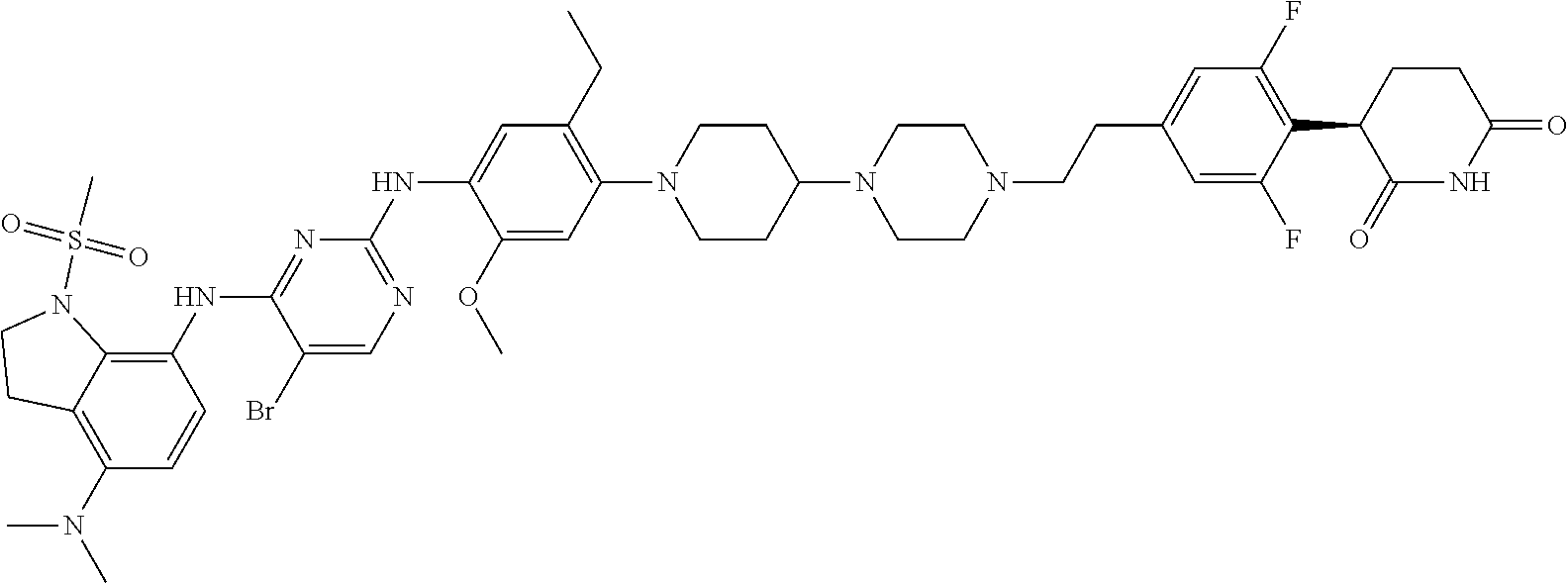
[0624]The titled compound was prepared in a manner similar to that in Example 3. 1H NMR (500 MHz, DMSO-d6) δ 10.95 (s, 1H), 8.53 (s, 1H), 8.12 (s, 1H), 7.81 (s, 1H), 7.60 (d, J=8.5 Hz, 1H), 7.49 (s, 1H), 7.03 (d, J=10 Hz, 2H), 6.73 (s, 1H), 6.64 (d, J=8.5 Hz, 1H), 4.20 (dd, J=13 Hz, 1H), 4.00 (t, J=7 Hz, 2H), 3.76 (s, 3H), 3.08-3.01 (m, 5H), 3.00-2.94 (m, 2H), 2.86-2.51 (m, 18H), 2.49-2.26 (m, 7H), 2.17-2.07 (m, 1H), 2.03-1.95 (m, 1H), 1.88-1.81 (m, 2H), 1.61-1.51 (m, 2H), 0.98 (t, J=7 Hz, 3H); [M+H]+=979.0.
Example 203: (R)-3-(4-(2-(4-(1-(4-((5-bromo-4-((4-ethyl-1-(methylsulfonyl)indolin-7-yl)amino)pyrimidin-2-yl)amino)-5-ethoxy-2-ethylphenyl)piperidin-4-yl)piperazin-1-yl)ethyl)-2,6-difluorophenyl)piperidine-2,6-dione

[0626]The titled compound was prepared in a manner similar to that in Example 3. 6′H NMR (500 MHz, d-DMSO) δ 10.95 (s, 1H), 8.73 (s, 1H), 8.17 (s, 1H), 7.79 (s, 1H), 7.65 (d, J=8.5 Hz, 1H), 7.51 (s, 1H), 7.02 (d, J=10.0 Hz, 2H), 6.97 (d, J=8.5 Hz, 1H), 6.71 (s, 1H), 4.20 (dd, J=13.0, 5.5 Hz, 1H), 4.06-3.98 (m, 4H), 3.08-2.99 (m, 5H), 2.95 (d, J=11.0 Hz, 2H), 2.83-2.74 (m, 3H), 2.64 (t, J=11.0 Hz, 2H), 2.60-2.41 (m, 15H), 2.29 (t, J=11.0 Hz, 1H), 2.14-2.11 (m, 1H), 2.03-1.95 (m, 1H), 1.84 (d, J=11.0 Hz, 2H), 1.61-1.49 (m, 2H), 1.27 (t, J=7.0 Hz, 3H), 1.18 (t, J=7.5 Hz, 3H), 0.96 (t, J=7.5 Hz, 3H). [M+H]+=978.2.
[0627]Cell Degradation 1
[0628]Cell Treatment
[0629]On day 1, H1975 cells are seeded at 30000 cells/well at a volume of 90 μl/well in cell culture medium [RPMI1640 (Gibco, Cat #72400-047), 10% heat-inactive FBS, 1% PS (Gibco, Cat #10378)] in Corning 96 well plate (Cat #3599), H1975 cells are treated with compounds diluted in 0.2% DMSO on day 2, dilution is done according to the following protocol: (1) make 1000× stock solution in DMSO from 10 mM by 4-fold dilution, total 8 doses were included; (2) make 10× solution in cell culture medium by transferring 1 μl 1000× stock solution into 99 μl medium; (3) 10 μl of 10× solution is added to cells and incubate for 16 h.
[0630]HTFR Assay
[0631]After 16 h treatment, add 100 μl 1× lysis buffer to each well; seal the plate and incubate 1 hour at room temperature on a plate shaker; Once the cells are lysed, 16 μL of cell lysate are transferred to a PE 384-well HTRF detection plate; 4 μL of pre-mixed HTRF antibodies are added to each well; Cover the plate with a plate sealer, spin 1000 rpm for 1 min, Incubate overnight at room temperature; Read on BMG PheraStar with HTRF protocol (337 nm-665 nm-620 nm).
- [0633]Low control=only lysis buffer without cells, indicating that EGFR is completely degraded;
- [0634]High control=Cell group with added DMSO and without compound, indicating microplate readings without EGFR degradation;
- [0635]Dmax is the maximum percentage of inhibition (degradation).
[0636]The IC50 (DC50) value of a compound can be obtained by fitting the following equation
Y=Bottom+(TOP−Bottom)/(1+((IC50/X){circumflex over ( )}hillslope))
[0637]Wherein, X and Y are known values, and IC50, Hillslope, Top and Bottom are the parameters obtained by fitting with software. Y is the inhibition percentage (calculated from the equation), X is the concentration of the compound; IC50 is the concentration of the compound when the 50% inhibition is reached. The smaller the IC50 value is, the stronger the inhibitory ability of the compound is. Vice versa, the higher the IC50 value is, the weaker the ability the inhibitory ability of the compound is; Hillslope represents the slope of the fitted curve, generally around 1*; Bottom represents the minimum value of the curve obtained by data fitting, which is generally 0%±20%; Top represents the maximum value of the curve obtained by data fitting, which is generally 100%±20%. The experimental data were fitted by calculating and analyzing with Dotmatics data analysis software.
| TABLE 1 |
|---|
| Degradation result |
| Example | DC50 (nM) | Example | DC50 (nM) | Example | DC50 (nM) | Example | DC50 (nM) |
| 1 | 9.9 | 2 | 36.9 | 3 | 9.5 | 4 | 15.5 |
| 5 | 9 | 6 | 7.4 | 8 | 9.1 | 9 | 19.1 |
| 10 | 9.3 | 11 | 23.7 | 12 | 12.4 | 13 | 11.05 |
| 14 | 27.1 | 15 | 10 | 16 | 33.7 | 17 | 9.6 |
| 18 | 14.1 | 19 | 6.03 | 20 | 9.7 | 21 | 38.4 |
| 27 | 10.6 | 34 | 7 | 35 | 7.2 | 36 | 15.5 |
| 37 | 3.8 | 38 | 9.8 | 39 | 12.1 | 40 | 10.5 |
| 41 | 20.7 | 42 | 13.5 | 43 | 49.1 | 44 | 10.9 |
| 45 | 2.3 | 46 | 23.2 | 47 | 21.4 | 48 | >10000 |
| 49 | >10000 | 50 | 7.5 | 51 | 19.5 | 52 | 7 |
| 53 | 2.6 | 54 | 8.9 | 55 | 9.6 | 56 | 13.5 |
| 58 | 2.8 | 59 | 2.7 | 60 | 4.9 | 61 | 5.7 |
| 62 | 4.4 | 63 | 3.9 | 64 | 6.1 | 66 | 7.1 |
| 67 | 13.8 | 68 | 3.7 | 69 | 10.8 | 73 | 3.4 |
| 74 | 4.7 | 75 | 3.9 | 76 | 3.4 | 77 | 2.3 |
| 78 | 5.5 | 79 | 6 | 80 | 5.5 | 81 | 12.2 |
| 82 | 3.2 | 83 | 3.2 | 84 | >10000 | 85 | 3.0 |
| 86 | 1.8 | 87 | 3.5 | 88 | 4.2 | 90 | 96.4 |
| 91 | 3.5 | 154 | 16 | 159 | 3.0 | 163 | 3.0 |
| 168 | 7.0 | ||||||
[0638]The foregoing examples and description of certain embodiments should be taken as illustrating, rather than as limiting the present invention as defined by the claims. As will be readily appreciated, numerous variations and combinations of the features set forth above can be utilized without departing from the present invention as set forth in the claims. All such variations are intended to be included within the scope of the present invention. All references cited are incorporated herein by reference in their entireties.
[0639]It is to be understood that, if any prior art publication is referred to herein, such reference does not constitute an admission that the publication forms a part of the common general knowledge in the art in any country.
[0640]Cell Degradation 2
[0641]Cell Treatment
[0642]On day 1, HCC827 cells are seeded at 20000 cells/well at a volume of 90 μl/well in cell culture medium [RPMI1640 (Gibco, Cat #72400-047), 10% heat-inactive FBS, 1% PS (Gibco, Cat #10378)] in Corning 96 well plate (Cat #3599), HCC827 cells are treated with compounds diluted in 0.2% DMSO on day 2, dilution is done according to the following protocol: (1) make 1000× stock solution in DMSO from 10 mM by 4-fold dilution, total 8 doses were included; (2) make 10× solution in cell culture medium by transferring 1 μl 1000× stock solution into 99 μl medium; (3) 10 μl of 10× solution is added to cells and incubate for 16 h.
[0643]HTFR Assay
[0644]After 16 h treatment, add 100 μl 1× lysis buffer to each well; seal the plate and incubate 1 hour at room temperature on a plate shaker; Once the cells are lysed, 16 ul diluted (2 μL to 14 ul 1× lysis buffer) cell lysate are transferred to a PE 384-well HTRF detection plate; 4 μL of pre-mixed HTRF antibodies are added to each well; Cover the plate with a plate sealer, spin 1000 rpm for 1 min, Incubate overnight at room temperature; Read on BMG PheraStar with HTRF protocol (337 nm-665 nm-620 nm).
- [0646]Low control=only lysis buffer without cells, indicating that EGFR is completely degraded;
- [0647]High control=Cell group with added DMSO and without compound, indicating microplate readings without EGFR degradation;
- [0648]Dmax is the maximum percentage of inhibition (degradation).
[0649]The IC50 (DC50) value of a compound can be obtained by fitting the following equation
Y=Bottom+(TOP−Bottom)/(1+((IC50/X){circumflex over ( )}hillslope))
[0650]Wherein, X and Y are known values, and IC50, Hillslope, Top and Bottom are the parameters obtained by fitting with software. Y is the inhibition percentage (calculated from the equation), X is the concentration of the compound; IC50 is the concentration of the compound when the 50% inhibition is reached. The smaller the IC50 value is, the stronger the inhibitory ability of the compound is. Vice versa, the higher the IC50 value is, the weaker the ability the inhibitory ability of the compound is; Hillslope represents the slope of the fitted curve, generally around 1*; Bottom represents the minimum value of the curve obtained by data fitting, which is generally 0%±20%; Top represents the maximum value of the curve obtained by data fitting, which is generally 100%±20%. The experimental data were fitted by calculating and analyzing with Dotmatics data analysis software.
| TABLE 2 |
|---|
| Degradation result |
| Examplem | DC50 (nM) | Example | DC50 (nM) | Example | DC50 (nM) | Example | DC50 (nM) |
| 1 | 24.7 | 2 | 33.4 | 3 | 19.8 | 4 | >10000.0 |
| 5 | 62.6 | 6 | 29.3 | 8 | 12.7 | 9 | 16.7 |
| 10 | >10000.0 | 11 | 123 | 12 | 33.5 | 13 | 29.3 |
| 14 | 92.2 | 15 | 9.2 | 16 | 32.6 | 17 | 30.8 |
| 18 | 10.8 | 19 | 10.8 | 20 | 14.7 | 21 | 113.3 |
| 27 | 33.6 | 34 | 6.7 | 35 | 8.4 | 36 | 8.6 |
| 37 | 3.5 | 38 | 9.7 | 39 | 13.6 | 40 | 8.2 |
| 41 | 16.7 | 42 | 4.9 | 43 | 11.1 | 44 | 4.6 |
| 45 | 6.7 | 46 | 32.2 | 47 | 13.8 | 48 | 51.8 |
| 49 | 138.3 | 50 | 36.9 | 51 | 12.4 | 52 | 3.5 |
| 53 | 3.7 | 54 | 8.9 | 55 | 11.9 | 56 | 5.8 |
| 58 | 17.7 | 59 | 3.1 | 60 | 14.6 | 61 | 19.4 |
| 62 | 22.1 | 63 | >10000.0 | 64 | 155.7 | 66 | 18 |
| 67 | 3.5 | 68 | 17.6 | 69 | 29.8 | 73 | 1173.9 |
| 74 | >10000.0 | 75 | >10000.0 | 76 | 3.3 | 77 | 1.7 |
| 78 | 4.6 | 79 | 5.5 | 80 | 4.3 | 81 | 3.4 |
| 82 | 2.8 | 83 | 3.0 | 84 | 1977.2 | 85 | 2.9 |
| 86 | 2.7 | 87 | 3.1 | 88 | 2.7 | 90 | 40.2 |
| 91 | 6.4 | 154 | 6 | 159 | 2.0 | 163 | 20 |
| 168 | 2.0 | 172 | 2.0 | ||||
[0651]Cell Degradation 3
[0652]Cell Treatment
[0653]BaF3 cells are seeded at 100000 cells/well at a volume of 30 μl/well in cell culture medium [RPMI1640 (Gibco, phenol red free, Cat #11835-030), 10% heat-inactive FBS, 1% PS (Gibco, Cat #10378)] in Corning 96 well plate (Cat #3799). BaF3 cells are treated with compounds diluted in 0.2% DMSO, dilution is done according to the following protocol: (1) make 500× stock solution in DMSO from 5 mM by 4-fold dilution, total 8 doses were included; (2) make 2× solution in cell culture medium by transferring 0.5 μl 500× stock solution into 125 μl medium; (3) 30 μl of 2× solution is added to cells and incubate for 16 h.
[0654]HTFR Assay
[0655]After 16 h treatment, add 20 μl 4× lysis buffer to each well; seal the plate and incubate 1 hour at room temperature on a plate shaker; Once the cells are lysed, 16 μL of cell lysate are transferred to a PE 384-well HTRF detection plate (for triple mutant cells, the lysate were diluted by the qual volume 1× lysis buffer before transfer); 4 μL of pre-mixed HTRF antibodies are added to each well; Cover the plate with a plate sealer, spin 1000 rpm for 1 min, Incubate overnight at room temperature; Read on BMG PheraStar with HTRF protocol (337 nm-665 nm-620 nm).
- [0657]Low control=only lysis buffer without cells, indicating that EGFR is completely degraded;
- [0658]High control=Cell group with added DMSO and without compound, indicating microplate readings without EGFR degradation;
- [0659]Dmax is the maximum percentage of inhibition (degradation).
[0660]The IC50 (DC50) value of a compound can be obtained by fitting the following equation
Y=Bottom+(TOP−Bottom)/(1+((IC50/X){circumflex over ( )}hillslope))
[0661]Wherein, X and Y are known values, and IC50, Hillslope, Top and Bottom are the parameters obtained by fitting with software. Y is the inhibition percentage (calculated from the equation), X is the concentration of the compound; IC50 is the concentration of the compound when the 50% inhibition is reached. The smaller the IC50 value is, the stronger the inhibitory ability of the compound is. Vice versa, the higher the IC50 value is, the weaker the ability the inhibitory ability of the compound is; Hillslope represents the slope of the fitted curve, generally around 1*; Bottom represents the minimum value of the curve obtained by data fitting, which is generally 0%±20%; Top represents the maximum value of the curve obtained by data fitting, which is generally 100%±20%. The experimental data were fitted by calculating and analyzing with Dotmatics data analysis software.
| TABLE 3 |
|---|
| Degradation result |
| Example | DC50 (nM) DTC | DC50 (nM) LTC |
| 3 | 11.6 | 19.9 |
| 8 | 13.4 | 8.4 |
| 15 | 35.8 | 68.3 |
| 19 | 16.7 | 24.2 |
| 34 | 38.2 | 276.1 |
| 35 | 48.1 | 202.8 |
| 36 | 26.3 | 42.6 |
| 37 | 16.7 | 43.1 |
| 38 | 176.3 | 230.2 |
| 39 | 33.7 | 157.2 |
| 45 | 9.9 | 17.3 |
| 53 | 21.8 | 35.7 |
| 54 | 120.5 | 442.8 |
| 56 | 23.6 | 232.7 |
| 62 | 3.0 | 4.7 |
| 67 | 11.7 | 15.7 |
| 68 | 3.0 | 4.4 |
| 76 | 4.8 | 8.0 |
| 77 | 1.8 | 2.7 |
| 79 | 49.6 | 84.6 |
| 80 | 6.5 | 12.2 |
| 82 | 3.5 | 15.1 |
| 83 | 5.9 | 14.6 |
| 85 | 1.8 | 2.8 |
| 86 | 13.0 | 16.2 |
| 87 | 2.4 | 16.5 |
| 88 | 15.6 | 43.3 |
| 91 | 14.9 | 39.9 |
| 151 | 14 | 17 |
| 152 | 66 | 27 |
| 154 | 11 | 13 |
| 155 | 19 | 56 |
| 156 | 21 | 33 |
| 157 | 300 | 396 |
| 158 | 19 | 41 |
| 159 | 11 | 19 |
| 160 | 150 | 162 |
| 162 | 78 | >10000 |
| 163 | 49 | 40 |
| 164 | 52 | 60 |
| 165 | 91 | 100 |
| 166 | 175 | 247 |
| 167 | 225 | >10000 |
| 168 | 14 | 25 |
| 169 | 39 | 57 |
| 170 | 8 | 23 |
| 171 | 4 | 9 |
| 172 | 4 | 9 |
| 173 | 15 | 27 |
| 174 | 30 | 69 |
| 175 | 17 | 31 |
| 176 | 94 | 65 |
| 177 | >10000 | 123 |
| 178 | 8 | 23 |
| 180 | 14 | 30 |
| 181 | 43 | 64 |
| 182 | 77 | 70 |
| 184 | 27 | 33 |
| 185 | 4 | 18 |
| 186 | 6 | 27 |
| 187 | 14 | 19 |
| 188 | 6 | 15 |
| 192 | 65 | |
| 193 | 74 | |
| 194 | 29 | |
| 195 | 24 | |
| 196 | 71 | |
| 197 | 83 | |
| 198 | 34 | |
| 200 | 513 | |
| 203 | 83 | |
[0662]The foregoing examples and description of certain embodiments should be taken as illustrating, rather than as limiting the present invention as defined by the claims. As will be readily appreciated, numerous variations and combinations of the features set forth above can be utilized without departing from the present invention as set forth in the claims. All such variations are intended to be included within the scope of the present invention. All references cited are incorporated herein by reference in their entirety.
[0663]It is to be understood that, if any prior art publication is referred to herein, such reference does not constitute an admission that the publication forms a part of the common general knowledge in the art in any country.
Claims
1. A compound of Formula (I):

or an N-oxide thereof, or a pharmaceutically acceptable salt thereof, or a stereoisomer thereof, or a tautomer or a prodrug thereof, wherein:
Cy1 is selected from an aromatic ring or non-aromatic ring;
R1 is selected from —S(O)R1a, —S(O)2R1a, —C(O)R1a or —P(O)R1aR1b, wherein R1a and R1b are each independently selected from —C1-8alkyl, —C2-8alkenyl, —C2-8alkynyl, cycloalkyl, heterocyclyl, aryl, heteroaryl, —CN, —OR1d, —CH2CONR1dR1e, —CH2CH2CONR1dR1e, —CH2CH2CH2CONR1dR1e, —NR1dR1e, —CH2NR1dR1e, —CH2CH2NR1dR1e, —CH2CH2CH2NR1dR1e or —NR1dCOR1e, wherein each of said —C1-8alkyl, —C2-8alkenyl, —C2-8alkynyl, cycloalkyl, heterocyclyl, aryl or heteroaryl is optionally substituted with at least one substituent R1f;
R1d and R1e are each independently hydrogen, —C1-8alkyl, —C1-8haloalkyl, —C2-8alkenyl, —C2-8alkynyl, cycloalkyl, heterocyclyl, aryl, or heteroaryl; or
R1d and R1e together with the atom(s) to which they are attached, form a 3- to 12-membered ring, said ring comprising 0, 1 or 2 additional heteroatom(s) independently selected from nitrogen, oxygen or optionally oxidized sulfur as ring member(s), said ring is optionally substituted with at least one substituent R1f;
R1f, at each of its occurrences, is independently hydrogen, halogen, hydroxyl, —C1-8alkyl, —C1-8haloalkyl, —C2-8alkenyl, —C2-8alkynyl, cycloalkyl, heterocyclyl, aryl, heteroaryl, oxo, —CN, —OR1g, —COR1g, —CO2R1g, —CONR1gR1h, —NR1gR1h, —NR1gCOR1h, or —NR1gCO2R1h, wherein each of said cycloalkyl, heterocyclyl, aryl or heteroaryl is optionally substituted with 1, 2 or 3 substituents selected from halogen and —C1-8alkyl;
R1g and R1h are each independently hydrogen, halogen, hydroxyl, —C1-8alkyl, C1-8alkoxy-C1-8alkyl-, —C1-8haloalkyl, —C2-8alkenyl, —C2-8alkynyl, cycloalkyl, heterocyclyl, aryl or heteroaryl;
R2, at each of their occurrences, is selected from hydrogen, halogen, oxo, —C1-8alkyl, cycloalkyl, heterocyclyl, —C6-C12aryl, 5- to 12-membered heteroaryl, —CN, —OR2a, —COR2a, —CO2R2a, —CONR2aR2b, —NR2aR2b, —NR2aCOR2b or —NR2aCO2R2b, wherein each of said —C1-8alkyl, cycloalkyl, heterocyclyl, aryl or heteroaryl is optionally substituted with at least one substituent R2c; or
when m≥2, two R2 together with the atom(s) to which they are attached, form a 3- to 12-membered ring, said ring comprising 0, 1 or 2 heteroatom(s) independently selected from nitrogen, oxygen, or optionally oxidized sulfur as ring member(s), said ring is optionally substituted with at least one substituent R2c;
R2a and R2b are each independently selected from hydrogen, —C1-8alkyl, —C2-8alkenyl, —C2-8alkynyl, C1-8alkoxy-C1-8alkyl-, cycloalkyl, heterocyclyl, aryl or heteroaryl, wherein each of said —C1-8alkyl, —C2-8alkenyl, —C2-8alkynyl, C1-8alkoxy-C1-8alkyl-, cycloalkyl, heterocyclyl, aryl or heteroaryl is optionally substituted with at least one substituent R2c;
R2c, at each of its occurrence, is independently halogen, hydroxyl, —C1-8alkyl, -haloC1-8alkyl, —C2-8alkenyl, —C2-8alkynyl, cycloalkyl, heterocyclyl, aryl, heteroaryl, oxo, —CN, —OR2d, —COR2d, —CO2R2d, —CONR2dR2e, —NR2dR2e, —NR2dCOR2e, or —NR2dCO2R2e;
R2d and R2e are each independently hydrogen, —C1-8alkyl, -haloC1-8alkyl, —C2-8alkenyl, —C2-8alkynyl, cycloalkyl, heterocyclyl, aryl or heteroaryl;
R3, R9 and R10 are each independently selected from hydrogen, halogen, —C1-8alkyl, —NR3aR3b, —OR3a, cycloalkyl, heterocyclyl, aryl, heteroaryl, —CN, —COR3a or —CO2R3a, wherein each of said —C1-8alkyl, cycloalkyl, heterocyclyl, aryl, or heteroaryl is optionally substituted with at least one substituent R30;
R3a and R3b are each independently selected from hydrogen, —C1-8alkyl, —C2-8alkenyl, —C2-8alkynyl, C1-8alkoxy-C1-8alkyl-, cycloalkyl, heterocyclyl, aryl or heteroaryl, wherein each of said —C1-8alkyl, —C2-8alkenyl, —C2-8alkynyl, cycloalkyl, heterocyclyl, aryl or heteroaryl is optionally substituted with at least one substituent R3d; or
R3c and R3d are each independently halogen, hydroxy, —C1-8alkyl, -haloC1-8alkyl, —C1-8alkoxy, —C2-8alkenyl, —C2-8alkynyl, cycloalkyl, heterocyclyl, aryl or heteroaryl;
R4 and R11 are each independently selected from hydrogen, halogen, —C1-8alkyl, —C2-8alkynyl, —C1-8alkoxy, cycloalkyl, heterocyclyl, aryl, heteroaryl, —CN, —OR4a, —NR4aR4b, —NR4aCOR4b, or CONR4aR4b, wherein each of said —C1-8alkyl, —C2-8alkynyl, —C1-8alkoxy, cycloalkyl, heterocyclyl, aryl, or heteroaryl is optionally substituted with at least one R4e, or
R4a and R4b are each independently hydrogen, —C1-8alkyl, -haloC1-8alkyl, —C2-8alkenyl, —C2-8alkynyl, cycloalkyl, heterocyclyl, aryl, or heteroaryl; or
R4 and R11, together with the atom(s) to which they are attached, form a 3- to 12-membered ring, said ring comprising 0, 1 or 2 heteroatom(s) independently selected from nitrogen, oxygen, or optionally oxidized sulfur as ring member(s), said ring is optionally substituted with at least one substituent R4e;
R4e is selected from halogen, —C1-8alkyl, -haloC1-8alkyl, cycloalkyl, heterocyclyl, aryl, heteroaryl, oxo, —CN, —OR4c, —SO2R4c, —SO2NR4cR4d, —COR4c, —CO2R4c, —CONR4cR4d, —NR4cR4d, —NR4cCOR4d, —NR4CO2R4d, or —NR4cSO2R4d;
R4c and R4d are each independently hydrogen, —C1-8alkyl, -haloC1-8alkyl, —C2-8alkenyl, —C2-8alkynyl, cycloalkyl, heterocyclyl, aryl, or heteroaryl;
R12 is independently selected from hydrogen, halogen, —C1-8alkyl, —NR12aR12b, —OR12a, cycloalkyl, heterocyclyl, aryl, heteroaryl, oxo or —CN, wherein each of said —C1-8alkyl, cycloalkyl, heterocyclyl, aryl, or heteroaryl is optionally substituted with at least one substituent R12c; or
two R12 together with the atom(s) to which they are attached, form a 3- to 12-membered ring, said ring comprising 0, 1 or 2 heteroatom(s) independently selected from nitrogen, oxygen, or optionally oxidized sulfur as ring member(s), said ring is optionally substituted with at least one substituent R12c;
R12a and R12b are each independently selected from hydrogen, —C1-8alkyl, —C2-8alkenyl, —C2-8alkynyl, cycloalkyl, heterocyclyl, aryl or heteroaryl, wherein each of said —C1-8alkyl, —C2-8alkenyl, —C2-8alkynyl, cycloalkyl, heterocyclyl, aryl or heteroaryl is optionally substituted with at least one substituent R12d; or
R12c and R12d are each independently halogen, hydroxy, —C1-8alkyl, -haloC1-8alkyl, —C1-8alkoxy, —C2-8alkenyl, —C2-8alkynyl, cycloalkyl, heterocyclyl, aryl or heteroaryl;
Z1, Z2, Z3 and Z4 are each independently selected from —CRZ, or N;
RZ, at each of its occurrences, is independently selected from hydrogen, halogen, —C1-8alkyl, —NRZaRZb, —ORZa, cycloalkyl, heterocyclyl, aryl, heteroaryl, or CN, wherein each of said —C1-8alkyl, cycloalkyl, heterocyclyl, aryl, or heteroaryl is optionally substituted with at least one RZc;
or two RZ, when attached to adjacent carbon atoms of the ring, together with the two carbon atoms to which they are attached, form a 3- to 12-membered ring comprising 0, 1 or 2 heteroatom(s) independently selected from nitrogen, oxygen or optionally oxidized sulfur as ring member(s), said ring is optionally substituted with at least one substituent RZe;
RZa and RZb are each independently selected from hydrogen, —C1-8alkyl, —C2-8alkenyl, —C2-8alkynyl, cycloalkyl, heterocyclyl, aryl, or heteroaryl, wherein each of said —C1-8alkyl, —C2-8alkenyl, —C2-8alkynyl, cycloalkyl, heterocyclyl, aryl, or heteroaryl is optionally substituted with at least one substituent RZa;
RZc is independently halogen, hydroxy, —C1-8alkyl, -haloC1-8alkyl, —C1-8alkoxy, —C2-8alkenyl, —C2-8alkynyl, cycloalkyl, heterocyclyl, aryl, or heteroaryl; or
two RZc, together with the atom(s) to which they are attached, form a 3- to 12-membered ring, said ring comprising 0, 1 or 2 heteroatom(s) independently selected from nitrogen, oxygen, or optionally oxidized sulfur as ring member(s), said ring is optionally substituted with at least one substituent RZa;
RZa is independently halogen, hydroxy, —C1-8alkyl, -haloC1-8alkyl, —C1-8alkoxy, —C2-8alkenyl, —C2-8alkynyl, cycloalkyl, heterocyclyl, aryl, or heteroaryl;
L1 is selected from a single bond, —O—, —SO2—, —C(O)—, —NRL1a—, —C3-C8cycloalkylene-, *L1—O—C1-8alkylene-**L1, *L1—C1-8alkylene-O—**L1, *L1—SO2—C1-8alkylene-**L1, *L1—C1-8alkylene-SO2—**L1, *L1—C(O)—C1-8alkylene-**L1, *L1—C1-8alkylene-C(O)—**L1, *L1—NRL1a—C1-8alkylene-**L1, *L1—C1-8alkylene-NRL1a—**L1, *L1—NRL1aC(O)—**L1, *L1—C(O) NRL1a—**L1, —C1-8alkylene-, —C2-8alkenylene-, —C2-8alkynylene-, —[O(CRL1aRL1b)m4]m5—,


each of said —C3-C8cycloalkylene-, *L1—O—C1-8alkylene-**L1, *L1—C1-8alkylene-O—**L1, *L1—S—C1-8alkylene-**L1, *L1—SO2—C1-8alkylene-**L1, *L1—C1-8alkylene-SO2—**L1, *L1—CO—C1-8alkylene-**L1, *L1—C1-8alkylene-CO—**L1, *L1—NRL1a—C1-8alkylene-**L1, *L1—C1-8alkylene-NRL1a—**L1, —C1-8alkylene-, —C2-8alkenylene-, —C2-8alkynylene-,


are optionally substituted with at least one RL1c;
wherein *L1 refers to the position attached to the

moiety, and **L1 refers to the position attached to the

moiety;
RL1a and RL1b are each independently selected from hydrogen, —C1-8alkyl, —C2-8alkenyl, —C2-8alkynyl, cycloalkyl, heterocyclyl, aryl or heteroaryl, wherein each of said —C1-8alkyl, —C2-8alkenyl, —C2-8alkynyl, cycloalkyl, heterocyclyl, aryl or heteroaryl is optionally substituted with at least one substituent RL1d;
each of said RL1c and RL1d are independently halogen, hydroxy, —C1-8alkyl, -haloC1-8alkyl, —C1-8alkoxy, —C2-8alkenyl, —C2-8alkynyl, cycloalkyl, heterocyclyl, aryl or heteroaryl;
L2 is selected from a single bond, —O—, —SO2—, —CO—, —NRL2a—, —C3-C8cycloalkylene-, *L2—O—C1-8alkylene-**L2, *L2—C1-8alkylene-O—**L2, *L2—SO2—C1-8alkylene-**L2, *L2—C1-8alkylene-SO2—**L2, *L2—CO—C1-8alkylene-**L2, *L2—C1-8alkylene-CO—**L2, *L2—NRL2a—C1-8alkylene-**L2, *L2—C1-8alkylene-NRL2a—**L2, *L2—NRL2aC(O)—**L2, *L2—C(O)NRL2a—**L2, C1-8alkylene-, —C2-8alkenylene-, —C2-8alkynylene-, —[O(CRL2aRL2b)m4]m5—,
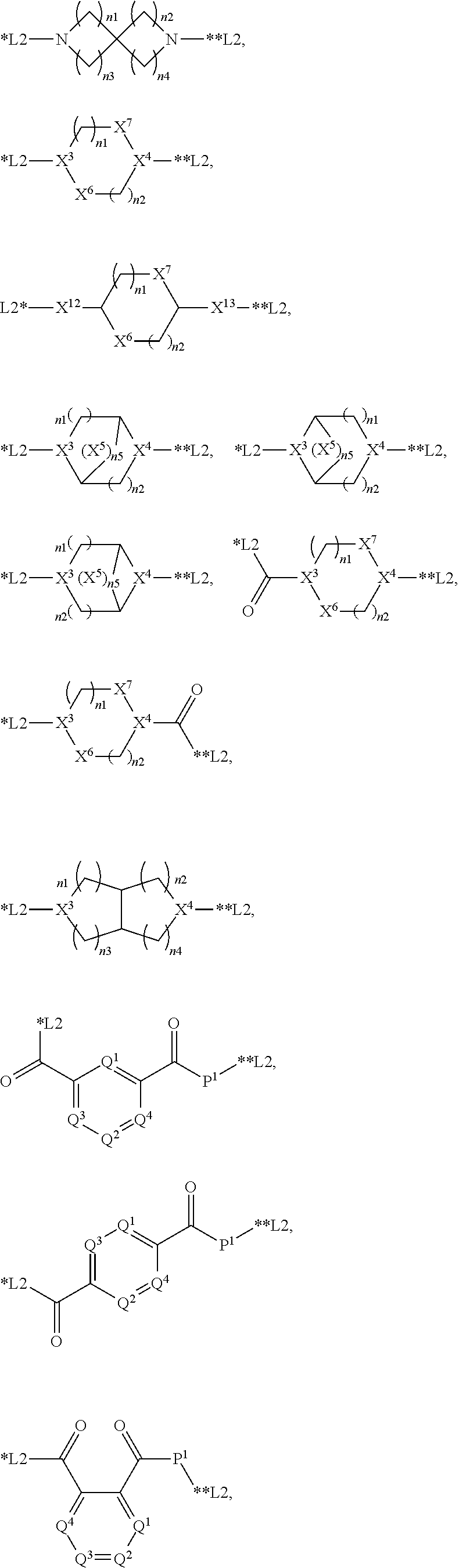

each of said —C3-C8cycloalkylene-, *L2—O—C1-8alkylene-**L2, *L2—C1-8alkylene-O—**L2, *L2—SO2—C1-8alkylene-**L2, *L2—C1-8alkylene-SO2—**L2, *L2—CO—C1-8alkylene-**L2, *L2—C1-8alkylene-CO—**L2, *L2—NRL2aC1-8alkylene-**L2, *L2—C1-8alkylene-NRL2a—**L2, —C1-8alkylene-, —C2-8alkenylene-, —C2-8alkynylene-,


are optionally substituted with at least one substituent RL2c;
wherein *L2 refers to the position attached to the

moiety, and **L2 refers to the position attached to the

moiety;
RL2a and RL2b are each independently selected from hydrogen, —C1-8alkyl, —C2-8alkenyl, —C2-8alkynyl, cycloalkyl, heterocyclyl, aryl or heteroaryl, wherein each of said —C1-8alkyl, —C2-8alkenyl, —C2-8alkynyl, cycloalkyl, heterocyclyl, aryl or heteroaryl is optionally substituted with at least one substituent RL2d;
each of said RL2c and RL2d are independently halogen, hydroxy, —C1-8alkyl, -haloC1-8alkyl, —C1-8alkoxy, —C2-8alkenyl, —C2-8alkynyl, cycloalkyl, heterocyclyl, aryl or heteroaryl;
L3 is selected from a single bond, —O—, —SO2—, —CO—, —NRL3a—, —C3-C8cycloalkylene-, *L3—O—C1-8alkylene-**L3, *L3—C1-8alkylene-O—**L3, *L3—SO2—C1-8alkylene-**L3, *L3—C1-8alkylene-SO2—**L3, *L3—CO—C1-8alkylene-**L3, *L3—C1-8alkylene-CO—**L3, *L3—NRL3a—C1-8alkylene-**L3, *L3—C1-8alkylene-NRL3a—**L3, *L3—NRL3aC(O)—**L3, *L3—C(O)NRL3a—**L3, —C1-8alkylene-, —C2-8alkenylene-, —C2-8alkynylene-, —[O(CRL3aRL3b)m4]m5—,


each of said —C3-C8cycloalkylene-, *L3—O—C1-8alkylene-**L3, *L3—C1-8alkylene-O—**L3, *L3—SO2—C1-8alkylene-**L3, *L3—C1-8alkylene-SO2—**L3, *L3—CO—C1-8alkylene-**L3, *L3—C1-8alkylene-CO—**L3, *L3—NRL3a—C1-8alkylene-**L3, *L3—C1-8alkylene-NRL3a—**L3, —C1-8alkylene-, —C2-8alkenylene-, —C2-8alkynylene-,


are optionally substituted with at least one substituent RL3c;
wherein *L3 refers to the position attached to the

moiety, and **L3 refers to the position attached to the

moiety;
RL3a and RL3b are each independently selected from hydrogen, —C1-8alkyl, —C2-8alkenyl, —C2-8alkynyl, cycloalkyl, heterocyclyl, aryl or heteroaryl, wherein each of said —C1-8alkyl, —C2-8alkenyl, —C2-8alkynyl, cycloalkyl, heterocyclyl, aryl or membered heteroaryl is optionally substituted with at least one substituent RL3d;
each of said RL3c and RL3d are independently halogen, hydroxy, —C1-8alkyl, -haloC1-8alkyl, —C1-8alkoxy, —C2-8alkenyl, —C2-8alkynyl, cycloalkyl, heterocyclyl, aryl or heteroaryl;

is selected from


wherein Ring A is selected from 3-12 membered cycloalkyl, 3-12 membered heterocyclyl, aryl, or heteroaryl;
R13, R14, R15, R16 and R17 are independently selected from hydrogen, halogen, CN, —C1-8alkyl, —C1-8alkoxy, cycloalkyl, heterocyclyl, aryl, heteroaryl, —OR13a, —COR13a, —CO2R13a, —NR13aR13b, —NR13aCOR13b or —NR13aCO2R13b, wherein each of said —C1-8alkyl, —C1-8alkoxy, cycloalkyl, heterocyclyl, aryl or heteroaryl is optionally substituted with at least one substituent halogen, —C1-8alkyl, -haloC1-8alkyl, C1-8alkoxy-C1-8alkyl-, —C2-8alkenyl, —C2-8alkynyl, cycloalkyl, heterocyclyl, aryl or heteroaryl;
R13a and R13b are each independently selected from hydrogen, —C1-8alkyl, —C2-8alkenyl, —C2-8alkynyl, C1-8alkoxy-C1-8alkyl-, cycloalkyl, heterocyclyl, aryl or heteroaryl, wherein each of said —C1-8alkyl, —C2-8alkenyl, —C2-8alkynyl, C1-8alkoxy-C1-8alkyl-, cycloalkyl, heterocyclyl, aryl or heteroaryl is optionally substituted with at least one substituent halogen, —C1-8alkyl, -haloC1-8alkyl, C1-8alkoxy-C1-8alkyl-, —C2-8alkenyl, —C2-8alkynyl, cycloalkyl, heterocyclyl, aryl or heteroaryl;
X1, X2, X3, X4 and X8 are each independently selected from —CRa or N;
X5, X6, X7 and X9 are each independently selected from —NRa—, —O—, —S— and —CRaRb—;
X12 and X13 are each independently selected from a single bond, —NRa— and —O—;
L4 is each independently selected from a single bond, —O—, —NRa—, —(CRaRb)n9—, —O(CRaRb)—, —NRa(CRaRb)n9— or —C(O)—;
L5 and L6 are each independently selected from —CRaRb- or —C(O)—;
Q1, Q2, Q3, Q4, Y1, Y2 and Y3 are each independently selected from CRa or N;
Q5 is each independently selected from —O—, —NRa—, —CRaRb—, —S— or —C(O)—;
P1 is a single bond, —O—, —NH—, —CH2—, —S—, —SO— or —SO2—;
Ra and Rb are each independently selected from oxo, hydrogen, halogen, CN, —C1-8alkyl, —C1-8alkoxy, —C2-8alkenyl, —C2-8alkynyl, cycloalkyl, heterocyclyl, aryl or heteroaryl, wherein each of said —C1-8alkyl, —C1-8alkoxy, —C2-8alkenyl, —C2-8alkynyl, cycloalkyl, heterocyclyl, aryl or heteroaryl is optionally substituted with at least one substituent halogen, hydroxy, halogen, —C1-8alkyl, —C1-8alkoxy, —C2-8alkenyl, —C2-8alkynyl, cycloalkyl, heterocyclyl, aryl or heteroaryl;
m1 is 0, 1 or 2;
m2 and m3 are each independently 0, 1, 2, 3, 4, 5, 6, 7 or 8;
m4, m5 are each independently 0, 1, 2 or 3;
m6 is each independently 0, 1, 2 or 3;
m7 each independently 0, 1, 2, 3 or 4;
n, n1, n2, n3, n4 and n5 are each independently 0, 1, 2 or 3; and
n6, n7, n8 and n9 are each independently 0, 1, 2, 3 or 4.
2. The compound of
R1d and R1e are each independently hydrogen, —C1-8alkyl, —C1-8haloalkyl, —C2-8alkenyl, —C2-8alkynyl, cycloalkyl, heterocyclyl, aryl, or heteroaryl;
R1f, at each of its occurrences, is independently hydrogen, halogen, —C1-8alkyl, —C1-8haloalkyl, —C2-8alkenyl, —C2-8alkynyl, cycloalkyl, halocycloalkyl, heterocyclyl, phenyl, heteroaryl, —CN, or —OR1g, wherein each of said cycloalkyl, heterocyclyl, aryl or heteroaryl is optionally substituted with 1, 2 or 3 substituents selected from halogen and —C1-8alkyl;
R1g is hydrogen, —C1-8alkyl, —C1-8haloalkyl, C1-8alkoxy-C1-8alkyl-, —C2-8alkenyl, —C2-8alkynyl, cycloalkyl, heterocyclyl, aryl, or heteroaryl; preferably, wherein R1a is selected from —CH3, —C2H5, —C3H7, -tert-butyl, -n-butyl, -iso-butyl, —C5H11, -cyclopropyl,

—CH2F, —CHF2, —CF3, —N(CH3)2, —NHCH3, —NHC2H5, or —NHC3H7.
3. (canceled)
4. The compound of
two germinal R2 together with the atom to which they are attached, form a spiro 3-, 4-, 5- or 6-membered cycloalkyl, said cycloalkyl is optionally substituted with at least one substituent R2c; or
two R2 on different atoms, together with the atoms to which they are attached, form a 3-, 4-, 5- or 6-membered cycloalkyl, said cycloalkyl is optionally substituted with at least one substituent R2c;
R2a is selected from hydrogen, —C1-8alkyl, —C2-8alkenyl, —C2-8alkynyl, C1-8alkoxy-C1-8alkyl-, or C3-8cycloalkyl;
R2c, at each of its occurrences, is independently —F, —Cl, —Br, —I, —OH, —C1-8alkyl, -haloC1-8alkyl, —C2-8alkenyl, —C2-8alkynyl, or —C3-8cycloalkyl,
preferably, R2 is selected from hydrogen, —F, —Cl, —Br, —I, methyl, ethyl, propyl, butyl, pentyl, hexyl, heptyl, or octyl: or two germinal R2, together with the atom to which they are attached, form a spiro 3-, 4-membered cycloalkyl;
more preferably, R2 is selected from hydrogen, F, Cl, Br, I, —CH3, —C2H5, —C3H7, —C4H9, or —C5H11; or two germinal R2, together with the atom to which they are attached, form a spiro cyclopropyl or a spiro cyclobutyl.
5. (canceled)
6. (canceled)
7. The compound of
R3, R9 and R10 are independently selected from hydrogen, —F, —Cl, —Br, —I, methyl, ethyl, propyl, butyl, pentyl, hexyl, heptyl, octyl, cyclopropyl, cyclobutyl, cyclopentyl, cyclohexyl, cycloheptyl, cyclooctyl, —NR3aR3b, —CN, —OR3a, —COR3a or —CO2R3a, wherein each of methyl, ethyl, propyl, butyl, pentyl, hexyl, heptyl, octyl, cyclopropyl, cyclobutyl, cyclopentyl, cyclohexyl, cycloheptyl, cyclooctyl is optionally substituted with at least one substituent R3c,
R3a is each independently selected from hydrogen, —C1-8alkyl, —C2-8alkenyl, —C2-8alkynyl, C1-8alkoxy-C1-8alkyl-, or C3-8cycloalkyl, wherein each of said —C1-8alkyl, —C2-8alkenyl, —C2-8alkynyl, C1-8alkoxy-C1-8alkyl-, or C3-8cycloalkyl is optionally substituted with at least one substituent R3d;
R3c and R3d, at each of their occurrences, is independently halogen, —C1-8alkyl, —C2-8alkenyl, —C2-8alkynyl, or —C3-8cycloalkyl;
preferably, R3, R9 and R10 are each independently selected from H, F, Br, Cl, I, —CH3, —C2H5, —C3H7, —C4H9, —C5H11, —CF3, cyclopropyl, cyclobutyl, cyclopentyl, cyclohexyl, cycloheptyl, cyclooctyl, —NH2, —N(CH3)2, —N(CH3)C2H5, —N(C2H5)2, —OCH3, —OC2H5, —OC3H7, —OC4H9, or —OC5H11.
8. (canceled)
9. The compound of

moiety is selected from

preferably, the

moiety is

preferred


10. (canceled)
11. The compound of
R4a and R4b are each independently hydrogen, —C1-8alkyl, -haloC1-8alkyl, —C2-8alkenyl, —C2-8alkynyl, C3-C8cycloalkyl, 3- to 8-membered heterocyclyl, C6-C12aryl, or 5- to 12-membered heteroaryl;
R4e is selected from F, Br, Cl, I, methyl, ethyl, propyl, butyl, pentyl, hexyl, heptyl, octyl, cyclopropyl, cyclobutyl, cyclopentyl, cyclohexyl, cycloheptyl, cyclooctyl, 3- to 8-membered heterocyclyl, phenyl, 5- to 12-membered heteroaryl, oxo, —CN, or —OR4c;
R4c is independently hydrogen, methyl, ethyl, propyl, butyl, pentyl, hexyl, heptyl, octyl, or phenyl;
preferably, wherein R4 and R11, together with the atom(s) to which they are attached, form a 3-, 4-, 5-, 6-, 7- or 8-membered ring, said ring comprising 0, 1 or 2 heteroatom(s) independently selected from nitrogen, oxygen, or optionally oxidized sulfur as ring member(s), said ring is optionally substituted with at least one substituent R4c;
R4e is selected from —F, —Cl, —Br, —I, methyl, ethyl, propyl, butyl, pentyl, hexyl, heptyl, octyl, cyclopropyl, cyclobutyl, cyclopentyl, cyclohexyl, cycloheptyl, cyclooctyl, 3- to 8-membered heterocyclyl, phenyl, 5- to 12-membered heteroaryl, oxo, —CN, or —OR4c;
R4c is independently hydrogen, —C1-8alkyl, —C2-8alkenyl, —C2-8alkynyl, C3-C8cycloalkyl, 3- to 8-membered heterocyclyl, C6-C12aryl, or 5- to 12-membered heteroaryl;
more preferably, R4 and R11, together with the atom(s) to which they are attached, form a 5- or 6-membered ring, said ring comprising 1 or 2 heteroatom(s) independently selected from nitrogen, oxygen, or optionally oxidized sulfur, said ring is optionally substituted with at least one substituent R4c;
R4e is selected from —F, —Cl, —Br, —I, methyl, ethyl, propyl, butyl, pentyl, hexyl, heptyl, octyl, cyclopropyl, cyclobutyl, cyclopentyl, cyclohexyl, cycloheptyl, cyclooctyl, phenyl, 5- to 12-membered heteroaryl, oxo, —CN, —OCH3, —OC2H5, —OC3H7, —OC4H9, and —OC5H11.
12. (canceled)
13. (canceled)
14. The compound of

moiety is selected from


15. The compound of
two germinal R12 together with the atom to which they are attached, form a spiro 3-, 4-, 5-, 6-membered cycloalkyl, said cycloalkyl is optionally substituted with at least one substituent R12c; or
two R12 on different atoms, together with the atoms to which they are attached, form a 3-, 4-, 5-, 6-membered cycloalkyl, said cycloalkyl is optionally substituted with at least one substituent R12c;
R12c is independently halogen, hydroxy, —C1-8alkyl, -haloC1-8alkyl, —C1-8alkoxy, —C2-8alkenyl, —C2-8alkynyl, cycloalkyl, heterocyclyl, aryl or heteroaryl.
16. The compound of

is selected from
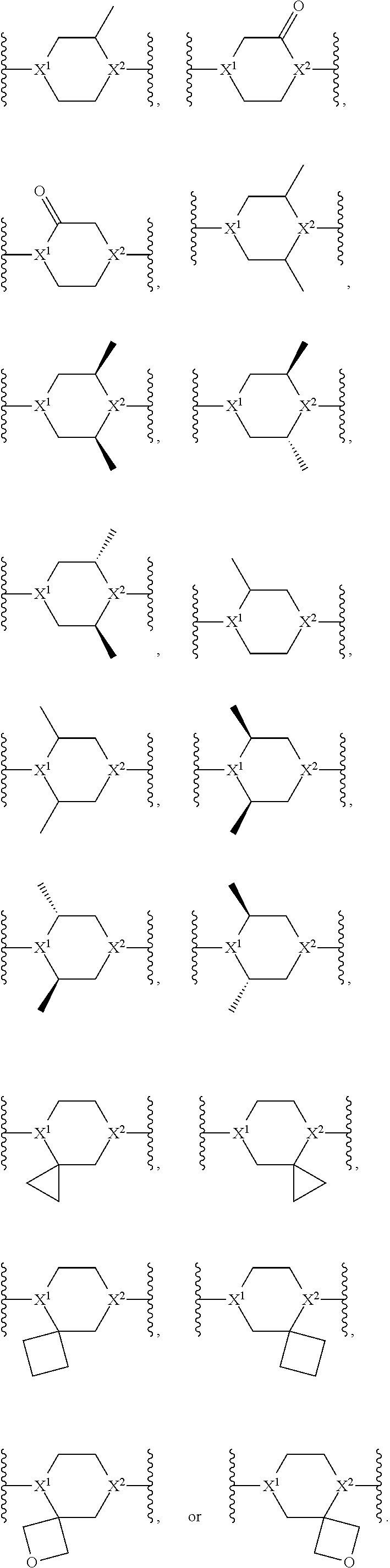
17. The compound of
RZ, at each of its occurrences, is independently selected from hydrogen, —F, —Cl, —Br, —I, methyl, ethyl, propyl, butyl, pentyl, hexyl, heptyl, octyl, —NRZaRZb, —ORZa, cyclopropyl, cyclobutyl, cyclopentyl, cyclohexyl, cycloheptyl, cyclooctyl, 3- to 8-membered heterocyclyl, phenyl, 5- to 12-membered heteroaryl, or CN, wherein each of said methyl, ethyl, propyl, butyl, pentyl, hexyl, heptyl, octyl, cyclopropyl, cyclobutyl, cyclopentyl, cyclohexyl, cycloheptyl, cyclooctyl, 3- to 8-membered heterocyclyl, phenyl, or 5- to 12-membered heteroaryl is optionally substituted with at least one RZc; or
or two RZ, when attached to adjacent carbon atoms of the ring, together with the two carbon atoms to which they are attached, form a 3- to 12-membered ring comprising 0, 1 or 2 heteroatom(s) independently selected from nitrogen, oxygen or optionally oxidized sulfur as ring member(s), said ring is optionally substituted with at least one substituent RZc;
RZa and RZb are each independently selected from hydrogen, methyl, ethyl, propyl, butyl, pentyl, hexyl, heptyl, octyl, cyclopropyl, cyclobutyl, cyclopentyl, cyclohexyl, cycloheptyl, cyclooctyl, or phenyl, wherein each of said methyl, ethyl, propyl, butyl, pentyl, hexyl, heptyl, octyl, cyclopropyl, cyclobutyl, cyclopentyl, cyclohexyl, cycloheptyl, cyclooctyl, or phenyl is optionally substituted with at least one substituent RZa;
RZc and RZd are each independently —F, —Cl, —Br, —I, —OH, methyl, ethyl, propyl, butyl, pentyl, hexyl, heptyl, octyl, —OCH3, —OC2H5, —OC3H7, —OC4H9, —OC5H11, cyclopropyl, cyclobutyl, cyclopentyl, cyclohexyl, cycloheptyl, cyclooctyl, or phenyl, or
two RZc, together with the atom(s) to which they are attached, form a 3- to 8-membered ring, said ring comprising 0, 1 or 2 heteroatom(s) independently selected from nitrogen, oxygen, or optionally oxidized sulfur as ring member(s);
preferably, wherein Z1, Z2, Z3 and Z4 are each independently —CRz;
RZ, at each of its occurrences, is independently selected from hydrogen, —F, —Cl, —Br, —I, methyl, ethyl, propyl, butyl, pentyl, hexyl, heptyl, octyl, —OCH3, —OC2H5, —OC3H7, —OC4H9, or —OC5H11; or
two RZ, when attached to adjacent carbon atoms of the ring, together with the atoms to which they are attached, form a 4-, 5-, 6- or 7-membered ring, said ring comprising 0, 1 or 2 heteroatom(s) independently selected from nitrogen or oxygen, said ring is optionally substituted with at least one substituent RZc, wherein two germinal RZc, together with the atom to which they are attached, form a spiro 3-, 4-, 5- or 6-membered cycloalkyl or, two RZc on different atoms, together with the atoms to which they are attached, form a 3-, 4-, 5- or 6-membered cycloalkyl.
18. (canceled)
19. The compound of

moiety is selected from


wherein *a refers to the position attached to

moiety, and *b refers to the position attached to the

moiety.
20. The compound of


21. The compound of
22. The compound of
23. The compound of


wherein RL2a is selected from hydrogen, methyl, ethyl or propyl.
24. The compound of

wherein RL3a is selected from hydrogen, methyl, ethyl or propyl.
25. The compound of

is selected from


wherein * refers to the position attached to

moiety, and ** refers to the position attached to the

moiety.
26. The compound of

or an N-oxide thereof, or a pharmaceutically acceptable salt thereof, or a stereoisomer thereof, or a tautomer or a prodrug thereof, wherein: R1, R2, R3, R4, R9, R10, R11, R12, Z1, Z2, Z3, Z4, X1, X2, X3, X4, L2, L3, Degron, n, m1, m2, m3 and m7 have the same meaning with
27. The compound of

or an N-oxide thereof, or a pharmaceutically acceptable salt thereof, or a stereoisomer thereof, or a tautomer or a prodrug thereof, wherein: R1, R2, R3, R4, R9, R1, R11, R12, Z1, Z2, Z3, Z4, X1, X2, X3, X4, L2, L3, Degron, n, m1, m3 and m7 have the same meaning with
28. The compound of

is selected from

R14 is independently selected from hydrogen, halogen, —C1-8alkyl, —C1-8alkoxy, or CN, wherein each of said —C1-8alkyl or —C1-8alkoxy is optionally substituted by one or more halogen or —C1-8alkyl; preferably R14 is independently selected from H, F, Cl, Br, I, CH3, —OCH3, CH2F, CN, CHF2, or CF3;
X8 is independently selected from CF, CH, C(CH3), C(C2H5), C(C3H7), C(CN) or N;
L4 is independently selected from a single bond, —O—, —NH—, —CH2—, —CHF—, or —CF2—;
Y1, Y2, and Y3 are each independently selected from CRa or N, wherein Ra is each independently selected from hydrogen, halogen, —C1-8alkyl or —C1-8alkoxy, wherein each of said —C1-8alkyl or —C1-8alkoxy is optionally substituted with at least one or more halogen, hydroxy, halogen, —C1-8alkyl, or —C1-8alkoxy;
X9 is CH2;
n6 is independently 0, 1 or 2.
29. The compound of

wherein Ring A is selected from 5-7 membered cycloalkyl, 5-7 membered heterocyclyl, aryl, or heteroaryl;
X8 is independently selected from CF, CH, C(CH3), C(C2H5), C(C3H7), C(CN) or N;
L4 is independently selected from a single bond, —O—, —NH—, —CH2—, —CHF—, or —CF2—;
Y1 and Y2 are each independently selected from CRa or N;
Ra is each independently selected from hydrogen, halogen, —C1-8alkyl, or —C1-8alkoxy, each of said —C1-8alkyl or —C1-8alkoxy is optionally substituted with at least one or more halogen, hydroxy, halogen, —C1-8alkyl, or —C1-8alkoxy;
X9 is CH2; and
n6 is independently 0, 1 or 2.
30. The compound of

Wherein R14 is independently selected from hydrogen, halogen, —C1-8alkyl, or —C1-8alkoxy, wherein each of said each —C1-8alkyl or —C1-8alkoxy is optionally substituted by one or more halogen, —C1-8alkyl, or C1-8alkoxy-C1-8alkyl-;
X8 is independently selected from CH, C(CH3), C(C2H5), C(C3H7), C(CN) or N;
L4 is independently selected from a single bond, —O—, —NH—, —CH2—, —CHF—, or —CF2—;
Y1, Y2, and Y3 are each independently selected from CRa, or N;
Ra is each independently selected from hydrogen, halogen, —C1-8alkyl, or —C1-8alkoxy, each of said —C1-8alkyl, or —C1-8alkoxy is optionally substituted with at least one or more halogen, hydroxy, halogen, —C1-8alkyl, or —C1-8alkoxy;
X9 is CH2; and
n6 is independently 0, 1 or 2.
31. The compound of

wherein L5 and L6 are each independently selected from —CH2 or —CO—;
X9 is CH2;
each R13 is independently selected from hydrogen, halogen, CN, —C1-8alkyl, or —C1-8alkoxy;
n6 is 0 or 1; and
n7 is 0, 1 or 2.
32. The compound of

wherein R13 and R16 are independently selected from hydrogen, halogen, —C1-8alkyl, or —C1-8alkoxy; said each —C1-8alkyl or —C1-8alkoxy is optionally substituted by one or more halogen, —C1-8alkyl, or C1-8alkoxy-C1-8alkyl-;
R15 and R14 is selected from the group consisting of 5- to 12-membered heteroaryl, 3- to 8-membered heterocyclyl, and C6-C12aryl, and R15 is optionally substituted by one or more halogen, —C1-8alkyl, or C1-8alkoxy-C1-8alkyl-; and
n7 is independently 0, 1, 2, 3 or 4.
33. The compound of

is selected from


34. A compound selected from


or an N-oxide thereof, or a pharmaceutically acceptable salt thereof, or a stereoisomer thereof, or a tautomer or a prodrug thereof.
35. A pharmaceutical composition comprising the compound of
36. A method of treating a disease in which EGFR modulation is involved, comprising administrating to a subject in need thereof a therapeutically effective amount of the compound of
37. The method of
38. (canceled)
39. (canceled)