US20260133490A1
SULFONIUM SALT, CHEMICALLY AMPLIFIED RESIST COMPOSITION AND PATTERN FORMING PROCESS
Publication
Application
Classifications
IPC Classifications
CPC Classifications
Applicants
Shin-Etsu Chemical Co., Ltd.
Inventors
Masahiro Fukushima
Abstract
The sulfonium salt consists of an aromatic sulfonate anion having the following formula (1A) and a sulfonium cation having the following formula (1B). The sulfonium salt can be used in a chemically amplified resist composition. The resist composition has a high solvent solubility, high sensitivity and high contrast, and forming a resist film with improved lithography properties such as LWR, CDU, MEF, EL, and DOF when processed by photolithography using high-energy radiation such as a KrF or ArF excimer laser beam, an electron beam (EB) or EUV.
Description
CROSS-REFERENCE TO RELATED APPLICATION
[0001]This non-provisional application claims priority under 35 U.S.C. § 119(a) on Patent Application No. 2024-186982 filed in Japan on Oct. 23, 2024, the entire contents of which are hereby incorporated by reference.
TECHNICAL FIELD
[0002]This invention relates to a sulfonium salt, a chemically amplified resist composition and a pattern forming process.
BACKGROUND ART
[0003]A number of recent efforts are being made to achieve a finer pattern rule in the drive for higher integration density and operating speeds in LSI devices. DUV and EUV lithography processes are thought to hold particular promise as the microfabrication technology of the next generation.
[0004]The photolithography using an ArF excimer laser beam (ArF lithography) started partial use from the fabrication of 130-nm node devices and became the main lithography since 90-nm node devices. Although lithography using F2 laser of wavelength 157 nm was initially thought promising as the next lithography for 45-nm node devices, its development was retarded by several problems. A practical technique that has been used is the ArF immersion lithography that introduces a liquid having a higher refractive index than air (e.g., water, ethylene glycol, glycerin) between the projection lens and the wafer, allowing the projection lens to be designed to a numerical aperture (NA) of 1.0 or higher and achieving a higher resolution. The immersion lithography requires a resist material which is substantially insoluble in water.
[0005]In the ArF lithography, a high sensitivity resist material capable of achieving a high resolution at a small dose of exposure is needed to prevent the degradation of precise and expensive optical system materials. Among several measures for providing the high sensitivity resist material, the most common is to select each component which is highly transparent at the wavelength of 193 nm. For example, base polymers of acrylic acid and derivatives thereof, norbornene-maleic anhydride alternating copolymers, polynorbornene, ring-opening metathesis polymerization (ROMP) polymers, and hydrogenated ROMP polymers have been proposed as the base resin. This choice is effective to some extent in that the transparency of a resin alone is increased.
[0006]Recently a highlight is put on the negative tone resist adapted for organic solvent development as well as the positive tone resist adapted for aqueous alkaline development. It would be desirable if a very fine hole pattern, which is not achievable with the positive tone, is resolvable through negative tone exposure. To this end, a positive resist material featuring a high resolution is subjected to organic solvent development to form a negative pattern. An attempt to double a resolution by combining two developments, aqueous alkaline development and organic solvent development is under study. As the ArF resist material for negative tone development with organic solvent, positive ArF resist compositions of the prior art design may be used. Such pattern forming processes are described in Patent Documents 1 to 3.
[0007]To meet the current rapid progress of microfabrication technology, development efforts are put on not only the process, but also the resist material. Studies have also been made on photoacid generators (PAGs). Commonly used are sulfonium salts of triphenylsulfonium cations with perfluoroalkanesulfonic acid anions. These salts generate perfluoroalkanesulfonic acids, especially perfluorooctanesulfonic acid (PFOS), which are considered problematic with respect to their non-degradability, biological concentration and toxicity. It is rather restricted to apply these salts to the resist material. Instead, photoacid generators capable of generating perfluorobutanesulfonic acid are currently used, but are awkward to achieve a high resolution because of substantial diffusion of the generated acid in the resist material. To address the problem, partially fluorinated alkane sulfonic acids and salts thereof are developed. For instance, Patent Document 1 describes the prior art photoacid generators capable of generating α,α-difluoroalkanesulfonic acid, such as di(4-tert-butylphenyl)iodonium 1,1-difluoro-2-(1-naphthyl)ethanesulfonate and photoacid generators capable of generating α,α,β,β-tetrafluoroalkanesulfonic acid. Despite a reduced degree of fluorine substitution, these photoacid generators still have the following problems. Since they do not have a decomposable substituent group such as ester structure, they are unsatisfactory from the aspect of environmental safety or ease of decomposition. The molecular design to change the size of alkanesulfonic acid is limited. Fluorine-containing starting reactants are expensive.
[0008]As the circuit line width is reduced, the degradation of contrast by acid diffusion becomes more serious for the resist material. The reason is that the pattern feature size is approaching the diffusion length of acid. This invites a lowering of mask fidelity and a degradation of pattern rectangularity because a dimensional shift on wafer (known as mask error factor (MEF)) relative to a dimensional shift on mask is exaggerated. Accordingly, to gain more benefits from a reduction of exposure light wavelength and an increase of lens NA, the resist material is required to increase a dissolution contrast or restrain acid diffusion, as compared with the prior art materials. One approach is to lower the bake temperature for suppressing acid diffusion and hence, improving MEF. A low bake temperature, however, inevitably leads to a low sensitivity.
[0009]Incorporating a bulky substituent or polar group into photoacid generator is effective for suppressing acid diffusion. Patent Document 4 discloses a photoacid generator capable of generating 2-acyloxy-1,1,3,3,3-pentafluoropropane-1-sulfonic acid which is fully soluble and stable in resist solvents and allows for a wide span of molecular design. In particular, a photoacid generator having a bulky substituent incorporated therein or capable of generating 2-(1-adamantyloxy)-1,1,3,3,3-pentafluoropropane-1-sulfonic acid is characterized by slow acid diffusion. Patent Documents 5 to 7 describe photoacid generators having fused ring lactone, sultone or thiolactone incorporated as the polar group. Although some improvement in performance is observed due to the acid diffusion suppressing effect of the polar group incorporated, they are still insufficient in precise control of acid diffusion. Their lithography performance is unsatisfactory when evaluated totally in terms of MEF, pattern profile and sensitivity.
[0010]Incorporating a polar group into an anion of photoacid generator is effective for suppressing acid diffusion, but disadvantageous from the standpoint of solvent solubility. Attempting to improve solvent solubility, Patent Documents 8 and 9 propose to incorporate an alicyclic group into a cation moiety of a photoacid generator. Specifically, a cyclohexane or adamantane ring is incorporated. While incorporating such an alicyclic group achieves an improvement in solubility, a relatively large number of carbon atoms is necessary to insure a satisfactory solubility. This means that the molecular structure of photoacid generator becomes bulky, causing to degrade lithography properties such as LWR and CDU in forming small-size patterns.
[0011]Patent Document 10 describes a photoacid generator containing an anion having an aromatic fused ring derived from anthracene and adapted to generate a fluoroalkanesulfonic acid. Although the lithography performance is improved to some extent, the alkanesulfonic acid structure lacks robustness and its influence to the environment and human body is concerned as viewed from the current circumstance where organic fluorine compounds within the class of PFAS are regulated.
[0012]Since iodine atoms are highly absorptive to EUV of wavelength 13.5 nm, they generate secondary electrons upon light exposure. This effect is noteworthy in the EUV lithography. Patent Document 11 describes a photoacid generator having an iodized anion. Patent Document 12 describes a photoacid generator having an iodized anion and containing a polymerizable group. Patent Document 13 describes a photoacid generator consisting of a cation and an anion, both having iodine introduced therein. Although the lithography performance is improved to some extent, the organic solvent solubility of iodine-containing compounds is not so high, accompanied with a concern about precipitation in the solvent.
[0013]Patent Document 14 discloses a photoacid generator having a cation containing a plurality of fluorine atoms. The inclusion of plurality of fluorine atoms is effective for improving the solvent solubility of the photoacid generator, but is still insufficient from the aspect of EUV absorption. There is left room for further improvement.
[0014]Patent Documents 15 to 19 disclose a photoacid generator and quencher (acid diffusion inhibitor) having a cation containing iodine and/or fluorine. These developing efforts are successful in improving the performance of resist materials, but are still unsatisfactory from the aspect of acid diffusion control. To meet the demand for further miniaturization, it is desired to have a resist material capable of overcoming the outstanding problems.
CITATION LIST
- [0015]Patent Document 1: JP-A 2008-281974
- [0016]Patent Document 2: JP-A 2008-281975
- [0017]Patent Document 3: JP 4554665
- [0018]Patent Document 4: JP-A 2007-145797
- [0019]Patent Document 5: JP 5061484
- [0020]Patent Document 6: JP-A 2016-147879
- [0021]Patent Document 7: JP-A 2015-063472
- [0022]Patent Document 8: JP 5573098
- [0023]Patent Document 9: JP 6461919
- [0024]Patent Document 10: JP 7109178
- [0025]Patent Document 11: JP 6720926
- [0026]Patent Document 12: JP 6973274
- [0027]Patent Document 13: JP 7041204
- [0028]Patent Document 14: JP 7389562
- [0029]Patent Document 15: JP-A 2021-123579
- [0030]Patent Document 16: JP-A 2021-123580
- [0031]Patent Document 17: JP-A 2022-123839
- [0032]Patent Document 18: JP-A 2023-88869
- [0033]Patent Document 19: JP-A 2023-88870
- [0034]Non-Patent Document 1: Journal of Photopolymer Science and Technology, Vol. 17, No. 4, p. 587-601 (2004)
SUMMARY OF THE INVENTION
[0035]While it is recently demanded to form resist patterns at a high resolution, a resist composition using a photoacid generator of conventional onium salt type fails to fully suppress acid diffusion. As a result, lithography properties such as contrast, LWR, CDU, MEF, EL, and DOF are degraded.
[0036]An object of the invention is to provide an onium salt and a chemically amplified resist composition comprising the onium salt as photoacid generator, the resist composition having a high solvent solubility, high sensitivity and high contrast, and forming a resist film with improved lithography properties such as LWR, CDU, MEF, EL, and DOF when processed by photolithography using high-energy radiation such as a KrF or ArF excimer laser beam, an electron beam (EB) or EUV; and a pattern forming process using the resist composition.
[0037]The inventors have found that a sulfonium salt comprising an aromatic sulfonic acid anion substituted with a hydrocarbyl group containing at least one aromatic ring and a sulfonium cation having a pentafluorosulfanyl group and a hydrocarbyloxycarbonyl group has a high solvent solubility and that a chemically amplified resist composition comprising the onium salt as a photoacid generator exhibits a high sensitivity, high contrast, acid diffusion inhibition, and improved lithography properties such as LWR, CDU, MEF, EL, and DOF and is quite effective for forming small-size patterns.
[0038]The invention provides the following sulfonium salts, chemically amplified resist compositions and pattern forming processes.
[0039]In one aspect, the invention provides a sulfonium salt consisting of an aromatic sulfonate anion having the following formula (1A) and a sulfonium cation having the following formula (1).

- [0041]W is a C6-C40 hydrocarbyl group which contains at least one aromatic ring and may contain a heteroatom,
- [0042]RF1 is fluorine, a C1-C6 fluorinated saturated hydrocarbyl group, C1-C6 fluorinated saturated hydrocarbyloxy group, or C1-C6 fluorinated saturated hydrocarbylthio group, a plurality of RF1 may be identical or different when m2 is 2, 3 or 4,
- [0043]R1 is halogen exclusive of iodine, nitro, a C1-C20 hydrocarbyl group which may contain a heteroatom, a C1-C20 hydrocarbyloxy group which may contain a heteroatom, or a C1-C20 hydrocarbylthio group which may contain a heteroatom, a plurality of R1 may be identical or different and a plurality of R1 may bond together to form a ring with the carbon atoms to which they are attached, when m3 is 2, 3 or 4,
- [0044]LA and LB are each independently a single bond, ether bond, ester bond, sulfonate ester bond, amide bond, sulfonamide bond, carbonate bond or carbamate bond, and
- [0045]XL is a single bond, or a C1-C40 hydrocarbylene group which may contain a heteroatom.

- [0047]R11, R12 and R13 are each independently a C1-C20 hydrocarbyl group which may contain a heteroatom, a plurality of R11 may be identical or different when n3 is 2, a plurality of R12 may be identical or different when n7 is 2, a plurality of R13 may be identical or different when n11 is 2,
- [0048]R14, R15 and R16 are each independently halogen, nitro, hydroxy, a C1-C20 hydrocarbyl group which may contain a heteroatom, a C1-C20 hydrocarbyloxy group which may contain a heteroatom, or a C1-C20 hydrocarbylthio group which may contain a heteroatom, a plurality of R14 may be identical or different and two R14 may bond together to form a ring with the carbon atoms to which they are attached, when n4 is 2, a plurality of R15 may be identical or different and two R15 may bond together to form a ring with the carbon atoms to which they are attached, when n8 is 2, a plurality of R16 may be identical or different and two R16 may bond together to form a ring with the carbon atoms to which they are attached, when n12 is 2, and
- [0049]two of three aromatic rings bonded to S+ may bond together to form a ring with a sulfur atom to which they are attached.
[0050]In a preferred embodiment, W is a group having the following formula (W-1) or (W-2).

- [0052]R2 is each independently hydrogen, halogen exclusive of iodine, or a C1-C20 hydrocarbyl group which may contain a heteroatom,
- [0053]R3 and R4 are each independently hydrogen, halogen or a C1-C20 hydrocarbyl group which may contain a heteroatom,
- [0054]R5 to R9 are each independently hydrogen, halogen or a C1-C40 hydrocarbyl group which may contain a heteroatom, and
- [0055]the broken line designates a point of attachment to LA.
[0056]In a preferred embodiment, the anion has the formula (1A-1):

wherein m1 to m4, W, RF1, R1 and LA are as defined above.
[0057]In a preferred embodiment, the cation has the formula (1B-1):

wherein n2 to n4, n6 to n8, n10 to n12 and R11 to R16 are as defined above.
[0058]In another aspect, the invention provides a photoacid generator comprising the onium salt defined herein.
[0059]In a further aspect, the invention provides a chemically amplified resist composition comprising the photoacid generator defined herein.
[0060]Typically, the chemically amplified resist composition further comprises a base polymer comprising a polymer comprising repeat units having the following formula (a1) or (a2).

- [0061]X1 is a single bond, phenylene group, naphthylene group or *—C(═O)—O—X11—, the phenylene group or naphthylene group may be substituted with hydroxy, nitro, cyano, a C1-C10 saturated hydrocarbyl group which may contain fluorine, a C1-C10 saturated hydrocarbyloxy group which may contain fluorine, or halogen, X11 is a C1-C10 saturated hydrocarbylene group, phenylene group, or naphthylene group, and the saturated hydrocarbylene group may contain a hydroxy group, ether bond, ester bond or lactone ring,
- [0062]X2 is a single bond or *—C(═O)—O—.
[0063]The asterisk (*) designates a point of attachment to the carbon atom in the backbone.
- [0065]AL1 and AL2 are each independently an acid labile group, and
- [0066]a1 is 0, 1, 2, 3 or 4.
[0067]In a preferred embodiment, the polymer further comprises repeat units having the following formula (a3).

- [0069]RA is hydrogen, fluorine, methyl or trifluoromethyl,
- [0070]X3 is a single bond, *—C(═O)—O— or *—C(═O)—NH—, * designates a point of attachment to the carbon atom in the backbone,
- [0071]X4 is a single bond, C1-C4 aliphatic hydrocarbylene group, carbonyl group, sulfonyl group or a group obtained by combining the foregoing,
- [0072]X5 and X6 are each independently oxygen or sulfur, X4 and X6 are bonded to adjacent carbon atoms on the aromatic ring,
- [0073]R22 and R23 are each independently hydrogen or a C1-C20 hydrocarbyl group which may contain a heteroatom, R22 and R23 may bond together to form a ring with the carbon atoms to which they are attached,
- [0074]R24 is halogen, hydroxy, cyano, nitro, a C1-C20 hydrocarbyl group which may contain a heteroatom, a C1-C20 hydrocarbyloxy group which may contain a heteroatom, a C2-C20 hydrocarbyloxycarbonyl group which may contain a heteroatom, a C1-C20 hydrocarbylthio group which may contain a heteroatom, or —N(R24A)(R24B), R24A and R24B are each independently hydrogen, or a C1-C6 saturated hydrocarbyl group, and a plurality of R24 may be identical or different and a plurality of R24 may bond together to form a ring with the carbon atoms of the aromatic ring to which they are attached, when b2 is 2 or more.
[0075]In a preferred embodiment, the polymer further comprises repeat units having the following formula (b1) or (b2).

- [0076]Y1 is a single bond or *—C(═O)—O—, The asterisk (*) designates a point of attachment to the carbon atom in the backbone.
- [0078]R32 is halogen, carboxy, nitro, cyano, a C1-C20 hydrocarbyl group which may contain a heteroatom, a C1-C20 hydrocarbyloxy group which may contain a heteroatom, a C2-C20 hydrocarbylcarbonyl group which may contain a heteroatom, a C2-C20 hydrocarbylcarbonyloxy group which may contain a heteroatom, or a C2-C20 hydrocarbyloxycarbonyl group which may contain a heteroatom, a plurality of R32 may be identical or different when c2 is 2, 3 or 4,
- [0079]c1 is 1, 2, 3 or 4, c2 is 0, 1, 2, 3 or 4, and c1+c2 is from 1 to 5.
[0080]In a preferred embodiment, the polymer further comprises repeat units of at least one type selected from repeat units having the following formulae (c1) to (c5).

- [0082]e1 is 0 or 1, e2 is 0, 1, 2, 3 or 4, e3 is 0, 1, 2, 3 or 4, meeting 0≤e2+e3≤4 in case of e1=0 and 0≤e2+e3≤6 in case of e1=1,
- [0083]RA is each independently hydrogen, fluorine, methyl, or trifluoromethyl,
- [0084]Z1 is a single bond or optionally substituted phenylene group,
- [0085]Z2 is a single bond, **—C(═O)—O—Z21—, **—C(═O)—NH—Z21— or **—O—Z21—, Z21 is a C1-C6 aliphatic hydrocarbylene group, a phenylene group or a divalent group obtained by combining the foregoing, which may contain halogen, carbonyl group, ester bond, ether bond or hydroxy group,
- [0086]Z3 is a single bond, ether bond, ester bond, sulfonate ester bond, amide bond, sulfonamide bond, carbonate bond or carbamate bond.
- [0087]Z4 is a single bond, or a C1-C6 aliphatic hydrocarbylene group, phenylene group or a divalent group obtained by combining the foregoing, which may contain halogen, carbonyl group, ester bond, ether bond or hydroxy group,
- [0088]Z5 is each independently a single bond, optionally substituted phenylene group, naphthylene group, or *—C(═O)—O—Z51—, Z51 is a C1-C10 aliphatic hydrocarbylene group which may contain halogen, hydroxy group, ether bond, ester bond or lactone ring, or phenylene or naphthylene group,
- [0089]Z6 is a single bond, ether bond, ester bond, sulfonate ester bond, amide bond, sulfonamide bond, carbonate bond or carbamate bond.
- [0090]Z7 is each independently a single bond, ***—Z71—C(═O)—O—, ***—C(═O)—NH—Z71—, or ***—O—Z71—, Z71 is a C1-C20 hydrocarbylene group which may contain a heteroatom,
- [0091]Z8 is each independently a single bond, ****—Z81—C(═O)—O—, ****—C(═O)—NH—Z81—, or ****—O—Z81—, Z81 is a C1-C20 hydrocarbylene group which may contain a heteroatom,
- [0092]Z9 is a single bond, methylene, ethylene, phenylene, fluorinated phenylene, trifluoromethyl-substituted phenylene, *—C(═O)—O—Z91—, *—C(═O)—N(H)—Z91—, or *—O—Z91—, Z91 is a C1-C6 aliphatic hydrocarbylene group, phenylene group, fluorinated phenylene group or trifluoromethyl-substituted phenylene group, which may contain a carbonyl moiety, ester bond, ether bond or hydroxy group,
- [0093]The asterisk (*) designates a point of attachment to the carbon atom in the backbone. ** designates a point of attachment to Z1, *** designates a point of attachment to Z6, **** designates a point of attachment to Z7,
- [0094]L1 is a single bond, ether bond, ester bond, carbonyl group, sulfonate ester bond, sulfonamide bond, carbonate bond or carbamate bond, Rf1 and Rf2 are each independently fluorine, or a C1-C6 fluorinated saturated hydrocarbyl group,
- [0095]Rf3 and Rf4 are each independently hydrogen, fluorine, or a C1-C6 fluorinated saturated hydrocarbyl group,
- [0096]Rf5 and Rf6 are each independently hydrogen, fluorine, or a C1-C6 fluorinated saturated hydrocarbyl group, excluding that all Rf5 and Rf6 are hydrogen at the same time,
- [0097]Rf7 is fluorine, a C1-C6 fluorinated alkyl group, C1-C6 fluorinated alkoxy group or C1-C6 fluorinated alkylthio group,
- [0098]R41 and R42 are each independently a C1-C20 hydrocarbyl group which may contain a heteroatom, R41 and R42 may bond together to form a ring with the sulfur atom to which they are attached,
- [0099]R43 is halogen exclusive of iodine, or a C1-C20 hydrocarbyl group which may contain a heteroatom, a plurality of R43 may be identical or different and a plurality of R43 may bond together to form a ring with the carbon atoms to which they are attached, when e3 is 2, 3 or 4,
- [0100]M− is a non-nucleophilic counter ion, and
- [0101]A+ is an onium cation.
[0102]In a preferred embodiment, the chemically amplified resist composition further comprises an organic solvent.
[0103]In a preferred embodiment, the chemically amplified resist composition further comprises a quencher.
[0104]In a preferred embodiment, the chemically amplified resist composition further comprises a photoacid generator other than the photoacid generator defined herein.
[0105]In a preferred embodiment, the chemically amplified resist composition further comprises a surfactant.
[0106]In a still further aspect, the invention provides a pattern forming process comprising the steps of applying the chemically amplified resist composition defined herein onto a substrate to form a resist film thereon, exposing the resist film to high-energy radiation, and developing the exposed resist film in a developer.
[0107]Most often, the high-energy radiation is a KrF excimer laser beam, an ArF excimer laser beam, EB or EUV of wavelength 3 to 15 nm.
Advantageous Effects of the Invention
[0108]When the chemically amplified resist composition comprising the sulfonium salt as a photoacid generator is processed by lithography, resist patterns having a high sensitivity, acid diffusion inhibition, and improved properties including LWR, CDU, MEF, EL, and DOF can be formed. The risk of pattern collapse during formation of small-size patterns is minimized.
DESCRIPTION OF THE PREFERRED EMBODIMENT
[0109]Hereinafter, the invention is described in detail. It is understood that for some structures represented by chemical formulae, there can exist enantiomers and diastereomers because of the presence of asymmetric carbon atoms. In such a case, a single formula collectively represents all such isomers. The isomers may be used alone or in admixture.
[Sulfonium Salt]
[0110]The inventive sulfonium salt contains an aromatic sulfonate anion having the following formula (1A).

[0111]In the formula (1A), m1 is 0 or 1. The relevant structure is a benzene ring when m1=0, and a naphthalene ring when m1=1. From the aspect of solvent solubility, the benzene ring corresponding to m1=0 is preferred. m2 is 0, 1, 2, 3 or 4. From the aspect of reactant availability, m2 is preferably 4 when m2 is 1 or more. m3 is 0, 1, 2, 3 or 4. m2+m3 is from 0 to 4 when m1=0 and m2+m3 is from 0 to 6 when m1=1. The subscript m4 is 0 or 1. From the aspect of acid diffusion control, m4 is preferably 1.
[0112]In the formula (1A), RF1 is fluorine, a C1-C6 fluorinated saturated hydrocarbyl group, a C1-C6 fluorinated saturated hydrocarbyloxy group, or a C1-C6 fluorinated saturated hydrocarbylthio group. RF1 is preferably fluorine, a trifluoromethyl, difluoromethyl, trifluoromethoxy, difluoromethoxy, trifluoromethylthio or difluoromethylthio, more preferably fluorine, trifluoromethyl or trifluoromethoxy. When fluorine or a fluorinated substituent group is contained, the acid strength of the generated acid is so enhanced due to the electron attractive effect that deprotection reaction of acid labile groups such as tertiary ester or tertiary ether groups may smoothly take place. A plurality of RF1 may be identical or different when m2 is 2, 3 or 4.
[0113]In the formula (1A), R1 is halogen exclusive of iodine, nitro, a C1-C20 hydrocarbyl group which may contain a heteroatom, a C1-C20 hydrocarbyloxy group which may contain a heteroatom, or a C1-C20 hydrocarbylthio group which may contain a heteroatom. Examples of the halogen exclusive of fluorine include chlorine, bromine and iodine, with iodine being preferred. The hydrocarbyl group may be saturated or unsaturated, and may be straight, branched or cyclic. Examples thereof include C1-C20 alkyl groups such as methyl, ethyl, n-propyl, isopropyl, n-butyl, isobutyl, sec-butyl, tert-butyl, n-pentyl, n-hexyl, n-octyl, n-nonyl, n-decyl, undecyl, dodecyl, tridecyl, tetradecyl, pentadecyl, heptadecyl, octadecyl, nonadecyl and icosyl groups; C3-C20 cyclic saturated hydrocarbyl groups such as cyclopropyl, cyclopentyl, cyclohexyl, cyclopropylmethyl, 4-methylcyclohexyl, cyclohexylmethyl, norbornyl and adamantyl groups; C2-C20 alkenyl groups such as vinyl, 1-propenyl, 2-propenyl, butenyl and hexenyl groups; C3-C20 cyclic unsaturated hydrocarbyl groups such as a cyclohexenyl group; C6-C20 aryl groups such as phenyl and naphthyl groups; C7-C20 aralkyl groups such as benzyl, 1-phenylethyl and 2-phenylethyl groups; and combinations thereof. Inter alia, aryl groups are preferred. In the hydrocarbyl group, some or all hydrogen may be replaced by a moiety containing a heteroatom such as oxygen, sulfur, nitrogen or halogen, and some constituent —CH2— in the hydrocarbyl group may be replaced by a moiety containing a heteroatom such as oxygen, sulfur or nitrogen, so that the group may contain a hydroxy moiety, cyano moiety, fluorine, chlorine, bromine, iodine, carbonyl moiety, ether bond, ester bond, sulfonate ester bond, carbonate bond, lactone ring, sultone ring, carboxylic anhydride (—C(═O)—O—C(═O)—) or haloalkyl moiety. A plurality of R1 may be identical or different when m3 is 2, 3 or 4. A plurality of R1 may bond together to form a ring with the carbon atoms to which they are attached when m3 is 2, 3 or 4. The ring is preferably a 5 to 8-membered ring.
[0114]In the formula (1A), W is a C6-C40 hydrocarbyl group which contains at least one aromatic ring and may contain a heteroatom.
[0115]In the formula (1A), W is preferably a group having the formula (W-1) or (W-2).

[0116]Herein the broken line designates a point of attachment to LA.
[0117]In the formula (W-1), m5 is 0 or 1. The relevant structure is a benzene ring when m5=0, and a naphthalene ring when m5=1. From the aspect of solvent solubility, the benzene ring corresponding to m5=0 is preferred. The subscript m6 is 0, 1, 2, 3 or 4. The subscript m6 is preferably 2, 3 or 4 when m5=0. It is preferred from the aspect of absorption of EUV radiation that m6 be 3 or 4. The subscript m7 is 1, 2, 3 or 4. From the aspect of reactant availability, m7 is preferably 1, 2 or 3. From the aspect of acid diffusion control, m7 is preferably 2 or 3.
[0118]In the formula (W-1), R2 is each independently hydrogen, halogen exclusive of iodine, or a C1-C20 hydrocarbyl group which may contain a heteroatom. Examples of the halogen exclusive of iodine include fluorine, chlorine and bromine, with fluorine being preferred from the aspect of solvent solubility. Examples of the C1-C20 hydrocarbyl group which may contain a heteroatom are as exemplified above for the hydrocarbyl group R1 in formula (1A), but not limited thereto. R2 is preferably a group having a branched or cyclic structure.
[0119]In the formula (W-1), at least one of R2 and iodine is preferably attached to the carbon atom disposed adjacent to the carbon atom to which LA is attached. Then the rotation of the aromatic ring to which they are attached and the aromatic ring to which the sulfo group is attached, about the bond axis of -LA-XL1-LB-, is restrained by the steric hindrance, which leads to reduced acid diffusion.
[0120]In the formula (W-2), m8 is 0 or 1. The relevant structure is a benzene ring when m8=0, and a naphthalene ring when m8=1. From the aspect of solvent solubility, the benzene ring corresponding to m8=0 is preferred. The subscript m9 is 0 or 1. The relevant structure is a benzene ring when m9=0, and a naphthalene ring when m9=1. From the aspect of solvent solubility, the benzene ring corresponding to m9=0 is preferred. The subscript m10 is 0, 1, 2, 3 or 4. It is preferred from the aspect of reactant availability that m10 be 0, 1 or 2. The subscript m11 is 0, 1, 2, 3 or 4. It is preferred from the aspect of reactant availability that m11 be 0, 1 or 2.
[0121]In the formula (W-2), R3 and R4 are each independently hydrogen, halogen or a C1-C20 hydrocarbyl group which may contain a heteroatom. Examples of the halogen include fluorine, chlorine, bromine and iodine, with fluorine and iodine being preferred. Examples of the C1-C20 hydrocarbyl group which may contain a heteroatom are as exemplified above for the hydrocarbyl group R1 in formula (1A), but not limited thereto. R3 and R4 are preferably a group having a branched or cyclic structure.
[0122]In the formula (W-2), R5 to R9 are each independently hydrogen, halogen, or a C1-C40 hydrocarbyl group which may contain a heteroatom. Examples of the halogen include fluorine, chlorine, bromine and iodine, with fluorine and iodine being preferred. Examples of the C1-C20 hydrocarbyl group which may contain a heteroatom are as exemplified above for the hydrocarbyl group R1 in formula (1A), but not limited thereto. R5 to R9 each are preferably a group having a branched or cyclic structure.
[0123]In the formula (W-2), any two of R5 and R9 may bond together to form a ring with the carbon atoms to which they are attached. The ring is preferably a 5 to 8-membered ring.
[0124]In the formula (1A), LA and LB are each independently a single bond, ether bond, ester bond, sulfonate ester bond, amide bond, sulfonamide bond, carbonate bond or carbamate bond. Of these, a single bond, ether bond or ester bond is preferred.
[0125]In the formula (1A), XL1 is a single bond or C1-C40 hydrocarbylene group which may contain a heteroatom. The hydrocarbylene group may be straight, branched or cyclic, and examples thereof include alkanediyl, cyclic saturated hydrocarbylene, and arylene groups. Examples of the heteroatom include oxygen, nitrogen and sulfur.
[0126]Examples of the optionally heteroatom-containing C1-C40 hydrocarbylene group XL1 are shown below, but not limited thereto. Herein * each designates a point of attachment to LA or LB.


[0127]Of these, XL-0 to XL-22, and XL-47 to XL-58 are preferred.
[0128]Of the anions of formula (1A), those having the formula (1A-1) are preferred.

[0129]Herein m1 to m4, W, RF1, R1 and LA are as defined above.
[0130]Examples of the anion having the formula (1A) are shown below, but not limited thereto. In the following formula, Me is methyl.


[0131]The inventive sulfonium salt comprises a sulfonium cation having the following formula (1B).

[0132]In the formula (1B), n1 is 0 or 1. The relevant structure is a benzene ring in case of n1=0, and a naphthalene ring in case of n1=1. From the aspect of solvent solubility, the benzene ring corresponding to n1=0 is preferred. The subscript n2 is 0, 1 or 2. The subscript n3 is 0, 1 or 2. The subscript n4 is 0, 1 or 2. From the aspect of reactant availability, n4 is preferably 0 or 1. It is noted that n2+n3+n4 is from 0 to 5 in case of n1=0, and n2+n3+n4 is from 0 to 7 in case of n1=1.
[0133]In the formula (1B), n5 is 0 or 1. The relevant structure is a benzene ring in case of n5=0, and a naphthalene ring in case of n5=1. From the aspect of solvent solubility, the benzene ring corresponding to n5=0 is preferred. The subscript n6 is 0, 1 or 2. The subscript n7 is 0, 1 or 2. The subscript n8 is 0, 1 or 2. From the aspect of reactant availability, n8 is preferably 0 or 1. It is noted that n6+n7+n8 is from 0 to 5 in case of n5=0 and n6+n7+n8 is from 0 to 7 in case of n5=1.
[0134]In the formula (1B), n9 is 0 or 1. The relevant structure is a benzene ring in case of n9=0, and a naphthalene ring in case of n9=1. From the aspect of solvent solubility, the benzene ring corresponding to n9=0 is preferred. The subscript n10 is 0, 1 or 2. The subscript n11 is 0, 1 or 2. The subscript n12 is 0, 1 or 2. From the aspect of reactant availability, n12 is preferably 0 or 1. It is noted that n10+n11+n12 is from 0 to 5 in case of n9=0, and n10+n11+n12 is from 0 to 7 in case of n9=1. In the formula (1), the number of pentafluorosulfanyl groups is 1≤n2+n6+n10≤6, preferably 1≤n2+n6+n10≤3, more preferably 1≤n2+n6+n10≤2. When the number of pentafluorosulfanyl groups is 2 or more, a plurality of pentafluorosulfanyl groups may be bonded to the same aromatic ring or different aromatic rings.
[0135]In the formula (1), the number of hydrocarbyloxycarbonyl groups is 1≤n3+n7+n11≤6, preferably 1≤n3+n7+n11≤3, more preferably 1≤n3+n7+n11≤2.
[0136]When the number of hydrocarbyloxycarbonyl groups is 2 or more, a plurality of hydrocarbyloxycarbonyl groups may be bonded to the same aromatic ring or different aromatic rings.
[0137]In the formula (1), R11, R12 and R13 are each independently a C1-C20 hydrocarbyl group which may contain a heteroatom. The hydrocarbyl group may be saturated or unsaturated, and may be straight, branched or cyclic. Examples thereof include, but are not limited to, C1-C20 alkyl groups such as methyl, ethyl, n-propyl, isopropyl, n-butyl, isobutyl, sec-butyl, n-pentyl, n-hexyl, n-octyl, n-nonyl, n-decyl, undecyl, dodecyl, tridecyl, tetradecyl, pentadecyl, heptadecyl, octadecyl, nonadecyl and icosyl groups; C3-C20 cyclic saturated hydrocarbyl groups such as cyclopropyl, cyclopentyl, cyclohexyl, cyclopropylmethyl, 4-methylcyclohexyl, cyclohexylmethyl, norbornyl and adamantyl groups; C6-C20 aryl groups such as phenyl and naphthyl groups; C7-C20 aralkyl groups such as benzyl, 1-phenylethyl and 2-phenylethyl groups; and combinations thereof.
[0138]In the hydrocarbyl group, some or all hydrogen may be replaced by a moiety containing a heteroatom such as oxygen, sulfur, nitrogen or halogen, and some constituent —CH2— in the hydrocarbyl group may be replaced by a moiety containing a heteroatom such as oxygen, sulfur or nitrogen, so that the group may contain a hydroxy moiety, cyano moiety, fluorine, chlorine, bromine, iodine, carbonyl moiety, ether bond, ester bond, sulfonate ester bond, carbonate bond, lactone ring, sultone ring, carboxylic anhydride (—C(═O)—O—C(═O)—) or haloalkyl moiety. Examples of the heteroatom-containing hydrocarbyl group include, but are not limited to, fluoroalkyl groups such as trifluoromethyl, 1,1,1-trifluoroethyl, 1,1,1,3,3,3-hexafluoroisopropyl, nonafluorobutyl and octafluoropentyl; and oxanorbornyl groups. The fluoroalkyl group is preferably a C1-C6 fluoroalkyl group.
[0139]A plurality of R11 may be identical or different when n3 is 2. A plurality of R12 may be identical or different when n7 is 2. A plurality of R13 may be identical or different when n11 is 2.
[0140]In the formula (1), R14, R15 and R16 are each independently halogen, nitro, hydroxy, carboxy, a C1-C20 hydrocarbyl group which may contain a heteroatom, a C1-C20 hydrocarbyloxy group which may contain a heteroatom, or a C1-C20 hydrocarbylthio group which may contain a heteroatom. Examples of the halogen include fluorine, chlorine, bromine and iodine. The hydrocarbyl group and hydrocarbyl moiety in the hydrocarbyloxy and hydrocarbylthio groups may be saturated or unsaturated and straight, branched or cyclic. Examples thereof include C1-C20 alkyl groups such as methyl, ethyl, n-propyl, isopropyl, n-butyl, isobutyl, sec-butyl, tert-butyl, n-pentyl, n-hexyl, n-octyl, n-nonyl, n-decyl, undecyl, dodecyl, tridecyl, tetradecyl, pentadecyl, heptadecyl, octadecyl, nonadecyl and icosyl groups; C3-C20 cyclic saturated hydrocarbyl groups such as cyclopropyl, cyclopentyl, cyclohexyl, cyclopropylmethyl, 4-methylcyclohexyl, cyclohexylmethyl, norbornyl and adamantyl groups; C2-C20 alkenyl groups such as vinyl, 1-propenyl, 2-propenyl, butenyl and hexenyl groups; C3-C20 cyclic unsaturated hydrocarbyl groups such as a cyclohexenyl group; C6-C20 aryl groups such as phenyl and naphthyl groups; C7-C20 aralkyl groups such as benzyl, 1-phenylethyl and 2-phenylethyl groups; and combinations thereof. Inter alia, aryl groups are preferred. In the hydrocarbyl group, some or all hydrogen may be replaced by a moiety containing a heteroatom such as oxygen, sulfur, nitrogen or halogen, and some constituent —CH2— in the hydrocarbyl group may be replaced by a moiety containing a heteroatom such as oxygen, sulfur or nitrogen, so that the group may contain a hydroxy moiety, cyano moiety, fluorine, chlorine, bromine, iodine, carbonyl moiety, ether bond, ester bond, sulfonate ester bond, carbonate bond, lactone ring, sultone ring, carboxylic anhydride (—C(═O)—O—C(═O)—) or haloalkyl moiety. A plurality of R14 may be identical or different when n4 is 2. Two R14 may bond together to form a ring with the carbon atoms to which they are attached when n4 is 2. The ring is preferably a 5 to 8-membered ring. A plurality of R15 may be identical or different when n8 is 2. Two R15 may bond together to form a ring with the carbon atoms to which they are attached when n8 is 2. The ring is preferably a 5 to 8-membered ring. A plurality of R16 may be identical or different when n12 is 2. Two R16 may bond together to form a ring with the carbon atoms to which they are attached when n12 is 2. The ring is preferably a 5 to 8-membered ring.
[0141]Two of three substituents bonded to S+ may bond together to form a ring with the sulfur atom to which they are attached. Examples of the structure of the ring include those represented by the following formula.

[0142]Herein the broken line designates a point of attachment.
[0143]Of the sulfonium cations having the formula (1B), those having the formula (1B-1) are preferred.

[0144]Herein n2 to n4, n6 to n8, n10 to n12 and R11 to R16 are as defined above.
[0145]Examples of the sulfonium cation having the formula (1B) are shown below, but not limited thereto.


[0146]Examples of the sulfonium salt include arbitrary combinations of anions with cations, both as exemplified above.
[0147]The sulfonium salt may be synthesized, for example, by the same method as the synthesis methods described in JP-A 2010-155824 and JP 7067271. These synthesis methods are merely exemplary and the method of preparing the sulfonium salt is not limited thereto.
[0148]The inventive sulfonium salt is structurally characterized by having an aromatic sulfonate anion substituted with a hydrocarbyl group containing at least one aromatic ring and a sulfonium cation having a pentafluorosulfanyl group and a hydrocarbyloxycarbonyl group. It is known that secondary electrons are released upon exposure of a base polymer to EUV radiation. In the pentafluorosulfanyl group of the sulfonium cation, the electron withdrawing effect of fluorine serves to lower the energy level of the lowest unoccupied molecular orbital (LUMO) of the frontier orbital theory so that the cation is more likely to accept the generated secondary electrons, whereby the decomposition of the cation is promoted and the acid is effectively generated. Also, the hydrocarbyloxycarbonyl group with which the aromatic ring of the sulfonium cation is substituted has a lone electron pair derived from the ester bond, and can be expected to exhibit a function as an acid diffusion inhibiting group by interacting with protons of the generated acid. The electron-withdrawing property of the hydrocarbyloxycarbonyl group is not as strong as that of the pentafluorosulfanyl group, but can be expected to lower the energy level of the LUMO of the frontier orbital theory. Further, since the hydrocarbyloxycarbonyl group is hydrolyzable in an alkaline developer, the decomposition product of the cation has affinity for the alkaline developer in exposed regions, so that development residues can be reduced. On the other hand, the hydrocarbyl group containing at least one aromatic ring has a large excluded volume and thus serves as a bulky substituent to effectively inhibit the generated acid from diffusing. Such effects are available particularly when the hydrocarbyl group containing at least one aromatic ring has an aromatic ring structure having a substituent as represented by formula (W-1) or a fused ring structure having a substituent as represented by formula (W-2). Also, resistance to an alkaline developer leads to a reduction of film thickness loss of resist pattern in unexposed region. Further, the acid generated from the aromatic sulfonic acid structure has a robust structure, which is effective for restraining acid diffusion. It is preferred that the aromatic ring that forms the aromatic sulfonic acid structure contains fluorine or an electron-withdrawing sulfonate ester bond as a linking group. Then the generated acid has a higher acidity enough to efficiently deprotect the acid labile groups in the base polymer. Since fluorine has a high EUV absorption effect, which is not so high as iodine, the inclusion of more fluorine atoms leads to a greater number of secondary electrons. This promotes decomposition of cations and contributes to a sensitivity increase. JP 7109178 proposes an alkanesulfonic acid type photoacid generator having 2 to 4 fluorine atoms, which has the problems of noticeable acid diffusion because of alkanesulfonic acid and poor solvent solubility which leaves the risk of development defects. By virtue of the synergy of these effects, the resist composition comprising the inventive sulfonium salt has a high sensitivity and low acid diffusion and can form a resist pattern that is excellent in lithography properties such as LWR and CDU. The pattern is fully resistant to collapse. The resist composition is effective for forming small-size patterns.
[0149]The inventive sulfonium salt is advantageously used as a photoacid generator.
[Chemically Amplified Resist Composition]
(A) Photoacid Generator
[0150]Another embodiment of the invention is a chemically amplified resist composition essentially comprising (A) a photoacid generator in the form of the sulfonium salt comprising an aromatic sulfonate anion having the formula (1A) and a sulfonium cation having the formula (1).
[0151]In the chemically amplified resist composition, the amount of the photoacid generator in the form of the sulfonium salt as component (A) is preferably 0.1 to 40 parts by weight, more preferably 0.5 to 30 parts by weight per 80 parts by weight of a base polymer to be described just below. As long as the amount of component (A) is in the range, good sensitivity and resolution are achievable and the risk of foreign matter being formed after development or during stripping of resist film is avoided. The photoacid generator may be used alone or in admixture as component (A).
(B) Base Polymer
[0152]The chemically amplified resist composition may comprise a base polymer as component (B). The base polymer (B) contains repeat units having the formula (a1) or repeat units having the formula (a2), which are also referred to as repeat units (a1) or (a2).

[0153]In the formulae (a1) and (a2), RA is each independently hydrogen, fluorine, methyl, or trifluoromethyl.
[0154]In the formula (a1), X1 is a single bond, phenylene group, naphthylene group or *—C(═O)—O—X11—, the phenylene group or naphthylene group may be substituted with hydroxy, nitro, cyano, a C1-C10 saturated hydrocarbyl group which may contain fluorine, a C1-C10 saturated hydrocarbyloxy group which may contain fluorine, or halogen. X11 is a C1-C10 saturated hydrocarbylene group, phenylene group, or naphthylene group, and the saturated hydrocarbylene group may contain a hydroxy group, ether bond, ester bond or lactone ring. The asterisk (*) designates a point of attachment to the carbon atom in the backbone.
[0155]In the formula (a2), X2 is a single bond or *—C(═O)—O—. The asterisk (*) designates a point of attachment to the carbon atom in the backbone. R21 is halogen, cyano, hydroxy, nitro, a C1-C20 hydrocarbyl group which may contain a heteroatom, a C1-C20 hydrocarbyloxy group which may contain a heteroatom, a C2-C20 hydrocarbylcarbonyl group which may contain a heteroatom, a C2-C20 hydrocarbylcarbonyloxy group which may contain a heteroatom, or a C2-C20 hydrocarbyloxycarbonyl group which may contain a heteroatom. The subscript a1 is 0, 1, 2, 3 or 4, preferably 0 or 1. A plurality of R21 may be identical or different when a1 is 2, 3 or 4.
[0156]In the formulae (a1) and (a2), AL1 and AL2 are each independently an acid labile group. Examples of the acid labile group include those described in JP-A 2013-080033 and JP-A 2013-083821.
[0157]Typical of the acid labile group are groups of the following formulae (AL-1) to (AL-3).

[0158]Herein * designates a point of attachment.
[0159]In the formulae (AL-1) and (AL-2), RL1 and RL2 are each independently a C1-C40 hydrocarbyl group which may contain a heteroatom such as oxygen, sulfur, nitrogen, or fluorine. The hydrocarbyl group may be saturated or unsaturated, and may be straight, branched or cyclic. The hydrocarbyl group is preferably a C1-C20 hydrocarbyl group.
[0160]In the formula (AL-1), a2 is an integer of 0 to 10, preferably 1, 2, 3, 4 or 5.
[0161]In the formula (AL-2), RL3 and RL4 are each independently hydrogen or a C1-C20 hydrocarbyl group which may contain a heteroatom such as oxygen, sulfur, nitrogen, or fluorine. The hydrocarbyl group may be saturated or unsaturated, and may be straight, branched or cyclic. Two of RL2, RL3 and RL4 may bond together to form a C3-C20 ring with the carbon atoms or carbon and oxygen atoms to which they are attached. The ring is preferably a C4-C16 ring, particularly preferably in an alicyclic form.
[0162]In the formula (AL-3), RL5, RL6, and RL7 are each independently a C1-C20 hydrocarbyl group which may contain a heteroatom such as oxygen, sulfur, nitrogen, or fluorine. The hydrocarbyl group may be saturated or unsaturated, and may be straight, branched or cyclic. Two of RL5, RL6 and RL7 may bond together to form a C3-C20 ring with the carbon atoms to which they are attached. The ring is preferably a C4-C16 ring, particularly preferably in an alicyclic form.
[0163]Examples of the acid labile group include those described in JP-A 2023-123222, paragraphs [0064]-[0068], and JP 7492842, paragraphs [0013] and [0014]. These are obtained through a reaction driven to proceed by generation of a conjugated olefin or an acrylic acid ester derivative after the acid elimination reaction.
[0164]Examples of repeat unit a1 are shown below, but not limited thereto. Herein RA and AL1 are as defined above.


[0165]Examples of the repeat unit (a2) are shown below, but not limited thereto. Herein RA and AL2 are as defined above.


[0166]In a preferred embodiment, the polymer comprises repeat units having the following formula (a3), which are simply referred to as repeat units (a3).

[0167]In the formula (a3), b1 is 0 or 1. The relevant structure is a benzene ring in case of b1=0, and a naphthalene ring in case of b1=1. From the aspect of solvent solubility, the benzene ring corresponding to b1=0 is preferred. The subscript b2 is 0, 1, 2 or 3 in case of b1=0, and 0, 1, 2, 3, 4 or 5 in case of b1=1. From the aspect of reactant availability, b2 is preferably 0, 1, 2 or 3, more preferably 0, 1 or 2.
[0168]In the formula (a3), RA is hydrogen, fluorine, methyl, or trifluoromethyl. RA is preferably hydrogen or methyl, more preferably hydrogen.
[0169]In the formula (a3), X3 is a single bond, *—C(═O)—O— or *—C(═O)—NH—. The asterisk (*) designates a point of attachment to the carbon atom in the backbone. Of these, a single bond and *—C(═O)—O— are preferred, and a single bond is more preferred.
[0170]In the formula (a3), X4 is a single bond, C1-C4 aliphatic hydrocarbylene group, carbonyl group, sulfonyl group or a group obtained by combining the foregoing. Inter alia, a single bond, carbonyl group or sulfonyl group is preferred from the aspect of reactant availability, and a single bond or carbonyl group is more preferred from the aspect of polar groups formed after the reaction.
[0171]In the formula (a3), X5 and X6 are each independently oxygen or sulfur. X4 and X6 are bonded to adjacent carbon atoms on the aromatic ring. X5 and X6 may be identical or different. It is preferred from the aspect of reactivity that X5 and X6 be both oxygen.
[0172]In the formula (a3), R22 and R23 are each independently hydrogen or a C1-C20 hydrocarbyl group which may contain a heteroatom. The hydrocarbyl group may be saturated or unsaturated, and may be straight, branched or cyclic. Examples thereof include C1-C20 alkyl groups such as methyl, ethyl, n-propyl, isopropyl, n-butyl, isobutyl, sec-butyl, tert-butyl, n-pentyl, n-hexyl, n-octyl, n-nonyl, n-decyl, undecyl, dodecyl, tridecyl, tetradecyl, pentadecyl, heptadecyl, octadecyl, nonadecyl and icosyl groups; C3-C20 cyclic saturated hydrocarbyl groups such as cyclopropyl, cyclopentyl, cyclohexyl, cyclopropylmethyl, 4-methylcyclohexyl, cyclohexylmethyl, norbornyl and adamantyl groups; C2-C20 alkenyl groups such as vinyl, 1-propenyl, 2-propenyl, butenyl and hexenyl groups; C3-C20 cyclic unsaturated hydrocarbyl groups such as a cyclohexenyl group; C6-C20 aryl groups such as phenyl and naphthyl groups; C7-C20 aralkyl groups such as benzyl, 1-phenylethyl and 2-phenylethyl groups; and combinations thereof. In the hydrocarbyl group, some or all hydrogen may be replaced by a moiety containing a heteroatom such as oxygen, sulfur, nitrogen or halogen, and some constituent —CH2— in the hydrocarbyl group may be replaced by a moiety containing a heteroatom such as oxygen, sulfur or nitrogen, so that the group may contain a hydroxy moiety, cyano moiety, fluorine, chlorine, bromine, iodine, carbonyl moiety, ether bond, ester bond, sulfonate ester bond, carbonate bond, lactone ring, sultone ring, carboxylic anhydride (—C(═O)—O—C(═O)—) or haloalkyl moiety.
[0173]R22 and R23 are optionally bonded to each other to form a ring together with the carbon atoms to which these groups are bonded. Examples of the ring formed herein include cyclopropane, cyclobutane, cyclopentane, cyclohexane, norbornane and adamantane rings. In the ring, some or all hydrogen may be replaced by a moiety containing a heteroatom such as oxygen, sulfur, nitrogen or halogen, and some constituent —CH2— may be replaced by a moiety containing a heteroatom such as oxygen, sulfur or nitrogen, so that the ring may contain a hydroxy moiety, fluorine, chlorine, bromine, iodine, cyano moiety, carbonyl moiety, ether bond, ester bond, sulfonate ester bond, carbonate bond, lactone ring, sultone ring, carboxylic anhydride (—C(═O)—O—C(═O)—) or haloalkyl moiety.
[0174]In formula (a3), R24 is halogen, hydroxy group, cyano group, nitro group, a C1-C20 hydrocarbyl group which may contain a heteroatom, a C1-C20 hydrocarbyloxy group which may contain a heteroatom, a C2-C20 hydrocarbyloxycarbonyl group which may contain a heteroatom, a C1-C20 hydrocarbylthio group which may contain a heteroatom, or —N(R24A)(R24B). R24A and R24B are each independently hydrogen, or a C1-C6 saturated hydrocarbyl group. The halogen is preferably fluorine, chlorine, bromine or iodine, more preferably fluorine or iodine. The hydrocarbyl group and hydrocarbyl moiety in the hydrocarbyloxy, hydrocarbyloxycarbonyl and hydrocarbylthio groups may be saturated or unsaturated and straight, branched or cyclic. Examples thereof are as exemplified above as hydrocarbyl groups R22 and R23. In the hydrocarbyl group, some or all hydrogen may be replaced by a moiety containing a heteroatom such as oxygen, sulfur, nitrogen or halogen, and some constituent —CH2— in the hydrocarbyl group may be replaced by a moiety containing a heteroatom such as oxygen, sulfur or nitrogen, so that the group may contain a hydroxy moiety, cyano moiety, fluorine, chlorine, bromine, iodine, carbonyl moiety, ether bond, ester bond, sulfonate ester bond, carbonate bond, lactone ring, sultone ring, carboxylic anhydride (—C(═O)—O—C(═O)—) or haloalkyl moiety. A plurality of R24 may be identical or different when b2 is 2 or more.
[0175]A plurality of R24 may bond together to form a ring with the aromatic ring carbon atom to which they are attached when b2 is 2 or more. Examples of the ring formed herein include cyclopropane, cyclobutane, cyclopentane, cyclohexane, norbornane and adamantane rings. In the ring, some or all hydrogen may be replaced by a moiety containing a heteroatom such as oxygen, sulfur, nitrogen or halogen, and some constituent —CH2— may be replaced by a moiety containing a heteroatom such as oxygen, sulfur or nitrogen, so that the ring may contain a hydroxy moiety, fluorine, chlorine, bromine, iodine, cyano moiety, carbonyl moiety, ether bond, ester bond, sulfonate ester bond, carbonate bond, lactone ring, sultone ring, carboxylic anhydride (—C(═O)—O—C(═O)—) or haloalkyl moiety.
[0176]Examples of repeat units (a3) are shown below, but not limited thereto. In the following formulae, RA is as defined above, and Me is methyl. The bond positions of the substituents on the aromatic ring are interchangeable.


[0177]The polymer may comprise repeat units having the formula (b1) or repeat units having the formula (b2), referred to as repeat units (b1) or (b2), hereinafter.

[0178]In the formulae (b1) and (b2), RA is each independently hydrogen, fluorine, methyl or trifluoromethyl. Y1 is a single bond or *—C(═O)—O—. The asterisk (*) designates a point of attachment to the carbon atom in the backbone. R31 is hydrogen, or a C1-C20 group containing at least one structure selected from hydroxy exclusive of phenolic hydroxy, cyano, carbonyl, carboxy, ether bond, ester bond, sulfonic ester bond, carbonate bond, lactone ring, sultone ring, and carboxylic anhydride (—C(═O)—O—C(═O)—). R32 is halogen, carboxy, nitro, cyano, a C1-C20 hydrocarbyl group which may contain a heteroatom, a C1-C20 hydrocarbyloxy group which may contain a heteroatom, a C2-C20 hydrocarbylcarbonyl group which may contain a heteroatom, a C2-C20 hydrocarbylcarbonyloxy group which may contain a heteroatom, or a C2-C20 hydrocarbyloxycarbonyl group which may contain a heteroatom. A plurality of R32 may be identical or different when c2 is 2, 3 or 4. The subscript c1 is 1, 2, 3 or 4. The subscript c2 is 0, 1, 2, 3 or 4. It is noted that c1+c2 is from 1 to 5.
[0179]Examples of the repeat unit (b1) are shown below, but not limited thereto. Herein RA is as defined above.


[0180]Examples of the repeat unit (b2) are shown below, but not limited thereto. Herein RA is as defined above.


[0181]Of the repeat units (b1) and (b2), those units having a lactone ring as the polar group are preferred in the ArF lithography and those units having a phenolic site are preferred in the KrF, EB and EUV lithography.
[0182]The polymer may comprise repeat units of at least one type selected from repeat units having the following formulae (c1) to (c5), which are simply referred to as repeat units (c1) to (c5).

[0183]In the formulae (c1) to (c5), RA is each independently hydrogen, fluorine, methyl or trifluoromethyl. Z1 is a single bond or optionally substituted phenylene group. Z2 is a single bond, **—C(═O)—O—Z21—, **—C(═O)—NH—Z21— or **—O—Z21—. Z21 is a C1-C6 aliphatic hydrocarbylene group, a phenylene group or a divalent group obtained by combining the foregoing, which may contain halogen, carbonyl group, ester bond, ether bond or hydroxy group. Z3 is a single bond, ether bond, ester bond, amide bond, sulfonate ester bond, sulfonamide bond, carbonate bond or carbamate bond. Z4 is a single bond, or a C1-C6 aliphatic hydrocarbylene group, phenylene group or a divalent group obtained by combining the foregoing, which may contain halogen, carbonyl group, ester bond, ether bond or hydroxy group. Z5 is each independently a single bond, optionally substituted phenylene group, naphthylene group, or *—C(═O)—O—Z51—. Z51 is a C1-C10 aliphatic hydrocarbylene group which may contain halogen, hydroxy group, ether bond, ester bond or lactone ring, or phenylene or naphthylene group. Z6 is a single bond, ether bond, ester bond, amide bond, sulfonate ester bond, sulfonamide bond, carbonate bond or carbamate bond. Z7 is each independently a single bond, ***—Z71—C(═O)—O—, ***—C(═O)—NH—Z71—, or ***—O—Z71—. Z71 is a C1-C20 hydrocarbylene group which may contain a heteroatom. Z8 is each independently a single bond, ****—Z81—C(═O)—O—, ****—C(═O)—NH—Z8—, or ****—O—Z81—. Z81 is a C1-C20 hydrocarbylene group which may contain a heteroatom. Z9 is a single bond, methylene, ethylene, phenylene, fluorinated phenylene, trifluoromethyl-substituted phenylene, *—C(═O)—O—Z91—, *—C(═O)—N(H)—Z91—, or *—O—Z91—. Z91 is a C1-C6 aliphatic hydrocarbylene group, phenylene group, fluorinated phenylene group or trifluoromethyl-substituted phenylene group, which may contain a carbonyl moiety, ester bond, ether bond or hydroxy group. The asterisk (*) designates a point of attachment to the carbon atom in the backbone. The asterisk ** designates a point of attachment to Z1. The asterisk *** designates a point of attachment to Z6. The asterisk **** designates a point of attachment to Z7.
[0184]The aliphatic hydrocarbylene groups Z21, Z51 and Z91 may be straight, branched or cyclic. Examples thereof include alkanediyl groups such as methanediyl, ethane-1,1-diyl, ethane-1,2-diyl, propane-1,1-diyl, propane-1,2-diyl, propane-1,3-diyl, propane-2,2-diyl, butane-1,1-diyl, butane-1,2-diyl, butane-1,3-diyl, butane-2,3-diyl, butane-1,4-diyl, 1,1-dimethylethane-1,2-diyl, pentane-1,5-diyl, 2-methylbutane-1,2-diyl, and hexane-1,6-diyl, cycloalkanediyl groups such as cyclopropanediyl, cyclobutanediyl, cyclopentanediyl and cyclohexanediyl, and combinations thereof.
[0185]The hydrocarbylene groups Z71 and Z81 which may contain a heteroatom may be saturated or unsaturated and straight, branched or cyclic. Examples of the hydrocarbylene group are shown below, but not limited thereto.

[0186]Herein the broken line designates a point of attachment.
[0187]In the formula (c1), R41 and R42 are each independently a C1-C20 hydrocarbyl group which may contain a heteroatom. The hydrocarbyl group may be saturated or unsaturated, and may be straight, branched or cyclic. Examples thereof include C1-C20 alkyl groups such as methyl, ethyl, n-propyl, isopropyl, n-butyl, sec-butyl and tert-butyl groups; C3-C20 cyclic saturated hydrocarbyl groups such as cyclopropyl, cyclopentyl, cyclohexyl, cyclopropylmethyl, 4-methylcyclohexyl, cyclohexylmethyl, norbornyl and adamantyl groups; C2-C20 alkenyl groups such as vinyl, 1-propenyl, 2-propenyl, butenyl and hexenyl groups; C3-C20 cyclic unsaturated hydrocarbyl groups such as a cyclohexenyl group; C6-C20 aryl groups such as phenyl, naphthyl and thienyl groups; C7-C20 aralkyl groups such as benzyl, 1-phenylethyl and 2-phenylethyl groups; and combinations thereof. The aryl groups are preferred. In the hydrocarbyl group, some or all hydrogen may be replaced by a moiety containing a heteroatom such as oxygen, sulfur, nitrogen or halogen, and some constituent —CH2— may be replaced by a moiety containing a heteroatom such as oxygen, sulfur or nitrogen, so that the group may contain a hydroxy moiety, fluorine, chlorine, bromine, iodine, cyano moiety, carbonyl moiety, ether bond, ester bond, sulfonate ester bond, carbonate bond, lactone ring, sultone ring, carboxylic anhydride (—C(═O)—O—C(═O)—) or haloalkyl moiety.
[0188]R41 and R42 may bond together to form a ring with the sulfur atom to which they are attached. Examples of the ring are shown below.

[0189]Herein the broken line designates a point of attachment to Z4.
[0190]Examples of the cation in repeat unit (c1) are shown below, but not limited thereto. Herein RA is as defined above.


[0191]In the formula (c1), M− is a non-nucleophilic counter ion. Halide, sulfonate, imide and methide anions are preferred. Examples of the halide ion include chloride and bromide ions. Examples of the sulfonate anion (sulfonate ion) include fluoroalkylsulfonate ions such as triflate, 1,1,1-trifluoroethanesulfonate and nonafluorobutanesulfonate ions; arylsulfonate ions such as tosylate, benzenesulfonate, 4-fluorobenzenesulfonate and 1,2,3,4,5-pentafluorobenzenesulfonate ions; and alkylsulfonate ions such as mesylate and butanesulfonate ions. Examples of the imide anion (imide ion) include bis(trifluoromethylsulfonyl)imide, bis(perfluoroethylsulfonyl)imide and bis(perfluorobutylsulfonyl)imide ions. Examples of the methide anion (methide ion) include tris(trifluoromethylsulfonyl)methide and tris(perfluoroethylsulfonyl)methide ions.
[0192]Anions having the following formulae (c1-1) to (c1-4) are also useful as the non-nucleophilic counter ion.

[0193]In the formula (c1-1), Rfa is fluorine or a C1-C40 hydrocarbyl group which may contain a heteroatom. The hydrocarbyl group may be saturated or unsaturated, and may be straight, branched or cyclic. Examples thereof are as will be exemplified below for the hydrocarbyl group Rfa1 in the formula (c1-1-1).
[0194]Of the anions of the formula (c1-1), an anion having the formula (c1-1-1) is preferred.

[0195]In the formula (c1-1-1), Q1 and Q2 are each independently hydrogen, fluorine or a C1-C6 fluorinated saturated hydrocarbyl group. It is preferred for solvent solubility that at least one of Q1 and Q2 be trifluoromethyl. The subscript m is 0, 1, 2, 3 or 4, most preferably 1. Rfa1 is a C1-C35 hydrocarbyl group which may contain a heteroatom. As the heteroatom, oxygen, nitrogen, sulfur and halogen are preferred, with oxygen being more preferred. Of the hydrocarbyl groups, those groups of 6 to 30 carbon atoms are preferred from the aspect of achieving a high resolution in forming patterns of small feature size.
[0196]In the formula (c1-1-1), the C1-C35 hydrocarbyl group Rfa1 may be saturated or unsaturated and straight, branched or cyclic. Examples thereof include C1-C35 alkyl groups such as methyl, ethyl, n-propyl, isopropyl, n-butyl, isobutyl, sec-butyl, tert-butyl, pentyl, neopentyl, hexyl, heptyl, 2-ethylhexyl, nonyl, undecyl, tridecyl, pentadecyl, heptadecyl and icosyl groups; C3-C35 cyclic saturated hydrocarbyl groups such as cyclopentyl, cyclohexyl, 1-adamantyl, 2-adamantyl, 1-adamantylmethyl, norbornyl, norbornylmethyl, tricyclodecyl, tetracyclodecyl, tetracyclodecylmethyl and dicyclohexylmethyl groups; C2-C35 unsaturated aliphatic hydrocarbyl groups such as 2-propenyl and 3-cyclohexenyl groups; C6-C35 aryl groups such as phenyl, 1-naphthyl, 2-naphthyl and 9-fluorenyl groups; C7-C35 aralkyl groups such as benzyl and diphenylmethyl groups; and combinations thereof.
[0197]In the hydrocarbyl group, some or all hydrogen may be replaced by a moiety containing a heteroatom such as oxygen, sulfur, nitrogen or halogen, and some constituent —CH2— may be replaced by a moiety containing a heteroatom such as oxygen, sulfur or nitrogen, so that the group may contain a hydroxy moiety, fluorine, chlorine, bromine, iodine, cyano moiety, nitro moiety, carbonyl moiety, ether bond, ester bond, sulfonate ester bond, carbonate bond, lactone ring, sultone ring, carboxylic anhydride (—C(═O)—O—C(═O)—) or haloalkyl moiety. Examples of the heteroatom-containing hydrocarbyl group include tetrahydrofuryl, methoxymethyl, ethoxymethyl, methylthiomethyl, acetamidomethyl, trifluoroethyl, (2-methoxyethoxy)methyl, acetoxymethyl, 2-carboxy-1-cyclohexyl, 2-oxopropyl, 4-oxo-1-adamantyl, and 3-oxocyclohexyl groups.
[0198]In the formula (c1-1-1), La1 is a single bond, ether bond, ester bond, sulfonate ester bond, carbonate bond or carbamate bond. From the aspect of synthesis, an ether bond or ester bond is preferred, with the ester bond being more preferred.
[0199]Examples of the anion having the formula (c1-1) are shown below, but not limited thereto. In the following formulae, Q1 is as defined above, and Ac is acetyl.


[0200]In the formula (c1-2), Rfb1 and Rfb2 are each independently fluorine, or a C1-C40 hydrocarbyl group which may contain a heteroatom. The hydrocarbyl group may be saturated or unsaturated, and may be straight, branched or cyclic. Examples thereof are as exemplified above for the hydrocarbyl group Rai in the formula (c1-1-1). Preferably Rfb1 and Rfb2 are fluorine or straight C1-C4 fluorinated alkyl groups. Also, Rfb1 and Rfb2 may bond together to form a ring with the linkage: —CF2—SO2—N—SO2—CF2— to which they are attached. It is preferred that a combination of Rfb1 and Rfb2 be a fluorinated ethylene or fluorinated propylene group.
[0201]In the formula (c1-3), Rfc1, Rfc2 and Rfc3 are each independently fluorine or a C1-C40 hydrocarbyl group which may contain a heteroatom. The hydrocarbyl group may be saturated or unsaturated, and may be straight, branched or cyclic. Examples thereof are as exemplified above for the hydrocarbyl group Rai in the formula (c1-1-1). Preferably Rfc1, Rfc2 and Rfc3 are fluorine or straight C1-C4 fluorinated alkyl groups. Also, Rfc1 and Rfc2 may bond together to form a ring with the linkage: —CF2—SO2—C—SO2—CF2— to which they are attached. It is preferred that a combination of Rfc1 and Rfc2 be a fluorinated ethylene or fluorinated propylene group.
[0202]In the formula (c1-4), Rfd is a C1-C40 hydrocarbyl group which may contain a heteroatom. The hydrocarbyl group may be saturated or unsaturated, and may be straight, branched or cyclic. Examples thereof are as exemplified above for the hydrocarbyl group Rfa1 in the formula (c1-1-1).
[0203]Examples of the anion having the formula (c1-4) are shown below, but not limited thereto.


[0204]Anions having an iodized or brominated aromatic ring are also useful as the non-nucleophilic counter ion. These anions have the formula (c1-5).

[0205]In the formula (c1-5), x is 1, 2 or 3. The subscript y is 1, 2, 3, 4 or 5. The subscript z is 0, 1, 2 or 3. The sum of y+z is from 1 to 5. The subscript y is preferably 1, 2 or 3, more preferably 2 or 3. The subscript z is preferably 0, 1 or 2.
[0206]In the formula (c1-5), XBI is iodine or bromine. A plurality of XBI may be identical or different when x and/or y are 2 or more.
[0207]In the formula (c1-5), L11 is a single bond, ether bond, ester bond, or a C1-C6 saturated hydrocarbylene group which may contain an ether bond or ester bond. The saturated hydrocarbylene group may be straight, branched or cyclic.
[0208]In the formula (c1-5), L12 is a single bond or a C1-C20 divalent linking group when x=1, or a C1-C20 (x+1)-valent linking group when x=2 or 3. The linking group may contain an oxygen, sulfur or nitrogen atom.
[0209]In the formula (c1-5), Rfe is hydroxy, carboxy, fluorine, chlorine, bromine, amino group, or a C1-C20 hydrocarbyl, C1-C20 hydrocarbyloxy, C2-C20 hydrocarbylcarbonyl, C2-C20 hydrocarbyloxycarbonyl, C2-C20 hydrocarbylcarbonyloxy, or C1-C20 hydrocarbylsulfonyloxy group, which may contain fluorine, chlorine, bromine, hydroxy, amino or ether bond, or —N(RfeA)(RfeB), —N(RfeC)—C(═O)—RfeD or —N(RfeC)—C(═O)—O—RfeD. RfeA and RfeB are each independently hydrogen or a C1-C6 saturated hydrocarbyl group. RfeC is hydrogen, or a C1-C6 saturated hydrocarbyl group which may contain a halogen atom, a hydroxy group, a C1-C6 saturated hydrocarbyloxy group, a C2-C6 saturated hydrocarbylcarbonyl group, or a C2-C6 saturated hydrocarbylcarbonyloxy group. RfeD is a C1-C16 aliphatic hydrocarbyl group, a C6-C12 aryl group, or a C7-C15 aralkyl group, a halogen atom, a hydroxy group, a C1-C6 saturated hydrocarbyloxy group, a C2-C6 saturated hydrocarbylcarbonyl group, or a C2-C6 saturated hydrocarbylcarbonyloxy group. The aliphatic hydrocarbyl group may be saturated or unsaturated and straight, branched or cyclic. The hydrocarbyl, hydrocarbyloxy, hydrocarbylcarbonyl, hydrocarbyloxycarbonyl, hydrocarbylcarbonyloxy and hydrocarbylsulfonyloxy groups may be straight, branched or cyclic. A plurality of Rfe may be identical or different when x and/or z are 2 or more.
[0210]Of these, Rfe is preferably hydroxy, —N(RfeC)—C(═O)—RfeD, —N(RfeC)—C(═O)—O—RfeD, fluorine, chlorine, bromine, methyl, or methoxy.
[0211]In the formula (c1-5), Rf11 to Rf14 are each independently hydrogen, fluorine or trifluoromethyl, at least one of Rf11 to Rf14 is fluorine or trifluoromethyl. Rf11 and Rf12, taken together, may form a carbonyl group. More preferably, both Rf13 and Rf14 are fluorine. Examples of the anion having the formula (c1-5) are shown below, but not limited thereto. XBI is as defined above.


[0212]Other useful examples of the non-nucleophilic counter ion include fluorobenzenesulfonic acid anions having an iodized aromatic ring bonded thereto as described in JP 6648726, anions having an acid-catalyzed decomposition mechanism as described in WO 2021/200056 and JP-A 2021-70692, anions having a cyclic ether group as described in JP-A 2018-180525 and JP-A 2021-35935, and anions as described in JP-A 2018-92159.
[0213]Further useful examples of the non-nucleophilic counter ion include bulky fluorine free benzenesulfonic acid derivative anions as described in JP-A 2006-276759, JP-A 2015-117200, JP-A 2016-65016, and JP-A 2019-202974; fluorine-free benzenesulfonic acid or alkylsulfonic acid anions having an iodized aromatic group bonded thereto as described in JP 6645464.
[0214]Also useful are bissulfonic acid anions as described in JP-A 2015-206932, sulfonamide or sulfonimide anions having sulfonic acid side and different side as described in WO 2020/158366, and anions having a sulfonic acid side and a carboxylic acid side as described in JP-A 2015-24989.
[0215]In the formulae (c2) and (c3), d1 and d2 are each independently 0, 1, 2 or 3, preferably 1.
[0216]In the formula (c4), e1 is 0 or 1. The subscript e2 is 0, 1, 2, 3 or 4. The subscript e3 is 0, 1, 2, 3 or 4. It is noted that e2+e3 is from 0 to 4 in case of e1=0, and e2+e3 is from 0 to 6 in case of e1=1.
[0217]In the formulae (c2), (c3) and (c4), L1 is a single bond, ether bond, ester bond, carbonyl group, sulfonic ester bond, sulfonamide bond, carbonate bond, or carbamate bond. From the aspect of synthesis, an ether bond, ester bond or carbonyl group is preferred, with the ester bond or carbonyl being more preferred.
[0218]In the formula (c2), Rf1 and Rf2 are each independently fluorine or a C1-C6 fluorinated saturated hydrocarbyl group. It is preferred that both Rf1 and Rf2 be fluorine because the generated acid has a higher acid strength. Rf3 and Rf4 are each independently hydrogen, fluorine, or a C1-C6 fluorinated saturated hydrocarbyl group. It is preferred for solvent solubility that at least one of Rf3 and Rf4 be trifluoromethyl.
[0219]In the formula (c3), Rf5 and Rf6 are each independently hydrogen, fluorine or a C1-C6 fluorinated saturated hydrocarbyl group. It is excluded that all Rf5 and Rf6 are hydrogen at the same time. It is preferred for solvent solubility that at least one of Rf5 and Rf6 be trifluoromethyl.
[0220]In the formula (c4), Rf7 is a fluorine, C1-C6 fluorinated alkyl group, C1-C6 fluorinated alkoxy group or C1-C6 fluorinated alkylthio group. Rf7 is preferably fluorine, a trifluoromethyl, difluoromethyl, trifluoromethoxy, difluoromethoxy, trifluoromethylthio or difluoromethylthio, more preferably fluorine, trifluoromethyl or trifluoromethoxy. A plurality of Rf7 may be identical or different when e2 is 2, 3 or 4.
[0221]In formula (c4), R43 is halogen exclusive of iodine, or a C1-C20 hydrocarbyl group which may contain a heteroatom. The hydrocarbyl group may be saturated or unsaturated, and may be straight, branched or cyclic. Examples thereof are as exemplified for the hydrocarbyl groups R11 to R13 in the formula (1B), but not limited thereto. A plurality of R43 may be identical or different when e3 is 2, 3 or 4.
[0222]A plurality of R43 may bond together to form a ring with the carbon atoms to which they are attached when e3 is 2, 3 or 4. Examples of the ring formed herein include cyclopropane, cyclobutane, cyclopentane, cyclohexane, norbornane and adamantane rings. In the ring, some or all hydrogen may be replaced by a moiety containing a heteroatom such as oxygen, sulfur, nitrogen or halogen, and some constituent —CH2— may be replaced by a moiety containing a heteroatom such as oxygen, sulfur or nitrogen, so that the ring may contain a hydroxy moiety, fluorine, chlorine, bromine, iodine, cyano moiety, carbonyl moiety, ether bond, ester bond, sulfonate ester bond, carbonate bond, lactone ring, sultone ring, carboxylic anhydride (—C(═O)—O—C(═O)—) or haloalkyl moiety.
[0223]Examples of the anion in repeat unit (c2) are shown below, but not limited thereto. In the following formulae, RA is as defined above, and Me is methyl.


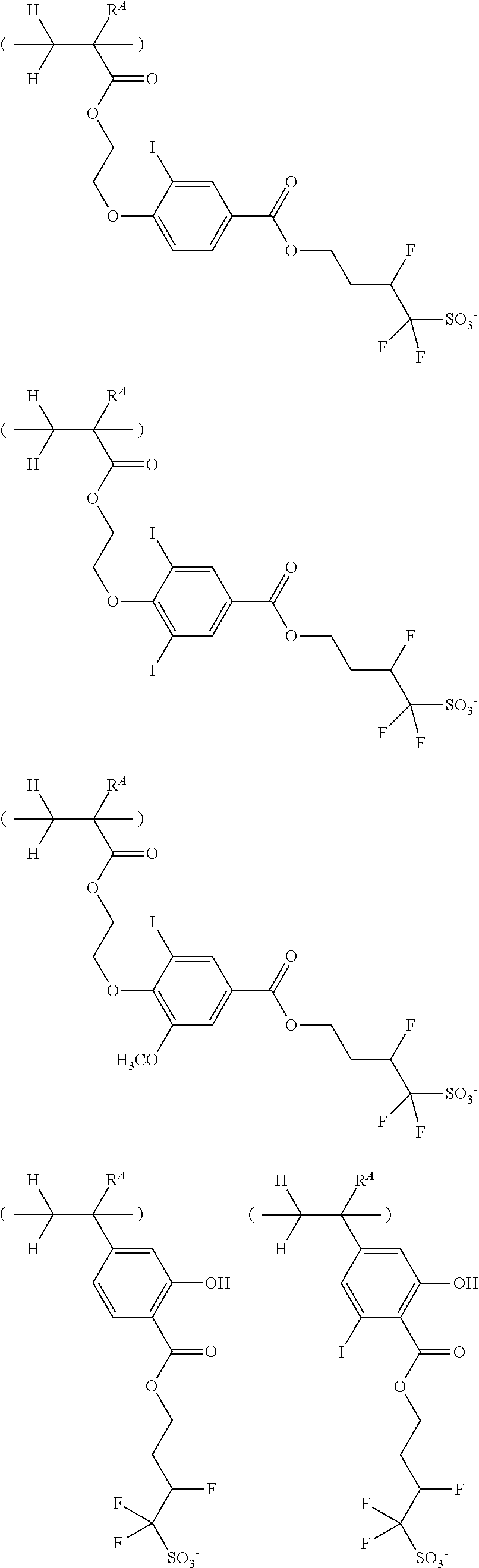





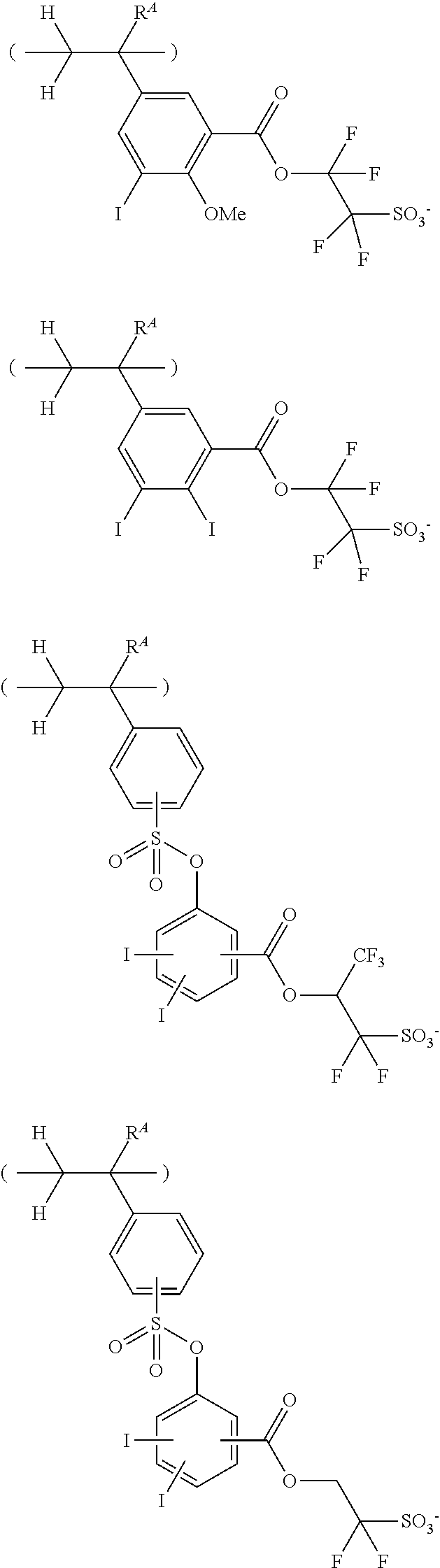


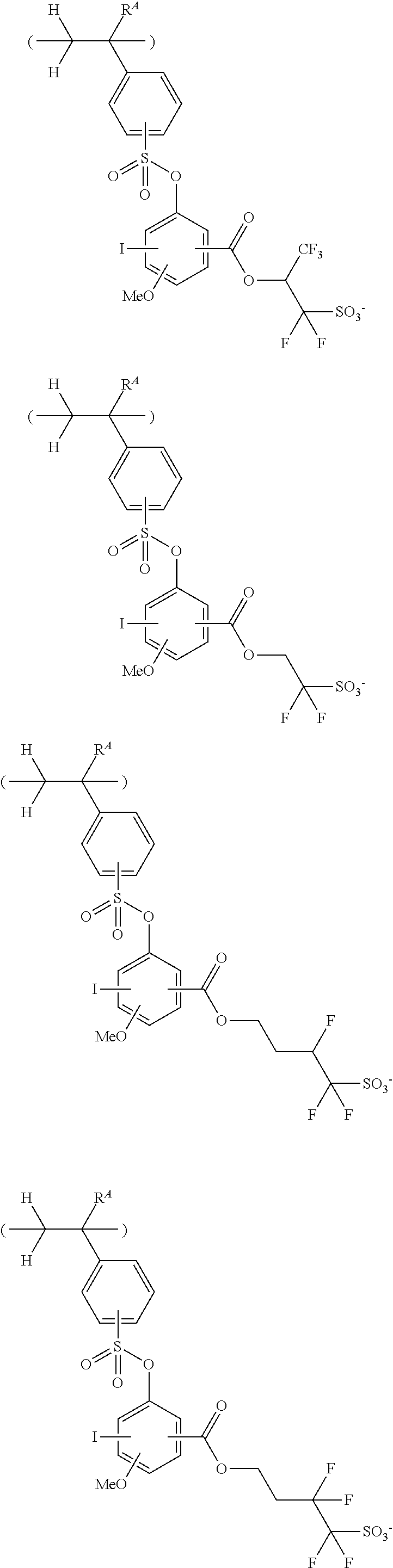


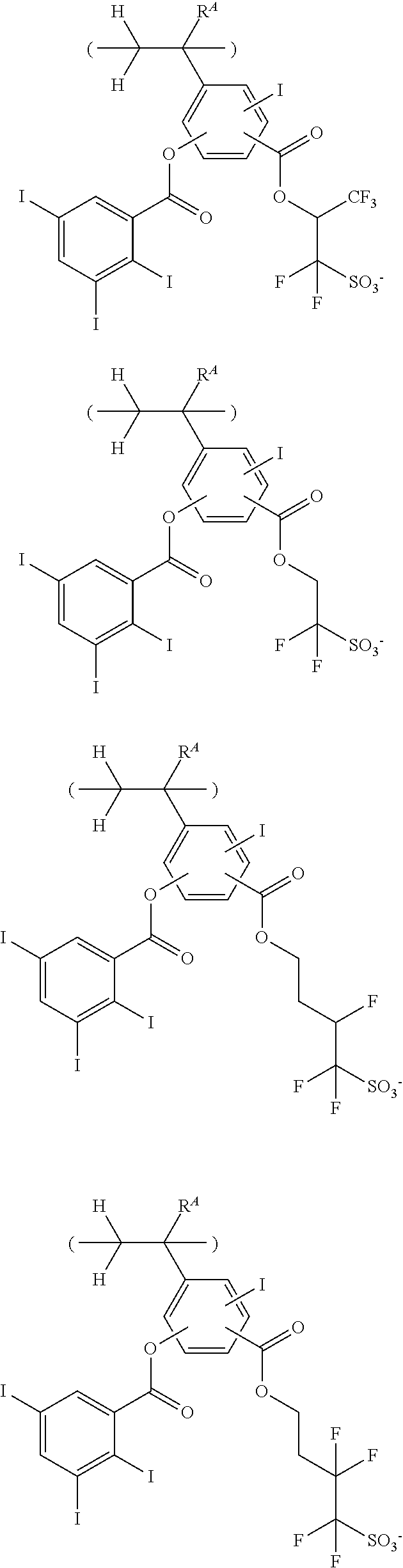


[0224]Examples of the anion in repeat unit (c3) are shown below, but not limited thereto. Herein RA is as defined above.





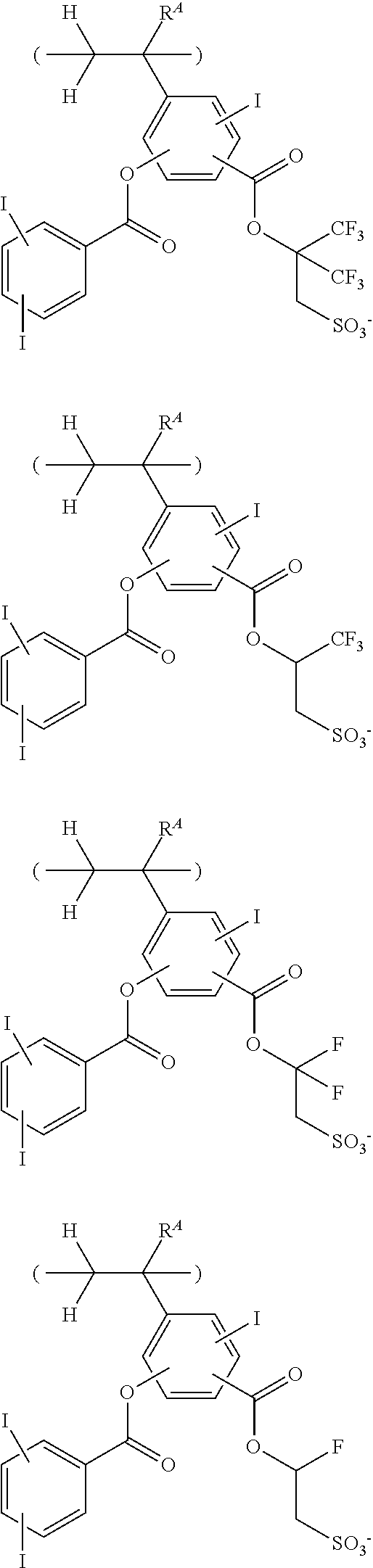


[0225]Examples of the anion in repeat unit (c4) are shown below, but not limited thereto. Herein RA is as defined above.


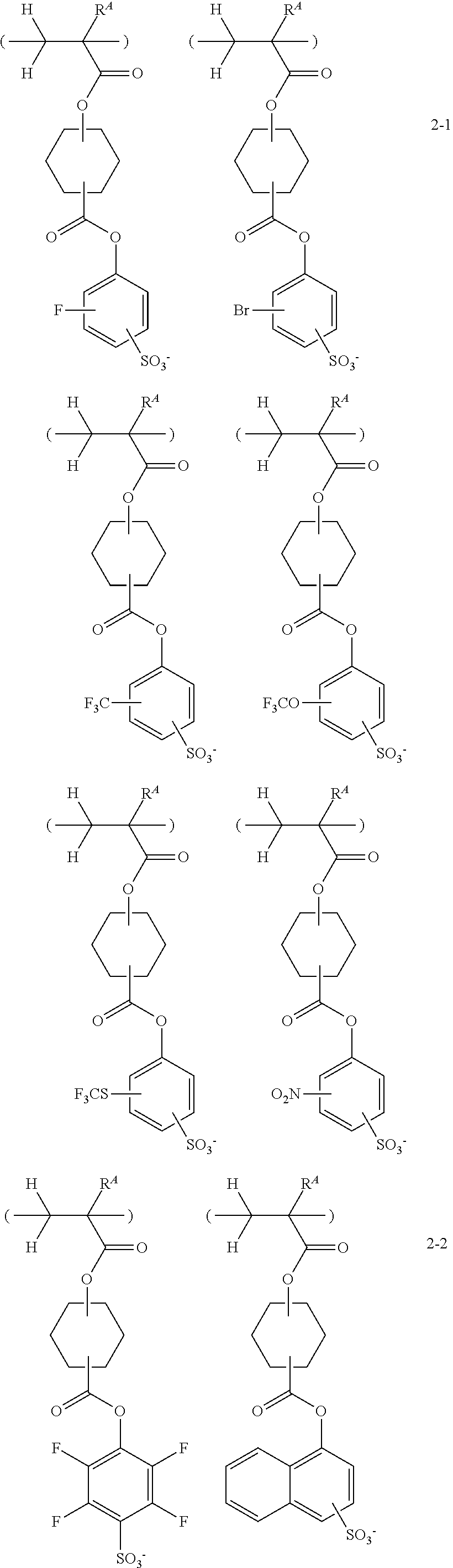


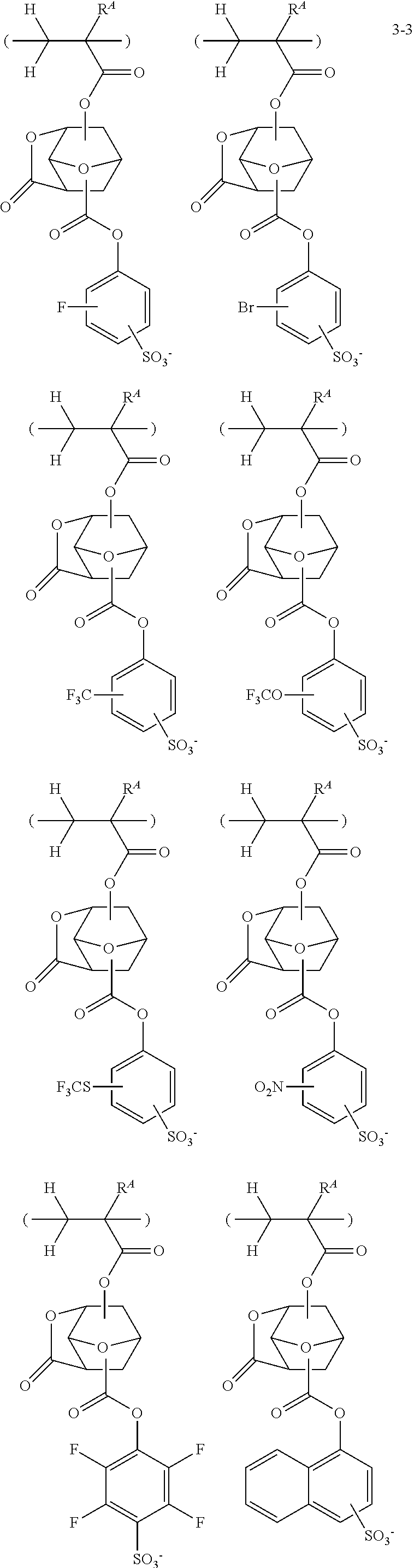


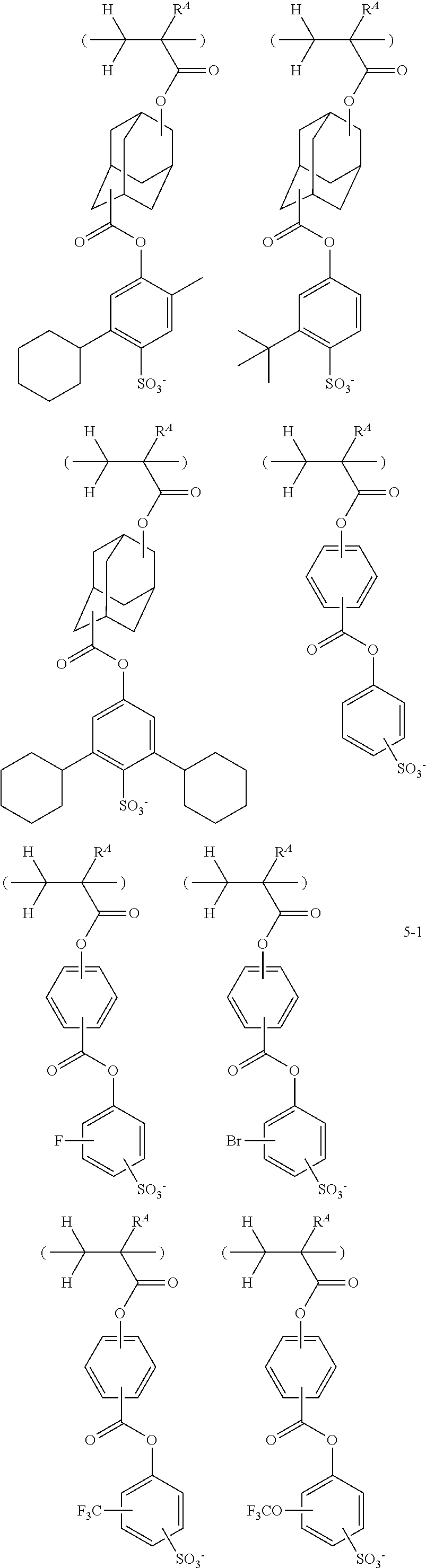


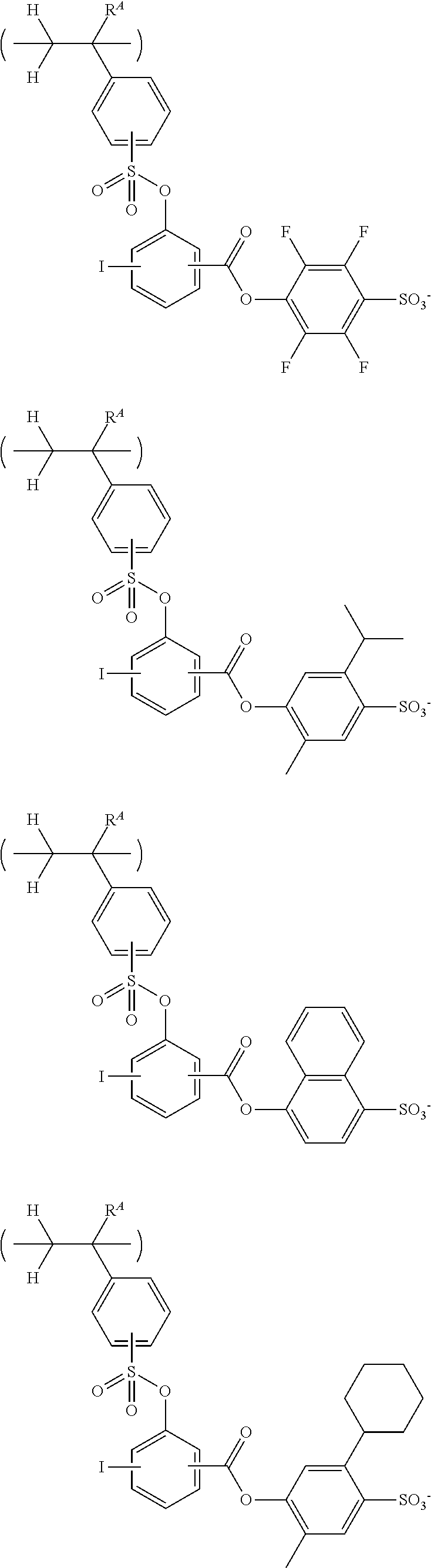
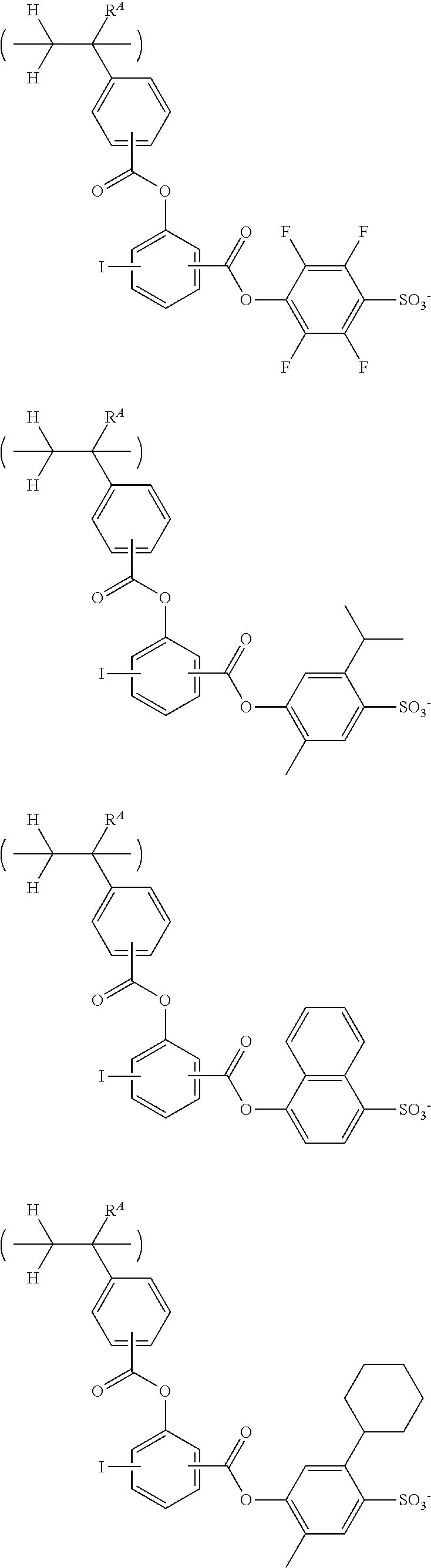


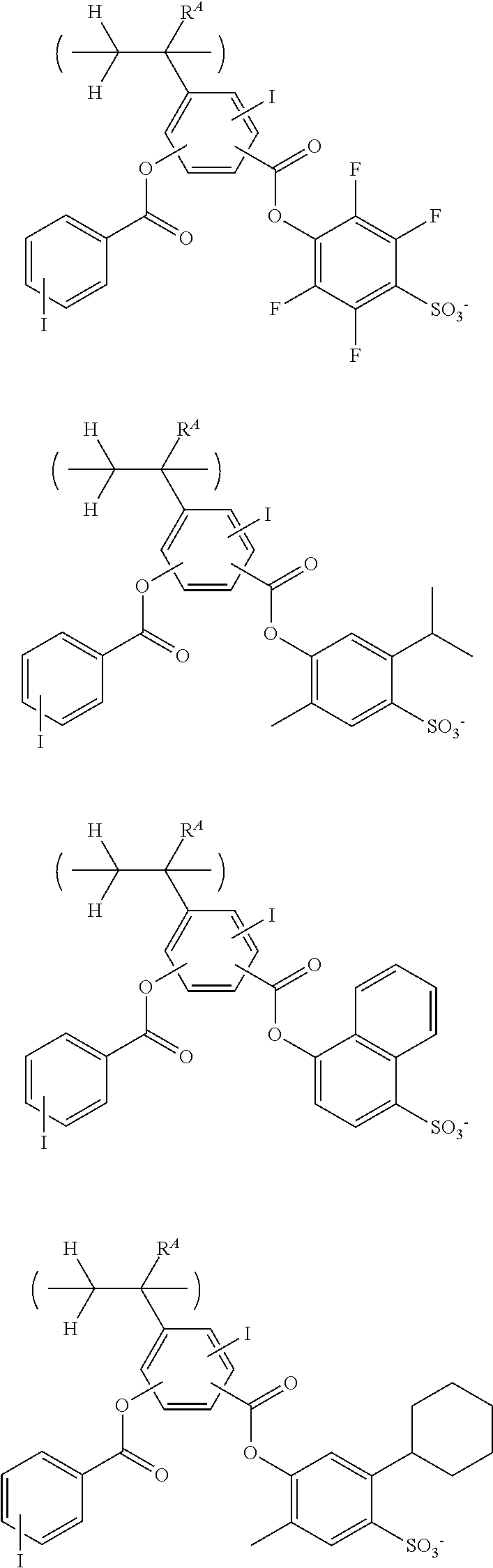

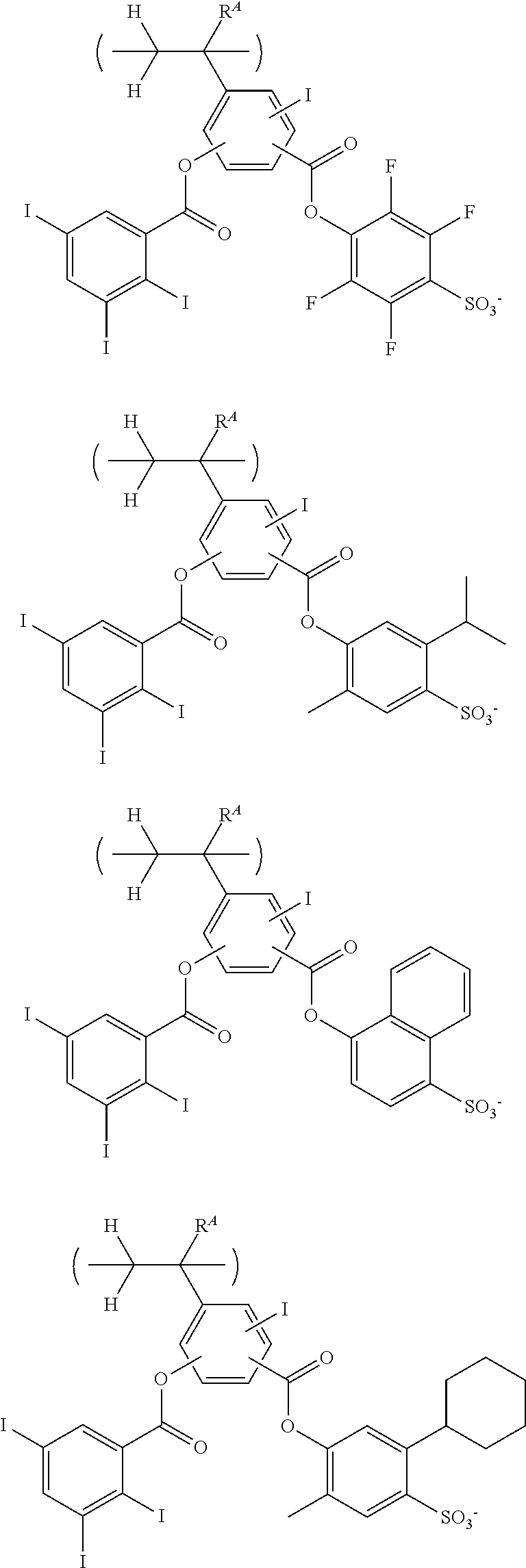
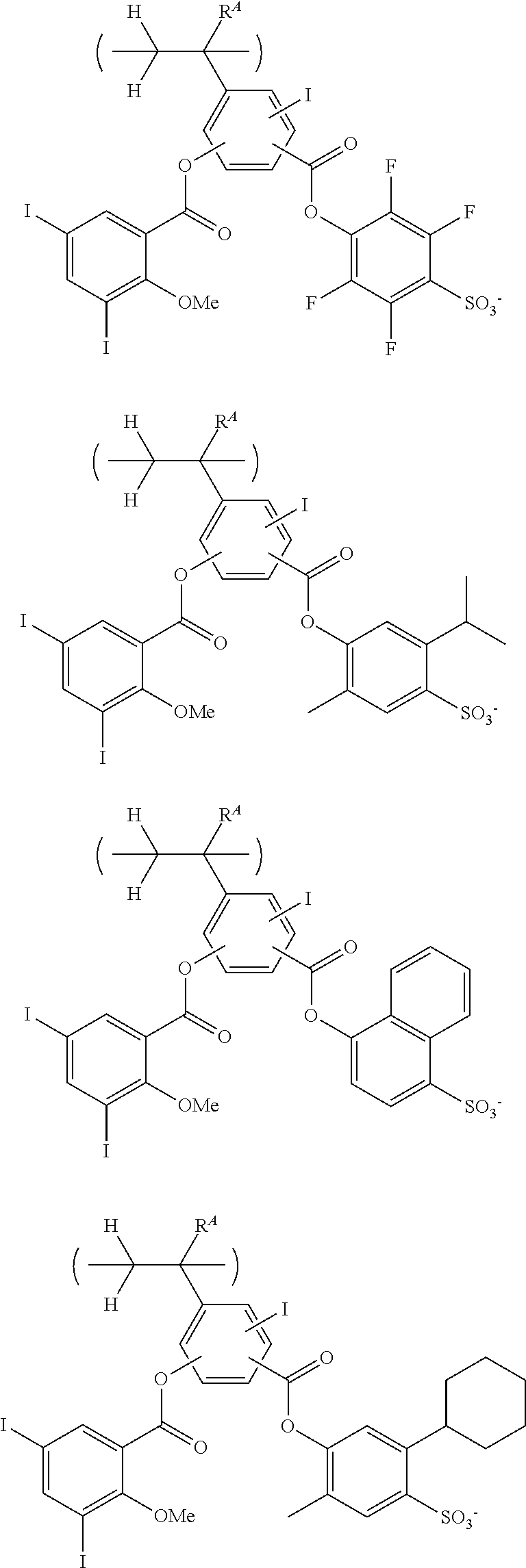


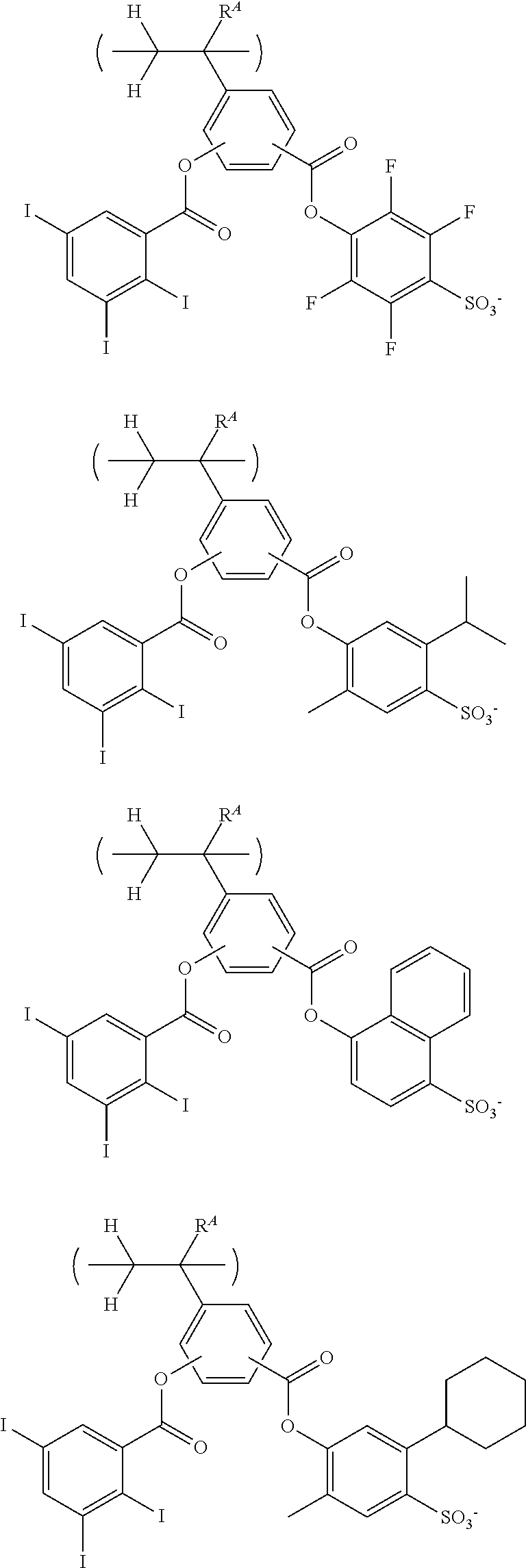

[0226]Examples of the anion in repeat unit (c5) are shown below, but not limited thereto. Herein RA is as defined above.

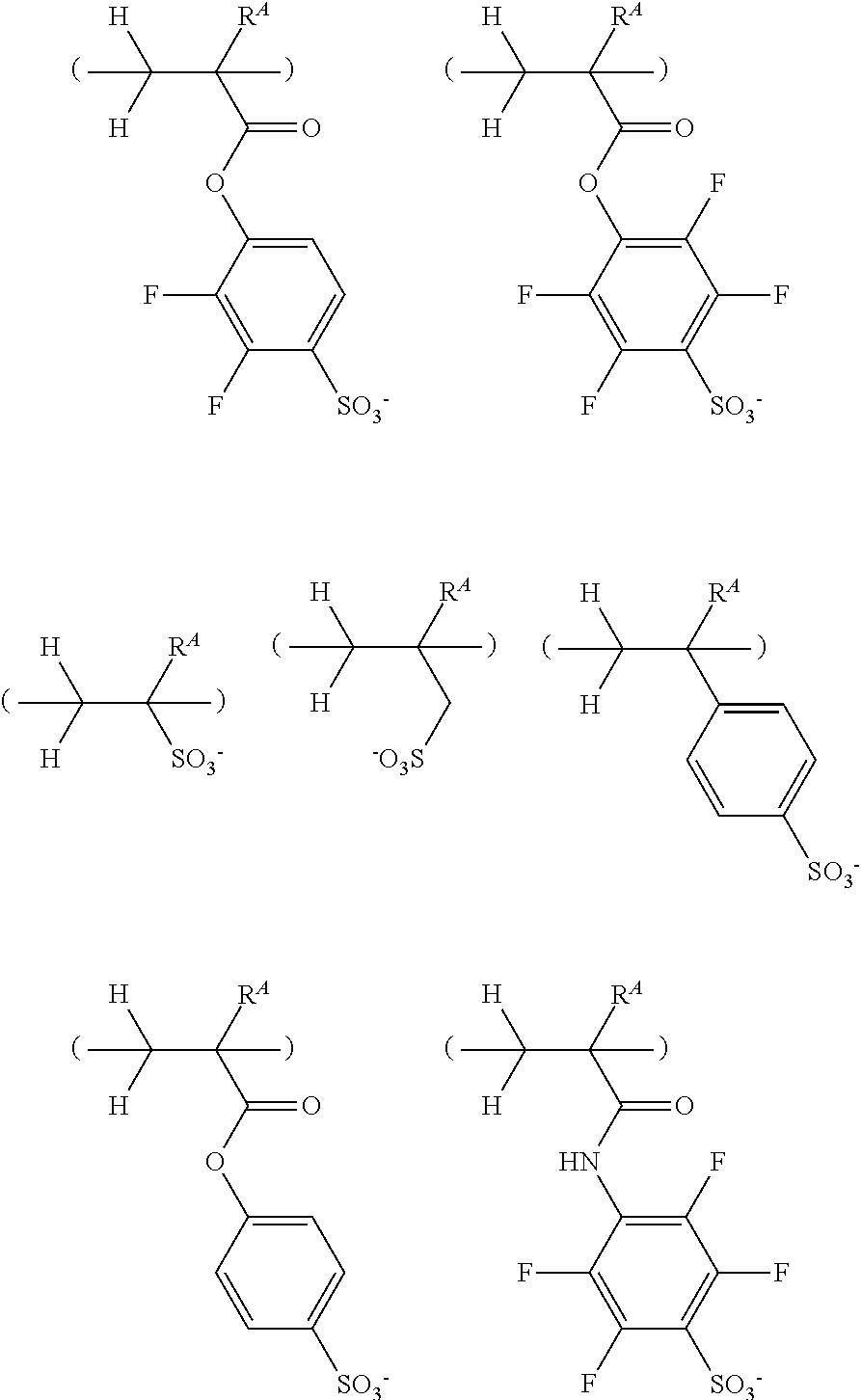
[0227]In the formulae (c2) to (c5), A+ is an onium cation. Suitable onium cations include sulfonium, iodonium and ammonium cations, with the sulfonium and iodonium cations being preferred. Examples of the sulfonium cation are as exemplified for the sulfonium cation in the formula (1B), and as described in JP-A 2024-3744, paragraphs [0102]-[0125], WO 2024/128017, paragraphs [0044]-[0049], and JP 7491173, paragraphs [0035]-[0046], but not limited thereto.
[0228]Also preferred as the sulfonium cation is a sulfonium cation having the formula (sulfo-1).

[0229]In the formula (sulfo-1), f1 is 0 or 1. The relevant structure is a benzene ring in case of f1=0, and a naphthalene ring in case of f1=1. From the aspect of solvent solubility, the benzene ring corresponding to f1=0 is preferred. The subscript f2 is 0 or 1. The relevant structure is a benzene ring in case of f2=0, and a naphthalene ring in case of f2=1. From the aspect of solvent solubility, the benzene ring corresponding to f2=0 is preferred. The subscript f3 is 0 or 1. The relevant structure is a benzene ring in case of f3=0, and a naphthalene ring in case of f3=1. From the aspect of solvent solubility, the benzene ring corresponding to f3=0 is preferred.
[0230]In the formula (sulfo-1), f4 is 0, 1, 2, 3 or 4. As the number of iodine atoms in the cationic structure becomes larger, the amount of absorption of EUV increases, but precipitation in the resist composition may occur due to reduced solvent solubility. Therefore, f4 is preferably 0, 1, 2 or 3, more preferably, 0, 1 or 2.
[0231]In the formula (sulfo-1), f5 is 0, 1, 2, 3 or 4. From the aspect of reactant availability, f5 is preferably 0, 1, 2 or 3, more preferably 0, 1 or 2. The subscript f6 is 0, 1, 2, 3, 4, 5 or 6. From the aspect of reactant availability, f6 is preferably 0, 1, 2 or 3, more preferably 0, 1 or 2. The subscript f7 is 0, 1, 2, 3, 4, 5 or 6. From the aspect of reactant availability, f7 is preferably 0, 1, 2 or 3, more preferably 0, 1 or 2.
[0232]In the formula (sulfo-1), f8 is 0, 1 or 2. From the aspect of reactant availability, f8 is preferably 0 or 1. The subscript f9 is 0, 1 or 2. From the aspect of reactant availability, f9 is preferably 0 or 1. The subscript f10 is 0, 1 or 2. From the aspect of reactant availability, f10 is preferably 0 or 1.
[0233]In the formula (sulfo-1), f11 is 0 or 1. The relevant structure is a benzene ring in case of f11=0, and a naphthalene ring in case of f11=1. From the aspect of solvent solubility, the benzene ring corresponding to f11=0 is preferred.
[0234]In the formula (sulfo-1), f12 is 0, 1, 2, 3 or 4. As the number of iodine atoms in the cationic structure becomes larger, the amount of absorption of EUV increases, but precipitation in the resist composition may occur due to reduced solvent solubility. Therefore, f12 is preferably 0, 1, 2 or 3, more preferably, 0, 1 or 2.
[0235]In the formula (sulfo-1), f13 is 0, 1 or 2. From the aspect of reactant availability, f13 is preferably 0 or 1. The subscript f14 is 0, 1 or 2. From the aspect of synthesis, f14 is preferably 0 or 1.
[0236]It is noted that f6+f9 is from 0 to 4 in case of f1=0, and f6+f9 is from 0 to 6 in case of f1=1. The sum of f7+f10 is from 0 to 4 in case of f2=0, and f7+f10 is from 0 to 6 in case of f2=1. The sum of f4+f5+f8+f14 is from 1 to 4 in case of f3=0, and f4+f5+f8+f14 is from 1 to 6 in case of f3=1. The sum of f12+f13 is from 0 to 4 in case of f11=0, and f12+f13 is from 0 to 6 in case of f11=1. The sum of f4+f12 is 1 or more.
[0237]In the formula (sulfo-1), RF1 to RF3 are each independently fluorine, a C1-C6 fluorinated saturated hydrocarbyl group, C1-C6 fluorinated saturated hydrocarbyloxy group, or C1-C6 fluorinated saturated hydrocarbylthio group. Of these, trifluoromethyl, trifluoromethoxy and trifluorothiomethoxy groups are preferred. A plurality of RF1 may be identical or different when f5 is 2, 3 or 4. A plurality of RF2 may be identical or different when f6 is 2, 3, 4, 5 or 6. A plurality of RF3 may be identical or different when f7 is 2, 3, 4, 5 or 6.
[0238]In the formula (sulfo-1), each of Rct1 to Rct4 is halogen exclusive of iodine and fluorine, nitro group, cyano group, a C1-C20 hydrocarbyl group which may contain a heteroatom, a C1-C20 hydrocarbyloxy group which may contain a heteroatom, or a C1-C20 hydrocarbylthio group which may contain a heteroatom. The hydrocarbyl group and hydrocarbyl moiety in the hydrocarbyloxy and hydrocarbylthio groups may be saturated or unsaturated and straight, branched or cyclic. Examples of thereof are as exemplified above for the hydrocarbyl group R11 to R13 in the formula (1). In the hydrocarbyl group and the hydrocarbyl moiety in the hydrocarbyloxy and hydrocarbylthio groups, some or all hydrogen may be replaced by a moiety containing a heteroatom such as oxygen, sulfur, nitrogen or halogen and some constituent —CH2— in the hydrocarbyl group may be replaced by a moiety containing a heteroatom such as oxygen, sulfur or nitrogen, so that the group may contain a hydroxy moiety, cyano moiety, fluorine, chlorine, bromine, iodine, carbonyl moiety, ether bond, ester bond, sulfonic ester bond, carbonate bond, lactone ring, sultone ring, carboxylic anhydride (—C(═O)—O—C(═O)—) or haloalkyl moiety.
[0239]Two Rct1 may be identical or different and two Rct1 may bond together to form a ring with the carbon atoms to which they are attached, when f8 is 2. Two Rct2 may be identical or different and two R12 may bond together to form a ring with the carbon atoms to which they are attached, when f9 is 2. Two Rct3 may be identical or different and two Rct3 may bond together to form a ring with the carbon atoms to which they are attached, when f10 is 2. Two Rct4 may be identical or different and two Rct4 may bond together to form a ring with the carbon atoms to which they are attached, when f13 is 2. Examples of the ring formed herein include cyclopropane, cyclobutane, cyclopentane, cyclohexane, norbornane and adamantane rings. In the ring, some or all hydrogen may be replaced by a moiety containing a heteroatom such as oxygen, sulfur, nitrogen or halogen, and some constituent —CH2— may be replaced by a moiety containing a heteroatom such as oxygen, sulfur or nitrogen, so that the ring may contain a hydroxy moiety, fluorine, chlorine, bromine, iodine, cyano moiety, carbonyl moiety, ether bond, ester bond, sulfonate ester bond, carbonate bond, lactone ring, sultone ring, carboxylic anhydride (—C(═O)—O—C(═O)—) or haloalkyl moiety.
[0240]The aromatic rings directly bonded to S+ in the sulfonium cation having the formula (sulfo-1) may bond together to form a ring with S+. Examples of the structure of the ring include those represented by the following formula.

[0241]Herein the broken line designates a point of attachment.
[0242]In the formula (sulfo-1), LC and LD are each independently a single bond, ether bond, ester bond, amide bond, sulfonate ester bond, sulfonic amide bond, carbonate bond or carbamate bond. Inter alia, LC is preferably a single bond, ether bond, ester bond or sulfonate ester bond, more preferably ester bond or sulfonic ester bond. LD is preferably a single bond, ether bond or ester bond, more preferably a single bond.
[0243]In the formula (sulfo-1), XL2 is a single bond or a C1-C40 hydrocarbylene group which may contain a heteroatom. The hydrocarbylene group may be straight, branched or cyclic, and examples thereof include alkanediyl, cyclic saturated hydrocarbylene, and arylene groups. Examples of the heteroatom include oxygen, nitrogen and sulfur. Examples of the C1-C40 hydrocarbylene group XL2 which may contain a heteroatom include XL-0 to XL-58 exemplified for the formula (1A) as examples of the C1-C40 hydrocarbylene groups XL1 which may contain a heteroatom. Of these, XL-0 to XL-22, XL-29 to XL-34, and XL-47 to XL-58 are preferred.
[0244]Preferably, the sulfonium cation of the formula (sulfo-1) has the formula (sulfo-1-1).

[0245]Herein f4 to f10, f12 to f14, RF1 to RF3, Rct1 to Rct4, LC, LD and XL2 are as defined above.
[0246]Preferably, the sulfonium cation of the formula (sulfo-1-1) has the formula (sulfo-1-2).

[0247]Herein f4 to f10, RF1 to RF3 and Rct1 to Rct3 are as defined above.
[0248]Examples of the sulfonium cation of the formula (sulfo-1) are shown below, but not limited thereto. In the following formula, Me is methyl.


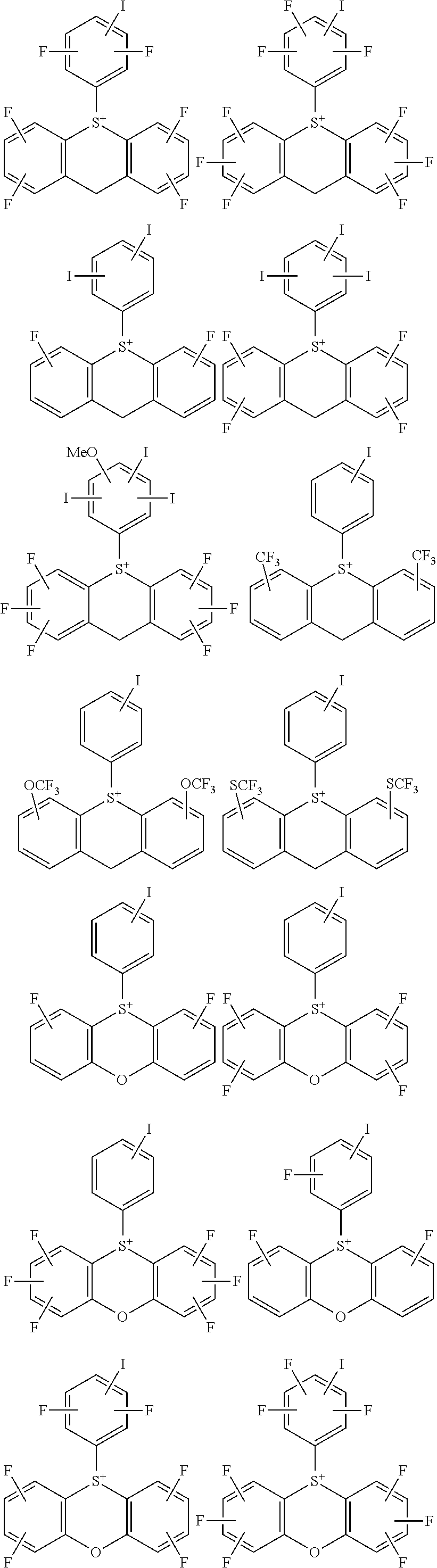
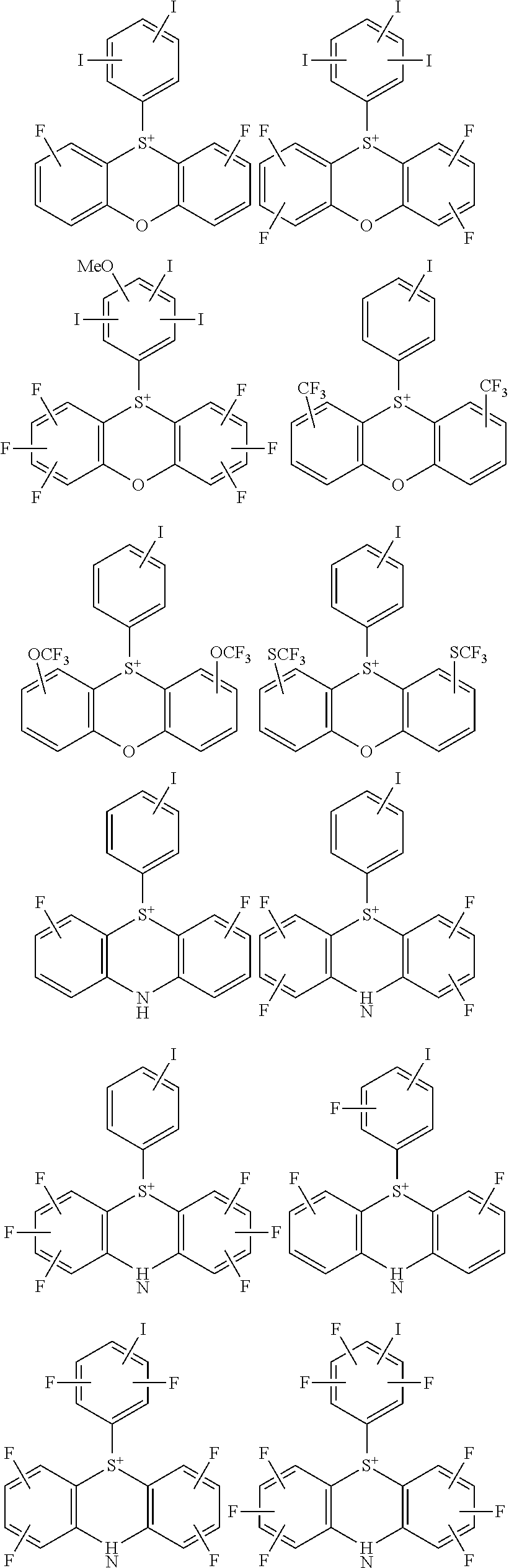


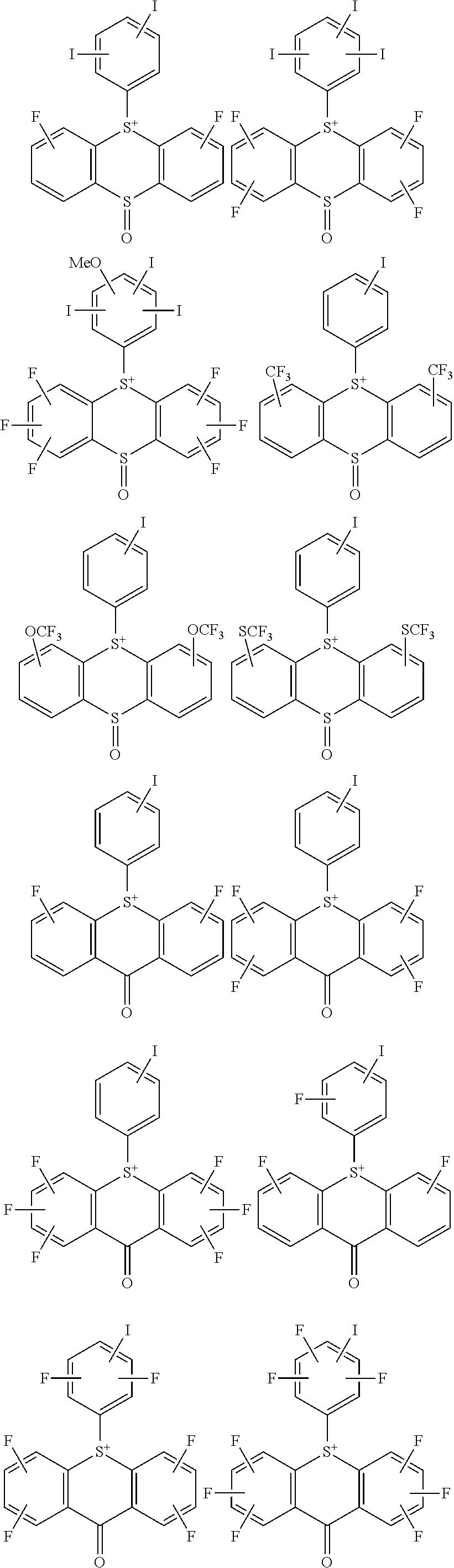
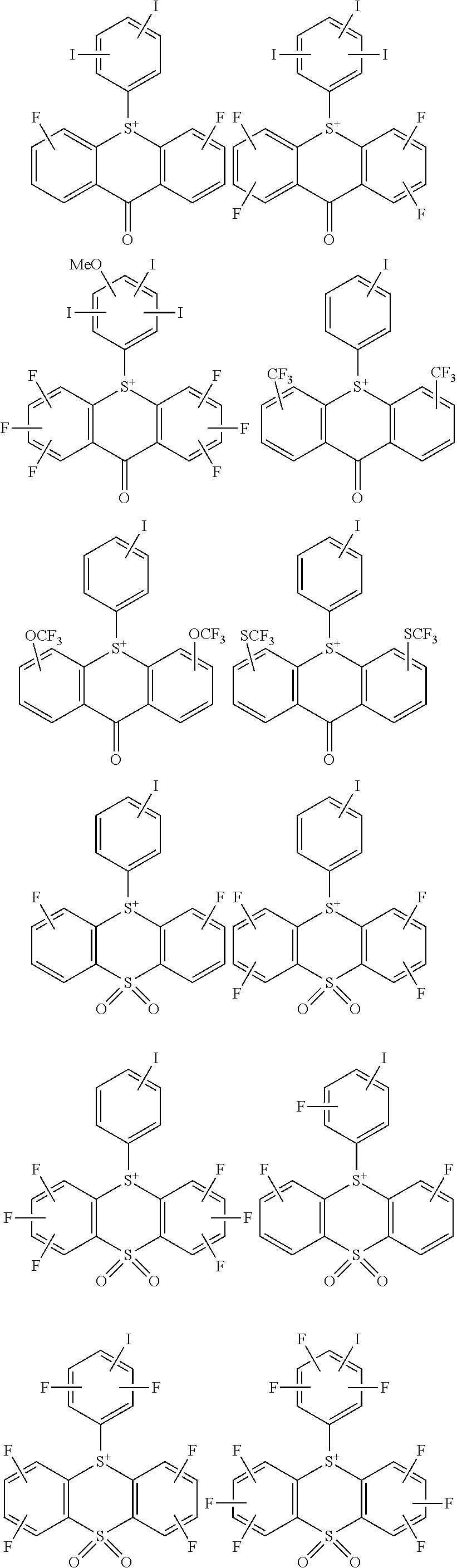


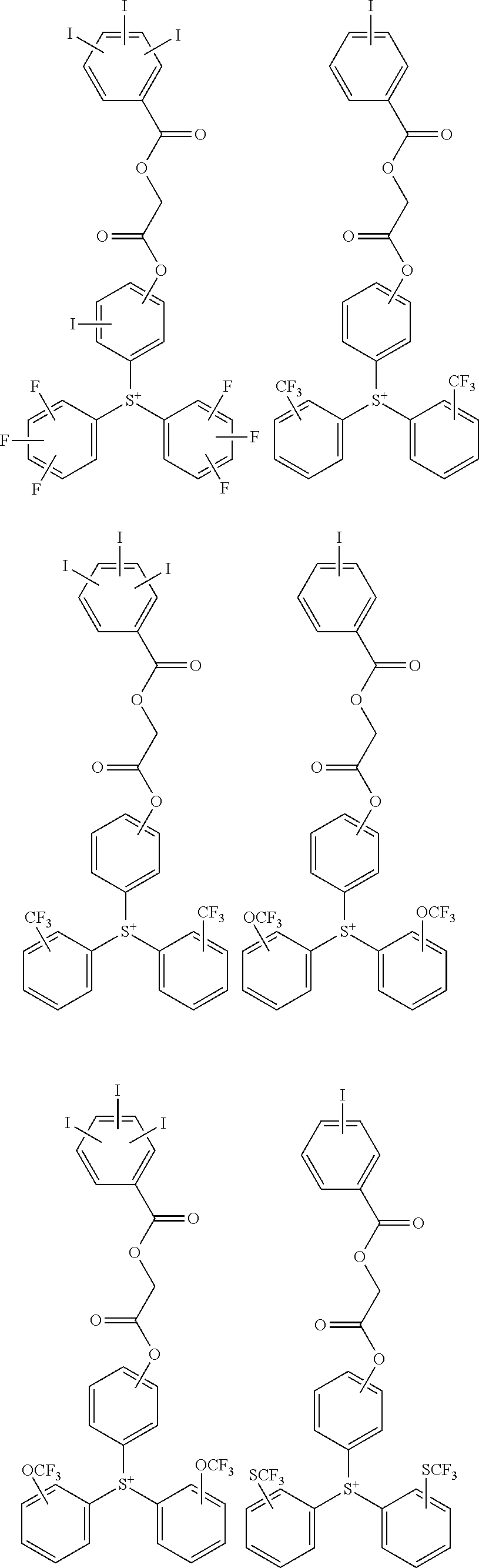















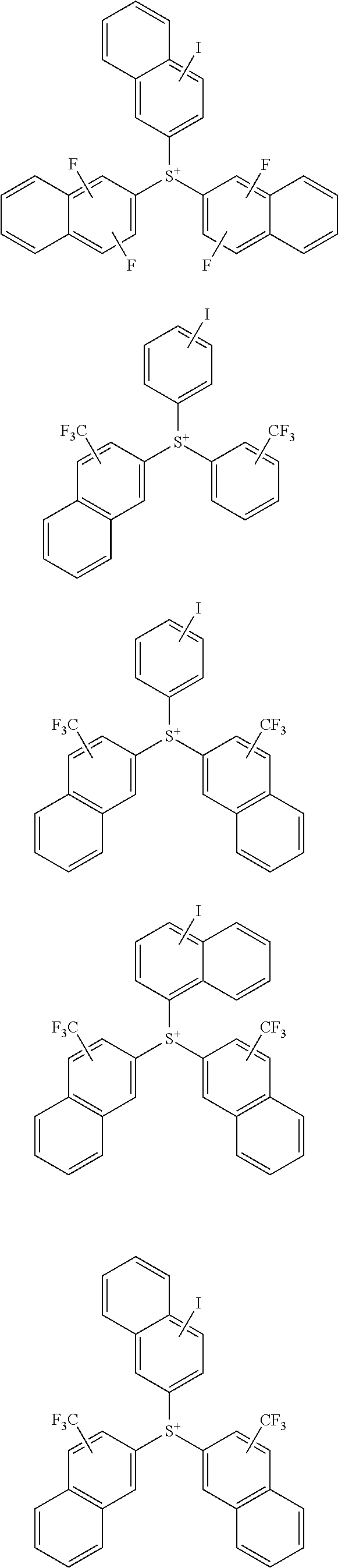


[0249]Examples of the iodonium cation are as described in JP-A 2024-259, paragraph [0181], but not limited thereto.
[0250]Typical of the ammonium cation are cations of the formula (am-1).

[0251]In the formula (am-1), Rct5 to Rct8 are each independently a C1-C40 hydrocarbyl group which may contain a heteroatom. Rct5 and Rct6 may bond together to form a ring with the nitrogen atom to which they are attached. Examples of the hydrocarbyl group are as exemplified above for the hydrocarbyl groups R11 to R13 in the formula (1).
[0252]Examples of the ammonium cation having the formula (am-1) are shown below, but not limited thereto.
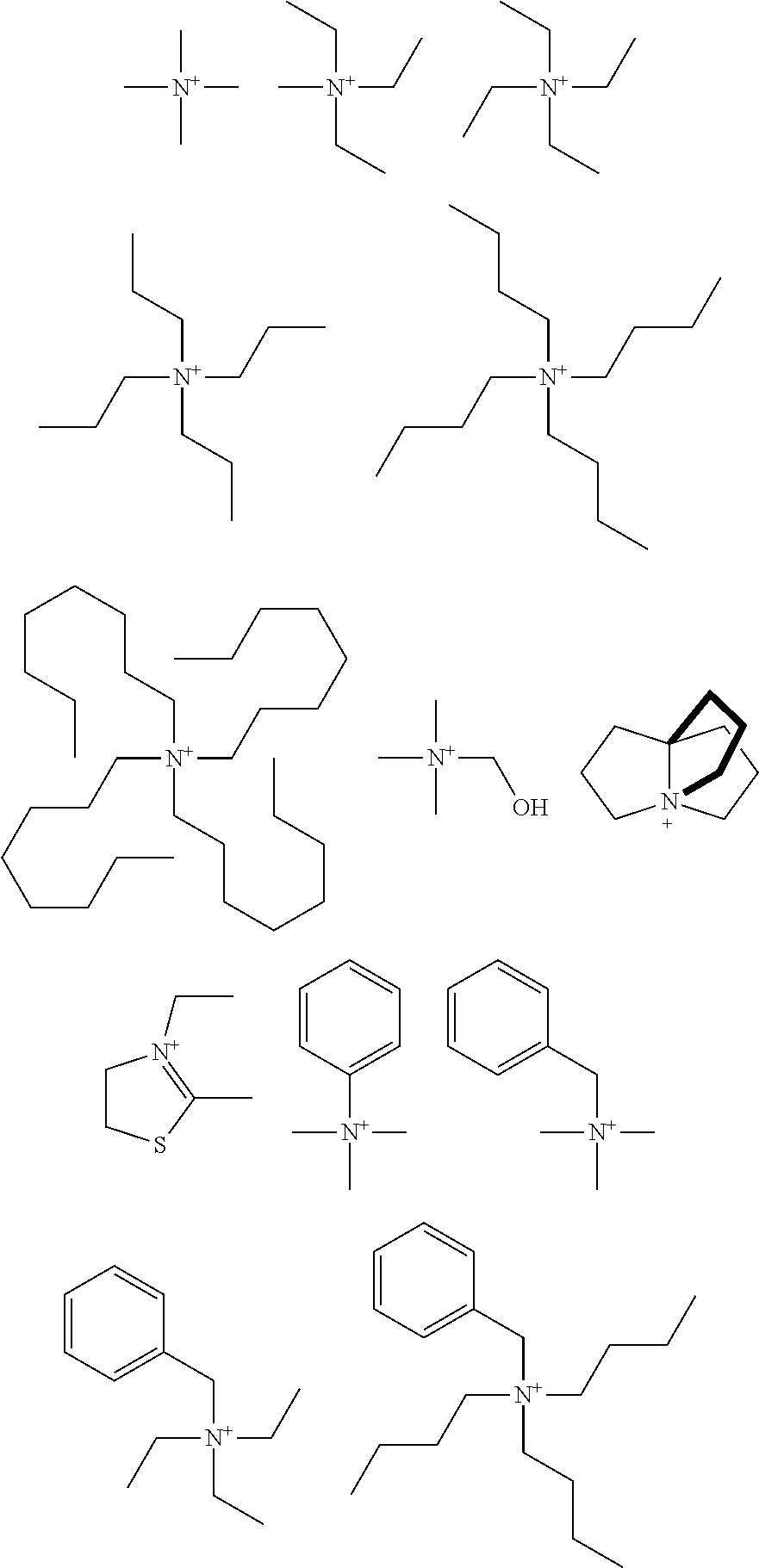
[0253]Examples of repeat units (c1) to (c5) include arbitrary combinations of the anion with the cation, both as exemplified above.
[0254]Of the repeat units (c1) to (c5), repeat units (c2) to (c5) are preferred from the aspect of controlling acid diffusion. Repeat units (c2), (c4) and (c5) are more preferred from the aspect of the acid strength of generated acid. Repeat units (c2) are most preferred from the aspect of solvent solubility.
[0255]The polymer may contain repeat units of a structure having a hydroxy group protected with an acid labile group (also referred to repeat units (d) hereinafter). The repeat unit (d) is not particularly limited as long as the unit includes one or more structures having a hydroxy group protected with a protective group such that the protective group is decomposed to generate the hydroxy group under the action of acid. Repeat units having the formula (d1) are preferred.

[0256]In the formula (d1), RA is hydrogen, fluorine, methyl or trifluoromethyl. R41 is a C1-C30 (g+1)-valent hydrocarbon group which may contain a heteroatom. R42 is an acid labile group. The subscript g is 1, 2, 3 or 4.
[0257]In formula (d1), the acid labile group R41 is deprotected under the action of acid so that a hydroxy group is generated. The structure of R41 is not particularly limited, an acetal structure, ketal structure, hydrocarbyloxycarbonyl group and hydrocarbyloxymethyl group having the following formula (d2) are preferred, with the hydrocarbyloxymethyl group having the formula (d2) being more preferred.
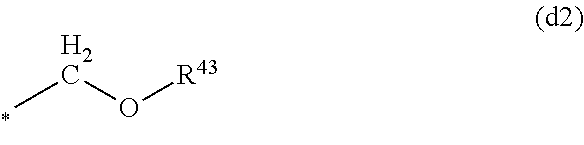
[0258]Herein, * designates a point of attachment. R43 is a C1-C15 hydrocarbyl group.
[0259]Examples of the acid labile group R43, the hydrocarbyloxymethyl group having the formula (d2), and the repeat units (d) are as described in JP-A 2020-111564 as examples of repeat units (d).
[0260]In another preferred embodiment, the polymer may further contain repeat units (e) derived from indene, benzofuran, benzothiophene, acenaphthylene, chromone, coumarin, and norbornadiene, or derivatives thereof. Examples of the monomer from which repeat units (e) are derived are shown below, but not limited thereto.

[0261]The polymer may contain repeat units (f) derived from indane, vinylpyridine or vinylcarbazole.
[0262]In the polymer, repeat units (a1), (a2), (a3), (b1), (b2), (c1) to (c5), (d), (e) and (f) are incorporated in a ratio of preferably 0<a1≤0.8, 0≤a2≤0.8, 0≤a3≤0.6, 0≤b1≤0.6, 0≤b2≤0.6, 0≤c1≤0.4, 0≤c2≤0.4, 0≤c3≤0.4, 0≤c4≤0.4, 0≤c5≤0.4, 0≤d≤0.5, 0≤e≤0.3, and 0≤f≤0.3; more preferably 0≤a1≤0.7, 0≤a2≤0.7, 0≤a3≤0.5, 0≤b1≤0.5, 0≤b2≤0.5, 0≤c1≤0.3, 0≤c2≤0.3, 0≤c3≤0.3, 0≤c4≤0.3, 0≤c5≤0.3, 0≤d≤0.3, 0≤e≤0.3, and 0≤f≤0.3. It is noted that a1+a2+a3+b1+b2+c1+c2+c3+c4+d+e+f≤1.0.
[0263]The polymer should preferably have a weight average molecular weight (Mw) in the range of 1,000 to 500,000, more preferably 3,000 to 100,000. A Mw in the range ensures satisfactory etch resistance and eliminates the risk of resolution being lowered due to a failure to acquire a difference in dissolution rate before and after exposure. In the invention, Mw is a value measured by gel permeation chromatography (GPC) with tetrahydrofuran (THF) or N,N-dimethylformamide (DMF) as a solvent, and calculated as polystyrene.
[0264]The influence of Mw/Mn becomes stronger as the pattern rule becomes finer. Therefore, the polymer should preferably have a narrow dispersity (Mw/Mn) of 1.0 to 2.0 in order to provide a resist composition suitable for micropatterning to a small feature size. A Mw/Mn in the range ensures that the contents of lower and higher molecular weight polymer fractions are low and eliminates a possibility that foreign matter is left on the pattern or the pattern profile is degraded after exposure.
[0265]Examples of the method for synthesizing the polymer include a method in which one or more monomers selected from the monomers corresponding to the foregoing repeat units are dissolved in an organic solvent, a radical polymerization initiator is added thereto, and the mixture is heated for polymerization.
[0266]Examples of the organic solvent which can be used for polymerization include toluene, benzene, tetrahydrofuran THF, diethyl ether, dioxane, cyclohexane, cyclopentane, methyl ethyl ketone (MEK), propylene glycol monomethyl ether acetate (PGMEA), and γ-butyrolactone (GBL). Examples of the polymerization initiator used herein include 2,2′-azobisisobutyronitrile (AIBN), 2,2′-azobis(2,4-dimethylvaleronitrile), dimethyl-2,2-azobis(2-methylpropionate), 1,1′-azobis(1-acetoxy-1-phenylethane), benzoyl peroxide, and lauroyl peroxide. The amount of the initiator added is preferably 0.01 to 25 mol % based on the total of monomers. The reaction temperature is preferably 50 to 150° C., more preferably 60 to 100° C. The reaction time is preferably 2 to 24 hours, and more preferably 2 to 12 hours from the aspect of production efficiency.
[0267]The polymerization initiator may be added to the monomer solution before supply to a reaction vessel, or an initiator solution may be prepared separately from the monomer solution and each solution may be supplied to a reaction vessel independently. Since there is a possibility that the initiator generates a radical in the standby time, by which polymerization reaction takes place to form an ultrahigh molecular weight compound, it is preferred from the standpoint of quality control that the monomer solution and the initiator solution be independently prepared and added dropwise. The acid labile group that has been incorporated in the monomer may be kept as such, or the polymerization may be followed by protection or partial protection. Any of well-known chain transfer agents such as dodecylmercaptan and 2-mercaptoethanol may be used for the purpose of adjusting molecular weight. An appropriate amount of the chain transfer agent is 0.01 to 20 mol % based on the total of monomers to be polymerized.
[0268]Where a monomer having a hydroxy group is copolymerized, the hydroxy group may be replaced by an acetal group susceptible to deprotection with acid, typically ethoxyethoxy, prior to polymerization, and the polymerization be followed by deprotection with weak acid and water. Alternatively, the hydroxy group may be replaced by an acetyl, formyl, pivaloyl or similar group prior to polymerization, and the polymerization be followed by alkaline hydrolysis.
[0269]When hydroxystyrene or hydroxyvinylnaphthalene is copolymerized, hydroxystyrene or hydroxyvinylnaphthalene and other monomers may be dissolved in an organic solvent, a radical polymerization initiator is added thereto, and the mixture is heated for polymerization. Instead, as alternative method, acetoxystyrene or acetoxyvinylnaphthalene may be used and after polymerization, the acetoxy group is deprotected by alkaline hydrolysis, for thereby converting the polymer product to polyhydroxystyrene or hydroxypolyvinylnaphthalene.
[0270]Examples of the base that may be used in alkaline hydrolysis include aqueous ammonia and triethylamine. Preferably the reaction temperature is −20° C. to 100° C., more preferably 0° C. to 60° C. The reaction time is 0.2 to 100 hours, more preferably 0.5 to 20 hours.
[0271]The amount of each monomer in the monomer solution is to be appropriately set, for example, so as to achieve the foregoing preferred content ratio of the repeat unit.
[0272]The reaction solution resulting from polymerization reaction may be used as the final product. Alternatively, the polymer may be recovered in powder form through a purifying step such as re-precipitation step of adding the reaction solution to a poor solvent and letting the polymer precipitate as powder, after which the polymer powder is used as the final product. It is preferred from the standpoints of operation efficiency and consistent quality to handle a polymer solution which is obtained by dissolving the powder polymer resulting from the purifying step in a solvent, as the final product.
[0273]The solvents which can be used herein are described in JP-A 2008-111103, paragraphs [0144]-[0145]. Exemplary solvents include ketones such as cyclohexanone and methyl-2-n-pentyl ketone; alcohols such as 3-methoxybutanol, 3-methyl-3-methoxybutanol, 1-methoxy-2-propanol, 1-ethoxy-2-propanol; ethers such as propylene glycol monomethyl ether (PGME), ethylene glycol monomethyl ether, propylene glycol monoethyl ether, ethylene glycol monoethyl ether, propylene glycol dimethyl ether, and diethylene glycol dimethyl ether; esters such as PGMEA, propylene glycol monoethyl ether acetate, ethyl lactate, ethyl pyruvate, butyl acetate, methyl 3-methoxypropionate, ethyl 3-ethoxypropionate, tert-butyl acetate, tert-butyl propionate, and propylene glycol mono-tert-butyl ether acetate; lactones such as GBL; alcohols such as diacetone alcohol (DAA); and high-boiling alcohols such as diethylene glycol, propylene glycol, glycerol, 1,4-butanediol, and 1,3-butanediol, which may be used alone or in admixture.
[0274]The polymer solution preferably has a polymer concentration of 0.01 to 30 wt %, more preferably 0.1 to 20 wt %.
[0275]Prior to use, the reaction solution or polymer solution is preferably filtered through a filter. Filtration is effective for consistent quality because foreign matter and gel which can cause defects are removed.
[0276]Suitable materials of which the filter is made include fluorocarbon, cellulose, nylon, polyester, and hydrocarbon base materials. Preferred for the filtering step of a resist composition are filters made of fluorocarbons commonly known as Teflon®, hydrocarbons such as polyethylene and polypropylene, and nylon. While the pore size of the filter may be selected appropriate to comply with the desired cleanness, the filter preferably has a pore size of up to 100 nm, more preferably up to 20 nm. A single filter may be used or a plurality of filters may be used in combination. Although the filtering method may be single pass of the solution, preferably the filtering step is repeated by flowing the solution in a circulating manner. In the polymer preparation process, the filtering step may be carried out any times, in any order and in any stage. The reaction solution as polymerized or the polymer solution may be filtered, preferably both are filtered.
[0277]The base polymer (B) may be used alone or as a blend of two or more polymers which differ in compositional ratio, Mw and/or Mw/Mn. Component (B) may also be a blend of the base polymer defined above and a hydrogenated product of ROMP. For the ROMP, reference is made to JP-A 2003-66612.
(C) Organic Solvent
[0278]The chemically amplified resist composition of the invention may comprise an organic solvent as component (C). The organic solvent (C) is not particularly limited as long as the foregoing and other components are soluble therein. Examples of the organic solvent include ketones such as cyclopentanone, cyclohexanone and methyl-2-n-pentyl ketone; alcohols such as 3-methoxybutanol, 3-methyl-3-methoxybutanol, 1-methoxy-2-propanol, 1-ethoxy-2-propanol; keto-alcohols such as DAA, ethers such as PGME, ethylene glycol monomethyl ether, propylene glycol monoethyl ether, ethylene glycol monoethyl ether, propylene glycol dimethyl ether, and diethylene glycol dimethyl ether; esters such as PGMEA, propylene glycol monoethyl ether acetate, ethyl lactate, ethyl pyruvate, butyl acetate, methyl 3-methoxypropionate, ethyl 3-ethoxypropionate, tert-butyl acetate, tert-butyl propionate, and propylene glycol mono-tert-butyl ether acetate; and lactones such as GBL, which may be used alone or in admixture.
[0279]Of the foregoing organic solvents, 1-ethoxy-2-propanol, PGMEA, cyclohexanone, GBL, ethyl lactate, DAA and mixtures thereof are preferred because the base polymer (B) is most soluble therein.
[0280]The content of the organic solvent (C) in the chemically amplified resist composition of the invention is preferably 200 to 5,000 parts by weight, more preferably 400 to 3,500 parts by weight per 80 parts by weight of the base polymer (B). The organic solvent (C) may be used alone or in admixture.
(D) Quencher
[0281]The inventive chemically amplified resist composition may comprise (D) a quencher. In the invention, the quencher refers to a compound capable of trapping the acid, which is generated by the photoacid generator in the chemically amplified resist composition upon light exposure, to prevent the acid from diffusing to the unexposed region and to assist in forming the desired pattern.
[0282]Onium salts having the formulae (2) and (3) are useful as the quencher (D).

[0283]In the formula (2), Rq1 is hydrogen or a C1-C40 hydrocarbyl group which may contain a heteroatom, exclusive of the group wherein hydrogen bonded to the carbon atom at α-position relative to the sulfo group is replaced by fluorine or fluoroalkyl. In the formula (3), Rq2 is hydrogen, or a C1-C40 hydrocarbyl group which may contain a heteroatom.
[0284]Examples of the C1-C40 hydrocarbyl group Rq1 include C1-C40 alkyls such as methyl, ethyl, n-propyl, isopropyl, n-butyl, isobutyl, sec-butyl, tert-butyl, n-pentyl, tert-pentyl, n-hexyl, n-octyl, 2-ethylhexyl, n-nonyl and n-decyl groups; C3-C40 cyclic saturated hydrocarbyl groups such as cyclopentyl, cyclohexyl, cyclopentylmethyl, cyclopentylethyl, cyclopentylbutyl, cyclohexylmethyl, cyclohexylethyl, cyclohexylbutyl, norbornyl, tricyclo[5.2.1.02,6] decyl and adamantyl groups; and C6-C40 aryl groups such as phenyl, naphthyl and anthracenyl groups. In the hydrocarbyl group, some or all hydrogen may be replaced by a moiety containing a heteroatom such as oxygen, sulfur, nitrogen or halogen, and some constituent —CH2— may be replaced by a moiety containing a heteroatom such as oxygen, sulfur or nitrogen, so that the group may contain a hydroxy moiety, fluorine, chlorine, bromine, iodine, cyano moiety, carbonyl moiety, ether bond, ester bond, sulfonate ester bond, carbonate bond, lactone ring, sultone ring, carboxylic anhydride (—C(═O)—O—C(═O)—) or haloalkyl moiety.
[0285]Examples of the hydrocarbyl group Rq2 include those exemplified above for Rq1, fluorinated saturated hydrocarbyl groups such as trifluoromethyl and trifluoroethyl groups, and fluorinated aryl groups such as pentafluorophenyl and 4-trifluoromethylphenyl groups.
[0286]Examples of the anion in the onium salt having the formula (2) are shown below, but not limited thereto.


[0287]Examples of the anion in the onium salt having the formula (3) are shown below, but not limited thereto.


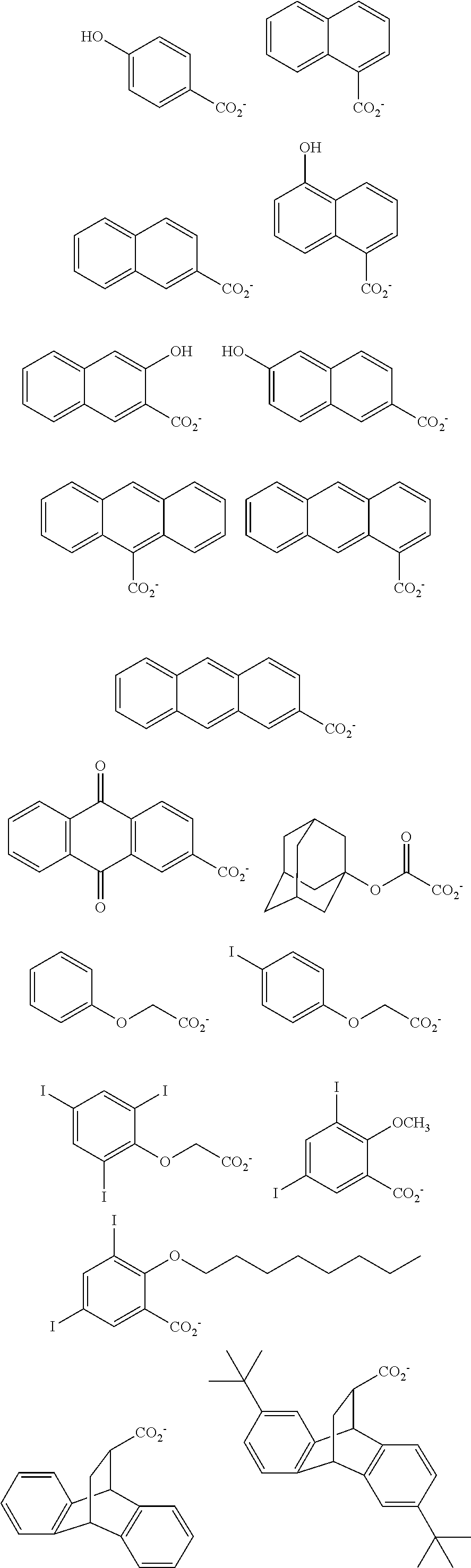


[0288]In the formulae (2) and (3), Mq+ is an onium cation. The onium cation is preferably a sulfonium, iodonium or ammonium cation. Examples of the sulfonium cation are as exemplified for the sulfonium cation in the formula (1), and as described in JP-A 2024-3744, paragraphs [0102]-[0125], WO 2024/128017, paragraphs [0044]-[0049], and JP 7491173, paragraphs [0035]-[0046], and exemplified for the sulfonium cation in the formula (sulfo-1), but not limited thereto. Examples of the iodonium cation are as described in JP-A 2024-259, paragraph [0181], but not limited thereto. Examples of the ammonium cation are as exemplified for the ammonium cation of formula (am-1).
[0289]Examples of the onium salt having the formula (2) or (3) include arbitrary combinations of anions with cations, both as exemplified above. These onium salts may be readily prepared by ion exchange reaction using any well-known organic chemistry technique. For the ion exchange reaction, reference may be made to JP-A 2007-145797, for example.
[0290]The onium salt having the formula (2) or (3) functions as a quencher in the chemically amplified resist composition. This is because the counter anion of the onium salt is a conjugate base of a weak acid. As used herein, the weak acid indicates an acidity insufficient to deprotect an acid labile group from an acid labile group-containing unit for the base polymer. The onium salt having the formula (2) or (3) functions as a quencher when used in combination with an onium salt type photoacid generator having a conjugate base of a strong acid (typically a sulfonic acid which is fluorinated at α-position) as the counter anion. In a system using a mixture of an onium salt capable of generating a strong acid (e.g., a position fluorinated sulfonic acid) and an onium salt capable of generating a weak acid (e.g., non-fluorinated sulfonic acid or carboxylic acid), if the strong acid generated from the photoacid generator upon exposure to high-energy radiation collides with the unreacted onium salt having a weak acid anion, then a salt exchange occurs whereby the weak acid is released and an onium salt having a strong acid anion is formed. In this course, the strong acid is exchanged into an acid having low catalytic activity, incurring apparent deactivation of the acid for enabling to control acid diffusion.
[0291]Also useful as the quencher (D) are onium salts having sulfonium cation and phenoxide anion sites in a common molecule as described in JP 6848776, onium salts having sulfonium cation and carboxylate anion sites in a common molecule as described in JP 6583136 and JP-A 2020-200311, and onium salts having iodonium cation and carboxylate anion sites in a common molecule as described in JP 6274755.
[0292]If a photoacid generator capable of generating a strong acid is an onium salt, an exchange from the strong acid generated upon exposure to high-energy radiation to a weak acid as above can take place, but it rarely happens that the weak acid generated upon exposure to high-energy radiation collides with the unreacted onium salt capable of generating a strong acid to induce a salt exchange. This is because of a likelihood of an onium cation forming an ion pair with a stronger acid anion.
[0293]When the inventive chemically amplified resist composition comprises an onium salt of the formula (2) or (3) as the quencher (D), the amount of the onium salt used is preferably 0.1 to 20 parts by weight, more preferably 0.1 to 10 parts by weight per 80 parts by weight of the base polymer (B). As long as the amount of onium salt type quencher (E) is in the range, a satisfactory resolution is available without a substantial lowering of sensitivity. The onium salt having the formula (2) or (3) may be used alone or in admixture.
[0294]The inventive chemically amplified resist composition may comprise a nitrogen-containing compound as the quencher (D). Suitable nitrogen-containing compounds include primary, secondary and tertiary amine compounds, specifically amine compounds having a hydroxy group, ether bond, ester bond, lactone ring, cyano group or sulfonate ester bond, as described in JP-A 2008-111103, paragraphs [0146]-[0164], and primary or secondary amine compounds protected with a carbamate group, as described in JP 3790649.
[0295]A sulfonic acid sulfonium salt having a nitrogen-containing substituent may also be used as the nitrogen-containing compound. This compound functions as a quencher in the unexposed region, but as a so-called photo-degradable base in the exposed region because it loses the quencher function in the exposed region due to neutralization thereof with the acid generated by itself. Using a photo-degradable base, the contrast between exposed and unexposed regions can be further enhanced. With respect to the photo-degradable base, reference may be made to JP-A 2009-109595 and JP-A 2012-46501, for example.
[0296]When the nitrogen-containing compound is used as the quencher (D), the amount of the nitrogen-containing compound used is preferably 0.001 to 12 parts by weight, more preferably 0.01 to 8 parts by weight per 80 parts by weight of the base polymer (B). The nitrogen-containing compound may be used alone or in admixture.
(E) Other Photoacid Generator
[0297]The chemically amplified resist composition of the invention may comprise (E) a photoacid generator other than component (A) (hereinafter, also referred to as the other photoacid generator). The other photoacid generator is not particularly limited as long as it is capable of generating an acid upon exposure to high-energy radiation. The preferred other photoacid generator is a salt having the formula (4) or (5).

[0298]In the formula (4), R101 to R105 are each independently halogen or a C1-C20 hydrocarbyl group which may contain a heteroatom. Any two of R101, R102 and R103 may bond together to form a ring with a sulfur atom to which they are attached. Examples of the hydrocarbyl group are as exemplified above for the hydrocarbyl groups R11 to R13 in the formula (1).
[0299]Examples of the sulfonium salt cation of the formula (4) are as exemplified for the sulfonium cation in the formula (1), and as described in JP-A 2024-3744, paragraphs [0102]-[0125], WO 2024/128017, paragraphs [0044]-[0049], and JP 7491173, paragraphs [0035]-[0046], and exemplified for the sulfonium cation in the formula (sulfo-1), but not limited thereto. Examples of the cation in the iodonium salt having the formula (5) are as described in JP-A 2024-259, paragraph [0181], but not limited thereto.
[0300]In the formulae (4) and (5), Xa− is an anion of a strong acid. Examples of the strong acid anion are any of anions of the formulae (c1-1) to (c1-5).
[0301]Other photoacid generators (E) having the formula (6) are also preferred.

[0302]In the formula (6), R201 to R202 are each independently a C1-C30 hydrocarbyl group which may contain a heteroatom. R203 is a C1-C30 hydrocarbylene group which may contain a heteroatom. Any two of R201 and R202 and R203 may bond together to form a ring with a sulfur atom to which they are attached.
[0303]The C1-C30 hydrocarbyl groups R201 and R202 may be saturated or unsaturated and straight, branched or cyclic. Examples thereof include C1-C30 alkyl groups such as methyl, ethyl, n-propyl, isopropyl, n-butyl, isobutyl, sec-butyl, tert-butyl, tert-pentyl, n-pentyl, n-hexyl, n-octyl, 2-ethylhexyl, n-nonyl and n-decyl groups; C3-C30 cyclic saturated hydrocarbyl groups such as cyclopentyl, cyclohexyl, cyclopentylmethyl, cyclopentylethyl, cyclopentylbutyl, cyclohexylmethyl, cyclohexylethyl, cyclohexylbutyl, norbornyl, oxanorbornyl, tricyclo[5.2.1.02,6]decyl and adamantyl groups; C6-C30 aryl groups such as phenyl, methylphenyl, ethylphenyl, n-propylphenyl, isopropylphenyl, n-butylphenyl, isobutylphenyl, sec-butylphenyl, tert-butylphenyl, naphthyl, methylnaphthyl, ethylnaphthyl, n-propylnaphthyl, isopropylnaphthyl, n-butylnaphthyl, isobutylnaphthyl, sec-butylnaphthyl, tert-butylnaphthyl and anthracenyl groups; and combinations thereof. In the hydrocarbyl group, some or all hydrogen may be replaced by a moiety containing a heteroatom such as oxygen, sulfur, nitrogen or halogen, and some constituent —CH2— in the hydrocarbyl group may be replaced by a moiety containing a heteroatom such as oxygen, sulfur or nitrogen, so that the group may contain a hydroxy moiety, cyano moiety, fluorine, chlorine, bromine, iodine, carbonyl moiety, ether bond, ester bond, sulfonate ester bond, carbonate bond, lactone ring, sultone ring, carboxylic anhydride (—C(═O)—O—C(═O)—) or haloalkyl moiety.
[0304]The C1-C30 hydrocarbylene group R203 may be saturated or unsaturated and straight, branched or cyclic. Examples thereof include C1-C30 alkanediyl groups such as methanediyl, ethane-1,1-diyl, ethane-1,2-diyl, propane-1,3-diyl, butane-1,4-diyl, pentane-1,5-diyl, hexane-1,6-diyl, heptane-1,7-diyl, octane-1,8-diyl, nonane-1,9-diyl, decane-1,10-diyl, undecane-1,11-diyl, dodecane-1,12-diyl, tridecane-1,13-diyl, tetradecane-1,14-diyl, pentadecane-1,15-diyl, hexadecane-1,16-diyl and heptadecane-1,17-diyl groups; C3-C30 cyclic saturated hydrocarbylene groups such as cyclopentanediyl, cyclohexanediyl, norbornanediyl and adamantanediyl groups; and arylene groups such as phenylene, methylphenylene, ethylphenylene, n-propylphenylene, isopropylphenylene, n-butylphenylene, isobutylphenylene, sec-butylphenylene, tert-butylphenylene, naphthylene, methylnaphthylene, ethylnaphthylene, n-propylnaphthylene, isopropylnaphthylene, n-butylnaphthylene, isobutylnaphthylene, sec-butylnaphthylene and tert-butylnaphthylene groups. In the hydrocarbylene group, some or all hydrogen may be replaced by a moiety containing a heteroatom such as oxygen, sulfur, nitrogen or halogen, and some constituent —CH2— may be replaced by a moiety containing a heteroatom such as oxygen, sulfur or nitrogen, so that the group may contain a hydroxy moiety, fluorine, chlorine, bromine, iodine, cyano moiety, carbonyl moiety, ether bond, ester bond, sulfonate ester bond, carbonate bond, lactone ring, sultone ring, carboxylic anhydride (—C(═O)—O—C(═O)—) or haloalkyl moiety. The heteroatom is preferably oxygen.
[0305]In the formula (6), L21 is a single bond, an ether bond, or a C1-C20 hydrocarbylene group which may contain a heteroatom. The hydrocarbylene group may be saturated or unsaturated, and may be straight, branched or cyclic. Examples of the hydrocarbylene group are as exemplified above as a hydrocarbylene group R203.
[0306]In the formula (6), Xa, Xb, Xc and Xd are each independently hydrogen, fluorine or trifluoromethyl. It is noted that at least one of Xa, Xb, Xc and Xd is fluorine or trifluoromethyl.
[0307]Preferably, the photoacid generator of the formula (6) has the following formula (6′).

[0308]In the formula (6′), L21 is as defined above. Xe is hydrogen or trifluoromethyl, preferably trifluoromethyl. R301, R302 and R303 are each independently halogen or a C1-C20 hydrocarbyl group which may contain a heteroatom. The hydrocarbyl group may be saturated or unsaturated, and may be straight, branched or cyclic. Examples thereof are as exemplified above for the hydrocarbyl group Rfa1 in the formula (c1-1-1). The subscripts p and q are each independently 0, 1, 2, 3, 4 or 5, and the subscript r is 0, 1, 2, 3 or 4.
[0309]Examples of the photoacid generator having the formula (6) are as exemplified as for the photoacid generator having the formula (2) in JP-A 2017-26980.
[0310]Of the foregoing other photoacid generators, those having an anion of formula (c1-1-1) or (c1-4) are especially preferred because of reduced acid diffusion and high solubility in the resist solvent. Also those having the formula (6′) are especially preferred because of extremely reduced acid diffusion.
[0311]When used, the photoacid generator (E) is preferably added in an amount of 0.1 to 40 parts by weight, and more preferably 0.5 to 20 parts by weight per 80 parts by weight of the base polymer (B). An amount of the photoacid generator (E) in the range ensures good resolution and eliminates the risk of leaving foreign matter after development or during separation of resist film. The other photoacid generator (E) may be used alone or in admixture.
(F) Surfactant
[0312]The chemically amplified resist composition of the invention may further comprise (F) a surfactant. It is preferably (F) a surfactant which is insoluble or substantially insoluble in water but soluble in alkaline developer, or a surfactant which is insoluble or substantially insoluble in water and alkaline developer. For the surfactant, reference should be made to those compounds described in JP-A 2010-215608 and JP-A 2011-16746.
[0313]While many examples of the surfactant which is insoluble or substantially insoluble in water and alkaline developer are described in the patent documents cited herein, preferred examples are FC-4430 (3M), Olfine® E1004 (Nissin Chemical Co., Ltd.), Surflon® 5-381, KH-20 and KH-30 (AGC Seimi Chemical Co., Ltd.). Oxetane ring-opened polymers having the formula (surf-1) are also useful.

[0314]It is provided herein that R, Rf, A, B, C, m, and n are applied to only the formula (surf-1), independent of the above descriptions. R is a di- to tetra-valent C2-C5 aliphatic group. Exemplary divalent aliphatic groups include ethylene, 1,4-butylene, 1,2-propylene, 2,2-dimethyl-1,3-propylene and 1,5-pentylene. Exemplary tri- and tetra-valent groups are shown below.

[0315]Herein the broken line denotes a valence bond. These formulae are partial structures derived from glycerol, trimethylol ethane, trimethylol propane, and pentaerythritol, respectively.
[0316]Of these, 1,4-butylene and 2,2-dimethyl-1,3-propylene are preferred.
[0317]Rf is trifluoromethyl group or pentafluoroethyl group, preferably trifluoromethyl group. The subscript m is an integer of 0 to 3, n is an integer of 1 to 4, and the sum of m and n, which represents the valence of R, is an integer of 2 to 4. A is 1. B is an integer of 2 to 25, preferably an integer of 4 to 20. C is an integer of 0 to 10, preferably 0 or 1. Note that the formula (surf-1) does not prescribe the arrangement of respective constituent units while they may be arranged either blockwise or randomly. For the preparation of surfactants in the form of partially fluorinated oxetane ring-opened polymers, reference should be made to U.S. Pat. No. 5,650,483, for example.
[0318]The surfactant which is insoluble or substantially insoluble in water and soluble in alkaline developer is useful when ArF immersion lithography is applied to the resist composition in the absence of a resist protective film. In this embodiment, the surfactant has a propensity to segregate on the surface of a resist film for achieving a function of minimizing water penetration or leaching. The surfactant is also effective for preventing water-soluble components from being leached out of the resist film for minimizing any damage to the exposure tool. The surfactant becomes solubilized during alkaline development following exposure and PEB, and thus forms few or no foreign matter which becomes defects. The preferred surfactant is a polymeric surfactant which is insoluble or substantially insoluble in water, but soluble in alkaline developer, also referred to as “hydrophobic resin” in this sense, and especially which is water repellent and enhances water sliding.
[0319]Suitable polymeric surfactants include those containing repeat units of at least one type selected from the formulae (7A) to (7E).

[0320]In the formulae (7A) to (7E), RB is hydrogen, fluorine, methyl, or trifluoromethyl. W1 is —CH2—, —CH2CH2— or —O—, or two separate —H. Rs1 is each independently hydrogen or a C1-C10 hydrocarbyl group. Rs2 is a single bond or C1-C5 straight or branched hydrocarbylene group. Rs3 is each independently hydrogen, a C1-C15 hydrocarbyl or fluorinated hydrocarbyl group, or an acid labile group. When Rs3 is a hydrocarbyl or fluorinated hydrocarbyl group, an ether bond or carbonyl moiety may intervene in a carbon-carbon bond. Rs4 is a C1-C20 (u+1)-valent hydrocarbon or fluorinated hydrocarbon group. The subscript u is 1, 2 or 3. Rs5 is each independently hydrogen or a group: —C(═O)—O—Rsa. Rsa is a C1-C20 fluorinated hydrocarbyl group. Rs6 is a C1-C15 hydrocarbyl or fluorinated hydrocarbyl group in which an ether bond or carbonyl moiety may intervene in a carbon-carbon bond.
[0321]The C1-C10 hydrocarbyl group Rs1 is preferably saturated while it may be straight, branched or cyclic. Examples thereof include C1-C10 alkyl groups such as methyl, ethyl, n-propyl, isopropyl, n-butyl, isobutyl, sec-butyl, tert-butyl, n-pentyl, n-hexyl, n-heptyl, n-octyl, n-nonyl and n-decyl, and C3-C10 cyclic saturated hydrocarbyl groups such as cyclopropyl, cyclobutyl, cyclopentyl, cyclohexyl, adamantyl and norbornyl. Inter alia, C1-C6 hydrocarbyl groups are preferred.
[0322]The hydrocarbylene group Rs2 is preferably saturated while it may be straight, branched or cyclic. Examples thereof include methylene, ethylene, propylene, butylene and pentylene groups.
[0323]The hydrocarbyl group Rs3 or Rs6 may be saturated or unsaturated and straight, branched or cyclic. Examples thereof include saturated hydrocarbyl groups and aliphatic unsaturated hydrocarbyl groups such as alkenyl and alkynyl groups, with the saturated hydrocarbyl groups being preferred. Examples of the saturated hydrocarbyl groups include those exemplified for the hydrocarbyl group Rs1 as well as undecyl, dodecyl, tridecyl, tetradecyl, and pentadecyl groups. Examples of the fluorinated hydrocarbyl group Rs3 or Rs6 include the foregoing hydrocarbyl groups in which some or all carbon-bonded hydrogen is replaced by fluorine atoms. In these groups, an ether bond or carbonyl moiety may intervene in a carbon-carbon bond as mentioned above.
[0324]Examples of the acid labile group Rs3 include the groups of the formulae (AL-3) to (AL-5), trialkylsilyl groups in which each alkyl group is a C1-C6 alkyl group, and C4-C20 oxoalkyl groups.
[0325]The (u+1)-valent hydrocarbon or fluorinated hydrocarbon group Rs4 may be straight, branched or cyclic, and examples thereof include the foregoing hydrocarbyl or fluorinated hydrocarbyl groups from which “u” number of hydrogen atoms are eliminated.
[0326]The fluorinated hydrocarbyl group Rsa is preferably saturated while it may be straight, branched or cyclic. Examples thereof include the foregoing hydrocarbyl groups in which some or all hydrogen is replaced by fluorine atoms. Illustrative examples include trifluoromethyl, 2,2,2-trifluoroethyl, 3,3,3-trifluoro-1-propyl, 3,3,3-trifluoro-2-propyl, 2,2,3,3-tetrafluoropropyl, 1,1,1,3,3,3-hexafluoroisopropyl, 2,2,3,3,4,4,4-heptafluorobutyl, 2,2,3,3,4,4,5,5-octafluoropentyl, 2,2,3,3,4,4,5,5,6,6,7,7-dodecafluoroheptyl, 2-(perfluorobutyl)ethyl, 2-(perfluorohexyl)ethyl, 2-(perfluorooctyl)ethyl, and 2-(perfluorodecyl)ethyl.
[0327]Examples of the repeat units of formulae (7A) to (7E) are shown below, but not limited thereto. Herein RB is as defined above.


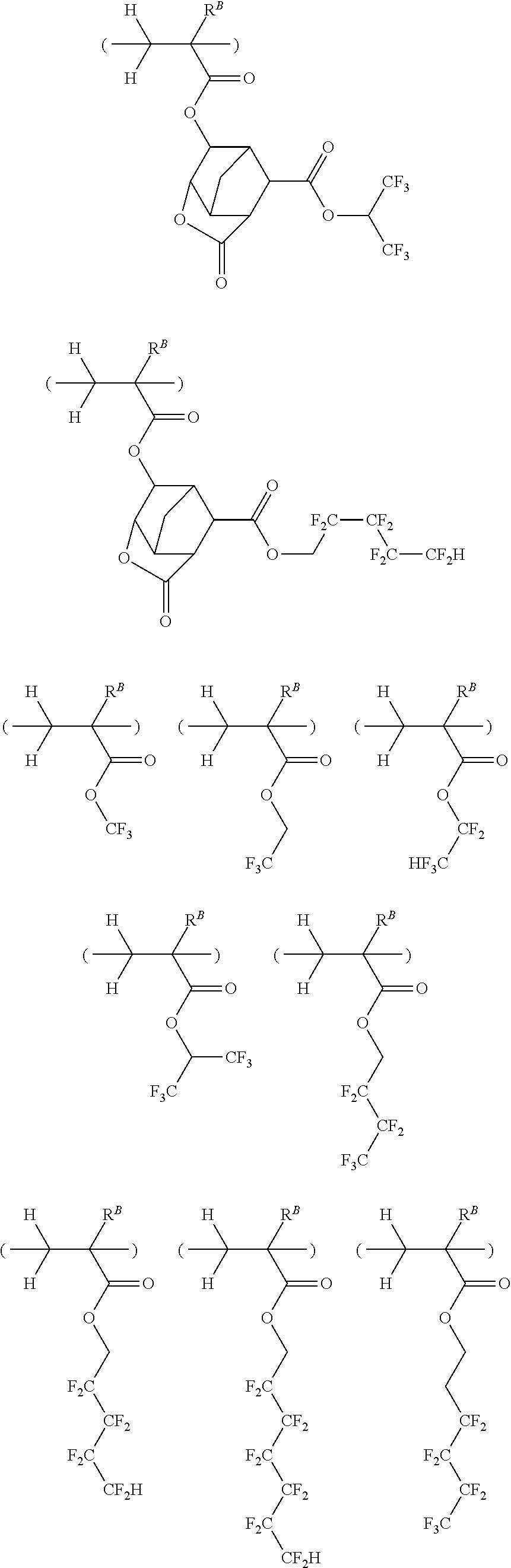

[0328]The polymeric surfactant may further contain repeat units other than the repeat units having formulae (7A) to (7E). Typical other repeat units are, for example, those derived from methacrylic acid and α-trifluoromethylacrylic acid derivatives. In the polymeric surfactant, the content of the repeat units having formulae (7A) to (7E) is preferably at least 20 mol %, more preferably at least 60 mol %, most preferably 100 mol % of the overall repeat units.
[0329]Mw of the polymeric surfactant is preferably 1,000 to 500,000, more preferably 3,000 to 100,000. Mw/Mn is preferably 1.0 to 2.0, more preferably 1.0 to 1.6.
[0330]The polymeric surfactant may be synthesized, for example, by dissolving an unsaturated bond-containing monomer or monomers, from which repeat units having formulae (7A) to (7E) and optional other repeat units are derived, in an organic solvent, adding a radical initiator, and heating for polymerization. Examples of the suitable organic solvent used herein include toluene, benzene, THF, diethyl ether, and dioxane. Examples of the polymerization initiator used herein include AIBN, 2,2′-azobis(2,4-dimethylvaleronitrile), dimethyl 2,2-azobis(2-methylpropionate), benzoyl peroxide, and lauroyl peroxide. The reaction temperature is preferably 50 to 100° C. The reaction time is preferably 4 to 24 hours. The acid labile group that has been incorporated in the monomer may be kept as such, or the polymerization may be followed by protection or partial protection.
[0331]During the synthesis of the polymeric surfactant, any of well-known chain transfer agents such as dodecylmercaptan and 2-mercaptoethanol may be used for the purpose of adjusting molecular weight. An appropriate amount of the chain transfer agent is 0.01 to 10 mol % based on the total moles of monomers to be polymerized.
[0332]When the chemically amplified resist composition contains the surfactant (F), the amount of the surfactant (F) used is 0.1 to 50 parts by weight, more preferably 0.5 to 10 parts by weight per 80 parts by weight of the base polymer (B). At least 0.1 part of the surfactant is effective in improving the receding contact angle with water of the resist film at its surface. Up to 50 parts of the surfactant (F) is effective in forming a resist film having a low rate of dissolution in a developer and capable of maintaining the height of a small-size pattern formed therein. The surfactant (F) may be used alone or in admixture.
(G) Other Components
[0333]The inventive chemically amplified resist composition may further contain (G) another component, for example, a compound which is decomposed with an acid to generate another acid (i.e., acid amplifier compound), an organic acid derivative, a fluorinated alcohol, and a compound having a Mw of up to 3,000 which changes its solubility in developer under the action of an acid (i.e., dissolution inhibitor). The acid amplifier compound is described in JP-A 2009-269953 and JP-A 2010-215608. The acid amplifier compound is preferably used in an amount of 0 to 5 parts by weight, more preferably 0 to 3 parts by weight per 80 parts by weight of the base polymer (B). An extra amount of the acid amplifier compound can make the acid diffusion control difficult and cause degradations to resolution and pattern profile. With respect to the organic acid derivative, fluorinated alcohol and dissolution inhibitor, reference should be made to JP-A 2009-269953 and JP-A 2010-215608.
[Pattern Forming Process]
[0334]Another embodiment of the invention is a pattern forming process using the chemically amplified resist composition defined above. The process comprises steps of applying the chemically amplified resist composition to a substrate to form a resist film thereon, exposing the resist film to high-energy radiation, and developing the exposed resist film in a developer.
[0335]The substrate used herein may be a substrate for integrated circuitry fabrication, e.g., Si, SiO2, SiN, SiON, TiN, WSi, BPSG, SOG, organic antireflective film, etc. or a substrate for mask circuitry fabrication, e.g., Cr, CrO, CrON, MoSi2, SiO2, etc.
[0336]The chemically amplified resist composition is applied by a suitable coating technique such as spin coating. The coating is prebaked on a hot plate preferably at a temperature of 60 to 150° C. for 1 to 10 minutes, more preferably at 80 to 140° C. for 1 to 5 minutes. The resulting resist film preferably has a thickness of preferably 0.05 to 2 μm.
[0337]The resist film is exposed to high-energy radiation, for example, a KrF or ArF excimer laser beam, EB, or EUV of wavelength 3 to 15 nm. On use of a KrF excimer laser beam, an ArF excimer laser beam or EUV, the resist film is exposed through a mask having a desired pattern, preferably in a dose of 1 to 200 mJ/cm2, more preferably 10 to 100 mJ/cm2. On use of EB, a pattern may be written directly or through a mask having the desired pattern, preferably in a dose of 1 to 300 μC/cm2, more preferably 10 to 200 μC/cm2.
[0338]The exposure may be performed by conventional lithography whereas the immersion lithography of holding a liquid having a refractive index of at least 1.0 between the resist film and the projection lens may be employed if desired. The liquid is typically water, and in this case, a protective film which is insoluble in water may be formed on the resist film.
[0339]While the water-insoluble protective film serves to prevent any components from being leached out of the resist film and to improve water sliding on the film surface, it is generally divided into two types. The first type is an organic solvent-strippable protective film which must be stripped, prior to alkaline development, with an organic solvent in which the resist film is not dissolvable. The second type is an alkali-soluble protective film which is soluble in an alkaline developer so that it can be removed simultaneously with the removal of solubilized regions of the resist film. The protective film of the second type is preferably of a material comprising a polymer having a 1,1,1,3,3,3-hexafluoro-2-propanol residue (which is insoluble in water and soluble in an alkaline developer) as a base in an alcohol solvent of at least 4 carbon atoms, an ether solvent of 8 to 12 carbon atoms or a mixture thereof. Alternatively, the aforementioned surfactant which is insoluble in water and soluble in an alkaline developer may be dissolved in an alcohol solvent of at least 4 carbon atoms, an ether solvent of 8 to 12 carbon atoms or a mixture thereof to form a material from which the protective film of the second type is formed.
[0340]The exposure may be followed by PEB. The resist film may be baked (PEB), for example, on a hotplate preferably at 60 to 150° C. for 1 to 5 minutes, more preferably at 80 to 140° C. for 1 to 3 minutes.
[0341]The resist film is developed in a developer in the form of an aqueous alkaline solution for preferably 0.1 to 3 minutes, more preferably 0.5 to 2 minutes by conventional techniques such as dip, puddle and spray techniques. A preferable developer is a 0.1 to 5 wt %, more preferably 2 to 3 wt % aqueous solution of tetramethylammonium hydroxide (TMAH) or another alkali. In this way, the exposed regions are dissolved, and the desired pattern is formed on the substrate.
[0342]After the resist film is formed, a step of rinsing with pure water may be introduced to extract the acid generator or the like from the film surface or wash away particles. After exposure, a step of rinsing may be introduced to remove any water remaining on the film after exposure.
[0343]Also, a double patterning process may be used for pattern formation. The double patterning process includes a trench process of processing an underlay to a 1:3 trench pattern by a first step of exposure and etching, shifting the position, and forming a 1:3 trench pattern by a second step of exposure, for forming a 1:1 pattern; and a line process of processing a first underlay to a 1:3 isolated left pattern by a first step of exposure and etching, shifting the position, processing a second underlay formed below the first underlay by a second step of exposure through the 1:3 isolated left pattern, for forming a half-pitch 1:1 pattern.
[0344]In the inventive pattern forming process, a negative tone development method may also be used. That is, an organic solvent may be used instead of the aqueous alkaline solution as the developer for dissolving away the unexposed region of the resist film.
[0345]The organic solvent used as the developer is preferably selected from 2-octanone, 2-nonanone, 2-heptanone, 3-heptanone, 4-heptanone, 2-hexanone, 3-hexanone, diisobutyl ketone, methylcyclohexanone, acetophenone, methylacetophenone, propyl acetate, butyl acetate, isobutyl acetate, pentyl acetate, butenyl acetate, isopentyl acetate, propyl formate, butyl formate, isobutyl formate, pentyl formate, isopentyl formate, methyl valerate, methyl pentenoate, methyl crotonate, ethyl crotonate, methyl propionate, ethyl propionate, ethyl 3-ethoxypropionate, methyl lactate, ethyl lactate, propyl lactate, butyl lactate, isobutyl lactate, pentyl lactate, isopentyl lactate, methyl 2-hydroxyisobutyrate, ethyl 2-hydroxyisobutyrate, methyl benzoate, ethyl benzoate, phenyl acetate, benzyl acetate, methyl phenylacetate, ethyl phenylacetate, benzyl formate, phenylethyl formate, methyl 3-phenylpropionate, benzyl propionate, and 2-phenylethyl acetate. The organic solvents may be used alone or in admixture.
EXAMPLES
- [0347]MALDI TOF-MS: S3000 manufactured by JEOL Ltd.
[1] Synthesis of Sulfonium Salts
Example 1-1
Synthesis of Sulfonium Salt PAG-1

(1) Synthesis of Intermediate In-1
[0348]In nitrogen atmosphere, a reactor was charged with 25.0 g of reactant SM-1, 43.5 g of reactant SM-2, 1.2 g of DMAP, and 150 g of methylene chloride and cooled in an ice bath. While the internal temperature of the reactor was kept below 20° C., 24.9 g of 1-ethyl-3-(3-dimethylaminopropyl)carbodiimide hydrochloride in powder form was added. Thereafter, the reactor was allowed to reach room temperature, at which the reaction solution was aged for 12 hours. At the end of aging, water was added to quench the reaction, followed by ordinary aqueous work-up. The subsequent steps of distilling off the solvent and washing the residue with diisopropyl ether gave 57.7 g of Intermediate In-1 as oily matter (yield 92%).
(2) Synthesis of PAG-1
[0349]In nitrogen atmosphere, a reactor was charged with 12.6 g of Intermediate In-1, 10.6 g of reactant SM-3, 50 g of methylene chloride, and 30 g of water, which were stirred for 15 minutes. The organic layer was taken out, washed with water, and concentrated under reduced pressure. To the concentrate, 50 g of methyl isobutyl ketone was added, and water is removed by azeotropic distillation. Diisopropyl ether was then added to wash the residue, obtaining 17.4 g of the target PAG-1 as oily matter (yield 94%).
MALDI TOF-MS:
- [0350]POSITIVE M+447 (corresponding to C20H16F5O2S2+)
- [0351]NEGATIVE M−477 (corresponding to C23H13F4O5S−)
Examples 1-2 to 1-9
Synthesis of Sulfonium Salts PAG-2 to PAG-9
[0352]Sulfonium Salts PAG-2 to PAG-9 of the following formulae were synthesized using the corresponding reactants and well-known organic chemistry reaction.


[2] Synthesis of Base Polymer
Synthesis Example
Synthesis of Base Polymers (P-1 to P-5)
[0353]Base polymers P-1 to P-5 were synthesized by combining monomers, performing copolymerization reaction in MEK solvent, pouring the reaction solution to hexane for precipitation, washing the solid precipitate with hexane, isolation and drying. The base polymer was analyzed for composition by 1H-NMR spectroscopy and for Mw and Mw/Mn by GPC versus polystyrene standards using THF solvent.

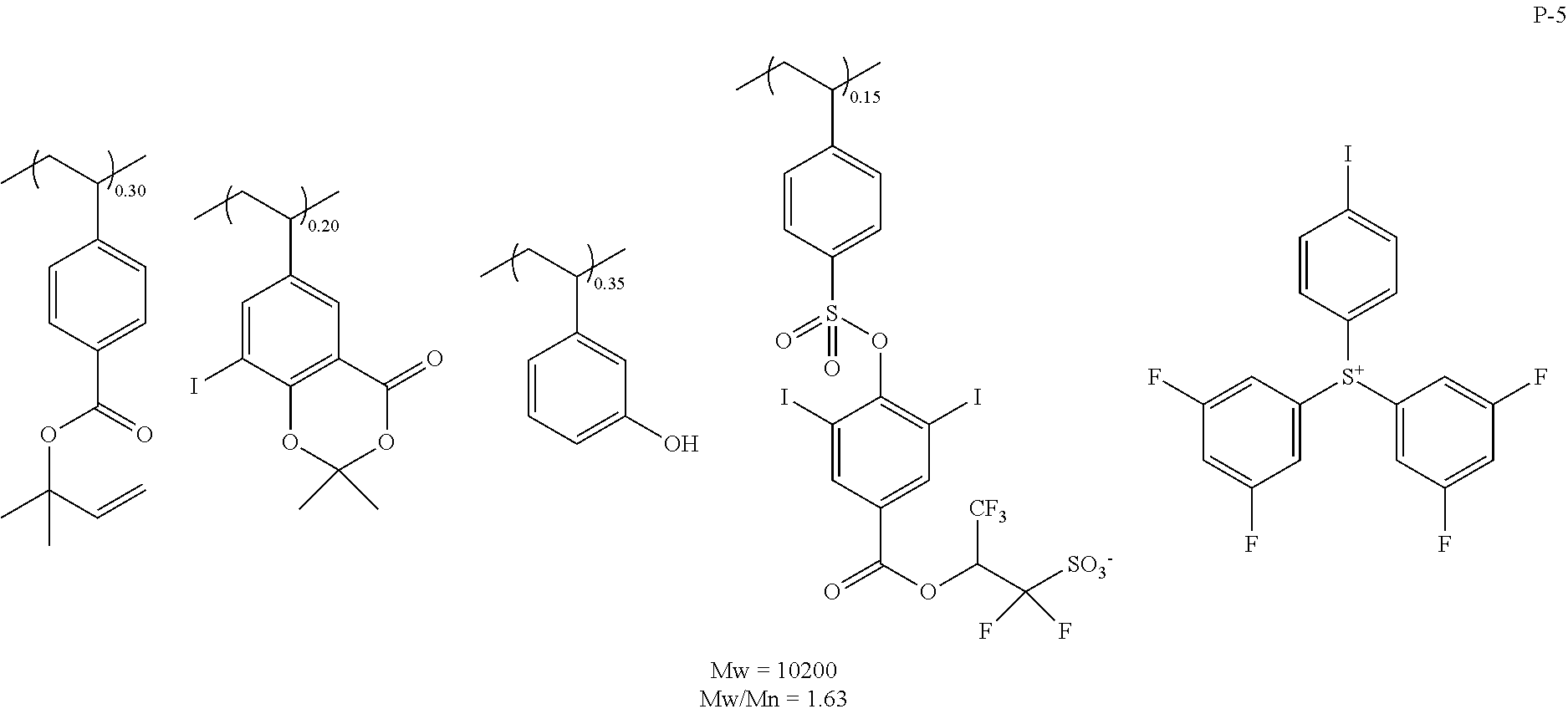
[3] Preparation of Chemically Amplified Resist Compositions
Examples 2-1 to 2-30 and Comparative Examples 1-1 to 1-20
[0354]Chemically amplified resist compositions (R-1 to R-30, CR-1 to CR-20) in solution form were prepared by dissolving a photoacid generator in the form of sulfonium salt (PAG-1 to PAG-9) or comparative photoacid generator (PAG-A to PAG-E), other photoacid generator (PAG-X), base polymer (P-1 to P-5), and quencher (Q-1 to Q-4) in a solvent containing 0.01 wt % of surfactant A (OMNOVA Inc.) in accordance with the formulation shown in Tables 1 and 2, and filtering through a Teflon® filter with a pore size of 0.2 μm.
| TABLE 1 | |||||||||
|---|---|---|---|---|---|---|---|---|---|
| Other | |||||||||
| Base | Photoacid | photoacid | |||||||
| Resist | polymer | generator | generator | Quencher | Solvent 1 | Solvent 2 | Solvent 3 | ||
| composition | (pbw) | (pbw) | (pbw) | (pbw) | (pbw) | (pbw) | (pbw) | ||
| Example | 2-1 | R-1 | P-1 (80) | PAG-1 (28) | — | Q-1 (8.0) | PGMEA (2250) | EL (2800) | DAA (550) |
| 2-2 | R-2 | P-1 (80) | PAG-2 (28) | — | Q-1 (7.8) | PGMEA (2250) | EL (2800) | DAA (550) | |
| 2-3 | R-3 | P-1 (80) | PAG-3 (20) | PAG-X (10) | Q-1 (7.4) | PGMEA (2250) | EL (2800) | DAA (550) | |
| 2-4 | R-4 | P-1 (80) | PAG-4 (27) | — | Q-1 (8.0) | PGMEA (2250) | EL (2800) | DAA (550) | |
| 2-5 | R-5 | P-1 (80) | PAG-5 (15) | PAG-X (10) | Q-1 (8.0) | PGMEA (2250) | EL (2800) | DAA (550) | |
| 2-6 | R-6 | P-1 (80) | PAG-6 (28) | — | Q-1 (8.0) | PGMEA (2250) | EL (2800) | DAA (550) | |
| 2-7 | R-7 | P-1 (80) | PAG-7 (28) | — | Q-1 (7.8) | PGMEA (2250) | EL (2800) | DAA (550) | |
| 2-8 | R-8 | P-1 (80) | PAG-8 (29) | — | Q-1 (7.4) | PGMEA (2250) | EL (2800) | DAA (550) | |
| 2-9 | R-9 | P-1 (80) | PAG-9 (15) | PAG-X (8) | Q-1 (8.0) | PGMEA (2250) | EL (2800) | DAA (550) | |
| 2-10 | R-10 | P-2 (80) | PAG-1 (29) | — | Q-1 (8.0) | PGMEA (2250) | EL (2800) | DAA (550) | |
| 2-11 | R-11 | P-2 (80) | PAG-2 (30) | — | Q-3 (7.8) | PGMEA (2250) | EL (2800) | DAA (550) | |
| 2-12 | R-12 | P-2 (80) | PAG-4 (28) | — | Q-1 (8.0) | PGMEA (2250) | EL (2800) | DAA (550) | |
| 2-13 | R-13 | P-2 (80) | PAG-5 (18) | PAG-X (7) | Q-1 (8.0) | PGMEA (2250) | EL (2800) | DAA (550) | |
| 2-14 | R-14 | P-2 (80) | PAG-7 (28) | — | Q-2 (4.0) | PGMEA (2250) | EL (2800) | DAA (550) | |
| Q-4 (4.0) | |||||||||
| 2-15 | R-15 | P-3 (80) | PAG-1 (10) | — | Q-1 (8.0) | PGMEA (2250) | EL (2800) | DAA (550) | |
| 2-16 | R-16 | P-3 (80) | PAG-2 (9) | — | Q-3 (7.6) | PGMEA (2250) | EL (2800) | DAA (550) | |
| 2-17 | R-17 | P-3 (80) | PAG-5 (8) | PAG-X (4) | Q-1 (7.8) | PGMEA (2250) | EL (2800) | DAA (550) | |
| 2-18 | R-18 | P-3 (80) | PAG-7 (9) | — | Q-3 (8.0) | PGMEA (2250) | EL (2800) | DAA (550) | |
| 2-19 | R-19 | P-3 (80) | PAG-9 (8) | PAG-X (4) | Q-2 (8.0) | PGMEA (2250) | EL (2800) | DAA (550) | |
| 2-20 | R-20 | P-4 (80) | PAG-1 (10) | — | Q-1 (8.0) | PGMEA (2250) | EL (2800) | DAA (550) | |
| 2-21 | R-21 | P-4 (80) | PAG-3 (7) | PAG-X (3) | Q-1 (7.6) | PGMEA (2250) | EL (2800) | DAA (550) | |
| 2-22 | R-22 | P-4 (80) | PAG-4 (8) | PAG-X (4) | Q-3 (8.0) | PGMEA (2250) | EL (2800) | DAA (550) | |
| 2-23 | R-23 | P-4 (80) | PAG-6 (10) | — | Q-2 (8.0) | PGMEA (2250) | EL (2800) | DAA (550) | |
| 2-24 | R-24 | P-4 (80) | PAG-8 (8) | — | Q-3 (4.0) | PGMEA (2250) | EL (2800) | DAA (550) | |
| Q-4 (4.0) | |||||||||
| 2-25 | R-25 | P-5 (80) | PAG-1 (10) | — | Q-1 (8.0) | PGMEA (2250) | EL (2800) | DAA (550) | |
| 2-26 | R-26 | P-5 (80) | PAG-2 (8) | — | Q-2 (8.0) | PGMEA (2250) | EL (2800) | DAA (550) | |
| 2-27 | R-27 | P-5 (80) | PAG-4 (8) | — | Q-3 (7.8) | PGMEA (2250) | EL (2800) | DAA (550) | |
| 2-28 | R-28 | P-5 (80) | PAG-6 (10) | — | Q-1 (4.0) | PGMEA (2250) | EL (2800) | DAA (550) | |
| Q-4 (4.0) | |||||||||
| 2-29 | R-29 | P-5 (80) | PAG-7 (10) | — | Q-3 (8.0) | PGMEA (2250) | EL (2800) | DAA (550) | |
| 2-30 | R-30 | P-5 (80) | PAG-9 (8) | PAG-X (4) | Q-2 (7.6) | PGMEA (2250) | EL (2800) | DAA (550) | |
| TABLE 2 | |||||||||
|---|---|---|---|---|---|---|---|---|---|
| Other | |||||||||
| Base | Photoacid | photoacid | |||||||
| Resist | polymer | generator | generator | Quencher | Solvent 1 | Solvent 2 | Solvent 3 | ||
| composition | (pbw) | (pbw) | (pbw) | (pbw) | (pbw) | (pbw) | (pbw) | ||
| Comparative | 1-1 | CR-1 | P-1 (80) | PAG-A (28) | — | Q-1 (8.0) | PGMEA (2250) | EL (2800) | DAA (550) |
| Example | 1-2 | CR-2 | P-1 (80) | PAG-B (28) | — | Q-1 (7.8) | PGMEA (2250) | EL (2800) | DAA (550) |
| 1-3 | CR-3 | P-1 (80) | PAG-C (20) | PAG-X (10) | Q-1 (7.8) | PGMEA (2250) | EL (2800) | DAA (550) | |
| 1-4 | CR-4 | P-1 (80) | PAG-D (27) | — | Q-1 (8.2) | PGMEA (2250) | EL (2800) | DAA (550) | |
| 1-5 | CR-5 | P-1 (80) | PAG-E (15) | PAG-X (10) | Q-1 (8.2) | PGMEA (2250) | EL (2800) | DAA (550) | |
| 1-6 | CR-6 | P-2 (80) | PAG-A (27) | — | Q-2 (8.0) | PGMEA (2250) | EL (2800) | DAA (550) | |
| 1-7 | CR-7 | P-2 (80) | PAG-B (25) | — | Q-1 (8.0) | PGMEA (2250) | EL (2800) | DAA (550) | |
| 1-8 | CR-8 | P-2 (80) | PAG-E (18) | PAG-X (7) | Q-1 (8.0) | PGMEA (2250) | EL (2800) | DAA (550) | |
| 1-9 | CR-9 | P-3 (80) | PAG-A (10) | — | Q-1 (7.8) | PGMEA (2250) | EL (2800) | DAA (550) | |
| 1-10 | CR-10 | P-3 (80) | PAG-B (9) | — | Q-3 (8.0) | PGMEA (2250) | EL (2800) | DAA (550) | |
| 1-11 | CR-11 | P-3 (80) | PAG-C (7) | PAG-X (3) | Q-1 (4.0) | PGMEA (2250) | EL (2800) | DAA (550) | |
| Q-4 (4.0) | |||||||||
| 1-12 | CR-12 | P-3 (80) | PAG-D (8) | — | Q-2 (7.6) | PGMEA (2250) | EL (2800) | DAA (550) | |
| 1-13 | CR-13 | P-4 (80) | PAG-A (10) | — | Q-1 (7.8) | PGMEA (2250) | EL (2800) | DAA (550) | |
| 1-14 | CR-14 | P-4 (80) | PAG-B (10) | — | Q-2 (8.0) | PGMEA (2250) | EL (2800) | DAA (550) | |
| 1-15 | CR-15 | P-4 (80) | PAG-C (10) | — | Q-3 (4.0) | PGMEA (2250) | EL (2800) | DAA (550) | |
| Q-4 (4.0) | |||||||||
| 1-16 | CR-16 | P-4 (80) | PAG-E (8) | PAG-X (4) | Q-1 (8.0) | PGMEA (2250) | EL (2800) | DAA (550) | |
| 1-17 | CR-17 | P-5 (80) | PAG-A (10) | — | Q-1 (8.0) | PGMEA (2250) | EL (2800) | DAA (550) | |
| 1-18 | CR-18 | P-5 (80) | PAG-B (10) | — | Q-3 (7.6) | PGMEA (2250) | EL (2800) | DAA (550) | |
| 1-19 | CR-19 | P-5 (80) | PAG-C (8) | — | Q-1 (4.0) | PGMEA (2250) | EL (2800) | DAA (550) | |
| Q-4 (4.0) | |||||||||
| 1-20 | CR-20 | P-5 (80) | PAG-E (8) | PAG-X (4) | Q-2 (8.0) | PGMEA (2250) | EL (2800) | DAA (550) | |
[0355]The solvents, other photoacid generator PAG-X, comparative photoacid generators PAG-A to PAG-E, quenchers Q-1 to Q-4, and surfactant A in Tables 1 and 2 are identified below.
Solvent:
- [0356]PGMEA (propylene glycol monomethyl ether acetate)
- [0357]DAA (diacetone alcohol)
Other Photoacid Generators: PAG-X

Comparative Photoacid Generators: PAG-A to PAG-E

Quencher: Q-1 to Q-4

Surfactant A:
- [0358]3-methyl-3-(2,2,2-trifluoroethoxymethyl)oxetane/tetrahydrofuran/
- [0359]2,2-dimethyl-1,3-propanediol copolymer (manufactured by OMNOVA Inc.)

- [0360]a:(b+b′):(c+c′)=1:4 to 7:0.01 to 1 (molar ratio)
- [0361]Mw=1,500
[4] EUV Lithography Test (1)
Examples 3-1 to 3-30 and Comparative Examples 2-1 to 2-20
[0362]Each of the chemically amplified resist compositions (R-1 to R-30, CR-1 to CR-20) shown in Tables 1 to 3 was spin coated on a silicon substrate having a 20-nm coating of silicon-containing spin on hard mask SHB-A940 (Shin-Etsu Chemical Co., Ltd., silicon content 43 wt %) and prebaked on a hotplate at 100° C. for 60 seconds to form a resist film of 50 nm thick. Using an EUV scanner NXE3400 (ASML, NA 0.33, σ 0.9/0.6, dipole illumination), the resist film was exposed to EUV through a mask bearing an LS pattern having a size of 18 nm and a pitch of 36 nm (on-wafer size) while varying the dose and focus (dose pitch: 1 mJ/cm2, focus pitch: 0.020 μm). After the exposure, the resist film was baked (PEB) at the temperature shown in Tables 4 and 5 for 60 seconds, and puddle developed in a 2.38 wt % TMAH aqueous solution for 30 seconds, rinsed with a rinse fluid containing surfactant, and spin dried to form a positive pattern.
[0363]The LS pattern as developed was observed under CD-SEM (CG6300, Hitachi High-Technologies Corp.) whereupon sensitivity, EL, LWR, DOF and collapse limit were evaluated by the following methods. Development defect evaluation was performed on the obtained LS pattern. The results are shown in Tables 3 and 4.
[Evaluation of Sensitivity]
[0364]The optimum dose Eop (mJ/cm2) which provided an LS pattern with a line width of 18 nm and a pitch of 36 nm was determined as an index of sensitivity. A smaller value indicates a higher sensitivity.
[Evaluation of EL]
[0365]The exposure dose which provided an LS pattern with a space width of 18 nm±10% (i.e., 16.2 to 19.8 nm) was determined. EL (%) is calculated from the exposure doses according to the following equation. A greater value indicates better performance.
- [0367]E2 is an optimum exposure dose which provides an LS pattern with a line width of 19.8 nm and a pitch of 36 nm, and
- [0368]Eop is an optimum exposure dose which provides an LS pattern with a line width of 18 nm and a pitch of 36 nm.
[Evaluation of LWR]
[0369]For the LS pattern formed by exposure at the optimum dose Eop, the line width was measured at 10 longitudinally spaced apart points, from which a 3-fold value (3σ) of standard deviation (σ) was determined and reported as LWR. A smaller value of 3σ indicates a pattern having small roughness and uniform line width.
[Evaluation of DOF]
[0370]As an index of DOF, a range of focus which provided an LS pattern with a size of 18 nm±10% (i.e., 16.2 to 19.8 nm) was determined. A greater value indicates a wider DOF.
[Evaluation of Collapse Limit of Line Pattern]
[0371]For the LS pattern formed by exposure at the dose corresponding to the optimum focus, the line size was measured at 10 longitudinally spaced apart points. The minimum line size above which lines could be resolved without collapse was determined and reported as collapse limit. A smaller value indicates better collapse limit.
[Development Defect Evaluation]
[0372]Using a defect inspection apparatus KLA2360 (trade name) manufactured by KLA-Tencor Corporation, which was adjusted to a pixel size of 0.16 μm and a threshold value of 20, defects (number/cm2) extracted from differences appearing when an LS pattern formed at the optimum exposure dose and having a line width of 18 nm and a pitch 36 nm was superposed on a comparison image pixel by pixel, and the number of defects per unit area (number/cm2) was calculated. Thereafter, development defects were classified and extracted from all defects by performing defect review, and the number of development defects (number/cm2) per unit area was calculated. “A” was assigned when the value was less than 0.5, “B” was assigned when the value was 0.5 or more and less than 1.0, “C” was assigned when the value was 1.0 or more and less than 5.0, and “D” was assigned when the value was 5.0 or more. A smaller value indicates better performance.
| TABLE 3 | |||||||||
|---|---|---|---|---|---|---|---|---|---|
| Optimum | |||||||||
| PEB | exposure | Collapse | |||||||
| Resist | temp. | dose | EL | LWR | DOF | limit | Development | ||
| composition | (° C.) | (mJ/cm2) | (%) | (nm) | (nm) | (nm) | defects | ||
| Example | 3-1 | R-1 | 100 | 31 | 19 | 2.2 | 120 | 10.6 | A |
| 3-2 | R-2 | 100 | 33 | 18 | 2.4 | 120 | 10.8 | A | |
| 3-3 | R-3 | 95 | 34 | 17 | 2.3 | 120 | 10.7 | A | |
| 3-4 | R-4 | 105 | 32 | 17 | 2.4 | 110 | 10.9 | A | |
| 3-5 | R-5 | 105 | 34 | 18 | 2.5 | 100 | 10.7 | A | |
| 3-6 | R-6 | 95 | 32 | 19 | 2.2 | 110 | 11.1 | A | |
| 3-7 | R-7 | 105 | 32 | 17 | 2.4 | 120 | 11.0 | A | |
| 3-8 | R-8 | 105 | 32 | 18 | 2.5 | 120 | 11.1 | A | |
| 3-9 | R-9 | 100 | 33 | 18 | 2.3 | 120 | 10.7 | A | |
| 3-10 | R-10 | 95 | 35 | 17 | 2.3 | 120 | 10.6 | A | |
| 3-11 | R-11 | 100 | 34 | 18 | 2.2 | 100 | 10.7 | A | |
| 3-12 | R-12 | 105 | 32 | 19 | 2.4 | 110 | 11.1 | A | |
| 3-13 | R-13 | 105 | 32 | 18 | 2.4 | 110 | 10.7 | A | |
| 3-14 | R-14 | 100 | 34 | 19 | 2.3 | 110 | 11.1 | A | |
| 3-15 | R-15 | 100 | 33 | 18 | 2.3 | 120 | 10.7 | A | |
| 3-16 | R-16 | 100 | 33 | 17 | 2.4 | 120 | 10.8 | A | |
| 3-17 | R-17 | 105 | 32 | 18 | 2.2 | 110 | 11.1 | A | |
| 3-18 | R-18 | 95 | 34 | 18 | 2.4 | 120 | 10.8 | A | |
| 3-19 | R-19 | 100 | 32 | 17 | 2.3 | 110 | 10.9 | A | |
| 3-20 | R-20 | 105 | 33 | 18 | 2.4 | 100 | 11.1 | A | |
| 3-21 | R-21 | 95 | 34 | 17 | 2.3 | 120 | 11.0 | A | |
| 3-22 | R-22 | 100 | 33 | 19 | 2.5 | 110 | 10.9 | A | |
| 3-23 | R-23 | 105 | 33 | 18 | 2.4 | 120 | 11.0 | A | |
| 3-24 | R-24 | 95 | 33 | 18 | 2.4 | 120 | 11.1 | A | |
| 3-25 | R-25 | 100 | 32 | 18 | 2.3 | 110 | 10.8 | A | |
| 3-26 | R-26 | 95 | 33 | 19 | 2.3 | 120 | 10.9 | A | |
| 3-27 | R-27 | 100 | 34 | 18 | 2.5 | 100 | 10.7 | A | |
| 3-28 | R-28 | 100 | 33 | 17 | 2.3 | 120 | 11.2 | A | |
| 3-29 | R-29 | 100 | 32 | 17 | 2.2 | 110 | 11.2 | A | |
| 3-30 | R-30 | 95 | 34 | 19 | 2.3 | 110 | 11.1 | A | |
| TABLE 4 | |||||||||
|---|---|---|---|---|---|---|---|---|---|
| Optimum | |||||||||
| PEB | exposure | Collapse | |||||||
| Resist | temp. | dose | EL | LWR | DOF | limit | Development | ||
| composition | (° C.) | (mJ/cm2) | (%) | (nm) | (nm) | (nm) | defects | ||
| Comparative | 2-1 | CR-1 | 100 | 38 | 14 | 3.0 | 90 | 11.9 | B |
| Example | 2-2 | CR-2 | 100 | 39 | 14 | 2.8 | 90 | 12.0 | C |
| 2-3 | CR-3 | 105 | 40 | 15 | 3.1 | 100 | 12.1 | B | |
| 2-4 | CR-4 | 100 | 42 | 15 | 3.1 | 90 | 12.2 | B | |
| 2-5 | CR-5 | 100 | 41 | 14 | 2.8 | 80 | 12.3 | C | |
| 2-6 | CR-6 | 100 | 37 | 13 | 3.2 | 80 | 12.1 | C | |
| 2-7 | CR-7 | 100 | 37 | 15 | 2.9 | 90 | 12.1 | B | |
| 2-8 | CR-8 | 105 | 38 | 14 | 3.2 | 70 | 12.1 | C | |
| 2-9 | CR-9 | 100 | 41 | 13 | 2.8 | 100 | 12.2 | C | |
| 2-10 | CR-10 | 100 | 40 | 13 | 3.0 | 90 | 12.2 | B | |
| 2-11 | CR-11 | 95 | 41 | 14 | 2.6 | 70 | 12.1 | C | |
| 2-12 | CR-12 | 100 | 37 | 15 | 2.8 | 90 | 12.1 | B | |
| 2-13 | CR-13 | 100 | 38 | 16 | 3.0 | 80 | 12.1 | C | |
| 2-14 | CR-14 | 100 | 38 | 15 | 2.6 | 90 | 11.7 | B | |
| 2-15 | CR-15 | 100 | 41 | 14 | 2.7 | 90 | 12.4 | C | |
| 2-16 | CR-16 | 95 | 40 | 15 | 3.0 | 80 | 11.9 | B | |
| 2-17 | CR-17 | 100 | 37 | 13 | 3.0 | 80 | 12.1 | C | |
| 2-18 | CR-18 | 105 | 38 | 15 | 2.9 | 90 | 11.8 | B | |
| 2-19 | CR-19 | 100 | 37 | 14 | 3.1 | 90 | 11.7 | B | |
| 2-20 | CR-20 | 100 | 39 | 15 | 2.7 | 80 | 12.1 | C | |
[0373]It is demonstrated in Tables 3 and 4 that chemically amplified resist compositions comprising a photoacid generator comprising a sulfonium salt within the scope of the invention exhibit a high sensitivity and improved EL, LWVR and DOF. The resist composition is also confirmed to have a low collapse resistance value, and resistance to pattern collapse in fine pattern formation. Further, it was confirmed that development defects were also suppressed. This demonstrates that chemically amplified resist compositions are suitable as materials for EUV lithography.
[5] EUV Lithography Test (2)
Examples 4-1 to 4-30 and Comparative Examples 3-1 to 3-20
[0374]Each of the chemically amplified resist compositions (R-1 to R-30, CR-1 to CR-20) shown in Tables 1 to 3 was spin coated on a silicon substrate having a 20-nm coating of silicon-containing spin on hard mask SHB-A940 (Shin-Etsu Chemical Co., Ltd., silicon content 43 wt %) and prebaked on a hotplate at 105° C. for 60 seconds to form a resist film of 50 nm thick. Using an EUV scanner NXE3400 (ASML, NA 0.33, a 0.9/0.6, quadrupole illumination), the resist film was exposed to EUV through a mask bearing a hole pattern having a pitch of 46 nm (on-wafer size) and +20% bias. The resist film was baked (PEB) on a hotplate at the temperature shown in Tables 5 and 6 for 60 seconds and developed in a 2.38 wt % TMAH aqueous solution for 30 seconds to form a hole pattern with a size of 23 nm.
[0375]The pattern as developed was observed under CD-SEM (CG6300, Hitachi High Technologies Corp.). The dose (mJ/cm2) at which a pattern with a hole size of 23 nm was printed was determined as an index of sensitivity. The size of 50 holes was measured, from which a 3-fold value (3a) of the standard deviation (a) was determined as a dimensional variation (or CDU). The results are shown in Tables 5 and 6.
| TABLE 5 | |||||
|---|---|---|---|---|---|
| Optimum | |||||
| Resist | PEB temp. | exposure dose | CDU | ||
| composition | (° C.) | (mJ/cm2) | (nm) | ||
| Example | 4-1 | R-1 | 95 | 21 | 2.1 |
| 4-2 | R-2 | 95 | 22 | 2.2 | |
| 4-3 | R-3 | 95 | 23 | 2.3 | |
| 4-4 | R-4 | 90 | 21 | 2.3 | |
| 4-5 | R-5 | 90 | 22 | 2.4 | |
| 4-6 | R-6 | 95 | 24 | 2.4 | |
| 4-7 | R-7 | 90 | 23 | 2.3 | |
| 4-8 | R-8 | 95 | 23 | 2.2 | |
| 4-9 | R-9 | 90 | 25 | 2.4 | |
| 4-10 | R-10 | 95 | 23 | 2.4 | |
| 4-11 | R-11 | 90 | 24 | 2.4 | |
| 4-12 | R-12 | 90 | 23 | 2.3 | |
| 4-13 | R-13 | 95 | 22 | 2.2 | |
| 4-14 | R-14 | 95 | 24 | 2.4 | |
| 4-15 | R-15 | 95 | 24 | 2.4 | |
| 4-16 | R-16 | 95 | 22 | 2.5 | |
| 4-17 | R-17 | 90 | 23 | 2.4 | |
| 4-18 | R-18 | 90 | 24 | 2.4 | |
| 4-19 | R-19 | 95 | 23 | 2.3 | |
| 4-20 | R-20 | 90 | 23 | 2.4 | |
| 4-21 | R-21 | 95 | 23 | 2.3 | |
| 4-22 | R-22 | 90 | 22 | 2.5 | |
| 4-23 | R-23 | 95 | 23 | 2.3 | |
| 4-24 | R-24 | 90 | 24 | 2.2 | |
| 4-25 | R-25 | 95 | 22 | 2.3 | |
| 4-26 | R-26 | 90 | 23 | 2.4 | |
| 4-27 | R-27 | 95 | 23 | 2.4 | |
| 4-28 | R-28 | 90 | 24 | 2.5 | |
| 4-29 | R-29 | 90 | 24 | 2.3 | |
| 4-30 | R-30 | 95 | 23 | 2.4 | |
| TABLE 6 | |||||
|---|---|---|---|---|---|
| Optimum | |||||
| exposure | |||||
| Resist | PEB temp. | dose | CDU | ||
| composition | (° C.) | (mJ/cm2) | (nm) | ||
| Comparative | 3-1 | CR-1 | 90 | 27 | 2.8 |
| Example | 3-2 | CR-2 | 90 | 26 | 2.9 |
| 3-3 | CR-3 | 85 | 26 | 2.6 | |
| 3-4 | CR-4 | 90 | 27 | 2.8 | |
| 3-5 | CR-5 | 95 | 28 | 3.0 | |
| 3-6 | CR-6 | 90 | 26 | 3.1 | |
| 3-7 | CR-7 | 85 | 27 | 2.9 | |
| 3-8 | CR-8 | 90 | 28 | 3.1 | |
| 3-9 | CR-9 | 90 | 27 | 2.9 | |
| 3-10 | CR-10 | 90 | 29 | 2.7 | |
| 3-11 | CR-11 | 85 | 30 | 3.0 | |
| 3-12 | CR-12 | 90 | 28 | 3.1 | |
| 3-13 | CR-13 | 90 | 31 | 3.0 | |
| 3-14 | CR-14 | 90 | 30 | 3.2 | |
| 3-15 | CR-15 | 90 | 29 | 2.9 | |
| 3-16 | CR-16 | 85 | 27 | 2.7 | |
| 3-17 | CR-17 | 95 | 28 | 2.8 | |
| 3-18 | CR-18 | 90 | 27 | 2.7 | |
| 3-19 | CR-19 | 90 | 28 | 2.8 | |
| 3-20 | CR-20 | 90 | 28 | 3.0 | |
[0376]It is demonstrated in Tables 5 and 6 that chemically amplified resist compositions comprising photoacid generators in the form of sulfonium salts within the scope of the invention exhibit a high sensitivity and satisfactory CDU.
[0377]Japanese Patent Application No. 2024-186982 is incorporated herein by reference.
[0378]Although some preferred embodiments have been described, many modifications and variations may be made thereto in light of the above teachings. It is therefore to be understood that the invention may be practiced otherwise than as specifically described without departing from the scope of the appended claims.
Claims
1. A sulfonium salt comprising an aromatic sulfonate anion having the following formula (1A) and a sulfonium cation having the following formula (1B):
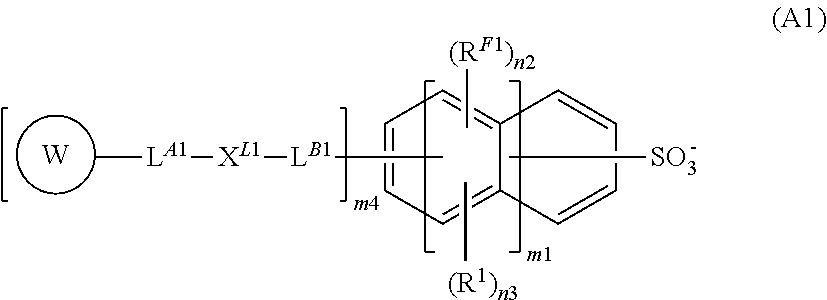
wherein m1 is 0 or 1, m2 is 0, 1, 2, 3 or 4, m3 is 0, 1, 2, 3 or 4, m2+m3 is from 0 to 4 when m1=0 and m2+m3 is from 0 to 6 when m1=1, m4 is 0 or 1,
W is a C6-C40 hydrocarbyl group which contains at least one aromatic ring and may contain a heteroatom,
RF1 is fluorine, a C1-C6 fluorinated saturated hydrocarbyl group, C1-C6 fluorinated saturated hydrocarbyloxy group, or C1-C6 fluorinated saturated hydrocarbylthio group, a plurality of RF1 may be identical or different when m2 is 2, 3 or 4,
R1 is halogen exclusive of iodine, nitro, a C1-C20 hydrocarbyl group which may contain a heteroatom, a C1-C20 hydrocarbyloxy group which may contain a heteroatom, or a C1-C20 hydrocarbylthio group which may contain a heteroatom, a plurality of R1 may be identical or different and a plurality of R1 may bond together to form a ring with the carbon atoms to which they are attached, when m3 is 2, 3 or 4,
LA and LB are each independently a single bond, ether bond, ester bond, sulfonate ester bond, amide bond, sulfonamide bond, carbonate bond or carbamate bond, and
XL is a single bond, or a C1-C40 hydrocarbylene group which may contain a heteroatom;

wherein n1 is 0 or 1, n2 is 0, 1 or 2, n3 is 0, 1 or 2, n4 is 0, 1 or 2, n2+n3+n4 is from 0 to 5 when n1=0, n2+n3+n4 is from 0 to 7 when n1=1, n5 is 0 or 1, n6 is 0, 1 or 2, n7 is 0, 1 or 2, n8 is 0, 1 or 2, n6+n7+n8 is from 0 to 5 when n5=0, n6+n7+n8 is from 0 to 7 when n5=1, n9 is 0 or 1, n10 is 0, 1 or 2, n11 is 0, 1 or 2, n12 is 0, 1 or 2, n10+n11+n12 is from 0 to 5 when n9=0, n10+n11+n12 is from 0 to 7 when n9=1, n2+n6+n10 is from 1 to 6, n3+n7+n11 is from 1 to 6,
R11, R12 and R13 each independently a C1-C20 hydrocarbyl group which may contain a heteroatom, a plurality of R11 may be identical or different when n3 is 2, a plurality of R12 may be identical or different when n7 is 2, a plurality of R13 may be identical or different when n11 is 2,
R14, R15 and R16 are each independently halogen exclusive of iodine, nitro, hydroxy, a C1-C20 hydrocarbyl group which may contain a heteroatom, a C1-C20 hydrocarbyloxy group which may contain a heteroatom, or a C1-C20 hydrocarbylthio group which may contain a heteroatom, a plurality of R14 may be identical or different and two R14 may bond together to form a ring with the carbon atoms to which they are attached, when n4 is 2, a plurality of R15 may be identical or different and two R15 may bond together to form a ring with the carbon atoms to which they are attached, when n8 is 2, a plurality of R16 may be identical or different and two R16 may bond together to form a ring with the carbon atoms to which they are attached, when n12 is 2, and
two of three aromatic rings bonded to S+ may bond together to form a ring with the sulfur atom to which they are attached.
2. The sulfonium salt of

wherein m5 is 0 or 1, m6 is 0, 1, 2, 3 or 4, m7 is 1, 2, 3 or 4, m8 is 0 or 1, m9 is 0 or 1, m10 is 0, 1, 2, 3 or 4, m11 is 0, 1, 2, 3 or 4,
R2 is each independently hydrogen, halogen exclusive of iodine, or a C1-C20 hydrocarbyl group which may contain a heteroatom,
R3 and R4 are each independently hydrogen, halogen or a C1-C20 hydrocarbyl group which may contain a heteroatom,
R5 to R9 are each independently hydrogen, halogen or a C1-C40 hydrocarbyl group which may contain a heteroatom, and
the broken line designates a point of attachment to LA.
3. The sulfonium salt of

wherein m1 to m4, W, RF1, R1 and LA are as defined above.
4. The sulfonium salt of

wherein n2 to n4, n6 to n8, n10 to n12 and R11 to R16 are as defined above.
5. A photoacid generator comprising the sulfonium salt of
6. A chemically amplified resist composition comprising the photoacid generator of
7. The chemically amplified resist composition of

wherein RA is each independently hydrogen, fluorine, methyl group or trifluoromethyl group,
X1 is a single bond, phenylene group, naphthylene group or *—C(═O)—O—X11—, the phenylene group or naphthylene group may be substituted with hydroxy, nitro, cyano, a C1-C10 saturated hydrocarbyl group which may contain fluorine, a C1-C10 saturated hydrocarbyloxy group which may contain fluorine, or halogen, X11 is a C1-C10 saturated hydrocarbylene group, phenylene group, or naphthylene group, the saturated hydrocarbylene group may contain hydroxy group, ether bond, ester bond or lactone ring,
X2 is a single bond or *—C(═O)—O—,
* designates a point of attachment to the carbon atom in the backbone,
R21 is halogen, cyano, hydroxy, nitro, a C1-C20 hydrocarbyl group which may contain a heteroatom, a C1-C20 hydrocarbyloxy group which may contain a heteroatom, a C2-C20 hydrocarbylcarbonyl group which may contain a heteroatom, a C2-C20 hydrocarbylcarbonyloxy group which may contain a heteroatom, or a C2-C20 hydrocarbyloxycarbonyl group which may contain a heteroatom, a plurality of R21 may be identical or different when a1 is 2, 3 or 4,
AL1 and AL2 are each independently an acid labile group, and
a1 is 0, 1, 2, 3 or 4.
8. The chemically amplified resist composition of

wherein b1 is 0 or 1, and b2 is 0, 1, 2 or 3 in case of b1=0 and 0, 1, 2, 3, 4 or 5 in case of b1=1,
RA is hydrogen, fluorine, methyl or trifluoromethyl,
X3 is a single bond, *—C(═O)—O—, or *—C(═O)—NH—, * designates a point of attachment to the carbon atom in the backbone,
X4 is a single bond, C1-C4 aliphatic hydrocarbylene group, carbonyl group, sulfonyl group, or a group obtained by combining the foregoing,
X5 and X6 are each independently oxygen or sulfur, X4 and X6 are bonded to vicinal carbon atoms on the aromatic ring,
R22 and R23 are each independently hydrogen, or a C1-C20 hydrocarbyl group which may contain a heteroatom, R22 and R23 may bond together to form a ring with the carbon atoms to which they are attached,
R24 is halogen, hydroxy, cyano, nitro, a C1-C20 hydrocarbyl group which may contain a heteroatom, a C1-C20 hydrocarbyloxy group which may contain a heteroatom, a C2-C20 hydrocarbyloxycarbonyl group which may contain a heteroatom, a C1-C20 hydrocarbylthio group which may contain a heteroatom, or —N(R24A)(R24B), R24A and R24B are each independently hydrogen or a C1-C6 hydrocarbyl group, and a plurality of R24 may be identical or different and a plurality of R24 may bond together to form a ring with the carbon atoms on the aromatic ring to which they are attached when b2 is 2 or more.
9. The chemically amplified resist composition of

wherein RA is each independently hydrogen, fluorine, methyl group or trifluoromethyl,
Y1 is a single bond or *—C(═O)—O—, * designates a point of attachment to the carbon atom in the backbone,
R31 is hydrogen, or a C1-C20 group containing at least one structure selected from hydroxy exclusive of phenolic hydroxy, cyano, carbonyl, carboxy, ether bond, ester bond, sulfonic ester bond, carbonate bond, lactone ring, sultone ring, and carboxylic anhydride (—C(═O)—O—C(═O)—),
R32 is halogen, carboxy, nitro, cyano, a C1-C20 hydrocarbyl group which may contain a heteroatom, a C1-C20 hydrocarbyloxy group which may contain a heteroatom, a C2-C20 hydrocarbylcarbonyl group which may contain a heteroatom, a C2-C20 hydrocarbylcarbonyloxy group which may contain a heteroatom, or a C2-C20 hydrocarbyloxycarbonyl group which may contain a heteroatom, a plurality of R32 may be identical or different when c2 is 2, 3 or 4,
c1 is 1, 2, 3 or 4, c2 is 0, 1, 2, 3 or 4, and c1+c2 is from 1 to 5.
10. The chemically amplified resist composition of

wherein d1 and d2 are each independently 0, 1, 2 or 3, e1 is 0 or 1, e2 is 0, 1, 2, 3 or 4, e3 is 0, 1, 2, 3 or 4, e2+e3 is from 0 to 4 when e1=0, e2+e3 is from 0 to 6 when e1=1,
RA is each independently hydrogen, fluorine, methyl or trifluoromethyl,
Z1 is a single bond or optionally substituted phenylene group,
Z2 is a single bond, **—C(═O)—O—Z21—, **—C(═O)—NH—Z21— or **—O—Z21—, Z21— is a C1-C6 aliphatic hydrocarbylene group, phenylene group or a divalent group obtained by combining the foregoing, which may contain halogen, carbonyl, ester bond, ether bond or hydroxy,
Z3 is a single bond, ether bond, ester bond, sulfonate ester bond, amide bond, sulfonamide bond, carbonate bond or carbamate bond,
Z4 is a single bond, C1-C6 aliphatic hydrocarbylene group, phenylene group or a divalent group obtained by combining the foregoing, which may contain halogen, carbonyl moiety, ester bond, ether bond or hydroxy,
Z5 is each independently a single bond, optionally substituted phenylene group, naphthylene group or *—C(═O)—O—Z51—Z51 is a C1-C10 aliphatic hydrocarbylene group, phenylene group or naphthylene group, the aliphatic hydrocarbylene group may contain halogen, hydroxy, ether bond, ester bond or lactone ring,
Z6 is a single bond, ether bond, ester bond, sulfonate ester bond, amide bond, sulfonamide bond, carbonate bond or carbamate bond,
Z7 is each independently a single bond, ***—Z71—C(═O)—O—, ***—C(═O)—NH—Z71—, or ***—O—Z71—, Z71 is a C1-C20 hydrocarbylene group which may contain a heteroatom,
Z8 is each independently a single bond, ****—Z81—C(═O)—O—, ****—C(═O)—NH—Z81—, or ****—O—Z81—, Z81 is a C1-C20 hydrocarbylene group which may contain a heteroatom,
Z9 is a single bond, methylene, ethylene, phenylene group, fluorinated phenylene group, trifluoromethyl-substituted phenylene group, *—C(═O)—O—Z91—, *—C(═O)—N(H)—Z91— or *—O—Z91—, Z91 is a C1-C6 aliphatic hydrocarbylene group, phenylene group, fluorinated phenylene group or trifluoromethyl-substituted phenylene group, which may contain a carbonyl moiety, ester bond, ether bond or hydroxy moiety,
* designates a point of attachment to the carbon atom in the backbone, ** designates a point of attachment to Z1, *** designates a point of attachment to Z6, **** designates a point of attachment to Z7,
L1 is a single bond, ether bond, ester bond, carbonyl moiety, sulfonate ester bond, sulfonamide bond, carbonate bond or carbamate bond,
Rf1 and Rf2 are each independently fluorine or a C1-C6 fluorinated saturated hydrocarbyl group,
Rf3 and Rf4 are each independently hydrogen, fluorine, or a C1-C6 fluorinated saturated hydrocarbyl group,
Rf5 and Rf6 are each independently hydrogen, fluorine, or a C1-C6 fluorinated saturated hydrocarbyl group, excluding that all Rf5 and Rf6 are hydrogen at the same time,
Rf7 is fluorine, a C1-C6 fluorinated alkyl group, C1-C6 fluorinated alkoxy group, C1-C6 fluorinated alkylthio group,
R41 and R42 are each independently a C1-C20 hydrocarbyl group which may contain a heteroatom, R41 and R42 may bond together to form a ring with the sulfur atom to which they are attached,
R43 is halogen exclusive of fluorine, or a C1-C20 hydrocarbyl group which may contain a heteroatom, a plurality of R43 may be identical or different and a plurality of R43 may bond together to form a ring with the carbon atoms to which they are attached when e3 is 2, 3 or 4,
M− is a non-nucleophilic counter ion, and
A+ is an onium cation.
11. The chemically amplified resist composition of
12. The chemically amplified resist composition of
13. The chemically amplified resist composition of
14. The chemically amplified resist composition of
15. A pattern forming process comprising the steps of applying the chemically amplified resist composition of
16. The pattern forming process of