US20260173748A1
NOVEL HETEROCYCLIC COMPOUND AND ORGANIC LIGHT-EMITTING DIODE INCLUDING SAME
Publication
Application
Classifications
IPC Classifications
CPC Classifications
Applicants
SFC CO., LTD.
Inventors
Si In KIM, Kyeong-Hyeon KIM, Hyuk Woo JANG, Do Yeong CHOI, Seo Youn PARK, Yeon Jae CHOI, Kyeong Wan KIM, Se Jin LEE
Abstract
The present disclosure relates to a novel aromatic heterocyclic compound that can be used in an organic light-emitting diode, and an organic light-emitting diode including same.
Figures
Description
CROSS-REFERENCE TO RELATED APPLICATIONS
[0001]This application is a Continuation of Application No. PCT/KR2024/010721, filed on Jul. 24, 2024, which in turn claims the benefit of Korean Patent Applications No. 10-2023-0115288, filed on Aug. 31, 2023, and No. 10-2024-0094412, filed on Jul. 17, 2024. The entire disclosures of all these applications are hereby incorporated by reference.
TECHNICAL FIELD
[0002]The present disclosure relates to a novel compound that can be used in an organic light-emitting diode, and more particularly, to a novel heterocyclic compound that can be used as a host material of an emission layer in an organic light-emitting diode, thereby enabling diode characteristics of low driving voltage, high efficiency, and long lifetime, and to an organic light-emitting diode including same.
BACKGROUND ART
[0003]Organic light-emitting diodes (OLEDs), based on self-luminescence, are used to create digital displays with the advantage of having a wide viewing angle and being able to be made thinner and lighter than liquid crystal displays. In addition, an OLED display exhibits a very fast response time. Accordingly, OLEDs find applications in the full color display field or the illumination field.
[0004]In general, the term “organic light-emitting phenomenon” refers to a phenomenon in which electrical energy is converted to light energy by means of an organic material. An organic light-emitting diode utilizing the organic light-emitting phenomenon has a structure usually including an anode, a cathode, and an organic material layer interposed therebetween. In this regard, the organic material layer may have, for the most part, a multilayer structure consisting of different materials, for example, a hole injection layer, a hole transport layer, an emission layer, an electron transport layer, and an electron injection layer in order to enhance the efficiency and stability of the organic light-emitting diode. In the organic light-emitting diode having such a structure, application of a voltage between the two electrodes injects a hole from the anode and an electron from the cathode to the organic layer. In the luminescent zone, the hole and the electron recombine to produce an exciton. When the exciton returns to the ground state from the excited state, the molecule of the organic layer emits light. Such an organic light-emitting diode is known to have characteristics such as self-luminescence, high luminance, high efficiency, low driving voltage, a wide viewing angle, high contrast, and high-speed response.
[0005]Materials used as organic material layers in organic light-emitting diodes may be classified, depending on their functions, into light-emitting materials and charge transport materials, such as hole injection materials, hole transport materials, electron transport materials, and electron injection materials. The light-emitting materials may be classified into polymer-type materials and low-molecular-weight materials according to molecular weight, and may also be classified into fluorescent materials derived from singlet excited states of electrons and phosphorescent materials derived from triplet excited states of electrons according to the emission mechanism.
[0006]When only a single material is used as a light-emitting material, intermolecular interactions may cause a shift of the maximum emission wavelength toward a longer wavelength and a reduction in color purity, or may cause emission quenching, thereby reducing device efficiency. Accordingly, a host-dopant system may be used as a light-emitting material in order to improve color purity and increase emission efficiency through energy transfer.
[0007]The principle thereof is that when a dopant having a smaller energy band gap than that of the host forming the emission layer is mixed in a small amount into the emission layer, excitons generated in the emission layer are transferred to the dopant, thereby emitting light with high efficiency. At this time, since the wavelength of the host shifts to the wavelength of the dopant, light of a desired wavelength can be obtained depending on the type of dopant used.
[0008]Recently, as host compounds for organic light-emitting diodes using phosphorescence in such emission layers, heterocyclic compounds containing heteroatoms such as nitrogen or oxygen have been studied. With regard to a related art, reference may be made to Korean Patent No. 10-2020-0139834 A (issued on Dec. 14, 2020) that discloses an organic light-emitting diode including an aromatic heterocyclic compound having a polycyclic ring structure as a phosphorescent host.
[0009]However, despite the preparation of various types of compounds for use in emission layers of organic light-emitting diodes, including the above related art, there is still a continuous demand for the development of novel compounds applicable to organic light-emitting diodes and organic light-emitting diodes including same, which can exhibit low driving voltage, high efficiency, and long lifetime.
DISCLOSURE
Technical Problem
[0010]Accordingly, an aspect of the present disclosure is to provide a novel organic compound that can be used as a phosphorescent host material in an emission layer of an organic light-emitting diode.
[0011]In addition, another aspect of the present disclosure is to provide an organic light-emitting diode (OLED) including the organic compound as a host material therein, which exhibits the characteristics of low driving voltage, high efficiency, and long lifetime.
Technical Solution
[0012]In order to achieve the above goals, the present disclosure provides a heterocyclic compound represented by the following Chemical Formula 1:

- [0013]wherein,
- [0014]M1 and M2 are each a substituent represented by Structural Formula 1-1 or Structural Formula 1-2, but are simultaneously neither a substituent represented by Structural Formula 1-1 nor a substituent represented by Structural Formula 1-2,
- [0015]any one of a plurality of substituents R4, a plurality of substituents R5, and a plurality of substituents Re in Structural Formula 1-1 is a single bond connected to linker L1 or L2 in Chemical Formula 1,
- [0016]any one of a plurality of substituents R7 in Structural Formula 1-2 is a single bond connected to a linker other than the linker to which the moiety of Structural Formula 1-1 is connected,
- [0017]the substituents R1 to R3, the substituents R4 to R7 except for the single bonds respectively connected to the two linkers L1 or L2 in Chemical Formula 1, and the substituent R8, which are same or different, are each independently any one selected from a hydrogen atom, a deuterium atom, a tritium atom, a substituted or unsubstituted alkyl of 1 to 30 carbon atoms, a substituted or unsubstituted halogenated alkyl of 1 to 30 carbon atoms, a substituted or unsubstituted alkenyl of 2 to 30 carbon atoms, a substituted or unsubstituted alkynyl of 2 to 30 carbon atoms, a substituted or unsubstituted aryl of 6 to 50 carbon atoms, a substituted or unsubstituted cycloalkyl of 3 to 30 carbon atoms, a substituted or unsubstituted cycloalkenyl of 5 to 30 carbon atoms, a substituted or unsubstituted heterocycloalkyl of 2 to 30 carbon atoms, a substituted or unsubstituted heteroalkyl of 2 to 50 carbon atoms, a substituted or unsubstituted heteroaryl of 2 to 50 carbon atoms, a substituted or unsubstituted aromatic hydrocarbon ring-fused cycloalkyl of 7 to 30 carbon atoms, a substituted or unsubstituted heteroaromatic ring-fused cycloalkyl of 5 to 30 carbon atoms, a substituted or unsubstituted aromatic hydrocarbon ring-fused heterocycloalkyl of 6 to 30 carbon atoms, a substituted or unsubstituted aliphatic hydrocarbon ring-fused aryl of 8 to 30 carbon atoms, a substituted or unsubstituted aliphatic hydrocarbon ring-fused heteroaryl of 5 to 30 carbon atoms, a substituted or unsubstituted alkoxy of 1 to 30 carbon atoms, a substituted or unsubstituted aryloxy of 6 to 30 carbon atoms, a substituted or unsubstituted cycloalkyloxy of 3 to 30 carbon atoms, a substituted or unsubstituted heteroaryloxy of 2 to 30 carbon atoms, a substituted or unsubstituted alkylthio of 1 to 30 carbon atoms, a substituted or unsubstituted arylthio of 6 to 30 carbon atoms, a substituted or unsubstituted cycloalkylthio of 3 to 30 carbon atoms, a substituted or unsubstituted heteroarylthio of 2 to 30 carbon atoms, a substituted or unsubstituted amine of 0 to 40 carbon atoms, a substituted or unsubstituted silyl of 0 to 40 carbon atoms, a germanium of 0 to 40 carbon atoms, a nitro, a cyano, and a halogen,
- [0018]adjacent substituents among R1 to R8, except for the single bonds, may be linked to each other to additionally form a mono- or polycyclic aliphatic or aromatic ring,
- [0019]the linkers L1 and L2, which are same or different, are each independently any one selected from a single bond, a substituted or unsubstituted arylene of 6 to 30 carbon atoms, a substituted or unsubstituted heteroarylene of 3 to 30 carbon atoms, and a substituted or unsubstituted aliphatic hydrocarbon ring-fused arylene of 8 to 30 carbon atoms,
- [0020]n1 and n2, which are same or different, are each independently 1 or 2, wherein when n1 and n2 are each 2, the corresponding multiple linkers within each of L1 and L2 are same or different,
- [0021]m1 is 2, wherein the corresponding plural R1's are same or different,
- [0022]m2 to m5, m7, and me are each 4, wherein the corresponding multiple substituents within each of R2 to R5, R7, and Re in the aromatic rings are same or different,
- [0023]m6 is 3, wherein the corresponding multiple substituents R6 are same or different,
- [0024]Y1 and Y2 in Structural Formula 1-1, which are same or different, are each independently any one selected from O and S,
- [0025]W in Structural Formula 1-2 is O or S,
- [0026]wherein the term “substituted” in the expression “a substituted or unsubstituted” used for the compounds of Chemical Formula 1 and Structural Formulas 1-1 and 1-2 means having at least one substituent selected from the group consisting of a deuterium atom, a tritium atom, a cyano, a halogen, a hydroxy, a nitro, an alkyl of 1 to 30 carbon atoms, a halogenated alkyl of 1 to 30 carbon atoms, an alkenyl of 2 to 24 carbon atoms, an alkynyl of 2 to 24 carbon atoms, a cycloalkyl of 3 to 24 carbon atoms, a heteroalkyl of 1 to 24 carbon atoms, an aryl of 6 to 24 carbon atoms, an arylalkyl of 7 to 24 carbon atoms, an alkylaryl of 7 to 24 carbon atoms, a heteroaryl of 2 to 24 carbon atoms, a heteroarylalkyl of 3 to 24 carbon atoms, an alkylheteroaryl of 3 to 24 carbon atoms, an alkoxy of 1 to 24 carbon atoms, an aromatic hydrocarbon ring-fused cycloalkyl of 7 to 30 carbon atoms, an heteroaromatic ring-fused cycloalkyl of 5 to 30 carbon atoms, an aromatic hydrocarbon ring-fused heterocycloalkyl of 6 to 30 carbon atoms, an aliphatic hydrocarbon ring-fused aryl of 7 to 30 carbon atoms, an aliphatic hydrocarbon ring-fused heteroaryl of 5 to 30 carbon atoms, a substituted or unsubstituted heteroaliphatic ring-fused aryl of 6 to 30 carbon atoms, a substituted or unsubstituted heteroaliphatic ring-fused heteroaryl of 5 to 30 carbon atoms, an amine of 1 to 30 carbon atoms, a silyl of 1 to 30 carbon atoms, a germanium of 1 to 30 carbon atoms, an aryloxy of 6 to 24 carbon atoms, and an arylthionyl of 6 to 24 carbon atoms, with at least one hydrogen atom on the substituent being substitutable with a deuterium or tritium atom.
Advantageous Effects
[0027]When employing the heterocyclic compound represented by Chemical Formula 1 according to the present disclosure as a phosphorescent host material in an emission layer therein, an organic light-emitting diode having characteristics of lower driving voltage, higher efficiency, and longer lifetime can be provided compared to conventional organic light-emitting diodes.
DESCRIPTION OF DRAWINGS
[0028]
BEST MODE FOR INVENTION
[0029]Below, a detailed description will be given of the present disclosure. In each drawing of the present disclosure, sizes or scales of components may be enlarged or reduced from their actual sizes or scales for better illustration, and known components may not be depicted therein to clearly show features of the present disclosure. Therefore, the present disclosure is not limited to the drawings. When describing the principle of the embodiments of the present disclosure in detail, details of well-known functions and features may be omitted to avoid unnecessarily obscuring the presented embodiments.
[0030]In the drawing, for convenience of description, sizes of components may be exaggerated for clarity. For example, since sizes and thicknesses of components in drawings are arbitrarily shown for convenience of description, the sizes and thicknesses are not limited thereto. Furthermore, throughout the description, the terms “on” and “over” are used to refer to the relative positioning, and mean not only that one component or layer is directly disposed on another component or layer but also that one component or layer is indirectly disposed on another component or layer with a further component or layer being interposed therebetween. Also, spatially relative terms, such as “below”, “beneath”, “lower”, and “between” may be used herein for ease of description to refer to the relative positioning.
[0031]Throughout the specification, when a portion may “include” a certain constituent element, unless explicitly described to the contrary, it may not be construed to exclude another constituent element but may be construed to further include other constituent elements. Further, throughout the specification, the word “on” means positioning on or below the object portion, but does not essentially mean positioning on the lower side of the object portion based on a gravity direction.
[0032]The present disclosure provides a heterocyclic compound represented by the following Chemical Formula 1:

- [0033]wherein,
- [0034]M1 and M2 are each a substituent represented by Structural Formula 1-1 or Structural Formula 1-2, but are simultaneously neither a substituent represented by Structural Formula 1-1 nor a substituent represented by Structural Formula 1-2,
- [0035]any one of a plurality of substituents R4, a plurality of substituents R5, and a plurality of substituents R6 in Structural Formula 1-1 is a single bond connected to linker L1 or L2 in Chemical Formula 1,
- [0036]any one of a plurality of substituents R7 in Structural Formula 1-2 is a single bond connected to a linker other than the linker to which the moiety of Structural Formula 1-1 is connected,
- [0037]the substituents R1 to R3, the substituents R4 to R7 except for the single bonds respectively connected to the two linkers L or L2 in Chemical Formula 1, and the substituent R8, which are same or different, are each independently any one selected from a hydrogen atom, a deuterium atom, a tritium atom, a substituted or unsubstituted alkyl of 1 to 30 carbon atoms, a substituted or unsubstituted halogenated alkyl of 1 to 30 carbon atoms, a substituted or unsubstituted alkenyl of 2 to 30 carbon atoms, a substituted or unsubstituted alkynyl of 2 to 30 carbon atoms, a substituted or unsubstituted aryl of 6 to 50 carbon atoms, a substituted or unsubstituted cycloalkyl of 3 to 30 carbon atoms, a substituted or unsubstituted cycloalkenyl of 5 to 30 carbon atoms, a substituted or unsubstituted heterocycloalkyl of 2 to 30 carbon atoms, a substituted or unsubstituted heteroalkyl of 2 to 50 carbon atoms, a substituted or unsubstituted heteroaryl of 2 to 50 carbon atoms, a substituted or unsubstituted aromatic hydrocarbon ring-fused cycloalkyl of 7 to 30 carbon atoms, a substituted or unsubstituted heteroaromatic ring-fused cycloalkyl of 5 to 30 carbon atoms, a substituted or unsubstituted aromatic hydrocarbon ring-fused heterocycloalkyl of 6 to 30 carbon atoms, a substituted or unsubstituted aliphatic hydrocarbon ring-fused aryl of 8 to 30 carbon atoms, a substituted or unsubstituted aliphatic hydrocarbon ring-fused heteroaryl of 5 to 30 carbon atoms, a substituted or unsubstituted alkoxy of 1 to 30 carbon atoms, a substituted or unsubstituted aryloxy of 6 to 30 carbon atoms, a substituted or unsubstituted cycloalkyloxy of 3 to 30 carbon atoms, a substituted or unsubstituted heteroaryloxy of 2 to 30 carbon atoms, a substituted or unsubstituted alkylthio of 1 to 30 carbon atoms, a substituted or unsubstituted arylthio of 6 to 30 carbon atoms, a substituted or unsubstituted cycloalkylthio of 3 to 30 carbon atoms, a substituted or unsubstituted heteroarylthio of 2 to 30 carbon atoms, a substituted or unsubstituted amine of 0 to 40 carbon atoms, a substituted or unsubstituted silyl of 0 to 40 carbon atoms, a germanium of 0 to 40 carbon atoms, a nitro, a cyano, and a halogen,
- [0038]adjacent substituents among R1 to R8, except for the single bonds, may be linked to each other to additionally form a mono- or polycyclic aliphatic or aromatic ring,
- [0039]the linkers L1 and L2, which are same or different, are each independently any one selected from a single bond, a substituted or unsubstituted arylene of 6 to 30 carbon atoms, a substituted or unsubstituted heteroarylene of 3 to 30 carbon atoms, and a substituted or unsubstituted aliphatic hydrocarbon ring-fused arylene of 8 to 30 carbon atoms,
- [0040]n1 and ny, which are same or different, are each independently 1 or 2, wherein when n1 and n2 are each 2, the corresponding multiple linkers within each of L1 and L2 are same or different,
- [0041]m is 2, wherein the corresponding plural R1's are same or different,
- [0042]m2 to m5, m7, and mg are each 4, wherein the corresponding multiple substituents within each of R2 to R5, R7, and Re in the aromatic rings are same or different,
- [0043]m6 is 3, wherein the corresponding multiple substituents Re are same or different,
- [0044]Y1 and Y2 in Structural Formula 1-1, which are same or different, are each independently any one selected from O and S,
- [0045]W in Structural Formula 1-2 is O or S,
- [0046]wherein the term “substituted” in the expression “a substituted or unsubstituted” used for the compounds of Chemical Formula 1 and Structural Formulas 1-1 and 1-2 means having at least one substituent selected from the group consisting of a deuterium atom, a tritium atom, a cyano, a halogen, a hydroxy, a nitro, an alkyl of 1 to 30 carbon atoms, a halogenated alkyl of 1 to 30 carbon atoms, an alkenyl of 2 to 24 carbon atoms, an alkynyl of 2 to 24 carbon atoms, a cycloalkyl of 3 to 24 carbon atoms, a heteroalkyl of 1 to 24 carbon atoms, an aryl of 6 to 24 carbon atoms, an arylalkyl of 7 to 24 carbon atoms, an alkylaryl of 7 to 24 carbon atoms, a heteroaryl of 2 to 24 carbon atoms, a heteroarylalkyl of 3 to 24 carbon atoms, an alkylheteroaryl of 3 to 24 carbon atoms, an alkoxy of 1 to 24 carbon atoms, an aromatic hydrocarbon ring-fused cycloalkyl of 7 to 30 carbon atoms, an heteroaromatic ring-fused cycloalkyl of 5 to 30 carbon atoms, an aromatic hydrocarbon ring-fused heterocycloalkyl of 6 to 30 carbon atoms, an aliphatic hydrocarbon ring-fused aryl of 7 to 30 carbon atoms, an aliphatic hydrocarbon ring-fused heteroaryl of 5 to 30 carbon atoms, a substituted or unsubstituted heteroaliphatic ring-fused aryl of 6 to 30 carbon atoms, a substituted or unsubstituted heteroaliphatic ring-fused heteroaryl of 5 to 30 carbon atoms, an amine of 1 to 30 carbon atoms, a silyl of 1 to 30 carbon atoms, a germanium of 1 to 30 carbon atoms, an aryloxy of 6 to 24 carbon atoms, and an arylthionyl of 6 to 24 carbon atoms, with at least one hydrogen atom on the substituent being substitutable with a deuterium or tritium atom.
[0047]The expression indicating the number of carbon atoms, such as in “a substituted or unsubstituted alkyl of 1 to 30 carbon atoms”, “a substituted or unsubstituted aryl of 5 to 50 carbon atoms”, etc., means the total number of carbon atoms of, for example, the alkyl or aryl radical or moiety alone, exclusive of the number of carbon atoms of substituents attached thereto. For instance, a phenyl group with a butyl at the para position falls within the scope of an aryl of 6 carbon atoms, even though it is substituted with a butyl radical of 4 carbon atoms.
[0048]As used herein, the term “aryl” means an organic radical derived from an aromatic hydrocarbon by removing one hydrogen that is bonded to the aromatic hydrocarbon. When the aryl group is substituted, the substituents may be fused with one another to form an additional ring. The aryl group may also include an organic radical obtained by the removal of a single hydrogen atom from an arene ring formed by the fusion of two arene rings.
[0049]Concrete examples of the aryl include aromatic radical groups such as phenyl, o-biphenyl, m-biphenyl, p-biphenyl, o-terphenyl, m-terphenyl, p-terphenyl, naphthyl, anthryl, phenanthryl, pyrenyl, indenyl, fluorenyl, tetrahydronaphthyl, perylenyl, chrysenyl, naphthacenyl, fluoranthenyl, triphenylenyl, and the like, but are not limited thereto. The aryl group may also include organic radicals obtained by the removal of one hydrogen atom from a fused arene ring formed by two arene rings, such as a fluorene ring fused with a phenylene ring or a fluorene ring fused with a phenanthrene ring.
[0050]In addition, at least one hydrogen atom in the aryl may be substituted by a deuterium atom, a tritium atom, a halogen atom, a hydroxy, a nitro, a cyano, a silyl, an amino (—NH2, —NH(R), —N(R′) (R″) wherein R′ and R″ are each independently an alkyl of 1 to 10 carbon atoms, in this case, called “alkylamino”), an amidino, a hydrazine, a hydrazone, a carboxyl, a sulfonic acid, a phosphoric acid, an alkyl of 1 to 24 carbon atoms, a halogenated alkyl of 1 to 24 carbon atoms, an alkenyl of 2 to 24 carbon atoms, an alkynyl of 2 to 24 carbon atoms, a heteroalkyl of 1 to 24 carbon atoms, an aryl of 6 to 24 carbon atoms, an arylalkyl of 7 to 24 carbon atoms, an alkylaryl of 7 to 24 carbon atoms, a heteroaryl of 2 to 24 carbon atoms, a heteroarylalkyl of 3 to 24 carbon atoms, or an alkylheteroaryl of 3 to 24 carbon atoms.
[0051]As used herein, the term “aromatic hydrocarbon ring” refers to an aromatic ring composed of carbon and hydrogen atoms and the term “aliphatic hydrocarbon ring” refers to a hydrocarbon ring that is composed of carbon and hydrogen atoms, but does not belong to the aromatic hydrocarbon rings. Particularly, the aliphatic hydrocarbon ring may have a bonding structure of the sp3 orbital for at least 30% of the carbon atoms as ring members, with 0 to 3 double and/or triple bonds within the ring. More particularly, the aliphatic hydrocarbon ring may have a bonding structure of the sp3 orbital for at least 50% of the carbon atoms as ring members, with 0 to 2 double and/or triple bonds within the ring.
[0052]As used herein, the term “aliphatic hydrocarbon ring-fused aryl” refers to a cyclic substituent having overall non-aromaticity, in which two adjacent carbon atoms of the aliphatic hydrocarbon ring are fused with two adjacent carbon atoms of the aryl ring, exclusive of the carbon atom that becomes an organic radical by removal of a hydrogen atom, to form a shared double bond. Specific examples include tetrahydronaphthyl, tetrahydrobenzocycloheptene, tetrahydrophenanthrenyl, tetrahydroanthracenyl, octahydrotriphenylenyl, and the like, but are not limited thereto.
[0053]The substituent “heteroaryl” used in the compound of the present disclosure refers to a cyclic aromatic system of 2 to 24 carbon atoms bearing as ring members one to three heteroatoms selected from among N, O, P, Si, S, Ge, Se, and Te. In the aromatic system, two or more rings may be fused. One or more hydrogen atoms on the heteroaryl may be substituted by the same substituents as on the aryl.
[0054]Concrete examples of the heteroaryl include thiophenyl, furanyl, pyrrolyl, imidazolyl, thiazolyl, oxazolyl, oxadiazolyl, triazolyl, pyridyl, bipyridyl, pyrimidinyl, triazinyl, acridinyl, carbolynyl, acenaphthoquinoxalinyl, indenoquinazolinyl, indenoisoquinolinyl, indenoquinolinyl, pyridoindolyl, pyridazinyl, pyrazinyl, quinolinyl, quinazolinyl, quinoxalinyl, phthalazinyl, pyridopyrimidinyl, pyridopyrazinyl, pyrazinopyrazinyl, isoquinolinyl, indolyl, carbazolyl, benzoxazolyl, benzimidazolyl, benzothiazolyl, benzocarbazolyl, benzofuranyl, benzothiophenyl, benzoselenophenyl, dibenzothiophenyl, dibenzofuranyl, dibenzoselenophenyl, phenanthrolinyl, thiazolinyl, isoxazolyl, thiadiazolyl, phenoxazinyl, phenothiazinyl, azadibenzofuranyl, azadibenzothiophenyl, azadibenzoselenophenyl, indolocarbazolyl, and the like, but are not limited thereto.
[0055]In addition, the term “heteroaromatic ring”, as used herein, refers to an aromatic hydrocarbon ring bearing at least one heteroatom as an aromatic ring member. In the heteroaromatic ring, one to three carbon atoms of the aromatic hydrocarbon may be substituted by at least one selected particularly from N, O, P, Si, S, Ge, Se, and Te.
[0056]As used herein, the term “aliphatic hydrocarbon ring-fused heteroaryl” refers to the same cyclic substituent as in the aliphatic hydrocarbon ring-fused aryl, with the exception that a heteroaryl, instead of an aryl, is substituted. Specific examples include, but are not limited to, tetrahydroindole, tetrahydrobenzofuranyl, tetrahydrobenzothiophene, tetrahydrocarbazole, tetrahydrodibenzofuranyl, tetrahydroquinoline, and tetrahydroquinoxaline.
[0057]In addition, the term “heteroaromatic ring”, as used herein, refers to an aromatic hydrocarbon ring bearing at least one heteroatom as an aromatic ring member. In the heteroaromatic ring, one to three carbon atoms of the aromatic hydrocarbon may be substituted by at least one selected particularly from N, O, P, Si, S, Ge, Se, and Te.
[0058]As used herein, the term “fused ring in which an aromatic hydrocarbon ring is fused with an aliphatic hydrocarbon ring” means a fused ring in which an aromatic hydrocarbon ring has two adjacent carbon atoms in common with an aliphatic hydrocarbon ring, as exemplified by a tetrahydronaphthalene ring, dihydroindene, and the like, in which the benzene ring shares two adjacent carbon atoms with the cyclohexane ring.
[0059]In the present disclosure, the term “fused ring in which a heteroaromatic hydrocarbon ring and an aliphatic hydrocarbon ring are fused to each other” refer to a cyclic radical in which two adjacent carbon atoms as ring members of an aromatic hydrocarbon ring and two adjacent carbon atoms as ring members of an aliphatic hydrocarbon ring are fused with each other to share two carbon atoms therebetween, as exemplified by hexahydrodibenzofuran in which a benzofuran ring and a cyclohexane ring are fused by sharing their respective two adjacent carbon atoms as ring members.
[0060]As used herein, the term “alkyl” refers to an alkane missing one hydrogen atom and includes linear or branched structures. Examples of the alkyl substituent useful in the present disclosure include methyl, ethyl, propyl, isopropyl, isobutyl, sec-butyl, tert-butyl, pentyl, iso-amyl, hexyl, and the like. At least one hydrogen atom of the alkyl may be substituted by the same substituent as in the aryl.
[0061]As used herein, the term “halogenated alkyl” refers to an alkyl with a halogen substituted for at least one hydrogen atom. Preferably, the halogen may be a fluorine atom.
[0062]The term “cyclo” as used in substituents of the compounds of the present disclosure, such as cycloalkyl, cycloalkoxy, etc., refers to a structure responsible for a mono- or polycyclic ring of saturated hydrocarbons within an alkyl radical, an alkoxy radical, etc. Concrete examples of cycloalkyl include cyclopropyl, cyclobutyl, cyclopentyl, cyclohexyl, methylcyclopentyl, methylcyclohexyl, ethylcyclopentyl, ethylcyclohexyl, adamantyl, dicyclopentadienyl, decahydronaphthyl, norbornyl, bornyl, isobornyl, and so on. One or more hydrogen atoms on the cycloalkyl may be substituted by the same substituents as on the aryl. This is true of the cycloalkoxy.
[0063]In the present disclosure, the term “heterocycloalkyl” refers to a cycloalkyl with at least one heteroatom substituted as a ring member for a carbon atom within the ring. Preferably, one to three carbon atoms within the ring may be substituted by at least one selected from N, O, P, S, Si, Ge, Se, and Te.
[0064]The term “aromatic hydrocarbon ring- or heteroaromatic ring-fused cycloalkyl”, as used herein, refers to a cyclic radical in which two adjacent carbon atoms as ring members of an aromatic or heteroaromatic hydrocarbon ring and two adjacent carbon atoms as ring members of a cycloalkyl are fused with each other to share one double bond therebetween, with non-aromaticity across the molecule. Specific examples include tetrahydronaphthyl, tetrahydrophenanthrene, tetrahydroquinoline, tetrahydroquinoxaline, cyclopentabenzofuran, and the like, but with no limitations thereto.
[0065]The term “aromatic hydrocarbon ring-fused heterocyclic alkyl” is same as the aromatic hydrocarbon ring-fused cycloalkyl, with the exception that at least one carbon atom within the cycloalkyl ring is substituted by a heteroatom, with non-aromaticity across the molecule. Preferably, one to three carbon atoms within the cycloalkyl ring are substituted by at least one selected from N, O, P, S, Si, Ge, Se, and Te. Specific examples of aromatic hydrocarbon ring-heterocyclic alkyl include hexahydrocarbazole, hexahydrodibenzofuranyl, hexahydrodibenzothiophene, dihydrobenzodioxine, and the like, but with no limitations thereto.
[0066]As used herein, the “heteroaliphatic ring-fused aryl or heteroaryl” is same as the aliphatic hydrocarbon ring-fused aryl or heteroaryl, except for a heteroaliphatic ring substituted for the aliphatic hydrocarbon ring, with non-aromaticity across the molecule thereof. Specific examples include chromane, dihydropyranopyridine, thiocromane, dihydrobenzodioxine, dihydrothiopyranopyridine, dihydropyranopyrimidine, and the like, with no limitations thereto.
[0067]The term “heteroaliphatic ring” refers to an aliphatic hydrocarbon bearing at least one heteroatom as a ring member. Preferably, one to three carbon atoms within an aliphatic hydrocarbon are substituted by at least one heteroatom selected from N, O, and S.
[0068]The term “alkoxy,” as used in the compounds of the present disclosure, refers to an alkyl or cycloalkyl singularly bonded to oxygen. Specific examples of the alkoxy include methoxy, ethoxy, propoxy, isobutoxy, sec-butoxy, pentoxy, iso-amyloxy, hexyloxy, cyclobutyloxy, cyclopentyloxy, adamantyloxy, dicyclopentyloxy, bornyloxy, isobornyloxy, and the like, but are not limited thereto. One or more hydrogen atoms on the alkoxy may be substituted by the same substituents as on the aryl.
[0069]Specific examples of the arylalkyl used in the compounds of the present disclosure include phenylmethyl (benzyl), phenylethyl, phenylpropyl, naphthylmethyl, naphthylethyl, and the like, but are not limited thereto. One or more hydrogen atoms on the arylalkyl may be substituted by the same substituents as on the aryl.
[0070]Specific examples of the alkylaryl used in the compound of the present disclosure include tolyl, xylenyl, dimethylnaphthyl, t-butylphenyl, t-butylnaphthyl, t-butylphenanthryl, and the like, but are not limited thereto. One or more hydrogen atoms on the alkylaryl may be substituted by the same substituents as on the aryl.
- [0072]the arylheteroarylsilyl to a functional group based on —SiH3 in which at least two of the three hydrogen atoms bonded to the silicon atom are substituted by aryl and heteroaryl, as exemplified by a silyl having one or two aryl radicals and correspondingly two or one heteroaryl radical; and the heteroarylsilyl to a functional group based on —SiH3 in which at least one of the three hydrogen atoms bonded to the silicon atom is substituted by heteroaryl. Examples of the arylsilyl include a substituted or unsubstituted monoarylsilyl, a substituted or unsubstituted diarylsilyl, and a substituted or unsubstituted triarylsilyl. Such examples are true of the alkylsilyl and the heteroarylsilyl.
[0073]Here, each of the aryl radicals in the arylsilyl, heteroarylsilyl, and arylheteroarylsilyl may be a mono- or polycyclic aryl, and each of the heteroaryl radicals in the arylsilyl, heteroarylsilyl, and arylheteroarylsilyl may be a mono- or polycyclic heteroaryl.
[0074]Furthermore, specific examples of the silyl include trimethylsilyl, triethylsilyl, triphenylsilyl, trimethoxysilyl, dimethoxyphenylsilyl, diphenylmethylsilyl, diphenylvinylsilyl, methylcyclobutylsilyl, and dimethylfurylsilyl. One or more hydrogen atoms on the silyl may be substituted by the same substituents as on the aryl.
[0075]As used herein, the term “germanium” (or germyl or germane) is intended to encompass —GeH3, alkyl germanium, aryl germanium, heteroaryl germanium, alkylaryl germanium, alkylheteroaryl germanium, and arylheteroaryl germanium and can be accounted for by the definitions for silyl radicals, with the exception that the silicon atom (Si) in the silyl radical is substituted by a germanium atom (Ge).
[0076]Specific examples of the germanium radical include trimethylgermane, triethylgermane, triphenylgermane, trimethoxygermane, dimethoxyphenylgermane, diphenylmethylgermane, diphenylvinylgermane, methylcyclobutylgermane, and dimethylfurylgermane. One or more hydrogen atoms on the germanium radical may be substituted by the same substituents as on the aryl.
[0077]As used herein, the term “alkenyl” refers to an alkyl substituent containing a carbon-carbon double bond between two carbon atoms and the term “alkynyl” refers to an alkyl substituent containing a carbon-carbon triple bond between two carbon atoms.
[0078]As used herein, the term “alkylene” refers to an organic radical regarded as derived from an alkane by removal two hydrogen atoms from one carbon atom for methylene or different carbon atoms for ethylene or higher, such as methylene, ethylene, propylene, isopropylene, isobutylene, sec-butylene, tert-butylene, pentylene, iso-amylene, hexylene, and the like. One or more hydrogen atoms on the alkylene may be substituted by the same substituents as on the aryl.
[0079]In the present disclosure, the term “amine” is intended to encompass —NH2, alkylamine, arylamine, alkylarylamine, arylheteroarylamine, heteroarylamine, and the like. The term “arylamine” refers to a functional group including —NH2, in which one or two of the hydrogen atoms in —NH2 are substituted by aryl; the term “alkylamine” to a functional group including —NH2, in which one or two of the hydrogen atoms in —NH2 are substituted by alkyl; the term “alkylarylamine” to a functional group including —NH2, in which one of the hydrogen atoms in —NH2 is substituted by alkyl and the other hydrogen atom is substituted by aryl; the term “arylheteroarylamine to a functional group including —NH2, in which one of the hydrogen atoms in —NH2 is substituted by aryl and the other hydrogen atom is substituted by heteroaryl; and the term “heteroarylamine” to a functional group including —NH2, in which one or two of the hydrogen atoms in —NH2 are substituted by heteroaryl. Examples of the arylamine include a substituted or unsubstituted monoarylamine and a substituted or unsubstituted diarylamine. Such examples are true of the alkylamine and the heteroarylamine.
[0080]Each of the aryl radicals in the arylamine, heteroarylamine, and arylheteroarylamine may be a monocyclic or polycyclic one. Each of the heteroaryl radicals in the heteroarylamine, and arylheteroarylamine may be a mono- or polycyclic one.
[0081]In a preferable embodiment, the substituent accounted for by the term “substituted” in the expression “substituted or unsubstituted” used for compounds of Chemical Formula 1 may be at least one selected from the group consisting of a deuterium atom, a tritium atom, a cyano, a halogen, a hydroxy, a nitro, an alkyl of 1 to 12 carbon atoms, a halogenated alkyl of 1 to 12 carbon atoms, an alkenyl of 2 to 12 carbon atoms, an alkynyl of 2 to 12 carbon atoms, a cycloalkyl of 3 to 12 carbon atoms, a heteroalkyl of 1 to 12 carbon atoms, an aryl of 6 to 18 carbon atoms, an arylalkyl of 7 to 20 carbon atoms, an alkylaryl of 7 to 20 carbon atoms, a heteroaryl of 2 to 18 carbon atoms, a heteroarylalkyl of 3 to 18 carbon atoms, an alkyl heteroaryl of 3 to 18 carbon atoms, an aromatic hydrocarbon ring-fused cycloalkyl of 9 to 20 carbon atoms, a heteroaromatic ring-fused cycloalkyl of 7 to 20 carbon atoms, an aromatic hydrocarbon ring-fused heterocycloalkyl of 9 to 20 carbon atoms, an aliphatic hydrocarbon ring-fused aryl of 9 to 20 carbon atoms, an aliphatic hydrocarbon ring-fused heteroaryl of 7 to 20 carbon atoms, an alkoxy of 1 to 12 carbon atoms, an amine of 1 to 18 carbon atoms, a silyl of 1 to 18 carbon atoms, a germanium of 1 to 18 carbon atoms, an aryloxy of 6 to 18 carbon atoms, and an arylthionyl of 6 to 18 carbon atoms. At least one hydrogen atom within each substituent may be substituted with a deuterium or tritium atom.
[0082]In a more preferable embodiment of the present disclosure, the substituted or unsubstituted aromatic hydrocarbon ring-fused cycloalkyl of 7 to 30 carbon atoms may be a substituted or unsubstituted aromatic hydrocarbon ring-fused cycloalkyl of 9 to carbon atoms.
[0083]In a more preferable of the present disclosure, the substituted or unsubstituted heteroaromatic ring-fused cycloalkyl of 5 to 30 carbon atoms may be a substituted or unsubstituted heteroaromatic ring-fused cycloalkyl of 7 to 20 carbon atoms.
[0084]In a more preferable embodiment of the present disclosure, the substituted or unsubstituted aromatic hydrocarbon ring-fused heterocycloalkyl of 6 to 30 carbon atoms may be a substituted or unsubstituted aromatic hydrocarbon ring-fused heterocycloalkyl of 9 to 20 carbon atoms.
[0085]In a more preferable embodiment of the present disclosure, the substituted or unsubstituted aliphatic hydrocarbon ring-fused aryl of 8 to 30 carbon atoms may be a substituted or unsubstituted aliphatic hydrocarbon ring-fused aryl of 9 to 20 carbon atoms.
[0086]In a more preferable embodiment of the present disclosure, the substituted or unsubstituted aliphatic hydrocarbon ring-fused heteroaryl of 5 to 30 carbon atoms may be a substituted or unsubstituted aliphatic hydrocarbon ring-fused heteroaryl of 7 to 20 carbon atoms.
[0087]In a more preferable embodiment of the present disclosure, the substituted or unsubstituted heteroaliphatic ring-fused aryl of 6 to 30 carbon atoms may be a substituted or unsubstituted heteroaliphatic ring-fused aryl of 7 to 20 carbon atoms.
[0088]In a more preferable of the present disclosure, the substituted or unsubstituted heteroaliphatic ring-fused heteroaryl of 5 to 30 carbon atoms may be a substituted or unsubstituted heteroaliphatic ring-fused heteroaryl of 6 to 20 carbon atoms.
[0089]As used herein, the expression “adjacent substituents among R1 to Re, except for the single bonds, may be linked to each other to additionally form a mono- or polycyclic aliphatic or aromatic ring” means that one hydrogen radical is removed from each of two adjacent substituents selected from R1 to R8 (multiple R1, multiple R2, multiple R3, multiple R4, multiple R5, multiple R6, multiple R7, and multiple R8), except for the single bonds, and the two dehydrogenated substituents are linked to each other to additionally form a ring.
[0090]In the present disclosure, the heterocyclic compound represented by Chemical Formula 1 is technically characterized by the fused ring structure of “a six-membered aromatic hydrocarbon ring—a five-membered ring bearing a nitrogen atom—a six-membered aromatic hydrocarbon ring—a five-membered ring bearing a nitrogen atom—a six-membered aromatic hydrocarbon ring” in which the polycyclic compound bearing boron (B) represented by Structural Formula 1-1 is bonded to any one of linkers L1 or L2, and an aromatic ring of a dibenzofuran or dibenzothiophene structure represented by Structural Formula 1-2 is bonded to the other linker.
[0091]Here, the polycyclic compound bearing boron represented by Structural Formula 1-1 has a structural feature in which three six-membered aromatic hydrocarbon rings are bonded to a central boron (B) atom, and among the three aromatic hydrocarbon rings, the aromatic hydrocarbon ring including substituent Re is connected to the remaining aromatic hydrocarbon rings through an oxygen (O) or sulfur(S) atom as a bridge structure.
[0092]In an embodiment, Y1 and Y2 in Structural Formula 1-1 may each be an oxygen atom (O).
[0093]In an embodiment, one of the multiple R6 radicals in Structural Formula 1-1 may be a single bond to L1 or L2 in the compound represented by Chemical Formula 1.
[0094]In an embodiment of the present disclosure, the compound represented by Chemical Formula 1 may contain at least one deuterium atom.
[0095]More specifically, at least one of the substituents R1 to R3 in the compound represented by Chemical Formula 1 may contain a deuterium atom.
[0096]In an embodiment of the present disclosure, the substituents R1 to R3 in the compound represented by Chemical Formula 1 may each be deuterium atom.
[0097]In a more preferable embodiment, W in Structural Formula 1-2 in the heterocyclic compound represented by Chemical Formula 1 may be an oxygen atom (O).
[0098]In a more preferable embodiment, the linkers L1 and L2 in Chemical Formula 1 are same or different and may each be any one selected from a single bond and a substituted or unsubstituted arylene of 6 to 18 carbon atoms.
[0099]In a more preferable embodiment, n1 and n2 in Chemical Formula 1 are each 1, and at least one of the linkers L1 and L2 may be a single bond.
[0100]In a more preferable embodiment, the linkers L1 and L2 in Chemical Formula 1 may each be a single bond.
[0101]Furthermore, concrete examples of the heterocyclic compound represented by Chemical Formula 1 in the present disclosure include, but are not limited to, the following compounds 1 to 84:
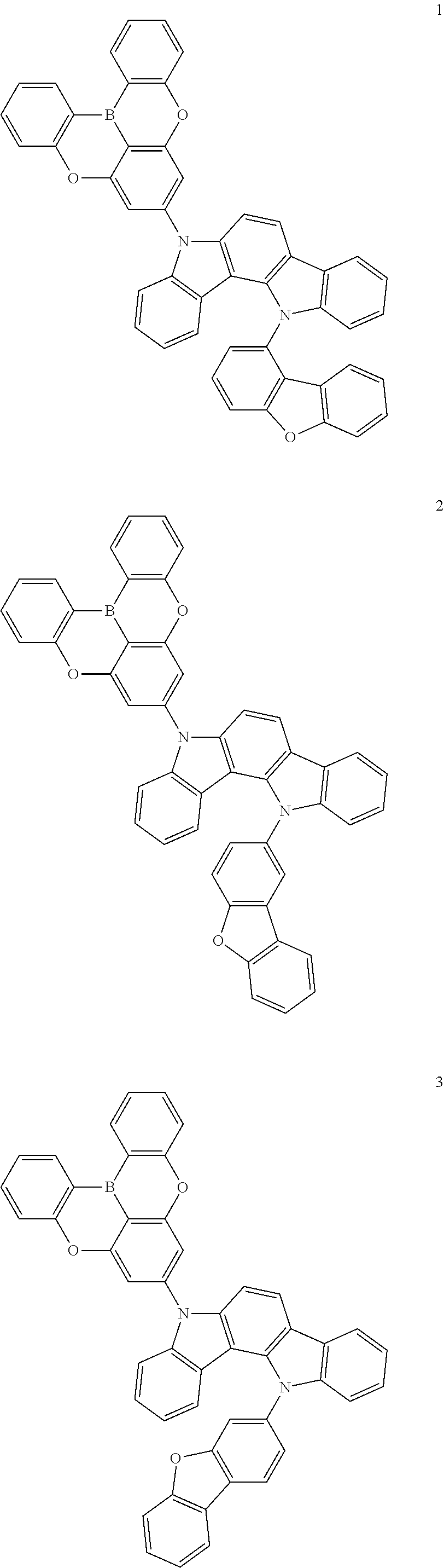


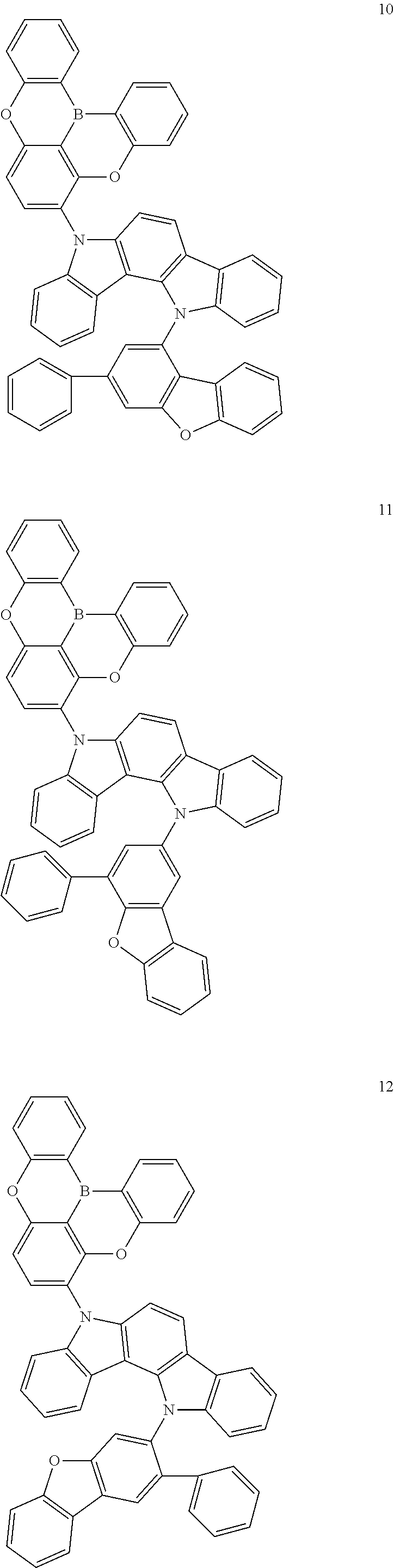


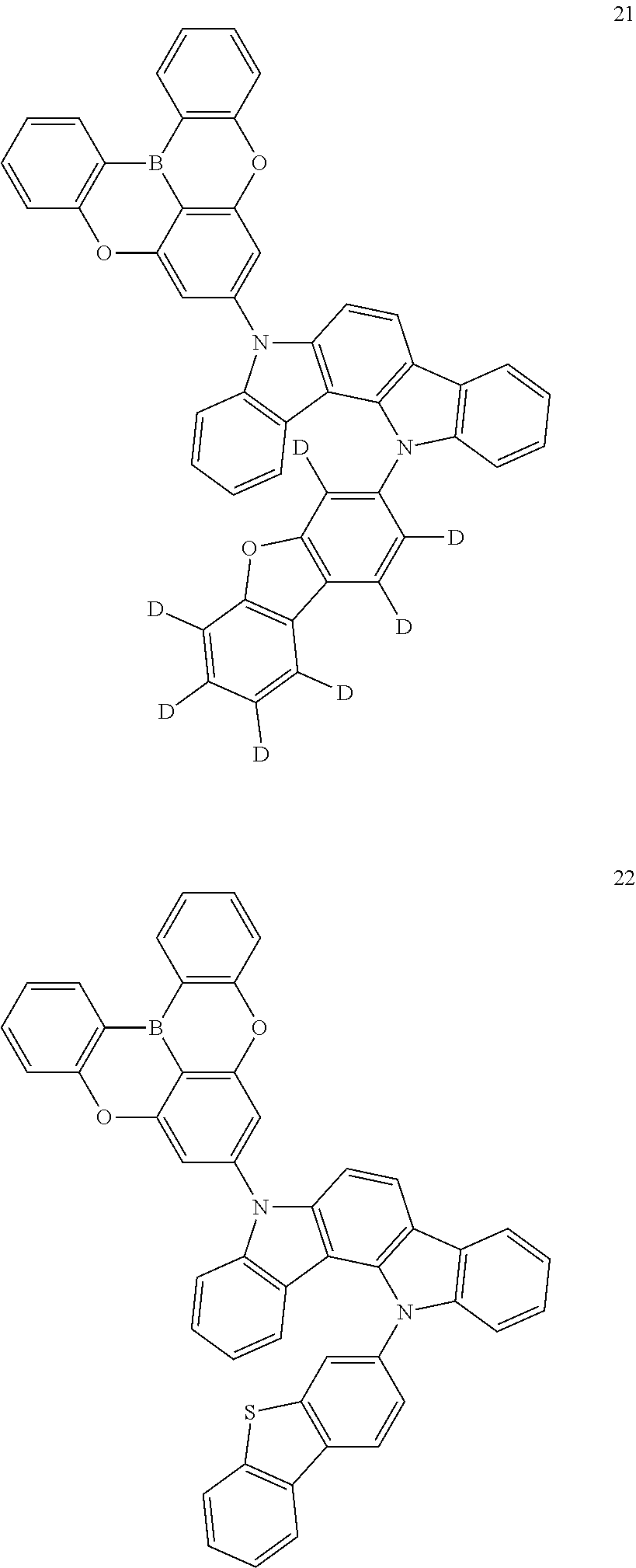


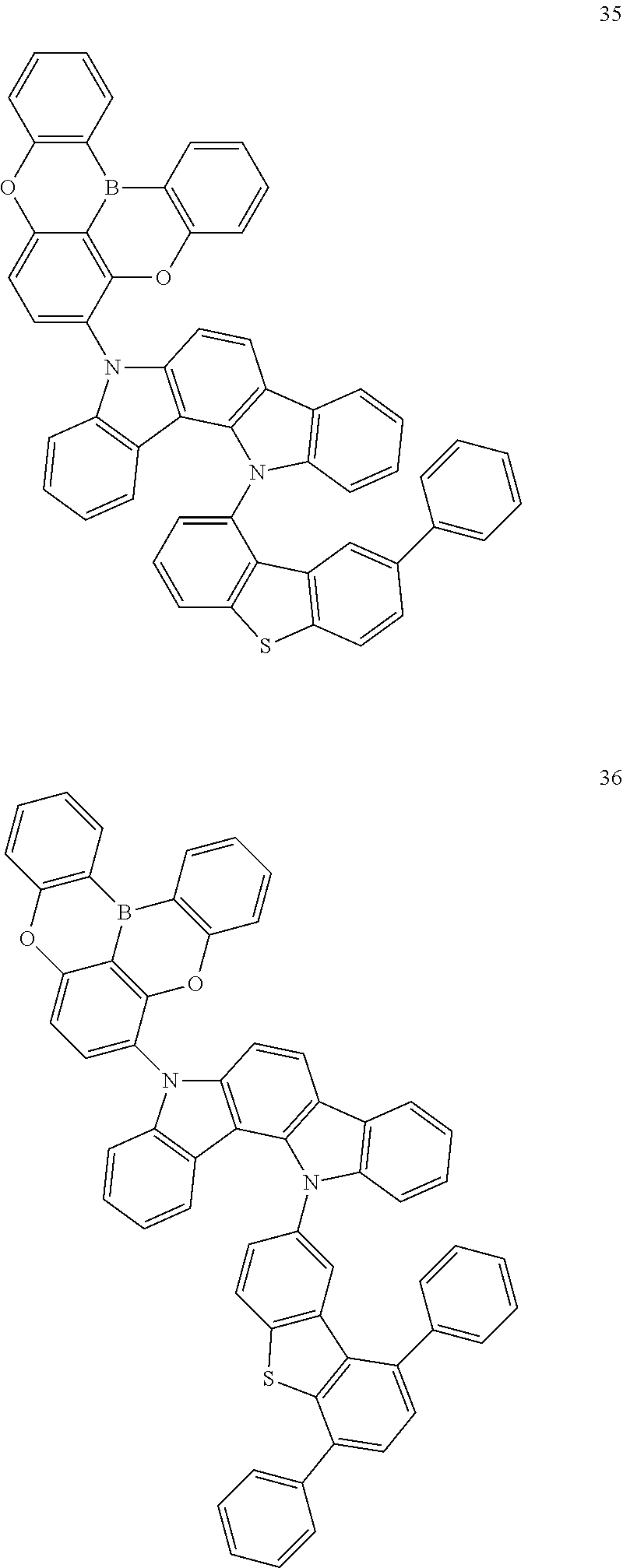


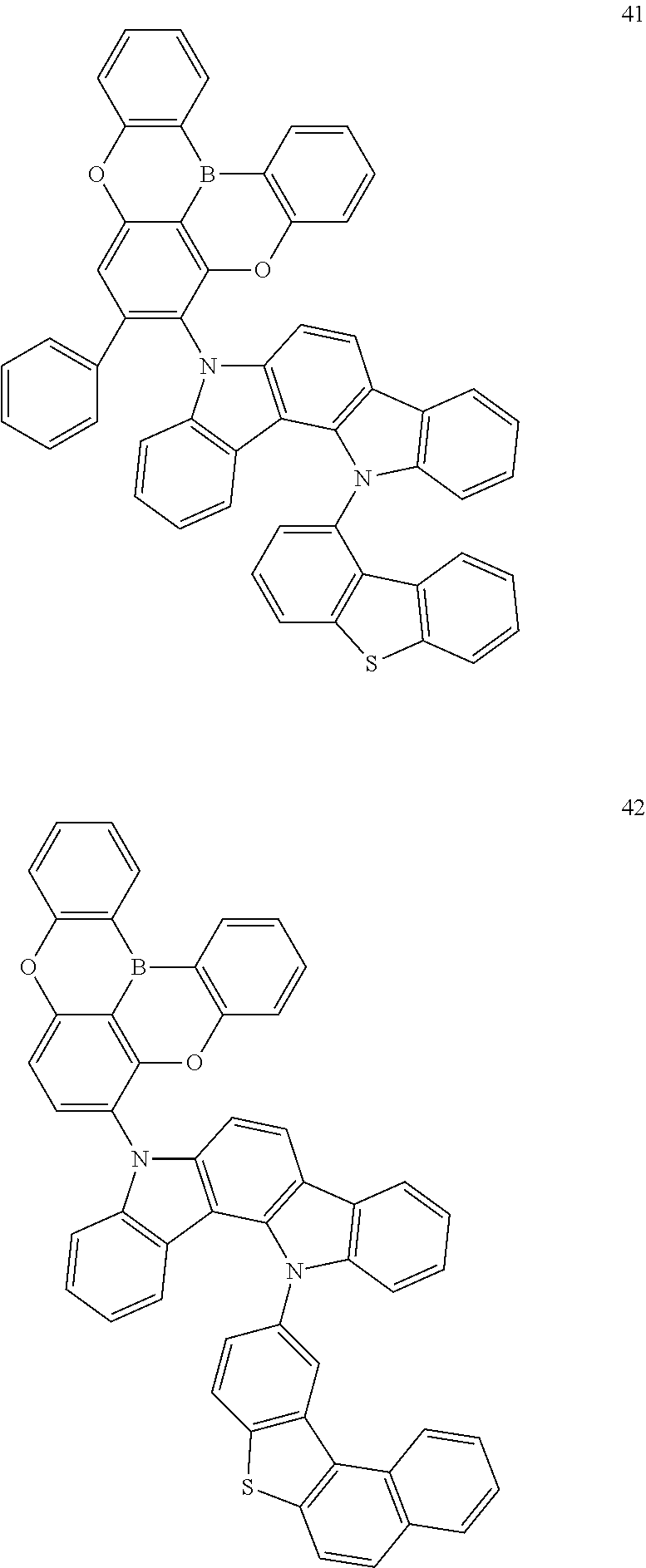


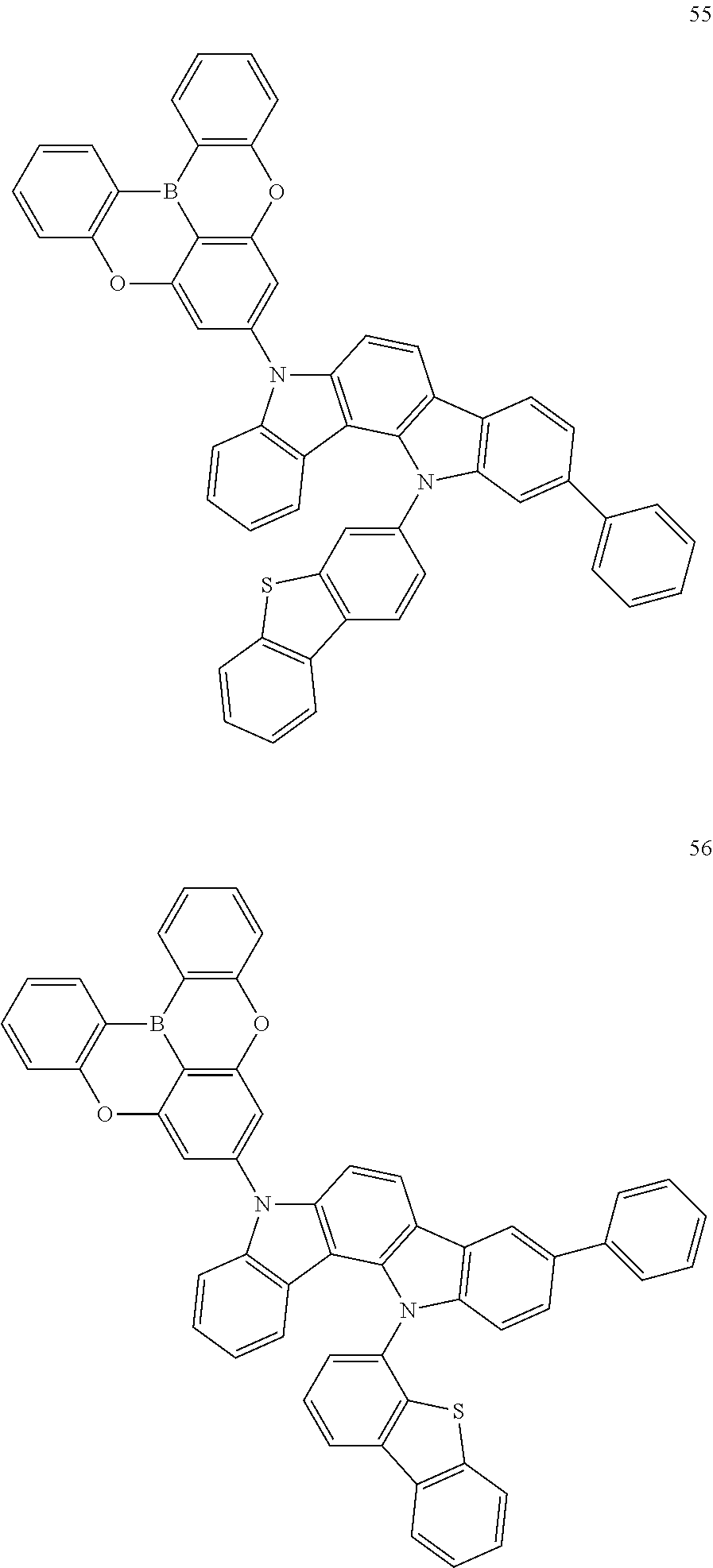


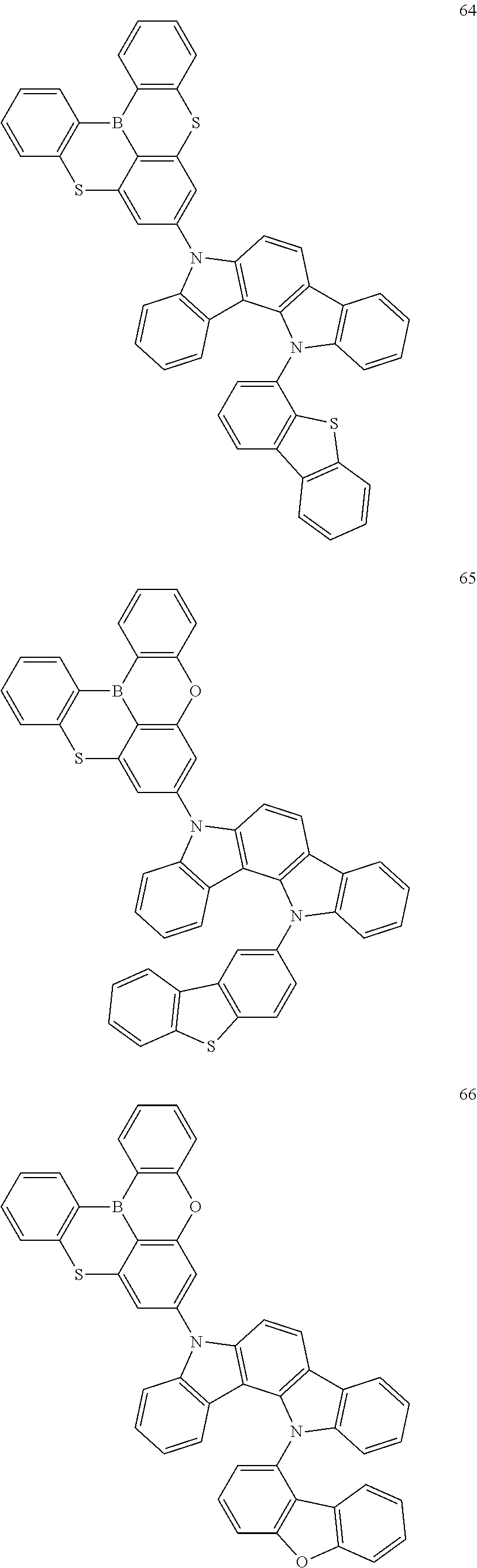


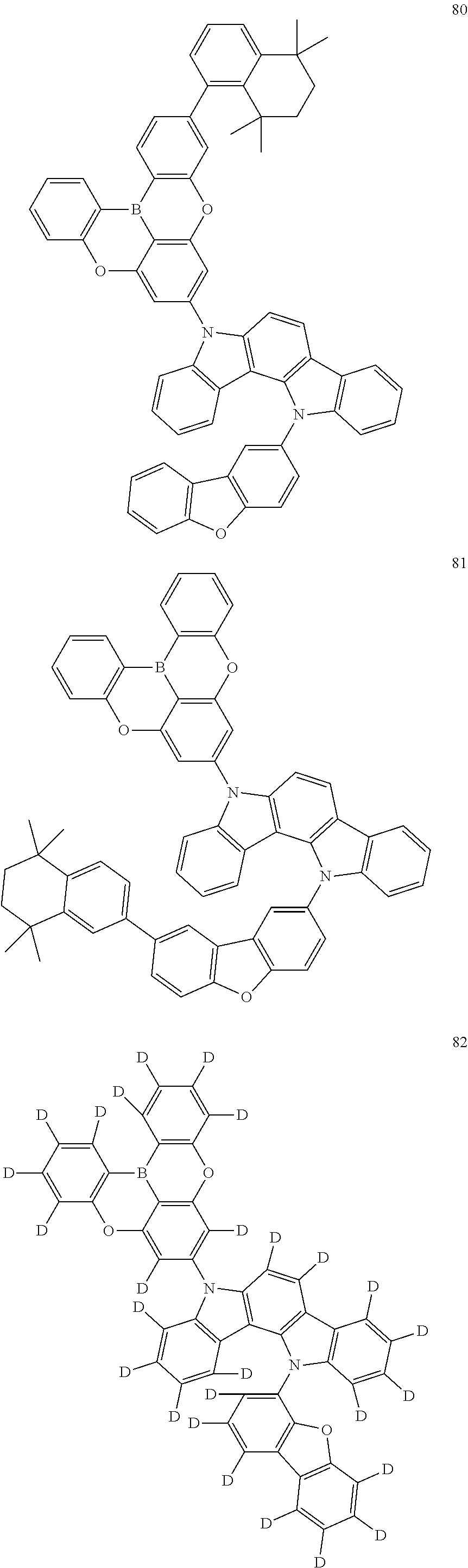

[0102]In addition, the present disclosure provides an organic light-emitting diode, including: a first electrode; a second electrode facing the first electrode; and an organic layer disposed between the first electrode and the second electrode, wherein the organic layer includes an emission layer containing a host and a dopant and the host in the emission layer includes at least one of the heterocyclic compounds described above according to the present disclosure. The organic light-emitting diode can exhibit low-voltage driving, high efficiency, and long lifespan characteristics.
[0103]Herein, the organic layer may further include at least one layer selected from a hole injection layer, a hole transport layer, a functional layer capable of both hole injection and hole transport, an electron blocking layer, an electron transport layer, an electron injection layer, a functional layer capable of both electron injection and electron transport, and a hole blocking layer.
[0104]Throughout the description of the present disclosure, the phrase “(organic layer) includes at least one organic compound” may be construed to mean that “(organic layer) may include a single organic compound species or two or more different species of organic compounds falling within the scope of the present disclosure”.
[0105]According to a more preferred embodiment thereof, the present disclosure may provide an organic light-emitting diode including: a first electrode; a second electrode facing the first electrode; and an organic layer interposed between the first electrode and the second electrode, wherein the organic layer includes: an emission layer including a host and a dopant; and at least one layer selected from a hole injection layer, a hole transport layer, a functional layer capable of both hole injection and hole transport, an electron blocking layer, a hole blocking layer, an electron transport layer, and an electron injection layer, and the host includes one or more heterocyclic compounds according to the present disclosure. In this regard, the heterocyclic compound represented by Chemical Formula 1 according to the present disclosure may be used as a blue phosphorescent host.
[0106]In the present disclosure, a dopant material may be used, together with the host, in the emission layer. When the emission layer includes the host and the dopant, the content of the dopant may generally be selected within a range of about 0.01 to about 20 parts by weight based on 100 parts by weight of the host, without being limited thereto.
[0107]In an embodiment of the present disclosure, the emission layer of the organic light-emitting diode further comprises a host compound different from the heterocyclic compound, the host compound and the heterocyclic compound being used in mixture or stacked. That is, the host according to the present disclosure may include, in addition to one compound represented by Chemical Formula 1, one or more additional host compounds different therefrom, such that two or more host compounds are mixed or stacked. In the case of stacking, a layer including the heterocyclic compound according to the present disclosure may be stacked above or below a layer including a host compound different from the heterocyclic compound.
[0108]Here, when two or more host compounds including one or more additional host compounds in addition to the compound represented by Chemical Formula 1 are mixed or stacked, a compound having an electron-accepting moiety may be more preferably used as the additional host. Due to high hole injection and electron injection barriers resulting from HOMO/LUMO levels formed by mixing or stacking with Chemical Formula 1 having an amine group as an electron-donating moiety, a recombination zone may be confined to an interface between the two hosts, thereby minimizing current loss and enabling realization of an organic light-emitting diode with high efficiency and long lifetime.
[0109]At this time, the compound having an electron-accepting moiety refers to a compound having a moiety that provides an environment capable of easily accepting electrons from the outside, such as azine compounds that are nitrogen-containing aromatic heterocycles including pyridine, pyrimidine, triazine, and the like, or compounds substituted with a cyano group (—CN). Preferably, the compound may include a heteroaryl group containing 1 to 3 nitrogen (N) atoms in a molecule, or an aryl group including 1 to 3 cyano groups (—CN) in a molecule.
[0110]Here, as the compound having an electron-accepting moiety and including a heteroaryl group containing 1 to 3 nitrogen (N) atoms in a molecule, a compound represented by the following Chemical Formula B may be used.
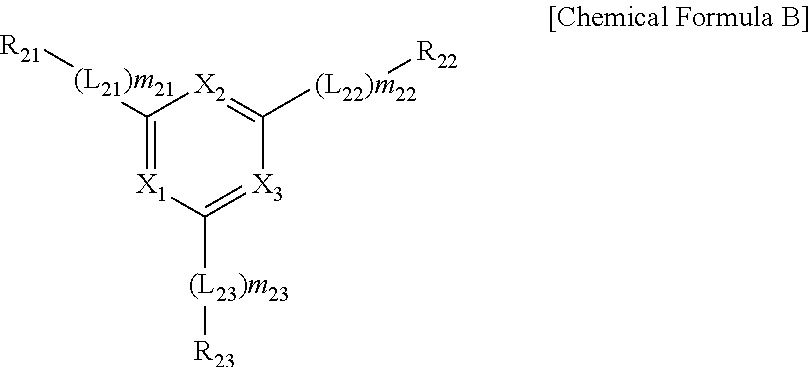
- [0111]wherein,
- [0112]X1 to X3, which are same or different, are each independently N or CR24, with a proviso that at least one of X1 to X3 is N, wherein when two of X1 to X3 are CR24, the corresponding CR24 radicals are same or different,
- [0113]L21 to L23, which are same or different, are each independently any one selected from a single bond, a substituted or unsubstituted arylene of 6 to 20 carbon atoms, a substituted or unsubstituted heteroarylene of 3 to 20 carbon atoms, and a substituted or unsubstituted, aliphatic hydrocarbon ring-fused arylene of 8 to 20 carbon atoms,
- [0114]m21 to m23, which are same or different, are each independently an integer of 1 to 2, wherein when they are 2, the corresponding L21 to L23 radicals are individually same or different, and
- [0115]R21 to R24, which are same or different, are each independently any one selected from a hydrogen atom, a deuterium atom, a tritium atom, a substituted or unsubstituted alkyl of 1 to 30 carbon atoms, a substituted or unsubstituted halogenated alkyl of 1 to 30 carbon atoms, a substituted or unsubstituted alkenyl of 2 to 30 carbon atoms, a substituted or unsubstituted alkynyl of 2 to 30 carbon atoms, a substituted or unsubstituted aryl of 6 to 50 carbon atoms, a substituted or unsubstituted cycloalkyl of 3 to 30 carbon atoms, a substituted or unsubstituted cycloalkenyl of 5 to 30 carbon atoms, a substituted or unsubstituted heterocycloalkyl of 2 to 30 carbon atoms, a substituted or unsubstituted heteroalkyl of 2 to 50 carbon atoms, a substituted or unsubstituted heteroaryl of 2 to 50 carbon atoms, a substituted or unsubstituted aromatic hydrocarbon ring-fused cycloalkyl of 7 to 30 carbon atoms, a substituted or unsubstituted heteroaromatic ring-fused cycloalkyl of 5 to 30 carbon atoms, a substituted or unsubstituted aromatic hydrocarbon ring-fused heterocycloalkyl of 6 to 30 carbon atoms, a substituted or unsubstituted aliphatic hydrocarbon ring-fused aryl of 8 to 30 carbon atoms, a substituted or unsubstituted aliphatic hydrocarbon ring-fused heteroaryl of 5 to 30 carbon atoms, a substituted or unsubstituted alkoxy of 1 to 30 carbon atoms, a substituted or unsubstituted aryloxy of 6 to 30 carbon atoms, a substituted or unsubstituted cycloalkyloxy of 3 to 30 carbon atoms, a substituted or unsubstituted heteroaryloxy of 2 to 30 carbon atoms, a substituted or unsubstituted alkylthio of 1 to 30 carbon atoms, a substituted or unsubstituted arylthio of 6 to 30 carbon atoms, a substituted or unsubstituted cycloalkylthio of 3 to 30 carbon atoms, a substituted or unsubstituted heteroarylthio of 2 to 30 carbon atoms, a substituted or unsubstituted amine of 0 to 40 carbon atoms, a substituted or unsubstituted silyl of 0 to 40 carbon atoms, a germanium of 0 to 40 carbon atoms, a nitro, a cyano, and a halogen atom,
- [0116]wherein the term “substituted” in the expression “substituted or unsubstituted” used for the compound of Chemical Formula B means having at least one substituent selected from the group consisting of a deuterium atom, a tritium atom, a cyano, a halogen, a hydroxy, a nitro, an alkyl of 1 to 30 carbon atoms, a halogenated alkyl of 1 to 30 carbon atoms, an alkenyl of 2 to 30 carbon atoms, an alkynyl of 2 to 30 carbon atoms, a cycloalkyl of 3 to 30 carbon atoms, a heteroalkyl of 1 to 30 carbon atoms, an aryl of 6 to 30 carbon atoms, an arylalkyl of 7 to 30 carbon atoms, an alkylaryl of 7 to 30 carbon atoms, a heteroaryl of 2 to 30 carbon atoms, a heteroarylalkyl of 3 to 30 carbon atoms, an alkylheteroaryl of 3 to 30 carbon atoms, an alkoxy of 1 to 30 carbon atoms, an aromatic hydrocarbon ring-fused cycloalkyl of 7 to 30 carbon atoms, an heteroaromatic ring-fused cycloalkyl of 5 to 30 carbon atoms, an aromatic hydrocarbon ring-fused heterocycloalkyl of 6 to 30 carbon atoms, an aliphatic hydrocarbon ring-fused aryl of 7 to 30 carbon atoms, an aliphatic hydrocarbon ring-fused heteroaryl of 5 to 30 carbon atoms, a substituted or unsubstituted heteroaliphatic ring-fused aryl of 6 to 30 carbon atoms, a substituted or unsubstituted heteroaliphatic ring-fused heteroaryl of 5 to 30 carbon atoms, an amine of 1 to 30 carbon atoms, a silyl of 1 to 30 carbon atoms, a germanium of 1 to 30 carbon atoms, an aryloxy of 6 to 30 carbon atoms, and an arylthionyl of 6 to 30 carbon atoms, with at least one hydrogen atom on the substituent being substitutable with a deuterium or tritium atom.
[0117]In a more preferred embodiment of the present disclosure, X1 to X3 in Chemical Formula B may each be N, and at least one of R21 to R23 may be a substituted or unsubstituted carbazole.
[0118]In the present disclosure, a dopant material may be used, together with the host, in the emission layer. When the emission layer includes the host and the dopant, the content of the dopant may generally be selected within a range of about 0.01 to about 20 parts by weight based on 100 parts by weight of the host, without being limited thereto.
[0119]More specifically, the dopant in the emission layer of the organic light-emitting diode according to the present disclosure may be an organometallic compound containing a transition metal. In this regard, the dopant is not a fluorescent dopant material that undergoes transition only to a singlet state via Forster energy transfer in a conventional host-dopant system, but rather a phosphorescent dopant t material that undergoes transition without distinguishing between singlet and triplet states via Dexter energy transfer, and includes a metal complex containing one or more metals selected from Ir, Pt, Os, Ti, Zr, Hf, Eu, Tb, Tm, Fe, Co, Ni, Ru, Rh, Re, and Pd. Any known dopant material that emits light from a triplet excited state may be used without particular limitation.
[0120]The dopant material is preferably a transition metal complex, and Ir, Pt, and Pd may be selected. Specific examples include Ir(ppy)3, Ir(ppy)2acac, Ir(Bt)2acac, Ir(MDQ)2acac, Ir(mppy)3, Ir(piq)3, Ir(piq)2acac, Ir(pq)2acac, Ir(mpp)2acac, F2Irpic, (F2ppy)2Ir(tmd), Ir(ppy)2tmd, Ir(pmi)3, Ir(pmb)3, FCNIr, FCNIrpic, FIr6, FIrN4, FIrpic, PtOEP, Ir(chpy)3, PO-01(C31H23IrN2O2S2), Ir(ppz)3, Ir(dfppz)3, PtNON, Pt-10, and Pt-11, but are not limited thereto.
[0121]In addition to the dopant and the host, the emission layer may further include various hosts and various dopant materials. Preferably, in the emission layer of the organic light-emitting diode, one or more dopant compounds containing boron (B), which are different from the organometallic compound containing the transition metal, may be mixed or stacked together with the dopant.
[0122]More specifically, in the emission layer of the organic light-emitting diode, one or more polycyclic compounds represented by the following Chemical Formula 2 may be used in mixture with the organometallic compound containing the transition metal or may be used by stacking the polycyclic compound represented by [Chemical Formula 2] on an upper or lower surface of a layer including the organometallic compound:
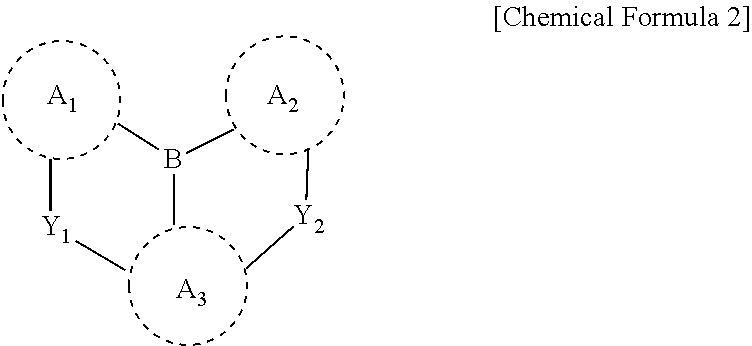
- [0123]wherein,
- [0124]Y1 and Y2, which are same or different, are each independently any one selected from O, S, NR11, CR12R13, SiR14R15, and GeR16R17,
- [0125]A1 to A3, which are same or different, are each independently any one selected from a substituted or unsubstituted aromatic hydrocarbon ring of 6 to 50 carbon atoms, a substituted or unsubstituted aliphatic hydrocarbon ring of 5 to 50 carbon atoms, a substituted or unsubstituted, aliphatic hydrocarbon ring-fused aromatic hydrocarbon ring of 8 to 50 carbon atoms, a substituted or unsubstituted heteroaromatic ring of 2 to 50 carbon atoms, and a substituted or unsubstituted, aliphatic hydrocarbon ring-fused heteroaromatic ring of 5 to 50 carbon atoms,
- [0126]R11 to R17, which are same or different, are each independently any one selected from a hydrogen atom, a deuterium atom, a tritium atom, a substituted or unsubstituted alkyl of 1 to 30 carbon atoms, a substituted or unsubstituted halogenated alkyl of 1 to 30 carbon atoms, a substituted or unsubstituted alkenyl of 2 to 30 carbon atoms, a substituted or unsubstituted alkynyl of 2 to 30 carbon atoms, a substituted or unsubstituted aryl of 6 to 50 carbon atoms, a substituted or unsubstituted cycloalkyl of 3 to 30 carbon atoms, a substituted or unsubstituted cycloalkenyl of 5 to 30 carbon atoms, a substituted or unsubstituted heterocycloalkyl of 2 to 30 carbon atoms, a substituted or unsubstituted heteroalkyl of 2 to 50 carbon atoms, a substituted or unsubstituted heteroaryl of 2 to 50 carbon atoms, a substituted or unsubstituted aromatic hydrocarbon ring-fused cycloalkyl of 7 to 30 carbon atoms, a substituted or unsubstituted heteroaromatic ring-fused cycloalkyl of 5 to 30 carbon atoms, a substituted or unsubstituted aromatic hydrocarbon ring-fused heterocycloalkyl of 6 to 30 carbon atoms, a substituted or unsubstituted aliphatic hydrocarbon ring-fused aryl of 8 to 30 carbon atoms, a substituted or unsubstituted aliphatic hydrocarbon ring-fused heteroaryl of 5 to 30 carbon atoms, a substituted or unsubstituted alkoxy of 1 to 30 carbon atoms, a substituted or unsubstituted aryloxy of 6 to 30 carbon atoms, a substituted or unsubstituted cycloalkyloxy of 3 to 30 carbon atoms, a substituted or unsubstituted heteroaryloxy of 2 to 30 carbon atoms, a substituted or unsubstituted alkylthio of 1 to 30 carbon atoms, a substituted or unsubstituted arylthio of 6 to 30 carbon atoms, a substituted or unsubstituted cycloalkylthio of 3 to 30 carbon atoms, a substituted or unsubstituted heteroarylthio of 2 to 30 carbon atoms, a substituted or unsubstituted amine of 0 to 40 carbon atoms, a substituted or unsubstituted silyl of 0 to 40 carbon atoms, a germanium of 0 to 40 carbon atoms, a nitro, a cyano, and a halogen,
- [0127]R11 to R17 may be connected to the A1 to A3 ring moieties to additionally form an aliphatic or aromatic mono- or polycyclic ring, and
- [0128]a linkage may be made between R12 and R13, between R14 and R15, and between R16 and R17 to additionally form respective mono- or polycyclic aliphatic or aromatic rings,
- [0129]wherein the term “substituted” in the expression “substituted or unsubstituted” used for the compound of Chemical Formula 2 means having at least one substituent selected from the group consisting of a deuterium atom, a tritium atom, a cyano, a halogen, a hydroxy, a nitro, alkyl of 1 to 30 carbon atoms, a halogenated alkyl of 1 to 30 carbon atoms, an alkenyl of 2 to 24 carbon atoms, an alkynyl of 2 to 24 carbon atoms, a cycloalkyl of 3 to 24 carbon atoms, a heteroalkyl of 1 to 24 carbon atoms, an aryl of 6 to 24 carbon atoms, an arylalkyl of 7 to 24 carbon atoms, an alkylaryl of 7 to 24 carbon atoms, a heteroaryl of 2 to 24 carbon atoms, a heteroarylalkyl of 3 to 24 carbon atoms, an alkylheteroaryl of 3 to 24 carbon atoms, an alkoxy of 1 to 24 carbon atoms, an aromatic hydrocarbon ring-fused cycloalkyl of 7 to 30 carbon atoms, an heteroaromatic ring-fused cycloalkyl of 5 to 30 carbon atoms, an aromatic hydrocarbon ring-fused heterocycloalkyl of 6 to 30 carbon atoms, an aliphatic hydrocarbon ring-fused aryl of 7 to 30 carbon atoms, an aliphatic hydrocarbon ring-fused heteroaryl of 5 to 30 carbon atoms, a substituted or unsubstituted heteroaliphatic ring-fused aryl of 6 to 30 carbon atoms, a substituted or unsubstituted heteroaliphatic ring-fused heteroaryl of 5 to 30 carbon atoms, an amine of 1 to 30 carbon atoms, a silyl of 1 to 30 carbon atoms, a germanium of 1 to 30 carbon atoms, an aryloxy of 6 to 24 carbon atoms, and an arylthionyl of 6 to 24 carbon atoms, with at least one hydrogen atom on the substituents being substitutable with a deuterium or tritium atom.
[0130]Herein, the polycyclic compound represented by Chemical Formula 2 is a boron-based thermally activated delayed fluorescence emitter, which enables Forster energy transfer from the triplet state of a phosphorescent sensitizer to the singlet state of the boron-based thermally activated delayed fluorescence emitter. Accordingly, the number of long-lived triplet excitons involved in device degradation can be reduced, thereby improving device lifetime. In addition, since the compound has a high molar extinction coefficient, the rate of fluorescence resonance energy transfer from the phosphorescent sensitizer to the emitter is increased, and the emission spectrum is narrowed due to a multiple-resonance effect, resulting in improved color purity. Owing to these effects, the compound has advantages in improving efficiency and lifetime.
[0131]In a more preferred embodiment of the present disclosure, A1 to A3 may be same as or different from each other, and each independently may be any one selected from a substituted or unsubstituted aromatic hydrocarbon ring of 6 to 30 carbon atoms, and a substituted or unsubstituted aliphatic hydrocarbon ring-fused aromatic hydrocarbon ring of 8 to 30 carbon atoms.
[0132]Below, with reference to the drawing, a description will be given of the organic light-emitting diode of the present disclosure.
[0133]FIGURE is a schematic view illustrating the structure of an organic light-emitting diode according to an embodiment of the present disclosure.
[0134]As shown in FIGURE, the organic light-emitting diode according to an embodiment of the present disclosure sequentially comprises an anode (20), a hole transport layer (40), an emission layer (50) containing a host and a dopant, an electron transport layer (60), and a cathode (80), wherein the anode and the cathode serve as a first electrode and a second electrode, respectively, with the interposition of the hole transport layer between the anode and the light emission layer, and the electron transport layer between the emission layer and the cathode.
[0135]Furthermore, the organic light-emitting diode according to an embodiment of the present disclosure may include a hole injection layer (30) between the anode (20) and the hole transport layer (40), and an electron injection layer (70) between the electron transport layer (60) and the cathode (80).
[0136]Reference is made to FIGURE with regard to the organic light-emitting diode of the present disclosure and the fabrication thereof.
[0137]First, a substrate (10) is coated with an anode material to form an anode (20). So long as it is used in a typical organic electroluminescence (EL) device, any substrate may be used as the substrate (10). Preferable is an organic substrate or transparent plastic substrate that exhibits excellent transparency, surface smoothness, ease of handling, and waterproofness. As the anode material, indium tin oxide (ITO), indium zinc oxide (IZO), tin oxide (SnO2), or zinc oxide (ZnO), which are transparent and superior in terms of conductivity, may be used.
[0138]A hole injection layer material is applied on the anode (20) by thermal deposition in a vacuum or by spin coating to form a hole injection layer (30). Subsequently, thermal deposition in a vacuum or by spin coating may also be conducted to form a hole transport layer (40) with a hole transport layer material on the hole injection layer (30).
[0139]So long as it is typically used in the art, any material may be selected for the hole injection layer (30) without particular limitations thereto. Examples include, but are not limited to, 2-TNATA [4,4′,4″-tris(2-naphthylphenyl-phenylamino)-triphenylamine], NPD[N,N′-di(1-naphthyl)-N, N′-diphenylbenzidine)], TPD [N,N′-diphenyl-N, N′-bis(3-methylphenyl)-1,1′-biphenyl-4,4′-diamine], DNTPD[N,N′-diphenyl-N, N′-bis-[4-(phenyl-m-tolyl-amino)-phenyl]-biphenyl-4,4′-diamine], and HAT-CN[1,4,5,8,9,11-Hexaazatriphenylenehexacarbonitrile].
[0140]Any material that is typically used in the art may be selected for the hole transport layer (40) without particular limitations thereto. Examples include, but are not limited to, N,N′-bis(3-methylphenyl)-N, N′-diphenyl-[1,1-biphenyl]-4,4′-diamine (TPD) or N,N′-di(naphthalen-1-yl)-N, N′-diphenylbenzidine (a-NPD), N-[[1,1′-biphenyl]-4-yl]-9,9-dimethyl-N-[4-(9-phenyl-9H-carbazol-3-yl)phenyl]-9H-fluorene-2-amine (BCEN), and the like.
[0141]In an embodiment of the present disclosure, an electron blocking layer may be additionally disposed on the hole transport layer. Functioning to prevent the electrons injected from the electron injection layer from entering the hole transport layer through the emission layer, the electron blocking layer is adapted to increase the life span and luminous efficiency of the diode. The electron blocking layer may be formed at a suitable position between the emission layer and the hole injection layer and particularly between the emission layer and the hole transport layer.
[0142]Next, the emission layer (50) may each be deposited or co-deposited on the hole transport layer (40) by deposition in a vacuum or by spin coating.
[0143]Here, the emission layer may be composed of a host and a dopant, and the materials constituting the layer are as previously described.
[0144]According to a specific embodiment of the present disclosure, the thickness of the emission layer may preferably range from 50 to 2,000 Å.
[0145]In the present disclosure, a hole blocking layer (not shown) may be formed on the organic emission layer (50) by vacuum deposition or spin coating.
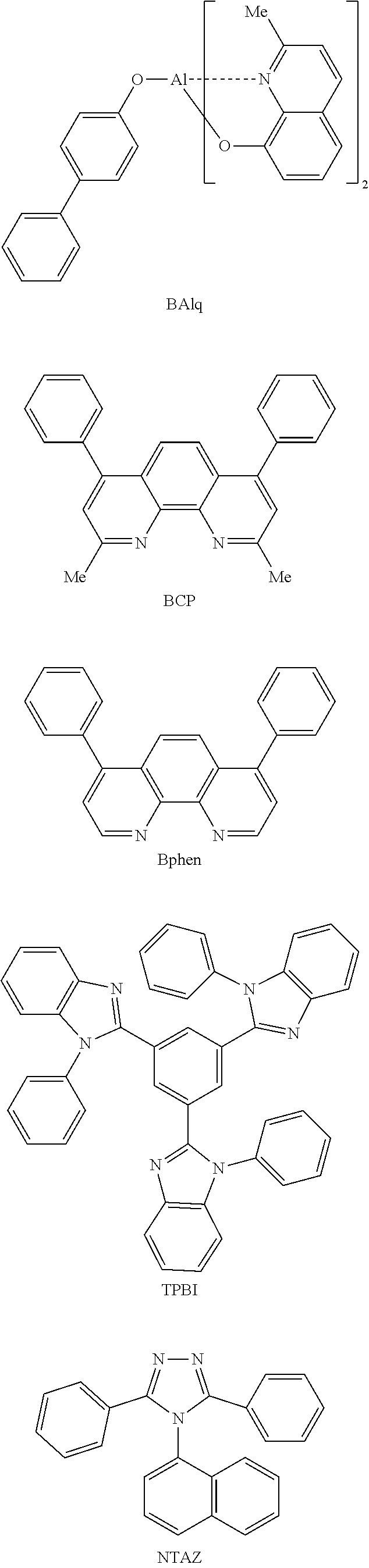
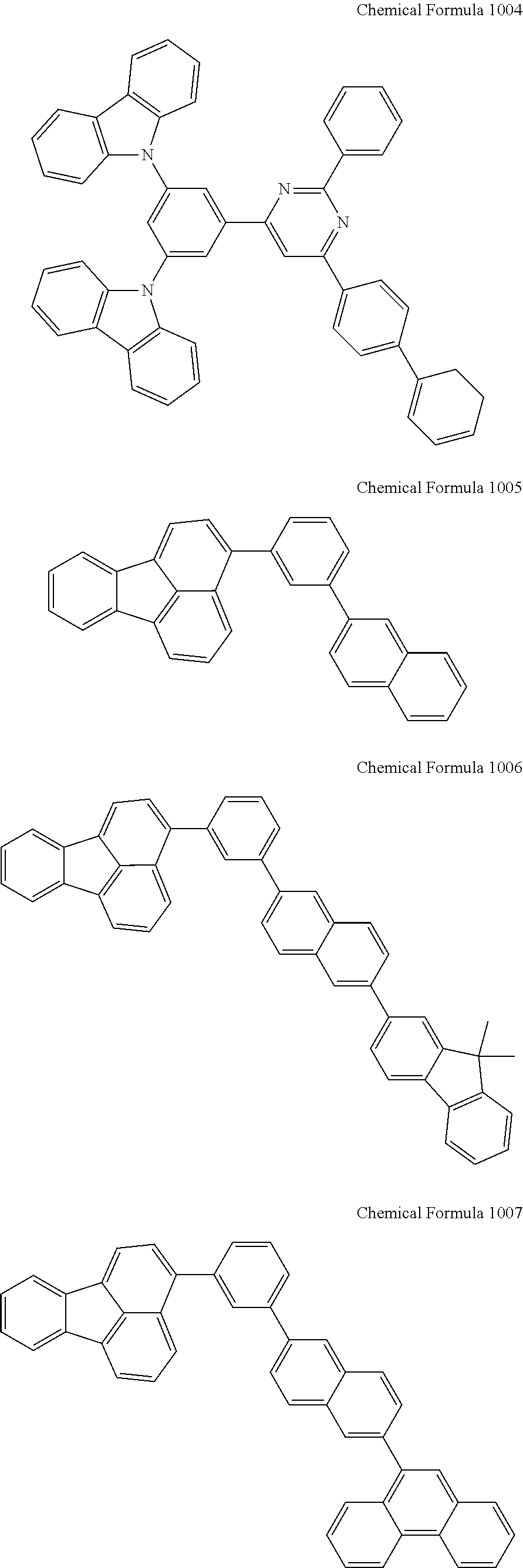
[0146]The hole blocking layer serves to prevent a reduction in device lifetime and efficiency that may occur when holes pass through the light-emitting layer and flow into the cathode, by employing a material having a very low HOMO (Highest Occupied Molecular Orbital) level. At this time, the hole blocking material to be used is not particularly limited, as long as it has electron-transporting ability and a higher ionization potential than that of the light-emitting compound. Examples of materials that may be used in the hole blocking layer include BAlq, BCP, Bphen, TPBI, NTAZ, BeBq2, OXD-7, Liq, and any one selected from Chemical Formula 1001 to Chemical Formula 1007, but are not limited thereto.

[0147]The electron transport layer (60) may be deposited on the emission layer by vacuum deposition or spin coating.
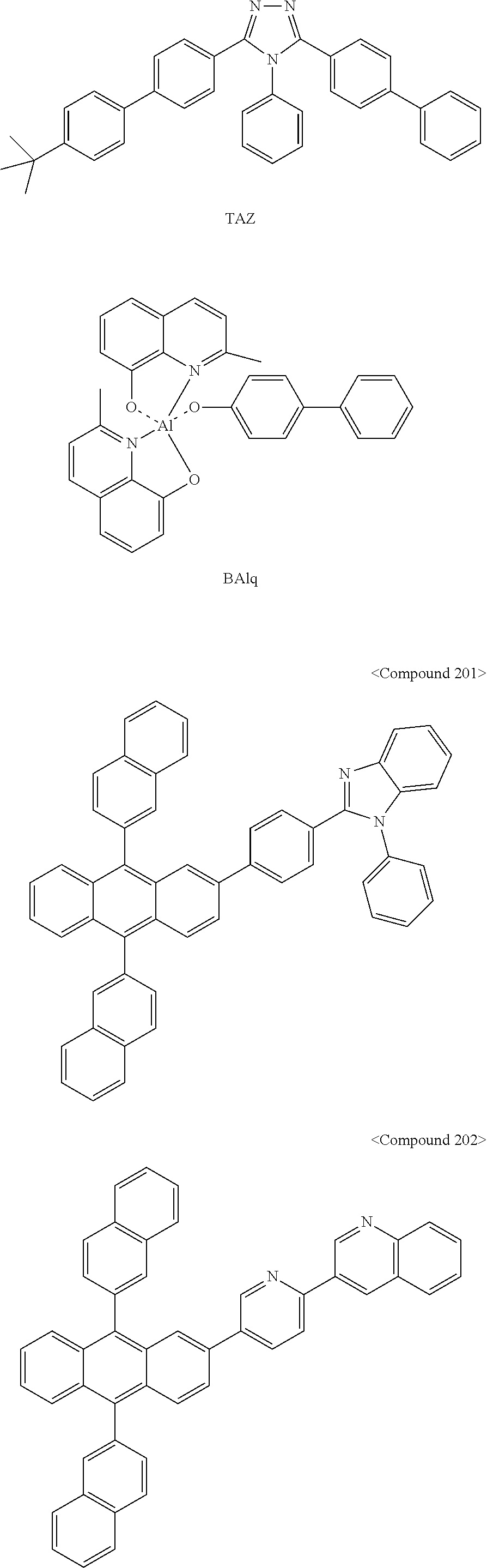
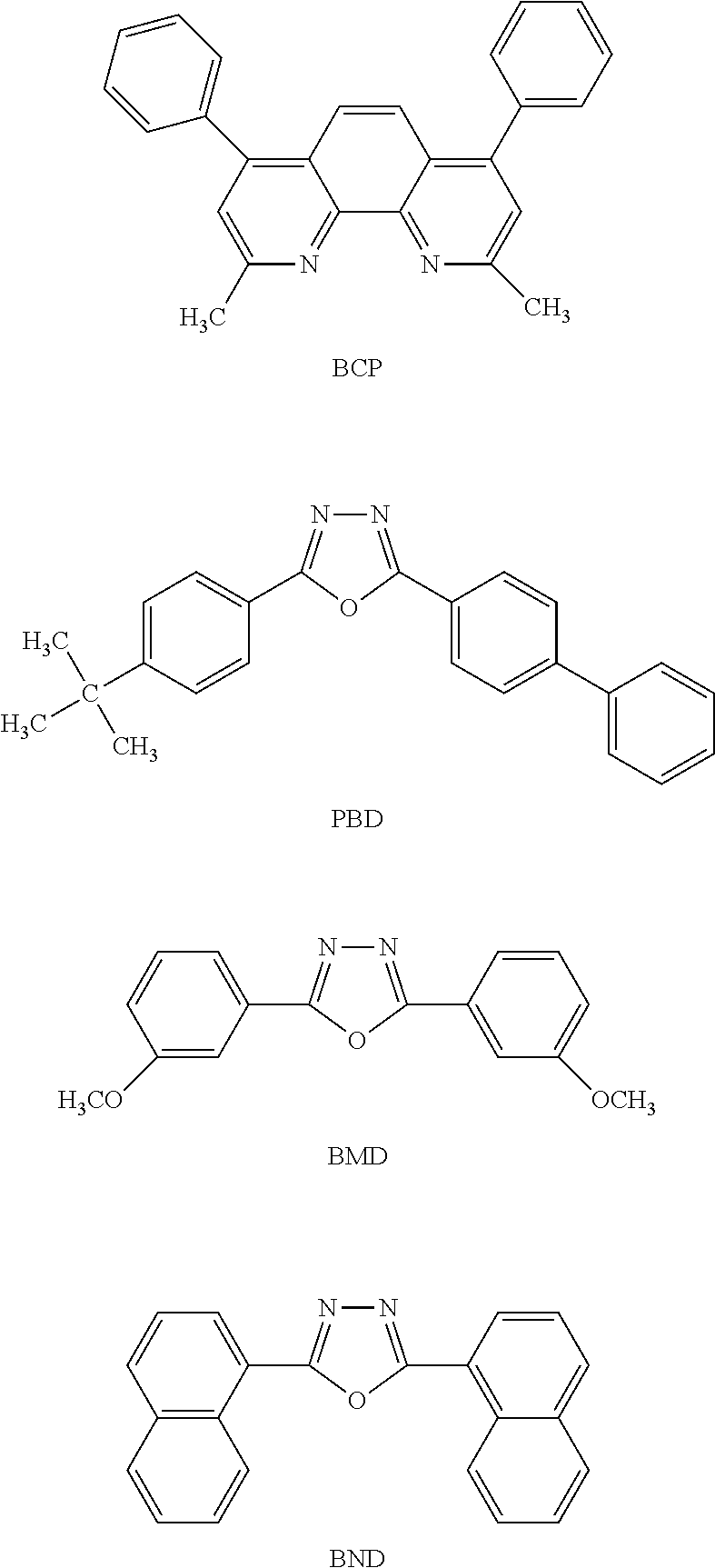
[0148]In the present disclosure, the electron transport layer (60) functions to stably transport electrons injected from the electron-injecting electrode (cathode), and known electron transport materials may be used. Examples of such known materials include quinoline derivatives, particularly tris(8-quinolinolato)aluminum (Alq3), Liq, TAZ, BAlq, beryllium bis(benzoquinolin-10-olate) (Bebq2), Compound 201, Compound 202, BCP, and oxadiazole derivatives such as PBD, BMD, and BND, but are not limited thereto:
[0149]In the organic light-emitting diode of the present disclosure, an electron injection layer (EIL) that functions to facilitate electron injection from the cathode may be formed on the electron transport layer. The material for the EIL is not particularly limited.
[0150]Any material that is conventionally used in the art can be available for the electron injection layer. Examples include CsF, NaF, LiF, Li2O, and BaO. Deposition conditions for the electron injection layer may vary, depending on compounds used, but may be generally selected from condition scopes that are almost the same as for the formation of hole injection layers.
[0151]The electron injection layer may range in thickness from about 1 Å to about 100 Å, and particularly from about 3 Å to about 90 Å. Given the thickness range for the electron injection layer, the diode can exhibit satisfactory electron injection properties without actually elevating a driving voltage.
[0152]In order to facilitate electron injection, the cathode may be made of a material having a small work function, such as metal or metal alloy such as lithium (Li), magnesium (Mg), calcium (Ca), an alloy aluminum (Al) thereof, aluminum-lithium (Al—Li), magnesium-indium (Mg—In), and magnesium-silver (Mg—Ag). Alternatively, ITO or IZO may be employed to form a transparent cathode for an organic light-emitting diode.
[0153]Furthermore, at least one selected from among the layers may be deposited using a single-molecule deposition process or a solution process.
[0154]Here, the deposition process is a process by which a material is vaporized in a vacuum or at a low pressure and deposited to form a layer, and the solution process is a method in which a material is dissolved in a solvent and applied for the formation of a thin film by means of inkjet printing, roll-to-roll coating, screen printing, spray coating, dip coating, spin coating, etc.
[0155]Also, the organic light-emitting diode of the present disclosure may be applied to a device selected from among flat display devices; flexible display devices; monochrome or grayscale flat illumination devices; monochrome or grayscale flexible illumination devices; vehicle or aircraft display devices, and display devices for virtual or augmented reality.
[0156]A better understanding of the present disclosure may be obtained through the following examples which are set forth to illustrate, but are not to be construed as limiting the present disclosure.
EXAMPLES
Synthesis Example 1. Synthesis of [Compound 67]
Synthesis Example 1-1. Synthesis of A-1

[0157]In a round-bottom flask, <A-1b> (50 g), <A-1a> (187.8 g), potassium carbonate (220.3 g), and N, N-dimethylformamide (500 mL) were refluxed together for 24 hours. After completion of the reaction, the reaction mixture was cooled to room temperature and then filtered through celite. The filtrate was concentrated in a vacuum, followed by column chromatography to afford <A-1>. (143 g, 77.8%)
Synthesis Example 1-2. Synthesis of A-2

[0158]In a round-bottom flask, <A-1> (143 g), <A-2a> (63.8 g), potassium carbonate (171.4 g), and N, N-dimethylformamide (720 mL) were refluxed together for 24 hours. After completion of the reaction, the reaction mixture was cooled to room temperature and then filtered through celite. The filtrate was concentrated in a vacuum, followed by column chromatography to afford <A-2>. (133 g, 70.8%)
Synthesis Example 1-3. Synthesis of A-3

[0159]In a round-bottom flask, <A-2> (133 g) and m-xylene (1300 mL) were stirred together at 0° C. for 30 min under a nitrogen atmosphere. Thereafter, drops of 1.6M n-butyl lithium (192 mL) was slowly added. After dropwise addition, the mixture was heated and stirred for one hour. Then, the mixture was chilled to −30° C. and dropwise added with borontribromide (88 g). Subsequent to elevation to room temperature, stirring was conducted for one hour. Again, the mixture was chilled to 0° C., added with N, N-diisopropylethylamine (143.7 g), and reacted at 130° C. for 12 hours. After completion of the reaction, the reaction mixture was chilled to room temperature and filtered. The solid was washed with methanol and recrystallized in monochlorobenzene to afford <A-3>. (38.4 g, 34.2%)
Synthesis Example 1-4. Synthesis of A-4

[0160]In a round-bottom flask, <A-3> (15 g), <A-4a> (9.3 g), tetrakis(triphenylphosphine) palladium (1.4 g), potassium carbonate (10.8 g), toluene (120 mL), ethanol (45 mL), and water (75 mL) were refluxed together for 12 hours. After completion of the reaction, the reaction mixture was cooled to room temperature and allowed to undergo layer separation. The organic layer was concentrated in a vacuum. Then, methanol was added and stirred, followed by filtration to afford <A-4>. (14.6 g, 81.7%)
Synthesis Example 1-5. Synthesis of A-5

[0161]In a round-bottom flask, <A-4> (14.6 g), <A-5a> (12.3 g), tris(dibenzylideneacetone) dipalladium (0.2 g), sodium tert-butoxide (7.7 g), tri-tert-butylphosphine (0.2 g), and toluene (150 mL) were refluxed together for 4 hours. After completion of the reaction, the reaction mixture was cooled to room temperature and then poured to methanol to precipitate crystals. After stirring for one hour, filtration afforded <A-5>. (12.4 g, 57.3%)
Synthesis Example 1-6. Synthesis of [Compound 67]

[0162]In a round-bottom flask, <A-5> (12.4 g), <A-6a> (7.2 g), tris(dibenzylideneacetone) dipalladium (0.1 g), sodium tert-butoxide (4.4 g), tri-tert-butylphosphine (0.1 g), and toluene (125 mL) were refluxed together for 12 hours. After completion of the reaction, the reaction mixture was cooled to room temperature and then poured to methanol to precipitate crystals. Stirring was conducted for one hour before filtration. The solid thus obtained was recrystallized in monochlorobenzene to afford [Compound 67]. (7.7 g, 48.9%)
[0163]MS (MALDI-TOF): m/z 858.25 [M+]
Synthesis Example 2. Synthesis of [Compound 1]
Synthesis Example 2-1. Synthesis of B-1

[0164]<B-1> was synthesized in the same manner as in Synthesis Example 1-1, with the exception that the equivalent of <A-1b> was doubled (Yield: 78.2%).
Synthesis Example 2-2. Synthesis of B-2

[0165]<B-2> was synthesized in the same manner as in Synthesis Example 1-3, with the exception of using <B-1> instead of <A-2>. (Yield 29%)
Synthesis Example 2-3. Synthesis of B-3

[0166]<B-3> was synthesized in the same manner as in Synthesis Example 1-5, with the exception of using <B-2> instead of <A-4>. (Yield 75.4%)
Synthesis Example 2-4. Synthesis of [Compound 1]

[0167][Compound 1] was synthesized in the same manner as in Synthesis Example 1-6, with the exception of using <B-3> and <B-4a> instead of <A-5> and <A-6a>, respectively. (Yield 53%)
[0168]MS (MALDI-TOF): m/z 690.21 [M+]
Synthesis Example 3. Synthesis of [Compound 2]
Synthesis Example 3-1. Synthesis of [Compound 2]
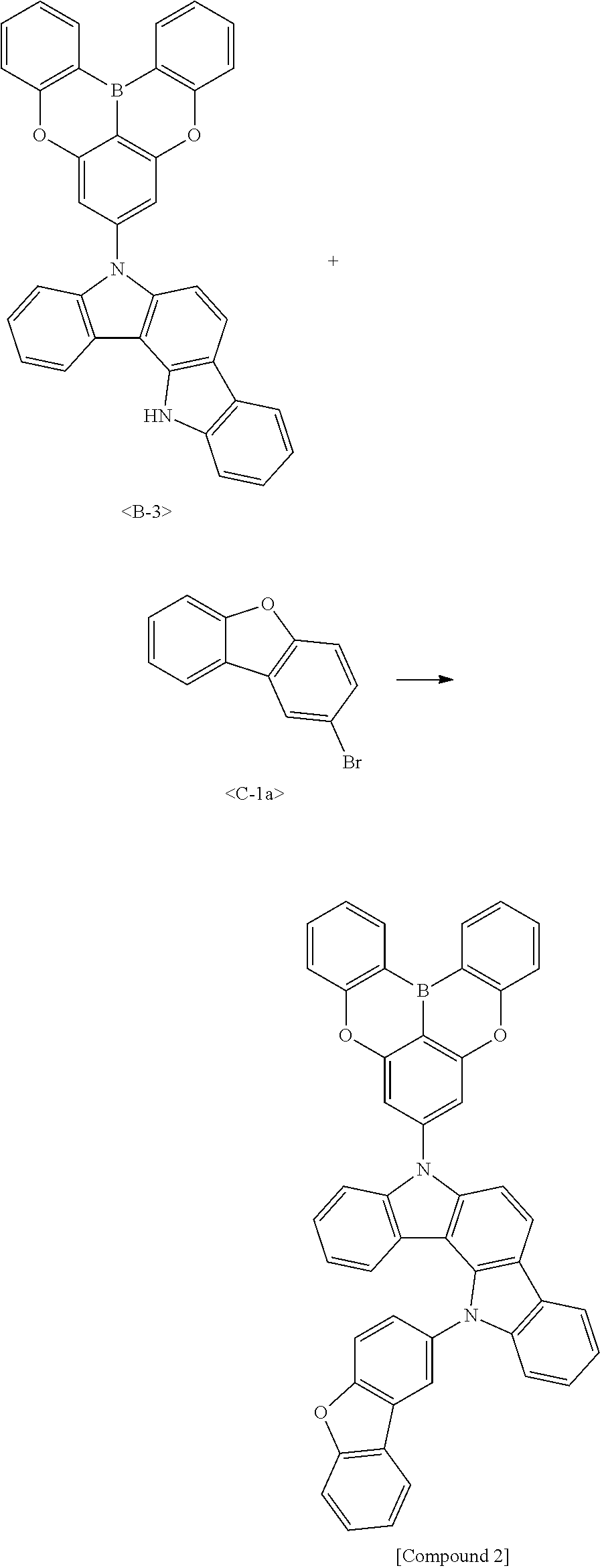
[0169][Compound 2] was synthesized in the same manner as in Synthesis Example 2-4, with the exception of using <C-1a> instead of <B-4a>. (Yield 57%)
[0170]MS (MALDI-TOF): m/z 690.21 [M+]
Synthesis Example 4. Synthesis of [Compound 22]
Synthesis Example 4-1. Synthesis of [Compound 22]

[0171][Compound 22] was synthesized in the same manner as in Synthesis Example 2-4, with the exception of using <D-1a> instead of <B-4a>. (Yield 47%)
[0172]MS (MALDI-TOF): m/z 706.19 [M+]
Synthesis Example 5. Synthesis of [Compound 23]
Synthesis Example 5-1. Synthesis of [Compound 23]

[0173][Compound 23] was synthesized in the same manner as in Synthesis Example 2-4, with the exception of using <E-1a> instead of <B-4a>. (Yield 48%)
[0174]MS (MALDI-TOF): m/z 706.19 [M+]
Synthesis Example 6. Synthesis of [Compound 31]
Synthesis Example 6-1. Synthesis of F-1

[0175]<F-1> was synthesized in the same manner as in Synthesis Example 1-1, with the exception of using <F-1a> instead of <A-1a>. (Yield 84%)
Synthesis Example 6-2. Synthesis of F-2

[0176]<F-2> was synthesized in the same manner as in Synthesis Example 1-3, with the exception of using <F-1> instead of <A-2>. (Yield 28%)
Synthesis Example 6-3. Synthesis of F-3

[0177]In a round-bottom flask, <F-2> (20.8 g) and tetrahydrofuran (420 mL) were stirred together under a nitrogen atmosphere, after which N-bromosuccinimide (14.4 g) was added in five portions at room temperature. The reaction was then allowed to proceed at room temperature for 5 hours. Upon completion of the reaction, the reaction mixture was poured into water to precipitate a solid, which was then filtered and washed with methanol. The resulting solid was recrystallized from dichloromethane and methanol to afford <F-3>. (21.7 g, 80.7%)
Synthesis Example 6-4. Synthesis of F-4
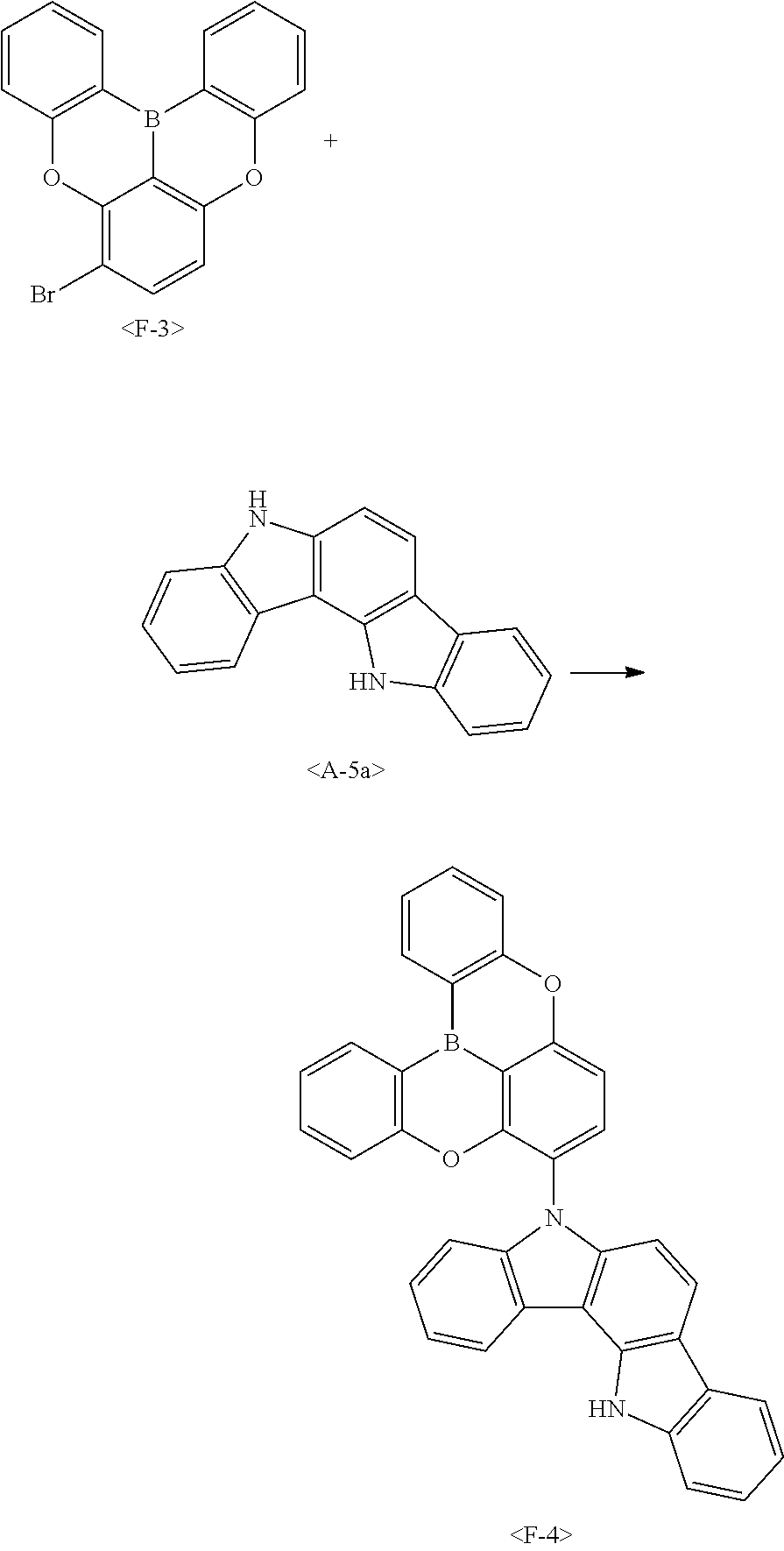
[0178]<F-4> was synthesized in the same manner as in Synthesis Example 1-5, with the exception of using <F-3> instead of <A-4>. (Yield 59%)
Synthesis Example 6-5. Synthesis of [Compound 31]
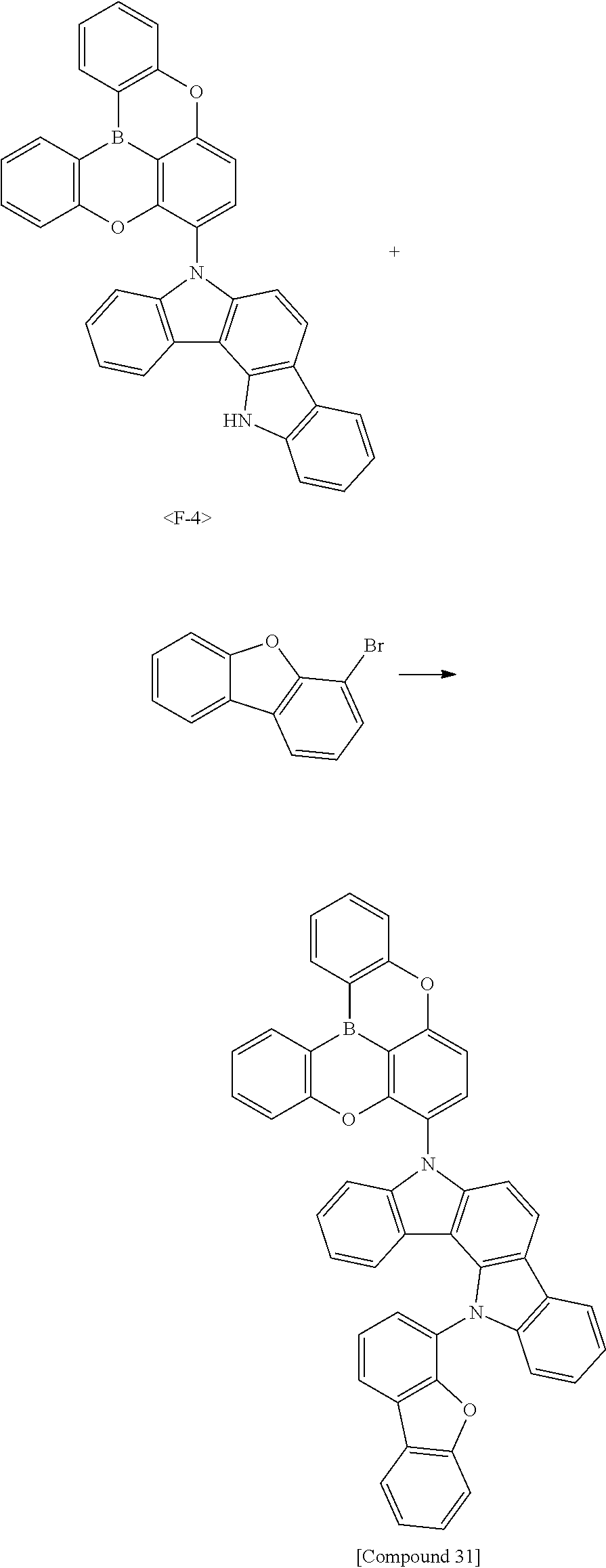
[0179][Compound 31] was synthesized in the same manner as in Synthesis Example 1-6, with the exception of using <F-4> and <F-5a> instead of <A-5> and <A-6a>, respectively. (Yield 43%)
[0180]MS (MALDI-TOF): m/z 690.21 [M+]
Synthesis Example 7. Synthesis of [Compound 40]
Synthesis Example 7-1. Synthesis of G-1
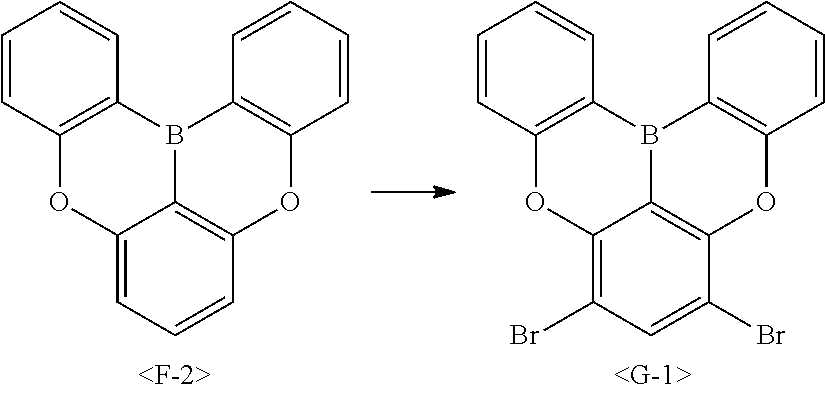
[0181]In a round-bottom flask, <F-2> (16 g) and tetrahydrofuran (320 mL) were stirred together under a nitrogen atmosphere, after which N-bromosuccinimide (23.2 g) was added. The reaction was then allowed to proceed at 30° C. for 6 hours. Upon completion of the reaction, the reaction mixture was poured into water to precipitate a solid, which was then filtered and washed with methanol. The resulting solid was recrystallized from dichloromethane and methanol to afford <G-1>. (22 g, 86.8%)
Synthesis Example 7-2. Synthesis of G-2

[0182]<G-2> was synthesized in the same manner as in Synthesis Example 1-4, with the exception of using <G-1> and <G-2a> instead of <A-3> and <A-4a>, respectively. (Yield 66.3%)
Synthesis Example 7-3. Synthesis of G-3
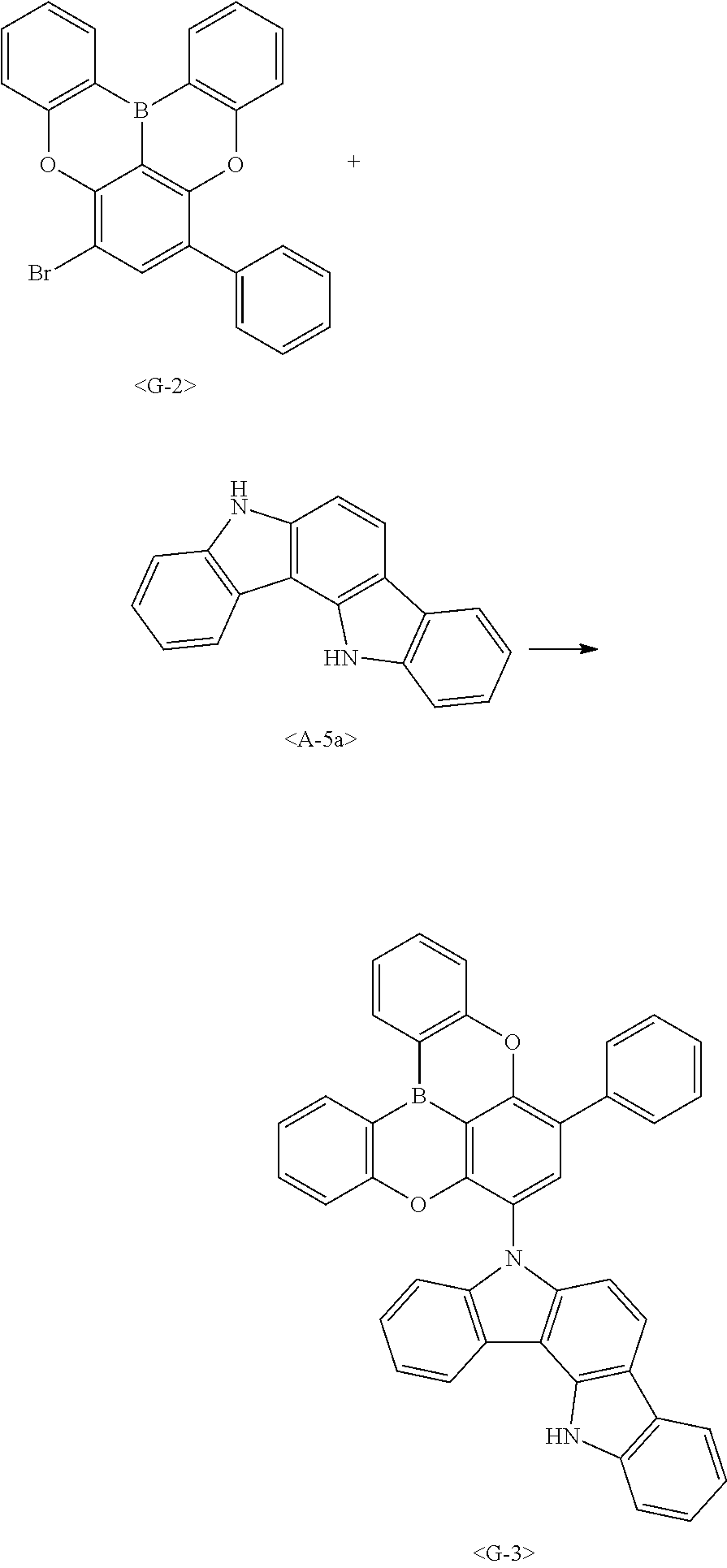
[0183]<G-3> was synthesized in the same manner as in Synthesis Example 1-5, with the exception of using <G-2> instead of <A-4>. (Yield 64%)
Synthesis Example 7-4. Synthesis of [Compound 40]

[0184][Compound 40] was Synthesized in the Same Manner as in Synthesis Example 1-6, with the Exception of Using <G-3> and <F-5a> Instead of <A-5> and <A-6a>, Respectively. (Yield 43.1%)
[0185]MS (MALDI-TOF): m/z 766.24 [M+]
Synthesis Example 8. Synthesis of [Compound 73]
Synthesis Example 8-1. Synthesis of H-1

[0186]<H-1> was synthesized in the same manner as in Synthesis Example 1-5, with the exception of using <B-4a> instead of <A-4>. (Yield 39.2%)
Synthesis Example 8-2. Synthesis of [Compound 73]

[0187][Compound 73] was synthesized in the same manner as in Synthesis Example 1-6, with the exception of using <H-1> and <B-2> instead of <A-5> and <A-6a>, respectively. (Yield 39.2%)
[0188]MS (MALDI-TOF): m/z 690.21 [M+]
Synthesis Example 9. Synthesis of [Compound 74]
Synthesis Example 9-1. Synthesis of I-1
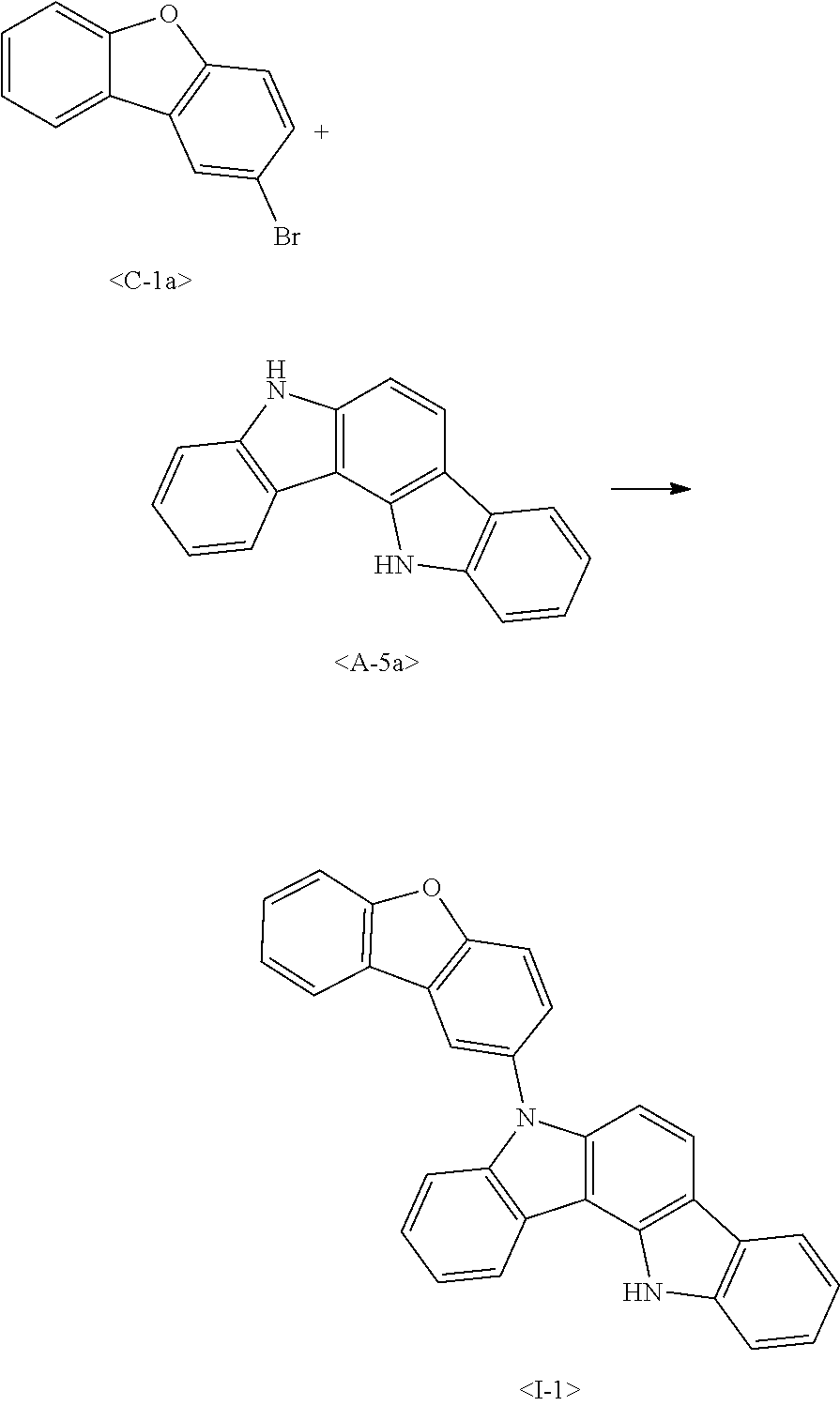
[0189]<I-1> was synthesized in the same manner as in Synthesis Example 1-5, with the exception of using <C-1a> instead of <A-4>. (Yield 62.3%)
Synthesis Example 9-2. Synthesis of [Compound 74]
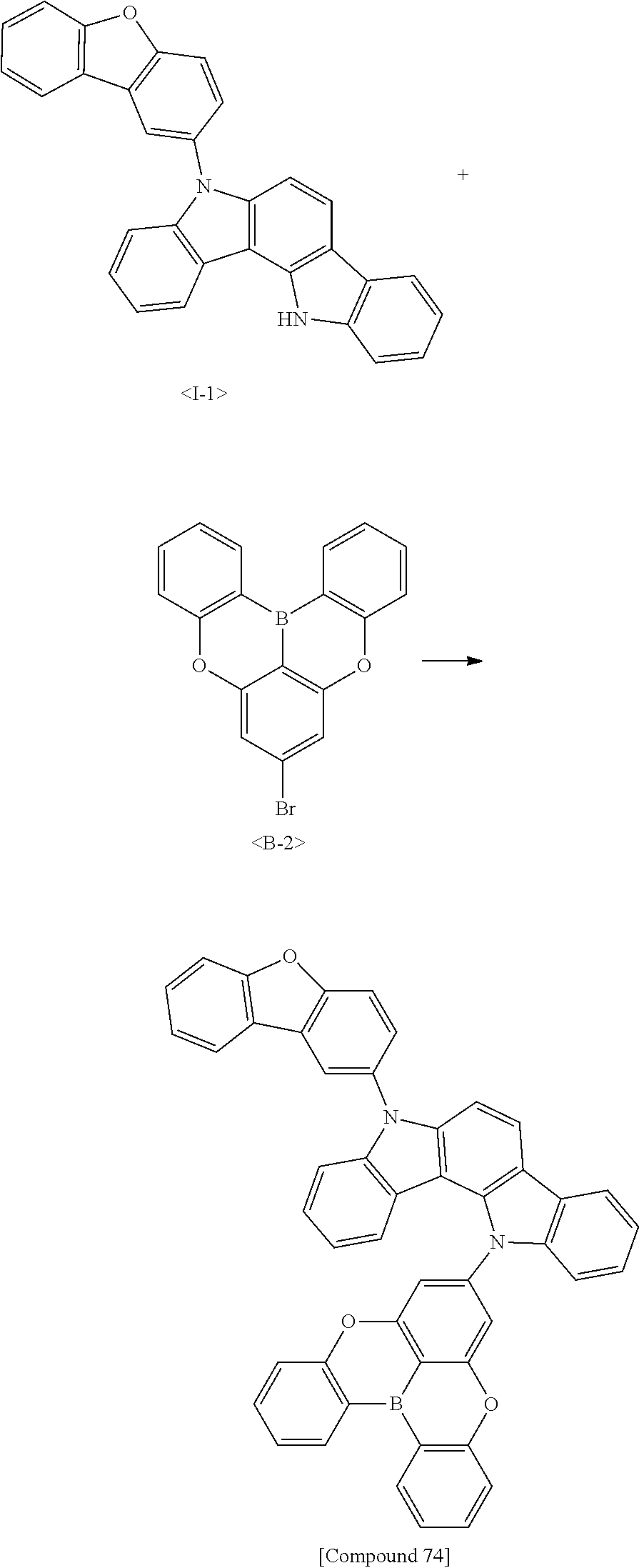
[0190][Compound 74] was synthesized in the same manner as in Synthesis Example 1-6, with the exception of using <I-1> and <B-2> instead of <A-5> and <A-6a>, respectively. (Yield 43.1%)
[0191]MS (MALDI-TOF): m/z 690.21 [M+]
Synthesis Example 10. Synthesis of [Compound 83]
Synthesis Example 10-1. Synthesis of J-1

[0192]<J-1> was synthesized in the same manner as in Synthesis Example 1-5, with the exception of using <B-2> and <J-1a> instead of <A-4> and <A-5a>, respectively. (Yield 76.1%)
Synthesis Example 10-2. Synthesis of [Compound 83]

[0193][Compound 83] was synthesized in the same manner as in Synthesis Example 1-6, with the exception of using <J-1> and <J-2a> instead of <A-5> and <A-6a>, respectively. (Yield 49.3%)
[0194]MS (MALDI-TOF): m/z 723.30 [M+]
Examples 1 to 10: Fabrication of Organic Light-Emitting Diodes
[0195]An ITO glass substrate was patterned to have a translucent area of 2 mm×2 mm and cleansed. The ITO glass was mounted in a vacuum chamber that was then set to have a base pressure of 1×10⁻⁶ torr. On the ITO glass substrate, HAT-CN (50 Å) and BCEN (600 Å) were sequentially deposited to form a hole injection layer and a hole transport layer, respectively, followed by forming a film of PBCz (50 Å) as an electron blocking layer. As an emission layer, a film (350 Å) was formed from the first and second host compounds according to the present disclosure, with the following PBD serving as a dopant compound in an amount of 12 wt % based on the total weight of the emission layer. A hole blocking layer was made of mSiTrz (50 Å). Thereafter, films were sequentially formed from a mixture of 1:1 of mSiTrz:Liq (300 Å) for an electron injection and transport layer (300 Å), Liq for an electron injection layer (10 Å), and Al for a cathode (1000 Å), thereby fabricating an organic light-emitting diode. The organic light-emitting diodes thus obtained were measured at 0.4 mA for luminescence properties:

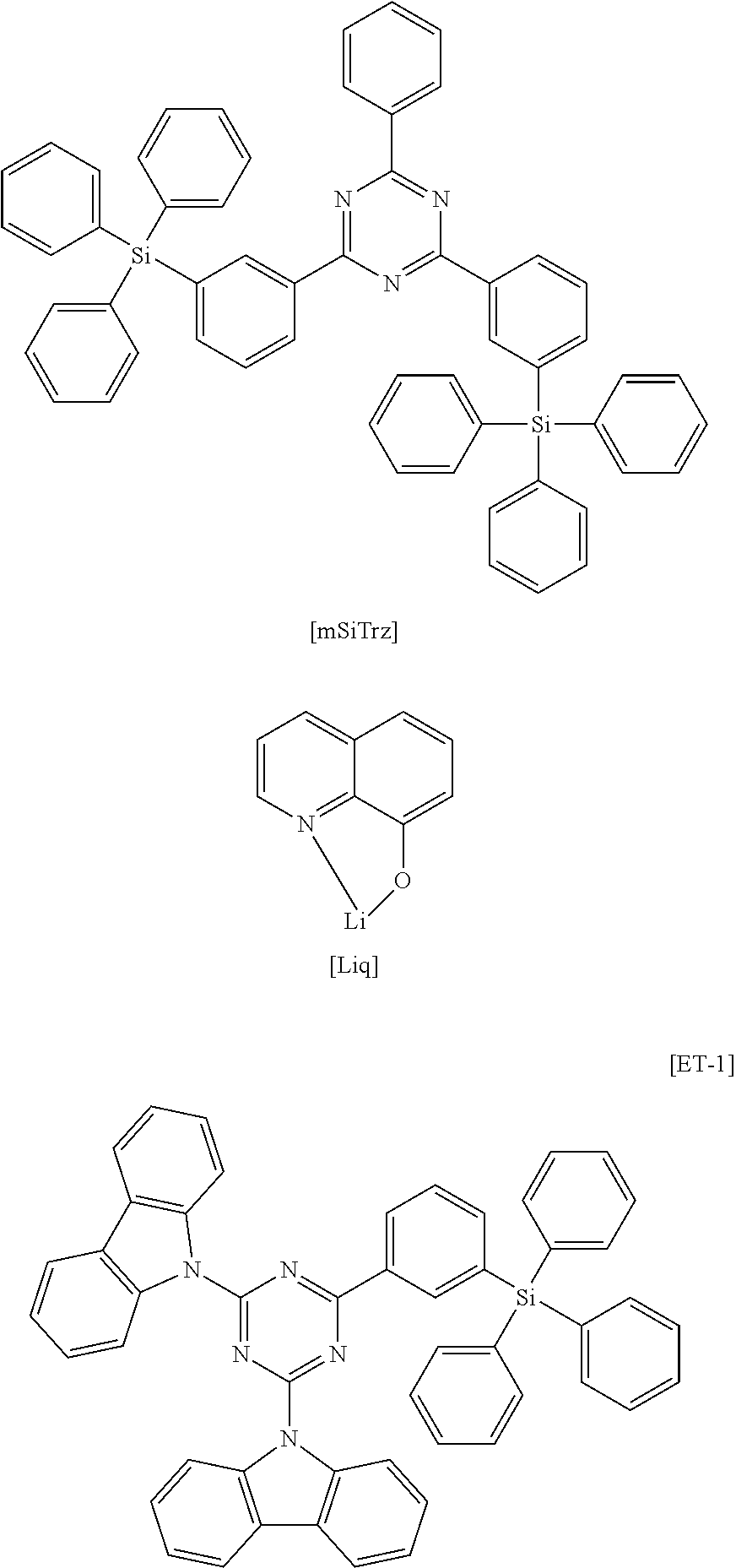
Comparative Examples 1 to 4
[0196]Organic light-emitting diodes for the Comparative Examples were fabricated in the same manner as in the Examples, with the exception of using the following [RH-1] to [RH-4], instead of the compounds according to the present disclosure, as hosts in the diodes of the Examples. The organic light-emitting diodes thus obtained were measured at 0.4 mA for luminescence properties. Here, the structures of [RH-1] to [RH-4] are as follows:
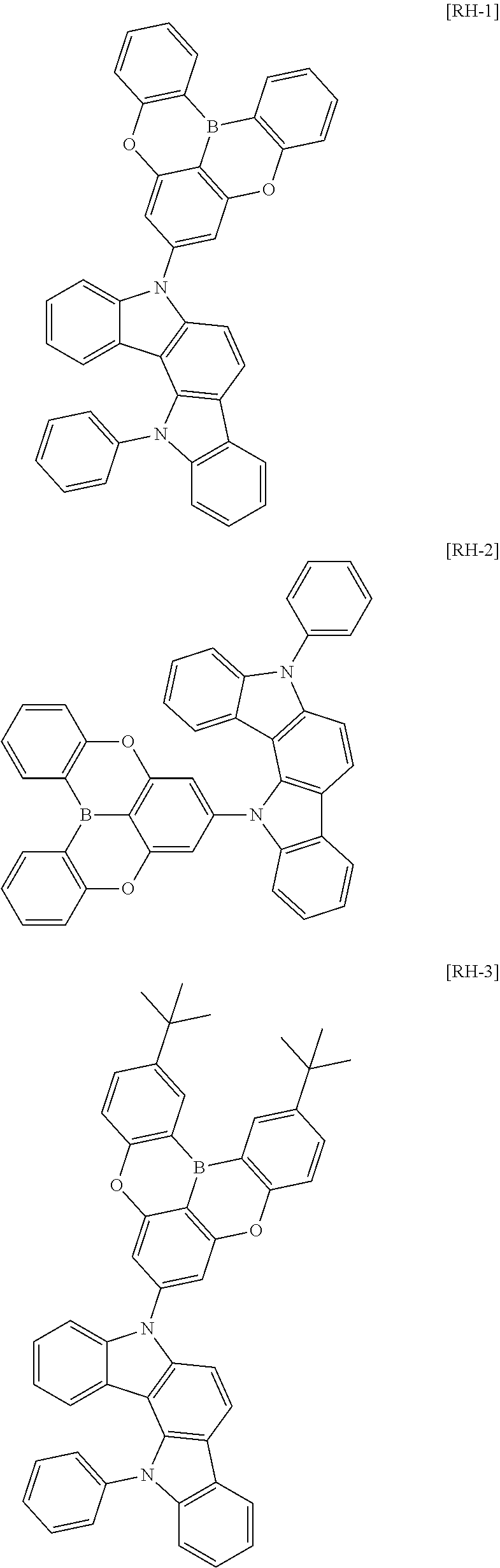

| TABLE 1 | ||||||
|---|---|---|---|---|---|---|
| External | ||||||
| Driving | Quantum | Lumines- | ||||
| Ex. | Volt. | Effici. | Lifetime | cence | ||
| No. | Host (1:1) | (V) | (EQE, % ) | (T95, hr) | (color) |
| Ex. 1 | Cpd. 1 | ET-1 | 4.1 | 16.5 | 152 | Blue |
| Ex. 2 | Cpd. 2 | ET-1 | 4.1 | 17.1 | 171 | Blue |
| Ex. 3 | Cpd. 22 | ET-1 | 4.2 | 16.8 | 166 | Blue |
| Ex. 4 | Cpd. 23 | ET-1 | 4.1 | 16.9 | 161 | Blue |
| Ex. 5 | Cpd. 31 | ET-1 | 4.2 | 16.5 | 147 | Blue |
| Ex. 6 | Cpd. 40 | ET-1 | 4.2 | 17.3 | 157 | Blue |
| Ex. 7 | Cpd. 67 | ET-1 | 4.2 | 17.2 | 178 | Blue |
| Ex. 8 | Cpd. 73 | ET-1 | 4.3 | 16.6 | 149 | Blue |
| Ex. 9 | Cpd. 74 | ET-1 | 4.1 | 16.8 | 163 | Blue |
| Ex. 10 | Cpd. 83 | ET-1 | 4.1 | 16.2 | 176 | Blue |
| C. Ex. 1 | RH-1 | ET-1 | 4.4 | 12.1 | 82 | Blue |
| C. Ex. 2 | RH-2 | ET-1 | 4.5 | 11.8 | 79 | Blue |
| C. Ex. 3 | RH-3 | ET-1 | 4.5 | 11.8 | 85 | Blue |
| C. Ex. 4 | RH-4 | ET-1 | 5.4 | 6.7 | 49 | Blue |
[0197]As shown in Table 1, the organic light-emitting diodes employing the compounds according to the present disclosure as hosts in the emission layers thereof exhibited high efficiency and long lifetime characteristics, with improved luminous efficiency and lifetime at lower driving voltages, in comparison to the organic light-emitting diodes employing conventional comparative compounds (Comparative Examples 1 to 4) having characteristic structures contrast to the compounds according to the present disclosure.
Examples 11 to 20: Fabrication of Organic Light-Emitting Diodes
[0198]Organic light-emitting diodes are fabricated in the same manner as in Examples 1 to 10, with the exception that the following TBD compound was as an additional dopant in an amount of 1.5 wt % based on the total weight of the emission layer. The organic light-emitting diodes thus obtained were measured at 0.4 mA for luminescence properties and the measurements are given in Table 2, below:

Comparative Examples 5 to 8
[0199]Organic light-emitting diodes for the Comparative Examples were fabricated in the same manner as in the Examples, with the exception of using [RH-1] to [RH-4], instead of the compounds according to the present disclosure, as host compounds. The organic light-emitting diodes thus obtained were measured at 0.4 mA for luminescence properties and the measurements are given in Table 2, below.
| TABLE 2 | ||||||
|---|---|---|---|---|---|---|
| External | ||||||
| Driving | Quantum | Lumines- | ||||
| Ex. | Volt. | Effici. | Lifetime | cence | ||
| No. | Host (1:1) | (V) | (EQE, %) | (T95, hr) | (color) |
| Ex. 11 | Cpd. 1 | ET-1 | 4.1 | 17.8 | 186 | Blue |
| Ex. 12 | Cpd. 2 | ET-1 | 4.0 | 18.0 | 197 | Blue |
| Ex. 13 | Cpd. 22 | ET-1 | 4.1 | 17.8 | 183 | Blue |
| Ex. 14 | Cpd. 23 | ET-1 | 4.1 | 17.9 | 182 | Blue |
| Ex. 15 | Cpd. 31 | ET-1 | 4.0 | 17.2 | 169 | Blue |
| Ex. 16 | Cpd. 40 | ET-1 | 4.1 | 18.1 | 180 | Blue |
| Ex. 17 | Cpd. 67 | ET-1 | 4.1 | 18.6 | 201 | Blue |
| Ex. 18 | Cpd. 73 | ET-1 | 4.2 | 17.9 | 167 | Blue |
| Ex. 19 | Cpd. 74 | ET-1 | 3.9 | 17.7 | 178 | Blue |
| Ex. 20 | Cpd. 83 | ET-1 | 4.1 | 17.6 | 198 | Blue |
| C. Ex. 5 | RH-1 | ET-1 | 4.2 | 13.3 | 99 | Blue |
| C. Ex. 6 | RH-2 | ET-1 | 4.7 | 12.2 | 96 | Blue |
| C. Ex. 7 | RH-3 | ET-1 | 4.6 | 12.1 | 91 | Blue |
| C. Ex. 8 | RH-4 | ET-1 | 5.2 | 5.4 | 43 | Blue |
[0200]As shown in Table 2, the organic light-emitting diodes employing the compounds according to the present disclosure as hosts in the emission layers thereof exhibited high efficiency and long lifetime characteristics, with improved luminous efficiency and lifetime at lower driving voltages, in comparison to the organic light-emitting diodes employing conventional comparative compounds (Comparative Examples 5 to 8) having characteristic structures contrast to the compounds according to the present disclosure.
Examples 21 to 24: Fabrication of Organic Light-Emitting Diodes
[0201]Organic light-emitting diodes are fabricated in the same manner as in Examples 1 to 10, with the exception that the heterocyclic compounds according to the present disclosure were used alone as a host in the emission layer. The organic light-emitting diodes thus obtained were measured at 0.4 mA for luminescence properties and the measurements are given in Table 3, below:
Comparative Example 9
[0202]Organic light-emitting diodes for the Comparative Examples were fabricated in the same manner as in the Examples 21 to 24, with the exception of using [RH-3], instead of the compounds according to the present disclosure, as a host. The organic light-emitting diodes thus obtained were measured at 0.4 mA for luminescence properties and the measurements are given in Table 3, below.
| TABLE 3 | |||||
|---|---|---|---|---|---|
| External | |||||
| Driving | Quantum | ||||
| Host | Volt. | Effici. | Lifetime | Luminescence | |
| Ex. No. | (1:1) | (V) | (EQE, %) | (T95, hr) | (color) |
| Ex. 21 | Cpd. 2 | 5.5 | 14.2 | 126 | Blue |
| Ex. 22 | Cpd. 23 | 5.5 | 14.0 | 117 | Blue |
| Ex. 23 | Cpd. 40 | 5.6 | 14.5 | 109 | Blue |
| Ex. 24 | Cpd. 67 | 5.6 | 14.4 | 132 | Blue |
| C. Ex. 9 | RH-3 | 5.9 | 8.8 | 56 | Blue |
[0203]As shown in Table 3, the OLEDs employing the heterocyclic compounds according to the present disclosure as host compounds in the emission layer thereof exhibited high efficiency and long lifetime characteristics, with improved luminous efficiency and lifetime at lower driving voltages, in comparison to the organic light-emitting diodes employing the conventional comparative compound (Comparative Example 9) having characteristic structures contrast to the compounds according to the present disclosure.
INDUSTRIAL APPLICABILITY
[0204]When the heterocyclic compound represented by Chemical Formula 1 according to the present disclosure is used as a phosphorescent host material in the light-emitting layer of an organic light-emitting diode, the organic light-emitting diode exhibits higher efficiency, longer lifespan, and lower driving voltage compared to organic light-emitting devices according to conventional technologies. Therefore, it has high industrial applicability in fields such as organic light-emitting devices and displays
Claims
1. A heterocyclic compound represented by the following Chemical Formula 1, but except for the following Compound:

wherein,
M1 and M2 are each a substituent represented by Structural Formula 1-1 or Structural Formula 1-2, but are simultaneously neither a substituent represented by Structural Formula 1-1 nor a substituent represented by Structural Formula 1-2,
any one of a plurality of substituents R4, a plurality of substituents R5, and a plurality of substituents R6 in Structural Formula 1-1 is a single bond connected to linker L1 or L2 in Chemical Formula 1,
any one of a plurality of substituents R7 in Structural Formula 1-2 is a single bond connected to a linker other than the linker to which the moiety of Structural Formula 1-1 is connected,
the substituents R1 to R3, the substituents R4 to R7 except for the single bonds respectively connected to the two linkers L1 or L2 in Chemical Formula 1, and the substituent R8, which are same or different, are each independently any one selected from a hydrogen atom, a deuterium atom, a tritium atom, a substituted or unsubstituted alkyl of 1 to 30 carbon atoms, a substituted or unsubstituted halogenated alkyl of 1 to 30 carbon atoms, a substituted or unsubstituted alkenyl of 2 to 30 carbon atoms, a substituted or unsubstituted alkynyl of 2 to 30 carbon atoms, a substituted or unsubstituted aryl of 6 to 50 carbon atoms, a substituted or unsubstituted cycloalkyl of 3 to 30 carbon atoms, a substituted or unsubstituted cycloalkenyl of 5 to 30 carbon atoms, a substituted or unsubstituted heterocycloalkyl of 2 to 30 carbon atoms, a substituted or unsubstituted heteroalkyl of 2 to 50 carbon atoms, a substituted or unsubstituted heteroaryl of 2 to 50 carbon atoms, a substituted or unsubstituted aromatic hydrocarbon ring-fused cycloalkyl of 7 to 30 carbon atoms, a substituted or unsubstituted heteroaromatic ring-fused cycloalkyl of 5 to 30 carbon atoms, a substituted or unsubstituted aromatic hydrocarbon ring-fused heterocycloalkyl of 6 to 30 carbon atoms, a substituted or unsubstituted aliphatic hydrocarbon ring-fused aryl of 8 to 30 carbon atoms, a substituted or unsubstituted aliphatic hydrocarbon ring-fused heteroaryl of 5 to 30 carbon atoms, a substituted or unsubstituted alkoxy of 1 to 30 carbon atoms, a substituted or unsubstituted aryloxy of 6 to 30 carbon atoms, a substituted or unsubstituted cycloalkyloxy of 3 to 30 carbon atoms, a substituted or unsubstituted heteroaryloxy of 2 to 30 carbon atoms, a substituted or unsubstituted alkylthio of 1 to 30 carbon atoms, a substituted or unsubstituted arylthio of 6 to 30 carbon atoms, a substituted or unsubstituted cycloalkylthio of 3 to 30 carbon atoms, a substituted or unsubstituted heteroarylthio of 2 to 30 carbon atoms, a substituted or unsubstituted amine of 0 to 40 carbon atoms, a substituted or unsubstituted silyl of 0 to 40 carbon atoms, a germanium of 0 to 40 carbon atoms, a nitro, a cyano, and a halogen, adjacent substituents among R1 to R8, except for the single bonds, may be linked to each other to additionally form a mono- or polycyclic aliphatic or aromatic ring,
the linkers L1 and L2, which are same or different, are each independently any one selected from a single bond, a substituted or unsubstituted arylene of 6 to 30 carbon atoms, a substituted or unsubstituted heteroarylene of 3 to 30 carbon atoms, and a substituted or unsubstituted aliphatic hydrocarbon ring-fused arylene of 8 to 30 carbon atoms,
n1 and n2, which are same or different, are each independently 1 or 2, wherein when n1 and n2 are each 2, the corresponding multiple linkers within each of L1 and L2 are same or different,
m1 is 2, wherein the corresponding plural R1's are same or different, m2 to m5, m7, and me are each 4, wherein the corresponding multiple substituents within each of R2 to R5, R7, and R8 in the aromatic rings are same or different,
m6 is 3, wherein the corresponding multiple substituents R6 are same or different,
Y1 and Y2 in Structural Formula 1-1, which are same or different, are each independently any one selected from O and S,
W in Structural Formula 1-2 is 0 or S,
wherein the term “substituted” in the expression “a substituted or unsubstituted” used for the compounds of Chemical Formula 1 and Structural Formulas 1-1 and 1-2 means having at least one substituent selected from the group consisting of a deuterium atom, a tritium atom, a cyano, a halogen, a hydroxy, a nitro, an alkyl of 1 to 30 carbon atoms, a halogenated alkyl of 1 to 30 carbon atoms, an alkenyl of 2 to 24 carbon atoms, an alkynyl of 2 to 24 carbon atoms, a cycloalkyl of 3 to 24 carbon atoms, a heteroalkyl of 1 to 24 carbon atoms, an aryl of 6 to 24 carbon atoms, an arylalkyl of 7 to 24 carbon atoms, an alkylaryl of 7 to 24 carbon atoms, a heteroaryl of 2 to 24 carbon atoms, a heteroarylalkyl of 3 to 24 carbon atoms, an alkylheteroaryl of 3 to 24 carbon atoms, an alkoxy of 1 to 24 carbon atoms, an aromatic hydrocarbon ring-fused cycloalkyl of 7 to 30 carbon atoms, an heteroaromatic ring-fused cycloalkyl of 5 to 30 carbon atoms, an aromatic hydrocarbon ring-fused heterocycloalkyl of 6 to 30 carbon atoms, an aliphatic hydrocarbon ring-fused aryl of 7 to 30 carbon atoms, an aliphatic hydrocarbon: ring-fused heteroaryl of 5 to 30 carbon atoms, a substituted or unsubstituted heteroaliphatic ring-fused aryl of 6 to 30 carbon atoms, a substituted or unsubstituted heteroaliphatic ring-fused heteroaryl of 5 to 30 carbon atoms, an amine of 1 to 30 carbon atoms, a silyl of 1 to 30 carbon atoms, a germanium of 1 to carbon atoms, an aryloxy of 6 to 24 carbon atoms, and an arylthionyl of 6 to 24 carbon atoms, with at least one hydrogen atom on the substituent being substitutable with a deuterium or tritium atom,
but with the exclusion of the following compound from the heterocyclic compound represented by the following Chemical Formula 1:

2. The heterocyclic compound of
3. The heterocyclic compound of
4. The heterocyclic compound of
5. The heterocyclic compound of
6. The heterocyclic compound of
7. The heterocyclic compound of
8. The heterocyclic compound of
9. The heterocyclic compound of
10. The heterocyclic compound of

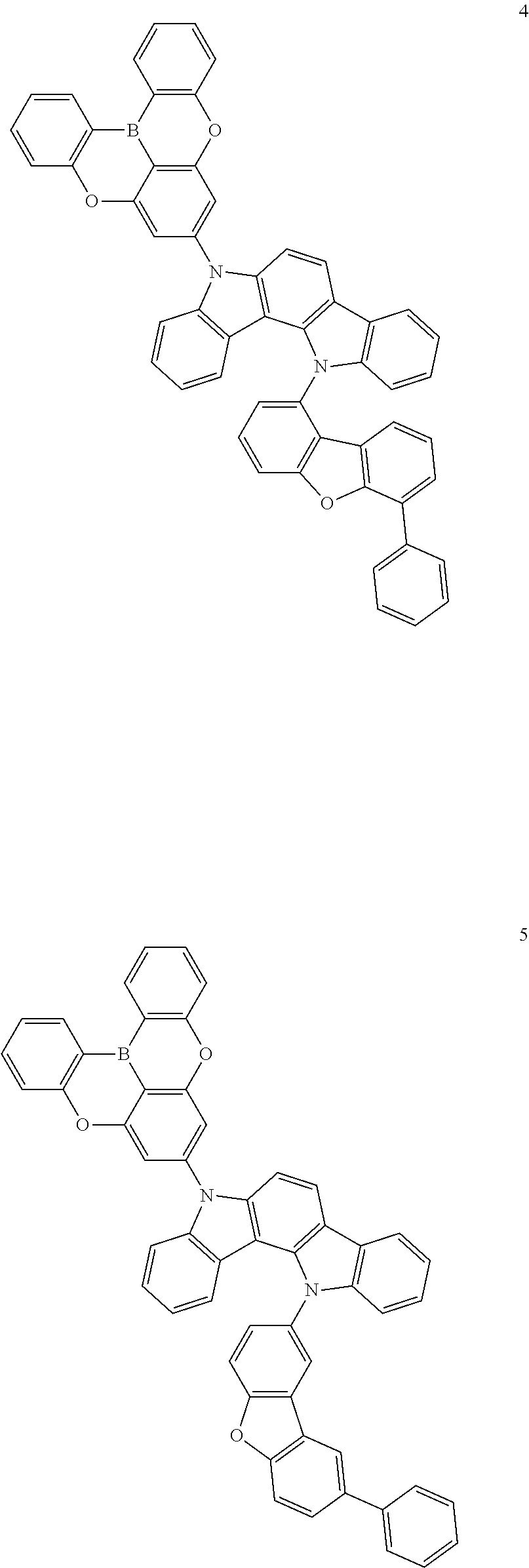

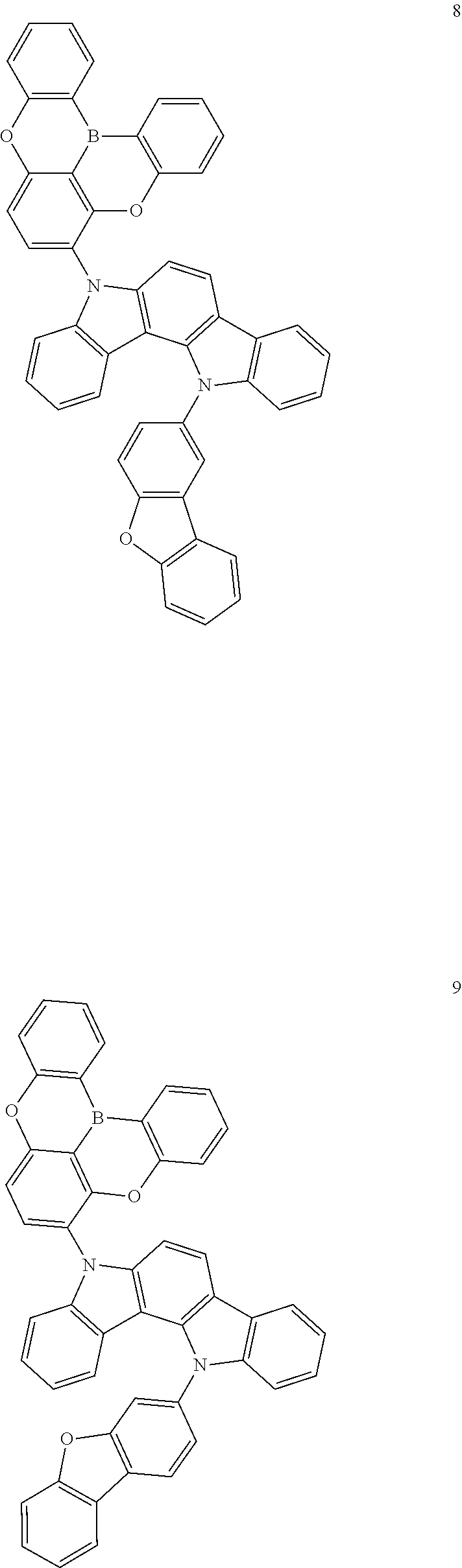

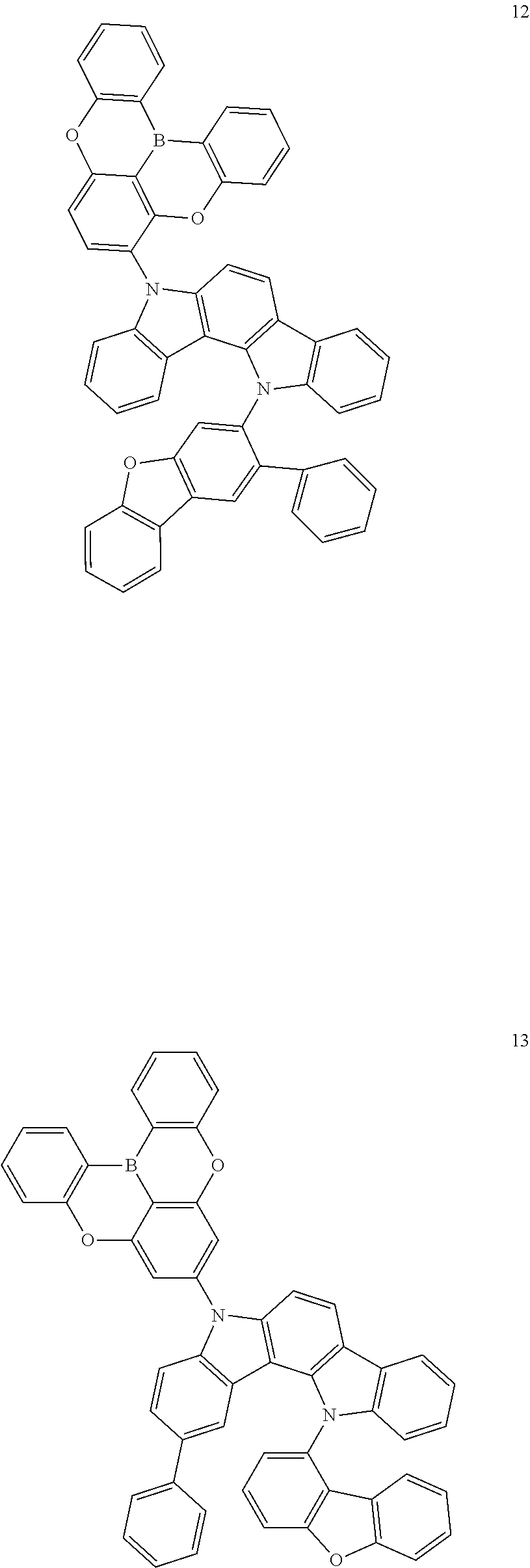

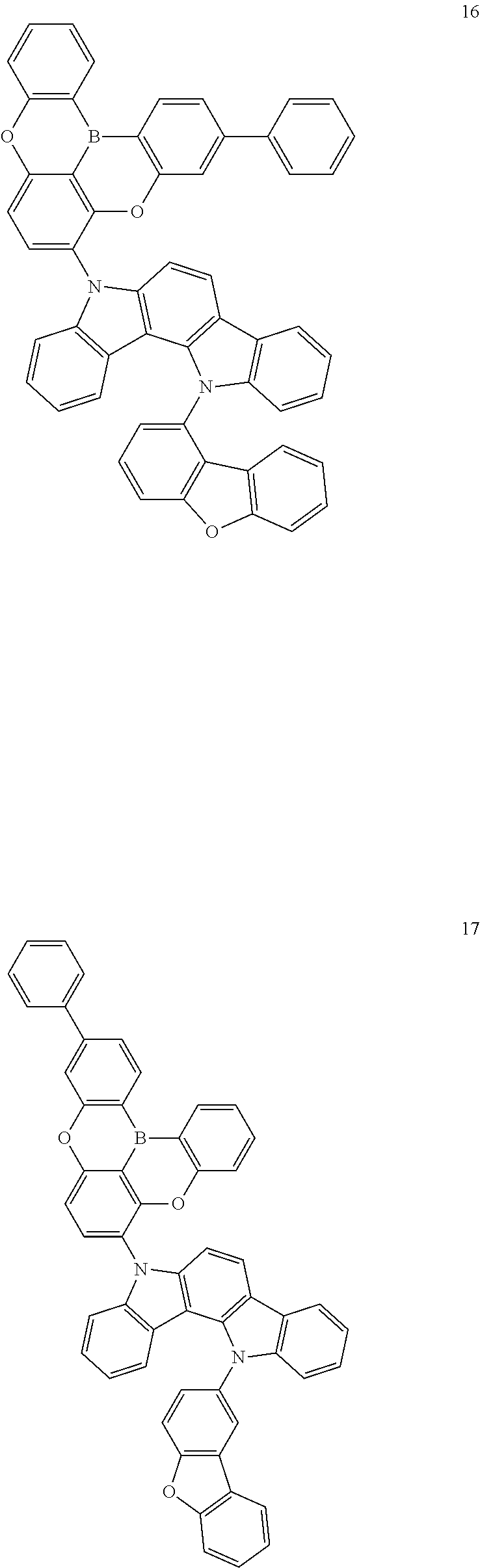


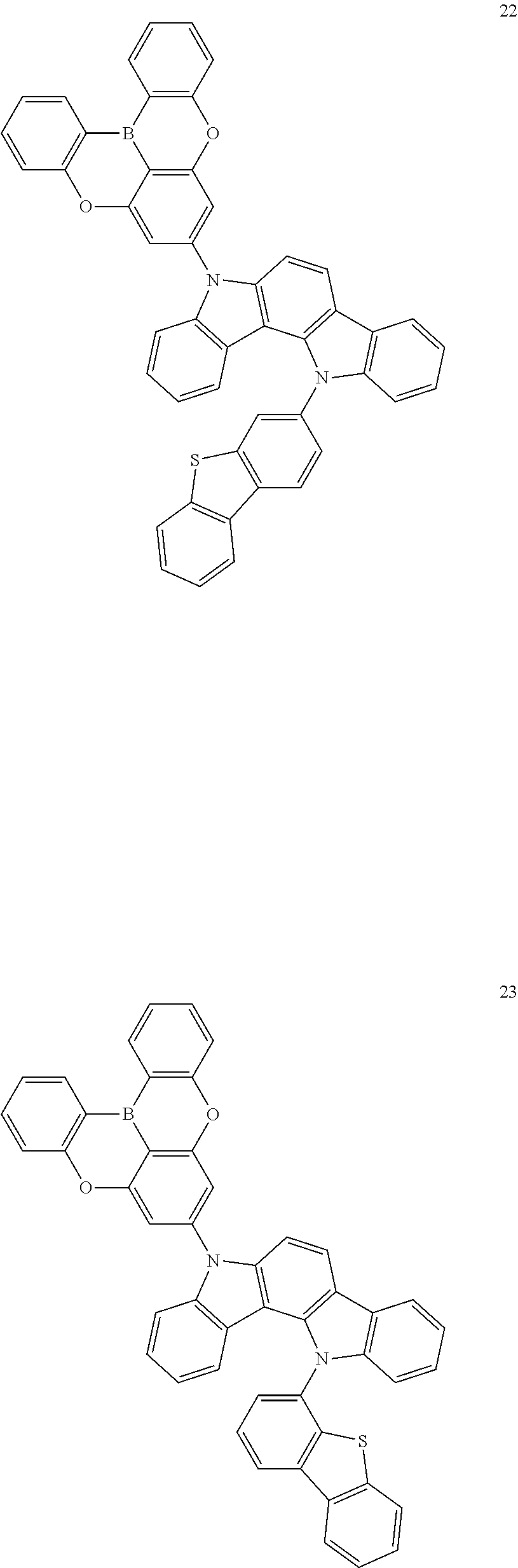


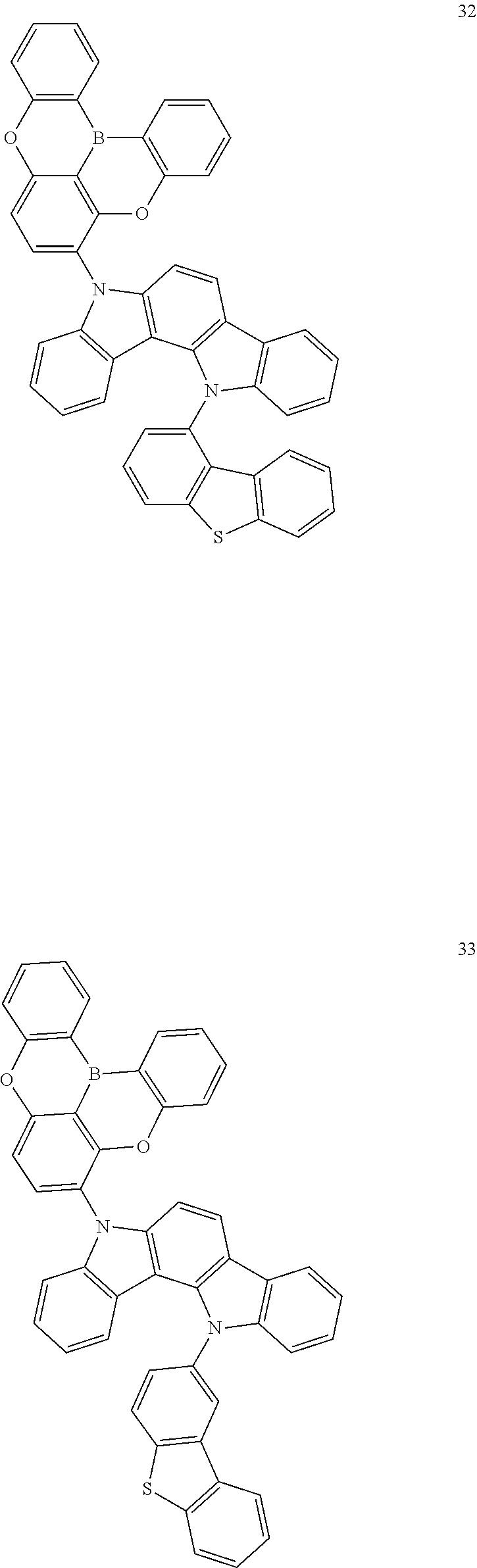

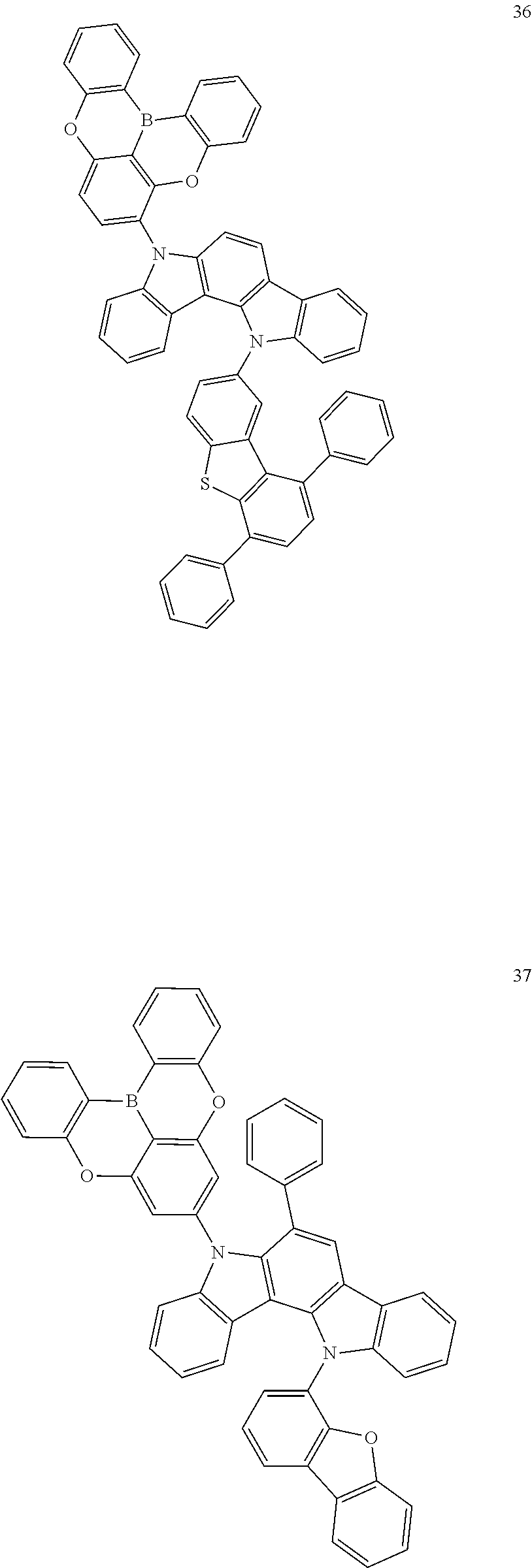
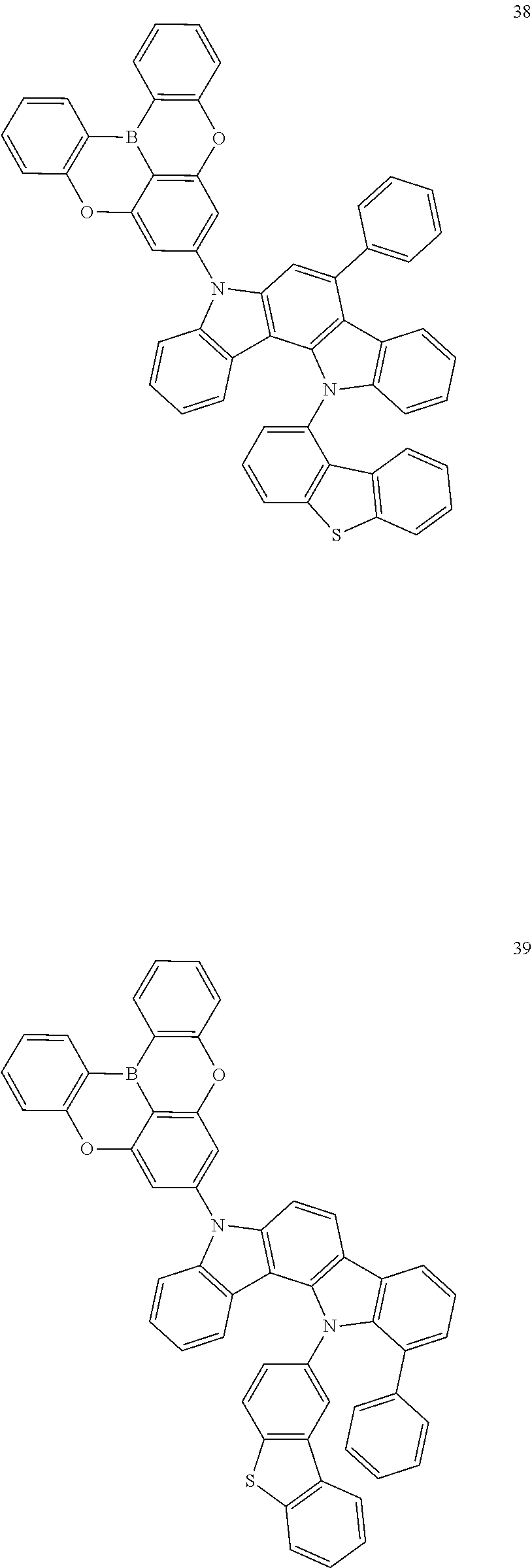

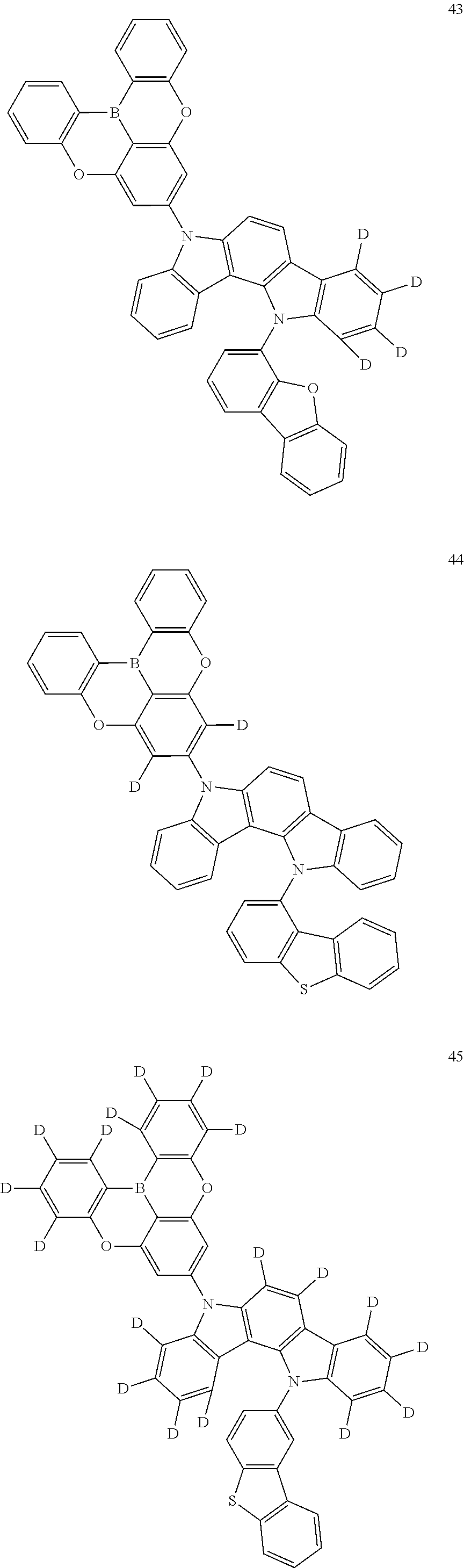
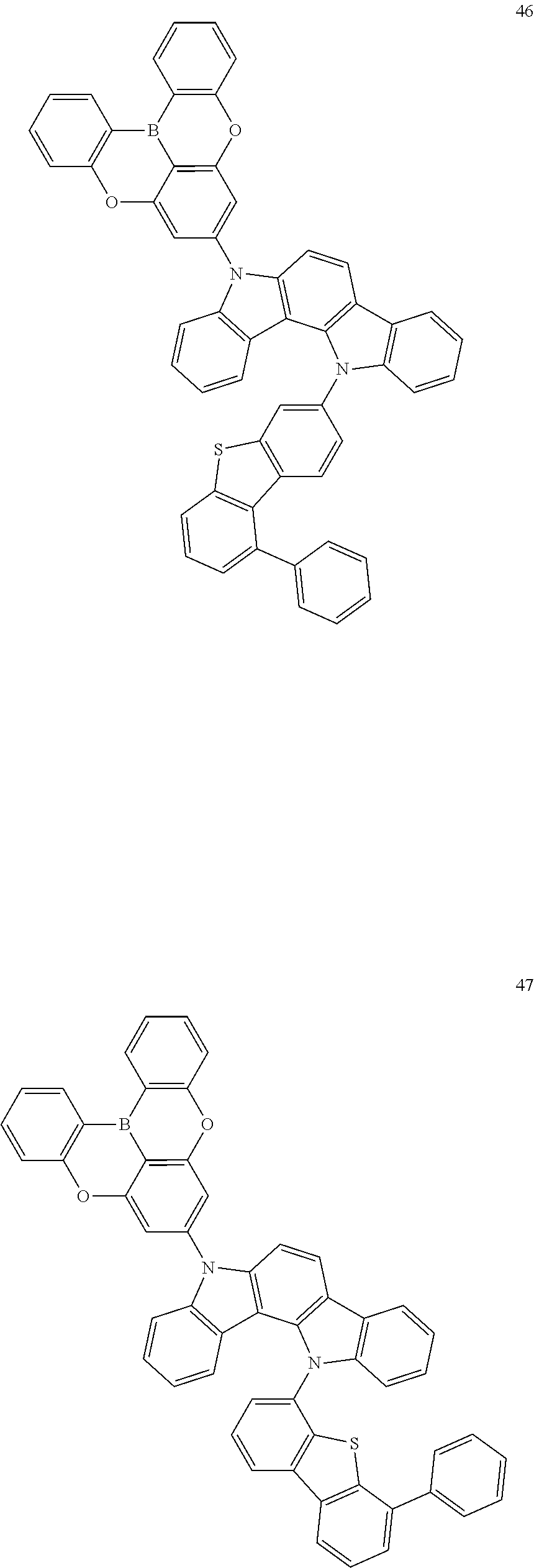


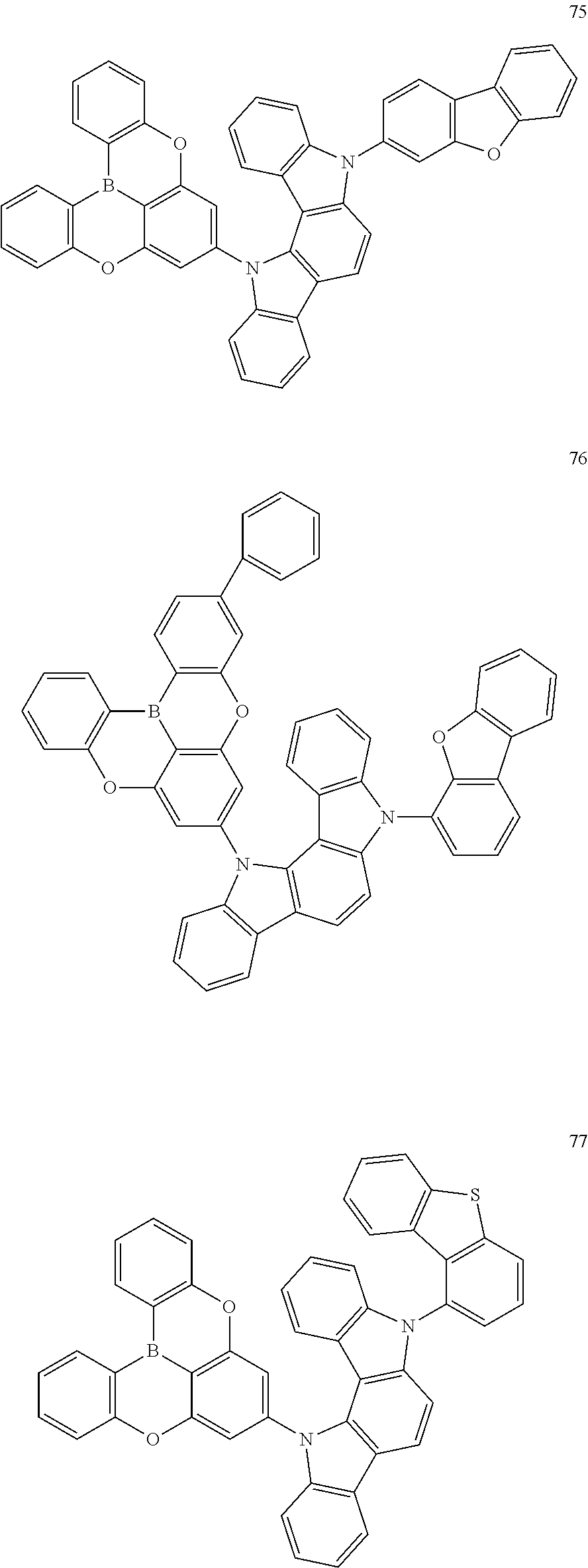
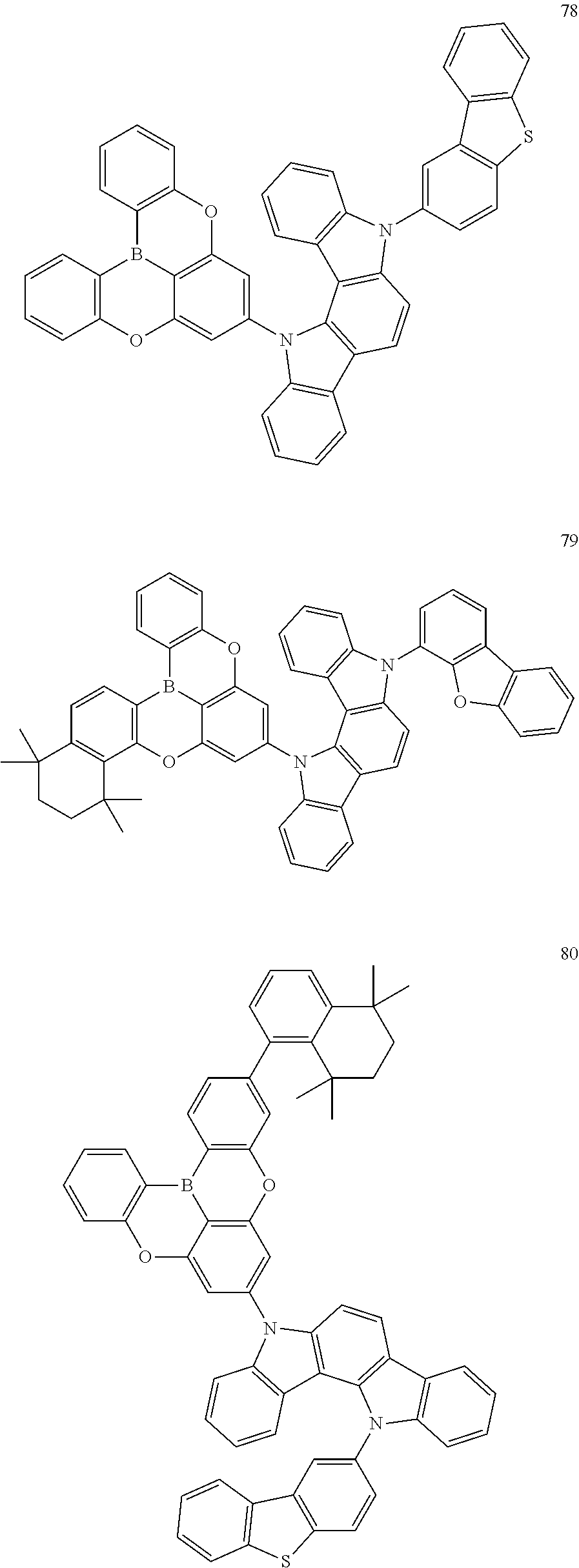


11. An organic light-emitting diode comprising:
a first electrode;
a second electrode facing the first electrode;
an organic layer interposed between the first electrode and the second electrode
wherein the organic layer comprises an emission layer containing a host and a dopant therein and the host in the emission layer comprises at least one of the heterocyclic compounds as set forth in
12. The organic light-emitting diode of
13. The organic light-emitting diode of
14. The organic light-emitting diode of

wherein,
Y1 and Y2, which are same or different, are each independently any one selected from O, S, NR11, CR12R13, SiR14R15, and GeR16R17,
A1 to A3, which are same or different, are each independently any one selected from a substituted or unsubstituted aromatic hydrocarbon ring of 6 to 50 carbon atoms, a substituted or unsubstituted aliphatic hydrocarbon ring of 5 to 50 carbon atoms, a substituted or unsubstituted, aliphatic hydrocarbon ring-fused aromatic hydrocarbon ring of 8 to 50 carbon atoms, a substituted or unsubstituted heteroaromatic ring of 2 to 50 carbon atoms, and a substituted or unsubstituted, aliphatic hydrocarbon ring-fused heteroaromatic ring of 5 to 50 carbon atoms,
R11 to R17, which are same or different, are each independently any one selected from a hydrogen atom, a deuterium atom, a tritium atom, a substituted or unsubstituted alkyl of 1 to 30 carbon atoms, a substituted or unsubstituted halogenated alkyl of 1 to 30 carbon atoms, a substituted or unsubstituted alkenyl of 2 to 30 carbon atoms, a substituted or unsubstituted alkynyl of 2 to 30 carbon atoms, a substituted or unsubstituted aryl of 6 to 50 carbon atoms, a substituted or unsubstituted cycloalkyl of 3 to 30 carbon atoms, a substituted or unsubstituted cycloalkenyl of 5 to 30 carbon atoms, a substituted or unsubstituted heterocycloalkyl of 2 to 30 carbon atoms, a substituted or unsubstituted heteroalkyl of 2 to 50 carbon atoms, a substituted or unsubstituted heteroaryl of 2 to 50 carbon atoms, a substituted or unsubstituted aromatic hydrocarbon ring-fused cycloalkyl of 7 to 30 carbon atoms, a substituted or unsubstituted heteroaromatic ring-fused cycloalkyl of 5 to 30 carbon atoms, a substituted or unsubstituted aromatic hydrocarbon ring-fused heterocycloalkyl of 6 to 30 carbon atoms, a substituted or unsubstituted aliphatic hydrocarbon ring-fused aryl of 8 to 30 carbon atoms, a substituted or unsubstituted aliphatic hydrocarbon ring-fused heteroaryl of 5 to 30 carbon atoms, a substituted or unsubstituted alkoxy of 1 to 30 carbon atoms, a substituted or unsubstituted aryloxy of 6 to 30 carbon atoms, a substituted or unsubstituted cycloalkyloxy of 3 to 30 carbon atoms, a substituted or unsubstituted heteroaryloxy of 2 to 30 carbon atoms, a substituted or unsubstituted alkylthio of 1 to 30 carbon atoms, a substituted or unsubstituted arylthio of 6 to 30 carbon atoms, a substituted or unsubstituted cycloalkylthio of 3 to 30 carbon atoms, a substituted or unsubstituted heteroarylthio of 2 to 30 carbon atoms, a substituted or unsubstituted amine of 0 to 40 carbon atoms, a substituted or unsubstituted silyl of 0 to 40 carbon atoms, a germanium of 0 to 40 carbon atoms, a nitro, a cyano, and a halogen, R11 to R17 may be connected to the A1 to A3 ring moieties to additionally form an aliphatic or aromatic mono- or polycyclic ring, and
a linkage may be made between R12 and R13, between R14 and R15, and between R16 and R17 to additionally form respective mono- or polycyclic aliphatic or aromatic rings,
wherein the term “substituted” in the expression “substituted or unsubstituted” used for the compound of Chemical Formula 2 means having at least one substituent selected from the group consisting of a deuterium atom, a tritium atom, a cyano, a halogen, a hydroxy, a nitro, alkyl of 1 to 30 carbon atoms, a halogenated alkyl of 1 to 30 carbon atoms, an alkenyl of 2 to 24 carbon atoms, an alkynyl of 2 to 24 carbon atoms, a cycloalkyl of 3 to 24 carbon atoms, a heteroalkyl of 1 to 24 carbon atoms, an aryl of 6 to 24 carbon atoms, an arylalkyl of 7 to 24 carbon atoms, an alkylaryl of 7 to 24 carbon atoms, a heteroaryl of 2 to 24 carbon atoms, a heteroarylalkyl of 3 to 24 carbon atoms, an alkylheteroaryl of 3 to 24 carbon atoms, an alkoxy of 1 to 24 carbon atoms, an aromatic hydrocarbon ring-fused cycloalkyl of 7 to 30 carbon atoms, an heteroaromatic ring-fused cycloalkyl of 5 to 30 carbon atoms, an aromatic hydrocarbon ring-fused heterocycloalkyl of 6 to 30 carbon atoms, an aliphatic hydrocarbon ring-fused aryl of 7 to 30 carbon atoms, an aliphatic hydrocarbon ring-fused heteroaryl of 5 to 30 carbon atoms, a substituted or unsubstituted heteroaliphatic ring-fused aryl of 6 to 30 carbon atoms, a substituted or unsubstituted heteroaliphatic ring-fused heteroaryl of 5 to 30 carbon atoms, an amine of 1 to 30 carbon atoms, a silyl of 1 to 30 carbon atoms, a germanium of 1 to 30 carbon atoms, an aryloxy of 6 to 24 carbon atoms, and an arylthionyl of 6 to 24 carbon atoms, with at least one hydrogen atom on the substituents being substitutable with a deuterium or tritium atom.
15. The organic light-emitting diode of