US20260193293A1 · App 19/132,926
PEPTIDES CAPABLE OF INHIBITING PROTEIN-PROTEIN INTERACTIONS AT GABAB1A SUBUNIT AND USES THEREOF
Publication
Application
Classifications
IPC Classifications
CPC Classifications
Applicants
UNIVERSITY OF COPENHAGEN, UNIVERSITÄT BASEL
Inventors
Vita Sereikaite, Ziyang Chen, Pascal Rem, Bernhard Bettler, Kristian StrØmgaard
Abstract
The present invention relates to peptides capable of inhibiting protein-protein interactions of GABA B R1a receptors and uses thereof.
Get a summary, plain-language explanation, or ask your own question.
Figures
Description
TECHNICAL FIELD
[0001]The present invention relates to peptides capable of inhibiting protein-protein interactions at the GABAB1a subunit of GABAB receptors and uses thereof.
BACKGROUND
[0002]Synaptic transmission is a process tightly regulated by release of neurotransmitters and it is dependent on a fine-tuned balance of neuronal excitation and inhibition. Neurotransmitters are released from a presynaptic neuron and bind to receptors on a postsynaptic neuron. Synaptic transmission at the excitatory synapses is mainly mediated and regulated by ionotropic and metabotropic glutamate receptors, respectively, which are activated by the excitatory neurotransmitter glutamate. In contrast, γ-amino butyric acid (GABA), the key inhibitory neurotransmitter in the central nervous system (CNS), activates ionotropic GABAA and metabotropic GABAB receptors (GBRs), which mediate and regulate inhibitory synaptic transmission, respectively. GBRs is involved in learning and memory, and their dysfunction has been implicated in neurological and psychiatric disorders such as epilepsy, spasticity, depression, anxiety, schizophrenia, Alzheimer's disease and cognitive deficits (Heaney et al. 2016). However, therapeutics targeting GBRs are very scarce as only two drugs, baclofen and γ-hydroxybutyrate (GHB), are currently used for the treatment of spasticity (Bowery et al. 2002), alcohol use disorders (Garbutt 2020) and narcolepsy (Wedin et al. 2006; Bay et al. 2014). Unfortunately, the use of both baclofen and GHB is associated with serious adverse side effects such as sedation and muscle relaxation, which has significantly hampered their therapeutic value in the treatment of mental health disorders (Gassmann et al. 2012; Fritzius et al. 2019).
[0003]The molecular diversity of functional GBR is defined by GABAB1a (GB1a), GABAB1b (GB1b) and GABAB2 (GB2) subunits, which can form either heterodimeric GB1a/2 or GB1b/2 receptor subtypes (Bettler et al. 2006; Bettler et al. 2004). Most importantly, GB1a and GB1b fulfil different physiological roles resulting from distinct cellular localizations (Vigot et al. 2006). GB1a and GB1b subunits are nearly identical except for a 129-residue extension at the extreme extracellular N-terminus of GB1a, referred to as the sushi domains (SDs) (Blein et al. 2004). Previous studies indicate that the major difference between the two isoforms is that they display very distinct subcellular distribution, where the GB1a/2 receptor localizes to presynaptic sites, whereas the GB1b/2 receptor localizes to postsynaptic sites (Ulrich and Bettler 2007; Perez-Garci et al. 2006). Consequently, GB1a/2 is involved in regulating vesicular neurotransmitter release (including glutamate) at presynaptic termini, while GB1b/2 activates potassium currents in the spines and dendrites.
[0004]Recent proteomic studies identified three transmembrane proteins interacting specifically with the GB1a/2 receptor: the amyloid precursor protein (APP), the adherence-junction associated protein 1 (AJAP1) and the PILRα-associated neural protein (PIANP) (Schwenk et al. 2016; Dinamarca et al. 2019; Rice et al. 2019). Sequence alignment of the APP, AJAP1 and PIANP sequences displayed no obvious similarity, except for a stretch of six amino acids, suggesting a potential central binding interface, which mediates the interaction of these proteins with the N-terminal Sushi domain 1 (SD1) of GBR1a/2. Interestingly, the affinity for SD1 binding is different within the three SD-interacting proteins and follows the order AJAP1>PIANP>>APP. Functionally, APP mediates the trafficking of GB1a/2 receptors to the presynaptic site, where GB1a/2 receptors are likely transferred to AJAP1 or PIANP that precisely localize the receptor at the cell surface. Activated presynaptic GBRs at glutamatergic terminals inhibit the release of neurotransmitters (glutamate) and thereby inhibit excitatory neuronal transmission.
[0005]Mild cognitive impairment (MCI) is a stage of cognitive decline between normal aging caused cognitive decline and dementia. Consequently, patients suffering from MCI have difficulties with memory, language, thinking or judgment. Worldwide, the annual prevalence of MCI in persons older than 60 years is estimated to be between 12-18%. Additionally, among MCI patient groups approx. 10-15% develop dementia annually, and dementia is reported as the seventh leading cause of death worldwide. Currently there is no approved treatment directed at MCI.
[0006]Cognitive functions like learning and memory depend on balanced-neuronal transmission. An increase in glutamate or acetylcholine release at excitatory synapses is expected to have cognition enhancing effects in Alzheimer's disease and patients with MCI (Fritzius et al. 2019). Therefore, increasing excitatory neurotransmission in patients with cognition decline may offer a new mode of action to target cognitive impairments, and there is a need for new agents that can modulate excitatory neurotransmission.
SUMMARY
[0007]The current invention is directed to compounds that inhibit GBR-associated protein-protein interactions (PPIs), specifically those involving the N-terminal sushi domains (SDs), and in particular Sushi domain 1 (SD1), of the GABAB1a/2 (GB1a/2) receptor, which is present at excitatory terminals.
[0008]The compounds disclosed herein are capable of inhibiting protein-protein interactions such as interactions between any one of adherence-junction associated protein 1 (AJAP1), PILRα-associated neural protein (PIANP) and amyloid precursor protein (APP) and the N-terminal SD1 of the GB1a/2 receptor. Interactions with these proteins stabilize presynaptic GB1a/2 receptors at glutamatergic terminals, which controls inhibition of excitatory neurotransmitter release. The compounds of the present disclosure can thus upregulate excitatory neurotransmitter release, resulting in cognition enhancing effects. In particular, the compounds disclosed herein can uncouple presynaptic GB1a/2 from APP, AJAP1 and PIANP and therefore cause delocalization of the receptors and prevent inhibition of neurotransmitter release.
[0009]Consequently, this will lead to an increase in excitatory neurotransmission and an enhancement of cognitive functions.
[0010]The developed peptide-based modulators act specifically at presynaptic GB1a/2 receptors, resulting in increased efficacy and specificity, and reduced adverse effects.
[0011]Thus, one aspect of the present disclosure relates to a peptide comprising or consisting of the sequence 1 2 3 4 5 6 7 8 9 10 11 12 13 14 15
| (SEQ ID NO: 64) | |
| E X1 X2 X3 X4 <u style="single">X</u>5 X6 <u style="single">W</u> X7 X8 X9 X10 D X11 D |
[0025]Another aspect of the present disclosure relates to a peptide defined herein for use as a medicament.
[0026]Another aspect of the present disclosure relates to a peptide defined herein for use in the treatment of neurological and/or psychiatric disorders, such as wherein the neurological disorder is epilepsy, spasticity, schizophrenia, dystonia, neuropathic pain, narcolepsy, spasticity, cognitive deficits such as Mild cognitive impairment (MCI), autism spectrum disorder and/or substance-use disorders; and/or wherein the psychiatric disorder is depression, anxiety and/or Attention deficit hyperactivity disorder (ADHD).
DESCRIPTION OF DRAWINGS
[0027]
[0028]
[0029]
[0030]
[0031]
[0032]
DEFINITIONS
[0033]The term “affinity” refers to the strength of binding between a ligand and its receptor.
[0034]An “amino acid residue” can be a natural or non-natural amino acid residue linked by peptide bonds or bonds different from peptide bonds. The amino acid residues can be in
[0035]An “equivalent amino acid residue” refers to an amino acid residue capable of replacing another amino acid residue in a polypeptide without substantially altering the structure and/or functionality of the polypeptide. Equivalent amino acids thus have similar properties such as bulkiness of the side-chain, side chain polarity (polar or non-polar), hydrophobicity (hydrophobic or hydrophilic), pH (acidic, neutral or basic) and side chain organization of carbon molecules (aromatic/aliphatic). As such, “equivalent amino acid residues” can be regarded as “conservative amino acid substitutions”.
[0036]Within the meaning of the term “equivalent amino acid substitution” as applied herein, one amino acid may be substituted for another, in one embodiment, within the groups of amino acids indicated herein below:
[0037]Amino acids having polar side chains (Asp, Glu, Lys, Arg, His, Asn, Gln, Ser, Thr, Pro, and Cys); Amino acids having non-polar side chains (Gly, Ala, Val, Leu, Ile, Phe, Trp, Tyr and Met); Amino acids having aliphatic side chains (Gly, Ala Val, Leu, Ile); Amino acids having cyclic side chains (Trp, His, Pro); Amino acids having aromatic side chains (Phe, Tyr, Trp); Amino acids having acidic, such as negatively charged side chains (Asp, Glu); Amino acids having basic, such as positively charged side chains (Lys, Arg, His); Amino acids having amide side chains (Asn, Gln); Amino acids having hydroxy side chains (Ser, Thr); Amino acids having sulphur-containing side chains (Cys, Met); Neutral, weakly hydrophobic amino acids (Pro, Ala, Gly, Ser, Thr); Hydrophilic, acidic amino acids (Gln, Asn, Glu, Asp); and Hydrophobic amino acids (Leu, Ile, Val).
[0038]Where the
[0039]A “functional variant” of a peptide is a peptide capable of performing essentially the same functions as the peptide it is a functional variant of. In particular, a functional variant can bind the same molecules, preferably with the same affinity, as the peptide it is a functional variant of.
[0040]The terms “drug” and “medicament” as used herein include biologically, physiologically, or pharmacologically active substances that act locally or systemically in the human or animal body.
[0041]The terms “treatment” and “treating” as used herein refer to the management and care of a patient for the purpose of combating a condition, disease or disorder. The term is intended to include the full spectrum of treatments for a given condition from which the patient is suffering, and refer equally to curative therapy, prophylactic or preventative therapy and ameliorating or palliative therapy, such as administration of the peptide or composition for the purpose of: alleviating or relieving symptoms or complications; delaying the progression of the condition, partially arresting the clinical manifestations, disease or disorder; curing or eliminating the condition, disease or disorder; amelioration or palliation of the condition or symptoms, and remission (whether partial or total), whether detectable or undetectable; and/or preventing or reducing the risk of acquiring the condition, disease or disorder, wherein “preventing” or “prevention” is to be understood to refer to the management and care of a patient for the purpose of hindering the development of the condition, disease or disorder, and includes the administration of the active compounds to prevent or reduce the risk of the onset of symptoms or complications. The term “palliation”, and variations thereof, as used herein, means that the extent and/or undesirable manifestations of a physiological condition or symptom are lessened and/or time course of the progression is slowed or lengthened, as compared to not administering compositions of the present invention.
[0042]The term “individual” refers to vertebrates, particular members of the mammalian species, preferably primates including humans. As used herein, ‘subject’ and ‘individual’ may be used interchangeably. Treatment of animals, such as mice, rats, dogs, cats, cows, horses, sheep and pigs, is, however, also within the scope of the present invention.
[0043]An “individual in need thereof” refers to an individual who may benefit from treatment. In one embodiment, said individual in need thereof is a diseased individual, wherein said disease may be a neurological and/or a psychiatric disorder.
[0044]A “treatment effect” or “therapeutic effect” is manifested if there is a change in the condition being treated, as measured by the criteria constituting the definition of the terms “treating” and “treatment.” There is a “change” in the condition being treated if there is at least 5% improvement, preferably 10% improvement, more preferably at least 25%, even more preferably at least 50%, such as at least 75%, and most preferably at least 100% improvement. The change can be based on improvements in the severity of the treated condition in an individual, or on a difference in the frequency of improved conditions in populations of individuals with and without treatment with the bioactive agent, or with the bioactive agent in combination with a pharmaceutical composition of the present invention.
[0045]A treatment according to the invention can be prophylactic, ameliorating and/or curative.
[0046]“Pharmacologically effective amount”, “pharmaceutically effective amount” or “physiologically effective amount” of a “bioactive agent” is the amount of a bioactive agent present in a pharmaceutical composition as described herein that is needed to provide a desired level of active agent in the bloodstream or at the site of action in an individual (e.g. the lungs, the gastric system, the colorectal system, prostate, etc.) to be treated to give an anticipated physiological response when such composition is administered.
DETAILED DESCRIPTION
Peptides
[0047]One aspect of the present disclosure relates to a peptide comprising or consisting of the sequence 1 2 3 4 5 6 7 8 9 10 11 12 13 14 15
| (SEQ ID NO: 64) | |
| E X1 X2 X3 X4 <u style="single">X</u>5 X6 <u style="single">W</u> X7 X8 X9 X10 D X11 D |
[0061]One aspect of the present disclosure relates to a peptide comprising or consisting of an amino acid sequence disclosed in any one of Table 3, Table 4, Table 5, Table 6, Table 7, Table 8, Table 9, Table 10, Table 11, Table 12, Table 13, Table 14, Table 15 or Table 16, as well as functional variant thereof, wherein the functional variant comprises 1 or 2 individual amino acid substitutions.
[0062]In one embodiment of the present disclosure, the functional variant of the peptides disclosed herein comprises 2 individual amino acid substitutions.
[0063]In one embodiment of the present disclosure, the functional variant of the peptides disclosed herein comprises 1 individual amino acid substitution.
[0064]In one embodiment of the present disclosure, the peptides or functional variants thereof comprises at least 8 amino acid residues, such as at least 9 amino acid residues, such as at least 10 amino acid residues, such as at least 11 amino acid residues, such as at least 12 amino acid residues, such as at least 13 amino acid residues, such as at least 14 amino acid residues, such as at least 15 amino acid residues, such as between 8 and 35 amino acid residues, such as between 8 and 30 amino acid residues, such as between 8 and 27 amino acid residues, such as between 8 and 23 amino acid residues.
[0065]In one embodiment of the present disclosure, the peptides or functional variants thereof comprises no more than 35 amino acid residues, such as no more than 34 amino acid residues, such as no more than 33 amino acid residues, such as no more than 32 amino acid residues, such as no more than 31 amino acid residues, such as no more than 30 amino acid residues, such as no more than 29 amino acid residues, such as no more than 28 amino acid residues, such as no more than 27 amino acid residues, such as no more than 26 amino acid residues, such as no more than 25 amino acid residues, such as no more than 24 amino acid residues, such as no more than 23 amino acid residues, such as no more than 22 amino acid residues, such as no more than 21 amino acid residues, such as no more than 20 amino acid residues.
[0066]In one embodiment of the present disclosure, the peptides or functional variants thereof consists of at least 8 amino acid residues. In one embodiment of the present disclosure, the peptides or functional variants thereof consists of 8 amino acid residues, such as 9 amino acid residues, such as 10 amino acid residues, such as 11 amino acid residues, such as 12 amino acid residues, such as 13 amino acid residues, such as 14 amino acid residues, such as 15 amino acid residues, such as 16 amino acid residues, such as 17 amino acid residues, such as 18 amino acid residues, such as 19 amino acid residues, such as 20 amino acid residues, such as 21 amino acid residues, such as 22 amino acid residues, such as 23 amino acid residues, such as 24 amino acid residues, such as 25 amino acid residues, such as 26 amino acid residues, such as 27 amino acid residues.
[0067]In one embodiment of the present disclosure, X1 of the peptides disclosed herein is D.
[0068]In one embodiment of the present disclosure, X2 of the peptides disclosed herein is D.
[0069]In one embodiment of the present disclosure, X3 of the peptides disclosed herein is S, D or Y. In one embodiment of the present disclosure, X3 of the peptides disclosed herein is D or Y. In one embodiment of the present disclosure, X3 of the peptides disclosed herein is X3 is D.
[0070]The present inventors have found that residues at positions 5 to 8, corresponding to X4 X5 X6 W, of the peptides disclosed herein form most interactions with SD1, and these interactions are facilitated by the presence of hydrophobic amino acid residues at one or more of these positions. Hence, presence of hydrophobic amino acid residues at one or more of these positions makes the peptides of the present disclosure have high affinity to SD1 and to GB1a/2Rs.
[0071]Thus, in one embodiment one or more of the amino acid residues at positions 5 to 8 of the peptides of the present disclosure, or functional variants thereof, are hydrophobic residues.
[0072]In one embodiments one or both of the amino acid residues at positions 6 and 8 of the peptides of the present disclosure, or functional variants thereof, are hydrophobic residues.
[0073]In one embodiment of the present disclosure, X4 of the peptides disclosed herein is absent, or it is W, 2-Nala, Oetyr or Obtyr. Presence of an unnatural amino acid at position 5, such as at X4 may improve affinity. Presence of an unnatural amino acid at position 5, such as at X4 may improve stability of the peptide to proteases.
[0074]In one embodiment of the present disclosure, X4 of the peptides disclosed herein is absent.
[0075]In one embodiment of the present disclosure, X4 of the peptides disclosed herein is W, 2-Nala, Oetyr or Obtyr. In one embodiment of the present disclosure, X4 of the peptides disclosed herein is W or 2-Nala.
[0076]In one embodiment of the present disclosure, X5 of the peptides disclosed herein is I.
[0077]In one embodiment of the present disclosure, X5 of the peptides disclosed herein is T.
[0078]In one embodiment of the present disclosure, X6 of the peptides disclosed herein is D.
[0079]The present inventors have also found that the amino acid residue at position 10, corresponding to X8, is involved in pi-pi interactions with certain residues of SD1, thus, presence of suitable residues at this position may also be important for the affinity of the peptides of the present disclosure to SD1 and to GB1a/2Rs.
[0080]Thus, in one embodiment of the present disclosure, X8 of the peptides disclosed herein is P or D.
[0081]In one embodiment of the present disclosure, X9 of the peptides disclosed herein is A or S, and X10 is absent.
[0082]In one embodiment of the present disclosure, X9 of the peptides disclosed herein is T and X10 is G or S.
[0083]In one embodiment of the present disclosure, X10 of the peptides disclosed herein is G, S or absent. In one embodiment of the present disclosure, X10 of the peptides disclosed herein is G or S. In one embodiment of the present disclosure, X10 is absent.
[0084]In one embodiment of the present disclosure, X10 of the peptides disclosed herein is absent and X11 is D or T. In one embodiment of the present disclosure, X10 of the peptides disclosed herein is absent and X11 is D.
[0085]In one embodiment of the present disclosure, X11 of the peptides disclosed herein is D or E and X10 is G or S.
[0086]In one embodiment of the present disclosure, the peptide is selected from the group consisting of:
| SEQ ID NO: 15: | |
| TETEFIAWGPTGDED | |
| SEQ ID NO: 16: | |
| EDDDWIDWYDSDDD | |
| SEQ ID NO: 17: | |
| EDDDWIDWGPTSDDD | |
| SEQ ID NO: 18: | |
| EDDYIDWYDSDDD | |
| SEQ ID NO: 19: | |
| EDDYIDWGPTSDDD | |
| SEQ ID NO: 20: | |
| EDDD(2Nala)IDWYDSDDD | |
| SEQ ID NO: 21: | |
| EDDD(2Nala)IDWGPTSDDD | |
| SEQ ID NO: 22: | |
| EDDYTDWYDSDDD | |
| SEQ ID NO: 23: | |
| EDDYTDWGPTSDDD | |
| SEQ ID NO: 24: | |
| ETEFIAWGPTADED | |
| SEQ ID NO: 25: | |
| ETEYIAWGPTGDED | |
| SEQ ID NO: 26: | |
| ETEFIDWGPTGDED | |
| SEQ ID NO: 27: | |
| EDDSWIWWGPTGDED | |
| SEQ ID NO: 28: | |
| EDDSWIWWYGADTD | |
| SEQ ID NO: 29: | |
| EDDSWIDWGPTGDED | |
| SEQ ID NO: 30: | |
| EDDSWIDWYGADTD | |
| SEQ ID NO: 31: | |
| ETEFI(Cya)WGPTGDED | |
| SEQ ID NO: 32: | |
| EDDD(Oetyr)IDWYDSDDD | |
| SEQ ID NO: 33: | |
| EDDD(Obtyr)IDWYDSDDD | |
| SEQ ID NO: 34: | |
| EDDD(Oetyr)IDWGPTSDDD | |
| SEQ ID NO: 35: | |
| EDDD(Obtyr)IDWGPTSDDD |
or a functional variant thereof, wherein the functional variant comprises 1 or 2 individual amino acid substitutions.
[0087]In one embodiment of the present disclosure, the peptide is N-terminally acetylated (Ac—N-terminus).
[0088]In one embodiment of the present disclosure, the peptide is C-terminally amidated (—NH2).
[0089]In one embodiment of the present disclosure, the C-terminus of any of the peptides disclosed herein is a carboxylic acid.
[0090]The trafficking process of GB1a-containing receptors along the axon localizes intracellularly, thus the cell membrane represents a significant barrier to be crossed by peptides that are intended to modulate GB1a-containing receptors and in particular to target the interaction between certain proteins and SD1/2, such as between any of APP, AJAP-1 and PIANP and SD1/2.
[0091]Thus, in one embodiment of the present disclosure, the peptide disclosed herein is conjugated to a cell-penetrating peptide (CPP). Presence of a CPP may facilitate both cell penetration and permeability through the blood brain barrier.
[0092]In one embodiment of the present disclosure, the CPP may be conjugated to the N-terminus or to the C-terminus of a peptide of the present disclosure. In one embodiment of the present disclosure, the CPP may be conjugated to the N-terminus of a peptide of the present disclosure.
[0093]In one embodiment of the present disclosure, the CPP may be any one of:
| Tat, | |
| (SEQ ID NO: 55) | |
| YGRKKRRQRRR, | |
| R8, | |
| (SEQ ID NO: 56) | |
| RRRRRRRR, | |
| R7, | |
| (SEQ ID NO: 57) | |
| RRRRRRR, | |
| R6, | |
| (SEQ ID NO: 58) | |
| RRRRRR, | |
| R5, | |
| (SEQ ID NO: 59) | |
| RRRRR, | |
| R4, | |
| (SEQ ID NO: 60) | |
| RRRR, | |
| R3, | |
| RRR, | |
| or | |
| R2, | |
| RR. |
[0094]Longer CPP may improve cell permeability of a peptide of the present disclosure. However, too long CPP may negatively affect affinity of a peptide of the present disclosure for SD1/2.
[0095]In one embodiment of the present disclosure, the CPP is
| R8, | |
| (SEQ ID NO: 56) | |
| RRRRRRRR | |
| or | |
| R4, | |
| (SEQ ID NO: 60) | |
| RRRR |
[0096]In one embodiment of the present disclosure, the CPP may conjugated to a peptide of the present disclosure via a linker, for example via a peptidic linker.
[0097]In one embodiment of the present disclosure, the peptide is selected from the group consisting of:
| SEQ ID NO: 15: | |
| Ac-TETEFIAWGPTGDED-NH2 | |
| SEQ ID NO: 16: | |
| Ac-EDDDWIDWYDSDDD-NH2 | |
| SEQ ID NO: 17: | |
| Ac-EDDDWIDWGPTSDDD-NH2 | |
| SEQ ID NO: 18: | |
| Ac-EDDYIDWYDSDDD-NH2 | |
| SEQ ID NO: 19: | |
| Ac-EDDYIDWGPTSDDD-NH2 | |
| SEQ ID NO: 20: | |
| Ac-EDDD(2Nala)IDWYDSDDD-NH2 | |
| SEQ ID NO: 21: | |
| Ac-EDDD(2Nala)IDWGPTSDDD-NH2 | |
| SEQ ID NO: 22: | |
| Ac-EDDYTDWYDSDDD-NH2 | |
| SEQ ID NO: 23: | |
| Ac-EDDYTDWGPTSDDD-NH2 | |
| SEQ ID NO: 24: | |
| Ac-ETEFIAWGPTADED-NH2 | |
| SEQ ID NO: 25: | |
| Ac-ETEYIAWGPTGDED-NH2 | |
| SEQ ID NO: 26: | |
| Ac-ETEFIDWGPTGDED-NH2 | |
| SEQ ID NO: 27: | |
| Ac-EDDSWIWWGPTGDED-NH2 | |
| SEQ ID NO: 28: | |
| Ac-EDDSWIWWYGADTD-NH2 | |
| SEQ ID NO: 29: | |
| Ac-EDDSWIDWGPTGDED-NH2 | |
| SEQ ID NO: 30: | |
| Ac-EDDSWIDWYGADTD-NH2 | |
| SEQ ID NO: 31: | |
| Ac-ETEFI(Cya)WGPTGDED-NH2 | |
| SEQ ID NO: 32: | |
| Ac-EDDD(Oetyr)IDWYDSDDD-NH2 | |
| SEQ ID NO: 33: | |
| Ac-EDDD(Obtyr)IDWYDSDDD-NH2 | |
| SEQ ID NO: 34: | |
| Ac-EDDD(Oetyr) IDWGPTSDDD-NH2 | |
| SEQ ID NO: 35: | |
| Ac-EDDD(Obtyr)IDWGPTSDDD-NH2 | |
| SEQ ID NO: 36: | |
| Ac-RRRRRRRREDDDWIDWYDSDDD-NH2 | |
| SEQ ID NO: 37: | |
| Ac-RRRREDDDWIDWYDSDDD-NH2 | |
| SEQ ID NO: 38: | |
| Ac-RRREDDDWIDWYDSDDD-NH2 | |
| SEQ ID NO: 39: | |
| Ac-RRRRRRRREDDDWIDWGPTSDDD-NH2 | |
| SEQ ID NO: 40: | |
| Ac-RRRREDDDWIDWGPTSDDD-NH2 | |
| SEQ ID NO: 41: | |
| Ac-RRREDDDWIDWGPTSDDD-NH2 | |
| SEQ ID NO: 42: | |
| Ac-RRRREDDD(2Nala)IDWYDSDDD-NH2 | |
| SEQ ID NO: 43: | |
| Ac-RRRREDDD(2Nala)IDWGPTSDDD-NH2 |
or a functional variant thereof, wherein the functional variant comprises 1 or 2 individual amino acid substitutions.
[0098]In one embodiment of the present disclosure, the peptide is conjugated to an additional moiety.
Activities of the Peptides
[0099]In one embodiment, the present disclosure relates to peptides that are inhibitors of GB1a/2Rs (heterodimeric GABAB1a/GABAB2 receptor).
[0100]In one embodiment, the present disclosure relates to peptides that are capable of modulating excitatory neurotransmission.
[0101]GB1a/2Rs display very distinct subcellular distribution compared to GB1b/2Rs, and in particular GB1a/2Rs are localized at presynaptic sites, whereas GB1b/2Rs accumulate at postsynaptic terminals. Consequently, the peptides disclosed herein inhibit GB1a/2Rs at presynaptic sites and in particular inhibit activation of GB1a/2Rs at presynaptic sites. Consequently, the peptides of the present disclosure may enhance excitatory neuronal transmission by preventing and/or stopping GB1a/2Rs from inhibiting the release of neurotransmitters such as glutamate.
[0102]In particular, in one embodiment, the peptides of the present disclosure, as well as functional variants thereof, are capable of inhibiting an interaction between a protein and a sushi domain 1/2 (SD1/2) of GB1a, such as an interaction between SD1 of GB1a at presynaptic neurons.
[0103]In one embodiment, the peptides of the present disclosure, as well as functional variants thereof, are capable of inhibiting an interaction between SD1 of GB1a, such as an interaction between SD1 of GB1a at presynaptic neurons.
- [0105]SD and adherence-junction associated protein 1 (AJAP1),
- [0106]SD and PILRα-associated neural protein (PIANP), and/or
- [0107]SD and amyloid precursor protein (APP).
[0108]In one embodiment, the peptides of the present disclosure, as well as functional variants thereof, have binding affinity (Ki) to a sushi domain 1/2 (SD1/2) protein of 20 nM or less.
[0109]A definition of SD1/2 is found in Dinamarca et al. 2019.
[0110]For example, the peptides of the present disclosure, as well as functional variants thereof, have higher binding affinity (Ki) to SD1/2 than wild-type AJAP-1 (SEQ ID NO: 15).
[0111]In one embodiment, the peptides of the present disclosure, as well as functional variants thereof, have binding affinity (Ki) to a sushi domain 1/2 (SD1/2) protein of 19 nM or less, such as of 18 nM or less, such as of 17 nM or less, such as of 16 nM or less, such as of 15 nM or less, such as of 14 nM or less, such as of 13 nM or less, such as of 12 nM or less, such as of 11 nM or less, such as of 10 nM or less, such as of 9 nM or less, such as of 8 nM or less, such as of 7 nM or less, such as of 6 nM or less, such as of 5 nM or less, such as of 4 nM or less, such as of 3 nM or less, such as of 2 nM or less, such as of about 1 nM.
[0112]Binding affinity can be measured according to any conventional methods for determining affinity of a peptide or ligand to its receptor known by the skilled person, e.g. those described in the working examples.
[0113]As provided herein above, trafficking process of GB1a-containing receptors along the axon localizes intracellularly, and therefore a peptide needs to penetrate into a cell in order to bind to those receptors.
[0114]Thus, in one embodiment, the peptides of the present disclosure, as well as functional variants thereof, have membrane permeability (CP50) of 30 μM or less, such as 25 μM or less, such as 20 μM or less, such as 15 μM or less, such as 10 μM or less. Permeability of a peptide can be measured according to any conventional methods of for determining permeability of a peptide into a mammalian cell known by the skilled person, e.g. those described in the working examples.
[0115]In one embodiment, the peptides of the present disclosure, as well as functional variants thereof, have membrane permeability (CP50) of 28 μM or less, such as of 25 μM or less, such as of 20 μM or less, such as of 15 μM or less, such as of 10 μM or less, such as of 5 μM or less, such as about 1 μM.
[0116]In one embodiment, the peptides of the present disclosure, as well as functional variants thereof, have plasma stability (T1/2) of 12 hours or more, such as of 14 hours or more, such as of 16 hours or more, such as of 18 hours or more, such as of 20 hours or more, such as of 22 hours or more, such as of 24 hours or more, such as of 26 hours or more, such as of 28 hours or more, such as of 30 hours or more, such as of 32 hours or more, such as of 34 hours or more, such as of 38 hours or more, such as of 40 hours or more, such as of 42 hours or more, such as of 44 hours or more, such as of 46 hours or more, 48 hours or more.
[0117]Stability of a peptide, e.g. metabolic stability and/or plasma stability of a peptide, can be measured according to any conventional methods of for determining stability of a peptide in a mammalian system known by the skilled person, e.g. those described in the working examples.
[0118]In one embodiment, the peptides of the present disclosure, as well as functional variants thereof, cause an increase in the constitutive activity and a decrease in the EC50 of GABA towards GB1a/2R, thus reducing the negative allosteric modulation effects of any one of AJAP-1 and/or PIANP at GB1a/2Rs.
Cyclic Peptides
[0119]In one embodiment, the peptide is cyclized to form a cyclic polypeptide. For example, a peptide may be cyclized by side chain-to-side chain, tail-to-side chain, side chain-to-head and head-to-tail. It will be evident to the skilled person that the peptides of the present disclosure can be made cyclic by any method known in the art. Common cyclization strategies include, but are not limited to, disulfide bridge between two cysteines (side chain-to-side chain), thioether bridge with e.g. a bromoacetic addition on the N-terminus and a cysteine (head-to-side chain) and lactamization either using coupling between a basic residue (Lys) and acid residues (Asp or Glu), or via native chemical ligation (NCL).
[0120]In one embodiment, the peptide is back-bone cyclized. In one embodiment, the peptide is “head-to-tail” cyclized, i.e. the N-terminal amino acid residue is linked to the C-terminal amino acid residue. In one embodiment, the N-terminal amino acid residue is linked to the C-terminal amino acid residue via a peptide bond. In one embodiment, the N-terminal amino acid residue is linked to the C-terminal amino acid residue via a non-peptide chemical linker.
- [0122]a. two cysteines linked via a non-peptide chemical linker; and/or
- [0123]b. a cysteine linked to the N-terminal amino acid residue of the peptide.
[0124]In one embodiment, the peptides of the present disclosure further comprise two cysteines.
[0125]In one embodiment, the peptides of the present disclosure further comprise a cysteine at the N-terminal. In one embodiment, the peptides of the present disclosure further comprise a cysteine at the C-terminal. In one embodiment, the peptides of the present disclosure further comprise a cysteine at the N-terminal and a cysteine at the C-terminal.
[0126]In one embodiment, a linker connects two cysteines within the peptide of the present disclosure.
[0127]In one embodiment, a linker connects a cysteine at the N-terminal amino acid residue and a cysteine at the C-terminal amino acid residue of the peptides of the present disclosure.
[0128]In one embodiment, the non-peptide chemical linker is:

[0129]Thus, in one embodiment, the peptide of the present disclosure is selected from the group consisting of:

wherein X1 to X11 are defined as in the section “Peptides” of the present disclosure.
[0130]Thus, in one embodiment, the peptide of the present disclosure is

wherein X1 to X11 are defined as in the section “Peptides” of the present disclosure.
[0131]In one embodiment, the peptide of the present disclosure is

wherein X1 to X11 are defined as in the section “Peptides” of the present disclosure.
[0132]Thus, in one embodiment, the peptide of the present disclosure is selected from the group consisting of:

[0133]Thus, in one embodiment, the peptide of the present disclosure is selected from the group consisting of:

[0134]Thus, in one embodiment, the peptide of the present disclosure is selected from the group consisting of:
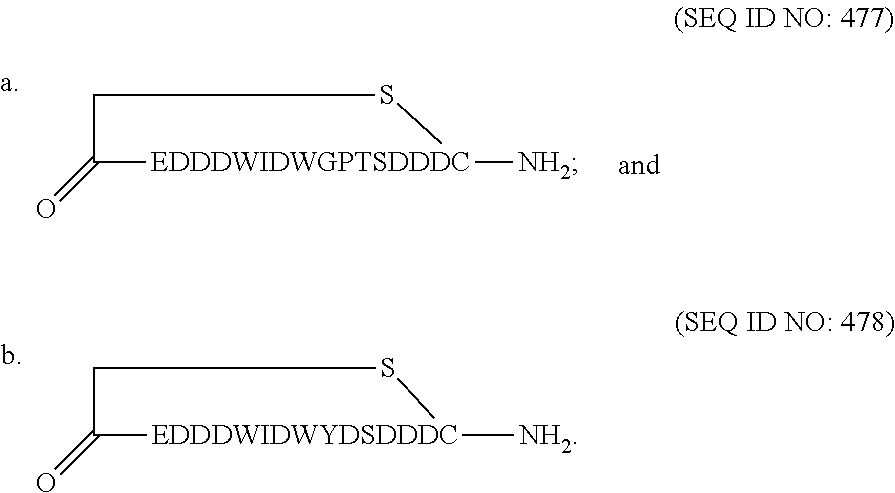
[0135]In one embodiment, the peptide of the present disclosure is

[0136]In one embodiment, the peptide of the present disclosure is

[0137]In one embodiment, the peptide of the present disclosure is

[0138]In one embodiment, the peptide of the present disclosure is

Medicament/Medical Use
[0139]One aspect of the present disclosure relates to a peptide disclosed herein, as well as functional variants thereof, for use as a medicament.
[0140]The present inventors have found that the peptides of the present disclosure, as well as functional variants thereof, can act directly at presynaptic site and modulate the release of several excitatory neurotransmitters including glutamate and acetylcholine. This finds application in treatment of multiple diseases and disturbs.
[0141]Another aspect of the present disclosure relates to a peptide disclosed herein, as well as functional variants thereof, for use in the treatment of neurological and/or psychiatric disorders.
[0142]In one embodiment, the neurological disorder is epilepsy, spasticity, schizophrenia, dystonia, neuropathic pain, narcolepsy, spasticity, cognitive deficits such as Mild cognitive impairment (MCI), autism spectrum disorder and/or substance-use disorders.
[0143]In one embodiment, the neurological disorder is a cognitive deficit, for example MCI, in an individual suffering from Alzheimer's disease.
[0144]In one embodiment, the psychiatric disorder is depression, anxiety and/or Attention deficit hyperactivity disorder (ADHD).
[0145]One aspect of the present disclosure relates to a method for treatment of neurological and/or psychiatric disorders, and symptoms thereof, comprising administration of a peptide according to the present disclosure, as well as functional variants thereof, to an individual in need thereof.
[0146]One aspect of the present disclosure relates to a use of a peptide according to the present disclosure, as well as functional variants thereof, for the manufacture of a medicament for the treatment of neurological and/or psychiatric disorders, and symptoms thereof.
[0147]One aspect of the present disclosure relates to a medicament for use in the treatment or prevention of neurological and/or psychiatric disorders, and symptoms thereof comprising a peptide according to the present disclosure, as well as functional variants thereof.
[0148]Without being bound to theory, a peptide of the present disclosure, as well as a functional variant thereof, may be capable of increasing the release of dopamine and/or serotonin in an individual suffering from depressive disorders or ADHD.
Nucleic Acid Construct Encoding a Peptide
[0149]In one embodiment there is provided a nucleic acid construct encoding a peptide as defined herein. In one embodiment said nucleic acid construct will be able to continuously express said peptide for a prolonged period of time; such as at least 1 month, for example at least 2 months, such as at least 3 months, for example at least 4 months, such as at least 5 months, for example at least 6 months, such as at least 7 months, for example at least 8 months, such as at least 9 months, for example at least 12 months.
[0150]It is thus an aspect to provide a nucleic acid construct encoding a peptide as defined herewith.
[0151]In one embodiment there is provided a nucleic acid construct encoding a peptide of SEQ ID NO: 64, or a functional variant thereof, or any peptide disclosed herein, such as any peptide disclosed in any one of Table 3, table 4, Table 5, Table 6, Table 7, Table 8, Table 9, Table 10, Table 11, Table 12, Table 13, Table 14, Table 15 and/or Table 16, or a functional variant thereof.
[0152]It is also an aspect to provide a nucleic acid construct encoding a peptide as defined herein for use in a method of treating neurological and/or psychiatric disorders as defined herein.
[0153]By nucleic acid construct is understood a genetically engineered nucleic acid. The nucleic acid construct may be a non-replicating and linear nucleic acid, a circular expression vector or an autonomously replicating plasmid. A nucleic acid construct may comprise several elements such as, but not limited to genes or fragments of same, promoters, enhancers, terminators, poly-A tails, linkers, polylinkers, operative linkers, multiple cloning sites (MCS), markers, STOP codons, internal ribosomal entry sites (IRES) and host homologous sequences for integration or other defined elements. It is to be understood that the nucleic acid construct according to the present invention may comprise all or a subset of any combination of the above-mentioned elements.
[0154]Methods for engineering nucleic acid constructs are well known in the art (see, e.g., Molecular Cloning: A Laboratory Manual, Sambrook et al., eds., Cold Spring Harbor Laboratory, 2nd Edition, Cold Spring Harbor, N.Y., 1989). Further, nucleic acid constructs according to the present invention may be synthesized without template, and may be obtained from various commercial suppliers (e.g. Genscript Corporation).
[0155]In one embodiment, the nucleic acid constructs are naked DNA constructs comprising sequences encoding the triple agonist peptide.
Delivery Vehicles
[0156]It is also an aspect to provide the nucleic acid construct as described herein above comprised within a delivery vehicle. A delivery vehicle is an entity whereby a nucleotide sequence or polypeptide or both can be transported from at least one media to another. Delivery vehicles are generally used for expression of the sequences encoded within the nucleic acid construct and/or for the intracellular delivery of the construct or the polypeptide encoded therein.
[0157]In one embodiment, there is provided a delivery vehicle comprising the nucleic acid construct as defined herein. A delivery vehicle may be selected from the group consisting of: RNA based vehicles, DNA based vehicles/vectors, lipid based vehicles (such as a liposome), polymer based vehicles (such as a cationic polymer DNA carrier), colloidal gold particles (coating) and virally derived DNA or RNA vehicles or vectors.
[0158]Methods of non-viral delivery include physical (carrier-free delivery) and chemical approaches (synthetic vector-based delivery).
[0159]Physical approaches, including needle injection, gene gun, jet injection, electroporation, ultrasound, and hydrodynamic delivery, employ a physical force that permeates the cell membrane and facilitates intracellular gene transfer. Said physical force may be electrical or mechanical.
[0160]Examples of chemical delivery vehicles include, but are not limited to: biodegradable polymer microspheres, lipid based formulations such as liposome carriers, cationically charged molecules such as liposomes, calcium salts or dendrimers, lipopolysaccharides, polypeptides and polysaccharides.
Recombinant Cell
[0161]Another aspect of relates to a cell comprising the nucleic acid construct as defined herein. Such a recombinant cell can be used a tool for in vitro research, as a delivery vehicle for the nucleic acid construct or as part of a gene-therapy regime. The nucleic acid construct can be introduced into cells by techniques well known in the art which include microinjection of DNA into the nucleus of a cell, transfection, electroporation, lipofection/liposome fusion and particle bombardment. Suitable cells include autologous and non-autologous cells, and may include xenogenic cells.
Method of Preparation (Peptide)
[0162]In one aspect, the present disclosure relates to methods of manufacturing peptides according to SEQ ID NO: 64 or a functional variant thereof, or any peptide disclosed herein such as any peptide disclosed in any one of Table 3, table 4, Table 5, Table 6, Table 7, Table 8, Table 9, Table 10, Table 11, Table 12, Table 13, Table 14, Table 15 and/or Table 16, or a functional variant thereof.
[0163]Peptides according to the present invention may be prepared according to any conventional methods of peptide synthesis known by the skilled person, e.g. those described in the working examples. The starting materials for the processes described in the present application are known or may readily be prepared by conventional methods known by the skilled artisan from commercially available chemicals.
[0164]The peptides disclosed herein, as well as functional variants thereof, may be prepared by any methods known in the art; such as by standard peptide-preparation techniques including solution peptide synthesis or Merrifield-type solid phase peptide synthesis.
[0165]In one embodiment a peptide according to the disclosure is synthetically made or produced. The methods for synthetic production of peptides are well known in the art.
[0166]Detailed descriptions as well as practical advice for producing synthetic peptides may be found in Synthetic Peptides: A User's Guide (Advances in Molecular Biology), Grant G. A. ed., Oxford University Press, 2002, or in: Pharmaceutical Formulation: Development of Peptides and Proteins, Frokjaer and Hovgaard eds., Taylor and Francis, 1999.
[0167]In one embodiment the peptide or peptide sequences of the disclosure are produced synthetically, in particular, by the sequence assisted peptide synthesis (SAPS) method, by solution synthesis, by solid-phase peptide synthesis (SPPS) such as Merrifield-type solid phase synthesis, by recombinant techniques (production by host cells comprising a first nucleic acid sequence encoding the peptide operably associated with a second nucleic acid capable of directing expression in said host cells) or enzymatic synthesis. These are well-known to the skilled person.
[0168]Peptides may be synthesised either batch-wise on a fully automated peptide synthesiser using 9-fluorenylmethyloxycarbonyl (Fmoc) or tert-Butyloxycarbonyl (Boc) as N-alpha-amino protecting group and suitable common protection groups for side-chain functionalities.
[0169]After purification such as by reversed phase HPLC, peptides may be further processed to obtain for example C- or N-terminal modified isoforms. The methods for terminal modification are well-known in the art.
Pharmaceutical Formulations
[0170]In one aspect, the present invention relates to a composition comprising the peptide as disclosed herein. Preferably, said composition is pharmaceutically acceptable. In one embodiment the composition as described herein is in the form of a pharmaceutical formulation. In one embodiment, the composition as described herein further comprises a pharmaceutically acceptable carrier. In one aspect, the present invention concerns a composition comprising the compound as defined herein and a pharmaceutically acceptable carrier.
Items
- [0171]1. A peptide comprising or consisting of the sequence
- [0172]1 2 3 4 5 6 7 8 9 10 11 12 13 14 15
- [0171]1. A peptide comprising or consisting of the sequence
| (SEQ ID NO: 64) | |
| E X1 X2 X3 X4 <u style="single">X5</u> X6 <u style="single">W</u> X7 X8 X9 X10 D X11 D |
| SEQ ID NO: 15: | |
| TETEFIAWGPTGDED | |
| SEQ ID NO: 16: | |
| EDDDWIDWYDSDDD | |
| SEQ ID NO: 17: | |
| EDDDWIDWGPTSDDD | |
| SEQ ID NO: 18: | |
| EDDYIDWYDSDDD | |
| SEQ ID NO: 19: | |
| EDDYIDWGPTSDDD | |
| SEQ ID NO: 20: | |
| EDDD(2Nala)IDWYDSDDD | |
| SEQ ID NO: 21: | |
| EDDD(2Nala)IDWGPTSDDD | |
| SEQ ID NO: 22: | |
| EDDYTDWYDSDDD | |
| SEQ ID NO: 23: | |
| EDDYTDWGPTSDDD | |
| SEQ ID NO: 24: | |
| ETEFIAWGPTADED | |
| SEQ ID NO: 25: | |
| ETEYIAWGPTGDED | |
| SEQ ID NO: 26: | |
| ETEFIDWGPTGDED | |
| SEQ ID NO: 27: | |
| EDDSWIWWGPTGDED | |
| SEQ ID NO: 28: | |
| EDDSWIWWYGADTD | |
| SEQ ID NO: 29: | |
| EDDSWIDWGPTGDED | |
| SEQ ID NO: 30: | |
| EDDSWIDWYGADTD | |
| SEQ ID NO: 31: | |
| ETEFI(Cya)WGPTGDED | |
| SEQ ID NO: 32: | |
| EDDD(Oetyr)IDWYDSDDD | |
| SEQ ID NO: 33: | |
| EDDD(Obtyr)IDWYDSDDD | |
| SEQ ID NO: 34: | |
| EDDD(Oetyr)IDWGPTSDDD | |
| SEQ ID NO: 35: | |
| EDDD(Obtyr)IDWGPTSDDD |
| Tat, | |
| (SEQ ID NO: 55) | |
| YGRKKRRQRRR, | |
| R8, | |
| (SEQ ID NO: 56) | |
| RRRRRRRR, | |
| R7, | |
| (SEQ ID NO: 57) | |
| RRRRRRR, | |
| R6, | |
| (SEQ ID NO: 58) | |
| RRRRRR, | |
| R5, | |
| (SEQ ID NO: 59) | |
| RRRRR, | |
| R4, | |
| (SEQ ID NO: 60) | |
| RRRR, | |
| R3, | |
| RRR, | |
| or | |
| R2, | |
| RR. |
| SEQ ID NO: 15: | |
| Ac-TETEFIAWGPTGDED-NH2 | |
| SEQ ID NO: 16: | |
| Ac-EDDDWIDWYDSDDD-NH2 | |
| SEQ ID NO: 17: | |
| Ac-EDDDWIDWGPTSDDD-NH2 | |
| SEQ ID NO: 18: | |
| Ac-EDDYIDWYDSDDD-NH2 | |
| SEQ ID NO: 19: | |
| Ac-EDDYIDWGPTSDDD-NH2 | |
| SEQ ID NO: 20: | |
| Ac-EDDD(2Nala)IDWYDSDDD-NH2 | |
| SEQ ID NO: 21: | |
| Ac-EDDD(2Nala)IDWGPTSDDD-NH2 | |
| SEQ ID NO: 22: | |
| Ac-EDDYTDWYDSDDD-NH2 | |
| SEQ ID NO: 23: | |
| Ac-EDDYTDWGPTSDDD-NH2 | |
| SEQ ID NO: 24: | |
| Ac-ETEFIAWGPTADED-NH2 | |
| SEQ ID NO: 25: | |
| Ac-ETEYIAWGPTGDED-NH2 | |
| SEQ ID NO: 26: | |
| Ac-ETEFIDWGPTGDED-NH2 | |
| SEQ ID NO: 27: | |
| Ac-EDDSWIWWGPTGDED-NH2 | |
| SEQ ID NO: 28: | |
| Ac-EDDSWIWWYGADTD-NH2 | |
| SEQ ID NO: 29: | |
| Ac-EDDSWIDWGPTGDED-NH2 | |
| SEQ ID NO: 30: | |
| Ac-EDDSWIDWYGADTD-NH2 | |
| SEQ ID NO: 31: | |
| Ac-ETEFI(Cya)WGPTGDED-NH2 | |
| SEQ ID NO: 32: | |
| Ac-EDDD(Oetyr)IDWYDSDDD-NH2 | |
| SEQ ID NO: 33: | |
| Ac-EDDD(Obtyr)IDWYDSDDD-NH2 | |
| SEQ ID NO: 34: | |
| Ac-EDDD(Oetyr) IDWGPTSDDD-NH2 | |
| SEQ ID NO: 35: | |
| Ac-EDDD(Obtyr)IDWGPTSDDD-NH2 | |
| SEQ ID NO: 36: | |
| Ac-RRRRRRRREDDDWIDWYDSDDD-NH2 | |
| SEQ ID NO: 37: | |
| Ac-RRRREDDDWIDWYDSDDD-NH2 | |
| SEQ ID NO: 38: | |
| Ac-RRREDDDWIDWYDSDDD-NH2 | |
| SEQ ID NO: 39: | |
| Ac-RRRRRRRREDDDWIDWGPTSDDD-NH2 | |
| SEQ ID NO: 40: | |
| Ac-RRRREDDDWIDWGPTSDDD-NH2 | |
| SEQ ID NO: 41: | |
| Ac-RRREDDDWIDWGPTSDDD-NH2 | |
| SEQ ID NO: 42: | |
| Ac-RRRREDDD(2Nala)IDWYDSDDD-NH2 | |
| SEQ ID NO: 43: | |
| Ac-RRRREDDD(2Nala)IDWGPTSDDD-NH2 |
EXAMPLES
Example 1. General Methods and Material
[0215]Except where otherwise stated, amino acids and reagents for SPPS were purchased from Iris Biotech or Gyros Protein Technologies. Reagents and solvents were purchased from commercial suppliers and used without further purification. Synthesized crude peptides were purified using a preparative reverse phase high performance liquid chromatography (RP-HPLC) system (Waters) with a reverse phase C18 column (Zorbax, 300 SB-C18, 21.2×250 mm) with a binary buffer system of H2O:CH3CN:TFA (A: 95:5:0.1; B: 5:95:0.1) at 20 mL/min. Mass spectra of peptides were characterized using the electron spray ionization (ESI) liquid chromatography-mass spectrometry (LC-MS) coupled to an Agilent 6410 Triple Quadrupole Mass with a reverse phase C18 column (Zorbax Eclipse XBD-C18, 4.6×50 mm) using a binary buffer system consisting of H2O:CH3CN:formic acid (A: 95:5:0.1; B: 5:95:0.1) at 0.75 mL/min. The purity of synthesized peptides were determined by at 214 nm UV absorbance on an analytical reverse phase ultra-performance liquid chromatography (RP-UPLC) (Waters) system with a reverse phase C18 column (Acquity UPLC BEH C18, 1.7 μm 2.1×50 mm) using a binary buffer system consisting of H2O:CH3CN:TFA (A: 95:5:0.1; B: 5:95:0.1) at 0.45 mL/min.
[0216]SPOT peptide array synthesis. μSPOT peptide arrays (CelluSpots, Intavis AG, Cologne, Germany) were synthesized using a RePepSL synthesizer (Intavis AG) on acid labile, amino functionalized, cellulose membrane discs (Intavis AG) containing 9-fluorenylmethyloxycarbonyl-β-alanine (Fmoc-β-Ala) linkers (minimum loading 1.0 μmol/cm). Synthesis was initiated by Fmoc deprotection using 20% piperidine in N-methylpyrrolidone (NMP) (1×2 and 1×4 μL, 3 and 5 min, respectively) followed by washing with dimethylformamide (DMF, 7×100 μL per disc) and ethanol (EtOH, 3×300 μL per disc).
[0217]Peptide chain elongation was achieved using 1.2 μL of coupling solution consisting of preactivated amino acids (AAs, 0.5 M) with ethyl 2-cyano-2-(hydroxyimino)acetate oxyma (1.5 M) and N,N′-diisopropylcarbodiimide (DIC, 1.1 M) in NMP (2:1:1, aa:oxyma:DIC). The couplings were carried out 6 times (10, 15, 25, 30, 30 and 30 min, respectively), and subsequently, the membrane was capped twice with capping mixture (5% acidic anhydride in NMP), followed by washes with DMF (7×100 μL per disc). After chain elongation, final Fmoc deprotection was performed with 20% piperidine in NMP (3×4 μL, 5 min each), followed by 6× washes with DMF, subsequent N-terminal acetylation with capping mixture (3×4 μL, 5 min each) and final washes with DMF (7×100 μL per disc) and EtOH (7×200 μL per disc). Dried cellulose membrane discs were transferred to 96 deep-well blocks and were treated with the side-chain deprotection solution consisting of 80% TFA, 12% DCM, 5% H2O, and 3% TIPS (150 μL per well) for 1.5 h at room temperature (rt). Afterward, the deprotection solution was removed, and the discs were solubilized overnight at rt using a solvation mixture containing 88.5% TFA, 4% trifluoromethanesulfonic acid (TFMSA), 5% H2O, and 2.5% TIPS (250 μL per well). The resulting peptide-cellulose conjugates were precipitated with ice-cold ether (1 mL per well) and spun down at 1000 rpm for 90 min, followed by an additional wash of the formed pellet with ice-cold ether. The resulting pellets were redissolved in DMSO (500 μL per well) to give final stocks, which were transferred to a 384-well plate and printed (in duplicates) on white coated CelluSpots blank slides (76×26 mm, Intavis AG) using a SlideSpotter robot (Intavis AG).
[0218]Quality control of SPOT. Cleavable peptides as synthesis quality controls were prepared following general SPOT synthesis procedure (see above). For peptide cleavage from the cellulose support Fmoc-Rink amide linker was coupled as a first building block (4 times at 10, 15, 25, and 30 min, respectively), followed by deprotection and standard SPOT peptide chain elongation procedure. The discs with synthesized peptides were transferred into Eppendorf tubes and treated with side chain deprotection solution 80% TFA, 12% DCM, 5% H2O, and 3% TIPS (150 μL per well) for 1.5 h. Subsequently, the cleaved peptides were precipitated with ice-cold diethyl ether and spun down at 14 000×g (4° C., 20 min). The precipitate was dissolved in 100 μL of 50:50:0.1 (CH3CN:H2O:TFA), filtered (Fisherbrand™ Syringe Filters: PTFE Membrane, 0.2 μM) and analyzed by LC-MS and RP-UPLC.
[0219]SPOT peptide array screening based on slide imaging method. The DMSO stocks of SPOT synthesized peptide-cellulose conjugates were pipetted into a 384-well plate and then printed in duplicates onto the white coated CelluSpots slides (76×26 mm, Intavis AG) using a SlideSpotter robot (Intavis AG). After air drying overnight, the slides were rinsed gently with 1× phosphate buffered saline (PBS, pH 7.4), and then blocked in blocking solution (5% bovine serum albumin (BSA) in PBS) for >2 h at rt on an orbital shaker. Subsequently, the slides were incubated with 6×His-tagged SD1/2 protein in blocking solution at different concentrations (epitopes mapping: 0.25 μM, 0.01 μM and 0.05 μM for APP, AJAP-1 and PIANP, respectively. Deep mutational scans: 0.02 μM, 0.005 μM and 0.01 μM for APP, AJAP-1 and PIANP, respectively) for 1 h at rt. After briefly rinsing with washing solution (PBS-T: 0.05% Tween-20 in PBS buffer), the slides were washed 3 times by PBS-T for 2 min. Subsequently, slides were incubated with diluted HRP conjugated 6×His Tag antibody (1:10000, ab184607, abcam) for 30 min at rt. Finally, the slides were washed 5×2 min with washing solution and then visualized with SuperSignal West Femto Maximum Sensitivity Substrate (ThermoFisher Scientific) using Syngene P×i image system. The resulting SPOT slide images were analyzed using the Array Analyze Software (Active Motif) to quantify the relative SD1/2 binding of each peptide.
[0220]SPOT peptide array screening based on fluorescence polarization assay. FP assay was employed to explore the possibility of using SPOT synthesized peptide-cellulose conjugates to compete the binding between AJAP-1probe (SEQ ID NO: 15) and SD1/2 in solution to generate reproducible dose-response curves in black flat bottom 384-well plates (Corning Life Science).
[0221]The DMSO stocks of all positional scan peptide-cellulose conjugates were diluted 10, 320 and 10 times (for APP, AJAP-1, PIANP-derived peptides, respectively) directly into 1×PBS (pH 7.4). All experiments were conducted following standard FP assay protocol by using 25 nM of AJAP-1probe and 40 nM of recombinant SD1/2 protein (Dinamarca et al, 2019) in 100 mM PBS (pH 7.4) containing 1% bovine serum albumin (BSA) at rt. Subsequently, the fresh prepared diluted peptide-cellulose conjugates were pipetted into the flat bottom black 384-well plates (Corning Life Science) incubating with the pre-mixed SDs/AJAP-1probe. The fluorescence polarization values were measured using excitation/emission wavelengths of 530/580 nm with a Safire2 plate reader (Tecan). The instrumental Z-factor was adjusted to obtain the maximum fluorescence intensity and the G-factor was calibrated to give an initial 20 mP (millipolarization value) of the reference wells. The obtained the polarization value (mP) from each well represents the relative binding affinity of the mutated peptide compared to the corresponding wild type peptides.
Solution Array Synthesis.
[0222]Parallel synthesis in 96 format peptide synthesis was done using Intavis multipep RSi instrument. Fmoc-PAL resins was used (10 mg per well). Fmoc-amino acids (Fmoc-AA) were dissolved in dimethylformamide (DMF) containing 0.3 M OxymaPure. Throughout the synthesis Fmoc-AA were preactivated with diisopropylcarbodiimide (DIC) for 2 min before adding to the resin. Three couplings using 100 μL Fmoc-AA and 10 μL DIC (3 M in DMF) pr well were employed with coupling times of 5, 15 and 60 min. Removal of Fmoc was performed by washing twice with 120 μl per well of 25% piperidine in DMF for 2 and 8 min. Washing steps after deprotection with piperidine and after coupling steps included washing with DMF (150 μL per well) five times. After synthesis the resins were dried with ethanol and trifluoroacetic acid (TFA) was added using 92% TFA containing 4% triisopropylsilane (TIPS), 1% thioanisol, and 3% H2O for 2 hours. This was done by adding 100 μL per well of the TFA cleavage cocktail over a period of 30 min adding up to a total volume of 1 mL to each well. TFA was then reduced in volume to approximately 100-150 μL by N2 flow and peptides were precipitated by the addition 800 μL of diethylether to each well. The peptides were transferred to Waters solvinert plates and washed thoroughly five times with diethylether 500 μL per well. After washing, the peptides were dried and then dissolved in 80% DMSO. Characterization was performed by UPLC-MS on a setup consisting of a Waters Acquity UPLC system connected to an LCT Premier XE mass spectrometer from Micromass using solvent A 0.1% TFA in H2O and solvent B 0.1% TFA in CH3CN. The peptides were confirmed by MS and had an average purity of >80%.
[0223]Peptide synthesis. All peptides were synthesized by solid-phase peptide synthesis (SPPS) using the Fmoc-strategy on the H-Rink amide ChemMatrix resin (Sigma-Aldrich) ranging from 0.01 to 0.1 mmol scale. Standard amide condensation reactions were carried out at rt under agitation using the coupling mixture with the equivalent ratio of 1:4:4:8 (resin:protected AAs:HCTU:DIPEA) and were monitored using a Kaiser Test Kit (Sigma-Aldrich). Fmoc deprotection was performed 2 times and 2 min for each using 20% piperidine in DMF and followed by extensive washing with DMF. After completion of elongation, the N-terminal Fmoc was deprotected by 20% piperidine and then capped for 5 min using 5% acid anhydride in DMF at the presence of 8 equivalents of DIPEA and then the resin was washed with DMF and DCM before being dried under vacuum.
[0224]Automated peptide synthesis. Automated peptide synthesis using Fmoc-based SPPS was carried out either on a Prelude X or PurePep Chorus peptide synthesizers (Gyros Protein Technologies, Tucson, AZ, USA) with 10 mL (0.05 mmol scale) or 25 mL (0.1 mmol scale) glass reaction vessels using H-Rink amide ChemMatrix resin (Sigma-Aldrich).
[0225]For Prelude X, all reagents were prepared as DMF solutions: Fmoc-protected amino acids (0.2 M), HCTU (0.4 M), and DIPEA (1.0 M). Sequences were elongated as the following procedures: deprotection (2×2 min, rt, 300 rpm shaking) and coupling (2×5 min, 65° C., 300 rpm shaking, for Cys and His couplings 2×5 min, 50° C., 300 rpm shaking). Amino acids were double coupled using amino acid/HCTU/DIPEA (ratio=1:1:2.5) in 5-fold equivalent excess over the resin scale to ensure synthetic efficiency. For PurePep Chorus, all reagents were also prepared as solutions in DMF: Fmoc-protected amino acids (0.1 M), Oxyma Pure (0.4 M) and DIC (0.4 M). Sequences were elongated as the following procedures: deprotection (2×2 min, rt, 350 rpm shaking) and coupling (2×7 min, 65° C., 350 rpm shaking, for Cys and His couplings 2×7 min, 50° C., 350 rpm shaking). Amino acids were double coupled using amino acids/DIC/Oxyma pure (ratio=1:1.05:1.1) in 4-fold equivalent excess over the resin scale to ensure synthetic efficiency.
[0226]TAMRA labelling. For FP assay, the fluorescent peptides were synthesized on resin by coupling the fluorophore TAMRA (Anaspec Inc.) onto the free N-terminus of peptides. The reaction was performed at rt using a mixture of TAMRA/PyBOP/DIPEA (ratio=1.5:1.5:3) in NMP. For minimizing photobleaching, the agitated reaction vessels were covered by tinfoil. After about 16 h, the resin was washed extensive with DMF and DCM followed by drying under vacuum before the final cleavage.
[0227]Peptide cleavage and purification. The synthesized peptides were cleaved from the resin using the cleavage cocktail containing 92.5% TFA, 2.5% H2O, 2.5% TIPS and 2.5% DODT for 2 h under agitation at rt. After cleavage, the peptides were precipitated with ice-cold diethyl ether and centrifuged at 4350 rpm for 10 min at 4° C. The resulting crude peptides were redissolved in 50:50:0.1 (H2O:CH3CN:TFA), analyzed using LC-MS and UPLC and lyophilized for purification (as described in General methods section). The collected fractions from purification were characterized by LC-MS. The purity of the fractions was determined at 214 nm using UPLC. The fractions with higher than 95% purity were pooled and lyophilized for further experiments.
[0228]Fluorescence polarization (FP). FP assay was employed to determine the binding affinity of peptides in flat bottom black 384-well plates (Corning Life Science) using a Safire2 plate reader (Tecan). All experiments were conducted in 1×PBS (pH 7.4) containing 1% bovine serum albumin (BSA) at rt. The fluorescence polarization values were measured using excitation/emission wavelengths of 530/580 nm. The instrumental Z-factor was adjusted to obtain the maximum fluorescence intensity and the G-factor was calibrated to give an initial millipolarization value of 20 mP. All FP assays including saturation or competition experiments were performed using 25 nM of TAMRA labeled peptides as probes. For saturation assay, the millipolarization values were measured after mixing of probes with 12 serial 1 to 1 diluted concentrations of Sushi domains (SD1/2) protein. All experiments were performed in triplicate and the data were plotted to the one-site binding model using GraphPad Prism 9 to calculate the Kd of probes. In the competition assay, pre-mixed of SDs/probes were outcompeted with unlabeled peptides at 12 serial 1 to 1 diluted concentrations ranging from 0.24 to 500 μM based on the expected affinity. The experiments were performed at least in triplicate and the data were fitted to the sigmoidal dose response curve using GraphPad Prism 9 to obtain the IC50 of peptides. The Ki values were calculated according to Nikolovska-Coleska et al310.
Results
[0229]Taken together, SPOT identified several peptide hits from each APP, AJAP-1 and PIANP (data not shown), which were combined to three 21-mer length SDs binding epitopes (APP197-217, AJAP-1173-193 and PIANP93-113). Moreover, based on SPOT results the overlapping 9 residues length regions (203EDDSDVWWG211 SEQ ID NO: 4, 179EFIAWGPTG187 SEQ ID NO: 5, and 99AIVWGPTVS107 SEQ ID NO: 6) within APP, AJAP-1 and PIANP, respectively, were indicated representing the core binding regions to SD1/2. Additionally, alignment of all peptide hits to the previously reported two critical residues (WG) within the three proteins, the overlapped 5 amino acids, 207DVWWG211 SEQ ID NO: 7, 179FIAWG187 SEQ ID NO: 8 and 99AIVWG103 SEQ ID NO: 9 within APP, AJAP-1 and PIANP, respectively, were anticipated as the most essential residues for SD1/2 binding and highlighted in the red dashed frame.
[0230]High-affinity AJAP-1probe facilitated determination of binding constants of peptides 11 (SEQ ID NO: 11) and 12 (SEQ ID NO: 12) (Ki=5 and 1.3 μM, respectively). Thereafter, we successfully characterized the binding affinities of all synthesized SPOT hits by FP using the AJAP-1probe (data not shown). AJAP-1 derived peptides exhibited the highest SD1/2 binding affinity with Ki values all below 100 nM. Additionally, peptide 15 (SEQ ID NO: 15) again proved to be the highest binding affinity hit (Ki=23 nM). In contrast, peptides derived from the other two proteins exhibited much lower binding affinity, with peptides 13 (EDDSDVWWGGADTDY, SEQ ID NO: 13) (581 nM) and 14 (PWAIVWGPTVSREDG, SEQ ID NO: 14) (465 nM) being the best SPOT-identified hits from APP and PIANP, respectively (Table 3).
Example 2. Definition of the Optimal Binding Motif
[0231]We first selected three peptides (peptides 15 (SEQ ID NO: 15), 36 (SEQ ID NO: 15) and 14 (SEQ ID NO: 14), displaying the highest binding affinity towards SD1/2, as a starting point for definition of optimal and the shortest possible binding interface. Thus, we next focused on systematic truncation scan at both N- and C-terminus of all three SD-binding peptides.
Results
[0232]The information form elongation and truncation scans (Tables 4, 5 and 6) was used to design, synthesize and evaluate, the shortest possible 14-mer binding epitopes-APPWT (Ac-EDDSDVWWGGADTD-NH2 (SEQ ID NO: 1)), AJAP-1WT (Ac-ETEFIAWGPTGDED-NH2 (SEQ ID NO: 2)) and PIANPWT (Ac-PWAIVWGPTVSRED-NH2 (SEQ ID NO: 3)). Calculated Ki values from FP experiments suggested a rank order of SD1/2 binding affinities—AJAP-1 (31±1 nM)>>PIANP (476±19 nM)>APP (557±9 nM). Alignment of the three binding regions to the WG (positions 0 and 1, respectively) motif revealed overall similar structure consisting of a hydrophobic core (positions-3 to 2) surrounded by polar residues at both termini, apart from PIANPWT containing a more hydrophobic N-terminal.
Example 3. Alanine-Scan, D -Amino Acid Scan and N-Methylation Scan
[0233]An Ala scan on the identified APPWT, AJAP-1WT and PIANPWT was performed to elucidate the importance of each residue for the molecular recognition. 39 peptide variants (13 from each binding motif) each containing a single alanine substitution were synthesized and subsequently evaluated in the FP assay for their binding to SD1/2.
[0234]Similarly, a
Results
[0235]Comparison of the resulting binding affinities indicated similar tendencies as seen in truncation scan, underlining the importance of hydrophobic core (
[0236]Similarly,
[0237]Similarly, to the previous scans, amino acid substitutions with the corresponding N-Me amino acids again highlighted the importance of the core binding region. Specifically, N-methylation at positions −1 and 1 (corresponding to positions 7 and 9 in the peptide consensus of claim 1, SEQ ID NO: 64) exhibited the largest impact negative impact on the peptides binding to SD1/2 compared to the parent peptide variants. Interestingly, substitutions of position 2 amino acid (corresponding to position 10 in the peptide consensus of claim 1, SEQ ID NO: 64) with N-Me-Gly at APPWT yielded a peptide variant showing 3-fold increased affinity. Both AJAP-1WT and PIANPWT peptides at position 2 (corresponding to position 10 in the peptide consensus of claim 1, SEQ ID NO: 64) have a Pro residue, which provides rigidity. N-Me-Gly substitution introduced in APPWT likewise introduce conformational constrains, thus potentially leading to preferred binding conformation and increased binding affinity.
[0238]The binding affinity for all synthesised and tested peptides are shown in Tables 7, 8 and 9.
Example 4. Deep Mutational Scan of APP WT , AJAP-1 WT and PIANP WT Peptides
[0239]We applied the deep mutational scanning method using canonical amino acids (cAAs) for peptides of APPWT, AJAP-1WT and PIANPWT. To achieve this, we again employed SPOT technology and generated three arrays and each comprising 280 14-mer peptides (including 14 wild peptides as references).
[0240]We synthesized additional positional scanning array (termed solution array) of APPWT using the conventional on-resin SPPS strategy in 96-well plates. This solution array contained 268 peptides (including two wild type peptides). Noteworthy, all peptides synthesized in this array showed around 90% crude purity. Taking advantage of the high purity of this peptide array, we generated six-point FP inhibition curve of each peptide and the obtained dose response curves enabled us to calculate the binding affinity (Ki) of each peptide variant (data not shown).
Results
[0241]The obtained Ki (635 nM) using the crude APPWT (Table 10) in the solution array is almost identical to the previously measured Ki (557 nM) using the purified APPWT. The solution array results revealed dramatically increased affinity of the two most interesting mutants of APPWT, D207W and G211Y, which showed Ki values of 78 nM and 167 nM, respectively. Substitution of D207 with bulkier hydrophobic amino acids including Phe, Tyr and Trp enabled additional contacts with hydrophobic residues at SD1.
[0242]FP-based screen of SPOT synthesized AJAP-1WT (Table 11) positional scan array identified 7 residues within AJAP-1WT, 179EFIAWGP185 (SEQ ID NO: 62), as the highly conserved core binding motif, which was consistent with the SPOT epitope mapping experiments. Multiple substitutions of the A182, located between two critical residues (I181 and W183), generated mutants exhibiting comparable or even higher binding affinity compared to AJAP-1WT. Particularly, the mutant A182D (peptide 26, SEQ ID NO: 26) represented the most promising mutation of AJAP-1WT with dramatically increased binding affinity (Ki=9 nM).
[0243]Two Arg residues are present in SD1 (R32 and R36) are in proximity to the A182. Therefore, A182D mutation might facilitate additional electrostatic interaction between these thereby resulting in improved binding affinity.
[0244]T178 could be mutated into hydrophobic amino acids such as Ile and Val with improved affinity. Furthermore, F180Y, showed a potential to improve affinity.
[0245]Deep mutational scanning of PIANPWT (Table 12) revealed a highly conserved hydrophobic core binding motif composed of 6 residues (100IVWGPT105 (SEQ ID NO: 63)). Identified beneficial mutations of PIANPWT were relating mostly to mutations of hydrophobic residues into acidic amino acids. However, just slight affinity improvements (less than 2-fold) compared to the PIANPWT were observed.
Example 5. NcAA Deep Mutation Scan of APP WT , AJAP-1 WT and PIANP WT Peptides
[0246]We performed computational ncAAs based deep mutational scanning of APPWT, AJAP-1WT and PIANPWT using the generated random forest (RF) models to predict the relative SD1/2 binding affinity of each mutant with introduced single ncAA. Specifically, each residue within peptides was individually replaced by any of the available 67 ncAAs in the z-scales database, resulting in 938 variants having a single ncAA introduced in each wild type peptide.
Results
[0247]The beneficial ncAA mutations for APPWT were mainly related to mutation of residues Asp207 and Gly211 into aromatic and/or hydrophobic ncAAs. The relative affinities of peptides with ncAAs were organized as three individual heat maps (
Example 6. Affinity Maturation
[0248]Design of novel SD-specific high affinity peptides based on APPWT and AJAP-1WT. We first divided both wild type peptides into the N-terminal and C-terminal parts, separating them at positions 0 and 1. Then for the design of novel peptides one part (either N- or C-terminal) was taken from APPWT and other part (either N- or C-terminal) from AJAP-1WT, generating two hybrid peptides X (Ac-EDDSDVWWGPTGDED-NH2 SEQ ID NO: 48) and Y (Ac-ETEFIAWGGADTD-NH2 SEQ ID NO: 49). The hybrid peptide X was obtained by merging APPWT N-terminal part and AJAP-1WT C-terminal part and displayed similar affinity as AJAP-1WT that is almost 10-fold higher than APPWT. In contrast, the hybrid peptide Y containing AJAP-1WT N-terminal part and C-terminal part of APPWT exhibited comparable affinity as APPWT (Table 1). Next, to further optimize binding properties we introduced the best C-terminal mutation G211Y of APPWT into peptide Y generating a chameleon peptide 37 (Ac-ETEFIAWYGADTD-NH2 SEQ ID NO: 50), which showed improved affinity comparable to peptides X and AJAP-1WT (Table 2). Then, we substituted the Pro in the AJAP-1WT, generating peptide 38 (Ac-ETEFIAWG (N-Me-G)TGDED-NH2 SEQ ID NO: 51), which exhibited the same affinity as AJAP-1WT indicating that the N-Me-Gly can mimic peptide binding conformation introduced by Pro (Table 1). After exploring contributions of single modifications, we moved forward with incorporation of multiple beneficial mutations into native or hybrid peptide variants. First, we investigated the effect of introducing double modification, namely D207W and V2081 into peptide X.
[0249]This led to peptide 27 (Ac-EDDSWIWWGPTGDED-NH2 SEQ ID NO: 27) showing 3.8-fold better affinity than 9. With this information we combined D207W and V2081 with G211Y mutations and incorporated them to APPWT, resulting peptide 28 (Ac-EDDSWIWWYGADTD-NH2 SEQ ID NO: 28) displayed Ki value almost identical to peptide X (Table 1). Encouraged by synergistic effect of multiple mutations on the peptides binding affinity we in introduced the best mutation (A182D) of AJAP-1WT into peptides 27 and 28 at the corresponding positions, generating peptides 29 and 30 with further improved affinity (Table 1). Additionally, we introduced other identified favourable mutations of APPWT including S206D, G212D, T215D and A213S into peptide 30. Additionally, affinity improving mutations (G187S and E189D) from AJAP-1WT SAR study were introduced into the AJAP-1WT derived C-terminal part of peptide 29, together with S206D. Satisfyingly, all incorporated mutations into peptides APPWT and X were compatible and generated peptides 16 (Ac-EDDDWIDWYDSDDD-NH2 SEQ ID NO: 16) and 17 (Ac-EDDDWIDWGPTSDDD-NH2 SEQ ID NO: 17) with low nanomolar affinity. Similarly, optimized versions of AJAP-1WT and peptide Y, resulted in two high affinity peptides 18 (Ac-EDDYIDWGPTSDDD-NH2 SEQ ID NO: 18) and 19 (Ac-EDDYIDWYDSDDD-NH2 SEQ ID NO: 19) (Table 1).
[0250]The 3 the most promising hydrophobic ncAAs were Obtyr, 2Nala and Oetyr, which showed the greatest improvement to the affinity of APPWT by substituting the D207 residue. We incorporated these ncAAs into corresponding positions within peptides 16 and 17. The FP data showed that all but one of resulting peptides (peptides 32-35, SEQ ID NOs: 36 to 39) exhibited slightly higher affinity compared to peptides 16 and 17. In contrast, introduction of the 2Nala into peptide 16 further increased affinity to 1.5 nM (peptide 20). (Table 1). The full list of the synthesised and tested peptides for affinity maturation can be found in Table 13.
| TABLE 1 |
|---|
| Overview of synthesized peptides for affinity |
| maturation. Data are displayed as calculated Ki |
| values (mean ± SEM, n ≥ 3). All peptides have N- |
| terminal acetylation and C-terminal amidation. |
| Peptide | Sequences | Ki (nM) |
| APPWT | EDDSDVWWGGADTD | 557 ± 9 |
| X | EDDSDVWWGPTGDED | 62 ± 1 |
| Y | ETEFIAWGGADTD | 354 ± 9 |
| AJAP-1WT | ETEFIAWGPTGDED | 31 ± 1 |
| 37 | ETEFIAWYGADTD | 95 ± 5 |
| 38 | ETEFIAWG(N-Me-G)TGDED | 32 ± 2 |
| 27 | EDDSWIWWGPTGDED | 16 ± 1 |
| 28 | EDDSWIWWYGADTD | 18 ± 1 |
| 29 | EDDSWIDWGPTGDED | 5.6 ± 0.7 |
| 30 | EDDSWIDWYGADTD | 11 ± 0.1 |
| 16 | EDDDWIDWYDSDDD | 3.2 ± 0.2 |
| 17 | EDDDWIDWGPTSDDD | 4.0 ± 0.3 |
| 18 | EDDYIDWYDSDDD | 4.6 ± 0.3 |
| 19 | EDDYIDWGPTSDDD | 3.8 ± 0.2 |
| 20 | EDDD(2Nala)IDWYDSDDD | 1.5 ± 0.2 |
| Scr-20 | (2Nala)EDSDDYDDIDDDW | 31.000 ± 1.000 |
| 33 | EDDD(Obtyr)IDWYDSDDD | 9.3 ± 0.2 |
| 32 | EDDD(Oetyr)IDWYDSDDD | 5.3 ± 0.2 |
| 21 | EDDD(2Nala)IDWGPTSDDD | 5.3 ± 0.2 |
| 35 | EDDD(Obtyr)IDWGPTSDDD | 9.5 ± 0.3 |
| 34 | EDDD(Oetyr)IDWGPTSDDD | 6.5 ± 0.4 |
Example 7 Pull-Down Experiments
[0251]The aim of these experiments was to examine whether the most potent peptide 20 could bind to native SD and examine the selectivity towards the SD.
[0252]Covalent immobilization of peptides. Peptides AJAP-1WT, 17 and 20 comprising a C-terminal Cys and a PEG2 linker, were loaded covalently to Dynabeads M-270 Epoxy beads (Thermo Fischer Scientific) according to the protocol of the manufacturer. 25 μL DMSO stocks of peptides (10 mM) were diluted 15 times into 350 μL coupling buffer (100 mM PBS buffer containing 2 M (NH4)SO4 and 10 mM TCEP, PH=7.4) and agitated overnight at 37° C. with Dynabeads M-270 Epoxy beads (5 mg, ~3.3×10⁸ beads), which had been washed and equilibrated with coupling buffer before. After removing excess peptides, the Dynabeads M-270 Epoxy beads were washed three times and equilibrated with 100 mM PBS buffer, pH=7.4 and stored at 4° C.
[0253]Preparation of whole-brain lysates. Dissected adult mouse brains were placed in ice-cold homogenization buffer (320 mM sucrose, 4 mM HEPES, PH 7.5, 1 mM EDTA, 1 mM EGTA, supplemented with complete EDTA-free protease inhibitor mixture (Roche), 1 mL per 100 mg of brain) and homogenized with a glass-Teflon homogenizer (40 passes) on ice. The homogenized material was cleared by centrifugation at 500×g (4° C., 15 min). The supernatant was carefully removed and ultracentrifuged at 48 000×g (4° C., 45 min) to isolate membrane-enriched fraction (pallet), which was solubilized for 3 h at 4° C. in NETN buffer (100 mM NaCl, 1 mM EDTA, 0.5% Nonidet P-40, 20 mM Tris-HCl, pH 7.4, supplemented with a protease inhibitor mixture). The solubilized membrane-enriched fraction was cleared by ultracentrifugation at 100 000×g (4° C., 45 min). The final brain lysates (at 2 mg/mL protein concentration) were directly used for immunoblot analysis (input lanes) or for pull-down experiments.
[0254]Pull-down experiments. The covalently immobilized peptides AJAP-1WT, 16 and 20 were washed with 3×1 mL of 100 mM PBS and 1 mL of 100 mM PBS containing 0.1% Tween-20 and directly incubated with freshly prepared whole-brain lysate (2 mg/ml of total protein) overnight on a spring wheel at 4° C. The next day, the beads were washed with 2×1 mL of 100 mM PBS and 2×1 mL of 100 mM PBS containing 0.1% Tween-20, and then the pulled down proteins were eluted with 4× sample loading buffer containing 200 mM DTT (2×10 μL). Proteins were resolved using standard one-dimensional SDS-PAGE on 10% polyacrylamide gels (for 45 min at 70 mV, followed by an additional 1.5 h at 120 mV). For immunoblotting analysis, proteins were transferred to nitrocellulose membrane (0.2-μm pore size) (iBlot™ 2 Transfer Stacks, nitrocellulose, mini) using iBlot2 (invitrogen) and then probed with the primary antibodies mouse anti-SD clone 43N12 (1:250) or mouse monoclonal to GABAB1 subunit (abcam, 1:500) in combination with secondary peroxidase-coupled sheep anti-mouse IgG antibody (Cytiva, 1:5000).
Results
[0255]The pull-down experiments demonstrated that both AJAP-1WT and peptide 20 showed the ability to bind and enrich full-length GB1a subunit in a complex native environment, whereas the negative control peptide Scr-20 and beads alone did not interact with the GB1a subunit (
Example 8. In Vitro Plasma Stability
[0256]For time-course assay, 360 μL human plasma was pre-warmed up at 37° C. for 15 min and then spiked with 40 μL of tested peptides (1 mM in 1×PBS). After 0, 2, 6, 12, 24 and 48 h incubation at 37° C., for each time point 45 μL sample was collected and pre-treated with 50 μL 6 M urea for 10 min at 0° C. Subsequently, 100 μL acetonitrile was added into and then samples were incubated overnight at −20° C. After that, all samples were centrifuged at 13,400 rpm for 10 min and the supernatant was filtered and then analyzed by LC-MS and UPLC (Waters). The area under the curve (AUC) was determined and normalized to the value of the first time point. The half-life (T1/2) was obtained by fitting the data to the one-phase decay equation in GraphPad Prism 9 and expressed as the mean of three individual experiments. For end-point assay, 108 μL human plasma was pre-warmed up at 37° C. for 15 min and then spiked with 12 μL of tested peptides (1 mM in 1×PBS). After 0 and 48 h incubation at 37° C., 45 μL sample was collected and then treated as following the same procedure described in time-course assay above. The area under the curve (AUC) of end-point (48 h incubation) was normalized to the value of the first time point and then the stability was expressed as compound remaining (%).
Results
[0257]It was found that even the native protein-derived wild type peptides (APPWT, AJAP-1WT and PIANPWT) exhibited excellent stability in human plasma with half-life times of >48, >48 and 16 h, respectively. Similarly, the half life of all four optimized peptides composed of cAAs (16-19) were >48 hours and no apparent degradation was observed after two days incubation with 90% of intact peptide remaining. Moreover, we also investigated the impact of polyR tagging on the plasma stability of peptides. The results demonstrated that R8-tagged peptides (R8-16 and R8-17) showed excellent stability as well with about 50% remaining after 48 hours incubation. Interestingly, truncation of the poly-R from 8R to 3R further improved plasma stability (R3-16 and R3-17), and the amount of the remaining peptide increased from 50% to about 80% after 48 hours incubation (
[0258]Additionally, we evaluated the influence of incorporating the ncAA (2Nala) into 4R tagged version of peptides by characterization of their affinity, permeability, and plasma stability. We found that 4R-20 exhibited about 2-fold higher affinity than 4R-16, while 4R-21 showed almost identical affinity as 4R-17 (
[0259]In conclusion, it was demonstrated that truncating the polyR moieties of our CPP tagged peptides to 4R resulted in excellent membrane permeability, while displaying much less negative impact on the affinity, exhibiting higher human plasma stability compared to 8R tagged peptides.
[0260]The full list of the synthesised and tested peptides in combination with a CPP can be found in Table 14.
Example 9. Chloroalkane Penetration Assay (CAPA)
[0261]The HeLa cell line used for CAPA assay was generated by Chenoweth and co-workers and provided by Kritzer and co-workers. The cells stably express a HaloTag-GFP fusion protein anchored through a mitochondria targeting peptide exposed to the cytosol. For CAPA, Hela cells were seeded using DMEM supplemented with FBS in a 96-well plate one day before the experiment at a density of 4×10⁴ cells/well. Just before the assay, the growth media was aspirated off and replaced with Opti-MEM assay media (100 μL/well). DMSO stocks of peptides (10 mM) were diluted in Opti-MEM to prepare serial dilutions of peptides in a separate 96-well PCR plate ensuring the final concentration of DMSO was kept consistent and below 1%. Subsequently, 25 μL of peptide solution was added into each well and the plate was incubated for 4 h at 37° C. with 5% CO2. After aspirating the assay media off, cells were washed with fresh Opti-MEM (80 μL/well) for 15 min at rt. Following removal of the washing media, cells were incubated with 5 μM CA-TAMRA in Opti-MEM (50 μL/well) for 15 min. Non CATAMRA control wells were incubated with Opti-MEM alone (50 μL/well). After removal of the dye containing media, cells were washed with fresh Opti-MEM (80 μL/well) for 30 min. After aspiration, cells were trypsinized using clear Trypsin (20 μL/well, 10 min at 37° C.), resuspended in PBS containing 2% FBS (180 L/well), and analyzed using a benchtop flow cytometer (Guava EasyCyte, EMD Millipore).
Results
[0262]Due to high similarity, we chose peptides 16 and 17 as models for characterizing and potential optimizing their cell membrane permeability. As expected, CAPA results of CA-tagged peptides 16 and 20 showed only poor cell membrane permeability with CP50 values around 150 μM indicating that it is difficult for highly negatively charged peptides to penetrate cell membranes. Strikingly, the other two similar peptides 17 and 21 showed 2- to 7-fold better membrane permeability compared to peptides 16 and 20, with 17 being the best in permeating the cell membrane (CP50=21 μM) (Table 2).
[0263]The full list of the synthesised and tested CA-tagged peptides can be found in Table 15.
| TABLE 0 |
|---|
| Overview of sythesized CPP tagged peptides. Values of calculated SD1/2 |
| binding affinity (Ki), cell membrane permeability (CP50) and plasma stability |
| (T1/2) are expressed as mean ± SEM, n ≥ 3. |
| CP50 | ||||
| Peptide | Sequence | Ki (nM) | (μM) | T1/2 (h) |
| 16 | EDDDWIDWYDSDDD | 3.2 ± 0.2 | 153 ± 21 | >48 |
| 20 | EDDD(2Nala)IDWYDSDDD | 1.5 ± 0.2 | 146 ± 17 | >48 |
| 17 | EDDDWIDWGPTSDDD | 4.0 ± 0.3 | 21 ± 2 | >48 |
| 21 | EDDD(2Nala)IDWGPTSDDD | 5.3 ± 0.2 | 72 ± 6 | >48 |
| Tat-16 | YGRKKRRQRRREDDDWIDWYDSDDD | 83 ± 1 | 0.8 ± 0.1 | — |
| R8-16 | RRRRRRRREDDDWIDWYDSDDD | 107 ± 1 | 1.5 ± 0.9 | >48 |
| 16-Tat | DDDWIDWYDSDDDYGRKKRRQRRR | 71 ± 1 | 19 ± 0.4 | — |
| 16-R8 | EDDDWIDWYDSDDDRRRRRRRR | 65 ± 1 | 17 ± 0.2 | — |
| R8-RL-16 | RRRRRRRREAAAKEDDDWIDWYDSDDD | 314 ± 4 | — | — |
| R8-FL-16 | RRRRRRRRGGGGSEDDDWIDWYDSDDD | 280 ± 2 | — | — |
| 16-RL-R8 | EDDDWIDWYDSDDDEAAAKRRRRRRRR | 100 ± 4 | — | — |
| 16-FL-R8 | EDDDWIDWYDSDDDGGGGSRRRRRRRR | 118 ± 3 | — | — |
| Tat-17 | YGRKKRRQRRREDDDWIDWGPTSDDD | 50 ± 2 | 2.4 ± 1.0 | — |
| R8-17 | RRRRRRRREDDDWIDWGPTSDDD | 58 ± 3 | 1.3 ± 0.7 | >48 |
| 17-Tat | EDDDWIDWGPTSDDDYGRKKRRQRRR | 79 ± 1 | 6.1 ± 0.8 | — |
| 17-R8 | EDDDWIDWGPTSDDDRRRRRRRR | 123 ± 4 | 17 ± 2 | — |
| R8-RL-17 | RRRRRRRREAAAKEDDDWIDWGPTSDDD | 105 ± 2 | — | — |
| R8-FL-17 | RRRRRRRRGGGGSEDDDWIDWGPTSDDD | 140 ± 4 | — | — |
| 17-RL-R8 | EDDDWIDWGPTSDDDEAAAKRRRRRRRR | 139 ± 2 | — | — |
| 17-FL-R8 | EDDDWIDWGPTSDDDGGGGSRRRRRRRR | 147 ± 9 | — | — |
| R4-20 | RRRREDDD(2Nala)IDWYDSDDD | 12 ± 1 | 1.1 ± 0.2 | >48 |
| R4-21 | RRRREDDD(2Nala)IDWGPTSDDD | 13 ± 1 | 1.2 ± 0.3 | >48 |
[0264]To improve cell membrane permeability of the peptides 16 and 17, we decided to conjugate the two prototypical CPPs, Tat (YGRKKRRQRRR SEQ ID NO: 28) and polyR (SEQ ID NOs: 29 to 33) to the N-terminus. The CAPA results demonstrated that both Tat and R8 N-terminally attached to 16 and 17 (R8-16, Tat-16, R8-17 and Tat-17) significantly improved the conjugates permeability with CP50 values around 1 μM (Table 2). However, we found that the positively charged CPPs dramatically influenced the affinity of the negatively charged SD1/2 binding peptides 16 and 17 resulting in 12- to 33-fold loss of affinity.
[0265]changing the position of CPPs from the N- to C-terminus had almost no effect of the affinity of the peptides. Moreover, changing in the CPP position resulted in 3- to 23-fold higher CP50 values compared to the corresponding N-terminally tagged peptides (Table 2).
[0266]Comparing to CPP-tagged peptides without linkers, adding linkers between CPPs and peptides did not improve binding affinity but in contrast the linker-containing peptides exhibited lower affinity (R8-FL-16/17 and R8-RL-16/17 versus R8-16/17, respectively) (Table 2). The linkers tested were a rigid linker (RL) of sequence EAAAK (SEQ ID NO: 60) and a more flexible linker (FL) of sequence GGGGS (SEQ ID NO: 61).
[0267]The CAPA results revealed that truncation to 4R still maintained excellent cell membrane permeability similar to the R8-tagged version with a CP50 around 1 μM. However, further reduction to 3R resulted in substantially decreased permeability (CP50=~10 μM) (
Example 10. SRE-Luciferase Accumulation Assay
[0268]To elucidate whether our developed peptides AJAP-1WT, 16 and 20 could interact and disrupt the trans-interaction between AJAP-1 and GB1a/2Rs, we used an established accumulation assay based on coupling GB1a/2Rs to phospholipase C (PLC) via chimeric Gαqi (Conklin et al. 1993). PLC activity is then monitored with a serum responsive element-luciferase (SRE-Luciferase) reporter amplifying the GB1a/2Rs response (Yoo et al. 2017) (
[0269]HEK293T cells stably expressing Gαq/i were transiently transfected with Flag-GB1a, Flag-GB2 and SRE-FLuc with or without AJAP-1. In order to ensure GB1a/2 binding of AJAP-1 in trans, a pool of HEK293T-Gαq/i cells expressing AJAP-1 was mixed with HEK293-Gαq/i cells expressing Flag-GB1a, Flag-GB2 and SRE-FLuc. Transfected cells were distributed into 96-well microplates (Greiner Bio-One) at a density of 80,000 cells/well. After 24 h, the culture medium was replaced with Opti-MEM™-GlutaMAX™ Peptides were incubated in Opti-MEM™-GlutaMAX™ for 10 minutes. In presence of peptide, GB1a/2 receptors were activated with various concentrations of GABA for 6 h. FLuc activity in lysed cells was measured using the Luciferase® Assay Kit (Promega) and a Spark® microplate reader. Luminescence signals were adjusted by subtracting the luminescence obtained when expressing SRE-FLuc fusion proteins alone.
Results
[0270]The presence of AJAP-1 protein in trans significantly reduced the constitutive activity of transcellular GB1a/2Rs and shifted the EC50 towards a higher GABA concentration without affecting the maximum efficacy (Emax) (
[0271]Peptides AJAP-1WT, 16 and 20 specifically disrupt the transcellular AJAP-1/GB1a/2Rs interaction and reduce the negative allosteric modulation effects of AJAP-1 at GB1a/2Rs, and thus modulate the pharmacological profiles of GABA at GB1a/2Rs.
Example 11. Synthesis of Cyclic Peptides
[0272]Linear peptides comprising two cysteine residues were solubilized in a solution consisting of 50% acetonitrile (ACN) and NH4CO3 buffer (pH=8.5) at a concentration of 1 mM. Subsequently, the linker, Xylylene dibromide, for cysteine cross-linking was dissolved in ACN at a concentration of 12 mM. The ACN solution of Xylylene dibromide was added dropwise into the peptide solution at room temperature under vigorous stirring until it reached a 1.2-fold excess relative to the quantity of peptides.
[0273]For linear peptides containing a single cysteine and chloroacetic acid-capped N-terminus, the cyclization reaction was initiated by dissolving these peptides in a solution comprising 50% ACN and NH4CO3 buffer (pH=8.5) at a concentration of 1 mM. Subsequently, the conversion of linear peptides into cyclic peptides was monitored using Ultra-Performance Liquid Chromatography (UPLC) and Liquid Chromatography-Mass Spectrometry (LC-MS). Upon completion of cyclization, the crude cyclized peptides were purified through Reversed-Phase High-Performance Liquid Chromatography (RP-HPLC).
[0274]Cyclic peptides generated are disclosed in table 17 of the present disclosure.
| Sequence overview |
|---|
| SEQ ID NO: 4: EDDSDVWWG, is APP(203-211) |
| SEQ ID NO: 5: EFIAWGPTG, is AJAP-1(179-187) |
| SEQ ID NO: 6: AIVWGPTVS, is PIANP(99-107) |
| SEQ ID NO: 7: DVWWG, is APP(207-211) |
| SEQ ID NO: 8: FIAWG, is AJAP-1(180-184) |
| SEQ ID NO: 9: is AIVWG, is PIANP(99-103) |
| SEQ ID NO: 28: YGRKKRRQRRR is cell-penetrating peptide Tat |
| SEQ ID NO: 29: RRRRRRRR is cell-penetrating peptide polyR (R8) |
| SEQ ID NO: 30: RRRRRRR is cell-penetrating peptide polyR (R7) |
| SEQ ID NO: 31: RRRRRR is cell-penetrating peptide polyR (R6) |
| SEQ ID NO: 32: RRRRR is cell-penetrating peptide polyR (R5) |
| SEQ ID NO: 33: RRRR is cell-penetrating peptide polyR (R4) |
| SEQ ID NO: 60: Rigid Linker (RL) EAAAK |
| SEQ ID NO: 61: Flexible Linker (FL): GGGGS |
| SEQ ID NO: 62: EFIAWGP |
| SEQ ID NO: 63: IVWGPT |
| E X1 X2 X3 X4 <u style="single">X5</u> X6 <u style="single">W</u> X7 X8 X9 X10 D X11 D (SEQ ID NO: 64) |
[0275]All peptides listed in any one of Table 3 to table 16 are N-terminally acetylated and C-terminally amidated.
| TABLE 3 |
|---|
| SPOT hit (epitopes mapping) validation and |
| previously reported peptides |
| Ki (nM) | ||
| Sequence | mean ± SEM | SEQ ID NO: |
| DDSDVWWGG | 2627 ± 97 | 65 |
| DDSDVWWGGADTDYADG | 687 ± 17 | 66 |
| EEDDSDVWWGGADTDYAD | 244 ± 13 | 67 |
| DSADAEEDDSDVWWG | 5030 ± 171 | 68 |
| SADAEEDDSDVWWGG | 1302 ± 28 | 69 |
| ADAEEDDSDVWWGGA | 1528 ± 46 | 70 |
| EDDSDVWWGGADTDY | 581 ± 21 | 71 |
| TTETEFIAWGPTGDE | 73 ± 1 | 72 |
| TETEFIAWGPTGDED | 23 ± 1 | 73 |
| ETEFIAWGPTGDEDA | 39 ± 1 | 74 |
| PWAIVWGPTVSREDG | 465 ± 16 | 75 |
| WAIVWGPTVSREDGG | 1347 ± 49 | 76 |
| AIVWGPTVSREDGGD | 637 ± 45 | 77 |
| TABLE 4 |
|---|
| Truncation and elongation scans of APP epitope |
| Ki (nM) | SEQ | |
| Sequence | mean ± SEM | ID NO: |
| DSADAEEDDSDVWWGGADTDYAD | 513 ± 17 | 78 |
| SADAEEDDSDVWWGGADTDYAD | 284 ± 5 | 79 |
| ADAEEDDSDVWWGGADTDYAD | 500 ± 16 | 80 |
| DAEEDDSDVWWGGADTDYAD | 247 ± 7 | 81 |
| AEEDDSDVWWGGADTDYAD | 237 ± 8 | 82 |
| EEDDSDVWWGGADTDYAD | 244 ± 13 | 83 |
| EEDDSDVWWGGADTDYADG | 343 ± 17 | 84 |
| EEDDSDVWWGGADTDYADGG | 341 ± 6 | 85 |
| EEDDSDVWWGGADTDYADGGE | 351 ± 26 | 86 |
| EEDDSDVWWGGADTDYADGGED | 356 ± 11 | 87 |
| EEDDSDVWWGGADTDYADGGEDK | 392 ± 14 | 88 |
| GGADTDYAD | >62500 | 89 |
| WGGADTDYAD | >62500 | 90 |
| WWGGADTDYAD | >62500 | 91 |
| VWWGGADTDYAD | 60837 ± 5215 | 92 |
| DVWWGGADTDYAD | 6105 ± 307 | 93 |
| SDVWWGGADTDYAD | 2950 ± 82 | 94 |
| DSDVWWGGADTDYAD | 1497 ± 66 | 95 |
| DDSDVWWGGADTDYAD | 517 ± 16 | 96 |
| EDDSDVWWGGADTDYAD | 281 ± 4 | 97 |
| EEDDSDVWWGGADTDYAD | 233 ± 7 | 98 |
| EEDDSDVWWGGADTDYA | 299 ± 8 | 99 |
| EEDDSDVWWGGADTDY | 301 ± 7 | 100 |
| EEDDSDVWWGGADTD | 341 ± 10 | 101 |
| EEDDSDVWWGGADT | 585 ± 10 | 102 |
| EEDDSDVWWGGAD | 534 ± 13 | 103 |
| EEDDSDVWWGGA | 1021 ± 18 | 104 |
| EEDDSDVWWGG | 1754 ± 7 | 105 |
| EEDDSDVWWG | 12802 ± 415 | 106 |
| EEDDSDVWW | 1786 ± 16 | 107 |
| EEDDSDVW | >62500 | 108 |
| TABLE 5 |
|---|
| Elongation and Truncation scan of AJAP-1 binding |
| epitope |
| Ki (nM) | ||
| Sequence | mean ± SEM | SEQ ID NO: |
| RPTTETEFIAWGPTGDED | 58 ± 0.4 | 109 |
| PTTETEFIAWGPTGDED | 30 ± 0.5 | 110 |
| TTETEFIAWGPTGDED | 32 ± 1.4 | 111 |
| TETEFIAWGPTGDED | 26 ± 0.3 | 112 |
| TETEFIAWGPTGDEDA | 36 ± 1.7 | 113 |
| TETEFIAWGPTGDEDAL | 47 ± 2.0 | 114 |
| AWGPTGDED | >125000 | 115 |
| IAWGPTGDED | 38000 ± 430 | 116 |
| FIAWGPTGDED | 118 ± 1 | 117 |
| EFIAWGPTGDED | 112 ± 1 | 118 |
| TEFIAWGPTGDED | 102 ± 4 | 119 |
| ETEFIAWGPTGDED | 32 ± 1 | 120 |
| TETEFIAWGPTGDED | 26 ± 1 | 121 |
| TETEFIAWGPTGDE | 69 ± 1 | 122 |
| TETEFIAWGPTGD | 97 ± 7 | 123 |
| TETEFIAWGPTG | 248 ± 7 | 124 |
| TETEFIAWGPT | 236 ± 9 | 125 |
| TETEFIAWGP | 574 ± 7 | 126 |
| TETEFIAWG | 2470 ± 170 | 127 |
| TETEFIAW | 1010 ± 67 | 128 |
| TABLE 6 |
|---|
| Elongation and Truncation scan of PIANP binding |
| epitope |
| Ki (nM) | SEQ | |
| Sequence | mean ± SEM | ID NO: |
| PSSQYPWAIVWGPTVSREDG | >62500 | 129 |
| SSQYPWAIVWGPTVSREDG | 29900 ± 2000 | 130 |
| SQYPWAIVWGPTVSREDG | 762 ± 13 | 131 |
| QYPWAIVWGPTVSREDG | 650 ± 9 | 132 |
| YPWAIVWGPTVSREDG | 433 ± 2 | 133 |
| PWAIVWGPTVSREDG | 463 ± 10 | 134 |
| PWAIVWGPTVSREDGG | 561 ± 21 | 135 |
| PWAIVWGPTVSREDGGD | 716 ± 6 | 136 |
| PWAIVWGPTVSREDGGDP | 597 ± 7 | 137 |
| PWAIVWGPTVSREDGGDPN | 579 ± 21 | 138 |
| PWAIVWGPTVSREDGGDPNS | 706 ± 16 | 139 |
| VWGPTVSREDG | 1740 ± 62 | 140 |
| IVWGPTVSREDG | 15700 ± 210 | 141 |
| AIVWGPTVSREDG | 5550 ± 11 | 142 |
| WAIVWGPTVSREDG | >62500 | 143 |
| PWAIVWGPTVSREDG | 29900 ± 2000 | 144 |
| PWAIVWGPTVSRED | 762 ± 13 | 145 |
| PWAIVWGPTVSRE | 650 ± 9 | 146 |
| PWAIVWGPTVSR | 433 ± 2 | 147 |
| PWAIVWGPTVS | 463 ± 10 | 148 |
| PWAIVWGPTV | 561 ± 21 | 149 |
| PWAIVWGPT | 716 ± 6 | 150 |
| PWAIVWGP | 597 ± 7 | 151 |
| PWAIVWG | 579 ± 21 | 152 |
| PWAIVW | 706 ± 16 | 153 |
| TABLE 7 |
|---|
| Ala-, D-amino acids and <i>N-</i>methylation |
| scans of APPWT |
| Ki (nM) | SEQ ID | |
| Sequence | mean ± SEM | NO: |
| ADDSDVWWGGADTD | 803 ± 5 | 154 |
| EADSDVWWGGADTD | 1238 ± 65 | 155 |
| EDASDVWWGGADTD | 1832 ± 54 | 156 |
| EDDADVWWGGADTD | 660 ± 21 | 157 |
| EDDSAVWWGGADTD | 3076 ± 22 | 158 |
| EDDSDAWWGGADTD | >62.5 μM | 159 |
| EDDSDVAWGGADTD | 8786 ± 92 | 160 |
| EDDSDVWAGGADTD | >62.5 μM | 161 |
| EDDSDVWWAGADTD | 485 ± 19 | 162 |
| EDDSDVWWGAADTD | 731 ± 17 | 163 |
| EDDSDVWWGGAATD | 653 ± 25 | 164 |
| EDDSDVWWGGADAD | 480 ± 8 | 165 |
| EDDSDVWWGGADTA | 786 ± 29 | 166 |
| eDDSDVWWGGADTD | 483 ± 4 | 167 |
| EdDSDVWWGGADTD | 567 ± 21 | 168 |
| EDdSDVWWGGADTD | 736 ± 15 | 169 |
| EDDsDVWWGGADTD | 752 ± 30 | 170 |
| EDDSdVWWGGADTD | 1632 ± 21 | 171 |
| EDDSDvWWGGADTD | >62.5 μM | 172 |
| EDDSDVwWGGADTD | >62.5 μM | 173 |
| EDDSDVWwGGADTD | >62.5 μM | 174 |
| EDDSDVWWaGADTD | 8703 ± 532 | 175 |
| EDDSDVWWGaADTD | 1213 ± 18 | 176 |
| EDDSDVWWGGaDTD | 755 ± 9 | 177 |
| EDDSDVWWGGAdTD | 637 ± 10 | 178 |
| EDDSDVWWGGADtD | 469 ± 11 | 179 |
| EDDSDVWWGGADTd | 529 ± 8 | 180 |
| (<i>N-</i>Me-E)DDSDVWWGGADTD | 670 ± 6 | 181 |
| E(<i>N-</i>Me-D)DSDVWWGGADTD | 655 ± 24 | 182 |
| ED(<i>N-</i>Me-D)SDVWWGGADTD | 671 ± 27 | 183 |
| EDD(<i>N-</i>Me-S)DVWWGGADTD | 1671 ± 32 | 184 |
| EDDS(<i>N-</i>Me-D)VWWGGADTD | 3759 ± 64 | 185 |
| EDDSD(<i>N-</i>Me-V)WWGGADTD | 12255 ± 375 | 186 |
| EDDSDV(<i>N-</i>Me-W)WGGADTD | 85559 ± 10133 | 187 |
| EDDSDVW(<i>N-</i>Me-W)GGADTD | 1382 ± 16 | 188 |
| EDDSDVWW(<i>N-</i>Me-G)GADTD | 18855 ± 554 | 189 |
| EDDSDVWWG(<i>N-</i>Me-G)ADTD | 161 ± 2 | 190 |
| EDDSDVWWGG(<i>N-</i>Me-A)DTD | 704 ± 11 | 191 |
| EDDSDVWWGGA(<i>N-</i>Me-D)TD | 403 ± 14 | 192 |
| EDDSDVWWGGAD(<i>N-</i>Me-T)D | 503 ± 13 | 193 |
| EDDSDVWWGGADT(<i>N-</i>Me-D) | 565 ± 23 | 194 |
| TABLE 8 |
|---|
| Ala-, D-amino acids and <i>N-</i>methylation |
| scans of AJAP-1WT |
| Ki (nM) | SEQ ID | |
| Sequence | mean ± SEM | NO: |
| ATEFIAWGPTGDED | 53 ± 2 | 195 |
| EAEFIAWGPTGDED | 34 ± 3 | 196 |
| ETAFIAWGPTGDED | 49 ± 2 | 197 |
| ETEAIAWGPTGDED | 688 ± 11 | 198 |
| ETEFAAWGPTGDED | >6.25 μM | 199 |
| ETEFIAAGPTGDED | >6.25 μM | 200 |
| ETEFIAWAPTGDED | 196 ± 6 | 201 |
| ETEFIAWGATGDED | 291 ± 6 | 202 |
| ETEFIAWGPAGDED | 89 ± 2 | 203 |
| ETEFIAWGPTADED | 20 ± 1 | 204 |
| ETEFIAWGPTGAED | 50 ± 1 | 205 |
| ETEFIAWGPTGDAD | 38 ± 1 | 206 |
| ETEFIAWGPTGDEA | 44 ± 1 | 207 |
| eTEFIAWGPTGDED | 46 ± 2 | 208 |
| EtEFIAWGPTGDED | 56 ± 1 | 209 |
| ETeFIAWGPTGDED | 178 ± 8 | 210 |
| ETEfIAWGPTGDED | 930 ± 47 | 211 |
| ETEFIAWGPTGDED | >6.25 μM | 212 |
| ETEFlaWGPTGDED | >6.25 μM | 213 |
| ETEFIAwGPTGDED | >6.25 μM | 214 |
| ETEFIAWaPTGDED | 5402 ± 1117 | 215 |
| ETEFIAWGpTGDED | 352 ± 4 | 216 |
| ETEFIAWGPIGDED | 48 ± 2 | 217 |
| ETEFIAWGPTaDED | 54 ± 4 | 218 |
| ETEFIAWGPTGdED | 29 ± 1 | 219 |
| ETEFIAWGPTGDeD | 44 ± 1 | 220 |
| ETEFIAWGPTGDEd | 39 ± 1 | 221 |
| (<i>N-</i>Me-E)TEFIAWGPTGDED | 35 ± 1 | 222 |
| E(<i>N-</i>Me-T)EFIAWGPTGDED | 37 ± 2 | 223 |
| ET(<i>N-</i>Me-E)FIAWGPTGDED | 159 ± 3 | 224 |
| ETE(<i>N-</i>Me-F)IAWGPTGDED | 252 ± 5 | 225 |
| ETEF(<i>N-</i>Me-I)AWGPTGDED | 33 ± 1 | 226 |
| ETEFI(<i>N-</i>Me-A)WGPTGDED | >6.25 μM | 227 |
| ETEFIA(<i>N-</i>Me-W)GPTGDED | 46 ± 2 | 228 |
| ETEFIAW(<i>N-</i>Me-G)PTGDED | >6.25 μM | 229 |
| ETEFIAWG(<i>N-</i>Me-G)TGDED | 32 ± 2 | 230 |
| ETEFIAWGP(<i>N-</i>Me-T)GDED | 77 ± 3 | 231 |
| ETEFIAWGPT(<i>N-</i>Me-G)DED | 132 ± 5 | 232 |
| ETEFIAWGPTG(<i>N-</i>Me-D)ED | 45 ± 2 | 233 |
| ETEFIAWGPTGD(<i>N-</i>Me-E)D | 31 ± 1 | 234 |
| ETEFIAWGPTGDE(<i>N-</i>Me-D) | 29 ± 1 | 235 |
| TABLE 9 |
|---|
| Ala-, D-amino acids and <i>N-</i>methylation |
| scans of PIANPWT |
| Ki (nM) | SEQ ID | |||
| Sequence | mean ± SEM | NO: | ||
| AWAIVWGPTVSRED | 552 ± 20 | 236 | ||
| PAAIVWGPTVSRED | 911 ± 13 | 237 | ||
| PWAAVWGPTVSRED | 46641 ± 4835 | 238 | ||
| PWAIAWGPTVSRED | 1462 ± 14 | 239 | ||
| PWAIVAGPTVSRED | >62.5 μM | 240 | ||
| PWAIVWAPTVSRED | 877 ± 19 | 241 | ||
| PWAIVWGATVSRED | 1505 ± 34 | 242 | ||
| PWAIVWGPAVSRED | 1029 ± 26 | 243 | ||
| PWAIVWGPTASRED | 318 ± 3 | 244 | ||
| PWAIVWGPTVARED | 480 ± 4 | 245 | ||
| PWAIVWGPTVSAED | 341 ± 7 | 246 | ||
| PWAIVWGPTVSRAD | 600 ± 22 | 247 | ||
| PWAIVWGPTVSREA | 572 ± 9 | 248 | ||
| pWAIVWGPTVSRED | 555 ± 27 | 249 | ||
| PwAIVWGPTVSRED | 1232 ± 73 | 250 | ||
| PWaIVWGPTVSRED | 14102 ± 124 | 251 | ||
| PWAIVWGPTVSRED | >62.5 μM | 252 | ||
| PWAIvWGPTVSRED | >62.5 μM | 253 | ||
| PWAIVwGPTVSRED | >62.5 μM | 254 | ||
| PWAIVWaPTVSRED | 18118 ± 62 | 255 | ||
| PWAIVWGpTVSRED | 6858 ± 185 | 256 | ||
| PWAIVWGPtVSRED | 1300 ± 10 | 257 | ||
| PWAIVWGPTvSRED | 686 ± 19 | 258 | ||
| PWAIVWGPTVsRED | 552 ± 4 | 259 | ||
| PWAIVWGPTVSrED | 605 ± 15 | 260 | ||
| PWAIVWGPTVSReD | 760 ± 25 | 261 | ||
| PWAIVWGPTVSREd | 725 ± 3 | 262 | ||
| P(<i>N-</i>Me-W)AIVWGPTVSRED | 833 ± 12 | 263 | ||
| PW(<i>N-</i>Me-A)IVWGPTVSRED | 7233 ± 130 | 264 | ||
| PWA(<i>N-</i>Me-I)VWGPTVSRED | 370 ± 5 | 265 | ||
| PWAI(<i>N-</i>Me-V)WGPTVSRED | 6999 ± 100 | 266 | ||
| PWAIV(<i>N-</i>Me-W)GPTVSRED | 636 ± 6 | 267 | ||
| PWAIVW(<i>N-</i>Me-G)PTVSRED | 58309 ± 4414 | 268 | ||
| PWAIVWG(<i>N-</i>Me-G)TVSRED | 525 ± 22 | 269 | ||
| PWAIVWGP(<i>N-</i>Me-T)VSRED | 1265 ± 27 | 270 | ||
| PWAIVWGPT(<i>N-</i>Me-V)SRED | 1778 ± 87 | 271 | ||
| PWAIVWGPTV(<i>N-</i>Me-S)RED | 1045 ± 1 | 272 | ||
| PWAIVWGPTVS(<i>N-</i>Me-R)ED | 502 ± 15 | 273 | ||
| PWAIVWGPTVSR(<i>N-</i>Me-E)D | 523 ± 13 | 274 | ||
| PWAIVWGPTVSRE(<i>N-</i>Me-D) | 434 ± 10 | 275 | ||
| TABLE 10 |
|---|
| Deep mutational scanning validation |
| variants of APPWT |
| Ki (nM) | SEQ ID | |||
| Sequence | mean ± SEM | NO: | ||
| KDDSDVWWGGADTD | 1525 ± 53 | 276 | ||
| EDDWDVWWGGADTD | 257 ± 4 | 277 | ||
| EDDSFVWWGGADTD | 142 ± 6 | 278 | ||
| EDDSIVWWGGADTD | 243 ± 3 | 279 | ||
| EDDSYVWWGGADTD | 191 ± 10 | 280 | ||
| EDDSWVWWGGADTD | 100 ± 3 | 281 | ||
| EDDSDIWWGGADTD | 401 ± 7 | 282 | ||
| EDDSDVDWGGADTD | 4804 ± 43 | 283 | ||
| EDDSDVIWGGADTD | 951 ± 20 | 284 | ||
| EDDSDVYWGGADTD | 3601 ± 49 | 285 | ||
| EDDSDVWWDGADTD | 429 ± 7 | 286 | ||
| EDDSDVWWHGADTD | 270 ± 4 | 287 | ||
| EDDSDVWWYGADTD | 108 ± 1 | 288 | ||
| EDDSDVWWGPADTD | 332 ± 13 | 289 | ||
| EDDSDVWWGGHDTD | 346 ± 6 | 290 | ||
| EDDSDVWWGGSDTD | 204 ± 4 | 291 | ||
| EDDSDVWWGGYDTD | 255 ± 11 | 292 | ||
| EDDSDVWWGGADED | 337 ± 10 | 293 | ||
| EDDSDVWWGGADHD | 739 ± 9 | 294 | ||
| EDDSDVWWGGADWD | 459 ± 21 | 295 | ||
| TABLE 11 |
|---|
| Deep mutational |
| scanning validation |
| variants of AJAP-1WT |
| Ki (nM) | SEQ ID | |||
| mean ± SEM | NO: | |||
| Sequence | scanning | variants | ||
| RTEFIAWGPTGDED | 87 ± 3 | 296 | ||
| NTEFIAWGPTGDED | 62 ± 3 | 297 | ||
| VTEFIAWGPTGDED | 67 ± 1 | 298 | ||
| EIEFIAWGPTGDED | 22 ± 1 | 299 | ||
| EVEFIAWGPTGDED | 28 ± 1 | 300 | ||
| ETDFIAWGPTGDED | 26 ± 1 | 301 | ||
| ETHFIAWGPTGDED | 58 ± 4 | 302 | ||
| ETSFIAWGPTGDED | 34 ± 1 | 303 | ||
| ETEWIAWGPTGDED | 35 ± 2 | 304 | ||
| ETEYIAWGPTGDED | 18 ± 1 | 305 | ||
| ETEKIAWGPTGDED | >6.25 μM | 306 | ||
| ETEFIPWGPTGDED | >6.25 μM | 307 | ||
| ETEFIDWGPTGDED | 9 ± 1 | 308 | ||
| ETEFIHWGPTGDED | 24 ± 1 | 309 | ||
| ETEFIVWGPTGDED | 30 ± 1 | 310 | ||
| ETEFIAWHPTGDED | 240 ± 7 | 311 | ||
| ETEFIAWYPTGDED | 199 ± 10 | 312 | ||
| ETEFIAWGPFGDED | 40 ± 1 | 313 | ||
| ETEFIAWGPHGDED | 38 ± 1 | 314 | ||
| ETEFIAWGPSGDED | 32 ± 1 | 315 | ||
| ETEFIAWGPTFDED | 46 ± 2 | 316 | ||
| ETEFIAWGPTHDED | 30 ± 1 | 317 | ||
| ETEFIAWGPTRDED | 32 ± 1 | 318 | ||
| ETEFIAWGPTGHED | 60 ± 4 | 319 | ||
| ETEFIAWGPTGYED | 41 ± 1 | 320 | ||
| ETEFIAWGPTGDDD | 27 ± 2 | 321 | ||
| ETEFIAWGPTGDFD | 41 ± 2 | 322 | ||
| ETEFIAWGPTGDHD | 39 ± 2 | 323 | ||
| ETEFIAWGPTGDND | 39 ± 1 | 324 | ||
| ETEFIAWGPTGDPD | 34 ± 2 | 325 | ||
| ETEFIAWGPTGDRD | 54 ± 2 | 326 | ||
| ETEFIAWGPTGDVD | 39 ± 1 | 327 | ||
| ETEFIAWGPTGDWD | 54 ± 1 | 328 | ||
| ETEFIAWGPTGDYD | 40 ± 1 | 329 | ||
| ETEFIAWGPTGDEF | 48 ± 1 | 330 | ||
| ETEFIAWGPTGDEH | 39 ± 2 | 331 | ||
| ETEFIAWGPTGDEN | 43 ± 2 | 332 | ||
| ETEFIAWGPTGDEP | 41 ± 2 | 333 | ||
| ETEFIAWGPTGDEQ | 37 ± 2 | 334 | ||
| ETEFIAWGPTGDEV | 40 ± 2 | 335 | ||
| ETEFIAWGPTGDEW | 54 ± 2 | 336 | ||
| ETEFIAWGPTGDEY | 39 ± 1 | 337 | ||
| TABLE 12 |
|---|
| Deep mutational scanning validation |
| variants of PIANPWT |
| SEQ | Pep- | ||
| Ki (nM) | ID | tide | |
| Sequence | mean ± SEM | NO: | no.: |
| VWAIVWGPTVSRED | 412 ± 20 | 338 | |
| DWAIVWGPTVSRED | 338 ± 1 | 339 | |
| PDAIVWGPTVSRED | 673 ± 7 | 340 | |
| DAIVWGPTVSRED | 715 ± 15 | 341 | |
| DAIVWGPTVSRED | 208 ± 10 | 342 | |
| PHAIVWGPTVSRED | 1503 ± 50 | 343 | |
| PSAIVWGPTVSRED | 906 ± 20 | 344 | |
| PFAIVWGPTVSRED | 792 ± 11 | 345 | |
| PWFIVWGPTVSRED | 461 ± 10 | 346 | |
| PWIIVWGPTVSRED | 339 ± 8 | 347 | |
| PWVIVWGPTVSRED | 302 ± 4 | 348 | |
| PWYIVWGPTVSRED | 336 ± 2 | 349 | |
| PWFIVWGPTVSDED | 192 ± 4 | 350 | |
| PWAIDWGPTVSRED | 1302 ± 16 | 351 | |
| PWAIVWGPTSSRED | 383 ± 3 | 352 | |
| PWAIVWGPTDSRED | 417 ± 6 | 353 | |
| PWAIVWGPTVDRED | 379 ± 9 | 354 | |
| PWAIVWGPTVSDED | 327 ± 6 | 355 | |
| AIVWGPTVSRED | 683 ± 41 | 356 | |
| AIVWGPTVSRED* | 773 ± 11 | 357 | |
| FIVWGPTVSRED | 367 ± 18 | 358 | |
| FIVWGPTVSRED* | 503 ± 9 | 359 | |
| TABLE 13 |
|---|
| Peptides for affinity maturation |
| SEQ | ||
| Ki (nM) | ID | |
| Sequence | mean ± SEM | NO: |
| ETEFIAWGPTVSRED | 148 ± 6 | 360 |
| PWAIVWGPTGDED | 222 ± 1 | 361 |
| PWAIVWG(<i>N-</i>Me-G)TVSRED | 525 ± 22 | 362 |
| EDDSWVWWG(<i>N-</i>Me-G)ADTD | 36 ± 1 | 363 |
| EDDSDVWWGPTGDED | 62 ± 1 | 364 |
| ETEFIAWGGADTD | 345 ± 9 | 365 |
| ETEFIAWYGADTD | 95 ± 5 | 366 |
| ETEFIAWYPADTD | 190 ± 3 | 367 |
| ETEFIAWYGPADTD | 182 ± 2 | 368 |
| ETEFIAWYPTGDED | 199 ± 10 | 369 |
| ETEFIAWYGPTGDED | 195 ± 7 | 370 |
| ETEFIAWG(<i>N-</i>Me-G)TGDED | 32 ± 2 | 371 |
| EDDSDVWWG(<i>N-</i>Me-G)ADTD | 161 ± 2 | 372 |
| EDDSDVWWY(<i>N-</i>Me-G)ADTD | 201 ± 6 | 373 |
| EDDSDVWWYG(<i>N-</i>Me-G)ADTD | 164 ± 2 | 374 |
| EDDSDVWWY(<i>N-</i>Me-G)TGDED | 142 ± 3 | 375 |
| EDDSDVWWYG(<i>N-</i>Me-G)TGDED | 138 ± 5 | 376 |
| EDDSWIWWYGADTD | 18 ± 1 | 377 |
| EDDSWIWWGPTGDED | 16 ± 1 | 378 |
| EDDSWIDWYGADTD | 11 ± 0.1 | 379 |
| EDDSWIDWGPTGDED | 5.6 ± 0.7 | 380 |
| EDDDWIDWYDSDDD | 3.2 ± 0.2 | 381 |
| EDDDWIDWGPTSDDD | 4.0 ± 0.3 | 382 |
| EDDYIDWYDSDDD | 4.6 ± 0.3 | 383 |
| EDDYIDWGPTSDDD | 3.8 ± 0.2 | 384 |
| TABLE 14 |
|---|
| CPPs tagged peptides |
| Ki (nM) | SEQ ID | |
| Sequence | mean ± SEM | NO: |
| RRRRRRRREDDDWIDWYDSDDD | 107.3 ± 1 | 385 |
| EDDDWIDWYDSDDDRRRRRRRR | 65.3 ± 1 | 386 |
| YGRKKRRQRRREDDDWIDWYDSDDD | 83.4 ± 1 | 387 |
| EDDDWIDWYDSDDDYGRKKRRQRRR | 70.5 ± 0.3 | 388 |
| RRRRRRRREDDDWIDWGPTSDDD | 58.1 ± 3 | 389 |
| EDDDWIDWGPTSDDDRRRRRRRR | 123.4 ± 4 | 390 |
| YGRKKRRQRRREDDDWIDWGPTSDDD | 49.9 ± 2 | 391 |
| EDDDWIDWGPTSDDDYGRKKRRQRRR | 78.5 ± 1 | 392 |
| RRRRRRRREAAAKEDDDWIDWYDSDDD | 314 ± 4 | 393 |
| RRRRRRRRGGGGSEDDDWIDWYDSDDD | 280 ± 2 | 394 |
| RRRRRRRREAAAKEDDDWIDWGPTSDDD | 105 ± 2 | 395 |
| RRRRRRRRGGGGSEDDDWIDWGPTSDDD | 140 ± 4 | 396 |
| EDDDWIDWGPTSDDDEAAAKRRRRRRRR | 139 ± 2 | 397 |
| EDDDWIDWGPTSDDDGGGGSRRRRRRRR | 147 ± 9 | 398 |
| EDDDWIDWYDSDDDEAAAKRRRRRRRR | 99.5 ± 4 | 399 |
| EDDDWIDWYDSDDDGGGGSRRRRRRRR | 117.9 ± 3 | 400 |
| RRRRRRRREDDDWIDWYDSDDD | 107.3 ± 2 | 401 |
| RRRRRRREDDDWIDWYDSDDD | 89.1 ± 3 | 402 |
| RRRRRREDDDWIDWYDSDDD | 70.9 ± 1 | 403 |
| RRRRREDDDWIDWYDSDDD | 39.5 ± 2 | 404 |
| RRRREDDDWIDWYDSDDD | 20.6 ± 0.2 | 405 |
| RRREDDDWIDWYDSDDD | 6.4 ± 0.1 | 406 |
| RRRRRRRREDDDWIDWGPTSDDD | 58.1 ± 3 | 407 |
| RRRRRRREDDDWIDWGPTSDDD | 65 ± 2 | 408 |
| RRRRRREDDDWIDWGPTSDDD | 43.4 ± 1 | 409 |
| RRRRREDDDWIDWGPTSDDD | 32 ± 1 | 410 |
| RRRREDDDWIDWGPTSDDD | 15 ± 1 | 411 |
| RRREDDDWIDWGPTSDDD | 9 ± 0.2 | 412 |
| RRRREDDD(2Nala)IDWYDSDDD | 15 ± 1 | 413 |
| RRRREDDD(2Nala)IDWGPTSDDD | 13 ± 1 | 414 |
| RRRR(2Nala)EDSDDYDDIDDDW | 142537 ± 2504 | 415 |
| TABLE 15 |
|---|
| CA-tagged peptides for CAPA |
| Ki (nM) | SEQ ID | |
| Sequence | mean ± SEM | NO: |
| CA-ETEFIAWGPTGDED | 45 ± 4 | 416 |
| CA-EDDDWIDWYDSDDD | 153 ± 21 | 417 |
| CA-EDDDWIDWGPTSDDD | 21 ± 2 | 418 |
| CA-EDDD(2Nala)IDWYDSDDD | 146 ± 7 | 419 |
| CA-EDDD(2Nala)IDWGPTSDDD | 72 ± 6 | 420 |
| CA-(2Nala)EDSDDYDDIDDDW | 118 ± 15 | 421 |
| CA-RRRR(2Nala)EDSDDYDDIDDDW | 0.6 ± 0.2 | 422 |
| CA-RRRREDDD(2Nala)IDWYDSDDD | 1.1 ± 0.2 | 423 |
| CA-RRRREDDD(2Nala)IDWGPTSDDD | 1.2 ± 0.3 | 424 |
| CA-RRRRRRRREDDDWIDWGPTSDDD | 1.3 ± 0.7 | 425 |
| CA-RRRRRRRREDDDWIDWYDSDDD | 1.5 ± 0.9 | 426 |
| CA-EDDDWIDWGPTSDDDRRRRRRRR | 17 ± 1.6 | 427 |
| CA-EDDDWIDWYDSDDDRRRRRRRR | 17 ± 0.2 | 428 |
| CA-YGRKKRRQRRREDDDWIDWGPTSDDD | 2.4 ± 1.0 | 429 |
| CA-YGRKKRRQRRREDDDWIDWYDSDDD | 0.8 ± 0.1 | 430 |
| CA-EDDDWIDWYDSDDDYGRKKRRQRRR | 19 ± 0.4 | 431 |
| CA-EDDDWIDWGPTSDDDYGRKKRRQRRR | 6.1 ± 0.8 | 432 |
| CA-EDDDWIDWYDSDDDEAAAKRRRRRRRR | 10 ± 1.5 | 433 |
| CA-EDDDWIDWYDSDDDGGGGSRRRRRRRR | 9.0 ± 1.2 | 434 |
| CA-RRRRRRRREDDDWIDWYDSDDD | 1.5 ± 0.9 | 435 |
| CA-RRRRRRREDDDWIDWYDSDDD | 0.6 ± 0.4 | 436 |
| CA-RRRRRREDDDWIDWYDSDDD | 0.5 ± 0.3 | 437 |
| CA-RRRRREDDDWIDWYDSDDD | 0.5 ± 0.2 | 438 |
| CA-RRRREDDDWIDWYDSDDD | 1.0 ± 0.4 | 439 |
| CA-RRREDDDWIDWYDSDDD | 5.3 ± 2.2 | 440 |
| CA-RRRRRRRREDDDWIDWGPTSDDD | 1.3 ± 0.7 | 441 |
| CA-RRRRRRREDDDWIDWGPTSDDD | 0.9 ± 0.3 | 442 |
| CA-RRRRRREDDDWIDWGPTSDDD | 0.6 ± 0.1 | 443 |
| CA-RRRRREDDDWIDWGPTSDDD | 0.6 ± 0.1 | 444 |
| CA-RRRREDDDWIDWGPTSDDD | 1.4 ± 0.3 | 445 |
| CA-RRREDDDWIDWGPTSDDD | 8.3 ± 2.0 | 446 |
| TABLE 16 |
|---|
| ncAAs incorporated peptides |
| Ki (nM) | SEQ ID | |||
| Sequence | mean ± SEM | NO: | ||
| EDDS(1Nala)VWWGGADTD | 69 ± 3 | 447 | ||
| EDDS(2Nala)VWWGGADTD | 43 ± 1 | 448 | ||
| EDDS(Obtyr)VWWGGADTD | 28 ± 1 | 449 | ||
| EDDS(Oetyr)VWWGGADTD | 46 ± 2 | 450 | ||
| EDDS(Omtyr)VWWGGADTD | 101 ± 4 | 451 | ||
| EDDS(Fphe)VWWGGADTD | 117 ± 2 | 452 | ||
| EDDS(Aphe)VWWGGADTD | 184 ± 3 | 453 | ||
| EDDS(Buphe)VWWGGADTD | 269 ± 3 | 454 | ||
| EDDS(3Pal)VWWGGADTD | 373 ± 7 | 455 | ||
| EDDS(4Pal)VWWGGADTD | 424 ± 13 | 456 | ||
| EDDSDVWW(1Nala)GADTD | 114 ± 1 | 457 | ||
| EDDSDVWW(2Nala)GADTD | 75 ± 1 | 458 | ||
| EDDSDVWW(Obtyr)GADTD | 88 ± 4 | 459 | ||
| EDDSDVWW(Oetyr)GADTD | 113 ± 2 | 460 | ||
| EDDSDVWW(Omtyr)GADTD | 109 ± 4 | 461 | ||
| EDDSDVWW(Aphe)GADTD | 102 ± 1 | 462 | ||
| EDDSDVW(1Nala)GGADTD | 499 ± 17 | 463 | ||
| EDDSDVW(2Nala)GGADTD | 814 ± 10 | 464 | ||
| EDDSDVW(Obtyr)GGADTD | 3863 ± 62 | 465 | ||
| ETEFI(Cya)WGPTGDED | 12 ± 0.3 | 466 | ||
| (2Nala)EDSDDYDDIDDDW | 31222 ± 989 | 467 | ||
| EDDD(2Nala)IDWYDSDDD | 1.5 ± 0.2 | 468 | ||
| EDDD(2Nala)IDWGPTSDDD | 5.3 ± 0.2 | 469 | ||
| EDDD(Obtyr)IDWYDSDDD | 9.3 ± 0.2 | 470 | ||
| EDDD(Obtyr)IDWGPTSDDD | 9.5 ± 0.3 | 471 | ||
| EDDD(Oetyr)IDWYDSDDD | 5.3 ± 0.2 | 472 | ||
| EDDD(Oetyr)IDWGPTSDDD | 6.5 ± 0.4 | 473 | ||
| SEQ ID NO: 1: | ||
| Ac-EDDSDVWWGGADTD-NH2, is (APPWT) | ||
| SEQ ID NO: 2: | ||
| Ac-ETEFIAWGPTGDED-NH2, is (AJAP-1WT) | ||
| SEQ ID NO: 3: | ||
| Ac-PWAIVWGPTVSRED-NH2, is (PIANPWT) | ||
| SEQ ID NO: 10: | ||
| TAMRA-TETEFIAWGPTGDED is AJAP-1probe | ||
| SEQ ID NO: 11: | ||
| DSADAEEDDSDVWWG | ||
| SEQ ID NO: 12: | ||
| SADAEEDDSDVWWGG | ||
| SEQ ID NO: 13: | ||
| EDDSDVWWGGADTDY | ||
| SEQ ID NO: 15: | ||
| Ac-TETEFIAWGPTGDED-NH2 | ||
| SEQ ID NO: 16: | ||
| Ac-EDDDWIDWYDSDDD-NH2 | ||
| SEQ ID NO: 17: | ||
| Ac-EDDDWIDWGPTSDDD-NH2 | ||
| SEQ ID NO: 18: | ||
| Ac-EDDYIDWYDSDDD-NH2 | ||
| SEQ ID NO: 19: | ||
| Ac-EDDYIDWGPTSDDD-NH2 | ||
| SEQ ID NO: 20: | ||
| Ac-EDDD(2Nala)IDWYDSDDD-NH2 | ||
| SEQ ID NO: 21: | ||
| Ac-EDDD(2Nala)IDWGPTSDDD-NH2 | ||
| SEQ ID NO: 22: | ||
| Ac-EDDYTDWYDSDDD-NH2 | ||
| SEQ ID NO: 23: | ||
| Ac-EDDYTDWGPTSDDD-NH2 | ||
| SEQ ID NO: 24: | ||
| Ac-ETEFIAWGPTADED-NH2 | ||
| SEQ ID NO: 25: | ||
| Ac-ETEYIAWGPTGDED-NH2 | ||
| SEQ ID NO: 26: | ||
| Ac-ETEFIDWGPTGDED-NH2 | ||
| SEQ ID NO: 27: | ||
| Ac-EDDSWIWWGPTGDED-NH2 | ||
| SEQ ID NO: 28: | ||
| Ac-EDDSWIWWYGADTD-NH2 | ||
| SEQ ID NO: 29: | ||
| Ac-EDDSWIDWGPTGDED-NH2 | ||
| SEQ ID NO: 30: | ||
| Ac-EDDSWIDWYGADTD-NH2 | ||
| SEQ ID NO: 31: | ||
| Ac-ETEFI(Cya)WGPTGDED-NH2 | ||
| SEQ ID NO: 32: | ||
| Ac-EDDD(Oetyr)IDWYDSDDD-NH2 | ||
| SEQ ID NO: 33: | ||
| Ac-EDDD(Obtyr)IDWYDSDDD-NH2 | ||
| SEQ ID NO: 34: | ||
| Ac-EDDD(Oetyr)IDWGPTSDDD-NH2 | ||
| SEQ ID NO: 35: | ||
| Ac-EDDD(Obtyr)IDWGPTSDDD-NH2 | ||
| SEQ ID NO: 36: | ||
| Ac-RRRRRRRREDDDWIDWYDSDDD-NH2 | ||
| SEQ ID NO: 37: | ||
| Ac-RRRREDDDWIDWYDSDDD-NH2 | ||
| SEQ ID NO: 38: | ||
| Ac-RRREDDDWIDWYDSDDD-NH2 | ||
| SEQ ID NO: 39: | ||
| Ac-RRRRRRRREDDDWIDWGPTSDDD-NH2 | ||
| SEQ ID NO: 40: | ||
| Ac-RRRREDDDWIDWGPTSDDD-NH2 | ||
| SEQ ID NO: 41: | ||
| Ac-RRREDDDWIDWGPTSDDD-NH2 | ||
| SEQ ID NO: 42: | ||
| Ac-RRRREDDD(2Nala)IDWYDSDDD-NH2 | ||
| SEQ ID NO: 43: | ||
| Ac-RRRREDDD(2Nala)IDWGPTSDDD-NH2 | ||
| SEQ ID NO: 22: | ||
| Ac-EDDYTDWYDSDDD-NH2 | ||
| SEQ ID NO: 23: | ||
| Ac-EDDYTDWGPTSDDD-NH2 | ||
| SEQ ID NO: 27: | ||
| Ac-EDDSWIWWGPTGDED-NH2 | ||
| SEQ ID NO: 28: | ||
| Ac-EDDSWIWWYGADTD-NH2 | ||
| SEQ ID NO: 48: | ||
| Ac-EDDSDVWWGPTGDED-NH2 (Peptide X) | ||
| SEQ ID NO: 49: | ||
| Ac-ETEFIAWGGADTD-NH2 (Peptide Y) | ||
| SEQ ID NO: 50: | ||
| Ac-ETEFIAWYGADTD-NH2 (Peptide 37) | ||
| SEQ ID NO: 51: | ||
| Ac-ETEFIAWG(<i>N-</i>Me-G)TGDED-NH2 (Peptide 38) | ||
| Tat-16 Ac-YGRKKRRQRRREDDDWIDWYDSDDD-NH2 | ||
| 16-Tat Ac-DDDWIDWYDSDDDYGRKKRRQRRR-NH2 | ||
| SEQ ID NO: 55: | ||
| Ac-EEDDSDVWWGGADTDYAD-NH2 (Peptide 36) | ||
| TABLE 17 |
|---|
| Overview of synthesized cyclic peptides. Data are displayed |
| as calculated Ki values (mean + SEM, n ≥ 3). |
| Affinity, | SEQ | ||
| No. | Sequence (structure) | (Ki) | ID no |
| ZC509 | 140 ± 2.3 | 475 | |
| ZC510 | 100 ± 1.7 | 476 | |
| ZC513 | 19 ± 0.5 | 477 | |
| ZC514 | 4.3 ± 0.3 | 478 | |
REFERENCES
- [0276]Heaney, C. F.; Kinney, J. W., Role of GABA (B) receptors in learning and memory and neurological disorders. Neurosci Biobehav Rev 2016, 63, 1-28.
- [0277]Bowery, N. G.; Bettler, B.; Froestl, W.; Gallagher, J. P.; Marshall, F.; Raiteri, M.; Bonner, T. I.; Enna, S. J., International Union of Pharmacology. XXXIII. Mammalian γ-aminobutyric acidB receptors: structure and function. Pharmacol. Rev. 2002, 54 (2), 247-264.
- [0278]Wedin, G. P.; Hornfeldt, C. S.; Ylitalo, L. M., The clinical development of γ-hydroxybutyrate (GHB). Curr. Drug Saf. 2006, 1 (1), 99-106.
- [0279]Bay, T.; Eghorn, L. F.; Klein, A. B.; Wellendorph, P., GHB receptor targets in the CNS: Focus on high-affinity binding sites. Biochem Pharmacol 2014, 87 (2), 220-228.
- [0280]Gassmann, M.; Bettler, B., Regulation of neuronal GABAB receptor functions by subunit composition. Nat. Rev. Neurosci. 2012, 13 (6), 380-394.
- [0281]Fritzius, T.; Bettler, B., The organizing principle of GABAB receptor complexes: Physiological and pharmacological implications. Basic Clin. Pharmacol. Toxicol. 2019.
- [0282]Bettler, B.; Tiao, J. Y., Molecular diversity, trafficking and subcellular localization of GABAB receptors. Pharmacol. Ther. 2006, 110 (3), 533-543.
- [0283]Bettler, B.; Kaupmann, K.; Mosbacher, J.; Gassmann, M., Molecular structure and physiological functions of GABAB receptors. Physiol. Rev. 2004, 84, 835-867.
- [0284]Vigot, R.; Barbieri, S.; Brauner-Osborne, H.; Turecek, R.; Shigemoto, R.; Zhang, Y. P.; Lujan, R.; Jacobson, L. H.; Biermann, B.; Fritschy, J. M.; Vacher, C. M.; Muller, M.; Sansig, G.; Guetg, N.; Cryan, J. F.; Kaupmann, K.; Gassmann, M.; Oertner, T. G.; Bettler, B., Differential compartmentalization and distinct functions of GABA(B) receptor variants. Neuron 2006, 50 (4), 589-601.
- [0285]Blein, S.; Ginham, R.; Uhrin, D.; Smith, B. O.; Soares, D. C.; Veltel, S.; McIlhinney, R. A. J.; White, J. H.; Barlow, P. N., Structural analysis of the complement control protein (CCP) modules of GABAB receptor 1a J. Biol. Chem. 2004, 279 (46), 48292-48306.
- [0286]Ulrich, D.; Bettler, B., GABAB receptors: synaptic functions and mechanisms of diversity. Curr. Opin. Neurobiol. 2007, 17 (3), 298-303.
- [0287]Perez-Garci, E.; Gassmann, M.; Bettler, B.; Larkum, M. E., The GABAB1b isoform mediates long-lasting inhibition of dendritic Ca2+ spikes in layer 5 somatosensory pyramidal neurons. Neuron 2006, 50 (4), 603-616.
- [0288]Schwenk, J.; Perez-Garci, E.; Schneider, A.; Kollewe, A.; Gauthier-Kemper, A.; Fritzius, T.; Raveh, A.; Dinamarca, M. C.; Hanuschkin, A.; Bildl, W.; Klingauf, J.; Gassmann, M.; Schulte, U.; Bettler, B.; Fakler, B., Modular composition and dynamics of native GABAB receptors identified by high-resolution proteomics. Nat. Neurosci. 2016, 19 (2), 233-242.
- [0289]Dinamarca, M. C.; Raveh, A.; Schneider, A.; Fritzius, T.; Fruh, S.; Rem, P. D.; Stawarski, M.; Lalanne, T.; Turecek, R.; Choo, M.; Besseyrias, V.; Bildl, W.; Bentrop, D.; Staufenbiel, M.; Gassmann, M.; Fakler, B.; Schwenk, J.; Bettler, B., Complex formation of APP with GABAB receptors links axonal trafficking to amyloidogenic processing. Nat. Commun. 2019, 10, 1331.
- [0290]Rice, H. C.; De Malmazet, D.; Schreurs, A.; Frere, S.; Van Molle, I.; Volkov, A. N.; Creemers, E.; Vertkin, I.; Nys, J.; Ranaivoson, F. M.; Comoletti, D.; Savas, J. N.; Remaut, H.; Balschun, D.; Wierda, K. D.; Slutsky, I.; Farrow, K.; De Strooper, B.; De Wit, J., Secreted amyloid-β precursor protein functions as a GABABR1a ligand to modulate synaptic transmission. Science 2019, 363 (6423), eaao4827.
- [0291]Fritzius, T.; Bettler, B., The organizing principle of GABAB receptor complexes: Physiological and pharmacological implications. Basic Clin. Pharmacol. Toxicol. 2019.
- [0292]Conklin, B. R.; Farfel, Z.; Lustig, K. D.; Julius, D.; Bourne, H. R., Substitution of three amino acids switches receptor specificity of Gq alpha to that of Gi alpha. Nature 1993, 363 (6426), 274-6.
- [0293]Yoo, Y.; Jung, J.; Lee, Y. N.; Lee, Y.; Cho, H.; Na, E.; Hong, J.; Kim, E.; Lee, J. S.; Lee, J. S.; Hong, C.; Park, S. Y.; Wie, J.; Miller, K.; Shur, N.; Clow, C.; Ebel, R. S.; DeBrosse, S. D.; Henderson, L. B.; Willaert, R.; Castaldi, C.; Tikhonova, I.; Bilguvar, K.; Mane, S.; Kim, K. J.; Hwang, Y. S.; Lee, S. G.; So, I.; Lim, B. C.; Choi, H. J.; Seong, J. Y.; Shin, Y. B.; Jung, H.; Chae, J. H.; Choi, M., GABBR2 mutations determine phenotype in rett syndrome and epileptic encephalopathy. Annals of Neurology 2017, 82 (3), 466-478.
- [0294]Garbutt J C, Approval of Baclofen for Alcohol Use Disorders in France: A Perspective From the United States. Alcohol and Alcoholism. 2020, 55 (1) 48.
Claims
1. A peptide comprising or consisting of the sequence 1 2 3 4 5 6 7 8 9 10 11 12 13 14 15
wherein
X1 is Aspartic acid (D) or Threonine (T),
X2 is Aspartic acid (D) or Glutamic acid (E),
X3 is S, Aspartic acid (D), Tyrosine (Y) or Phenylalanine (F),
X4 is absent, Tryptophan (W), 3-(2-naphthyl)-L-alanine (2Nala), O-ethyl-L-tyrosine (Oetyr), O-benzyl-L-tyrosine (Obtyr), or L-Cysteic acid (Cya),
X5 is Isoleucine (I) or Threonine (T),
X6 is Aspartic acid (D), Tryptophan (W) or Alanine (A),
X7 is Tyrosine (Y) or Glycine (G),
X8 is Glycine (G), Proline (P) or Aspartic acid (D),
X9 is Alanine (A), Threonine (T) or Serine(S),
X10 is absent, Glycine (G), Serine(S) or Alanine (A),
X11 is Aspartic acid (D), Threonine (T) or Glutamic acid (E),
or a functional variant thereof, wherein the functional variant comprises 1 or 2 individual amino acid substitutions
2. The peptide according to
3. The peptide according to
4. The peptide according to
5. The peptide according to
6. The peptide according to
7. The peptide according to
8. The peptide according to
9. The peptide according to
10. The peptide according to
11. The peptide according to
12. The peptide according to
13. The peptide according to
14. The peptide according to
15. The peptide according to
16. The peptide according to
17. The peptide according to
18. The peptide according to
19. The peptide according to
20. The peptide according to
21. The peptide according to
or a functional variant thereof, wherein the functional variant comprises 1 or 2 individual amino acid substitutions.
22. The peptide according to
23. The peptide according to
24. The peptide according to
25. The peptide according to
26. The peptide according to
27. The peptide according to
28. The peptide according to
29. The peptide according to
or a functional variant thereof, wherein the functional variant comprises 1 or 2 individual amino acid substitutions.
30. The peptide according to
31. The peptide according to
32. The peptide according to
33. The peptide according to
34. The peptide according to
35. The peptide according to
36. The peptide according to
37. The peptide according to
38. The peptide according to
a. two cysteines linked via a non-peptide chemical linker; and/or
b. a cysteine linked to the N-terminal amino acid residue of the peptide.
39. The peptide according to
40. The peptide according to
41. The peptide according to
42. The peptide according to
43. The peptide according to
44. The peptide according to
45. The peptide according to

46. The peptide according to

47. The peptide according to

48. The peptide according to

49. The peptide according to

50. The peptide according to

51. The peptide according to

52. The peptide according to

53. The peptide according to
54. The peptide according to
55. The peptide according to
56. The peptide according to
57. The peptide according to
58. The peptide according to
sushi domain (SD) and adherence-junction associated protein 1 (AJAP1),
SD and PILRα-associated neural protein (PIANP), and/or
SD and amyloid precursor protein (APP).
59. A peptide according to
60. A peptide according to
61. A peptide for use according to
62. A peptide for use according to
63. A method for treatment of neurological and/or psychiatric disorders comprising administration of a peptide according to
64. Use of a peptide according to
65. A medicament for use in the treatment or prevention of neurological and/or psychiatric disorders comprising a peptide according to